

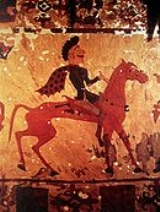
Pazyryk

Encyclopedia
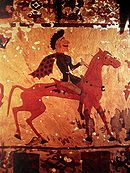
Ukok Plateau
Ukok Plateau is a remote and pristine grasslands area located in the heart of southwestern Siberia, the Altai Mountains region of Russia near the borders with China, Kazakhstan and Mongolia...
in the Altai Mountains, Siberia
Siberia
Siberia is an extensive region constituting almost all of Northern Asia. Comprising the central and eastern portion of the Russian Federation, it was part of the Soviet Union from its beginning, as its predecessor states, the Tsardom of Russia and the Russian Empire, conquered it during the 16th...
, south of the modern city of Novosibirsk
Novosibirsk
Novosibirsk is the third-largest city in Russia, after Moscow and Saint Petersburg, and the largest city of Siberia, with a population of 1,473,737 . It is the administrative center of Novosibirsk Oblast as well as of the Siberian Federal District...
, Russia
Russia
Russia or , officially known as both Russia and the Russian Federation , is a country in northern Eurasia. It is a federal semi-presidential republic, comprising 83 federal subjects...
; the site is close to the borders with China
China
Chinese civilization may refer to:* China for more general discussion of the country.* Chinese culture* Greater China, the transnational community of ethnic Chinese.* History of China* Sinosphere, the area historically affected by Chinese culture...
, Kazakhstan
Kazakhstan
Kazakhstan , officially the Republic of Kazakhstan, is a transcontinental country in Central Asia and Eastern Europe. Ranked as the ninth largest country in the world, it is also the world's largest landlocked country; its territory of is greater than Western Europe...
and Mongolia
Mongolia
Mongolia is a landlocked country in East and Central Asia. It is bordered by Russia to the north and China to the south, east and west. Although Mongolia does not share a border with Kazakhstan, its western-most point is only from Kazakhstan's eastern tip. Ulan Bator, the capital and largest...
.
The tombs are Scythian kurgans, that is barrow
Tumulus
A tumulus is a mound of earth and stones raised over a grave or graves. Tumuli are also known as barrows, burial mounds, Hügelgrab or kurgans, and can be found throughout much of the world. A tumulus composed largely or entirely of stones is usually referred to as a cairn...
-like tomb mounds of larch logs covered over by large cairn
Cairn
Cairn is a term used mainly in the English-speaking world for a man-made pile of stones. It comes from the or . Cairns are found all over the world in uplands, on moorland, on mountaintops, near waterways and on sea cliffs, and also in barren desert and tundra areas...
s of boulders and stones, dated to between the 6th and 3rd centuries BCE.
The Pazyryk kurgans are the type site
Type site
In archaeology a type site is a site that is considered the model of a particular archaeological culture...
of the wider Pazyryk culture
Pazyryk culture
The Pazyryk culture is an Iron Age archaeological culture identified by excavated artifacts and mummified humans found in the Siberian permafrost in the Altay Mountains. The mummies are buried in long barrows similar to the tomb mounds of western Scythian culture in modern Ukraine...
. The site is included in the Golden Mountains of Altai
Golden Mountains of Altai
Golden Mountains of Altai is the name of an UNESCO World Heritage Site consisting of the Altai and Katun Natural Reserves, Lake Teletskoye, Belukha Mountain, and the Ukok Plateau...
UNESCO World Heritage Site.
In this part of the Ukok Plateau
Ukok Plateau
Ukok Plateau is a remote and pristine grasslands area located in the heart of southwestern Siberia, the Altai Mountains region of Russia near the borders with China, Kazakhstan and Mongolia...
, many ancient Bronze Age
Bronze Age
The Bronze Age is a period characterized by the use of copper and its alloy bronze as the chief hard materials in the manufacture of some implements and weapons. Chronologically, it stands between the Stone Age and Iron Age...
barrow
Tumulus
A tumulus is a mound of earth and stones raised over a grave or graves. Tumuli are also known as barrows, burial mounds, Hügelgrab or kurgans, and can be found throughout much of the world. A tumulus composed largely or entirely of stones is usually referred to as a cairn...
-like tomb mounds of larch logs covered over by large cairn
Cairn
Cairn is a term used mainly in the English-speaking world for a man-made pile of stones. It comes from the or . Cairns are found all over the world in uplands, on moorland, on mountaintops, near waterways and on sea cliffs, and also in barren desert and tundra areas...
s of boulders and stones have been found. In Russian, such "barrows" are called kurgans—a word of Turkic
Turkic languages
The Turkic languages constitute a language family of at least thirty five languages, spoken by Turkic peoples across a vast area from Eastern Europe and the Mediterranean to Siberia and Western China, and are considered to be part of the proposed Altaic language family.Turkic languages are spoken...
origin— and the spectacular Scythia
Scythia
In antiquity, Scythian or Scyths were terms used by the Greeks to refer to certain Iranian groups of horse-riding nomadic pastoralists who dwelt on the Pontic-Caspian steppe...
n burials at Pazyryk introduced "kurgan
Kurgan
Kurgan is the Turkic term for a tumulus; mound of earth and stones raised over a grave or graves, originating with its use in Soviet archaeology, now widely used for tumuli in the context of Eastern European and Central Asian archaeology....
" into general usage to describe such log-barrow burials. It, along with the Ukok Plateau
Ukok Plateau
Ukok Plateau is a remote and pristine grasslands area located in the heart of southwestern Siberia, the Altai Mountains region of Russia near the borders with China, Kazakhstan and Mongolia...
, is included in the Golden Mountains of Altai
Golden Mountains of Altai
Golden Mountains of Altai is the name of an UNESCO World Heritage Site consisting of the Altai and Katun Natural Reserves, Lake Teletskoye, Belukha Mountain, and the Ukok Plateau...
UNESCO World Heritage Site.
The bearers of the Pazyryk culture were horse-riding pastoral nomad
Nomad
Nomadic people , commonly known as itinerants in modern-day contexts, are communities of people who move from one place to another, rather than settling permanently in one location. There are an estimated 30-40 million nomads in the world. Many cultures have traditionally been nomadic, but...
s of the steppe
Steppe
In physical geography, steppe is an ecoregion, in the montane grasslands and shrublands and temperate grasslands, savannas, and shrublands biomes, characterized by grassland plains without trees apart from those near rivers and lakes...
, and some may have accumulated great wealth through horse-trading with merchants in Persia, India
India
India , officially the Republic of India , is a country in South Asia. It is the seventh-largest country by geographical area, the second-most populous country with over 1.2 billion people, and the most populous democracy in the world...
and China
China
Chinese civilization may refer to:* China for more general discussion of the country.* Chinese culture* Greater China, the transnational community of ethnic Chinese.* History of China* Sinosphere, the area historically affected by Chinese culture...
.
Discoveries
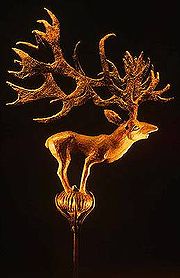
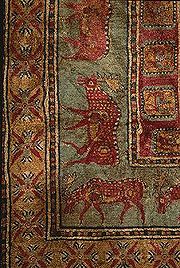
Carpet
A carpet is a textile floor covering consisting of an upper layer of "pile" attached to a backing. The pile is generally either made from wool or a manmade fibre such as polypropylene,nylon or polyester and usually consists of twisted tufts which are often heat-treated to maintain their...
, a 3-metre-high four-wheel funeral chariot from the 5th century BC and other splendid objects that had escaped the ravages of time. These finds are now exhibited at the Hermitage Museum
Hermitage Museum
The State Hermitage is a museum of art and culture in Saint Petersburg, Russia. One of the largest and oldest museums of the world, it was founded in 1764 by Catherine the Great and has been opened to the public since 1852. Its collections, of which only a small part is on permanent display,...
in St. Petersburg.
Pazyryk chief
Rudenko's most striking discovery was the body of a tattooed Pazyryk chief: a thick-set, powerfully built man who had died when he was about 50. Parts of the body had deteriorated, but much of the tattooing was still clearly visible (see image). Subsequent investigation using reflected infrared photographyInfrared photography
In infrared photography, the film or image sensor used is sensitive to infrared light. The part of the spectrum used is referred to as near-infrared to distinguish it from far-infrared, which is the domain of thermal imaging. Wavelengths used for photography range from about 700 nm to about...
revealed that all five bodies discovered in the Pazyryk kurgans were tattooed. No instruments specifically designed for tattooing were found, but the Pazyryks had extremely fine needles with which they did miniature embroidery
Embroidery
Embroidery is the art or handicraft of decorating fabric or other materials with needle and thread or yarn. Embroidery may also incorporate other materials such as metal strips, pearls, beads, quills, and sequins....
, and these were probably used for tattooing.
The chief was elaborately decorated with an interlocking series of striking designs representing a variety of fantastic beasts. The best preserved tattoo
Tattoo
A tattoo is made by inserting indelible ink into the dermis layer of the skin to change the pigment. Tattoos on humans are a type of body modification, and tattoos on other animals are most commonly used for identification purposes...
s were images of a donkey
Donkey
The donkey or ass, Equus africanus asinus, is a domesticated member of the Equidae or horse family. The wild ancestor of the donkey is the African Wild Ass, E...
, a mountain ram
Argali
The argali, or the mountain sheep is a wild sheep, which roams the highlands of Central Asia . It is the biggest wild sheep, standing at the shoulder, measuring long and weighing , with a maximum known weight of...
, two highly stylized deer
Deer
Deer are the ruminant mammals forming the family Cervidae. Species in the Cervidae family include white-tailed deer, elk, moose, red deer, reindeer, fallow deer, roe deer and chital. Male deer of all species and female reindeer grow and shed new antlers each year...
with long antlers and an imaginary carnivore
Carnivore
A carnivore meaning 'meat eater' is an organism that derives its energy and nutrient requirements from a diet consisting mainly or exclusively of animal tissue, whether through predation or scavenging...
on the right arm. Two monsters resembling griffin
Griffin
The griffin, griffon, or gryphon is a legendary creature with the body of a lion and the head and wings of an eagle...
s decorate the chest, and on the left arm are three partially obliterated images which seem to represent two deer and a mountain goat
Mountain goat
The Mountain Goat , also known as the Rocky Mountain Goat, is a large-hoofed mammal found only in North America. Despite its vernacular name, it is not a member of Capra, the genus of true goats...
. On the front of the right leg a fish
Fish
Fish are a paraphyletic group of organisms that consist of all gill-bearing aquatic vertebrate animals that lack limbs with digits. Included in this definition are the living hagfish, lampreys, and cartilaginous and bony fish, as well as various extinct related groups...
extends from the foot to the knee. A monster crawls over the right foot, and on the inside of the shin is a series of four running rams which touch each other to form a single design. The left leg also bears tattoos, but these designs could not be clearly distinguished. In addition, the chief's back is tattooed with a series of small circles in line with the vertebral column. This tattooing was probably done for therapeutic reasons. Contemporary Siberian tribesmen still practice tattooing of this kind to relieve back pain.
Ice Maiden
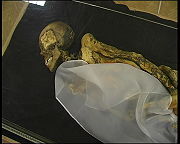
Natalia Polosmak
Natalia Victorovna Polosmak is a Russian archaeologist specialising in the Eurasian nomads, especially those known as the Pazyryk, an ancient people who lived in the Altay Mountains in Siberian Russia...
in 1993, a rare example of a single woman given a full ceremonial wooden chamber-tomb in the 5th century BC, accompanied by six horses.
She had been buried over 2,400 years ago in a casket fashioned from the hollowed-out trunk of a larch tree
Larch
Larches are conifers in the genus Larix, in the family Pinaceae. Growing from 15 to 50m tall, they are native to much of the cooler temperate northern hemisphere, on lowlands in the north and high on mountains further south...
. On the outside of the casket were stylized images of deer and snow leopard
Snow Leopard
The snow leopard is a moderately large cat native to the mountain ranges of South Asia and Central Asia...
s carved in leather. Shortly after burial the grave had apparently been flooded by freezing rain and the entire contents of the burial chamber had remained frozen in permafrost
Permafrost
In geology, permafrost, cryotic soil or permafrost soil is soil at or below the freezing point of water for two or more years. Ice is not always present, as may be in the case of nonporous bedrock, but it frequently occurs and it may be in amounts exceeding the potential hydraulic saturation of...
. Six horses wearing elaborate harnesses had been sacrificed and lay on the logs which formed the roof of the burial chamber. The maiden's well-preserved body, carefully embalmed with peat and bark, was arranged to lie on her side as if asleep. She was young; her hair was still blonde; she had been 5 feet 6 inches tall. Even the animal style
Animal style
Animal style art is characterized by its emphasis on animal and bird motifs, and the term describes an approach to decoration which existed from China to Northern Europe in the early Iron Age, and the barbarian art of the Migration Period...
tattoo
Tattoo
A tattoo is made by inserting indelible ink into the dermis layer of the skin to change the pigment. Tattoos on humans are a type of body modification, and tattoos on other animals are most commonly used for identification purposes...
s were preserved on her pale skin: creatures with horns that develop into flowered forms. Her coffin was made large enough to accommodate the high felt headdress she was wearing, which had 15 gilded wooden birds sewn to it. On a gold buckle retrieved from another tomb, a similar woman's headdress intertwined with branches of the tree of life are depicted. Her blouse was originally thought to be made of wild "tussah" silk but closer examination of the fibers indicate the material is not Chinese but was a wild silk
Wild silk
Wild silks have been known and used in many countries from early times, although the scale of production is far smaller than that from cultivated silkworms.-Background:...
which came from somewhere else, perhaps India
India
India , officially the Republic of India , is a country in South Asia. It is the seventh-largest country by geographical area, the second-most populous country with over 1.2 billion people, and the most populous democracy in the world...
. She was clad in a long crimson woolen skirt and white felt stockings. Near her coffin was a vessel made of yak
Yak
The yak, Bos grunniens or Bos mutus, is a long-haired bovine found throughout the Himalayan region of south Central Asia, the Tibetan Plateau and as far north as Mongolia and Russia. In addition to a large domestic population, there is a small, vulnerable wild yak population...
horn, and dishes containing gifts of coriander
Coriander
Coriander is an annual herb in the family Apiaceae. Coriander is native to southern Europe and North Africa to southwestern Asia. It is a soft, hairless plant growing to tall. The leaves are variable in shape, broadly lobed at the base of the plant, and slender and feathery higher on the...
seeds: all of which suggest that the Pazyryk trade routes stretched across vast areas of Iran. Similar dishes in other tombs were thought to have held Cannabis sativa
Cannabis sativa
Cannabis sativa is an annual herbaceous plant in the Cannabaceae family. Humans have cultivated this herb throughout recorded history as a source of industrial fibre, seed oil, food, recreation, spiritual enlightenment and medicine...
, confirming a practice described by Herodotus
Herodotus
Herodotus was an ancient Greek historian who was born in Halicarnassus, Caria and lived in the 5th century BC . He has been called the "Father of History", and was the first historian known to collect his materials systematically, test their accuracy to a certain extent and arrange them in a...
but after tests the mixture was found to be coriander seeds, probably used to disguise the smell of the body.
Two years after the discovery of the "Ice Maiden" Dr. Polosmak's husband, Vyacheslav Molodin, found a frozen man, elaborately tattooed with an elk, with two long braids that reached to his waist, buried with his weapons.
Other findings
In a corner of one grave chamber of the Pazyryk cemetery was a fur bag containing cannabis seed, a censer filled with stones, and the hexapod frame of an inhalation tent - these are believed to have been utilized at the end of the funerary ritual for purification.Other undisturbed kurgans have been found to contain remarkably well-preserved remains, comparable to the earlier Tarim mummies
Tarim mummies
The Tarim mummies are a series of mummies discovered in the Tarim Basin in present-day Xinjiang, China, which date from 1900 BC to 200 AD. Some of the mummies are frequently associated with the presence of the Indo-European Tocharian languages in the Tarim Basin, although the evidence is not...
of Xinjiang
Xinjiang
Xinjiang is an autonomous region of the People's Republic of China. It is the largest Chinese administrative division and spans over 1.6 million km2...
. Bodies were preserved using mummification
Mummy
A mummy is a body, human or animal, whose skin and organs have been preserved by either intentional or incidental exposure to chemicals, extreme coldness , very low humidity, or lack of air when bodies are submerged in bogs, so that the recovered body will not decay further if kept in cool and dry...
techniques and were also naturally frozen in solid ice from water seeping into the tombs. They were encased in coffins made from hollowed trunks of larch
Larch
Larches are conifers in the genus Larix, in the family Pinaceae. Growing from 15 to 50m tall, they are native to much of the cooler temperate northern hemisphere, on lowlands in the north and high on mountains further south...
(which may have had sacral significance) and sometimes accompanied by sacrificed concubines and horses. The clustering of tombs in a single area implies that it had particular ritual significance for these people, who were likely to have been willing to transport their deceased leaders great distances for burial.
As recently as January 2007, tombs are still discovered at various locations, such as the timber tomb of a blond chieftain warrior that was unearthed in the permafrost of the Altai mountains region
Altai Republic
Altai Republic is a federal subject of Russia . Its capital is the town of Gorno-Altaysk. The area of the republic is . Population: -Geography:...
close to the Mongolian border. The body of the presumed Pazyryk chieftain is tattooed; his sable coat is well-preserved, as are some other objects, including what looks like scissors
Scissors
Scissors are hand-operated cutting instruments. They consist of a pair of metal blades pivoted so that the sharpened edges slide against each other when the handles opposite to the pivot are closed. Scissors are used for cutting various thin materials, such as paper, cardboard, metal foil, thin...
. A local archaeologist, Aleksei Tishkin, complained that the indigenous population of the region strongly disapproves of archaeological digs, prompting the scientists to move their activities across the border to Mongolia
Mongolia
Mongolia is a landlocked country in East and Central Asia. It is bordered by Russia to the north and China to the south, east and west. Although Mongolia does not share a border with Kazakhstan, its western-most point is only from Kazakhstan's eastern tip. Ulan Bator, the capital and largest...
.
Pazyryk culture
Rudenko initially assigned the neutral label Pazyryk culturePazyryk culture
The Pazyryk culture is an Iron Age archaeological culture identified by excavated artifacts and mummified humans found in the Siberian permafrost in the Altay Mountains. The mummies are buried in long barrows similar to the tomb mounds of western Scythian culture in modern Ukraine...
for these nomads and dated them to the 5th century BC. The Pazyryk culture has since been connected to the Scythians whose similar tombs have been found across the steppes. The Siberian animal style
Animal style
Animal style art is characterized by its emphasis on animal and bird motifs, and the term describes an approach to decoration which existed from China to Northern Europe in the early Iron Age, and the barbarian art of the Migration Period...
tattooing is characteristic of the Scythians. Trading routes between Central Asia
Central Asia
Central Asia is a core region of the Asian continent from the Caspian Sea in the west, China in the east, Afghanistan in the south, and Russia in the north...
, China
China
Chinese civilization may refer to:* China for more general discussion of the country.* Chinese culture* Greater China, the transnational community of ethnic Chinese.* History of China* Sinosphere, the area historically affected by Chinese culture...
and the Near East
Near East
The Near East is a geographical term that covers different countries for geographers, archeologists, and historians, on the one hand, and for political scientists, economists, and journalists, on the other...
passed through the oases on the plateau and these ancient Altai nomads profited from the rich trade and culture passing through. There is evidence that Pazyryk trade routes were vast and connected with large areas of Asia
Asia
Asia is the world's largest and most populous continent, located primarily in the eastern and northern hemispheres. It covers 8.7% of the Earth's total surface area and with approximately 3.879 billion people, it hosts 60% of the world's current human population...
including India
India
India , officially the Republic of India , is a country in South Asia. It is the seventh-largest country by geographical area, the second-most populous country with over 1.2 billion people, and the most populous democracy in the world...
, perhaps Pazyryk merchants largely trading in high quality horses.
It has been suggested that Pazyryk was a homeland for these tribes before they migrated west. There is also the possibility that the current inhabitants of the Altai
Altay Mountains
The Altai Mountains are a mountain range in East-Central Asia, where Russia, China, Mongolia and Kazakhstan come together, and where the rivers Irtysh and Ob have their sources. The Altai Mountains are known as the original locus of the speakers of Turkic as well as other members of the proposed...
region are descendants of the Pazyryk culture, a continuity that would accord with current ethnic politics: Archaeogenetics
Archaeogenetics
Archaeogenetics, a term coined by Colin Renfrew, refers to the application of the techniques of molecular population genetics to the study of the human past. This can involve:*the analysis of DNA recovered from archaeological remains, i.e...
is now being used to study the Pazyryk mummies.
External links
A library of scholarly publications about the Altai Scythians- A collection at Novosibirsk State University site, including Pazyryk
- Pazyryk carpet, at State Hermitage Museum
- BME wiki: Pazyryk Mummies
- (Discovery Channel) Winnie Allingham, "The frozen horseman of Siberia"
- "Ancient Mummy found in Mongolia", Der Spiegel, 2004
- Maiden recreated in photographic project", Sydney Australia, 2009
- 'The Preservation of the Frozen Tombs of the Altai Mountains', UNESCOUNESCOThe United Nations Educational, Scientific and Cultural Organization is a specialized agency of the United Nations...
(pdf)