


Srubna culture

Encyclopedia
Yamna culture
The Yamna culture is a late copper age/early Bronze Age culture of the Southern Bug/Dniester/Ural region , dating to the 36th–23rd centuries BC...
, the Pit Grave culture and the Poltavka culture
Poltavka culture
Poltavka culture, 2700—2100 BC, an early to middle Bronze Age archaeological culture of the middle Volga from about where the Don-Volga canal begins up to the Samara bend, with an easterly extension north of present Kazakhstan along the Samara River valley to somewhat west of Orenburg.It is...
.
It occupied the area along and above the north shore of the Black Sea
Black Sea
The Black Sea is bounded by Europe, Anatolia and the Caucasus and is ultimately connected to the Atlantic Ocean via the Mediterranean and the Aegean seas and various straits. The Bosphorus strait connects it to the Sea of Marmara, and the strait of the Dardanelles connects that sea to the Aegean...
from the Dnieper eastwards along the northern base of the Caucasus
Caucasus
The Caucasus, also Caucas or Caucasia , is a geopolitical region at the border of Europe and Asia, and situated between the Black and the Caspian sea...
to the area abutting the north shore of the Caspian Sea
Caspian Sea
The Caspian Sea is the largest enclosed body of water on Earth by area, variously classed as the world's largest lake or a full-fledged sea. The sea has a surface area of and a volume of...
, west of the Ural Mountains
Ural Mountains
The Ural Mountains , or simply the Urals, are a mountain range that runs approximately from north to south through western Russia, from the coast of the Arctic Ocean to the Ural River and northwestern Kazakhstan. Their eastern side is usually considered the natural boundary between Europe and Asia...
to come up against the domain of the approximately contemporaneous and somewhat related Andronovo culture
Andronovo culture
The Andronovo culture, is a collection of similar local Bronze Age cultures that flourished ca. 21200–1400 BCE in western Siberia and the west Asiatic steppe. It is probably better termed an archaeological complex or archaeological horizon...
.
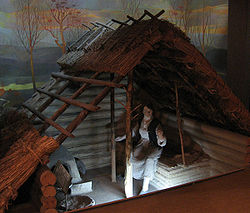
The name comes from Russian cруб (srub), "timber framework", from the way graves were constructed. Animal parts were buried with the body.
The economy was mixed agriculture and livestock breeding. The historical Cimmerians
Cimmerians
The Cimmerians or Kimmerians were ancient equestrian nomads of Indo-European origin.According to the Greek historian Herodotus, of the 5th century BC, the Cimmerians inhabited the region north of the Caucasus and the Black Sea during the 8th and 7th centuries BC, in what is now Ukraine and Russia...
have been suggested as descended from this culture.
The Srubna culture is succeeded by Scythians and Sarmatians
Sarmatians
The Iron Age Sarmatians were an Iranian people in Classical Antiquity, flourishing from about the 5th century BC to the 4th century AD....
in the 1st millennium BC, and by Khazars and Kipchaks in the first millennium AD.
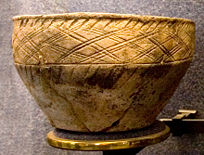
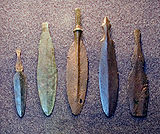
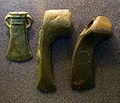
Artifacts
Hermitage Museum
The State Hermitage is a museum of art and culture in Saint Petersburg, Russia. One of the largest and oldest museums of the world, it was founded in 1764 by Catherine the Great and has been opened to the public since 1852. Its collections, of which only a small part is on permanent display,...
collections >
Sources
- J. P. Mallory, "Srubna Culture", Encyclopedia of Indo-European Culture, Fitzroy Dearborn, 1997.