
All Topics  
Wadjet


   Email Print
   Bookmark   Link


Wadjet


In Egyptian mythology
Egyptian mythology

Ancient Egyptian religion encompasses the various religious beliefs and rituals practiced in ancient Egypt over at least 3,000 years, from the Predynastic Egypt until the adoption of Coptic Christianity in the early centuries Common Era....
, Wadjet, or the Green One (Egyptian
Egyptian language

Egyptian is a branch of the Afro-Asiatic languages language family along with the Chadic languages, Berber languages, Semitic languages, Cushitic languages and possibly Omotic languages languages....
 ; also spelt Wadjit, Wedjet, Uadjet or Ua Zit and in Greek, Udjo, Uto, Edjo, and Buto among other names), was originally the ancient local goddess of the city of Dep, which became part of the city that the Egyptians named Per-Wadjet, House of Wadjet, and the Greeks called Buto
Buto

Buto or Butos or Butosos , was the later, Greek name for an ancient city located 95 km east of Alexandria in the Nile Delta of Egypt....
, a city that was an important site in the Predynastic era of Ancient Egypt
Ancient Egypt

Ancient Egypt was an Ancient history civilization in eastern North Africa, concentrated along the lower reaches of the Nile in what is now the modern nation of Egypt....
 and the cultural developments of ten thousand years from the Paleolithic
Paleolithic

The Paleolithic or Palaeolithic or "Old Stone" era is a Prehistory era distinguished by the development of the first stone tools, and covers roughly 99% of human history....
 to 3100 B.C.


Discussion
Ask a question about 'Wadjet'
Start a new discussion about 'Wadjet'
Answer questions from other users
Full Discussion Forum


Encyclopedia


In Egyptian mythology
Egyptian mythology

Ancient Egyptian religion encompasses the various religious beliefs and rituals practiced in ancient Egypt over at least 3,000 years, from the Predynastic Egypt until the adoption of Coptic Christianity in the early centuries Common Era....
, Wadjet, or the Green One (Egyptian
Egyptian language

Egyptian is a branch of the Afro-Asiatic languages language family along with the Chadic languages, Berber languages, Semitic languages, Cushitic languages and possibly Omotic languages languages....
 ; also spelt Wadjit, Wedjet, Uadjet or Ua Zit and in Greek, Udjo, Uto, Edjo, and Buto among other names), was originally the ancient local goddess of the city of Dep, which became part of the city that the Egyptians named Per-Wadjet, House of Wadjet, and the Greeks called Buto
Buto

Buto or Butos or Butosos , was the later, Greek name for an ancient city located 95 km east of Alexandria in the Nile Delta of Egypt....
, a city that was an important site in the Predynastic era of Ancient Egypt
Ancient Egypt

Ancient Egypt was an Ancient history civilization in eastern North Africa, concentrated along the lower reaches of the Nile in what is now the modern nation of Egypt....
 and the cultural developments of ten thousand years from the Paleolithic
Paleolithic

The Paleolithic or Palaeolithic or "Old Stone" era is a Prehistory era distinguished by the development of the first stone tools, and covers roughly 99% of human history....
 to 3100 B.C. She came to be the patron and protector of Lower Egypt and upon unification with Upper Egypt, the joint protector and patron of all of Egypt with the goddess of Upper Egypt. The image of Wadjet with the sun disk is called the uraeus
Uraeus

The Uraeus is the stylized, upright form of an Egyptian spitting Egyptian cobra , used as a symbol of sovereignty, Royal family, deity, and divine authority in ancient Egypt....
, and it was the emblem on the crown of the rulers of Lower Egypt.

As the patron goddess, she was associated with the land and depicted as a snake-headed woman or a snake
Snake

Snakes are elongate legless carnivore reptiles of the suborder Serpentes that can be distinguished from legless lizards by their lack of eyelids and external ears....
—usually an Egyptian cobra
Egyptian cobra

The Egyptian cobra , commonly confused with the snouted cobra , is a type of venom snake native to North Africa and the Middle East. The Egyptian cobra is the most common cobra in Africa and is responsible for many deaths there....
, poisonous snakes which were common in the region—sometimes she was depicted as a woman with two snake heads and at other times, a snake with a woman's head.

Her oracle
Oracle

An oracle is a person or agency considered to be a source of wise counsel or prophecy opinion; an infallible authority, usually Spirituality in nature....
 was in the renowned temple in Per-Wadjet that was dedicated to her worship and gave the city its name. This oracle may have been the source for the oracular tradition that spread to Greece from Egypt.

The Going Forth of Wadjet was celebrated on December 25 with chants and songs. An annual festival held in the city celebrated Wadjet on April 21. Other important dates for special worship of her were, June 21, the Summer Solstice, and March 14. She also was assigned the fifth hour of the fifth day of the moon.

Wadjet was closely associated in the Egyptian pantheon
Egyptian pantheon

Most Egyptologists today side with Sir Flinders Petrie that Egyptian religion was strictly polytheistic. His contemporary adversary, E. A. Wallis Budge, however, thought Egyptian religion to be primarily monotheistic where all the gods and goddesses were aspects of the God Ra, similar to the Trinity in Christianity and devas in Hinduism....
 with Bast the fierce goddess depicted as a lioness warrior and protector, as the sun goddess whose eye
Eye of Horus

The Eye of Horus or is an ancient Egyptian symbol of protection and royal power from deities, in this case from Horus or Ra. The symbol is seen on images of Horus' mother, Hathor, and on other deities associated with her....
 later became the eye of Horus, the eye of Ra, and as the Lady of Flame. The hieroglyph for her eye is shown below and sometimes two are shown in the sky of religious images. Per-Wadjet also contained a sanctuary of Horus
Horus

Horus is a god of the Ancient Egyptian religion, most commonly known by the Greek language version Horus, of the Egyptian language Heru/Har....
, the child of the sun deity who would be interpreted to represent the pharaoh. Much later, Wadjet became associated with Isis
ISIS

ISIS is an industry standard interface for technologies, developed by Pixel Translations in 1990 .ISIS is an open standard for scanner control and a complete image-processing framework....
 as well as with many other deities.

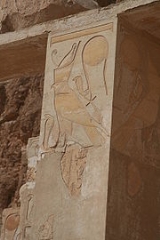
In the relief shown to the right, which is on the wall of the Hatshepsut
Hatshepsut

Hatshepsut , meaning, Foremost of Noble Ladies, was the fifth pharaoh of the Eighteenth dynasty of Egypt of Ancient Egypt. She is generally regarded by Egyptologists as one of the most successful pharaohs, reigning longer than any other woman of an Indigenous peoples Egyptian dynasty....
 Temple at Luxor
Luxor

Luxor is a city in Upper Egypt and the capital of Luxor Governorate. Its population numbers 376,022 , and its area is about . As the site of the ancient Egyptian city of Thebes, Egypt, Luxor has frequently been characterized as the "world's greatest open air museum", the ruins of the temple complexes at Karnak and Luxor Temple standing wi...
, there are two images of Wadjet, one of her as the uraeus
Uraeus

The Uraeus is the stylized, upright form of an Egyptian spitting Egyptian cobra , used as a symbol of sovereignty, Royal family, deity, and divine authority in ancient Egypt....
 sun disk with her head through an ankh
Ankh

The ankh was the Egyptian hieroglyphic character that read "eternal life", a triliteral sign for the consonants Ayin-Nun -?a'. Egyptian gods are often portrayed carrying it by its loop, or bearing one in each hand, arms crossed over their chest....
 and another where she precedes a Horus hawk wearing the double crown of united Egypt, representing the pharaoh whom she protects.

Protector of country, pharaohs, and other deities

Eventually, Wadjet became the patron goddess and protector of the whole of Lower Egypt
Lower Egypt

Lower Egypt is the northern-most section of Egypt. It refers to the Fertile Crescent Nile Delta region, which stretches from the area between El-Aiyat and Zawyet Dahshur, south of modern-day Cairo, and the Mediterranean Sea....
. As goddess of Lower Egypt, she became associated with Nekhbet
Nekhbet

In Egyptian mythology, Nekhbet was an early predynastic local goddess who was the patron of the city of Nekheb, her name meaning of Nekheb....
, depicted as a white vulture
Egyptian Vulture

The Egyptian Vulture is a small Old World vulture, found from southwestern Europe and northern Africa to southern Asia. It is the only living member of the genus Neophron....
, who held the same position in Upper Egypt
Upper Egypt

File:Ancient Egypt map-en.svgUpper Egypt is a narrow strip of land that extends from the Cataracts of the Nile section of Upper Egypt, between El-Ayait and Asyut is sometimes known as Middle Egypt....
. When the two parts of Egypt were joined together, there was no merger of the deities as often occurred, both goddesses were retained because of the importance of their roles and they became known, euphemistically
Euphemism

A euphemism is a substitution of an agreeable or less offensive expression in place of one that may offend or suggest something unpleasant to the listener, or in the case of #Doublespeak, to make it less troublesome for the speaker....
, as the two ladies
Two Ladies

In Ancient Egyptian texts, Two Ladies is a religious euphemism for Wadjet and Nekhbet, the deity who were the Tutelary deity of the Ancient Egyptians and worshiped by all after the unification of its two parts, Lower Egypt, and Upper Egypt....
, who were the protectors of unified Egypt. After the unification the image of Nekhbet joined Wadjet on the crown, thereafter shown as part of the uraeus
Uraeus

The Uraeus is the stylized, upright form of an Egyptian spitting Egyptian cobra , used as a symbol of sovereignty, Royal family, deity, and divine authority in ancient Egypt....
.

The ancient Egyptian word Wedjat signifies blue and green. It is also the name for the well known Eye of the Moon, which later became the Eye of Horus and the Eye of Ra as additional sun deities arose. Indeed, in later times, she was often depicted simply as a woman with a snake's head, or as a woman wearing the uraeus. The uraeus
Uraeus

The Uraeus is the stylized, upright form of an Egyptian spitting Egyptian cobra , used as a symbol of sovereignty, Royal family, deity, and divine authority in ancient Egypt....
 originally had been her body alone, which wrapped around or was coiled upon the head of the pharaoh or another deity.

Depicted as an Egyptian cobra she became confused with Renenutet
Renenutet

In Egyptian mythology, Renenutet was the anthropomorphism deification of the act of gaining a true name, an Egyptian soul, during birth. Her name simply meaning, gives Ren, with Ren being the Egyptian word for this true name....
, whose identity eventually merged with hers. As patron and protector, later Wadjet often was shown coiled upon the head of Ra
Ra

Ra is an ancient Egyptian Solar deity . By the Fifth dynasty of Egypt he became a major deity in ancient Egyptian religion, identified primarily with the noon, with other deities representing other positions of the sun....
, who much later became the Egyptian chief deity, in order to act as his protection, this image of her became the uraeus symbol used on the royal crowns as well.

Another early depiction of Wadjet is as a cobra entwined around a papyrus stem, beginning in the Predynastic era (prior to 3100 B.C.) and it is thought to be the first image that shows a snake
Serpent (symbolism)

Serpent is a word of Latin origin that is commonly used in a specifically mythology or religion context, signifying a snake that is to be regarded not as a mundane natural phenomenon nor as an object of scientific zoology, but as the bearer of some symbolic value....
 entwined around a staff symbol. This is a sacred image that appeared repeatedly in the later images and myths of cultures surrounding the Mediterranean Sea, called the caduceus
Caduceus

The caduceus is typically depicted as a short herald's Staff entwined by two Serpent in the form of a double helix, and sometimes is surmounted by wings....
, which may have had separate origins.

Her image also rears up from the staff of the "flag" poles that are used to indicate deities, as seen in the hieroglyph for uraeus above and for goddess in other places.

Associations with other deities


An interpretation of the Milky Way
Milky Way

The Milky Way, sometimes called simply the Galaxy, is the galaxy in which the Solar System is located. It is a barred spiral galaxy that is part of the Local Group of galaxies....
 was that it was the primal snake, Wadjet, the protector of Egypt. In this interpretation she was closely associated with Hathor
Hathor

In Egyptian mythology, Hathor was originally a personification of the Milky Way, which was seen as the milk that flowed from the udders of a heavenly cow....
 and other early deities among the various aspects of the great mother goddess, including Mut
Mut

Mut, which meant mother in the ancient Egyptian language, was an ancient Egyptian mother goddess with multiple aspects that changed over the thousands of years of the culture....
 and Naunet
Naunet

"Nu " redirects here. For other uses, see Nu.In Egyptian mythology, Nu is the deification of the primordial watery abyss. In the Ogdoad cosmogony, the name means abyss....
. The association with Hathor brought her son Horus into association also. The cult of Ra absorbed most of Horus's traits and included the protective eye of Wadjet that had shown her association with Hathor.

When identified as the protector of Ra, who also was a sun deity associated with heat and fire, she sometimes was said to be able to send fire onto those who might attack, just as the cobra spits poison into the eyes of its enemies. In this role she was called the Lady of Flame.

She later became identified with the war goddess of Lower Egypt, Bast
Bast (goddess)

In Ancient Egyptian religion, Bast is an ancient solar and war goddess, worshipped at least since the Second dynasty of Egypt. In the late dynasties, the priests of Amun began to call her Bastet, a repetitive and diminutive form after her role in the pantheon became diminished as Sekhmet, a similar lioness war deity, became more domin...
, who acted as another figure symbolic of the nation, consequently becoming Wadjet-Bast. In this role, since Bastet was a lion
Lion

The lion is a member of the family Felidae and one of four big cats in the genus Panthera. With exceptionally large males exceeding 250 kg in weight, it is the second-largest living cat after the tiger....
ess, Wadjet-Bast often was depicted with a lioness head.

When Lower Egypt had been conquered by Upper Egypt and they were unified, the lioness goddess of Upper Egypt, Sekhmet
Sekhmet

In Egyptian mythology, Sekhmet , was originally the warrior goddess of Upper Egypt. She is depicted as a lion, the fiercest hunter known to the Egyptians....
, was seen as the more powerful of the two warrior goddesses. It was Sekhmet who was seen as the Avenger of Wrongs, and the Scarlet Lady, a reference to blood, as the one with bloodlust. She is depicted with the solar disk and Wadjet, however.

Eventually, her position as patron led to her being identified as the more powerful goddess Mut
Mut

Mut, which meant mother in the ancient Egyptian language, was an ancient Egyptian mother goddess with multiple aspects that changed over the thousands of years of the culture....
, whose cult had come to the fore in conjunction with rise of the cult of Amun
Amun

Amun, reconstructed Egyptian language Yamanu , was the name of a deity in Egyptian mythology who gradually rose from being an abstract concept to the patron deity of Thebes, Egypt and one of the most important deities in Ancient Egypt before fading into obscurity....
, and eventually being absorbed into her as the Mut-Wadjet-Bast triad
Triple deities

Triple deities, legendary persons, deities, and mythological creatures , are common throughout world mythology; the number 3 has a long history of mythical associations....
.

When the pairing of deities occurred in later Egyptian myths, since she was linked to the land, after the unification of Lower and Upper Egypt she came to be thought of as the wife of Hapy
Hapy

Hapy was a deification of the annual flooding of the Nile River, in Egyptian mythology, which deposited rich silt on its banks, allowing the Egyptians to grow crops....
, a deity of the Nile
Nile

The Nile is a major north-flowing river in Africa, generally regarded as the List of rivers by length in the world.The Nile has two major tributary, the White Nile and Blue Nile, the latter being the source of most of the Nile's water and silt, but the former being the longer of the two....
, which flowed through the land.

Etymology

The name Wadjet is derived from the term for the symbol of her domain, Lower Egypt, the papyrus
Papyrus

Papyrus is a thick paper material produced from the pith of the papyrus plant, Cyperus papyrus, a wetland Cyperaceae that was once abundant in the Nile Delta of Egypt....
.

Its hieroglyphs differ from those of the Green Crown (Red Crown) of Lower Egypt only by the determinative, which in the case of the crown was a picture of the Green Crown and, in the case of the goddess, a rearing cobra.

Footnotes


See also


  • Eye of Horus
    Eye of Horus

    The Eye of Horus or is an ancient Egyptian symbol of protection and royal power from deities, in this case from Horus or Ra. The symbol is seen on images of Horus' mother, Hathor, and on other deities associated with her....