

Edfu

Encyclopedia
Edfu is an Egypt
ian city, located on the west bank of the Nile River between Esna
and Aswan
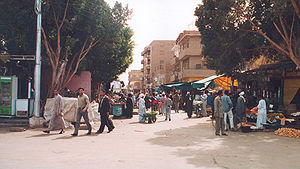
, with a population of approximately sixty thousand people. For the ancient history of the city, see below. Edfu is the site of the Ptolemaic Temple of Horus and an ancient settlement, Tell Edfu (described below). About 5 km (3.1 mi) north of Edfu are remains of ancient pyramids.
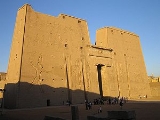
temple, built between 237 BCE and 57 BCE, into the reign of Cleopatra VII. Of all the temple remains in Egypt
, the Temple of Horus
at Edfu is the most completely preserved. Built from sandstone blocks, the huge Ptolemaic temple was constructed over the site of a smaller New Kingdom
temple, oriented east to west, facing towards the river. The later structure faces north to south and leaves the ruined remains of the older temple pylon
to be seen on the east side of the first court.
. This settlement is known as Wetjeset-hor and the Latin name was Apollinopolis Magna. According to Notitia Dignitatum
, part of Legio II Traiana Fortis
was camped in Apollo superior, which was the Roman
name for the town.
Although unassuming and unglamorous to the visiting tourists, Tell Edfu is a monument that contains evidence of more Egyptian history and is of more archaeological interest than the Ptolemaic temple. Although major parts of the settlement show severe signs of erosion, cut away or have been exposed during sebakh-digging, enough is preserved to gain information from as far back as the Predynastic Period. The remains of the settlement (tell) provides an insight into the development of Edfu as a provincial town from the end of the Old Kingdom until the Byzantine period. The settlement at Edfu was the capital of the Second Upper Egypt nome, and played an important role within the region. The oldest part of the town which can be dated to the late Old Kingdom lies on the eastern part of the tell, not far from the Ptolemaic temple. There is evidence that the town flourished during the First Intermediate Period when it expanded extensively to the west. Interestingly, it is one of few settlements in southern Egypt that thrived when it seems that the north, especially around the delta, was in economic decline.
Today, the ancient mound of Tell Edfu is preserved in some areas up to 20 m high and contains complete archaeological sequences of occupation dating to the Old Kingdom until the Graeco-Roman period, more than 3000 years of history, therefore providing ideal conditions to study the development of a provincial town. A central part of the site was explored by Henri Henne from the Institute for Egyptology in Lille in 1921 and 1922. His team identified the remains of a small sanctuary from the Late or Ptolemaic period, possibly the Osiris chapel built by Psamtek I. Henne was followed by Octave Guéraud in 1928 then by Maurice Alliot in 1931 who each explored and excavated different aspects of the settlement remains. The top layers of the settlement containing the Byzantine, Roman and Ptolemaic remains and the Old and Middle Kingdom cemetery at the southern western corner were recorded by a Franco-Polish mission in 1937-39, directed by B. Bruyère, J. Manteuffel and Kazimierz Michałowski, and three elaborate reports on the archaeology of Tell Edfu were published.
Unfortunately, since the mid 1939's no new detailed discoveries or thorough research has been completed at the tell except for
recent work done by Barry Kemp, from the University of Cambridge. Since 2001, the Tell Edfu project is directed by Nadine Moeller (Oriental Institute, University of Chicago). The current work focuses on the eastern part of the site. So far the administrative centre of the ancient town has been discovered with remains of a columned hall dating to the late Middle Kingdom as well as a large granary courtyard that functioned as a grain reserve for this provincial capital. Latter dates to the Second Intermediate Period (17th Dynasty). At least seven large round silos have been excavated here with a diameter between 5.5 and 6.5 meters which makes them the largest ones so far discovered within an ancient Egyptian urban centre.
No larger remains dating earlier than the 5th Dynasty have been found at Edfu. The ancient cemetery comprised mastabas of the Old Kingdom as well as later tombs. Before the beginning of the New Kingdom, the necropolis was transferred to Hager Edfu, to the west and then in the Late period to the south at Nag’ el-Hassaya. The entire area was called Behedet. The god Horus was herein worshipped as Horus Behedet.
One of these mastabas belonged to Isi, a local administrator, who, it was quoted was the "great chief of the Nome of Edfu" in the Sixth Dynasty. Isi lived during the reign of King Djedkare Isesi of the Fifth and into the reign of Pepi I of the Sixth Dynasties. He was an administrator, judge, chief of the royal archives and a "Great One among the Tens of the South" [ref?]. Isi later became a living god and was so worshipped during the Middle Kingdom. As the Sixth Dynasty and the Old Kingdom drew to a close, local regional governors and administrative nobles took on a larger power in their areas, away from the royal central authority.
of the Third Dynasty
. The purpose of these pyramids is unknown. Further investigations and a detailed survey are carried out by the Oriental Institute, University of Chicago since 2010.
 Apollonopolis Magna or Apollinopolis Magna (Greek
: , Strabo
xvii. p. 817; Agartharch. p. 22; Plin.
v. 9. s. 11; Plut.
Is. et Osir. 50; Aelian. Hist. An. x. 2; Ptol.
iv. 5. § 70; , Steph. Byzant.
s. v.; , Hierocl.
p. 732; It. Ant.
p. 160, 174; Not. Imp. Orient. c. 143; Latin
: Apollonos Superioris [urbs]). Ptolemy (l. c.) assigns Apollinopolis to the Hermonthite nome, but it was more commonly regarded as the capital town of the nome Apollopolites. Under the Roman emperors
it was the seat of a bishop's see
, and the head-quarters of the Legio II Trajana
. Its inhabitants were enemies of the crocodile and its worshippers.
The ancient city derived its principal reputation from two temples, which are considered second only to the Temple of Dendera
as specimens of the sacred structures of Egypt. The larger temple is in good preservation, and is being excavated (see Edfu). The smaller temple, sometimes, but improperly, called a Typhonium, is apparently an appendage of the latter, and its sculptures represent the birth and education of the youthful deity, Horus
, whose parents Noum, or Kneph
and Athor
, were worshipped in the larger edifice. The principal temple is dedicated to Noum, whose symbol is the disc of the sun, supported by two asps and the extended wings of a vulture. Its sculptures represent (Rosellini, Monum. del Culto, p. 240, tav. xxxviii.) the progress of the Sun, Phre-Hor-Hat, Lord of Heaven, moving in his bark (Bari) through the circle of the Hours. The local name of the district round Apollinopolis was Hat, and Noum was styled Hor-hat-kah, or Horus, the tutelary genius of the land of Hat. This deity forms also at Apollinopolis a triad with the goddess Athor and Hor-Senet. The members of the triad are youthful gods, pointing their finger towards their mouths, and before the decipherment of the hieroglyphics
were regarded as figures of Harpocrates.
The entrance into the larger temple of Apollinopolis is a gateway (πυλών) 50 feet high, flanked by two converging wings (πτερά) in the form of truncated pyramids, rising to 107 feet (32.6 m). The wings contain ten stories, are pierced by round loop-holes for the admission of light, and probably served as chambers or dormitories for the priests and servitors of the temple. From the jambs of the door project two blocks of stone, which were intended, as Ddnon supposes, to support the heads of two colossal figures. This propylaeon leads into a large square, surrounded by a colonnade roofed with squared granite, and on the opposite side is a pronaos or portico, 53 feet (16.2 m) in height, and having a triple row of columns, six in each row, with variously and gracefully foliaged capitals. The temple is 145 feet (44.2 m) wide, and 424 feet (129.2 m) long from the entrance to the opposite end. Every part of the walls is covered with hieroglyphics, and the main court ascends gradually to the pronaos by broad steps. The whole area of the building was surrounded by a wall 20 feet (6.1 m) high, of great thickness. Like so many of the Egyptian temples, that of Apollinopolis was capable of being employed as a fortress. It stood about a third of a mile from the river. The sculptures, although carefully and indeed beautifully executed, are of the Ptolemaic era, the earliest portion of the temple having been erected by Ptolemy VI Philometor
in 181 BC.
Egypt
Egypt , officially the Arab Republic of Egypt, Arabic: , is a country mainly in North Africa, with the Sinai Peninsula forming a land bridge in Southwest Asia. Egypt is thus a transcontinental country, and a major power in Africa, the Mediterranean Basin, the Middle East and the Muslim world...
ian city, located on the west bank of the Nile River between Esna
Esna
Esna , known to the ancient Egyptians as Egyptian: Iunyt or Ta-senet; Greek: or or ; Latin: Lato, is a city in Egypt. It is located on the west bank of the River Nile, some 55 km south of Luxor...
and Aswan
Aswan
Aswan , formerly spelled Assuan, is a city in the south of Egypt, the capital of the Aswan Governorate.It stands on the east bank of the Nile at the first cataract and is a busy market and tourist centre...
, with a population of approximately sixty thousand people. For the ancient history of the city, see below. Edfu is the site of the Ptolemaic Temple of Horus and an ancient settlement, Tell Edfu (described below). About 5 km (3.1 mi) north of Edfu are remains of ancient pyramids.
Edfu Temple of Horus
The town is known for the major PtolemaicPtolemaic dynasty
The Ptolemaic dynasty, was a Macedonian Greek royal family which ruled the Ptolemaic Empire in Egypt during the Hellenistic period. Their rule lasted for 275 years, from 305 BC to 30 BC...
temple, built between 237 BCE and 57 BCE, into the reign of Cleopatra VII. Of all the temple remains in Egypt
Egypt
Egypt , officially the Arab Republic of Egypt, Arabic: , is a country mainly in North Africa, with the Sinai Peninsula forming a land bridge in Southwest Asia. Egypt is thus a transcontinental country, and a major power in Africa, the Mediterranean Basin, the Middle East and the Muslim world...
, the Temple of Horus
Horus
Horus is one of the oldest and most significant deities in the Ancient Egyptian religion, who was worshipped from at least the late Predynastic period through to Greco-Roman times. Different forms of Horus are recorded in history and these are treated as distinct gods by Egyptologists...
at Edfu is the most completely preserved. Built from sandstone blocks, the huge Ptolemaic temple was constructed over the site of a smaller New Kingdom
New Kingdom
The New Kingdom of Egypt, also referred to as the Egyptian Empire is the period in ancient Egyptian history between the 16th century BC and the 11th century BC, covering the Eighteenth, Nineteenth, and Twentieth Dynasties of Egypt....
temple, oriented east to west, facing towards the river. The later structure faces north to south and leaves the ruined remains of the older temple pylon
Pylon (architecture)
Pylon is the Greek term for a monumental gateway of an Egyptian temple It consists of two tapering towers, each surmounted by a cornice, joined by a less elevated section which enclosed the entrance between them. The entrance was generally about half the height of the towers...
to be seen on the east side of the first court.
Ancient Tell Edfu
The remains of the ancient settlement of Edfu are situated about 50 m to the west of the Ptolemaic temple - to the left of the older temple pylonPylon (architecture)
Pylon is the Greek term for a monumental gateway of an Egyptian temple It consists of two tapering towers, each surmounted by a cornice, joined by a less elevated section which enclosed the entrance between them. The entrance was generally about half the height of the towers...
. This settlement is known as Wetjeset-hor and the Latin name was Apollinopolis Magna. According to Notitia Dignitatum
Notitia Dignitatum
The Notitia Dignitatum is a unique document of the Roman imperial chanceries. One of the very few surviving documents of Roman government, it details the administrative organisation of the eastern and western empires, listing several thousand offices from the imperial court down to the provincial...
, part of Legio II Traiana Fortis
Legio II Traiana Fortis
Legio secunda Traiana Fortis, , was a Roman legion levied by emperor Trajan in 105, along with XXX Ulpia Victrix, for the campaigns in Dacia. There are still records of the II Traiana Fortis in Egypt in the middle of the 5th century...
was camped in Apollo superior, which was the Roman
Ancient Rome
Ancient Rome was a thriving civilization that grew on the Italian Peninsula as early as the 8th century BC. Located along the Mediterranean Sea and centered on the city of Rome, it expanded to one of the largest empires in the ancient world....
name for the town.
Although unassuming and unglamorous to the visiting tourists, Tell Edfu is a monument that contains evidence of more Egyptian history and is of more archaeological interest than the Ptolemaic temple. Although major parts of the settlement show severe signs of erosion, cut away or have been exposed during sebakh-digging, enough is preserved to gain information from as far back as the Predynastic Period. The remains of the settlement (tell) provides an insight into the development of Edfu as a provincial town from the end of the Old Kingdom until the Byzantine period. The settlement at Edfu was the capital of the Second Upper Egypt nome, and played an important role within the region. The oldest part of the town which can be dated to the late Old Kingdom lies on the eastern part of the tell, not far from the Ptolemaic temple. There is evidence that the town flourished during the First Intermediate Period when it expanded extensively to the west. Interestingly, it is one of few settlements in southern Egypt that thrived when it seems that the north, especially around the delta, was in economic decline.
Today, the ancient mound of Tell Edfu is preserved in some areas up to 20 m high and contains complete archaeological sequences of occupation dating to the Old Kingdom until the Graeco-Roman period, more than 3000 years of history, therefore providing ideal conditions to study the development of a provincial town. A central part of the site was explored by Henri Henne from the Institute for Egyptology in Lille in 1921 and 1922. His team identified the remains of a small sanctuary from the Late or Ptolemaic period, possibly the Osiris chapel built by Psamtek I. Henne was followed by Octave Guéraud in 1928 then by Maurice Alliot in 1931 who each explored and excavated different aspects of the settlement remains. The top layers of the settlement containing the Byzantine, Roman and Ptolemaic remains and the Old and Middle Kingdom cemetery at the southern western corner were recorded by a Franco-Polish mission in 1937-39, directed by B. Bruyère, J. Manteuffel and Kazimierz Michałowski, and three elaborate reports on the archaeology of Tell Edfu were published.
Unfortunately, since the mid 1939's no new detailed discoveries or thorough research has been completed at the tell except for
recent work done by Barry Kemp, from the University of Cambridge. Since 2001, the Tell Edfu project is directed by Nadine Moeller (Oriental Institute, University of Chicago). The current work focuses on the eastern part of the site. So far the administrative centre of the ancient town has been discovered with remains of a columned hall dating to the late Middle Kingdom as well as a large granary courtyard that functioned as a grain reserve for this provincial capital. Latter dates to the Second Intermediate Period (17th Dynasty). At least seven large round silos have been excavated here with a diameter between 5.5 and 6.5 meters which makes them the largest ones so far discovered within an ancient Egyptian urban centre.
No larger remains dating earlier than the 5th Dynasty have been found at Edfu. The ancient cemetery comprised mastabas of the Old Kingdom as well as later tombs. Before the beginning of the New Kingdom, the necropolis was transferred to Hager Edfu, to the west and then in the Late period to the south at Nag’ el-Hassaya. The entire area was called Behedet. The god Horus was herein worshipped as Horus Behedet.
One of these mastabas belonged to Isi, a local administrator, who, it was quoted was the "great chief of the Nome of Edfu" in the Sixth Dynasty. Isi lived during the reign of King Djedkare Isesi of the Fifth and into the reign of Pepi I of the Sixth Dynasties. He was an administrator, judge, chief of the royal archives and a "Great One among the Tens of the South" [ref?]. Isi later became a living god and was so worshipped during the Middle Kingdom. As the Sixth Dynasty and the Old Kingdom drew to a close, local regional governors and administrative nobles took on a larger power in their areas, away from the royal central authority.
Edfu pyramid ruins
The remains of one of seven small provincial step pyramids built along the Nile Valley, is situated about 5 km south of Edfu near the west bank village of Naga el-Goneima. The structure was built from rough reddish sandstone and rises to a present height of 5.5 m. The pyramid has been loosely attributed to King HuniHuni
Huni was the last Pharaoh of Egypt of the Third dynasty. He was the successor to Khaba.-Family:Huni was the father of Hetepheres I, the wife of Sneferu who was the first king of the Fourth Dynasty...
of the Third Dynasty
Third dynasty of Egypt
For the Sumerian Renaissance, see Third Dynasty of Ur.The Third Dynasty of ancient Egypt is the first dynasty of the Old Kingdom. Other dynasties of the Old Kingdom include the Fourth, Fifth and Sixth...
. The purpose of these pyramids is unknown. Further investigations and a detailed survey are carried out by the Oriental Institute, University of Chicago since 2010.
Apollonopolis Magna
Greek language
Greek is an independent branch of the Indo-European family of languages. Native to the southern Balkans, it has the longest documented history of any Indo-European language, spanning 34 centuries of written records. Its writing system has been the Greek alphabet for the majority of its history;...
: , Strabo
Strabo
Strabo, also written Strabon was a Greek historian, geographer and philosopher.-Life:Strabo was born to an affluent family from Amaseia in Pontus , a city which he said was situated the approximate equivalent of 75 km from the Black Sea...
xvii. p. 817; Agartharch. p. 22; Plin.
Pliny the Elder
Gaius Plinius Secundus , better known as Pliny the Elder, was a Roman author, naturalist, and natural philosopher, as well as naval and army commander of the early Roman Empire, and personal friend of the emperor Vespasian...
v. 9. s. 11; Plut.
Plutarch
Plutarch then named, on his becoming a Roman citizen, Lucius Mestrius Plutarchus , c. 46 – 120 AD, was a Greek historian, biographer, essayist, and Middle Platonist known primarily for his Parallel Lives and Moralia...
Is. et Osir. 50; Aelian. Hist. An. x. 2; Ptol.
Ptolemy
Claudius Ptolemy , was a Roman citizen of Egypt who wrote in Greek. He was a mathematician, astronomer, geographer, astrologer, and poet of a single epigram in the Greek Anthology. He lived in Egypt under Roman rule, and is believed to have been born in the town of Ptolemais Hermiou in the...
iv. 5. § 70; , Steph. Byzant.
Stephanus of Byzantium
Stephen of Byzantium, also known as Stephanus Byzantinus , was the author of an important geographical dictionary entitled Ethnica...
s. v.; , Hierocl.
Hierocles (author of Synecdemus)
Hierocles or Hierokles was a Byzantine geographer of the sixth century and the attributed author of the Synecdemus or Synekdemos, which contains a table of administrative divisions of the Byzantine Empire and lists of the cities of each...
p. 732; It. Ant.
Antonine Itinerary
The Antonine Itinerary is a register of the stations and distances along the various roads of the Roman empire, containing directions how to get from one Roman settlement to another...
p. 160, 174; Not. Imp. Orient. c. 143; Latin
Latin
Latin is an Italic language originally spoken in Latium and Ancient Rome. It, along with most European languages, is a descendant of the ancient Proto-Indo-European language. Although it is considered a dead language, a number of scholars and members of the Christian clergy speak it fluently, and...
: Apollonos Superioris [urbs]). Ptolemy (l. c.) assigns Apollinopolis to the Hermonthite nome, but it was more commonly regarded as the capital town of the nome Apollopolites. Under the Roman emperors
Roman Empire
The Roman Empire was the post-Republican period of the ancient Roman civilization, characterised by an autocratic form of government and large territorial holdings in Europe and around the Mediterranean....
it was the seat of a bishop's see
Diocese
A diocese is the district or see under the supervision of a bishop. It is divided into parishes.An archdiocese is more significant than a diocese. An archdiocese is presided over by an archbishop whose see may have or had importance due to size or historical significance...
, and the head-quarters of the Legio II Trajana
Legio II Traiana Fortis
Legio secunda Traiana Fortis, , was a Roman legion levied by emperor Trajan in 105, along with XXX Ulpia Victrix, for the campaigns in Dacia. There are still records of the II Traiana Fortis in Egypt in the middle of the 5th century...
. Its inhabitants were enemies of the crocodile and its worshippers.
The ancient city derived its principal reputation from two temples, which are considered second only to the Temple of Dendera
Dendera
Dendera is a small town in Egypt situated on the west bank of the Nile, about 5 km south of Qena, on the opposite side of the river.-History:...
as specimens of the sacred structures of Egypt. The larger temple is in good preservation, and is being excavated (see Edfu). The smaller temple, sometimes, but improperly, called a Typhonium, is apparently an appendage of the latter, and its sculptures represent the birth and education of the youthful deity, Horus
Horus
Horus is one of the oldest and most significant deities in the Ancient Egyptian religion, who was worshipped from at least the late Predynastic period through to Greco-Roman times. Different forms of Horus are recorded in history and these are treated as distinct gods by Egyptologists...
, whose parents Noum, or Kneph
Kneph
In Ancient Egyptian religious art, Kneph refers of a motif, variously a winged egg, a globe surrounded by one or more serpents, or Amun in the form of a serpent called Kematef. Some Theosophical sources tried to syncretize this motif with the deity Khnum, along with Serapis and Pluto....
and Athor
Hathor
Hathor , is an Ancient Egyptian goddess who personified the principles of love, beauty, music, motherhood and joy. She was one of the most important and popular deities throughout the history of Ancient Egypt...
, were worshipped in the larger edifice. The principal temple is dedicated to Noum, whose symbol is the disc of the sun, supported by two asps and the extended wings of a vulture. Its sculptures represent (Rosellini, Monum. del Culto, p. 240, tav. xxxviii.) the progress of the Sun, Phre-Hor-Hat, Lord of Heaven, moving in his bark (Bari) through the circle of the Hours. The local name of the district round Apollinopolis was Hat, and Noum was styled Hor-hat-kah, or Horus, the tutelary genius of the land of Hat. This deity forms also at Apollinopolis a triad with the goddess Athor and Hor-Senet. The members of the triad are youthful gods, pointing their finger towards their mouths, and before the decipherment of the hieroglyphics
Egyptian hieroglyphs
Egyptian hieroglyphs were a formal writing system used by the ancient Egyptians that combined logographic and alphabetic elements. Egyptians used cursive hieroglyphs for religious literature on papyrus and wood...
were regarded as figures of Harpocrates.
The entrance into the larger temple of Apollinopolis is a gateway (πυλών) 50 feet high, flanked by two converging wings (πτερά) in the form of truncated pyramids, rising to 107 feet (32.6 m). The wings contain ten stories, are pierced by round loop-holes for the admission of light, and probably served as chambers or dormitories for the priests and servitors of the temple. From the jambs of the door project two blocks of stone, which were intended, as Ddnon supposes, to support the heads of two colossal figures. This propylaeon leads into a large square, surrounded by a colonnade roofed with squared granite, and on the opposite side is a pronaos or portico, 53 feet (16.2 m) in height, and having a triple row of columns, six in each row, with variously and gracefully foliaged capitals. The temple is 145 feet (44.2 m) wide, and 424 feet (129.2 m) long from the entrance to the opposite end. Every part of the walls is covered with hieroglyphics, and the main court ascends gradually to the pronaos by broad steps. The whole area of the building was surrounded by a wall 20 feet (6.1 m) high, of great thickness. Like so many of the Egyptian temples, that of Apollinopolis was capable of being employed as a fortress. It stood about a third of a mile from the river. The sculptures, although carefully and indeed beautifully executed, are of the Ptolemaic era, the earliest portion of the temple having been erected by Ptolemy VI Philometor
Ptolemy VI Philometor
Ptolemy VI Philometor was a king of Egypt from the Ptolemaic period. He reigned from 180 to 145 BC....
in 181 BC.
See also
- EsnaEsnaEsna , known to the ancient Egyptians as Egyptian: Iunyt or Ta-senet; Greek: or or ; Latin: Lato, is a city in Egypt. It is located on the west bank of the River Nile, some 55 km south of Luxor...
- nearby town. - Kom OmboKom OmboKom Ombo or Ombos or Latin: Ambo and Ombi – is an agricultural town in Egypt famous for the Temple of Kom Ombo...
- temple south along the NileNileThe Nile is a major north-flowing river in North Africa, generally regarded as the longest river in the world. It is long. It runs through the ten countries of Sudan, South Sudan, Burundi, Rwanda, Democratic Republic of the Congo, Tanzania, Kenya, Ethiopia, Uganda and Egypt.The Nile has two major...
. - Temple of EdfuTemple of EdfuThe Temple of Edfu is an ancient Egyptian temple located on the west bank of the Nile in the city of Edfu which was known in Greco-Roman times as Apollonopolis Magna, after the chief god Horus-Apollo. It is one of the best preserved temples in Egypt. The temple, dedicated to the falcon god Horus,...
External links
- Tell Edfu Project
- The Edfu-Project
- Edfu images
- fotopedia.com, Selected photos of Edfu