

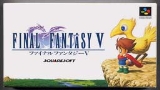
Final Fantasy V

Encyclopedia
is a medieval-fantasy role-playing video game
developed and published by Square
(now Square Enix
) in 1992 as a part of the Final Fantasy
series. The game first appeared only in Japan on Nintendo
's Super Famicom
(known internationally as the Super Nintendo Entertainment System). It has been ported with minor differences to Sony
's PlayStation and Nintendo's Game Boy Advance
. An original video animation
produced in 1994 called Final Fantasy: Legend of the Crystals
serves as a sequel to the events depicted in the game. It was released for the PlayStation Network on April 6, 2011 in Japan.
The game begins as a wanderer named Bartz investigates a fallen meteor. There, he encounters several characters, one of whom reveals the danger facing the four Crystals that control the world's elements. These Crystals act as a seal on Exdeath, an evil sorcerer. Bartz and his party must keep the Crystals from being exploited by Exdeath's influence and prevent his resurgence.
Final Fantasy V has been praised for the freedom of customization that the player has over the characters, achieved through the greatly expanded Job System. Despite the lack of an early release in territories other than Japan, the Super Famicom version sold more than two million copies. The PlayStation version has earned "Greatest Hits" status, selling more than 350,000 copies.
connects the various towns, dungeons
, and other points of interest. The player can traverse the overworld by foot, Chocobo
, hydra-guided ship, wind drake, or airship, depending on the situation. Most towns scattered contain inns for resting, shops for purchasing equipment, and people from whom the player can gain information. The player may also embark on several side quests that become available as the story progresses. Characters grow in strength by gaining experience point
s from random encounter
s with monsters on the overworld or in a dungeon. Experience culminates in a "level up", in which character attributes
, such as hit points or magic power, increase. A menu-based management system allows the player to equip, heal, and change each character's selected job outside of battle as well as to save the game's progress.
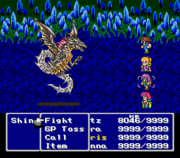
Final Fantasy V is the second Final Fantasy game to use the Active Time Battle (ATB) system, in which time flows continuously for both the player and enemies during combat. This system was first established in Final Fantasy IV
but in that game, there was no way to visibly anticipate which character's turn would come up next. In Final Fantasy V, the player can see which playable character's turn is next in battle, in the form of a time gauge—or "ATB Bar"—which fills according to a character's speed. When the selected character's turn arrives, the player can execute one of several commands, such as attacking the enemy with an equipped weapon, using a special ability or item, or changing the character's row position. The ATB mechanic with a gauge, as seen in Final Fantasy V, is used in four of the following titles in the series.
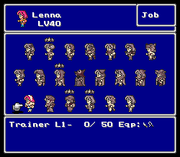 The main feature of the gameplay of Final Fantasy V is the Job System. Players can freely select jobs (also called "classes") for their characters to master, allowing each character to gain special abilities and potentially master all 22 jobs (26 in the Game Boy Advance version). Each character begins with only the "Freelancer" class; to gain access to new jobs, players must acquire crystal shards. This system is basically an improved version of the one in Final Fantasy III; several older jobs were either reused or revamped for Final Fantasy V, such as the Black Mage and Thief. The game also introduces several classes to the series, including the Blue Mage, Time Mage, and Mime. Each of these classes has been featured in numerous Final Fantasy installments since.
Once the player gains access to the job system, characters begin to earn a separate form of experience—Ability Points (ABP)—in conjunction with regular experience points. Characters gain job levels after accumulating ABP; as with regular levels, the required amount of experience increases after each job level. ABP and job levels do not transfer from class to class. As job levels increase, new skills become available for the character to use in a new form of customization; characters learn job-specific abilities that may be transferred to a new job. For example, a character with the Knight
job who has also earned job levels as a Black Mage may set Black Magic as a secondary command, enabling both Black Mage and Knight abilities in battle. The nature of these abilities varies; while some serve as special commands in battle, others may be innate to the class or activated automatically when conditions are met, such as the Thief's "Caution" skill, which prevents rear attacks from enemies. This system allows for deeper customization of characters.
Crystals into two sets, effectively creating two worlds. The Void then became sealed in a dimensional cleft between the two worlds.
Nearly 1,000 years passed without incident, and both worlds prospered due to the powers of their Crystals of Wind, Water, Fire, and Earth. New kingdoms and towns flourished, and travel by ship acted as a critical means of commerce and communication. However, a sinister force was stirring in the second world—ever since the Void incident, malicious demons had been sealed inside a tree in the Great Forest of Moore. The corrupted amalgamation of spirits emerged as Exdeath, the game's primary antagonist. When Exdeath attempted to claim the world for himself, a group of heroes called the "Four Warriors of Dawn" (Galuf, Xezat, Dorgann, and Kelger) sealed him within the first world using its Crystals, and peace returned for another 30 years.
s, though only four of which are playable at a given time. Bartz Klauser is a traveling adventurer who becomes involved in the story when he investigates the site of a meteorite strike. Lenna Charlotte Tycoon is a princess of Tycoon who follows her father to investigate the Wind Shrine's Crystal. Early on, Bartz finds her unconscious and saves her from goblins. Galuf Doe is a mysterious old man who was discovered unconscious near the meteorite with a case of amnesia
. Faris Scherwiz is a pirate captain who captures Bartz, Lenna, and Galuf when they try to steal her ship; she is revealed to be Sarisa Scherwill Tycoon in disguise. Krile Mayer Baldesion is the granddaughter of Galuf who journeys with him to the planet and receives his abilities.
Most of the main characters were involved with or related to the original Four Warriors of Dawn, such as Dorgann Klauser (Bartz's father), Kelger Vlondett, and Xezat Matias Surgate; Galuf was the fourth warrior. The game also contains several supporting characters, including engineer Cid Previa, his grandson Mid Previa, and turtle sage Ghido. One of Exdeath's henchmen, Gilgamesh, is a recurring mini-boss in the second half of the game. Gilgamesh has also appeared in newer Final Fantasy titles, such as Final Fantasy VIII
and Final Fantasy XII
. Concept art for the characters was designed by Yoshitaka Amano
; he has offered such artwork for every main Final Fantasy installment since the original.
Meanwhile, a young traveller named Bartz, resting in the woods near Tycoon, beholds a meteorite
plunge to the planet's surface just outside the castle. Bartz promptly investigates, discovering a young woman, Lenna, lying unconscious from attack. After rescuing her, they discover an old man in the debris with partial amnesia
named Galuf. Lenna explains that she had been on her way to the Wind Shrine after her father. Galuf suddenly recalls that it was his original destination as well, opting to accompany her. Though the trio part ways, Bartz soon encounters Lenna and Galuf again assaulted by monsters in a quaking valley. The three travel together, finding all land routes blockaded by the upheavals caused by the meteorite's fall. Exploring an underground cavern, they encounter a den of pirates and their leader, Faris. With the help of the pirate captain, the group makes its way to the Wind Shrine to discover the shattered Crystal, but no sign of the missing king. The shards react to their presence, however, and an image of Tycoon appears, explaining to them that they must protect those Crystals that yet remain.
Eventually, the party comes to discover that the Crystals formed a seal upon Exdeath; with them destroyed, not only would the dark essence be released, but over time the planet itself would become uninhabitable. The party attempts to save the crystals of Water, Fire, and Earth; but by the machinations of human folly or the influence of the sealed Exdeath they fail. Having been freed, Exdeath defeats the party and returns to his homeworld. Galuf's granddaughter Krile arrives by meteorite, restoring Galuf's memory completely; he recalls he originated from the same world as Exdeath, pursuing him back home with Krile. Bartz and the others resolve that the fight is not Galuf's alone, together traveling to the distant planet world, where Exdeath is already wreaking havoc in pursuit of that world's Crystals. The trio is captured, but Galuf rescues them and defeats Exdeath's lieutenant, Gilgamesh, in the process. They are blown to a distant continent when a magical barrier is activated during their escape, but make their way to Val Castle, Galuf's kingdom.
The party meets Kelger, one of Galuf's companions and a former Warrior of Dawn, and learn that Bartz's father was part of their group. Joining forces, they deactivate the barrier around Exdeath's castle, but at the cost of Kelger's life. They then learn of Exdeath's origins, traveling to the Guardian Tree to dispel the seals. Exdeath anticipates the party's actions and torches Moore Forest, ensnaring the group. Krile arrives to help, but is herself trapped by the warlock's powers. At the sight of his granddaughter's capture, Galuf frees himself and battles Exdeath to the point of death, refusing to fall until the creature flees. Collapsing from his wounds, Galuf dies despite the party's efforts to save him, imparting his abilities to Krile. The party pursues Exdeath to his tower and defeats him, but the remaining Crystals shatter and the worlds are reunited.
For a time, it seems Exdeath has been truly destroyed, and the party celebrates in Tycoon. Bartz, however, is contacted by the sage Ghido. Meeting with him, a thorn suddenly leaps from Faris' palm, manifesting as Exdeath, now resurrected and fully in command of the Void. With it, he removes entire towns and kingdoms from existence, tossing them into a tear in reality.
Fortunately for the party, the reunification of worlds has opened the pathways to ancient sites where weapons and powers used to quell Enuo's rise a thousand years past lay in wait. So armed, the party enters the Rift, seeking out Exdeath at the center of the inter-dimensional nexus where they, too, fall prey to the Void. With help from their fallen allies, the party survives and is returned before Exdeath, now manifested as a demonic sylvan, battling him until he weakens and is swallowed by his own power. He then transforms into Neo Exdeath, intent on destroying the very essence of reality, himself with it. Exdeath is ultimately defeated, and, using the power of the Crystal shards, the heroes seal the Void once more and restore the reunified world and its Crystals. The game's ending varies based on how many party members are still alive at Neo Exdeath's defeat, detailing the events after the world's resurrection. At the end, the remaining group visits the Guardian Tree, and find that the fallen party members have returned to life.
by Final Fantasy series creator Hironobu Sakaguchi
who, prior to the release of Final Fantasy IX
, called it his favorite Final Fantasy game. The character, image, and title logo designs were created by series illustrator and image designer Yoshitaka Amano
, while monsters and some of the battle graphics were designed by Tetsuya Nomura
. Amano has stated that he counts his depictions of both Faris from Final Fantasy V and Terra from Final Fantasy VI among his favorite Final Fantasy designs. Yoshinori Kitase
was responsible for the event scenes and also collaborated with Hironobu Sakaguchi on writing the scenario text. The actual story was written by Hironobu Sakaguchi. The Job System was designed by Hiroyuki Ito
, who worked on the game as a battle planner alongside Akihiko Matsui
. Mode 7 effects were used in the airship sequences, which moving in the airship would cause the planet to rotate on its axis. In total, Square employed a team of 45 people to create the game, and 16 MB of space were used to accommodate for the sprites, animations, and detailed background. According to GamePro
in a May 1993 issue, the Japanese authorities had asked Square not to release the game during a school day because schoolchildren would skip class to wait in line for the game.
 The official English translation of Final Fantasy V began shortly after the release of the Japanese version. The game was to be titled "Final Fantasy III" in North America, but the project fell through. Translator Ted Woolsey
explained in a 1994 interview, "[Final Fantasy V is] just not accessible enough to the average gamer". Rumors circulated that a second attempt at localization would be made and that the game would be titled Final Fantasy Extreme, but this attempt was also canceled. A third attempt was made to port the game to Microsoft Windows
-based personal computers for North American release by developer Top Dog Software, but this was canceled. Another attempt to port the game to Windows for North America was "handled by Eidos Interactive
" circa 1998 (but it is unclear whether this is the same version Top Dog Software was working on or an actual fourth attempt). The continual canceling of the localization angered fans and led to Final Fantasy V becoming one of the first games to receive a complete fan translation.
and consists of 56 tracks. A two-disc
album was released alongside the game totaling 67 tracks. Uematsu had originally calculated that the game would require more than 100 pieces of music, but he managed to reduce the number to 56. The song "Dear Friends" would become the title piece in the 2004 concert tour Dear Friends -Music from Final Fantasy-, chosen to reflect Uematsu's appreciation for his music's worldwide fan support. The song "Clash on the Big Bridge" would later be arranged by Hitoshi Sakimoto
for the Final Fantasy XII Original Soundtrack in 2006.
The album Final Fantasy V: 5+1 was released in 1992 and contained five songs from the original score as well as a previously unreleased Super Famicom version of "Matoya's Cave" from the original 1987 Final Fantasy
for the Nintendo Entertainment System
. A collection of arranged tracks, Final Fantasy V Dear Friends; a 13-track disc, Piano Collections Final Fantasy V; and a short series of remix
es, Final Fantasy V: Mambo de Chocobo, were all released in 1993. Finally, many of the original songs were included on the North American Final Fantasy Anthology Soundtrack, together with the two-game compilation.
to the Sony
PlayStation and re-released in Japan on March 19, 1998; it was included in the 1999 release of Final Fantasy Collection, alongside Final Fantasy IV and Final Fantasy VI. The PlayStation version boasted two new full motion video
opening and ending sequences and a "memo-save" feature, but the game otherwise remained unchanged. Square released 50,000 limited edition copies of the collection which included a Final Fantasy-themed alarm clock. In the same year, Square released the PlayStation compilation Final Fantasy Anthology in North America, which included Final Fantasy V, as well as the PlayStation version of Final Fantasy VI. This would mark the first time the game was published outside Japan, nearly seven years after its initial release. In 2002, Square released this version of the game in Europe and Australia, this time alongside Final Fantasy IV. The English version of the game received changes from its original format, including a different interpretation of character names, such as the names "Bartz" as opposed to "Butz" and "Gill" as opposed to "Guido", the official romanizations in Japan.
Following the release of the PlayStation 2
, Sony reported that the new system had compatibility issues with the Final Fantasy V half of Final Fantasy Anthology. The game experienced a bug where if players attempted to save their games, a graphical error would occur. Square
then released a statement that only the look of the save screen was corrupted, and saving was still possible, and if players wished, repeatedly going into and out of the save screen would make a normal screen eventually appear.
Final Fantasy V was ported a second time by Tose to the Nintendo
Game Boy Advance
as Final Fantasy V Advance, which was released on October 12, 2006, in Japan, November 6, 2006, in North America, and April 20, 2007, in Europe. Similar to the Game Boy Advance re-releases of its predecessors, this version features updated graphics, though the changes are very subtle. Additional features include four new jobs (Gladiator, Cannoneer, Necromancer, and Oracle), a new dungeon called "The Sealed Temple", and a new optional boss from the back story of Final Fantasy V, Enuo, which was designed by Tetsuya Nomura
, the monster designer of the original game. In addition, the game included a bestiary, a quick save function, music player, and additional equipment in the style of previous Game Boy Advance re-releases. Like the remakes of its predecessors, Final Fantasy V Advance featured a new English translation.
sequel to Final Fantasy V, simply titled Final Fantasy. Produced by animation studio Madhouse
, the anime was released in four 30-minute VHS tapes in Japan and was set two hundred years after the game. The story focuses on four warriors, one of them the descendant of Bartz, protecting the Wind Crystal from the villain Deathgyunos, who pursues it to achieve godhood. It was localized by Urban Vision
in 1998 and released in two VHS volumes for North America under the title Final Fantasy: Legend of the Crystals.
On April 27, 2010, Square Enix producer Shinji Hashimoto
stated that the development of a remake of Final Fantasy V for the Nintendo DS is at present "undecided" due to "technical issues". However, on June 24, 2010, he added that a remake for the Nintendo 3DS
is being considered, but he would first have to "look and see how 3DS does, how it evolves, and then make a decision".
There is also a release for this game on the Wii
Virtual Console
in Japan, released in January 2011.
Square Enix released Final Fantasy V on the PlayStation Network as a PSOne Classic in Japan on April 6, 2011 and in North America on November 22, 2011.
While not initially released in North America, the game received mixed reception from import reviews. 1UP.com
's staff stated that while the game's story was very weak, the gameplay was "another story", heavily praising the job system and the feature to combine abilities from different job classes, and gave it a score of B-. Allgame
's review shared similar sentiments regarding the storyline and job system, adding praise for the addition of hidden events and items for players to search for, giving the game a score of 3.5 out of 5. RPGamer
found that the game improved on the visual presentation, menu system, and overall field navigation of Final Fantasy IV, but the "maddeningly high encounter rate", "average sound selection", and "washed out" color palette hurt the game's presentation, giving it a score of 5/10.
Critics likewise gave mixed reviews of the Anthology version of the game. GameSpot
criticized the game for having "paper-thin characters" and a cliche plot, augmented by a lack of character development during the game's fetch quests. They went further to say that the translation was terrible and overshadowed by the two previous fan efforts. IGN
called Final Fantasy V' s graphics "dated" but cited "incredibly engrossing" job system as the game's highlight and praised its music. Electronic Gaming Monthly repeated the sentiments towards the job system, adding that while the game suffered from long load times
periodically, Final Fantasy V was the main reason to buy the collection.
In comparison, reviews of the Game Boy Advance re-release of the game were mostly positive. GameSpot's review regarded the game more favorably than its PlayStation counterpart, calling it "better than ever" and citing the strong localization of the script and extensive special features. They further stated that while the game's characters seemed unlikable and that the plot felt "predictable or trite", they felt both aspects were superior to many of today's games, giving the game a score of 8.5. Nintendo Power
stated that "while playing Final Fantasy V is a chore on the PlayStation, it's good fun on the GBA because of the vastly improved translation and new features", further calling it the "definitive" version of one of the series' best titles. IGN gave the game a score of 8.5, calling it a "must-own" for the portable system and describing it further as always an "entertaining and surprisingly deep role-playing game". 1UP.com stated the port of the game from the Super Famicom to the Game Boy Advance was "rock solid", and added that while the game's story started off at a slow pace, it gradually improved. The review further praised the addition of features and removal of questionable ones that had been added to the Anthology version of the game. GameDaily
gave the game a score of 7/10, noting that while enjoyable, the high encounter rate, the necessity to constantly engage in battle to gain abilities through the job system, and other aspects made the game feel repetitive at times.
Role-playing video game
Role-playing video games are a video game genre with origins in pen-and-paper role-playing games such as Dungeons & Dragons, using much of the same terminology, settings and game mechanics. The player in RPGs controls one character, or several adventuring party members, fulfilling one or many quests...
developed and published by Square
Square Co.
was a Japanese video game company founded in September 1983 by Masafumi Miyamoto. It merged with Enix in 2003 and became part of Square Enix...
(now Square Enix
Square Enix
is a Japanese video game and publishing company best known for its console role-playing game franchises, which include the Final Fantasy series, the Dragon Quest series, and the action-RPG Kingdom Hearts series...
) in 1992 as a part of the Final Fantasy
Final Fantasy
is a media franchise created by Hironobu Sakaguchi, and is developed and owned by Square Enix . The franchise centers on a series of fantasy and science-fantasy role-playing video games , but includes motion pictures, anime, printed media, and other merchandise...
series. The game first appeared only in Japan on Nintendo
Nintendo
is a multinational corporation located in Kyoto, Japan. Founded on September 23, 1889 by Fusajiro Yamauchi, it produced handmade hanafuda cards. By 1963, the company had tried several small niche businesses, such as a cab company and a love hotel....
's Super Famicom
Super Nintendo Entertainment System
The Super Nintendo Entertainment System is a 16-bit video game console that was released by Nintendo in North America, Europe, Australasia , and South America between 1990 and 1993. In Japan and Southeast Asia, the system is called the , or SFC for short...
(known internationally as the Super Nintendo Entertainment System). It has been ported with minor differences to Sony
Sony Computer Entertainment
Sony Computer Entertainment, Inc. is a major video game company specializing in a variety of areas in the video game industry, and is a wholly owned subsidiary and part of the Consumer Products & Services Group of Sony...
's PlayStation and Nintendo's Game Boy Advance
Game Boy Advance
The is a 32-bit handheld video game console developed, manufactured, and marketed by Nintendo. It is the successor to the Game Boy Color. It was released in Japan on March 21, 2001; in North America on June 11, 2001; in Australia and Europe on June 22, 2001; and in the People's Republic of China...
. An original video animation
Original video animation
, abbreviated as media , are animated films and series made specially for release in home-video formats. The term originated in relation to Japanese animation...
produced in 1994 called Final Fantasy: Legend of the Crystals
Final Fantasy: Legend of the Crystals
is an anime OVA based on the Final Fantasy series of console role-playing games. It was released in Japan in 1994 and distributed by Urban Vision in 1998 in North America. Urban Vision does not have the license to this series now, and it has not been relicensed in North America.Legend of the...
serves as a sequel to the events depicted in the game. It was released for the PlayStation Network on April 6, 2011 in Japan.
The game begins as a wanderer named Bartz investigates a fallen meteor. There, he encounters several characters, one of whom reveals the danger facing the four Crystals that control the world's elements. These Crystals act as a seal on Exdeath, an evil sorcerer. Bartz and his party must keep the Crystals from being exploited by Exdeath's influence and prevent his resurgence.
Final Fantasy V has been praised for the freedom of customization that the player has over the characters, achieved through the greatly expanded Job System. Despite the lack of an early release in territories other than Japan, the Super Famicom version sold more than two million copies. The PlayStation version has earned "Greatest Hits" status, selling more than 350,000 copies.
Gameplay
Final Fantasy V includes many standard role-playing elements as well as renovated features introduced in earlier Final Fantasy games. Players navigate the characters from a top-down perspective; a traversable overworldOverworld
An overworld is, in a broad sense, an area within a video game that interconnects all its levels or locations. They are mostly common in role-playing games, though this does not exclude other video game genres....
connects the various towns, dungeons
Dungeon crawl
A dungeon crawl is a type of scenario in fantasy role-playing games in which heroes navigate a labyrinthine environment, battling various monsters, and looting any treasure they may find...
, and other points of interest. The player can traverse the overworld by foot, Chocobo
Chocobo
A is a fictional creature from the Final Fantasy video game series. The creature is a large and normally flightless galliforme/ratite bird capable of being ridden and otherwise used by player characters during gameplay...
, hydra-guided ship, wind drake, or airship, depending on the situation. Most towns scattered contain inns for resting, shops for purchasing equipment, and people from whom the player can gain information. The player may also embark on several side quests that become available as the story progresses. Characters grow in strength by gaining experience point
Experience point
An experience point is a unit of measurement used in many role-playing games and role-playing video games to quantify a player character's progression through the game...
s from random encounter
Random encounter
A random encounter is a feature commonly used in various role-playing games whereby encounters with non-player character enemies or other dangers occur sporadically and at random...
s with monsters on the overworld or in a dungeon. Experience culminates in a "level up", in which character attributes
Attribute (role-playing games)
An attribute is a piece of data that describes to what extent a fictional character in a role-playing game possesses a specific natural, in-born characteristic common to all characters in the game. That piece of data is usually an abstract number or, in some cases, a set of dice...
, such as hit points or magic power, increase. A menu-based management system allows the player to equip, heal, and change each character's selected job outside of battle as well as to save the game's progress.
Final Fantasy V is the second Final Fantasy game to use the Active Time Battle (ATB) system, in which time flows continuously for both the player and enemies during combat. This system was first established in Final Fantasy IV
Final Fantasy IV
is a role-playing video game developed and published by Square in 1991 as a part of the Final Fantasy series. The game was originally released for the Super Famicom in Japan and has since then been rereleased for many other platforms with varying modifications. An enhanced remake with 3D graphics...
but in that game, there was no way to visibly anticipate which character's turn would come up next. In Final Fantasy V, the player can see which playable character's turn is next in battle, in the form of a time gauge—or "ATB Bar"—which fills according to a character's speed. When the selected character's turn arrives, the player can execute one of several commands, such as attacking the enemy with an equipped weapon, using a special ability or item, or changing the character's row position. The ATB mechanic with a gauge, as seen in Final Fantasy V, is used in four of the following titles in the series.
Job System
Once the player gains access to the job system, characters begin to earn a separate form of experience—Ability Points (ABP)—in conjunction with regular experience points. Characters gain job levels after accumulating ABP; as with regular levels, the required amount of experience increases after each job level. ABP and job levels do not transfer from class to class. As job levels increase, new skills become available for the character to use in a new form of customization; characters learn job-specific abilities that may be transferred to a new job. For example, a character with the Knight
Warrior (character class)
Warrior is a character class found in many role-playing games. This class may also be referred to as Fighter, as in Dungeons & Dragons. The class is sometimes also referred to as a Knight, although in some games this is a separate class with a more chivalric aspect...
job who has also earned job levels as a Black Mage may set Black Magic as a secondary command, enabling both Black Mage and Knight abilities in battle. The nature of these abilities varies; while some serve as special commands in battle, others may be innate to the class or activated automatically when conditions are met, such as the Thief's "Caution" skill, which prevents rear attacks from enemies. This system allows for deeper customization of characters.
Setting
The backstory of Final Fantasy V is revealed in phases through cutscenes and interactions with non-playable characters. One millennium before the events of the main story, a powerful mage named Enuo imperiled the world using the power of an evil entity called the "Void". The people retaliated by using twelve legendary weapons to vanquish Enuo; however, the Void itself could not be destroyed. Consequently, the people split the world's four elementalClassical element
Many philosophies and worldviews have a set of classical elements believed to reflect the simplest essential parts and principles of which anything consists or upon which the constitution and fundamental powers of anything are based. Most frequently, classical elements refer to ancient beliefs...
Crystals into two sets, effectively creating two worlds. The Void then became sealed in a dimensional cleft between the two worlds.
Nearly 1,000 years passed without incident, and both worlds prospered due to the powers of their Crystals of Wind, Water, Fire, and Earth. New kingdoms and towns flourished, and travel by ship acted as a critical means of commerce and communication. However, a sinister force was stirring in the second world—ever since the Void incident, malicious demons had been sealed inside a tree in the Great Forest of Moore. The corrupted amalgamation of spirits emerged as Exdeath, the game's primary antagonist. When Exdeath attempted to claim the world for himself, a group of heroes called the "Four Warriors of Dawn" (Galuf, Xezat, Dorgann, and Kelger) sealed him within the first world using its Crystals, and peace returned for another 30 years.
Characters
Final Fantasy V features five player characterPlayer character
A player character or playable character is a character in a video game or role playing game who is controlled or controllable by a player, and is typically a protagonist of the story told in the course of the game. A player character is a persona of the player who controls it. Player characters...
s, though only four of which are playable at a given time. Bartz Klauser is a traveling adventurer who becomes involved in the story when he investigates the site of a meteorite strike. Lenna Charlotte Tycoon is a princess of Tycoon who follows her father to investigate the Wind Shrine's Crystal. Early on, Bartz finds her unconscious and saves her from goblins. Galuf Doe is a mysterious old man who was discovered unconscious near the meteorite with a case of amnesia
Amnesia
Amnesia is a condition in which one's memory is lost. The causes of amnesia have traditionally been divided into categories. Memory appears to be stored in several parts of the limbic system of the brain, and any condition that interferes with the function of this system can cause amnesia...
. Faris Scherwiz is a pirate captain who captures Bartz, Lenna, and Galuf when they try to steal her ship; she is revealed to be Sarisa Scherwill Tycoon in disguise. Krile Mayer Baldesion is the granddaughter of Galuf who journeys with him to the planet and receives his abilities.
Most of the main characters were involved with or related to the original Four Warriors of Dawn, such as Dorgann Klauser (Bartz's father), Kelger Vlondett, and Xezat Matias Surgate; Galuf was the fourth warrior. The game also contains several supporting characters, including engineer Cid Previa, his grandson Mid Previa, and turtle sage Ghido. One of Exdeath's henchmen, Gilgamesh, is a recurring mini-boss in the second half of the game. Gilgamesh has also appeared in newer Final Fantasy titles, such as Final Fantasy VIII
Final Fantasy VIII
is a role-playing video game released for the PlayStation in 1999 and for Windows-based personal computers in 2000. It was developed and published by Square as the Final Fantasy series' eighth title, removing magic point-based spell-casting and the first title to consistently use realistically...
and Final Fantasy XII
Final Fantasy XII
is a console role-playing video game developed and published by Square Enix for the PlayStation 2. Released in 2006, it is the twelfth title in the Final Fantasy series and the last in the series to be released exclusively on the PlayStation platform...
. Concept art for the characters was designed by Yoshitaka Amano
Yoshitaka Amano
is a Japanese artist. He began his career as an animator and has become known for his illustrations for the anime Vampire Hunter D and for his character designs, image illustrations and title logo designs for the Final Fantasy video game series developed by Square Enix . His influences include...
; he has offered such artwork for every main Final Fantasy installment since the original.
Story
Final Fantasy V begins on a day when the world's wind currents begin to slow and stale. Deeply troubled by this occurrence, the king of Tycoon makes ready to travel to the Wind Shrine on the back of his drake, quelling the worries of his daughter, Princess Lenna (Reina in Final Fantasy Anthology). Upon arriving at the Shrine, the king bears witness to the Wind Crystal shattering before his eyes.Meanwhile, a young traveller named Bartz, resting in the woods near Tycoon, beholds a meteorite
Meteorite
A meteorite is a natural object originating in outer space that survives impact with the Earth's surface. Meteorites can be big or small. Most meteorites derive from small astronomical objects called meteoroids, but they are also sometimes produced by impacts of asteroids...
plunge to the planet's surface just outside the castle. Bartz promptly investigates, discovering a young woman, Lenna, lying unconscious from attack. After rescuing her, they discover an old man in the debris with partial amnesia
Amnesia
Amnesia is a condition in which one's memory is lost. The causes of amnesia have traditionally been divided into categories. Memory appears to be stored in several parts of the limbic system of the brain, and any condition that interferes with the function of this system can cause amnesia...
named Galuf. Lenna explains that she had been on her way to the Wind Shrine after her father. Galuf suddenly recalls that it was his original destination as well, opting to accompany her. Though the trio part ways, Bartz soon encounters Lenna and Galuf again assaulted by monsters in a quaking valley. The three travel together, finding all land routes blockaded by the upheavals caused by the meteorite's fall. Exploring an underground cavern, they encounter a den of pirates and their leader, Faris. With the help of the pirate captain, the group makes its way to the Wind Shrine to discover the shattered Crystal, but no sign of the missing king. The shards react to their presence, however, and an image of Tycoon appears, explaining to them that they must protect those Crystals that yet remain.
Eventually, the party comes to discover that the Crystals formed a seal upon Exdeath; with them destroyed, not only would the dark essence be released, but over time the planet itself would become uninhabitable. The party attempts to save the crystals of Water, Fire, and Earth; but by the machinations of human folly or the influence of the sealed Exdeath they fail. Having been freed, Exdeath defeats the party and returns to his homeworld. Galuf's granddaughter Krile arrives by meteorite, restoring Galuf's memory completely; he recalls he originated from the same world as Exdeath, pursuing him back home with Krile. Bartz and the others resolve that the fight is not Galuf's alone, together traveling to the distant planet world, where Exdeath is already wreaking havoc in pursuit of that world's Crystals. The trio is captured, but Galuf rescues them and defeats Exdeath's lieutenant, Gilgamesh, in the process. They are blown to a distant continent when a magical barrier is activated during their escape, but make their way to Val Castle, Galuf's kingdom.
The party meets Kelger, one of Galuf's companions and a former Warrior of Dawn, and learn that Bartz's father was part of their group. Joining forces, they deactivate the barrier around Exdeath's castle, but at the cost of Kelger's life. They then learn of Exdeath's origins, traveling to the Guardian Tree to dispel the seals. Exdeath anticipates the party's actions and torches Moore Forest, ensnaring the group. Krile arrives to help, but is herself trapped by the warlock's powers. At the sight of his granddaughter's capture, Galuf frees himself and battles Exdeath to the point of death, refusing to fall until the creature flees. Collapsing from his wounds, Galuf dies despite the party's efforts to save him, imparting his abilities to Krile. The party pursues Exdeath to his tower and defeats him, but the remaining Crystals shatter and the worlds are reunited.
For a time, it seems Exdeath has been truly destroyed, and the party celebrates in Tycoon. Bartz, however, is contacted by the sage Ghido. Meeting with him, a thorn suddenly leaps from Faris' palm, manifesting as Exdeath, now resurrected and fully in command of the Void. With it, he removes entire towns and kingdoms from existence, tossing them into a tear in reality.
Fortunately for the party, the reunification of worlds has opened the pathways to ancient sites where weapons and powers used to quell Enuo's rise a thousand years past lay in wait. So armed, the party enters the Rift, seeking out Exdeath at the center of the inter-dimensional nexus where they, too, fall prey to the Void. With help from their fallen allies, the party survives and is returned before Exdeath, now manifested as a demonic sylvan, battling him until he weakens and is swallowed by his own power. He then transforms into Neo Exdeath, intent on destroying the very essence of reality, himself with it. Exdeath is ultimately defeated, and, using the power of the Crystal shards, the heroes seal the Void once more and restore the reunified world and its Crystals. The game's ending varies based on how many party members are still alive at Neo Exdeath's defeat, detailing the events after the world's resurrection. At the end, the remaining group visits the Guardian Tree, and find that the fallen party members have returned to life.
Development
Final Fantasy V was directedGame director
Game director may refer to:* Video game producer, the person in charge of overseeing development of a video game* Technical director, usually a senior technical person within creative group...
by Final Fantasy series creator Hironobu Sakaguchi
Hironobu Sakaguchi
is a Japanese game designer, game director and game producer. He is world famous as the creator of the Final Fantasy series, and has had a long career in gaming with over 100 million units of video games sold worldwide...
who, prior to the release of Final Fantasy IX
Final Fantasy IX
is a role-playing video game developed and published by Square for the PlayStation video game console. It is the ninth title in the Final Fantasy series. The game introduced new features to the series like the 'Active Time Event', 'Mognet' and a unique equipment and skill system.Final Fantasy IXs...
, called it his favorite Final Fantasy game. The character, image, and title logo designs were created by series illustrator and image designer Yoshitaka Amano
Yoshitaka Amano
is a Japanese artist. He began his career as an animator and has become known for his illustrations for the anime Vampire Hunter D and for his character designs, image illustrations and title logo designs for the Final Fantasy video game series developed by Square Enix . His influences include...
, while monsters and some of the battle graphics were designed by Tetsuya Nomura
Tetsuya Nomura
is a Japanese video game director and character designer working for Square Enix , best known for his work on both the Final Fantasy and Kingdom Hearts series.-Time before Square:Nomura was born in Kōchi, Japan...
. Amano has stated that he counts his depictions of both Faris from Final Fantasy V and Terra from Final Fantasy VI among his favorite Final Fantasy designs. Yoshinori Kitase
Yoshinori Kitase
is a Japanese game producer and former game director that has been working for Square Enix since April 1, 1990. He is mostly known for his work on the role-playing video game series Final Fantasy and is currently the manager of 1st Production Department....
was responsible for the event scenes and also collaborated with Hironobu Sakaguchi on writing the scenario text. The actual story was written by Hironobu Sakaguchi. The Job System was designed by Hiroyuki Ito
Hiroyuki Ito
, also credited with the spelling Hiroyuki Itou, is a Japanese game producer, game director and game designer who has been working for Square Enix since 1987. He is famous for being the creator of Active Time Battle and Active Dimension Battle...
, who worked on the game as a battle planner alongside Akihiko Matsui
Akihiko Matsui
Akihiko Matsui is a video game developer and battle designer working for Square Enix . He was notably the director for Chrono Trigger with Yoshinori Kitase and Takashi Tokita.- Work history :...
. Mode 7 effects were used in the airship sequences, which moving in the airship would cause the planet to rotate on its axis. In total, Square employed a team of 45 people to create the game, and 16 MB of space were used to accommodate for the sprites, animations, and detailed background. According to GamePro
GamePro
GamePro Media was a United States gaming media company publishing online and print content on the video game industry, video game hardware, and video game software developed for a video game console , a computer, and/or a mobile device . GamePro Media properties include GamePro magazine and...
in a May 1993 issue, the Japanese authorities had asked Square not to release the game during a school day because schoolchildren would skip class to wait in line for the game.
Ted Woolsey
Ted Woolsey is an American video game translator and producer. He had the primary role in the North American production and localization of Square's role-playing games during the SNES era between 1991 and 1996.-Square:...
explained in a 1994 interview, "[Final Fantasy V is] just not accessible enough to the average gamer". Rumors circulated that a second attempt at localization would be made and that the game would be titled Final Fantasy Extreme, but this attempt was also canceled. A third attempt was made to port the game to Microsoft Windows
Microsoft Windows
Microsoft Windows is a series of operating systems produced by Microsoft.Microsoft introduced an operating environment named Windows on November 20, 1985 as an add-on to MS-DOS in response to the growing interest in graphical user interfaces . Microsoft Windows came to dominate the world's personal...
-based personal computers for North American release by developer Top Dog Software, but this was canceled. Another attempt to port the game to Windows for North America was "handled by Eidos Interactive
Eidos Interactive
Eidos Interactive Ltd. is a British video game publisher and is a label of Square Enix Europe. As an independent company Eidos plc was headquartered in the Wimbledon Bridge House in Wimbledon, London Borough of Merton....
" circa 1998 (but it is unclear whether this is the same version Top Dog Software was working on or an actual fourth attempt). The continual canceling of the localization angered fans and led to Final Fantasy V becoming one of the first games to receive a complete fan translation.
Music
The game's soundtrack was composed by Nobuo UematsuNobuo Uematsu
is a Japanese video game composer, best known for scoring the majority of titles in the Final Fantasy series. He is considered as one of the most famous and respected composers in the video game community...
and consists of 56 tracks. A two-disc
Compact Disc
The Compact Disc is an optical disc used to store digital data. It was originally developed to store and playback sound recordings exclusively, but later expanded to encompass data storage , write-once audio and data storage , rewritable media , Video Compact Discs , Super Video Compact Discs ,...
album was released alongside the game totaling 67 tracks. Uematsu had originally calculated that the game would require more than 100 pieces of music, but he managed to reduce the number to 56. The song "Dear Friends" would become the title piece in the 2004 concert tour Dear Friends -Music from Final Fantasy-, chosen to reflect Uematsu's appreciation for his music's worldwide fan support. The song "Clash on the Big Bridge" would later be arranged by Hitoshi Sakimoto
Hitoshi Sakimoto
is a Japanese video game composer and arranger. He is best known for scoring the games Final Fantasy Tactics and Final Fantasy XII, though he has composed soundtracks for over 70 games and arranged music for more than 40 others. He began playing music and video games in elementary school, and began...
for the Final Fantasy XII Original Soundtrack in 2006.
The album Final Fantasy V: 5+1 was released in 1992 and contained five songs from the original score as well as a previously unreleased Super Famicom version of "Matoya's Cave" from the original 1987 Final Fantasy
Final Fantasy (video game)
is a fantasy role-playing video game created by Hironobu Sakaguchi, developed and first published in Japan by Square in 1987. It is the first game in Square's Final Fantasy series...
for the Nintendo Entertainment System
Nintendo Entertainment System
The Nintendo Entertainment System is an 8-bit video game console that was released by Nintendo in North America during 1985, in Europe during 1986 and Australia in 1987...
. A collection of arranged tracks, Final Fantasy V Dear Friends; a 13-track disc, Piano Collections Final Fantasy V; and a short series of remix
Remix
A remix is an alternative version of a recorded song, made from an original version. This term is also used for any alterations of media other than song ....
es, Final Fantasy V: Mambo de Chocobo, were all released in 1993. Finally, many of the original songs were included on the North American Final Fantasy Anthology Soundtrack, together with the two-game compilation.
Re-releases
Final Fantasy V was ported by ToseTOSE
is a video game development company based in Kyoto, Japan. It is most known for developing Nintendo's Game & Watch Gallery series, various Dragon Ball games, as well as other Nintendo products...
to the Sony
Sony Computer Entertainment
Sony Computer Entertainment, Inc. is a major video game company specializing in a variety of areas in the video game industry, and is a wholly owned subsidiary and part of the Consumer Products & Services Group of Sony...
PlayStation and re-released in Japan on March 19, 1998; it was included in the 1999 release of Final Fantasy Collection, alongside Final Fantasy IV and Final Fantasy VI. The PlayStation version boasted two new full motion video
Full motion video
Full motion video based games are video games that rely upon pre-recorded TV-quality movie or animation rather than sprites, vectors, or 3D models to display action in the game. In the early 1990s a diverse set of games utilized this format...
opening and ending sequences and a "memo-save" feature, but the game otherwise remained unchanged. Square released 50,000 limited edition copies of the collection which included a Final Fantasy-themed alarm clock. In the same year, Square released the PlayStation compilation Final Fantasy Anthology in North America, which included Final Fantasy V, as well as the PlayStation version of Final Fantasy VI. This would mark the first time the game was published outside Japan, nearly seven years after its initial release. In 2002, Square released this version of the game in Europe and Australia, this time alongside Final Fantasy IV. The English version of the game received changes from its original format, including a different interpretation of character names, such as the names "Bartz" as opposed to "Butz" and "Gill" as opposed to "Guido", the official romanizations in Japan.
Following the release of the PlayStation 2
PlayStation 2
The PlayStation 2 is a sixth-generation video game console manufactured by Sony as part of the PlayStation series. Its development was announced in March 1999 and it was first released on March 4, 2000, in Japan...
, Sony reported that the new system had compatibility issues with the Final Fantasy V half of Final Fantasy Anthology. The game experienced a bug where if players attempted to save their games, a graphical error would occur. Square
Square (company)
was a Japanese video game company founded in September 1983 by Masafumi Miyamoto. It merged with Enix in 2003 and became part of Square Enix...
then released a statement that only the look of the save screen was corrupted, and saving was still possible, and if players wished, repeatedly going into and out of the save screen would make a normal screen eventually appear.
Final Fantasy V was ported a second time by Tose to the Nintendo
Nintendo
is a multinational corporation located in Kyoto, Japan. Founded on September 23, 1889 by Fusajiro Yamauchi, it produced handmade hanafuda cards. By 1963, the company had tried several small niche businesses, such as a cab company and a love hotel....
Game Boy Advance
Game Boy Advance
The is a 32-bit handheld video game console developed, manufactured, and marketed by Nintendo. It is the successor to the Game Boy Color. It was released in Japan on March 21, 2001; in North America on June 11, 2001; in Australia and Europe on June 22, 2001; and in the People's Republic of China...
as Final Fantasy V Advance, which was released on October 12, 2006, in Japan, November 6, 2006, in North America, and April 20, 2007, in Europe. Similar to the Game Boy Advance re-releases of its predecessors, this version features updated graphics, though the changes are very subtle. Additional features include four new jobs (Gladiator, Cannoneer, Necromancer, and Oracle), a new dungeon called "The Sealed Temple", and a new optional boss from the back story of Final Fantasy V, Enuo, which was designed by Tetsuya Nomura
Tetsuya Nomura
is a Japanese video game director and character designer working for Square Enix , best known for his work on both the Final Fantasy and Kingdom Hearts series.-Time before Square:Nomura was born in Kōchi, Japan...
, the monster designer of the original game. In addition, the game included a bestiary, a quick save function, music player, and additional equipment in the style of previous Game Boy Advance re-releases. Like the remakes of its predecessors, Final Fantasy V Advance featured a new English translation.
Sequels and remakes
In 1994, Square released an original video animationOriginal video animation
, abbreviated as media , are animated films and series made specially for release in home-video formats. The term originated in relation to Japanese animation...
sequel to Final Fantasy V, simply titled Final Fantasy. Produced by animation studio Madhouse
Madhouse (company)
is a Japanese animation studio, founded in 1972 by ex–Mushi Pro animators including Masao Maruyama, Osamu Dezaki, Rintaro, and Yoshiaki Kawajiri. It has created and helped to produce many well known shows, starting with TV anime series Ace o Nerae! in 1973, and including western favourites Ninja...
, the anime was released in four 30-minute VHS tapes in Japan and was set two hundred years after the game. The story focuses on four warriors, one of them the descendant of Bartz, protecting the Wind Crystal from the villain Deathgyunos, who pursues it to achieve godhood. It was localized by Urban Vision
Urban Vision
Urban Vision Entertainment Inc., an American based production/distribution company created in Los Angeles, California formed in July, 1996 by Mataichiro Yamamoto to help introduce the alternative animation genre known as anime or Japanimation to mainstream media....
in 1998 and released in two VHS volumes for North America under the title Final Fantasy: Legend of the Crystals.
On April 27, 2010, Square Enix producer Shinji Hashimoto
Shinji Hashimoto
Shinji Hashimoto is a Japanese game producer. He currently works for Square Enix, which he joined in 1995, and has been the producer for several of their titles, including games in the Final Fantasy and Kingdom Hearts series...
stated that the development of a remake of Final Fantasy V for the Nintendo DS is at present "undecided" due to "technical issues". However, on June 24, 2010, he added that a remake for the Nintendo 3DS
Nintendo 3DS
The is a portable game console produced by Nintendo. The autostereoscopic device is able to project stereoscopic 3D effects without the use of 3D glasses or any additional accessories. The Nintendo 3DS features backward compatibility with Nintendo DS series software, including Nintendo DSi software...
is being considered, but he would first have to "look and see how 3DS does, how it evolves, and then make a decision".
There is also a release for this game on the Wii
Wii
The Wii is a home video game console released by Nintendo on November 19, 2006. As a seventh-generation console, the Wii primarily competes with Microsoft's Xbox 360 and Sony's PlayStation 3. Nintendo states that its console targets a broader demographic than that of the two others...
Virtual Console
Virtual console
A virtual console – also known as a virtual terminal – is a conceptual combination of the keyboard and display for a computer user interface. It is a feature of some operating systems such as UnixWare, Linux, and BSD, in which the system console of the computer can be used to switch between...
in Japan, released in January 2011.
Square Enix released Final Fantasy V on the PlayStation Network as a PSOne Classic in Japan on April 6, 2011 and in North America on November 22, 2011.
Reception
Final Fantasy V has sold 2.45 million units on the Super Famicom, (including 2 million copies during its first two months of release) while the Japanese Game Boy Advance version has sold nearly 260,000 copies as of December 2007. Final Fantasy Collection sold over 400,000 copies in 1999, making it the 31st best selling release of that year in Japan. The North American release of Final Fantasy Anthology sold 364,000 copies as of 2004.While not initially released in North America, the game received mixed reception from import reviews. 1UP.com
1UP.com
1UP.com is a video game website owned by IGN Entertainment, a division of News Corporation. Previously, the site was owned by Ziff Davis before being sold to UGO Entertainment in 2009....
's staff stated that while the game's story was very weak, the gameplay was "another story", heavily praising the job system and the feature to combine abilities from different job classes, and gave it a score of B-. Allgame
Allgame
Allgame is a commercial database of information about arcade games, video games and console manufacturers.Allgame is owned by All Media Guide, along with Allmusic and Allmovie....
's review shared similar sentiments regarding the storyline and job system, adding praise for the addition of hidden events and items for players to search for, giving the game a score of 3.5 out of 5. RPGamer
RPGamer
RPGamer is a media and news website dedicated to covering computer and video game RPGs. Its coverage includes North American game news, European game news, Asian game news, gaming industry news, game reviews, game previews, hands-on game impressions, gaming conventions, game merchandise, release...
found that the game improved on the visual presentation, menu system, and overall field navigation of Final Fantasy IV, but the "maddeningly high encounter rate", "average sound selection", and "washed out" color palette hurt the game's presentation, giving it a score of 5/10.
Critics likewise gave mixed reviews of the Anthology version of the game. GameSpot
GameSpot
GameSpot is a video gaming website that provides news, reviews, previews, downloads, and other information. The site was launched in May 1, 1996 by Pete Deemer, Vince Broady and Jon Epstein. It was purchased by ZDNet, a brand which was later purchased by CNET Networks. CBS Interactive, which...
criticized the game for having "paper-thin characters" and a cliche plot, augmented by a lack of character development during the game's fetch quests. They went further to say that the translation was terrible and overshadowed by the two previous fan efforts. IGN
IGN
IGN is an entertainment website that focuses on video games, films, music and other media. IGN's main website comprises several specialty sites or "channels", each occupying a subdomain and covering a specific area of entertainment...
called Final Fantasy V
Load (computing)
In UNIX computing, the system load is a measure of the amount of work that a computer system performs. The load average represents the average system load over a period of time...
periodically, Final Fantasy V was the main reason to buy the collection.
In comparison, reviews of the Game Boy Advance re-release of the game were mostly positive. GameSpot's review regarded the game more favorably than its PlayStation counterpart, calling it "better than ever" and citing the strong localization of the script and extensive special features. They further stated that while the game's characters seemed unlikable and that the plot felt "predictable or trite", they felt both aspects were superior to many of today's games, giving the game a score of 8.5. Nintendo Power
Nintendo Power
Nintendo Power magazine is a monthly news and strategy magazine formerly published in-house by Nintendo of America, but now run independently. As of issue #222 , Nintendo contracted publishing duties to Future US, the U.S. subsidiary of British publisher Future.The first issue published was...
stated that "while playing Final Fantasy V is a chore on the PlayStation, it's good fun on the GBA because of the vastly improved translation and new features", further calling it the "definitive" version of one of the series' best titles. IGN gave the game a score of 8.5, calling it a "must-own" for the portable system and describing it further as always an "entertaining and surprisingly deep role-playing game". 1UP.com stated the port of the game from the Super Famicom to the Game Boy Advance was "rock solid", and added that while the game's story started off at a slow pace, it gradually improved. The review further praised the addition of features and removal of questionable ones that had been added to the Anthology version of the game. GameDaily
GameDaily
GameDaily was a video game journalism website based in the United States. Launched in 1995 by entrepreneur Mark Friedler under the name Gigex and focused on free game demo downloads, The site changed its business model from a flat fee per download CDN distributed service network to an...
gave the game a score of 7/10, noting that while enjoyable, the high encounter rate, the necessity to constantly engage in battle to gain abilities through the job system, and other aspects made the game feel repetitive at times.