


Esna

Encyclopedia
Esna known to the ancient Egypt
ians as Egyptian
: Iunyt or Ta-senet; Greek
: (Latopolis or Letopolis) or (Polis Laton) or (Latton); Latin
: Lato, is a city in Egypt
. It is located on the west bank of the River Nile
, some 55 km south of Luxor
. The town was formerly part of the modern Qena Governorate, but as of 9/12/2009, has been incorporated into the new Luxor Governorate.
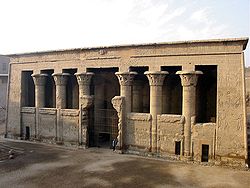
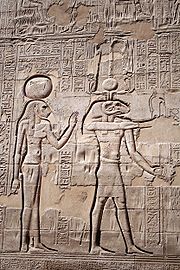
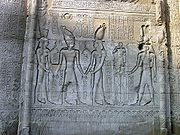 The name "Latopolis" is in honor of the Nile perch
, Lates niloticus, the largest of the 52 species which inhabit the Nile, which was abundant in these stretches of the river in ancient times, and which appears in sculptures, among the symbols of the goddess Neith
, associated by the ancient Greeks as Pallas-Athene
, surrounded by the oval shield or ring indicative of royalty or divinity. Held sacred, the Lates niloticus was buried in a cemetery west of the town.
The tutelary deities of Latopolis seem to have been the triad – Khnum and Neith
, and Heka
their offspring. The temple
of Esna, dedicated to this triad, was remarkable for the beauty of its site and the magnificence of its architecture. It was built of red sandstone, and its portico consisted of six rows of four columns each, with lotus-leaf capitals, all of which however differ from each other.
Another temple of the same period has been identified at Kom Mer, about 12 km to the south, but cannot be excavated because a modern village is built over it.
There was a smaller temple, dedicated to the triad of Latopolis, about two miles and a half north of the city, at a village now called el-Dayr. Here, too, is a small Zodiac of the age of Ptolemy III Euergetes
(246-221 BC). This latter building has been destroyed in the 19th century, as it stood in the way of a new canal. The temple of Esna has been cleared of the soil and rubbish which filled its area when Denon visited it, and served as a cotton warehouse in the mid-19th century.
With the exception of the jamb of a gateway – now converted into a door-sill – of the reign of Thutmose II
(Eighteenth Dynasty), the remains of Latopolis belong to the Ptolemaic
or Roman
eras. Ptolemy III Euergetes
, the restorer of so many temples in Upper Egypt
, was a benefactor to Latopolis, and he is depicted upon the walls of its temple followed by a tame lion, and in the act of striking down the chiefs of his enemies. The name of Ptolemy V Epiphanes
is found also inscribed upon a doorway. Although the scale of the ruins are impressive, their sculptures and hieroglyphics
attest to the decline of Egyptian art. The west wall features reliefs of Ptolemy VI Philometor
and Ptolemy VIII Physcon
. The pronaos, which alone exists, resembles in style that of Apollonopolis Magna (Edfu
), and was begun not earlier than the reign of Claudius
(41-54 AD), and completed in that of Vespasian
, whose name and titles are carved on the dedicatory inscription over the entrance. On the ceiling of the pronaos is the larger Latopolitan Zodiac. The name of the emperor Geta
, the last ruler that can be read in hieroglyphics, although partially erased by his brother and murderer Caracalla
(212), is still legible on the walls of Latopolis. Before raising their own edifice, the Romans seem to have destroyed even the basements of the earlier Egyptian temple. The ceremonial way, which probably linked the quay to the temple, has disappeared. The quay bears cartouches of Marcus Aurelius.
The cemetery west of the town, where the Lates niloticus was buried, also contains human burials dating of the Middle Kingdom
to the Late Period
.
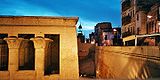 The Temple of Esna conveys a sense of the importance which the Ancient Egyptians placed upon their places of worship. All Egyptians who entered the confines of an Egyptian temple were required "to comply with the strict rules regarding ritual purity." According to inscriptions carved on the walls of the Temple of Esna, those who entered this temple were expected to fastidiously cut their fingernails and toenails, remove other body hair, wash their hands with natron
(a natural occurring salt), "be dressed in linen (they were forbidden from wearing wool), and not to have had sexual intercourse for several days."
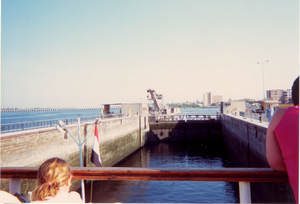 Two barrage bridges straddle the Nile
at this point: one built by the British in 1906, and the "Electricity Bridge" built in the 1990s. Navigation, particularly, Nile cruisers ferrying tourists from Luxor
to Aswan
155 km further upstream, can be held up for hours while vessels negotiate their way through the lock system.
The two main points of interest in Esna are its lively tourist-oriented market, which fills a couple of streets leading inland from the corniche
. The other is the temple of Esna. The temple, which has only been partially excavated, is about 200 meters from the river and some 9 meters below street level.
Ancient Egypt
Ancient Egypt was an ancient civilization of Northeastern Africa, concentrated along the lower reaches of the Nile River in what is now the modern country of Egypt. Egyptian civilization coalesced around 3150 BC with the political unification of Upper and Lower Egypt under the first pharaoh...
ians as Egyptian
Egyptian language
Egyptian is the oldest known indigenous language of Egypt and a branch of the Afroasiatic language family. Written records of the Egyptian language have been dated from about 3400 BC, making it one of the oldest recorded languages known. Egyptian was spoken until the late 17th century AD in the...
: Iunyt or Ta-senet; Greek
Greek language
Greek is an independent branch of the Indo-European family of languages. Native to the southern Balkans, it has the longest documented history of any Indo-European language, spanning 34 centuries of written records. Its writing system has been the Greek alphabet for the majority of its history;...
: (Latopolis or Letopolis) or (Polis Laton) or (Latton); Latin
Latin
Latin is an Italic language originally spoken in Latium and Ancient Rome. It, along with most European languages, is a descendant of the ancient Proto-Indo-European language. Although it is considered a dead language, a number of scholars and members of the Christian clergy speak it fluently, and...
: Lato, is a city in Egypt
Egypt
Egypt , officially the Arab Republic of Egypt, Arabic: , is a country mainly in North Africa, with the Sinai Peninsula forming a land bridge in Southwest Asia. Egypt is thus a transcontinental country, and a major power in Africa, the Mediterranean Basin, the Middle East and the Muslim world...
. It is located on the west bank of the River Nile
Nile
The Nile is a major north-flowing river in North Africa, generally regarded as the longest river in the world. It is long. It runs through the ten countries of Sudan, South Sudan, Burundi, Rwanda, Democratic Republic of the Congo, Tanzania, Kenya, Ethiopia, Uganda and Egypt.The Nile has two major...
, some 55 km south of Luxor
Luxor
Luxor is a city in Upper Egypt and the capital of Luxor Governorate. The population numbers 487,896 , with an area of approximately . As the site of the Ancient Egyptian city of Thebes, Luxor has frequently been characterized as the "world's greatest open air museum", as the ruins of the temple...
. The town was formerly part of the modern Qena Governorate, but as of 9/12/2009, has been incorporated into the new Luxor Governorate.
The ancient city
Nile perch
The Nile perch is a species of freshwaterfish in family Latidae of order Perciformes. It is widespread throughout muchof the Afrotropic ecozone, being native to the Congo, Nile, Senegal, Niger, and Lake Chad, Volta, Lake Turkana and other river basins. It also occurs in the brackish waters of...
, Lates niloticus, the largest of the 52 species which inhabit the Nile, which was abundant in these stretches of the river in ancient times, and which appears in sculptures, among the symbols of the goddess Neith
Neith
In Egyptian mythology, Neith was an early goddess in the Egyptian pantheon. She was the patron deity of Sais, where her cult was centered in the Western Nile Delta of Egypt and attested as early as the First Dynasty...
, associated by the ancient Greeks as Pallas-Athene
Athena
In Greek mythology, Athena, Athenê, or Athene , also referred to as Pallas Athena/Athene , is the goddess of wisdom, courage, inspiration, civilization, warfare, strength, strategy, the arts, crafts, justice, and skill. Minerva, Athena's Roman incarnation, embodies similar attributes. Athena is...
, surrounded by the oval shield or ring indicative of royalty or divinity. Held sacred, the Lates niloticus was buried in a cemetery west of the town.
The tutelary deities of Latopolis seem to have been the triad – Khnum and Neith
Neith
In Egyptian mythology, Neith was an early goddess in the Egyptian pantheon. She was the patron deity of Sais, where her cult was centered in the Western Nile Delta of Egypt and attested as early as the First Dynasty...
, and Heka
Heka (god)
In Egyptian mythology, Heka was the deification of magic, his name being the Egyptian word for magic. According to Egyptian writing , Heka existed "before duality had yet come into being." The term "Heka" was also used for the practice of magical ritual...
their offspring. The temple
Egyptian temple
Egyptian temples were built for the official worship of the gods and commemoration of pharaohs in Ancient Egypt and in regions under Egyptian control. These temples were seen as houses for the gods or kings to whom they were dedicated...
of Esna, dedicated to this triad, was remarkable for the beauty of its site and the magnificence of its architecture. It was built of red sandstone, and its portico consisted of six rows of four columns each, with lotus-leaf capitals, all of which however differ from each other.
Another temple of the same period has been identified at Kom Mer, about 12 km to the south, but cannot be excavated because a modern village is built over it.
There was a smaller temple, dedicated to the triad of Latopolis, about two miles and a half north of the city, at a village now called el-Dayr. Here, too, is a small Zodiac of the age of Ptolemy III Euergetes
Ptolemy III Euergetes
-Family:Euergetes was the eldest son of Ptolemy II Philadelphus and his first wife, Arsinoe I, and came to power in 246 BC upon the death of his father.He married Berenice of Cyrene in the year corresponding to 244/243 BC; and their children were:...
(246-221 BC). This latter building has been destroyed in the 19th century, as it stood in the way of a new canal. The temple of Esna has been cleared of the soil and rubbish which filled its area when Denon visited it, and served as a cotton warehouse in the mid-19th century.
With the exception of the jamb of a gateway – now converted into a door-sill – of the reign of Thutmose II
Thutmose II
Thutmose II was the fourth Pharaoh of the Eighteenth dynasty of Egypt. He built some minor monuments and initiated at least two minor campaigns but did little else during his rule and was probably strongly influenced by his wife, Hatshepsut...
(Eighteenth Dynasty), the remains of Latopolis belong to the Ptolemaic
Ptolemaic Egypt
Ptolemaic Egypt began when Ptolemy I Soter invaded Egypt and declared himself Pharaoh of Egypt in 305 BC and ended with the death of queen Cleopatra VII of Egypt and the Roman conquest in 30 BC. The Ptolemaic Kingdom was a powerful Hellenistic state, extending from southern Syria in the east, to...
or Roman
Roman Empire
The Roman Empire was the post-Republican period of the ancient Roman civilization, characterised by an autocratic form of government and large territorial holdings in Europe and around the Mediterranean....
eras. Ptolemy III Euergetes
Ptolemy III Euergetes
-Family:Euergetes was the eldest son of Ptolemy II Philadelphus and his first wife, Arsinoe I, and came to power in 246 BC upon the death of his father.He married Berenice of Cyrene in the year corresponding to 244/243 BC; and their children were:...
, the restorer of so many temples in Upper Egypt
Upper Egypt
Upper Egypt is the strip of land, on both sides of the Nile valley, that extends from the cataract boundaries of modern-day Aswan north to the area between El-Ayait and Zawyet Dahshur . The northern section of Upper Egypt, between El-Ayait and Sohag is sometimes known as Middle Egypt...
, was a benefactor to Latopolis, and he is depicted upon the walls of its temple followed by a tame lion, and in the act of striking down the chiefs of his enemies. The name of Ptolemy V Epiphanes
Ptolemy V Epiphanes
Ptolemy V Epiphanes , son of Ptolemy IV Philopator and Arsinoe III of Egypt, was the fifth ruler of the Ptolemaic dynasty. He became ruler at the age of five, and under a series of regents the kingdom was paralyzed.-Regency infighting:Ptolemy Epiphanes was only a small boy when his father, Ptolemy...
is found also inscribed upon a doorway. Although the scale of the ruins are impressive, their sculptures and hieroglyphics
Egyptian hieroglyphs
Egyptian hieroglyphs were a formal writing system used by the ancient Egyptians that combined logographic and alphabetic elements. Egyptians used cursive hieroglyphs for religious literature on papyrus and wood...
attest to the decline of Egyptian art. The west wall features reliefs of Ptolemy VI Philometor
Ptolemy VI Philometor
Ptolemy VI Philometor was a king of Egypt from the Ptolemaic period. He reigned from 180 to 145 BC....
and Ptolemy VIII Physcon
Ptolemy VIII Physcon
Ptolemy VIII Euergetes II , nicknamed , Phúskōn, Physcon for his obesity, was a king of the Ptolemaic dynasty in Egypt. His complicated career started in 170 BC, when Antiochus IV Epiphanes invaded Egypt, captured his brother Ptolemy VI Philometor and let him continue as a puppet monarch...
. The pronaos, which alone exists, resembles in style that of Apollonopolis Magna (Edfu
Edfu
Edfu is an Egyptian city, located on the west bank of the Nile River between Esna and Aswan, with a population of approximately sixty thousand people. For the ancient history of the city, see below...
), and was begun not earlier than the reign of Claudius
Claudius
Claudius , was Roman Emperor from 41 to 54. A member of the Julio-Claudian dynasty, he was the son of Drusus and Antonia Minor. He was born at Lugdunum in Gaul and was the first Roman Emperor to be born outside Italy...
(41-54 AD), and completed in that of Vespasian
Vespasian
Vespasian , was Roman Emperor from 69 AD to 79 AD. Vespasian was the founder of the Flavian dynasty, which ruled the Empire for a quarter century. Vespasian was descended from a family of equestrians, who rose into the senatorial rank under the Emperors of the Julio-Claudian dynasty...
, whose name and titles are carved on the dedicatory inscription over the entrance. On the ceiling of the pronaos is the larger Latopolitan Zodiac. The name of the emperor Geta
Publius Septimius Geta
Geta , was a Roman Emperor co-ruling with his father Septimius Severus and his older brother Caracalla from 209 to his death.-Early life:Geta was the younger son of Septimius Severus by his second wife Julia Domna...
, the last ruler that can be read in hieroglyphics, although partially erased by his brother and murderer Caracalla
Caracalla
Caracalla , was Roman emperor from 198 to 217. The eldest son of Septimius Severus, he ruled jointly with his younger brother Geta until he murdered the latter in 211...
(212), is still legible on the walls of Latopolis. Before raising their own edifice, the Romans seem to have destroyed even the basements of the earlier Egyptian temple. The ceremonial way, which probably linked the quay to the temple, has disappeared. The quay bears cartouches of Marcus Aurelius.
The cemetery west of the town, where the Lates niloticus was buried, also contains human burials dating of the Middle Kingdom
Middle Kingdom of Egypt
The Middle Kingdom of Egypt is the period in the history of ancient Egypt stretching from the establishment of the Eleventh Dynasty to the end of the Fourteenth Dynasty, between 2055 BC and 1650 BC, although some writers include the Thirteenth and Fourteenth dynasties in the Second Intermediate...
to the Late Period
Late Period of Ancient Egypt
The Late Period of Ancient Egypt refers to the last flowering of native Egyptian rulers after the Third Intermediate Period from the 26th Saite Dynasty into Persian conquests and ended with the death of Alexander the Great...
.
Ritual Significance
Natron
Natron is a naturally occurring mixture of sodium carbonate decahydrate and about 17% sodium bicarbonate along with small quantities of household salt and sodium sulfate. Natron is white to colourless when pure, varying to gray or yellow with impurities...
(a natural occurring salt), "be dressed in linen (they were forbidden from wearing wool), and not to have had sexual intercourse for several days."
Modern Esna
Nile
The Nile is a major north-flowing river in North Africa, generally regarded as the longest river in the world. It is long. It runs through the ten countries of Sudan, South Sudan, Burundi, Rwanda, Democratic Republic of the Congo, Tanzania, Kenya, Ethiopia, Uganda and Egypt.The Nile has two major...
at this point: one built by the British in 1906, and the "Electricity Bridge" built in the 1990s. Navigation, particularly, Nile cruisers ferrying tourists from Luxor
Luxor
Luxor is a city in Upper Egypt and the capital of Luxor Governorate. The population numbers 487,896 , with an area of approximately . As the site of the Ancient Egyptian city of Thebes, Luxor has frequently been characterized as the "world's greatest open air museum", as the ruins of the temple...
to Aswan
Aswan
Aswan , formerly spelled Assuan, is a city in the south of Egypt, the capital of the Aswan Governorate.It stands on the east bank of the Nile at the first cataract and is a busy market and tourist centre...
155 km further upstream, can be held up for hours while vessels negotiate their way through the lock system.
The two main points of interest in Esna are its lively tourist-oriented market, which fills a couple of streets leading inland from the corniche
Corniche
The word corniche typically refers to a road on the side of a cliff or mountain, with the ground rising on one side of the road and falling away on the other...
. The other is the temple of Esna. The temple, which has only been partially excavated, is about 200 meters from the river and some 9 meters below street level.
External links
- biologie.uni-hamburg.de, Gallery of temple reliefs
- Falling Rain Genomics, Inc. Geographical information on Esna
- touregypt.net, The temple of Khnum (Esna) Esna on Wikivoyage
- fotopedia.com, Selected photos of Esna
- Esna revisited, Al-ahram Weekly historical review on Esna by Giovanna Montalbetti with photos by Sherif SonbolSherif SonbolSherif Sonbol is a photographer specializing in architecture, scenic fine arts and photojournalism.- Early life :...