

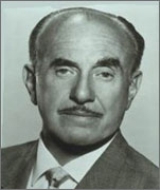
Jack Warner

Encyclopedia
Jack Leonard "J. L." Warner (August 2, 1892 – September 9, 1978), born Jacob Warner in London, Ontario
, was a Canadian American film executive who was the president and driving force behind the Warner Bros. Studios
in Hollywood
, Los Angeles
, California
. Warner's 45-year career was longer than that of any other traditional Hollywood studio tycoon
.
As co-head of production at Warner Bros. Studios, he worked with his brother, Sam Warner
, to procure the technology for the film industry's first talking picture. After Sam's death, Jack clashed with his surviving older brothers, Harry
and Albert Warner
. He assumed exclusive control of the film production company in the 1950s, when he secretly purchased his brothers' shares in the business after convincing them to participate in a joint sale of stocks.
Although Warner was feared by many of his employees and inspired ridicule with his uneven attempts at humor, he earned respect for his shrewd instincts and toughmindedness. He recruited many of Warner Bros.'s top stars and promoted the hard-edged social dramas for which the studio became known. Given to decisiveness, Warner once commented, "If I'm right fifty-one percent of the time, I'm ahead of the game."
Throughout his career, he was viewed as a contradictory and enigmatic figure. Although he was a staunch Republican, Warner encouraged film projects that promoted the agenda of Democratic President Franklin D. Roosevelt
's New Deal
. He opposed European fascism
and criticized Nazi Germany
well before America's involvement in World War II
. An opponent of Communism
, after the war Warner appeared as a friendly witness before the House Un-American Activities Committee
, voluntarily naming screenwriters who had been fired as suspected Communists or sympathizers. Despite his controversial public image, Warner remained a force in the motion picture industry until his retirement in the early 1970s.
, Ontario
, Canada
in 1892. His parents were Jewish immigrants from Poland
who spoke mainly Yiddish. Jack was the fifth surviving son of Benjamin Warner a cobbler from Krasnosielc
, Poland (then located in the Russian Empire
) and his wife, the former Pearl Leah Eichelbaum. Following their marriage in 1876, the couple had three children in Poland, one of whom died at a young age. One of the surviving children was Jack's eldest brother, Hirsch (later Harry). The Warner family had occupied a "hostile world", where the "night-riding of cossacks, the burning of houses, and the raping of women were part of life's burden for the Jews of the 'shtetl
'". In 1888, in search of a better future for his family and himself, Benjamin made his way to Hamburg
, Germany
, and then took a ship to America. The Warner surname was perhaps originally "Wonsal" or "Wonskolaser" Upon arriving in New York City
, Benjamin introduced himself as "Benjamin Warner", and the surname "Warner" remained with him for the rest of his life. Pearl Warner and the couple's two children joined him in Baltimore, Maryland
, less than a year later. In Baltimore, the couple had five more children, including Abraham (later known as Albert) and Sam Warner.
Benjamin Warner's decision to move to Canada in the early 1890s was inspired by a friend's advice that he could make an excellent living bartering tin wares with trappers in exchange for furs. Their sons Jack and David were born in Ontario. After two arduous years in Canada, Benjamin and Pearl Warner returned to Baltimore, bringing along their growing family. Two more children, Sadie and Milton, were added to the household there. In 1896, the family relocated to Youngstown
, Ohio
, following the lead of Harry Warner, who established a shoe repair shop in the heart of the emerging industrial town. Benjamin worked with his son Harry in the shoe repair shop until he secured a loan to open a meat counter and grocery store in the city's downtown area.
Jack spent much of his youth in Youngstown. He observed in his autobiography that his experiences there molded his sensibilities. Warner wrote: "J. Edgar Hoover
told me that Youngstown in those days was one of the toughest cities in America, and a gathering place for Sicilian
thugs active in the Mafia
. There was a murder or two almost every Saturday night in our neighborhood, and knives and brass knuckles
were standard equipment for the young hotheads on the prowl." Warner claimed that he briefly belonged to a street gang based at Westlake's Crossing, a notorious neighborhood located just west of the city's downtown area. Meanwhile, he received his first taste of show business
in the burgeoning steel town
, singing at local theaters and forming a brief business partnership with another aspiring "song-and-dance man". During his brief career in vaudeville
, he officially changed his name to Jack Leonard Warner. Jack's older brother Sam disapproved of these youthful pursuits. "Get out front where they pay the actors," Sam Warner advised Jack. "That's where the money is."
at Idora Park
, a local amusement park. He convinced the family of the new medium's possibilities and negotiated the purchase of a Model B Kinetoscope
from a projectionist who was "down on his luck". The purchase price was $1,000, and Jack Warner contributed $150 to the venture by pawning a horse, according to his obituary.
The enterprising brothers screened a well-used copy of The Great Train Robbery
throughout Ohio
and Pennsylvania
before renting a vacant store in New Castle, Pennsylvania
. This makeshift theatre, called the Bijou, was furnished with chairs borrowed from a local undertaker. Jack, who was still living in Youngstown at the time, arrived on weekends "to sing illustrated song-slides during reel changes". In 1906, the brothers purchased a small theater in New Castle, which they called the Cascade Movie Palace. They maintained the theater until moving into film distribution in 1907. That year, the Warner brothers established the Pittsburgh
-based Duquesne Amusement Company, a distribution firm that proved lucrative until the advent of Thomas Edison
's Motion Picture Patents Company
(also known as the Edison Trust), which charged distributors exorbitant fees. In 1909, Harry agreed to bring Jack into the family business; he sent his younger brother to Norfolk, Virginia
, where Jack assisted Sam in the operation of a second film exchange company. Later that year, the Warners sold the family business to the General Film Company for "$10,000 in cash, $12,000 in preferred stock, and payments over a four-year period for a total of $52,000" (equivalent to $ today).
's Independent Motion Picture Company, which challenged the monopolistic control of the Edison Trust. That same year, Jack Warner acquired a job as a film splicer in New York, where he assisted brother Sam with the production of the film, Dante's Inferno. Despite the film's success at the box office, Harry Warner remained concerned about the economic threat presented by the Edison Trust. He subsequently broke with Laemmle and sent Jack to establish a film exchange in San Francisco, while Sam did the same in Los Angeles. The brothers were soon poised to exploit the expanding California movie market. In 1917, Jack was sent to Los Angeles to open another film exchange company. Their first opportunity to produce a major film came in 1918, when they purchased the film rights for My Four Years in Germany, a bestselling novel that condemned German wartime atrocities. The film proved to be a commercial and critical success, and the four brothers were able to establish a studio in California. In the new studio, Jack became co-head of production along with his older brother, Sam. In this capacity, the two brothers secured new scripts and story lines, managed film production, and looked for ways to reduce production costs.
 Warner Bros. followed up the success of My Four Years in Germany with a popular serial titled The Tiger's Claw in 1919. That same year, the studio was less successful in its efforts to promote Open Your Eyes, a tract on the dangers of venereal disease that featured Jack Warner's sole screen appearance. During this period, the studio earned few profits; and in 1920, the Warners secured a bank loan to settle outstanding debts. Shortly thereafter, the Warners relocated their production studio from Culver City, California
, to Hollywood, where they purchased a lot on the corner of Sunset Boulevard
and Bronson Avenue., known today as Sunset Bronson Studios. The new location and upgraded facilities did not significantly improve the studio's image, which remained defined by its low-budget comedies and racy films on declining morality.
The studio discovered a trained German Shepherd
named Rin Tin Tin
in 1923. The canine made his debut in Where the North Begins, a film about an abandoned pup who is raised by wolves and befriends a fur trapper. According to one biographer, Jack Warner's initial doubts about the project were quelled when he met Rin Tin Tin, "who seemed to display more intelligence than some of the Warner comics." Rin Tin Tin proved to be the studio's most important commercial asset until the introduction of sound. Screenwriter Darryl F. Zanuck
produced several scripts for Rin Tin Tin vehicles and, during one year, wrote more than half of the studio's features. Between 1928 and 1933, Zanuck served as Jack Warner's right-hand man and executive producer, a position whose responsibilities included the day-to-day production of films. Despite the success of Rin Tin Tin and other projects, however, Warner Bros. was unable to compete with Hollywood's "Big Three" – Paramount, Universal
, and First National
studios.
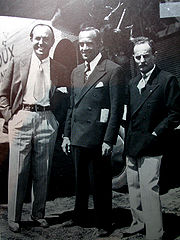 In 1925, the studio expanded its operations and acquired the Brooklyn-based theater company, Vitagraph. Later that year, Sam Warner urged his brother, Harry, to sign an agreement with Western Electric
to develop a series of talking "shorts" using the newly developed Vitaphone
technology. Sam died of pneumonia in 1927 (just before the premiere of the first feature-length talking picture, The Jazz Singer
), and Jack became sole head of production. Sam's death left Jack unconsolable. One biographer writes, "Throughout his life, Jack had been warmed by Sam's sunshiny optimism, his thirst for excitement, his inventive mind, his gambling nature. Sam had also served as a buffer between Jack and his stern eldest brother, Harry. In the years to come, Jack ran the Warner Bros. Burbank
studio with an iron hand. Following his brother's death, he became increasingly difficult to deal with and inspired the resentment of many of his employees.
As the family grieved over Sam's sudden passing, the success of The Jazz Singer helped establish Warner Bros. as a major studio. While Warner Bros. invested only $500,000 in the film, the studio reaped $3 million in profits. Hollywood's five major studios, which controlled most of the nation's movie theaters, initially attempted to block the growth of "talking pictures". In the face of such organized opposition, Warner Bros. produced 12 "talkies" in 1928 alone. The following year, the newly formed Academy of Motion Picture Arts and Sciences
recognized Warner Bros. for "revolutionizing the industry with sound".
Despite Warner Bros.'s new prosperity, Jack kept a tight rein on costs. He placed the studio's directors on a quota system, and decreed a flat, low-key lighting style to make the sets look cheaper than they were.
and The Public Enemy
as well as the critically acclaimed I Am a Fugitive from a Chain Gang
, starring Paul Muni
. Some of these films reflected a surprising (albeit temporary) shift in Warner's political outlook. By 1932, despite his longstanding association with the Republican Party, he openly supported Democratic presidential candidate Franklin D. Roosevelt, staging a "Motion Picture and Electrical Parade Sports Pageant" at L.A. Stadium in Roosevelt's honor. This development foreshadowed an "era in which Warner would recruit the most New Dealish (often simultaneously the most left-wing) writers".
During this period, Warner took an active role in recruiting talent. To furnish Warner Bros. with much needed "star power", he raided contract players from rival studios, in some cases offering to double their salaries. This strategy yielded three leading stars from Paramount
Studios – William Powell
, Kay Francis
, and Ruth Chatterton
. In 1929, Warner persuaded British stage and screen actor George Arliss
to play the title role in a remake of the 1921 United Artists
film, Disraeli
, a project that turned out to be a box-office hit. Then, in 1930, he spotted future stars James Cagney
, Joan Blondell
, and Frank McHugh
in the cast of a New York
play called Penny Arcade. Although Cagney turned out to be Warner's greatest prize, he was also the studio executive's biggest professional challenge. During his frequent arguments with Warner, Cagney often resorted to screaming the Yiddish obscenities he learned during his upbringing in the Hell's Kitchen
district of New York City. According to a 1937 Fortune
magazine article, Warner's most intense contract disputes involved Cagney, "who got sick of being typed as a girl-hitting mick and of making five pictures a year instead of four."
The studio's executive producer, Darryl F. Zanuck, resigned during a contract dispute with Harry Warner in 1933. According to a 1933 letter that Jack wrote to Will H. Hays
, then president of the Motion Picture Producers and Distributors of America
, Zanuck requested a higher salary and "indicated his desire to raise the salaries of the actors and personnel in the motion pictures we were producing". That year, Zanuck established 20th Century
Studios, which merged with Fox Film Corporation in 1935. Longtime producer for the studio, Hal B. Wallis
, took over as the studio's executive producer. Warner, however, denied Wallis the sweeping powers enjoyed by Zanuck, and the result was a decentralization of creative and administrative control that often created confusion at the studio. Under the new system, each picture was assigned a supervisor who was usually plucked from the ranks of the studio's screenwriters. Although Warner Bros. maintained a high rate of production throughout the 1930s, some pictures showed an uneven quality that reflected "not only the difficulty of shifting to a supervisory system but also the consequences of dispersing authority into the creative ranks".
Meanwhile, Jack Warner's role in production became somewhat limited. After acquiring a creative property, he often had little to do with a film's production until it was ready for preview. Nevertheless, Warner could be heavyhanded in his dealings with employees, and he was "merciless in his firings." Film director Gottfried Reinhardt claimed that Warner "derived pleasure" from humiliating subordinates. "Harry Cohn
was a sonofabitch," Reinhardt said, "but he did it for business; he was not a sadist. [Louis B.] Mayer could be a monster, but he was not mean for the sake of meanness. Jack was."
Warner's management style frustrated many studio employees. Comedian Jack Benny
, who once worked at Warner Bros., quipped, "Jack Warner would rather tell a bad joke than make a good movie"; Warner frequently clashed with actors and supposedly banned them from the studio's executive dining room, with the explanation, "I don't need to look at actors when I eat." The studio executive did, however, win the affection of a few film personalities. Among these was Bette Davis
, one of the studio's leading stars, who once fled to England to secure release from her contract. In later years, Davis defended Warner against rumors of sexual impropriety when she wrote: "No lecherous boss was he! His sins lay elsewhere. He was the father. The power. The glory. And he was in business to make money." Davis revealed that, after the birth of her child, Warner's attitude toward her became warm and protective. "We became father and child, no question about it." she said. "He told me I didn't have to come back to work until I really felt like it. He was a thoughtful man. Not many nice things were said about him." Warner also earned the gratitude and affection of Errol Flynn
. In 1935, the studio head personally selected Flynn for the title role of Captain Blood, even though Flynn was an unknown actor at the time. In 1936, following the success of another costume epic, The Charge of the Light Brigade
, Warner tore up Flynn's contract and signed him to a long-term deal that doubled his weekly salary.
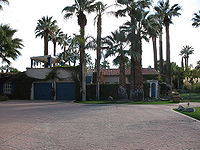 As the 1930s came to an end, both Jack and Harry Warner became increasingly alarmed over the rise of Nazism
. As Bernard F. Dick observed, the Warners, "as sons of Polish Jews who fled their homeland because of anti-Semitic pogroms ... had a personal interest in exposing Nazism." Moreover, the attraction to films critical of German militarism had a long history with the Warners that predated their production in 1918 of My Four Years in Germany. In 1917, while still in distribution, the Warners had secured the rights for War Brides, a film that featured Alla Nazimova
as "a woman who kills herself rather than breed children for an unidentified country whose army looks suspiciously Teutonic."
Beyond this, Jack Warner was shaken by the 1936 murder of studio salesman Joe Kaufman, who was beaten to death by Nazi stormtroopers in Berlin
. Warner later described the incident in the following terms: "Like many an outnumbered Jew he was trapped in an alley. They [Nazi hoodlums] hit him with fists and clubs and then kicked the life out of him with their boots and left him dying there." Hence, while other Hollywood studios sidestepped the issue, fearing domestic criticism and the loss of European markets, Warner Bros. produced films openly critical of Germany's fascist government. In 1939, the studio released Confessions of a Nazi Spy
, starring Edward G. Robinson
. The film project, which was recommended to Jack Warner by FBI Director J. Edgar Hoover
, drew on the real-life experiences of agent Leon Turrou, who had worked as an undercover agent. Despite legal ramifications preventing the use of actual names, the studio aimed for an "aura of authenticity", and Hal Wallis initially recommended eliminating credits to give the film "the appearance of a newsreel." Confessions of a Nazi Spy was widely attacked. Critic Pare Lorentz wrote, "The Warner brothers have declared war on Germany with this one." The German ambassador responded by issuing a protest to U.S. Secretary of State Cordell Hull
, and German dictator Adolf Hitler
, who screened the film at Berchtesgaden
, was outraged. Meanwhile, the studio received stern warnings from U.S. lawmaker Martin Dies
about defaming a "friendly country."
Initially, the studio bowed to pressure from the Roosevelt Administration, the Hays Office, and isolationist lawmakers to desist from similar projects. Jack Warner announced that the studio would release no more "propaganda pictures" and promptly ordered the shelving of several projects with an anti-Nazi theme. In time, however, Warner Bros. produced more films with anti-Nazi messages, including Underground and All Through the Night. In 1940, the studio produced shorts that dramatically documented the devastation wrought by the German bombing raids on London
. Meanwhile, the studio celebrated the exploits of the Royal Canadian Air Force
, with films such as Captains of the Clouds
. In 1941, Warner also produced the influential pro-war film Sergeant York
. Contemporary reports that Jack Warner had banned the use of the German language throughout the company's Burbank studio were denied by studio representatives, who indicated this move would have prevented scores of studio employees from communicating with each other.
At the start of American participation in the war, like other studio heads, Jack Warner was commissioned a lieutenant colonel
in the Army of the United States
.
In 1943, Warner, at the advice of President Franklin D. Roosevelt, produced a film adaption of the controversial book Mission to Moscow
; a film intended to inspire public support for the uneasy military alliance the United States had with the Soviet Union
. Later, while testifying before the House Un-American Activities Committee
on October 27, 1947, Warner dismissed Cold War
allegations that the film was subversive, arguing that Mission to Moscow was produced "only to help a desperate war effort and not for posterity." After the film's lackluster release, the Republican National Committee accused Warner of releasing the film as "New Deal propaganda."
In line with the Warner brothers' early opposition to Nazism, Warner Bros. produced more pictures about the war than any other studio, covering every branch of the armed services. In addition, the studio produced patriotic musicals such as This is the Army
and Yankee Doodle Dandy
.
with a weekly show, Warner Bros. Presents
. The studio followed up with a series of Western dramas, such as Maverick
, Bronco
, and Colt .45
. Within a few years, Warner, accustomed to dealing with actors in a high-handed manner, provoked hostility among emerging TV stars like James Garner
, who filed a lawsuit against Warner Bros. over a contract dispute. He was angered by the perceived ingratitude of television actors, who evidently showed more independence than film actors, and this deepened his contempt for the new medium. Following his deal with ABC, Warner also made his son, Jack Jr., head of the company's new television department
.
During this period, Warner showed little foresight in his treatment of the studio's cartoon operation. Animated characters such as Bugs Bunny
, Daffy Duck
, and Porky Pig
, while embraced by cartoon lovers, "were always stepchildren at Warner Bros." As biographer Bob Thomas wrote, "Jack Warner...considered cartoons no more than an extraneous service provided to exhibitors who wanted a full program for their customers." In 1953, during a rare meeting between the Warners and the studio's cartoon makers, Jack confessed that he didn't "even know where the hell the cartoon studio
is", and Harry added, "The only thing I know is that we make Mickey Mouse
," a reference to the flagship character of a competing company, Walt Disney Productions. Several years later, Jack sold all of the 400 cartoons Warner Bros. made before 1948 for $3,000 apiece. As Thomas noted, "They have since earned millions, but not for Warner Bros."
Jack Warner's tumultuous relationship with his brother, Harry, worsened in February 1956, when Harry learned of Jack's decision to sell the Warner Bros.'s pre-1950 sound films to Associated Artists Productions
(soon to merge with United Artists Television
) for the modest sum of $21 million. (The deal did not include the black-and-white Looney Tunes
films, the first Merrie Melodie
film, Lady, Play Your Mandolin!
, and the color cartoons released between August 1, 1948, and the close of 1949. The black-and-white cartoons and the silent films were sold to Guild Films under license of Sunset Productions
, which was established by Warners as its television subsidiary in the same manner as Columbia Pictures
' Screen Gems
, and the aforementioned 1948–1949 color cartoons remained with Warner Brothers). "This is our heritage, what we worked all our lives to create, and now it is gone," Harry exclaimed, upon hearing of the deal. The breach between Jack and Harry widened later that year. In July 1956, Jack, Harry, and Albert announced they were putting Warner Bros. on the market. Jack, however, secretly organized a syndicate
that purchased control of the company. By the time Harry and Albert learned of their brother's dealings, it was too late. Jack, as the company's largest stockholder, appointed himself as the new company president. Shortly after the deal was closed, Jack Warner announced that the company and its subsidiaries would be "directed more vigorously to the acquisition of the most important story properties, talents, and to the production of the finest motion pictures possible". The two brothers had often argued, and earlier in the decade, studio employees claimed they saw Harry chase Jack through the studio with a lead pipe, shouting, "I'll get you for this, you son of a bitch" and threatening to kill him. This subterfuge, however, proved too much for Harry; he never spoke to Jack again. When Harry Warner died on July 27, 1958, Jack avoided the funeral and departed for his annual vacation at Cap d'Antibes
. Asked to respond to his brother's death, Jack said, "I didn't give a shit about Harry." At the same time, Jack took pride in the fact that U.S. President Dwight D. Eisenhower
sent him a letter of condolence.
, paying an unprecedented $5.5 million. The previous owner, CBS
director William S. Paley
, set terms that included 50 percent of the distributor's gross profits "plus ownership of the negative at the end of the contract." Despite the "outrageous" purchase price, and the ungenerous terms of the contract, the deal proved lucrative for Warner Bros., securing the studio $12 million in profits. Warner was criticized for choosing a non-singing star, Audrey Hepburn
, to play the leading role of Eliza Doolittle
, and indeed that year's Academy Award for Best Actress went to Julie Andrews
, who had played Eliza on Broadway and the London Stage, for Mary Poppins, while Audrey Hepburn was not even nominated. However, the film won the best-picture Academy Award for 1964.
In 1965, Warner surprised many industry observers when he purchased the rights to Who's Afraid of Virginia Woolf?
, Edward Albee
's searing play about a destructive marriage. From the beginning, the project was beset by controversy. Ernest Lehman
's script, which was extremely faithful to Albee's play, stretched the U.S. film industry's Production Code to the limit. Jack Valenti
, who just assumed leadership of the Motion Picture Association of America
, recalled that a meeting with Warner and studio aide Ben Kalmenson left him "uneasy". "I was uncomfortable with the thought that this was just the beginning of an unsettling new era in film, in which we would lurch from crisis to crisis without any suitable solution in sight," Valenti wrote. Meanwhile, Lehman and the film's director, Mike Nichols
, battled with studio executives and exhibitors who insisted that the film be shot in color rather than black and white. These controversies soon faded into the background. Upon its release, Who's Afraid of Virginia Woolf? was embraced by audiences and critics alike. It secured 13 nominations from the Academy including one for Best Picture of 1966.
Despite these achievements, Jack grew weary of making films, and he sold a substantial amount of his studio stock to Seven Arts Productions
on November 14, 1966. Some observers believed that Ben Kalmenson, Warner Bros.'s executive vice president, persuaded Warner to sell his stock so that Kalmenson could assume leadership of the studio. Warner, however, had personal reasons for seeking retirement. His wife, Ann, continually pressured him to "slow down", and the aging studio head felt a need to put his affairs in order. Warner sold his 1.6 million shares of studio stock shortly after producing the film adaptation of Lerner & Loewe's Camelot. The sale yielded, after capital gains taxes, about $24 million (equivalent to $ million today). Eight months after the sale, Warner quipped, "Who would ever have thought that a butcher boy from Youngstown, Ohio, would end up with twenty-four million smackers in his pocket?" At the time of the sale, Warner had earned the distinction of being the second chief to also serve as company president, after Columbia Pictures
' Harry Cohn.
Warner's decision to sell came at a time when he was losing the formidable power that he once took for granted. He had already survived the dislocations of the 1950s, when other studio heads – including Louis B. Mayer
, David O. Selznick
, and Samuel Goldwyn
– were pushed out by stockholders who "sought scapegoats for dwindling profits". Structural changes that occurred in the industry during this period ensured that studios would become "more important as backers of independent producers than as creators of their own films", a situation that left little room for the traditional movie mogul. By the mid-1960s, most of the film moguls from the Golden Age of Hollywood had died, and Warner was regarded as one of the last of a dying breed. Evidence of Warner's eroding control at Warner Bros. included his failure to block production of the controversial but highly influential film, Bonnie and Clyde
, a film project he initially "hated". Similarly, as producer of the film adaptation of Camelot
, Warner was unable to persuade director Joshua Logan
to cast Richard Burton
and Julie Andrews
in the leading roles. Instead, Logan selected Richard Harris
and Vanessa Redgrave
, a move that contributed to the project's critical – and commercial – failure. Warner officially retired from his studio in 1969.
. Before the film's release, Warner showed a preview cut to U.S. President Richard Nixon
, who recommended substantial changes, including the removal of two songs that struck him as veiled criticisms of the ongoing Vietnam War
. Without consulting the film's director, Peter H. Hunt, Warner ordered the film re-edited. In November 1972, the film opened to enthusiastic audiences at Radio City Music Hall
, but it fared poorly in theaters. Faced with a polarized political climate, few Americans were drawn to "a cheery exercise in prerepublic civics". Warner's efforts to promote the film were sometimes counterproductive. During an interview with talk show host Merv Griffin
, the elderly producer engaged in a lengthy tirade against "pinko communists". This proved to be Warner's first and last television interview.
on March 27, 1916. Jack Warner named the child after himself, disregarding an Ashkenazi Jewish custom that children should not be named after living relatives. Although his son bore a different middle initial, he "has been called Junior all his life". The marriage ended in 1935, when Warner left his wife for another woman, Ann Page. Together, Warner and Ann had a daughter named Barbara. Irma Warner sued her husband for divorce (a scandalous move at the time) on the grounds of desertion. Jack's older brother, Harry, reflected the Warner family feelings about the marriage when he exclaimed, "Thank God our mother didn't live to see this". Warner married Ann after the divorce. The Warners, who took Irma's side in the affair, refused to accept Ann as a family member. In the wake of this falling out, Jack's relationship with his son, Jack Warner Jr., also became strained.
In the late 1950s, Warner was almost killed in a car accident that left him in a coma
for several days. On August 5, 1958, after an evening of baccarat
at the Palm Beach Casino in Cannes
, Warner's Alfa Romeo
roadster swerved into the path of a coal truck on a stretch of road located near the seaside villa of Prince Aly Khan
. Warner was thrown from the car, which burst into flames upon impact. Shortly after the accident, his son, Jack Jr., joined other family members in France, where the unconscious studio head was hospitalized. In an interview with reporters, Jack Jr. suggested that his father was dying. Then, during a visit to his father's hospital room, the young man offended Ann Warner, whom he largely blamed for his parents' divorce. When Warner regained consciousness, he was enraged by reports of his son's behavior, and their "tenuous" relationship came to an end. On December 30, 1958, Jack Jr. was informed, by Jack Sr.'s lawyer Arnold Grant, that the elder Warner had released him from the company. When he attempted to report for work, studio guards denied him entry. The two men never achieved a reconciliation, and Jack Jr. is not mentioned in his father's 1964 autobiography.
Warner made no pretense of faithfulness to his wife, Ann, and kept a series of mistresses throughout the 1950s and 1960s. The most enduring of these "girlfriends" was an aspiring actress named Jackie Park, who bore a "startling" resemblance to Warner's second wife. The relationship was in its fourth year when Ann Warner pressed her husband to terminate the affair. Although aware of his many infidelities, Ann remained loyal to Warner, though she did once have an affair with studio actor Eddie Albert
in 1941. In the 1960s, she insisted that, despite his reputation for ruthlessness, Jack Warner had a softer side. In a note to author Dean Jennings, who assisted Warner on his 1964 autobiography, My First Hundred Years in Hollywood, Ann Warner wrote: "He is extremely sensitive, but there are few who know that because he covers it with a cloak."
political views. In 1947, however, Warner served as a "friendly witness" for the House Un-American Activities Committee
(HUAC), thereby lending support to allegations of a "Red" infiltration of Hollywood. Warner felt that Communists were responsible for the studio's month-long strike that occurred in the fall of 1946, and on his own initiative, he provided the names of a dozen screenwriters who were dismissed because of suspected Communist sympathies, a move that effectively destroyed their careers. Former studio employees named by Warner included Alvah Bessie, Howard Koch
, Ring Lardner Jr.
, John Howard Lawson
, Albert Maltz
, Robert Rossen
, Dalton Trumbo
, Clifford Odets
, and Irwin Shaw
. As one biographer observed, Warner "was furious when Humphrey Bogart
, Lauren Bacall
, Paul Henreid and John Huston
joined other members of the stellar Committee for the First Amendment
in a flight to Washington
to preach against the threat to free expression". Lester D. Friedman noted that Warner's response to the HUAC hearings was similar to other Jewish studio heads who "feared that a blanket equation of Communists with Jews would destroy them and their industry".
Warner publicly supported Richard Nixon during the 1960 presidential election and paid for full-page ads in The New York Times
"to proclaim why Nixon should be elected". In the wake of Nixon's loss to John F. Kennedy
, however, the studio head made arrangements to attend a fundraiser at the Los Angeles Palladium
in honor of the president-elect. Several weeks later, Warner received a phone call from the new chief executive's father, Joseph P. Kennedy, and within a short time, Warner Bros. purchased the film rights for Robert Donovan's book, PT 109
, a bestseller concerning John Kennedy's exploits during World War II. "I don't think President Kennedy would object to my friendship with Dick Nixon," Warner said later. "I would have voted for both of them if I could. You might think this is a form of fence-straddling, but I love everybody." In the late 1960s, he emerged as an outspoken proponent of the Vietnam War
.
, the synagogue to which many members of the Warner family belonged. He was interred at Home of Peace Cemetery
in East Los Angeles, California
.
Jack Warner left behind an estate estimated at $15 million. Much of the Warner estate, including property and memorabilia, was bequeathed to his widow, Ann. Warner, however, left $200,000 to his estranged son, Jack Jr., perhaps in an effort to discourage him from contesting the will. In the days following Warner's death, newspaper obituaries recounted the familiar story of "the four brothers who left the family butcher shop for nicklelodeons" and went on to revolutionize American cinema. A front-page story in Warner's adopted hometown of Youngstown featured accounts of the family's pre-Hollywood struggles in Ohio, describing how Jack Warner drove a wagon for his father's business when he was only seven years old. The late movie [mogul] was widely eulogized for his role in "shaping Hollywood's 'Golden Age'".
Several months after Warner's death, a more personal tribute was organized by the Friends of the Libraries at the University of Southern California
. The event, called "The Colonel: An Affectionate Remembrance of Jack L. Warner", drew Hollywood notables such as entertainers Olivia de Havilland
and Debbie Reynolds
, and cartoon voice actor Mel Blanc
. Blanc closed the event with a rendition of Porky Pig's famous farewell, "A-bee-a-bee-a-bee–that's all, folks." In recognition of his contributions to the motion picture industry, Jack Warner was accorded a star on the Hollywood Walk of Fame
, located at 6541 Hollywood Boulevard. He is also represented on Canada's Walk of Fame
in Toronto
, which honours outstanding Canadians from all fields.
London, Ontario
London is a city in Southwestern Ontario, Canada, situated along the Quebec City – Windsor Corridor. The city has a population of 352,395, and the metropolitan area has a population of 457,720, according to the 2006 Canadian census; the metro population in 2009 was estimated at 489,274. The city...
, was a Canadian American film executive who was the president and driving force behind the Warner Bros. Studios
Warner Bros.
Warner Bros. Entertainment, Inc., also known as Warner Bros. Pictures or simply Warner Bros. , is an American producer of film and television entertainment.One of the major film studios, it is a subsidiary of Time Warner, with its headquarters in Burbank,...
in Hollywood
Hollywood, Los Angeles, California
Hollywood is a famous district in Los Angeles, California, United States situated west-northwest of downtown Los Angeles. Due to its fame and cultural identity as the historical center of movie studios and movie stars, the word Hollywood is often used as a metonym of American cinema...
, Los Angeles
Los Angeles, California
Los Angeles , with a population at the 2010 United States Census of 3,792,621, is the most populous city in California, USA and the second most populous in the United States, after New York City. It has an area of , and is located in Southern California...
, California
California
California is a state located on the West Coast of the United States. It is by far the most populous U.S. state, and the third-largest by land area...
. Warner's 45-year career was longer than that of any other traditional Hollywood studio tycoon
Business magnate
A business magnate, sometimes referred to as a capitalist, czar, mogul, tycoon, baron, oligarch, or industrialist, is an informal term used to refer to an entrepreneur who has reached prominence and derived a notable amount of wealth from a particular industry .-Etymology:The word magnate itself...
.
As co-head of production at Warner Bros. Studios, he worked with his brother, Sam Warner
Sam Warner
Samuel Louis "Sam" Warner was an American film producer who was the co-founder and chief executive officer of Warner Bros. Studios. He established the studio along with his brothers Harry, Albert, and Jack Warner. Sam Warner is credited with procuring the technology that enabled Warner Bros...
, to procure the technology for the film industry's first talking picture. After Sam's death, Jack clashed with his surviving older brothers, Harry
Harry Warner
Harry Morris Warner was an American studio executive, one of the founders of Warner Bros., and a major contributor to the development of the film industry. Along with his three brothers Warner played a crucial role in the film business and played a key role in establishing Warner Bros...
and Albert Warner
Albert Warner
Aaron "Albert" Warner was a Polish-born American film executive who was one of the founders of Warner Bros. Studios. He established the production studio with his brothers Harry, Sam, and Jack Warner...
. He assumed exclusive control of the film production company in the 1950s, when he secretly purchased his brothers' shares in the business after convincing them to participate in a joint sale of stocks.
Although Warner was feared by many of his employees and inspired ridicule with his uneven attempts at humor, he earned respect for his shrewd instincts and toughmindedness. He recruited many of Warner Bros.'s top stars and promoted the hard-edged social dramas for which the studio became known. Given to decisiveness, Warner once commented, "If I'm right fifty-one percent of the time, I'm ahead of the game."
Throughout his career, he was viewed as a contradictory and enigmatic figure. Although he was a staunch Republican, Warner encouraged film projects that promoted the agenda of Democratic President Franklin D. Roosevelt
Franklin D. Roosevelt
Franklin Delano Roosevelt , also known by his initials, FDR, was the 32nd President of the United States and a central figure in world events during the mid-20th century, leading the United States during a time of worldwide economic crisis and world war...
's New Deal
New Deal
The New Deal was a series of economic programs implemented in the United States between 1933 and 1936. They were passed by the U.S. Congress during the first term of President Franklin D. Roosevelt. The programs were Roosevelt's responses to the Great Depression, and focused on what historians call...
. He opposed European fascism
Fascism
Fascism is a radical authoritarian nationalist political ideology. Fascists seek to rejuvenate their nation based on commitment to the national community as an organic entity, in which individuals are bound together in national identity by suprapersonal connections of ancestry, culture, and blood...
and criticized Nazi Germany
Nazi Germany
Nazi Germany , also known as the Third Reich , but officially called German Reich from 1933 to 1943 and Greater German Reich from 26 June 1943 onward, is the name commonly used to refer to the state of Germany from 1933 to 1945, when it was a totalitarian dictatorship ruled by...
well before America's involvement in World War II
World War II
World War II, or the Second World War , was a global conflict lasting from 1939 to 1945, involving most of the world's nations—including all of the great powers—eventually forming two opposing military alliances: the Allies and the Axis...
. An opponent of Communism
Communism
Communism is a social, political and economic ideology that aims at the establishment of a classless, moneyless, revolutionary and stateless socialist society structured upon common ownership of the means of production...
, after the war Warner appeared as a friendly witness before the House Un-American Activities Committee
House Un-American Activities Committee
The House Committee on Un-American Activities or House Un-American Activities Committee was an investigative committee of the United States House of Representatives. In 1969, the House changed the committee's name to "House Committee on Internal Security"...
, voluntarily naming screenwriters who had been fired as suspected Communists or sympathizers. Despite his controversial public image, Warner remained a force in the motion picture industry until his retirement in the early 1970s.
Early years
Jack Warner was born in LondonLondon, Ontario
London is a city in Southwestern Ontario, Canada, situated along the Quebec City – Windsor Corridor. The city has a population of 352,395, and the metropolitan area has a population of 457,720, according to the 2006 Canadian census; the metro population in 2009 was estimated at 489,274. The city...
, Ontario
Ontario
Ontario is a province of Canada, located in east-central Canada. It is Canada's most populous province and second largest in total area. It is home to the nation's most populous city, Toronto, and the nation's capital, Ottawa....
, Canada
Canada
Canada is a North American country consisting of ten provinces and three territories. Located in the northern part of the continent, it extends from the Atlantic Ocean in the east to the Pacific Ocean in the west, and northward into the Arctic Ocean...
in 1892. His parents were Jewish immigrants from Poland
Poland
Poland , officially the Republic of Poland , is a country in Central Europe bordered by Germany to the west; the Czech Republic and Slovakia to the south; Ukraine, Belarus and Lithuania to the east; and the Baltic Sea and Kaliningrad Oblast, a Russian exclave, to the north...
who spoke mainly Yiddish. Jack was the fifth surviving son of Benjamin Warner a cobbler from Krasnosielc
Krasnosielc
Krasnosielc is a village in Maków County , on the river Orzyc, in east-central Poland. It is the seat of the administrative district called Gmina Krasnosielc. It lies approximately north of Maków Mazowiecki and north of Warsaw. Previous names include: Sielc, Siedlec and in...
, Poland (then located in the Russian Empire
Russian Empire
The Russian Empire was a state that existed from 1721 until the Russian Revolution of 1917. It was the successor to the Tsardom of Russia and the predecessor of the Soviet Union...
) and his wife, the former Pearl Leah Eichelbaum. Following their marriage in 1876, the couple had three children in Poland, one of whom died at a young age. One of the surviving children was Jack's eldest brother, Hirsch (later Harry). The Warner family had occupied a "hostile world", where the "night-riding of cossacks, the burning of houses, and the raping of women were part of life's burden for the Jews of the 'shtetl
Shtetl
A shtetl was typically a small town with a large Jewish population in Central and Eastern Europe until The Holocaust. Shtetls were mainly found in the areas which constituted the 19th century Pale of Settlement in the Russian Empire, the Congress Kingdom of Poland, Galicia and Romania...
'". In 1888, in search of a better future for his family and himself, Benjamin made his way to Hamburg
Hamburg
-History:The first historic name for the city was, according to Claudius Ptolemy's reports, Treva.But the city takes its modern name, Hamburg, from the first permanent building on the site, a castle whose construction was ordered by the Emperor Charlemagne in AD 808...
, Germany
Germany
Germany , officially the Federal Republic of Germany , is a federal parliamentary republic in Europe. The country consists of 16 states while the capital and largest city is Berlin. Germany covers an area of 357,021 km2 and has a largely temperate seasonal climate...
, and then took a ship to America. The Warner surname was perhaps originally "Wonsal" or "Wonskolaser" Upon arriving in New York City
New York City
New York is the most populous city in the United States and the center of the New York Metropolitan Area, one of the most populous metropolitan areas in the world. New York exerts a significant impact upon global commerce, finance, media, art, fashion, research, technology, education, and...
, Benjamin introduced himself as "Benjamin Warner", and the surname "Warner" remained with him for the rest of his life. Pearl Warner and the couple's two children joined him in Baltimore, Maryland
Maryland
Maryland is a U.S. state located in the Mid Atlantic region of the United States, bordering Virginia, West Virginia, and the District of Columbia to its south and west; Pennsylvania to its north; and Delaware to its east...
, less than a year later. In Baltimore, the couple had five more children, including Abraham (later known as Albert) and Sam Warner.
Benjamin Warner's decision to move to Canada in the early 1890s was inspired by a friend's advice that he could make an excellent living bartering tin wares with trappers in exchange for furs. Their sons Jack and David were born in Ontario. After two arduous years in Canada, Benjamin and Pearl Warner returned to Baltimore, bringing along their growing family. Two more children, Sadie and Milton, were added to the household there. In 1896, the family relocated to Youngstown
Youngstown, Ohio
Youngstown is a city in the U.S. state of Ohio and the county seat of Mahoning County; it also extends into Trumbull County. The municipality is situated on the Mahoning River, approximately southeast of Cleveland and northwest of Pittsburgh, Pennsylvania...
, Ohio
Ohio
Ohio is a Midwestern state in the United States. The 34th largest state by area in the U.S.,it is the 7th‑most populous with over 11.5 million residents, containing several major American cities and seven metropolitan areas with populations of 500,000 or more.The state's capital is Columbus...
, following the lead of Harry Warner, who established a shoe repair shop in the heart of the emerging industrial town. Benjamin worked with his son Harry in the shoe repair shop until he secured a loan to open a meat counter and grocery store in the city's downtown area.
Jack spent much of his youth in Youngstown. He observed in his autobiography that his experiences there molded his sensibilities. Warner wrote: "J. Edgar Hoover
J. Edgar Hoover
John Edgar Hoover was the first Director of the Federal Bureau of Investigation of the United States. Appointed director of the Bureau of Investigation—predecessor to the FBI—in 1924, he was instrumental in founding the FBI in 1935, where he remained director until his death in 1972...
told me that Youngstown in those days was one of the toughest cities in America, and a gathering place for Sicilian
Sicily
Sicily is a region of Italy, and is the largest island in the Mediterranean Sea. Along with the surrounding minor islands, it constitutes an autonomous region of Italy, the Regione Autonoma Siciliana Sicily has a rich and unique culture, especially with regard to the arts, music, literature,...
thugs active in the Mafia
Mafia
The Mafia is a criminal syndicate that emerged in the mid-nineteenth century in Sicily, Italy. It is a loose association of criminal groups that share a common organizational structure and code of conduct, and whose common enterprise is protection racketeering...
. There was a murder or two almost every Saturday night in our neighborhood, and knives and brass knuckles
Brass knuckles
Brass knuckles, also sometimes called knuckles, knucks, brass knucks, or knuckledusters, are weapons used in hand-to-hand combat. Brass knuckles are pieces of metal, usually steel despite their name, shaped to fit around the knuckles...
were standard equipment for the young hotheads on the prowl." Warner claimed that he briefly belonged to a street gang based at Westlake's Crossing, a notorious neighborhood located just west of the city's downtown area. Meanwhile, he received his first taste of show business
Show business
Show business, sometimes shortened to show biz, is a vernacular term for all aspects of entertainment. The word applies to all aspects of the entertainment industry from the business side to the creative element ....
in the burgeoning steel town
Rust Belt
The Rust Belt is a term that gained currency in the 1980s as the informal description of an area straddling the Midwestern and Northeastern United States, in which local economies traditionally garnered an increased manufacturing sector to add jobs and corporate profits...
, singing at local theaters and forming a brief business partnership with another aspiring "song-and-dance man". During his brief career in vaudeville
Vaudeville
Vaudeville was a theatrical genre of variety entertainment in the United States and Canada from the early 1880s until the early 1930s. Each performance was made up of a series of separate, unrelated acts grouped together on a common bill...
, he officially changed his name to Jack Leonard Warner. Jack's older brother Sam disapproved of these youthful pursuits. "Get out front where they pay the actors," Sam Warner advised Jack. "That's where the money is."
Early business ventures
In Youngstown, the Warner brothers took their first tentative steps into the entertainment industry. In the early 20th century, Sam Warner formed a business partnership with another local resident and "took over" the city's Old Grand Opera House, which he used as a venue for "cheap vaudeville and photoplays". The venture failed after one summer. Sam Warner then secured a job as a projectionistProjectionist
A Projectionist is a person who operates a movie projector. In the strict sense of the term this means any movie projector and therefore could include someone who operates the projector in a home video show or school. In common usage the term is generally understood to describe a paid employee of...
at Idora Park
Idora Park, Youngstown
Idora Park was a northeastern Ohio amusement park popularly known as "Youngstown's Million Dollar Playground."Built by the Youngstown Park and Falls Street Railway Company, the park's expansion coincided with the growth of the South Side of Youngstown, Ohio, in the Fosterville neighborhood...
, a local amusement park. He convinced the family of the new medium's possibilities and negotiated the purchase of a Model B Kinetoscope
Kinetoscope
The Kinetoscope is an early motion picture exhibition device. Though not a movie projector—it was designed for films to be viewed individually through the window of a cabinet housing its components—the Kinetoscope introduced the basic approach that would become the standard for all cinematic...
from a projectionist who was "down on his luck". The purchase price was $1,000, and Jack Warner contributed $150 to the venture by pawning a horse, according to his obituary.
The enterprising brothers screened a well-used copy of The Great Train Robbery
The Great Train Robbery (1903 film)
The Great Train Robbery is a 1903 American action Western film by Edwin S. Porter. Twelve minutes long, it is considered a milestone in film making, expanding on Porter's previous work Life of an American Fireman. The film used a number of innovative techniques including cross cutting, double...
throughout Ohio
Ohio
Ohio is a Midwestern state in the United States. The 34th largest state by area in the U.S.,it is the 7th‑most populous with over 11.5 million residents, containing several major American cities and seven metropolitan areas with populations of 500,000 or more.The state's capital is Columbus...
and Pennsylvania
Pennsylvania
The Commonwealth of Pennsylvania is a U.S. state that is located in the Northeastern and Mid-Atlantic regions of the United States. The state borders Delaware and Maryland to the south, West Virginia to the southwest, Ohio to the west, New York and Ontario, Canada, to the north, and New Jersey to...
before renting a vacant store in New Castle, Pennsylvania
New Castle, Pennsylvania
New Castle is a city in Lawrence County, Pennsylvania, United States, northwest of Pittsburgh and near the Pennsylvania-Ohio border just east of Youngstown, Ohio; in 1910, the total population was 36,280; in 1920, 44,938; and in 1940, 47,638. The population has fallen to 26,309 according to the...
. This makeshift theatre, called the Bijou, was furnished with chairs borrowed from a local undertaker. Jack, who was still living in Youngstown at the time, arrived on weekends "to sing illustrated song-slides during reel changes". In 1906, the brothers purchased a small theater in New Castle, which they called the Cascade Movie Palace. They maintained the theater until moving into film distribution in 1907. That year, the Warner brothers established the Pittsburgh
Pittsburgh, Pennsylvania
Pittsburgh is the second-largest city in the US Commonwealth of Pennsylvania and the county seat of Allegheny County. Regionally, it anchors the largest urban area of Appalachia and the Ohio River Valley, and nationally, it is the 22nd-largest urban area in the United States...
-based Duquesne Amusement Company, a distribution firm that proved lucrative until the advent of Thomas Edison
Thomas Edison
Thomas Alva Edison was an American inventor and businessman. He developed many devices that greatly influenced life around the world, including the phonograph, the motion picture camera, and a long-lasting, practical electric light bulb. In addition, he created the world’s first industrial...
's Motion Picture Patents Company
Motion Picture Patents Company
The Motion Picture Patents Company , founded in December 1908, was a trust of all the major American film companies , the leading film distributor and the biggest supplier of raw film stock, Eastman Kodak...
(also known as the Edison Trust), which charged distributors exorbitant fees. In 1909, Harry agreed to bring Jack into the family business; he sent his younger brother to Norfolk, Virginia
Norfolk, Virginia
Norfolk is an independent city in the Commonwealth of Virginia in the United States. With a population of 242,803 as of the 2010 Census, it is Virginia's second-largest city behind neighboring Virginia Beach....
, where Jack assisted Sam in the operation of a second film exchange company. Later that year, the Warners sold the family business to the General Film Company for "$10,000 in cash, $12,000 in preferred stock, and payments over a four-year period for a total of $52,000" (equivalent to $ today).
Formation of Warner Bros.
The Warner brothers pooled their resources and moved into film production in 1910. Then, in 1912, they lent their support to filmmaker Carl LaemmleCarl Laemmle
Carl Laemmle , born in Laupheim, Württemberg, Germany, was a pioneer in American film making and a founder of one of the original major Hollywood movie studios - Universal...
's Independent Motion Picture Company, which challenged the monopolistic control of the Edison Trust. That same year, Jack Warner acquired a job as a film splicer in New York, where he assisted brother Sam with the production of the film, Dante's Inferno. Despite the film's success at the box office, Harry Warner remained concerned about the economic threat presented by the Edison Trust. He subsequently broke with Laemmle and sent Jack to establish a film exchange in San Francisco, while Sam did the same in Los Angeles. The brothers were soon poised to exploit the expanding California movie market. In 1917, Jack was sent to Los Angeles to open another film exchange company. Their first opportunity to produce a major film came in 1918, when they purchased the film rights for My Four Years in Germany, a bestselling novel that condemned German wartime atrocities. The film proved to be a commercial and critical success, and the four brothers were able to establish a studio in California. In the new studio, Jack became co-head of production along with his older brother, Sam. In this capacity, the two brothers secured new scripts and story lines, managed film production, and looked for ways to reduce production costs.
Culver City, California
Culver City is a city in western Los Angeles County, California. As of the 2010 census, the city had a population of 38,883, up from 38,816 at the 2000 census. It is mostly surrounded by the city of Los Angeles, but also shares a border with unincorporated areas of Los Angeles County. Culver...
, to Hollywood, where they purchased a lot on the corner of Sunset Boulevard
Sunset Boulevard
Sunset Boulevard is a street in the western part of Los Angeles County, California, that stretches from Figueroa Street in downtown Los Angeles to the Pacific Coast Highway at the Pacific Ocean in the Pacific Palisades...
and Bronson Avenue., known today as Sunset Bronson Studios. The new location and upgraded facilities did not significantly improve the studio's image, which remained defined by its low-budget comedies and racy films on declining morality.
The studio discovered a trained German Shepherd
German Shepherd Dog
The German Shepherd Dog , also known as an Alsatian or just the German Shepherd, is a breed of large-sized dog that originated in Germany. The German Shepherd is a relatively new breed of dog, with its origin dating to 1899. As part of the Herding Group, the German Shepherd is a working dog...
named Rin Tin Tin
Rin Tin Tin
Rin Tin Tin was the name given to a dog adopted from a WWI battlefield that went on to star in twenty-three Hollywood films. The name was subsequently given to several related German Shepherd dogs featured in fictional stories on film, radio and television.-Origins:The first of the line Rin Tin...
in 1923. The canine made his debut in Where the North Begins, a film about an abandoned pup who is raised by wolves and befriends a fur trapper. According to one biographer, Jack Warner's initial doubts about the project were quelled when he met Rin Tin Tin, "who seemed to display more intelligence than some of the Warner comics." Rin Tin Tin proved to be the studio's most important commercial asset until the introduction of sound. Screenwriter Darryl F. Zanuck
Darryl F. Zanuck
Darryl Francis Zanuck was an American producer, writer, actor, director and studio executive who played a major part in the Hollywood studio system as one of its longest survivors...
produced several scripts for Rin Tin Tin vehicles and, during one year, wrote more than half of the studio's features. Between 1928 and 1933, Zanuck served as Jack Warner's right-hand man and executive producer, a position whose responsibilities included the day-to-day production of films. Despite the success of Rin Tin Tin and other projects, however, Warner Bros. was unable to compete with Hollywood's "Big Three" – Paramount, Universal
Universal Studios
Universal Pictures , a subsidiary of NBCUniversal, is one of the six major movie studios....
, and First National
First National
First National was an association of independent theater owners in the United States that expanded from exhibiting movies to distributing them, and eventually to producing them as a movie studio, called First National Pictures, Inc. It later merged with Warner Bros.-Early history:The First National...
studios.
Western Electric
Western Electric Company was an American electrical engineering company, the manufacturing arm of AT&T from 1881 to 1995. It was the scene of a number of technological innovations and also some seminal developments in industrial management...
to develop a series of talking "shorts" using the newly developed Vitaphone
Vitaphone
Vitaphone was a sound film process used on feature films and nearly 1,000 short subjects produced by Warner Bros. and its sister studio First National from 1926 to 1930. Vitaphone was the last, but most successful, of the sound-on-disc processes...
technology. Sam died of pneumonia in 1927 (just before the premiere of the first feature-length talking picture, The Jazz Singer
The Jazz Singer (1927 film)
The Jazz Singer is a 1927 American musical film. The first feature-length motion picture with synchronized dialogue sequences, its release heralded the commercial ascendance of the "talkies" and the decline of the silent film era. Produced by Warner Bros. with its Vitaphone sound-on-disc system,...
), and Jack became sole head of production. Sam's death left Jack unconsolable. One biographer writes, "Throughout his life, Jack had been warmed by Sam's sunshiny optimism, his thirst for excitement, his inventive mind, his gambling nature. Sam had also served as a buffer between Jack and his stern eldest brother, Harry. In the years to come, Jack ran the Warner Bros. Burbank
Burbank, California
Burbank is a city in Los Angeles County in Southern California, United States, north of downtown Los Angeles. The estimated population in 2010 was 103,340....
studio with an iron hand. Following his brother's death, he became increasingly difficult to deal with and inspired the resentment of many of his employees.
As the family grieved over Sam's sudden passing, the success of The Jazz Singer helped establish Warner Bros. as a major studio. While Warner Bros. invested only $500,000 in the film, the studio reaped $3 million in profits. Hollywood's five major studios, which controlled most of the nation's movie theaters, initially attempted to block the growth of "talking pictures". In the face of such organized opposition, Warner Bros. produced 12 "talkies" in 1928 alone. The following year, the newly formed Academy of Motion Picture Arts and Sciences
Academy of Motion Picture Arts and Sciences
The Academy of Motion Picture Arts and Sciences is a professional honorary organization dedicated to the advancement of the arts and sciences of motion pictures...
recognized Warner Bros. for "revolutionizing the industry with sound".
Despite Warner Bros.'s new prosperity, Jack kept a tight rein on costs. He placed the studio's directors on a quota system, and decreed a flat, low-key lighting style to make the sets look cheaper than they were.
Depression era
The studio emerged relatively unscathed from the Wall Street Crash of 1929 and produced a broad range of films, including "backstage musicals," "crusading biopics," "swashbucklers," and "women's pictures." As Thomas Schatz observed, this repertoire was "a means of stabilizing marketing and sales, of bringing efficiency and economy into the production of some fifty feature films per year, and of distinguishing Warners' collective output from that of its competitors". Warner Bros. became best known, however, for its hard-hitting social dramas, whose production Jack Warner tended to support. These included gangster classics such as Little CaesarLittle Caesar (film)
Little Caesar is a 1931 Warner Bros. Pre-Code crime film. It tells the story of a hoodlum who ascends the ranks of organized crime until he reaches its upper echelons. Directed by Mervyn LeRoy, the film stars Edward G. Robinson and Douglas Fairbanks, Jr.. The story was adapted by Francis Edward...
and The Public Enemy
The Public Enemy
The Public Enemy is a 1931 American Pre-Code crime film starring James Cagney and directed by William A. Wellman. The film relates the story of a young man's rise in the criminal underworld in prohibition-era urban America...
as well as the critically acclaimed I Am a Fugitive from a Chain Gang
I Am a Fugitive from a Chain Gang
I Am a Fugitive from a Chain Gang is a Pre-Code crime/drama film starring Paul Muni as a wrongfully convicted convict on a chain gang who escapes to Chicago. The film was written by Howard J. Green and Brown Holmes from Robert Elliott Burns's autobiography, I Am a Fugitive from a Georgia Chain...
, starring Paul Muni
Paul Muni
Paul Muni was an Austrian-Hungarian-born American stage and film actor...
. Some of these films reflected a surprising (albeit temporary) shift in Warner's political outlook. By 1932, despite his longstanding association with the Republican Party, he openly supported Democratic presidential candidate Franklin D. Roosevelt, staging a "Motion Picture and Electrical Parade Sports Pageant" at L.A. Stadium in Roosevelt's honor. This development foreshadowed an "era in which Warner would recruit the most New Dealish (often simultaneously the most left-wing) writers".
During this period, Warner took an active role in recruiting talent. To furnish Warner Bros. with much needed "star power", he raided contract players from rival studios, in some cases offering to double their salaries. This strategy yielded three leading stars from Paramount
Paramount Pictures
Paramount Pictures Corporation is an American film production and distribution company, located at 5555 Melrose Avenue in Hollywood. Founded in 1912 and currently owned by media conglomerate Viacom, it is America's oldest existing film studio; it is also the last major film studio still...
Studios – William Powell
William Powell
William Horatio Powell was an American actor.A major star at MGM, he was paired with Myrna Loy in 14 films, including the popular Thin Man series in which Powell and Loy played Nick and Nora Charles...
, Kay Francis
Kay Francis
Kay Francis was an American stage and film actress. After a brief period on Broadway in the late 1920s, she moved to film and achieved her greatest success between 1930 and 1936, when she was the number one female star at the Warner Brothers studio, and the highest paid American film actress...
, and Ruth Chatterton
Ruth Chatterton
Ruth Chatterton was an American actress, novelist, and early aviatrix.- Early life :Chatterton was born in New York City, on Christmas Eve 1892, to Walter Smith and Lillian Reed Chatterton...
. In 1929, Warner persuaded British stage and screen actor George Arliss
George Arliss
George Arliss was an English actor, author and filmmaker who found success in the United States. He was the first British actor to win an Academy Award.-Life and career:...
to play the title role in a remake of the 1921 United Artists
United Artists
United Artists Corporation is an American film studio. The original studio of that name was founded in 1919 by D. W. Griffith, Charles Chaplin, Mary Pickford and Douglas Fairbanks....
film, Disraeli
Disraeli (film)
Disraeli is a film that was adapted by Julien Josephson and De Leon Anthony from a play by Louis N. Parker. The film was directed by Alfred E. Green....
, a project that turned out to be a box-office hit. Then, in 1930, he spotted future stars James Cagney
James Cagney
James Francis Cagney, Jr. was an American actor, first on stage, then in film, where he had his greatest impact. Although he won acclaim and major awards for a wide variety of performances, he is best remembered for playing "tough guys." In 1999, the American Film Institute ranked him eighth...
, Joan Blondell
Joan Blondell
Rose Joan Blondell was an American actress who performed in movies and on television for five decades as Joan Blondell.After winning a beauty pageant, Blondell embarked upon a film career...
, and Frank McHugh
Frank McHugh
Francis Curray "Frank" McHugh was an American film and television actor.Born in Homestead, Pennsylvania, McHugh came from a theatrical family. His parents ran a stock theatre company and as a young child he performed on stage...
in the cast of a New York
New York City
New York is the most populous city in the United States and the center of the New York Metropolitan Area, one of the most populous metropolitan areas in the world. New York exerts a significant impact upon global commerce, finance, media, art, fashion, research, technology, education, and...
play called Penny Arcade. Although Cagney turned out to be Warner's greatest prize, he was also the studio executive's biggest professional challenge. During his frequent arguments with Warner, Cagney often resorted to screaming the Yiddish obscenities he learned during his upbringing in the Hell's Kitchen
Hell's Kitchen, Manhattan
Hell's Kitchen, also known as Clinton and Midtown West, is a neighborhood of Manhattan in New York City between 34th Street and 59th Street, from 8th Avenue to the Hudson River....
district of New York City. According to a 1937 Fortune
Fortune (magazine)
Fortune is a global business magazine published by Time Inc. Founded by Henry Luce in 1930, the publishing business, consisting of Time, Life, Fortune, and Sports Illustrated, grew to become Time Warner. In turn, AOL grew as it acquired Time Warner in 2000 when Time Warner was the world's largest...
magazine article, Warner's most intense contract disputes involved Cagney, "who got sick of being typed as a girl-hitting mick and of making five pictures a year instead of four."
The studio's executive producer, Darryl F. Zanuck, resigned during a contract dispute with Harry Warner in 1933. According to a 1933 letter that Jack wrote to Will H. Hays
Will H. Hays
William Harrison Hays, Sr. , was the namesake of the Hays Code for censorship of American films, chairman of the Republican National Committee and U.S. Postmaster General from 1921 to 1922....
, then president of the Motion Picture Producers and Distributors of America
Motion Picture Association of America
The Motion Picture Association of America, Inc. , originally the Motion Picture Producers and Distributors of America , was founded in 1922 and is designed to advance the business interests of its members...
, Zanuck requested a higher salary and "indicated his desire to raise the salaries of the actors and personnel in the motion pictures we were producing". That year, Zanuck established 20th Century
20th Century Fox
Twentieth Century Fox Film Corporation — also known as 20th Century Fox, or simply 20th or Fox — is one of the six major American film studios...
Studios, which merged with Fox Film Corporation in 1935. Longtime producer for the studio, Hal B. Wallis
Hal B. Wallis
Hal B. Wallis was an American film producer.-Career:Harold Brent Wallis was born in Chicago in 1898. His family moved in 1922 to Los Angeles, California, where he found work as part of the publicity department at Warner Bros...
, took over as the studio's executive producer. Warner, however, denied Wallis the sweeping powers enjoyed by Zanuck, and the result was a decentralization of creative and administrative control that often created confusion at the studio. Under the new system, each picture was assigned a supervisor who was usually plucked from the ranks of the studio's screenwriters. Although Warner Bros. maintained a high rate of production throughout the 1930s, some pictures showed an uneven quality that reflected "not only the difficulty of shifting to a supervisory system but also the consequences of dispersing authority into the creative ranks".
Meanwhile, Jack Warner's role in production became somewhat limited. After acquiring a creative property, he often had little to do with a film's production until it was ready for preview. Nevertheless, Warner could be heavyhanded in his dealings with employees, and he was "merciless in his firings." Film director Gottfried Reinhardt claimed that Warner "derived pleasure" from humiliating subordinates. "Harry Cohn
Harry Cohn
Harry Cohn was the American president and production director of Columbia Pictures.-Career:Cohn was born to a working-class German-Jewish family in New York City. In later years, he appears to have disparaged his heritage...
was a sonofabitch," Reinhardt said, "but he did it for business; he was not a sadist. [Louis B.] Mayer could be a monster, but he was not mean for the sake of meanness. Jack was."
Warner's management style frustrated many studio employees. Comedian Jack Benny
Jack Benny
Jack Benny was an American comedian, vaudevillian, and actor for radio, television, and film...
, who once worked at Warner Bros., quipped, "Jack Warner would rather tell a bad joke than make a good movie"; Warner frequently clashed with actors and supposedly banned them from the studio's executive dining room, with the explanation, "I don't need to look at actors when I eat." The studio executive did, however, win the affection of a few film personalities. Among these was Bette Davis
Bette Davis
Ruth Elizabeth "Bette" Davis was an American actress of film, television and theater. Noted for her willingness to play unsympathetic characters, she was highly regarded for her performances in a range of film genres, from contemporary crime melodramas to historical and period films and occasional...
, one of the studio's leading stars, who once fled to England to secure release from her contract. In later years, Davis defended Warner against rumors of sexual impropriety when she wrote: "No lecherous boss was he! His sins lay elsewhere. He was the father. The power. The glory. And he was in business to make money." Davis revealed that, after the birth of her child, Warner's attitude toward her became warm and protective. "We became father and child, no question about it." she said. "He told me I didn't have to come back to work until I really felt like it. He was a thoughtful man. Not many nice things were said about him." Warner also earned the gratitude and affection of Errol Flynn
Errol Flynn
Errol Leslie Flynn was an Australian-born actor. He was known for his romantic swashbuckler roles in Hollywood films, being a legend and his flamboyant lifestyle.-Early life:...
. In 1935, the studio head personally selected Flynn for the title role of Captain Blood, even though Flynn was an unknown actor at the time. In 1936, following the success of another costume epic, The Charge of the Light Brigade
The Charge of the Light Brigade (1936 film)
The Charge of the Light Brigade is a 1936 historical film made by Warner Bros. It was directed by Michael Curtiz and produced by Samuel Bischoff, with Hal B. Wallis as executive producer, from a screenplay by Michael Jacoby and Rowland Leigh, from a story by Michael Jacoby based on the poem The...
, Warner tore up Flynn's contract and signed him to a long-term deal that doubled his weekly salary.
Pre-war and war years
Nazism
Nazism, the common short form name of National Socialism was the ideology and practice of the Nazi Party and of Nazi Germany...
. As Bernard F. Dick observed, the Warners, "as sons of Polish Jews who fled their homeland because of anti-Semitic pogroms ... had a personal interest in exposing Nazism." Moreover, the attraction to films critical of German militarism had a long history with the Warners that predated their production in 1918 of My Four Years in Germany. In 1917, while still in distribution, the Warners had secured the rights for War Brides, a film that featured Alla Nazimova
Alla Nazimova
Alla Nazimova , was a Russian American film and theatre actress, a screenwriter and film producer. She is perhaps best known as simply Nazimova, but also went under the name Alia Nasimoff.-Early life:...
as "a woman who kills herself rather than breed children for an unidentified country whose army looks suspiciously Teutonic."
Beyond this, Jack Warner was shaken by the 1936 murder of studio salesman Joe Kaufman, who was beaten to death by Nazi stormtroopers in Berlin
Berlin
Berlin is the capital city of Germany and is one of the 16 states of Germany. With a population of 3.45 million people, Berlin is Germany's largest city. It is the second most populous city proper and the seventh most populous urban area in the European Union...
. Warner later described the incident in the following terms: "Like many an outnumbered Jew he was trapped in an alley. They [Nazi hoodlums] hit him with fists and clubs and then kicked the life out of him with their boots and left him dying there." Hence, while other Hollywood studios sidestepped the issue, fearing domestic criticism and the loss of European markets, Warner Bros. produced films openly critical of Germany's fascist government. In 1939, the studio released Confessions of a Nazi Spy
Confessions of a Nazi Spy
Confessions of a Nazi Spy is a 1939 American spy thriller film and the first blatantly anti-Nazi film produced by a major Hollywood studio prior to World War II. The film stars Edward G. Robinson, Francis Lederer, George Sanders, and a large cast of German actors, including some who had emigrated...
, starring Edward G. Robinson
Edward G. Robinson
Edward G. Robinson was a Romanian-born American actor. A popular star during Hollywood's Golden Age, he is best remembered for his roles as gangsters, such as Rico in his star-making film Little Caesar and as Rocco in Key Largo...
. The film project, which was recommended to Jack Warner by FBI Director J. Edgar Hoover
J. Edgar Hoover
John Edgar Hoover was the first Director of the Federal Bureau of Investigation of the United States. Appointed director of the Bureau of Investigation—predecessor to the FBI—in 1924, he was instrumental in founding the FBI in 1935, where he remained director until his death in 1972...
, drew on the real-life experiences of agent Leon Turrou, who had worked as an undercover agent. Despite legal ramifications preventing the use of actual names, the studio aimed for an "aura of authenticity", and Hal Wallis initially recommended eliminating credits to give the film "the appearance of a newsreel." Confessions of a Nazi Spy was widely attacked. Critic Pare Lorentz wrote, "The Warner brothers have declared war on Germany with this one." The German ambassador responded by issuing a protest to U.S. Secretary of State Cordell Hull
Cordell Hull
Cordell Hull was an American politician from the U.S. state of Tennessee. He is best known as the longest-serving Secretary of State, holding the position for 11 years in the administration of President Franklin Delano Roosevelt during much of World War II...
, and German dictator Adolf Hitler
Adolf Hitler
Adolf Hitler was an Austrian-born German politician and the leader of the National Socialist German Workers Party , commonly referred to as the Nazi Party). He was Chancellor of Germany from 1933 to 1945, and head of state from 1934 to 1945...
, who screened the film at Berchtesgaden
Berchtesgaden
Berchtesgaden is a municipality in the German Bavarian Alps. It is located in the south district of Berchtesgadener Land in Bavaria, near the border with Austria, some 30 km south of Salzburg and 180 km southeast of Munich...
, was outraged. Meanwhile, the studio received stern warnings from U.S. lawmaker Martin Dies
Martin Dies, Jr.
Martin Dies, Jr. was a Texas politician and a Democratic member of the United States House of Representatives. His father, Martin Dies, was also a member of the United States House of Representatives.-Biography:...
about defaming a "friendly country."
Initially, the studio bowed to pressure from the Roosevelt Administration, the Hays Office, and isolationist lawmakers to desist from similar projects. Jack Warner announced that the studio would release no more "propaganda pictures" and promptly ordered the shelving of several projects with an anti-Nazi theme. In time, however, Warner Bros. produced more films with anti-Nazi messages, including Underground and All Through the Night. In 1940, the studio produced shorts that dramatically documented the devastation wrought by the German bombing raids on London
London
London is the capital city of :England and the :United Kingdom, the largest metropolitan area in the United Kingdom, and the largest urban zone in the European Union by most measures. Located on the River Thames, London has been a major settlement for two millennia, its history going back to its...
. Meanwhile, the studio celebrated the exploits of the Royal Canadian Air Force
Royal Canadian Air Force
The history of the Royal Canadian Air Force begins in 1920, when the air force was created as the Canadian Air Force . In 1924 the CAF was renamed the Royal Canadian Air Force and granted royal sanction by King George V. The RCAF existed as an independent service until 1968...
, with films such as Captains of the Clouds
Captains of the Clouds
Captains of the Clouds is a 1942 Warner Bros. war film in Technicolor, directed by Michael Curtiz and starring James Cagney. It was produced by William Cagney , with Hal B. Wallis as executive producer. The screenplay was written by Arthur T. Horman, Richard Macaulay and Norman Reilly Raine,...
. In 1941, Warner also produced the influential pro-war film Sergeant York
Sergeant York
Sergeant York is a 1941 biographical film about the life of Alvin York, the most-decorated American soldier of World War I. It was directed by Howard Hawks and was the highest-grossing film of the year....
. Contemporary reports that Jack Warner had banned the use of the German language throughout the company's Burbank studio were denied by studio representatives, who indicated this move would have prevented scores of studio employees from communicating with each other.
At the start of American participation in the war, like other studio heads, Jack Warner was commissioned a lieutenant colonel
Lieutenant colonel
Lieutenant colonel is a rank of commissioned officer in the armies and most marine forces and some air forces of the world, typically ranking above a major and below a colonel. The rank of lieutenant colonel is often shortened to simply "colonel" in conversation and in unofficial correspondence...
in the Army of the United States
Army of the United States
The Army of the United States is the official name for the conscription force of the United States Army that may be raised at the discretion of the United States Congress in the event of the United States entering into a major armed conflict...
.
In 1943, Warner, at the advice of President Franklin D. Roosevelt, produced a film adaption of the controversial book Mission to Moscow
Mission to Moscow
Mission to Moscow is a book by the former U.S. Ambassador to the Soviet Union Joseph E. Davies published by Simon and Schuster in 1941. It was adapted into a film directed by Michael Curtiz in 1943....
; a film intended to inspire public support for the uneasy military alliance the United States had with the Soviet Union
Soviet Union
The Soviet Union , officially the Union of Soviet Socialist Republics , was a constitutionally socialist state that existed in Eurasia between 1922 and 1991....
. Later, while testifying before the House Un-American Activities Committee
House Un-American Activities Committee
The House Committee on Un-American Activities or House Un-American Activities Committee was an investigative committee of the United States House of Representatives. In 1969, the House changed the committee's name to "House Committee on Internal Security"...
on October 27, 1947, Warner dismissed Cold War
Cold War
The Cold War was the continuing state from roughly 1946 to 1991 of political conflict, military tension, proxy wars, and economic competition between the Communist World—primarily the Soviet Union and its satellite states and allies—and the powers of the Western world, primarily the United States...
allegations that the film was subversive, arguing that Mission to Moscow was produced "only to help a desperate war effort and not for posterity." After the film's lackluster release, the Republican National Committee accused Warner of releasing the film as "New Deal propaganda."
In line with the Warner brothers' early opposition to Nazism, Warner Bros. produced more pictures about the war than any other studio, covering every branch of the armed services. In addition, the studio produced patriotic musicals such as This is the Army
This Is the Army
This Is the Army is a 1943 American wartime motion picture produced by Hal B. Wallis and Jack L. Warner, and directed by Michael Curtiz, and a wartime musical designed to boost morale in the U.S. during World War II, directed by Sgt. Ezra Stone...
and Yankee Doodle Dandy
Yankee Doodle Dandy
Yankee Doodle Dandy is a 1942 American biographical musical film about George M. Cohan, known as "The Man Who Owns Broadway". It stars James Cagney, Joan Leslie, Walter Huston, and Richard Whorf, and features Irene Manning, George Tobias, Rosemary DeCamp and Jeanne Cagney.The movie was written by...
.
Postwar era
Jack Warner responded grudgingly to the rising popularity of television in the late 1940s. Initially, he tried to compete with the new medium, introducing gimmicks such as 3-D films, which soon lost their appeal among moviegoers. In 1954, Warner finally engaged the new medium, providing ABCAmerican Broadcasting Company
The American Broadcasting Company is an American commercial broadcasting television network. Created in 1943 from the former NBC Blue radio network, ABC is owned by The Walt Disney Company and is part of Disney-ABC Television Group. Its first broadcast on television was in 1948...
with a weekly show, Warner Bros. Presents
Warner Bros. Presents
Warner Bros. Presents is the umbrella title for three series telecast as part of the 1955-56 season on ABC: Cheyenne, a new Western series that originated on Presents, and two based on classic Warner Bros. films, Casablanca and Kings Row....
. The studio followed up with a series of Western dramas, such as Maverick
Maverick (TV series)
Maverick is a western television series with comedic overtones created by Roy Huggins. The show ran from September 22, 1957 to July 8, 1962 on ABC and stars James Garner as Bret Maverick, a cagey, articulate cardsharp. Eight episodes into the first season, he was joined by Jack Kelly as his brother...
, Bronco
Bronco (TV series)
Bronco is a Western series on ABC from 1958 through 1962. It was shown by the BBC in the United Kingdom. The program starred Ty Hardin as Bronco Layne, a former Confederate officer who wandered the Old West, meeting such well-known individuals as Wild Bill Hickok, Billy the Kid, Jesse James,...
, and Colt .45
Colt .45 (TV series)
Colt .45 is an American Western television series shown on ABC between 1957 and 1960. The half-hour show derives from the 1950 Warner Brothers film of the same name starring Randolph Scott and formed part of the William T...
. Within a few years, Warner, accustomed to dealing with actors in a high-handed manner, provoked hostility among emerging TV stars like James Garner
James Garner
James Garner is an American film and television actor, one of the first Hollywood actors to excel in both media. He has starred in several television series spanning a career of more than five decades...
, who filed a lawsuit against Warner Bros. over a contract dispute. He was angered by the perceived ingratitude of television actors, who evidently showed more independence than film actors, and this deepened his contempt for the new medium. Following his deal with ABC, Warner also made his son, Jack Jr., head of the company's new television department
Warner Bros. Television
Warner Bros. Television is the television production arm of Warner Bros. Entertainment, itself part of Time Warner. Alongside CBS Television Studios, it serves as a television production arm of The CW Television Network , though it also produces shows for other networks, such as Shameless on...
.
During this period, Warner showed little foresight in his treatment of the studio's cartoon operation. Animated characters such as Bugs Bunny
Bugs Bunny
Bugs Bunny is a animated character created in 1938 at Leon Schlesinger Productions, later Warner Bros. Cartoons. Bugs is an anthropomorphic gray rabbit and is famous for his flippant, insouciant personality and his portrayal as a trickster. He has primarily appeared in animated cartoons, most...
, Daffy Duck
Daffy Duck
Daffy Duck is an animated cartoon character in the Warner Bros. Looney Tunes and Merrie Melodies series of cartoons, often running the gamut between being the best friend and sometimes arch-rival of Bugs Bunny...
, and Porky Pig
Porky Pig
Porky Pig is an animated cartoon character in the Warner Bros. Looney Tunes and Merrie Melodies series of cartoons. He was the first character created by the studio to draw audiences based on his star power, and the animators created many critically acclaimed shorts using the fat little pig...
, while embraced by cartoon lovers, "were always stepchildren at Warner Bros." As biographer Bob Thomas wrote, "Jack Warner...considered cartoons no more than an extraneous service provided to exhibitors who wanted a full program for their customers." In 1953, during a rare meeting between the Warners and the studio's cartoon makers, Jack confessed that he didn't "even know where the hell the cartoon studio
Warner Bros. Cartoons
Warner Bros. Cartoons, Inc. was the in-house division of Warner Bros. Pictures during the Golden Age of American animation. One of the most successful animation studios in American media history, Warner Bros. Cartoons was primarily responsible for the Looney Tunes and Merrie Melodies theatrical...
is", and Harry added, "The only thing I know is that we make Mickey Mouse
Mickey Mouse
Mickey Mouse is a cartoon character created in 1928 by Walt Disney and Ub Iwerks at The Walt Disney Studio. Mickey is an anthropomorphic black mouse and typically wears red shorts, large yellow shoes, and white gloves...
," a reference to the flagship character of a competing company, Walt Disney Productions. Several years later, Jack sold all of the 400 cartoons Warner Bros. made before 1948 for $3,000 apiece. As Thomas noted, "They have since earned millions, but not for Warner Bros."
Jack Warner's tumultuous relationship with his brother, Harry, worsened in February 1956, when Harry learned of Jack's decision to sell the Warner Bros.'s pre-1950 sound films to Associated Artists Productions
Associated Artists Productions
Associated Artists Productions was a distributor of theatrical feature films and short subjects for television. It existed from 1953 to 1958. It was later folded into United Artists. The former a.a.p. library was later owned by MGM/UA Entertainment and then Turner Entertainment. Turner continues...
(soon to merge with United Artists Television
United Artists Television
-Background:UA purchased Associated Artists Productions in 1958, giving UA access to the pre-1950 Warner Bros. library and the Popeye cartoons made by Fleischer Studios and Famous Studios between 1933 and 1957....
) for the modest sum of $21 million. (The deal did not include the black-and-white Looney Tunes
Looney Tunes
Looney Tunes is a Warner Bros. animated cartoon series. It preceded the Merrie Melodies series and was Warner Bros.'s first animated theatrical series. Since its first official release, 1930's Sinkin' in the Bathtub, the series has become a worldwide media franchise, spawning several television...
films, the first Merrie Melodie
Merrie Melodies
Merrie Melodies is the name of a series of animated cartoons distributed by Warner Bros. Pictures between 1931 and 1969.Originally produced by Harman-Ising Pictures, Merrie Melodies were produced by Leon Schlesinger Productions from 1933 to 1944. Schlesinger sold his studio to Warner Bros. in 1944,...
film, Lady, Play Your Mandolin!
Lady, Play Your Mandolin!
Lady, Play Your Mandolin! was the first Warner Bros. Merrie Melodies cartoon, directed by Rudolf Ising of Harman and Ising. It was originally released in August 1931.-Overview:...
, and the color cartoons released between August 1, 1948, and the close of 1949. The black-and-white cartoons and the silent films were sold to Guild Films under license of Sunset Productions
Sunset Productions
Sunset Productions was a television syndication division of Warner Bros. which existed in the 1950s.-Overview:Sunset Productions is best known as the company identified on a package of black-and-white Warner Bros. cartoons distributed in television syndication in the early 1950s...
, which was established by Warners as its television subsidiary in the same manner as Columbia Pictures
Columbia Pictures
Columbia Pictures Industries, Inc. is an American film production and distribution company. Columbia Pictures now forms part of the Columbia TriStar Motion Picture Group, owned by Sony Pictures Entertainment, a subsidiary of the Japanese conglomerate Sony. It is one of the leading film companies...
' Screen Gems
Screen Gems
Screen Gems is an American movie production company and subsidiary company of Sony Pictures Entertainment's Columbia TriStar Motion Picture Group that has served several different purposes for its parent companies over the decades since its incorporation....
, and the aforementioned 1948–1949 color cartoons remained with Warner Brothers). "This is our heritage, what we worked all our lives to create, and now it is gone," Harry exclaimed, upon hearing of the deal. The breach between Jack and Harry widened later that year. In July 1956, Jack, Harry, and Albert announced they were putting Warner Bros. on the market. Jack, however, secretly organized a syndicate
Syndicate
A syndicate is a self-organizing group of individuals, companies or entities formed to transact some specific business, or to promote a common interest or in the case of criminals, to engage in organized crime...
that purchased control of the company. By the time Harry and Albert learned of their brother's dealings, it was too late. Jack, as the company's largest stockholder, appointed himself as the new company president. Shortly after the deal was closed, Jack Warner announced that the company and its subsidiaries would be "directed more vigorously to the acquisition of the most important story properties, talents, and to the production of the finest motion pictures possible". The two brothers had often argued, and earlier in the decade, studio employees claimed they saw Harry chase Jack through the studio with a lead pipe, shouting, "I'll get you for this, you son of a bitch" and threatening to kill him. This subterfuge, however, proved too much for Harry; he never spoke to Jack again. When Harry Warner died on July 27, 1958, Jack avoided the funeral and departed for his annual vacation at Cap d'Antibes
Antibes
Antibes is a resort town in the Alpes-Maritimes department in southeastern France.It lies on the Mediterranean in the Côte d'Azur, located between Cannes and Nice. The town of Juan-les-Pins is within the commune of Antibes...
. Asked to respond to his brother's death, Jack said, "I didn't give a shit about Harry." At the same time, Jack took pride in the fact that U.S. President Dwight D. Eisenhower
Dwight D. Eisenhower
Dwight David "Ike" Eisenhower was the 34th President of the United States, from 1953 until 1961. He was a five-star general in the United States Army...
sent him a letter of condolence.
The Sixties
In the 1960s, Warner kept pace with rapid changes in the industry and played a key role in developing films that were commercial and critical successes. In February 1962, he purchased the film rights for the Broadway musical, My Fair LadyMy Fair Lady
My Fair Lady is a musical based upon George Bernard Shaw's Pygmalion and with book and lyrics by Alan Jay Lerner and music by Frederick Loewe...
, paying an unprecedented $5.5 million. The previous owner, CBS
CBS
CBS Broadcasting Inc. is a major US commercial broadcasting television network, which started as a radio network. The name is derived from the initials of the network's former name, Columbia Broadcasting System. The network is sometimes referred to as the "Eye Network" in reference to the shape of...
director William S. Paley
William S. Paley
William S. Paley was the chief executive who built Columbia Broadcasting System from a small radio network into one of the foremost radio and television network operations in the United States.-Early life:...
, set terms that included 50 percent of the distributor's gross profits "plus ownership of the negative at the end of the contract." Despite the "outrageous" purchase price, and the ungenerous terms of the contract, the deal proved lucrative for Warner Bros., securing the studio $12 million in profits. Warner was criticized for choosing a non-singing star, Audrey Hepburn
Audrey Hepburn
Audrey Hepburn was a British actress and humanitarian. Although modest about her acting ability, Hepburn remains one of the world's most famous actresses of all time, remembered as a film and fashion icon of the twentieth century...
, to play the leading role of Eliza Doolittle
Eliza Doolittle
Eliza Sophie Caird , better known by her stage name Eliza Doolittle, is an English singer–songwriter from London, who signed to the Parlophone record label in October 2008. Her debut self-titled album, Eliza Doolittle was released on 12 July 2010, where it debuted at number 3 in the UK...
, and indeed that year's Academy Award for Best Actress went to Julie Andrews
Julie Andrews
Dame Julia Elizabeth Andrews, DBE is an English film and stage actress, singer, and author. She is the recipient of Golden Globe, Emmy, Grammy, BAFTA, People's Choice Award, Theatre World Award, Screen Actors Guild and Academy Award honors...
, who had played Eliza on Broadway and the London Stage, for Mary Poppins, while Audrey Hepburn was not even nominated. However, the film won the best-picture Academy Award for 1964.
In 1965, Warner surprised many industry observers when he purchased the rights to Who's Afraid of Virginia Woolf?
Who's Afraid of Virginia Woolf? (film)
Who's Afraid of Virginia Woolf? is a 1966 American drama film directed by Mike Nichols. The screenplay by Ernest Lehman is an adaptation of the play of the same title by Edward Albee...
, Edward Albee
Edward Albee
Edward Franklin Albee III is an American playwright who is best known for The Zoo Story , The Sandbox , Who's Afraid of Virginia Woolf? , and a rewrite of the screenplay for the unsuccessful musical version of Capote's Breakfast at Tiffany's . His works are considered well-crafted, often...
's searing play about a destructive marriage. From the beginning, the project was beset by controversy. Ernest Lehman
Ernest Lehman
Ernest Lehman was an American screenwriter. He received 6 Academy Award nominations during his screenwriting career...
's script, which was extremely faithful to Albee's play, stretched the U.S. film industry's Production Code to the limit. Jack Valenti
Jack Valenti
Jack Joseph Valenti was a long-time president of the Motion Picture Association of America. During his 38-year tenure in the MPAA, he created the MPAA film rating system, and he was generally regarded as one of the most influential pro-copyright lobbyists in the world...
, who just assumed leadership of the Motion Picture Association of America
Motion Picture Association of America
The Motion Picture Association of America, Inc. , originally the Motion Picture Producers and Distributors of America , was founded in 1922 and is designed to advance the business interests of its members...
, recalled that a meeting with Warner and studio aide Ben Kalmenson left him "uneasy". "I was uncomfortable with the thought that this was just the beginning of an unsettling new era in film, in which we would lurch from crisis to crisis without any suitable solution in sight," Valenti wrote. Meanwhile, Lehman and the film's director, Mike Nichols
Mike Nichols
Mike Nichols is a German-born American television, stage and film director, writer, producer and comedian. He began his career in the 1950s as one half of the comedy duo Nichols and May, along with Elaine May. In 1968 he won the Academy Award for Best Director for the film The Graduate...
, battled with studio executives and exhibitors who insisted that the film be shot in color rather than black and white. These controversies soon faded into the background. Upon its release, Who's Afraid of Virginia Woolf? was embraced by audiences and critics alike. It secured 13 nominations from the Academy including one for Best Picture of 1966.
Despite these achievements, Jack grew weary of making films, and he sold a substantial amount of his studio stock to Seven Arts Productions
Seven Arts Productions
Seven Arts Productions was founded in 1957 by Ray Stark and Eliot Hyman. The company was a frequent producer of movies for other studios, including The Misfits for United Artists, Gigot for Twentieth Century-Fox, Lolita for Metro-Goldwyn-Mayer, and Is Paris Burning? for Paramount Pictures.Over...
on November 14, 1966. Some observers believed that Ben Kalmenson, Warner Bros.'s executive vice president, persuaded Warner to sell his stock so that Kalmenson could assume leadership of the studio. Warner, however, had personal reasons for seeking retirement. His wife, Ann, continually pressured him to "slow down", and the aging studio head felt a need to put his affairs in order. Warner sold his 1.6 million shares of studio stock shortly after producing the film adaptation of Lerner & Loewe's Camelot. The sale yielded, after capital gains taxes, about $24 million (equivalent to $ million today). Eight months after the sale, Warner quipped, "Who would ever have thought that a butcher boy from Youngstown, Ohio, would end up with twenty-four million smackers in his pocket?" At the time of the sale, Warner had earned the distinction of being the second chief to also serve as company president, after Columbia Pictures
Columbia Pictures
Columbia Pictures Industries, Inc. is an American film production and distribution company. Columbia Pictures now forms part of the Columbia TriStar Motion Picture Group, owned by Sony Pictures Entertainment, a subsidiary of the Japanese conglomerate Sony. It is one of the leading film companies...
' Harry Cohn.
Warner's decision to sell came at a time when he was losing the formidable power that he once took for granted. He had already survived the dislocations of the 1950s, when other studio heads – including Louis B. Mayer
Louis B. Mayer
Louis Burt Mayer born Lazar Meir was an American film producer. He is generally cited as the creator of the "star system" within Metro-Goldwyn-Mayer in its golden years. Known always as Louis B...
, David O. Selznick
David O. Selznick
David O. Selznick was an American film producer. He is best known for having produced Gone with the Wind and Rebecca , both of which earned him an Oscar for Best Picture.-Early years:...
, and Samuel Goldwyn
Samuel Goldwyn
Samuel Goldwyn was an American film producer, and founding contributor executive of several motion picture studios.-Biography:...
– were pushed out by stockholders who "sought scapegoats for dwindling profits". Structural changes that occurred in the industry during this period ensured that studios would become "more important as backers of independent producers than as creators of their own films", a situation that left little room for the traditional movie mogul. By the mid-1960s, most of the film moguls from the Golden Age of Hollywood had died, and Warner was regarded as one of the last of a dying breed. Evidence of Warner's eroding control at Warner Bros. included his failure to block production of the controversial but highly influential film, Bonnie and Clyde
Bonnie and Clyde (film)
The film was originally offered to François Truffaut, the best-known director of the New Wave movement, who made contributions to the script. He passed on the project to make Fahrenheit 451. The producers approached Jean-Luc Godard next...
, a film project he initially "hated". Similarly, as producer of the film adaptation of Camelot
Camelot (film)
Camelot is a 1967 film adaptation of the musical of the same name. Richard Harris stars as Arthur, Vanessa Redgrave as Guinevere, and Franco Nero as Lancelot. The film was directed by Joshua Logan.-Plot:...
, Warner was unable to persuade director Joshua Logan
Joshua Logan
Joshua Lockwood Logan III was an American stage and film director and writer.-Early years:Logan was born in Texarkana, Texas, the son of Susan and Joshua Lockwood Logan. When he was three years old his father committed suicide...
to cast Richard Burton
Richard Burton
Richard Burton, CBE was a Welsh actor. He was nominated seven times for an Academy Award, six of which were for Best Actor in a Leading Role , and was a recipient of BAFTA, Golden Globe and Tony Awards for Best Actor. Although never trained as an actor, Burton was, at one time, the highest-paid...
and Julie Andrews
Julie Andrews
Dame Julia Elizabeth Andrews, DBE is an English film and stage actress, singer, and author. She is the recipient of Golden Globe, Emmy, Grammy, BAFTA, People's Choice Award, Theatre World Award, Screen Actors Guild and Academy Award honors...
in the leading roles. Instead, Logan selected Richard Harris
Richard Harris
Richard St John Harris was an Irish actor, singer-songwriter, theatrical producer, film director and writer....
and Vanessa Redgrave
Vanessa Redgrave
Vanessa Redgrave, CBE is an English actress of stage, screen and television, as well as a political activist.She rose to prominence in 1961 playing Rosalind in As You Like It with the Royal Shakespeare Company and has since made more than 35 appearances on London's West End and Broadway, winning...
, a move that contributed to the project's critical – and commercial – failure. Warner officially retired from his studio in 1969.
After Warner Bros.
Warner remained active as an independent producer until the early 1970s. to run some of the company's distributions and exhibition division. Among his last productions was another film adaptation of a Broadway musical, 17761776 (musical)
1776 is a musical with music and lyrics by Sherman Edwards and a book by Peter Stone. The story is based on the events surrounding the signing of the Declaration of Independence...
. Before the film's release, Warner showed a preview cut to U.S. President Richard Nixon
Richard Nixon
Richard Milhous Nixon was the 37th President of the United States, serving from 1969 to 1974. The only president to resign the office, Nixon had previously served as a US representative and senator from California and as the 36th Vice President of the United States from 1953 to 1961 under...
, who recommended substantial changes, including the removal of two songs that struck him as veiled criticisms of the ongoing Vietnam War
Vietnam War
The Vietnam War was a Cold War-era military conflict that occurred in Vietnam, Laos, and Cambodia from 1 November 1955 to the fall of Saigon on 30 April 1975. This war followed the First Indochina War and was fought between North Vietnam, supported by its communist allies, and the government of...
. Without consulting the film's director, Peter H. Hunt, Warner ordered the film re-edited. In November 1972, the film opened to enthusiastic audiences at Radio City Music Hall
Radio City Music Hall
Radio City Music Hall is an entertainment venue located in New York City's Rockefeller Center. Its nickname is the Showplace of the Nation, and it was for a time the leading tourist destination in the city...
, but it fared poorly in theaters. Faced with a polarized political climate, few Americans were drawn to "a cheery exercise in prerepublic civics". Warner's efforts to promote the film were sometimes counterproductive. During an interview with talk show host Merv Griffin
Merv Griffin
Mervyn Edward "Merv" Griffin, Jr. was an American television host, musician, actor, and media mogul. He began his career as a radio and big band singer who went on to appear in movies and on Broadway. From 1965 to 1986 Griffin hosted his own talk show, The Merv Griffin Show on Group W Broadcasting...
, the elderly producer engaged in a lengthy tirade against "pinko communists". This proved to be Warner's first and last television interview.
Personal life
On October 14, 1914, Warner married Irma Solomons, the adolescent daughter of one of San Francisco's pioneer Jewish families. Irma Warner gave birth to the couple's only child, Jack M. WarnerJack M. Warner
Jack Milton Warner was a film producer and son of Warner Bros. chief Jack Warner. Warner graduated from the University of Southern California and worked in the short-subject department of the Warner Brothers studio in Burbank...
on March 27, 1916. Jack Warner named the child after himself, disregarding an Ashkenazi Jewish custom that children should not be named after living relatives. Although his son bore a different middle initial, he "has been called Junior all his life". The marriage ended in 1935, when Warner left his wife for another woman, Ann Page. Together, Warner and Ann had a daughter named Barbara. Irma Warner sued her husband for divorce (a scandalous move at the time) on the grounds of desertion. Jack's older brother, Harry, reflected the Warner family feelings about the marriage when he exclaimed, "Thank God our mother didn't live to see this". Warner married Ann after the divorce. The Warners, who took Irma's side in the affair, refused to accept Ann as a family member. In the wake of this falling out, Jack's relationship with his son, Jack Warner Jr., also became strained.
In the late 1950s, Warner was almost killed in a car accident that left him in a coma
Coma
In medicine, a coma is a state of unconsciousness, lasting more than 6 hours in which a person cannot be awakened, fails to respond normally to painful stimuli, light or sound, lacks a normal sleep-wake cycle and does not initiate voluntary actions. A person in a state of coma is described as...
for several days. On August 5, 1958, after an evening of baccarat
Baccarat
Baccarat is a card game, played at casinos and by gamblers. It is believed to have been introduced into France from Italy during the reign of King Charles VIII , and it is similar to Faro and Basset...
at the Palm Beach Casino in Cannes
Cannes
Cannes is one of the best-known cities of the French Riviera, a busy tourist destination and host of the annual Cannes Film Festival. It is a Commune of France in the Alpes-Maritimes department....
, Warner's Alfa Romeo
Alfa Romeo
Alfa Romeo Automobiles S.p.A. is an Italian manufacturer of cars. Founded as A.L.F.A. on June 24, 1910, in Milan, the company has been involved in car racing since 1911, and has a reputation for building expensive sports cars...
roadster swerved into the path of a coal truck on a stretch of road located near the seaside villa of Prince Aly Khan
Prince Aly Khan
Prince Ali Solomone Aga Khan , known as Aly Khan was a son of Aga Khan III, the head of the Ismaili Muslims, and the father of Aga Khan IV. A socialite, racehorse owner and jockey, he was the third husband of actress Rita Hayworth...
. Warner was thrown from the car, which burst into flames upon impact. Shortly after the accident, his son, Jack Jr., joined other family members in France, where the unconscious studio head was hospitalized. In an interview with reporters, Jack Jr. suggested that his father was dying. Then, during a visit to his father's hospital room, the young man offended Ann Warner, whom he largely blamed for his parents' divorce. When Warner regained consciousness, he was enraged by reports of his son's behavior, and their "tenuous" relationship came to an end. On December 30, 1958, Jack Jr. was informed, by Jack Sr.'s lawyer Arnold Grant, that the elder Warner had released him from the company. When he attempted to report for work, studio guards denied him entry. The two men never achieved a reconciliation, and Jack Jr. is not mentioned in his father's 1964 autobiography.
Warner made no pretense of faithfulness to his wife, Ann, and kept a series of mistresses throughout the 1950s and 1960s. The most enduring of these "girlfriends" was an aspiring actress named Jackie Park, who bore a "startling" resemblance to Warner's second wife. The relationship was in its fourth year when Ann Warner pressed her husband to terminate the affair. Although aware of his many infidelities, Ann remained loyal to Warner, though she did once have an affair with studio actor Eddie Albert
Eddie Albert
Edward Albert Heimberger , known professionally as Eddie Albert, was an American actor and activist. He was nominated for the Academy Award for Best Supporting Actor in 1954 for his performance in Roman Holiday, and in 1973 for The Heartbreak Kid.Other well-known screen roles of his include Bing...
in 1941. In the 1960s, she insisted that, despite his reputation for ruthlessness, Jack Warner had a softer side. In a note to author Dean Jennings, who assisted Warner on his 1964 autobiography, My First Hundred Years in Hollywood, Ann Warner wrote: "He is extremely sensitive, but there are few who know that because he covers it with a cloak."
Political views
An ardent Republican, Jack Warner nevertheless supported Franklin D. Roosevelt in the early 1930s. Later in the decade, he made common cause with opponents of Nazi Germany, overlooking ideological differences with those who held leftistLeft-wing politics
In politics, Left, left-wing and leftist generally refer to support for social change to create a more egalitarian society...
political views. In 1947, however, Warner served as a "friendly witness" for the House Un-American Activities Committee
House Un-American Activities Committee
The House Committee on Un-American Activities or House Un-American Activities Committee was an investigative committee of the United States House of Representatives. In 1969, the House changed the committee's name to "House Committee on Internal Security"...
(HUAC), thereby lending support to allegations of a "Red" infiltration of Hollywood. Warner felt that Communists were responsible for the studio's month-long strike that occurred in the fall of 1946, and on his own initiative, he provided the names of a dozen screenwriters who were dismissed because of suspected Communist sympathies, a move that effectively destroyed their careers. Former studio employees named by Warner included Alvah Bessie, Howard Koch
Howard Koch (screenwriter)
Howard E. Koch was an American playwright and screenwriter who was blacklisted by the Hollywood movie studio bosses in the 1950s.-Early Years:...
, Ring Lardner Jr.
Ring Lardner Jr.
Ringgold Wilmer "Ring" Lardner, Jr. was an American journalist and screenwriter blacklisted by the Hollywood movie studios during the Red Scare of the late 1940s and 1950s.-Early life:...
, John Howard Lawson
John Howard Lawson
John Howard Lawson was an American writer. He was head of the Hollywood division of the Communist Party USA. He was also the cell's cultural manager, and answered directly to V.J. Jerome, the Party's New York-based cultural chief...
, Albert Maltz
Albert Maltz
Albert Maltz was an American author and screenwriter. He was one of the Hollywood Ten who were later blacklisted by the Hollywood movie studio bosses....
, Robert Rossen
Robert Rossen
Robert Rossen was an American screenwriter, film director, and producer whose film career spanned almost three decades. His 1949 film All the King's Men won Oscars for Best Picture, Best Actor and Best Supporting Actress, while Rossen was nominated for an Oscar as Best Director...
, Dalton Trumbo
Dalton Trumbo
James Dalton Trumbo was an American screenwriter and novelist, and one of the Hollywood Ten, a group of film professionals who refused to testify before the House Un-American Activities Committee in 1947 during the committee's investigation of Communist influences in the motion picture industry...
, Clifford Odets
Clifford Odets
Clifford Odets was an American playwright, screenwriter, socialist, and social protester.-Early life:Odets was born in Philadelphia to Romanian- and Russian-Jewish immigrant parents, Louis Odets and Esther Geisinger, and raised in Philadelphia and the Bronx, New York. He dropped out of high...
, and Irwin Shaw
Irwin Shaw
Irwin Shaw was a prolific American playwright, screenwriter, novelist, and short-story author whose written works have sold more than 14 million copies. He is best-known for his novel, The Young Lions about the fate of three soldiers during World War II that was made into a film starring Marlon...
. As one biographer observed, Warner "was furious when Humphrey Bogart
Humphrey Bogart
Humphrey DeForest Bogart was an American actor. He is widely regarded as a cultural icon.The American Film Institute ranked Bogart as the greatest male star in the history of American cinema....
, Lauren Bacall
Lauren Bacall
Lauren Bacall is an American film and stage actress and model, known for her distinctive husky voice and sultry looks.She first emerged as leading lady in the Humphrey Bogart film To Have And Have Not and continued on in the film noir genre, with appearances in The Big Sleep and Dark Passage ,...
, Paul Henreid and John Huston
John Huston
John Marcellus Huston was an American film director, screenwriter and actor. He wrote most of the 37 feature films he directed, many of which are today considered classics: The Maltese Falcon , The Treasure of the Sierra Madre , Key Largo , The Asphalt Jungle , The African Queen , Moulin Rouge...
joined other members of the stellar Committee for the First Amendment
Committee for the First Amendment
The Committee for the First Amendment was an action group formed in September 1947 by actors in support of the Hollywood Ten during the hearings of the House Un-American Activities Committee...
in a flight to Washington
Washington, D.C.
Washington, D.C., formally the District of Columbia and commonly referred to as Washington, "the District", or simply D.C., is the capital of the United States. On July 16, 1790, the United States Congress approved the creation of a permanent national capital as permitted by the U.S. Constitution....
to preach against the threat to free expression". Lester D. Friedman noted that Warner's response to the HUAC hearings was similar to other Jewish studio heads who "feared that a blanket equation of Communists with Jews would destroy them and their industry".
Warner publicly supported Richard Nixon during the 1960 presidential election and paid for full-page ads in The New York Times
The New York Times
The New York Times is an American daily newspaper founded and continuously published in New York City since 1851. The New York Times has won 106 Pulitzer Prizes, the most of any news organization...
"to proclaim why Nixon should be elected". In the wake of Nixon's loss to John F. Kennedy
John F. Kennedy
John Fitzgerald "Jack" Kennedy , often referred to by his initials JFK, was the 35th President of the United States, serving from 1961 until his assassination in 1963....
, however, the studio head made arrangements to attend a fundraiser at the Los Angeles Palladium
Hollywood Palladium
The Hollywood Palladium is a theater located at 6215 Sunset Boulevard in Hollywood, California. It was built in a Streamline Moderne, Art Deco style and includes an 11,200 square foot dance floor with room for up to 4,000 people.-History:...
in honor of the president-elect. Several weeks later, Warner received a phone call from the new chief executive's father, Joseph P. Kennedy, and within a short time, Warner Bros. purchased the film rights for Robert Donovan's book, PT 109
PT 109 (film)
PT 109 is a 1963 biographical film which depicts the actions of John F. Kennedy in command of Motor Torpedo Boat PT-109 as an officer of the United States Navy during World War II. The movie was adapted by Vincent Flaherty and Howard Sheehan from the book PT 109: John F. Kennedy in World War II by...
, a bestseller concerning John Kennedy's exploits during World War II. "I don't think President Kennedy would object to my friendship with Dick Nixon," Warner said later. "I would have voted for both of them if I could. You might think this is a form of fence-straddling, but I love everybody." In the late 1960s, he emerged as an outspoken proponent of the Vietnam War
Vietnam War
The Vietnam War was a Cold War-era military conflict that occurred in Vietnam, Laos, and Cambodia from 1 November 1955 to the fall of Saigon on 30 April 1975. This war followed the First Indochina War and was fought between North Vietnam, supported by its communist allies, and the government of...
.
Death and legacy
By the end of 1973, those closest to Warner became aware of signs that he was becoming disoriented. Shortly after losing his way in the building that housed his own office, Warner retired. In 1974, the former studio chief suffered a stroke that left him blind and enfeebled. During the next several years, he gradually lost the ability to speak and became unresponsive to friends and relatives. Finally, on August 13, 1978, Warner was admitted to Cedars-Sinai Hospital, where he died of a heart inflammation (edema) on September 9. He was 86 years old. A funeral service was held at the Wilshire Boulevard TempleWilshire Boulevard Temple
Wilshire Boulevard Temple, founded in 1862 as Congregation B'nai B'rith, is the oldest Jewish congregation in Los Angeles, California. One of the country’s most respected Reform congregations, Wilshire Boulevard Temple's magnificent sanctuary, with its iconic dome and Warner Murals, is a City of...
, the synagogue to which many members of the Warner family belonged. He was interred at Home of Peace Cemetery
Home of Peace Cemetery
The Home of Peace Cemetery is a Jewish cemetery located at 4334 Whittier Boulevard west of Interstate 710 in East Los Angeles, California.The cemetery is located across from Calvary Catholic Cemetery and next to Beth Israel Cemetery and Mount Zion Cemetery .There are a number of famous rabbis...
in East Los Angeles, California
East Los Angeles, California
East Los Angeles is an unincorporated area and census-designated place in Los Angeles County, California, United States...
.
Jack Warner left behind an estate estimated at $15 million. Much of the Warner estate, including property and memorabilia, was bequeathed to his widow, Ann. Warner, however, left $200,000 to his estranged son, Jack Jr., perhaps in an effort to discourage him from contesting the will. In the days following Warner's death, newspaper obituaries recounted the familiar story of "the four brothers who left the family butcher shop for nicklelodeons" and went on to revolutionize American cinema. A front-page story in Warner's adopted hometown of Youngstown featured accounts of the family's pre-Hollywood struggles in Ohio, describing how Jack Warner drove a wagon for his father's business when he was only seven years old. The late movie [mogul] was widely eulogized for his role in "shaping Hollywood's 'Golden Age'".
Several months after Warner's death, a more personal tribute was organized by the Friends of the Libraries at the University of Southern California
University of Southern California
The University of Southern California is a private, not-for-profit, nonsectarian, research university located in Los Angeles, California, United States. USC was founded in 1880, making it California's oldest private research university...
. The event, called "The Colonel: An Affectionate Remembrance of Jack L. Warner", drew Hollywood notables such as entertainers Olivia de Havilland
Olivia de Havilland
Olivia Mary de Havilland is a British American film and stage actress. She won the Academy Award for Best Actress in 1946 and 1949. She is the elder sister of actress Joan Fontaine. The sisters are among the last surviving leading ladies from Hollywood of the 1930s.-Early life:Olivia de Havilland...
and Debbie Reynolds
Debbie Reynolds
Debbie Reynolds is an American actress, singer, and dancer.She was initially signed at age 16 by Warner Bros., but her career got off to a slow start. When her contract was not renewed, Metro-Goldwyn-Mayer gave her a small, but significant part in the film Three Little Words , then signed her to...
, and cartoon voice actor Mel Blanc
Mel Blanc
Melvin Jerome "Mel" Blanc was an American voice actor and comedian. Although he began his nearly six-decade-long career performing in radio commercials, Blanc is best remembered for his work with Warner Bros...
. Blanc closed the event with a rendition of Porky Pig's famous farewell, "A-bee-a-bee-a-bee–that's all, folks." In recognition of his contributions to the motion picture industry, Jack Warner was accorded a star on the Hollywood Walk of Fame
Hollywood Walk of Fame
The Hollywood Walk of Fame consists of more than 2,400 five-pointed terrazzo and brass stars embedded in the sidewalks along fifteen blocks of Hollywood Boulevard and three blocks of Vine Street in Hollywood, California...
, located at 6541 Hollywood Boulevard. He is also represented on Canada's Walk of Fame
Canada's Walk of Fame
Canada's Walk of Fame , located in Toronto, Ontario, Canada, is a walk of fame that acknowledges the achievements and accomplishments of successful Canadians...
in Toronto
Toronto
Toronto is the provincial capital of Ontario and the largest city in Canada. It is located in Southern Ontario on the northwestern shore of Lake Ontario. A relatively modern city, Toronto's history dates back to the late-18th century, when its land was first purchased by the British monarchy from...
, which honours outstanding Canadians from all fields.