
Home      Discussion      Topics      Dictionary      Almanac
Signup       Login
Kinetoscope

Kinetoscope

Overview

Discussion
Ask a question about 'Kinetoscope'
Start a new discussion about 'Kinetoscope'
Answer questions from other users
Full Discussion Forum
 
Unanswered Questions
Encyclopedia

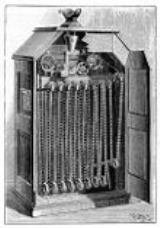
The Kinetoscope is an early motion picture
Film
A film, also called a movie or motion picture, is a series of still or moving images. It is produced by recording photographic images with cameras, or by creating images using animation techniques or visual effects...

 exhibition device. Though not a movie projector
Movie projector
A movie projector is an opto-mechanical device for displaying moving pictures by projecting them on a projection screen. Most of the optical and mechanical elements, except for the illumination and sound devices, are present in movie cameras.-Physiology:...

—it was designed for films to be viewed individually through the window of a cabinet housing its components—the Kinetoscope introduced the basic approach that would become the standard for all cinematic projection before the advent of video
Video
Video is the technology of electronically capturing, recording, processing, storing, transmitting, and reconstructing a sequence of still images representing scenes in motion.- History :...

: it creates the illusion of movement by conveying a strip of perforated film
Film perforations
Film perforations, also known as perfs, are the holes placed in the film stock during manufacturing and used for transporting and steadying the film. Films may have different types of perforations depending on film gauge, film format, and the intended usage...

 bearing sequential images over a light source with a high-speed shutter. First described in conceptual terms by U.S. inventor Thomas Edison in 1888, it was largely developed by his employee William Kennedy Laurie Dickson between 1889 and 1892. Dickson and his team at the Edison lab also devised the Kinetograph, an innovative motion picture camera
Movie camera
The movie camera is a type of photographic camera which takes a rapid sequence of photographs on strips of film which was very popular for private use in the last century until its successor, the video camera, replaced it...

 with rapid intermittent, or stop-and-go, film movement, to photograph movies for in-house experiments and, eventually, commercial Kinetoscope presentations.

On April 14, 1894, the first commercial exhibition of motion pictures in history was given in New York City, using ten Kinetoscopes. Instrumental to the birth of American movie culture, the Kinetoscope also had a major impact in Europe; its influence abroad was magnified by Edison's decision not to seek international patents on the device, facilitating numerous imitations of and improvements on the technology. In 1895, Edison introduced the Kinetophone, which joined the Kinetoscope with a cylinder
Phonograph cylinder
Phonograph cylinders were the earliest commercial medium for recording and reproducing sound. Commonly known simply as "records" in their era of greatest popularity , these cylinder shaped objects had an audio recording engraved on the outside surface which could be reproduced when the cylinder was...

 phonograph
Phonograph
The phonograph record player, or gramophone is a device introduced in 1877 that has had continued common use for reproducing sound recordings, although when first developed, the phonograph was used to both record and reproduce sounds...

. Film projection, which Edison initially disdained as financially nonviable, soon superseded the Kinetoscope's individual exhibition model. Many of the projection systems developed by Edison's firm in later years would use the Kinetoscope name.

Development


An encounter with the work and ideas of photographic pioneer Eadweard Muybridge
Eadweard Muybridge
Eadweard J. Muybridge was an English photographer who spent much of his life in the United States. He is known for his pioneering work on animal locomotion which used multiple cameras to capture motion, and his zoopraxiscope, a device for projecting motion pictures that pre-dated the flexible...

 appears to have spurred Edison to pursue the development of a motion picture system. On February 25, 1888, in Orange, New Jersey
Orange, New Jersey
The City of Orange is a city and township in Essex County, New Jersey, United States. As of the 2010 United States Census, the township population was 30,134...

, Muybridge gave a lecture that may have included a demonstration of his zoopraxiscope
Zoopraxiscope
The zoopraxiscope is an early device for displaying motion pictures. Created by photographic pioneer Eadweard Muybridge in 1879, it may be considered the first movie projector. The zoopraxiscope projected images from rotating glass disks in rapid succession to give the impression of motion. The...

, a device that projected sequential images drawn around the edge of a glass disc, producing the illusion of motion. The Edison facility was very close by, and the lecture was possibly attended by both Edison and his company's official photographer, William Dickson. Two days later, Muybridge and Edison met at Edison's laboratory in West Orange
West Orange, New Jersey
West Orange is a township in central Essex County, New Jersey, United States. As of the 2010 United States Census, the township population was 46,207...

; Muybridge later described how he proposed a collaboration to join his device with the Edison phonograph—a combination system that would play sound and images concurrently. No such collaboration was undertaken, but in October 1888, Edison filed a preliminary claim, known as a caveat, with the U.S. Patent Office
United States Patent and Trademark Office
The United States Patent and Trademark Office is an agency in the United States Department of Commerce that issues patents to inventors and businesses for their inventions, and trademark registration for product and intellectual property identification.The USPTO is based in Alexandria, Virginia,...

 announcing his plans to create a device that would do "for the Eye what the phonograph does for the Ear". It is clear that it was intended as part of a complete audiovisual system: "we may see & hear a whole Opera as perfectly as if actually present". In March 1889, a second caveat was filed, in which the proposed motion picture device was given a name, Kinetoscope, derived from the Greek roots kineto- ("movement") and scopos ("to view").

Edison assigned Dickson, one of his most talented employees, to the job of making the Kinetoscope a reality. Edison would take full credit for the invention, but the historiographical consensus is that the title of creator can hardly go to one man:

While Edison seems to have conceived the idea and initiated the experiments, Dickson apparently performed the bulk of the experimentation, leading most modern scholars to assign Dickson with the major credit for turning the concept into a practical reality. The Edison laboratory, though, worked as a collaborative organization. Laboratory assistants were assigned to work on many projects while Edison supervised and involved himself and participated to varying degrees.


Dickson and his then lead assistant, Charles Brown, made halting progress at first. Edison's original idea involved recording pinpoint photographs, 1/32 of an inch wide, directly on to a cylinder (also referred to as a "drum"); the cylinder, made of an opaque material for positive images or of glass for negatives, was coated in collodion
Collodion
Collodion is a flammable, syrupy solution of pyroxylin in ether and alcohol. There are two basic types; flexible and non-flexible. The flexible type is often used as a surgical dressing or to hold dressings in place. When painted on the skin, collodion dries to form a flexible cellulose film...

 to provide a photographic base. An audio cylinder would provide synchronized sound, while the rotating images, hardly operatic in scale, were viewed through a microscope-like tube. When tests were made with images expanded to a mere 1/8 of an inch in width, the coarseness of the silver bromide
Silver halide
A silver halide is one of the compounds formed between silver and one of the halogens — silver bromide , chloride , iodide , and three forms of silver fluorides. As a group, they are often referred to as the silver halides, and are often given the pseudo-chemical notation AgX...

 emulsion
Photographic film
Photographic film is a sheet of plastic coated with an emulsion containing light-sensitive silver halide salts with variable crystal sizes that determine the sensitivity, contrast and resolution of the film...

 used on the cylinder became unacceptably apparent. Around June 1889, the lab began working with sensitized celluloid sheets, supplied by John Carbutt, that could be wrapped around the cylinder, providing a far superior base for the recording of photographs. The first film made for the Kinetoscope, and apparently the first motion picture ever produced on photographic film in the United States, may have been shot at this time (there is an unresolved debate over whether it was made in June 1889 or November 1890); known as Monkeyshines, No. 1
Monkeyshines, No. 1
Monkeyshines is believed to be the first film shot in the United States. An experimental film made to test the original cylinder format of the Kinetoscope....

, it shows an employee of the lab in an apparently tongue-in-cheek display of physical dexterity. Attempts at synchronizing sound were soon left behind, while Dickson would also experiment with disc-based exhibition designs.

The project would soon head off in more productive directions, largely impelled by a trip of Edison's to Europe and the Exposition Universelle
Exposition Universelle (1889)
The Exposition Universelle of 1889 was a World's Fair held in Paris, France from 6 May to 31 October 1889.It was held during the year of the 100th anniversary of the storming of the Bastille, an event traditionally considered as the symbol for the beginning of the French Revolution...

 in Paris, for which he departed August 2 or 3, 1889. During his two months abroad, Edison visited with scientist-photographer Étienne-Jules Marey
Étienne-Jules Marey
Étienne-Jules Marey was a French scientist and chronophotographer.His work was significant in the development of cardiology, physical instrumentation, aviation, cinematography and the science of labor photography...

, who had devised a "chronophotographic gun
Chronophotography
Chronophotography is an antique photographic technique from the Victorian era , which captures movement in several frames of print. These prints can be subsequently arranged either like animation cels or layered in a single frame...

"—the first portable motion picture camera
Camera
A camera is a device that records and stores images. These images may be still photographs or moving images such as videos or movies. The term camera comes from the camera obscura , an early mechanism for projecting images...

—which used a strip of flexible film designed to capture sequential images at twelve frames per second. Upon his return to the United States, Edison filed another patent caveat, on November 2, which described a Kinetoscope based not just on a flexible filmstrip, but one in which the film was perforated to allow for its engagement by sprockets, making its mechanical conveyance much more smooth and reliable. The first motion picture system to employ a perforated image band was apparently the Théâtre Optique, patented by French inventor Charles-Émile Reynaud
Charles-Émile Reynaud
Charles-Émile Reynaud was a French science teacher, responsible for the first projected animated cartoon films....

 in 1888. Reynaud's system did not use photographic film, but images painted on gelatine frames. At the Exposition Universelle, Edison would have seen both the Théâtre Optique and the electrical tachyscope
Electrotachyscope
The électrotachyscope is an 1887 invention of Ottomar Anschütz of Germany which presents the illusion of motion with transparent serial photographs, chronophotographs, arranged on a spinning wheel of fortune or mandala-like glass disc, significant as a technological development in the history of...

 of German inventor Ottamar Anschütz. This disc-based projection device is often referred to as an important conceptual source for the development of the Kinetoscope. Its crucial innovation was to take advantage of the persistence of vision
Persistence of vision
Persistence of vision is the phenomenon of the eye by which an afterimage is thought to persist for approximately one twenty-fifth of a second on the retina....

 theory by using an intermittent light source to momentarily "freeze" the projection of each image; the goal was to facilitate the viewer's retention of many minutely different stages of a photographed activity, thus producing a highly effective illusion of constant motion. By late 1890, intermittent visibility would be integral to the Kinetoscope's design.

The question of when the Edison lab began working on a filmstrip device is a matter of historical debate. According to Dickson, in the summer of 1889, he began cutting the stiff celluloid sheets supplied by Carbutt into strips for use in such a prototype machine; in August, by his description, he attended a demonstration of George Eastman
George Eastman
George Eastman was an American innovator and entrepreneur who founded the Eastman Kodak Company and invented roll film, helping to bring photography to the mainstream...

's new flexible film and was given a roll by an Eastman representative, which was immediately applied to experiments with the prototype. As described by historian Marta Braun, Eastman's product

was sufficiently strong, thin, and pliable to permit the intermittent movement of the film strip behind [a camera] lens at considerable speed and under great tension without tearing...stimulat[ing] the almost immediate solution of the essential problems of cinematic invention.


Some scholars—in particular, Gordon Hendricks
Gordon Hendricks
Gordon Hendricks was an American art and film historian.In 1961 Hendricks published the The Edison motion picture myth in which he showed that it was not Thomas Alva Edison who should be attributed with the invention of the first device for cinema screeningss, but in fact William Kennedy Laurie...

, in The Edison Motion Picture Myth (1961)—have argued that the lab began working on a filmstrip machine much later and that Dickson and Edison misrepresented the date to establish priority for reasons of both patent protection and intellectual status. In any event, though film historian David Robinson claims that "the cylinder experiments seem to have been carried on to the bitter end" (meaning the final months of 1890), as far back as September 1889—while Edison was still in Europe, but corresponding regularly with Dickson—the lab definitely placed its first order with the Eastman company for roll film. Three more orders for roll film were placed over the next five months.

Only sporadic work was done on the Kinetoscope for much of 1890 as Dickson concentrated on Edison's unsuccessful venture into ore milling—between May and November, no expenses at all were billed to the lab's Kinetoscope account. By early 1891, however, Dickson, his new chief assistant, William Heise
William Heise
William Heise was an American film director, active in the 1890s. He 'directed' The Kiss, a 1896 short film that depicted a kiss between May Irwin and John Rice....

, and another lab employee, Charles Kayser, had succeeded in devising a functional strip-based film viewing system. In the new design, whose mechanics were housed in a wooden cabinet, a loop of horizontally configured 19 mm (3/4 inch) film ran around a series of spindles. The film, with a single row of perforations engaged by an electrically powered sprocket wheel, was drawn continuously beneath a magnifying lens. An electric lamp shone up from beneath the film, casting its circular-format images onto the lens and thence through a peephole atop the cabinet. As described by Robinson, a rapidly spinning shutter "permitted a flash of light so brief that [each] frame appeared to be frozen. This rapid series of apparently still frames appeared, thanks to the persistence of vision phenomenon, as a moving image." The lab also developed a motor
Electric motor
An electric motor converts electrical energy into mechanical energy.Most electric motors operate through the interaction of magnetic fields and current-carrying conductors to generate force...

-powered camera, the Kinetograph, capable of shooting with the new sprocketed film. To govern the intermittent movement of the film in the camera, allowing the strip to stop long enough so each frame could be fully exposed and then advancing it quickly (in about 1/460 of a second) to the next frame, the sprocket wheel that engaged the strip was driven by an escapement
Escapement
In mechanical watches and clocks, an escapement is a device that transfers energy to the timekeeping element and enables counting the number of oscillations of the timekeeping element...

 disc mechanism—the first practical system for the high-speed stop-and-go film movement that would be the foundation for the next century of cinematography
Cinematography
Cinematography is the making of lighting and camera choices when recording photographic images for cinema. It is closely related to the art of still photography...

.

On May 20, 1891, the first public demonstration of a prototype Kinetoscope was given at the laboratory for approximately 150 members of the National Federation of Women's Clubs. The New York Sun
New York Sun (historical)
The Sun was a New York newspaper that was published from 1833 until 1950. It was considered a serious paper, like the city's two more successful broadsheets, The New York Times and the New York Herald Tribune...

 described what the club women saw in the "small pine box" they encountered:

In the top of the box was a hole perhaps an inch in diameter. As they looked through the hole they saw the picture of a man. It was a most marvelous picture. It bowed and smiled and waved its hands and took off its hat with the most perfect naturalness and grace. Every motion was perfect....

The man was Dickson; the little movie, approximately three seconds long, is now referred to as Dickson Greeting
Dickson Greeting
Dickson Greeting is credited as one of the world's first films. Directed, produced by and starring motion-picture pioneer William Dickson, it displays a 3 second clip of him passing a hat in front of himself, and reaching for it with his other hand...

. On August 24, three detailed patent applications were filed: the first for a "Kinetographic Camera", the second for the camera as well, and the third for an "Apparatus for Exhibiting Photographs of Moving Objects". In the first Kinetograph application, Edison stated, "I have been able to take with a single camera and a tape-film as many as forty-six photographs per second...but I do not wish to limit the scope of my invention to this high rate of speed...since with some subjects a speed as low as thirty pictures per second or even lower is sufficient." Indeed, according to the Library of Congress archive, based on data from a study by historian Charles Musser
Charles Musser
Charles Musser is Professor of Film and American Studies at Yale University. He is a prominent film historian and documentary film maker who has "added a great deal to our knowledge of early cinema with his writings and his filmmaking."...

, Dickson Greeting and at least two other films made with the Kinetograph in 1891 were shot at 30 frames per second or even slower. The Kinetoscope application also included a plan for a stereoscopic
Stereoscopy
Stereoscopy refers to a technique for creating or enhancing the illusion of depth in an image by presenting two offset images separately to the left and right eye of the viewer. Both of these 2-D offset images are then combined in the brain to give the perception of 3-D depth...

 film projection system that was apparently abandoned.

In the spring of the following year, steps began to make coin operation, via a nickel slot, part of the mechanics of the viewing system. By autumn 1892, the design of the Kinetoscope was essentially complete. The filmstrip, based on stock manufactured first by Eastman, and then, from April 1893 onward, by New York's Blair Camera Co., was 35 mm
35 mm film
35 mm film is the film gauge most commonly used for chemical still photography and motion pictures. The name of the gauge refers to the width of the photographic film, which consists of strips 35 millimeters in width...

 (1 3/8 inches) wide; each vertically sequenced frame bore a rectangular image and four perforations on each side. Within a few years, this basic format would be adopted globally as the standard for motion picture film, which it remains to this day. The publication in the October 1892 Phonogram of cinematographic
Cinematography
Cinematography is the making of lighting and camera choices when recording photographic images for cinema. It is closely related to the art of still photography...

 sequences shot in the format demonstrates that the Kinetograph had already been reconfigured to produce movies with the new film.

As for the Kinetoscope itself, there is a significant disagreement over the location of the shutter providing the crucial intermittent visibility effect. According to a report by inventor Herman Casler
Herman Casler
Herman Casler — American inventor , was co-founder of the partnership called the K.M.C.D. Syndicate, along with W.K-L...

 described as "authoritative" by Hendricks, who personally examined five of the six still-extant first-generation devices, "Just above the film,...a shutter wheel having five spokes and a very small rectangular opening in the rim [rotates] directly over the film. An incandescent lamp...is placed below the film...and the light passes up through the film, shutter opening, and magnifying lens...to the eye of the observer placed at the opening in the top of the case." Robinson, on the other hand, says the shutter—which he agrees has only a single slit—is positioned lower, "between the lamp and film". The Casler–Hendricks description is supported by the diagrams of the Kinetoscope that accompany the 1891 patent application, in particular, diagram 2. A side view, it does not illustrate the shutter, but it shows the impossibility of it fitting between the lamp and the film without a major redesign and indicates a space that seems suitable for it between the film and the lens. Robinson's description, however, is supported by a photograph of a Kinetoscope interior that appears in Hendricks's own book.

On February 21, 1893, a patent was issued for the system that governed the intermittent movement of film in the Kinetograph. The escapement-based mechanism would be superseded within a few years by competing systems, in particular those based on the so-called Geneva drive
Geneva drive
The Geneva drive or Maltese cross is a gear mechanism that translates a continuous rotation into an intermittent rotary motion. The rotating drive wheel has a pin that reaches into a slot of the driven wheel advancing it by one step...

 or "Maltese cross" that would become the norm for both movie cameras and projectors. The exhibition device itself—which, despite erroneous accounts to the contrary, never employed intermittent film movement, only intermittent lighting or viewing—was finally awarded its patent, number 493,426, on March 14. The Kinetoscope was ready to be unveiled.

Going public


The premiere of the completed Kinetoscope was held not at the Chicago World's Fair
World's Columbian Exposition
The World's Columbian Exposition was a World's Fair held in Chicago in 1893 to celebrate the 400th anniversary of Christopher Columbus's arrival in the New World in 1492. Chicago bested New York City; Washington, D.C.; and St...

, as originally scheduled, but at the Brooklyn Institute of Arts and Sciences on May 9, 1893. The first film publicly shown on the system was Blacksmith Scene
Blacksmith Scene
Blacksmith Scene is an 1893 American short black-and-white silent film directed by William K.L...

(aka Blacksmiths); directed by Dickson and shot
Cinematography
Cinematography is the making of lighting and camera choices when recording photographic images for cinema. It is closely related to the art of still photography...

 by Heise, it was produced at the new Edison moviemaking studio, known as the Black Maria
Edison's Black Maria
The Black Maria was Thomas Edison's movie production studio in West Orange, New Jersey. It is widely referred to as America's First Movie Studio.- History :...

. Despite extensive promotion, a major display of the Kinetoscope, involving as many as twenty-five machines, never took place at the Chicago exposition. Kinetoscope production had been delayed in part because of Dickson's absence of more than eleven weeks early in the year with a nervous breakdown. Robinson argues that "[s]peculation that a single Kinetoscope reached the Fair seems to be conclusively dismissed by an 1894 leaflet issued for the launching of the invention in London," which states, "the Kinetoscope was not perfected in time for the great Fair." Hendricks, in contrast, refers to accounts in the Scientific American
Scientific American
Scientific American is a popular science magazine. It is notable for its long history of presenting science monthly to an educated but not necessarily scientific public, through its careful attention to the clarity of its text as well as the quality of its specially commissioned color graphics...

of July 21 and October 21, 1893, that constitute evidence no less "conclusive" that one Kinetoscope did make it to the fair. The weight of evidence supports Hendricks; as fair historian Stanley Appelbaum states, "Doubt has been cast on the reports of [the Kinetoscope's] actual presence at the fair, but these reports are numerous and circumstantial" (Appelbaum does err in claiming that the device was "first shown at the Exposition").
Work proceeded, though slowly, on the Kinetoscope project. On October 6, a U.S. copyright
Copyright
Copyright is a legal concept, enacted by most governments, giving the creator of an original work exclusive rights to it, usually for a limited time...

 was issued for a "publication" received by the Library of Congress
Library of Congress
The Library of Congress is the research library of the United States Congress, de facto national library of the United States, and the oldest federal cultural institution in the United States. Located in three buildings in Washington, D.C., it is the largest library in the world by shelf space and...

 consisting of "Edison Kinetoscopic Records." It remains unclear what film was awarded this, the first motion picture copyright in North America. By the turn of the year, the Kinetoscope project would be reenergized. During the first week of January 1894, a five-second film starring an Edison technician was shot at the Black Maria; Fred Ott's Sneeze
Fred Ott
Frederick P. Ott was an employee of Thomas Edison's laboratory in the 1890s. His likeness appears in two of the earliest surviving motion pictures – Edison Kinetoscopic Record of a Sneeze Frederick P. Ott (1860; New Jersey – October 24, 1936; West Orange, New Jersey) was an employee of...

, as it is now widely known, was made expressly to produce a sequence of images for an article in Harper's magazine. Never intended for exhibition, it would become one of the most famous Edison films and the first identifiable motion picture to receive a U.S. copyright. Three months later, the Kinetoscope's epochal moment arrived.

On April 14, 1894, a public Kinetoscope parlor was opened by the Holland Bros. in New York City at 1155 Broadway, on the corner of 27th Street—the first commercial motion picture house. The venue had ten machines, set up in parallel rows of five, each showing a different movie. For 25 cents a viewer could see all the films in either row; half a dollar gave access to the entire bill. The machines were purchased from the new Kinetoscope Company, which had contracted with Edison for their production; the firm, headed by Norman C. Raff and Frank R. Gammon, included among its investors Andrew M. Holland, one of the entrepreneurial siblings, and Edison's former business chief, Alfred O. Tate. The ten films that comprise the first commercial movie program, all shot at the Black Maria, were descriptively titled: Barber Shop, Bertoldi (mouth support) (Ena Bertoldi, a British vaudeville contortionist), Bertoldi (table contortion), Blacksmiths, Roosters (some manner of cock fight), Highland Dance, Horse Shoeing, Sandow (Eugen Sandow
Eugen Sandow
Eugen Sandow , born Friedrich Wilhelm Müller, was a Prussian pioneering bodybuilder in the 19th century and is often referred to as the "Father of Modern Bodybuilding".-Early life:...

, a German strongman managed by Florenz Ziegfeld
Florenz Ziegfeld
Florenz Ziegfeld, Jr. , , was an American Broadway impresario, notable for his series of theatrical revues, the Ziegfeld Follies , inspired by the Folies Bergère of Paris. He also produced the musical Show Boat...

), Trapeze, and Wrestling. As historian Charles Musser describes, a "profound transformation of American life and performance culture" had begun.

Twenty-five cents for no more than a few minutes of entertainment was hardly cheap diversion. For the same amount, one could purchase a ticket to a major vaudeville
Vaudeville
Vaudeville was a theatrical genre of variety entertainment in the United States and Canada from the early 1880s until the early 1930s. Each performance was made up of a series of separate, unrelated acts grouped together on a common bill...

 theater; when America's first amusement park
Amusement park
thumb|Cinderella Castle in [[Magic Kingdom]], [[Disney World]]Amusement and theme parks are terms for a group of entertainment attractions and rides and other events in a location for the enjoyment of large numbers of people...

 opened in Coney Island
Coney Island
Coney Island is a peninsula and beach on the Atlantic Ocean in southern Brooklyn, New York, United States. The site was formerly an outer barrier island, but became partially connected to the mainland by landfill....

 the following year, a 25-cent entrance fee covered admission to three rides, a performing sea lion show, and a dance hall. The Kinetoscope was an immediate success, however, and by June 1, the Hollands were also operating venues in Chicago and San Francisco. Entrepreneurs (including Raff and Gammon, with their own International Novelty Co.) were soon running Kinetoscope parlors and temporary exhibition venues around the United States. New firms joined the Kinetoscope Company in commissioning and marketing the machines. The Kinetoscope exhibition spaces were largely, though not uniformly, profitable. After fifty weeks in operation, the Hollands' New York parlor had generated approximately $1,400 in monthly receipts against an estimated $515 in monthly operating costs; receipts from the Chicago venue (located in a Masonic temple) were substantially lower, about $700 a month, though presumably operating costs were lower as well. For each machine, Edison's business at first generally charged $250 to the Kinetoscope Company and other distributors, which would use them in their own exhibition parlors or resell them to independent exhibitors; individual films were initially priced by Edison at $10. During the Kinetoscope's first eleven months of commercialization, the sale of viewing machines, films, and auxiliary items generated a profit of more than $85,000 for Edison's company.

One of the new firms to enter the field was the Kinetoscope Exhibition Company; the firm's partners, brothers Otway and Grey Latham, Otway's friend Enoch Rector, and their employer, Samuel J. Tilden Jr., sought to combine the popularity of the Kinetoscope with that of prizefighting
Boxing
Boxing, also called pugilism, is a combat sport in which two people fight each other using their fists. Boxing is supervised by a referee over a series of between one to three minute intervals called rounds...

. This led to a series of significant developments in the motion picture field: The Kinetograph was then capable of shooting only a 50-foot-long negative (evidence suggests 48 feet (14.6 m) feet was the longest length actually used). At 16 frames per foot, this meant a maximum running time of 20 seconds at 40 frames per second (fps), the speed most frequently employed with the camera. At the rate of 30 fps that had been used as far back as 1891, a film could run for almost 27 seconds. Hendricks identifies Sandow as having been shot at 16 fps, as does the Library of Congress in its online catalog, where its duration is listed as 40 seconds. Even at the slowest of these rates, the running time would not have been enough to accommodate a satisfactory exchange of fisticuffs; 16 fps, as well, might have been thought to give too herky-jerky a visual effect for enjoyment of the sport. The Kinetograph and Kinetoscope were modified, possibly with Rector's assistance, so they could manage filmstrips three times longer than had previously been used.

On June 14, a match with abbreviated rounds was staged between boxers Michael Leonard and Jack Cushing at the Black Maria. Seven-hundred-and-fifty feet worth of images or even more were shot at the rate of 30 fps—easily the longest motion picture to date. In August 1894, the film premiered at the Kinetoscope Exhibition Company's parlor at 83 Nassau Street in New York. A half-dozen expanded Kinetoscope machines each showed a different round of the fight for a dime, meaning sixty cents to see the complete bout. For a planned series of follow-up fights (of which the outcome of at least the first was fixed), the Lathams signed famous heavyweight James J. Corbett
James J. Corbett
James John "Gentleman Jim" Corbett was an Irish-American heavyweight boxing champion, best known as the man who defeated the great John L. Sullivan. He also coached boxing at the Olympic Club in San Francisco...

, stipulating that his image could not be recorded by any other Kinetoscope company—the first movie star contract.

Just three months after the commercial debut of the motion picture came the first recorded instance of motion picture censorship. The film in question showed a performance by the Spanish dancer Carmencita, a New York music hall star since the beginning of the decade. According to one description of her live act, she "communicated an intense sexuality across the footlights that led male reporters to write long, exuberant columns about her performance"—articles that would later be reproduced in the Edison film catalog. The Kinetoscope movie of her dance, shot at the Black Maria in mid-March 1894, was playing in the New Jersey resort town Asbury Park
Asbury Park, New Jersey
Asbury Park is a city in Monmouth County, New Jersey, United States, located on the Jersey Shore and part of the New York City Metropolitan Area. As of the 2010 United States Census, the city population was 16,116. The city is known for its rich musical history, including its association with...

 by summer. The town's founder, James A. Bradley, a real estate developer and leading member of the Methodist
Methodism
Methodism is a movement of Protestant Christianity represented by a number of denominations and organizations, claiming a total of approximately seventy million adherents worldwide. The movement traces its roots to John Wesley's evangelistic revival movement within Anglicanism. His younger brother...

 community, had recently been elected a state senator: "The Newark Evening News of 17 July 1894 reported that [Senator] Bradley...was so shocked by the glimpse of Carmencita's ankles and lace that he complained to Mayor Ten Broeck. The showman was thereupon ordered to withdraw the offending film, which he replaced with Boxing Cats." The following month, a San Francisco exhibitor was arrested for a Kinetoscope operation "alleged to be indecent." The group whose disgruntlement occasioned the arrest was the Pacific Society for the Suppression of Vice, whose targets included "illicit literature, obscene pictures and books, the sale of morphine, cocaine, opium, tobacco and liquors to minors, lottery tickets, etc.," and which proudly took credit for having "caused 70 arrests and obtained 48 convictions" in a recent two-month span.

The Kinetoscope was also gaining notice on the other side of the Atlantic. In the summer of 1894, it was demonstrated at 20, boulevard Poissonnière in Paris; this was one of the primary inspirations to the Lumière
Lumière
-Characters:*Lumière , one of the two main characters of the 2002 anime series Kiddy Grade*Lumiere, a character in the Disney version of Beauty and the Beast-Places:*Lumière, a restaurant in Vancouver, Canada...

 brothers, who would go on to develop the first commercially successful movie projection system. On October 17, 1894, the first Kinetoscope parlor outside the United States opened in London. Dissemination of the system proceeded rapidly in Europe, as Edison had left his patents unprotected overseas. The most likely reason was the technology's reliance on a variety of foreign innovations and a consequent belief that patent applications would have little chance of success. An alternative view, however, used to be popular: The 1971 edition of the Encyclopædia Britannica
Encyclopædia Britannica
The Encyclopædia Britannica , published by Encyclopædia Britannica, Inc., is a general knowledge English-language encyclopaedia that is available in print, as a DVD, and on the Internet. It is written and continuously updated by about 100 full-time editors and more than 4,000 expert...

, for instance, claims that Edison "apparently thought so little of his invention that he failed to pay the $150 that would have granted him an international copyright [sic]." As recently as 2004, Andrew Rausch stated that Edison "balked at a $150 fee for overseas patents" and "saw little commercial value in the Kinetoscope." Given that Edison, as much a businessman as an inventor, spent approximately $24,000 on the system's development and went so far as to build a facility expressly for moviemaking before his U.S. patent was awarded, Rausch's interpretation is not widely shared by present-day scholars. Whatever the cause, two Greek entrepreneurs, George Georgiades and George Tragides, took advantage of the opening. Already successfully operating a pair of London movie parlors with Edison Kinetoscopes, they commissioned English inventor and manufacturer Robert W. Paul
Robert W. Paul
Robert W. Paul was a British electrician, scientific instrument maker and early pioneer of British film.-Early career:...

 to make copies of them. After fulfilling the Georgiades–Tragides contract, Paul decided to go into the movie business himself, proceeding to make dozens of additional Kinetoscope reproductions. Paul's work would result in a series of important innovations in both camera and exhibition technology. Meanwhile, plans were advancing at the Black Maria to realize Edison's goal of a motion picture system uniting image with sound.

Kinetophone


The Kinetophone (aka Phonokinetoscope) was an early attempt by Edison and Dickson to create a sound-film
Sound film
A sound film is a motion picture with synchronized sound, or sound technologically coupled to image, as opposed to a silent film. The first known public exhibition of projected sound films took place in Paris in 1900, but decades would pass before sound motion pictures were made commercially...

 system. Reports suggest that in July 1893, a Kinetoscope accompanied by a cylinder phonograph had been presented at the Chicago World's Fair. The first known movie made as a test of the Kinetophone was shot at Edison's New Jersey studio in late 1894 or early 1895; now referred to as the Dickson Experimental Sound Film
Dickson Experimental Sound Film
The Dickson Experimental Sound Film is a film made by William Dickson in late 1894 or early 1895. It is the first known film with live-recorded sound and appears to be the first motion picture made for the Kinetophone, the proto-sound-film system developed by Dickson and Thomas Edison...

, it is the only surviving movie with live-recorded sound made for the Kinetophone. In March 1895, Edison offered the device for sale; involving no technological innovations, it was a Kinetoscope whose modified cabinet included an accompanying cylinder phonograph. Kinetoscope owners were also offered kits with which to retrofit their equipment. The first Kinetophone exhibitions appear to have taken place in April. Though a Library of Congress educational website states, "The picture and sound were made somewhat synchronous by connecting the two with a belt," this is incorrect. As historian David Robinson describes, "The Kinetophone...made no attempt at synchronization. The viewer listened through tubes to a phonograph concealed in the cabinet and performing approximately appropriate music or other sound." Historian Douglas Gomery
Douglas Gomery
Douglas Gomery is Professor Emeritus at the Philip Merrill College of Journalism at the University of Maryland in College Park. He holds a doctorate in Communications from the University of Wisconsin and has taught mass media history at the University of Wisconsin, Northwestern University, New...

 concurs, "[Edison] did not try to synchronize sound and image." Leading production sound mixer Mark Ulano writes, "[O]nly 45 Kinetophones were made. They did NOT play synchronously other than the phonograph turned on when viewing and off when stopped." Though the surviving Dickson test involves live-recorded sound, certainly most, and probably all, of the films marketed for the Kinetophone were shot as silents, predominantly march or dance subjects; exhibitors could then choose from a variety of musical cylinders offering a rhythmic match. For example, three different cylinders with orchestral performances were proposed as accompaniments for Carmencita: "Valse Santiago", "La Paloma", and "Alma-Danza Spagnola".

Even as Edison followed his dream of securing the Kinetoscope's popularity by adding sound to its allure, many in the field were beginning to suspect that film projection was the next step that should be pursued. When Norman Raff communicated his customers' interest in such a system to Edison, the great inventor summarily rejected the notion:

No, if we make this screen machine that you are asking for, it will spoil everything. We are making these peep show machines and selling a lot of them at a good profit. If we put out a screen machine there will be a use for maybe about ten of them in the whole United States. With that many screen machines you could show the pictures to everybody in the country—and then it would be done. Let's not kill the goose that lays the golden egg.

Under continuing pressure from Raff, Edison eventually conceded to investigate the possibility of developing a projection system. He seconded one of his lab's technicians to the Kinetoscope Company to initiate the work, without informing Dickson. Dickson's ultimate discovery of this move appears to have been one of the central factors leading to his break with Edison that occurred in spring 1895.

Projecting Kinetoscopes


Over the course of 1895, it became clear that the Kinetoscope was going to lose out on one end to projected motion pictures and, on the other, to a new "peep show" device, the cheap, flip-book
Flip book
A flip book or flick book is a book with a series of pictures that vary gradually from one page to the next, so that when the pages are turned rapidly, the pictures appear to animate by simulating motion or some other change. Flip books are often illustrated books for children, but may also be...

-based Mutoscope
Mutoscope
frame|right|An 1899 trade advertisementThe Mutoscope was an early motion picture device, patented by Herman Casler on November 21, 1894. Like Thomas Edison's Kinetoscope it did not project on a screen, and provided viewing to only one person at a time...

. In its second year of commercialization, the Kinetoscope operation's profits plummeted by more than 95 percent, to just over $4,000. The Latham brothers and their father, Woodville
Woodville Latham
Major Woodville Latham was an ordnance officer of the Confederacy during the American Civil War and professor of chemistry at West Virginia University. He was significant in the development of early film technology....

, had retained the services of former Edison employee Eugene Lauste and then, in April 1895, Dickson himself to develop a film projection system. On May 20, in New York City, the new Eidoloscope
Eidoloscope
The Eidoloscope was an early motion picture system created by Woodville Latham and his two sons through their business, the Lambda Company, in New York City in 1894 and 1895.-History:...

 was used for the first commercial screening of a motion picture: a boxing match between Young Griffo
Young Griffo
Albert Griffiths , better known as Young Griffo, was a world featherweight boxing champion.-Professional career:...

 and Charles Barnett, four or eight minutes long. European inventors, most prominently the Lumières and Germany's Skladanowsky
Max Skladanowsky
Max Skladanowsky was a German inventor and early filmmaker. Along with his brother Emil, he invented the Bioscop, an early movie projector the Skladanowsky brothers used to display the first moving picture show to a paying audience on November 1, 1895, some two months before the public debut of...

 brothers, were moving forward with similar systems.

By the beginning of 1896, Edison had turned his attention to promoting a projector technology, the Phantoscope, developed by young inventors Charles Francis Jenkins
Charles Francis Jenkins
Charles Francis Jenkins was an American pioneer of early cinema and one of the inventors of television, though he used mechanical rather than electronic technologies...

 and Thomas Armat
Thomas Armat
Thomas J. Armat was an American mechanic and inventor, a pioneer of cinema best known through the co-invention of the Edison Vitascope.-Biography:...

. The rights to the system had been acquired by Raff and Gammon, who redubbed it the Vitascope
Vitascope
Vitascope was an early film projector first demonstrated in 1895 by Charles Francis Jenkins and Thomas Armat. They had made modifications to Jenkins patented "Phantoscope", which cast images via film & electric light onto a wall or screen...

 and arranged with Edison to present himself as its creator. With Dickson having left his employ, the Kinetophone was soon mothballed and Edison suspended work on sound cinema for an extended period. Departing the Vitascope operation after little more than a year, Edison commissioned the development of his own projection systems, the Projectoscope and then multiple iterations of the Projecting Kinetoscope. In 1912, he introduced the ambitious and expensive Home Projecting Kinetoscope, which employed a unique format of three parallel columns of sequential frames on one strip of film—the middle column ran through the machine in the reverse direction from its neighbors. It was a commercial failure. Four years later, the Edison operation came out with its last substantial new film exhibition technology, a short-lived theatrical system called the Super Kinetoscope. Much of the Edison company's most creative work in the motion picture field from 1897 on involved the use of Kinetoscope-related patents in threatened or actual lawsuits for the purpose of financially pressuring or blocking commercial rivals.


As far back as the Vitascope days, some exhibitors had screened films accompanied by phonographs playing appropriate, though very roughly timed, sound effects; in the style of the Kinetophone described above, rhythmically matching recordings were also made available for march and dance subjects. While Edison oversaw cursory sound-cinema experiments after the success of The Great Train Robbery
The Great Train Robbery (1903 film)
The Great Train Robbery is a 1903 American action Western film by Edwin S. Porter. Twelve minutes long, it is considered a milestone in film making, expanding on Porter's previous work Life of an American Fireman. The film used a number of innovative techniques including cross cutting, double...

(1903) and other Edison Manufacturing Company productions, it was not until 1908 that he returned in earnest to the combined audiovisual concept that had first led him to enter the motion picture field. Edison patented a synchronization system connecting a projector and a phonograph, located behind the screen, via an assembly of three rigid shafts—a vertical one descending from each device, joined by a third running horizontally the entire length of the theater, beneath the floor. Two years later, he supervised a press demonstration at the laboratory of a sound-film system of either this or a later design. In 1913, Edison finally introduced the new Kinetophone—like all of his sound-film exhibition systems since the first in the mid-1890s, it used a cylinder phonograph, now connected to a Projecting Kinetoscope via a fishing line–type belt and a series of metal pulleys. While it met with great acclaim in the short term, poorly trained operators had trouble keeping picture in synchronization with sound and, like other sound-film systems of the era, the Kinetophone had not solved the issues of insufficient amplification and unpleasant audio quality. Its drawing power as a novelty soon faded and when a fire at Edison's West Orange complex in December 1914 destroyed all of the company's Kinetophone image and sound masters, the system was abandoned.

See also


  • History of film
    History of film
    The history of film is the historical development of the medium known variously as cinema, motion pictures, film, or the movies.The history of film spans over 100 years, from the latter part of the 19th century to the present day...

  • List of film formats
  • Motion Picture Patents Company
    Motion Picture Patents Company
    The Motion Picture Patents Company , founded in December 1908, was a trust of all the major American film companies , the leading film distributor and the biggest supplier of raw film stock, Eastman Kodak...

  • William Friese-Greene
    William Friese-Greene
    William Friese-Greene was a British portrait photographer and prolific inventor. He is principally known as a pioneer in the field of motion pictures and is credited by some as the inventor of cinematography.-Career:William Edward Green was born on 7 September 1855, in Bristol...


Sources


  • Altman, Rick (2004). Silent Film Sound. New York: Columbia University Press. ISBN 0-231-11662-4
  • Appelbaum, Stanley (1980). The Chicago World's Fair of 1893: A Photographic Record. New York: Dover. ISBN 0-486-23990-X
  • Baldwin, Neil (2001 [1995]). Edison: Inventing the Century. Chicago: University of Chicago Press. ISBN 0-226-03571-9
  • Braun, Marta (1992). Picturing Time: The Work of Etienne-Jules Marey (1830–1904). Chicago: University of Chicago Press. ISBN 0-226-07173-1
  • Burns, Richard W. (1998). Television: An International History of the Formative Years. London: Institution of Electrical Engineers. ISBN 0-85296-914-7
  • Cross, Gary S., and John K. Walton (2005). The Playful Crowd: Pleasure Places in the Twentieth Century. New York: Columbia University Press. ISBN 0-231-12724-3
  • Dickson W.K.L. (1907). "Edison's Kinematograph Experiments," in A History of Early Film, vol. 1 (2000), ed. Stephen Herbert. London and New York: Routledge. ISBN 0-415-21152-2
  • Edison, Thomas A. (1891a). "Kinetographic Camera" (U.S. patent application no. 403,534; witnessed and signed July 31, 1891; filed August 24, 1891), in Mannoni et al., Light and Movement, n.p.
  • Edison, Thomas A. (1891b). "Apparatus for Exhibiting Photographs of Moving Objects" (U.S. patent application no. 403,536; witnessed and signed July 31, 1891; filed August 24, 1891), in Mannoni et al., Light and Movement, n.p.
  • Gomery, Douglas (1985). "The Coming of Sound: Technological Change in the American Film Industry," in Technology and Culture—The Film Reader (2005), ed. Andrew Utterson, pp. 53–67. Oxford and New York: Routledge/Taylor & Francis. ISBN 0-415-31984-6
  • Gomery, Douglas (2005). The Coming of Sound: A History. New York and Oxon, UK: Routledge. ISBN 0-415-96900-X
  • Gosser, H. Mark (1977). Selected Attempts at Stereoscopic Moving Pictures and Their Relationship to the Development of Motion Picture Technology, 1852–1903. New York: Arno Press. ISBN 0-405-09890-1
  • Grieveson, Lee, and Peter Krämer, eds. (2004). The Silent Cinema Reader. London and New York: Routledge. ISBN 0-415-25283-0
  • Griffith, Richard, and Stanley William Reed (1971). "Motion Pictures," in Encyclopædia Britannica, 15th ed, vol. 15, pp. 898–918. Chicago et al.: Encyclopædia Britannica. ISBN 0-85229-151-5
  • Guida practica per l'uso...del kinetoscopio Edison (n.a.; 1895–96). Milan: Edita dall' "Elettricità." Selected pages in Mannoni et al., Light and Movement, n.p.
  • Gunning, Tom (1994 [1991]). D. W. Griffith and the Origins of American Narrative Film: The Early Years at Biograph. Urbana and Chicago: University of Illinois Press. ISBN 0-252-06366-X
  • Hendricks, Gordon (1961). The Edison Motion Picture Myth. Berkeley and Los Angeles: University of California Press. Reprinted in Hendricks, Gordon (1972). Origins of the American Film. New York: Arno Press/New York Times. ISBN 0-405-03919-0
  • Hendricks, Gordon (1966). The Kinetoscope: America's First Commercially Successful Motion Picture Exhibitor. New York: Theodore Gaus' Sons. Reprinted in Hendricks, Origins of the American Film.
  • Jenness, Charles Kelley (1894). The Charities of San Francisco: A Directory of the Benevolent and Correctional Agencies. San Francisco: Book Room Print/Stanford University.
  • Karcher, Alan J. (1998). New Jersey's Multiple Municipal Madness. New Brunswick, New Jersey, and London: Rutgers University Press. ISBN 0-8135-2565-9
  • Mannoni, Laurent, Donata Pesenti Campagnoni, and David Robinson (1996). Light and Movement: Incunabula of the Motion Picture, 1420–1896/Luce e movimento: Incunaboli dell'immagine animata, 1420–1896. London: BFI Publishing/Le Giornate Del CInema Muto, Cinémathèque française–Musée du Cinéma, Museo Nazionale del Cinema. ISBN 88-86155-05-0
  • Millard, Andre (1990). Edison and the Business of Innovation. Baltimore: Johns Hopkins University Press. ISBN 0-8018-3306-X
  • Münsterberg, Hugo (2004 [1916]). The Film: A Psychological Study. Mineola, N.Y.: Dover. ISBN 0-486-43386-2
  • Musser, Charles (1991). Before the Nickelodeon: Edwin S. Porter and the Edison Manufacturing Company. Berkeley, Los Angeles, and Oxford: University of California Press. ISBN 0-520-06986-2
  • Musser, Charles (1994 [1990]). The Emergence of Cinema: The American Screen to 1907. Berkeley, Los Angeles, and London: University of California Press. ISBN 0-520-08533-7
  • Musser, Charles (2002). "Introducing Cinema to the American Public: The Vitascope in the United States, 1896–7," in Moviegoing in America: A Sourcebook in the History of Film Exhibition, ed. Gregory Waller, pp. 13–26. Maiden, Mass., and Oxford: Blackwell (available online). ISBN 0-631-22591-9
  • Musser, Charles (2004). "At the Beginning: Motion Picture Production, Representation and Ideology at the Edison and Lumière Companies," in Grieveson and Krämer, Silent Cinema Reader, pp. 15–28.
  • Ramsaye, Terry (1986 [1926]). A Million and One Nights: A History of the Motion Picture Through 1925. New York: Touchstone (chapters 8–10 available online; part of the Adventures in CyberSound website). ISBN 0-671-62404-0
  • Rausch, Andrew J. (2004). Turning Points in Film History. New York: Citadel Press. ISBN 0-8065-2592-4
  • Robertson, Patrick (2001). Film Facts. New York: Billboard Books. ISBN 0-8230-7943-0
  • Robinson, David (1996). "[Carmencita description]," in Mannoni et al., Light and Movement, n.p.
  • Robinson, David (1997). From Peepshow to Palace: The Birth of American Film. New York and Chichester, West Sussex: Columbia University Press. ISBN 0-231-10338-7
  • Rossell, Deac (1998). Living Pictures: The Origins of the Movies. Albany: State University of New York Press. ISBN 0-7914-3767-1
  • Salt, Barry (1992). Film Style and Technology: History and Analysis. London: Starword. ISBN 0-9509066-0-3
  • Schwartz, Vanessa R. (1999 [1998]). Spectacular Realities: Early Mass Culture in Fin-de-siècle Paris. Berkeley, Los Angeles, and London: University of California Press. ISBN 0-520-22168-0
  • Spehr, Paul C. (2000). "Unaltered to Date: Developing 35 mm Film," in Moving Images: From Edison to the Webcam, ed. John Fullerton and Astrid Söderbergh Widding, pp. 3–28. Sydney: John Libbey & Co. ISBN 1-86462-054-4
  • Stross, Randall E. (2007). The Wizard of Menlo Park: How Thomas Alva Edison Invented the Modern World. New York: Crown. ISBN 1-4000-4763-3
  • Van Dulken, Stephen (2004). American Inventions: A History of Curious, Extraordinary, and Just Plain Useful Patents. New York: New York University Press. ISBN 0-8147-8813-0
  • Zielinski, Siegfried (1999 [1989]). Audiovisions: Cinema and Television as Entr'actes in History, trans. Gloria Custance. Amsterdam: Amsterdam University Press. ISBN 90-5356-303-2


External links


  • Edison Motion Picture Equipment Chronology part of Professor Hall's Silent Movies website
  • Machines illustrated survey of early cinematic equipment; part of the Who's Who of Victorian Cinema website
  • "Motion Pictures" chap. 21 of Edison, His Life and Inventions (1910), by Frank Lewis Dyer (Edison lawyer) and Thomas Commerford Martin
    Thomas Commerford Martin
    Thomas Commerford Martin was an American electrical engineer and editor, born in London, England. His father worked with Lord Kelvin and other pioneers of submarine telegraph cables, and Martin spent much time on the cable-laying ship SS Great Eastern. Educated as a theological student, Martin...

     (AIEE
    American Institute of Electrical Engineers
    The American Institute of Electrical Engineers was a United States based organization of electrical engineers that existed between 1884 and 1963, when it merged with the Institute of Radio Engineers to form the Institute of Electrical and Electronics Engineers .- History :The 1884 founders of the...

     ex-president)
  • Technology: Kinetoscope essay with technical analysis of the system; part of the EarlyCinema.com website
  • Voice Trial—Kinetophone Actor Audition by Frank Lenord mp3 audio file of undated audition; part of Project Gutenberg
  • Voice Trial—Kinetophone Actor Audition by Siegfried Von Schultz mp3 audio file of undated audition; part of Project Gutenberg

Kinetoscope films

  • Edison National Historic Site: Blacksmith Scene (1893), Sandow (1894), Serpentine Dance (ca. 1894–95), Edison at Work in His Chemistry Lab (n.d.). Note that The Kiss (1896) was shot not for the Kinetoscope but for Vitascope projection.
  • Library of Congress: twenty-five films from 1891 through 1895