
| |
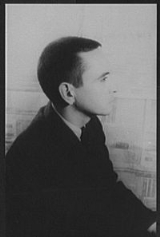
Edward Franklin Albee III ( "AWL-bee") (born March 12, 1928) is an American playwright best known for works, Who's Afraid of Virginia Woolf?, The Zoo Story, The Sandbox and The American Dream. His works are considered well-crafted, often unsympathetic examinations of the modern condition. His early works reflect a mastery and Americanization of the Theatre of the Absurd that found its peak in works by European playwrights such as Jean Genet, Samuel Beckett, and Eugène Ionesco.

Discussion
Ask a question about 'Edward Albee'
Start a new discussion about 'Edward Albee'
Answer questions from other users
|
Recent Posts

Quotations
A play is fiction — and fiction is fact distilled into truth.
The New York Times (18 September 1966)
American critics are like American universities. They both have dull and half-dead faculties.
Address to New York Cultural League (6 May 1969)
What people really want in the theater is fantasy involvement and not reality involvement.
Quote (4 June 1967)
One must let the play happen to one; one must let the mind loose to respond as it will, to receive impressions, to sense rather than know, to gather rather than immediately understand.
On his play Tiny Alice, in National Observer (5 April 1965)
I'm not suggesting that the play is without fault; all of my plays are imperfect, I'm rather happy to say — it leaves me something to do.
On his play Tiny Alice, in National Observer (5 April 1965)
Good writers define reality; bad ones merely restate it. A good writer turns fact into truth; a bad writer will, more often than not, accomplish the opposite.
Saturday Review (4 May 1966)

Encyclopedia
Edward Franklin Albee III ( "AWL-bee") (born March 12, 1928) is an American playwright best known for works, Who's Afraid of Virginia Woolf?, The Zoo Story, The Sandbox and The American Dream. His works are considered well-crafted, often unsympathetic examinations of the modern condition. His early works reflect a mastery and Americanization of the Theatre of the Absurd that found its peak in works by European playwrights such as Jean Genet, Samuel Beckett, and Eugène Ionesco. Younger American playwrights, such as Pulitzer Prize-winner Paula Vogel, credit Albee's daring mix of theatricalism and biting dialogue with helping to reinvent the post-war American theatre in the early 1960s. Albee's dedication to continuing to evolve his voice — as evidenced in later productions such as The Goat: or, Who Is Sylvia? (2002) — also routinely marks him as distinct from other American playwrights of his era.
Biography
According to Magill's Survey of American Literature (2007), Edward Albee was born somewhere in Virginia (contrary to the popular belief that he was born in Washington D.C.). He was adopted two weeks later and taken to Westchester County, New York. Albee's adoptive father, Reed A. Albee — himself the son of vaudeville magnate Edward Franklin Albee II — owned several theaters, where young Edward first gained familiarity with the theatre as a child. His adoptive mother was Reed's third wife, Frances.
Albee attended the Rye Country Day School in New York, then the Lawrenceville School in New Jersey, where he was expelled. He then was sent to Valley Forge Military Academy in Wayne, Pennsylvania, where he graduated in 1945 at the age of 17. He next enrolled in the graduate studies program at Choate prep school in Connecticut, graduating in 1946. His formal education continued at Trinity College in Hartford, Connecticut, where he was expelled in 1947 for skipping classes and refusing to attend compulsory chapel.
Albee left home for good when he was in his late teens, later saying in an interview: "I never felt comfortable with the adoptive parents. I don't think they knew how to be parents. I probably didn't know how to be a son, either." More recently, he told interviewer Charlie Rose that he was "thrown out" because his parents wanted him to become a "corporate thug", and didn't approve of his aspirations to become a writer.
The less than diligent student later dedicated much of his time to promoting American university theatre, frequently speaking at campuses and serving as a distinguished professor at the University of Houston from 1989 to 2003.
A member of the Dramatists Guild Council, Albee has received three Pulitzer Prizes for drama — for A Delicate Balance (1967), Seascape (1975), Three Tall Women (1994); a Special Tony Award for Lifetime Achievement (2005); the Gold Medal in Drama from the American Academy and Institute of Arts and Letters (1980); as well as the Kennedy Center Honors and the National Medal of Arts (both in 1996).
Albee is the President of the Edward F. Albee Foundation, Inc., which maintains the William Flanagan Creative Persons Center, a writers and artists colony in Montauk, New York. Albee's longtime partner, Jonathan Thomas, a sculptor, died on May 2, 2005, the result of a two year-long battle with bladder cancer.
In 2008, in celebration of his eightieth birthday, numerous Albee plays are being mounted in distinguished Off Broadway venues, including the historic Cherry Lane Theatre, where the playwright himself is directing two of his one-acts, The American Dream and The Sandbox, which were produced at the theater in 1961 and 1962, respectively.
Plays
Non Dramatic Writings
- Stretching My Mind: Essays 1960-2005 (Avalon Publishing, 2005)
Quotes
- "What could be worse than getting to the end of your life and realizing you hadn't lived it?"
- "A usefully lived life is probably going to be, ultimately, more satisfying."
- "Writing should be useful. If it can't instruct people a little bit more about the responsibilities of consciousness there's no point in doing it."
- "If you're willing to fail interestingly, you tend to succeed interestingly."
- "That's what happens in plays, yes? The shit hits the fan."
- "Creativity is magic. Don't examine it too closely."
Discography
- Mark Richman & William Daniels in The Zoo Story by Edward Albee - Directed by Arthur Luce Klein (LP, Spoken Arts SA 808)
Awards and nominations
Awards
- 1960 Drama Desk Award Vernon Rice Award - The Zoo Story
- 1963 Tony Award for Best Play - Who's Afraid of Virginia Woolf?
- 1967 Pulitzer Prize for Drama - A Delicate Balance
- 1975 Pulitzer Prize for Drama - Seascape
- 1994 Pulitzer Prize for Drama - Three Tall Women
- 1996 National Medal of Arts
- 2002 Drama Desk Award Outstanding New Play - The Goat, or Who Is Sylvia?
- 2002 Tony Award for Best Play - The Goat, or Who Is Sylvia?
- 2005 Special Tony Award for Lifetime Achievement
- 2008 Drama Desk Award Special Award
Nominations
- 1964 Tony Award for Best Play - The Ballad of the Sad Cafe
- 1965 Tony Award for Best Author of a Play - Tiny Alice
- 1965 Tony Award for Best Play - Tiny Alice
- 1967 Tony Award for Best Play - A Delicate Balance
- 1975 Drama Desk Award Outstanding New Play - Seascape
- 1975 Tony Award for Best Play - Seascape
- 1976 Drama Desk Award Outstanding Director of a Play - Who's Afraid of Virginia Woolf?
- 1994 Drama Desk Award Outstanding Play - Three Tall Women
- 2001 Pulitzer Prize for Drama - The Play About the Baby
- 2003 Pulitzer Prize for Drama - The Goat, or Who Is Sylvia?
- 2005 Tony Award for Best Revival of a Play - Who's Afraid of Virginia Woolf?
The Pulitzer Prize committee for the Best Play in 1963 recommended Who's Afraid of Virginia Woolf?, but the Pulitzer board, who have sole discretion in awarding the prize, rejected the recommendation, due to the play's perceived vulgarity, and no award was given instead.
External links
|