
|
|
|
|
Radio City Music Hall
|
| |
|
| |
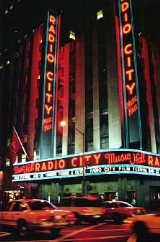
Radio City Music Hall is an entertainment venue located in New York City's Rockefeller Center. Its nickname is the Showplace of the Nation, and it was for a time the leading tourist destination in the city. Its interior was declared a city landmark in 1978.
12 acre (49,000 mē) complex in midtown Manhattan known as Rockefeller Center was developed between 1929 and 1940 by John D. Rockefeller, Jr., on land leased from Columbia University.

Discussion
Ask a question about 'Radio City Music Hall'
Start a new discussion about 'Radio City Music Hall'
Answer questions from other users
|
Encyclopedia
Radio City Music Hall is an entertainment venue located in New York City's Rockefeller Center. Its nickname is the Showplace of the Nation, and it was for a time the leading tourist destination in the city. Its interior was declared a city landmark in 1978.
History
The 12 acre (49,000 mē) complex in midtown Manhattan known as Rockefeller Center was developed between 1929 and 1940 by John D. Rockefeller, Jr., on land leased from Columbia University. The Radio City Music Hall was designed by architect Edward Durell Stone and interior designer Donald Deskey in the Art Deco style. Rockefeller initially planned a new home for the Metropolitan Opera on the site, but after the Stock Market Crash of 1929, the plans changed and the opera company withdrew from the project.
The names "Radio City" and "Radio City Music Hall" derive from one of the complex's first tenants, the Radio Corporation of America. Radio City Music Hall was a project of Rockefeller; Samuel Roxy Rothafel, who previously opened the Roxy Theatre in 1927; and RCA chairman David Sarnoff. RCA had developed numerous studios for NBC at 30 Rockefeller Plaza, just to the south of the Music Hall, and the radio-TV complex that lent the Music Hall its name is still known as the NBC Radio City Studios.
The Music Hall opened to the public on December 27, 1932 with a lavish stage show featuring Ray Bolger and Martha Graham. The opening was meant to be a return to high-class variety entertainment. The new format was not a success. The program was very long and individual acts were lost in the cavernous hall. On January 11, 1933, the Music Hall converted to the then familiar format of a feature film with a spectacular stage show which Rothafel had perfected at the Roxy Theatre. The first film was shown on the giant screen was Frank Capra's The Bitter Tea of General Yen starring Barbara Stanwyck and the Music Hall became the premiere showcase for films from the RKO-Radio Studio. The film plus stage spectacle format continued at the Music Hall until 1979 with four complete performances presented every day.
Radio City has 5,933 seats for spectators; it became the largest movie theater in the world at the time of its opening. Designed by Edward Durell Stone, the interior of the theater, with decor by Donald Deskey, incorporates glass, aluminum, chrome, and geometric ornamentation. Deskey rejected the Rococo embellishment generally used for theaters at that time in favor of a contemporary Art Deco style, borrowed heavily from a European Modern aesthetic style, of which he was the foremost exponent at the time.
The Great Stage, measuring 66.5 feet (20 m) deep and 144 feet (44 m) wide, resembles a setting sun. Its system of elevators was so advanced that the U.S. Navy incorporated identical hydraulics in constructing World War II aircraft carriers; according to Radio City lore, during the war, government agents guarded the basement to assure the Navy's technological advantage.
The Music Hall's "Mighty Wurlitzer" pipe organ is the largest theater pipe organ built for a movie theater: Twin identical consoles flank both sides of the Great Stage, apart; its 4,410 pipes are installed in chambers on either side of the proscenium's arch. Installed in 1932, the instrument was the largest produced by the Rudolph Wurlitzer Manufacturing Company of North Tonawanda, New York; it was built as a serious concert instrument rather than to accompany silent movies, capable of playing many styles of music including classical organ literature. A rebuild of the historic organ was undertaken that was completed in time for the theater's restoration in 1999. A smaller Wurlitzer organ was installed in the theater's radio studios, but was put into storage when the studio was converted into office space.
By the 1970s, changes in film distribution made it difficult for Radio City to secure exclusive bookings of many films; furthermore, the theater preferred to show only G-rated movies, which became increasingly less common as the decade wore on. Regular film showings at Radio City ended in 1979. Plans were made to convert the theater into office space, but a combination of preservation and commercial interests resulted in the preservation of Radio City and in 1980, after a renovation, it reopened to the public.
Radio City Music Hall is currently leased to and managed by Cablevision. Movie premieres and feature runs have occasionally taken place there but the focus of the theater is now on concerts and live stage shows.
Attractions
- The Music Hall Christmas show, a New York Christmas tradition since 1933, has been revived as an all live spectacular show featuring the women's precision dance team known as The Rockettes and is performed every year during the holidays. Additional companies of Rockettes now also tour every holiday season, bringing the Radio City Christmas Spectacular to theaters around the country.
- See main article: Radio City Christmas Spectacular.
- The Music Hall has been the frequent site of the annual televised Grammy Awards, Tony Awards, MTV Video Music Awards, and Daytime Emmy Awards shows.
- In 1998, Latin pop artist Luis Miguel held shows in the hall by selling out five consecutive shows in five straight nights, and also sold out four straight nights in four straight concerts in 2000.
- Famous progressive metal band, Dream Theater, recorded their concert here on April 1, 2006 during their 20th anniversary tour and released it on a 3CD/2DVD live album named Score.
- Heaven and Hell recorded their March 30, 2007 concert here, releasing it as a two CD live album and DVD, Heaven and Hell: Live from Radio City Music Hall.
- On January 15, 2000, Radio City Music Hall played host to its first ever sports event, a boxing card that featured undisputed light heavyweight champion Roy Jones, Jr. defeating David Telesco in the main event, and in the co-feature heavyweight David Izon defeating Derrick Jefferson.
- The New York Liberty played some of their 2004 home games at Radio City while Madison Square Garden was reserved for the Republican National Convention.
- The Great Stage has been home to the NFL Draft since 2006. (The Draft was previously held at Madison Square Garden until Cablevision's opposition over a proposed Jets stadium caused the NFL to move the 2005 draft to the Jacob Javits Convention Center. After the stadium dispute was settled, the NFL moved the draft to another Cablevision-owned venue, Radio City.)
- On April 22, 2007 Dave Matthews and Tim Reynolds held a concert at the Radio City Music Hall that was later released on DVD and Blu-Ray on August 14th 2007. The DVD is Entitled Live at Radio City: Dave Matthews and Tim Reynolds.
- In April 2008, Radio City was used for an Elton John concert to raise funds for the Hillary Clinton Presidential Campaign. Tickets ranged from $150.00 to $2,500.00 and the concert was sold out.
- Radio City Music Hall is the regular site of commencement ceremonies for Hunter College and Pace University's New York City campus.
- Radio City Music Hall is home to the periodic New York editions of the Merv Griffin game shows, Jeopardy! and Wheel of Fortune.
- The two remaining Beatles are set to perform at a charity concert on 4 April 2009.
In popular culture
- Radio City Music Hall is seen to be submerged underwater in the film A.I. Artificial Intelligence.
- In the movie Annie (1982), Daddy Warbucks and Miss Farrell take Annie and Sandy to see Camille at Radio City Music Hall.
- In The Godfather (1972), Michael Corleone receives news that his father, Vito Corleone has been shot from a newspaper report at a nearby news stand outside Radio City.
- In Dashiell Hammett's The Thin Man, Nora and Nick Charles go to the opening of the Radio City Music Hall, but having enough of the performance, leave after an hour.
- Radio City Music Hall is briefly mentioned in High School Musical 3, in the scene where Ryan and Sharpay dream about being superstars.
- Radio City Music Hall is referenced in Futurama, where someone is travelling to the 'Radio City Mutant Hall' (Series 1 Episode 1)
Further reading
- Okrent, Daniel. Great Fortune: The Epic of Rockefeller Center, New York: Viking Press, 2003.
- Roussel, Christine. The Art of Rockefeller Center, New York: W.W. Norton & Company, 2006.
External links
|
| |
|
|