

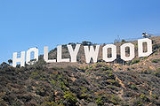
Hollywood, Los Angeles, California

Encyclopedia
Hollywood is a famous district in Los Angeles
, California
, United States
situated west-northwest of downtown Los Angeles
. Due to its fame and cultural identity
as the historical center of movie studio
s and movie stars, the word Hollywood is often used as a metonym
of American cinema
. Today, much of the movie industry has dispersed into surrounding areas such as the Westside neighborhood, and the San Fernando
and Santa Clarita
Valleys, but significant auxiliary industries, such as editing
, effects, props
, post-production
, and lighting
companies remain in Hollywood, as does the backlot
of Paramount Pictures
.
On February 16, 2005, California Assembly Members Jackie Goldberg
and Paul Koretz
introduced a bill to require California to keep specific records on Hollywood as if it were independent, although it is not the typical practice of the City of Los Angeles to establish specific boundaries for districts or neighborhoods. For this to be done, the boundaries were defined. The bill was unanimously supported by the Hollywood Chamber of Commerce
and the Los Angeles City Council
. Assembly Bill 588 was approved by the Governor of California
on August 28, 2006, and now the district of Hollywood has official borders. The border can be loosely described as the area east of West Hollywood, south of Mulholland Drive
, Laurel Canyon
, Cahuenga Boulevard, and Barham Boulevard, and the cities of Burbank
and Glendale
, north of Melrose Avenue
and west of the Golden State Freeway and Hyperion Avenue. This includes all of Griffith Park
and Los Feliz – two areas that were hitherto considered separate from Hollywood by most Angelenos. The population of the district, including Los Feliz, as of the 2000 census was 123,436 and the median
household income was $33,409 in 1999.
As a district within the Los Angeles city limits, Hollywood does not have its own municipal government. There was an official, appointed by the Hollywood Chamber of Commerce, who served as an honorary "Mayor of Hollywood
" for ceremonial purposes only. Johnny Grant held this position from 1980 until his death on January 9, 2008. However, no replacement has ever been named after Grant's death.
hut stood in Nopalera, named for the Mexican nopal cactus
indigenous to the area. By 1870, an agricultural community flourished in the area with thriving crops of many common and exotic varieties. The area was known to these residents as the Cahuenga Valley
, after the pass in the Santa Monica Mountains
immediately to the north. Soon thereafter, land speculation led to subdivision of the large plots and an influx of homeowners.
In spite of the area's short history, it has been filled with events driven by optimistic progress. The name Hollywood was coined by H. J. Whitley
, the "Father of Hollywood". DEATH CALLS H. J. WHITLEY. Retrieved July 17, 2008. "H. J. Whitley, pioneer California real estate man and known as the "Father of Hollywood" died yesterday at the age of 83 years and after an illness of more than a year. Mr. Whitley died during his sleep while staying as a guest of his son Ross Whitley at the Whitley Park" Whitley arranged to buy the 500 acres (2 km²) E.C. Hurd ranch and disclosed to him his plans for the land. They agreed on a price and Hurd agreed to sell at a later date. Before Whitley got off the ground with Hollywood, plans for the new town had spread to General Harrison Gray Otis, Mr Hurd's wife, Mrs. Daeida Wilcox
, and numerous others through the mill of gossip and land speculation.
Daeida learned of the name Hollywood from her neighbor in Holly Canyon (now Lake Hollywood), Ivar Weid, a prominent investor and friend of Whitley's. She recommended the same name to her husband, H. H. Wilcox. On February 1, 1887, Harvey filed a deed and map of property he sold with the Los Angeles County Recorder's office. Harvey wanted to be the first to record it on a deed. The early real-estate boom busted that same year, yet Hollywood began its slow growth.
By 1900, the region had a post office, newspaper, hotel, and two markets. Los Angeles, with a population of 102,479 lay 10 miles (16.1 km) east through the vineyards, barley fields, and citrus
groves. A single-track streetcar line ran down the middle of Prospect Avenue from it, but service was infrequent and the trip took two hours. The old citrus fruit-packing house would be converted into a livery stable
, improving transportation for the inhabitants of Hollywood.

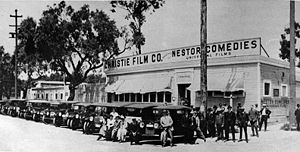
 The famous Hollywood Hotel
, the first major hotel in Hollywood, was opened in 1902, by H. J. Whitley
, then President of the Los Pacific Boulevard and Development Company, of which he was a major shareholder. Having finally acquired the Hurd ranch and subdivided it, Whitley built the hotel to attract land buyers, and was eager to sell these residential lots among the lemon ranches lining the foothills. Flanking the west side of Highland Avenue, the structure fronted on Prospect Avenue
, which, still a dusty, unpaved road, was regularly graded and graveled. The Hotel was to become internationally known and was the center of the civic and social life and home of the stars for many years. His company was developing and selling one of the early residential areas, the Ocean View Tract. Whitley did much to promote the area. He paid many thousands of dollars for electric lighting, including bringing electricity and building a bank, as well as a road into the Cahuenga Pass
. The lighting ran for several blocks down Prospect Avenue. Whitley's land was centered on Highland Avenue.
Hollywood was incorporated as a municipality
on November 14, 1903. The vote was 88 for incorporation and 77 against. On January 30, 1904, the voters in Hollywood decided, by a vote of 113 to 96, for the banishment of liquor in the city, except when it was being sold for medicinal purposes. Neither hotels nor restaurants were allowed to serve wine or liquor before or after meals.
By 1910, because of an ongoing struggle to secure an adequate water supply, town officials voted for Hollywood to be annexed into the City of Los Angeles, as the water system of the growing city had opened the Los Angeles Aqueduct
and was piping water down from the Owens River
in the Owens Valley
. Another reason for the vote was that Hollywood could have access to drainage through Los Angeles' sewer system. With annexation, the name of Prospect Avenue was changed to Hollywood Boulevard
and all the street numbers in the new district changed. For example, 100 Prospect Avenue, at Vermont
Avenue, became 6400 Hollywood Boulevard; and 100 Cahuenga Boulevard, at Hollywood Boulevard, changed to 1700 Cahuenga Boulevard.
in Edendale
, with construction beginning in August 1909.
Prolific director D. W. Griffith
was the first to make a motion picture in Hollywood. His 17-minute short film In Old California, which was released on March 10, 1910, was filmed entirely in the village of Hollywood for Biograph
. Although Hollywood banned movie theaters—of which it had none—before annexation that year, Los Angeles had no such restriction. The first film by a Hollywood Studio, Nestor Motion Picture Company
, was shot on October 26, 1911. The Whitley home was used as its set, and the unnamed movie was filmed in the middle of their groves on the corner of Whitley Ave and Hollywood Boulevard by directors Al Christie
and David and William Horsley.
Various producers and filmmakers moved bases from the east coast to escape punitive licensing from the Motion Picture Patents Company
.
The first studio in Hollywood was established by the New Jersey–based Centaur Co., which wanted to make westerns in California. They rented an unused roadhouse
at 6121 Sunset Boulevard
at the corner of Gower
, and converted it into a movie studio in October 1911, calling it Nestor Studio after the name of the western branch of their company. The first feature film made specifically in a Hollywood studio, in 1914, was The Squaw Man, directed by Cecil B. DeMille
and Oscar Apfel
, and was filmed at the Lasky-DeMille Barn
among other area locations.
By 1911, Los Angeles was second only to New York in motion picture production, and by 1915, the majority of American films were being produced in the Los Angeles area.
 Four major film companies – Paramount
, Warner Bros.
, RKO
and Columbia
– had studios in Hollywood, as did several minor companies and rental studios. Hollywood had begun its dramatic transformation from sleepy suburb to movie production capital. The residential and agrarian Hollywood Boulevard
of 1910 was virtually unrecognizable by 1920 as the new commercial and retail sector replaced it. The sleepy town was no more, and, to the chagrin of many original residents, the boom town could not be stopped.
. In 1918, HJ Whitley commissioned architect A.S. Barnes to design Whitley Heights as a Mediterranean-style village on the steep hillsides above Hollywood Boulevard, and it became the first celebrity community. The neighborhood is roughly bordered on the north and east by Cahuenga Boulevard, on the west by Highland Avenue, and on the south by Franklin Avenue
. Among Whitley Heights' many famous residents have been Rudolph Valentino
, Barbara Stanwyck
, W.C. Fields, Jean Harlow
, Carole Lombard
, William Powell
. Tyrone Power
, Gloria Swanson
, Rosalind Russell
, Judy Garland
, and Marlene Dietrich
.
From the 1920s to the 1940s, a large percentage of transportation to and from Hollywood was by means of the red cars of the Pacific Electric Railway
.
 On January 22, 1947, the first commercial television station west of the Mississippi River
, KTLA
, began operating in Hollywood. In December of that year, The Public Prosecutor became the first network television series to be filmed in Hollywood. In the 1950s, music recording studios and offices began moving into Hollywood. Other businesses, however, continued to migrate to different parts of the Los Angeles area, primarily to Burbank
. Much of the movie industry remained in Hollywood, although the district's outward appearance changed.
In 1952, CBS
built CBS Television City
on the corner of Fairfax Avenue and Beverly Boulevard
, on the former site of Gilmore Stadium. CBS's expansion into the Fairfax District pushed the unofficial boundary of Hollywood farther south than it had been. CBS's slogan for the shows taped there was "From Television City in Hollywood..."
During the early 1950s the famous Hollywood Freeway
was constructed from Four Level Interchange
interchange in downtown Los Angeles, past the Hollywood Bowl
, up through Cahuenga Pass
and into the San Fernando Valley
. In the early days, streetcars ran up through the pass, on rails running along the central median.
The famous Capitol Records Building
on Vine St. just north of Hollywood Boulevard was built in 1956. The building houses offices and recording studios, which are not open to the public, but its circular design looks like a stack of 7 inches (177.8 mm) vinyl records.
The now derelict lot at the corner of Hollywood Boulevard and Serrano Avenue was once the site of the illustrious Hollywood Professional School
, whose alumni reads like a Hollywood Who's Who of household "names". Many of these former child stars attended a "farewell" party at the commemorative sealing of a time capsule buried on the lot.
The Hollywood Walk of Fame
was created in 1958 as a tribute to artists and other significant contributors within the entertainment industry. Official groundbreaking occurred on February 8, 1960, and the first star to be permanently installed was that of director Stanley Kramer
(not Joanne Woodward
, as commonly related). A detailed history of the Walk can be found in the Walk of Fame main article
. Honorees receive a star based on their achievements in motion pictures, live theatre, radio
, television, and/or music, as well as their charitable and civic contributions.
In 1985, the Hollywood Boulevard Commercial and Entertainment District
was officially listed in the National Register of Historic Places
protecting important buildings and ensuring that the significance of Hollywood's past would always be a part of its future.
In June 1999, the Hollywood extension of the Los Angeles County Metro Rail
Red Line
subway
opened, running from Downtown Los Angeles
to the San Fernando Valley, with stops along Hollywood Boulevard at Western Avenue, Vine Street and Highland Avenue.
The Kodak Theatre
, which opened in 2001 on Hollywood Boulevard at Highland Avenue, where the historic Hollywood Hotel
once stood, has become the new home of the Oscars
.
While motion picture production still occurs within the Hollywood district, most major studios are actually located elsewhere in the Los Angeles region. Paramount Pictures
is the only major studio still physically located within Hollywood. Other studios in the district include the aforementioned Jim Henson (formerly Chaplin) Studios, Sunset Gower Studios, and Raleigh Studios.
While Hollywood and the adjacent neighborhood of Los Feliz served as the initial homes for all of the early television stations in the Los Angeles market
, most have now relocated to other locations within the metropolitan area. KNBC
began this exodus in 1962, when it moved from the former NBC Radio City Studios
located at the northeast corner of Sunset Boulevard and Vine Street to NBC Studios
in Burbank. KTTV
(purchased by FOX) pulled up stakes in 1996 from its former home at Metromedia Square
on Sunset Boulevard to relocate to to the FOX Studio lot in West Los Angeles. KABC-TV
moved from its original location at ABC Television Center (now branded The Prospect Studios
) just east of Hollywood to Glendale
in 2000, though the Los Angeles bureau of ABC News still resides at Prospect and still serves as an ABC Network studios facility. After being purchased by 20th Century Fox
in 2001, KCOP left its former home on La Brea Avenue to join KTTV on the Fox lot. The CBS Corporation
-owned duopoly
of KCBS-TV
and KCAL-TV
moved from its longtime home at CBS Columbia Square
on Sunset Boulevard to a new facility at CBS Studio Center
in Studio City. KTLA
and KCET
, both located on Sunset Boulevard, are the last broadcasters (television or radio) with Hollywood addresses. However, KCET has since sold its studios on Sunset and plans to move to another location.
In addition, Hollywood once served as the home of nearly every radio station in Los Angeles, all of which have now moved into other communities, especially Burbank, but a fair number also relocated to Wilshire Center and Miracle Mile district with the latter being home to many TV production companies including Mark Goodson and the E! network. KNX
was the last station to broadcast from Hollywood, when it left CBS Columbia Square
for a studio in the Miracle Mile in 2005. While Hollywood was home to several foreign language radio stations, they too moved to many of the same areas as their English language counter-parts. In fact, today, not a single L.A. market radio station has operations in Hollywood.
In 2002, a number of Hollywood citizens began a campaign for the district to secede from Los Angeles and become, as it had been a century earlier, its own incorporated municipality. Secession supporters argued that the needs of their community were being ignored by the leaders of Los Angeles. In June of that year, the Los Angeles County Board of Supervisors placed secession referendums for both Hollywood and the San Fernando Valley on the ballots for a "citywide election." To pass, they required the approval of a majority of voters in the proposed new municipality as well as a majority of voters in all of Los Angeles. In the November election, both referendums failed by wide margins in the citywide vote.
Hollywood is served by several neighborhood councils, including the Hollywood United Neighborhood Council (HUNC) and the Hollywood Studio District Neighborhood Council. These two groups are part of the network of neighborhood councils certified by the City of Los Angeles Department of Neighborhood Empowerment. Neighborhood Councils cast advisory votes on such issues as zoning, planning, and other community issues. The council members are voted in by stakeholders, generally defined as anyone living, working, owning property, or belonging to an organization within the boundaries of the council.
and revitalization with the goal of urban density
in mind. Many developments have been completed, typically centered on Hollywood Boulevard. The Hollywood and Highland
complex (site of the Kodak Theater) has been a major catalyst for the redevelopment of the area. In addition, numerous fashionable bars, clubs, and retail businesses have opened on or surrounding the boulevard, returning Hollywood to a center of nightlife in Los Angeles. Many older buildings have also been converted to lofts and condominiums. The W Hollywood Hotel is now open at the intersection of Hollywood and Vine
operates four fire stations – Station 27, 41, 52, and 82 – in the area.
operates the Hollywood-Wilshire Health Center in Hollywood.
operates the Hollywood Post Office, the Hollywood Pavilion Post Office, and the Sunset Post Office.
. The area is within Board District 4. As of 2008 Marlene Canter represents the district. Canter announced that she will not seek re-election after her term expires in June 2009.
Elementary schools:
Middle schools:
Hollywood High School
and Helen Bernstein High School
are public high schools in the Hollywood area.
Christ the King Elementary School is a private school in the area.
For many years, the motion picture Industry had its own private
Industry-run institution for child actors, the Hollywood Professional School
.
are in Hollywood.

Los Ángeles
Los Ángeles is the capital of the province of Biobío, in the commune of the same name, in Region VIII , in the center-south of Chile. It is located between the Laja and Biobío rivers. The population is 123,445 inhabitants...
, California
California
California is a state located on the West Coast of the United States. It is by far the most populous U.S. state, and the third-largest by land area...
, United States
United States
The United States of America is a federal constitutional republic comprising fifty states and a federal district...
situated west-northwest of downtown Los Angeles
Downtown Los Angeles
Downtown Los Angeles is the central business district of Los Angeles, California, United States, located close to the geographic center of the metropolitan area...
. Due to its fame and cultural identity
Cultural identity
Cultural identity is the identity of a group or culture, or of an individual as far as one is influenced by one's belonging to a group or culture. Cultural identity is similar to and has overlaps with, but is not synonymous with, identity politics....
as the historical center of movie studio
Movie studio
A movie studio is a term used to describe a major entertainment company or production company that has its own privately owned studio facility or facilities that are used to film movies...
s and movie stars, the word Hollywood is often used as a metonym
Metonymy
Metonymy is a figure of speech used in rhetoric in which a thing or concept is not called by its own name, but by the name of something intimately associated with that thing or concept...
of American cinema
Cinema of the United States
The cinema of the United States, also known as Hollywood, has had a profound effect on cinema across the world since the early 20th century. Its history is sometimes separated into four main periods: the silent film era, classical Hollywood cinema, New Hollywood, and the contemporary period...
. Today, much of the movie industry has dispersed into surrounding areas such as the Westside neighborhood, and the San Fernando
San Fernando Valley
The San Fernando Valley is an urbanized valley located in the Los Angeles metropolitan area of southern California, United States, defined by the dramatic mountains of the Transverse Ranges circling it...
and Santa Clarita
Santa Clarita, California
Santa Clarita is the fourth largest city in Los Angeles County, California, United States and the twenty-fourth largest city in the state of California. The 2010 US Census reported the city's population grew 16.7% from the year 2000 to 176,320 residents. It is located about northwest of downtown...
Valleys, but significant auxiliary industries, such as editing
Film editing
Film editing is part of the creative post-production process of filmmaking. It involves the selection and combining of shots into sequences, and ultimately creating a finished motion picture. It is an art of storytelling...
, effects, props
Theatrical property
A theatrical property, commonly referred to as a prop, is an object used on stage by actors to further the plot or story line of a theatrical production. Smaller props are referred to as "hand props". Larger props may also be set decoration, such as a chair or table. The difference between a set...
, post-production
Post-production
Post-production is part of filmmaking and the video production process. It occurs in the making of motion pictures, television programs, radio programs, advertising, audio recordings, photography, and digital art...
, and lighting
Lighting
Lighting or illumination is the deliberate application of light to achieve some practical or aesthetic effect. Lighting includes the use of both artificial light sources such as lamps and light fixtures, as well as natural illumination by capturing daylight...
companies remain in Hollywood, as does the backlot
Backlot
A backlot is an area behind or adjoining a movie studio, containing permanent exterior buildings for outdoor scenes in filmmaking or television productions, or space for temporary set construction....
of Paramount Pictures
Paramount Pictures
Paramount Pictures Corporation is an American film production and distribution company, located at 5555 Melrose Avenue in Hollywood. Founded in 1912 and currently owned by media conglomerate Viacom, it is America's oldest existing film studio; it is also the last major film studio still...
.
On February 16, 2005, California Assembly Members Jackie Goldberg
Jackie Goldberg
Jackie Goldberg is an American politician and teacher, and a member of the Democratic Party. She is a former member of the California State Assembly....
and Paul Koretz
Paul Koretz
Paul Koretz is an American politician. He is currently a member of the Los Angeles City Council, representing the Fifth Council District. He was previously a member of the California State Assembly and the West Hollywood City Council...
introduced a bill to require California to keep specific records on Hollywood as if it were independent, although it is not the typical practice of the City of Los Angeles to establish specific boundaries for districts or neighborhoods. For this to be done, the boundaries were defined. The bill was unanimously supported by the Hollywood Chamber of Commerce
Chamber of commerce
A chamber of commerce is a form of business network, e.g., a local organization of businesses whose goal is to further the interests of businesses. Business owners in towns and cities form these local societies to advocate on behalf of the business community...
and the Los Angeles City Council
Los Angeles City Council
The Los Angeles City Council is the governing body of the City of Los Angeles.The Council is composed of fifteen members elected from single-member districts for four-year terms. The president of the council and the president pro tempore are chosen by the Council at the first regular meeting after...
. Assembly Bill 588 was approved by the Governor of California
Arnold Schwarzenegger
Arnold Alois Schwarzenegger is an Austrian-American former professional bodybuilder, actor, businessman, investor, and politician. Schwarzenegger served as the 38th Governor of California from 2003 until 2011....
on August 28, 2006, and now the district of Hollywood has official borders. The border can be loosely described as the area east of West Hollywood, south of Mulholland Drive
Mulholland Drive
Mulholland Drive is a street and road in the eastern Santa Monica Mountains of Southern California. It is named after Los Angeles pioneer civil engineer William Mulholland...
, Laurel Canyon
Laurel Canyon, Los Angeles, California
Laurel Canyon is a canyon neighborhood of Los Angeles, California. It was first developed in the 1910s, and became a part of the city of Los Angeles in 1923 ....
, Cahuenga Boulevard, and Barham Boulevard, and the cities of Burbank
Burbank, California
Burbank is a city in Los Angeles County in Southern California, United States, north of downtown Los Angeles. The estimated population in 2010 was 103,340....
and Glendale
Glendale, California
Glendale is a city in Los Angeles County, California, United States. As of the 2010 Census, the city population is 191,719, down from 194,973 at the 2000 census. making it the third largest city in Los Angeles County and the 22nd largest city in the state of California...
, north of Melrose Avenue
Melrose Avenue
Melrose Avenue is an internationally renowned shopping, dining and entertainment destination in Los Angeles that starts from Santa Monica Boulevard at the border between Beverly Hills and West Hollywood and ends at Lucille Avenue in Silver Lake...
and west of the Golden State Freeway and Hyperion Avenue. This includes all of Griffith Park
Griffith Park
Griffith Park is a large municipal park at the eastern end of the Santa Monica Mountains in the Los Feliz neighborhood of Los Angeles, California. The park covers of land, making it one of the largest urban parks in North America...
and Los Feliz – two areas that were hitherto considered separate from Hollywood by most Angelenos. The population of the district, including Los Feliz, as of the 2000 census was 123,436 and the median
Median
In probability theory and statistics, a median is described as the numerical value separating the higher half of a sample, a population, or a probability distribution, from the lower half. The median of a finite list of numbers can be found by arranging all the observations from lowest value to...
household income was $33,409 in 1999.
As a district within the Los Angeles city limits, Hollywood does not have its own municipal government. There was an official, appointed by the Hollywood Chamber of Commerce, who served as an honorary "Mayor of Hollywood
Mayor of Hollywood
The Mayor of Hollywood is an honorary and ceremonial position in Hollywood, a neighborhood of the City of Los Angeles, California. The office carries responsibilities, such as presiding at Hollywood Walk of Fame ceremonies, but it entails no salary or official power. Mayors are appointed by the...
" for ceremonial purposes only. Johnny Grant held this position from 1980 until his death on January 9, 2008. However, no replacement has ever been named after Grant's death.
History
In 1853, one adobeAdobe
Adobe is a natural building material made from sand, clay, water, and some kind of fibrous or organic material , which the builders shape into bricks using frames and dry in the sun. Adobe buildings are similar to cob and mudbrick buildings. Adobe structures are extremely durable, and account for...
hut stood in Nopalera, named for the Mexican nopal cactus
Cactus
A cactus is a member of the plant family Cactaceae. Their distinctive appearance is a result of adaptations to conserve water in dry and/or hot environments. In most species, the stem has evolved to become photosynthetic and succulent, while the leaves have evolved into spines...
indigenous to the area. By 1870, an agricultural community flourished in the area with thriving crops of many common and exotic varieties. The area was known to these residents as the Cahuenga Valley
Cahuenga Pass
The Cahuenga Pass is a mountain pass through the eastern end of the Santa Monica Mountains in the Hollywood district of the City of Los Angeles, California....
, after the pass in the Santa Monica Mountains
Santa Monica Mountains
The Santa Monica Mountains are a Transverse Range in Southern California, along the coast of the Pacific Ocean in the United States.-Geography:...
immediately to the north. Soon thereafter, land speculation led to subdivision of the large plots and an influx of homeowners.
In spite of the area's short history, it has been filled with events driven by optimistic progress. The name Hollywood was coined by H. J. Whitley
Hobart Johnstone Whitley
Hobart Johnstone Whitley , also known as H.J. Whitley is the "Father of Hollywood", was a real estate developer who helped create the Hollywood subdivision in Los Angeles, Southern California. He and his wife, Margaret Virginia Whitley named the town while on their honeymoon in 1886...
, the "Father of Hollywood". DEATH CALLS H. J. WHITLEY. Retrieved July 17, 2008. "H. J. Whitley, pioneer California real estate man and known as the "Father of Hollywood" died yesterday at the age of 83 years and after an illness of more than a year. Mr. Whitley died during his sleep while staying as a guest of his son Ross Whitley at the Whitley Park" Whitley arranged to buy the 500 acres (2 km²) E.C. Hurd ranch and disclosed to him his plans for the land. They agreed on a price and Hurd agreed to sell at a later date. Before Whitley got off the ground with Hollywood, plans for the new town had spread to General Harrison Gray Otis, Mr Hurd's wife, Mrs. Daeida Wilcox
Daeida Wilcox Beveridge
Daeida Hartell Wilcox Beveridge Along with her first husband, the Kansas prohibitionist Harvey Wilcox, co-developed and named, in 1887, the Los Angeles, California, suburb of Hollywood.-Biography:...
, and numerous others through the mill of gossip and land speculation.
Daeida learned of the name Hollywood from her neighbor in Holly Canyon (now Lake Hollywood), Ivar Weid, a prominent investor and friend of Whitley's. She recommended the same name to her husband, H. H. Wilcox. On February 1, 1887, Harvey filed a deed and map of property he sold with the Los Angeles County Recorder's office. Harvey wanted to be the first to record it on a deed. The early real-estate boom busted that same year, yet Hollywood began its slow growth.
By 1900, the region had a post office, newspaper, hotel, and two markets. Los Angeles, with a population of 102,479 lay 10 miles (16.1 km) east through the vineyards, barley fields, and citrus
Citrus
Citrus is a common term and genus of flowering plants in the rue family, Rutaceae. Citrus is believed to have originated in the part of Southeast Asia bordered by Northeastern India, Myanmar and the Yunnan province of China...
groves. A single-track streetcar line ran down the middle of Prospect Avenue from it, but service was infrequent and the trip took two hours. The old citrus fruit-packing house would be converted into a livery stable
Stable
A stable is a building in which livestock, especially horses, are kept. It most commonly means a building that is divided into separate stalls for individual animals...
, improving transportation for the inhabitants of Hollywood.
Hollywood Hotel
The Hollywood Hotel was a famous hostelry and landmark located on the north side of Hollywood Boulevard between Highland and Orchid Avenues in Hollywood, California.-History:The first section of the hotel was built in 1902 by H.J...
, the first major hotel in Hollywood, was opened in 1902, by H. J. Whitley
Hobart Johnstone Whitley
Hobart Johnstone Whitley , also known as H.J. Whitley is the "Father of Hollywood", was a real estate developer who helped create the Hollywood subdivision in Los Angeles, Southern California. He and his wife, Margaret Virginia Whitley named the town while on their honeymoon in 1886...
, then President of the Los Pacific Boulevard and Development Company, of which he was a major shareholder. Having finally acquired the Hurd ranch and subdivided it, Whitley built the hotel to attract land buyers, and was eager to sell these residential lots among the lemon ranches lining the foothills. Flanking the west side of Highland Avenue, the structure fronted on Prospect Avenue
Prospect Avenue
Prospect Avenue may refer to:*Prospect Avenue , a street that runs close to U.S. Route 71-New York City Subway stations:*Prospect Avenue , in the Bronx; serving the trains...
, which, still a dusty, unpaved road, was regularly graded and graveled. The Hotel was to become internationally known and was the center of the civic and social life and home of the stars for many years. His company was developing and selling one of the early residential areas, the Ocean View Tract. Whitley did much to promote the area. He paid many thousands of dollars for electric lighting, including bringing electricity and building a bank, as well as a road into the Cahuenga Pass
Cahuenga Pass
The Cahuenga Pass is a mountain pass through the eastern end of the Santa Monica Mountains in the Hollywood district of the City of Los Angeles, California....
. The lighting ran for several blocks down Prospect Avenue. Whitley's land was centered on Highland Avenue.
Hollywood was incorporated as a municipality
Municipality
A municipality is essentially an urban administrative division having corporate status and usually powers of self-government. It can also be used to mean the governing body of a municipality. A municipality is a general-purpose administrative subdivision, as opposed to a special-purpose district...
on November 14, 1903. The vote was 88 for incorporation and 77 against. On January 30, 1904, the voters in Hollywood decided, by a vote of 113 to 96, for the banishment of liquor in the city, except when it was being sold for medicinal purposes. Neither hotels nor restaurants were allowed to serve wine or liquor before or after meals.
By 1910, because of an ongoing struggle to secure an adequate water supply, town officials voted for Hollywood to be annexed into the City of Los Angeles, as the water system of the growing city had opened the Los Angeles Aqueduct
Los Angeles Aqueduct
The Los Angeles Aqueduct system comprising the Los Angeles Aqueduct and the Second Los Angeles Aqueduct, is a water conveyance system operated by the Los Angeles Department of Water and Power...
and was piping water down from the Owens River
Owens River
The Owens River is a river in southeastern California in the United States, approximately long. It drains into and through the Owens Valley, an arid basin between the eastern slope of the Sierra Nevada and the western faces of the Inyo and White Mountains. The river terminates at Owens Lake, but...
in the Owens Valley
Owens Valley
Owens Valley is the arid valley of the Owens River in eastern California in the United States, to the east of the Sierra Nevada and west of the White Mountains and Inyo Mountains on the west edge of the Great Basin section...
. Another reason for the vote was that Hollywood could have access to drainage through Los Angeles' sewer system. With annexation, the name of Prospect Avenue was changed to Hollywood Boulevard
Boulevard
A Boulevard is type of road, usually a wide, multi-lane arterial thoroughfare, divided with a median down the centre, and roadways along each side designed as slow travel and parking lanes and for bicycle and pedestrian usage, often with an above-average quality of landscaping and scenery...
and all the street numbers in the new district changed. For example, 100 Prospect Avenue, at Vermont
Vermont
Vermont is a state in the New England region of the northeastern United States of America. The state ranks 43rd in land area, , and 45th in total area. Its population according to the 2010 census, 630,337, is the second smallest in the country, larger only than Wyoming. It is the only New England...
Avenue, became 6400 Hollywood Boulevard; and 100 Cahuenga Boulevard, at Hollywood Boulevard, changed to 1700 Cahuenga Boulevard.
Motion picture industry
Filmmaking in the greater Los Angeles area preceded the establishment of filmmaking in Hollywood. The Biograph Company filmed the short film A Daring Hold-Up in Southern California in Los Angeles in 1906. The first studio in the Los Angeles area was established by the Selig Polyscope CompanySelig Polyscope Company
The Selig Polyscope Company was an American motion picture company founded in 1896 by William Selig in Chicago, Illinois. Selig Polyscope is noted for establishing Southern California's first permanent movie studio, in the historic Edendale district of Los Angeles...
in Edendale
Edendale, Los Angeles, California
Edendale is a historical name for a district in Los Angeles, California, northwest of Downtown Los Angeles, in what is known today as Echo Park, Los Feliz and Silver Lake....
, with construction beginning in August 1909.
Prolific director D. W. Griffith
D. W. Griffith
David Llewelyn Wark Griffith was a premier pioneering American film director. He is best known as the director of the controversial and groundbreaking 1915 film The Birth of a Nation and the subsequent film Intolerance .Griffith's film The Birth of a Nation made pioneering use of advanced camera...
was the first to make a motion picture in Hollywood. His 17-minute short film In Old California, which was released on March 10, 1910, was filmed entirely in the village of Hollywood for Biograph
Biograph
Biograph may refer to:* An early form of the cinematograph, made by the American Mutoscope and Biograph Company, a motion picture company founded in 1895 and active until 1928* Biograph , a 1985 box set compiling music by Bob Dylan...
. Although Hollywood banned movie theaters—of which it had none—before annexation that year, Los Angeles had no such restriction. The first film by a Hollywood Studio, Nestor Motion Picture Company
Nestor Studios
The Nestor Motion Picture Company was a motion picture studio/production company located in Bayonne, New Jersey, and Hollywood, California, which was owned and operated by David Horsley and his brother, William Horsley....
, was shot on October 26, 1911. The Whitley home was used as its set, and the unnamed movie was filmed in the middle of their groves on the corner of Whitley Ave and Hollywood Boulevard by directors Al Christie
Al Christie
Al Christie was a Canadian-born motion picture director, producer and screenwriter.-Career:Born Alfred Ernest Christie, in London, Ontario, Canada, he was one of a number of Canadian pioneers in early Hollywood who made their way to Hollywood, California, attracted by the newly developing motion...
and David and William Horsley.
Various producers and filmmakers moved bases from the east coast to escape punitive licensing from the Motion Picture Patents Company
Motion Picture Patents Company
The Motion Picture Patents Company , founded in December 1908, was a trust of all the major American film companies , the leading film distributor and the biggest supplier of raw film stock, Eastman Kodak...
.
The first studio in Hollywood was established by the New Jersey–based Centaur Co., which wanted to make westerns in California. They rented an unused roadhouse
Roadhouse (facility)
A roadhouse is a commercial establishment typically built on a major road or highway, to service passing travellers. Its meaning varies slightly by country.-USA:...
at 6121 Sunset Boulevard
Sunset Boulevard
Sunset Boulevard is a street in the western part of Los Angeles County, California, that stretches from Figueroa Street in downtown Los Angeles to the Pacific Coast Highway at the Pacific Ocean in the Pacific Palisades...
at the corner of Gower
Gower Street (Hollywood)
Gower Street is a street in Los Angeles, California that has played an important role in the ongoing evolution of Hollywood, particularly as the home to several prominent Poverty Row studios during the area's Golden Age...
, and converted it into a movie studio in October 1911, calling it Nestor Studio after the name of the western branch of their company. The first feature film made specifically in a Hollywood studio, in 1914, was The Squaw Man, directed by Cecil B. DeMille
Cecil B. DeMille
Cecil Blount DeMille was an American film director and Academy Award-winning film producer in both silent and sound films. He was renowned for the flamboyance and showmanship of his movies...
and Oscar Apfel
Oscar Apfel
Oscar C. Apfel was an American film actor, director, screenwriter and producer. He appeared in 167 films between 1913 and 1939, and also directed 94 films between 1911 and 1927.-Biography:...
, and was filmed at the Lasky-DeMille Barn
Lasky-DeMille Barn
The Lasky-DeMille Barn is one of Hollywood's first film studios and a designated California State Historic Landmark. It is now the site of the Hollywood Heritage Museum.-History:...
among other area locations.
By 1911, Los Angeles was second only to New York in motion picture production, and by 1915, the majority of American films were being produced in the Los Angeles area.
Paramount Pictures
Paramount Pictures Corporation is an American film production and distribution company, located at 5555 Melrose Avenue in Hollywood. Founded in 1912 and currently owned by media conglomerate Viacom, it is America's oldest existing film studio; it is also the last major film studio still...
, Warner Bros.
Warner Bros.
Warner Bros. Entertainment, Inc., also known as Warner Bros. Pictures or simply Warner Bros. , is an American producer of film and television entertainment.One of the major film studios, it is a subsidiary of Time Warner, with its headquarters in Burbank,...
, RKO
RKO Pictures
RKO Pictures is an American film production and distribution company. As RKO Radio Pictures Inc., it was one of the Big Five studios of Hollywood's Golden Age. The business was formed after the Keith-Albee-Orpheum theater chains and Joseph P...
and Columbia
Columbia Pictures
Columbia Pictures Industries, Inc. is an American film production and distribution company. Columbia Pictures now forms part of the Columbia TriStar Motion Picture Group, owned by Sony Pictures Entertainment, a subsidiary of the Japanese conglomerate Sony. It is one of the leading film companies...
– had studios in Hollywood, as did several minor companies and rental studios. Hollywood had begun its dramatic transformation from sleepy suburb to movie production capital. The residential and agrarian Hollywood Boulevard
Hollywood Boulevard
-Revitalization:In recent years successful efforts have been made at cleaning up Hollywood Blvd., as the street had gained a reputation for crime and seediness. Central to these efforts was the construction of the Hollywood and Highland shopping center and adjacent Kodak Theatre in 2001...
of 1910 was virtually unrecognizable by 1920 as the new commercial and retail sector replaced it. The sleepy town was no more, and, to the chagrin of many original residents, the boom town could not be stopped.
1920s–1940s
By 1920, Hollywood had become world-famous as the center of the United States film industryCinema of the United States
The cinema of the United States, also known as Hollywood, has had a profound effect on cinema across the world since the early 20th century. Its history is sometimes separated into four main periods: the silent film era, classical Hollywood cinema, New Hollywood, and the contemporary period...
. In 1918, HJ Whitley commissioned architect A.S. Barnes to design Whitley Heights as a Mediterranean-style village on the steep hillsides above Hollywood Boulevard, and it became the first celebrity community. The neighborhood is roughly bordered on the north and east by Cahuenga Boulevard, on the west by Highland Avenue, and on the south by Franklin Avenue
Franklin Avenue (Los Angeles)
Franklin Avenue is a street in Los Angeles. It is the northernmost street in Hollywood, north of Hollywood Boulevard and south of the Hollywood Hills, and later Los Feliz Boulevard....
. Among Whitley Heights' many famous residents have been Rudolph Valentino
Rudolph Valentino
Rudolph Valentino was an Italian actor, and early pop icon. A sex symbol of the 1920s, Valentino was known as the "Latin Lover". He starred in several well-known silent films including The Four Horsemen of the Apocalypse, The Sheik, Blood and Sand, The Eagle and Son of the Sheik...
, Barbara Stanwyck
Barbara Stanwyck
Barbara Stanwyck was an American actress. She was a film and television star, known during her 60-year career as a consummate and versatile professional with a strong screen presence, and a favorite of directors including Cecil B. DeMille, Fritz Lang and Frank Capra...
, W.C. Fields, Jean Harlow
Jean Harlow
Jean Harlow was an American film actress and sex symbol of the 1930s. Known as the "Blonde Bombshell" and the "Platinum Blonde" , Harlow was ranked as one of the greatest movie stars of all time by the American Film Institute...
, Carole Lombard
Carole Lombard
Carole Lombard was an American actress. She was particularly noted for her comedic roles in the screwball comedies of the 1930s...
, William Powell
William Powell
William Horatio Powell was an American actor.A major star at MGM, he was paired with Myrna Loy in 14 films, including the popular Thin Man series in which Powell and Loy played Nick and Nora Charles...
. Tyrone Power
Tyrone Power
Tyrone Edmund Power, Jr. , usually credited as Tyrone Power and known sometimes as Ty Power, was an American film and stage actor who appeared in dozens of films from the 1930s to the 1950s, often in swashbuckler roles or romantic leads such as in The Mark of Zorro, Blood and Sand, The Black Swan,...
, Gloria Swanson
Gloria Swanson
Gloria Swanson was an American actress, singer and producer. She was one of the most prominent stars during the silent film era as both an actress and a fashion icon, especially under the direction of Cecil B. DeMille, made dozens of silents and was nominated for the first Academy Award in the...
, Rosalind Russell
Rosalind Russell
Rosalind Russell was an American actress of stage and screen, perhaps best known for her role as a fast-talking newspaper reporter in the Howard Hawks screwball comedy His Girl Friday, as well as the role of Mame Dennis in the film Auntie Mame...
, Judy Garland
Judy Garland
Judy Garland was an American actress and singer. Through a career that spanned 45 of her 47 years and for her renowned contralto voice, she attained international stardom as an actress in musical and dramatic roles, as a recording artist and on the concert stage...
, and Marlene Dietrich
Marlene Dietrich
Marlene Dietrich was a German-American actress and singer.Dietrich remained popular throughout her long career by continually re-inventing herself, professionally and characteristically. In the Berlin of the 1920s, she acted on the stage and in silent films...
.
From the 1920s to the 1940s, a large percentage of transportation to and from Hollywood was by means of the red cars of the Pacific Electric Railway
Pacific Electric Railway
The Pacific Electric Railway , also known as the Red Car system, was a mass transit system in Southern California using streetcars, light rail, and buses...
.
Modern Hollywood
Mississippi River
The Mississippi River is the largest river system in North America. Flowing entirely in the United States, this river rises in western Minnesota and meanders slowly southwards for to the Mississippi River Delta at the Gulf of Mexico. With its many tributaries, the Mississippi's watershed drains...
, KTLA
KTLA
KTLA, virtual channel 5, is a television station in Los Angeles, California, USA. Owned by the Tribune Company, KTLA is an affiliate of the CW Television Network. KTLA's studios are on Sunset Boulevard in Hollywood, and its transmitter is located atop Mount Wilson...
, began operating in Hollywood. In December of that year, The Public Prosecutor became the first network television series to be filmed in Hollywood. In the 1950s, music recording studios and offices began moving into Hollywood. Other businesses, however, continued to migrate to different parts of the Los Angeles area, primarily to Burbank
Burbank, California
Burbank is a city in Los Angeles County in Southern California, United States, north of downtown Los Angeles. The estimated population in 2010 was 103,340....
. Much of the movie industry remained in Hollywood, although the district's outward appearance changed.
In 1952, CBS
CBS
CBS Broadcasting Inc. is a major US commercial broadcasting television network, which started as a radio network. The name is derived from the initials of the network's former name, Columbia Broadcasting System. The network is sometimes referred to as the "Eye Network" in reference to the shape of...
built CBS Television City
CBS Television City
CBS Television City is a television studio complex located in the Fairfax District of Los Angeles at 7800 Beverly Boulevard, at the corner of North Fairfax Avenue...
on the corner of Fairfax Avenue and Beverly Boulevard
Beverly Boulevard
Beverly Boulevard is one of the main east-west thoroughfares in Los Angeles, California. It begins off Santa Monica Boulevard in Beverly Hills and ends on the Lucas Avenue overpass near Downtown Los Angeles to become 1st Street...
, on the former site of Gilmore Stadium. CBS's expansion into the Fairfax District pushed the unofficial boundary of Hollywood farther south than it had been. CBS's slogan for the shows taped there was "From Television City in Hollywood..."
During the early 1950s the famous Hollywood Freeway
Hollywood Freeway
The Hollywood Freeway is one of the principal freeways of Los Angeles, California and one of the busiest in the United States. It is the principal route over the Cahuenga Pass, the primary shortcut between the Los Angeles Basin and the San Fernando Valley...
was constructed from Four Level Interchange
Four Level Interchange
The Four Level Interchange was the first stack interchange in the world. Completed in 1949 and fully opened in 1953 at the northern edge of downtown Los Angeles, California, USA, it connects U.S...
interchange in downtown Los Angeles, past the Hollywood Bowl
Hollywood Bowl
The Hollywood Bowl is a modern amphitheater in the Hollywood area of Los Angeles, California, United States that is used primarily for music performances...
, up through Cahuenga Pass
Cahuenga Pass
The Cahuenga Pass is a mountain pass through the eastern end of the Santa Monica Mountains in the Hollywood district of the City of Los Angeles, California....
and into the San Fernando Valley
San Fernando Valley
The San Fernando Valley is an urbanized valley located in the Los Angeles metropolitan area of southern California, United States, defined by the dramatic mountains of the Transverse Ranges circling it...
. In the early days, streetcars ran up through the pass, on rails running along the central median.
The famous Capitol Records Building
Capitol Records Building
The Capitol Records Building, also known as the Capitol Records Tower, Hollywood Boulevard Commercial and Entertainment District, located in Hollywood, Los Angeles is a thirteen story tower designed by Welton Becket – and one of the city's landmarks...
on Vine St. just north of Hollywood Boulevard was built in 1956. The building houses offices and recording studios, which are not open to the public, but its circular design looks like a stack of 7 inches (177.8 mm) vinyl records.
The now derelict lot at the corner of Hollywood Boulevard and Serrano Avenue was once the site of the illustrious Hollywood Professional School
Hollywood Professional School
Hollywood Professional School was a private school in Hollywood, California, United States, for children working in show business, operating mornings only so that the children could work in the afternoon...
, whose alumni reads like a Hollywood Who's Who of household "names". Many of these former child stars attended a "farewell" party at the commemorative sealing of a time capsule buried on the lot.
The Hollywood Walk of Fame
Hollywood Walk of Fame
The Hollywood Walk of Fame consists of more than 2,400 five-pointed terrazzo and brass stars embedded in the sidewalks along fifteen blocks of Hollywood Boulevard and three blocks of Vine Street in Hollywood, California...
was created in 1958 as a tribute to artists and other significant contributors within the entertainment industry. Official groundbreaking occurred on February 8, 1960, and the first star to be permanently installed was that of director Stanley Kramer
Stanley Kramer
Stanley Earl Kramer was an American film director and producer. Kramer was responsible for some of Hollywood's most famous "message" movies...
(not Joanne Woodward
Joanne Woodward
Joanne Gignilliat Trimmier Woodward is an American actress, television and theatrical producer, and widow of Paul Newman...
, as commonly related). A detailed history of the Walk can be found in the Walk of Fame main article
Hollywood Walk of Fame
The Hollywood Walk of Fame consists of more than 2,400 five-pointed terrazzo and brass stars embedded in the sidewalks along fifteen blocks of Hollywood Boulevard and three blocks of Vine Street in Hollywood, California...
. Honorees receive a star based on their achievements in motion pictures, live theatre, radio
Radio programming
Radio programming is the Broadcast programming of a Radio format or content that is organized for Commercial broadcasting and Public broadcasting radio stations....
, television, and/or music, as well as their charitable and civic contributions.
In 1985, the Hollywood Boulevard Commercial and Entertainment District
Hollywood Boulevard
-Revitalization:In recent years successful efforts have been made at cleaning up Hollywood Blvd., as the street had gained a reputation for crime and seediness. Central to these efforts was the construction of the Hollywood and Highland shopping center and adjacent Kodak Theatre in 2001...
was officially listed in the National Register of Historic Places
National Register of Historic Places
The National Register of Historic Places is the United States government's official list of districts, sites, buildings, structures, and objects deemed worthy of preservation...
protecting important buildings and ensuring that the significance of Hollywood's past would always be a part of its future.
In June 1999, the Hollywood extension of the Los Angeles County Metro Rail
Los Angeles County Metro Rail
Metro Rail is the rapid transit rail system consisting of five separate lines serving 70 stations in the Los Angeles County, California area. The new Expo line is due to enter service in early 2012. It connects with the Metro liner bus rapid transit system and also with the Metrolink commuter...
Red Line
LACMTA Red Line
The Red Line is a subway line running between Downtown Los Angeles via the districts of Hollywood and Mid-Wilshire to North Hollywood within Los Angeles where it connects with the Metroliner Orange line service for stations to the Warner Center in Woodland Hills.The red line, which is one of five...
subway
Rapid transit
A rapid transit, underground, subway, elevated railway, metro or metropolitan railway system is an electric passenger railway in an urban area with a high capacity and frequency, and grade separation from other traffic. Rapid transit systems are typically located either in underground tunnels or on...
opened, running from Downtown Los Angeles
Downtown Los Angeles
Downtown Los Angeles is the central business district of Los Angeles, California, United States, located close to the geographic center of the metropolitan area...
to the San Fernando Valley, with stops along Hollywood Boulevard at Western Avenue, Vine Street and Highland Avenue.
The Kodak Theatre
Kodak Theatre
The Kodak Theatre is a live theatre in the Hollywood and Highland shopping mall and entertainment complex on Hollywood Boulevard and North Highland Avenue in the Hollywood district of Los Angeles...
, which opened in 2001 on Hollywood Boulevard at Highland Avenue, where the historic Hollywood Hotel
Hollywood Hotel
The Hollywood Hotel was a famous hostelry and landmark located on the north side of Hollywood Boulevard between Highland and Orchid Avenues in Hollywood, California.-History:The first section of the hotel was built in 1902 by H.J...
once stood, has become the new home of the Oscars
Academy Awards
An Academy Award, also known as an Oscar, is an accolade bestowed by the American Academy of Motion Picture Arts and Sciences to recognize excellence of professionals in the film industry, including directors, actors, and writers...
.
While motion picture production still occurs within the Hollywood district, most major studios are actually located elsewhere in the Los Angeles region. Paramount Pictures
Paramount Pictures
Paramount Pictures Corporation is an American film production and distribution company, located at 5555 Melrose Avenue in Hollywood. Founded in 1912 and currently owned by media conglomerate Viacom, it is America's oldest existing film studio; it is also the last major film studio still...
is the only major studio still physically located within Hollywood. Other studios in the district include the aforementioned Jim Henson (formerly Chaplin) Studios, Sunset Gower Studios, and Raleigh Studios.
While Hollywood and the adjacent neighborhood of Los Feliz served as the initial homes for all of the early television stations in the Los Angeles market
Media market
A media market, broadcast market, media region, designated market area , Television Market Area , or simply market is a region where the population can receive the same television and radio station offerings, and may also include other types of media including newspapers and Internet content...
, most have now relocated to other locations within the metropolitan area. KNBC
KNBC
KNBC, channel 4, is an owned-and-operated television station of the NBC Television Network, licensed to Los Angeles, California, USA. KNBC's studios and offices are located within the NBC Studios complex in Burbank, California, and its transmitter is located on Mount Wilson...
began this exodus in 1962, when it moved from the former NBC Radio City Studios
NBC Radio City Studios
NBC Radio City Studios is the name given to radio and television studio complexes in New York's Rockefeller Center, San Francisco, and the former radio-TV complex located at the northeast corner of Sunset Boulevard and Vine Street in Hollywood, California....
located at the northeast corner of Sunset Boulevard and Vine Street to NBC Studios
NBC Studios
The NBC Studios in New York, New York is located at 30 Rockefeller Plaza in Manhattan, the historic GE Building houses the headquarters of the NBC television network, its parent General Electric, and NBC's flagship station WNBC , as well as cable news channel MSNBC.When NBC Universal relocated,...
in Burbank. KTTV
KTTV
KTTV, channel 11, is an owned-and-operated television station of the News Corporation-owned Fox Broadcasting Company, located in Los Angeles, California. Serving the vast Los Angeles metropolitan area, KTTV is a sister station to KCOP , Los Angeles' MyNetworkTV station...
(purchased by FOX) pulled up stakes in 1996 from its former home at Metromedia Square
Metromedia Square
Metromedia Square was a radio and television studio facility located at 5746 Sunset Boulevard in Hollywood, Los Angeles, California, on the southeastern corner of Sunset and Van Ness Avenue. For decades it was recognizable by the white, ladder-like snake on the building's roof...
on Sunset Boulevard to relocate to to the FOX Studio lot in West Los Angeles. KABC-TV
KABC-TV
KABC-TV, channel 7, is an owned-and-operated television station of the Walt Disney Company-owned American Broadcasting Company, licensed to Los Angeles, California. KABC-TV's studios are located in Glendale, California...
moved from its original location at ABC Television Center (now branded The Prospect Studios
The Prospect Studios
The Prospect Studios is a lot containing several television studios located at 4151 Prospect Avenue in the Los Feliz neighborhood of Los Angeles, at the corner of Prospect and Talmadge Avenues , just east of Hollywood...
) just east of Hollywood to Glendale
Glendale, California
Glendale is a city in Los Angeles County, California, United States. As of the 2010 Census, the city population is 191,719, down from 194,973 at the 2000 census. making it the third largest city in Los Angeles County and the 22nd largest city in the state of California...
in 2000, though the Los Angeles bureau of ABC News still resides at Prospect and still serves as an ABC Network studios facility. After being purchased by 20th Century Fox
20th Century Fox
Twentieth Century Fox Film Corporation — also known as 20th Century Fox, or simply 20th or Fox — is one of the six major American film studios...
in 2001, KCOP left its former home on La Brea Avenue to join KTTV on the Fox lot. The CBS Corporation
CBS Corporation
CBS Corporation is an American media conglomerate focused on commercial broadcasting, publishing, billboards and television production, with most of its operations in the United States. The President and CEO of the company is Leslie Moonves. Sumner Redstone, owner of National Amusements, is CBS's...
-owned duopoly
Duopoly
A true duopoly is a specific type of oligopoly where only two producers exist in one market. In reality, this definition is generally used where only two firms have dominant control over a market...
of KCBS-TV
KCBS-TV
KCBS-TV, channel 2, is an owned-and-operated television station of the CBS Television Network, located in Los Angeles, California. KCBS-TV shares its offices and studio facilities with sister station KCAL-TV inside CBS Studio Center in the Studio City section of Los Angeles, and its transmitter...
and KCAL-TV
KCAL-TV
KCAL-TV, channel 9, is an independent television station in Los Angeles, California, USA, owned by the CBS Corporation. KCAL-TV shares its studio facilities with KCBS-TV inside CBS Studio Center in the Studio City section of Los Angeles, and its transmitter is located atop Mount Wilson.-Digital...
moved from its longtime home at CBS Columbia Square
CBS Columbia Square
CBS Columbia Square, located at 6121 Sunset Boulevard in Hollywood, Los Angeles, California, was the home of CBS's Los Angeles radio and television operations from 1938 until 2007. The building housed the CBS Radio Network's West Coast facilities, as well as CBS' original Los Angeles radio...
on Sunset Boulevard to a new facility at CBS Studio Center
CBS Studio Center
CBS Studio Center is a television and film studio located in the Studio City district of Los Angeles in the San Fernando Valley. It is located at 4024 Radford Avenue and takes up a triangular piece of land, with the Los Angeles River bisecting the site...
in Studio City. KTLA
KTLA
KTLA, virtual channel 5, is a television station in Los Angeles, California, USA. Owned by the Tribune Company, KTLA is an affiliate of the CW Television Network. KTLA's studios are on Sunset Boulevard in Hollywood, and its transmitter is located atop Mount Wilson...
and KCET
KCET
KCET, channel 28, is an independent, non-commercial public television station licensed to Los Angeles, California, USA. KCET's studio is located on West Sunset Boulevard in Hollywood, and its transmitter is atop Mount Wilson. Al Jerome is the current CEO and President, serving since 1996.KCET was...
, both located on Sunset Boulevard, are the last broadcasters (television or radio) with Hollywood addresses. However, KCET has since sold its studios on Sunset and plans to move to another location.
In addition, Hollywood once served as the home of nearly every radio station in Los Angeles, all of which have now moved into other communities, especially Burbank, but a fair number also relocated to Wilshire Center and Miracle Mile district with the latter being home to many TV production companies including Mark Goodson and the E! network. KNX
KNX (AM)
KNX is an all-news radio station in Los Angeles, California, USA. The station operates on a clear channel and is owned by CBS Radio. KNX broadcasts from facilities shared with sister stations KFWB, KCBS-FM, KTWV, and KAMP on Los Angeles' Miracle Mile...
was the last station to broadcast from Hollywood, when it left CBS Columbia Square
CBS Columbia Square
CBS Columbia Square, located at 6121 Sunset Boulevard in Hollywood, Los Angeles, California, was the home of CBS's Los Angeles radio and television operations from 1938 until 2007. The building housed the CBS Radio Network's West Coast facilities, as well as CBS' original Los Angeles radio...
for a studio in the Miracle Mile in 2005. While Hollywood was home to several foreign language radio stations, they too moved to many of the same areas as their English language counter-parts. In fact, today, not a single L.A. market radio station has operations in Hollywood.
In 2002, a number of Hollywood citizens began a campaign for the district to secede from Los Angeles and become, as it had been a century earlier, its own incorporated municipality. Secession supporters argued that the needs of their community were being ignored by the leaders of Los Angeles. In June of that year, the Los Angeles County Board of Supervisors placed secession referendums for both Hollywood and the San Fernando Valley on the ballots for a "citywide election." To pass, they required the approval of a majority of voters in the proposed new municipality as well as a majority of voters in all of Los Angeles. In the November election, both referendums failed by wide margins in the citywide vote.
Hollywood is served by several neighborhood councils, including the Hollywood United Neighborhood Council (HUNC) and the Hollywood Studio District Neighborhood Council. These two groups are part of the network of neighborhood councils certified by the City of Los Angeles Department of Neighborhood Empowerment. Neighborhood Councils cast advisory votes on such issues as zoning, planning, and other community issues. The council members are voted in by stakeholders, generally defined as anyone living, working, owning property, or belonging to an organization within the boundaries of the council.
Revitalization
After many years of serious decline, when many Hollywood landmarks were threatened with demolition, Hollywood is now undergoing rapid gentrificationGentrification
Gentrification and urban gentrification refer to the changes that result when wealthier people acquire or rent property in low income and working class communities. Urban gentrification is associated with movement. Consequent to gentrification, the average income increases and average family size...
and revitalization with the goal of urban density
Urban density
Urban density is a term used in urban planning and urban design to refer to the number of people inhabiting a given urbanized area. As such it is to be distinguished from other measures of population density. Urban density is considered an important factor in understanding how cities function...
in mind. Many developments have been completed, typically centered on Hollywood Boulevard. The Hollywood and Highland
Hollywood and Highland
The Hollywood & Highland Center is a shopping mall and entertainment complex at Hollywood Boulevard and Highland Avenue in the Hollywood district in Los Angeles. The center also includes Grauman's Chinese Theatre and the Kodak Theatre, home to the Academy Awards. The historic site was once the...
complex (site of the Kodak Theater) has been a major catalyst for the redevelopment of the area. In addition, numerous fashionable bars, clubs, and retail businesses have opened on or surrounding the boulevard, returning Hollywood to a center of nightlife in Los Angeles. Many older buildings have also been converted to lofts and condominiums. The W Hollywood Hotel is now open at the intersection of Hollywood and Vine
Hollywood and Vine
Hollywood and Vine, the intersection of Hollywood Boulevard and Vine Street in Hollywood, Los Angeles, California, became famous in the 1920s for its concentration of radio and movie-related businesses. The Hollywood Walk of Fame is centered on the intersection.Today, not many production...
Hollywood neighborhoods and communities
- Cahuenga PassCahuenga PassThe Cahuenga Pass is a mountain pass through the eastern end of the Santa Monica Mountains in the Hollywood district of the City of Los Angeles, California....
- Hollywood Hills
- Beachwood Canyon
- Hollywood Heights
- Laurel Canyon
- Mount Olympus
- Nichols Canyon
- Outpost Estates
- Sunset Hills
- Whitley Heights
- East Hollywood
- Little Armenia
- Thai Town
- Virgil Village
- Melrose District
- Melrose Hill
- Sierra Vista
- Spaulding Square
- Yucca Corridor.
Fire services
Los Angeles Fire DepartmentLos Angeles Fire Department
The Los Angeles Fire Department is the agency that provides fire protection and emergency medical services for the city of Los Angeles....
operates four fire stations – Station 27, 41, 52, and 82 – in the area.
County representation
The Los Angeles County Department of Health ServicesLos Angeles County Department of Health Services
Health services to over 10 million residents in the Los Angeles County are provided by the Los Angeles County Department of Health Services and the Los Angeles County Department of Public Health. Mental health services are provided by the County Department of Mental Health...
operates the Hollywood-Wilshire Health Center in Hollywood.
Federal representation
The United States Postal ServiceUnited States Postal Service
The United States Postal Service is an independent agency of the United States government responsible for providing postal service in the United States...
operates the Hollywood Post Office, the Hollywood Pavilion Post Office, and the Sunset Post Office.
Demographics
As of the 2000 census, there were 210,777 people residing in the Community Plan Area of Hollywood. The population density was 8,443 people per square mile (3,261/km²). The racial makeup of the community was 59.84% White (47.27% White Non-Hispanic), 9.44% Asian, 0.13% Pacific Islander, 4.28% Black, 0.62% Native American, 19.10% from other races, and 6.59% from two or more races. 34.51% of the population were Hispanic of any race. 49.63% of the population was foreign born; of this, 46.24% came from Latin America, 32.73% from Asia, 17.80% from Europe and 3.23% from other parts of the world.Education
Students who live in Hollywood are zoned to schools in the Los Angeles Unified School DistrictLos Angeles Unified School District
Los Angeles Unified School District is the largest public school system in California. It is the 2nd largest public school district in the United States. Only the New York City Department of Education has a larger student population...
. The area is within Board District 4. As of 2008 Marlene Canter represents the district. Canter announced that she will not seek re-election after her term expires in June 2009.
Elementary schools:
- Cheremoya Elementary School
- Vineyard Street Elementary School
- Ramona Elementary School
- Gardner Elementary School
- Valley View Elementary School
- Grant Elementary School
- Selma Ave. Elementary School
Middle schools:
- Le Conte Middle SchoolLe Conte Middle SchoolJoseph Le Conte Middle School is located at 1316 North Bronson Avenue in Hollywood, in Los Angeles, California with a ZIP code of 90028 next to Tribune Studios. The middle school was named after the geologist, Joseph Le Conte....
- Bancroft Middle School
Hollywood High School
Hollywood High School
Hollywood High School is a Los Angeles Unified School District high school located at the intersection of North Highland Avenue and West Sunset Boulevard in the Hollywood district of Los Angeles, California.-History:...
and Helen Bernstein High School
Helen Bernstein High School
Helen Bernstein High School is a public high school in the Hollywood area of Los Angeles, California. The school is named after educational reformer and former president of United Teachers Los Angeles, Helen Bernstein.-History:...
are public high schools in the Hollywood area.
Christ the King Elementary School is a private school in the area.
For many years, the motion picture Industry had its own private
Industry-run institution for child actors, the Hollywood Professional School
Hollywood Professional School
Hollywood Professional School was a private school in Hollywood, California, United States, for children working in show business, operating mornings only so that the children could work in the afternoon...
.
Public libraries
The Will and Ariel Durant Branch and the Frances Howard Goldwyn – Hollywood Regional Branch of the Los Angeles Public LibraryLos Angeles Public Library
The Los Angeles Public Library system serves the residents of Los Angeles, California, United States. With over 6 million volumes, LAPL is one of the largest publicly funded library systems in the world. The system is overseen by a Board of Library Commissioners with five members appointed by the...
are in Hollywood.
Landmarks
- Barnsdall Art ParkBarnsdall Art ParkThe Barnsdall Art Park has as its mission the presentation, promotion, enrichment, and development of the arts and artists of the Los Angeles region in all its cultural diversity...
- Capitol Records Tower
- CBS Columbia SquareCBS Columbia SquareCBS Columbia Square, located at 6121 Sunset Boulevard in Hollywood, Los Angeles, California, was the home of CBS's Los Angeles radio and television operations from 1938 until 2007. The building housed the CBS Radio Network's West Coast facilities, as well as CBS' original Los Angeles radio...
- Charlie Chaplin StudiosCharlie Chaplin StudiosCharlie Chaplin Studios is a motion picture studio built in 1917 by silent film star Charlie Chaplin just south of the southeast corner of La Brea and Sunset Boulevard in Hollywood, Los Angeles, California....
- Cinerama DomeCinerama DomePacific Theatres' Cinerama Dome is a movie theater located at 6360 Sunset Boulevard in Hollywood, California. Designed to present widescreen, 70mm Cinerama films, it opened November 7, 1963. Today it continues as a leading first run theater.- History :...
- Crossroads of the WorldCrossroads of the WorldCrossroads of the World has been called America's first outdoor shopping mall. Located on Sunset Boulevard and Las Palmas in Los Angeles, the mall features a central building designed to resemble an ocean liner surrounded by a small village of cottage-style bungalows. It was designed by Robert V...
- Earl Carroll TheatreEarl Carroll TheatreEarl Carroll Theatre was the name of two important theaters owned by Broadway impresario and showman Earl Carroll. One was located on Broadway in New York City and the other on Sunset Blvd in Hollywood, California.-Broadway:...
- El Capitan TheatreEl Capitan TheatreEl Capitan Theatre is a fully restored movie palace at 6838 Hollywood Boulevard in Hollywood. It is owned by Pacific Theatres and operated by the Walt Disney Company. It serves as the venue for many of Walt Disney Pictures' movie premieres...
- Frederick's of HollywoodFrederick's of HollywoodFrederick's of Hollywood is a well-known retailer of women's lingerie in the United States, with stores in many modern shopping malls across the USA....
- Gibson AmphitheatreGibson AmphitheatreThe Gibson Amphitheatre is a theatre located in Universal City, California, USA. It seats up to 6,189 for concerts, including 6,089 chairback seats...
- Gower GulchGower GulchGower Gulch is a nickname for the intersection of Sunset Boulevard and Gower Street in Hollywood, California. Since the days of silent film, the surrounding area had contained several movie studios, including the Christie Studios during the 1920s, then later, Columbia and Republic Studios to the...
- Grauman's Chinese TheatreGrauman's Chinese TheatreGrauman's Chinese Theatre is a movie theater at 6925 Hollywood Boulevard in Hollywood. It is on the historic Hollywood Walk of Fame.The Chinese Theatre was commissioned following the success of the nearby Grauman's Egyptian Theatre which opened in 1922...
- Grauman's Egyptian TheatreGrauman's Egyptian TheatreGrauman's Egyptian Theatre on Hollywood Boulevard in Hollywood, California, is one of the world's most famous movie theatres. Opened in 1922, it was the venue for the first-ever Hollywood premiere.- History :...
- Guitar CenterGuitar CenterGuitar Center is the largest chain of musical instrument retailers in the world with 223 locations throughout the United States. Its headquarters is in Westlake Village, California....
- Hollywood & Western BuildingHollywood & Western BuildingThe Hollywood & Western Building, formerly known as the "Hollywood Western Building," is a four-story Art Deco office building located at 5504 Hollywood Boulevard in Hollywood, Los Angeles, California. It was declared Los Angeles Historic-Cultural Monument on January 1, 1988.Designed by S....
- Hollywood and Highland Center
- Hollywood and VineHollywood and VineHollywood and Vine, the intersection of Hollywood Boulevard and Vine Street in Hollywood, Los Angeles, California, became famous in the 1920s for its concentration of radio and movie-related businesses. The Hollywood Walk of Fame is centered on the intersection.Today, not many production...
- Hollywood BowlHollywood BowlThe Hollywood Bowl is a modern amphitheater in the Hollywood area of Los Angeles, California, United States that is used primarily for music performances...
- Hollywood Forever CemeteryHollywood Forever CemeteryHollywood Forever Cemetery, originally called Hollywood Memorial Park Cemetery, is one of the oldest cemeteries in Los Angeles, California. It is located at 6000 Santa Monica Boulevard in the Hollywood...
- Hollywood Heritage MuseumHollywood Heritage MuseumThe Hollywood Heritage Museum, also known as the "Hollywood Studio Museum," is located on Highland Ave. in Hollywood, California, USA.The museum is opposite the Hollywood Bowl and is housed in the restored Lasky-DeMille Barn, which was acquired in February 1983 by Hollywood Heritage, Inc., and...
- Hollywood High SchoolHollywood High SchoolHollywood High School is a Los Angeles Unified School District high school located at the intersection of North Highland Avenue and West Sunset Boulevard in the Hollywood district of Los Angeles, California.-History:...
- Hollywood PalladiumHollywood PalladiumThe Hollywood Palladium is a theater located at 6215 Sunset Boulevard in Hollywood, California. It was built in a Streamline Moderne, Art Deco style and includes an 11,200 square foot dance floor with room for up to 4,000 people.-History:...
- Hollywood Masonic TempleHollywood Masonic TempleHollywood Masonic Temple, now known as the El Capitan Entertainment Centre, is a building on Hollywood Boulevard in Hollywood, California that was listed in the National Register of Historic Places in 1985. The building was designed by architect John C. Austin, also noted as the lead architect of...
- Hollywood SignHollywood SignThe Hollywood Sign is a landmark and American cultural icon in the Hollywood Hills area of Mount Lee, Santa Monica Mountains, in Los Angeles, California. The sign spells out the name of the area in and white letters. It was created as an advertisement in 1923, but garnered increasing recognition...
- Hollywood Walk of FameHollywood Walk of FameThe Hollywood Walk of Fame consists of more than 2,400 five-pointed terrazzo and brass stars embedded in the sidewalks along fifteen blocks of Hollywood Boulevard and three blocks of Vine Street in Hollywood, California...
- Hollywood Wax MuseumHollywood Wax MuseumThe ' is located in the heart of the tourist district of Hollywood, Los Angeles, California, USA and in Branson, Missouri, USA.The museum, the brainchild of entrepreneur Spoony Singh, was opened in 1965, and claims in promotional literature to be the only wax museum dedicated solely to celebrities...
- KCBS-TVKCBS-TVKCBS-TV, channel 2, is an owned-and-operated television station of the CBS Television Network, located in Los Angeles, California. KCBS-TV shares its offices and studio facilities with sister station KCAL-TV inside CBS Studio Center in the Studio City section of Los Angeles, and its transmitter...
- KCETKCETKCET, channel 28, is an independent, non-commercial public television station licensed to Los Angeles, California, USA. KCET's studio is located on West Sunset Boulevard in Hollywood, and its transmitter is atop Mount Wilson. Al Jerome is the current CEO and President, serving since 1996.KCET was...
- Knickerbocker HotelKnickerbocker Hotel (Los Angeles)The Hollywood Knickerbocker Apartments, formerly the Knickerbocker Hotel, is a senior home 1714 Ivar Avenue in Los Angeles, California. Built in 1925 by E.M. Frasier in Spanish Colonial Revival style, the historic hotel catered to the region's nascent film industry, and is the site for some of...
- Kodak TheatreKodak TheatreThe Kodak Theatre is a live theatre in the Hollywood and Highland shopping mall and entertainment complex on Hollywood Boulevard and North Highland Avenue in the Hollywood district of Los Angeles...
- KTLAKTLAKTLA, virtual channel 5, is a television station in Los Angeles, California, USA. Owned by the Tribune Company, KTLA is an affiliate of the CW Television Network. KTLA's studios are on Sunset Boulevard in Hollywood, and its transmitter is located atop Mount Wilson...
- Pantages TheatrePantages Theatre (Hollywood)The Pantages Theatre, formerly known as RKO Pantages Theatre, is located at Hollywood and Vine , Hollywood, California, USA. Designed by architect B. Marcus Priteca, it was the last theater built by the vaudeville impresario Alexander Pantages...
- Paramount PicturesParamount PicturesParamount Pictures Corporation is an American film production and distribution company, located at 5555 Melrose Avenue in Hollywood. Founded in 1912 and currently owned by media conglomerate Viacom, it is America's oldest existing film studio; it is also the last major film studio still...
- Ripley's Believe It Or Not! OdditoriumRipley's Believe It or Not!Ripley's Believe It or Not! is a franchise, founded by Robert Ripley, which deals in bizarre events and items so strange and unusual that readers might question the claims...
- Rock 'n' Roll Ralphs
- Roosevelt Hotel
- Runyon Canyon ParkRunyon Canyon ParkRunyon Canyon Park is a park in Los Angeles, California, at the eastern end of the Santa Monica Mountains, managed by the Los Angeles Department of Recreation and Parks. The southern entrance to the park is located at the north end of Fuller Avenue in Hollywood. The northern entrance is off the...
- Sunset Gower StudiosSunset Gower StudiosSunset Gower Studios is a television and movie studio at the corner of Sunset Boulevard and Gower Street in Hollywood, California. It continues today as Hollywood's largest independent studio and an active facility for television and film production on its twelve soundstages.The studios were...
- Sunset StripSunset StripThe Sunset Strip is the name given to the mile-and-a-half stretch of Sunset Boulevard that passes through West Hollywood, California. It extends from West Hollywood's eastern border with Hollywood at Harper Avenue, to its western border with Beverly Hills at Sierra Drive...
- The Laugh FactoryThe Laugh FactoryThe Laugh Factory is a world famous comedy club located at 8001 on the Sunset Strip in Hollywood, California.-History:In 1979, after a dispute over club owners refusing to pay comedians, a then 16 year old Jamie Masada recognized the need for a new venue for comedians to perform...
- The Magic CastleThe Magic CastleThe Magic Castle, located at 7001 Franklin Avenue in the Hollywood district of Los Angeles, California, is a nightclub for magicians and magic enthusiasts, as well as the clubhouse for the Academy of Magical Arts. It bills itself as "the most unusual private club in the world."-Nightclub:The Magic...
- The Prospect StudiosThe Prospect StudiosThe Prospect Studios is a lot containing several television studios located at 4151 Prospect Avenue in the Los Feliz neighborhood of Los Angeles, at the corner of Prospect and Talmadge Avenues , just east of Hollywood...
- Universal Studios HollywoodUniversal Studios HollywoodUniversal Studios Hollywood is a movie studio and theme park in the unincorporated Universal City community of Los Angeles County, California, United States. It is one of the oldest and most famous Hollywood movie studios still in use...
- Upright Citizens Brigade TheatreUpright Citizens Brigade TheatreThe Upright Citizens Brigade Theatre or UCB Theatre is an improvisational theatre and associated UCB Training Center with locations in Chelsea, New York, the EEast Village, New York and Hollywood, California.....
- Whitley Heights
Special events
- The Academy AwardsAcademy AwardsAn Academy Award, also known as an Oscar, is an accolade bestowed by the American Academy of Motion Picture Arts and Sciences to recognize excellence of professionals in the film industry, including directors, actors, and writers...
are held in late February/early March (since 2004) of each year, honoring the preceding year in film. Prior to 2004, they were held in late March/early April. Since 2002, the Oscars have been held at their new home at the Kodak Theater at Hollywood Boulevard and Highland Avenue. - CINECON Classic Film Festival & Exposition (Annual timing is five days—connected to Labor Day weekend) Classic film memorabilia, expert presentations, author signings, and movie screenings with celebrity guests.
- The annual Hollywood Christmas ParadeHollywood Christmas ParadeThe Hollywood Christmas Parade, formerly the Hollywood Santa Parade or Santa Claus Lane Parade, is an annual parade that takes place on the weekend after Thanksgiving in the Hollywood community in Los Angeles, California, United States...
: The 2006 parade on Nov. 26 was the 75th edition of the Christmas Parade. The parade goes down Hollywood BoulevardHollywood Boulevard-Revitalization:In recent years successful efforts have been made at cleaning up Hollywood Blvd., as the street had gained a reputation for crime and seediness. Central to these efforts was the construction of the Hollywood and Highland shopping center and adjacent Kodak Theatre in 2001...
and is broadcast in the LA area on KTLAKTLAKTLA, virtual channel 5, is a television station in Los Angeles, California, USA. Owned by the Tribune Company, KTLA is an affiliate of the CW Television Network. KTLA's studios are on Sunset Boulevard in Hollywood, and its transmitter is located atop Mount Wilson...
, and around the United States on Tribune-owned stations and the WGN superstation.
See also
- Los Angeles Historic-Cultural Monuments in Hollywood
- 2007-2008 Writers Guild of America strike
- Cinema of the United StatesCinema of the United StatesThe cinema of the United States, also known as Hollywood, has had a profound effect on cinema across the world since the early 20th century. Its history is sometimes separated into four main periods: the silent film era, classical Hollywood cinema, New Hollywood, and the contemporary period...
- Hollywood cerise
- Hollywood PicturesHollywood PicturesHollywood Pictures is one of The Walt Disney Company's several alternate movie divisions. Like Disney's Touchstone Pictures brand, it produces films for a more mature adult audience than Walt Disney Pictures.-History:...
- Hollywood PrincipleHollywood PrincipleIn computer programming, the Hollywood principle is stated as "don't call us, we'll call you." It has applications in software engineering; see also implicit invocation for a related architectural principle.-Overview:...
- Hollywood Subway
- Hollywood Walk of FameHollywood Walk of FameThe Hollywood Walk of Fame consists of more than 2,400 five-pointed terrazzo and brass stars embedded in the sidewalks along fifteen blocks of Hollywood Boulevard and three blocks of Vine Street in Hollywood, California...
- History of cinema
- List of Hollywood novels
- List of movie-related topics
- List of movies set in Los Angeles
- List of television shows set in Los Angeles
- West Hollywood, CaliforniaWest Hollywood, CaliforniaWest Hollywood, a city of Los Angeles County, California, was incorporated on November 29, 1984, with a population of 34,399 at the 2010 census. 41% of the city's population is made up of gay men according to a 2002 demographic analysis by Sara Kocher Consulting for the City of West Hollywood...
External links
- AboutHollywood.com – Top Hollywood Area Resource