

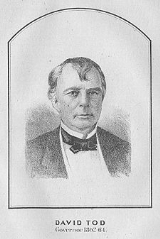
Youngstown, Ohio

Encyclopedia
Youngstown is a city in the U.S. state
of Ohio
and the county seat
of Mahoning County; it also extends into Trumbull County
. The municipality is situated on the Mahoning River
, approximately 65 miles (105 km) southeast of Cleveland
and 61 miles (98.2 km) northwest of Pittsburgh, Pennsylvania
. Youngstown has its own metropolitan area, but is often included in commercial and cultural depictions of the Pittsburgh Tri-State area and Greater Cleveland
. Youngstown lies 10 miles (16 km) west of the Pennsylvania
state line, midway between New York City
and Chicago
via Interstate 80
.
The city was named for John Young
, an early settler from Whitestown, New York
, who established the community's first sawmill and gristmill
. Youngstown is located in a region of the United States that is often referred to as the Rust Belt
. Traditionally known as a center of steel production, Youngstown was forced to redefine itself when the U.S. steel industry fell into decline in the 1970s, leaving communities throughout the region without major industry. The 2010 census showed that Youngstown had a total population of 66,982, making it Ohio's ninth largest city.
According to the 2010 Census, the Youngstown-Warren
-Boardman
Metropolitan Statistical Area
(MSA) contains 565,773 people and includes Mahoning and Trumbull
counties in Ohio, and Mercer County
in Pennsylvania. The Steel Valley area as a whole has 763,207 residents.
 Youngstown was named for New York native John Young
, who surveyed the area in 1796 and settled there soon after. On February 9, 1797, Young purchased the township of 15,560 acres (63 km²) from the Western Reserve Land Company
for $16,085. The 1797 establishment of Youngstown was officially recorded on August 19, 1802.
The area constituting present-day Youngstown was part of the Connecticut Western Reserve
, a section of the Northwest Territory
reserved for settlers from the state of Connecticut
. While many of the area's early settlers came from Connecticut, Youngstown attracted a significant number of Scots-Irish
settlers from neighboring Pennsylvania
. The first European Americans to settle permanently in the area were Pittsburgh native James Hillman and wife Catherine Dougherty. By 1798, Youngstown was the home of several families who were concentrated near the point where Mill Creek meets the Mahoning River.
As the Western Reserve's population grew, the need for administrative districts became apparent. In 1800, territorial governor Arthur St. Clair
established Trumbull County (named in honor of Connecticut Governor Jonathan Trumbull
), and designated the smaller settlement of Warren as its administrative center, or "county seat
". In 1813, Trumbull County was divided into townships, with Youngstown Township comprising much of what became Mahoning County. The village of Youngstown was incorporated in 1848, and in 1867 Youngstown was chartered as a city. It became the county seat in 1876, when the administrative center of Mahoning County was moved from neighboring Canfield
.
The discovery of coal by the community in the early 19th century paved the way for the Youngstown area's inclusion on the network of the famed Erie Canal
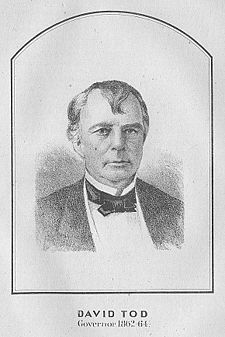
. The Pennsylvania and Ohio Canal Company was organized in 1835, and the canal was completed in 1840. Local industrialist David Tod
, who was later Ohio governor during the Civil War
, persuaded Lake Erie
steamboat owners that coal mined in the Mahoning Valley could fuel their vessels if canal transportation were available between Youngstown and Cleveland. The arrival of the railroad in 1856 smoothed the path for further economic growth.
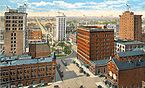 Youngstown's industrial development changed the face of the Mahoning Valley. The community's burgeoning coal industry drew hundreds of immigrants from Wales
, Germany, and Ireland. With the establishment of steel mills in the late 19th century, Youngstown became a popular destination for immigrants from Eastern Europe
, Italy, and Greece. In the early 20th century, the community saw an influx of immigrants from non-European countries including what is modern day Lebanon
, Israel
, and Syria
. By the 1920s, this dramatic demographic shift produced a nativist backlash, and the Mahoning Valley became a center of Ku Klux Klan
activity. The situation reached a climax in 1924, when street clashes between Klan members and Italian
and Irish
Americans in neighboring Niles
led Ohio Governor A. Victor Donahey
to declare martial law. By 1928, however, the Klan was in steep decline; and three years later, the organization sold its Canfield, Ohio, meeting area, Kountry Klub Field. Today, the metropolitan area's ethnic diversity is reflected in businesses such as a Jewish delicatessen
, Italian eateries, and Middle East
ern restaurants. Urban neighborhoods are dotted with churches, synagogue
s, and mosque
s.
The growth of industry attracted people from within the borders of the United States, and from Latin America
. By the late 19th Century, African Americans were well represented in Youngstown, and the first local congregation of the African Methodist Episcopal Church
was established in 1871. In the 1880s, local attorney William R. Stewart
was the second African American elected to the Ohio House of Representatives
. A large influx of African Americans in the early 20th century owed much to developments in the industrial sector. During the national Steel Strike of 1919
, local industrialists recruited thousands of workers from the South
, many of whom were Black. This move inflamed racist sentiment among local Whites, and for decades, African-American steelworkers experienced discrimination in the workplace. Migration from the South rose dramatically in the 1940s, when the mechanization of southern agriculture brought an end to the exploitative sharecropping
system, leading onetime farm laborers to seek industrial jobs.
The city's population became more diverse since the end of World War II, when a seemingly robust steel industry attracted thousands of workers. In the 1950s, the Latino population grew significantly; and by the 1970s, St. Rose of Lima Roman Catholic Church and the First Spanish Baptist
Church of Ohio were among the largest religious institutions for Spanish-speaking residents in the Youngstown metropolitan area. While diversity is among the community's enduring characteristics, the industrial economy that drew various groups to the area collapsed in the late 1970s. In response to subsequent challenges, the city has taken well-publicized steps to diversify economically, while building on some traditional strengths.
According to the United States Census Bureau
, the city has a total area of 34.2 square miles (88.7 km²); 33.9 square miles (87.8 km²) is land and 0.3 square mile (0.9 km²) is water. The total area is 1.02% water.
Youngstown is in the Mahoning Valley
on the Glaciated Allegheny Plateau
. At the end of the last Ice Age
, the glacier
s left behind a uniform plain with valleys caused by the Mahoning River
crossing the plain. Lakes created by glaciers that dammed small streams were eventually drained, leaving behind fertile terrain.
The racial makeup of the city is roughly 43% White, 45% Black or African American, and 9% Hispanic or Latino of any race, though Puerto Ricans are the dominant Latino group.
Records suggest that 27.2% of the households have children under the age of 18. Of these, 33.2% are married couples living together, 22.9% have a female householder with no husband present, and 38.7% are non-families. Meanwhile, 34.0% of all households comprise a single person, and 14.7% of households comprise a person over 65 years of age living alone. The average household size is 2.39 and the average family size is 3.07.
In Youngstown, the population leans toward greater numbers of youths, as is often the case in U.S. inner-city areas with higher birth rates. Survey data show the following: 25.8% under the age of 18, 10.1% from 18 to 24, 26.4% from 25 to 44, 20.3% from 45 to 64, and 17.4% who are 65 years of age or older. The median age is 36 years. For every 100 females, there are 91.9 males; for every 100 females aged 18 and over, there are 87.8 males.
The median household income is $24,201, and the median family income $30,701; but the average per capita income for the city is $13,293. Males have a median income of $29,900 and females $21,050. About 24.8% of the population lives below the poverty line. Out of the total population, 37.3% of those under the age of 18 and 13.3% of those 65 and older are living below the poverty line
.
The United States Census Bureau
's 2006 Annual Social and Economic (ASEC) Supplement Current Population Survey estimates a median household income of $21,850. Analysis by CNNMoney states that Youngstown has the lowest median income of U.S. cities with more than 65,000 residents.
Iron & Coal Company. The iron industry continued to expand in the 1890s, despite the depletion of local natural resources. Numerous rail connections ensured a consistent supply of coal and iron ore from neighboring states.
At the turn of the 20th century, local industrialists began to convert to steel manufacturing, amid a wave of industrial consolidations that placed much of the Mahoning Valley's industry in the hands of national corporations. Shortly after the establishment of U.S. Steel
in 1901, the corporate entity absorbed Youngstown's premier steel producer, the National Steel Company. One year earlier, however, a group of city investors took steps to ensure high levels of local ownership in the area's industrial sector. Led by local industrialists George D. Wick
and James A. Campbell
, they organized what became the Youngstown Sheet and Tube Company
, among the nation's most important regional steel producers. The firm significantly expanded its operations in 1923, when it acquired plants in South Chicago and East Chicago, Indiana
. This impulse to support local ownership surfaced again in 1931, when Campbell, as chairman of the Youngstown Sheet and Tube Company, attempted to merge the firm with Bethlehem Steel
, in a bid to create the nation's second-largest steel corporation. Other area industrialists blocked the move, with the financial backing of Republic Steel founder Cyrus S. Eaton
, who feared the implications of a strengthened Bethlehem Steel.
In the late 1930s, the community's steel sector gained national attention once again, when Youngstown became a site of the so-called "Little Steel Strike", an effort by the Steel Workers Organizing Committee
, a precursor to United Steelworkers
, to secure contract agreements with smaller steel companies. These firms included Republic Steel
, Bethlehem Steel, Youngstown Sheet and Tube, National Steel
, Inland Steel
, and American Rolling Mills. Gus Hall
, one of the committee's founding organizers, led strikes in Youngstown and Warren. On June 21, 1937, strike-related violence in Youngstown resulted in two deaths and 42 injuries. Despite violent episodes in Youngstown and Chicago, the Little Steel Strike proved to be a turning point in the history of the U.S. labor movement
. Historian William Lawson observed that the strike transformed industrial unions from "basically local and ineffective organizations into all-encompassing, nationwide collective bargaining representatives of American workers". A historical marker commemorating the strike was recently installed on the grounds of the Youngstown Historical Center of Industry and Labor.
, an event still remembered by many Youngstowners as "Black Monday", is widely regarded as the death knell of the old area steel industry. This was followed by the withdrawal of U.S. Steel in 1979 and 1980, and the bankruptcy of Republic Steel in the mid-1980s. Attempts to revive the local steel industry proved unsuccessful. Shortly after the closure of most of Youngstown Sheet and Tube's area operations, local religious leaders, steelworkers, and activists such as Staughton Lynd
participated in a grassroots effort to purchase and refurbish one of the company's abandoned plants in neighboring Campbell, Ohio
. This project met with failure in April 1979. In the wake of the steel plant shutdowns, the community lost an estimated 40,000 manufacturing jobs, 400 satellite businesses, $414 million in personal income, and from 33 to 75 percent of the school tax revenues. The Youngstown area has yet to fully recover from the loss of jobs in the steel sector.
(YSU), an urban public campus that serves about 15,000 students, located just north of downtown.
The blow dealt to the community's industrial economy in the 1970s, was slightly mitigated by the presence of auto production plants in the metropolitan area. In the late 1980s, the Avanti
, an automobile with a fiberglass body originally designed by Studebaker
to compete with the Corvette
, was manufactured in an industrial complex located on Youngstown's Albert Street. However, this company didn't last long in Youngstown, moving after just a few years. A mainstay, though, of Youngstown's industrial economy has long been the GM Lordstown plant.The General Motors' Lordstown Assembly
plant is the largest industrial employer in the area. One of the nation's largest auto plants in terms of square feet, the Lordstown facility was home to production of the Chevrolet Impala, Vega, and Cavalier
. Recently expanded and retooled with a new paint facility, it is the current home of the Cavalier's successor, the 2011 Chevrolet Cruze
.
The largest industrial employers within the Youngstown city limits are V&M Star Steel Company (formerly North Star Steel), in the Brier Hill district, and Exal Corporation, located on Poland Avenue. The latter has recently expanded its operations.
, located in the heart of the downtown, houses several start-up technology companies, which have received office space, furnishings, and access to utilities. Some companies supported by the incubator have earned recognition, and a few are starting to outgrow their current space. One such company–Turning Technologies–has been rated by Inc. Magazine as the fastest-growing privately held software company in the United States and 18th fastest-growing privately held company overall. In an effort to keep such companies downtown, the incubator secured approval to demolish a row of vacant buildings nearby to clear space for expansion. The project will be funded by a $2 million federal grant awarded in 2006.
brand of ice cream novelties, and the popular franchise of Handel's Homemade Ice Cream & Yogurt
was established there in the 1940s. In the 1950s, the suburb of Boardman became the site of one of the country's first modern shopping plazas, which was established by Youngstown-born developer Edward J. DeBartolo, Sr. The fast-food chain, Arby's
, opened the first of its restaurants in Boardman in 1964, and Arthur Treacher's Fish & Chips was headquartered in Youngstown in the late 1970s. More recently, the city's downtown hosted the corporate headquarters of the now-defunct pharmacy chain store Phar-Mor
, which was established by Youngstown native Mickey Monus
.
's ballad, "Youngstown
", featured on his The Ghost of Tom Joad
album. In the lyric, Springsteen addresses "my sweet Jenny," a reference to the Jeanette Blast Furnace, owned by Youngstown Sheet and Tube Company
, which sat along the Mahoning River
in the Brier Hill area of the city and was dynamited in 1977. Springsteen made Youngstown the first stop on his solo Ghost of Tom Joad Tour
, playing to a sold-out audience at Stambaugh Auditorium
on January 12, 1996.
Another pop culture reference to Youngstown came via the HBO television show The Sopranos
in 2002. In the show's fourth season premiere episode, entitled "For All Debts Public and Private", the character Paulie Gualtieri
is imprisoned in Youngstown for possessing a weapon that was used in an unsolved Youngstown murder. This episode's use of Youngstown as a setting seems to reference the city's association with crime and mob-related violence.
, which is the largest gas field discovered in the past decade, estimated to provide enough natural gas to supply the United States
for 100 years. Production is expected to begin in 2012.
mayors since the late 1920s because of the local unions' support for Democratic candidates for office. Youngstown's current mayor is Charles Sammarone, who replaced Jay Williams
, the city's first African-American mayor and its first independent
mayor since 1922. Williams belonged to the Mayors Against Illegal Guns Coalition
, a bi-partisan group with the stated goal of "making the public safer by getting illegal guns off the streets". He left his position in Youngstown to become President Barack Obama's auto czar, directing the Presidential Task Force on the Auto Industry
.
Residents elect an eight-member city council, which includes representatives of the city's seven wards and a council president. The council, in turn, appoints a city clerk. The council traditionally meets every first and third Wednesday of the month. City council meetings are generally held from the third week in September to the third week in June. Meanwhile, the board of control oversees contracts for public projects within the municipal limits. The Youngstown Police Department and Youngstown Fire Department
fall under the board's supervision, as do the parks, civil service, community development, health, planning, and water departments.
Youngstown's finance department oversees all municipal finances and supervises the departments of economic development and income tax. The city's department of public works has sweeping supervisory responsibilities and oversees the departments of engineering, building inspection, building and grounds, signal and sign, demolition and housing, litter and recycling, street, and water waste treatment. The city's law department represents the city on all legal issues, serving as counsel to all municipal departments.
manages all public education within the city. As of 2007, the school district was engaged in a process of reconfiguration, consolidating existing schools while building some new ones. District high schools once included South, North, Chaney
, Rayen
, East, Woodrow Wilson
, Youngstown Early College, and Choffin Career and Technical Center. This roster has changed, however. Chaney expanded, while Rayen and Wilson were closed to make way for a newly built East High School
. Youngstown City School District participate in an "Early College" program, in cooperation with Youngstown State University. This program enables high school students to attend classes on campus and earn college credit.
once oversaw more than 20 schools within the city limits. As a result of dwindling enrollment, however, only three Catholic schools continue to operate within Youngstown proper. These include one elementary school – St. Christine's – and two secondary schools, Ursuline
and Cardinal Mooney
. (The two high schools share a heated and longstanding rivalry in athletics.) Several additional Catholic schools operate in Mahoning, Trumbull, Columbiana, Portage, Stark, and Ashtabula counties.
There is also Akiva Academy on Gypsy Lane in Youngstown.
Youngstown hosts a small number of charter schools and one Montessori school. The Montessori School of the Mahoning Valley, which recently celebrated its 35th year, offers alternative learning environments for students ranging from preschool to eighth grade.
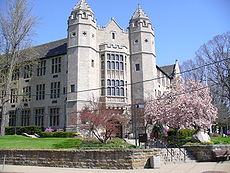 Youngstown State University
, the primary institution of higher learning in the Youngstown-Warren metropolitan area, traces its origins to a local YMCA
program that began offering college-level courses in 1908. YSU joined the Ohio system of higher education in 1967. Once regarded as a commuter school, YSU serves about 13,000 students, many from outside the Youngstown area. The campus is situated just north of the city's downtown and south of Youngstown's historic district, a neighborhood of Tudor
-, Victorian
-, and Spanish Colonial Revival
-style homes.
YSU offers the lowest tuition of any public institution of higher learning in Ohio, and its campus was reported to be among the safest in the state in 1996. The university's assets include the Dana School of Music, an All-Steinway school. The Dana School of Music is one of the six oldest continuously operating schools of music in the United States. Youngstown State's Engineering programs are accredited through ABET, making it one of the best Engineering Schools in the country, many graduates from the school have gone on to become the founders and heads for various Fortune 100 companies.
, a former Warner Brothers
movie palace that serves as the area's primary music hall while providing a home for the Youngstown Symphony Orchestra
. This downtown landmark is one of five auditoriums located within the city limits. Ford Recital Hall was built in 2006 as an addition to newly renovated Powers Auditorium. Imposing and neo-classical Stambaugh Auditorium
, located on the city's north side, has served for decades as a site of concerts and is often rented for private events. The facility also hosts the Stambaugh Youth Concert Band.
Oakland Center for the Arts
, located in the downtown area, is a venue for locally produced plays. This institution is complemented by the Youngstown Playhouse
, which is located on the city's south side. The Youngstown Playhouse, Mahoning County's primary community theater, has served the area for more than 80 years, despite intermittent financial problems. Well known theatrical personalities from the Youngstown area include comedic actor Joe Flynn
, screen actress Elizabeth Hartman
, singer and Broadway
performer Maureen McGovern
, and television and screen actor Ed O'Neill
.
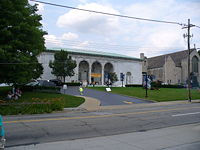
is located on the northeastern edge of the Youngstown State University campus. This institution was established by industrialist Joseph G. Butler, Jr.
, in 1919 as the first museum in the country dedicated to American art. Across the street from the Butler Institute stands the McDonough Museum of Art
, YSU's University Art Museum and the Mahoning Valley's center for contemporary art. The McDonough, established in 1991, features regular changing exhibitions by regional, national and international artists and provides public access to the work of students, faculty and alumni from the Department of Art. The Clarence R. Smith Mineral Museum, also located on the YSU campus, is operated by the university's geology department and housed in a campus building.
 To the immediate north of YSU is the Arms Family Museum of Local History. The museum, housed in a 1905 Arts & Crafts style
mansion on the main artery of Wick Avenue, is managed by the Mahoning Valley Historical Society. Once the estate of a local industrialist, the museum maintains period rooms that showcase the original contents of the household, including furnishings, art objects, and personal artifacts. The museum mounts rotating exhibits on topics related to local history. Recently, the museum opened the "Anne Kilcawley Christman Hands-on History Room". The MVHS Archival Library operates in the estate's former carriage house, located near the back of the site.
Located just south of the YSU campus is the Youngstown Historical Center of Industry and Labor, which sits on a grade overlooking the downtown area. This museum, owned and operated by the Ohio Historical Society
, focuses on the Mahoning Valley's history of steel production. Other museums include the Children's Museum of the Valley, an interactive educational center located in the downtown area, and the Davis Education and Recreation Center, a small museum that showcases the history of Youngstown's Mill Creek Park
.
On the city's north side the Youngstown Steel Heritage Foundation is constructing the Tod Engine Heritage Park, featuring a collection of steel industry equipment and artifacts. The main exhibit is a 1914 William Tod Co. rolling mill steam engine that was built in Youngstown and used at the Youngstown Sheet and Tube Brier Hill Works. The Tod Engine is one of three remaining rolling mill engines in the United States and is a Mechanical and Materials Engineering Landmark.
, a five-mile (8 km)-long stretch of landscaped woodland reminiscent of Rock Creek Park
in Washington, D.C.
Mill Creek Park is the oldest park district in Ohio, established as a township park in 1891. The park's highlights include the restored 19th century Lanterman's Mill, the rock formations of Bear's Den, scores of nature trails, the Fellows Riverside Gardens
and Education Center, the "Cinderella" iron link bridge, and two 18 hole Donald Ross golf courses.
Mill Creek Park encompasses approximately 2600 acres (10.5 km²), 20 miles (32.2 km) of drives and 15 miles (24.1 km) of foot trails. Its attractions include gardens, streams, lakes, woodlands, meadows, and wildlife.
Fellows Riverside Gardens' popular lookout point offers visitors contrasting views of the area. From the south side, the canopied woodlands overlooking Lake Glacier are visible; from the north side, visitors are presented with a view of downtown Youngstown. The park features two 18-hole golf courses. The North Course is situated on rolling terrain, while the South Course features narrow, tree-lined fairways. Other features include playgrounds, athletic fields, and picnic areas.
In 2005, Mill Creek Park was placed on the National Register of Historic Places
. A plaque commemorating this event is located near a memorial statue of Volney Rogers
, the Youngstown attorney who set aside land for the creation of Mill Creek Park.
A smaller recreational area called Wick Park
is located on the historic north side. Wick Park's periphery is lined with early 20th-century mansions built by the city's industrialists, business leaders, and professionals during Youngstown's "boom" years. Stambaugh Auditorium, a popular venue for concerts and other public events, is located near the park's southwestern edge. Several cemeteries (notably historic Oak Hill Cemetery) and small recreational spaces are scattered throughout the city.
Youngstown has enjoyed a long tradition of professional and semi-professional sports. In earlier decades, the city produced scores of minor league baseball teams, including the Youngstown Ohio Works
, Youngstown Champs
, Youngstown Indians
, Youngstown Steelmen
, Youngstown Browns
, Youngstown Gremlins
, and Youngstown Athletics. Local enthusiasm for baseball was such that the community hosted championship games of the National Amateur Baseball Federation throughout the 1930s and 1940s. The area's minor league baseball teams were supplemented by semi-professional football teams, including the Youngstown Patricians
, which won the 1915 championship of what became the National Football League
, and the Youngstown Hardhats
, which competed in the Middle Atlantic Football League in the 1970s and early 1980s. For three seasons, Youngstown was home to the Mahoning Valley Thunder
of the now-defunct af2
, the minor league for the Arena Football League until 2009 when the franchise ceased operations. Local minor league basketball teams included the Youngstown Pride
(which played in the WBA
from 1987 to 1992), the Youngstown Hawks
(IBA
, 1999), and the Mahoning Valley Wildcats
(IBL
, 2005). Youngstown's Covelli Centre was the home of the Youngstown SteelHounds
hockey team (when it was the Chevrolet Centre), which played in the Central Hockey League
until May 2008.
In early 2007, the "Championship Wrestling Experience" began holding events in the area that featured stars like "Jake the Snake" Roberts and Jerry Lynn. These wrestlers have appeared at the "Salute to Wrestling" event held in July for the Mahoning Valley Scrappers
.
The community has a lengthy tradition of collegiate sports. The Youngstown State University Penguins, a major regional draw, compete in the Missouri Valley Football Conference. The Penguins, noted participants in FCS (I-AA) football, play their games at Stambaugh Stadium
and enjoy one of the more supportive fan bases. All other YSU athletic teams compete in the Horizon League
. The Youngstown State men and women's basketball teams hold their games at Youngstown State's Beeghly Center
. The teams average about 2,500 fans per game, a number which has been on the rise the past two seasons with a new style of play under Head Coach Jerry Slocum. In addition, the YSU baseball and softball teams have enjoyed local support and success. The baseball team reached the NCAA super-regionals in 2005, and the softball team did so in 2006.
Meanwhile, Youngstown has produced a significant number of boxing
champions, including bantamweight Greg Richardson
, lightweights Ray "Boom Boom" Mancini
, Harry Arroyo
, and middleweight Kelly Pavlik
.
, and the Mahoning Valley Thunder, an af2 arena football team which began play in 2007. Previously, it was home to the Youngstown Steelhounds hockey team, who played in the CHL
. The city plans to develop vacant land adjacent to the Centre. Plans included using the space for a park, riverwalk (the Mahoning River flows through the site), amphitheater, or athletic stadium for the city's public and private high schools.
Such investments reflect wide appreciation of Youngstown's athletic tradition, which has produced noted figures in a variety of sports. Prominent athletes with connections to the city include former world boxing champions Greg Richardson, IBF
lightweight
champion Harry Arroyo, College Football Hall of Fame
end
Bob Dove
, Hall of Fame umpire Billy Evans
, major league pitcher
Dave Dravecky
, NFL
quarterback
Bernie Kosar
, IBF
cruiserweight champion Jeff Lampkin, WBA
lightweight champion Ray "Boom Boom" Mancini, major league manager Jimmy McAleer
, WBC
and WBO middleweight champion Kelly Pavlik, legendary baseball trainer "Bonesetter" Reese
, major league outfielder
George Shuba
, and Heisman Trophy
recipient Frank Sinkwich
.
, an amusement park that served as a convenient alternative for residents who preferred not to travel to larger parks in Northern Ohio and Western Pennsylvania. (These included Conneaut Lake Park
in Conneaut Lake, Pennsylvania
, Geauga Lake in Aurora, Ohio, Cedar Point
in Sandusky, Ohio
, and Kennywood
in Pittsburgh
.) The park, which closed in 1984, held sentimental value for many local residents and enjoyed a degree of historical significance. Former Youngstown resident Jack Warner
noted in his autobiography that the Warner brothers
took their first step into the movie business when they screened a used copy of The Great Train Robbery
at Idora Park and other local venues.
From the early 20th century to the mid-1970s, Youngstown was the retail center of the Mahoning Valley. There were two flagship department stores in the downtown area, including Strouss Hirshberg's
(later absorbed by Kaufmann's
, now part of Macy's
) and McKelvey's (later Higbee's
, now part of Dillard's
). Specialty shops lined the main artery of West Federal Street, and the district had four upscale movie theater
s, including the Palace Theater, the Warner Brothers' first Theater, the State Theater, and the Paramount Theater. These businesses were the first to close as a result of declining attendance in the 1950s, 1960s, and 1970s.
In the early 1970s, the appearance of two suburban malls (the Southern Park Mall
, in Boardman, and the Eastwood Mall
, in Niles) hastened the closure or relocation of many businesses that remained. The collapse of the community's steel industry at the end of the decade created additional challenges for downtown business owners; and throughout the 1980s and 1990s, efforts to revive the former retail hub were unsuccessful.
Government Center and state and federal courthouses: the Seventh District Court of Appeals and the Nathaniel R. Jones
Federal Building and U.S. Courthouse. The latter features an award-winning design by the architectural firm, Robert A. M. Stern Architects
.
In 2005, Federal Street, a major downtown thoroughfare that was closed off to create a pedestrian-oriented plaza, was reopened to through traffic. The downtown area has seen the razing of structurally unsound buildings and the expansion or restoration of others.
allowed for the demolition of Westlake Terrace, a sprawling and dilapidated public housing project. Today, the site features a blend of senior housing, rental townhouses and for-sale single-family homes. Low real-estate prices and the efforts of the Youngstown Central Area Improvement Corporation (CIC) have contributed to the purchase of several long-abandoned downtown buildings (many by out-of-town investors) and their restoration and conversion into specialty shops, restaurants, and eventually condominiums. Further, a nonprofit organization called Wick Neighbors is planning a $250 million New Urbanist revitalization of Smoky Hollow, a former ethnic neighborhood that borders the downtown and university campus. The neighborhood will eventually comprise about 400 residential units, university student housing, retail space, and a central park. Construction for the project began in 2006.
New construction has dovetailed with efforts to cultivate business growth. One of the area's more successful business ventures in recent years has been the Youngstown Business Incubator. This nonprofit organization, based in a former downtown department store building, fosters the growth of fledgling technology-based companies. The incubator, which boasts more than a dozen business tenants, has recently completed construction on the Taft Technology Center, where some of its largest tenants will locate their offices.
by director Martin Scorsese
included a homage to Youngstown in the final scene, where the character Henry Hill picked up a copy of The Vindicator
from the stoop of the Midwestern home he was located in under witness protection. The image of image Youngstown being associated with crime has been reinforced by the widely reported fact that five prisons operate within the metropolitan area. The city, however, has accelerated measures to limit the influence of organized crime upon all sectors of municipal life. For some observers, the climax of this ongoing effort was the arrest, trial, and 2002 conviction of former U.S. Representative
James A. Traficant, Jr. (D), on bribery, tax fraud, and racketeering charges. Meanwhile, the municipal government has responded to a rise in gang- and drug-related violence by increasing the presence of police in urban neighborhoods. In the course of enforcing traffic laws and issuing warrants, police and state troopers have apprehended serious criminal offenders. Despite these efforts, crime remains an area for improvement.
terminal.
Located in the vicinity of the WRTA terminal is a former Baltimore and Ohio Railroad
station. The historic terminal building, which has been converted into a banquet hall, served as a train station from 1995 to 2005. The local railroads now serve freight trains exclusively.
The only airport within the city limits is the Lansdowne Airport, located on the city's east side. This facility is used for general aviation. The metropolitan area's main airport is the Youngstown-Warren Regional Airport
(YNG), located in nearby Vienna, Ohio. The only commercial route available at this airport is a flight to Orlando, Florida
through Allegiant Air
. Most valley residents take advantage of larger airports such as Cleveland Hopkins International Airport
, Akron-Canton Regional Airport
, and Pittsburgh International Airport
.
(daily/regional news), and the The Vindicator
(daily/regional news).
Youngstown is served by 10 television stations, three of which are repeaters of TV stations in other cities, and a fourth coming in the near future from Pittsburgh NBC affiliate WPXI
in nearby New Castle, Pennsylvania
that would easily penetrate Youngstown pending FCC
approval. This is unusual for a mid-sized city located near large metro areas such as Cleveland and Pittsburgh. Nearby Akron, with a larger population than Youngstown and Warren combined, has no local television stations and relies on Cleveland for its local news. The community's 273,480 television households make the Youngstown market the nation's 106th largest, according to Nielsen Media Research.
The market is served by stations affiliated with major American networks including: WFMJ-TV
(channel 21, NBC
), WYTV
(channel 33, ABC
), WYFX-LP
(channel 17/62 & 27.2 on WKBN-DT2, Fox
), WKBN-TV
(channel 27, CBS
), MY-YTV
(channel 33.2, MNTV), and WBCB
(channel 21.2, The CW
). WFMJ-TV and its digital subchannel
WBCB are both locally owned & operated by the Maag family, owners of The Vindicator. The rest of Youngstown's commercial television stations are either owned & operated by New Vision Television
or operated by NVT through a shared services
agreement, which is essentially a local marketing agreement
under different legal terms. Western Reserve Public Media, which airs on channel 45 (WNEO) from Alliance, Ohio
and channel 49 (WEAO) from Akron, is a member of PBS
.
Youngstown is served by 37 different radio station
s in the metropolitan area which makes it the 119th largest radio market in the United States. Stations include 17 on the AM band
and 20 on the FM band
. The majority of the most powerful and popular radio stations in the Youngstown-Warren market are divided between two conglomerates: Clear Channel
and Cumulus Media
.
(SA), Italy Spišská Nová Ves, Slovakia Surda, Palestinian Authority Al-Bireh
, Palestinian Authority Sana'a
, Yemen Ciudad Obregón
(Sonora
), México
U.S. state
A U.S. state is any one of the 50 federated states of the United States of America that share sovereignty with the federal government. Because of this shared sovereignty, an American is a citizen both of the federal entity and of his or her state of domicile. Four states use the official title of...
of Ohio
Ohio
Ohio is a Midwestern state in the United States. The 34th largest state by area in the U.S.,it is the 7th‑most populous with over 11.5 million residents, containing several major American cities and seven metropolitan areas with populations of 500,000 or more.The state's capital is Columbus...
and the county seat
County seat
A county seat is an administrative center, or seat of government, for a county or civil parish. The term is primarily used in the United States....
of Mahoning County; it also extends into Trumbull County
Trumbull County, Ohio
As of the census of 2000, there were 225,116 people, 89,020 households, and 61,690 families residing in the county. The population density was 365 people per square mile . There were 95,117 housing units at an average density of 154 per square mile...
. The municipality is situated on the Mahoning River
Mahoning River
The Mahoning River is a river located in eastern Ohio and western Pennsylvania. It joins the Shenango River to form the Beaver River and is part of the Ohio River watershed.- Physical properties :...
, approximately 65 miles (105 km) southeast of Cleveland
Cleveland, Ohio
Cleveland is a city in the U.S. state of Ohio and is the county seat of Cuyahoga County, the most populous county in the state. The city is located in northeastern Ohio on the southern shore of Lake Erie, approximately west of the Pennsylvania border...
and 61 miles (98.2 km) northwest of Pittsburgh, Pennsylvania
Pittsburgh, Pennsylvania
Pittsburgh is the second-largest city in the US Commonwealth of Pennsylvania and the county seat of Allegheny County. Regionally, it anchors the largest urban area of Appalachia and the Ohio River Valley, and nationally, it is the 22nd-largest urban area in the United States...
. Youngstown has its own metropolitan area, but is often included in commercial and cultural depictions of the Pittsburgh Tri-State area and Greater Cleveland
Greater Cleveland
Greater Cleveland is a nickname for the metropolitan area surrounding Cleveland, Ohio and is part of what used to be the Connecticut Western Reserve.Northeast Ohio refers to a similar but substantially larger area as described below...
. Youngstown lies 10 miles (16 km) west of the Pennsylvania
Pennsylvania
The Commonwealth of Pennsylvania is a U.S. state that is located in the Northeastern and Mid-Atlantic regions of the United States. The state borders Delaware and Maryland to the south, West Virginia to the southwest, Ohio to the west, New York and Ontario, Canada, to the north, and New Jersey to...
state line, midway between New York City
New York City
New York is the most populous city in the United States and the center of the New York Metropolitan Area, one of the most populous metropolitan areas in the world. New York exerts a significant impact upon global commerce, finance, media, art, fashion, research, technology, education, and...
and Chicago
Chicago
Chicago is the largest city in the US state of Illinois. With nearly 2.7 million residents, it is the most populous city in the Midwestern United States and the third most populous in the US, after New York City and Los Angeles...
via Interstate 80
Interstate 80
Interstate 80 is the second-longest Interstate Highway in the United States, following Interstate 90. It is a transcontinental artery running from downtown San Francisco, California to Teaneck, New Jersey in the New York City Metropolitan Area...
.
The city was named for John Young
John Young (pioneer)
John Young was an American surveyor and pioneer. He is best known as the founder of Youngstown, Ohio, a village that eventually became one of the nation's largest steel producers. Young, a native of Whitestown, New York, first surveyed the area in 1796 and settled there soon after...
, an early settler from Whitestown, New York
Whitestown, New York
Whitestown is a town in Oneida County, New York, USA. The population was 18,635 at the 2000 census. The name is derived from Judge Hugh White, an early settler.The Town of Whitestown is immediately west of Utica, New York...
, who established the community's first sawmill and gristmill
Gristmill
The terms gristmill or grist mill can refer either to a building in which grain is ground into flour, or to the grinding mechanism itself.- Early history :...
. Youngstown is located in a region of the United States that is often referred to as the Rust Belt
Rust Belt
The Rust Belt is a term that gained currency in the 1980s as the informal description of an area straddling the Midwestern and Northeastern United States, in which local economies traditionally garnered an increased manufacturing sector to add jobs and corporate profits...
. Traditionally known as a center of steel production, Youngstown was forced to redefine itself when the U.S. steel industry fell into decline in the 1970s, leaving communities throughout the region without major industry. The 2010 census showed that Youngstown had a total population of 66,982, making it Ohio's ninth largest city.
According to the 2010 Census, the Youngstown-Warren
Warren, Ohio
As of the census of 2000, there were 46,832 people, 19,288 households and 12,035 families residing in the city. The population density was 2,912.4 people per square mile . There were 21,279 housing units at an average density of 1,322.9 per square mile...
-Boardman
Boardman, Ohio
Boardman is a census-designated place in Boardman Township, Mahoning County, Ohio, United States, just south of Youngstown. Boardman is considered to be a moderately affluent community and is one of two major retail hubs in the greater Youngstown area...
Metropolitan Statistical Area
Youngstown-Warren-Boardman, OH-PA Metropolitan Area
The Youngstown Metropolitan Area is a metropolitan area centered on the American city of Youngstown, Ohio. According to the US Census Bureau, the metropolitan area includes Mahoning and Trumbull counties in Ohio and Mercer county in Pennsylvania...
(MSA) contains 565,773 people and includes Mahoning and Trumbull
Trumbull County, Ohio
As of the census of 2000, there were 225,116 people, 89,020 households, and 61,690 families residing in the county. The population density was 365 people per square mile . There were 95,117 housing units at an average density of 154 per square mile...
counties in Ohio, and Mercer County
Mercer County, Pennsylvania
Mercer County is a county located in the U.S. state of Pennsylvania. As of 2010, the population was 116,638. Its county seat is Mercer; Sharon is its largest city....
in Pennsylvania. The Steel Valley area as a whole has 763,207 residents.
Origins
John Young (pioneer)
John Young was an American surveyor and pioneer. He is best known as the founder of Youngstown, Ohio, a village that eventually became one of the nation's largest steel producers. Young, a native of Whitestown, New York, first surveyed the area in 1796 and settled there soon after...
, who surveyed the area in 1796 and settled there soon after. On February 9, 1797, Young purchased the township of 15,560 acres (63 km²) from the Western Reserve Land Company
Connecticut Western Reserve
The Connecticut Western Reserve was land claimed by Connecticut from 1662 to 1800 in the Northwest Territory in what is now northeastern Ohio.-History:...
for $16,085. The 1797 establishment of Youngstown was officially recorded on August 19, 1802.
The area constituting present-day Youngstown was part of the Connecticut Western Reserve
Connecticut Western Reserve
The Connecticut Western Reserve was land claimed by Connecticut from 1662 to 1800 in the Northwest Territory in what is now northeastern Ohio.-History:...
, a section of the Northwest Territory
Northwest Territory
The Territory Northwest of the River Ohio, more commonly known as the Northwest Territory, was an organized incorporated territory of the United States that existed from July 13, 1787, until March 1, 1803, when the southeastern portion of the territory was admitted to the Union as the state of Ohio...
reserved for settlers from the state of Connecticut
Connecticut
Connecticut is a state in the New England region of the northeastern United States. It is bordered by Rhode Island to the east, Massachusetts to the north, and the state of New York to the west and the south .Connecticut is named for the Connecticut River, the major U.S. river that approximately...
. While many of the area's early settlers came from Connecticut, Youngstown attracted a significant number of Scots-Irish
Scots-Irish American
Scotch-Irish Americans are an estimated 250,000 Presbyterian and other Protestant dissenters from the Irish province of Ulster who immigrated to North America primarily during the colonial era and their descendants. Some scholars also include the 150,000 Ulster Protestants who immigrated to...
settlers from neighboring Pennsylvania
Pennsylvania
The Commonwealth of Pennsylvania is a U.S. state that is located in the Northeastern and Mid-Atlantic regions of the United States. The state borders Delaware and Maryland to the south, West Virginia to the southwest, Ohio to the west, New York and Ontario, Canada, to the north, and New Jersey to...
. The first European Americans to settle permanently in the area were Pittsburgh native James Hillman and wife Catherine Dougherty. By 1798, Youngstown was the home of several families who were concentrated near the point where Mill Creek meets the Mahoning River.
As the Western Reserve's population grew, the need for administrative districts became apparent. In 1800, territorial governor Arthur St. Clair
Arthur St. Clair
Arthur St. Clair was an American soldier and politician. Born in Scotland, he served in the British Army during the French and Indian War before settling in Pennsylvania, where he held local office...
established Trumbull County (named in honor of Connecticut Governor Jonathan Trumbull
Jonathan Trumbull
Jonathan Trumbull, Sr. was one of the few Americans who served as governor in both a pre-Revolutionary colony and a post-Revolutionary state...
), and designated the smaller settlement of Warren as its administrative center, or "county seat
County seat
A county seat is an administrative center, or seat of government, for a county or civil parish. The term is primarily used in the United States....
". In 1813, Trumbull County was divided into townships, with Youngstown Township comprising much of what became Mahoning County. The village of Youngstown was incorporated in 1848, and in 1867 Youngstown was chartered as a city. It became the county seat in 1876, when the administrative center of Mahoning County was moved from neighboring Canfield
Canfield, Ohio
Canfield is an affluent suburban city located in Mahoning County, Ohio,[United States, at the intersection of U.S. Route 224 and State Route 46/U.S. Route 62, about ten miles southwest of Youngstown. As of the 2000 census, the city population was 7,374. It is part of the Youngstown-Warren-Boardman,...
.
The discovery of coal by the community in the early 19th century paved the way for the Youngstown area's inclusion on the network of the famed Erie Canal
Erie Canal
The Erie Canal is a waterway in New York that runs about from Albany, New York, on the Hudson River to Buffalo, New York, at Lake Erie, completing a navigable water route from the Atlantic Ocean to the Great Lakes. The canal contains 36 locks and encompasses a total elevation differential of...
. The Pennsylvania and Ohio Canal Company was organized in 1835, and the canal was completed in 1840. Local industrialist David Tod
David Tod
David Tod was a politician and industrialist from the U.S. state of Ohio. As the 25th Governor of Ohio, Tod gained recognition for his forceful and energetic leadership during the American Civil War....
, who was later Ohio governor during the Civil War
American Civil War
The American Civil War was a civil war fought in the United States of America. In response to the election of Abraham Lincoln as President of the United States, 11 southern slave states declared their secession from the United States and formed the Confederate States of America ; the other 25...
, persuaded Lake Erie
Lake Erie
Lake Erie is the fourth largest lake of the five Great Lakes in North America, and the tenth largest globally. It is the southernmost, shallowest, and smallest by volume of the Great Lakes and therefore also has the shortest average water residence time. It is bounded on the north by the...
steamboat owners that coal mined in the Mahoning Valley could fuel their vessels if canal transportation were available between Youngstown and Cleveland. The arrival of the railroad in 1856 smoothed the path for further economic growth.
Peopling of the valley
Wales
Wales is a country that is part of the United Kingdom and the island of Great Britain, bordered by England to its east and the Atlantic Ocean and Irish Sea to its west. It has a population of three million, and a total area of 20,779 km²...
, Germany, and Ireland. With the establishment of steel mills in the late 19th century, Youngstown became a popular destination for immigrants from Eastern Europe
Eastern Europe
Eastern Europe is the eastern part of Europe. The term has widely disparate geopolitical, geographical, cultural and socioeconomic readings, which makes it highly context-dependent and even volatile, and there are "almost as many definitions of Eastern Europe as there are scholars of the region"...
, Italy, and Greece. In the early 20th century, the community saw an influx of immigrants from non-European countries including what is modern day Lebanon
Lebanon
Lebanon , officially the Republic of LebanonRepublic of Lebanon is the most common term used by Lebanese government agencies. The term Lebanese Republic, a literal translation of the official Arabic and French names that is not used in today's world. Arabic is the most common language spoken among...
, Israel
Israel
The State of Israel is a parliamentary republic located in the Middle East, along the eastern shore of the Mediterranean Sea...
, and Syria
Syria
Syria , officially the Syrian Arab Republic , is a country in Western Asia, bordering Lebanon and the Mediterranean Sea to the West, Turkey to the north, Iraq to the east, Jordan to the south, and Israel to the southwest....
. By the 1920s, this dramatic demographic shift produced a nativist backlash, and the Mahoning Valley became a center of Ku Klux Klan
Ku Klux Klan
Ku Klux Klan, often abbreviated KKK and informally known as the Klan, is the name of three distinct past and present far-right organizations in the United States, which have advocated extremist reactionary currents such as white supremacy, white nationalism, and anti-immigration, historically...
activity. The situation reached a climax in 1924, when street clashes between Klan members and Italian
Italian American
An Italian American , is an American of Italian ancestry. The designation may also refer to someone possessing Italian and American dual citizenship...
and Irish
Irish American
Irish Americans are citizens of the United States who can trace their ancestry to Ireland. A total of 36,278,332 Americans—estimated at 11.9% of the total population—reported Irish ancestry in the 2008 American Community Survey conducted by the U.S. Census Bureau...
Americans in neighboring Niles
Niles, Ohio
Niles is a city in Trumbull County, Ohio, United States. The city's population was 20,932 at the 2000 census. It is part of the Youngstown-Warren-Boardman, OH-PA Metropolitan Statistical Area....
led Ohio Governor A. Victor Donahey
A. Victor Donahey
Alvin Victor Donahey was a Democratic Party politician from Ohio. Donahey was the 50th Governor of Ohio and a United States Senator from Ohio.Donahey was born in Cadwallader, Tuscarawas County, Ohio. His parents were John C...
to declare martial law. By 1928, however, the Klan was in steep decline; and three years later, the organization sold its Canfield, Ohio, meeting area, Kountry Klub Field. Today, the metropolitan area's ethnic diversity is reflected in businesses such as a Jewish delicatessen
Delicatessen
Delicatessen is a term meaning "delicacies" or "fine foods". The word entered English via German,with the old German spelling , plural of Delikatesse "delicacy", ultimately from Latin delicatus....
, Italian eateries, and Middle East
Middle East
The Middle East is a region that encompasses Western Asia and Northern Africa. It is often used as a synonym for Near East, in opposition to Far East...
ern restaurants. Urban neighborhoods are dotted with churches, synagogue
Synagogue
A synagogue is a Jewish house of prayer. This use of the Greek term synagogue originates in the Septuagint where it sometimes translates the Hebrew word for assembly, kahal...
s, and mosque
Mosque
A mosque is a place of worship for followers of Islam. The word is likely to have entered the English language through French , from Portuguese , from Spanish , and from Berber , ultimately originating in — . The Arabic word masjid literally means a place of prostration...
s.
The growth of industry attracted people from within the borders of the United States, and from Latin America
Latin America
Latin America is a region of the Americas where Romance languages – particularly Spanish and Portuguese, and variably French – are primarily spoken. Latin America has an area of approximately 21,069,500 km² , almost 3.9% of the Earth's surface or 14.1% of its land surface area...
. By the late 19th Century, African Americans were well represented in Youngstown, and the first local congregation of the African Methodist Episcopal Church
African Methodist Episcopal Church
The African Methodist Episcopal Church, usually called the A.M.E. Church, is a predominantly African American Methodist denomination based in the United States. It was founded by the Rev. Richard Allen in Philadelphia, Pennsylvania, in 1816 from several black Methodist congregations in the...
was established in 1871. In the 1880s, local attorney William R. Stewart
William R. Stewart
William R. Stewart was the second African American to be elected to the Ohio State Senate. As a lawmaker, he was instrumental in the passage of anti-lynching legislation and also sponsored bills providing pensions to civil servants...
was the second African American elected to the Ohio House of Representatives
Ohio House of Representatives
The Ohio House of Representatives is the lower house of the Ohio General Assembly, the state legislature of the U.S. state of Ohio; the other house of the bicameral legislature being the Ohio Senate....
. A large influx of African Americans in the early 20th century owed much to developments in the industrial sector. During the national Steel Strike of 1919
Steel strike of 1919
The Steel Strike of 1919 was an attempt by the weakened Amalgamated Association of Iron, Steel and Tin Workers to organize the United States steel industry in the wake of World War I. The strike began on September 22, 1919, and collapsed on January 8, 1920.The AA had formed in 1876. It was a...
, local industrialists recruited thousands of workers from the South
Southern United States
The Southern United States—commonly referred to as the American South, Dixie, or simply the South—constitutes a large distinctive area in the southeastern and south-central United States...
, many of whom were Black. This move inflamed racist sentiment among local Whites, and for decades, African-American steelworkers experienced discrimination in the workplace. Migration from the South rose dramatically in the 1940s, when the mechanization of southern agriculture brought an end to the exploitative sharecropping
Sharecropping
Sharecropping is a system of agriculture in which a landowner allows a tenant to use the land in return for a share of the crop produced on the land . This should not be confused with a crop fixed rent contract, in which a landowner allows a tenant to use the land in return for a fixed amount of...
system, leading onetime farm laborers to seek industrial jobs.
The city's population became more diverse since the end of World War II, when a seemingly robust steel industry attracted thousands of workers. In the 1950s, the Latino population grew significantly; and by the 1970s, St. Rose of Lima Roman Catholic Church and the First Spanish Baptist
Baptist
Baptists comprise a group of Christian denominations and churches that subscribe to a doctrine that baptism should be performed only for professing believers , and that it must be done by immersion...
Church of Ohio were among the largest religious institutions for Spanish-speaking residents in the Youngstown metropolitan area. While diversity is among the community's enduring characteristics, the industrial economy that drew various groups to the area collapsed in the late 1970s. In response to subsequent challenges, the city has taken well-publicized steps to diversify economically, while building on some traditional strengths.
Geography and climate
Youngstown is located at 41°5′47"N 80°38′57"W (41.096258, −80.649299). It borders or touches the following other townships and municipalities:- Boardman Township, Mahoning CountyBoardman Township, Mahoning County, OhioBoardman Township is one of the fourteen townships of Mahoning County, Ohio, United States. The 2000 census found 42,518 people in the township...
on the south - Canfield Township, Mahoning CountyCanfield, OhioCanfield is an affluent suburban city located in Mahoning County, Ohio,[United States, at the intersection of U.S. Route 224 and State Route 46/U.S. Route 62, about ten miles southwest of Youngstown. As of the 2000 census, the city population was 7,374. It is part of the Youngstown-Warren-Boardman,...
on the southwest - Austintown Township, Mahoning CountyAustintown, OhioAustintown is a census-designated place in Mahoning County, Ohio, United States. It is part of the Youngstown-Warren-Boardman, OH-PA Metropolitan Statistical Area. The population was 31,627 at the 2000 census...
on the west - Weathersfield Township, Trumbull CountyWeathersfield Township, Trumbull County, OhioWeathersfield Township is one of the twenty-four townships of Trumbull County, Ohio, United States. The 2000 census found 27,717 people in the township, 8,677 of whom lived in the unincorporated portions of the township.-Geography:...
, on the northwest (touches, but does not border) - Girard, Trumbull CountyGirard, OhioGirard is a city in Trumbull County, Ohio, United States. The population was 10,902 at the 2000 census. It is part of the Youngstown–Warren–Boardman, OH-PA Metropolitan Statistical Area.-Geography:Girard is located at ....
on the north–northwest - Liberty Township, Trumbull CountyLiberty Township, Trumbull County, OhioLiberty Township is one of the twenty-four townships of Trumbull County, Ohio, United States. The 2000 census found 23,522 people in the township, 12,661 of whom lived in the unincorporated portions of the township.- Geography :...
, on the north - Hubbard Township, Trumbull CountyHubbard Township, Trumbull County, OhioHubbard Township is one of the twenty-four townships of Trumbull County, Ohio, United States. The 2000 census found 14,304 people in the township, 6,020 of whom lived in the unincorporated portions of the township.-Geography:...
, on the northeast - Coitsville Township, Mahoning CountyCoitsville Township, Mahoning County, OhioCoitsville Township is one of the fourteen townships of Mahoning County, Ohio, United States. The 2000 census found 1,608 people in the township.-Geography:...
on the east - Campbell, Mahoning CountyCampbell, OhioCampbell is a city in Mahoning County, Ohio, United States. The population was 8,235 at the 2010 census. Residents generally pronounce the city's name as "camel" , with a silent "PB". Campbell is served by a branch of the Public Library of Youngstown and Mahoning County...
on the east–southeast - Struthers, Mahoning CountyStruthers, OhioStruthers is a city in Mahoning County, Ohio, United States. The population was 12,036 at the 2000 census. Struthers is served by a branch of the Public Library of Youngstown and Mahoning County. It is part of the Youngstown-Warren-Boardman, OH-PA Metropolitan Statistical Area.- History :John...
on the southeast - Poland, Ohio, Mahoning CountyPoland, OhioPoland is a village in Mahoning County, Ohio, United States. The population was 26,866 at the 2000 census. It is part of the Youngstown-Warren-Boardman, OH-PA Metropolitan Statistical Area.-History:...
on the south-southeast
According to the United States Census Bureau
United States Census Bureau
The United States Census Bureau is the government agency that is responsible for the United States Census. It also gathers other national demographic and economic data...
, the city has a total area of 34.2 square miles (88.7 km²); 33.9 square miles (87.8 km²) is land and 0.3 square mile (0.9 km²) is water. The total area is 1.02% water.
Youngstown is in the Mahoning Valley
Mahoning Valley
The Mahoning Valley is a geographic valley encompassing the area of northeast Ohio and northwest Pennsylvania that drains into the Mahoning River. The Mahoning River empties into the Beaver River, which empties into the Ohio River. The Mahoning River flows through Lawrence and Mercer counties in...
on the Glaciated Allegheny Plateau
Glaciated Allegheny Plateau
The Glaciated Allegheny Plateau is that portion of the Allegheny Plateau that lies within the area covered by the last glaciation. As a result, this area of the Allegheny Plateau has lower relief and more gentle slopes than the relatively rugged Unglaciated Allegheny Plateau...
. At the end of the last Ice Age
Ice age
An ice age or, more precisely, glacial age, is a generic geological period of long-term reduction in the temperature of the Earth's surface and atmosphere, resulting in the presence or expansion of continental ice sheets, polar ice sheets and alpine glaciers...
, the glacier
Glacier
A glacier is a large persistent body of ice that forms where the accumulation of snow exceeds its ablation over many years, often centuries. At least 0.1 km² in area and 50 m thick, but often much larger, a glacier slowly deforms and flows due to stresses induced by its weight...
s left behind a uniform plain with valleys caused by the Mahoning River
Mahoning River
The Mahoning River is a river located in eastern Ohio and western Pennsylvania. It joins the Shenango River to form the Beaver River and is part of the Ohio River watershed.- Physical properties :...
crossing the plain. Lakes created by glaciers that dammed small streams were eventually drained, leaving behind fertile terrain.
Demographics
According to the 2000 Census numbers, Youngstown has 32,177 households and 19,724 families in the city. The population density is 893/km² (2,312.9/sq mi). There are 37,159 housing units at an average density of 1,096.3 per square mile (423.2/km²).The racial makeup of the city is roughly 43% White, 45% Black or African American, and 9% Hispanic or Latino of any race, though Puerto Ricans are the dominant Latino group.
Records suggest that 27.2% of the households have children under the age of 18. Of these, 33.2% are married couples living together, 22.9% have a female householder with no husband present, and 38.7% are non-families. Meanwhile, 34.0% of all households comprise a single person, and 14.7% of households comprise a person over 65 years of age living alone. The average household size is 2.39 and the average family size is 3.07.
In Youngstown, the population leans toward greater numbers of youths, as is often the case in U.S. inner-city areas with higher birth rates. Survey data show the following: 25.8% under the age of 18, 10.1% from 18 to 24, 26.4% from 25 to 44, 20.3% from 45 to 64, and 17.4% who are 65 years of age or older. The median age is 36 years. For every 100 females, there are 91.9 males; for every 100 females aged 18 and over, there are 87.8 males.
The median household income is $24,201, and the median family income $30,701; but the average per capita income for the city is $13,293. Males have a median income of $29,900 and females $21,050. About 24.8% of the population lives below the poverty line. Out of the total population, 37.3% of those under the age of 18 and 13.3% of those 65 and older are living below the poverty line
Poverty threshold
The poverty threshold, or poverty line, is the minimum level of income deemed necessary to achieve an adequate standard of living in a given country...
.
The United States Census Bureau
United States Census Bureau
The United States Census Bureau is the government agency that is responsible for the United States Census. It also gathers other national demographic and economic data...
's 2006 Annual Social and Economic (ASEC) Supplement Current Population Survey estimates a median household income of $21,850. Analysis by CNNMoney states that Youngstown has the lowest median income of U.S. cities with more than 65,000 residents.
Economy
Endowed with large deposits of coal and iron as well as "old growth" hardwood forests needed to produce charcoal, the Youngstown area eventually developed a thriving steel industry. The area's first blast furnace was established to the east of town in 1803 by James and Daniel Heaton. In time, the availability of fossil fuels contributed to the development of other coal-fired mills, including the Youngstown Rolling Mill Company, which was established in 1846. By the mid-19th century, Youngstown was the site of several iron industrial plants, notably David Tod's Brier HillBrier Hill
Brier Hill is a neighborhood in Youngstown, Ohio, that was once viewed as the city's "Little Italy" district. The neighborhood, which was the site of the city's first Italian settlement, stretches along the western edge of Youngstown's lower north side and encircles St. Anthony's Church, an...
Iron & Coal Company. The iron industry continued to expand in the 1890s, despite the depletion of local natural resources. Numerous rail connections ensured a consistent supply of coal and iron ore from neighboring states.
At the turn of the 20th century, local industrialists began to convert to steel manufacturing, amid a wave of industrial consolidations that placed much of the Mahoning Valley's industry in the hands of national corporations. Shortly after the establishment of U.S. Steel
U.S. Steel
The United States Steel Corporation , more commonly known as U.S. Steel, is an integrated steel producer with major production operations in the United States, Canada, and Central Europe. The company is the world's tenth largest steel producer ranked by sales...
in 1901, the corporate entity absorbed Youngstown's premier steel producer, the National Steel Company. One year earlier, however, a group of city investors took steps to ensure high levels of local ownership in the area's industrial sector. Led by local industrialists George D. Wick
George D. Wick
Colonel George Dennick Wick was an American industrialist who served as founding president of the Youngstown Sheet and Tube Company, one of the nation's largest regional steel-manufacturing firms...
and James A. Campbell
James A. Campbell
James Anson Campbell was an American business leader known for his role as chairman of Youngstown Sheet and Tube Company, one of the largest regional steel-production firms in the United States...
, they organized what became the Youngstown Sheet and Tube Company
Youngstown Sheet and Tube
The Youngstown Iron Sheet and Tube Company, based in Youngstown, Ohio, was one of the largest steel manufacturers in the world. Officially, the company was created on November 23, 1900, when Articles of Incorporation of the Youngstown Iron Sheet and Tube Company were filed with the Ohio Secretary...
, among the nation's most important regional steel producers. The firm significantly expanded its operations in 1923, when it acquired plants in South Chicago and East Chicago, Indiana
East Chicago, Indiana
East Chicago is a city in Lake County, Indiana. The population was 29,698 at the 2010 census.-Geography:East Chicago is located at ....
. This impulse to support local ownership surfaced again in 1931, when Campbell, as chairman of the Youngstown Sheet and Tube Company, attempted to merge the firm with Bethlehem Steel
Bethlehem Steel
The Bethlehem Steel Corporation , based in Bethlehem, Pennsylvania, was once the second-largest steel producer in the United States, after Pittsburgh, Pennsylvania-based U.S. Steel. After a decline in the U.S...
, in a bid to create the nation's second-largest steel corporation. Other area industrialists blocked the move, with the financial backing of Republic Steel founder Cyrus S. Eaton
Cyrus S. Eaton
Cyrus Stephen Eaton was a Canadian-born investment banker, businessman and philanthropist in the United States, with a career that spanned seventy years....
, who feared the implications of a strengthened Bethlehem Steel.
In the late 1930s, the community's steel sector gained national attention once again, when Youngstown became a site of the so-called "Little Steel Strike", an effort by the Steel Workers Organizing Committee
Steel Workers Organizing Committee
The Steel Workers Organizing Committee was one of two precursor labor organizations to the United Steelworkers. It was formed by the CIO in 1936. It disbanded in 1942 to become the United Steel Workers of America....
, a precursor to United Steelworkers
United Steelworkers
The United Steel, Paper and Forestry, Rubber, Manufacturing, Energy, Allied Industrial and Service Workers International Union is the largest industrial labor union in North America, with 705,000 members. Headquartered in Pittsburgh, U.S., the United Steelworkers represents workers in the United...
, to secure contract agreements with smaller steel companies. These firms included Republic Steel
Republic Steel
Republic Steel was once the third largest steel producer in the United States.The Republic Iron and Steel Company was founded in Youngstown, Ohio in 1899....
, Bethlehem Steel, Youngstown Sheet and Tube, National Steel
National Steel Corporation
The National Steel Corporation was a major American steel producer. It was founded in 1929 through a merger arranged by Weirton Steel with some properties of the Great Lakes Steel Corporation and M.A. Hanna Company. Despite a difficult market in Depression-setting 1930, the company reported USD...
, Inland Steel
Inland Steel Company
The Inland Steel Company was a U.S. steel company active in 1893-1998. Its history as an independent firm thus spanned much of the 20th century. It was headquartered in Chicago, Illinois at the landmark Inland Steel Building....
, and American Rolling Mills. Gus Hall
Gus Hall
Gus Hall, born Arvo Kustaa Hallberg , was a leader and Chairman of the Communist Party USA and its four-time U.S. presidential candidate. As a labor leader, Hall was closely associated with the so-called "Little Steel" Strike of 1937, an effort to unionize the nation's smaller, regional steel...
, one of the committee's founding organizers, led strikes in Youngstown and Warren. On June 21, 1937, strike-related violence in Youngstown resulted in two deaths and 42 injuries. Despite violent episodes in Youngstown and Chicago, the Little Steel Strike proved to be a turning point in the history of the U.S. labor movement
Labour movement
The term labour movement or labor movement is a broad term for the development of a collective organization of working people, to campaign in their own interest for better treatment from their employers and governments, in particular through the implementation of specific laws governing labour...
. Historian William Lawson observed that the strike transformed industrial unions from "basically local and ineffective organizations into all-encompassing, nationwide collective bargaining representatives of American workers". A historical marker commemorating the strike was recently installed on the grounds of the Youngstown Historical Center of Industry and Labor.
Decline of steel
Between the 1920s and 1960s, the city was known as an important industrial hub that featured the massive furnaces and foundries of such companies as Republic Steel and U.S. Steel. At the same time, Youngstown never became economically diversified, as did larger industrial cities such as Chicago, Pittsburgh, Akron, or Cleveland. Hence, when economic changes forced the closure of plants throughout the 1970s, the city was left with few substantial economic alternatives. The 1969 corporate merger between the Youngstown Sheet and Tube Company and the New Orleans-based Lykes Corporation proved to be a turning point in the demise of the local steel industry. The merger and subsequent takeover of Youngstown Sheet and Tube burdened the community's primary steel producer with hundreds of thousands of dollars in debt. Further, the deal placed control of the company outside of the Mahoning Valley. The September 19, 1977, announcement of the closure of a large portion of Youngstown Sheet and TubeYoungstown Sheet and Tube
The Youngstown Iron Sheet and Tube Company, based in Youngstown, Ohio, was one of the largest steel manufacturers in the world. Officially, the company was created on November 23, 1900, when Articles of Incorporation of the Youngstown Iron Sheet and Tube Company were filed with the Ohio Secretary...
, an event still remembered by many Youngstowners as "Black Monday", is widely regarded as the death knell of the old area steel industry. This was followed by the withdrawal of U.S. Steel in 1979 and 1980, and the bankruptcy of Republic Steel in the mid-1980s. Attempts to revive the local steel industry proved unsuccessful. Shortly after the closure of most of Youngstown Sheet and Tube's area operations, local religious leaders, steelworkers, and activists such as Staughton Lynd
Staughton Lynd
Staughton Craig Lynd is an American conscientious objector, Quaker, peace activist and civil rights activist, tax resister, historian, professor, author and lawyer. His involvement in social justice causes has brought him into contact with some of the nation's most influential activists, including...
participated in a grassroots effort to purchase and refurbish one of the company's abandoned plants in neighboring Campbell, Ohio
Campbell, Ohio
Campbell is a city in Mahoning County, Ohio, United States. The population was 8,235 at the 2010 census. Residents generally pronounce the city's name as "camel" , with a silent "PB". Campbell is served by a branch of the Public Library of Youngstown and Mahoning County...
. This project met with failure in April 1979. In the wake of the steel plant shutdowns, the community lost an estimated 40,000 manufacturing jobs, 400 satellite businesses, $414 million in personal income, and from 33 to 75 percent of the school tax revenues. The Youngstown area has yet to fully recover from the loss of jobs in the steel sector.
Post-steel economy
Youngstown is the site of several steel and metalworking operations, though nothing on the scale seen during the "glory days" of the "Steel Valley". The largest employer in the city is Youngstown State UniversityYoungstown State University
Youngstown State University, founded in 1908, is an urban research university located in Youngstown, Ohio, United States. As of fall 2010, there were 15,194 students and a student-faculty ratio of 19:1. It is recognized as being one of the premier schools in the country, comparable to Ivy League...
(YSU), an urban public campus that serves about 15,000 students, located just north of downtown.
The blow dealt to the community's industrial economy in the 1970s, was slightly mitigated by the presence of auto production plants in the metropolitan area. In the late 1980s, the Avanti
Studebaker Avanti
See also Avanti cars The Studebaker Avanti was a sports coupé built by the Studebaker Corporation at the direction of its president Sherwood Egbert between June 1962 and December 1963...
, an automobile with a fiberglass body originally designed by Studebaker
Studebaker
Studebaker Corporation was a United States wagon and automobile manufacturer based in South Bend, Indiana. Founded in 1852 and incorporated in 1868 under the name of the Studebaker Brothers Manufacturing Company, the company was originally a producer of wagons for farmers, miners, and the...
to compete with the Corvette
Corvette
A corvette is a small, maneuverable, lightly armed warship, originally smaller than a frigate and larger than a coastal patrol craft or fast attack craft , although many recent designs resemble frigates in size and role...
, was manufactured in an industrial complex located on Youngstown's Albert Street. However, this company didn't last long in Youngstown, moving after just a few years. A mainstay, though, of Youngstown's industrial economy has long been the GM Lordstown plant.The General Motors' Lordstown Assembly
Lordstown Assembly
The Lordstown Complex is a General Motors automobile factory in Lordstown, Ohio comprising three facilities: Vehicle Assembly, Metal Center, and Paint Shop. The plant opened in 1966. Lordstown currently builds the global Chevrolet Cruze compact car....
plant is the largest industrial employer in the area. One of the nation's largest auto plants in terms of square feet, the Lordstown facility was home to production of the Chevrolet Impala, Vega, and Cavalier
Cavalier
Cavalier was the name used by Parliamentarians for a Royalist supporter of King Charles I and son Charles II during the English Civil War, the Interregnum, and the Restoration...
. Recently expanded and retooled with a new paint facility, it is the current home of the Cavalier's successor, the 2011 Chevrolet Cruze
Chevrolet Cruze
The Chevrolet Cruze is a General Motors automobile, spanning two unrelated models. The original iteration, a subcompact crossover SUV, was manufactured by Suzuki in Japan between 2001 and 2008 under joint venture with GM...
.
The largest industrial employers within the Youngstown city limits are V&M Star Steel Company (formerly North Star Steel), in the Brier Hill district, and Exal Corporation, located on Poland Avenue. The latter has recently expanded its operations.
New growth
Youngstown's downtown, which once underscored the community's economic difficulties, is a site of new business growth. The Youngstown Business IncubatorBusiness incubator
Business incubators are programs designed to accelerate the successful development of entrepreneurial companies through an array of business support resources and services, developed and orchestrated by incubator management and offered both in the incubator and through its network of contacts...
, located in the heart of the downtown, houses several start-up technology companies, which have received office space, furnishings, and access to utilities. Some companies supported by the incubator have earned recognition, and a few are starting to outgrow their current space. One such company–Turning Technologies–has been rated by Inc. Magazine as the fastest-growing privately held software company in the United States and 18th fastest-growing privately held company overall. In an effort to keep such companies downtown, the incubator secured approval to demolish a row of vacant buildings nearby to clear space for expansion. The project will be funded by a $2 million federal grant awarded in 2006.
Businesses started in Youngstown area
Extensive coverage of Youngstown's economic challenges has overshadowed the city's long entrepreneurial tradition. A number of products and enterprises introduced in Youngstown later became national household names. Among these is Youngstown-based Schwebel's Bakery, which was established in neighboring Campbell in the 20th century. The company now distributes bread products nationally. In the 1920s, Youngstown was the birthplace of the Good HumorGood Humor
Good Humor is an American brand of ice cream novelties sold from ice cream trucks as well as stores and other retail outlets. Originally, Good Humors were chocolate-coated ice cream bars on a stick, but the line was expanded over the years to include a wide range of novelties...
brand of ice cream novelties, and the popular franchise of Handel's Homemade Ice Cream & Yogurt
Handel's Homemade Ice Cream & Yogurt
Handel's Homemade Ice Cream & Yogurt is a popular ice cream company franchise founded by Alice Handel in 1945 in Youngstown, Ohio. The company operates thirty-four corporate and franchise stores in five states...
was established there in the 1940s. In the 1950s, the suburb of Boardman became the site of one of the country's first modern shopping plazas, which was established by Youngstown-born developer Edward J. DeBartolo, Sr. The fast-food chain, Arby's
Arby's
Arby's is a fast food restaurant chain in the United States and Canada. Roark Capital Group owns 81.5% of the company, with Wendy's Company owning the other 18.5%. It is primarily known for selling roast beef sandwiches and curly fries. The Arby's menu also includes chicken sandwiches, appetizers,...
, opened the first of its restaurants in Boardman in 1964, and Arthur Treacher's Fish & Chips was headquartered in Youngstown in the late 1970s. More recently, the city's downtown hosted the corporate headquarters of the now-defunct pharmacy chain store Phar-Mor
Phar-Mor
Phar-Mor was a United States chain of discount drug stores, based in Youngstown, Ohio, and founded by Michael "Mickey" Monus and David S. Shapira in 1982. Some of its stores used the names Pharmhouse and Rx Place...
, which was established by Youngstown native Mickey Monus
Michael I. Monus
Michael I. "Mickey" Monus is the former president of Phar-Mor, Inc., a defunct discount drug chain that established a strong national presence before declaring bankruptcy in the early 1990s. Accused of perpetrating a $350 million fraud and embezzlement scheme, Monus was fired from the company and...
.
Post-steel image in popular culture
A large segment of the American public associates Youngstown with the economic malaise that befell much of the industrial northeast after the collapse of its manufacturing sector. The decline of Youngstown's steel industry and its adverse effects on local workers were the subjects of Bruce SpringsteenBruce Springsteen
Bruce Frederick Joseph Springsteen , nicknamed "The Boss," is an American singer-songwriter who records and tours with the E Street Band...
's ballad, "Youngstown
Youngstown (song)
"Youngstown" is a song by Bruce Springsteen from his 1995 album The Ghost of Tom Joad. Although many of the songs on the album were performed by Springsteen solo, the lineup for the "Youngstown" includes Soozie Tyrell on violin, Jim Hanson on bass, Gary Mallaber on drums, co-producer Chuck Plotkin...
", featured on his The Ghost of Tom Joad
The Ghost of Tom Joad
The Ghost of Tom Joad is the eleventh studio album by Bruce Springsteen, released in 1995 . The album was recorded and mixed at Thrill Hill during the spring and summer of 1995. Musically and lyrically reminiscent of Springsteen's 1982 critically acclaimed album Nebraska, The Ghost of Tom Joad...
album. In the lyric, Springsteen addresses "my sweet Jenny," a reference to the Jeanette Blast Furnace, owned by Youngstown Sheet and Tube Company
Youngstown Sheet and Tube
The Youngstown Iron Sheet and Tube Company, based in Youngstown, Ohio, was one of the largest steel manufacturers in the world. Officially, the company was created on November 23, 1900, when Articles of Incorporation of the Youngstown Iron Sheet and Tube Company were filed with the Ohio Secretary...
, which sat along the Mahoning River
Mahoning River
The Mahoning River is a river located in eastern Ohio and western Pennsylvania. It joins the Shenango River to form the Beaver River and is part of the Ohio River watershed.- Physical properties :...
in the Brier Hill area of the city and was dynamited in 1977. Springsteen made Youngstown the first stop on his solo Ghost of Tom Joad Tour
Ghost of Tom Joad Tour
The Ghost of Tom Joad Tour was a lengthy, worldwide concert tour featuring Bruce Springsteen performing alone on stage in small halls and theatres, that ran off and on from late 1995 through the middle of 1997. It followed the release of his 1995 album The Ghost of Tom Joad.-Itinerary:The tour...
, playing to a sold-out audience at Stambaugh Auditorium
Stambaugh Auditorium
Stambaugh Auditorium is a public auditorium located in Youngstown, Ohio in the United States. It was listed on the National Register of Historic Places in 1984....
on January 12, 1996.
Another pop culture reference to Youngstown came via the HBO television show The Sopranos
The Sopranos
The Sopranos is an American television drama series created by David Chase that revolves around the New Jersey-based Italian-American mobster Tony Soprano and the difficulties he faces as he tries to balance the often conflicting requirements of his home life and the criminal organization he heads...
in 2002. In the show's fourth season premiere episode, entitled "For All Debts Public and Private", the character Paulie Gualtieri
Paulie Gualtieri
Peter Paul "Paulie Walnuts" Gualtieri played by Tony Sirico, is a fictional character on the HBO TV series The Sopranos. He is a caporegime and later underboss in the Soprano crime family.-Plot details:...
is imprisoned in Youngstown for possessing a weapon that was used in an unsolved Youngstown murder. This episode's use of Youngstown as a setting seems to reference the city's association with crime and mob-related violence.
Rebirth of Steel
In 2010, Vallourec and Mannesman Tubes broke ground for a $620 million-dollar pipe mill north of it's existing business V&M Star. The facility is 1 million square feet in area and will produce tube goods to service natural gas exploration in the Marcellus FormationMarcellus Formation
The Marcellus Formation is a unit of marine sedimentary rock found in eastern North America...
, which is the largest gas field discovered in the past decade, estimated to provide enough natural gas to supply the United States
United States
The United States of America is a federal constitutional republic comprising fifty states and a federal district...
for 100 years. Production is expected to begin in 2012.
Government
Youngstown is governed by a mayor who is elected every four years and limited to a maximum of two terms. Mayors are traditionally inaugurated on or around the second of January. The city has tended to elect DemocraticDemocratic Party (United States)
The Democratic Party is one of two major contemporary political parties in the United States, along with the Republican Party. The party's socially liberal and progressive platform is largely considered center-left in the U.S. political spectrum. The party has the lengthiest record of continuous...
mayors since the late 1920s because of the local unions' support for Democratic candidates for office. Youngstown's current mayor is Charles Sammarone, who replaced Jay Williams
Jay Williams (politician)
Roy Kojo Jawara Williams is the executive director of the federal Office of Recovery for Auto Communities and Workers, and the former mayor of Youngstown, Ohio. His election in 2005 gained local and regional media attention because it brought Youngstown its first African-American mayor as well...
, the city's first African-American mayor and its first independent
Independent (politician)
In politics, an independent or non-party politician is an individual not affiliated to any political party. Independents may hold a centrist viewpoint between those of major political parties, a viewpoint more extreme than any major party, or they may have a viewpoint based on issues that they do...
mayor since 1922. Williams belonged to the Mayors Against Illegal Guns Coalition
Mayors Against Illegal Guns Coalition
Mayors Against Illegal Guns is a coalition of over 600 mayors who support a number of gun control initiatives that the group calls "commonsense reforms" to fight illegal gun trafficking and gun violence in the United States...
, a bi-partisan group with the stated goal of "making the public safer by getting illegal guns off the streets". He left his position in Youngstown to become President Barack Obama's auto czar, directing the Presidential Task Force on the Auto Industry
Presidential Task Force on the Auto Industry
The Presidential Task Force on the Auto Industry is an ad hoc group of United States cabinet-level and other officials that was formed to deal with the financial bail out of automakers Chrysler Corporation and General Motors....
.
Residents elect an eight-member city council, which includes representatives of the city's seven wards and a council president. The council, in turn, appoints a city clerk. The council traditionally meets every first and third Wednesday of the month. City council meetings are generally held from the third week in September to the third week in June. Meanwhile, the board of control oversees contracts for public projects within the municipal limits. The Youngstown Police Department and Youngstown Fire Department
Youngstown Fire Department
The Youngstown Fire Department provides essential fire and allied public safety services for the City of Youngstown, Ohio.The Youngstown Fire Department operates nine fire stations...
fall under the board's supervision, as do the parks, civil service, community development, health, planning, and water departments.
Youngstown's finance department oversees all municipal finances and supervises the departments of economic development and income tax. The city's department of public works has sweeping supervisory responsibilities and oversees the departments of engineering, building inspection, building and grounds, signal and sign, demolition and housing, litter and recycling, street, and water waste treatment. The city's law department represents the city on all legal issues, serving as counsel to all municipal departments.
Public
The Youngstown City School DistrictYoungstown City School District
Youngstown City Schools is the public school system for Youngstown, Ohio. The current school superintendent of Youngstown is Dr. Connie Hathorn.-High Schools:*Chaney High School*Choffin Career and Technical School...
manages all public education within the city. As of 2007, the school district was engaged in a process of reconfiguration, consolidating existing schools while building some new ones. District high schools once included South, North, Chaney
Chaney High School (Youngstown, Ohio)
Chaney High School was one of two traditional public high schools in the city of Youngstown, Ohio. It is a part of the Youngstown City School District system...
, Rayen
Rayen High School (Youngstown, Ohio)
Rayen High School was a public high school in Youngstown, Ohio, United States. At the time it was closed in 2007, it was of the three oldest high schools in the city...
, East, Woodrow Wilson
Woodrow Wilson High School (Youngstown, Ohio)
Woodrow Wilson High School was one of six traditional public high schools in the city of Youngstown, Ohio and was a part of the Youngstown City School District system. It was closed in 2007, with the opening of the new East High School...
, Youngstown Early College, and Choffin Career and Technical Center. This roster has changed, however. Chaney expanded, while Rayen and Wilson were closed to make way for a newly built East High School
East High School (Youngstown, Ohio)
East High School is a public high school in the city of Youngstown, Ohio, United States. It had its first school year in fall 2007 since 1998, when a previous incarnation of the school closed. The original school was open from 1925 to 1998 when it was converted to a middle school and closed...
. Youngstown City School District participate in an "Early College" program, in cooperation with Youngstown State University. This program enables high school students to attend classes on campus and earn college credit.
Private
The Diocese of YoungstownRoman Catholic Diocese of Youngstown
The Diocese of Youngstown is a particular church or diocese of the Roman Catholic Church, consisting of six counties in Northeast Ohio: Mahoning, Trumbull, Columbiana, Stark, Portage, and Ashtabula....
once oversaw more than 20 schools within the city limits. As a result of dwindling enrollment, however, only three Catholic schools continue to operate within Youngstown proper. These include one elementary school – St. Christine's – and two secondary schools, Ursuline
Ursuline High School, Youngstown
Ursuline High School is a private Catholic coeducational secondary school located in Youngstown, Ohio. Founded in 1905 by the Ursuline Sisters, it was an all-women's academy until 1930. The north side school is owned and operated by the Roman Catholic Diocese of Youngstown...
and Cardinal Mooney
Cardinal Mooney High School
Cardinal Mooney High School is a coeducational Catholic high school in Youngstown, Ohio.-History:Cardinal Mooney was founded in 1956 and is run by the Roman Catholic Diocese of Youngstown. In the early 1950s, the Diocese of Youngstown recognized the need to expand Ursuline High School and to build...
. (The two high schools share a heated and longstanding rivalry in athletics.) Several additional Catholic schools operate in Mahoning, Trumbull, Columbiana, Portage, Stark, and Ashtabula counties.
There is also Akiva Academy on Gypsy Lane in Youngstown.
Youngstown hosts a small number of charter schools and one Montessori school. The Montessori School of the Mahoning Valley, which recently celebrated its 35th year, offers alternative learning environments for students ranging from preschool to eighth grade.
Higher education
Youngstown State University
Youngstown State University, founded in 1908, is an urban research university located in Youngstown, Ohio, United States. As of fall 2010, there were 15,194 students and a student-faculty ratio of 19:1. It is recognized as being one of the premier schools in the country, comparable to Ivy League...
, the primary institution of higher learning in the Youngstown-Warren metropolitan area, traces its origins to a local YMCA
YMCA
The Young Men's Christian Association is a worldwide organization of more than 45 million members from 125 national federations affiliated through the World Alliance of YMCAs...
program that began offering college-level courses in 1908. YSU joined the Ohio system of higher education in 1967. Once regarded as a commuter school, YSU serves about 13,000 students, many from outside the Youngstown area. The campus is situated just north of the city's downtown and south of Youngstown's historic district, a neighborhood of Tudor
Tudor style architecture
The Tudor architectural style is the final development of medieval architecture during the Tudor period and even beyond, for conservative college patrons...
-, Victorian
Victorian architecture
The term Victorian architecture refers collectively to several architectural styles employed predominantly during the middle and late 19th century. The period that it indicates may slightly overlap the actual reign, 20 June 1837 – 22 January 1901, of Queen Victoria. This represents the British and...
-, and Spanish Colonial Revival
Spanish Colonial Revival Style architecture
The Spanish Colonial Revival Style was a United States architectural stylistic movement that came about in the early 20th century, starting in California and Florida as a regional expression related to history, environment, and nostalgia...
-style homes.
YSU offers the lowest tuition of any public institution of higher learning in Ohio, and its campus was reported to be among the safest in the state in 1996. The university's assets include the Dana School of Music, an All-Steinway school. The Dana School of Music is one of the six oldest continuously operating schools of music in the United States. Youngstown State's Engineering programs are accredited through ABET, making it one of the best Engineering Schools in the country, many graduates from the school have gone on to become the founders and heads for various Fortune 100 companies.
Covelli Centre
Despite the impact of regional economic decline, Youngstown offers an array of cultural and recreational resources. Moreover, the community's range of attractions has increased in recent years. The newest addition is the Covelli Centre, a venue for Tier I Jr. A hockey games, concerts, "on ice" shows, and other forms of entertainment.Theater
The community's culture center is Powers AuditoriumPowers Auditorium
Powers Auditorium, in Youngstown, Ohio is the largest auditorium in the Youngstown-Warren area. The facility is the main venue of downtown Youngstown's DeYor Performing Arts Center....
, a former Warner Brothers
Warner Bros.
Warner Bros. Entertainment, Inc., also known as Warner Bros. Pictures or simply Warner Bros. , is an American producer of film and television entertainment.One of the major film studios, it is a subsidiary of Time Warner, with its headquarters in Burbank,...
movie palace that serves as the area's primary music hall while providing a home for the Youngstown Symphony Orchestra
Youngstown Symphony Orchestra
The Youngstown Symphony is a symphony orchestra based in Youngstown, Ohio. Now based in downtown Youngstown's Powers Auditorium, the symphony has been performing classical music for Youngstown and the Mahoning Valley since 1925. The symphony is conducted by Randall Craig Fleischer.- Performance...
. This downtown landmark is one of five auditoriums located within the city limits. Ford Recital Hall was built in 2006 as an addition to newly renovated Powers Auditorium. Imposing and neo-classical Stambaugh Auditorium
Stambaugh Auditorium
Stambaugh Auditorium is a public auditorium located in Youngstown, Ohio in the United States. It was listed on the National Register of Historic Places in 1984....
, located on the city's north side, has served for decades as a site of concerts and is often rented for private events. The facility also hosts the Stambaugh Youth Concert Band.
Oakland Center for the Arts
Oakland Center for the Arts
The Oakland Center for the Arts is an interdisciplinary arts center based in Youngstown, Ohio. The center was established in 1986, as a community venue for theater, film, music, literature, dance, and the visual arts....
, located in the downtown area, is a venue for locally produced plays. This institution is complemented by the Youngstown Playhouse
Youngstown Playhouse
The Youngstown Playhouse, based in the former industrial center of Youngstown, Ohio, is one of the nation's oldest and most respected community theaters.- Early years :...
, which is located on the city's south side. The Youngstown Playhouse, Mahoning County's primary community theater, has served the area for more than 80 years, despite intermittent financial problems. Well known theatrical personalities from the Youngstown area include comedic actor Joe Flynn
Joe Flynn (US actor)
Joseph A. Flynn was an American character actor. He was best known for his role in the 1960s ABC television situation comedy, McHale's Navy. He was also a frequent guest star on 1960s TV shows such as Batman and appeared in several Walt Disney film comedies...
, screen actress Elizabeth Hartman
Elizabeth Hartman
Mary Elizabeth Hartman was an American actress, best known for her performance in the 1965 film A Patch of Blue, playing a blind girl named Selina D'Arcy, opposite Sidney Poitier, a role for which she won the Golden Globe Award for New Star Of The Year - Actress and was nominated for the Academy...
, singer and Broadway
Broadway theatre
Broadway theatre, commonly called simply Broadway, refers to theatrical performances presented in one of the 40 professional theatres with 500 or more seats located in the Theatre District centered along Broadway, and in Lincoln Center, in Manhattan in New York City...
performer Maureen McGovern
Maureen McGovern
Maureen Therese McGovern is an American singer and Broadway actress, well known for her premier renditions of the Oscar winning songs "The Morning After" from the 1972 film The Poseidon Adventure, and "We May Never Love Like This Again" from The Towering Inferno in 1974.-Early life:McGovern was...
, and television and screen actor Ed O'Neill
Ed O'Neill
Edward Phillip "Ed" O'Neill, Jr. is an American actor. He is best known for his role as the main character, Al Bundy, on the Fox Network sitcom Married... with Children, for which he was nominated for two Golden Globes...
.
Museums
The Butler Institute of American ArtButler Institute of American Art
The Butler Institute of American Art, located on Wick Avenue in Youngstown, Ohio, United States, was the first museum dedicated exclusively to American art. Established by local industrialist and philanthropist Joseph G. Butler, Jr., the museum has been operating pro bono since 1919...
is located on the northeastern edge of the Youngstown State University campus. This institution was established by industrialist Joseph G. Butler, Jr.
Joseph G. Butler, Jr.
Joseph Green Butler, Jr. was an American industrialist, philanthropist, and popular historian. He is remembered primarily for establishing the first museum in the United States dedicated solely to American art....
, in 1919 as the first museum in the country dedicated to American art. Across the street from the Butler Institute stands the McDonough Museum of Art
McDonough Museum of Art
The McDonough Museum of Art is a center for contemporary art located in Youngstown, Ohio, USA, on the campus of Youngstown State University . Opened in 1991 in a building designed by Gwathmey Siegel & Associates Architects, the museum focuses on contemporary art through exhibits and art education...
, YSU's University Art Museum and the Mahoning Valley's center for contemporary art. The McDonough, established in 1991, features regular changing exhibitions by regional, national and international artists and provides public access to the work of students, faculty and alumni from the Department of Art. The Clarence R. Smith Mineral Museum, also located on the YSU campus, is operated by the university's geology department and housed in a campus building.
American Craftsman
The American Craftsman Style, or the American Arts and Crafts Movement, is an American domestic architectural, interior design, landscape design, applied arts, and decorative arts style and lifestyle philosophy that began in the last years of the 19th century. As a comprehensive design and art...
mansion on the main artery of Wick Avenue, is managed by the Mahoning Valley Historical Society. Once the estate of a local industrialist, the museum maintains period rooms that showcase the original contents of the household, including furnishings, art objects, and personal artifacts. The museum mounts rotating exhibits on topics related to local history. Recently, the museum opened the "Anne Kilcawley Christman Hands-on History Room". The MVHS Archival Library operates in the estate's former carriage house, located near the back of the site.
Located just south of the YSU campus is the Youngstown Historical Center of Industry and Labor, which sits on a grade overlooking the downtown area. This museum, owned and operated by the Ohio Historical Society
Ohio Historical Society
The Ohio Historical Society is a non-profit organization incorporated in 1885 as The Ohio State Archaeological and Historical Society "to promote a knowledge of archaeology and history, especially in Ohio"...
, focuses on the Mahoning Valley's history of steel production. Other museums include the Children's Museum of the Valley, an interactive educational center located in the downtown area, and the Davis Education and Recreation Center, a small museum that showcases the history of Youngstown's Mill Creek Park
Mill Creek Park
Mill Creek Park is a metropolitan park located in Youngstown, Ohio. It is the second largest metropolitan park in the United States after Fairmount Park in Philadelphia, and the 140th largest park located within the limits of a U.S. city.- History :...
.
On the city's north side the Youngstown Steel Heritage Foundation is constructing the Tod Engine Heritage Park, featuring a collection of steel industry equipment and artifacts. The main exhibit is a 1914 William Tod Co. rolling mill steam engine that was built in Youngstown and used at the Youngstown Sheet and Tube Brier Hill Works. The Tod Engine is one of three remaining rolling mill engines in the United States and is a Mechanical and Materials Engineering Landmark.
Parks
Youngstown's most popular resource is Mill Creek ParkMill Creek Park
Mill Creek Park is a metropolitan park located in Youngstown, Ohio. It is the second largest metropolitan park in the United States after Fairmount Park in Philadelphia, and the 140th largest park located within the limits of a U.S. city.- History :...
, a five-mile (8 km)-long stretch of landscaped woodland reminiscent of Rock Creek Park
Rock Creek Park
Rock Creek Park is a large urban natural area with public park facilities that bisects Washington, D.C. The park is administered by the National Park Service.-Rock Creek Park:The main section of the park contains , or , along the Rock Creek Valley...
in Washington, D.C.
Washington, D.C.
Washington, D.C., formally the District of Columbia and commonly referred to as Washington, "the District", or simply D.C., is the capital of the United States. On July 16, 1790, the United States Congress approved the creation of a permanent national capital as permitted by the U.S. Constitution....
Mill Creek Park is the oldest park district in Ohio, established as a township park in 1891. The park's highlights include the restored 19th century Lanterman's Mill, the rock formations of Bear's Den, scores of nature trails, the Fellows Riverside Gardens
Fellows Riverside Gardens
Fellows Riverside Gardens are public botanical gardens included in the Mill Creek Metro Parks system. The gardens are located at 123 McKinley Avenue, in Youngstown, Ohio, United States. They are open daily with no admission fee....
and Education Center, the "Cinderella" iron link bridge, and two 18 hole Donald Ross golf courses.
Mill Creek Park encompasses approximately 2600 acres (10.5 km²), 20 miles (32.2 km) of drives and 15 miles (24.1 km) of foot trails. Its attractions include gardens, streams, lakes, woodlands, meadows, and wildlife.
Fellows Riverside Gardens' popular lookout point offers visitors contrasting views of the area. From the south side, the canopied woodlands overlooking Lake Glacier are visible; from the north side, visitors are presented with a view of downtown Youngstown. The park features two 18-hole golf courses. The North Course is situated on rolling terrain, while the South Course features narrow, tree-lined fairways. Other features include playgrounds, athletic fields, and picnic areas.
In 2005, Mill Creek Park was placed on the National Register of Historic Places
National Register of Historic Places
The National Register of Historic Places is the United States government's official list of districts, sites, buildings, structures, and objects deemed worthy of preservation...
. A plaque commemorating this event is located near a memorial statue of Volney Rogers
Volney Rogers
Volney Rogers was a lawyer in Youngstown, Ohio, United States, who is known for his role in transforming Mill Creek "hollow" into one of the nation's most celebrated metropolitan parks...
, the Youngstown attorney who set aside land for the creation of Mill Creek Park.
A smaller recreational area called Wick Park
Wick Park
Wick Park Historic District is a historic neighborhood on the north side of Youngstown, Ohio, with Wick Park as its centerpiece. During the first half of the 20th century, the residential district surrounding Wick Park included some of the city's most affluent neighborhoods. The district is...
is located on the historic north side. Wick Park's periphery is lined with early 20th-century mansions built by the city's industrialists, business leaders, and professionals during Youngstown's "boom" years. Stambaugh Auditorium, a popular venue for concerts and other public events, is located near the park's southwestern edge. Several cemeteries (notably historic Oak Hill Cemetery) and small recreational spaces are scattered throughout the city.
Sports
| Club | League | Venue | Established | Championships |
|---|---|---|---|---|
| Youngstown Phantoms | USHL United States Hockey League The United States Hockey League is the top junior ice hockey league in the United States. The USHL has 16 member teams located in the Midwestern United States, consisting of players who are 20 years of age and younger... , Ice hockey |
Covelli Centre | 2003 | 0 |
Youngstown has enjoyed a long tradition of professional and semi-professional sports. In earlier decades, the city produced scores of minor league baseball teams, including the Youngstown Ohio Works
Youngstown Ohio Works
The Youngstown Ohio Works baseball team was a minor league club that was known for winning the premier championship of the Ohio–Pennsylvania League in 1905, and for launching the professional career of pitcher Roy Castleton a year later...
, Youngstown Champs
Youngstown Champs
The Youngstown Champs were a minor league baseball team that competed in the Ohio-Pennsylvania League in 1907 and 1908. The club won the league championship in 1907 but disbanded in the middle of the 1908 season.-Origins:...
, Youngstown Indians
Youngstown Indians
The Youngstown Indians were a minor league baseball club that competed during the 1909 season in the Ohio-Pennsylvania League. The team showed great promise at the outset of the season but finished with a disappointing 46–78 record, placing last in the league...
, Youngstown Steelmen
Youngstown Steelmen
The Youngstown Steelmen was a minor league baseball franchise that competed in three different leagues between 1910 and 1915. The club, based in Youngstown, Ohio, participated at various times in the Ohio-Pennsylvania League, the Tri-State League, and the Central League. The Steelmen's most notable...
, Youngstown Browns
Youngstown Browns
The Youngstown Browns was a baseball team in the Mid-Atlantic League that was based in Youngstown, Ohio, between 1939 and 1941. The team's overall performance was uneven, but it peaked during its second season....
, Youngstown Gremlins
Youngstown Gremlins
The Youngstown Gremlins were a minor league club affiliated with the Mid-Atlantic League. The club made its debut in 1946, the sixth consecutive season in which the National Amateur Baseball Federation tournament was hosted by Youngstown, Ohio.- Record :...
, and Youngstown Athletics. Local enthusiasm for baseball was such that the community hosted championship games of the National Amateur Baseball Federation throughout the 1930s and 1940s. The area's minor league baseball teams were supplemented by semi-professional football teams, including the Youngstown Patricians
Youngstown Patricians
The Youngstown Patricians were a semi-professional football team based in Youngstown, Ohio. In the 1910s, the team briefly held the professional football championship and established itself as a fierce rival of more experienced clubs around the country, some of which later formed the core of the...
, which won the 1915 championship of what became the National Football League
National Football League
The National Football League is the highest level of professional American football in the United States, and is considered the top professional American football league in the world. It was formed by eleven teams in 1920 as the American Professional Football Association, with the league changing...
, and the Youngstown Hardhats
Youngstown Hardhats
The Youngstown Hardhats were a semi-professional football team who played in the 1970s. The team was based in Youngstown, Ohio, and competed in the Middle Atlantic Football League....
, which competed in the Middle Atlantic Football League in the 1970s and early 1980s. For three seasons, Youngstown was home to the Mahoning Valley Thunder
Mahoning Valley Thunder
The Mahoning Valley Thunder was a professional af2 arena football team from 2007-2009.Having entered af2 as an expansion team in 2007, the Thunder played its home games at Cortland Banks Field at the Covelli Centre in downtown Youngstown, Ohio....
of the now-defunct af2
Af2
AF2 was the name of the Arena Football League's developmental league; it was founded in 1999 and played its first season in 2000. Like parent AFL, the AF2 played using the same arena football rules and style of play. League seasons ran from April through July with the postseason and ArenaCup...
, the minor league for the Arena Football League until 2009 when the franchise ceased operations. Local minor league basketball teams included the Youngstown Pride
Youngstown Pride (basketball team)
The Youngstown Pride was a professional basketball team that competed in the World Basketball League during the late 1980s and early 1990s. Based in Youngstown, Ohio, the Pride was established in 1987 by Phar-Mor executive Michael I...
(which played in the WBA
World Basketball League
World Basketball League was a minor professional basketball league in the United States and Canada. It was founded as the International Basketball Association in November 1987, before changing its name prior to the 1988 season. One of the major differences between it and other leagues was that it...
from 1987 to 1992), the Youngstown Hawks
Youngstown Hawks
The Youngstown Hawks were an International Basketball Association team based in Youngstown, Ohio, USA from 1999 to 2000. The team relocated to Saskatoon, Canada.-External links:**...
(IBA
International Basketball Association
The International Basketball Association was founded by Alexandria, Minnesota entrepreneur Thomas Anderson in 1995. Anderson traveled the Upper Midwest searching for franchise owners for a couple of years before the league began play with five teams in the 1995-1996 season...
, 1999), and the Mahoning Valley Wildcats
Mahoning Valley Wildcats
The Mahoning Valley Wildcats , were a team in the International Basketball League based in Struthers, Ohio. The team shared its name with the mascot of Struthers High School, whose gym they shared....
(IBL
International Basketball League (2005-)
The International Basketball League is a professional men's spring basketball league featuring teams from the West Coast, Rocky Mountains, Western Canada, and the Midwest. In 2010 the Albany Legends became the first team in the Northeastern United States...
, 2005). Youngstown's Covelli Centre was the home of the Youngstown SteelHounds
Youngstown Steelhounds
The Youngstown SteelHounds were a professional ice hockey team that participated in the CHL from the 2005-2006 season through the 2007-2008 season. The team was affiliated with the Columbus Blue Jackets of the NHL and the Syracuse Crunch of the AHL. The team played its home games at the Covelli...
hockey team (when it was the Chevrolet Centre), which played in the Central Hockey League
Central Hockey League
The Central Hockey League is a mid-level professional hockey league, owned by Global Entertainment Corporation. Its current champions are the Bossier-Shreveport Mudbugs, which defeated the Colorado Eagles four games to three in the 2011 playoffs....
until May 2008.
In early 2007, the "Championship Wrestling Experience" began holding events in the area that featured stars like "Jake the Snake" Roberts and Jerry Lynn. These wrestlers have appeared at the "Salute to Wrestling" event held in July for the Mahoning Valley Scrappers
Mahoning Valley Scrappers
The Mahoning Valley Scrappers are a minor league baseball club based in Niles, Ohio, a city in the valley of the Mahoning River. The Scrappers play in the Pinckney Division of the Short-Season A classification New York - Penn League and are affiliated with the Cleveland Indians Major League...
.
The community has a lengthy tradition of collegiate sports. The Youngstown State University Penguins, a major regional draw, compete in the Missouri Valley Football Conference. The Penguins, noted participants in FCS (I-AA) football, play their games at Stambaugh Stadium
Stambaugh Stadium
Arnold D. Stambaugh Stadium, usually shortened to just Stambaugh Stadium, is the home of football and soccer teams at Youngstown State University in Youngstown, Ohio. Built in 1982, Stambaugh has seen the Penguins football team rise to become a power in NCAA Division I Football Championship...
and enjoy one of the more supportive fan bases. All other YSU athletic teams compete in the Horizon League
Horizon League
The Horizon League is a ten school, NCAA Division I college athletic conference whose members are located in five of the Midwestern United States....
. The Youngstown State men and women's basketball teams hold their games at Youngstown State's Beeghly Center
Beeghly Center
The Beeghly Physical Education Center, or simply Beeghly Center, is a 6,500-seat multi-purpose arena in Youngstown, Ohio. The arena, built at a cost of $5.5 million and named for local businessman Leon A. Beeghly, opened on December 2, 1972. It is home to the Youngstown State University Penguins...
. The teams average about 2,500 fans per game, a number which has been on the rise the past two seasons with a new style of play under Head Coach Jerry Slocum. In addition, the YSU baseball and softball teams have enjoyed local support and success. The baseball team reached the NCAA super-regionals in 2005, and the softball team did so in 2006.
Meanwhile, Youngstown has produced a significant number of boxing
Boxing
Boxing, also called pugilism, is a combat sport in which two people fight each other using their fists. Boxing is supervised by a referee over a series of between one to three minute intervals called rounds...
champions, including bantamweight Greg Richardson
Greg Richardson (boxer)
Greg "The Flea" Richardson is a former African-American boxer who was WBC Bantamweight Champion between February 25, 1991, and September 19, 1991....
, lightweights Ray "Boom Boom" Mancini
Ray Mancini
Ray "Boom Boom" Mancini is a retired Italian-American boxer. He held the World Boxing Association lightweight championship from 1982 to 1984. Mancini inherited his distinctive nickname from his father, veteran boxer Lenny "Boom Boom" Mancini, who laid the foundation for his son's career...
, Harry Arroyo
Harry Arroyo
Harry Arroyo is a former American boxer who gained international recognition as the IBF Lightweight Champion of the World from 1984 to 1985.- Early years :...
, and middleweight Kelly Pavlik
Kelly Pavlik
Kelly Pavlik is an American professional boxer. He was The Ring, WBC, & WBO middleweight champion from when he beat Jermain Taylor on September 29, 2007 until he lost his titles to Sergio Martinez on April 17, 2010....
.
Building on tradition
One of the city's most recent sports-related attractions is the Covelli Centre (formerly the Chevrolet Center and during planning the Youngstown Convocation Center), which was funded primarily through a $26 million federal grant. Located on the site of an abandoned steel mill, the large, high-tech facility opened in October 2005. The Centre's main tenants are the Youngstown Phantoms, which play in the United States Hockey LeagueUnited States Hockey League
The United States Hockey League is the top junior ice hockey league in the United States. The USHL has 16 member teams located in the Midwestern United States, consisting of players who are 20 years of age and younger...
, and the Mahoning Valley Thunder, an af2 arena football team which began play in 2007. Previously, it was home to the Youngstown Steelhounds hockey team, who played in the CHL
Central Hockey League
The Central Hockey League is a mid-level professional hockey league, owned by Global Entertainment Corporation. Its current champions are the Bossier-Shreveport Mudbugs, which defeated the Colorado Eagles four games to three in the 2011 playoffs....
. The city plans to develop vacant land adjacent to the Centre. Plans included using the space for a park, riverwalk (the Mahoning River flows through the site), amphitheater, or athletic stadium for the city's public and private high schools.
Such investments reflect wide appreciation of Youngstown's athletic tradition, which has produced noted figures in a variety of sports. Prominent athletes with connections to the city include former world boxing champions Greg Richardson, IBF
International Boxing Federation
The International Boxing Federation or IBF is one of four major organizations recognized by IBHOF which sanction world championship boxing bouts, alongside the WBA, WBC and WBO.- History :...
lightweight
Lightweight
Light-weight is a class of athletes in a particular sport, based on their weight.-Professional boxing:The lightweight division is over 130 pounds and up to 135 pounds weight class in the sport of boxing....
champion Harry Arroyo, College Football Hall of Fame
College Football Hall of Fame
The College Football Hall of Fame is a hall of fame and museum devoted to college football. Located in South Bend, Indiana, it is connected to a convention center and situated in the city's renovated downtown district, two miles south of the University of Notre Dame campus. It is slated to move...
end
End (football)
An end in American football is a player who lines up at either end of the line of scrimmage. Rules state that a legal offensive formation must always consist of seven players on the line of scrimmage. An end who lines up close to the offensive line is known as a tight end, while one who lines up...
Bob Dove
Bob Dove
Robert Leo Patrick "Grandpappy" Dove served as an All-America end at the University of Notre Dame and went on to play for eight seasons in the National Football League. Following his retirement as a professional player, Dove embarked on a 37-year coaching career at the professional and collegiate...
, Hall of Fame umpire Billy Evans
Billy Evans
William George Evans , nicknamed "The Boy Umpire," was an American umpire in Major League Baseball who worked in the American League from 1906 to 1927...
, major league pitcher
Pitcher
In baseball, the pitcher is the player who throwsthe baseball from the pitcher's mound toward the catcher to begin each play, with the goal of retiring a batter, who attempts to either make contact with the pitched ball or draw a walk. In the numbering system used to record defensive plays, the...
Dave Dravecky
Dave Dravecky
David Francis Dravecky is a Christian motivational speaker, author, and former Major League Baseball player for the San Diego Padres and San Francisco Giants...
, NFL
National Football League
The National Football League is the highest level of professional American football in the United States, and is considered the top professional American football league in the world. It was formed by eleven teams in 1920 as the American Professional Football Association, with the league changing...
quarterback
Quarterback
Quarterback is a position in American and Canadian football. Quarterbacks are members of the offensive team and line up directly behind the offensive line...
Bernie Kosar
Bernie Kosar
Bernard Joseph "Bernie" Kosar, Jr. is a former American football quarterback in the National Football League. Kosar played for the Cleveland Browns from 1985 to 1993 and then finished his career with the Dallas Cowboys and the Miami Dolphins.-Early life and high school career:A Hungarian-American...
, IBF
IBF
IBF may refer to:*International Boxing Federation is one of several boxing organisations* International Bandy Federation former name of Federation of International Bandy , an international governing body for bandy...
cruiserweight champion Jeff Lampkin, WBA
World Boxing Association
The World Boxing Association is a boxing organization that sanctions official matches, and awards the WBA world championship title at the professional level. It was previously known as the National Boxing Association before changing its name in 1962...
lightweight champion Ray "Boom Boom" Mancini, major league manager Jimmy McAleer
Jimmy McAleer
James Robert "Loafer" McAleer was an American center fielder, manager, and stockholder in Major League Baseball who assisted in establishing the American League. He spent most of his 13-season playing career with the Cleveland Spiders, and went on to manage the Cleveland Blues, St. Louis Browns,...
, WBC
World Boxing Council
The World Boxing Council was initially established by 11 countries: the United States, Argentina, United Kingdom, France, Mexico, Philippines, Panama, Chile, Peru, Venezuela and Brazil plus Puerto Rico, met in Mexico City on February 14, 1963, upon invitation of the then President of Mexico, Adolfo...
and WBO middleweight champion Kelly Pavlik, legendary baseball trainer "Bonesetter" Reese
Bonesetter Reese
John D. "Bonesetter" Reese was a trainer in early 20th-century Major League Baseball who was known for his ability to get injured athletes "back in the game"...
, major league outfielder
Outfielder
Outfielder is a generic term applied to each of the people playing in the three defensive positions in baseball farthest from the batter. These defenders are the left fielder, the center fielder, and the right fielder...
George Shuba
George Shuba
George "Shotgun" Shuba is a former utility outfielder and left-handed pinch hitter in Major League Baseball who played seven seasons for the Brooklyn Dodgers. His seven seasons included three World Series as well as a World Series championship in 1955...
, and Heisman Trophy
Heisman Trophy
The Heisman Memorial Trophy Award , is awarded annually to the player deemed the most outstanding player in collegiate football. It was created in 1935 as the Downtown Athletic Club trophy and renamed in 1936 following the death of the Club's athletic director, John Heisman The Heisman Memorial...
recipient Frank Sinkwich
Frank Sinkwich
Frank Francis Sinkwich Sr. won the 1942 Heisman Trophy as a player for the University of Georgia, making him the first recipient from the Southeastern Conference. In the course of a brief but celebrated career in professional football, Sinkwich was selected for the National Football League Most...
.
Former attractions
Several of the city's recreational resources disappeared amid the economic hardships that began in the late 1970s. Among these was Idora ParkIdora Park, Youngstown
Idora Park was a northeastern Ohio amusement park popularly known as "Youngstown's Million Dollar Playground."Built by the Youngstown Park and Falls Street Railway Company, the park's expansion coincided with the growth of the South Side of Youngstown, Ohio, in the Fosterville neighborhood...
, an amusement park that served as a convenient alternative for residents who preferred not to travel to larger parks in Northern Ohio and Western Pennsylvania. (These included Conneaut Lake Park
Conneaut Lake Park
Conneaut Lake Park is a summer amusement resort, located in Conneaut Lake, Pennsylvania, USA. It has long served as a regional tourist destination, and is loved by roller coaster enthusiasts for its classic Blue Streak coaster, which was recently classified as "historic" by the group American...
in Conneaut Lake, Pennsylvania
Conneaut Lake, Pennsylvania
Conneaut Lake is a borough in Crawford County, Pennsylvania at the southern end of a lake with the same name. The population was 708 at the 2000 census.-History:...
, Geauga Lake in Aurora, Ohio, Cedar Point
Cedar Point
Cedar Point is a 364 acre amusement park located in Sandusky, Ohio, United States on a narrow peninsula jutting into Lake Erie. Cedar Point is the only amusement park with four roller coasters that are taller than...
in Sandusky, Ohio
Sandusky, Ohio
Sandusky is a city in the U.S. state of Ohio and the county seat of Erie County. It is located in northern Ohio and is situated on the shores of Lake Erie, almost exactly half-way between Toledo to the west and Cleveland to the east....
, and Kennywood
Kennywood
Kennywood is an amusement park located in West Mifflin, Pennsylvania, a suburb of Pittsburgh. The park first opened in 1898 as a "trolley park" at the end of the Monongahela Street Railway. The park was purchased in 1906 by F. W. Henninger and Andrew McSwigan and thus began the Kennywood...
in Pittsburgh
Pittsburgh, Pennsylvania
Pittsburgh is the second-largest city in the US Commonwealth of Pennsylvania and the county seat of Allegheny County. Regionally, it anchors the largest urban area of Appalachia and the Ohio River Valley, and nationally, it is the 22nd-largest urban area in the United States...
.) The park, which closed in 1984, held sentimental value for many local residents and enjoyed a degree of historical significance. Former Youngstown resident Jack Warner
Jack Warner
Jack Leonard "J. L." Warner , born Jacob Warner in London, Ontario, was a Canadian American film executive who was the president and driving force behind the Warner Bros. Studios in Hollywood, Los Angeles, California...
noted in his autobiography that the Warner brothers
Warner Bros.
Warner Bros. Entertainment, Inc., also known as Warner Bros. Pictures or simply Warner Bros. , is an American producer of film and television entertainment.One of the major film studios, it is a subsidiary of Time Warner, with its headquarters in Burbank,...
took their first step into the movie business when they screened a used copy of The Great Train Robbery
The Great Train Robbery (1903 film)
The Great Train Robbery is a 1903 American action Western film by Edwin S. Porter. Twelve minutes long, it is considered a milestone in film making, expanding on Porter's previous work Life of an American Fireman. The film used a number of innovative techniques including cross cutting, double...
at Idora Park and other local venues.
From the early 20th century to the mid-1970s, Youngstown was the retail center of the Mahoning Valley. There were two flagship department stores in the downtown area, including Strouss Hirshberg's
Strouss
Strouss was a department store serving the U.S. states of Ohio and Pennsylvania. Originally known as Strouss-Hirshberg Co., it was long the leading department store in the greater Youngstown, Ohio and the Mahoning/Shenango Valleys...
(later absorbed by Kaufmann's
Kaufmann's
Kaufmann's was a department store that originated in Pittsburgh, Pennsylvania. It was owned in the early 20th century by Edgar J. Kaufmann, patron of 'Fallingwater' and the Kaufmann's Desert House. In the post-war years the store became a regional chain in the eastern United States, and was last...
, now part of Macy's
Macy's
Macy's is a U.S. chain of mid-to-high range department stores. In addition to its flagship Herald Square location in New York City, the company operates over 800 stores in the United States...
) and McKelvey's (later Higbee's
Higbee's
Higbee's was a department store founded 1860 in Cleveland, Ohio. In 1992, Higbee's stores were re-branded as part of Dillard's.-History:Higbee's was founded by Edwin Converse Higbee and John G. Hower on September 10, 1860 as Higbee & Hower Dry Goods. The first day of business saw $100 in sales. ...
, now part of Dillard's
Dillard's
Dillard's, Inc. is a department store chain in the United States, with 330 stores in 29 states. Headquartered in Little Rock, Arkansas, Dillard's locations are concentrated in Texas and Florida; with a major presence in other states including Arizona, Iowa, Colorado, Wyoming, Kansas, Missouri,...
). Specialty shops lined the main artery of West Federal Street, and the district had four upscale movie theater
Movie theater
A movie theater, cinema, movie house, picture theater, film theater is a venue, usually a building, for viewing motion pictures ....
s, including the Palace Theater, the Warner Brothers' first Theater, the State Theater, and the Paramount Theater. These businesses were the first to close as a result of declining attendance in the 1950s, 1960s, and 1970s.
In the early 1970s, the appearance of two suburban malls (the Southern Park Mall
Southern Park Mall
The Southern Park Mall is a shopping mall in Boardman, Ohio. Originally owned by the Edward J. DeBartolo Corporation when it opened in 1970, it is now owned by the Simon Property Group...
, in Boardman, and the Eastwood Mall
Eastwood Mall (Niles)
The Eastwood Mall is an indoor shopping center located in Niles, Ohio, USA, serving the Youngstown-Warren area. It contains over 200 stores and restaurants....
, in Niles) hastened the closure or relocation of many businesses that remained. The collapse of the community's steel industry at the end of the decade created additional challenges for downtown business owners; and throughout the 1980s and 1990s, efforts to revive the former retail hub were unsuccessful.
Redevelopment
Youngstown's cityscape includes relatively few contemporary buildings, and from certain angles, the downtown area appears to have changed little since the 1960s. Yet, downtown Youngstown has seen modest levels of new construction. Recent additions include the George VoinovichGeorge Voinovich
George Victor Voinovich is a former United States Senator from the state of Ohio, and a member of the Republican Party. Previously, he served as the 65th Governor of Ohio from 1991 to 1998, and as the 54th mayor of Cleveland from 1980 to 1989.-Personal life:Born in Cleveland, Ohio, his father was...
Government Center and state and federal courthouses: the Seventh District Court of Appeals and the Nathaniel R. Jones
Nathaniel R. Jones
Judge Nathaniel R. Jones has served as a lawyer, jurist, academic, and public servant. He was a judge on the U.S. Court of Appeals for the Sixth Circuit before his retirement in March 2002...
Federal Building and U.S. Courthouse. The latter features an award-winning design by the architectural firm, Robert A. M. Stern Architects
Robert A. M. Stern
Robert Arthur Morton Stern, usually credited as Robert A. M. Stern, is an American architect and Dean of the Yale University School of Architecture....
.
In 2005, Federal Street, a major downtown thoroughfare that was closed off to create a pedestrian-oriented plaza, was reopened to through traffic. The downtown area has seen the razing of structurally unsound buildings and the expansion or restoration of others.
Construction and business development
In 2004, construction began on a 60-home upscale development called Arlington Heights, and a grant from the United States Department of Housing and Urban DevelopmentUnited States Department of Housing and Urban Development
The United States Department of Housing and Urban Development, also known as HUD, is a Cabinet department in the Executive branch of the United States federal government...
allowed for the demolition of Westlake Terrace, a sprawling and dilapidated public housing project. Today, the site features a blend of senior housing, rental townhouses and for-sale single-family homes. Low real-estate prices and the efforts of the Youngstown Central Area Improvement Corporation (CIC) have contributed to the purchase of several long-abandoned downtown buildings (many by out-of-town investors) and their restoration and conversion into specialty shops, restaurants, and eventually condominiums. Further, a nonprofit organization called Wick Neighbors is planning a $250 million New Urbanist revitalization of Smoky Hollow, a former ethnic neighborhood that borders the downtown and university campus. The neighborhood will eventually comprise about 400 residential units, university student housing, retail space, and a central park. Construction for the project began in 2006.
New construction has dovetailed with efforts to cultivate business growth. One of the area's more successful business ventures in recent years has been the Youngstown Business Incubator. This nonprofit organization, based in a former downtown department store building, fosters the growth of fledgling technology-based companies. The incubator, which boasts more than a dozen business tenants, has recently completed construction on the Taft Technology Center, where some of its largest tenants will locate their offices.
Crime control
Meanwhile, the city has attempted to come to terms with its troubling reputation for crime and corruption. In the late 1950s and early 1960s, Youngstown was nationally identified with gangland slayings that were often committed with car bombs. Hence, the town gained the nicknames "Murdertown, USA" and "Bomb City, USA," while the phrase "Youngstown tune-up" became a nationally popular slang term for car-bomb assassination. The 1990 motion picture GoodfellasGoodfellas
Goodfellas is a 1990 American crime film directed by Martin Scorsese. It is a film adaptation of the 1986 non-fiction book Wiseguy by Nicholas Pileggi, who co-wrote the screenplay with Scorsese...
by director Martin Scorsese
Martin Scorsese
Martin Charles Scorsese is an American film director, screenwriter, producer, actor, and film historian. In 1990 he founded The Film Foundation, a nonprofit organization dedicated to film preservation, and in 2007 he founded the World Cinema Foundation...
included a homage to Youngstown in the final scene, where the character Henry Hill picked up a copy of The Vindicator
The Vindicator
The Vindicator, also known at times as The Youngstown Vindicator, is a daily newspaper serving Youngstown, Ohio and the Mahoning County Region as well as southern Trumbull County and northern Columbiana County. Founded in 1869, the newspaper currently has a circulation of 62,100 daily and 87,000...
from the stoop of the Midwestern home he was located in under witness protection. The image of image Youngstown being associated with crime has been reinforced by the widely reported fact that five prisons operate within the metropolitan area. The city, however, has accelerated measures to limit the influence of organized crime upon all sectors of municipal life. For some observers, the climax of this ongoing effort was the arrest, trial, and 2002 conviction of former U.S. Representative
United States House of Representatives
The United States House of Representatives is one of the two Houses of the United States Congress, the bicameral legislature which also includes the Senate.The composition and powers of the House are established in Article One of the Constitution...
James A. Traficant, Jr. (D), on bribery, tax fraud, and racketeering charges. Meanwhile, the municipal government has responded to a rise in gang- and drug-related violence by increasing the presence of police in urban neighborhoods. In the course of enforcing traffic laws and issuing warrants, police and state troopers have apprehended serious criminal offenders. Despite these efforts, crime remains an area for improvement.
Renewal plan
In line with these efforts to change the community's image, the city government, in partnership with the university, has organized an ambitious urban renewal plan titled Youngstown 2010. The stated goals of Youngstown 2010 include the creation of a "cleaner, greener, and better planned and organized Youngstown". In January 2005, the organization unveiled its "master plan", which took shape in the course of several public meetings that featured input from citizens. The plan, which received national attention, is consistent with efforts in other metropolitan areas to address the phenomenon of urban depopulation. Given that the communities to the south and west of the city continue to enjoy a measure of economic prosperity, supporters of such projects hold out hope for the revitalization of Youngstown.Neighborhoods
|
Lansingville Lansingville is a traditional neighborhood in Youngstown, Ohio. Located on the city's south side, the area was named for John Lansing. The neighborhood was dominated by Slovak Americans, the majority of whom were Roman Catholic, during much of the 20th century.... North Heights North Heights is a neighborhood in Youngstown, Ohio, located on the city's upper North Side. The neighborhood's name derives from the fact that it sits at a higher elevation than the Wick Park District, Youngstown State University, and Downtown Youngstown... |
Smoky Hollow (neighborhood) Smoky Hollow is a neighborhood in Youngstown, Ohio. Located northeast of Youngstown's downtown, Smoky Hollow is now part of the campus of Youngstown State University... |
Transportation
The Youngstown area is served by the Western Reserve Transit Authority (WRTA) bus system, which is supported through Mahoning County property and sales taxes. WRTA, whose main terminal is located in the downtown area, provides service throughout the city and into surrounding Mahoning and Trumbull counties. The downtown terminal serves as the Youngstown area's GreyhoundGreyhound Lines
Greyhound Lines, Inc., based in Dallas, Texas, is an intercity common carrier of passengers by bus serving over 3,700 destinations in the United States, Canada and Mexico, operating under the well-known logo of a leaping greyhound. It was founded in Hibbing, Minnesota, USA, in 1914 and...
terminal.
Located in the vicinity of the WRTA terminal is a former Baltimore and Ohio Railroad
Baltimore and Ohio Railroad
The Baltimore and Ohio Railroad was one of the oldest railroads in the United States and the first common carrier railroad. It came into being mostly because the city of Baltimore wanted to compete with the newly constructed Erie Canal and another canal being proposed by Pennsylvania, which...
station. The historic terminal building, which has been converted into a banquet hall, served as a train station from 1995 to 2005. The local railroads now serve freight trains exclusively.
The only airport within the city limits is the Lansdowne Airport, located on the city's east side. This facility is used for general aviation. The metropolitan area's main airport is the Youngstown-Warren Regional Airport
Youngstown-Warren Regional Airport
Youngstown-Warren Regional Airport is a public and military use airport in Trumbull County, Ohio, United States. It is 10 nautical miles north of the central business district of Youngstown and east of Warren...
(YNG), located in nearby Vienna, Ohio. The only commercial route available at this airport is a flight to Orlando, Florida
Orlando, Florida
Orlando is a city in the central region of the U.S. state of Florida. It is the county seat of Orange County, and the center of the Greater Orlando metropolitan area. According to the 2010 US Census, the city had a population of 238,300, making Orlando the 79th largest city in the United States...
through Allegiant Air
Allegiant Air
Allegiant Air is an American low-cost airline owned by Allegiant Travel Co. that operates scheduled and charter flights. Allegiant Travel Company is a publicly traded company with 1,300 employees and one billion USD market capitalization...
. Most valley residents take advantage of larger airports such as Cleveland Hopkins International Airport
Cleveland Hopkins International Airport
Cleveland Hopkins International Airport is a public airport located nine miles southwest of the central business district of Cleveland, a city in Cuyahoga County, Ohio, United States. The airport lies just within the city limits of Cleveland...
, Akron-Canton Regional Airport
Akron-Canton Regional Airport
Akron-Canton Regional Airport is a commercial Class C airport located in the city of Green, in southern Summit County, Ohio roughly southeast of Akron, northwest of Canton, and northeast of Massillon...
, and Pittsburgh International Airport
Pittsburgh International Airport
Pittsburgh International Airport , formerly Greater Pittsburgh Airport, Greater Pittsburgh International Airport and commonly referred to as Pittsburgh International, is a joint civil–military international airport located in the Pittsburgh suburb of Findlay Township, approximately west of...
.
Media
Youngstown features diverse media, including television, print and radio. Newspapers include The Buckeye Review (bi-monthly/ African-American), The Business Journal (bi-monthly/business), The Catholic Exponent (bi-monthly/religious), Daily Legal News (daily/legal), The Jambar (bi-weekly/college), The Jewish Journal (monthly/Jewish), The Metro Monthly (monthly/news, features, calendar), The Morning Journal (daily/Columbiana County news), The Review (weekly/news, features), Senior News (monthly/seniors), The Journal (weekly/Struthers, Campbell and Lowellville), Parent Magazine (monthly/children's), Peace Action Youngstown (quarterly/peace activism), The Town Crier (weekly/suburban news), Record Courier (daily/Portage County news), Akron Beacon Journal (daily/regional news), The Plain Dealer (daily/regional news), Pittsburgh Post Gazette (daily/regional news), Warren Tribune ChronicleTribune Chronicle
The Tribune Chronicle is a daily morning newspaper serving Warren, Ohio and the Mahoning Valley area of the United States. The newspaper claims to be the second oldest in the US state of Ohio. "The Trib", as the newspaper is nicknamed by readers and in other local media, is owned by Ogden...
(daily/regional news), and the The Vindicator
The Vindicator
The Vindicator, also known at times as The Youngstown Vindicator, is a daily newspaper serving Youngstown, Ohio and the Mahoning County Region as well as southern Trumbull County and northern Columbiana County. Founded in 1869, the newspaper currently has a circulation of 62,100 daily and 87,000...
(daily/regional news).
Youngstown is served by 10 television stations, three of which are repeaters of TV stations in other cities, and a fourth coming in the near future from Pittsburgh NBC affiliate WPXI
WPXI
WPXI, channel 11, is the NBC-affiliated television station for Western Pennsylvania that is licensed to Pittsburgh. It broadcasts a high definition digital signal on UHF channel 48 from a transmitter located on the north side of Pittsburgh. Owned by Cox Enterprises, the station has studios in the...
in nearby New Castle, Pennsylvania
New Castle, Pennsylvania
New Castle is a city in Lawrence County, Pennsylvania, United States, northwest of Pittsburgh and near the Pennsylvania-Ohio border just east of Youngstown, Ohio; in 1910, the total population was 36,280; in 1920, 44,938; and in 1940, 47,638. The population has fallen to 26,309 according to the...
that would easily penetrate Youngstown pending FCC
Federal Communications Commission
The Federal Communications Commission is an independent agency of the United States government, created, Congressional statute , and with the majority of its commissioners appointed by the current President. The FCC works towards six goals in the areas of broadband, competition, the spectrum, the...
approval. This is unusual for a mid-sized city located near large metro areas such as Cleveland and Pittsburgh. Nearby Akron, with a larger population than Youngstown and Warren combined, has no local television stations and relies on Cleveland for its local news. The community's 273,480 television households make the Youngstown market the nation's 106th largest, according to Nielsen Media Research.
The market is served by stations affiliated with major American networks including: WFMJ-TV
WFMJ-TV
WFMJ-TV is the NBC-affiliated television station for Youngstown, Ohio. It broadcasts a high definition digital signal on UHF channel 20 from a transmitter on Mabel Street in Youngstown. Owned by the Maag family, the station has studios on West Boardman Street in downtown Youngstown. WFMJ-TV is...
(channel 21, NBC
NBC
The National Broadcasting Company is an American commercial broadcasting television network and former radio network headquartered in the GE Building in New York City's Rockefeller Center with additional major offices near Los Angeles and in Chicago...
), WYTV
WYTV
WYTV is the ABC-affiliated television station for the Mahoning Valley of Northeastern Ohio and Northwestern Pennsylvania that is licensed to Youngstown. It broadcasts a high definition digital signal on UHF channel 36 from a transmitter on Shady Run Road in Boardman Township...
(channel 33, ABC
American Broadcasting Company
The American Broadcasting Company is an American commercial broadcasting television network. Created in 1943 from the former NBC Blue radio network, ABC is owned by The Walt Disney Company and is part of Disney-ABC Television Group. Its first broadcast on television was in 1948...
), WYFX-LP
WYFX-LP
WYFX-LD is the Fox-affiliated television station for the Mahoning Valley of Northeastern Ohio, licensed to Youngstown. It broadcasts a low-powered digital signal UHF channel 19 from a transmitter on Sunset Boulevard in Boardman Township. Owned by New Vision Television, the station is sister to CBS...
(channel 17/62 & 27.2 on WKBN-DT2, Fox
Fox Broadcasting Company
Fox Broadcasting Company, commonly referred to as Fox Network or simply Fox , is an American commercial broadcasting television network owned by Fox Entertainment Group, part of Rupert Murdoch's News Corporation. Launched on October 9, 1986, Fox was the highest-rated broadcast network in the...
), WKBN-TV
WKBN-TV
WKBN-TV is the CBS-affiliated television station for Youngstown, Ohio. It broadcasts a high definition digital signal on UHF channel 41 from a transmitter at WKBN's studios on Sunset Boulevard in Boardman Township. Owned by New Vision Television, WKBN is sister to and shares studios with low-power...
(channel 27, CBS
CBS
CBS Broadcasting Inc. is a major US commercial broadcasting television network, which started as a radio network. The name is derived from the initials of the network's former name, Columbia Broadcasting System. The network is sometimes referred to as the "Eye Network" in reference to the shape of...
), MY-YTV
WYTV-DT2
WYTV-DT2 is the MyNetworkTV-affiliated television station for the Mahoning Valley of Northeastern Ohio and Northwestern Pennsylvania. It is a second digital subchannel of the area's ABC affiliate WYTV that is owned by PBC Broadcasting but operated by New Vision Television though a shared services...
(channel 33.2, MNTV), and WBCB
WFMJ-DT2
WFMJ-DT2, known on-air as WBCB, is CW Network affiliate for Youngstown, Ohio and New Castle, Pennsylvania. Launched in November 2004 as a WB affiliate, WBCB is the sister station of Youngstown's NBC affiliate, WFMJ. The station operates on WFMJ's digital subchannel on channel 20.2, though through...
(channel 21.2, The CW
The CW Television Network
The CW Television Network is a television network in the United States launched at the beginning of the 2006–2007 television season. It is a joint venture between CBS Corporation, the former owners of United Paramount Network , and Time Warner's Warner Bros., former majority owner of The WB...
). WFMJ-TV and its digital subchannel
Digital subchannel
In broadcasting, digital subchannels are a means to transmit more than one independent program at the same time from the same digital radio or digital television station on the same radio frequency channel. This is done by using data compression techniques to reduce the size of each individual...
WBCB are both locally owned & operated by the Maag family, owners of The Vindicator. The rest of Youngstown's commercial television stations are either owned & operated by New Vision Television
New Vision Television
New Vision Television is a broadcast company based in Los Angeles, California. The company owns or manages 18 television stations in medium sized markets.-New Vision I:...
or operated by NVT through a shared services
Shared services
Shared services refers to the provision of a service by one part of an organization or group where that service had previously been found in more than one part of the organization or group. Thus the funding and resourcing of the service is shared and the providing department effectively becomes an...
agreement, which is essentially a local marketing agreement
Local marketing agreement
In U.S. and Canadian broadcasting, a local marketing agreement is an agreement in which one company agrees to operate a radio or television station owned by another licensee...
under different legal terms. Western Reserve Public Media, which airs on channel 45 (WNEO) from Alliance, Ohio
Alliance, Ohio
Alliance is a city in Stark and Mahoning counties in the U.S. state of Ohio. The population was 22,322 at the 2010 census. Alliance's nickname is "The Carnation City", and the city is home to the University of Mount Union....
and channel 49 (WEAO) from Akron, is a member of PBS
Public Broadcasting Service
The Public Broadcasting Service is an American non-profit public broadcasting television network with 354 member TV stations in the United States which hold collective ownership. Its headquarters is in Arlington, Virginia....
.
Youngstown is served by 37 different radio station
Radio station
Radio broadcasting is a one-way wireless transmission over radio waves intended to reach a wide audience. Stations can be linked in radio networks to broadcast a common radio format, either in broadcast syndication or simulcast or both...
s in the metropolitan area which makes it the 119th largest radio market in the United States. Stations include 17 on the AM band
AM broadcasting
AM broadcasting is the process of radio broadcasting using amplitude modulation. AM was the first method of impressing sound on a radio signal and is still widely used today. Commercial and public AM broadcasting is carried out in the medium wave band world wide, and on long wave and short wave...
and 20 on the FM band
FM broadcasting
FM broadcasting is a broadcasting technology pioneered by Edwin Howard Armstrong which uses frequency modulation to provide high-fidelity sound over broadcast radio. The term "FM band" describes the "frequency band in which FM is used for broadcasting"...
. The majority of the most powerful and popular radio stations in the Youngstown-Warren market are divided between two conglomerates: Clear Channel
Clear Channel Communications
Clear Channel Communications, Inc. is an American media conglomerate company headquartered in San Antonio, Texas. It was founded in 1972 by Lowry Mays and Red McCombs, and was taken private by Bain Capital LLC and Thomas H. Lee Partners LP in a leveraged buyout in 2008...
and Cumulus Media
Cumulus Media
Cumulus Media, Inc. is the second largest Owner and Operator of AM and FM radio stations in the United States, behind Clear Channel Communications, operating 570 stations in 150 markets as of September 16, 2011. The company also owns Cumulus Media Networks...
.
Sister cities
SalernoSalerno
Salerno is a city and comune in Campania and is the capital of the province of the same name. It is located on the Gulf of Salerno on the Tyrrhenian Sea....
(SA), Italy Spišská Nová Ves, Slovakia Surda, Palestinian Authority Al-Bireh
Al-Bireh
al-Bireh or el-Bira is a Palestinian city adjacent to Ramallah in the central West Bank, north of Jerusalem. It is situated on the central ridge running through the West Bank and is above sea level, covering an area of...
, Palestinian Authority Sana'a
Sana'a
-Districts:*Al Wahdah District*As Sabain District*Assafi'yah District*At Tahrir District*Ath'thaorah District*Az'zal District*Bani Al Harith District*Ma'ain District*Old City District*Shu'aub District-Old City:...
, Yemen Ciudad Obregón
Ciudad Obregón
Ciudad Obregon is the second largest city in the northern Mexican state of Sonora and is situated south of the state's northern border with the U.S. state of Arizona. It is also the municipal seat of Cajeme municipality, located in the Yaqui Valley.- History :...
(Sonora
Sonora
Sonora officially Estado Libre y Soberano de Sonora is one of the 31 states which, with the Federal District, comprise the 32 Federal Entities of Mexico. It is divided into 72 municipalities; the capital city is Hermosillo....
), México
External links
- Official website of the City of Youngstown
- Youngstown 2010 – a citywide revitalization effort
- Youngstown Steel – website dedicated to the history of Youngstown's steel industry
- The Vindicator – published daily since 1869
- The Hometown Journal - Weekly newspaper featuring Youngstown news
- The Metro Monthly – Youngstown area monthly news and features publication
- Steel Valley Voices – An Ethnic Community Archive for the Mahoning Valley
- Mahoning Valley Talk – an online community website for Youngstown and the Mahoning Valley