
All Topics  
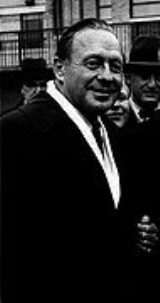
Jack Benny

 
Jack Benny

   Email Print
   Bookmark   Link


Jack Benny


Jack Benny (born Benjamin Kubelsky February 14, 1894 - December 26, 1974) was an American comedian
Comedian

A comedian or comic is a person who seeks to entertain members of an audience, primarily by making them laughter. This might be through jokes or amusing situations, or acting a fool, as in slapstick, or employing prop comedy....
, vaudevillian
Vaudeville

Vaudeville was a genre of a variety show prevalent on the theatre in the United States and Canada from the early 1880s until the early 1930s. It developed from many sources, including the concert saloon, minstrel show, freak shows, dime museums, and literary burlesque....
, and actor for radio
Radio programming

Radio programming is the content that is Broadcasting by radio stations.The original inventors of radio, such as Nikola Tesla and Guglielmo Marconi, expected it to be used for one-on-one communication tasks where telephones and telegraphs could not be used because of the impossibility of stringing wires from one point to another, such as in...
, television, and film.

Widely recognized as one of the leading American entertainers of the 20th century, Benny was known for his comic timing
Comic timing

Comic timing is use of rhythm and tempo to enhance comedy and humor. The pacing of the delivery of a joke has a strong impact on its comic effect; the same is also true of more physical comedy such as slapstick....
 and his ability to get laughs with either a pregnant pause or a single expression, such as his signature exasperated "Well!" His radio and television programs, tremendously popular in the 1930s, 1940s and 1950s, were a foundational influence on the situation comedy
Situation comedy

A situation comedy, usually referred to as a sitcom, is a genre of comedy programs which originated in radio. Today, sitcoms are found almost exclusively on television as one of its dominant narrative forms....
.

y was born on February 14, 1894 in Chicago, Illinois and grew up in neighboring Waukegan, Illinois
Waukegan, Illinois

Waukegan is a city in Lake County, Illinois, Illinois. As of the United States Census 2000, the city had a total population of 87,901. A 2003 census estimated the city population to be 91,452....
.


Discussion
Ask a question about 'Jack Benny'
Start a new discussion about 'Jack Benny'
Answer questions from other users
Full Discussion Forum


Quotations


Bob Crosby: That's like keeping the smog and throwing away Los Angeles.

Bob Hope: By the way, this is where Bing did his last show and I think they've done very nicely. They've gotten most of it out of the curtains. ----

Bob Hope: Let's not do any jokes we didn't plan on, eh.

Bob Hope: Put your head back through there, or I'll start handing out baseballs to the audience.

Bob Hope: on being on a CBS show I feel like Zsa Zsa at a P.T.A. meeting. ----

Bob: This is rather strange for me, I'm on the major network. mouths ABC ----


Encyclopedia


Jack Benny (born Benjamin Kubelsky February 14, 1894 - December 26, 1974) was an American comedian
Comedian

A comedian or comic is a person who seeks to entertain members of an audience, primarily by making them laughter. This might be through jokes or amusing situations, or acting a fool, as in slapstick, or employing prop comedy....
, vaudevillian
Vaudeville

Vaudeville was a genre of a variety show prevalent on the theatre in the United States and Canada from the early 1880s until the early 1930s. It developed from many sources, including the concert saloon, minstrel show, freak shows, dime museums, and literary burlesque....
, and actor for radio
Radio programming

Radio programming is the content that is Broadcasting by radio stations.The original inventors of radio, such as Nikola Tesla and Guglielmo Marconi, expected it to be used for one-on-one communication tasks where telephones and telegraphs could not be used because of the impossibility of stringing wires from one point to another, such as in...
, television, and film.

Widely recognized as one of the leading American entertainers of the 20th century, Benny was known for his comic timing
Comic timing

Comic timing is use of rhythm and tempo to enhance comedy and humor. The pacing of the delivery of a joke has a strong impact on its comic effect; the same is also true of more physical comedy such as slapstick....
 and his ability to get laughs with either a pregnant pause or a single expression, such as his signature exasperated "Well!" His radio and television programs, tremendously popular in the 1930s, 1940s and 1950s, were a foundational influence on the situation comedy
Situation comedy

A situation comedy, usually referred to as a sitcom, is a genre of comedy programs which originated in radio. Today, sitcoms are found almost exclusively on television as one of its dominant narrative forms....
.

Biography


Early life

Benny was born on February 14, 1894 in Chicago, Illinois and grew up in neighboring Waukegan, Illinois
Waukegan, Illinois

Waukegan is a city in Lake County, Illinois, Illinois. As of the United States Census 2000, the city had a total population of 87,901. A 2003 census estimated the city population to be 91,452....
. He was the son of Meyer Kubelsky and Emma Sachs Kubelsky. Meyer was a Jewish saloonkeeper, later to become a haberdasher
Haberdasher

A haberdasher is a person who sells small articles for sewing, such as buttons, ribbons and zippers. In U.S. English, haberdasher is another term for a men's outfitter....
, who had emigrated to America from Poland
Poland

Poland , officially the Republic of Poland , is a country in Central Europe. Poland is bordered by Germany to the west; the Czech Republic and Slovakia to the south; Ukraine, Belarus and Lithuania to the east; and the Baltic Sea and Kaliningrad Oblast, a Russian Enclave and exclave, to the north....
. Emma had emigrated from Lithuania
Lithuania

Lithuania , officially the Republic of Lithuania is a country in Northern Europe, the southernmost of the three Baltic states. Situated along the southeastern shore of the Baltic Sea, it shares borders with Latvia to the north, Belarus to the southeast, Poland, and the Russian exclave of Kaliningrad Oblast to the southwest....
. Benny began studying the violin
Violin

The violin is a Bow string instrument with four strings usually tuned in perfect fifths. It is the smallest and highest-pitched member of the violin family of string instruments, which also includes the viola and cello....
, an instrument that would become his trademark, when he was just six, with his parents' hopes that he would be a great classical violinist. He loved the violin but hated practice. By age 14, he was playing in local dance bands as well as in his high school orchestra. Benny was a dreamer and a poor student and he was expelled from high school. He did equally badly in business school and at his father's trade. At age 17, he began playing the instrument in local vaudeville
Vaudeville

Vaudeville was a genre of a variety show prevalent on the theatre in the United States and Canada from the early 1880s until the early 1930s. It developed from many sources, including the concert saloon, minstrel show, freak shows, dime museums, and literary burlesque....
 theaters for $7.50 a week.

In 1911, Benny was playing in the same theater as the young Marx Brothers
Marx Brothers

The Marx Brothers were a popular team of sibling comedians who appeared in vaudeville, stage plays, film, and television....
 and whose mother Minnie Palmer
Minnie Marx

Minnie Sch?nberg Marx , born in Dornum, East Frisia, then a part of the Kingdom of Hanover, was the mother and manager for the Marx Brothers, wife of Sam Marx, and the sister of vaudeville star Al Shean....
 was so enchanted with Benny's musicianship that she invited him to be their permanent accompanist. The plan was foiled by Benny's parents, who refused to let their son, then 17, go on the road, but it was the beginning of his long friendship with Zeppo Marx
Zeppo Marx

Herbert Manfred Marx is best known as Zeppo Marx, the name he used when he performed with his brothers, The Marx Brothers....
. Benny's wife Mary Livingstone
Mary Livingstone

Mary Livingstone , was an United States radio comedienne and the wife and radio partner of comedy great Jack Benny . Enlisted almost entirely by accident to perform on her husband's popular program, she proved a talented comedienne....
 was a distant cousin of the Marx Brothers.

The following year, Benny formed a vaudeville musical duo with pianist Cora Salisbury, a buxom 45-year-old widow who needed a partner for her act. This provoked famous violinist Jan Kubelik
Jan Kubelík

Jan Kubel?k was a Czech Republic violinist and composer.He was born in Michle . His father, a gardener by occupation, was an amateur violinist....
, who thought that the young vaudeville entertainer with a similar name (Kubelsky) would damage his reputation. Under pressure from Kubelik's lawyer, Benjamin Kubelsky agreed to change his name to Ben K. Benny (sometimes spelled Bennie). When Salisbury left the act, Benny found a new pianist, Lyman Woods, and re-named the act "From Grand Opera to Ragtime". They worked together for five years and slowly added comedy. They even reached the Palace Theater
Palace Theatre, New York

The Palace Theatre is a legitimate Broadway theatre theater located at 1564 Broadway in midtown-Manhattan....
, the "Mecca of Vaudeville", but bombed. Benny left show business briefly in 1917 to join the Navy
United States Navy

The United States Navy is the navy of the United States Armed Forces. It is one of the seven uniformed services of the United States. The U.S. Navy currently has approximately 331,682 personnel on active duty as of 31 December 2008 and 124,000 in the United States Navy Reserve....
 during World War I, and he often entertained the troops with his violin playing. One evening, his violin performance was booed by the troops, so with prompting from fellow sailor and actor Pat O'Brien
Pat O'Brien (actor)

Pat O'Brien was an American movie actor with over 100 screen credits....
, he ad-libbed his way out of the jam and left them laughing. He got more comedy spots in the revues and was a big hit, and earned himself a reputation as a comedian as well as a musician.

Shortly after the war, Benny started a one-man act, "Ben K. Benny: Fiddle Funology". But then he heard from another lawyer, this time that of Ben Bernie
Ben Bernie

Ben Bernie , born Bernard Anzelevitz, was an American jazz violinist and radio personality, often introduced as The Old Maestro. He was noted for his showmanship and memorable bits of snappy dialogue....
, another patter-and-fiddle performer who also threatened to sue. So Benny adopted the common sailor's nickname Jack. By 1921, the fiddle became more of a prop and the low-key comedy took over.

Benny had several romantic encounters, including one with a dancer, Mary Kelly, whose devoutly Catholic family forced her to turn down Benny's proposal because he was Jewish. Benny was introduced to Mary Kelly by Gracie Allen
Gracie Allen

Grace Ethel Cecile Rosalie Allen , better known as Gracie Allen, was an United States comedienne who became internationally famous as the zany partner and comic foil of husband George Burns....
. Later on, years after the split between Mary Kelly and Jack, Mary resurfaced as a dowdy fat girl and Jack gave her a part in an act of three girls: one homely, one fat and one who couldn't sing. This lasted till, at Mary Livingstone's request, Mary Kelly was let go.

In 1922, Jack accompanied Zeppo Marx
Zeppo Marx

Herbert Manfred Marx is best known as Zeppo Marx, the name he used when he performed with his brothers, The Marx Brothers....
 to a Passover
Passover

Passover is a Jewish and Samaritan holy day and festival commemorating God sparing the Israelites when He killed the first born of Egypt, and is followed by the seven day Feast of the Unleavened Bread commemorating the Exodus from Ancient Egypt and the liberation of the Israelites from Judaism and slavery....
 seder
Passover Seder

The Passover Seder Meal is a Jewish ritual feast held on the first and the second nights of the Jewish holiday of Passover . For Reform Jews and in Israel, the Seder is held only on the first night....
 where he met Sadye (Sadie) Marks, whom he married in 1927 after meeting again on a double-date. She was working in the hosiery section of May's department store and Benny would court her there. Called on to fill in for the "dumb girl" part in one of Benny's routines, Sadie proved a natural comedienne and a big hit. Adopting Mary Livingstone
Mary Livingstone

Mary Livingstone , was an United States radio comedienne and the wife and radio partner of comedy great Jack Benny . Enlisted almost entirely by accident to perform on her husband's popular program, she proved a talented comedienne....
 as her stage name, Sadie became Benny's collaborator throughout most of his career (according to Fred Allen
Fred Allen

Fred Allen was an United States comedian whose absurdist, pointed radio show made him one of the most popular and forward-looking humorists in the so-called classic era of American radio....
's book on vaudeville, Much Ado About Me, it was a custom for vaudeville comics to put their wives into the act once married, in order to save on expenses and so that the marital partners could keep an eye on each other). They later adopted a daughter, Joan.

In 1929, Benny's agent Sam Lyons convinced MGM's Irving Thalberg
Irving Thalberg

Irving Grant Thalberg was an Academy Award-winning United States film producer during the early years of motion pictures. He was called "The Boy Wonder" for his youth and his extraordinary ability to select the right scripts, choose the right actors, gather the best production staff, and make very profitable films....
 to catch Benny's act at the Orpheum Theatre
Orpheum Theatre (Los Angeles)

The Orpheum Theatre on Broadway in downtown Los Angeles, California, opened on February 15, 1926 as the fourth and final Los Angeles venue for the Orpheum Circuit, Inc....
 in Los Angeles. Benny was signed to a five-year contract and his first film role was in The Hollywood Revue of 1929
The Hollywood Revue of 1929

The Hollywood Revue of 1929 is an United States musical film/comedy motion picture released in 1929 in film. It was the studio's second feature-length musical, and one of the earliest ventures into the talkie format....
. His next movie, Chasing Rainbows, was a flop and after several months, Benny was released from his contract and returned to Broadway in Earl Carroll
Earl Carroll

Earl Carroll was an United States theatrical producer, director, songwriter and composer born in Pittsburgh, Pennsylvania....
's Vanities. At first dubious about the viability of radio, by this time Benny was eager to break into the new medium. In 1932, after a four-week nightclub run, he was invited onto Ed Sullivan
Ed Sullivan

Edward Vincent "Ed" Sullivan was an United States entertainment writer and television host, best known as the presenter of a popular TV variety show called The Ed Sullivan Show that was at its height of popularity in the 1950s and 1960s....
's radio program, uttering his first radio spiel "This is Jack Benny talking. There will be a slight pause while you say, 'Who cares?'..."

Radio


History
Benny had been only a minor vaudeville performer, but he became a national figure with The Jack Benny Program
The Jack Benny Program

The Jack Benny Program, starring Jack Benny, was a radio-TV comedy series which ran for more than three decades and is generally regarded as a high-water mark in 20th-century comedy....
, a weekly radio show which ran from 1932 to 1948 on NBC and from 1949 to 1955 on CBS
CBS

CBS Broadcasting Inc. is an American radio network and television network. The name is derived from the initials of Columbia Broadcasting System, its former legal name....
, and was consistently among the most highly rated programs during most of that run.

With Canada Dry
Canada Dry

File:Canada Dry logo.svg Canada Dry is a brand of soft drinks marketed by Dr Pepper/Seven Up, a unit of Dr Pepper Snapple Group. Canada Dry is best known for its ginger ale, but also manufactures a number of other soft drinks and drink mixers....
 Ginger Ale
Ginger ale

Ginger ale is a Carbonation soft drink flavored with ginger....
 as a sponsor, Benny came to radio on The Canada Dry Program, beginning May 2, 1932, on the NBC Blue Network
Blue Network

The Blue Network was the on-air name of an American radio production and distribution service from 1942 to 1945, which traced its formal origins back to 1927....
 and continuing there for six months until October 26, moving the show to CBS
CBS

CBS Broadcasting Inc. is an American radio network and television network. The name is derived from the initials of Columbia Broadcasting System, its former legal name....
 on October 30. With Ted Weems
Ted Weems

Wilfred Theodore Weems was a United States bandleader and musician.Born in Pitcairn, Pennsylvania, Weems learned to play the violin and trombone....
 leading the band, Benny stayed on CBS until January 26, 1933.

Arriving at NBC on March 17, Benny did The Chevrolet
Chevrolet

Chevrolet is a brand of automobile, produced by General Motors . It is the top selling GM marque, with "Chevrolet" or "Chevy" being at times synonymous with GM....
 Program
until April 1, 1934. He continued with sponsors General Tire
General Tire

The General Tire and Rubber Company is an United States manufacturer of tires for motor vehicles.General Tire was founded in 1915 in Akron, Ohio by William F....
s, Jell-O
Jell-O

Jell-O is a brand name belonging to U.S.-based Kraft Foods for a number of gelatin desserts, including fruit gels, puddings and no-bake cream pies....
 and Grape-Nuts
Grape-Nuts

Grape-Nuts is a breakfast cereal developed by C. W. Post in 1897. Post was a patient and later competitor of the 19th-century breakfast food innovator, Dr....
. Lucky Strike
Lucky Strike

Lucky Strike is a famous brand of American cigarettes, often referred to as "Luckies"....
 was the radio sponsor from 1944 to the mid-1950s.

The show returned to CBS on January 2, 1949, as part of CBS president William S. Paley
William S. Paley

William Samuel Paley was the chief executive who built Columbia Broadcasting System from a small radio network to one of the foremost radio and television network operations in the United States....
's notorious "raid" of NBC talent in 1948-49. There it stayed for the remainder of its radio run, which ended on May 22, 1955. CBS aired reruns of old radio episodes from 1956 to 1958 as The Best of Benny.

Characters
Benny's stage character was a clever inversion of his actual self. The character was just about everything the actual Jack Benny was not: cheap, petty, vain and self-congratulatory. His masterful comic rendering of these traits became the vital linchpin to the Benny show's success. Benny set himself up as the comedic foil, allowing his supporting characters to draw laughs at the expense of his stinginess, vanity, and pettiness. By allowing such a character to be seen as human and vulnerable, in an era where few male characters were allowed such obvious vulnerability, Benny made what might have been a despicable character into a lovable Everyman
Everyman

In literature and drama, the term everyman has come to mean an ordinary individual, with whom the audience or reader is supposed to be able to identify easily, and who is often placed in extraordinary circumstances....
 character. Benny himself said on several occasions: "I don't care who gets the laughs on my show, as long as the show is funny." In her book, Benny's daughter Joan said her father always said it doesn't matter who gets laughs, because come the next day they will say, "Remember the Jack Benny Show, last night, it was good, or it was bad." Jack felt he got the credit or blame either way, not the actor saying the lines, so it had better be funny.

The supporting characters who amplified that vulnerability only too gladly included wife Mary Livingstone
Mary Livingstone

Mary Livingstone , was an United States radio comedienne and the wife and radio partner of comedy great Jack Benny . Enlisted almost entirely by accident to perform on her husband's popular program, she proved a talented comedienne....
 as his wisecracking and not especially deferential female friend (not quite his girlfriend, since Benny would often try to date movie stars like Barbara Stanwyck
Barbara Stanwyck

Barbara Stanwyck was an United States actor, a star of film and television, known during her 60-year career as a consummate and versatile professional with a strong screen presence, and a favorite of directors such as Cecil B....
, and occasionally had stage girlfriends such as "Gladys Zybisco"); rotund announcer Don Wilson
Don Wilson (announcer)

Don Wilson was an United States announcer and occasional actor in radio programming and television, with a Falstaffian vocal presence, remembered best as the rotund announcer and comic foil to the star of The Jack Benny Program....
 (who also served as announcer for Fanny Brice
Fanny Brice

Fanny Brice was a popular and influential United States comedienne, singer, theatre and film actress, who made many stage , radio and film appearances but is best remembered as the creator and star of the top-rated radio comedy series, The Baby Snooks Show....
's hit, Baby Snooks); bandleader Phil Harris
Phil Harris

Phil Harris was an United States singer, songwriter, jazz musician, actor and comedian. Though successful as an orchestra leader, Harris is remembered today for his recordings as a vocalist, his Voice acting in animation and the radio situation comedy in which he co-starred with his second wife, singer-Actor Alice Faye, for eight years....
 as a jive-talking, wine-and-women type whose repartee was rather risque for its time (Harris and Mahlon Merrick shared the actual musical chores of the show); boy tenor Dennis Day
Dennis Day

Dennis Day , born Owen Patrick Eugene McNulty, was an Irish-American singer and radio and television personality.Day was born and raised in New York City, the son of Irish immigrants....
, who was cast as a sheltered, naive youth who still got the better of his boss as often as not (this character was originated by Kenny Baker
Kenny Baker (singer/actor)

Kenneth Laurence "Kenny" Baker was an American singer/actor who first gained notice as the featured singer on Jack Benny's radio shows during the 1930s....
, but perfected by Day); and, especially, Eddie Anderson
Eddie Anderson (comedian)

Edmund Lincoln Anderson , often known as Eddie "Rochester" Anderson, was an American comic actor who became famous playing "Rochester van Jones" , the valet to Jack Benny's eponymous title character on the long-running radio and television series The Jack Benny Program. Anderson also owned Burnt Cork, a Thoroughbred horse racing...
 as valet-chauffeur Rochester van Jones — who was as popular as Benny himself.

And that was itself a radical proposition for the era: unlike the protagonists of Amos 'n' Andy
Amos 'n' Andy

Amos 'n' Andy was a situation comedy based on stereotypes of African-Americans and popular in the United States from the 1920s through the 1950s....
, Rochester was a black man allowed to one-up his vain, skinflint boss. In more ways than one, with his mock-befuddled one-liners and his sharp retorts, he broke a barrier down for his race. Unlike many black supporting characters of the time, Rochester was depicted and treated as a regular member of Benny's fictional household. Benny, in character, tended if anything to treat Rochester more like an equal partner than as a hired domestic, even though gags about Rochester's flimsy salary were a regular part of the show. (Frederick W. Slater, newsman of St. Joseph, Missouri, recalled when Benny and his staff stayed at the restricted Robidioux Hotel during their visit to that town. When the desk staff told Benny that "Rochester" could not stay at the hotel, Benny replied, "If he doesn't stay here, neither do I." The hotel's staff eventually relented.) Rochester seemed to see right through his boss's vanities and knew how to prick them without overdoing it, often with his famous "Oh, Boss, come now!" Benny deserves credit for allowing this character and the actor who played him (it is difficult, if not impossible, to picture any other performer giving Rochester what Anderson gave him) to transcend the era's racial stereotype and for not discouraging his near-equal popularity. A New Year's Eve
New Year's Eve

New Year's Eve is on , the final day of the Gregorian calendar year, and the day before New Year's Day.New Year's Eve is a separate observance from the observance of New Year's Day....
 episode, in particular, shows the love each performer had for the other, quietly toasting each other with champagne. That this attention to Rochester's race was no accident became clearer during World War II, when Benny would frequently pay tribute to the diversity of Americans who had been drafted into service. In fact Benny made a conscious effort after the war, once the depths of Nazi race hatred had been revealed, to remove the most stereotypical aspects of Rochester's character. He also often gave key guest-star appearances to African-American performers such as Louis Armstrong
Louis Armstrong

Louis Daniel Armstrong , nicknamed Satchmo or Pops, was an American jazz trumpeter and singer.Coming to prominence in the 1920s as an innovative cornet and trumpet player, Armstrong was a foundational influence on jazz, shifting the music's focus from collective improvisation to solo performers....
.

The rest of Benny's cast included character actors and comedians: Sheldon Leonard
Sheldon Leonard

Sheldon Leonard was a pioneering American film and television Television producer, director, writer, and actor....
 (later a hugely successful television producer and creator) as a tight-lipped racetrack tout; Joseph Kearns
Joseph Kearns

Joseph Kearns was an United States actor, who is best remembered for his role as Mr. Wilson in the 1960s television series Dennis the Menace ....
 as Ed, the superannuated guard to Jack's money vault; Verna Felton
Verna Felton

Verna Felton was an Emmy-nominated United States actress who was best-known for providing many female voices in numerous Walt Disney Pictures animated films, as well as voicing Fred Flintstone's mother-in-law Pearl Slaghoople for Hanna-Barbera....
 as Dennis Day's mother Frank Nelson, usually as an oily desk clerk or floorwalker, always greeting Benny with an eager Yeeeeeeesss?; singer/bandleader Bob Crosby
Bob Crosby

Bob Crosby was an United States dixieland bandleader and vocalist, best known for his group Crosby and the Bob-Cats.He was the youngest of seven children: five boys, Larry Crosby , Everett , Ted , Bing Crosby and Bob; and two girls, Catherine and Mary Rose ....
 (who succeeded Phil Harris in the early 1950s); Artie Auerbach as the Yiddish-accented Mr. Kitzel ("hoo, hoo, hoo!"); and the remarkably versatile Mel Blanc
Mel Blanc

Melvin Jerome "Mel" Blanc was an United States voice acting and comedian. Although he began his nearly six-decade-long career performing in radio and television commercials, Blanc is best known for his work with Warner Bros....
, who provided several characters' voices, including the railroad station announcer who said, "Train leaving on track five for Anaheim, Azusa
Azusa

Azusa may refer to:*Azusa, California, a city in the United States*Azusa Street Revival, a Christian movement that began in Los Angeles*AZUSA - Radar interferometer...
and Cuc--amonga!" With the pause continually lengthened in the last place name, this running gag became so well known that it eventually led to a statue of Benny in Cucamonga. It is located inside the Epicenter Stadium at Jack Benny Way and Rochester Avenue.

Blanc also created the famous sound of Benny's aging auto, a rackety Maxwell
Maxwell automobile

The Maxwell was a brand of automobiles manufactured in the United States from about 1904 to 1925.The brand name of motor cars was started as the Maxwell-Briscoe Company of Tarrytown, New York....
 that was always on the verge of collapsing with a phat-phat-bang! Blanc is probably remembered best, however, as Benny's perpetually frustrated violin teacher, Professor LeBlanc, who was as likely to throw his own and Benny's instrument into the fireplace as he was to have a nervous breakdown before he was out the door.

Other musical contributions came starting in 1946 from the singing quartet The Sportsmen (members: Bill Days, Max Smith, Marty Sperzel and Gurney Bell) singing the middle Lucky Strike commercial. In the early days of the program, the supporting characters were often vaudevillian ethnic stereotypes whose humor was grounded in dialects; as the years went by the humor of these figures became more character-based.

Benny's method of bringing a character into a skit, by announcing his name, also became a well-known Benny shtick: "Oh, DEN-nis..." or "Oh, RO-CHEST-er..." typically answered by, "Yes, Mr. Benny (Boss)?"

Situations
The Jack Benny Program evolved from a variety show blending sketch comedy and musical interludes into the situation comedy form we know even now, crafting particular situations and scenarios from the fictionalization of Benny the radio star. Anything, from hosting a party to income tax time to a night on the town, was good for a Benny show situation, and somehow the writers and star would find the right ways and places to insert musical interludes from Phil Harris and Dennis Day. With Day, invariably, it would be a brief sketch that ended with Benny ordering Day to sing the song he planned to do on that week's show.

One extremely popular scenario that became an annual tradition on The Jack Benny Program was the "Christmas Shopping" episode, in which Benny would head to a local department store. Each year, Benny would buy a ridiculously cheap Christmas gift for Don Wilson from a store clerk played by Mel Blanc. Benny would then have second thoughts about his gift choice, driving Blanc (or, in two other cases, his wife and his psychiatrist) to insanity by exchanging the gift countless times throughout the episode.

For example, in the 1946 Christmas episode, Benny buys shoelaces for Don, and then is unable to make up his mind whether to give Wilson shoelaces with plastic tips or shoelaces with metal tips. After Benny exchanges the shoelaces repeatedly, Mel Blanc is heard screaming insanely, "Plastic tips! Metal tips! I can't stand it anymore!" A variation in 1948 concerned Benny buying an expensive wallet for Don, but repeatedly changing the greeting card inserted -- prompting Blanc to shout: "I haven't run into anyone like you in 20 years! Oh, why did the governor have to give me that pardon!?" -- until Benny realizes that he should have gotten Don a wallet for $1.98, whereupon the put-upon clerk mentally disintegrates, and in several instances, committed suicide, or attempted to commit suicide ("Look what you done! You made me so nervous, I missed!"). Over the years, in these episodes, Benny bought and repeatedly exchanged cuff links, golf tees, a box of dates, a paint set, and even a gopher trap.

In 1936, after a few years broadcasting from New York, Benny moved the show to Los Angeles, allowing him to bring in guests from among his show business friends — guests as diverse as Frank Sinatra
Frank Sinatra

Francis Albert "Frank" Sinatra was an United States singer and actor.Beginning his musical career in the swing era with Harry James and Tommy Dorsey, Sinatra became a solo artist with great success in the early to mid-1940s, being the idol of the "bobby soxers"....
, James Stewart
James Stewart (actor)

James Maitland Stewart , popularly known as Jimmy Stewart, was an United States film and stage actor best known for his self-effacing persona....
, Judy Garland
Judy Garland

Judy Garland was an American actress and alto singer. Through a career that spanned 45 of her 47 years, Garland attained international stardom as an actress in musical and dramatic roles, as a recording artist and on the concert stage....
, Barbara Stanwyck
Barbara Stanwyck

Barbara Stanwyck was an United States actor, a star of film and television, known during her 60-year career as a consummate and versatile professional with a strong screen presence, and a favorite of directors such as Cecil B....
, Bing Crosby
Bing Crosby

Harry Lillis "Bing" Crosby was an United States popular singer and actor whose career lasted from 1926 until his death.One of the first multimedia stars, from 1934 to 1954 Bing Crosby held a nearly unrivaled command of record sales, radio ratings and motion picture grosses....
, Burns and Allen
Burns and Allen

Burns and Allen, an American double act consisting of George Burns and his wife, Gracie Allen, worked together as a comedy team in vaudeville, films, radio and television and achieved substantial success over three decades....
 (George Burns was Benny's closest friend), and many others. Burns and Allen and Orson Welles
Orson Welles

George Orson Welles , better known as Orson Welles, was an Academy Award-winning United States actor, director, writer and producer, who worked extensively in film, theatre, television, and radio....
 guest hosted several episodes in March and April 1943 when Benny was seriously ill with pneumonia, while Ronald Colman
Ronald Colman

Ronald Colman was an England Academy Award and Golden Globe-winning actor....
 and his wife Benita Hume
Benita Hume

Benita Hume , was an English film actress born in London.She appeared in 44 films between 1925 in film and 1955 in film. She was married to actor Ronald Colman from 1938 to his death in 1958....
 appeared frequently in the 1940s as Benny's longsuffering neighbors.

Sponsors
In the early days of radio (and in the early television era, often as not), the airtime was owned by the sponsor, and Benny made a point of incorporating the commercials into the body of the show. Sometimes the sponsors were the butt of jokes, though Benny did not deploy this device as frequently as his friend and "rival" Fred Allen
Fred Allen

Fred Allen was an United States comedian whose absurdist, pointed radio show made him one of the most popular and forward-looking humorists in the so-called classic era of American radio....
 did at the time, or his cast member Phil Harris later did on his own successful radio sitcom. Nevertheless, for many years Benny insisted in contract negotiations that his writers pen the sponsor's commercial in middle of the program (leaving the sponsor to provide the opening and closing spots) and the resulting ads were cleverly and wittily worked into the storyline of the show. For example, on one program, Don Wilson accidentally misread Lucky Strike's slogan ("Be happy, go Lucky") as "Be Lucky, go happy" prompting a story arc over several weeks that had Wilson afraid to show up at the studio for fear the sponsor would fire him. In fact, the show was not officially called The Jack Benny Program for many years; usually, the primary name of the show tied to the sponsor. Benny's first sponsor was Canada Dry Ginger Ale from 1932 to 1933. Later, Benny's sponsors included Chevrolet
Chevrolet

Chevrolet is a brand of automobile, produced by General Motors . It is the top selling GM marque, with "Chevrolet" or "Chevy" being at times synonymous with GM....
 from 1933 to 1934, General Tire
General Tire

The General Tire and Rubber Company is an United States manufacturer of tires for motor vehicles.General Tire was founded in 1915 in Akron, Ohio by William F....
 in 1934, and Jell-O
Jell-O

Jell-O is a brand name belonging to U.S.-based Kraft Foods for a number of gelatin desserts, including fruit gels, puddings and no-bake cream pies....
 from 1934 to 1942. The Jell-O Program Starring Jack Benny was so successful in selling Jell-O, in fact, that General Foods could not manufacture it fast enough when sugar shortages arose in the early years of World War II, and the company had to stop advertising the popular dessert mix. General Foods switched the Benny program from Jell-O to Grape-Nuts
Grape-Nuts

Grape-Nuts is a breakfast cereal developed by C. W. Post in 1897. Post was a patient and later competitor of the 19th-century breakfast food innovator, Dr....
 from 1942 to 1944, and it became, naturally, The Grape Nuts Show Starring Jack Benny. Benny's longest-running sponsor, however, was the American Tobacco Company's Lucky Strike
Lucky Strike

Lucky Strike is a famous brand of American cigarettes, often referred to as "Luckies"....
 cigarettes, from 1944 to 1955, and it was during Lucky Strike's sponsorship that the show became, at last, The Jack Benny Program once and for all.

Writers
Benny was notable for employing a small group of writers, most of whom stayed with him for many years. This was very much in contrast to other successful radio or television comedians, such as Bob Hope
Bob Hope

Bob Hope, Order of the British Empire, Order of St. Gregory the Great , was an British-born American comedian and actor who appeared in vaudeville, on Broadway theatre, and in radio, television and movies....
, who would change writers frequently. Historical accounts (like those by longtime Benny writer Milt Josefsberg
Milt Josefsberg

Milt Josefsberg was a radio writer for Jack Benny and later for many television sitcoms, such as Archie Bunker's Place, All in the Family, Here's Lucy, The Lucy Show and The Jack Benny Show....
) indicate that Benny's role, like that of Fred Allen, was essentially that of both head writer and director of his radio programs, though he was not credited in either capacity.

Theme music
During his early radio shows, Benny adopted a medley of "Yankee Doodle Dandy
Yankee Doodle Dandy

Yankee Doodle Dandy is a biopic about George M. Cohan, the actor-singer-dancer-playwright-songwriter-producer-theatre owner-director-choreographer known as "The Man Who Owns Broadway", starring James Cagney, Joan Leslie, Walter Huston and Richard Whorf, and featuring Irene Manning, George Tobias, Rosemary DeCamp and Jeanne Cagney....
" and "Love in Bloom
Love in Bloom

Love in Bloom may refer to:*Love in Bloom , a 1934 popular song by Ralph Rainger and Leo Robin*Love in Bloom , a 1935 film with George Burns...
" as his theme music, opening every show. The strange interpolation of "Yankee Doodle Dandy" seems to have been an inside joke at Benny's expense: Jack Warner
Jack Warner

Jack Leonard "J.L." Warner , born Jacob Warner in London, Ontario, Canada, was the president and driving force behind the successful development of Warner Bros....
 of Warner Brothers had once promised to cast Jack Benny as George M. Cohan
George M. Cohan

George Michael Cohan , known publicly as George M. Cohan, was an United States entertainer, playwright, composer, lyricist, actor, singer, dancer, Film director, and Theatrical producer....
  the film Yankee Doodle Dandy (which of course didn't happen, although Warner did cast Benny in The Meanest Man in the World, based on a Cohan play). "Love in Bloom" later became the theme of his television show as well. His radio shows often ended with the orchestra playing "Hooray for Hollywood." The TV show ended with one of two bouncy instrumentals written for the show.

Benny would sometimes joke about the appropriateness of "Love in Bloom" as his theme song. On a segment often played in Tonight Show
The Tonight Show Starring Johnny Carson

The Tonight Show Starring Johnny Carson is a late-night Talk/Chat show hosted by Johnny Carson under the The Tonight Show franchise from 1962 to 1992....
 retrospectives, Benny talks with Johnny Carson about this. Benny says he has no objections to the song in and of itself, only as his theme. Proving his point, he begins reciting the lyrics slowly and deliberately: "Can it be the trees. That fill the breeze. With rare and magic perfume." Pause. "Now what the hell has that got to do with me?"

"Your money or your life"
A master of the carefully timed pregnant pause, Benny and his writers used it to set up what is popularly (but incorrectly) believed to be the longest laugh in radio history. It climaxed an episode (broadcast March 28, 1948) in which Benny borrowed neighbor Ronald Colman
Ronald Colman

Ronald Colman was an England Academy Award and Golden Globe-winning actor....
's Oscar
Academy Awards

The Academy Awards, popularly known as the Oscars, are presented annually by the Academy of Motion Picture Arts and Sciences to recognize excellence of professionals in the film industry, including directors, actors, and writers....
 and was returning home when accosted by a mugger (voiced by comedian Eddie Marr). After asking for a match to light a cigarette, the mugger demanded, "Don't make a move, this is a stickup. Now, come on. Your money or your life." Benny paused, and the studio audience—knowing his skinflint character—laughed. The robber then repeated his demand: "Look, bud! I said your money or your life!" And that's when Benny snapped back, without a break, "I'm thinking it over!" This time, the audience laughed louder and longer than they had during the pause.

The punchline came to Benny staff writers John Tackaberry
John Tackaberry

John Tackaberry was a radio writer for the The Jack Benny Show.He was born in Adelaide, Australia, and worked for Jack Benny in the United states from 1943 until approx 1956...
 and Milt Josefsberg almost by accident. Writer George Balzer
George Balzer

George Balzer was an American Emmy Award-winning screenwriter, television producer.External links...
 described the scene to author Jordan R. Young, for The Laugh Crafters, a 1999 book of interviews with veteran radio and television comedy writers:
... they had come to a point where they had the line, "Your money or your life." And that stopped them... Milt is pacing up and down, trying to get a follow... And he gets a little peeved at Tack, and he says, "For God's sakes, Tack, say something." Tack, maybe he was half asleep---in defense of himself, says, "I'm thinking it over." And Milt says, "Wait a minute. That's it." And that's the line that went in the script... By the way, that was not the biggest laugh that Jack ever got. It has the reputation of getting the biggest laugh. But that's not true.


The actual length of the laugh the joke got was five seconds when originally delivered and seven seconds when the gag was reprised on a followup show. In fact, the joke is probably not so memorable for the length of the laugh it provoked, but because it became the definitive "Jack Benny joke"—the joke that best illustrated Benny's "stingy man" persona. The punchline—"I'm thinking it over!"—simply would not have worked with any other comedian but Benny.

The actual longest laugh known to collectors of The Jack Benny Program lasted in excess of 32 seconds. The reports that, at the close of the program broadcast on December 13, 1936, sponsored by Jell-O
Gelatin dessert

The most common culinary use for gelatin is as a main ingredient in varieties of gelatin desserts. Unprepared gelatin for desserts is often marketed as a flavored powder or concentrated gelatinous solid....
, guest Andy Devine
Andy Devine

Andrew Vabre "Andy" Devine was an American character actor and comic cowboy sidekick known for his raspy voice....
 says that it is the "last number of the eleventh program in the new Jelly series." The audience, who loved any sort of accidental flub in the live program, is still laughing after 32 seconds, at which point the network cut off the program to prevent it from running overtime. The program broadcast September 16, 1951 is reported to have a laugh lasting 35 seconds, but the IJBFC website has a qualifying footnote that is not explained.

According to Jack himself, Mary Livingstone got the biggest laugh he ever heard on the show, on the April 25, 1948 broadcast. The punchline was the result of the following exchange between Don Wilson and noted opera singer Dorothy Kirsten
Dorothy Kirsten

Dorothy Kirsten was an American opera spinto soprano....
:

Don Wilson: Oh, Miss Kirsten, I wanted to tell you that I saw you in "Madame Butterfly" Wednesday afternoon, and I thought your performance was simply magnificent.
Dorothy Kirsten: Well, thanks, awfully. It's awfully nice and kind of you, Mr. Wilson. But, uh, who could help singing Puccini? It's so expressive. And particularly in the last act, starting with the allegro vivacissimo.
Don Wilson: Well, now, that's being very modest, Miss Kirsten. But not every singer has the necessary bel canto and flexibility or range to cope with the high testetura of the first act.
Dorothy Kirsten: Thank you, Mr. Wilson. And don't you think that in the aria, "Un bel di vedremo", that the strings played the cumulto passione exceptionally fine and with great sustunendo?
Jack Benny: Well, I thought--
Mary Livingstone (to Jack): Oh, shut up!


According to Jack, the huge laugh resulted from the long buildup, and the audience's knowledge that Jack, with his pompous persona, would have to break into the conversation at some point.

A nearly identical exchange occurred over a year earlier, among renowned violinist Isaac Stern
Isaac Stern

Isaac Stern was a Jewish violin virtuoso born in the Ukraine.He was renowned for his Sound recordings and for discovering new musical talent....
, radio personality Ron Coleman, Jack Benny, and Mary Livingstone. The quartet's back-and-forth, which centered on Stern's recent public performance of a Mendelsohn piece, was heard on an episode first broadcast on February 16, 1947. The resulting laughter lasted some 18 seconds, after which Jack retorted, "Mary, that's no way to talk to Mr. Stern."

The Benny-Allen "Feud"
In 1937 Benny began his famous radio "feud" with rival Fred Allen
Fred Allen

Fred Allen was an United States comedian whose absurdist, pointed radio show made him one of the most popular and forward-looking humorists in the so-called classic era of American radio....
. Allen kicked the "feud" off on his own show, after child violinist Stewart Canin gave a performance credible enough that Allen wisecracked about "a certain alleged violinist" who should by comparison be ashamed of himself. Benny — who either listened to the Allen show or was told about the crack — answered in kind on his own show, and the two comedians (who were actually good friends in real life) were off and running. For a decade, the two went at it back and forth, so convincingly that fans of either show could have been forgiven for believing they had become blood enemies. But Benny and Allen often appeared on each other's show during the thick of the "feud"; a very close listening should show that, often as not, when one guested on the other's show the guest usually got the better laugh lines. Benny later revealed that his and Allen's writers often met together to plot future takes on the mock feud.

Their playful sniping ("Benny was born ignorant, and he's been losing ground ever since") was also advanced in the films Love Thy Neighbor and It's in the Bag!
It's in the Bag!

It's in the Bag! is a film comedy starring radio comedian Fred Allen in his only starring film role, as the ringmaster of a flea circus whose search for his inheritance, hidden in one of five chairs, leads to a variety of strange encounters....
, but perhaps the climax of the "feud" came during Fred Allen's parody of popular quiz-and-prize show Queen for a Day
Queen for a Day

Queen for a Day was an American Radio network and Television program which helped to usher in American listeners' and viewers' fascination with big-prize giveaway shows when it was born on radio , before moving to television ....
, which was barely a year old when Allen decided to have a crack at it. Calling the sketch "King for a Day", Allen played the host and Benny a contestant who sneaked onto the show using the alias Myron Proudfoot. Benny answered the prize-winning question correctly and Allen crowned him "king" and showered him with a passel of almost meaningless prizes. Allen proudly announced, "Tomorrow night, in your ermine robe, you will be whisked by bicycle to Orange, New Jersey, where you will be the judge in a chicken-cleaning contest." To which Benny joyously declared, "I'm king for a day!" At this point a professional pressing-iron was wheeled on stage, to press Benny's suit properly. It didn't matter that Benny was still in the suit. Allen instructed his aides to remove Benny's suit, one item at a time, ending with his trousers, each garment's removal provoking louder laughter from the studio audience. As his trousers began to come off, Benny howled, "Allen, you haven't seen the end of me!" At once Allen shot back, "It won't be long now!"

The laughter was so loud and chaotic at the chain of events that the Allen show announcer, Kenny Delmar
Kenny Delmar

Kenneth Howard "Kenny" Delmar was an United States actor active in radio, film, and animation media.Delmar is notable for, among other jobs, his reading the role of Senator Claghorn on Fred Allen's radio program, which he did while also serving as the show's regular announcer....
, was cut off the air while trying to read a final commercial and the show's credits. Allen, who was notorious for running overtime thanks to his ad-lib virtuosity, had overrun the clock again.

Benny was profoundly shaken by Allen's sudden death of a heart attack in 1956. In a statement released on the day after Allen's death, Benny said, "People have often asked me if Fred Allen and I were really friends in real life. My answer is always the same. You couldn't have such a long-running and successful feud as we did, without having a deep and sincere friendship at the heart of it."

The CBS talent raid
Jack Benny had formed a holding company (a tax break major entertainers usually enjoyed in those years), which allowed him to bundle his entire program and personnel into a single commodity. While Benny was top of the proverbial heap on NBC, CBS
CBS

CBS Broadcasting Inc. is an American radio network and television network. The name is derived from the initials of Columbia Broadcasting System, its former legal name....
 czar William S. Paley
William S. Paley

William Samuel Paley was the chief executive who built Columbia Broadcasting System from a small radio network to one of the foremost radio and television network operations in the United States....
 cast a hungry eye upon the comedian. Paley apparently had good reason to believe Benny could be had: he learned that NBC balked at buying a "Jack Benny" package deal when "Jack Benny" was not the star's real name. Paley reached out to Benny and offered him a deal that would allow that package-buy — a tremendous capital-gains tax break for Benny, at a time when World War II had meant taxes as high as 90% at certain high income levels.

But Paley, according to CBS historian Robert Metz
Robert Metz

Robert Metz is a politician and political activist in London, Ontario, Ontario, Canada. He co-founded the Freedom Party of Ontario and served as its first leader....
, also learned that Benny chafed under NBC's almost indifferent attitude toward the talent that attracted the listeners. NBC, under the leadership of David Sarnoff
David Sarnoff

David Sarnoff was a Belarusian-born Russian-American businessman and pioneer of American commercial radio broadcasting and television. He founded the National Broadcasting Company and throughout most of his career he led the Radio Corporation of America in various capacities from shortly after its founding in 1919 until his retirement in 1...
, seemed at the time to think that listeners were listening to NBC because of NBC itself. To Paley, according to Metz, that was foolish thinking at best: Paley believed listeners were listening because of the talent, not because of which platform hosted them. When Paley said as much to Benny, the comedian agreed. Because Paley also took a personal interest in the Benny negotiations, as opposed to Sarnoff (who had actually never met his top-rated star), Benny was convinced at last to make the jump — and, in turn, he convinced a number of his fellow NBC performers (notably Burns and Allen and Kate Smith
Kate Smith

Kathryn Elizabeth "Kate" Smith was an American singer, best known for her rendition of Irving Berlin's "God Bless America". Smith had a radio, television and recording career spanning five decades, reaching its most-remembered zenith in the 1940s....
) to join him.

To sweeten the deal for a very nervous sponsor, Paley also agreed to make up the difference to American Tobacco if Benny's Hooper rating (the radio version of today's Nielsen ratings
Nielsen Ratings

Nielsen Ratings are audience measurement developed by the AC Nielsen Company, to determine the audience size and composition of broadcast programming....
) on CBS fell to a certain level below his best NBC Hooper rating. But Benny's CBS debut on January 2, 1949 bested his top NBC rating by several points. NBC, for its part, its smash Sunday night lineup now broken up in earnest, became nervous enough to offer prompt and lucrative new deals to two of those Sunday night hits, The Fred Allen Show and The Phil Harris-Alice Faye Show
The Phil Harris-Alice Faye Show

The Phil Harris-Alice Faye Show, a comedy radio program which ran on NBC from 1948 to 1954, evolved from an earlier music and comedy variety program, The Fitch Bandwagon....
 (Benny's bandleader and his singing actress wife now starred in their own hit sitcom, meaning Harris was featured on shows for two different networks), before they, too, got any ideas about jumping ship.

The ironic postscript, according to Metz: Benny and Sarnoff finally met, several years later, and became good friends, with Benny saying that if he could have had this kind of relationship with Sarnoff all those years earlier, when he was Sarnoff's number-one radio star, he never would have left NBC in the first place.

Television

Jackandmarybenny
The television version of The Jack Benny Program (which never used the sponsor's name) ran from October 28, 1950 to 1965. The show appeared every six weeks for the 1951-1952 season, every four weeks for the 1952-1953 season and every three weeks in 1953-1954. For the 1953-1954 season, half the episodes were live and half were filmed during the summer, to allow Benny to continue doing his radio show. From the fall of 1954 to 1960 it appeared every other week, and from 1960 to 1965 it was seen weekly.

In September 1954, CBS premiered Chrysler's Shower of Stars
Shower of Stars

Shower of Stars was an United States Variety show broadcast in the United States from 1954 to 1958 by CBS. The series was also known as Chrysler Shower of Stars....
co-hosted by Jack Benny and William Lundigan
William Lundigan

William Lundigan was a United States motion picture actor. His films include "Dodge City" ,"The Fighting 69th" , The Sea Hawk , Santa Fe Trail , Dishonored Lady , Pinky , Love Nest with Marilyn Monroe, The House on Telegraph Hill , and Inferno ....
. It enjoyed a successful run from 1954 until 1958. Both television shows often overlapped the radio show. In fact, the radio show alluded frequently to its television counterparts. Often as not, Benny would sign off the radio show in such circumstances with a line like, "Well, good night, folks. I'll see you on television."

When Benny moved to television, audiences learned that his verbal talent was matched by his controlled repertory of dead-pan facial expressions and gesture. The program was similar to the radio show (several of the radio scripts were recycled for television, as was somewhat common with other radio shows that moved to television), but with the addition of visual gags. Lucky Strike
Lucky Strike

Lucky Strike is a famous brand of American cigarettes, often referred to as "Luckies"....
 was the sponsor. Benny did his opening and closing monologues before a live audience, which he regarded as essential to timing of the material. As in other TV comedy shows, canned laughter was sometimes added to "sweeten" the soundtrack, as when the studio audience missed some closeup comedy because of cameras or microphones in their way. The television viewers learned to live without Mary Livingstone, who was afflicted by a striking case of stage fright — after she had been in show business for many years already. Livingstone appeared rarely if at all on the television show (for the last few years of the radio show, she pre-recorded her lines and Jack and Mary's daughter, Joan, stood in for the live broadcast as the pre-recordings were played), and finally retired from show business permanently in 1958.

Benny's television program relied more on guest stars and less on his regulars than his radio program. In fact, the only radio cast members who appeared regularly on the television program as well were Don Wilson and Eddie Anderson. Day appeared sporadically, and Harris had left the radio program in 1953. A frequent guest was the Canadian born singer-violinist Gisele Mackenzie
Gisele MacKenzie

Gis?le MacKenzie was a Canada singer, most famous for her performances on the popular television program Your Hit Parade.She was born Gis?le Marie-Louise Marguerite LaFl?che in Winnipeg, Manitoba, and studied violin and voice at the Royal Conservatory in Toronto, Ontario....
.

Benny was able to attract guests who rarely, if ever, appeared on television. In September, 1953, Marilyn Monroe
Marilyn Monroe

Marilyn Monroe was an American actress, singer, model, and a sex symbol.After spending much of her childhood in foster homes, Monroe began a career as a model, which led to a film contract in 1946....
 made her television debut on Benny's first program of the 1953-54 season. In 1955, Humphrey Bogart
Humphrey Bogart

Humphrey DeForest Bogart was an United_States_of_America actor and cultural icon. In 1997, Entertainment Weekly magazine named him the number one movie legend of all time....
 made a rare television appearance on the program and even participated in a Lucky Strike commercial written into the story In 1964, Walt Disney
Walt Disney

Walter Elias Disney was a multiple Academy Award-winning American film producer, film director, screenwriter, voice actor, animator, entrepreneur and philanthropist....
 was a guest, primarily to promote his production of Mary Poppins
Mary Poppins

Mary Poppins is a series of children's literature written by P.L. Travers and originally illustrated by Mary Shepard. The books centre on a mysterious, vain and acerbic magic England nanny, Mary Poppins ....
. Benny persuaded Disney to give him over 100 free admission tickets to Disneyland for his friends, but later in the show Disney apparently sent his pet tiger after Benny as revenge, at which point Benny opened his umbrella and soared above the stage like Mary Poppins.

In due course the ratings game finally got to Benny, too. CBS
CBS

CBS Broadcasting Inc. is an American radio network and television network. The name is derived from the initials of Columbia Broadcasting System, its former legal name....
 dropped the show in 1964, citing Benny's lack of appeal to the younger demographic the network began courting, and he went to NBC, his original network, in the fall, only to be out-rated by CBS's Gomer Pyle, U.S.M.C.
Gomer Pyle, U.S.M.C.

Gomer Pyle, U.S.M.C.The show renders the title as Gomer Pyle - USMC. is an United States situation comedy that originally aired on CBS from September 25, 1964 to May 2, 1969....
 Although NBC televised his shows in color (after 14 years of black and white shows on CBS), the network dropped Benny at the end of the season. He continued to make occasional specials into the 1970s. His last television appearance was in 1974, on a Dean Martin
Dean Martin

Dean Martin was an United States singer, film actor and comedian of Italians descent. He was one of the best known musical artists of the 1950s and 1960s....
 Roast for Lucille Ball
Lucille Ball

Lucille Ball was an United States comedian, film, television, stage and radio actress, model , film industry, and star of the landmark sitcoms I Love Lucy, The Lucy-Desi Comedy Hour, The Lucy Show and Here's Lucy....
. The videotaped show was telecast just a few weeks after his death.

In his unpublished autobiography, I Always Had Shoes (portions of which were later incorporated by Jack's daughter, Joan, into her memoir of her parents, Sunday Nights at Seven), Benny said that he, not NBC, made the decision to end his TV series in 1965. He said that while the ratings were still very good (he cited a figure of some 18,000,000 viewers per week... although he qualified that figure by saying he never believed the ratings services were doing anything more than guessing, no matter what they promised), advertisers were complaining that commercial time on his show was costing nearly twice as much as what they paid for most other shows, and he had grown tired of what was called the "rate race." Thus, after some three decades on radio and television in a weekly program, Jack Benny went out on top. In fairness, Benny himself shared Fred Allen's ambivalence about television, though not quite to Allen's extent. "By my second year in television, I saw that the camera was a man-eating monster...It gave a performer close-up exposure that, week after week, threatened his existence as an interesting entertainer."

In a joint appearance with Phil Silvers
Phil Silvers

Phil Silvers was an American entertainer and comedy actor. He is best known for starring in The Phil Silvers Show, a 1950s sitcom set on a United States Army post in which he played Sergeant Bilko....
 on Dick Cavett
Dick Cavett

Richard Alva "Dick" Cavett is an United States former television talk show host known for his conversational style and in-depth discussion of issues....
's show, Benny recalled that he had advised Silvers not to appear on television. However, Silvers ignored Benny's advice and proceeded to win several Emmy awards as Sergeant Bilko on the popular series The Phil Silvers Show
The Phil Silvers Show

The Phil Silvers Show was a comedy television series which ran on CBS from 1955 to 1959 for a total of 143 episodes . The series starred Phil Silvers as master sergeant Ernest G....
, while Benny claimed he never won any of the television honors.

Movies

Benny also acted in movies, including the Academy Award
Academy Awards

The Academy Awards, popularly known as the Oscars, are presented annually by the Academy of Motion Picture Arts and Sciences to recognize excellence of professionals in the film industry, including directors, actors, and writers....
-winning The Hollywood Revue of 1929
The Hollywood Revue of 1929

The Hollywood Revue of 1929 is an United States musical film/comedy motion picture released in 1929 in film. It was the studio's second feature-length musical, and one of the earliest ventures into the talkie format....
, Broadway Melody of 1936
Broadway Melody of 1936

Broadway Melody of 1936 is a musical film released by MGM in 1935 in film, despite the title. It was a follow up of sorts to the successful The Broadway Melody, which had been released in 1929 in film, although beyond the title and some music there is no story connection with the earlier film....
 (as a benign nemesis for Eleanor Powell
Eleanor Powell

Eleanor Torrey Powell was an United States film actress and dancer of the 1930s and 1940s, known for her exuberant solo tap dancing....
 and Robert Taylor
Robert Taylor (actor)

Robert Taylor was an United States actor....
), and notably, Charley's Aunt
Charley's Aunt

Charley's Aunt is a farce in three acts written by Brandon Thomas. It broke all historic records for plays of any kind, with an original London run of 1,466 performances....
 and To Be or Not to Be
To Be or Not to Be (1942 film)

To Be or Not to Be is a 1942 in film comedy film directed by Ernst Lubitsch, about a troupe of actors in Nazism-occupied Warsaw who use their abilities at disguise and acting to fool the occupying troops....
. Benny often parodied contemporary movies and movie genres on the radio program, and the 1940 film Buck Benny Rides Again features all the main radio characters in a funny Western parody adapted from program skits. The failure of one Benny vehicle, The Horn Blows at Midnight
The Horn Blows at Midnight

The Horn Blows at Midnight is a comedy fantasy starring Jack Benny, directed by Raoul Walsh and co-starring Alexis Smith, Dolores Moran, Allyn Joslyn, and Reginald Gardiner....
, became a running gag on his radio program, although contemporary viewers may not find the film as disappointing as the jokes suggest (Benny plays the trumpet
Trumpet

The trumpet is a musical instrument with the highest Register in the brass instrument family. Trumpets are among the oldest musical instruments, dating back to at least 1500 BC....
, not the violin).

Benny also was caricatured in several Warner Brothers cartoons including Daffy Duck and the Dinosaur
Daffy Duck and the Dinosaur

Daffy Duck and the Dinosaur is a 1939 in film Merrie Melodies animated cartoon short directed by Chuck Jones and produced by Warner Bros....
 (1939, as Casper the Caveman), I Love to Singa
I Love to Singa

I Love to Singa is both the title of a song written by Harold Arlen and E.Y. Harburg and a later Merrie Melodies animation short subject based on that song....
 (1936, as Jack Bunny), Malibu Beach Party (1940, as himself), Goofy Groceries (1941, as Jack Bunny), and The Mouse that Jack Built
The Mouse that Jack Built

The Mouse that Jack Built is a Merrie Melodies cartoon short, released April 4, 1959, directed by Robert McKimson and written by Tedd Pierce, a parody of The Jack Benny Show starring the voices of Jack Benny, Mary Livingstone, Don Wilson and Eddie "Rochester" Anderson as rodent caricatures of their respective radio and television characte...
 (1959). The last of these is probably the most memorable: animation giant Robert McKimson
Robert McKimson

Robert "Bob" McKimson, Sr. was an USA animator, illustrator, and film director best known for his work on the Looney Tunes and Merrie Melodies series of cartoons from Warner Bros....
 engaged Benny and his actual cast (Mary Livingstone, Eddie Anderson, and Don Wilson) to do the voices for the mouse versions of their characters, with Mel Blanc — the usual Warner Brothers cartoon voicemeister — reprising his old vocal turn as the always-aging Maxwell, always a phat-phat-bang! away from collapse. In the cartoon, Benny and Livingstone agree to spend their anniversary at the Kit-Kat Club — which they discover the hard way is inside the mouth of a live cat. Before the cat can devour the mice, Benny himself awakens from his dream, then shakes his head, smiles wryly, and mutters, "Imagine, me and Mary as little mice." Then, he glances toward the cat lying on a throw rug in a corner and sees his and Livingstone's cartoon alter egos scampering out of the cat's mouth. The cartoon ends with a classic Benny look of befuddlement. It was rumored that Benny requested that, in lieu of monetary compensation, he receive a copy of the finished film.

Running gags

Benny teamed with Fred Allen for the best-remembered running gag in classic radio history, in terms of character dialogue. But Benny alone sustained a classic repertoire of running gags in his own right, including his skinflint radio and television persona, his perpetual age of 39, and his atonal violin playing. (His periodic violin teacher, Professor LeBlanc — played by the "Man of a Thousand Voices" Mel Blanc
Mel Blanc

Melvin Jerome "Mel" Blanc was an United States voice acting and comedian. Although he began his nearly six-decade-long career performing in radio and television commercials, Blanc is best known for his work with Warner Bros....
 — often cried during their lessons ... when he didn't throw up his hands and threaten some variation of suicide or nervous breakdown.)

A running gag in Benny's private life concerned George Burns
George Burns

George Burns was an United States comedy, actor, and comedy writer.His career spanned vaudeville, film, radio, and television, with and without his wife, Gracie Allen....
. To Benny's eternal frustration, he could never get Burns to laugh. Burns, on the other hand, could crack Benny up with the least effort. An example of this occurred at a party when Benny pulled out a match to light a cigarette. Burns announced to all, "Jack Benny will now perform the famous match trick!" Benny had no idea what Burns was talking about, so he proceeded to light up. Burns observed, "Oh, a new ending!" and Benny collapsed in helpless laughter.

Benny even had a sound-based running gag of his own: his famous basement vault alarm, allegedly installed by Spike Jones
Spike Jones

Lindley Armstrong "Spike" Jones was a popular musician and bandleader specializing in performing satirical arrangements of popular songs. Ballads and classical works receiving the Jones treatment would be punctuated with gunshots, whistles, cowbells and ridiculous vocals....
, ringing off with a shattering cacophony of whistles, sirens, bells, and blasts, before ending invariably with the sound of a foghorn. The alarm rang off even when Benny opened his safe with the correct combination. The vault also featured a guard named Ed (voiced by Joseph Kearns
Joseph Kearns

Joseph Kearns was an United States actor, who is best remembered for his role as Mr. Wilson in the 1960s television series Dennis the Menace ....
) who had been on post down below before, apparently, the end of the Civil War, the end of the Revolutionary War, the founding of Los Angeles, on Jack's 38th birthday, and even the beginning of humanity. In one appearance, Ed asked Benny, "By the way, Mr. Benny...what's it like on the outside?" Benny responded, "...winter is nearly here, and the leaves are falling." Ed responded, "Hey, that must be exciting." To which Benny replied (in a stunningly risqué joke for the period), "Oh, no—people are wearing clothes now."

In one episode of the Benny radio show, Ed the Guard actually agreed when Jack invited him to take a break and come back to the surface world — only to discover that modern conveniences and transportation, which hadn't been around the last time he'd been to the surface, terrorized and confused him. (Poor Ed thought a crosstown bus was "a red and yellow dragon.") Finally, Ed decides to return to his post fathoms below, and stay there. The Basement vault gag was also used on an episode of The Lucy Show
The Lucy Show

The Lucy Show is a television series which ran from 1962 until 1968. It was Lucille Ball's follow-up to I Love Lucy. The premise and the cast changed frequently, with only Gale Gordon lasting most of the run of the show ....
.

A separate sound gag involved a song Benny had written, "If You Say I Beg Your Pardon, Then I'll Come Back to You." Its inane lyrics and insipid melody guaranteed that it would never be published or recorded, but Benny continued to try to con, extort, or otherwise inveigle some of his musical guests (including The Smothers Brothers and Peter, Paul and Mary
Peter, Paul and Mary

Peter, Paul and Mary are a musical group from the United States who were one of the most successful folk song groups of the 1960s. The trio is composed of Peter Yarrow, Noel Stookey and Mary Travers ....
) to perform it. None ever made it all the way through.

In keeping with his "stingy" schtick, on one of his television specials he remarked that, to his way of looking at things, a "special" is when the price of coffee is marked down.

The explanation usually given for the "stuck on 39" running joke is that he had celebrated his birthday on-air when he turned 39, and decided to do the same the following year, because "there's nothing funny about 40." Upon his death, having celebrated his 39th birthday 41 times, some newspapers continued the joke with headlines such as "Jack Benny Dies - At 39?"

Another popular running gag concerned the social habits of Benny's on-air orchestra, who were consistently portrayed as a bunch of drunken ne'er-do-wells. Led first by Phil Harris
Phil Harris

Phil Harris was an United States singer, songwriter, jazz musician, actor and comedian. Though successful as an orchestra leader, Harris is remembered today for his recordings as a vocalist, his Voice acting in animation and the radio situation comedy in which he co-starred with his second wife, singer-Actor Alice Faye, for eight years....
 and later Bob Crosby
Bob Crosby

Bob Crosby was an United States dixieland bandleader and vocalist, best known for his group Crosby and the Bob-Cats.He was the youngest of seven children: five boys, Larry Crosby , Everett , Ted , Bing Crosby and Bob; and two girls, Catherine and Mary Rose ....
, the orchestra—and in particular band member Frank Remley—were jokingly portrayed as often being too drunk to play properly, using an overturned bass drum to play cards on just minutes before a show, and so enamored by liquor that the sight of a glass of milk would make them sick. Remley in particular was portrayed in various unflattering situations, such as being thrown into a garbage can by a road sweeper who had found him passed out in the street at 4am, and on a Wanted poster at the Beverly Hills police station. Crosby himself also got consistent laughs by frequently joking about his more famous brother Bing's vast wealth.

39er

In February 2006, Benny's name appeared in the news again when his fans petitioned to put this famous 39er on the US postal stamp after the standard postal rate for first class letter was increased to 39 cents. The U.S. Postal Service had issued a stamp depicting Jack Benny in 1991, as part of a booklet of stamps honoring Comedians - however, the stamp was issued at the then-current First Class letter rate, which was 29 cents.

Final years

After his broadcasting career ended, Benny performed live as a standup comedian and also returned to films, with a cameo appearance
Cameo appearance

A cameo role or cameo appearance is a brief appearance of a known person in a work of the performing arts, such as plays, films, video games and television....
 in It's a Mad, Mad, Mad, Mad World
It's a Mad, Mad, Mad, Mad World

It's a Mad, Mad, Mad, Mad World is a 1963 in film American film comedy film directed by Stanley Kramer about the madcap pursuit of $350,000 of stolen cash by a diverse and colorful group of strangers....
 in 1963 and was preparing to star in the film version of Neil Simon
Neil Simon

Marvin Neil Simon is an American playwright and screenwriter. He is one of the most reliable hitmakers in Broadway history, as well as one of the most performed playwrights in the world....
's The Sunshine Boys
The Sunshine Boys

The Sunshine Boys is a play by Neil Simon that was produced on Broadway theatre in 1972 and later adapted for film and television.It focuses on aging Al Lewis and Willy Clark, a one-time vaudeville team known as "Lewis and Clark" who, over the course of forty-odd years, not only grew to hate each other but never spoke to each other off-...
 when his health failed. In fact, he prevailed upon his longtime best friend, George Burns
George Burns

George Burns was an United States comedy, actor, and comedy writer.His career spanned vaudeville, film, radio, and television, with and without his wife, Gracie Allen....
, to take his place on a nightclub tour while preparing for the film. (Burns ultimately had to replace Benny in the film as well and went on to win an Academy Award
Academy Awards

The Academy Awards, popularly known as the Oscars, are presented annually by the Academy of Motion Picture Arts and Sciences to recognize excellence of professionals in the film industry, including directors, actors, and writers....
 for his performance).

Benny made one of his final television appearances in the fall of 1972 on The Tonight Show with Johnny Carson when Carson celebrated his 10th anniversary. (An audio recording featuring highlights of Benny's appearance is featured on the album Here's Johnny: Magic Moments From The Tonight Show released in 1973.) During this appearance, he stated that he loved the violin so much, "if God came to me and said 'Jack, starting tomorrow I will make you one of the world's great violinists, but no more will you ever be able to tell a joke', I really believe that I would accept that." He also related something Isaac Stern
Isaac Stern

Isaac Stern was a Jewish violin virtuoso born in the Ukraine.He was renowned for his Sound recordings and for discovering new musical talent....
 once told him: "You know, Jack, when you walk out in front of a symphony orchestra in white tie and tails and your violin, you actually look like one of the world's great violinists. It's a damned shame you have to play!"

Death

In October 1974, Benny canceled a performance in Dallas
Dallas, Texas

Dallas is the third largest city in the state of Texas and the List of United States cities by population in the United States.The city, with a population of over 1.3 million, is the main economic center of the 12-county Dallas/Fort Worth Metroplex which contains 6.1 million people, and is the fourth-largest United States metropolitan area...
 after suffering a dizzy spell, coupled with a feeling of numbness in his arms. Despite a battery of tests, Benny's ailment could not be determined. When he complained of stomach pains in early December, a first test showed nothing but a subsequent one showed he had inoperable pancreatic cancer
Pancreatic cancer

Pancreatic cancer is a cancer of the pancreas. Each year in the United States, about 37,680 individuals are diagnosed with this condition and 34,290 die from the disease each year....
. Choosing to spend his final days at home, he was visited by close friends including George Burns
George Burns

George Burns was an United States comedy, actor, and comedy writer.His career spanned vaudeville, film, radio, and television, with and without his wife, Gracie Allen....
, Bob Hope
Bob Hope

Bob Hope, Order of the British Empire, Order of St. Gregory the Great , was an British-born American comedian and actor who appeared in vaudeville, on Broadway theatre, and in radio, television and movies....
, Frank Sinatra
Frank Sinatra

Francis Albert "Frank" Sinatra was an United States singer and actor.Beginning his musical career in the swing era with Harry James and Tommy Dorsey, Sinatra became a solo artist with great success in the early to mid-1940s, being the idol of the "bobby soxers"....
 and Johnny Carson
Johnny Carson

John William ?Johnny? Carson was an American television host and comedian, known as host of The Tonight Show Starring Johnny Carson for 30 years....
. He succumbed to the disease on December 26, 1974 at the age of 80. Bob Hope delivered the eulogy at his funeral. Two days after his death, he was interred in a crypt at Hillside Memorial Park Cemetery
Hillside Memorial Park Cemetery

The Hillside Memorial Park Cemetery is located at 6001 W. Centinela Avenue, in Culver City, California, USA. A number of prominent individuals of the Jewish faith, including a number from the entertainment industry, are buried or entombed here, such as:...
 in Culver City, California
Culver City, California

Culver City is a city in western Los Angeles County, California. As of the 2000 census, the city had a population of 38,816. The community is mostly surrounded by the city of Los Angeles, but also has a border with unincorporated areas of Los Angeles County....
. Mr. Benny's will arranged for flowers, specifically a single long-stemmed red rose
Rose

A rose is a perennial plant flower shrub or vine of the genus Rosa, within the family Rosaceae, that contains over 100 species and comes in a variety of colors....
, to be delivered to his widowed wife, Mary Livingstone, every day for the rest of her life. Livingstone died nine years later on June 30, 1983.

In trying to explain his successful life, Benny summed it up by stating "Everything good that happened to me happened by accident. I was not filled with ambition nor fired by a drive toward a clear-cut goal. I never knew exactly where I was going."

Jack Benny Middle School in Waukegan, Illinois
Waukegan, Illinois

Waukegan is a city in Lake County, Illinois, Illinois. As of the United States Census 2000, the city had a total population of 87,901. A 2003 census estimated the city population to be 91,452....
 is named after the famous comedian. Their motto matches his famous statement as "Home of the '39er's".

See also

  • List of most-listened-to radio programs
    List of most-listened-to radio programs

    In the United States radio listenership is gauged by Arbitron and others for both commercial radio and public radio. The total listenership for terrestrial radio in the year 2005 was 230 million....


Further reading

  • New York Times, April 16, 1953, p43,"Jack Benny plans more work on tv."
  • New York Times, March 16, 1960, p75, "Canned laughter: Comedians are crying on the inside about CBS rule that public know of its use."
  • Jack Benny, Mary Livingstone Benny, Hilliard Marks with Marcia Borie, Doubleday & Company, 1978, 322 p.
  • Sunday Nights at Seven: The Jack Benny Story, Jack Benny and Joan Benny, Warner Books, 1990, 302 p.
  • CBS: Reflections in a Bloodshot Eye, by Robert Metz, New American Library, 1978.
  • The Laugh Crafters: Comedy Writing in Radio and TV's Golden Age, by Jordan R. Young; Past Times Publishing, 1999.
  • Well! Reflections on the Life and Career of Jack Benny, edited by Michael Leannah, BearManor Media, 2007.
  • , 25 T.C. 197 (1955).


External links

  • Audio
      • at TVGuide.com**
  • of Humphrey Bogart on the Jack Benny Show


Further reading

  • Benny, Jack; Benny, Joan. (1990) Sunday Nights at Seven: The Jack Benny Story. Warner Books.
  • Josefsberg, Milt. (1977) The Jack Benny Show. New Rochelle: Arlington House. ISBN 0-87000-347-X
  • Leannah, Michael, editor. (2007) Well! Reflections on the Life and Career of Jack Benny. BearManor Media. Contributing authors: Frank Bresee, Clair Schulz, Kay Linaker, Janine Marr, Pam Munter, Mark Higgins, B. J. Borsody, Charles A. Beckett, Jordan R. Young, Philip G. Harwood, Noell Wolfgram Evans, Jack Benny, Michael Leannah, Steve Newvine, Ron Sayles, Kathryn Fuller-Seeley, Marc Reed, Derek Tague, Michael J. Hayde, Steve Thompson, Michael Mildredson.