


Holography

Encyclopedia
Holography is a technique that allows the light
scattered from an object to be recorded and later reconstructed so that when an imaging system (a camera or an eye) is placed in the reconstructed beam, an image of the object will be seen even when the object is no longer present. The image changes as the position and orientation of the viewing system changes in exactly the same way as if the object were still present, thus making the image appear three-dimensional
. This effect can be seen in the figure on the right where the orientation of the mouse is significantly different in the two images and its position relative to other parts of the scene has changed. The holographic recording itself is not an image – it consists of an apparently random structure of either varying intensity, density or profile – an example can be seen in Figure 4 below.
physicist Dennis Gabor
(Hungarian name: Gábor Dénes), work for which he received the Nobel Prize in Physics
in 1971. Pioneering work in the field of physics by other scientists including Mieczysław Wolfke resolved technical issues that previously had prevented advancement. The discovery was an unexpected result of research into improving electron microscope
s at the British Thomson-Houston
Company in Rugby
, England, and the company filed a patent in December 1947 (patent GB685286). The technique as originally invented is still used in electron microscopy, where it is known as electron holography
, but optical holography did not really advance until the development of the laser
in 1960.
The development of the laser
enabled the first practical optical holograms that recorded 3D objects to be made in 1962 by Yuri Denisyuk in the Soviet Union and by Emmett Leith
and Juris Upatnieks at University of Michigan
, USA. Early holograms used silver halide
photographic emulsions as the recording medium. They were not very efficient as the grating produced absorbed much of the incident light. Various methods of converting the variation in transmission to a variation in refractive index (known as "bleaching") were developed which enabled much more efficient holograms to be produced.
Several types of holograms can be made. Transmission holograms, such as those produced by Leith and Upatnieks, are viewed by shining laser light through them and looking at the reconstructed image from the side of the hologram opposite the source. A later refinement, the "rainbow transmission" hologram
, allows more convenient illumination by white light rather than by lasers. Rainbow holograms are commonly seen today on credit cards as a security feature and on product packaging.
Another kind of common hologram, the reflection or Denisyuk hologram, can also be viewed using a white-light illumination source on the same side of the hologram as the viewer and is the type of hologram normally seen in holographic displays. They are also capable of multicolour-image reproduction.
Specular holography
is a related technique for making three-dimensional images by controlling the motion of specularities on a two-dimensional surface. It works by reflectively or refractively manipulating bundles of light rays, whereas Gabor-style holography works by diffractively reconstructing wavefronts.
Most holograms produced are of static objects but systems for displaying changing scenes on a holographic volumetric display
are now being developed.
Holograms can also be used to store, retrieve, and process information optically.
In its early days, holography required high-power expensive lasers, but nowadays, mass-produced low-cost semi-conductor laser
s, such as those found in millions of DVD recorder
s and used in other common applications, can be used to make holograms and have made holography much more accessible to low-budget researchers, artists and dedicated hobbyists.
It was thought that it would be possible to use X-rays to make holograms of molecules and view them using visible light. However, X-ray holograms have not been created to date.
s or vocal chords, is encoded in such a way that it can be reproduced later without the presence of the original vibrating matter.
Holograms are recorded using a flash of light that illuminates a scene and then imprints on a recording medium, much in the way a photograph is recorded. A hologram, however, requires a laser
as the light source, since lasers can be precisely controlled and have a fixed wavelength
, unlike white light, which contains many different wavelengths.
A shutter
is required when taking a photograph to limit the time in which the film is exposed to light. Holography also requires a specific exposure time, and this can be done using a shutter, or by electronic timing of the laser.
This laser beam is generally aimed through a series of elements that change it in different ways - see Figure 2. The first element is a beam splitter
, which divides the beam into two identical beams, each aimed in different directions:
There are several different materials which can be used as the recording medium. One of the most common is silver halide
photographic emulsion which uses the same materials as photographic film but with much higher grain density, i.e. of much higher resolution
. A layer of the recording medium is attached to a transparent substrate which is normally glass, but may be plastic.
On the recording medium, the light waves of the two beams intersect and interfere with each other. It is this interference pattern that is imprinted on the holographic medium. The pattern itself is seemingly random, as this pattern represents the way in which the scene's light interfered with the original light source, but not the original light source itself. The interference pattern can be said to be an encoded version of the scene, requiring a particular key, that is, the original light source, in order to view its contents. This missing key is provided later by shining a laser, identical to the one used to record the hologram, onto the developed film which then recreates a range of the scene's original light.
When the original reference beam illuminates the hologram, it is diffracted
by the recorded hologram to produce a light field which is identical to the light field which was originally scattered by the object or objects onto the hologram - see Figure 3. When the object is removed, an observer who looks into the hologram "sees" the same image on his retina as he would have seen when looking at the original scene. This image is known as a virtual image
.
Figure 4 is a photograph of a hologram's surface. The object in the hologram is a toy van. It can be seen that it is no more possible to discern the subject of the hologram from this pattern than it is to identify what music has been recorded by looking at the hills and valleys on a vinyl record surface, or the pits on a CD
. Also note that the holographic recording is described by the speckle pattern
, rather than the "wavy" line pattern; the latter being an incidental result of interference between multiple reflections in the glass plate on which the film is mounted.
has light scattered only from a single point in the scene which has been focus
ed by a lens onto the film
or the digital capture medium
.
A hologram differs from a photograph in several ways:
. Interference occurs when one or more wavefronts are superimposed. Diffraction
occurs whenever a wavefront encounters an object. The process of producing a holographic reconstruction is explained below purely in terms of interference and diffraction. It is somewhat simplified but is accurate enough to provide an understanding of how the holographic process works.
For those unfamiliar with these concepts, it is worthwhile to read the respective articles before reading further in this article.
is a structure with a repeating pattern. A simple example is a metal plate with slits cut at regular intervals. A light wave incident on a grating is split into several waves; the direction of these diffracted waves is determined by the grating spacing and the wavelength of the light.
A simple hologram can be made by superimposing two plane wave
s from the same light source on a holographic recording medium. The two waves interfere giving a straight line fringe pattern whose intensity varies sinusoidally across the medium. The spacing of the fringe pattern is determined by the angle between the two waves, and on the wavelength of the light.
The recorded light pattern is a diffraction grating. When it is illuminated by only one of the waves used to create it, it can be shown that one of the diffracted waves emerges at the same angle as that at which the second wave was originally incident so that the second wave has been 'reconstructed'. Thus, the recorded light pattern is a holographic recording as defined above.
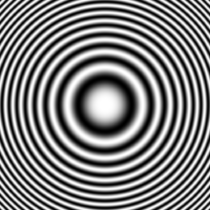 If the recording medium is illuminated with a point source and a normally incident plane wave, the resulting pattern is a sinusoidal zone plate
which acts as a negative Fresnel lens
whose focal length is equal to the separation of the point source and the recording plane.
When a plane wavefront illuminates a negative lens, it is expanded into a wave which appears to diverge from the focal point of the lens. Thus, when the recorded pattern is illuminated with the original plane wave, some of the light is diffracted into a diverging beam equivalent to the original plane wave; a holographic recording of the point source has been created.
When the plane wave is incident at a non-normal angle, the pattern formed is more complex but still acts as a negative lens provided it is illuminated at the original angle.
theory, each point in the object acts as a point source of light so the recording medium can be considered to be illuminated by a set of point sources located at varying distances from the medium.
The second (reference) beam illuminates the recording medium directly. Each point source wave interferes with the reference beam, giving rise to its own sinusoidal zone plate in the recording medium. The resulting pattern is the sum of all these 'zone plates' which combine to produce a random (speckle) pattern as in the photograph above.
When the hologram is illuminated by the original reference beam, each of the individual zone plates reconstructs the object wave which produced it, and these individual wavefronts add together to reconstruct the whole of the object beam. The viewer perceives a wavefront that is identical to the wavefront scattered from the object onto the recording medium, so that it appears to him or her that the object is still in place even if it has been removed. This image is known as a "virtual" image, as it is generated even though the object is no longer there.
U, which represents the electric or magnetic field
of the light wave. The amplitude
and phase
of the light are represented by the absolute value and angle of the complex number. The object and reference waves at any point in the holographic system are given by UO and UR. The combined beam is given by UO + UR. The energy of the combined beams is proportional to the square of magnitude of the combined waves as:

If a photographic plate is exposed to the two beams and then developed, its transmittance, T, is proportional to the light energy that was incident on the plate and is given by

where k is a constant.
When the developed plate is illuminated by the reference beam, the light transmitted through the plate, UH is equal to the transmittance T multiplied by the reference beam amplitude UR, giving

It can be seen that UH has four terms, each representing a light beam emerging from the hologram. The first of these is proportional to UO. This is the reconstructed object beam which enables a viewer to 'see' the original object even when it is no longer present in the field of view.
The second and third beams are modified versions of the reference beam. The fourth term is known as the "conjugate object beam". It has the reverse curvature to the object beam itself and forms a real image
of the object in the space beyond the holographic plate.
When the reference and object beams are incident on the holographic recording medium at significantly different angles, the virtual, real and reference wavefronts all emerge at different angles, enabling the reconstructed object to be seen clearly.
These requirements are inter-related, and it is essential to understand the nature of optical interference to see this. Interference is the variation in intensity which can occur when two light waves are superimposed. The intensity of the maxima exceeds the sum of the individual intensities of the two beams, and the intensity at the minima is less than this and may be zero. The interference pattern maps the relative phase between the two waves, and any change in the relative phases causes the interference pattern to move across the field of view. If the relative phase of the two waves changes by one cycle, then the pattern drifts by one whole fringe. One phase cycle corresponds to a change in the relative distances travelled by the two beams of one wavelength. Since the wavelength of light is of the order of 0.5μm, it can be seen that very small changes in the optical paths travelled by either of the beams in the holographic recording system lead to movement of the interference pattern which is the holographic recording. Such changes can be caused by relative movements of any of the optical components, and also by local changes in air-temperature. It is essential that any such changes are significantly less than the wavelength of light if a clear well-defined recording of the interference is to be created.
The exposure time required to record the hologram depends on the laser power available, on the particular medium used and on the size and nature of the object(s) to be recorded, just as in conventional photography. This determines the stability requirements. Exposure times of several minutes are typical when using quite powerful gas lasers and silver halide emulsions. All the elements within the optical system have to be stable to fractions of a μm over that period. It is possible to make holograms of much less stable objects by using a pulsed laser which produces a large amount of energy in a very short time (μs or less). These systems have been used to produce holograms of live people. A holographic portrait of Dennis Gabor was produced in 1971 using a pulsed ruby laser.
Thus, the laser power, recording medium sensitivity, recording time and mechanical and thermal stability requirements are all interlinked.
Another very important laser parameter is its coherence. This be envisaged by considering a laser to produce a sine wave whose frequency drifts over time; the coherence length can then be considered to be the distance over which it maintains a single frequency. This is important because two waves of different frequencies do not produce a stable interference pattern. The coherence length of the laser determines the depth of field which can be recorded in the scene. A good holography laser will typically have a coherence length of several meters, ample for a deep hologram.
The objects that form the scene must, in general, have optically rough surfaces so that they scatter light over a wide range of angles. A specularly reflecting (or shiny) surface reflects the light in only one direction at each point on its surface, so in general, most of the light will not be incident on the recording medium. Holograms of flat shiny objects have been made by locating it very close to the recording plate.
on a transparent substrate. The emulsion is exposed to the interference pattern, and is subsequently developed giving a transmittance which varies with the intensity of the pattern - the more light that fell on the plate at a given point, the darker the developed plate at that point.
A phase hologram is made by changing either the thickness or the refractive index
of the material in proportion to the intensity of the holographic interference pattern. This is a phase grating and it can be shown that when such a plate is illuminated by the original reference beam, it reconstructs the original object wavefront. The efficiency (i.e. the fraction of the illuminated beam which is converted to reconstructed object beam) is greater for phase than for amplitude modulated holograms.
A thick or volume hologram is one where the thickness of the recording medium is greater than the spacing of the interference pattern. The recorded hologram is now a three dimensional structure, and it can be shown that incident light is diffracted by the grating only at a particular angle, known as the Bragg angle
. If the hologram is illuminated with a light source incident at the original reference beam angle but a broad spectrum of wavelengths, reconstruction occurs only at the wavelength of the original laser used. If the angle of illumination is changed, reconstruction will occur at a different wavelength and the colour of the re-consturcted scene changes. A volume hologram effectively acts as a colour filter.
Normally, transmission holograms can only be reconstructed using a laser or a quasi-monochromatic source, but a particular type of transmission hologram, known as a rainbow hologram, can be viewed with white light.
In a reflection hologram, the object and reference beams are incident on the plate from opposite sides of the plate. The reconstructed object is then viewed from the same side of the plate as that at which the re-constructing beam is incident.
Only volume holograms can be used to make reflection holograms, as only a very low intensity diffracted beam would be reflected by a thin hologram.
or the phase
of an incident light beam in proportion to the intensity of the original light field.
The recording medium should be able to resolve fully all the fringes arising from interference between object and reference beam. These fringe spacings can range from tens of microns to less than one micron, i.e. spatial frequencies ranging from a few hundred to several thousand cycles/mm, and ideally, the recording medium should have a response which is flat over this range. If the response of the medium to these spatial frequencies is low, the diffraction efficiency of the hologram will be poor,and a dim image will be obtained. It should be noted that standard photographic film has a very low, or even zero, response at the frequencies involved and cannot be used to make a hologram - see, for example, Kodak's professional black and white film whose resolution starts falling off at 20 lines/mm and it is unlikely than any reconstructed beam would be obtained using this film.
If the response is not flat over the range of spatial frequencies in the interference pattern, then the resolution of the reconstructed image may also be degraded.
The table below shows the principal materials used for holographic recording. Note that these do not include the materials used in the mass replication of an existing hologram which are discussed in the next section. The resolution limit given in the table indicates the maximal number of interference lines/mm of the gratings. The required exposure is for a long exposure. Short exposure times (less than 1/1000 of a second, such as with a pulsed laser) require a higher exposure due to reciprocity failure.
----
even produces holographic gold and silver coinage through a complex stamping process. The first book to feature a hologram on the front cover was The Skook (Warner Books, 1984) by JP Miller
, featuring an illustration by Miller. That same year, "Telstar" by Ad Infinitum
became the first record with a hologram cover and National Geographic published the first magazine with a hologram cover.
The first step in the embossing process is to make a stamper by electrodeposition
of nickel
on the relief image recorded on the photoresist or photothermoplastic. When the nickel layer is thick enough, it is separated from the master hologram and mounted on a metal backing plate. The material used to make embossed copies consists of a polyester
base film, a resin separation layer and a thermoplastic
film constituting the holographic layer.
The embossing process can be carried out with a simple heated press. The bottom layer of the duplicating film (the thermoplastic layer) is heated above its softening point and pressed against the stamper, so that it takes up its shape. This shape is retained when the film is cooled and removed from the press. In order to permit the viewing of embossed holograms in reflection, an additional reflecting layer of aluminum is usually added on the hologram recording layer. Embossed holograms are used widely on credit cards, banknotes, and high value products.
It is possible to print holograms directly into steel using a sheet explosive charge to create the required surface relief.
, in the same way as the original objects would have done. It was very common in the early days of holography to use a chess board as the object and then take photographs at several different angles using the reconstructed light to show how the relative positions of the chess pieces appeared to change.
A holographic image can also be obtained using a different laser beam configuration to the original recording object beam, but the reconstructed image will not match the original exactly. When a laser is used to reconstruct the hologram, the image is speckled
just as the original image will have been. This can be a major drawback in viewing a hologram.
White light consists of light of a wide range of wavelengths. Normally, if a hologram is illuminated by a white light source, each wavelength can be considered to generate its own holographic reconstruction, and these will vary in size, angle, and distance. These will be superimposed, and the summed image will wipe out any information about the original scene, just as if you superimposed a set of photographs of the same object of different sizes and orientations. However, a holographic image can be obtained using white light
in specific circumstances, e.g. with volume holograms and rainbow holograms.The white light source used to view these holograms should always approximate to a point source, i.e. a spot light or the sun. An extended source (e.g. a fluorescent lamp) will not reconstruct a hologram since it light is incident at each point at a wide range of angles, giving multiple reconstructions which will "wipe" one another out.
White light reconstructions do not contain speckles.
A volume hologram can give a reconstructed beam using white light, as the hologram structure effectively filters out colours other than those equal to or very close to the colour of the laser used to make the hologram so that the reconstructed image will appear to be approximately the same colour as the laser light used to create the holographic recording.
In this method, parallax in the vertical plane is sacrificed to allow a bright well-defined single colour re-constructed image to be obtained using white light. The rainbow holography recording process uses a horizontal slit to eliminate vertical parallax
in the output image. The viewer is then effectively viewing the holographic image through a narrow horizontal slit. Horizontal parallax information is preserved but movement in the vertical direction produces colour rather than different vertical perspectives. Stereopsis
and horizontal motion parallax, two relatively powerful cues to depth, are preserved.
The holograms found on credit cards are examples of rainbow holograms. These are technically transmission holograms mounted onto a reflective surface like a metalized polyethylene terephthalate
substrate commonly known as PET
.
, where the holographically reconstructed wavefront interferes with the wavefront coming from the actual object, giving a null fringe if there has been no movement of the object and mapping out the displacement if the object has moved. This requires very precise relocation of the developed holographic plate.
Any change in the shape, orientation or wavelength of the reference beam gives rise to aberrations in the reconstructed image. For instance, the reconstructed image is magnified if the laser used to reconstruct the hologram has a shorter wavelength than the original laser. Nonetheless, good reconstruction is obtained using a laser of a different wavelength, quasi-monochromatic light or white light, in the right circumstances.
Since each point in the object illuminates all of the hologram, the whole object can be reconstructed from a small part of the hologram. Thus, a hologram can be broken up into small pieces and each one will enable the whole of the original object to be imaged. One does, however, lose information and the spatial resolution
gets worse as the size of the hologram is decreased — the image becomes "fuzzier". The field of view is also reduced, and the viewer will have to change position to see different parts of the scene.
Salvador Dalí
claimed to have been the first to employ holography artistically. He was certainly the first and best-known surrealist to do so, but the 1972 New York exhibit of Dalí holograms had been preceded by the holographic art exhibition that was held at the Cranbrook Academy of Art in Michigan in 1968 and by the one at the Finch College gallery in New York in 1970, which attracted national media attention.
During the 1970s, a number of art studios and schools were established, each with their particular approach to holography. Notably, there was the San Francisco School of Holography established by Lloyd Cross
, The Museum of Holography in New York founded by Rosemary (Possie) H. Jackson, the Royal College of Art in London and the Lake Forest College Symposiums organised by Tung Jeong (T.J.). None of these studios still exist; however, there is the Center for the Holographic Arts in New York and the HOLOcenter in Seoul, which offers artists a place to create and exhibit work.
During the 1980s, many artists who worked with holography helped the diffusion of this so-called "new medium" in the art world, such as Harriet Casdin-Silver of the USA, Dieter Jung (artist)
of Germany
, and Moysés Baumstein
of Brazil
, each one searching for a proper "language" to use with the three-dimensional work, avoiding the simple holographic reproduction of a sculpture or object. For instance, in Brazil, many concrete poets (Augusto de Campos, Décio Pignatari, Julio Plaza and José Wagner Garcia, associated with Moysés Baumstein
) found in holography a way to express themselves and to renew the Concrete Poetry (or Shape Poetry).
A small but active group of artists still use holography as their main medium, and many more artists integrate holographic elements into their work. Some are associated with novel holographic techniques; for example, artist Matt Brand employed computational mirror design to eliminate image distortion from specular holography
.
The MIT Museum and Jonathan Ross both have extensive collections of holography and on-line catalogues of art holograms.
reach the limit of possible data density (due to the diffraction
-limited size of the writing beams), holographic storage has the potential to become the next generation of popular storage media. The advantage of this type of data storage is that the volume of the recording media is used instead of just the surface.
Currently available SLMs
can produce about 1000 different images a second at 1024×1024-bit resolution. With the right type of media (probably polymers rather than something like LiNbO3
), this would result in about one-gigabit-per-second writing speed. Read speeds can surpass this, and experts believe one-terabit-per-second readout is possible.
In 2005, companies such as Optware
and Maxell
produced a 120 mm disc that uses a holographic layer to store data to a potential 3.9 TB
, which they plan to market under the name Holographic Versatile Disc
. Another company, InPhase Technologies
, is developing a competing format.
While many holographic data storage models have used "page-based" storage, where each recorded hologram holds a large amount of data, more recent research into using submicrometre-sized "microholograms" has resulted in several potential 3D optical data storage
solutions. While this approach to data storage can not attain the high data rates of page-based storage, the tolerances, technological hurdles, and cost of producing a commercial product are significantly lower.
There also exist holographic materials that do not need the developing process and can record a hologram in a very short time. This allows one to use holography to perform some simple operations in an all-optical way. Examples of applications of such real-time holograms include phase-conjugate mirrors ("time-reversal" of light), optical cache memories, image processing
(pattern recognition of time-varying images), and optical computing.
The amount of processed information can be very high (terabits/s), since the operation is performed in parallel on a whole image. This compensates for the fact that the recording time, which is in the order of a microsecond
, is still very long compared to the processing time of an electronic computer. The optical processing performed by a dynamic hologram is also much less flexible than electronic processing. On one side, one has to perform the operation always on the whole image, and on the other side, the operation a hologram can perform is basically either a multiplication or a phase conjugation. In optics, addition and Fourier transform
are already easily performed in linear materials, the latter simply by a lens. This enables some applications, such as a device that compares images in an optical way.
The search for novel nonlinear optical materials for dynamic holography is an active area of research. The most common materials are photorefractive crystals, but in semiconductor
s or semiconductor heterostructures
(such as quantum well
s), atomic vapors and gases, plasmas
and even liquids, it was possible to generate holograms.
A particularly promising application is optical phase conjugation. It allows the removal of the wavefront distortions a light beam receives when passing through an aberrating medium, by sending it back through the same aberrating medium with a conjugated phase. This is useful, for example, in free-space optical communications to compensate for atmospheric turbulence (the phenomenon that gives rise to the twinkling of starlight).
started the San Francisco School of Holography and started to teach amateurs the methods of making holograms with inexpensive equipment. This method relied on the use of a large table of deep sand to hold the optics
rigid and damp vibration
s that would destroy the image.
Many of these holographers would go on to produce art holograms. In 1983, Fred Unterseher published the Holography Handbook, a remarkably easy-to-read description of making holograms at home. This brought in a new wave of holographers and gave simple methods to use the then-available AGFA silver halide
recording materials.
In 2000, Frank DeFreitas
published the Shoebox Holography Book and introduced using inexpensive laser pointer
s to countless hobby
ists. This was a very important development for amateurs, as the cost for a 5 mW laser dropped from $1200 to $5 as semiconductor laser diodes reached mass market. Now, there are hundreds to thousands of amateur holographers worldwide.
In 2006, a large number of surplus Holography Quality Green Lasers (Coherent C315) became available and put Dichromated Gelatin (DCG) within the reach of the amateur holographer. The holography community was surprised at the amazing sensitivity of DCG to green light
. It had been assumed that the sensitivity would be non-existent. Jeff Blyth responded with the G307 formulation of DCG to increase the speed and sensitivity to these new lasers.
Many film suppliers have come and gone from the silver-halide market. While more film manufactures have filled in the voids, many amateurs are now making their own film. The favorite formulations are Dichromated Gelatin, Methylene Blue Sensitised Dichromated Gelatin and Diffusion Method Silver Halide preparations. Jeff Blyth has published very accurate methods for making film in a small lab or garage.
A small group of amateurs are even constructing their own pulsed lasers to make holograms of moving objects.
It has been widely used to measure stress, strain, and vibration in engineering structures.
, which, in turn, enables enhancement of the resolution of optical microscopy.
The corresponding technique is called interferometric microscopy
. Recent achievements of interferometric microscopy allow one to approach the quarter-wavelength limit of resolution.
20 note, British pound
5/10/20 notes, Estonian kroon
25/50/100/500 notes, Canadian dollar
5/10/20/50/100 notes, Euro
5/10/20/50/100/200/500 notes, South Korean won
5000/10000/50000 notes, and Japanese yen
5000/10000 notes. They are also used in credit and bank cards as well as passport
s, ID cards, book
s, DVD
s, and sports equipment
.
Holograms produced in elastomers can be used as stress-strain reporters due to its elasticity and compressibility, the pressure and force applied are correlated to the reflected wavelength, therefore its color.
.
Electron holography
is the application of holography techniques to electron waves rather than light waves. Electron holography was invented by Dennis Gabor to improve the resolution and avoid the aberrations of the transmission electron microscope. Today it is commonly used to study electric and magnetic fields in thin films, as magnetic and electric fields can shift the phase of the interfering wave passing through the sample. The principle of electron holography can also be applied to interference lithography
.
Acoustic holography
is a method used to estimate the sound field near a source by measuring acoustic parameters away from the source via an array of pressure and/or particle velocity transducers. Measuring techniques included within acoustic holography are becoming increasingly popular in various fields, most notably those of transportation, vehicle and aircraft design, and NVH. The general idea of acoustic holography has led to different versions such as near-field acoustic holography (NAH) and statistically optimal near-field acoustic holography (SONAH). For audio rendition, the wave field synthesis is the most related procedure.
Atomic holography has evolved out of the development of the basic elements of atom optics
. With the Fresnel diffraction lens and atomic mirrors
atomic holography follows a natural step in the development of the physics (and applications) of atomic beams. Recent developments including atomic mirrors
and especially ridged mirror
s have provided the tools necessary for the creation of atomic holograms, although such holograms have not yet been commercialized.
and Video projection
, Pepper's Ghost
, and Volumetric Projections are often confused with holograms.
In 2010, there was a series of concerts organized by Crypton Future Media
which included Hatsune Miku
, a singing synthesizer application with a female persona, performing on stage as a "holographic" character. This effect was actually achieved through a special method of rear projection against a semi-transparent screen.
In 2011, in Beijing, apparel company Burberry
produced the "Burberry Prorsum Autumn/Winter 2011 Hologram Runway Show", which included life size 2-D projections of models. The company's own video shows several centered and off-center shots of the main 2-dimensional projection screen, and all the 3-D effects stem from 2-D perspective
. The claim that holography was used was reported as fact in the trade media.
s in science fiction
.
Light
Light or visible light is electromagnetic radiation that is visible to the human eye, and is responsible for the sense of sight. Visible light has wavelength in a range from about 380 nanometres to about 740 nm, with a frequency range of about 405 THz to 790 THz...
scattered from an object to be recorded and later reconstructed so that when an imaging system (a camera or an eye) is placed in the reconstructed beam, an image of the object will be seen even when the object is no longer present. The image changes as the position and orientation of the viewing system changes in exactly the same way as if the object were still present, thus making the image appear three-dimensional
Three-dimensional space
Three-dimensional space is a geometric 3-parameters model of the physical universe in which we live. These three dimensions are commonly called length, width, and depth , although any three directions can be chosen, provided that they do not lie in the same plane.In physics and mathematics, a...
. This effect can be seen in the figure on the right where the orientation of the mouse is significantly different in the two images and its position relative to other parts of the scene has changed. The holographic recording itself is not an image – it consists of an apparently random structure of either varying intensity, density or profile – an example can be seen in Figure 4 below.
Overview and history
Holography was invented in 1947 by the Hungarian-BritishBritish people
The British are citizens of the United Kingdom, of the Isle of Man, any of the Channel Islands, or of any of the British overseas territories, and their descendants...
physicist Dennis Gabor
Dennis Gabor
Dennis Gabor CBE, FRS was a Hungarian-British electrical engineer and inventor, most notable for inventing holography, for which he later received the 1971 Nobel Prize in Physics....
(Hungarian name: Gábor Dénes), work for which he received the Nobel Prize in Physics
Nobel Prize in Physics
The Nobel Prize in Physics is awarded once a year by the Royal Swedish Academy of Sciences. It is one of the five Nobel Prizes established by the will of Alfred Nobel in 1895 and awarded since 1901; the others are the Nobel Prize in Chemistry, Nobel Prize in Literature, Nobel Peace Prize, and...
in 1971. Pioneering work in the field of physics by other scientists including Mieczysław Wolfke resolved technical issues that previously had prevented advancement. The discovery was an unexpected result of research into improving electron microscope
Electron microscope
An electron microscope is a type of microscope that uses a beam of electrons to illuminate the specimen and produce a magnified image. Electron microscopes have a greater resolving power than a light-powered optical microscope, because electrons have wavelengths about 100,000 times shorter than...
s at the British Thomson-Houston
British Thomson-Houston
British Thomson-Houston was a British engineering and heavy industrial company, based at Rugby, Warwickshire, England. They were known primarily for their electrical systems and steam turbines. They were merged with the similar Metropolitan-Vickers company in 1928, but the two maintained their own...
Company in Rugby
Rugby, Warwickshire
Rugby is a market town in Warwickshire, England, located on the River Avon. The town has a population of 61,988 making it the second largest town in the county...
, England, and the company filed a patent in December 1947 (patent GB685286). The technique as originally invented is still used in electron microscopy, where it is known as electron holography
Electron holography
Electron holography is holography with electron waves. Dennis Gabor invented holography in 1948 when he tried to improve resolution in electron microscope. The first attempts to perform holography with electron waves were made by Haine and Muley in 1952; they demonstrated recorded with 60keV...
, but optical holography did not really advance until the development of the laser
Laser
A laser is a device that emits light through a process of optical amplification based on the stimulated emission of photons. The term "laser" originated as an acronym for Light Amplification by Stimulated Emission of Radiation...
in 1960.
The development of the laser
Laser
A laser is a device that emits light through a process of optical amplification based on the stimulated emission of photons. The term "laser" originated as an acronym for Light Amplification by Stimulated Emission of Radiation...
enabled the first practical optical holograms that recorded 3D objects to be made in 1962 by Yuri Denisyuk in the Soviet Union and by Emmett Leith
Emmett Leith
Emmett Leith was a professor of electrical engineering at the University of Michigan and, with Juris Upatnieks of the University of Michigan, the co-inventor of three-dimensional holography.Leith received his B.S. in physics from Wayne State University in 1949 and his M.S. in physics in 1952...
and Juris Upatnieks at University of Michigan
University of Michigan
The University of Michigan is a public research university located in Ann Arbor, Michigan in the United States. It is the state's oldest university and the flagship campus of the University of Michigan...
, USA. Early holograms used silver halide
Silver halide
A silver halide is one of the compounds formed between silver and one of the halogens — silver bromide , chloride , iodide , and three forms of silver fluorides. As a group, they are often referred to as the silver halides, and are often given the pseudo-chemical notation AgX...
photographic emulsions as the recording medium. They were not very efficient as the grating produced absorbed much of the incident light. Various methods of converting the variation in transmission to a variation in refractive index (known as "bleaching") were developed which enabled much more efficient holograms to be produced.
Several types of holograms can be made. Transmission holograms, such as those produced by Leith and Upatnieks, are viewed by shining laser light through them and looking at the reconstructed image from the side of the hologram opposite the source. A later refinement, the "rainbow transmission" hologram
Rainbow hologram
The rainbow or Benton hologram is a type of hologram invented in 1968 by Dr. Stephen A. Benton at Polaroid Corporation . Rainbow holograms are designed to be viewed under white light illumination, rather than laser light which was required before this...
, allows more convenient illumination by white light rather than by lasers. Rainbow holograms are commonly seen today on credit cards as a security feature and on product packaging.
Another kind of common hologram, the reflection or Denisyuk hologram, can also be viewed using a white-light illumination source on the same side of the hologram as the viewer and is the type of hologram normally seen in holographic displays. They are also capable of multicolour-image reproduction.
Specular holography
Specular holography
Specular holography is a technique for making three dimensional imagery by controlling the motion of specularities on a two-dimensional surface. The image is made of many specularities and has the appearance of a 3D surface-stippling made of dots of light...
is a related technique for making three-dimensional images by controlling the motion of specularities on a two-dimensional surface. It works by reflectively or refractively manipulating bundles of light rays, whereas Gabor-style holography works by diffractively reconstructing wavefronts.
Most holograms produced are of static objects but systems for displaying changing scenes on a holographic volumetric display
Volumetric display
A volumetric display device is a graphical display device that forms a visual representation of an object in three physical dimensions, as opposed to the planar image of traditional screens that simulate depth through a number of different visual effects...
are now being developed.
Holograms can also be used to store, retrieve, and process information optically.
In its early days, holography required high-power expensive lasers, but nowadays, mass-produced low-cost semi-conductor laser
Laser
A laser is a device that emits light through a process of optical amplification based on the stimulated emission of photons. The term "laser" originated as an acronym for Light Amplification by Stimulated Emission of Radiation...
s, such as those found in millions of DVD recorder
DVD recorder
A DVD recorder , is an optical disc recorder that uses Optical disc recording technologies to digitally record analog signal or digital signals onto blank writable DVD media...
s and used in other common applications, can be used to make holograms and have made holography much more accessible to low-budget researchers, artists and dedicated hobbyists.
It was thought that it would be possible to use X-rays to make holograms of molecules and view them using visible light. However, X-ray holograms have not been created to date.
How holography works
Holography is a technique which enables a light field, which is generally the product of a light source scattering off objects, to be recorded and later reconstructed when the original light field is no longer present (due to the absence of the original objects). Holography can be thought of as somewhat similar to sound recording, whereby a sound field created by vibrating matter, like musical instrumentMusical instrument
A musical instrument is a device created or adapted for the purpose of making musical sounds. In principle, any object that produces sound can serve as a musical instrument—it is through purpose that the object becomes a musical instrument. The history of musical instruments dates back to the...
s or vocal chords, is encoded in such a way that it can be reproduced later without the presence of the original vibrating matter.
Holograms are recorded using a flash of light that illuminates a scene and then imprints on a recording medium, much in the way a photograph is recorded. A hologram, however, requires a laser
Laser
A laser is a device that emits light through a process of optical amplification based on the stimulated emission of photons. The term "laser" originated as an acronym for Light Amplification by Stimulated Emission of Radiation...
as the light source, since lasers can be precisely controlled and have a fixed wavelength
Wavelength
In physics, the wavelength of a sinusoidal wave is the spatial period of the wave—the distance over which the wave's shape repeats.It is usually determined by considering the distance between consecutive corresponding points of the same phase, such as crests, troughs, or zero crossings, and is a...
, unlike white light, which contains many different wavelengths.
A shutter
Shutter
Shutter may refer to:Windows:*Window shutter, a solid window covering used to block light and winds*Plantation Shutters/Jigsaw Shutters, interior wooden louvred shutters to control heat, light and privacy...
is required when taking a photograph to limit the time in which the film is exposed to light. Holography also requires a specific exposure time, and this can be done using a shutter, or by electronic timing of the laser.
This laser beam is generally aimed through a series of elements that change it in different ways - see Figure 2. The first element is a beam splitter
Beam splitter
A beam splitter is an optical device that splits a beam of light in two. It is the crucial part of most interferometers.In its most common form, a rectangle, it is made from two triangular glass prisms which are glued together at their base using Canada balsam...
, which divides the beam into two identical beams, each aimed in different directions:
- One beam, known as the illumination or object beam, is spread using lensLens (optics)A lens is an optical device with perfect or approximate axial symmetry which transmits and refracts light, converging or diverging the beam. A simple lens consists of a single optical element...
es and directed onto the scene using mirrorMirrorA mirror is an object that reflects light or sound in a way that preserves much of its original quality prior to its contact with the mirror. Some mirrors also filter out some wavelengths, while preserving other wavelengths in the reflection...
s, in order to illuminate it. Some of the light scattered (reflected) from this illumination falls onto the recording medium. - The second beam, known as the reference beam, is also spread through the use of lenses, but is directed so that it doesn't come in contact with the scene, and instead travels directly onto the recording medium.
There are several different materials which can be used as the recording medium. One of the most common is silver halide
Silver halide
A silver halide is one of the compounds formed between silver and one of the halogens — silver bromide , chloride , iodide , and three forms of silver fluorides. As a group, they are often referred to as the silver halides, and are often given the pseudo-chemical notation AgX...
photographic emulsion which uses the same materials as photographic film but with much higher grain density, i.e. of much higher resolution
Optical resolution
Optical resolution describes the ability of an imaging system to resolve detail in the object that is being imaged.An imaging system may have many individual components including a lens and recording and display components...
. A layer of the recording medium is attached to a transparent substrate which is normally glass, but may be plastic.
On the recording medium, the light waves of the two beams intersect and interfere with each other. It is this interference pattern that is imprinted on the holographic medium. The pattern itself is seemingly random, as this pattern represents the way in which the scene's light interfered with the original light source, but not the original light source itself. The interference pattern can be said to be an encoded version of the scene, requiring a particular key, that is, the original light source, in order to view its contents. This missing key is provided later by shining a laser, identical to the one used to record the hologram, onto the developed film which then recreates a range of the scene's original light.
When the original reference beam illuminates the hologram, it is diffracted
Diffraction
Diffraction refers to various phenomena which occur when a wave encounters an obstacle. Italian scientist Francesco Maria Grimaldi coined the word "diffraction" and was the first to record accurate observations of the phenomenon in 1665...
by the recorded hologram to produce a light field which is identical to the light field which was originally scattered by the object or objects onto the hologram - see Figure 3. When the object is removed, an observer who looks into the hologram "sees" the same image on his retina as he would have seen when looking at the original scene. This image is known as a virtual image
Virtual image
In optics, a virtual image is an image in which the outgoing rays from a point on the object always diverge. It will appear to converge in or behind the optical device . A simple example is a flat mirror where the image of oneself is perceived at twice the distance from oneself to the mirror...
.
Figure 4 is a photograph of a hologram's surface. The object in the hologram is a toy van. It can be seen that it is no more possible to discern the subject of the hologram from this pattern than it is to identify what music has been recorded by looking at the hills and valleys on a vinyl record surface, or the pits on a CD
Compact Disc
The Compact Disc is an optical disc used to store digital data. It was originally developed to store and playback sound recordings exclusively, but later expanded to encompass data storage , write-once audio and data storage , rewritable media , Video Compact Discs , Super Video Compact Discs ,...
. Also note that the holographic recording is described by the speckle pattern
Speckle pattern
A speckle pattern is a random intensity pattern produced by the mutual interference of a set of wavefronts. This phenomenon has been investigated by scientists since the time of Newton, but speckles have come into prominence since the invention of the laser and have now found a variety of...
, rather than the "wavy" line pattern; the latter being an incidental result of interference between multiple reflections in the glass plate on which the film is mounted.
Holography vs. photography
Each point in the holographic recording includes light scattered from every point in the scene, whereas each point in a photographPhotograph
A photograph is an image created by light falling on a light-sensitive surface, usually photographic film or an electronic imager such as a CCD or a CMOS chip. Most photographs are created using a camera, which uses a lens to focus the scene's visible wavelengths of light into a reproduction of...
has light scattered only from a single point in the scene which has been focus
Focus
Focus, FOCUS, or foci may refer to:In science, mathematics or computing:*Focus , selectively concentrating on one aspect of the environment while ignoring other things...
ed by a lens onto the film
Film
A film, also called a movie or motion picture, is a series of still or moving images. It is produced by recording photographic images with cameras, or by creating images using animation techniques or visual effects...
or the digital capture medium
CCD
-Science:*Carbonate compensation depth, a property of oceans*Colony collapse disorder, a phenomenon involving the abrupt disappearance of the worker bees in a beehive or Western honey bee colony...
.
A hologram differs from a photograph in several ways:
- The hologram allows the recorded scene to be viewed from a wide range of angles whereas the photograph gives only a single view.
- The reproduced range of a hologram adds many of the same depth perception cuesDepth perceptionDepth perception is the visual ability to perceive the world in three dimensions and the distance of an object. Depth sensation is the ability to move accurately, or to respond consistently, based on the distances of objects in an environment....
that were present in the original scene, which are again recognized by the human brainHuman brainThe human brain has the same general structure as the brains of other mammals, but is over three times larger than the brain of a typical mammal with an equivalent body size. Estimates for the number of neurons in the human brain range from 80 to 120 billion...
and translated into the same perception of a three-dimensional image as when the original scene might have been viewed. The photograph is a flat two-dimensional representation. - The developed hologram surface itself consists of a very fine, seemingly random pattern, which appears to bear no relationship to the scene which it has recorded. A photograph clearly maps out the light field of the original scene.
- When a photograph is cut in pieces, each piece shows only part of the scene. When a hologram is cut in pieces, the whole scene can still be seen in each piece - see Figure 8 below. Think of viewing a street outside your house through a 4 ft x 4 ft window, and then through a 2 ft x 2 ft window; You can see the same things through the smaller window, but you can see more at once through the 4 ft window and you may need to change your viewing position to see everything in the smaller window.
- A photograph can be viewed in a wide range of lighting conditions, whereas holograms can only be viewed with very specific forms of illumination.
Physics of holography
For a better understanding of the process, it is necessary to understand interference and diffractionDiffraction
Diffraction refers to various phenomena which occur when a wave encounters an obstacle. Italian scientist Francesco Maria Grimaldi coined the word "diffraction" and was the first to record accurate observations of the phenomenon in 1665...
. Interference occurs when one or more wavefronts are superimposed. Diffraction
Diffraction
Diffraction refers to various phenomena which occur when a wave encounters an obstacle. Italian scientist Francesco Maria Grimaldi coined the word "diffraction" and was the first to record accurate observations of the phenomenon in 1665...
occurs whenever a wavefront encounters an object. The process of producing a holographic reconstruction is explained below purely in terms of interference and diffraction. It is somewhat simplified but is accurate enough to provide an understanding of how the holographic process works.
For those unfamiliar with these concepts, it is worthwhile to read the respective articles before reading further in this article.
Plane wavefronts
A diffraction gratingDiffraction grating
In optics, a diffraction grating is an optical component with a periodic structure, which splits and diffracts light into several beams travelling in different directions. The directions of these beams depend on the spacing of the grating and the wavelength of the light so that the grating acts as...
is a structure with a repeating pattern. A simple example is a metal plate with slits cut at regular intervals. A light wave incident on a grating is split into several waves; the direction of these diffracted waves is determined by the grating spacing and the wavelength of the light.
A simple hologram can be made by superimposing two plane wave
Plane wave
In the physics of wave propagation, a plane wave is a constant-frequency wave whose wavefronts are infinite parallel planes of constant peak-to-peak amplitude normal to the phase velocity vector....
s from the same light source on a holographic recording medium. The two waves interfere giving a straight line fringe pattern whose intensity varies sinusoidally across the medium. The spacing of the fringe pattern is determined by the angle between the two waves, and on the wavelength of the light.
The recorded light pattern is a diffraction grating. When it is illuminated by only one of the waves used to create it, it can be shown that one of the diffracted waves emerges at the same angle as that at which the second wave was originally incident so that the second wave has been 'reconstructed'. Thus, the recorded light pattern is a holographic recording as defined above.
Point sources
Zone plate
A zone plate is a device used to focus light or other things exhibiting wave character. Unlike lenses or curved mirrors however, zone plates use diffraction instead of refraction or reflection. Based on analysis by Augustin-Jean Fresnel, they are sometimes called Fresnel zone plates in his honor...
which acts as a negative Fresnel lens
Fresnel lens
A Fresnel lens is a type of lens originally developed by French physicist Augustin-Jean Fresnel for lighthouses.The design allows the construction of lenses of large aperture and short focal length without the mass and volume of material that would be required by a lens of conventional design...
whose focal length is equal to the separation of the point source and the recording plane.
When a plane wavefront illuminates a negative lens, it is expanded into a wave which appears to diverge from the focal point of the lens. Thus, when the recorded pattern is illuminated with the original plane wave, some of the light is diffracted into a diverging beam equivalent to the original plane wave; a holographic recording of the point source has been created.
When the plane wave is incident at a non-normal angle, the pattern formed is more complex but still acts as a negative lens provided it is illuminated at the original angle.
Complex objects
To record a hologram of a complex object, a laser beam is first split into two separate beams of light. One beam illuminates the object, which then scatters light onto the recording medium. According to diffractionDiffraction
Diffraction refers to various phenomena which occur when a wave encounters an obstacle. Italian scientist Francesco Maria Grimaldi coined the word "diffraction" and was the first to record accurate observations of the phenomenon in 1665...
theory, each point in the object acts as a point source of light so the recording medium can be considered to be illuminated by a set of point sources located at varying distances from the medium.
The second (reference) beam illuminates the recording medium directly. Each point source wave interferes with the reference beam, giving rise to its own sinusoidal zone plate in the recording medium. The resulting pattern is the sum of all these 'zone plates' which combine to produce a random (speckle) pattern as in the photograph above.
When the hologram is illuminated by the original reference beam, each of the individual zone plates reconstructs the object wave which produced it, and these individual wavefronts add together to reconstruct the whole of the object beam. The viewer perceives a wavefront that is identical to the wavefront scattered from the object onto the recording medium, so that it appears to him or her that the object is still in place even if it has been removed. This image is known as a "virtual" image, as it is generated even though the object is no longer there.
Mathematical model
A light wave can be modelled by a complex numberComplex number
A complex number is a number consisting of a real part and an imaginary part. Complex numbers extend the idea of the one-dimensional number line to the two-dimensional complex plane by using the number line for the real part and adding a vertical axis to plot the imaginary part...
U, which represents the electric or magnetic field
Magnetic field
A magnetic field is a mathematical description of the magnetic influence of electric currents and magnetic materials. The magnetic field at any given point is specified by both a direction and a magnitude ; as such it is a vector field.Technically, a magnetic field is a pseudo vector;...
of the light wave. The amplitude
Amplitude
Amplitude is the magnitude of change in the oscillating variable with each oscillation within an oscillating system. For example, sound waves in air are oscillations in atmospheric pressure and their amplitudes are proportional to the change in pressure during one oscillation...
and phase
Phase (waves)
Phase in waves is the fraction of a wave cycle which has elapsed relative to an arbitrary point.-Formula:The phase of an oscillation or wave refers to a sinusoidal function such as the following:...
of the light are represented by the absolute value and angle of the complex number. The object and reference waves at any point in the holographic system are given by UO and UR. The combined beam is given by UO + UR. The energy of the combined beams is proportional to the square of magnitude of the combined waves as:
If a photographic plate is exposed to the two beams and then developed, its transmittance, T, is proportional to the light energy that was incident on the plate and is given by
where k is a constant.
When the developed plate is illuminated by the reference beam, the light transmitted through the plate, UH is equal to the transmittance T multiplied by the reference beam amplitude UR, giving
It can be seen that UH has four terms, each representing a light beam emerging from the hologram. The first of these is proportional to UO. This is the reconstructed object beam which enables a viewer to 'see' the original object even when it is no longer present in the field of view.
The second and third beams are modified versions of the reference beam. The fourth term is known as the "conjugate object beam". It has the reverse curvature to the object beam itself and forms a real image
Real image
In optics, a real image is a representation of an object in which the perceived location is actually a point of convergence of the rays of light that make up the image. If a screen is placed in the plane of a real image the image will generally become visible on the screen...
of the object in the space beyond the holographic plate.
When the reference and object beams are incident on the holographic recording medium at significantly different angles, the virtual, real and reference wavefronts all emerge at different angles, enabling the reconstructed object to be seen clearly.
Items required
To make a hologram, the following are required:- a suitable object or set of objects
- a suitable laser beam
- optical components which enable the laser beam to be split into two, with one beam (the object beam) directed onto the object, and the other beam (the reference beam) directed onto the recording medium, enabling an interference pattern between the object beam and the reference beam to be created
- a recording medium which converts this interference pattern into an optical element which modifies either the amplitude or the phase of an incident light beam according to the intensity of the interference pattern.
- an environment which provides sufficient mechanical and thermal stability that the interference pattern is stable during the time in which the interference pattern is recorded
These requirements are inter-related, and it is essential to understand the nature of optical interference to see this. Interference is the variation in intensity which can occur when two light waves are superimposed. The intensity of the maxima exceeds the sum of the individual intensities of the two beams, and the intensity at the minima is less than this and may be zero. The interference pattern maps the relative phase between the two waves, and any change in the relative phases causes the interference pattern to move across the field of view. If the relative phase of the two waves changes by one cycle, then the pattern drifts by one whole fringe. One phase cycle corresponds to a change in the relative distances travelled by the two beams of one wavelength. Since the wavelength of light is of the order of 0.5μm, it can be seen that very small changes in the optical paths travelled by either of the beams in the holographic recording system lead to movement of the interference pattern which is the holographic recording. Such changes can be caused by relative movements of any of the optical components, and also by local changes in air-temperature. It is essential that any such changes are significantly less than the wavelength of light if a clear well-defined recording of the interference is to be created.
The exposure time required to record the hologram depends on the laser power available, on the particular medium used and on the size and nature of the object(s) to be recorded, just as in conventional photography. This determines the stability requirements. Exposure times of several minutes are typical when using quite powerful gas lasers and silver halide emulsions. All the elements within the optical system have to be stable to fractions of a μm over that period. It is possible to make holograms of much less stable objects by using a pulsed laser which produces a large amount of energy in a very short time (μs or less). These systems have been used to produce holograms of live people. A holographic portrait of Dennis Gabor was produced in 1971 using a pulsed ruby laser.
Thus, the laser power, recording medium sensitivity, recording time and mechanical and thermal stability requirements are all interlinked.
Another very important laser parameter is its coherence. This be envisaged by considering a laser to produce a sine wave whose frequency drifts over time; the coherence length can then be considered to be the distance over which it maintains a single frequency. This is important because two waves of different frequencies do not produce a stable interference pattern. The coherence length of the laser determines the depth of field which can be recorded in the scene. A good holography laser will typically have a coherence length of several meters, ample for a deep hologram.
The objects that form the scene must, in general, have optically rough surfaces so that they scatter light over a wide range of angles. A specularly reflecting (or shiny) surface reflects the light in only one direction at each point on its surface, so in general, most of the light will not be incident on the recording medium. Holograms of flat shiny objects have been made by locating it very close to the recording plate.
Hologram classifications
There are three important properties of a hologram which are defined in this section. A given hologram will have one or other of each of these three properties, e.g. we can have an amplitude modulated thin transmission hologram, or a phase modulated, volume reflection hologram.Amplitude and phase modulation holograms
An amplitude modulation hologram is one where the amplitude of light diffracted by the hologram is proportional to the intensity of the recorded light. A straightforward example of this is photographic emulsionPhotographic emulsion
Photographic emulsion is a light-sensitive colloid, such as gelatin, coated onto a substrate. In silver-gelatin photography, the emulsion consists of silver halide crystals suspended in gelatin, and the substrate may be glass, plastic film, paper or fabric....
on a transparent substrate. The emulsion is exposed to the interference pattern, and is subsequently developed giving a transmittance which varies with the intensity of the pattern - the more light that fell on the plate at a given point, the darker the developed plate at that point.
A phase hologram is made by changing either the thickness or the refractive index
Refractive index
In optics the refractive index or index of refraction of a substance or medium is a measure of the speed of light in that medium. It is expressed as a ratio of the speed of light in vacuum relative to that in the considered medium....
of the material in proportion to the intensity of the holographic interference pattern. This is a phase grating and it can be shown that when such a plate is illuminated by the original reference beam, it reconstructs the original object wavefront. The efficiency (i.e. the fraction of the illuminated beam which is converted to reconstructed object beam) is greater for phase than for amplitude modulated holograms.
Thin holograms and thick (volume) holograms
A thin hologram is one where the thickness of the recording medium is much less than the spacing of the interference fringes which make up the holographic recording.A thick or volume hologram is one where the thickness of the recording medium is greater than the spacing of the interference pattern. The recorded hologram is now a three dimensional structure, and it can be shown that incident light is diffracted by the grating only at a particular angle, known as the Bragg angle
Bragg's law
In physics, Bragg's law gives the angles for coherent and incoherent scattering from a crystal lattice. When X-rays are incident on an atom, they make the electronic cloud move as does any electromagnetic wave...
. If the hologram is illuminated with a light source incident at the original reference beam angle but a broad spectrum of wavelengths, reconstruction occurs only at the wavelength of the original laser used. If the angle of illumination is changed, reconstruction will occur at a different wavelength and the colour of the re-consturcted scene changes. A volume hologram effectively acts as a colour filter.
Transmission and reflection holograms
A transmission hologram is one where the object and reference beams are incident on the recording medium from the same side. An optical arrangement for making a transmission hologram is shown in Figure 2. In practice, several more mirrors may be used to direct the beams in the required directions.Normally, transmission holograms can only be reconstructed using a laser or a quasi-monochromatic source, but a particular type of transmission hologram, known as a rainbow hologram, can be viewed with white light.
In a reflection hologram, the object and reference beams are incident on the plate from opposite sides of the plate. The reconstructed object is then viewed from the same side of the plate as that at which the re-constructing beam is incident.
Only volume holograms can be used to make reflection holograms, as only a very low intensity diffracted beam would be reflected by a thin hologram.
Holographic recording media
The recording medium has to convert the original interference pattern into an optical element that modifies either the amplitudeAmplitude
Amplitude is the magnitude of change in the oscillating variable with each oscillation within an oscillating system. For example, sound waves in air are oscillations in atmospheric pressure and their amplitudes are proportional to the change in pressure during one oscillation...
or the phase
Phase (waves)
Phase in waves is the fraction of a wave cycle which has elapsed relative to an arbitrary point.-Formula:The phase of an oscillation or wave refers to a sinusoidal function such as the following:...
of an incident light beam in proportion to the intensity of the original light field.
The recording medium should be able to resolve fully all the fringes arising from interference between object and reference beam. These fringe spacings can range from tens of microns to less than one micron, i.e. spatial frequencies ranging from a few hundred to several thousand cycles/mm, and ideally, the recording medium should have a response which is flat over this range. If the response of the medium to these spatial frequencies is low, the diffraction efficiency of the hologram will be poor,and a dim image will be obtained. It should be noted that standard photographic film has a very low, or even zero, response at the frequencies involved and cannot be used to make a hologram - see, for example, Kodak's professional black and white film whose resolution starts falling off at 20 lines/mm and it is unlikely than any reconstructed beam would be obtained using this film.
If the response is not flat over the range of spatial frequencies in the interference pattern, then the resolution of the reconstructed image may also be degraded.
The table below shows the principal materials used for holographic recording. Note that these do not include the materials used in the mass replication of an existing hologram which are discussed in the next section. The resolution limit given in the table indicates the maximal number of interference lines/mm of the gratings. The required exposure is for a long exposure. Short exposure times (less than 1/1000 of a second, such as with a pulsed laser) require a higher exposure due to reciprocity failure.
| Material | Reusable | Processing | Type of hologram | Theoretical maximum efficiency | Required exposure [mJ/cm2] | Resolution limit [mm−1] |
|---|---|---|---|---|---|---|
| Photographic emulsions Photographic paper Photographic paper is paper coated with light-sensitive chemicals, used for making photographic prints.Photographic paper is exposed to light in a controlled manner, either by placing a negative in contact with the paper directly to produce a contact print, by using an enlarger in order to create a... |
No | Wet | Amplitude | 6% | 1.5 | 5000 |
| Phase (bleached) | 60% | |||||
| Dichromated gelatin | No | Wet | Phase | 100% | 100 | 10,000 |
| Photoresist Photoresist A photoresist is a light-sensitive material used in several industrial processes, such as photolithography and photoengraving to form a patterned coating on a surface.-Tone:Photoresists are classified into two groups: positive resists and negative resists.... s |
No | Wet | Phase | 30% | 100 | 3,000 |
| Photothermoplastics | Yes | Charge and heat | Phase | 33% | 0.1 | 500–1,200 |
| Photopolymer Photopolymer A photopolymer is a polymer that changes its properties when exposed to light, often in the ultraviolet spectrum. These polymers are useful in dentistry for fillings and in rapid prototyping in the stereolithography and 3D printing processes. This material is also used in the creation of ADA... s |
No | Post exposure | Phase | 100% | 10000 | 5,000 |
| Photorefractives Photorefractive effect The photorefractive effect is a nonlinear optical effect seen in certain crystals and other materials that respond to light by altering their refractive index.... |
Yes | None | Phase | 100% | 10 | 10,000 |
----
Embossing and mass production
An existing hologram can be replicated, either optically, similar to holographic recording or in the case of surface relief holograms, by embossing. Surface relief holograms are recorded in photoresists or photothermoplastics and allow cheap mass reproduction. Such embossed holograms are now widely used, for instance, as security features on credit cards or quality merchandise. The Royal Canadian MintRoyal Canadian Mint
The Royal Canadian Mint produces all of Canada's circulation coins, and manufactures circulation coins on behalf of other nations. The Mint also designs and manufactures: precious and base metal collector coins; gold, silver, palladium, and platinum bullion coins; medals, as well as medallions and...
even produces holographic gold and silver coinage through a complex stamping process. The first book to feature a hologram on the front cover was The Skook (Warner Books, 1984) by JP Miller
JP Miller
James Pinckney Miller , known to friends and associates by the nickname Pappy, wrote under the name JP Miller. He was a leading playwright during the Golden Age of Television, receiving three Emmy nominations...
, featuring an illustration by Miller. That same year, "Telstar" by Ad Infinitum
Ad Infinitum (band)
Ad Infinitum were a musical group which were part of the Factory Records label. They were formed by Lindsay Reade, who was married to manager Tony Wilson at the time. They were composed of members of the Stockholm Monsters and New Order bassist Peter Hook....
became the first record with a hologram cover and National Geographic published the first magazine with a hologram cover.
The first step in the embossing process is to make a stamper by electrodeposition
Electrophoretic deposition
Electrophoretic deposition , is a term for a broad range of industrial processes which includes electrocoating, e-coating, cathodic electrodeposition, and electrophoretic coating, or electrophoretic painting...
of nickel
Nickel
Nickel is a chemical element with the chemical symbol Ni and atomic number 28. It is a silvery-white lustrous metal with a slight golden tinge. Nickel belongs to the transition metals and is hard and ductile...
on the relief image recorded on the photoresist or photothermoplastic. When the nickel layer is thick enough, it is separated from the master hologram and mounted on a metal backing plate. The material used to make embossed copies consists of a polyester
Polyester
Polyester is a category of polymers which contain the ester functional group in their main chain. Although there are many polyesters, the term "polyester" as a specific material most commonly refers to polyethylene terephthalate...
base film, a resin separation layer and a thermoplastic
Thermoplastic
Thermoplastic, also known as a thermosoftening plastic, is a polymer that turns to a liquid when heated and freezes to a very glassy state when cooled sufficiently...
film constituting the holographic layer.
The embossing process can be carried out with a simple heated press. The bottom layer of the duplicating film (the thermoplastic layer) is heated above its softening point and pressed against the stamper, so that it takes up its shape. This shape is retained when the film is cooled and removed from the press. In order to permit the viewing of embossed holograms in reflection, an additional reflecting layer of aluminum is usually added on the hologram recording layer. Embossed holograms are used widely on credit cards, banknotes, and high value products.
It is possible to print holograms directly into steel using a sheet explosive charge to create the required surface relief.
Reconstructing and viewing the holographic image
When the hologram plate is illuminated by a laser beam identical to the reference beam which was used to record the hologram, an exact reconstruction of the original object wavefront is obtained. An imaging system (an eye or a camera) located in the reconstructed beam 'sees' exactly the same scene as it would have done when viewing the original. When the lens is moved, the image changes in the same way as it would have done when the object was in place, as illustrated in Figure 1. If several objects were present when the hologram was recorded, the reconstructed objects move relative to one another, i.e. exhibit parallaxParallax
Parallax is a displacement or difference in the apparent position of an object viewed along two different lines of sight, and is measured by the angle or semi-angle of inclination between those two lines. The term is derived from the Greek παράλλαξις , meaning "alteration"...
, in the same way as the original objects would have done. It was very common in the early days of holography to use a chess board as the object and then take photographs at several different angles using the reconstructed light to show how the relative positions of the chess pieces appeared to change.
A holographic image can also be obtained using a different laser beam configuration to the original recording object beam, but the reconstructed image will not match the original exactly. When a laser is used to reconstruct the hologram, the image is speckled
Speckle pattern
A speckle pattern is a random intensity pattern produced by the mutual interference of a set of wavefronts. This phenomenon has been investigated by scientists since the time of Newton, but speckles have come into prominence since the invention of the laser and have now found a variety of...
just as the original image will have been. This can be a major drawback in viewing a hologram.
White light consists of light of a wide range of wavelengths. Normally, if a hologram is illuminated by a white light source, each wavelength can be considered to generate its own holographic reconstruction, and these will vary in size, angle, and distance. These will be superimposed, and the summed image will wipe out any information about the original scene, just as if you superimposed a set of photographs of the same object of different sizes and orientations. However, a holographic image can be obtained using white light
White Light
White Light may refer to:*Light with the color white*White Light , a 1980 novel by Rudy Rucke*White Light , 1971 album*White Light , 2010 album...
in specific circumstances, e.g. with volume holograms and rainbow holograms.The white light source used to view these holograms should always approximate to a point source, i.e. a spot light or the sun. An extended source (e.g. a fluorescent lamp) will not reconstruct a hologram since it light is incident at each point at a wide range of angles, giving multiple reconstructions which will "wipe" one another out.
White light reconstructions do not contain speckles.
Volume holograms
A volume hologram can give a reconstructed beam using white light, as the hologram structure effectively filters out colours other than those equal to or very close to the colour of the laser used to make the hologram so that the reconstructed image will appear to be approximately the same colour as the laser light used to create the holographic recording.
Rainbow holograms
In this method, parallax in the vertical plane is sacrificed to allow a bright well-defined single colour re-constructed image to be obtained using white light. The rainbow holography recording process uses a horizontal slit to eliminate vertical parallax
Parallax
Parallax is a displacement or difference in the apparent position of an object viewed along two different lines of sight, and is measured by the angle or semi-angle of inclination between those two lines. The term is derived from the Greek παράλλαξις , meaning "alteration"...
in the output image. The viewer is then effectively viewing the holographic image through a narrow horizontal slit. Horizontal parallax information is preserved but movement in the vertical direction produces colour rather than different vertical perspectives. Stereopsis
Stereopsis
Stereopsis refers to impression of depth that is perceived when a scene is viewed with both eyes by someone with normal binocular vision. Binocular viewing of a scene creates two slightly different images of the scene in the two eyes due the the eyes' different positions on the head...
and horizontal motion parallax, two relatively powerful cues to depth, are preserved.
The holograms found on credit cards are examples of rainbow holograms. These are technically transmission holograms mounted onto a reflective surface like a metalized polyethylene terephthalate
PET film (biaxially oriented)
BoPET is a polyester film made from stretched polyethylene terephthalate and is used for its high tensile strength, chemical and dimensional stability, transparency, reflectivity, gas and aroma barrier properties and electrical insulation.A variety of companies manufacture boPET and other...
substrate commonly known as PET
Polyethylene terephthalate
Polyethylene terephthalate , commonly abbreviated PET, PETE, or the obsolete PETP or PET-P, is a thermoplastic polymer resin of the polyester family and is used in synthetic fibers; beverage, food and other liquid containers; thermoforming applications; and engineering resins often in combination...
.
Fidelity of the reconstructed beam
To replicate the original object beam exactly, the reconstructing reference beam must be identical to the original reference beam and the recording medium must be able to fully resolve the interference pattern formed between the object and reference beams. Exact reconstruction is required in holographic interferometryHolographic interferometry
Holographic interferometry is a technique which enables static and dynamic displacements of objects with optically rough surfaces to be measured to optical interferometric precision . These measurements can be applied to stress, strain and vibration analysis, as well as to non-destructive testing...
, where the holographically reconstructed wavefront interferes with the wavefront coming from the actual object, giving a null fringe if there has been no movement of the object and mapping out the displacement if the object has moved. This requires very precise relocation of the developed holographic plate.
Any change in the shape, orientation or wavelength of the reference beam gives rise to aberrations in the reconstructed image. For instance, the reconstructed image is magnified if the laser used to reconstruct the hologram has a shorter wavelength than the original laser. Nonetheless, good reconstruction is obtained using a laser of a different wavelength, quasi-monochromatic light or white light, in the right circumstances.
Since each point in the object illuminates all of the hologram, the whole object can be reconstructed from a small part of the hologram. Thus, a hologram can be broken up into small pieces and each one will enable the whole of the original object to be imaged. One does, however, lose information and the spatial resolution
Optical resolution
Optical resolution describes the ability of an imaging system to resolve detail in the object that is being imaged.An imaging system may have many individual components including a lens and recording and display components...
gets worse as the size of the hologram is decreased — the image becomes "fuzzier". The field of view is also reduced, and the viewer will have to change position to see different parts of the scene.
Art
Early on, artists saw the potential of holography as a medium and gained access to science laboratories to create their work. Holographic art is often the result of collaborations between scientists and artists, although some holographers would regard themselves as both an artist and a scientist.Salvador Dalí
Salvador Dalí
Salvador Domènec Felip Jacint Dalí i Domènech, Marquis de Púbol , commonly known as Salvador Dalí , was a prominent Spanish Catalan surrealist painter born in Figueres,Spain....
claimed to have been the first to employ holography artistically. He was certainly the first and best-known surrealist to do so, but the 1972 New York exhibit of Dalí holograms had been preceded by the holographic art exhibition that was held at the Cranbrook Academy of Art in Michigan in 1968 and by the one at the Finch College gallery in New York in 1970, which attracted national media attention.
During the 1970s, a number of art studios and schools were established, each with their particular approach to holography. Notably, there was the San Francisco School of Holography established by Lloyd Cross
Lloyd Cross
Lloyd Cross is an American physicist and holographer.As a physicist, Cross' research started in the 1950s, and focused primarily on masers and lasers at Willow Run Laboratories, at the University of Michigan...
, The Museum of Holography in New York founded by Rosemary (Possie) H. Jackson, the Royal College of Art in London and the Lake Forest College Symposiums organised by Tung Jeong (T.J.). None of these studios still exist; however, there is the Center for the Holographic Arts in New York and the HOLOcenter in Seoul, which offers artists a place to create and exhibit work.
During the 1980s, many artists who worked with holography helped the diffusion of this so-called "new medium" in the art world, such as Harriet Casdin-Silver of the USA, Dieter Jung (artist)
Dieter Jung (artist)
Dieter Jung is a German artist working in the field of holography, painting and installation art. He lives and works in Berlin.- Education :...
of Germany
Germany
Germany , officially the Federal Republic of Germany , is a federal parliamentary republic in Europe. The country consists of 16 states while the capital and largest city is Berlin. Germany covers an area of 357,021 km2 and has a largely temperate seasonal climate...
, and Moysés Baumstein
Moysés Baumstein
Moysés Baumstein was a Brazilian artist.Moysés worked in many fields: from literary creation to painting, from film making to holography....
of Brazil
Brazil
Brazil , officially the Federative Republic of Brazil , is the largest country in South America. It is the world's fifth largest country, both by geographical area and by population with over 192 million people...
, each one searching for a proper "language" to use with the three-dimensional work, avoiding the simple holographic reproduction of a sculpture or object. For instance, in Brazil, many concrete poets (Augusto de Campos, Décio Pignatari, Julio Plaza and José Wagner Garcia, associated with Moysés Baumstein
Moysés Baumstein
Moysés Baumstein was a Brazilian artist.Moysés worked in many fields: from literary creation to painting, from film making to holography....
) found in holography a way to express themselves and to renew the Concrete Poetry (or Shape Poetry).
A small but active group of artists still use holography as their main medium, and many more artists integrate holographic elements into their work. Some are associated with novel holographic techniques; for example, artist Matt Brand employed computational mirror design to eliminate image distortion from specular holography
Specular holography
Specular holography is a technique for making three dimensional imagery by controlling the motion of specularities on a two-dimensional surface. The image is made of many specularities and has the appearance of a 3D surface-stippling made of dots of light...
.
The MIT Museum and Jonathan Ross both have extensive collections of holography and on-line catalogues of art holograms.
Data storage
Holography can be put to a variety of uses other than recording images. Holographic data storage is a technique that can store information at high density inside crystals or photopolymers. The ability to store large amounts of information in some kind of media is of great importance, as many electronic products incorporate storage devices. As current storage techniques such as Blu-ray DiscBlu-ray Disc
Blu-ray Disc is an optical disc storage medium designed to supersede the DVD format. The plastic disc is 120 mm in diameter and 1.2 mm thick, the same size as DVDs and CDs. Blu-ray Discs contain 25 GB per layer, with dual layer discs being the norm for feature-length video discs...
reach the limit of possible data density (due to the diffraction
Diffraction
Diffraction refers to various phenomena which occur when a wave encounters an obstacle. Italian scientist Francesco Maria Grimaldi coined the word "diffraction" and was the first to record accurate observations of the phenomenon in 1665...
-limited size of the writing beams), holographic storage has the potential to become the next generation of popular storage media. The advantage of this type of data storage is that the volume of the recording media is used instead of just the surface.
Currently available SLMs
Spatial light modulator
A spatial light modulator is an object that imposes some form of spatially-varying modulation on a beam of light. A simple example is an overhead projector transparency. Usually when the phrase SLM is used, it means that the transparency can be controlled by a computer. In the 1980s, large SLMs...
can produce about 1000 different images a second at 1024×1024-bit resolution. With the right type of media (probably polymers rather than something like LiNbO3
Lithium niobate
Lithium niobate is a compound of niobium, lithium, and oxygen. Its single crystals are an important material for optical waveguides, mobile phones, optical modulators and various other linear and non-linear optical applications.-Properties:...
), this would result in about one-gigabit-per-second writing speed. Read speeds can surpass this, and experts believe one-terabit-per-second readout is possible.
In 2005, companies such as Optware
Optware
Originally created for the Linksys NSLU2 Unslung firmware, Optware is an advanced package manager used for distribution of additional software packages on various operating systems.-What is Optware?:...
and Maxell
Maxell
, commonly known as Maxell, is a Japanese company which manufactures consumer electronics. The company's notable products are batteries -- the company's name is a contraction of "maximum capacity dry cell" -- and recording media, including audio cassettes and blank VHS tapes, and recordable optical...
produced a 120 mm disc that uses a holographic layer to store data to a potential 3.9 TB
Terabyte
The terabyte is a multiple of the unit byte for digital information. The prefix tera means 1012 in the International System of Units , and therefore 1 terabyte is , or 1 trillion bytes, or 1000 gigabytes. 1 terabyte in binary prefixes is 0.9095 tebibytes, or 931.32 gibibytes...
, which they plan to market under the name Holographic Versatile Disc
Holographic Versatile Disc
The Holographic Versatile Disc is an optical disc technology developed between April 2004 and mid-2008 that can store up to several terabytes of data on an optical disc the same size as a CD, DVD or Blu-ray disc. It employs a technique known as collinear holography, whereby a green and red laser...
. Another company, InPhase Technologies
InPhase Technologies
InPhase Technologies is a technology company developing holographic storage devices and media. InPhase was spun out from Bell Labs in 2000. Their technology eventually promises multiple terabyte storage. In May 2008 the company was due to release their first reader, tapestry 300r, offering a...
, is developing a competing format.
While many holographic data storage models have used "page-based" storage, where each recorded hologram holds a large amount of data, more recent research into using submicrometre-sized "microholograms" has resulted in several potential 3D optical data storage
3D optical data storage
3D optical data storage is the term given to any form of optical data storage in which information can be recorded and/or read with three dimensional resolution ....
solutions. While this approach to data storage can not attain the high data rates of page-based storage, the tolerances, technological hurdles, and cost of producing a commercial product are significantly lower.
Dynamic holography
In static holography, recording, developing and reconstructing occur sequentially, and a permanent hologram is produced.There also exist holographic materials that do not need the developing process and can record a hologram in a very short time. This allows one to use holography to perform some simple operations in an all-optical way. Examples of applications of such real-time holograms include phase-conjugate mirrors ("time-reversal" of light), optical cache memories, image processing
Image processing
In electrical engineering and computer science, image processing is any form of signal processing for which the input is an image, such as a photograph or video frame; the output of image processing may be either an image or, a set of characteristics or parameters related to the image...
(pattern recognition of time-varying images), and optical computing.
The amount of processed information can be very high (terabits/s), since the operation is performed in parallel on a whole image. This compensates for the fact that the recording time, which is in the order of a microsecond
Microsecond
A microsecond is an SI unit of time equal to one millionth of a second. Its symbol is µs.A microsecond is equal to 1000 nanoseconds or 1/1000 millisecond...
, is still very long compared to the processing time of an electronic computer. The optical processing performed by a dynamic hologram is also much less flexible than electronic processing. On one side, one has to perform the operation always on the whole image, and on the other side, the operation a hologram can perform is basically either a multiplication or a phase conjugation. In optics, addition and Fourier transform
Fourier transform
In mathematics, Fourier analysis is a subject area which grew from the study of Fourier series. The subject began with the study of the way general functions may be represented by sums of simpler trigonometric functions...
are already easily performed in linear materials, the latter simply by a lens. This enables some applications, such as a device that compares images in an optical way.
The search for novel nonlinear optical materials for dynamic holography is an active area of research. The most common materials are photorefractive crystals, but in semiconductor
Semiconductor
A semiconductor is a material with electrical conductivity due to electron flow intermediate in magnitude between that of a conductor and an insulator. This means a conductivity roughly in the range of 103 to 10−8 siemens per centimeter...
s or semiconductor heterostructures
Heterojunction
A heterojunction is the interface that occurs between two layers or regions of dissimilar crystalline semiconductors. These semiconducting materials have unequal band gaps as opposed to a homojunction...
(such as quantum well
Quantum well
A quantum well is a potential well with only discrete energy values.One technology to create quantization is to confine particles, which were originally free to move in three dimensions, to two dimensions, forcing them to occupy a planar region...
s), atomic vapors and gases, plasmas
Plasma (physics)
In physics and chemistry, plasma is a state of matter similar to gas in which a certain portion of the particles are ionized. Heating a gas may ionize its molecules or atoms , thus turning it into a plasma, which contains charged particles: positive ions and negative electrons or ions...
and even liquids, it was possible to generate holograms.
A particularly promising application is optical phase conjugation. It allows the removal of the wavefront distortions a light beam receives when passing through an aberrating medium, by sending it back through the same aberrating medium with a conjugated phase. This is useful, for example, in free-space optical communications to compensate for atmospheric turbulence (the phenomenon that gives rise to the twinkling of starlight).
Hobbyist use
Since the beginning of holography, experimenters have explored its uses. Starting in 1971, Lloyd CrossLloyd Cross
Lloyd Cross is an American physicist and holographer.As a physicist, Cross' research started in the 1950s, and focused primarily on masers and lasers at Willow Run Laboratories, at the University of Michigan...
started the San Francisco School of Holography and started to teach amateurs the methods of making holograms with inexpensive equipment. This method relied on the use of a large table of deep sand to hold the optics
Optics
Optics is the branch of physics which involves the behavior and properties of light, including its interactions with matter and the construction of instruments that use or detect it. Optics usually describes the behavior of visible, ultraviolet, and infrared light...
rigid and damp vibration
Vibration
Vibration refers to mechanical oscillations about an equilibrium point. The oscillations may be periodic such as the motion of a pendulum or random such as the movement of a tire on a gravel road.Vibration is occasionally "desirable"...
s that would destroy the image.
Many of these holographers would go on to produce art holograms. In 1983, Fred Unterseher published the Holography Handbook, a remarkably easy-to-read description of making holograms at home. This brought in a new wave of holographers and gave simple methods to use the then-available AGFA silver halide
Silver halide
A silver halide is one of the compounds formed between silver and one of the halogens — silver bromide , chloride , iodide , and three forms of silver fluorides. As a group, they are often referred to as the silver halides, and are often given the pseudo-chemical notation AgX...
recording materials.
In 2000, Frank DeFreitas
Frank DeFreitas
Frank DeFreitas is the maintainer of the popular website , aimed at amateur holographers, and author of . He instructs people new to holography how to make simple holograms; for example by using a laser pointer....
published the Shoebox Holography Book and introduced using inexpensive laser pointer
Laser pointer
A laser pointer or laser pen is a small portable device with a power source and a laser emitting a very narrow coherent low-powered beam of visible light, intended to be used to highlight something of interest by illuminating it with a small bright spot of colored light...
s to countless hobby
Hobby
A hobby is a regular activity or interest that is undertaken for pleasure, typically done during one's leisure time.- Etymology :A hobby horse is a wooden or wickerwork toy made to be ridden just like a real horse...
ists. This was a very important development for amateurs, as the cost for a 5 mW laser dropped from $1200 to $5 as semiconductor laser diodes reached mass market. Now, there are hundreds to thousands of amateur holographers worldwide.
In 2006, a large number of surplus Holography Quality Green Lasers (Coherent C315) became available and put Dichromated Gelatin (DCG) within the reach of the amateur holographer. The holography community was surprised at the amazing sensitivity of DCG to green light
Light
Light or visible light is electromagnetic radiation that is visible to the human eye, and is responsible for the sense of sight. Visible light has wavelength in a range from about 380 nanometres to about 740 nm, with a frequency range of about 405 THz to 790 THz...
. It had been assumed that the sensitivity would be non-existent. Jeff Blyth responded with the G307 formulation of DCG to increase the speed and sensitivity to these new lasers.
Many film suppliers have come and gone from the silver-halide market. While more film manufactures have filled in the voids, many amateurs are now making their own film. The favorite formulations are Dichromated Gelatin, Methylene Blue Sensitised Dichromated Gelatin and Diffusion Method Silver Halide preparations. Jeff Blyth has published very accurate methods for making film in a small lab or garage.
A small group of amateurs are even constructing their own pulsed lasers to make holograms of moving objects.
Holographic interferometry
Holographic interferometry (HI) is a technique that enables static and dynamic displacements of objects with optically rough surfaces to be measured to optical interferometric precision (i.e. to fractions of a wavelength of light). It can also be used to detect optical-path-length variations in transparent media, which enables, for example, fluid flow to be visualized and analyzed. It can also be used to generate contours representing the form of the surface.It has been widely used to measure stress, strain, and vibration in engineering structures.
Interferometric microscopy
The hologram keeps the information on the amplitude and phase of the field. Several holograms may keep information about the same distribution of light, emitted to various directions. The numerical analysis of such holograms allows one to emulate large numerical apertureNumerical aperture
In optics, the numerical aperture of an optical system is a dimensionless number that characterizes the range of angles over which the system can accept or emit light. By incorporating index of refraction in its definition, NA has the property that it is constant for a beam as it goes from one...
, which, in turn, enables enhancement of the resolution of optical microscopy.
The corresponding technique is called interferometric microscopy
Interferometric microscopy
Interferometric microscopy or Imaging interferometric microscopy is the concept of microscopy whichis related to holography, synthetic-aperture imaging, and off-axis-dark-field illumination techniques....
. Recent achievements of interferometric microscopy allow one to approach the quarter-wavelength limit of resolution.
Sensors or biosensors
The hologram is made with a modified material that interacts with certain molecules generating a change in the fringe periodicity or refractive index, therefore, the color of the holographic reflection.Security
Security holograms are very difficult to forge, because they are replicated from a master hologram that requires expensive, specialized and technologically advanced equipment. They are used widely in many currencies, such as the Brazilian realBrazilian real
The real is the present-day currency of Brazil. Its sign is R$ and its ISO code is BRL. It is subdivided into 100 centavos ....
20 note, British pound
Pound sterling
The pound sterling , commonly called the pound, is the official currency of the United Kingdom, its Crown Dependencies and the British Overseas Territories of South Georgia and the South Sandwich Islands, British Antarctic Territory and Tristan da Cunha. It is subdivided into 100 pence...
5/10/20 notes, Estonian kroon
Estonian kroon
In 1992, coins were introduced in denominations of 5, 10, 20 & 50 senti, as well as 1 kroon. The 1 kroon was struck in cupronickel, the others in aluminum-bronze. However, in 1997, nickel-plated steel 20 senti were introduced, followed by aluminum-bronze 1 kroon in 1998. 5 senti coins were not...
25/50/100/500 notes, Canadian dollar
Canadian dollar
The Canadian dollar is the currency of Canada. As of 2007, the Canadian dollar is the 7th most traded currency in the world. It is abbreviated with the dollar sign $, or C$ to distinguish it from other dollar-denominated currencies...
5/10/20/50/100 notes, Euro
Euro
The euro is the official currency of the eurozone: 17 of the 27 member states of the European Union. It is also the currency used by the Institutions of the European Union. The eurozone consists of Austria, Belgium, Cyprus, Estonia, Finland, France, Germany, Greece, Ireland, Italy, Luxembourg,...
5/10/20/50/100/200/500 notes, South Korean won
South Korean won
The won is the currency of South Korea. A single won is divided into 100 jeon, the monetary subunit. The jeon is no longer used for everyday transactions, and appears only in foreign exchange rates...
5000/10000/50000 notes, and Japanese yen
Japanese yen
The is the official currency of Japan. It is the third most traded currency in the foreign exchange market after the United States dollar and the euro. It is also widely used as a reserve currency after the U.S. dollar, the euro and the pound sterling...
5000/10000 notes. They are also used in credit and bank cards as well as passport
Passport
A passport is a document, issued by a national government, which certifies, for the purpose of international travel, the identity and nationality of its holder. The elements of identity are name, date of birth, sex, and place of birth....
s, ID cards, book
Book
A book is a set or collection of written, printed, illustrated, or blank sheets, made of hot lava, paper, parchment, or other materials, usually fastened together to hinge at one side. A single sheet within a book is called a leaf or leaflet, and each side of a leaf is called a page...
s, DVD
DVD
A DVD is an optical disc storage media format, invented and developed by Philips, Sony, Toshiba, and Panasonic in 1995. DVDs offer higher storage capacity than Compact Discs while having the same dimensions....
s, and sports equipment
Sports equipment
Sports equipment is a general term for any object used for sport or exercise. Examples of sports equipment include:-Exercise equipment:Examples for exercise include swiss balls, weights, equipment for the gym...
.
Other applications
Holographic scanners are in use in post offices, larger shipping firms, and automated conveyor systems to determine the three-dimensional size of a package. They are often used in tandem with checkweighers to allow automated pre-packing of given volumes, such as a truck or pallet for bulk shipment of goods.Holograms produced in elastomers can be used as stress-strain reporters due to its elasticity and compressibility, the pressure and force applied are correlated to the reflected wavelength, therefore its color.
Non-optical holography
In principle, it is possible to make a hologram for any waveWave
In physics, a wave is a disturbance that travels through space and time, accompanied by the transfer of energy.Waves travel and the wave motion transfers energy from one point to another, often with no permanent displacement of the particles of the medium—that is, with little or no associated mass...
.
Electron holography
Electron holography
Electron holography is holography with electron waves. Dennis Gabor invented holography in 1948 when he tried to improve resolution in electron microscope. The first attempts to perform holography with electron waves were made by Haine and Muley in 1952; they demonstrated recorded with 60keV...
is the application of holography techniques to electron waves rather than light waves. Electron holography was invented by Dennis Gabor to improve the resolution and avoid the aberrations of the transmission electron microscope. Today it is commonly used to study electric and magnetic fields in thin films, as magnetic and electric fields can shift the phase of the interfering wave passing through the sample. The principle of electron holography can also be applied to interference lithography
Interference lithography
Interference lithography is a technique for patterning regular arrays of fine features, without the use of complex optical systems or photomasks.-Basic principle:...
.
Acoustic holography
Acoustic holography
Acoustic holography is a method that is used to estimate the sound field near a source by measuring acoustic parameters away from the source via an array of pressure and/or particle velocity transducers. Measuring techniques included within acoustic holography are becoming increasingly popular in...
is a method used to estimate the sound field near a source by measuring acoustic parameters away from the source via an array of pressure and/or particle velocity transducers. Measuring techniques included within acoustic holography are becoming increasingly popular in various fields, most notably those of transportation, vehicle and aircraft design, and NVH. The general idea of acoustic holography has led to different versions such as near-field acoustic holography (NAH) and statistically optimal near-field acoustic holography (SONAH). For audio rendition, the wave field synthesis is the most related procedure.
Atomic holography has evolved out of the development of the basic elements of atom optics
Atom optics
Atom optics is the area of physics which deals with beams of cold, slowly moving neutral atoms, as a special case of a particle beam....
. With the Fresnel diffraction lens and atomic mirrors
Atomic mirror (physics)
In physics, an atomic mirror is a device which reflects neutral atoms in the similar way as the conventional mirror reflects visible light. Atomic mirrors can be made of electric fields or magnetic fields, electromagnetic waves or just silicon wafer; in the last case, atoms are reflected by the...
atomic holography follows a natural step in the development of the physics (and applications) of atomic beams. Recent developments including atomic mirrors
Atomic mirror (physics)
In physics, an atomic mirror is a device which reflects neutral atoms in the similar way as the conventional mirror reflects visible light. Atomic mirrors can be made of electric fields or magnetic fields, electromagnetic waves or just silicon wafer; in the last case, atoms are reflected by the...
and especially ridged mirror
Ridged mirror
In atomic physics, a ridged mirror is a kind of atomic mirror, designed for the specular reflection of neutral particles coming at the grazing incidence angle, characterised in the following: in order to reduce the mean attraction of particles to the surface and increase the reflectivity, this...
s have provided the tools necessary for the creation of atomic holograms, although such holograms have not yet been commercialized.
Things often confused with holograms
Effects produced by Lenticular printingLenticular printing
Lenticular printing is a technology in which a lenticular lens is used to produce images with an illusion of depth, or the ability to change or move as the image is viewed from different angles...
and Video projection
Video projector
A video projector is an image projector that receives a video signal and projects the corresponding image on a projection screen using a lens system. All video projectors use a very bright light to project the image, and most modern ones can correct any curves, blurriness, and other...
, Pepper's Ghost
Pepper's ghost
Pepper's ghost is an illusionary technique used in theatre and in some magic tricks. Using a plate glass and special lighting techniques, it can make objects seem to appear or disappear, transparent, or make one object seem to morph into another...
, and Volumetric Projections are often confused with holograms.
In 2010, there was a series of concerts organized by Crypton Future Media
Crypton Future Media
, or Crypton, is a media company based in Sapporo, Japan. It develops, imports, and sells products for music, such as sound generator software, sampling CDs and DVDs, and sound effect and background music libraries...
which included Hatsune Miku
Hatsune Miku
is a singing synthesizer application with a female persona, developed by Crypton Future Media. It uses Yamaha Corporation's Vocaloid 2 synthesizing technology. The name of the character comes from a fusion of the Japanese for , and future , referring to her position as the first of Crypton's...
, a singing synthesizer application with a female persona, performing on stage as a "holographic" character. This effect was actually achieved through a special method of rear projection against a semi-transparent screen.
In 2011, in Beijing, apparel company Burberry
Burberry
Burberry Group plc is a British luxury fashion house, manufacturing clothing, fragrance, and fashion accessories. Its distinctive tartan pattern has become one of its most widely copied trademarks. Burberry is most famous for its iconic trench coat, which was invented by founder Thomas Burberry...
produced the "Burberry Prorsum Autumn/Winter 2011 Hologram Runway Show", which included life size 2-D projections of models. The company's own video shows several centered and off-center shots of the main 2-dimensional projection screen, and all the 3-D effects stem from 2-D perspective
Perspective (graphical)
Perspective in the graphic arts, such as drawing, is an approximate representation, on a flat surface , of an image as it is seen by the eye...
. The claim that holography was used was reported as fact in the trade media.
Holography in fiction
Holograms are often used as plot devicePlot device
A plot device is an object or character in a story whose sole purpose is to advance the plot of the story, or alternatively to overcome some difficulty in the plot....
s in science fiction
Science fiction
Science fiction is a genre of fiction dealing with imaginary but more or less plausible content such as future settings, futuristic science and technology, space travel, aliens, and paranormal abilities...
.
- The Carpathian CastleCarpathian CastleThe Carpathian Castle is a novel by Jules Verne first published in 1893.-Title:The original French title was Le Château des Carpathes and in English there are some alternate titles, such as The Castle of the Carpathians, The Castle in Transylvania, and Rodolphe de Gortz; or the Castle of the...
(1893 novel by Jules VerneJules VerneJules Gabriel Verne was a French author who pioneered the science fiction genre. He is best known for his novels Twenty Thousand Leagues Under the Sea , A Journey to the Center of the Earth , and Around the World in Eighty Days...
) the plot revolves around prima donna La Stilla, represented at the times of the events as a projected image. - The JetsonsThe JetsonsThe Jetsons is a animated American sitcom that was produced by Hanna-Barbera, originally airing in prime-time from 1962–1963 and again from 1985–1987...
(1962-3 television series) uses holograms as entertainment devices, replacing the television in many episodes - Star Trek: The Animated Series (1974 television series) episode "The Practical Joker", the holodeckHolodeckA holodeck, in the fictional Star Trek universe, is a simulated reality facility located on starships and starbases. The first use of a "holodeck" by that name in the Star Trek universe was in the pilot episode of Star Trek: The Next Generation, "Encounter at Farpoint", although a conceptually...
is introduced - Star WarsStar WarsStar Wars is an American epic space opera film series created by George Lucas. The first film in the series was originally released on May 25, 1977, under the title Star Wars, by 20th Century Fox, and became a worldwide pop culture phenomenon, followed by two sequels, released at three-year...
(1977 film), use of the hologram in the movies and video games of the series to display people remotely communicating with each another - Hello AmericaHello AmericaHello America is a science fiction novel by J. G. Ballard, first published in 1981. The plot follows an expedition to a North America rendered uninhabitable by an ecological disaster.-Plot summary:...
(1981 book by J.G. Ballard), holographic technology is used by president Charles Manson to scare nomad peoples along the United States of America, showing images of American pop culture icons such as Gary Cooper, Mickey Mouse, or the Enterprise space ship. - Star Trek: The Next GenerationStar Trek: The Next GenerationStar Trek: The Next Generation is an American science fiction television series created by Gene Roddenberry as part of the Star Trek franchise. Roddenberry, Rick Berman, and Michael Piller served as executive producers at different times throughout the production...
(1987 television series), uses the holodeck extensively; beginning with this series, various episodes and films throughout the Star Trek series feature holographic characters and ships - Red DwarfRed DwarfRed Dwarf is a British comedy franchise which primarily comprises eight series of a television science fiction sitcom that aired on BBC Two between 1988 and 1999 and Dave from 2009–present. It gained cult following. It was created by Rob Grant and Doug Naylor, who also wrote the first six series...
(1988 television series), after a catastrophic radiation leak inside the Jupiter mining vessel called 'Red Dwarf', crew member Second Technician Arnold RimmerArnold RimmerArnold Judas Rimmer is a fictional character in the science fiction situation comedy Red Dwarf, played by Chris Barrie. He is unpopular with his crew mates, and is often the target of insults or pranks...
is resurrected as a hologram and walks about the ship and planets they encounter. Because he is a "soft-light hologram," he cannot touch anything as objects just pass right through him. However, later in the series he meets 'Legion,' a gestalt entity with advanced technology, who upgrades Rimmer's light bee – the object that projects his hologram by hovering around – changing his projection to what is called in the show "hard-light," thus allowing him to once again touch objects other than computer-generated. - Back to the Future Part IIBack to the Future Part IIBack to the Future Part II is a 1989 American science fiction comedy film and the second installment of the Back to the Future trilogy. It was directed by Robert Zemeckis, written by Zemeckis and Bob Gale, and starred Michael J. Fox, Christopher Lloyd, Thomas F. Wilson and Lea Thompson...
(1989 film), a giant projection hologram is used as an advertisement for the (fictional) 2015 film Jaws 19 - Total RecallTotal RecallTotal Recall is a 1990 American science fiction action film. The film stars Arnold Schwarzenegger, Rachel Ticotin, Sharon Stone, Michael Ironside, Ronny Cox & Mel Johnson, Jr.. It is based on the Philip K. Dick story “We Can Remember It for You Wholesale”...
(1990 film), the main character uses a device, similar to a wristwatch, to produce a hologram of himself and deceive his foes - Star Trek: VoyagerStar Trek: VoyagerStar Trek: Voyager is a science fiction television series set in the Star Trek universe. Set in the 24th century from the year 2371 through 2378, the series follows the adventures of the Starfleet vessel USS Voyager, which becomes stranded in the Delta Quadrant 70,000 light-years from Earth while...
(1995–2001 television series) introduced the Emergency Medical Hologram (EMH) doctor - Yu-Gi-Oh!Yu-Gi-Oh!is a Japanese manga created by Kazuki Takahashi. It has produced a franchise that includes multiple anime shows, a trading card game and numerous video games...
(1996–present manga,film,television series,video games), use of holographic technology used in order to make a game called Duel Monsters appear to be more life like, Duel Monsters is a game where players using a wrist mounted Duel DiskDuel DiskThe Yu-Gi-Oh! Duel Disk, sometimes referred to as the Duel Disk Launcher, as marketed in the United States, is a card-holding device attached to the left forearm by way of Velcro straps and plastic plate. It consists of two movable "wings" into which one can slip Yu-Gi-Oh! cards in either attack or...
summon monsters and cast spells and traps in order to bring a players life points to 0 or diminish all the cards in a players deck. Used throughout the entire series - Stargate: SG-1 (1997–2007 television series), various characters appear as holograms in various episodes: The AsgardAsgard (Stargate)The Asgard are a fictional highly advanced race in the science fiction series Stargate SG-1 and Stargate Atlantis. They are first mentioned in the episode , and first seen in . In the series, the Asgard gave rise to Norse mythology on Earth, as well as accounts of the Roswell "Greys"...
masquerade themselves holographically as Norse gods to the primitive peoples under their protection, Morgan le Fay in "The Pegasus Project" and Myrddin as a Merlin in "Avalon" and "Camelot" as a holographic sentry; Heliopolis "Book"; the puddle jumper starship has a holographic HUD - Lost in SpaceLost in Space (film)Lost in Space is a 1998 American science fiction film starring Gary Oldman and William Hurt. The film was shot in London and Shepperton, and produced by New Line Cinema. The plot is adapted from the 1965–1968 CBS television series Lost In Space...
(1998 film), June LockhartJune LockhartJune Lockhart is an American actress, primarily in 1950s and 1960s television, but with memorable performances on stage and in film too. She is remembered as the mother in two TV series, Lassie and Lost in Space. She also portrayed Dr...
(Maureen Robinson) appeared as Will's school principal "Cartwright" in a hologram - Power Rangers Time Force (2001 series), their chrono morphers use holographic communication.
- Halo (series)Halo (series)Halo is a multi-million dollar science fiction video game franchise created by Bungie and now managed by 343 Industries and owned by Microsoft Studios. The series centers on an interstellar war between humanity and a theocratic alliance of aliens known as the Covenant...
(2001 video game) uses "holotanks" to display the avatar of an artificial intelligence construct. In Halo: Reach, an Armor Ability called the hologram allows the user to create an identical decoy. - The First $20 Million Is Always the HardestThe First $20 Million Is Always the HardestThe First $20 Million Is Always the Hardest is a 2002 film based on a novel by technology-culture writer Po Bronson. The film stars Adam Garcia.- Plot :...
(2002 film) Computer geeks develop a $99 computer using a holographic projector as both the display and user interface. - Stargate: Atlantis (2004–2009 television series), the Atlantis city-starship features a hologram room that allows access to the Ancient database in the form of holograms; an Ancient Control Chair contains holographic projectors; in the episode "Rising", Melia (a member of the Atlantean High Council during the first siege of Atlantis some ten millennia ago) is first seen as a hologram describing the history of the Ancients in the Pegasus Galaxy; Aurora-class battleship can project holograms remotely for communication purposes
- The IslandThe Island (2005 film)The Island is a 2005 American science fiction/thriller film directed by Michael Bay and starring Ewan McGregor and Scarlett Johansson. It was released on July 22, 2005 in the United States, and was nominated for three awards including the Teen Choice Award....
(2005 film), a holographic projector surrounded the military compound where clones were kept to give the illusion of a tropical environment; holographic displays are present on various terminals, including the MSN information terminal in Los Angeles - Dead SpaceDead Space (video game)Dead Space is a survival horror third-person shooter video game, developed by EA Redwood Shores for Microsoft Windows, PlayStation 3 and Xbox 360. The game was made available on Steam on October 20, 2008...
(2008 video game), to replace the player's HUD, a holographic display shows up in front of the player's character - Avatar (2009 film), holographic displays are used extensively on terminals and HUDs
- G.I. Joe: The Rise of Cobra a 2009 live-action movie
- Iron ManIron Man (film)Iron Man is a 2008 American superhero film based on the Marvel Comics character of the same name. Directed by Jon Favreau, the film stars Robert Downey, Jr. as Tony Stark, an industrialist and master engineer who builds a powered exoskeleton and becomes the technologically advanced superhero, Iron...
and Iron Man 2Iron Man 2Iron Man 2 is a 2010 American superhero film featuring the Marvel Comics character Iron Man, produced by Marvel Studios and distributed by Paramount Pictures. It is the sequel to 2008's Iron Man, the second film in a planned trilogy and is a part of the Marvel Cinematic Universe. Directed by Jon...
, the 2008 and 2010 films. - Enthiran (2010 film), Chitti, the robot, can be telecommunicated with using a "virtual calling" where each caller can be seen as a holographic projection in front of the robot during the call
- Computer GUIs in Mass EffectMass Effect (series)Mass Effect is an award-winning, bestselling series of science fiction RPG third-person shooter video games developed by the Canadian company BioWare and released for the Xbox 360, Microsoft Windows and, from the second installment, for the PlayStation 3...
are explained in the codex to consist of a projected holographic display, combined with the use of 'force feedback' gloves that allow the user to experience simulated tactile sensations when manipulating them.
See also
- AutostereoscopyAutostereoscopyAutostereoscopy is any method of displaying stereoscopic images without the use of special headgear or glasses on the part of the viewer. Because headgear is not required, it is also called "glasses-free 3D" or "glassesless 3D"...
- Specular holographySpecular holographySpecular holography is a technique for making three dimensional imagery by controlling the motion of specularities on a two-dimensional surface. The image is made of many specularities and has the appearance of a 3D surface-stippling made of dots of light...
- Volume hologramVolume hologramVolume holograms are holograms where the thickness of the recording material is much larger than the light wavelength used for recording. In this case diffraction of light from the hologram is possible only as Bragg diffraction, i.e., the light has to have the right wavelength and the wave must...
- Digital holographyDigital holographyDigital holography is the technology of acquiring and processing holographic measurement data, typically via a CCD camera or a similar device. In particular, this includes the numerical reconstruction of object data from the recorded measurement data, in distinction to an optical reconstruction...
- Digital planar holographyDigital planar holographyDigital Planar Holography is a new technology, developed recently, circa 2003, for fabricating miniature components for integrated optics. The essence of the DPH technology is embedding digital holograms, calculated in a computer, inside a planar waveguide...
- Holographic SensorHolographic sensorA holographic sensor is a device that comprises a hologram embedded in a smart material that detects certain molecules or metabolites. This detection is usually a chemical interaction that is transduced as a change in one of the properties of the holographic reflection , either refractive index or...
- Holonomic brain theoryHolonomic brain theoryThe holonomic brain theory, originated by psychologist Karl Pribram and initially developed in collaboration with physicist David Bohm, is a model for human cognition that is drastically different from conventionally accepted ideas: Pribram and Bohm posit a model of cognitive function as being...
- Integral imagingIntegral imagingIntegral imaging is an autostereoscopic or multiscopic 3D display, meaning that it displays a 3D image without the use of special glasses on the part of the viewer. It achieves this by placing an array of microlenses in front of the image, where each lens looks different depending on viewing angle...
- Holographic principleHolographic principleThe holographic principle is a property of quantum gravity and string theories which states that the description of a volume of space can be thought of as encoded on a boundary to the region—preferably a light-like boundary like a gravitational horizon...
- TomographyTomographyTomography refers to imaging by sections or sectioning, through the use of any kind of penetrating wave. A device used in tomography is called a tomograph, while the image produced is a tomogram. The method is used in radiology, archaeology, biology, geophysics, oceanography, materials science,...
- List of emerging technologies
- Phase-coherent holographyPhase-coherent holographyPhase-coherent holography is a type of holography, in which undiffracted beams are deflected phase-coherent....
- Australian HolographicsAustralian HolographicsAustralian Holographics was started with the specific objective to produce high quality large format holograms. After two years of research and development the company began commercial operations in 1991....
- Holographic data storageHolographic data storageHolographic data storage is a potential technology in the area of high-capacity data storage currently dominated by magnetic and conventional optical data storage. Magnetic and optical data storage devices rely on individual bits being stored as distinct magnetic or optical changes on the surface...
- Computer generated holographyComputer generated holographyComputer Generated Holography is the method of digitally generating holographic interference patterns. A holographic image can be generated e.g...
Reference sources
- Hariharan P, 1996, Optical Holography, Cambridge University Press, ISBN 0-521-43965-5
- Hariharan P, 2002, Basics of Holography, Cambridge University Press, ISBN 0 521 00200 1
- Lipson A., Lipson SG, Lipson H, Optical Physics, 2011, Cambridge University Press, ISBN 978-0-521-40345-1
Further reading
- Lasers and holography: an introduction to coherent optics W. E. Kock, Dover Publications (1981), ISBN 978-0-486-24041-1
- Principles of holography H. M. Smith, Wiley (1976), ISBN 978-0-471-80341-6
- G. Berger et al., Digital Data Storage in a phase-encoded holograhic memory system: data quality and security, Proceedings of SPIE, Vol. 4988, p. 104–111 (2003)
- Holographic Visions: A History of New Science Sean F. Johnston, Oxford University Press (2006), ISBN 0-19-857122-4
- Three-Dimensional Imaging Techniques Takanori Okoshi, Atara Press (2011), ISBN 978-0-9822251-4-1
External links
- International Hologram Manufacturers Association — "Wavefront reconstruction using a coherent reference beam" — E. N. Leith et al.
- The nobel prize lecture of Denis Gabor
- MIT's Spatial Imaging Group with papers about holographic theory and Holographic video
- Medical Applications of Holograms
- How Stuff Works – holograms
- Center for the Holographic Arts, New York – a non-profit organisation promoting holography
- Specular holography art site
- Faster way to produce holographic tiles
- Abrasion, hand-drawn holograms
- Holoforum – A place to discuss holograpy