
All Topics  
Brazilian real

 
Brazilian Real

   Email Print
   Bookmark   Link


Brazilian real


The real (meaning both "royal" and "real", in English
English language

English is a West Germanic language that originated in Anglo-Saxon England and has lingua franca status in many parts of the world as a result of the military, economic, scientific, political and cultural influence of the British Empire in the 18th, 19th and early 20th centuries and that of the United States from the mid 20th century onwa...
, or in Brazilian Portuguese
Brazilian Portuguese

Brazilian Portuguese is a group of Portuguese dialects written and spoken by virtually all the 189 million inhabitants of Brazil and by a few million Brazilian emigrants, mainly in the United States, United Kingdom, Portugal, Canada, Japan and Paraguay....
; sign
Currency sign

A currency sign is a graphic symbol often used as a shorthand for a currency's name. Internationally, ISO 4217 codes are used instead of currency signs, though currency signs may be in common use in their respective countries....
: R$; code
ISO 4217

ISO 4217 is the international standard describing three-letter codes to define the names of currency established by the International Organization for Standardization ....
: BRL) is the present-day currency
Currency

A currency is a Medium of exchange, facilitating the trade of goods and/or Service s. It is coins and paper bills used as money. It is one form of money, where money is anything that serves as a medium of exchange, a store of value, and a standard of value....
 of Brazil
Brazil

Brazil , officially the Federative Republic of Brazil , is a country in South America. It is the List of countries and outlying territories by total area country by geographical area, occupying nearly half of South America, the List of countries by population country, and the fourth most populous democracy in the world....
 and was also the currency during the period 1690 to 1942. When the first real circulated, the plural used was réis. The currently used plural form is reais, with the symbol R$ and ISO 4217
ISO 4217

ISO 4217 is the international standard describing three-letter codes to define the names of currency established by the International Organization for Standardization ....
 code BRL. The modern real is subdivided into 100 centavos.


Discussion
Ask a question about 'Brazilian real'
Start a new discussion about 'Brazilian real'
Answer questions from other users
Full Discussion Forum


Encyclopedia


The real (meaning both "royal" and "real", in English
English language

English is a West Germanic language that originated in Anglo-Saxon England and has lingua franca status in many parts of the world as a result of the military, economic, scientific, political and cultural influence of the British Empire in the 18th, 19th and early 20th centuries and that of the United States from the mid 20th century onwa...
, or in Brazilian Portuguese
Brazilian Portuguese

Brazilian Portuguese is a group of Portuguese dialects written and spoken by virtually all the 189 million inhabitants of Brazil and by a few million Brazilian emigrants, mainly in the United States, United Kingdom, Portugal, Canada, Japan and Paraguay....
; sign
Currency sign

A currency sign is a graphic symbol often used as a shorthand for a currency's name. Internationally, ISO 4217 codes are used instead of currency signs, though currency signs may be in common use in their respective countries....
: R$; code
ISO 4217

ISO 4217 is the international standard describing three-letter codes to define the names of currency established by the International Organization for Standardization ....
: BRL) is the present-day currency
Currency

A currency is a Medium of exchange, facilitating the trade of goods and/or Service s. It is coins and paper bills used as money. It is one form of money, where money is anything that serves as a medium of exchange, a store of value, and a standard of value....
 of Brazil
Brazil

Brazil , officially the Federative Republic of Brazil , is a country in South America. It is the List of countries and outlying territories by total area country by geographical area, occupying nearly half of South America, the List of countries by population country, and the fourth most populous democracy in the world....
 and was also the currency during the period 1690 to 1942. When the first real circulated, the plural used was réis. The currently used plural form is reais, with the symbol R$ and ISO 4217
ISO 4217

ISO 4217 is the international standard describing three-letter codes to define the names of currency established by the International Organization for Standardization ....
 code BRL. The modern real is subdivided into 100 centavos. The exchange rate as of March 6, 2009 is approximately BRL 2.389 to USD
United States dollar

The United States dollar is the unit of currency of the United States and was defined by the Coinage Act of 1792 to be between 371 and 416 grains of silver ....
 1.00.

First real, 1690-1942

The Portuguese real
Portuguese real

The real was the unit of currency of Portugal from around 1430 until 1911. It replaced the Portuguese dinheiro at the rate of 1 real = 840 dinheiros and was itself replaced by the Portuguese escudo at a rate of 1 escudo = 1000 r?is....
 was the currency used by the first Portuguese
Portugal

Portugal , officially the Portuguese Republic , is a country on the Iberian Peninsula. Located in southwestern Europe, Portugal is the westernmost country of mainland Europe and is bordered by the Atlantic Ocean to the west and south and by Spain to the north and east....
 settlers to arrive in the Americas
Americas

The Americas are the region of the Western hemisphere that consists of the continents of North America and South America with their associated islands and regions....
, but the first official money to circulate bearing the name "real" was actually printed in 1654 by the Dutch
Netherlands

The Netherlands is a country that is part of the Kingdom of the Netherlands. It is a parliamentary democratic constitutional monarchy. The Netherlands is located in North-West Europe, and bordered by the North Sea to the north and west, Belgium to the south, and Germany to the east....
, during their occupation of part of the Brazilian Northeast
Northeast Region, Brazil

The Northeast Region is composed of the following states: Maranh?o, Piau?, Cear?, Rio Grande do Norte, Para?ba, Pernambuco, Alagoas, Sergipe and Bahia, and it represents 18.26% of the Brazilian territory....
.

The real became Brazil's official currency in 1790. It was not sub-divided in smaller units. The real was affected by inflation
Inflation

In economics, inflation is a rise in the general price level of goods and services in an economy over a period of time. The term "inflation" once referred to increases in the money supply ; however, economic debates about the relationship between money supply and price levels have led to its primary use today in describing price inflatio...
 during its long lifespan and the base currency unit shifted from the real to the mil réis (one thousand réis) and the conto de réis (one million réis) in the final years of the República Velha era.

One conto de réis was represented by the symbol Rs written before the value and by a dollar sign separating the units group (lower than one mil réis, i.e. between 000 and 999). Thus, 350 réis was written as "Rs 350"; 1,712 réis as "Rs 1$712"; and 1,020,800 réis was written as "Rs 1:020$800". This means that the colon functioned as the millions comma and the $ sign as the thousands comma; the colon is the actual group separator, and the $ sign is used only for separating the smaller group of units and only if it is not present in the initial currency symbol (the use of this $ sign was kept consistent within the symbols commonly used to abbreviate the currency unit when Brazil changed its currency, by keeping the past initial symbol and just appending the $ sign to it, meaning its value was one thousand times the previous currency).

In the 18th century and early 19th centuries, the gold currency was based on the 22 carat
Carat (purity)

The carat is a measure of the purity of gold alloys. In the United States and Canada, the spelling karat is used, while the spelling carat is used to refer to the measure of mass for gemstones ....
 gold piece which weighed ½ ounce (14.34 gram
Gram

The gram , ; symbol g, is a Physical unit of mass.Originally defined as "the absolute weight of a volume of pure water equal to the cube of the hundredth part of a metre, and at the temperature of melting ice" , a gram is now defined as one one-thousandth of the SI base unit, the kilogram, or Scientific notation kg, which itself is...
s). The standard for the silver currency varied during this period, with the 640 real coin fixed at onça (17.92 grams) of .917 silver in 1806. In 1834, the peça was revalued at 10,000 réis and the silver 1200 real coin was set at 415 grains (26.89 grams) of .917 silver. In 1846, a gold standard
Gold standard

The gold standard is a monetary system in which a region's common media of exchange are paper notes that are normally freely convertible into pre-set, fixed quantities of gold....
 was established with the mil réis set at 822.076 mg gold, a 37.5% debasement from the previous standard.

After the establishment of the Republic in 1889, the value of the currency fell, with a peg of 180 mg of gold for the mil réis set in 1926. This was abandoned in 1933 when the mil réis was pegged to the U.S. dollar at a rate of 12 mil réis = 1 dollar. In 1942, the real was replaced by the cruzeiro
Brazilian cruzeiro

The cruzeiro was the currency of Brazil from 1942 to 1986 and again between 1990 and 1993.The first cruzeiro circulated between 1942 and 1967 and had the symbol or ? and the ISO 4217 code BRZ....
, at a rate of 1 mil réis = 1 cruzeiro.

Coins

In the 1750s, copper coins were in circulation in denominations of 5, 10, 20 and 40 réis, silver coins for 75, 150, 300 and 600 réis, and gold coins for 1000, 2000, 4000 and 6400 réis. The silver coinage was reformed in 1778, with the introduction of 80, 160, 320 and 640 real coins. Between 1780 and 1782, gold 800, 1600 and 3200 réis were added. In 1809, older copper and silver coins were counterstamped with the Portuguese arms
Coat of arms of Portugal

The Coat of arms of Portugal was officially adopted in 30 June 1911, along with the Flag of Portugal of Portugal. It is based in the coat of arms used by the Portuguese Kingdom since the Middle Ages....
, doubling the value of 5, 10, 20 and 40 real pieces and increasing the value of 75, 150, 300 and 600 real coins to 80, 160, 320 and 640 réis. From 1810, Spanish 8 real
Spanish real

The real was a unit of currency in Spain for several centuries....
 coins ("Spanish dollar
Spanish dollar

The Spanish dollar is a silver coin, worth eight Spanish real, that was minted in the Spanish Empire after a Spanish currency reform in 1497. It was legal tender in the United States until an Act of the United States Congress discontinued the practice in 1857....
s") were overstruck to produce 960 real coins. Copper 80 réis were introduced in 1811.

Between 1823 and 1833, the copper coinage of Brazil varied across the country, with denominations of 10, 20, 37½, 40, 75 and 80 réis being produced. Silver coins continued in denominations of 80, 160, 320, 640 and 960 réis, along with gold 4000 and 6400 réis.

Between 1833 and 1835, the coinage was reformed. The copper coinage was standardized across the country, with the introduction of countermarked coins for 10, 20 and 40 réis. Silver coins were introduced in denominations of 100, 200, 400, 800 and 1200 réis, along with gold 10,000 réis.

A further reform between 1848 and 1854 reduced the silver and gold content of the coinage, with new silver coins for 200, 500, 1000 and 2000 réis, and gold 5000, 10,000 and 20,000 réis. Bronze 10 and 20 réis were introduced in 1868, followed by cupro-nickel 100 and 200 réis in 1871, bronze 40 réis in 1873 and cupro-nickel 50 réis in 1886. The 10 réis was discontinued in 1870.

In 1901, cupro-nickel 400 réis were introduced, followed by cupro-nickel 20 réis in 1918. Aluminium-bronze 500 and 1000 réis were introduced in 1922, followed by cupro-nickel 200 réis, aluminium-bronze 2000 réis and silver 5000 réis in 1936.

Banknotes

The earliest Brazilian paper money was issued between 1770 and 1793 by the Administracão Geral dos Diamantes (Royal Diamond Administration) to pay diamond prospectors. Various denominations were issued with the value written on at the time of issue. They circulated at face value and were convertible into coins. Notes were issued by various provinces between 1808 and 1857, in denominations of 37½, 75, 150, 300, 450, 500, 600, 10,000, 25,000, 50,000 and 100,000 réis.

The first (private) Banco do Brazil was founded in 1808 and began issuing notes in 1810, in denominations of 30, 40, 50, 60, 70, 80, 90, 100, 20, 300 and 400 mil réis, with 4, 6, 8, 10, 12 and 20 mil réis added in 1813 and 1 and 2 mil réis in 1828. This bank closed in 1829.

In 1833, the government issued copper exchange notes in denominations of 1, 2, 5, 10, 20, 50 and 100 mil réis. These were followed, in 1835, by Treasury notes in denominations of 1, 2, 5, 10, 20, 50, 100, 200 and 500 mil réis. 500 mil réis notes were added in 1874, with 1000 mil réis introduced in 1921. Treasury notes continued to be produced throughout the remaining period the real circulated and the final issues were overstamped to produce the first cruzeiro notes.

Between 1850 and 1893, a number of private banks issued paper money in denominations between 10 and 500 mil réis. They included a later Banco do Brazil (1853-1890), the Banco do Maranhão (1857-1885) and the Banco da República dos Estados Unidos do Brasil (1890-1892).

Regional governments issued paper money between 1892 and 1897. Denominations included 100, 200 and 500 réis and 1, 2, 5, 10, 50, 100, 200 and 500 mil réis, with issues from Alagoas
Alagoas

Alagoas is a small States of Brazil in northeastern Brazil lying between the states of Pernambuco and Sergipe; touching the state of Bahia along a part of its southwestern border....
, Amazonas, Maranhão
Maranhão

Maranh?o is one of the states of Brazil of Brazil in the north-eastern region. To the north is the coast of the Atlantic Ocean. Neighboring states are Piau?, Tocantins State and Par?....
, Pernambuco
Pernambuco

Pernambuco is a States of Brazil of Brazil, located in the Northeast Region, Brazil of the country. To the north are the states of Para?ba and Cear?, to the west is Piau?, to the south are Alagoas and Bahia, and to the east is the Atlantic Ocean....
, Rio Grande do Norte
Rio Grande do Norte

Rio Grande do Norte is one of the States of Brazil of Brazil, located in the northeastern part of the country, on the edge of the South American continent....
 and Sergipe
Sergipe

Sergipe , is the smallest States of Brazil of the Brazil, located on the northeastern Atlantic Ocean coast of the country. It borders on two other states, Bahia in the south and west and Alagoas in the north, and in the east on the Atlantic Ocean....
.

Between 1906 and 1910, the Caixa de Conversão issued notes in denominations of 10, 20, 50, 100, 200, 500 and 1000 mil réis (1 conto de réis). In 1905, another Banco do Brazil was founded, which issued paper money between 1923 and 1942 in denominations of 1, 2, 5, 10, 20, 50, 100, 200, 500 and 1000 mil réis. From 1923, the name of the bank was altered to Banco do Brasil. In 1926, the Caixa de Estabilização issued gold notes in denominations of 10, 20, 50, 100, 200, 500 and 1000 mil réis.

Regional governments again issued paper money between 1924 and 1942. Denominations included 2, 5, 10, 20, 50, 100, 200 and 500 mil réis, with issues from Minas Gerais
Minas Gerais

Minas Gerais was so named for its great riches in the mining industry. It is one of the 26 states of Brazil of Brazil, the second most populous and fourth largest by area in the federation....
, Rio Grande do Sul
Rio Grande do Sul

is the southernmost States of Brazil of Brazil, and the State with the fourth highest Human Development Index . In Rio Grande do Sul is the most southern city of the country, Chu?, on Uruguayan border....
 and São Paulo
São Paulo

S?o Paulo is the largest city in Brazil, and along with Tokyo, Seoul and Mexico City is among the four largest metropolitan regions of the world....
. The last "réis" banknotes were replaced by cruzeiro
Brazilian cruzeiro

The cruzeiro was the currency of Brazil from 1942 to 1986 and again between 1990 and 1993.The first cruzeiro circulated between 1942 and 1967 and had the symbol or ? and the ISO 4217 code BRZ....
 banknotes and withdrawn in 1955.

Contemporary real, 1994-

The modern real (plural reais) was introduced on July 1 1994, during the presidency of Itamar Franco
Itamar Franco

Itamar Augusto Cautiero Franco, usually known as Itamar Franco , is a Brazilian politician who was List of Presidents of Brazil from December 29, 1992 to January 1, 1995....
, when Fernando Henrique Cardoso
Fernando Henrique Cardoso

"Fernando Henrique" redirects here. For the Brazilian goalkeeper, see Fernando Henrique dos Anjos.Fernando Henrique Cardoso, Privy Councillor - also known by his initials FHC - was the 34th President of the Federative Republic of Brazil for two terms from January 1, 1995 to January 1, 2003....
 was the Minister of Finance, as part of a broader plan to stabilize the Brazilian economy
Economics

File:Ballard Farmers' Market - vegetables.jpgEconomics is the Social sciences that studies the Production theory basics, Distribution , and Consumption of Good and Service ....
, known as the Plano Real
Plano Real

The Plano Real was a set of measures taken to stabilize the Economy of Brazil in early 1994, under the direction of Fernando Henrique Cardoso as the Minister of Finance, during the presidency of Itamar Franco....
. It replaced the short-lived cruzeiro real
Brazilian cruzeiro real

The cruzeiro real was the short-lived currency of Brazil between 1 August 1993 and mid-1994. It was subdivided in 100 centavos, however, this unit was used only for accounting purposes....
.

The real was introduced at a rate of R$1.00 = 1 unidade real de valor
Unidade Real de Valor

The Unidade Real de Valor, or URV , was a non-monetary reference currency created in March 1994, as part of the Plano Real in Brazil. It was the most theoretically sophisticated piece of the Plano Real and was based on a previous academic work by P?rsio Arida and Andr? Lara Resende, the "Plano Larida", published in 1984....
 (URV, "real value unit") a non-circulating currency. At introduction, the CR$ to URV exchange rate
Exchange rate

In finance, the exchange rates between two currency specifies how much one currency is worth in terms of the other. It is the value of a foreign nation?s currency in terms of the home nation?s currency....
 was set at 1 URV = CR$2750 (the average exchange rate of the U.S. dollar to the cruzeiro real on that day) and a massive banknote changeover process was undertaken, due to the demonetization
Legal tender

Legal tender or forced tender is payment that, by law, cannot be refused in settlement of a debt.Legal tender is variously defined in different jurisdictions....
 of the cruzeiro real. As a result of multiple currency reforms, the present real is equivalent to 2.75 x 10¹⁸ pre-1942 réis.

The real is subdivided into 100 centavos. The symbol R$ is used before the number and the decimal separator
Decimal separator

In a Positional notation numeral system, the decimal separator is a symbol used to mark the boundary between the integer and the fraction parts of a decimal numeral....
 is a comma (): R$ 123,45.

The real initially appreciated (gained value) against the U.S. dollar as a result of the large amount of capital inflows in late 1994 and 1995. It then began a gradual depreciation process, culminating in the 1999 January Brazilian currency crisis, when the Real suffered a maxi-devaluation, and fluctuated wildly. Following this period (1994-1999) of a quasi-fixed exchange rate, an inflation-targeting policy was instituted by new central bank president Arminio Fraga, which effectively meant that the fixed-exchange period was over.

The currency suffered a gradual depreciation until late 2002, when the prospect of the election of PT's (Labour Party) candidate Luiz Inácio Lula da Silva
Luiz Inácio Lula da Silva

Luiz In?cio Lula da Silva , known simply as Lula, is the thirty-fifth and current President of Brazil of Brazil and a founding member of the Workers' Party ....
, considered a radical populist by sectors of the financial markets, prompted another currency crisis and a spike in inflation, as many Brazilians fearing another default or a resumption of heterodox economic policies purchased tangible assets as an inflation hedge or just simply took their money out of the country. At its worst point in October 2002, the Real actually reached its historic low of almost R$4 per US$1. However, following assurances by then central bank president Arminio Fraga and repeated assertions by Lula and his finance minister that orthodox macroeconomic policies would be continued (including inflation-targeting, primary fiscal surplus and floating exchange rate, as well as continued payments of the public debt) the real has been getting stronger and stronger against the dollar and, since the beginning of 2005, most other world currencies as well.

In the year of 2007, in spite of the various attempts of the Brazilian Banco Central (Central Bank) to keep real low, it has grown stronger against the dollar. In May 2007, the real became worth more than 50 U.S. cents for the first time in recent years. As of March 06 2009, 1 real = 0.41853 U.S. dollars, and 1 U.S. dollar = 2.3893 reais.

Coins

In 1994, coins were introduced in denominations of 1, 5, 10, 25 and 50 cents and 1 real. All were struck in stainless steel
Stainless steel

In metallurgy, stainless steel is defined as a steel alloy with a minimum of 10% chromium content by mass. Stainless steel does not stain, corrode, or rust as easily as ordinary steel , but it is not stain-proof....
. In 1998, a second series of coins was introduced, with copper-plated steel 1 and 5 centavos, brass
Brass

Brass is any alloy of copper and zinc; the proportions of zinc and copper can be varied to create a range of brasses with varying properties. In comparison, bronze is principally an alloy of copper and tin....
-plated steel 10 and 25 centavos, a cupronickel
Cupronickel

Cupronickel or Coppernickel is an alloy of copper, nickel and strengthening impurities, such as iron and manganese. Cupronickel does not corrosion in seawater, because its electrode potential is adjusted to be neutral with regard to seawater....
 50 centavos and a bi-coloured brass and cupronickel 1 real (from 2002 onwards a steel 50 centavos and a bi-coloured brass and steel 1 real). Both series of coins are valid, but the government has plans to eventually remove the first from circulation. On December 23 2003, the first type 1 real coin started to be withdrawn from circulation
Legal tender

Legal tender or forced tender is payment that, by law, cannot be refused in settlement of a debt.Legal tender is variously defined in different jurisdictions....
. In November, 2005, the Brazilian Central Bank decided to discontinue the production of 1 centavo coins due to their small value. However, the existing coins continue to be valid. Most retailers tend to round their prices to the next 5 or 10 centavos.

Images on board are to scale

Images on board are to scale

To mark special occasions, the Brazilian Central Bank has released new versions of the one real coin. So far, this has been done three times. The difference between those coins and the standard 1 real coins is only on the reverse side, which depicts something alluding to the specific occasion. All the versions are legal tender
Legal tender

Legal tender or forced tender is payment that, by law, cannot be refused in settlement of a debt.Legal tender is variously defined in different jurisdictions....
, being as valid as the main issue.

Banknotes

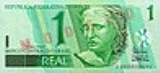
In 1994, banknotes were introduced in denominations of 1, 5, 10, 50 and 100 reais. These were followed by 2 reais in 2001 and 20 reais in 2002. In January, 2006, the Brazilian Central Bank discontinued production of the 1 real banknote.

Real Series
Image Value Dimensions Description
Obverse Reverse Obverse Reverse
1real 2
1realback
1 real 140 × 65 mm The Republic's Effigy
Efígie da República

File:1reallIIback 2.jpgFile:PRT008.JPGThe Ef?gie da Rep?blica is used as a national personification, both, in Brazil and in Portugal, symbolizing the Republic....
, portrayed as a bust
Bust

Bust may refer to:* Bust , a sculpture depicting a person's head and shoulders* Bust , a feminist pop culture magazine* breasts, a word for a woman's breasts...
Sapphire-spangled Emerald Hummingbird
Sapphire-spangled Emerald

The Sapphire-spangled Emerald, Amazilia lactea, is a species of hummingbird that occurs in Venezuela, Peru, Bolivia and Brazil from the Amazon Rainforest south to Santa Catarina ....
 (Amazilia lactea
Bird

Birds are wing, Bipedalismal, endothermic , vertebrate animals that lay egg . There are around 10,000 living species, making them the most numerous tetrapod vertebrates....
)
2real
2realback
2 reais Hawksbill turtle
Hawksbill turtle

The hawksbill turtle is a critically endangered sea turtle belonging to the family Cheloniidae. It is the only species in its genus. The species has a worldwide distribution, with Atlantic Ocean and Pacific Ocean subspecies....
 (Eretmochelys imbricata
Reptile

Reptiles, or members of the class Reptilia, are air-breathing, cold-blooded vertebrates that have skin covered in scale as opposed to hair or feathers....
)
5real 2
5realback
5 reais Great Egret
Great Egret

The Great Egret , also known as the Great White Egret or Common Egret or Great White Heron, and called kotuku in New Zealand, is a large egret....
 (Casmerodius albus
Bird

Birds are wing, Bipedalismal, endothermic , vertebrate animals that lay egg . There are around 10,000 living species, making them the most numerous tetrapod vertebrates....
)
10real 2
10realback
10 reais Green-winged Macaw (Ara chloreptera
Bird

Birds are wing, Bipedalismal, endothermic , vertebrate animals that lay egg . There are around 10,000 living species, making them the most numerous tetrapod vertebrates....
)
20real
20realback
20 reais Golden Lion Tamarin
Golden Lion Tamarin

The Golden Lion Tamarin also known as Golden Marmoset, is a small New World monkey of the family Cebidae. Native to the Atlantic coastal forests of Brazil, the Golden Lion Tamarin is an endangered species with an estimated wild population of "more than 1,000 individuals" and a captive population maintained at approximately 490 individu...
 (Leonthopitecus rosalia
Monkey

A monkey is a nonhuman primate mammal with the exception usually of the lemurs and tarsiers. More specifically, the term monkey refers to a subset of monkeys: any of the smaller longer-tailed catarrhine or platyrrhine primates as contrasted with the apes....
)
50real 2
50realback
50 reais Jaguar
Jaguar

The jaguar, Panthera onca, is a New World Felidae and one of four "big cats" in the Panthera genus, along with the tiger, lion, and leopard of the Old World....
 (Panthera onca
Felidae

Felidae is the family of the cats; a member of this family is called a felid. Felids are the most strictly Carnivore of the sixteen mammal families in the order Carnivora....
)
100real 2
100realback
100 reais Dusky Grouper
Epinephelus marginatus

The Dusky Grouper is the best known grouper of the Mediterranean Sea and North Africa coast. It is said to have the best taste of all Mediterranean fishes....
 (Epinephelus marginatus
Fish

A fish is any marine biology vertebrate animal that is typically ectothermic , covered with scale , and equipped with two sets of paired fins and several unpaired fins....
)


In April 2000, in comemoration of the 500th anniversary of the Portuguese arrival on Brazilian shores, the Brazilian Central Bank released a polymer
Polymer banknote

Polymer banknotes were developed by the Reserve Bank of Australia , Commonwealth Scientific and Industrial Research Organisation and The University of Melbourne and were first issued as currency in Australia in 1988....
 10 real banknote that circulates along with the other banknotes above. The Brazilian Mint
Casa da Moeda do Brasil

The Casa da Moeda do Brasil is the Brazil mint , owned by the Brazilian government and administratively subordinated to the Ministry of Finances....
 printed 250 million of these notes, which at the time accounted for about half of the 10 real banknotes in circulation.

This note contains a more complex design, as follows: Obverse:
  • Image of Pedro Álvares Cabral
    Pedro Álvares Cabral

    Pedro ?lvares Cabral was a Portugal navigator and List of explorers. Cabral is generally regarded as the European discoverer of Brazil .Cabral is thought to have been born in Belmonte , in the Beira Baixa province of Portugal....
    , the Portuguese sea captain;
  • A representation of the map "Terra Brasilis", one of the earliest drawings of the land;
  • A passage from Pero Vaz de Caminha
    Pêro Vaz de Caminha

    P?ro Vaz de Caminha...
    's letter
    Carta de Pero Vaz de Caminha

    In his letter to Manuel I of Portugal, P?ro Vaz de Caminha gives what is considered by many today as being one of the most accurate accounts of what Brazil used to look like in 1500....
     to King Manuel I of Portugal
    Manuel I of Portugal

    Manuel I ; Portuguese language: Manoel I, English language: Emmanuel I), the Fortunate , 14th List of Portuguese monarchs was the son of Infante Fernando, Duke of Viseu, by his wife, Beatriz of Portugal ....
    , the first known description of Brazil;
  • A 16th century Portuguese Rose of Winds
    Compass rose

    For Compass Airlines, an Airline in the US using the Callsign "Compass Rose," See Compass Airlines A compass rose is a figure displaying the Orientation of the Cardinal directions, north, south, east and west on a map or nautical chart....
    ;
  • To the right of the map, five ships from Cabral's expedition appear;
  • In the background, decorative elements from Portuguese tiles can be seen;
  • The white area around the red dot is actually transparent (the red dot is translucent);
  • Finally, also in the background, the Cross from the Order of Christ
    Order of Christ

    Four chivalric orders, are known as the Order of Christ:* Order of Christ ? former Knights Templar Military order awarded initially by the List of Portuguese monarchs, now by the Portuguese state...
    , which was present in all Portuguese ships of the time, appears.


Reverse: A styled version of a map of Brazil with photographs depicting the ethnic variety of the Brazilian people (white, black, amerindian).

See also

  • Portuguese real
    Portuguese real

    The real was the unit of currency of Portugal from around 1430 until 1911. It replaced the Portuguese dinheiro at the rate of 1 real = 840 dinheiros and was itself replaced by the Portuguese escudo at a rate of 1 escudo = 1000 r?is....
  • Plano Real
    Plano Real

    The Plano Real was a set of measures taken to stabilize the Economy of Brazil in early 1994, under the direction of Fernando Henrique Cardoso as the Minister of Finance, during the presidency of Itamar Franco....
  • Economy of Brazil
    Economy of Brazil

    Brazil has a moderate free market and export-oriented economy. Measured nominally, its gross domestic product surpasses a trillion dollars, the tenth in the world and the second in the Americas; measured by purchasing power parity, $1.9 trillion, making it the eighth largest economy in the world and the second largest in the Americas, after t...


External links