

Photographic paper

Encyclopedia
Photographic paper is paper coated
with light
-sensitive chemicals, used for making photographic prints.
Photographic paper is exposed to light in a controlled manner, either by placing a negative
in contact with the paper directly to produce a contact print
, by using an enlarger in order to create a latent image
, by exposing in some types of camera to produce a photographic negative
, by scanning a modulated light source over the paper, or by placing objects upon it to produce photogram
s. Photographic papers are subsequently developed using the gelatin-silver process
to create a visible image.
in 1802.
Photographic papers have been used since the beginning of all negative
–positive photographic processes
as developed and popularised by William Fox Talbot (Great Britain
/1841-calotype
).
Traditional photographic papers are still sold commercially today.
Papers used for negative-positive processes. This includes all current black-and-white
papers and chromogenic
color papers.
Papers used for positive-positive processes in which the "film" is the same as the final image (e.g., the Polaroid
process).
Papers used for positive-positive film-to-paper processes where a positive image is enlarged and copied onto a photographic paper, for example the Ilfochrome
process.
, consisting of silver halide
salts suspended
in a colloid
al material - usually gelatin
- coated onto a paper, resin coated paper or polyester support.
In black-and-white papers, the emulsion is normally sensitised to blue
and green
light, but is insensitive to wavelengths longer than 600 nm in order to facilitate handling under red or orange safelight
ing.
In Chromogenic
color papers, the emulsion layers are sensitive to red
, green
and blue
light, respectively producing cyan
, magenta
and yellow
dye during processing.
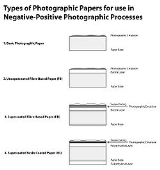
papers are coated on a small range of bases; baryta-coated paper, resin-coated paper or polyester. In the past, linen has been used as a base material.
Fiber-based (FB or Baryta) photographic papers consist of a paper base coated with a baryta. Tints are sometimes added to the baryta to add subtle color to the final print; however most modern papers use optical brightener
s to extend the paper's tonal range.
Most fiber-based papers include a clear hardened gelatin layer above the emulsion which protects it from physical damage, especially during processing. This is called a supercoating. Papers without a supercoating are suitable for use with the bromoil process
.
Fiber-based papers are generally chosen as a medium for high-quality prints for exhibition, display and archiving purposes. These papers require careful processing and handling, especially when wet. However, they are easier to tone
, hand-color and retouch
than resin-coated equivalents.
The paper base of resin-coated papers is sealed by two polyethylene
layers, making it impenetrable to liquids. Since no chemicals or water are absorbed into the paper base, the time needed for processing, washing and drying durations are significantly reduced in comparison to fiber-based papers. Resin paper prints can be finished and dried within twenty to thirty minutes. Resin-coated papers have improved dimensional stability, and do not curl upon drying.
, yellow
, and magenta
) along with other supporting layers. The color layers are sensitised to their corresponding colors. Although it is commonly believed that the layers in negative papers are shielded against the intrusion of light of a different wavelength than the actual layer by color filters which dissolve during processing, this is not so. The color layers in negative papers are actually produced to have speeds which increase from cyan (red sensitive) to magenta (green sensitive) to yellow (blue sensitive), and thus when filtered during printing, the blue light is "normalized" so that there is no crosstalk. Therefore the yellow (blue sensitive) layer is nearly ISO 100 while the cyan (red) layer is about ISO 25. After adding enough yellow filtration to make a neutral, the blue sensitivity of the slow cyan layer is "lost".
In negative-positive print systems, the blue sensitive layer is on the bottom, and the cyan layer is on the top. This is the reverse of the usual layer order in color films.
The emulsion layers can include the color dyes, as in Ilfochrome
; or they can include color couplers, which react with color developers to produce color dyes, as in type C print
s or chromogenic
negative–positive prints. Type R prints, which are no longer made, were positive–positive chromogenic prints.
crystals suspended in gelatin. Black-and-white papers typically use relatively insensitive emulsions composed of silver bromide
, silver chloride
or a combination of both. The silver halide used affects the paper's sensitivity and the image tone of the resulting print.
. They produce warm-black to neutral image tones by development, which can be varied by using different developers.
Variable-contrast - or "VC" papers - account for the great majority of consumption of these papers in the 21st century. VC papers permit the selection of a wide range of contrast grades, in the case of the brand leader between 00 and 5. These papers are coated with a mixture of three emulsions, all of equal contrast and sensitivity to blue
light. However, each emulsion is sensitised in different proportions to green
light. Upon exposure to blue light, all emulsions act in an additive manner to produce a high contrast image. When exposed to green light alone, the emulsions produce a low contrast image because each is differently sensitised to green. By varying the ratio of blue to green light, the contrast of the print can be continuously varied between these extremes, creating all contrast grades from 00 to 5.
Filters in the enlarger's light path are a common method of achieving this control. Magenta
filters absorb green and transmit blue and red, while yellow
filters absorb blue and transmit green and red.
The contrast of photographic papers can also be controlled during processing or by the use of bleaches or toners
.
must convert all non-image silver into soluble silver compounds that can be removed by washing with water.. Washing must remove these compounds and all residual fixing chemicals from the emulsion and paper base.
Toners
should be used to convert the metallic silver into more stable compounds. Commonly used archival toners are: selenium
, gold
and sulphide.
Prints on fiber-based papers that have been properly fixed and washed should last at least fifty years without fading. Some alternative non-silver processes - such as platinum prints
- employ metals that are, if processed correctly, inherently more stable than gelatin-silver prints.
is often used because of its clarity and the stability of the color dyes.
Coated paper
Coated paper is paper which has been coated by a compound to impart certain qualities to the paper, including weight, surface gloss, smoothness or reduced ink absorbency. Kaolinite or calcium carbonate are used to coat paper for high quality printing used in packaging industry and in magazines...
with light
Light
Light or visible light is electromagnetic radiation that is visible to the human eye, and is responsible for the sense of sight. Visible light has wavelength in a range from about 380 nanometres to about 740 nm, with a frequency range of about 405 THz to 790 THz...
-sensitive chemicals, used for making photographic prints.
Photographic paper is exposed to light in a controlled manner, either by placing a negative
Negative (photography)
In photography, a negative may refer to three different things, although they are all related.-A negative:Film for 35 mm cameras comes in long narrow strips of chemical-coated plastic or cellulose acetate. As each image is captured by the camera onto the film strip, the film strip advances so that...
in contact with the paper directly to produce a contact print
Contact print
A contact print is a photographic image produced from film; sometimes from a film negative, and sometimes from a film positive. The defining characteristic of a contact print is that the photographic result is made by exposing through the film negative or positive, onto a light sensitive material...
, by using an enlarger in order to create a latent image
Latent image
A latent image on photographic film is an invisible image produced by the exposure of the film to light. When the film is developed, the area that was exposed darkens and forms a visible image...
, by exposing in some types of camera to produce a photographic negative
Negative (photography)
In photography, a negative may refer to three different things, although they are all related.-A negative:Film for 35 mm cameras comes in long narrow strips of chemical-coated plastic or cellulose acetate. As each image is captured by the camera onto the film strip, the film strip advances so that...
, by scanning a modulated light source over the paper, or by placing objects upon it to produce photogram
Photogram
A photogram is a photographic image made without a camera by placing objects directly onto the surface of a photo-sensitive material such as photographic paper and then exposing it to light. The result is a negative shadow image varying in tone, depending on the transparency of the objects used...
s. Photographic papers are subsequently developed using the gelatin-silver process
Gelatin-silver process
The gelatin silver process is the photographic process used with currently available black-and-white films and printing papers. A suspension of silver salts in gelatin is coated onto a support such as glass, flexible plastic or film, baryta paper, or resin-coated paper...
to create a visible image.
History
The effect of light in darkening a prepared paper was discovered by M. Charles in 1800 or by Thomas WedgwoodThomas Wedgwood (1771-1805)
Thomas Wedgwood , son of Josiah Wedgwood, the potter, was an early experimenter with Humphry Davy in photography.-Life:...
in 1802.
Photographic papers have been used since the beginning of all negative
Negative (photography)
In photography, a negative may refer to three different things, although they are all related.-A negative:Film for 35 mm cameras comes in long narrow strips of chemical-coated plastic or cellulose acetate. As each image is captured by the camera onto the film strip, the film strip advances so that...
–positive photographic processes
Photography
Photography is the art, science and practice of creating durable images by recording light or other electromagnetic radiation, either electronically by means of an image sensor or chemically by means of a light-sensitive material such as photographic film...
as developed and popularised by William Fox Talbot (Great Britain
Great Britain
Great Britain or Britain is an island situated to the northwest of Continental Europe. It is the ninth largest island in the world, and the largest European island, as well as the largest of the British Isles...
/1841-calotype
Calotype
Calotype or talbotype is an early photographic process introduced in 1841 by William Henry Fox Talbot, using paper coated with silver iodide. The term calotype comes from the Greek for 'beautiful', and for 'impression'....
).
Traditional photographic papers are still sold commercially today.
Types of photographic papers
Photographic papers fall into one of three sub-categories:Papers used for negative-positive processes. This includes all current black-and-white
Black-and-white
Black-and-white, often abbreviated B/W or B&W, is a term referring to a number of monochrome forms in visual arts.Black-and-white as a description is also something of a misnomer, for in addition to black and white, most of these media included varying shades of gray...
papers and chromogenic
Chromogenic
Chromogenic refers to color photographic processes in which a traditional silver image is first formed, and then later replaced with a colored dye image.- Description :...
color papers.
Papers used for positive-positive processes in which the "film" is the same as the final image (e.g., the Polaroid
Polaroid Corporation
Polaroid Corporation is an American-based international consumer electronics and eyewear company, originally founded in 1937 by Edwin H. Land. It is most famous for its instant film cameras, which reached the market in 1948, and continued to be the company's flagship product line until the February...
process).
Papers used for positive-positive film-to-paper processes where a positive image is enlarged and copied onto a photographic paper, for example the Ilfochrome
Ilfochrome
Ilfochrome is a dye destruction positive-to-positive photographic process used for the reproduction of slides on photographic paper. The prints are made on a dimensionally stable polyester base, essentially a plastic base opposed to traditional paper base...
process.
Structure
All photographic papers consist of a light-sensitive emulsionPhotographic emulsion
Photographic emulsion is a light-sensitive colloid, such as gelatin, coated onto a substrate. In silver-gelatin photography, the emulsion consists of silver halide crystals suspended in gelatin, and the substrate may be glass, plastic film, paper or fabric....
, consisting of silver halide
Silver halide
A silver halide is one of the compounds formed between silver and one of the halogens — silver bromide , chloride , iodide , and three forms of silver fluorides. As a group, they are often referred to as the silver halides, and are often given the pseudo-chemical notation AgX...
salts suspended
Suspension (chemistry)
In chemistry, a suspension is a heterogeneous fluid containing solid particles that are sufficiently large for sedimentation. Usually they must be larger than 1 micrometer. The internal phase is dispersed throughout the external phase through mechanical agitation, with the use of certain...
in a colloid
Colloid
A colloid is a substance microscopically dispersed evenly throughout another substance.A colloidal system consists of two separate phases: a dispersed phase and a continuous phase . A colloidal system may be solid, liquid, or gaseous.Many familiar substances are colloids, as shown in the chart below...
al material - usually gelatin
Gelatin
Gelatin is a translucent, colorless, brittle , flavorless solid substance, derived from the collagen inside animals' skin and bones. It is commonly used as a gelling agent in food, pharmaceuticals, photography, and cosmetic manufacturing. Substances containing gelatin or functioning in a similar...
- coated onto a paper, resin coated paper or polyester support.
In black-and-white papers, the emulsion is normally sensitised to blue
Blue
Blue is a colour, the perception of which is evoked by light having a spectrum dominated by energy with a wavelength of roughly 440–490 nm. It is considered one of the additive primary colours. On the HSV Colour Wheel, the complement of blue is yellow; that is, a colour corresponding to an equal...
and green
Green
Green is a color, the perception of which is evoked by light having a spectrum dominated by energy with a wavelength of roughly 520–570 nanometres. In the subtractive color system, it is not a primary color, but is created out of a mixture of yellow and blue, or yellow and cyan; it is considered...
light, but is insensitive to wavelengths longer than 600 nm in order to facilitate handling under red or orange safelight
Safelight
A safelight is a light source suitable for use in a photographic darkroom. It provides illumination only from parts of the visible spectrum to which the photographic material in use is nearly or completely insensitive.- Design :...
ing.
In Chromogenic
Chromogenic
Chromogenic refers to color photographic processes in which a traditional silver image is first formed, and then later replaced with a colored dye image.- Description :...
color papers, the emulsion layers are sensitive to red
Red
Red is any of a number of similar colors evoked by light consisting predominantly of the longest wavelengths of light discernible by the human eye, in the wavelength range of roughly 630–740 nm. Longer wavelengths than this are called infrared , and cannot be seen by the naked eye...
, green
Green
Green is a color, the perception of which is evoked by light having a spectrum dominated by energy with a wavelength of roughly 520–570 nanometres. In the subtractive color system, it is not a primary color, but is created out of a mixture of yellow and blue, or yellow and cyan; it is considered...
and blue
Blue
Blue is a colour, the perception of which is evoked by light having a spectrum dominated by energy with a wavelength of roughly 440–490 nm. It is considered one of the additive primary colours. On the HSV Colour Wheel, the complement of blue is yellow; that is, a colour corresponding to an equal...
light, respectively producing cyan
Cyan
Cyan from , transliterated: kýanos, meaning "dark blue substance") may be used as the name of any of a number of colors in the blue/green range of the spectrum. In reference to the visible spectrum cyan is used to refer to the color obtained by mixing equal amounts of green and blue light or the...
, magenta
Magenta
Magenta is a color evoked by light stronger in blue and red wavelengths than in yellowish-green wavelengths . In light experiments, magenta can be produced by removing the lime-green wavelengths from white light...
and yellow
Yellow
Yellow is the color evoked by light that stimulates both the L and M cone cells of the retina about equally, with no significant stimulation of the S cone cells. Light with a wavelength of 570–590 nm is yellow, as is light with a suitable mixture of red and green...
dye during processing.
Black-and-white papers
Modern black-and-whiteBlack-and-white
Black-and-white, often abbreviated B/W or B&W, is a term referring to a number of monochrome forms in visual arts.Black-and-white as a description is also something of a misnomer, for in addition to black and white, most of these media included varying shades of gray...
papers are coated on a small range of bases; baryta-coated paper, resin-coated paper or polyester. In the past, linen has been used as a base material.
Fiber-based papers (FB)
Fiber-based (FB or Baryta) photographic papers consist of a paper base coated with a baryta. Tints are sometimes added to the baryta to add subtle color to the final print; however most modern papers use optical brightener
Optical brightener
Optical brighteners, optical brightening agents , fluorescent brightening agents or fluorescent whitening agents are dyes that absorb light in the ultraviolet and violet region of the electromagnetic spectrum, and re-emit light in the blue region...
s to extend the paper's tonal range.
Most fiber-based papers include a clear hardened gelatin layer above the emulsion which protects it from physical damage, especially during processing. This is called a supercoating. Papers without a supercoating are suitable for use with the bromoil process
Bromoil Process
The Bromoil Process was an early photographic process that was very popular with the Pictorialists during the first half of the twentieth century...
.
Fiber-based papers are generally chosen as a medium for high-quality prints for exhibition, display and archiving purposes. These papers require careful processing and handling, especially when wet. However, they are easier to tone
Photographic print toning
In photography, toning is a method of changing the color of black-and-white photographs. In analog photography, toning is a chemical process carried out on silver-based photographic prints. This darkroom process can not be done with a color photograph and although the black-and-white photograph is...
, hand-color and retouch
Spotting (photography)
In the production of photographic prints, spotting is a type of retouching concerned with correcting minor flaws in the finished print with specially made paints, dyes, pencils and pens....
than resin-coated equivalents.
Resin-coated papers (RC)
The paper base of resin-coated papers is sealed by two polyethylene
Polyethylene
Polyethylene or polythene is the most widely used plastic, with an annual production of approximately 80 million metric tons...
layers, making it impenetrable to liquids. Since no chemicals or water are absorbed into the paper base, the time needed for processing, washing and drying durations are significantly reduced in comparison to fiber-based papers. Resin paper prints can be finished and dried within twenty to thirty minutes. Resin-coated papers have improved dimensional stability, and do not curl upon drying.
Color papers
All color photographic materials available today are coated on either RC (resin coated) paper or on solid polyester. The photographic emulsion used for color photographic materials consists of three color emulsion layers (cyanCyan
Cyan from , transliterated: kýanos, meaning "dark blue substance") may be used as the name of any of a number of colors in the blue/green range of the spectrum. In reference to the visible spectrum cyan is used to refer to the color obtained by mixing equal amounts of green and blue light or the...
, yellow
Yellow
Yellow is the color evoked by light that stimulates both the L and M cone cells of the retina about equally, with no significant stimulation of the S cone cells. Light with a wavelength of 570–590 nm is yellow, as is light with a suitable mixture of red and green...
, and magenta
Magenta
Magenta is a color evoked by light stronger in blue and red wavelengths than in yellowish-green wavelengths . In light experiments, magenta can be produced by removing the lime-green wavelengths from white light...
) along with other supporting layers. The color layers are sensitised to their corresponding colors. Although it is commonly believed that the layers in negative papers are shielded against the intrusion of light of a different wavelength than the actual layer by color filters which dissolve during processing, this is not so. The color layers in negative papers are actually produced to have speeds which increase from cyan (red sensitive) to magenta (green sensitive) to yellow (blue sensitive), and thus when filtered during printing, the blue light is "normalized" so that there is no crosstalk. Therefore the yellow (blue sensitive) layer is nearly ISO 100 while the cyan (red) layer is about ISO 25. After adding enough yellow filtration to make a neutral, the blue sensitivity of the slow cyan layer is "lost".
In negative-positive print systems, the blue sensitive layer is on the bottom, and the cyan layer is on the top. This is the reverse of the usual layer order in color films.
The emulsion layers can include the color dyes, as in Ilfochrome
Ilfochrome
Ilfochrome is a dye destruction positive-to-positive photographic process used for the reproduction of slides on photographic paper. The prints are made on a dimensionally stable polyester base, essentially a plastic base opposed to traditional paper base...
; or they can include color couplers, which react with color developers to produce color dyes, as in type C print
Type C print
Chromogenic color prints are full-color photographic prints made using chromogenic materials and processes. These prints may be produced from an original which is a color negative, slide, or digital image. The chromogenic print process, was nearly synonymous with the 20th century color snapshot...
s or chromogenic
Chromogenic
Chromogenic refers to color photographic processes in which a traditional silver image is first formed, and then later replaced with a colored dye image.- Description :...
negative–positive prints. Type R prints, which are no longer made, were positive–positive chromogenic prints.
Black and White emulsion types
The emulsion contains light sensitive silver halideSilver halide
A silver halide is one of the compounds formed between silver and one of the halogens — silver bromide , chloride , iodide , and three forms of silver fluorides. As a group, they are often referred to as the silver halides, and are often given the pseudo-chemical notation AgX...
crystals suspended in gelatin. Black-and-white papers typically use relatively insensitive emulsions composed of silver bromide
Silver bromide
Silver bromide , a soft, pale-yellow, water insoluble salt well known for its unusual sensitivity to light. This property has allowed silver halides to become the basis of modern photographic materials. AgBr is widely used in photographic films and is believed by some to have been used for making...
, silver chloride
Silver chloride
Silver chloride is a chemical compound with the chemical formula AgCl. This white crystalline solid is well known for its low solubility in water . Upon illumination or heating, silver chloride converts to silver , which is signalled by greyish or purplish coloration to some samples...
or a combination of both. The silver halide used affects the paper's sensitivity and the image tone of the resulting print.
Chloride papers
Popular in the past, chloride papers are nowadays unusual; a single manufacturer produces this material. These insensitive papers are suitable for contact printing, and yield warm toned images by development. Chloride emulsions are also used for printing-out papers, or POP, which require no further development after exposure.Chlorobromide papers
Containing a blend of silver chloride and silver bromide salts, these emulsions produce papers sensitive enough to be used for enlargingEnlarger
An enlarger is a specialized transparency projector used to produce photographic prints from film or glass negatives using the gelatin silver process, or from transparencies.-Construction:...
. They produce warm-black to neutral image tones by development, which can be varied by using different developers.
Bromide papers
Papers with pure silver bromide emulsions are sensitive and produce neutral black or 'cold' blue-black image tones.Contrast control
Fixed grade - or graded - black-and-white papers were historically available in a wide range of contrast grades, numbered 0 to 5, with 0 being the softest, or least contrasty paper grade and 5 being the hardest, or most contrasty paper grade. Low contrast negatives can be corrected by printing on a contrasty paper; conversely a very contrasty negative can be printed on a low contrast paper. Because of decreased demand, most extreme paper grades are now discontinued, and the few graded ranges still available include only middle contrast grades.Variable-contrast - or "VC" papers - account for the great majority of consumption of these papers in the 21st century. VC papers permit the selection of a wide range of contrast grades, in the case of the brand leader between 00 and 5. These papers are coated with a mixture of three emulsions, all of equal contrast and sensitivity to blue
Blue
Blue is a colour, the perception of which is evoked by light having a spectrum dominated by energy with a wavelength of roughly 440–490 nm. It is considered one of the additive primary colours. On the HSV Colour Wheel, the complement of blue is yellow; that is, a colour corresponding to an equal...
light. However, each emulsion is sensitised in different proportions to green
Green
Green is a color, the perception of which is evoked by light having a spectrum dominated by energy with a wavelength of roughly 520–570 nanometres. In the subtractive color system, it is not a primary color, but is created out of a mixture of yellow and blue, or yellow and cyan; it is considered...
light. Upon exposure to blue light, all emulsions act in an additive manner to produce a high contrast image. When exposed to green light alone, the emulsions produce a low contrast image because each is differently sensitised to green. By varying the ratio of blue to green light, the contrast of the print can be continuously varied between these extremes, creating all contrast grades from 00 to 5.
Filters in the enlarger's light path are a common method of achieving this control. Magenta
Magenta
Magenta is a color evoked by light stronger in blue and red wavelengths than in yellowish-green wavelengths . In light experiments, magenta can be produced by removing the lime-green wavelengths from white light...
filters absorb green and transmit blue and red, while yellow
Yellow
Yellow is the color evoked by light that stimulates both the L and M cone cells of the retina about equally, with no significant stimulation of the S cone cells. Light with a wavelength of 570–590 nm is yellow, as is light with a suitable mixture of red and green...
filters absorb blue and transmit green and red.
The contrast of photographic papers can also be controlled during processing or by the use of bleaches or toners
Photographic print toning
In photography, toning is a method of changing the color of black-and-white photographs. In analog photography, toning is a chemical process carried out on silver-based photographic prints. This darkroom process can not be done with a color photograph and although the black-and-white photograph is...
.
Panchromatic papers
Panchromatic black-and-white photographic printing papers are sensitive to all wavelengths of visible light. They were designed for the printing of full-tone black-and-white images from color negatives; this is not possible with conventional orthochromatic papers. Panchromatic papers can also be used to produce paper negatives in large-format cameras. These materials must be handled and developed in near-complete darkness. Kodak Panalure Select RC was an example of a panchromatic black-and-white paper; it was discontinued in 2005.Archival stability
The longevity of any photographic print media will depend upon the processing, display and storage conditions of the print.Black-and-white prints
FixingPhotographic fixer
Photographic fixer is a chemical or a mix of chemicals used in the final step in the photographic processing of film or paper. The fixer stabilises the image, removing the unexposed silver halide remaining on the photographic film or photographic paper, leaving behind the reduced metallic silver...
must convert all non-image silver into soluble silver compounds that can be removed by washing with water.. Washing must remove these compounds and all residual fixing chemicals from the emulsion and paper base.
Toners
Photographic print toning
In photography, toning is a method of changing the color of black-and-white photographs. In analog photography, toning is a chemical process carried out on silver-based photographic prints. This darkroom process can not be done with a color photograph and although the black-and-white photograph is...
should be used to convert the metallic silver into more stable compounds. Commonly used archival toners are: selenium
Selenium
Selenium is a chemical element with atomic number 34, chemical symbol Se, and an atomic mass of 78.96. It is a nonmetal, whose properties are intermediate between those of adjacent chalcogen elements sulfur and tellurium...
, gold
Gold
Gold is a chemical element with the symbol Au and an atomic number of 79. Gold is a dense, soft, shiny, malleable and ductile metal. Pure gold has a bright yellow color and luster traditionally considered attractive, which it maintains without oxidizing in air or water. Chemically, gold is a...
and sulphide.
Prints on fiber-based papers that have been properly fixed and washed should last at least fifty years without fading. Some alternative non-silver processes - such as platinum prints
Platinotype
Platinum prints, also called platinotypes, are photographic prints made by a monochrome printing process that provides the greatest tonal range of any printing method using chemical development....
- employ metals that are, if processed correctly, inherently more stable than gelatin-silver prints.
Color prints
For color images, IlfochromeIlfochrome
Ilfochrome is a dye destruction positive-to-positive photographic process used for the reproduction of slides on photographic paper. The prints are made on a dimensionally stable polyester base, essentially a plastic base opposed to traditional paper base...
is often used because of its clarity and the stability of the color dyes.