
All Topics  
Volumetric display

 
Volumetric Display

   Email Print
   Bookmark   Link


Volumetric display


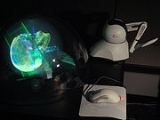
A volumetric display device is a graphical display device
Display device

A display device is an output device for presentation of information for visual, tactile or Hearing_ reception, acquired, stored, or transmitted in various forms....
 that forms a visual representation of an object in three physical dimensions
Three-dimensional space

Three-dimensional space is a geometric model of the physical universe in which we live. The three dimensions are commonly called length, width, and depth , although any three mutually perpendicular directions can serve as the three dimensions....
, as opposed to the planar image of traditional screens that simulate depth through a number of different visual effects. One definition offered by pioneers in the field is that volumetric displays create 3-D imagery via the emission, scattering, or relaying of illumination from well-defined regions in (x,y,z) space.


Discussion
Ask a question about 'Volumetric display'
Start a new discussion about 'Volumetric display'
Answer questions from other users
Full Discussion Forum


Encyclopedia


A volumetric display device is a graphical display device
Display device

A display device is an output device for presentation of information for visual, tactile or Hearing_ reception, acquired, stored, or transmitted in various forms....
 that forms a visual representation of an object in three physical dimensions
Three-dimensional space

Three-dimensional space is a geometric model of the physical universe in which we live. The three dimensions are commonly called length, width, and depth , although any three mutually perpendicular directions can serve as the three dimensions....
, as opposed to the planar image of traditional screens that simulate depth through a number of different visual effects. One definition offered by pioneers in the field is that volumetric displays create 3-D imagery via the emission, scattering, or relaying of illumination from well-defined regions in (x,y,z) space. Though there is no consensus among researchers in the field, it may be reasonable to admit holographic
Holography

A hologram is a picture that changes when looked at from different angles.Holography is a technique that allows the light scattered from an object to be recorded and later reconstructed so that it appears as if the object is in the same position relative to the recording medium as it was when recorded....
 and highly multiview displays to the volumetric display family if they do a reasonable job of projecting a three-dimensional light field within a volume.

Most, if not all, volumetric 3-D displays are autostereoscopic; that is, they create 3-D imagery visible to the unaided eye. Note that some display technologists reserve the term “autostereoscopic” for flat-panel spatially-multiplexed parallax displays, such as lenticular-sheet
Lenticular printing

Lenticular printing is a technology in which a lenticular lens is used to produce images with an illusion of depth, or the ability to change or move as the image is viewed from different angles....
 displays. However, nearly all 3-D displays other than those requiring headwear, e.g. stereo goggles and stereo head-mounted displays, are autostereoscopic. Therefore, a very broad group of display architectures are properly deemed autostereoscopic.

Volumetric 3-D displays embody just one family of 3-D displays in general. Other types of 3-D displays are: stereograms / stereoscopes, view-sequential displays, electro-holographic displays, parallax "two view" displays and parallax panoramagrams (which are typically spatially-multiplexed systems such as lenticular-sheet displays and parallax barrier displays), re-imaging systems, and others.

Although first postulated in 1912, and a staple of science fiction
Science fiction

Science fiction is a broad genre of fiction that often involves speculations based on current or future science or technology. Science fiction is found in books, art, television, films, games, theatre, and other media....
, volumetric displays are still under development, and have yet to reach the general population. With a variety of systems proposed and in use in small quantities—mostly in academia and various research labs—volumetric displays remain accessible only to academics, corporations, and the military.

Types of volumetric displays


Many different attempts have been made to extend the dynamic 2D representation of the cathode ray tube to three dimensions. There is no officially accepted "taxonomy" of the variety of volumetric displays, an issue which is complicated by the many permutations of their characteristics. For example, illumination within a volumetric display can either reach the eye directly or via an intermediate surface; likewise, the surface, which need not be tangible, can undergo motion such as reciprocation or rotation. One categorization is as follows:

Swept-volume display


Swept-surface
Swept-volume display

A swept-volume display is a volumetric display in which the three-Dimension is formed by illuminating a rapidly moving display surface, which may be "macroscopically" physical or otherwise ....
 (or "swept-volume") volumetric 3-D displays rely on the human persistence of vision
Persistence of vision

Persistence of vision is the phenomenon of the eye by which even nanoseconds of exposure to an image result in milliseconds of reaction from the retina to the optic nerves....
 to fuse a time-series of regions of the ultimate 3-D region into a single 3-D image. A variety of swept-volume displays have been created.

For example, the 3-D scene is computationally decomposed into a series of "slices," which can be rectangular, disc-shaped, or helical cross-sectioned, whereupon they are projected onto or from a display surface undergoing motion. The image on the 2D surface (created by projection onto the surface, LEDs embedded in the surface, or other techniques) changes as the surface rotates. Due to the persistence of vision humans perceive a volume of light. The display surface can be reflective, transmissive, or a combination of both.

Another type of 3-D display which is a candidate member of the class of swept-volume 3-D displays is the varifocal mirror architecture. One of the first references to this type of system is in 1966, in which a vibrating mirrored drumhead re-images a series of patterns from a high frame rate 2-D image source, such as a vector display, to a corresponding set of depth surfaces.

Static volume


So-called static volume volumetric 3-D displays create imagery without any macroscopic moving parts in the image volume. It is unclear if the rest of the system must remain stationary for membership in this display class to be viable.

This is probably the most 'direct' form of volumetric display. In the simplest case, an addressable volume of space is created out of active elements that are transparent in the off state but are either opaque or luminous in the on state. When the elements or voxel
Voxel

A voxel is a volume element, representing a value on a regular grid in 3D computer graphics space. This is analogous to a pixel, which represents 2D computer graphics image data....
s are activated they show a solid pattern within the space of the display.

Several static-volume volumetric 3-D displays use laser light to encourage visible radiation in a solid, liquid, or gas. For example, some researchers have relied on two-step upconversion within a rare earth-doped material when illuminated by intersecting infrared laser beams of the appropriate frequencies.

Laser Plasma Volumetric Display
Another technique uses a focused pulse
Pulse

In medicine, a person's pulse is the throbbing of their artery. It can be palpated in any place that allows for an artery to be compressed against a bone, such as at the neck , at the wrist , behind the knee , on the inside of the elbow , and near the ankle joint ....
d infrared
Infrared

Infrared radiation is electromagnetic radiation whose wavelength is longer than that of visible light , but shorter than that of terahertz radiation and microwaves ....
 laser
Laser

A laser is a device that emits light through a process called stimulated emission. The term laser is an acronym for light amplification by stimulated emission of radiation....
 (about 100 pulses per second; each lasting a nanosecond) to create balls of glowing plasma
Plasma (physics)

In physics and chemistry, plasma is a partially ionized gas, in which a certain proportion of electrons are free rather than being bound to an atom or molecule....
 at the focal point
Focal point

A focal point may mean:* Focus , the point at which initially collimated rays of light meet after passing through a convex lens, or reflecting off of a concave mirror....
 in normal air. The focal point is directed by two moving mirror
Mirror

A mirror is an object with one surface polished, which leads to reflection and another opaque. The most familiar type of mirror is the plane mirror, which has a flat surface....
s and a sliding lens
Lens (optics)

A lens is an optics device with perfect or approximate axial symmetry which transmittance and refraction light, converging or diverging the beam....
, allowing it to draw shapes in the air. Each pulse creates a popping sound, so the device crackles as it runs. Currently it can generate dots anywhere within a cubic metre
Cubic metre

The cubic metre is the SI derived unit of volume. It is the volume of a cube with edges one metre in length. An alternative name, which allowed a different usage with SI prefix, was the st?re....
. It is thought that the device could be scaled up to any size, allowing for 3D images to be generated in the sky.


Candidate: Highly multiview displays


Parallax panoramagram
Panoramagram

The panoramagram, invented in 1824, is an instrument used to obtain the illusion of depth on a flat surface....
s, such as parallax barrier displays, generate an approximation of a desired 3-D light field. For a sufficient angular density of "view" directions, the synthesized 3-D light field becomes nearly equivalent to a volumetric image. Some researchers state that even a flat-panel 3-D display that projects over 30 views within a 30-degree horizontal field of view evokes an accommodation response in the viewer. Therefore, multiview displays with a high angular view density might be rightful members of the class of volumetric 3-D displays.

Candidate: Holograms and electro-holographic


The realistic imagery of holograms and electro-holographic displays make them contenders for membership in the class of volumetric 3-D displays, as well.

Human-computer interfaces


The unique properties of volumetric displays, which may include: 360-degree viewing, agreement of converge and accommodation cues, and their inherent "three-dimensionality," enable new user interface techniques. There is recent work investigating the speed and accuracy benefits of volumetric displays (Van Orden et al, 2000), new graphical user interfaces (Grossman et al, 2004), and medical applications enhanced by volumetric displays (Med., 2005; Wang et al, 2005)...

Also, software platforms exist which deliver native and legacy 2-D and 3-D content to volumetric displays (Chun et al, 2005).

Artistic Use


An artform called Hologlyphics has been explored since 1994, combining elements of holography
Holography

A hologram is a picture that changes when looked at from different angles.Holography is a technique that allows the light scattered from an object to be recorded and later reconstructed so that it appears as if the object is in the same position relative to the recording medium as it was when recorded....
, music
Music

Music is an art form whose media is sound organized in time. Common elements of music are pitch , rhythm , dynamics , and the sonic qualities of timbre and texture ....
, video synthesis, visionary film, sculpture
Sculpture

Sculpture is Three-dimensional space artwork created by shaping or combining hard and or plastic material, sound, and or text and or light, commonly Stone sculpture , metal, glass, or wood....
 and improvisation
Improvisation

Improvisation is the practice of acting, singing, talking and reacting, of making and creating, in the moment and in response to the stimulus of one's immediate environment and inner feelings....
. Volumetric movies have been shown to live audiences at film festivals, art galleries and music events. Multiple Volumetric Displays and multi-loudspeaker arrays surround an audience. The movies are shown in conjunction with music, either live or recorded with the volumetric animations.

The original intent was to combine Holography
Holography

A hologram is a picture that changes when looked at from different angles.Holography is a technique that allows the light scattered from an object to be recorded and later reconstructed so that it appears as if the object is in the same position relative to the recording medium as it was when recorded....
 with Music, and finally Volumetric Displays were settled on as an artistic medium. Many traditional film
Film

Film encompasses individual motion pictures, the field of film as an art form, and the film industry. Films are produced by recording images from the world with cameras, or by creating images using animation techniques or special effects....
 & video
Video

Video is the technology of electronics Videography, recording, processing, storing, transmitting, and reconstructing a sequence of still images representing Scene in motion....
 special effects have been adapted to Hologlyphic Movies, plus many more special effects unique to Volumetric Displays have been developed. These include volumetric wipe effects, raster bending, morphing, kaleidoscope & mirroring effects, experimental rotations, spatial warping effects and image sequencing.

The Hologlyphic movies can also be performed in real-time, like a video synthesizer
Video synthesizer

A Video Synthesizer is a device that electronically creates a video signal.A video synthesizer is able to generate a variety of visual material without camera input through the use of internal video pattern generators, as seen in the stillframes of motion sequences shown above....
, controlled by musical keyboards, motion sensors, control panels, and acoustic instruments. The image generation system is mostly digital, but some of the original image generators and processors were analog and remain in use.

Drawbacks


Known volumetric display technologies also have several drawbacks that are exhibited depending on trade-offs chosen by the system designer.

It is often claimed that volumetric displays are incapable of reconstructing scenes with viewer-position-dependent effects, such as occlusion and opacity. This is a misconception; a display whose voxels have non-isotropic radiation profiles are indeed able to depict position-dependent effects. To-date, occlusion-capable volumetric displays require two conditions: (1) the imagery is rendered and projected as a series of "views," rather than "slices," and (2) the time-varying image surface is not a uniform diffuser. For example, researchers have demonstrated spinning-screen volumetric displays with reflective and/or vertically diffuse screens whose imagery exhibits occlusion and opacity. One system (Cossairt et al, 2004; Favalora, 4 Aug. 2005) created HPO 3-D imagery with a 360-degree field of view by oblique projection onto a vertical diffuser; another (Otsuka et al, 2004) projects 24 views onto a rotating controlled-diffusion surface; and another (Tanaka et al, 2006) provides 12-view images utilizing a vertically oriented louver.

So far, the ability to reconstruct scenes with occlusion and other position-dependent effects have been at the expense of vertical parallax, in that the 3-D scene appears distorted if viewed from locations other than those the scene was generated for.

One other consideration is the very large amount of bandwidth required to feed imagery to a volumetric display. For example, a standard 24 bit per pixel
24-bit

The IBM System/360, announced in 1964, was an extremely popular computer system with 24-bit addressing and 32-bit general registers and arithmetic. The early 1980s saw the first popular personal computers, including the IBM PC/AT with an Intel 80286 processor using 24-bit addressing and 16-bit general registers and arithmetic, and the Apple Inc....
, 1024×768, flat/2D display requires about 165 MB/s to be sent to the display hardware to sustain 70 frames per second, whereas a 24 bit per voxel
Voxel

A voxel is a volume element, representing a value on a regular grid in 3D computer graphics space. This is analogous to a pixel, which represents 2D computer graphics image data....
, 1024×768×1024 (1024 "pixel layers" in the Z axis) volumetric display would need to send about three orders of magnitude
Order of magnitude

An order of magnitude is the class of scale or magnitude of any amount, where each class contains values of a fixed Geometric progression to the class preceding it....
 more (165 GB/s) to the display hardware to sustain 70 volumes per second. As with regular 2-D video, one could reduce the bandwidth needed by simply sending fewer volumes per second and letting the display hardware repeat frames in the interim, or by sending only enough data to affect those areas of the display that need to be updated, as is the case in modern lossy-compression video formats such as MPEG. Furthermore, a 3-D volumetric display would require two to three orders of magnitude more CPU and/or GPU power beyond that necessary for 2-D imagery of equivalent quality, due at least in part to the sheer amount of data that must be created and sent to the display hardware.

Furthermore, volumetric displays could easily be replaced with Virtual retinal displays (VRD), using 2 to 3 orders of magnitude less of processing power, being a 2D display simulating a 3D environment. The cost of a volumetric display is also a great deal more than this competing technology, producing hundreds of times the amount of light, and undoubtedly hundreds of times the power, for the same effect.

See also


  • Hologram
  • Virtual retinal display
    Virtual retinal display

    File:Vrd blocks.gifA virtual retinal display , also known as a retinal scan display , is a display technology that draws a raster display directly onto the retina of the eye....
  • IS&T / SPIE Stereoscopic Displays and Applications
    Stereoscopic Displays and Applications

    Stereoscopic Displays and Applications is the pre-eminent academic technical conference in the field of stereoscopic 3D imaging. It is an annual conference that specialises in all forms of stereoscopic imaging, including stereoscopic 3D display hardware, stereoscopic 3D image capture, stereoscopic 3D image storage and processing, and also a...
     annual global conference
  • Holodeck
    Holodeck

    A holodeck is a simulated reality facility located on starships and starbases in the fictional universe Star Trek universe. The holodeck was first seen in the pilot episode of Star Trek: The Next Generation, "Encounter at Farpoint"....
  • Display device
    Display device

    A display device is an output device for presentation of information for visual, tactile or Hearing_ reception, acquired, stored, or transmitted in various forms....
  • 3D display
    3D display

    A 3D display is any display device capable of conveying three-dimensional images to the viewer. The optical principles of multiview auto-stereoscopy have been known for over a century....


External links

  • - developer of Perspecta volumetric displays (old website)
  • — by USC Institute for Creative Technologies
  • — a small volumetric display composed of 6x6x6 voxel
    Voxel

    A voxel is a volume element, representing a value on a regular grid in 3D computer graphics space. This is analogous to a pixel, which represents 2D computer graphics image data....
    s, each represented by a 2-color LED
  • - developer of Cheoptics360 volumetric displays


  • - 2005 presentation by QinetiQ
    QinetiQ

    QinetiQ is an international Defense contractor, formed from the greater part of the former UK government agency Defence Evaluation and Research Agency when it was split up in June 2001 ....
  • — Article about Perspecta displays at The Future of Things
    The Future of Things

    The Future of Things is an online magazine covering diverse topics related to science and technology. The magazine was launched in 2006....
  • — 1996 summary of volumetric displays by Mark Lucente