


Japanese yen

Encyclopedia
The is the official currency
of Japan
. It is the third most traded currency in the foreign exchange market after the United States dollar
and the euro
. It is also widely used as a reserve currency
after the U.S. dollar, the euro and the pound sterling
. As is common when counting in East Asia, large quantities of yen are often counted in multiples of 10,000 (man, 万) in the same way as values in Western countries are often quoted in thousands.
: 円, Traditional Chinese/Kyūjitai
: 圓) literally means "round object" in Japanese
, as yuán
does in Chinese
or won
in Korean
. Originally, Chinese had traded silver in mass (see sycee
) and when Spanish and Mexican silver coins
arrived, they called them 銀圓 (silver round) for their circular shapes. The coins and the name also appeared in Japan. Later, the Chinese replaced 圓 with 元 which has the same pronunciation in Mandarin
(but not in Japanese). The Japanese preferred 圓 which remains until now (albeit in its simplified form, 円, since the end of World War II
).
The spelling and pronunciation "yen" is standard in English
. This is because mainly English speakers who visited Japan at the end of the Edo period
to the early Meiji period
spelled words this way. ゑん/wen/ in historical kana orthography. In the 16th century, Japanese /e/(え) and /we/(ゑ) both had been pronounced [je] and Portuguese missionaries had spelled them "ye". Some time thereafter, by the middle of the 18th century, /e/ and /we/ came to be pronounced [e] as in modern Japanese, although some regions retain the [je] pronunciation. Walter Henry Medhurst
, who had not come to Japan and interviewed some Japanese in Batavia (Jakarta
), spelled some "e"s as "ye" in his An English and Japanese, and Japanese and English Vocabulary (1830). In the early Meiji era, James Curtis Hepburn
, following Medhurst, spelled all "e"s as "ye" in his A Japanese and English dictionary (1st ed. 1867). That was the first full-scale Japanese-English/English-Japanese dictionary, which had a strong influence on Westerners in Japan and probably prompted the spelling "yen". Hepburn revised most of "ye"s to "e" in the 3rd edition (1886) in order to mirror the contemporary pronunciation, except "yen". This was probably already fixed and has remained so ever since.
coins were common throughout South east Asia, the China coast, and Japan. These coins had been introduced through Manila
over a period of two hundred and fifty years, arriving on ships from Acapulco
in Mexico
. These ships were known as the Manila galleon
s. Until the 19th century these silver dollar coins were actual Spanish dollar
s minted in the new world
, mostly at Mexico City
. But from the 1840s they were increasingly replaced by silver dollars of the new Latin American republics. In the latter half of the 19th century some local coins in the region were made in the likeness of the Mexican peso
. The first of these local silver coins was the Hong Kong silver dollar coin that was minted in Hong Kong
between the years 1866 and 1868. The Chinese were slow to accept unfamiliar coinage and preferred the familiar Mexican dollars, and so the Hong Kong government ceased minting these coins and sold the mint machinery to Japan.
The Japanese then decided to adopt a silver dollar coinage under the name of 'yen', meaning 'a round object'. The yen was officially adopted by the Meiji
government in an Act signed on May 10, 1871. The new currency was gradually introduced beginning from July of that year. The yen was therefore basically a dollar
unit, like all dollars, descended from the Spanish
Pieces of eight
, and up until the year 1873, all the dollars in the world had more or less the same value. The yen replaced Tokugawa coinage
, a complex monetary system of the Edo period
based on the mon. The New Currency Act of 1871 stipulated the adoption of the decimal accounting system of yen (1, 圓), sen , and rin , with the coins being round and manufactured using Western machinery. The yen was legally defined as 0.78 troy ounces
(24.26 g) of pure silver, or 1.5 grams of pure gold (as recommended by the European Congress of Economists in Paris in 1867; the 5-yen coin was equivalent to the Argentine 5 peso fuerte coin),
hence putting it on a bimetallic standard. (The same amount of silver is worth about 1181 modern yen, while the same amount of gold is worth about 4715 yen.)
Following the silver devaluation of 1873, the yen devalued against the US dollar and the Canadian dollar
units since they adhered to a gold standard, and by the year 1897 the yen was worth only about US$0.50. In that year, Japan adopted a gold exchange standard and hence froze the value of the yen at $0.50.
(The sen and the rin were eventually taken out of circulation at the end of 1953.)
. After a period of instability, in 1949, the value of the yen was fixed
at ¥360 per US$
1 through a United States plan, which was part of the Bretton Woods System
, to stabilize prices in the Japanese economy
. That exchange rate
was maintained until 1971, when the United States abandoned the gold standard
, which had been a key element of the Bretton Woods System, and imposed a 10 percent surcharge on imports, setting in motion changes that eventually led to floating exchange rate
s in 1973. As of 2011, the yen has become much stronger and the USD to JPY ratio is about ¥75 to the dollar.
s were costing too little in international markets, and imports from abroad were costing the Japanese too much. This undervaluation was reflected in the current account balance, which had risen from the deficits of the early 1960s to a then-large surplus of US$5.8 billion in 1971. The belief that the yen, and several other major currencies, were undervalued motivated the United States' actions in 1971.
, signed at the end of the year. This agreement set the exchange rate at ¥308 per US$1. However, the new fixed rates of the Smithsonian Agreement were difficult to maintain in the face of supply and demand pressures in the foreign-exchange market. In early 1973, the rates were abandoned, and the major nations of the world allowed their currencies to float.
Despite intervention, market pressures caused the yen to continue climbing in value, peaking temporarily at an average of ¥271 per US$1 in 1973 before the impact of the 1973 oil crisis
was felt. The increased costs of imported oil
caused the yen to depreciate to a range of ¥290 to ¥300 between 1974 and 1976. The re-emergence of trade surpluses drove the yen back up to ¥211 in 1978. This currency strengthening was again reversed by the second oil shock in 1979
, with the yen dropping to ¥227 by 1980.
the international flow of capital
, led to a large net outflow of capital from Japan. This capital flow increased the supply of yen in foreign-exchange markets, as Japanese investors changed their yen for other currencies (mainly dollars) to invest overseas. This kept the yen weak relative to the dollar and fostered the rapid rise in the Japanese trade surplus that took place in the 1980s.
) affirming that the dollar was overvalued (and, therefore, the yen undervalued). This agreement, and shifting supply and demand pressures in the markets, led to a rapid rise in the value of the yen. From its average of ¥239 per US$1 in 1985, the yen rose to a peak of ¥128 in 1988, virtually doubling its value relative to the dollar. After declining somewhat in 1989 and 1990, it reached a new high of ¥123 to US$1 in December 1992. In April 1995, the yen hit a peak of under 80 yen per dollar, temporarily making Japan's economy nearly the size of the US.
and continued to do so afterwards, reaching a low of ¥134 to US$1 in February 2002. The Bank of Japan
's policy of zero interest rate
s has discouraged yen investments, with the carry trade of investors borrowing yen and investing in better-paying currencies (thus further pushing down the yen) estimated to be as large as $1 trillion. In February 2007 The Economist
estimated that the yen was 15% undervalued against the dollar, and as much as 40% undervalued against the euro.
Cupronickel
5 sen coins were introduced in 1889. In 1897, the silver 1 yen coin was demonetized and the sizes of the gold coins were reduced by 50%, with 5, 10 and 20 yen coins issued. In 1920, cupro-nickel 10 sen coins were introduced.
Production of silver coins ceased in 1938, after which a variety of base metals were used to produce 1, 5 and 10 sen coins during the Second World War
. Clay 5 and 10 sen coins were produced in 1945 but not issued for circulation.
After the war, brass 50 sen, 1 and 5 yen were introduced between 1946 and 1948. In 1949, the current type of holed 5 yen was introduced, followed by bronze 10 yen (of the type still in circulation) in 1951.
Coins in denominations of less than 1 yen became invalid on December 31, 1953, following enforcement of the .
In 1955 the current type of aluminium 1 yen was introduced, along with unholed, nickel 50 yen. In 1957, silver 100 yen pieces were introduced. These were replaced in 1967 by the current, cupro-nickel type, along with the holed 50 yen coin. In 1982 the first 500 yen coins were introduced.
The date (expressed as the year in the reign of the emperor at the time the coin was stamped) is on the reverse of all coins, and, in most cases, country name
(through 1945, 大日本 or Dai Nippon, "Great Japan"; after 1945, 日本国, Nihon koku, "State of Japan") and the value in kanji is on the obverse, except for the present 5-yen coin where the country name is on the reverse.
the 500 yen coin was the highest-valued coin to be used regularly in the world (depending on exchange rates, the rarely-used 5 Cuban convertible peso coin is sometimes the highest-valued), with value of over US$6. Because of this high face value, the 500 yen has been a favorite target for counterfeiters; it was counterfeited to such an extent that in 2000 a new series of coins was issued with various security features, but counterfeiting continued.
The 1 yen coin is made out of 100% aluminum and can float on water if placed correctly.
On various occasions, commemorative coins are minted, often using gold and silver with face values as high as 100,000 yen. The first of these were silver ¥100 and ¥1000 Summer Olympic coins
issued for the 1964 games. Recently this practice is undertaken with the 500 yen coin, first in commemoration of the Nagano Olympic games in 1998, and then the Aichi Expo in 2005. The current commemorative 500 and 1000 yen coin series began circulation in December, 2009, with 47 unique designs for each with only one available from banks in each prefecture. 100000 of each have been minted and they are all currently (as of October, 2010) still available in major banks at face value. Someone collecting one of each coin would need to invest 70500 yen, thus creating a major source of income for the Japanese government. Even though all commemorative coins can be used, they are not seen often in typical daily use and normally do not circulate.
Instead of displaying the CE
year of mintage like most nations' coins, yen coins instead display the year of the current emperor's reign
. For example, a coin minted in 2009 would bear the date Heisei
21 (the 21st year of Emperor Akihito
's reign).
Due to the great differences in style, size, weight and the pattern present on the edge of the coin they are very easy for people with visual impairments to tell apart from one another.
_front.jpg)
The issuance of the yen banknotes began in 1872, two years after the currency was introduced. Throughout its history, the denominations have ranged from 10 yen to 10000 yen.
Before and during World War II
, various bodies issued banknotes in yen, such as the Ministry of Finance and the Imperial Japanese National Bank. The Allied forces also issued some notes shortly after the war. Since then, the Bank of Japan
has been the exclusive note issuing authority. The bank has issued five series after World War II. Series E, the current series, consists of ¥1000, ¥2000, ¥5000, and ¥10,000. The ¥2000 bills are rare these days, and often not accepted as a means of payment, not even in dispensing machines.
The relative value of the yen is determined in foreign exchange market
s by the economic forces
of supply and demand
. The supply
of the yen in the market
is governed by the desire of yen holders to exchange their yen for other currencies to purchase goods, services, or asset
s. The demand
for the yen is governed by the desire of foreigners to buy goods and services in Japan and by their interest in investing in Japan (buying yen-denominated real and financial assets).
Since the 1990s, the Bank of Japan, the country's central bank, has kept interest rates low in order to spur economic growth. Short-term lending rates have responded to this monetary relaxation and fell from 3.7% to 1.3% between 1993 and 2008. Low interest rates combined with a ready liquidity for the yen prompted investors to borrow money in Japan and invest it in other countries (a practice known as carry trade). This has helped to keep the value of the yen low compared to other currencies.
(SDR) valuation is an IMF basket of currencies, including the Japanese yen. The SDR is linked to a basket of currencies with 41.9% for the dollar, 37.4% for the euro, 11.3% for the pound sterling, and 9.4% for the yen (as of 2011). The percentage for the yen has however declined from 18% in 2000. The exchange rate for the Japanese yen is expressed in terms of currency units per U.S. dollar; other rates are expressed as U.S. dollars per currency unit. The SDR currency value is calculated daily and the valuation basket is reviewed and adjusted every five years. The SDR was created in 1969 to support the fixed exchange system.
(monthly average).
Currency
In economics, currency refers to a generally accepted medium of exchange. These are usually the coins and banknotes of a particular government, which comprise the physical aspects of a nation's money supply...
of Japan
Japan
Japan is an island nation in East Asia. Located in the Pacific Ocean, it lies to the east of the Sea of Japan, China, North Korea, South Korea and Russia, stretching from the Sea of Okhotsk in the north to the East China Sea and Taiwan in the south...
. It is the third most traded currency in the foreign exchange market after the United States dollar
United States dollar
The United States dollar , also referred to as the American dollar, is the official currency of the United States of America. It is divided into 100 smaller units called cents or pennies....
and the euro
Euro
The euro is the official currency of the eurozone: 17 of the 27 member states of the European Union. It is also the currency used by the Institutions of the European Union. The eurozone consists of Austria, Belgium, Cyprus, Estonia, Finland, France, Germany, Greece, Ireland, Italy, Luxembourg,...
. It is also widely used as a reserve currency
Reserve currency
A reserve currency, or anchor currency, is a currency that is held in significant quantities by many governments and institutions as part of their foreign exchange reserves...
after the U.S. dollar, the euro and the pound sterling
Pound sterling
The pound sterling , commonly called the pound, is the official currency of the United Kingdom, its Crown Dependencies and the British Overseas Territories of South Georgia and the South Sandwich Islands, British Antarctic Territory and Tristan da Cunha. It is subdivided into 100 pence...
. As is common when counting in East Asia, large quantities of yen are often counted in multiples of 10,000 (man, 万) in the same way as values in Western countries are often quoted in thousands.
Pronunciation and etymology
Yen is pronounced "en" eɴ in Japanese. The word (ShinjitaiShinjitai
Shinjitai are the forms of kanji used in Japan since the promulgation of the Tōyō Kanji List in 1946. Some of the new forms found in shinjitai are also found in simplified Chinese, but shinjitai is generally not as extensive in the scope of its modification...
: 円, Traditional Chinese/Kyūjitai
Kyujitai
Kyūjitai, literally "old character forms" , are the traditional forms of kanji, Chinese written characters used in Japanese. Their simplified counterparts are shinjitai, "new character forms". Some of the simplified characters arose centuries ago and were in everyday use in both China and Japan,...
: 圓) literally means "round object" in Japanese
Japanese language
is a language spoken by over 130 million people in Japan and in Japanese emigrant communities. It is a member of the Japonic language family, which has a number of proposed relationships with other languages, none of which has gained wide acceptance among historical linguists .Japanese is an...
, as yuán
Chinese yuan
The yuan is the base unit of a number of modern Chinese currencies. The yuan is the primary unit of account of the Renminbi.A yuán is also known colloquially as a kuài . One yuán is divided into 10 jiǎo or colloquially máo...
does in Chinese
Chinese language
The Chinese language is a language or language family consisting of varieties which are mutually intelligible to varying degrees. Originally the indigenous languages spoken by the Han Chinese in China, it forms one of the branches of Sino-Tibetan family of languages...
or won
South Korean won
The won is the currency of South Korea. A single won is divided into 100 jeon, the monetary subunit. The jeon is no longer used for everyday transactions, and appears only in foreign exchange rates...
in Korean
Korean language
Korean is the official language of the country Korea, in both South and North. It is also one of the two official languages in the Yanbian Korean Autonomous Prefecture in People's Republic of China. There are about 78 million Korean speakers worldwide. In the 15th century, a national writing...
. Originally, Chinese had traded silver in mass (see sycee
Sycee
A sycee was a type of silver or gold ingot currency used in China until the 20th century. The name derives from the Cantonese words meaning "fine silk"...
) and when Spanish and Mexican silver coins
Spanish dollar
The Spanish dollar is a silver coin, of approximately 38 mm diameter, worth eight reales, that was minted in the Spanish Empire after a Spanish currency reform in 1497. Its purpose was to correspond to the German thaler...
arrived, they called them 銀圓 (silver round) for their circular shapes. The coins and the name also appeared in Japan. Later, the Chinese replaced 圓 with 元 which has the same pronunciation in Mandarin
Standard Mandarin
Standard Chinese or Modern Standard Chinese, also known as Mandarin or Putonghua, is the official language of the People's Republic of China and Republic of China , and is one of the four official languages of Singapore....
(but not in Japanese). The Japanese preferred 圓 which remains until now (albeit in its simplified form, 円, since the end of World War II
World War II
World War II, or the Second World War , was a global conflict lasting from 1939 to 1945, involving most of the world's nations—including all of the great powers—eventually forming two opposing military alliances: the Allies and the Axis...
).
The spelling and pronunciation "yen" is standard in English
English language
English is a West Germanic language that arose in the Anglo-Saxon kingdoms of England and spread into what was to become south-east Scotland under the influence of the Anglian medieval kingdom of Northumbria...
. This is because mainly English speakers who visited Japan at the end of the Edo period
Edo period
The , or , is a division of Japanese history which was ruled by the shoguns of the Tokugawa family, running from 1603 to 1868. The political entity of this period was the Tokugawa shogunate....
to the early Meiji period
Meiji period
The , also known as the Meiji era, is a Japanese era which extended from September 1868 through July 1912. This period represents the first half of the Empire of Japan.- Meiji Restoration and the emperor :...
spelled words this way. ゑん/wen/ in historical kana orthography. In the 16th century, Japanese /e/(え) and /we/(ゑ) both had been pronounced [je] and Portuguese missionaries had spelled them "ye". Some time thereafter, by the middle of the 18th century, /e/ and /we/ came to be pronounced [e] as in modern Japanese, although some regions retain the [je] pronunciation. Walter Henry Medhurst
Walter Henry Medhurst
Walter Henry Medhurst , was an English Congregationalist missionary to China, born in London and educated at St Paul's School, was one of the early translators of the Bible into Chinese language editions.-Early life:...
, who had not come to Japan and interviewed some Japanese in Batavia (Jakarta
Jakarta
Jakarta is the capital and largest city of Indonesia. Officially known as the Special Capital Territory of Jakarta, it is located on the northwest coast of Java, has an area of , and a population of 9,580,000. Jakarta is the country's economic, cultural and political centre...
), spelled some "e"s as "ye" in his An English and Japanese, and Japanese and English Vocabulary (1830). In the early Meiji era, James Curtis Hepburn
James Curtis Hepburn
James Curtis Hepburn, M.D., LL.D. was a physician who became a Christian missionary. He is known for the Hepburn romanization system for transliteration of the Japanese language into the Latin alphabet, which he popularized in his Japanese–English dictionary.- Biography :Hepburn was born in...
, following Medhurst, spelled all "e"s as "ye" in his A Japanese and English dictionary (1st ed. 1867). That was the first full-scale Japanese-English/English-Japanese dictionary, which had a strong influence on Westerners in Japan and probably prompted the spelling "yen". Hepburn revised most of "ye"s to "e" in the 3rd edition (1886) in order to mirror the contemporary pronunciation, except "yen". This was probably already fixed and has remained so ever since.
Introduction of the yen
In the 19th century silver Spanish dollarSpanish dollar
The Spanish dollar is a silver coin, of approximately 38 mm diameter, worth eight reales, that was minted in the Spanish Empire after a Spanish currency reform in 1497. Its purpose was to correspond to the German thaler...
coins were common throughout South east Asia, the China coast, and Japan. These coins had been introduced through Manila
Manila
Manila is the capital of the Philippines. It is one of the sixteen cities forming Metro Manila.Manila is located on the eastern shores of Manila Bay and is bordered by Navotas and Caloocan to the north, Quezon City to the northeast, San Juan and Mandaluyong to the east, Makati on the southeast,...
over a period of two hundred and fifty years, arriving on ships from Acapulco
Acapulco
Acapulco is a city, municipality and major sea port in the state of Guerrero on the Pacific coast of Mexico, southwest from Mexico City. Acapulco is located on a deep, semi-circular bay and has been a port since the early colonial period of Mexico’s history...
in Mexico
Mexico
The United Mexican States , commonly known as Mexico , is a federal constitutional republic in North America. It is bordered on the north by the United States; on the south and west by the Pacific Ocean; on the southeast by Guatemala, Belize, and the Caribbean Sea; and on the east by the Gulf of...
. These ships were known as the Manila galleon
Manila Galleon
The Manila galleons or Manila-Acapulco galleons were Spanish trading ships that sailed once or twice per year across the Pacific Ocean between Manila in the Philippines, and Acapulco, New Spain . The name changed reflecting the city that the ship was sailing from...
s. Until the 19th century these silver dollar coins were actual Spanish dollar
Spanish dollar
The Spanish dollar is a silver coin, of approximately 38 mm diameter, worth eight reales, that was minted in the Spanish Empire after a Spanish currency reform in 1497. Its purpose was to correspond to the German thaler...
s minted in the new world
New World
The New World is one of the names used for the Western Hemisphere, specifically America and sometimes Oceania . The term originated in the late 15th century, when America had been recently discovered by European explorers, expanding the geographical horizon of the people of the European middle...
, mostly at Mexico City
Mexico City
Mexico City is the Federal District , capital of Mexico and seat of the federal powers of the Mexican Union. It is a federal entity within Mexico which is not part of any one of the 31 Mexican states but belongs to the federation as a whole...
. But from the 1840s they were increasingly replaced by silver dollars of the new Latin American republics. In the latter half of the 19th century some local coins in the region were made in the likeness of the Mexican peso
Mexican peso
The peso is the currency of Mexico. Modern peso and dollar currencies have a common origin in the 15th–19th century Spanish dollar, most continuing to use its sign, "$". The Mexican peso is the 12th most traded currency in the world, the third most traded in the Americas, and by far the most...
. The first of these local silver coins was the Hong Kong silver dollar coin that was minted in Hong Kong
Hong Kong
Hong Kong is one of two Special Administrative Regions of the People's Republic of China , the other being Macau. A city-state situated on China's south coast and enclosed by the Pearl River Delta and South China Sea, it is renowned for its expansive skyline and deep natural harbour...
between the years 1866 and 1868. The Chinese were slow to accept unfamiliar coinage and preferred the familiar Mexican dollars, and so the Hong Kong government ceased minting these coins and sold the mint machinery to Japan.
The Japanese then decided to adopt a silver dollar coinage under the name of 'yen', meaning 'a round object'. The yen was officially adopted by the Meiji
Meiji period
The , also known as the Meiji era, is a Japanese era which extended from September 1868 through July 1912. This period represents the first half of the Empire of Japan.- Meiji Restoration and the emperor :...
government in an Act signed on May 10, 1871. The new currency was gradually introduced beginning from July of that year. The yen was therefore basically a dollar
Dollar
The dollar is the name of the official currency of many countries, including Australia, Belize, Canada, Ecuador, El Salvador, Hong Kong, New Zealand, Singapore, Taiwan, and the United States.-Etymology:...
unit, like all dollars, descended from the Spanish
Spain
Spain , officially the Kingdom of Spain languages]] under the European Charter for Regional or Minority Languages. In each of these, Spain's official name is as follows:;;;;;;), is a country and member state of the European Union located in southwestern Europe on the Iberian Peninsula...
Pieces of eight
Pieces of Eight
Pieces of Eight is the eighth studio album and second concept album by Styx, released September 1, 1978.The album was the band's follow-up to their Triple Platinum selling The Grand Illusion album....
, and up until the year 1873, all the dollars in the world had more or less the same value. The yen replaced Tokugawa coinage
Tokugawa coinage
Tokugawa coinage was a unitary and independent metallic monetary system established by Shogun Tokugawa Ieyasu in 1601 in Japan, and which lasted throughout the Tokugawa period until its end in 1867.-History:...
, a complex monetary system of the Edo period
Edo period
The , or , is a division of Japanese history which was ruled by the shoguns of the Tokugawa family, running from 1603 to 1868. The political entity of this period was the Tokugawa shogunate....
based on the mon. The New Currency Act of 1871 stipulated the adoption of the decimal accounting system of yen (1, 圓), sen , and rin , with the coins being round and manufactured using Western machinery. The yen was legally defined as 0.78 troy ounces
Troy weight
Troy weight is a system of units of mass customarily used for precious metals, gemstones, and black powder.There are 12 troy ounces per troy pound, rather than the 16 ounces per pound found in the more common avoirdupois system. The troy ounce is 480 grains, compared with the avoirdupois ounce,...
(24.26 g) of pure silver, or 1.5 grams of pure gold (as recommended by the European Congress of Economists in Paris in 1867; the 5-yen coin was equivalent to the Argentine 5 peso fuerte coin),
hence putting it on a bimetallic standard. (The same amount of silver is worth about 1181 modern yen, while the same amount of gold is worth about 4715 yen.)
Following the silver devaluation of 1873, the yen devalued against the US dollar and the Canadian dollar
Canadian dollar
The Canadian dollar is the currency of Canada. As of 2007, the Canadian dollar is the 7th most traded currency in the world. It is abbreviated with the dollar sign $, or C$ to distinguish it from other dollar-denominated currencies...
units since they adhered to a gold standard, and by the year 1897 the yen was worth only about US$0.50. In that year, Japan adopted a gold exchange standard and hence froze the value of the yen at $0.50.
(The sen and the rin were eventually taken out of circulation at the end of 1953.)
Fixed value of the yen to the US dollar
The yen lost most of its value during and after World War IIWorld War II
World War II, or the Second World War , was a global conflict lasting from 1939 to 1945, involving most of the world's nations—including all of the great powers—eventually forming two opposing military alliances: the Allies and the Axis...
. After a period of instability, in 1949, the value of the yen was fixed
Fixed exchange rate
A fixed exchange rate, sometimes called a pegged exchange rate, is a type of exchange rate regime wherein a currency's value is matched to the value of another single currency or to a basket of other currencies, or to another measure of value, such as gold.A fixed exchange rate is usually used to...
at ¥360 per US$
United States dollar
The United States dollar , also referred to as the American dollar, is the official currency of the United States of America. It is divided into 100 smaller units called cents or pennies....
1 through a United States plan, which was part of the Bretton Woods System
Bretton Woods system
The Bretton Woods system of monetary management established the rules for commercial and financial relations among the world's major industrial states in the mid 20th century...
, to stabilize prices in the Japanese economy
Economy of Japan
The economy of Japan, a free market economy, is the third largest in the world after the United States and the People's Republic of China, and ahead of Germany at 4th...
. That exchange rate
Exchange rate
In finance, an exchange rate between two currencies is the rate at which one currency will be exchanged for another. It is also regarded as the value of one country’s currency in terms of another currency...
was maintained until 1971, when the United States abandoned the gold standard
Gold standard
The gold standard is a monetary system in which the standard economic unit of account is a fixed mass of gold. There are distinct kinds of gold standard...
, which had been a key element of the Bretton Woods System, and imposed a 10 percent surcharge on imports, setting in motion changes that eventually led to floating exchange rate
Floating exchange rate
A floating exchange rate or fluctuating exchange rate is a type of exchange rate regime wherein a currency's value is allowed to fluctuate according to the foreign exchange market. A currency that uses a floating exchange rate is known as a floating currency....
s in 1973. As of 2011, the yen has become much stronger and the USD to JPY ratio is about ¥75 to the dollar.
Undervalued yen
By 1971 the yen had become undervalued. Japanese exportExport
The term export is derived from the conceptual meaning as to ship the goods and services out of the port of a country. The seller of such goods and services is referred to as an "exporter" who is based in the country of export whereas the overseas based buyer is referred to as an "importer"...
s were costing too little in international markets, and imports from abroad were costing the Japanese too much. This undervaluation was reflected in the current account balance, which had risen from the deficits of the early 1960s to a then-large surplus of US$5.8 billion in 1971. The belief that the yen, and several other major currencies, were undervalued motivated the United States' actions in 1971.
Yen and major currencies float
Following the United States' measures to devalue the dollar in the summer of 1971, the Japanese government agreed to a new, fixed exchange rate as part of the Smithsonian AgreementSmithsonian Agreement
The Smithsonian Agreement was a December 1971 agreement that ended the fixed exchange rates established at the Bretton Woods Conference of 1944.-History:...
, signed at the end of the year. This agreement set the exchange rate at ¥308 per US$1. However, the new fixed rates of the Smithsonian Agreement were difficult to maintain in the face of supply and demand pressures in the foreign-exchange market. In early 1973, the rates were abandoned, and the major nations of the world allowed their currencies to float.
Japanese government intervention in the currency market
In the 1970s, Japanese government and business people were very concerned that a rise in the value of the yen would hurt export growth by making Japanese products less competitive and would damage the industrial base. The government therefore continued to intervene heavily in foreign-exchange marketing (buying or selling dollars), even after the 1973 decision to allow the yen to float.Despite intervention, market pressures caused the yen to continue climbing in value, peaking temporarily at an average of ¥271 per US$1 in 1973 before the impact of the 1973 oil crisis
1973 oil crisis
The 1973 oil crisis started in October 1973, when the members of Organization of Arab Petroleum Exporting Countries or the OAPEC proclaimed an oil embargo. This was "in response to the U.S. decision to re-supply the Israeli military" during the Yom Kippur war. It lasted until March 1974. With the...
was felt. The increased costs of imported oil
Petroleum
Petroleum or crude oil is a naturally occurring, flammable liquid consisting of a complex mixture of hydrocarbons of various molecular weights and other liquid organic compounds, that are found in geologic formations beneath the Earth's surface. Petroleum is recovered mostly through oil drilling...
caused the yen to depreciate to a range of ¥290 to ¥300 between 1974 and 1976. The re-emergence of trade surpluses drove the yen back up to ¥211 in 1978. This currency strengthening was again reversed by the second oil shock in 1979
1979 energy crisis
The 1979 oil crisis in the United States occurred in the wake of the Iranian Revolution. Amid massive protests, the Shah of Iran, Mohammad Reza Pahlavi, fled his country in early 1979 and the Ayatollah Khomeini soon became the new leader of Iran. Protests severely disrupted the Iranian oil...
, with the yen dropping to ¥227 by 1980.
Yen in the early 1980s
During the first half of the 1980s, the yen failed to rise in value even though current account surpluses returned and grew quickly. From ¥221 in 1981, the average value of the yen actually dropped to ¥239 in 1985. The rise in the current account surplus generated stronger demand for yen in foreign-exchange markets, but this trade-related demand for yen was offset by other factors. A wide differential in interest rates, with United States interest rates much higher than those in Japan, and the continuing moves to deregulateDeregulation
Deregulation is the removal or simplification of government rules and regulations that constrain the operation of market forces.Deregulation is the removal or simplification of government rules and regulations that constrain the operation of market forces.Deregulation is the removal or...
the international flow of capital
Capital (economics)
In economics, capital, capital goods, or real capital refers to already-produced durable goods used in production of goods or services. The capital goods are not significantly consumed, though they may depreciate in the production process...
, led to a large net outflow of capital from Japan. This capital flow increased the supply of yen in foreign-exchange markets, as Japanese investors changed their yen for other currencies (mainly dollars) to invest overseas. This kept the yen weak relative to the dollar and fostered the rapid rise in the Japanese trade surplus that took place in the 1980s.
Effect of the Plaza Accord
In 1985 a dramatic change began. Finance officials from major nations signed an agreement (the Plaza AccordPlaza Accord
The Plaza Accord or Plaza Agreement was an agreement between the governments of France, West Germany, Japan, the United States, and the United Kingdom, to depreciate the U.S. dollar in relation to the Japanese yen and German Deutsche Mark by intervening in currency markets...
) affirming that the dollar was overvalued (and, therefore, the yen undervalued). This agreement, and shifting supply and demand pressures in the markets, led to a rapid rise in the value of the yen. From its average of ¥239 per US$1 in 1985, the yen rose to a peak of ¥128 in 1988, virtually doubling its value relative to the dollar. After declining somewhat in 1989 and 1990, it reached a new high of ¥123 to US$1 in December 1992. In April 1995, the yen hit a peak of under 80 yen per dollar, temporarily making Japan's economy nearly the size of the US.
Post-bubble years
The yen declined during the Japanese asset price bubbleJapanese asset price bubble
The was an economic bubble in Japan from 1986 to 1991, in which real estate and stock prices were greatly inflated. The bubble's collapse lasted for more than a decade with stock prices initially bottoming in 2003, although they would descend even further amidst the global crisis in 2008. The...
and continued to do so afterwards, reaching a low of ¥134 to US$1 in February 2002. The Bank of Japan
Bank of Japan
is the central bank of Japan. The Bank is often called for short. It has its headquarters in Chuo, Tokyo.-History:Like most modern Japanese institutions, the Bank of Japan was founded after the Meiji Restoration...
's policy of zero interest rate
Interest rate
An interest rate is the rate at which interest is paid by a borrower for the use of money that they borrow from a lender. For example, a small company borrows capital from a bank to buy new assets for their business, and in return the lender receives interest at a predetermined interest rate for...
s has discouraged yen investments, with the carry trade of investors borrowing yen and investing in better-paying currencies (thus further pushing down the yen) estimated to be as large as $1 trillion. In February 2007 The Economist
The Economist
The Economist is an English-language weekly news and international affairs publication owned by The Economist Newspaper Ltd. and edited in offices in the City of Westminster, London, England. Continuous publication began under founder James Wilson in September 1843...
estimated that the yen was 15% undervalued against the dollar, and as much as 40% undervalued against the euro.
Coins
Coins were introduced in 1870. There were silver 5, 10, 20 and 50 sen and 1 yen, and gold 2, 5, 10 and 20 yen. Gold 1 yen were introduced in 1871, followed by copper 1 rin, ½, 1 and 2 sen in 1873.Cupronickel
Cupronickel
Cupronickel or copper-nickel or "cupernickel" is an alloy of copper that contains nickel and strengthening elements, such as iron and manganese. Cupronickel is highly resistant to corrosion in seawater, because its electrode potential is adjusted to be neutral with regard to seawater...
5 sen coins were introduced in 1889. In 1897, the silver 1 yen coin was demonetized and the sizes of the gold coins were reduced by 50%, with 5, 10 and 20 yen coins issued. In 1920, cupro-nickel 10 sen coins were introduced.
Production of silver coins ceased in 1938, after which a variety of base metals were used to produce 1, 5 and 10 sen coins during the Second World War
World War II
World War II, or the Second World War , was a global conflict lasting from 1939 to 1945, involving most of the world's nations—including all of the great powers—eventually forming two opposing military alliances: the Allies and the Axis...
. Clay 5 and 10 sen coins were produced in 1945 but not issued for circulation.
After the war, brass 50 sen, 1 and 5 yen were introduced between 1946 and 1948. In 1949, the current type of holed 5 yen was introduced, followed by bronze 10 yen (of the type still in circulation) in 1951.
Coins in denominations of less than 1 yen became invalid on December 31, 1953, following enforcement of the .
In 1955 the current type of aluminium 1 yen was introduced, along with unholed, nickel 50 yen. In 1957, silver 100 yen pieces were introduced. These were replaced in 1967 by the current, cupro-nickel type, along with the holed 50 yen coin. In 1982 the first 500 yen coins were introduced.
The date (expressed as the year in the reign of the emperor at the time the coin was stamped) is on the reverse of all coins, and, in most cases, country name
Names of Japan
There are many names of Japan in the English, Japanese, and other languages. The word "Japan" is an exonym, and is used by a large number of languages. The Japanese names for Japan are Nippon and Nihon . They are both written in Japanese using the kanji 日本...
(through 1945, 大日本 or Dai Nippon, "Great Japan"; after 1945, 日本国, Nihon koku, "State of Japan") and the value in kanji is on the obverse, except for the present 5-yen coin where the country name is on the reverse.
the 500 yen coin was the highest-valued coin to be used regularly in the world (depending on exchange rates, the rarely-used 5 Cuban convertible peso coin is sometimes the highest-valued), with value of over US$6. Because of this high face value, the 500 yen has been a favorite target for counterfeiters; it was counterfeited to such an extent that in 2000 a new series of coins was issued with various security features, but counterfeiting continued.
The 1 yen coin is made out of 100% aluminum and can float on water if placed correctly.
On various occasions, commemorative coins are minted, often using gold and silver with face values as high as 100,000 yen. The first of these were silver ¥100 and ¥1000 Summer Olympic coins
Summer Olympic coins
Although the first Olympic coin can be traced back to 480 BC, the modern Olympics did not see its first commemoratives until 1951. The original concept of Olympic coins was that the Greeks believed that coins brought the general public closer to the Olympic games. The premise was that those who...
issued for the 1964 games. Recently this practice is undertaken with the 500 yen coin, first in commemoration of the Nagano Olympic games in 1998, and then the Aichi Expo in 2005. The current commemorative 500 and 1000 yen coin series began circulation in December, 2009, with 47 unique designs for each with only one available from banks in each prefecture. 100000 of each have been minted and they are all currently (as of October, 2010) still available in major banks at face value. Someone collecting one of each coin would need to invest 70500 yen, thus creating a major source of income for the Japanese government. Even though all commemorative coins can be used, they are not seen often in typical daily use and normally do not circulate.
Instead of displaying the CE
Common Era
Common Era ,abbreviated as CE, is an alternative designation for the calendar era originally introduced by Dionysius Exiguus in the 6th century, traditionally identified with Anno Domini .Dates before the year 1 CE are indicated by the usage of BCE, short for Before the Common Era Common Era...
year of mintage like most nations' coins, yen coins instead display the year of the current emperor's reign
Japanese era name
The Japanese era calendar scheme is a common calendar scheme used in Japan, which identifies a year by the combination of the and the year number within the era...
. For example, a coin minted in 2009 would bear the date Heisei
Heisei
is the current era name in Japan. The Heisei era started on 8 January 1989, the first day after the death of the reigning Emperor, Hirohito. His son, Akihito, succeeded to the throne...
21 (the 21st year of Emperor Akihito
Akihito
is the current , the 125th emperor of his line according to Japan's traditional order of succession. He acceded to the throne in 1989.-Name:In Japan, the emperor is never referred to by his given name, but rather is referred to as "His Imperial Majesty the Emperor" which may be shortened to . In...
's reign).
| Currently circulating coins | |||||||||
|---|---|---|---|---|---|---|---|---|---|
| Image | Value | Technical parameters | Description | Date of first minting | |||||
| Diameter | Thickness | Mass | Composition | Edge | Obverse | Reverse | |||
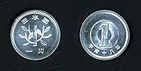 |
¥1 1 yen coin The 1 yen coin is currently the smallest denomination of Japanese yen. It has been in use since 1887 . The current design was first minted in 1955.-First One-Yen Coin:... |
20 mm | 1.2 mm | 1 g | 100% aluminium Aluminium Aluminium or aluminum is a silvery white member of the boron group of chemical elements. It has the symbol Al, and its atomic number is 13. It is not soluble in water under normal circumstances.... |
Smooth | Young tree, state title, value | Value, year of minting | 1955 |
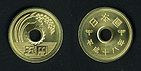 |
¥5 5 yen coin The is one denomination of Japanese yen. The current design was first minted in 1959 using Japanese characters known as the "new script", and were also minted from 1949-1958 using "old-script" Japanese characters... |
22 mm | 1.5 mm | 3.75 g | 60–70% copper Copper Copper is a chemical element with the symbol Cu and atomic number 29. It is a ductile metal with very high thermal and electrical conductivity. Pure copper is soft and malleable; an exposed surface has a reddish-orange tarnish... 30–40% zinc Zinc Zinc , or spelter , is a metallic chemical element; it has the symbol Zn and atomic number 30. It is the first element in group 12 of the periodic table. Zinc is, in some respects, chemically similar to magnesium, because its ion is of similar size and its only common oxidation state is +2... |
Smooth | Ear of Rice, gear, water, value | State title, year of minting | 1959 |
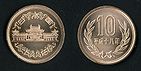 |
¥10 10 yen coin The is one denomination of Japanese yen.The obverse of the coin depicts the Phoenix Hall of Byōdō-in, a Buddhist temple in Uji, Kyoto prefecture, with the kanji for "Japan" and "Ten Yen." The reverse shows the numerals "10" and the date of issue in kanji surrounded by bay laurel leaves.10-yen... |
23.5 mm | 1.5 mm | 4.5 g | 95% copper Copper Copper is a chemical element with the symbol Cu and atomic number 29. It is a ductile metal with very high thermal and electrical conductivity. Pure copper is soft and malleable; an exposed surface has a reddish-orange tarnish... 3–4% zinc Zinc Zinc , or spelter , is a metallic chemical element; it has the symbol Zn and atomic number 30. It is the first element in group 12 of the periodic table. Zinc is, in some respects, chemically similar to magnesium, because its ion is of similar size and its only common oxidation state is +2... 1–2% tin Tin Tin is a chemical element with the symbol Sn and atomic number 50. It is a main group metal in group 14 of the periodic table. Tin shows chemical similarity to both neighboring group 14 elements, germanium and lead and has two possible oxidation states, +2 and the slightly more stable +4... |
Reeded Reeding -Numismatics:In numismatics, reeded edges are often referred to as "ridged" or "grooved". Some coins, such as United States quarters and dimes, have reeded edges. One reason for having reeded edges was to prevent counterfeiting... |
Hōōdō Temple, Byōdō-in Byodo-in is a Buddhist temple in the city of Uji in Kyoto Prefecture, Japan. It is jointly a temple of the Jōdo-shū and Tendai-shū sects.- History :... , state title, value |
Evergreen tree, value, year of minting | 1951 |
| Smooth | 1959 | ||||||||
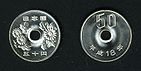 |
¥50 50 yen coin The 50 yen coin is a denomination of Japanese yen. The current design was first minted in 1967. -Design:The reverse of the coin shows the denomination of the coin and the year of issue in kanji below.... |
21 mm | 1.7 mm | 4 g | Cupronickel Cupronickel Cupronickel or copper-nickel or "cupernickel" is an alloy of copper that contains nickel and strengthening elements, such as iron and manganese. Cupronickel is highly resistant to corrosion in seawater, because its electrode potential is adjusted to be neutral with regard to seawater... 75% copper Copper Copper is a chemical element with the symbol Cu and atomic number 29. It is a ductile metal with very high thermal and electrical conductivity. Pure copper is soft and malleable; an exposed surface has a reddish-orange tarnish... 25% nickel Nickel Nickel is a chemical element with the chemical symbol Ni and atomic number 28. It is a silvery-white lustrous metal with a slight golden tinge. Nickel belongs to the transition metals and is hard and ductile... |
Reeded Reeding -Numismatics:In numismatics, reeded edges are often referred to as "ridged" or "grooved". Some coins, such as United States quarters and dimes, have reeded edges. One reason for having reeded edges was to prevent counterfeiting... |
Chrysanthemum Chrysanthemum Chrysanthemums, often called mums or chrysanths, are of the genus constituting approximately 30 species of perennial flowering plants in the family Asteraceae which is native to Asia and northeastern Europe.-Etymology:... , state title, value |
Value, year of minting | 1967 |
 |
¥100 100 yen coin The 100 yen coin is a denomination of Japanese yen. The current design was first minted in silver in 1959 and saw a change of metal in 1967. It is the second-highest denomination coin in Japan.-History:... |
22.6 mm | 1.7 mm | 4.8 g | Cupronickel Cupronickel Cupronickel or copper-nickel or "cupernickel" is an alloy of copper that contains nickel and strengthening elements, such as iron and manganese. Cupronickel is highly resistant to corrosion in seawater, because its electrode potential is adjusted to be neutral with regard to seawater... 75% copper Copper Copper is a chemical element with the symbol Cu and atomic number 29. It is a ductile metal with very high thermal and electrical conductivity. Pure copper is soft and malleable; an exposed surface has a reddish-orange tarnish... 25% nickel Nickel Nickel is a chemical element with the chemical symbol Ni and atomic number 28. It is a silvery-white lustrous metal with a slight golden tinge. Nickel belongs to the transition metals and is hard and ductile... |
Reeded Reeding -Numismatics:In numismatics, reeded edges are often referred to as "ridged" or "grooved". Some coins, such as United States quarters and dimes, have reeded edges. One reason for having reeded edges was to prevent counterfeiting... |
Cherry blossoms, state title, value | Value, year of minting | 1967 |
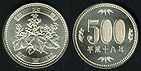
| ¥500 500 yen coin The is the largest coin denomination of the Japanese yen. Depending on fluctuations in exchange rates it is often the highest valued regularly used coin in the world. As of October 28, 2011, it is valued at US$6.60. As of August 13, 2011, it is valued at €4.57, £4.00, C$6.43, CHF5.07, A$6.29 and... |
26.5 mm | 2 mm | 7.2 g | Cupronickel Cupronickel Cupronickel or copper-nickel or "cupernickel" is an alloy of copper that contains nickel and strengthening elements, such as iron and manganese. Cupronickel is highly resistant to corrosion in seawater, because its electrode potential is adjusted to be neutral with regard to seawater... 75% copper Copper Copper is a chemical element with the symbol Cu and atomic number 29. It is a ductile metal with very high thermal and electrical conductivity. Pure copper is soft and malleable; an exposed surface has a reddish-orange tarnish... 25% nickel Nickel Nickel is a chemical element with the chemical symbol Ni and atomic number 28. It is a silvery-white lustrous metal with a slight golden tinge. Nickel belongs to the transition metals and is hard and ductile... |
Smooth with lettering ("NIPPON ◆ 500 ◆ NIPPON ◆ 500 ◆") | Paulownia Paulownia Paulownia is a genus of from 6 to 17 species of plants in the monogeneric family Paulowniaceae, related to and sometimes included in the Scrophulariaceae. They are native to much of China, south to northern Laos and Vietnam, and long cultivated elsewhere in eastern Asia, notably in Japan and Korea... , state title, value |
Value, bamboo Bamboo Bamboo is a group of perennial evergreens in the true grass family Poaceae, subfamily Bambusoideae, tribe Bambuseae. Giant bamboos are the largest members of the grass family.... , Mandarin orange Mandarin orange The orange, also known as the ' or mandarine , is a small citrus tree with fruit resembling other oranges. Mandarin oranges are usually eaten plain or in fruit salads... , year of minting |
1982 (no longer in mintage, limited circulation) | |
 |
7 g | 72% copper Copper Copper is a chemical element with the symbol Cu and atomic number 29. It is a ductile metal with very high thermal and electrical conductivity. Pure copper is soft and malleable; an exposed surface has a reddish-orange tarnish... 20% zinc Zinc Zinc , or spelter , is a metallic chemical element; it has the symbol Zn and atomic number 30. It is the first element in group 12 of the periodic table. Zinc is, in some respects, chemically similar to magnesium, because its ion is of similar size and its only common oxidation state is +2... 8% nickel |
Reeded Reeding -Numismatics:In numismatics, reeded edges are often referred to as "ridged" or "grooved". Some coins, such as United States quarters and dimes, have reeded edges. One reason for having reeded edges was to prevent counterfeiting... slantingly |
Value, bamboo Bamboo Bamboo is a group of perennial evergreens in the true grass family Poaceae, subfamily Bambusoideae, tribe Bambuseae. Giant bamboos are the largest members of the grass family.... , Mandarin orange Mandarin orange The orange, also known as the ' or mandarine , is a small citrus tree with fruit resembling other oranges. Mandarin oranges are usually eaten plain or in fruit salads... , year of minting, latent image |
2000 | ||||
Due to the great differences in style, size, weight and the pattern present on the edge of the coin they are very easy for people with visual impairments to tell apart from one another.
| Unholed | Holed | |
|---|---|---|
| Smooth edge | ¥1 (light) ¥10 (medium) |
¥5 |
| Reeded Reeding -Numismatics:In numismatics, reeded edges are often referred to as "ridged" or "grooved". Some coins, such as United States quarters and dimes, have reeded edges. One reason for having reeded edges was to prevent counterfeiting... edge |
¥100 (medium) ¥500 (heavy) |
¥50 |
Banknotes
The issuance of the yen banknotes began in 1872, two years after the currency was introduced. Throughout its history, the denominations have ranged from 10 yen to 10000 yen.
Before and during World War II
World War II
World War II, or the Second World War , was a global conflict lasting from 1939 to 1945, involving most of the world's nations—including all of the great powers—eventually forming two opposing military alliances: the Allies and the Axis...
, various bodies issued banknotes in yen, such as the Ministry of Finance and the Imperial Japanese National Bank. The Allied forces also issued some notes shortly after the war. Since then, the Bank of Japan
Bank of Japan
is the central bank of Japan. The Bank is often called for short. It has its headquarters in Chuo, Tokyo.-History:Like most modern Japanese institutions, the Bank of Japan was founded after the Meiji Restoration...
has been the exclusive note issuing authority. The bank has issued five series after World War II. Series E, the current series, consists of ¥1000, ¥2000, ¥5000, and ¥10,000. The ¥2000 bills are rare these days, and often not accepted as a means of payment, not even in dispensing machines.
Determinants of value
Beginning in December 1931, Japan gradually shifted from the gold standard system to the managed currency system.The relative value of the yen is determined in foreign exchange market
Foreign exchange market
The foreign exchange market is a global, worldwide decentralized financial market for trading currencies. Financial centers around the world function as anchors of trading between a wide range of different types of buyers and sellers around the clock, with the exception of weekends...
s by the economic forces
Economics
Economics is the social science that analyzes the production, distribution, and consumption of goods and services. The term economics comes from the Ancient Greek from + , hence "rules of the house"...
of supply and demand
Supply and demand
Supply and demand is an economic model of price determination in a market. It concludes that in a competitive market, the unit price for a particular good will vary until it settles at a point where the quantity demanded by consumers will equal the quantity supplied by producers , resulting in an...
. The supply
Supply (economics)
In economics, supply is the amount of some product producers are willing and able to sell at a given price all other factors being held constant. Usually, supply is plotted as a supply curve showing the relationship of price to the amount of product businesses are willing to sell.In economics the...
of the yen in the market
Market
A market is one of many varieties of systems, institutions, procedures, social relations and infrastructures whereby parties engage in exchange. While parties may exchange goods and services by barter, most markets rely on sellers offering their goods or services in exchange for money from buyers...
is governed by the desire of yen holders to exchange their yen for other currencies to purchase goods, services, or asset
Asset
In financial accounting, assets are economic resources. Anything tangible or intangible that is capable of being owned or controlled to produce value and that is held to have positive economic value is considered an asset...
s. The demand
Demand (economics)
In economics, demand is the desire to own anything, the ability to pay for it, and the willingness to pay . The term demand signifies the ability or the willingness to buy a particular commodity at a given point of time....
for the yen is governed by the desire of foreigners to buy goods and services in Japan and by their interest in investing in Japan (buying yen-denominated real and financial assets).
Since the 1990s, the Bank of Japan, the country's central bank, has kept interest rates low in order to spur economic growth. Short-term lending rates have responded to this monetary relaxation and fell from 3.7% to 1.3% between 1993 and 2008. Low interest rates combined with a ready liquidity for the yen prompted investors to borrow money in Japan and invest it in other countries (a practice known as carry trade). This has helped to keep the value of the yen low compared to other currencies.
SDR basket
The Special Drawing RightsSpecial Drawing Rights
Special Drawing Rights are supplementary foreign exchange reserve assets defined and maintained by the International Monetary Fund . Not a currency, SDRs instead represent a claim to currency held by IMF member countries for which they may be exchanged...
(SDR) valuation is an IMF basket of currencies, including the Japanese yen. The SDR is linked to a basket of currencies with 41.9% for the dollar, 37.4% for the euro, 11.3% for the pound sterling, and 9.4% for the yen (as of 2011). The percentage for the yen has however declined from 18% in 2000. The exchange rate for the Japanese yen is expressed in terms of currency units per U.S. dollar; other rates are expressed as U.S. dollars per currency unit. The SDR currency value is calculated daily and the valuation basket is reviewed and adjusted every five years. The SDR was created in 1969 to support the fixed exchange system.
Historical exchange rate
The table below shows the number of yen per U.S. dollarUnited States dollar
The United States dollar , also referred to as the American dollar, is the official currency of the United States of America. It is divided into 100 smaller units called cents or pennies....
(monthly average).
| Year | Month | |||||||||||
|---|---|---|---|---|---|---|---|---|---|---|---|---|
| Jan | Feb | Mar | Apr | May | Jun | Jul | Aug | Sep | Oct | Nov | Dec | |
| 1949–71 | 360 | |||||||||||
| 1972 | 308 | |||||||||||
| 1973 | 301.15 | 270.00 | 265.83 | 265.50 | 264.95 | 265.30 | 263.45 | 265.30 | 265.70 | 266.68 | 279.00 | 280.00 |
| 1974 | 299.00 | 287.60 | 276.00 | 279.75 | 281.90 | 284.10 | 297.80 | 302.70 | 298.50 | 299.85 | 300.10 | 300.95 |
| 1975 | 297.85 | 286.60 | 293.80 | 293.30 | 291.35 | 296.35 | 297.35 | 297.90 | 302.70 | 301.80 | 303.00 | 305.15 |
| 1976 | 303.70 | 302.25 | 299.70 | 299.40 | 299.95 | 297.40 | 293.40 | 288.76 | 287.30 | 293.70 | 296.45 | 293.00 |
| 1977 | 288.25 | 283.25 | 277.30 | 277.50 | 277.30 | 266.50 | 266.30 | 267.43 | 264.50 | 250.65 | 244.20 | 240.00 |
| 1978 | 241.74 | 238.83 | 223.40 | 223.90 | 223.15 | 204.50 | 190.80 | 190.00 | 189.15 | 176.05 | 197.80 | 195.10 |
| 1979 | 201.40 | 202.35 | 209.30 | 219.15 | 219.70 | 217.00 | 216.90 | 220.05 | 223.45 | 237.80 | 249.50 | 239.90 |
| 1980 | 237.73 | 244.07 | 248.61 | 251.45 | 228.06 | 218.11 | 220.91 | 224.34 | 214.95 | 209.21 | 212.99 | 209.79 |
| 1981 | 202.19 | 205.76 | 208.84 | 215.07 | 220.78 | 224.21 | 232.11 | 233.62 | 229.83 | 231.40 | 223.76 | 219.02 |
| 1982 | 224.55 | 235.25 | 240.64 | 244.90 | 236.97 | 251.11 | 255.10 | 258.67 | 262.74 | 271.33 | 265.02 | 242.49 |
| 1983 | 232.90 | 236.27 | 237.92 | 237.70 | 234.78 | 240.06 | 240.49 | 244.36 | 242.71 | 233.00 | 235.25 | 234.34 |
| 1984 | 233.95 | 233.67 | 225.52 | 224.95 | 230.67 | 233.29 | 242.72 | 242.24 | 245.19 | 246.89 | 243.29 | 247.96 |
| 1985 | 254.11 | 260.34 | 258.43 | 251.67 | 251.57 | 248.95 | 241.70 | 237.20 | 236.91 | 214.84 | 203.85 | 202.75 |
| 1986 | 200.05 | 184.62 | 178.83 | 175.56 | 166.89 | 167.82 | 158.65 | 154.11 | 154.78 | 156.04 | 162.72 | 162.13 |
| 1987 | 154.48 | 153.49 | 151.56 | 142.96 | 140.47 | 144.52 | 150.20 | 147.57 | 143.03 | 143.48 | 135.25 | 128.25 |
| 1988 | 127.44 | 129.26 | 127.23 | 124.88 | 124.74 | 127.20 | 133.10 | 133.63 | 134.45 | 128.85 | 123.16 | 123.63 |
| 1989 | 127.24 | 127.77 | 130.35 | 132.01 | 138.40 | 143.92 | 140.63 | 141.20 | 145.06 | 141.99 | 143.55 | 143.62 |
| 1990 | 145.09 | 145.54 | 153.19 | 158.50 | 153.52 | 153.78 | 149.23 | 147.46 | 138.96 | 129.73 | 129.01 | 133.72 |
| 1991 | 133.65 | 130.44 | 137.09 | 137.15 | 138.02 | 139.83 | 137.98 | 136.85 | 134.59 | 130.81 | 129.64 | 128.07 |
| 1992 | 125.05 | 127.53 | 132.75 | 133.59 | 130.55 | 126.90 | 125.66 | 126.34 | 122.72 | 121.14 | 123.84 | 123.98 |
| 1993 | 125.02 | 120.97 | 117.02 | 112.37 | 110.23 | 107.29 | 107.77 | 103.72 | 105.27 | 106.94 | 107.81 | 109.72 |
| 1994 | 111.49 | 106.14 | 105.12 | 103.48 | 104.00 | 102.69 | 98.54 | 99.86 | 98.79 | 98.40 | 98.00 | 100.17 |
| 1995 | 99.79 | 98.23 | 90.77 | 83.53 | 85.21 | 84.54 | 87.24 | 94.56 | 100.31 | 100.68 | 101.89 | 101.86 |
| 1996 | 105.81 | 105.70 | 105.85 | 107.40 | 106.49 | 108.82 | 109.25 | 107.84 | 109.76 | 112.30 | 112.27 | 113.74 |
| 1997 | 118.18 | 123.01 | 122.66 | 125.47 | 118.91 | 114.31 | 115.10 | 117.89 | 120.74 | 121.13 | 125.35 | 129.52 |
| 1998 | 129.45 | 125.85 | 128.83 | 131.81 | 135.08 | 140.35 | 140.66 | 144.76 | 134.50 | 121.33 | 120.61 | 117.40 |
| 1999 | 113.14 | 116.73 | 119.71 | 119.66 | 122.14 | 120.81 | 119.76 | 113.30 | 107.45 | 106.00 | 104.83 | 102.61 |
| 2000 | 105.21 | 109.34 | 106.62 | 105.35 | 108.13 | 106.13 | 107.90 | 108.02 | 106.75 | 108.34 | 108.87 | 112.21 |
| 2001 | 117.10 | 116.10 | 121.21 | 123.77 | 121.83 | 122.19 | 124.63 | 121.53 | 118.91 | 121.32 | 122.33 | 127.32 |
| 2002 | 132.66 | 133.53 | 131.15 | 131.01 | 126.39 | 123.44 | 118.08 | 119.03 | 120.49 | 123.88 | 121.54 | 122.17 |
| 2003 | 118.67 | 119.29 | 118.49 | 119.82 | 117.26 | 118.27 | 118.65 | 118.81 | 115.09 | 109.58 | 109.18 | 107.87 |
| 2004 | 106.39 | 106.54 | 108.57 | 107.31 | 112.27 | 109.45 | 109.34 | 110.41 | 110.05 | 108.90 | 104.86 | 103.82 |
| 2005 | 103.27 | 104.84 | 105.30 | 107.35 | 106.94 | 108.62 | 111.94 | 110.65 | 111.03 | 114.84 | 118.45 | 118.60 |
| 2006 | 115.33 | 117.81 | 117.31 | 117.13 | 111.53 | 114.57 | 115.59 | 115.86 | 117.02 | 118.59 | 117.33 | 117.26 |
| 2007 | 120.59 | 120.49 | 117.29 | 118.81 | 120.77 | 122.64 | 121.56 | 116.74 | 115.01 | 115.77 | 111.24 | 112.28 |
| 2008 | 107.60 | 107.18 | 100.83 | 102.41 | 104.11 | 106.86 | 106.76 | 109.24 | 106.71 | 100.20 | 96.89 | 91.21 |
| 2009 | 90.35 | 92.53 | 97.83 | 98.92 | 96.43 | 96.58 | 94.49 | 94.90 | 91.40 | 90.28 | 89.11 | 89.52 |
| 2010 | 91.26 | 90.28 | 90.56 | 93.43 | 91.79 | 90.89 | 87.67 | 85.44 | 84.31 | 81.80 | 82.43 | 83.38 |
| 2011 | 82.63 | 82.52 | 81.82 | 83.34 | 81.23 | 80.49 | 79.44 | 77.09 | 76.89 | 76.69 | ||
| Year | Jan | Feb | Mar | Apr | May | Jun | Jul | Aug | Sep | Oct | Nov | Dec |
| Month | ||||||||||||
See also
- Japan MintJapan MintThe is an Incorporated Administrative Agency of the Japanese government. This agency has its Head office in Osaka with branches in Tokyo and Hiroshima.-History:...
- Japanese military yenJapanese military yenJapanese Military Yen , commonly abbreviated as JMY, was the :currency issued to the soldiers of the Imperial Japanese Army and the Imperial Japanese Navy as a salary. The Imperial Japanese government first started issuing the military yen during the Russo-Japanese War in 1904...
- Economy of JapanEconomy of JapanThe economy of Japan, a free market economy, is the third largest in the world after the United States and the People's Republic of China, and ahead of Germany at 4th...
- Capital flows in JapanCapital flows in Japan- History :After World War II, Japan's return to world capital markets as a borrower was slow and deliberate. Even before the war, Japan did not participate in world capital markets to the same extent as did the United States or West European countries. Caution and control remained strong until...
- Monetary and fiscal policy of JapanMonetary and fiscal policy of JapanMonetary policy pertains to the regulatio, availability, and cost of credit, while fiscal policy deals with government expenditures, taxes, and debt...
- Balance of payments accounts of Japan (1960–90)
Older currency
- Japanese mon (currency)
- Koban (coin)
- Ryō (Japanese coin)
- WadōkaichinWadokaichin, also romanized as Wadō-kaichin or called Wadō-kaihō, is the oldest official Japanese coinage, having been minted starting in 708 AD on order of Empress Gemmei.-Description:...
Further reading
- MedhurstWalter Henry MedhurstWalter Henry Medhurst , was an English Congregationalist missionary to China, born in London and educated at St Paul's School, was one of the early translators of the Bible into Chinese language editions.-Early life:...
, Walter Henry. (1830). An English and Japanese, and Japanese and English Vocabulary: Compiled from Native Works. Batavia, Dutch East Indies: [s.n.]. OCLC 5452087 - HepburnJames Curtis HepburnJames Curtis Hepburn, M.D., LL.D. was a physician who became a Christian missionary. He is known for the Hepburn romanization system for transliteration of the Japanese language into the Latin alphabet, which he popularized in his Japanese–English dictionary.- Biography :Hepburn was born in...
, James Curtis. (1867). A Japanese and English Dictionary. Shanghai: American Presbyterian Mission Press. OCLC 32634467 - TitsinghIsaac TitsinghIsaac Titsingh FRS was a Dutch surgeon, scholar, merchant-trader and ambassador.During a long career in East Asia, Titsingh was a senior official of the Dutch East India Company . He represented the European trading company in exclusive official contact with Tokugawa Japan...
, Isaac. (1834). [Siyun-sai Rin-siyo/Hayashi GahōHayashi Gaho, also known as Hayashi Shunsai, was a Japanese Neo-Confucian scholar, teacher and administrator in the system of higher education maintained by the Tokugawa bakufu during the Edo period...
, 1652]. Nipon o daï itsi ran; ou, Annales des empereurs du Japon. Paris: Oriental Translation Society of Great Britain and IrelandRoyal Asiatic SocietyThe Royal Asiatic Society of Great Britain and Ireland was established, according to its Royal Charter of 11 August 1824, to further "the investigation of subjects connected with and for the encouragement of science, literature and the arts in relation to Asia." From its incorporation the Society...
. OCLC 5850691
External links
- Japanese Yen on Wikinvest
- Japanese currency FAQ in Currency Museum, Bank of Japan
- Money in Japan. A guide while traveling.
- Images of historic and modern Japanese bank notes
- Chart: US-Dollar in Yen) (German)
- Chart: 100 Yen in Euro (German)