


South Korean won

Encyclopedia
The won (sign
: ₩; code
: KRW) is the currency of South Korea
. A single won is divided into 100 jeon, the monetary subunit. The jeon is no longer used for everyday transactions, and appears only in foreign exchange rates. One South Korean won (as of May 25, 2010) is equal to 0.114364 North Korean won
, at the official North Korean rate.
of the Chinese yuan
and Japanese yen
. All three names derive from the Hanja
(원), which means "round shape." The won was subdivided into 100 jeon , which means "money", a word of Hanja origin referring to the bronze and copper coins of old.
has been in use for thousands of years. During the Colonial era
, the won was replaced at par by the yen, made up of the Korean yen
.
In 1945 after World War II
, Korea became divided
, resulting in two separate currencies, both called won, for the South and the North
. Both the Southern won
and the Northern won
replaced the yen at par. The first South Korean won was subdivided into 100 jeon.
The South Korean won was initially pegged to the U.S. dollar at a rate of 15 won = 1 dollar. A series of devaluations followed, the later ones in part due to the Korean War
. The pegs were:
The first South Korean won was replaced by the hwan
on February 15, 1953 at a rate of 1 hwan = 100 won.
introduced 10 and 100 won notes. These were followed in 1949 by 5 and 1000 won notes.
A new central bank, the Bank of Korea
, was established in 1950, and assumed the duties of Bank of Joseon. Notes were introduced (some dated 1949) in denominations of 5, 10 and 50 jeon, 100 and 1000 won. 500 won notes were introduced in 1952. In 1953, a series of banknotes was issued which, although it gave the denominations in English
in won, were, in fact, the first issues of the hwan
.
code is KRW. At the reintroduction of the won in 1962, its value was pegged at 125 won = 1 U.S. dollar. The following pegs operated between 1962 and 1980.
On February 27, 1980, efforts were initiated to lead to a floating exchange rate
. The won was finally allowed to float on December 24, 1997 when an agreement was signed with the International Monetary Fund
. Shortly after, the won was devalued to almost half of its value, as part of the East Asian financial crisis
.
on August 16, 1966 in denominations of 1, 5 and 10 won, with the 1 won struck in brass
and the 5 and 10 won in bronze. These were the first South Korean coins to display the date in the Common era
, earlier coins having used the Korean calendar
. The 10 and 50 hwan coins were demonetized on March 22, 1975.
In 1968, as the intrinsic value of the brass 1 won coin far surpassed its face value, new aluminium 1 won coins were issued to replace them. As an attempt to further reduce currency production costs, new 5 won and 10 won coins were issued in 1970, struck in brass. Cupro-nickel 100 won coins were also introduced that year, followed by Cupro-nickel 50 won in 1972.
In 1982, with inflation and the increasing popularity of vending machine
s, 500 won coins were introduced on June 12, 1982. In January 1983, with the purpose of standardizing the coinage, a new series of 1, 5, 10, 50, and 100 won coins were issued, using the same layout as the 500 won coins, but conserving the coins old themes.
The Bank of Korea announced in early 2006 its intention to redesign the 10 won coin by the end of that year. With the increasing manufacturing price, then at 38 won per 10 won coin, and rumors that some people had been melting the coins to make jewelry, the redesign was needed to make the coin more cost effective to produce. The new coin is made of copper-coated aluminum with a reduced diameter of 18 mm, and a weight of 1.22 g. Its visual design is the same as the old coin. The new coin was issued on December 18, 2006.
The 1 and 5 won coins are difficult to find in circulation today and prices of consumer goods are rounded to the nearest 10 won.
In 1998, the production costs per coin were are as follows: 10 won coins each cost 35 won to produce, 100 won coins cost 58 won, and 500 won coins cost 77 won.
The 100 won coins have exactly the same shape as the U.S. quarter
.
designates banknote and coin series in a unique way. Instead of putting those of similar design and issue dates in the same series, they assign series number X to the Xth design of for each individual value. The series numbers are expressed with Korean letters
used in alphabetical order, e.g. 가, 나, 다, 라, 마, 바, 사. Therefore, ₩1000 issued in 1983 is series II (나) because it is the second design of all ₩1000 designs since the won introduction in 1962.
In 1962, 10 and 50 jeon, 1, 5, 10, 50, 100 and 500 won notes were introduced by the Bank of Korea
. The first issue of 1, 5, 10, 50, 100 and 500 won notes were printed in the U.K. by Thomas De La Rue
. The jeon notes together with a second issue of 10 and 100 won notes were printed domestically by the Korea Minting and Security Printing Corporation
.
In 1965, 100 won notes (Series III) were printed using intaglio printing
techniques, for the first time on domestically printed notes, to reduce counterfeiting. Replacements for the British 500 won notes followed in 1966 also using intaglio printing
, and for the 50 won notes in 1969 using litho-printing
.
With the economic development from the 60s the value of the 500 won notes became lower, resulting in a greater use of cashier's checks with higher fixed denominations as means of payment, as well as an increased use of counterfeited ones. In 1970, the 100 won notes were replaced by coins, with the same happening to the 50 won notes in 1972.
Higher denomination notes of 5000 won and 10,000 won were introduced in 1972 and 1973 respectively. The notes incorporated new security features, including watermark
, security thread
and ultraviolet response fibres and were inglio printed
. The release of 10,000 won notes was planned to be at the same time as the 5000 won notes but problems with the main theme delayed it by a year. Newly designed 500 won notes were also released in 1973 and the need for a medium denomination resulted in the introduction of 1000 won notes in 1975.
In 1982, the 500 won note was replaced by a coin. The following year, as part of its policy of rationalizing the currency system, the Bank of Korea issued a new set of notes, as well as a new set of coins (see above). Some of the note's most notable features were distinguishable marks for the blind under the watermark and the addition of machine-readable language in preparation for mechanization of cash handling. They were also printed on better quality cotton pulp to reduce the production costs by extending their circulation life.
To cope with the deregulation of imports of color printer and the increasing use of computers and scanners, modified 5000 won and 10,000 won notes were released between 1994 and 2002 with various new security features, which included: color-shifting ink, microprint, segmented metal thread, moiré
, and EURion constellation
. The latest version of the 5000 and 10,000 won are easily identifiable by the copyright information inscribed under the watermark: "© 한국은행" and year of issue on the obverse, "© The Bank of Korea" and year of issue on the reverse.
The plates for the 5000 won notes were produced in Japan while the ones for the 1000 and 10,000 won notes were produced by the Korea Minting and Security Printing Corporation. They were all printed in intaglio
.
With the release of a new set of notes, no plan has yet been made to withdraw these notes from circulation.
The banknotes include over 10 security features in each denomination. The 10000 won note has 21 security features, the 5000 won note 17, and the 1000 won note
19. Many modern security features that can be also found in Euro
s, Pound sterling
, Canadian dollar
, Japanese yen
are included in the banknotes.
Some security features inserted in won notes are:
For the first time in the world, the KOMSCO, the Korean mint, inserted a new substance in the notes to detect counterfeits. This technique is being exported to Europe, North America, etc.
On June 23, 2009, the Bank of Korea released the 50,000 Won note. The obverse bears a portrait of Shin Saimdang, a prominent 16th-century artist, calligrapher, and mother of Korean scholar Yulgok, also known as Yi I, who is on the 5,000 Won note. This note is the first Korean banknote that features the portrait of a woman. 100,000 won notes were also announced, but their release was later canceled. The release of the 50,000 won note stirred some controversy among shop owners and those with visual impairments due to its similarity in color and numerical denomination with the 5,000 won note.
that has the right to print banknotes and mint coins
. The banknotes and coins are printed at KOMSCO, a government-owned corporation, under the guidance of the Bank of Korea.
After the new crisp banknotes and coins are printed/minted, they are bundled up in bundles/rolls and shipped to the Headquarters of the Bank of Korea. When delivered, the banknotes and coins are deposited inside the Bank's vault, ready to be distributed to commercial banks when requested.
Every year, around Seollal and Chuseok
, two major Korea
n holidays, the Bank of Korea distributes large amount of its currency to most of the commercial banks in South Korea, which are then given to their customers upon request.
Currency sign
A currency sign is a graphic symbol used as a shorthand for a currency's name, especially in reference to amounts of money. They typically employ the first letter or character of the currency, sometimes with minor changes such as ligatures or overlaid vertical or horizontal bars...
: ₩; code
ISO 4217
ISO 4217 is a standard published by the International Standards Organization, which delineates currency designators, country codes , and references to minor units in three tables:* Table A.1 – Current currency & funds code list...
: KRW) is the currency of South Korea
South Korea
The Republic of Korea , , is a sovereign state in East Asia, located on the southern portion of the Korean Peninsula. It is neighbored by the People's Republic of China to the west, Japan to the east, North Korea to the north, and the East China Sea and Republic of China to the south...
. A single won is divided into 100 jeon, the monetary subunit. The jeon is no longer used for everyday transactions, and appears only in foreign exchange rates. One South Korean won (as of May 25, 2010) is equal to 0.114364 North Korean won
North Korean won
The won is the currency of North Korea . It is subdivided into 100 chon. The won is issued by the Central Bank of the Democratic People's Republic of Korea...
, at the official North Korean rate.
Etymology
"Won" is a cognateCognate
In linguistics, cognates are words that have a common etymological origin. This learned term derives from the Latin cognatus . Cognates within the same language are called doublets. Strictly speaking, loanwords from another language are usually not meant by the term, e.g...
of the Chinese yuan
Chinese yuan
The yuan is the base unit of a number of modern Chinese currencies. The yuan is the primary unit of account of the Renminbi.A yuán is also known colloquially as a kuài . One yuán is divided into 10 jiǎo or colloquially máo...
and Japanese yen
Japanese yen
The is the official currency of Japan. It is the third most traded currency in the foreign exchange market after the United States dollar and the euro. It is also widely used as a reserve currency after the U.S. dollar, the euro and the pound sterling...
. All three names derive from the Hanja
Hanja
Hanja is the Korean name for the Chinese characters hanzi. More specifically, it refers to those Chinese characters borrowed from Chinese and incorporated into the Korean language with Korean pronunciation...
(원), which means "round shape." The won was subdivided into 100 jeon , which means "money", a word of Hanja origin referring to the bronze and copper coins of old.
History
The wonKorean won
The won was the currency of Korea between 1902 and 1910. It was subdivided into 100 chon .-Etymology:Won is a cognate of the Chinese yuan and Japanese yen.-History:...
has been in use for thousands of years. During the Colonial era
Korea under Japanese rule
Korea was under Japanese rule as part of Japan's 35-year imperialist expansion . Japanese rule ended in 1945 shortly after the Japanese defeat in World War II....
, the won was replaced at par by the yen, made up of the Korean yen
Korean yen
The Korean yen was the currency of Korea between 1910 and 1945. It was equivalent to the Japanese yen and consisted of Japanese currency and banknotes issued specifically for Korea. The yen was subdivided into 100 sen...
.
In 1945 after World War II
World War II
World War II, or the Second World War , was a global conflict lasting from 1939 to 1945, involving most of the world's nations—including all of the great powers—eventually forming two opposing military alliances: the Allies and the Axis...
, Korea became divided
Division of Korea
The division of Korea into North Korea and South Korea stems from the 1945 Allied victory in World War II, ending Japan's 35-year colonial rule of Korea. In a proposal opposed by nearly all Koreans, the United States and the Soviet Union agreed to temporarily occupy the country as a trusteeship...
, resulting in two separate currencies, both called won, for the South and the North
North Korea
The Democratic People’s Republic of Korea , , is a country in East Asia, occupying the northern half of the Korean Peninsula. Its capital and largest city is Pyongyang. The Korean Demilitarized Zone serves as the buffer zone between North Korea and South Korea...
. Both the Southern won
South Korean won (1945)
The won was the first South Korean currency and was in use from August 15, 1945 to February 15, 1953.-Etymology:Won is a cognate of the Chinese yuan and Japanese yen...
and the Northern won
North Korean won
The won is the currency of North Korea . It is subdivided into 100 chon. The won is issued by the Central Bank of the Democratic People's Republic of Korea...
replaced the yen at par. The first South Korean won was subdivided into 100 jeon.
The South Korean won was initially pegged to the U.S. dollar at a rate of 15 won = 1 dollar. A series of devaluations followed, the later ones in part due to the Korean War
Korean War
The Korean War was a conventional war between South Korea, supported by the United Nations, and North Korea, supported by the People's Republic of China , with military material aid from the Soviet Union...
. The pegs were:
| Pegs for the first South Korean won | |
|---|---|
| Date introduced | Value of U.S. dollar in won |
| October, 1945 | 15 |
| July 15, 1947 | 50 |
| October 1, 1948 | 450 |
| June 14, 1949 | 900 (non-government transactions only) |
| May 1, 1950 | 1800 |
| November 1, 1950 | 2500 |
| April 1, 1951 | 6000 |
The first South Korean won was replaced by the hwan
South Korean hwan
The hwan was the currency of South Korea between February 15, 1953 and June 9, 1962.-History:Due to the devaluation of the first South Korean won , the hwan was introduced in 1953 at the rate of 1 hwan = 100 won...
on February 15, 1953 at a rate of 1 hwan = 100 won.
Banknotes
In 1946, the Bank of JoseonBank of Joseon
The Bank of Joseon or Bank of Chosen was the central bank of Korea under Japanese rule, and of South Korea under American occupation. The bank issued the Korean yen from 1910 to 1945 and the won from 1945 to 1950.-History and background:...
introduced 10 and 100 won notes. These were followed in 1949 by 5 and 1000 won notes.
A new central bank, the Bank of Korea
Bank of Korea
The Bank of Korea is the central bank of South Korea and issuer of South Korean won. It was established on June 12, 1950 at Seoul, South Korea.The Bank's primary purpose is price stability. For that, the Bank targets inflation...
, was established in 1950, and assumed the duties of Bank of Joseon. Notes were introduced (some dated 1949) in denominations of 5, 10 and 50 jeon, 100 and 1000 won. 500 won notes were introduced in 1952. In 1953, a series of banknotes was issued which, although it gave the denominations in English
English language
English is a West Germanic language that arose in the Anglo-Saxon kingdoms of England and spread into what was to become south-east Scotland under the influence of the Anglian medieval kingdom of Northumbria...
in won, were, in fact, the first issues of the hwan
South Korean hwan
The hwan was the currency of South Korea between February 15, 1953 and June 9, 1962.-History:Due to the devaluation of the first South Korean won , the hwan was introduced in 1953 at the rate of 1 hwan = 100 won...
.
History
The won was reintroduced on June 9, 1962 at a rate of 1 won = 10 hwan. It became the sole legal tender on March 22, 1975 with the withdrawal of the last circulating hwan coins. Its ISO 4217ISO 4217
ISO 4217 is a standard published by the International Standards Organization, which delineates currency designators, country codes , and references to minor units in three tables:* Table A.1 – Current currency & funds code list...
code is KRW. At the reintroduction of the won in 1962, its value was pegged at 125 won = 1 U.S. dollar. The following pegs operated between 1962 and 1980.
| Pegs for the second South Korean won | |
|---|---|
| Date introduced | Value of U.S. dollar in won |
| June 10, 1962 | 125 |
| May 3, 1964 | 255 |
| August 3, 1972 | 400 |
| December 7, 1974 | 480 |
| January 12, 1980 | 580 |
On February 27, 1980, efforts were initiated to lead to a floating exchange rate
Floating exchange rate
A floating exchange rate or fluctuating exchange rate is a type of exchange rate regime wherein a currency's value is allowed to fluctuate according to the foreign exchange market. A currency that uses a floating exchange rate is known as a floating currency....
. The won was finally allowed to float on December 24, 1997 when an agreement was signed with the International Monetary Fund
International Monetary Fund
The International Monetary Fund is an organization of 187 countries, working to foster global monetary cooperation, secure financial stability, facilitate international trade, promote high employment and sustainable economic growth, and reduce poverty around the world...
. Shortly after, the won was devalued to almost half of its value, as part of the East Asian financial crisis
East Asian financial crisis
The Asian financial crisis was a period of financial crisis that gripped much of Asia beginning in July 1997, and raised fears of a worldwide economic meltdown due to financial contagion....
.
Coins
Until 1966, 10 and 50 hwan coins, revalued as 1 and 5 won, were the only coins in circulation. New coins, denominated in won, were introduced by the Bank of KoreaBank of Korea
The Bank of Korea is the central bank of South Korea and issuer of South Korean won. It was established on June 12, 1950 at Seoul, South Korea.The Bank's primary purpose is price stability. For that, the Bank targets inflation...
on August 16, 1966 in denominations of 1, 5 and 10 won, with the 1 won struck in brass
Brass
Brass is an alloy of copper and zinc; the proportions of zinc and copper can be varied to create a range of brasses with varying properties.In comparison, bronze is principally an alloy of copper and tin...
and the 5 and 10 won in bronze. These were the first South Korean coins to display the date in the Common era
Common Era
Common Era ,abbreviated as CE, is an alternative designation for the calendar era originally introduced by Dionysius Exiguus in the 6th century, traditionally identified with Anno Domini .Dates before the year 1 CE are indicated by the usage of BCE, short for Before the Common Era Common Era...
, earlier coins having used the Korean calendar
Korean calendar
The traditional Korean calendar is a lunisolar calendar, like the traditional calendars of other East Asian countries. Dates are calculated from Korea's meridian, and observances and festivals are based in Korean culture....
. The 10 and 50 hwan coins were demonetized on March 22, 1975.
In 1968, as the intrinsic value of the brass 1 won coin far surpassed its face value, new aluminium 1 won coins were issued to replace them. As an attempt to further reduce currency production costs, new 5 won and 10 won coins were issued in 1970, struck in brass. Cupro-nickel 100 won coins were also introduced that year, followed by Cupro-nickel 50 won in 1972.
| 1966-1982 issued coins http://www.bok.or.kr/template/main/html/index.jsp?tbl=tbl_FM0000000066_CA0000000507 http://www.bok.or.kr/template/main/html/index.jsp?tbl=tbl_FM0000000066_CA0000000508 | ||||||||||||
|---|---|---|---|---|---|---|---|---|---|---|---|---|
| Image | Value | Technical parameters | Description | Date of | BOK Bank of Korea The Bank of Korea is the central bank of South Korea and issuer of South Korean won. It was established on June 12, 1950 at Seoul, South Korea.The Bank's primary purpose is price stability. For that, the Bank targets inflation... Series Designation |
|||||||
| Obverse | Reverse | Diameter | Mass | Composition | Edge | Obverse | Reverse | first minting | issue | withdrawal | ||
 |
 |
₩1 | 17.2 mm | 1.7 g | Brass Brass Brass is an alloy of copper and zinc; the proportions of zinc and copper can be varied to create a range of brasses with varying properties.In comparison, bronze is principally an alloy of copper and tin... 60% copper Copper Copper is a chemical element with the symbol Cu and atomic number 29. It is a ductile metal with very high thermal and electrical conductivity. Pure copper is soft and malleable; an exposed surface has a reddish-orange tarnish... 40% zinc Zinc Zinc , or spelter , is a metallic chemical element; it has the symbol Zn and atomic number 30. It is the first element in group 12 of the periodic table. Zinc is, in some respects, chemically similar to magnesium, because its ion is of similar size and its only common oxidation state is +2... |
Plain | Rose of Sharon Hibiscus syriacus Hibiscus syriacus is a widely cultivated ornamental shrub in the genus Hibiscus. Common names include Rose of Sharon , Shrub Althea and Rose Althea.-Growth:... , value, bank title (hangul Hangul Hangul,Pronounced or ; Korean: 한글 Hangeul/Han'gŭl or 조선글 Chosŏn'gŭl/Joseongeul the Korean alphabet, is the native alphabet of the Korean language. It is a separate script from Hanja, the logographic Chinese characters which are also sometimes used to write Korean... ) |
Value (digit), bank title, year of minting | 1966 | August 16, 1966 | December 1, 1980 | Series I (가) |
 |
 |
₩1 | 17.2 mm | 0.729 g | 100% aluminium Aluminium Aluminium or aluminum is a silvery white member of the boron group of chemical elements. It has the symbol Al, and its atomic number is 13. It is not soluble in water under normal circumstances.... |
Plain | Rose of Sharon Hibiscus syriacus Hibiscus syriacus is a widely cultivated ornamental shrub in the genus Hibiscus. Common names include Rose of Sharon , Shrub Althea and Rose Althea.-Growth:... , value, bank title (hangul) |
Value (digit), bank title, year of minting | 1968 | August 26, 1968 | 1992 | Series II (나) |
 |
 |
₩5 | 20.4 mm | 3.09 g | Commercial bronze Bronze Bronze is a metal alloy consisting primarily of copper, usually with tin as the main additive. It is hard and brittle, and it was particularly significant in antiquity, so much so that the Bronze Age was named after the metal... 88% copper Copper Copper is a chemical element with the symbol Cu and atomic number 29. It is a ductile metal with very high thermal and electrical conductivity. Pure copper is soft and malleable; an exposed surface has a reddish-orange tarnish... 12% zinc Zinc Zinc , or spelter , is a metallic chemical element; it has the symbol Zn and atomic number 30. It is the first element in group 12 of the periodic table. Zinc is, in some respects, chemically similar to magnesium, because its ion is of similar size and its only common oxidation state is +2... |
Plain | Geobukseon Turtle ship The Turtle ship, also known as Geobukseon or Kobukson , was a type of large warship belonging to the Panokseon class in Korea that was used intermittently by the Royal Korean Navy during the Joseon Dynasty from the early 15th century up until the 19th century.The first references to older, first... , value, bank title (hangul) |
Value (digit), bank title, year of minting | 1966 | August 16, 1966 | 1992 | Series I (가) |
 |
 |
₩5 | 20.4 mm | 2.95 g | High brass Brass Brass is an alloy of copper and zinc; the proportions of zinc and copper can be varied to create a range of brasses with varying properties.In comparison, bronze is principally an alloy of copper and tin... 65% copper Copper Copper is a chemical element with the symbol Cu and atomic number 29. It is a ductile metal with very high thermal and electrical conductivity. Pure copper is soft and malleable; an exposed surface has a reddish-orange tarnish... 35% zinc Zinc Zinc , or spelter , is a metallic chemical element; it has the symbol Zn and atomic number 30. It is the first element in group 12 of the periodic table. Zinc is, in some respects, chemically similar to magnesium, because its ion is of similar size and its only common oxidation state is +2... |
Plain | Geobukseon Turtle ship The Turtle ship, also known as Geobukseon or Kobukson , was a type of large warship belonging to the Panokseon class in Korea that was used intermittently by the Royal Korean Navy during the Joseon Dynasty from the early 15th century up until the 19th century.The first references to older, first... , value, bank title (hangul) |
Value (digit), bank title, year of minting | 1970 | July 16, 1970 | 1992 | Series II (나) |
 |
 |
₩10 | 22.86 mm | 4.22 g | Commercial bronze Bronze Bronze is a metal alloy consisting primarily of copper, usually with tin as the main additive. It is hard and brittle, and it was particularly significant in antiquity, so much so that the Bronze Age was named after the metal... 88% copper Copper Copper is a chemical element with the symbol Cu and atomic number 29. It is a ductile metal with very high thermal and electrical conductivity. Pure copper is soft and malleable; an exposed surface has a reddish-orange tarnish... 12% zinc Zinc Zinc , or spelter , is a metallic chemical element; it has the symbol Zn and atomic number 30. It is the first element in group 12 of the periodic table. Zinc is, in some respects, chemically similar to magnesium, because its ion is of similar size and its only common oxidation state is +2... |
Plain | Dabotap Pagoda Dabotap The stone pagoda Dabotap, also known as pagoda of many treasures, is located in the temple of Bulguksa in Gyeongju, South Korea. From entering the temple through the Cheongun and Baegun Bridge, Dabotap is located on the right side, opposing Seokgatap on the left side. The pagoda is supposed to have... , value, bank title (hangul) |
Value (digit), bank title, year of minting | 1966 | August 16, 1966 | Still circulating | Series I (가) |
 |
 |
₩10 | 22.86 mm | 4.06 g | High brass Brass Brass is an alloy of copper and zinc; the proportions of zinc and copper can be varied to create a range of brasses with varying properties.In comparison, bronze is principally an alloy of copper and tin... 65% copper Copper Copper is a chemical element with the symbol Cu and atomic number 29. It is a ductile metal with very high thermal and electrical conductivity. Pure copper is soft and malleable; an exposed surface has a reddish-orange tarnish... 35% zinc Zinc Zinc , or spelter , is a metallic chemical element; it has the symbol Zn and atomic number 30. It is the first element in group 12 of the periodic table. Zinc is, in some respects, chemically similar to magnesium, because its ion is of similar size and its only common oxidation state is +2... |
Plain | Dabotap Pagoda Dabotap The stone pagoda Dabotap, also known as pagoda of many treasures, is located in the temple of Bulguksa in Gyeongju, South Korea. From entering the temple through the Cheongun and Baegun Bridge, Dabotap is located on the right side, opposing Seokgatap on the left side. The pagoda is supposed to have... , value, bank title (hangul) |
Value (digit), bank title, year of minting | 1970 | July 16, 1970 | Still circulating | Series II (나) |
 |
 |
₩50 | 21.6 mm | 4.16 g | 70% copper Copper Copper is a chemical element with the symbol Cu and atomic number 29. It is a ductile metal with very high thermal and electrical conductivity. Pure copper is soft and malleable; an exposed surface has a reddish-orange tarnish... 18% zinc Zinc Zinc , or spelter , is a metallic chemical element; it has the symbol Zn and atomic number 30. It is the first element in group 12 of the periodic table. Zinc is, in some respects, chemically similar to magnesium, because its ion is of similar size and its only common oxidation state is +2... 12% nickel Nickel Nickel is a chemical element with the chemical symbol Ni and atomic number 28. It is a silvery-white lustrous metal with a slight golden tinge. Nickel belongs to the transition metals and is hard and ductile... |
Milled | Stalk of rice Rice Rice is the seed of the monocot plants Oryza sativa or Oryza glaberrima . As a cereal grain, it is the most important staple food for a large part of the world's human population, especially in East Asia, Southeast Asia, South Asia, the Middle East, and the West Indies... , value (hangul) |
Value (digit), bank title (hangul), year of minting | 1972 | December 1, 1972 | Still circulating | Series I (가) |
 |
 |
₩100 | 24 mm | 5.42 g | Cupronickel Cupronickel Cupronickel or copper-nickel or "cupernickel" is an alloy of copper that contains nickel and strengthening elements, such as iron and manganese. Cupronickel is highly resistant to corrosion in seawater, because its electrode potential is adjusted to be neutral with regard to seawater... 75% copper Copper Copper is a chemical element with the symbol Cu and atomic number 29. It is a ductile metal with very high thermal and electrical conductivity. Pure copper is soft and malleable; an exposed surface has a reddish-orange tarnish... 25% nickel Nickel Nickel is a chemical element with the chemical symbol Ni and atomic number 28. It is a silvery-white lustrous metal with a slight golden tinge. Nickel belongs to the transition metals and is hard and ductile... |
Yi Sun-sin Yi Sun-sin Yi Sun-shin was a Korean naval commander, famed for his victories against the Japanese navy during the Imjin war in the Joseon Dynasty, and is well-respected for his exemplary conduct on and off the battlefield not only by Koreans, but by Japanese Admirals as well... , value, bank title (hangul) |
Value (digit), year of minting | 1970 | November 30, 1970 | |||
In 1982, with inflation and the increasing popularity of vending machine
Vending machine
A vending machine is a machine which dispenses items such as snacks, beverages, alcohol, cigarettes, lottery tickets, consumer products and even gold and gems to customers automatically, after the customer inserts currency or credit into the machine....
s, 500 won coins were introduced on June 12, 1982. In January 1983, with the purpose of standardizing the coinage, a new series of 1, 5, 10, 50, and 100 won coins were issued, using the same layout as the 500 won coins, but conserving the coins old themes.
| 1982-2006 issued coins http://www.bok.or.kr/template/eng/html/index.jsp?tbl=tbl_FM0000000066_CA0000001017 | |||||||||||
|---|---|---|---|---|---|---|---|---|---|---|---|
| Image | Value | Technical parameters | Description | Date of | BOK Series Designation | ||||||
| Obverse | Reverse | Diameter | Mass | Composition | Edge | Obverse | Reverse | first minting | issue | ||
 |
 |
₩1 | 17.2 mm | 0.729 g | 100% aluminium Aluminium Aluminium or aluminum is a silvery white member of the boron group of chemical elements. It has the symbol Al, and its atomic number is 13. It is not soluble in water under normal circumstances.... |
Plain | Rose of Sharon Hibiscus syriacus Hibiscus syriacus is a widely cultivated ornamental shrub in the genus Hibiscus. Common names include Rose of Sharon , Shrub Althea and Rose Althea.-Growth:... , value (hangul) |
Value (digit), bank title, year of minting | 1983 | January 15, 1983 | Series III (다) |
 |
 |
₩5 | 20.4 mm | 2.95 g | High brass Brass Brass is an alloy of copper and zinc; the proportions of zinc and copper can be varied to create a range of brasses with varying properties.In comparison, bronze is principally an alloy of copper and tin... 65% copper Copper Copper is a chemical element with the symbol Cu and atomic number 29. It is a ductile metal with very high thermal and electrical conductivity. Pure copper is soft and malleable; an exposed surface has a reddish-orange tarnish... 35% zinc Zinc Zinc , or spelter , is a metallic chemical element; it has the symbol Zn and atomic number 30. It is the first element in group 12 of the periodic table. Zinc is, in some respects, chemically similar to magnesium, because its ion is of similar size and its only common oxidation state is +2... |
Plain | Geobukseon Turtle ship The Turtle ship, also known as Geobukseon or Kobukson , was a type of large warship belonging to the Panokseon class in Korea that was used intermittently by the Royal Korean Navy during the Joseon Dynasty from the early 15th century up until the 19th century.The first references to older, first... , value (hangul) |
Value (digit), bank title, year of minting | 1983 | January 15, 1983 | Series III (다) |
 |
 |
₩10 | 22.86 mm | 4.06 g | Dabotap Pagoda Dabotap The stone pagoda Dabotap, also known as pagoda of many treasures, is located in the temple of Bulguksa in Gyeongju, South Korea. From entering the temple through the Cheongun and Baegun Bridge, Dabotap is located on the right side, opposing Seokgatap on the left side. The pagoda is supposed to have... , value (hangul) |
||||||
 |
 |
₩10 | 18 mm | 1.22 g | Copper plated Copper plating Copper plating is the process in which a layer of copper is deposited on the item to be plated by using an electric current.Three basic types of processes are commercially available based upon the complexing system utilized:... aluminium 48% copper Copper Copper is a chemical element with the symbol Cu and atomic number 29. It is a ductile metal with very high thermal and electrical conductivity. Pure copper is soft and malleable; an exposed surface has a reddish-orange tarnish... 52% aluminium Aluminium Aluminium or aluminum is a silvery white member of the boron group of chemical elements. It has the symbol Al, and its atomic number is 13. It is not soluble in water under normal circumstances.... |
Plain | Dabotap pagoda Dabotap The stone pagoda Dabotap, also known as pagoda of many treasures, is located in the temple of Bulguksa in Gyeongju, South Korea. From entering the temple through the Cheongun and Baegun Bridge, Dabotap is located on the right side, opposing Seokgatap on the left side. The pagoda is supposed to have... , value (hangul) |
Value (digit), bank title, year of minting | 2006 | December 18, 2006 | Series IV (라) |
 |
 |
₩50 | 21.6 mm | 4.16 g | 70% copper Copper Copper is a chemical element with the symbol Cu and atomic number 29. It is a ductile metal with very high thermal and electrical conductivity. Pure copper is soft and malleable; an exposed surface has a reddish-orange tarnish... 18% zinc Zinc Zinc , or spelter , is a metallic chemical element; it has the symbol Zn and atomic number 30. It is the first element in group 12 of the periodic table. Zinc is, in some respects, chemically similar to magnesium, because its ion is of similar size and its only common oxidation state is +2... 12% nickel Nickel Nickel is a chemical element with the chemical symbol Ni and atomic number 28. It is a silvery-white lustrous metal with a slight golden tinge. Nickel belongs to the transition metals and is hard and ductile... |
Milled | Stalk of rice Rice Rice is the seed of the monocot plants Oryza sativa or Oryza glaberrima . As a cereal grain, it is the most important staple food for a large part of the world's human population, especially in East Asia, Southeast Asia, South Asia, the Middle East, and the West Indies... , value (hangul) |
Value (digit), bank title, year of minting | 1983 | January 15, 1983 | Series II (나) |
 |
 |
₩100 | 24 mm | 5.42 g | Cupronickel Cupronickel Cupronickel or copper-nickel or "cupernickel" is an alloy of copper that contains nickel and strengthening elements, such as iron and manganese. Cupronickel is highly resistant to corrosion in seawater, because its electrode potential is adjusted to be neutral with regard to seawater... 75% copper Copper Copper is a chemical element with the symbol Cu and atomic number 29. It is a ductile metal with very high thermal and electrical conductivity. Pure copper is soft and malleable; an exposed surface has a reddish-orange tarnish... 25% nickel Nickel Nickel is a chemical element with the chemical symbol Ni and atomic number 28. It is a silvery-white lustrous metal with a slight golden tinge. Nickel belongs to the transition metals and is hard and ductile... |
Yi Sun-sin Yi Sun-sin Yi Sun-shin was a Korean naval commander, famed for his victories against the Japanese navy during the Imjin war in the Joseon Dynasty, and is well-respected for his exemplary conduct on and off the battlefield not only by Koreans, but by Japanese Admirals as well... , value (hangul) |
|||||
 |
 |
₩500 | 26.5 mm | 7.7 g | Red-crowned Crane Crane (bird) Cranes are a family, Gruidae, of large, long-legged and long-necked birds in the order Gruiformes. There are fifteen species of crane in four genera. Unlike the similar-looking but unrelated herons, cranes fly with necks outstretched, not pulled back... , value (hangul) |
1982 | June 12, 1982 | Series I (가) | |||
The Bank of Korea announced in early 2006 its intention to redesign the 10 won coin by the end of that year. With the increasing manufacturing price, then at 38 won per 10 won coin, and rumors that some people had been melting the coins to make jewelry, the redesign was needed to make the coin more cost effective to produce. The new coin is made of copper-coated aluminum with a reduced diameter of 18 mm, and a weight of 1.22 g. Its visual design is the same as the old coin. The new coin was issued on December 18, 2006.
The 1 and 5 won coins are difficult to find in circulation today and prices of consumer goods are rounded to the nearest 10 won.
In 1998, the production costs per coin were are as follows: 10 won coins each cost 35 won to produce, 100 won coins cost 58 won, and 500 won coins cost 77 won.
The 100 won coins have exactly the same shape as the U.S. quarter
Quarter (United States coin)
A quarter dollar, commonly shortened to quarter, is a coin worth ¼ of a United States dollar, or 25 cents. The quarter has been produced since 1796. The choice of 25¢ as a denomination, as opposed to 20¢ which is more common in other parts of the world, originated with the practice of dividing...
.
Banknotes
The Bank of KoreaBank of Korea
The Bank of Korea is the central bank of South Korea and issuer of South Korean won. It was established on June 12, 1950 at Seoul, South Korea.The Bank's primary purpose is price stability. For that, the Bank targets inflation...
designates banknote and coin series in a unique way. Instead of putting those of similar design and issue dates in the same series, they assign series number X to the Xth design of for each individual value. The series numbers are expressed with Korean letters
Hangul
Hangul,Pronounced or ; Korean: 한글 Hangeul/Han'gŭl or 조선글 Chosŏn'gŭl/Joseongeul the Korean alphabet, is the native alphabet of the Korean language. It is a separate script from Hanja, the logographic Chinese characters which are also sometimes used to write Korean...
used in alphabetical order, e.g. 가, 나, 다, 라, 마, 바, 사. Therefore, ₩1000 issued in 1983 is series II (나) because it is the second design of all ₩1000 designs since the won introduction in 1962.
In 1962, 10 and 50 jeon, 1, 5, 10, 50, 100 and 500 won notes were introduced by the Bank of Korea
Bank of Korea
The Bank of Korea is the central bank of South Korea and issuer of South Korean won. It was established on June 12, 1950 at Seoul, South Korea.The Bank's primary purpose is price stability. For that, the Bank targets inflation...
. The first issue of 1, 5, 10, 50, 100 and 500 won notes were printed in the U.K. by Thomas De La Rue
De La Rue
De La Rue plc is a British security printing, papermaking and cash handling systems company headquartered in Basingstoke, Hampshire. It also has a factory on the Team Valley Trading Estate, Gateshead, and other facilities at Loughton, Essex and Bathford, Somerset...
. The jeon notes together with a second issue of 10 and 100 won notes were printed domestically by the Korea Minting and Security Printing Corporation
Korea Minting and Security Printing Corporation
Korea Minting and Security Printing Corporation is a government-owned corporation which is responsible to print and mint the banknotes and coins and other government documents. Its headquarters are located in Daejeon, South Korea...
.
In 1965, 100 won notes (Series III) were printed using intaglio printing
Intaglio (printmaking)
Intaglio is a family of printmaking techniques in which the image is incised into a surface, known as the matrix or plate, and the incised line or area holds the ink. Normally, copper or zinc plates are used as a surface, and the incisions are created by etching, engraving, drypoint, aquatint or...
techniques, for the first time on domestically printed notes, to reduce counterfeiting. Replacements for the British 500 won notes followed in 1966 also using intaglio printing
Intaglio (printmaking)
Intaglio is a family of printmaking techniques in which the image is incised into a surface, known as the matrix or plate, and the incised line or area holds the ink. Normally, copper or zinc plates are used as a surface, and the incisions are created by etching, engraving, drypoint, aquatint or...
, and for the 50 won notes in 1969 using litho-printing
Lithography
Lithography is a method for printing using a stone or a metal plate with a completely smooth surface...
.
| 1962 Thomas De La Rue De La Rue De La Rue plc is a British security printing, papermaking and cash handling systems company headquartered in Basingstoke, Hampshire. It also has a factory on the Team Valley Trading Estate, Gateshead, and other facilities at Loughton, Essex and Bathford, Somerset... Series http://www.bok.or.kr/template/main/html/index.jsp?tbl=tbl_FM0000000066_CA0000000507 |
|||||||||
|---|---|---|---|---|---|---|---|---|---|
| Image | Value | Dimensions | Main color | Description | Date of | BOK Series Designation | |||
| Obverse | Reverse | Obverse | Reverse | issue | withdrawal | ||||
 |
 |
₩1 | 94 × 50 mm | Pink | Bank of Korea Bank of Korea The Bank of Korea is the central bank of South Korea and issuer of South Korean won. It was established on June 12, 1950 at Seoul, South Korea.The Bank's primary purpose is price stability. For that, the Bank targets inflation... 's symbol |
Value | June 10, 1962 | May 20, 1970 | None |
 |
 |
₩5 | Blue | May 1, 1969 | |||||
 |
 |
₩10 | 108 × 54 mm | Green | September 1, 1962 | Series I (가) | |||
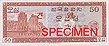 |
 |
₩50 | 156 × 66 mm | Orange | Haegeumgang near Geoje Geoje Geoje is a city located in South Gyeongsang province, just off the coast of the port city of Busan, South Korea. Daewoo Shipbuilding & Marine Engineering in Okpo and Samsung Heavy Industries in Gohyeon are both located on Geoje Island. The city also offers a wide range of tourist sights... |
Torch, value | May 20, 1970 | ||
 |
 |
₩100 | Green | Independence Gate Independence Gate The Independence Gate is a memorial gate located in Seoul, South Korea. The gate was built following the first Sino-Japanese war to inspire a spirit of independence away from previous Korean arrangement as a Chinese protectorate... |
February 14, 1969 | ||||
 |
 |
₩500 | Grey | Namdaemun | February 3, 1967 | ||||
| 1962-1969 KOMSCO Korea Minting and Security Printing Corporation Korea Minting and Security Printing Corporation is a government-owned corporation which is responsible to print and mint the banknotes and coins and other government documents. Its headquarters are located in Daejeon, South Korea... Series http://www.bok.or.kr/template/main/html/index.jsp?tbl=tbl_FM0000000066_CA0000000507 |
|||||||||
 |
 |
10 jeon | 90 × 50 mm | Blue | "Bank of Korea" and value (Korean) | "Bank of Korea" and value (English) | December 1, 1962 | December 1, 1980 | None |
 |
 |
50 jeon | Brown | ||||||
 |
 |
₩10 | 140 × 63 mm | Purple | Cheomseongdae Cheomseongdae Cheomseongdae is an astronomical observatory in Gyeongju, South Korea. Cheomseongdae means star-gazing tower in Korean. Cheomseongdae is the oldest surviving observatory in East Asia, and one of the oldest scientific installations on Earth. It dates to the 7th century to the time of kingdom of... |
Geobukseon Turtle ship The Turtle ship, also known as Geobukseon or Kobukson , was a type of large warship belonging to the Panokseon class in Korea that was used intermittently by the Royal Korean Navy during the Joseon Dynasty from the early 15th century up until the 19th century.The first references to older, first... |
September 21, 1962 | October 30, 1973 | Series II (나) |
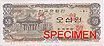 |
 |
₩50 | 149 × 64 mm | Green and orange / Blue | Pagoda Gongweon in Seoul Seoul Seoul , officially the Seoul Special City, is the capital and largest metropolis of South Korea. A megacity with a population of over 10 million, it is the largest city proper in the OECD developed world... |
Beacon Beacon A beacon is an intentionally conspicuous device designed to attract attention to a specific location.Beacons can also be combined with semaphoric or other indicators to provide important information, such as the status of an airport, by the colour and rotational pattern of its airport beacon, or of... , Rose of Sharon Hibiscus syriacus Hibiscus syriacus is a widely cultivated ornamental shrub in the genus Hibiscus. Common names include Rose of Sharon , Shrub Althea and Rose Althea.-Growth:... |
March 21, 1969 | Series II (나) | |
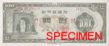 |
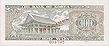 |
₩100 | 156 × 66 mm | Green | Independence Gate Independence Gate The Independence Gate is a memorial gate located in Seoul, South Korea. The gate was built following the first Sino-Japanese war to inspire a spirit of independence away from previous Korean arrangement as a Chinese protectorate... |
Gyeonghoeru Pavilion at Gyeongbok Palace | November 1, 1962 | Series II (나) | |
 |
 |
Sejong the Great | Main building of the Bank of Korea Bank of Korea The Bank of Korea is the central bank of South Korea and issuer of South Korean won. It was established on June 12, 1950 at Seoul, South Korea.The Bank's primary purpose is price stability. For that, the Bank targets inflation... |
August 14, 1965 | December 1, 1980 | Series III (다) | |||
 |
 |
₩500 | 165 × 73 mm | Brown | Namdaemun | Geobukseon Turtle ship The Turtle ship, also known as Geobukseon or Kobukson , was a type of large warship belonging to the Panokseon class in Korea that was used intermittently by the Royal Korean Navy during the Joseon Dynasty from the early 15th century up until the 19th century.The first references to older, first... |
August 16, 1966 | May 10, 1975 | Series II (나) |
With the economic development from the 60s the value of the 500 won notes became lower, resulting in a greater use of cashier's checks with higher fixed denominations as means of payment, as well as an increased use of counterfeited ones. In 1970, the 100 won notes were replaced by coins, with the same happening to the 50 won notes in 1972.
Higher denomination notes of 5000 won and 10,000 won were introduced in 1972 and 1973 respectively. The notes incorporated new security features, including watermark
Watermark
A watermark is a recognizable image or pattern in paper that appears as various shades of lightness/darkness when viewed by transmitted light , caused by thickness or density variations in the paper...
, security thread
Security thread
A security thread is a security feature of many bank notes to protect against counterfeiting, consisting of a thin ribbon that is threaded through the note's paper....
and ultraviolet response fibres and were inglio printed
Intaglio (printmaking)
Intaglio is a family of printmaking techniques in which the image is incised into a surface, known as the matrix or plate, and the incised line or area holds the ink. Normally, copper or zinc plates are used as a surface, and the incisions are created by etching, engraving, drypoint, aquatint or...
. The release of 10,000 won notes was planned to be at the same time as the 5000 won notes but problems with the main theme delayed it by a year. Newly designed 500 won notes were also released in 1973 and the need for a medium denomination resulted in the introduction of 1000 won notes in 1975.
| 1972-1973 Series http://www.bok.or.kr/template/main/html/index.jsp?tbl=tbl_FM0000000066_CA0000000508 | |||||||||||
|---|---|---|---|---|---|---|---|---|---|---|---|
| Image | Value | Dimensions | Main color | Description | Date of | BOK Bank of Korea The Bank of Korea is the central bank of South Korea and issuer of South Korean won. It was established on June 12, 1950 at Seoul, South Korea.The Bank's primary purpose is price stability. For that, the Bank targets inflation... Series Designation | Plate produced | ||||
| Obverse | Reverse | Obverse | Reverse | Watermark | issue | withdrawal | |||||
 |
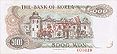 |
₩5000 | 167 × 77 mm | Brown | Yi I Yi I Yi I was one of the two most prominent Korean Confucian scholars of the Joseon Dynasty, the other being his older contemporary, Yi Hwang . Yi I is often referred to by his pen name Yulgok... |
Main building of the Bank of Korea Bank of Korea The Bank of Korea is the central bank of South Korea and issuer of South Korean won. It was established on June 12, 1950 at Seoul, South Korea.The Bank's primary purpose is price stability. For that, the Bank targets inflation... |
July 1, 1972 | December 1, 1980 | Series I (가) | By Thomas de la Rue De La Rue De La Rue plc is a British security printing, papermaking and cash handling systems company headquartered in Basingstoke, Hampshire. It also has a factory on the Team Valley Trading Estate, Gateshead, and other facilities at Loughton, Essex and Bathford, Somerset... |
|
 |
 |
₩10 000 | 171 × 81 mm | Brown | Sejong the Great, Rose of Sharon Hibiscus syriacus Hibiscus syriacus is a widely cultivated ornamental shrub in the genus Hibiscus. Common names include Rose of Sharon , Shrub Althea and Rose Althea.-Growth:... |
Geunjeongjeon at Gyeongbok Palace Gyeongbokgung Gyeongbokgung, also known as Gyeongbokgung Palace or Gyeongbok Palace, is a royal palace located in northern Seoul, South Korea. First constructed in 1394 and reconstructed in 1867, it was the main and largest palace of the Five Grand Palaces built by the Joseon Dynasty... |
June 12, 1973 | November 10, 1981 | Series I (가) | In Japan Japan Japan is an island nation in East Asia. Located in the Pacific Ocean, it lies to the east of the Sea of Japan, China, North Korea, South Korea and Russia, stretching from the Sea of Okhotsk in the north to the East China Sea and Taiwan in the south... |
|
| 1973-1979 Series http://www.bok.or.kr/template/main/html/index.jsp?tbl=tbl_FM0000000066_CA0000000508 | |||||||||||
 |
 |
₩500 | 159 × 69 mm | Green and pink | Yi Sun-sin Yi Sun-sin Yi Sun-shin was a Korean naval commander, famed for his victories against the Japanese navy during the Imjin war in the Joseon Dynasty, and is well-respected for his exemplary conduct on and off the battlefield not only by Koreans, but by Japanese Admirals as well... , Geobukseon Turtle ship The Turtle ship, also known as Geobukseon or Kobukson , was a type of large warship belonging to the Panokseon class in Korea that was used intermittently by the Royal Korean Navy during the Joseon Dynasty from the early 15th century up until the 19th century.The first references to older, first... |
Yi Sun-sin's Shrine at Hyeonchungsa | None | September 1, 1973 | May 12, 1993 | Series III (다) | |
 |
 |
₩1000 | 163 × 73 mm | Purple | Yi Hwang Yi Hwang Yi Hwang is one of the two most prominent Korean Confucian scholars of the Joseon Dynasty, the other being his younger contemporary Yi I . A key figure of the Neo-Confucian literati, he established the Yeongnam School and set up the Dosan Seowon, a private Confucian academy. Yi Hwang is often... , Rose of Sharon Hibiscus syriacus Hibiscus syriacus is a widely cultivated ornamental shrub in the genus Hibiscus. Common names include Rose of Sharon , Shrub Althea and Rose Althea.-Growth:... |
Dosan Seowon Dosan Seowon Dosan Seowon was established in 1574 in what is present day Andong, South Korea, in memory of and four years after the death of Korean Confucian scholar Yi Hwang by some of his disciples and other Korean Confucian authorities... (Dosan Confucian Academy) |
August 14, 1975 | Series I (가) | In Japan Japan Japan is an island nation in East Asia. Located in the Pacific Ocean, it lies to the east of the Sea of Japan, China, North Korea, South Korea and Russia, stretching from the Sea of Okhotsk in the north to the East China Sea and Taiwan in the south... |
||
 |
 |
₩5000 | 167 × 77 mm | Orange | Yi I Yi I Yi I was one of the two most prominent Korean Confucian scholars of the Joseon Dynasty, the other being his older contemporary, Yi Hwang . Yi I is often referred to by his pen name Yulgok... |
Ojukheon in Gangneung Gangneung Gangneung is a city in Gangwon-do, on the east coast of South Korea. It has a population of 229,869 . Gangneung is the economic centre of the Yeongdong region of eastern Gangwon Province. Gangneung has many tourist attractions, like Jeongdongjin, one of the most famous towns in Korea... |
June 1, 1977 | May 12, 1993 | Series II (나) | In Japan Japan Japan is an island nation in East Asia. Located in the Pacific Ocean, it lies to the east of the Sea of Japan, China, North Korea, South Korea and Russia, stretching from the Sea of Okhotsk in the north to the East China Sea and Taiwan in the south... |
|
 |
 |
₩10 000 | 171 × 81 mm | Green | Sejong the Great, Water clock Borugak Jagyeongnu The Borugak Jagyeongnu , classified as a scientific instrument, is the 229th National Treasure of South Korea and was designated by the South Korean government on March 3, 1985. The water clock is currently held and managed by the Royal Museum in Seoul... |
Gyeonghoeru Pavilion at Gyeongbok Palace Gyeongbokgung Gyeongbokgung, also known as Gyeongbokgung Palace or Gyeongbok Palace, is a royal palace located in northern Seoul, South Korea. First constructed in 1394 and reconstructed in 1867, it was the main and largest palace of the Five Grand Palaces built by the Joseon Dynasty... , Rose of Sharon Hibiscus syriacus Hibiscus syriacus is a widely cultivated ornamental shrub in the genus Hibiscus. Common names include Rose of Sharon , Shrub Althea and Rose Althea.-Growth:... |
June 15, 1979 | May 12, 1993 | Series II (나) | In Japan Japan Japan is an island nation in East Asia. Located in the Pacific Ocean, it lies to the east of the Sea of Japan, China, North Korea, South Korea and Russia, stretching from the Sea of Okhotsk in the north to the East China Sea and Taiwan in the south... |
|
In 1982, the 500 won note was replaced by a coin. The following year, as part of its policy of rationalizing the currency system, the Bank of Korea issued a new set of notes, as well as a new set of coins (see above). Some of the note's most notable features were distinguishable marks for the blind under the watermark and the addition of machine-readable language in preparation for mechanization of cash handling. They were also printed on better quality cotton pulp to reduce the production costs by extending their circulation life.
To cope with the deregulation of imports of color printer and the increasing use of computers and scanners, modified 5000 won and 10,000 won notes were released between 1994 and 2002 with various new security features, which included: color-shifting ink, microprint, segmented metal thread, moiré
Moiré pattern
In physics, a moiré pattern is an interference pattern created, for example, when two grids are overlaid at an angle, or when they have slightly different mesh sizes.- Etymology :...
, and EURion constellation
EURion constellation
The EURion constellation is a pattern of symbols found on a number of banknote designs worldwide since about 1996. It is added to help software detect the presence of a banknote in a digital image. Such software can then block the user from reproducing banknotes to prevent counterfeiting using...
. The latest version of the 5000 and 10,000 won are easily identifiable by the copyright information inscribed under the watermark: "© 한국은행" and year of issue on the obverse, "© The Bank of Korea" and year of issue on the reverse.
The plates for the 5000 won notes were produced in Japan while the ones for the 1000 and 10,000 won notes were produced by the Korea Minting and Security Printing Corporation. They were all printed in intaglio
Intaglio (printmaking)
Intaglio is a family of printmaking techniques in which the image is incised into a surface, known as the matrix or plate, and the incised line or area holds the ink. Normally, copper or zinc plates are used as a surface, and the incisions are created by etching, engraving, drypoint, aquatint or...
.
With the release of a new set of notes, no plan has yet been made to withdraw these notes from circulation.
| 1983-2002 Series http://www.bok.or.kr/template/main/html/index.jsp?tbl=tbl_FM0000000066_CA0000000509 | ||||||||||
|---|---|---|---|---|---|---|---|---|---|---|
| Image | Value | Dimensions | Main Color | Description | Date of issue | BOK Series Designation | Modification | |||
| Obverse | Reverse | Obverse | Reverse | Watermark | ||||||
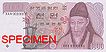 |
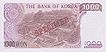 |
₩1000 | 151 × 76 mm | Purple | Yi Hwang Yi Hwang Yi Hwang is one of the two most prominent Korean Confucian scholars of the Joseon Dynasty, the other being his younger contemporary Yi I . A key figure of the Neo-Confucian literati, he established the Yeongnam School and set up the Dosan Seowon, a private Confucian academy. Yi Hwang is often... |
Dosan Seowon Dosan Seowon Dosan Seowon was established in 1574 in what is present day Andong, South Korea, in memory of and four years after the death of Korean Confucian scholar Yi Hwang by some of his disciples and other Korean Confucian authorities... (Dosan Confucian Academy) |
Reversed portrait | June 11, 1983 | Series II (나) | |
 |
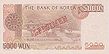 |
₩5000 | 156 × 76 mm | Orange | Yi I Yi I Yi I was one of the two most prominent Korean Confucian scholars of the Joseon Dynasty, the other being his older contemporary, Yi Hwang . Yi I is often referred to by his pen name Yulgok... |
Ojukheon in Gangneung Gangneung Gangneung is a city in Gangwon-do, on the east coast of South Korea. It has a population of 229,869 . Gangneung is the economic centre of the Yeongdong region of eastern Gangwon Province. Gangneung has many tourist attractions, like Jeongdongjin, one of the most famous towns in Korea... |
June 11, 1983 | Series III (다) | ||
 |
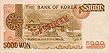 |
June 12, 2002 | Series IV (라) | Color-shifting ink on the dots for blinds, segmented metal thread, copyright inscription | ||||||
 |
 |
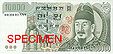
₩10 000 | 161 × 76 mm | Green | Sejong the Great, Water clock Borugak Jagyeongnu The Borugak Jagyeongnu , classified as a scientific instrument, is the 229th National Treasure of South Korea and was designated by the South Korean government on March 3, 1985. The water clock is currently held and managed by the Royal Museum in Seoul... |
Gyeonghoeru Pavilion at Gyeongbok Palace Gyeongbokgung Gyeongbokgung, also known as Gyeongbokgung Palace or Gyeongbok Palace, is a royal palace located in northern Seoul, South Korea. First constructed in 1394 and reconstructed in 1867, it was the main and largest palace of the Five Grand Palaces built by the Joseon Dynasty... |
October 8, 1983 | Series III (다) | ||
 |
 |
January 20, 1994 | Series IV (라) | Segmented metal thread, microprint under the water clock, moiré Moiré pattern In physics, a moiré pattern is an interference pattern created, for example, when two grids are overlaid at an angle, or when they have slightly different mesh sizes.- Etymology :... on watermark area, intaglio latent image |
||||||
 |
 |
Reversed portrait, Taeguk Taeguk Taegeuk refers to the ultimate reality from which all things and values originate according to oriental philosophy. It is also the symbol that makes up the center of the Korean Flag.-History:... |
June 19, 2000 | Series V (마) | Color-shifting ink on the dots for blinds, removal of moiré Moiré pattern In physics, a moiré pattern is an interference pattern created, for example, when two grids are overlaid at an angle, or when they have slightly different mesh sizes.- Etymology :... , EURion constellation EURion constellation The EURion constellation is a pattern of symbols found on a number of banknote designs worldwide since about 1996. It is added to help software detect the presence of a banknote in a digital image. Such software can then block the user from reproducing banknotes to prevent counterfeiting using... , copyright inscription |
|||||
New series
In 2006, it became a major concern that the Korean won banknotes were being counterfeited/forged. Notably the 5000 won note (worth about US$5), over 50% of the notes were confiscated as counterfeit. This led the government to issue a new series of banknotes, with the 5000 won note being the first one to be redesigned. Later in 2007, the 1000 and the 10000 won note was introduced.The banknotes include over 10 security features in each denomination. The 10000 won note has 21 security features, the 5000 won note 17, and the 1000 won note
19. Many modern security features that can be also found in Euro
Euro
The euro is the official currency of the eurozone: 17 of the 27 member states of the European Union. It is also the currency used by the Institutions of the European Union. The eurozone consists of Austria, Belgium, Cyprus, Estonia, Finland, France, Germany, Greece, Ireland, Italy, Luxembourg,...
s, Pound sterling
Pound sterling
The pound sterling , commonly called the pound, is the official currency of the United Kingdom, its Crown Dependencies and the British Overseas Territories of South Georgia and the South Sandwich Islands, British Antarctic Territory and Tristan da Cunha. It is subdivided into 100 pence...
, Canadian dollar
Canadian dollar
The Canadian dollar is the currency of Canada. As of 2007, the Canadian dollar is the 7th most traded currency in the world. It is abbreviated with the dollar sign $, or C$ to distinguish it from other dollar-denominated currencies...
, Japanese yen
Japanese yen
The is the official currency of Japan. It is the third most traded currency in the foreign exchange market after the United States dollar and the euro. It is also widely used as a reserve currency after the U.S. dollar, the euro and the pound sterling...
are included in the banknotes.
Some security features inserted in won notes are:
- Holograms with 3D images that change colors within the metallic foil on the obverse side of the notes(exception of 1000 won)
- WatermarkWatermarkA watermark is a recognizable image or pattern in paper that appears as various shades of lightness/darkness when viewed by transmitted light , caused by thickness or density variations in the paper...
portraits of the effigy of the note is visible when held to the light in the white section of the note - IntaglioIntaglio (printmaking)Intaglio is a family of printmaking techniques in which the image is incised into a surface, known as the matrix or plate, and the incised line or area holds the ink. Normally, copper or zinc plates are used as a surface, and the incisions are created by etching, engraving, drypoint, aquatint or...
printing on words and the effigy give off a raised feeling, different than ordinary paper - Security threadSecurity threadA security thread is a security feature of many bank notes to protect against counterfeiting, consisting of a thin ribbon that is threaded through the note's paper....
in the right side of the obverse side with small lettering "한국은행 Bank of Korea" and the denomination - Color shifting inkOptically Variable InkOptically variable ink is an anti-counterfeiting measure used on many major modern banknotes.The ink displays two distinct colors depending on the angle the bill is viewed at. The United States fifty-dollar bill, for example, uses color shifting ink for the numeral 50 so that it displays copper at...
on the value number at the back of the note
For the first time in the world, the KOMSCO, the Korean mint, inserted a new substance in the notes to detect counterfeits. This technique is being exported to Europe, North America, etc.
| 2006-2007 Series http://www.bok.or.kr/template/main/html/index.jsp?tbl=tbl_FM0000000066_CA0000003901 | |||||||||
|---|---|---|---|---|---|---|---|---|---|
| Image | Value | Dimensions | Main Color | Description | Date of issue | BOK Series Designation | |||
| Obverse | Reverse | Obverse | Reverse | Watermark | |||||
 |
 |
₩1000 | 136 × 68 mm | Blue | Yi Hwang Yi Hwang Yi Hwang is one of the two most prominent Korean Confucian scholars of the Joseon Dynasty, the other being his younger contemporary Yi I . A key figure of the Neo-Confucian literati, he established the Yeongnam School and set up the Dosan Seowon, a private Confucian academy. Yi Hwang is often... , Myeongryundang in Seonggyungwan Seonggyungwan Sungkyunkwan, also called Taehak , was the foremost education institution in Korea during the late Goryeo and Joseon Dynasties.- History :... , plum flowers |
"Gyesangjeonggeodo"; a painting Yi Hwang Yi Hwang Yi Hwang is one of the two most prominent Korean Confucian scholars of the Joseon Dynasty, the other being his younger contemporary Yi I . A key figure of the Neo-Confucian literati, he established the Yeongnam School and set up the Dosan Seowon, a private Confucian academy. Yi Hwang is often... in Dosan Seowon Dosan Seowon Dosan Seowon was established in 1574 in what is present day Andong, South Korea, in memory of and four years after the death of Korean Confucian scholar Yi Hwang by some of his disciples and other Korean Confucian authorities... by Jeong Seon |
Reversed portrait, value | January 22, 2007 | Series III (다) |
 |
 |
₩5000 | 142 × 68 mm | Red and yellow | Yi I Yi I Yi I was one of the two most prominent Korean Confucian scholars of the Joseon Dynasty, the other being his older contemporary, Yi Hwang . Yi I is often referred to by his pen name Yulgok... , Ojukheon in Gangneung Gangneung Gangneung is a city in Gangwon-do, on the east coast of South Korea. It has a population of 229,869 . Gangneung is the economic centre of the Yeongdong region of eastern Gangwon Province. Gangneung has many tourist attractions, like Jeongdongjin, one of the most famous towns in Korea... , black bamboo Phyllostachys nigra Phyllostachys nigra or black bamboo is a major Phyllostachys species of bamboo.-Uses:It is used for lumber, food, and musical instruments, among other things, in areas of China where it is native and worldwide. Unlike golden bamboo, it is not considered an invasive species in the United States. In... |
"Insects and Plants", a painting of a watermelon and cockscombs by Yi I Yi I Yi I was one of the two most prominent Korean Confucian scholars of the Joseon Dynasty, the other being his older contemporary, Yi Hwang . Yi I is often referred to by his pen name Yulgok... 's mother Shin Saimdang |
January 2, 2006 | Series V (마) | |
 |
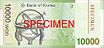 |
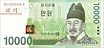
₩10 000 | 148 × 68 mm | Green | Sejong the Great, Irworobongdo Irworobongdo Irworobongdo is a Korean folding screen with a highly stylized landscape painting of a sun and moon, five peaks which always was set behind Eojwa, the king’s royal throne during the Joseon Dynasty. It literally means "Painting of the Sun, Moon and the Five Peaks" and is also called "Irwoldo" or... , a folding screen for Joseon Joseon Dynasty Joseon , was a Korean state founded by Taejo Yi Seong-gye that lasted for approximately five centuries. It was founded in the aftermath of the overthrow of the Goryeo at what is today the city of Kaesong. Early on, Korea was retitled and the capital was relocated to modern-day Seoul... -era kings, and text from the second chapter of Yongbieocheonga, the first work of literature written in Korean |
Globe of Honcheonsigye Honcheonsigye The Honcheonsigye is an astronomical clock created by Song I-yeong in 1669. It is designated as South Korean national treasure number 230.The clock has an armillary sphere with a diameter of 40 cm. The sphere is activated by a working clock mechanism, showing the position of the universe at any... and Cheonsang Yeolcha Bunyajido Cheonsang Yeolcha Bunyajido Cheonsang Yeolcha Bunyajido is a 14th century Korean star map, copies of which were spread nationwide in the Joseon Dynasty. The name is sometimes translated as "chart of the constellations and the regions they govern."... in the background |
January 22, 2007 | Series VI (바) | |
 |
 |
₩50 000 | 154 × 68 mm | Orange and Yellow | Shin Saimdang with Chochungdo - A Folding Screen of Embroidered Plants and Insects (South Korean National Treasure No. 595) in the background | Bamboo Bamboo Bamboo is a group of perennial evergreens in the true grass family Poaceae, subfamily Bambusoideae, tribe Bambuseae. Giant bamboos are the largest members of the grass family.... and a maesil tree |
June 23, 2009 | Series I (가) | |
50,000 won note
On June 23, 2009, the Bank of Korea released the 50,000 Won note. The obverse bears a portrait of Shin Saimdang, a prominent 16th-century artist, calligrapher, and mother of Korean scholar Yulgok, also known as Yi I, who is on the 5,000 Won note. This note is the first Korean banknote that features the portrait of a woman. 100,000 won notes were also announced, but their release was later canceled. The release of the 50,000 won note stirred some controversy among shop owners and those with visual impairments due to its similarity in color and numerical denomination with the 5,000 won note.
Currency production
The Bank of Korea is the only institution in South KoreaSouth Korea
The Republic of Korea , , is a sovereign state in East Asia, located on the southern portion of the Korean Peninsula. It is neighbored by the People's Republic of China to the west, Japan to the east, North Korea to the north, and the East China Sea and Republic of China to the south...
that has the right to print banknotes and mint coins
COinS
ContextObjects in Spans, commonly abbreviated COinS, is a method to embed bibliographic metadata in the HTML code of web pages. This allows bibliographic software to publish machine-readable bibliographic items and client reference management software to retrieve bibliographic metadata. The...
. The banknotes and coins are printed at KOMSCO, a government-owned corporation, under the guidance of the Bank of Korea.
After the new crisp banknotes and coins are printed/minted, they are bundled up in bundles/rolls and shipped to the Headquarters of the Bank of Korea. When delivered, the banknotes and coins are deposited inside the Bank's vault, ready to be distributed to commercial banks when requested.
Every year, around Seollal and Chuseok
Chuseok
Chuseok , originally known as Hangawi , is a major harvest festival and a three-day holiday in Korea celebrated on the 15th day of the 8th month of the lunar calendar. Like many other harvest festivals, it is held around the Autumn Equinox...
, two major Korea
Korea
Korea ) is an East Asian geographic region that is currently divided into two separate sovereign states — North Korea and South Korea. Located on the Korean Peninsula, Korea is bordered by the People's Republic of China to the northwest, Russia to the northeast, and is separated from Japan to the...
n holidays, the Bank of Korea distributes large amount of its currency to most of the commercial banks in South Korea, which are then given to their customers upon request.
See also
External links
- New Korea Notes, information page of BOK's new notes
- Pronunciation of Won at freedictionary.com