


History of Puerto Rico

Encyclopedia
The history of Puerto Rico began with the settlement of the archipelago
of Puerto Rico
by the Ortoiroid people
between 3000 and 2000 BC. Other tribes, such as the Saladoid
and Arawak Indians, populated the island between 430 BC and 1000 AD. At the time of Christopher Columbus
's arrival in the New World
in 1493, the dominant indigenous culture was that of the Taíno
s. The Taíno culture died out during the latter half of the 16th century because of exploitation by Spanish settlers, the war they waged on the Taíno, and diseases introduced by the invaders.
Located in the northeastern Caribbean, Puerto Rico formed a key part of the Spanish Empire
from the early years of the exploration, conquest and colonization of the New World
. The island was a major military post during many wars between Spain and other European powers for control of the region in the 16th, 17th and 18th centuries. The smallest of the Greater Antilles
, Puerto Rico was a stepping-stone in the passage from Europe to Cuba
, Mexico, Central America, and the northern territories of South America. Throughout most of the 19th century until the conclusion of the Spanish–American War, Puerto Rico and Cuba were the last two Spanish colonies in the New World; they served as Spain's final outposts in a strategy to regain control of the American continents.
In 1898, during the Spanish–American war, Puerto Rico was invaded and subsequently became a possession of the United States. The first half of the 20th century was marked by the struggle to obtain greater democratic rights from the United States. The Foraker Act
of 1900, which established a civil government, and the Jones Act
of 1917, which made Puerto Ricans U.S. citizens, paved the way for the drafting of Puerto Rico's Constitution
and the establishment of democratic elections in 1952. However, the political status of Puerto Rico, a Commonwealth controlled by the United States, remains an anomaly more than 500 years after the first Europeans settled the island.
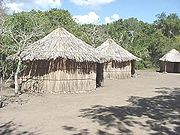 The settlement of Puerto Rico began with the establishment of the Ortoiroid
culture from the Orinoco region
in South America. Some scholars suggest that their settlement dates back 4000 years. An archeological dig at the island of Vieques
in 1990 found the remains of what is believed to be an Ortoiroid man (named Puerto Ferro man) which was dated to around 2000 BC. The Ortoiroid were displaced by the Saladoid
, a culture from the same region that arrived on the island between 430 and 250 BC.
Between the seventh and 11th centuries Arawaks are thought to have settled the island. During this time the Taíno culture developed, and by approximately 1000 AD it had become dominant. Taíno culture has been traced to the village of Saladero at the basin of the Orinoco River
in Venezuela
; the Taínos migrated to Puerto Rico by crossing the Lesser Antilles
.
At the time of Columbus' arrival, an estimated 30 to 60 thousand Taíno Amerindians, led by cacique
(chief) Agüeybaná, inhabited the island. They called it Boriken, "the great land of the valiant and noble Lord". The natives lived in small villages led by a cacique and subsisted on hunting, fishing and gathering of indigenous cassava
root and fruit. When the Spaniards arrived in 1493, conflicts with raiding Caribs, who were moving up the Antilles
chain, were taking place. The Taíno domination of the island was nearing its end and the Spanish arrival would mark the beginning of their extinction. Their culture, however, remains strongly embedded in that of contemporary Puerto Rico. Musical instruments such as maracas and güiro
, the hammock
, and words such as Mayagüez
, Arecibo
, iguana
, and huracán (hurricane) are examples of the legacy left by the Taíno.
 On September 25, 1493, Christopher Columbus
set sail on his second voyage with 17 ships and 1,200–1,500 men from Cádiz
. On November 19, 1493 he landed on the island, naming it San Juan Bautista in honor of Saint John the Baptist
. The first settlement, Caparra, was founded on August 8, 1508 by Juan Ponce de León
, a lieutenant
under Columbus, who later became the first governor
of the island. The following year, the settlement was abandoned in favor of a nearby islet on the coast, named Puerto Rico (Rich Port), which had a suitable harbor. In 1511, a second settlement, San Germán
was established in the southwestern part of the island. During the 1520s, the island took the name of Puerto Rico while the port became San Juan
.
Colonization took the form of encomienda
settlements, where settlers enslaved Taínos, providing them with military protection in return for labor. On December 27, 1512, under pressure from the Roman Catholic Church
, Ferdinand II of Aragon
issued the Burgos' Laws
, which modified the encomiendas into a system called repartimiento
s, aimed at ending the exploitation. The laws prohibited the use of any form of punishment toward the indigenous people, regulated their work hours, pay, hygiene, and care, and ordered them to be catechized
. In 1511, the Taínos revolted against the Spanish; cacique Urayoán
, as planned by Agüeybaná II
, ordered his warriors to drown the Spanish soldier Diego Salcedo
to determine whether the Spaniards were immortal. After drowning Salcedo, they kept watch over his body for three days to confirm his death. The revolt was easily crushed by Ponce de León and within a few decades much of the native population had been decimated by disease, violence, and a high occurrence of suicide.
The Roman Catholic Church, realizing the opportunity to expand its influence, also participated in colonizing the island. On August 8, 1511, Pope Julius II
established three diocese
s in the New World, one in Puerto Rico and two on the island of Hispaniola
under the archbishop
of Seville
. The Canon of Salamanca
, Alonso Manso
, was appointed bishop of the Puerto Rican diocese. On September 26, 1512, before his arrival on the island, the first school of advanced studies was established by the bishop. Taking possession in 1513, he became the first bishop to arrive in the Americas. Puerto Rico would also become the first ecclesiastical headquarters in the New World during the reign of Pope Leo X
and the general headquarters of the Spanish Inquisition
in the New World.
As part of the colonization process, African slaves
were brought to the island in 1513. Following the decline of the Taíno population, more slaves were brought to Puerto Rico; however, the number of slaves on the island paled in comparison to those in neighboring islands. Also, early in the colonization of Puerto Rico, attempts were made to wrest control of Puerto Rico from Spain. The Caribs, a raiding tribe of the Caribbean, attacked Spanish settlements along the banks of the Daguao and Macao rivers in 1514 and again in 1521 but each time they were easily repelled by the superior Spanish firepower. However, these would not be the last attempts at control of Puerto Rico. The European powers quickly realized the potential of the newly discovered lands and attempted to gain control of them.
 Sparked by the possibility of immense wealth, many European powers made attempts to wrest control of the Americas from Spain in the 16th, 17th and 18th centuries. Success in invasion varied, and ultimately all Spanish opponents failed to maintain permanent control of the island. In 1528, the French, recognizing the strategic value of Puerto Rico, sacked and burned the southwestern town of San Germán. They also destroyed many of the island's first settlements, including Guánica
, Sotomayor
, Daguao
and Loíza
before the local militia forced them to retreat. The only settlement that remained was the capital, San Juan. French corsairs would again sack San Germán in 1538 and 1554.
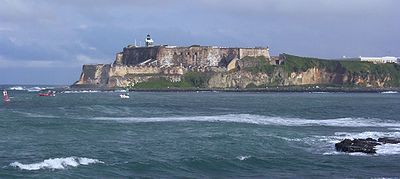
Spain, determined to defend its possession, began the fortification of the inlet of San Juan in the early 16th century. In 1532, construction of the first fortifications began with La Fortaleza
(the Fortress) near the entrance to San Juan bay. Seven years later the construction of massive defenses around San Juan began, including Fort San Felipe del Morro astride the entrance to San Juan bay. Later, Fort San Cristóbal
and Fort San Jerónimo
—built with a financial subsidy from the Mexican mines—garrisoned troops and defended against land attacks. In 1587, engineers Juan de Tejada and Juan Bautista Antonelli
redesigned Fort San Felipe del Morro; these changes endure. Politically, Puerto Rico was reorganized in 1580 into a captaincy general
to provide for more autonomy and quick administrative responses to military threats.
On November 22, 1595, English privateer
Sir Francis Drake—with 27 vessels and 2,500 troops—sailed into San Juan Bay intending to loot the city. Even though San Juan was set ablaze, they were unable to defeat the forces entrenched in the forts. Knowing Drake had failed to overcome the city's defenses by sea, on June 15, 1598, the Royal Navy
, led by George Clifford, 3rd Earl of Cumberland
, landed troops from 21 ships to the east in Santurce
. Clifford and his men met Spanish resistance while attempting to cross the San Antonio bridge (from an area known today as Condado) into the islet of San Juan. Nonetheless, the British conquered the island and held it for several months. They were forced to abandon the island owing to an outbreak of dysentery
among the troops. The following year Spain sent soldiers, cannons, and a new governor, Alonso de Mercado, to rebuild the city of San Juan.
In 1607, Puerto Rico served as a port for provisions for the English ships, the Godspeed, Susan Constant and the Discovery who were on their way to establish the Jamestown, Virginia
, the first English settlement in the New World.
The 17th and 18th centuries saw more attacks on the island. On September 25, 1625, the Dutch
, under the leadership of Boudewijn Hendrick (Balduino Enrico), attacked San Juan, besieging Fort San Felipe del Morro and La Fortaleza. Residents fled the city but the Spanish, led by Governor Juan de Haro, were able to repel the Dutch troops from Fort San Felipe del Morro. In their retreat the Dutch set the city ablaze. The fortification of San Juan continued; in 1634, Philip IV of Spain
fortified Fort San Cristóbal, along with six fortresses linked by a line of sandstone walls surrounding the city. In 1702, the English
assaulted the town of Arecibo, located on the north coast, west of San Juan, with no success. In 1797, the French and Spanish declared war on the United Kingdom
. The British attempted again to conquer the island, attacking San Juan with an invasion force of 7,000 troops and an armada
consisting of 64 warships under the command of General Ralph Abercromby
. Captain General Don Ramón de Castro and his army successfully resisted the attack.
Amidst the constant attacks, the first threads of Puerto Rican society emerged. A 1765 census conducted by Lt. General Alejandro O'Reilly
showed a total population of 44,883, of which 5,037 (11.2%) were slaves, a low percentage compared to the other Spanish colonies in the Caribbean. In 1786 the first comprehensive history of Puerto Rico—Historia Geográfica, Civil y Política de Puerto Rico by Fray Iñigo Abbad y Lasierra
—was published in Madrid
, documenting the history of Puerto Rico from the time of Columbus' landing in 1493 until 1783. The book also presents a first hand account of Puerto Rican identity, including music, clothing, personality and nationality.
In 1779, Puerto Ricans fought in the American Revolutionary War
under the command of Bernardo de Gálvez, who was named Field Marshal
of the Spanish colonial army in North America. Puerto Ricans participated the capture of Pensacola
, the capital of the British colony of West Florida and the cities of Baton Rouge
, St. Louis
and Mobile
. The Puerto Rican troops, commanded by Brigadier General Ramón de Castro, helped defeat the British and Indian army of 2,500 soldiers and British warships in Pensacola.
 The 19th century brought many changes to Puerto Rico, both political and social. In 1809, the Spanish government, in opposition to Napoleon, was convened in Cádiz in southern Spain. While still swearing allegiance to the king, the Supreme Central Junta
invited voting representatives from the colonies. Ramón Power y Giralt
was nominated as the local delegate to the Cádiz Cortes
. The Ley Power ("the Power Act") soon followed, which designated five ports for free commerce—Fajardo
, Mayagüez, Aguadilla
, Cabo Rojo
and Ponce
—and established economic reforms with the goal of developing a more efficient economy. In 1812, the Cádiz Constitution
was adopted, dividing Spain and its territories into provinces, each with a local corporation or council to promote its prosperity and defend its interests; this granted Puerto Ricans conditional citizenship.
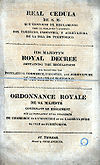
On August 10, 1815, the Royal Decree of Grace
was issued, allowing foreigners to enter Puerto Rico (including French refugees from Hispaniola), and opening the port to trade with nations other than Spain. This was the beginning of agriculture-based economic growth, with sugar, tobacco and coffee being the main products. The Decree also gave free land to anyone who swore their loyalty to the Spanish Crown and their allegiance to the Roman Catholic Church. Thousands of families from all regions of Spain (particularly Asturias, Catalonia, Majorca and Galicia), Germany
, Corsica
, Ireland
, France
, Portugal, the Canary Islands
and other locations, escaping from harsh economic times in Europe and lured by the offer of free land, soon immigrated to Puerto Rico. However, these small gains in autonomy and rights were short lived. After the fall of Napoleon, absolute power
returned to Spain, which revoked the Cádiz Constitution and reinstated Puerto Rico to its former condition as a colony
, subject to the unrestricted power of the Spanish monarch
.
The integration of immigrants into Puerto Rican culture and other events changed Puerto Rican society. On June 25, 1835, Queen María Cristina abolished the slave trade to Spanish colonies. In 1851, Governor Juan de la Pezuela Cevallos founded the Royal Academy of Belles Letters. The academy licensed primary school teachers, formulated school methods, and held literary contests that promoted the intellectual and literary progress of the island.
In 1858, Samuel Morse introduced wired communication to Latin America
when he established a telegraph system in Puerto Rico. Morse's oldest daughter Susan Walker Morse (1821-1885), would often visit her uncle Charles Pickering Walker who owned the Hacienda Concordia in the town of Guayama
. Morse, who often spent his winters at the Hacienda with his daughter and son-in-law, who lived and owned the Habienda Henriqueta, set a two-mile telegraph line connecting his son-in-law's hacienda to their house in Arroyo. The line was inaugurated on March 1, 1859 in a ceremony flanked by the Spanish and American flags. The first lines transmitted by Morse that day in Puerto Rico were:
. A census conducted in 1860 revealed a population of 583,308. Of these, 300,406 (51.5%) were white and 282,775 (48.5%) were persons of color, the latter including people of primarily African heritage, mulatto
s and mestizo
s. The majority of the population in Puerto Rico was illiterate (83.7%) and lived in poverty, and the agricultural industry—at the time, the main source of income—was hampered by lack of road infrastructure, adequate tools and equipment, and natural disasters, including hurricanes and droughts. The economy also suffered from increasing tariffs and taxes imposed by the Spanish Crown. Furthermore, Spain had begun to exile or jail any person who called for liberal reforms.
 On September 23, 1868, hundreds of men and women in the town of Lares
—stricken by poverty and politically estranged from Spain—revolted against Spanish rule, seeking Puerto Rican independence. The Grito de Lares
("Lares Cry" or "Lares Uprising") was planned by a group led by Dr. Ramón Emeterio Betances
, at the time exiled to the Dominican Republic
, and Segundo Ruiz Belvis
. Dr. Betances had founded the Comité Revolucionario de Puerto Rico (Revolutionary Committee of Puerto Rico
) in January 1868. The most important figures in the uprising were Manuel Rojas, Mathias Brugman
, Mariana Bracetti
, Francisco Ramirez Medina
and Lola Rodríguez de Tió
. The uprising, although significant, was quickly controlled by Spanish authorities.
Following the Grito de Lares revolt, political and social reforms occurred toward the end of the 19th century. On June 4, 1870, due to the efforts of Román Baldorioty de Castro
, Luis Padial
and Julio Vizcarrondo
, the Moret Law
was approved, giving freedom to slaves born after September 17, 1868 or over 60 years old; on March 22, 1873, the Spanish National Assembly officially abolished, with a few special clauses, slavery in Puerto Rico. In 1870, the first political organizations on the island were formed as two factions emerged. The Traditionalists, known as the Partido Liberal Conservador (Liberal Conservative Party) were led by José R. Fernández, Pablo Ubarri and Francisco Paula Acuña and advocated assimilation into the political party system of Spain. The Autonomists, known as the Partido Liberal Reformista (Liberal Reformist Party
) were led by Román Baldorioty de Castro, José Julián Acosta
, Nicolás Aguayo and Pedro Gerónimo Goico and advocated decentralization away from Spanish control. Both parties would later change their names to Partido Incondicional Español (Unconditional Spanish Party) and Partido Federal Reformista (Reformist Federal Party), respectively. In March 1887, the Partido Federal Reformista was reformed and named the Partido Autonomista Puertorriqueño (Puerto Rican Autonomist Party
); it tried to create a political and legal identity for Puerto Rico while emulating Spain in all political matters. It was led by Román Baldorioty de Castro, José Celso Barbosa
, Rosendo Matienzo Cintrón
and Luis Muñoz Rivera
.
 Leaders of "El Grito de Lares", who were in exile in New York City, joined the Puerto Rican Revolutionary Committee, founded on December 8, 1895, and continued their quest for Puerto Rican independence. In 1897, Antonio Mattei Lluberas
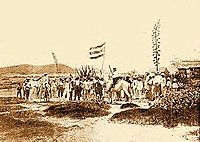
and the local leaders of the independence movement of the town of Yauco, organized another uprising, which became known as the "Intentona de Yauco
". This was the first time that the current Puerto Rican was unfurled in Puerto Rican soil. The local conservative political factions, which believed that such an attempt would be a threat to their struggle for autonomy, opposed such an action. Rumors of the planned event spread to the local Spanish authorities who acted swiftly and put an end to what would be the last major uprising in the island to Spanish colonial rule.
The struggle for autonomy came close to achieving its goal on November 25, 1897, when the Carta Autonómica (Charter of Autonomy), which conceded political and administrative autonomy to the island, was approved in Spain. In the past 400-plus years, after centuries of colonial rule, Práxedes Mateo Sagasta
, the Prime Minister of Spain granted the island an autonomous government on November 25, 1897 in the empire's legislative body in Cádiz, Spain, and trade was opened up with the United States and European colonies. The charter maintained a governor appointed by Spain, who held the power to veto any legislative decision he disagreed with, and a partially elected parliamentary structure. That same year, the Partido Autonomista Ortodoxo (Orthodox Autonomist Party), led by José Celso Barbosa and Manuel Fernández Juncos
, was founded. On February 9, 1898, the new government officially began. Local legislature set its own budget and taxes. They accepted or rejected commercial treaties concluded by Spain. In February 1898, Governor General Manuel Macías
inaugurated the new government of Puerto Rico under the Autonomous Charter which gave town councils complete autonomy in local matters. Subsequently, the governor had no authority to intervene in civil and political matters unless authorized to do so by the Cabinet. General elections were held in March and on July 17, 1898 Puerto Rico's autonomous government began to function, but not for long.
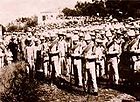 In 1890, Captain Alfred Thayler Mahan, a member of the Navy War Board and leading U.S. strategic thinker, wrote a book titled The Influence of Sea Power upon History in which he argued for the creation of a large and powerful navy modeled after the British Royal Navy. Part of his strategy called for the acquisition of colonies in the Caribbean Sea which would serve as coaling and naval stations and which would serve as strategical points of defense upon the construction of a canal in the Isthmus
.
This idea was not new, since William H. Seward
, the former Secretary of State under the administrations of various presidents, among them Abraham Lincoln
and Ulysses Grant, had stressed that a canal be built either in Honduras
, Nicaragua
or Panama
and that the United States annex the Dominican Republic
and purchase Puerto Rico and Cuba. The idea of annexing the Dominican Republic failed to receive the approval of the U.S. Senate and Spain did not accept the 160 million dollars which the U.S. offered for Puerto Rico and Cuba.
Captain Mahan made the following statement to the to the War Department:
Since 1894, the Naval War College
had been formulating plans for war with Spain. By 1896, the Office of Naval Intelligence had prepared a plan which included military operations in Puerto Rican waters. Not only was Puerto Rico considered valuable as a naval station, Puerto Rico and Cuba were also abundant in a valuable commercial commodity which the United States lacked, that commodity was sugar.
On March 10, 1898, Dr. Julio J. Henna
and Robert H. Todd
, leaders of the Puerto Rican section of the Cuban Revolutionary Party, began to correspond with United States President William McKinley
and the United States Senate in hopes that they would consider including Puerto Rico in the intervention planned for Cuba. Henna and Todd also provided the US government with information about the Spanish military presence on the island. On April 24, Spanish Minister of Defense Segismundo Bermejo
sent instructions to Spanish Admiral Cervera to proceed with his fleet from Cape Verde
to the Caribbean, Cuba and Puerto Rico.
In May, Lt. Henry H. Whitney of the United States Fourth Artillery was sent to Puerto Rico on a reconnaissance mission. He provided maps and information on the Spanish military forces to the US government that would be useful for an invasion. Following the sinking of the battleship USS Maine on February 15, 1898, in Havana harbor, Cuba, the United States forwarded an ultimatum to Spain to withdraw from Cuba. In response, Spain broke off diplomatic relations with the United States, and on April 23, 1898, Spain declared war
. On April 25, the U.S. Congress
declared that a state of war between the United States and Spain had existed since April 20. One of the United States' principal objectives in the Spanish-American War was to take control of Spanish possessions in the Atlantic — Puerto Rico and Cuba — and their possessions in the Pacific — the Philippines
and Guam
. On May 10, Spanish forces at Fort San Cristóbal under the command of Capt. Ángel Rivero Méndez
in San Juan exchanged fire with the under the command of Capt. William C. Wise. Two days later on May 12, a squadron of 12 US ships commanded by Rear Admiral William T. Sampson
bombarded San Juan, causing panic among the residents. On June 25, the blocked San Juan harbor. On July 18, General Nelson A. Miles
, commander of US forces, received orders to sail for Puerto Rico and to land his troops. On July 21, a convoy with nine transports and 3,300 soldiers, escorted by , sailed for Puerto Rico from Guantánamo
. General Nelson Miles landed unopposed at Guánica
, located in the southern coast of the island, on July 25, 1898 with the first contingent of American troops. Opposition was met in the southern and central regions of the island but by the end of August the island was under United States control.
On August 12, peace protocols were signed in Washington, D.C.
and Spanish Commissions met in San Juan on September 9 to discuss the details of the withdrawal of Spanish troops and the cession of the island to the United States. On October 1, an initial meeting was held in Paris to draft the Peace Treaty and on December 10, 1898, the Treaty of Paris
was signed (ratified by the US Senate February 6, 1899). Spain renounced all claim to Cuba, ceded Guam
and Puerto Rico and its dependent islets to the United States, and transferred sovereignty over the Philippines
to the United States for $20,000,000 ($ as of ). General John R. Brooke
became the first United States military governor of the island.
. Freedom of assembly, speech, press, and religion were decreed and an eight-hour day
for government employees was established. A public school system was begun and the U.S. Postal service
was extended to the island. The highway system was enlarged, and bridges over the more important rivers were constructed. The government lottery was abolished, cockfight
ing was forbidden, and a centralized public health service established. Health conditions were poor at the time, with high rates of infant mortality and numerous endemic diseases.
 The beginning of the military government also marked the creation of new political groups. The Partido Republicano (Republican Party) and the American Federal Party
were created, led by José Celso Barbosa and Luis Muñoz Rivera, respectively. Both groups supported annexation by the United States as a solution to the colonial situation. The island's Creole
sugar planters, who had suffered from declining prices, greeted U.S. rule, hoping to gain access to the North American market.
Disaster struck in August 1899, when two hurricanes ravaged the island: Hurricane San Ciriaco
on August 8, and an unnamed hurricane on August 22. Approximately 3,400 people died in the floods and thousands were left without shelter, food, or work. The effects on the economy were devastating: millions of dollars were lost due to the destruction of the majority of the sugar and coffee plantations.
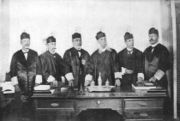 The military government in Puerto Rico was short lived; it was disbanded on April 2, 1900, when the U.S. Congress enacted the Foraker Act
(also known as the Organic Act of 1900), sponsored by Senator Joseph B. Foraker
. This act established a civil government and free commerce between the island and the United States. The structure of the insular government included a governor appointed by the president, an executive council (the equivalent of a senate), and a legislature with 35 members, though the executive veto required a two-thirds vote to override. The first appointed civil governor, Charles Herbert Allen
, was inaugurated on May 1, 1900. On June 5, President McKinley appointed an Executive Council which included five Puerto Rican members and six U.S. members. The act also established the creation of a judicial system headed by the Supreme Court of Puerto Rico
and allowed Puerto Rico to send a Resident Commissioner
as a representative to Congress. The Department of Education was subsequently formed, headed by Dr. M. G. Brumbaugh (later governor of Pennsylvania
). Teaching was conducted entirely in English with Spanish treated as a special subject. However, both Spanish and English were official languages in the island. On November 6, the first elections under the Foraker Act were held and on December 3, the first Legislative Assembly
took office. Federico Degetau
took office in Washington as the first Resident Commissioner from Puerto Rico on March 14, 1901. The Foraker Act, (with the influence of the American sugar companies) required the removal of a stipulation from a local law which placed a limit of 500 acres (2 km²) as the amount of land that any one person was allowed to own. Thus the Foraker Act, whose political framework was established by the military and the War Department, transformed Puerto Rico's agricultural economy into a sugar monoculture economy. American sugar companies had an advantage over the local sugar plantation owners. The local plantation owner could only finance his operations at local banks which offered high interest rates compared to the low rates that the American companies received from the commercial banks in Wall Street
. This factor, plus the tariffs now imposed, forced many of the local sugar plantation owners to go bankrupt or to sell their holdings to the more powerful sugar companies. Sugar was considered one of the few strategic commodities in which the United States was not fully self sufficient.
The new political status sparked the creation of more political groups on the island. In 1900, the Partido Federal (Federal Party
) and the Partido Obrero Socialista de Puerto Rico (Socialist Labor Party of Puerto Rico) were founded. The former campaigned for Puerto Rico to become one of the states in the United States while the latter followed the ideals of the Socialist Labor Party of America
. Four years later, in 1904, Luis Muñoz Rivera and José de Diego
restructured the American Federal Party into the Partido Unionista de Puerto Rico (Unionist Party of Puerto Rico
) with the intention of fighting against the colonial government established under the Foraker Act. In 1909, Rosendo Matienzo Cintrón
, Manuel Zeno Gandía
, Luis Llorens Torres
, Eugenio Benítez Castaño, and Pedro Franceschi founded the Partido Independentista (Independence Party). It was the first political party whose agenda was the independence of Puerto Rico.
The status quo was again altered in 1909 when the Foraker Act, due to weaknesses and a small crisis in Puerto Rico's government, was modified by the Olmsted Amendment
. This Amendment placed the supervision of Puerto Rican affairs in the jurisdiction of an executive department to be designated by the president. In 1914, the first Puerto Rican officers, Martin Travieso (Secretary) and Manuel V. Domenech
(Commissioner of Interiors), were assigned to the Executive Cabinet, allowing islanders a majority. A 1915 delegation from Puerto Rico, accompanied by the Governor Arthur Yager
, traveled to Washington, D.C. to ask Congress to grant the island more autonomy. This delegation and speeches made by Resident Commissioner Luis Muñoz Rivera in Congress, coupled with political and economic interests, led to the drafting of the Jones-Shafroth Act
of 1917 (Jones Act).
 By January 30, 1908, the "Puerto Rico Regiment of Infantry" was stationed at Camp Las Casas
in Santurce
. Different units were stationed at other forts throughout the island and Lt. Marxuach was stationed at El Morro Castle, (then an Army base called Fort Brooke) at San Juan Bay. The United States tried to remain neutral when World War I broke out in August 1914. However Washington
insisted on its neutral right to send ships without them being attacked by German submarines. The American ships carried food and raw materials to Britain
. On March 21, 1915, Lt. Teofilo Marxuach
was the officer of the day at El Morro Castle. The Odenwald, built in 1903 (not to be confused with the German World War II war ship which carried the same name), was an armed German supply ship which tried to force its way out of the San Juan Bay and deliver supplies to the German submarine
s waiting in the Atlantic Ocean. Lt. Marxuach gave the order to open fire on the ship from the walls of the fort. Sergeant Encarnacion Correa then manned a machine gun and fired warning shots at the ship with little effect. Marxuach then fired a shot from a cannon located at the Santa Rosa battery, in what is considered to be the first shot of World War I fired by the regular armed forces of the United States against any ship flying the colors of the Central Powers ", forcing the Odenwald to stop and to return to port where its supplies were confiscated. The shots ordered by Lt. Marxuach were the first fired by the United States in World War I.
was approved by the U.S. Congress on December 5, 1916, and signed into law by President Woodrow Wilson
on March 2, 1917. The law made Puerto Rico a United States territory
which is "organized but unincorporated." Puerto Ricans were also collectively given a restricted U.S. citizenship. This implied that Puerto Ricans in the island did not have full American citizenship rights, such as the right to vote for the president of the United States. via the Jones Act
. The Act allowed conscription
to be extended to the island, sending 20,000 Puerto Rican soldiers to the United States Army
during the First World War
. The Act also divided governmental powers into three branches: executive (appointed by the President of the United States), legislative, and judicial. The legislative branch was composed of the senate, consisting of 19 members, and a house of representatives, consisting of 39 members. The members of the legislature were freely elected by the Puerto Rican people. A bill of rights, which established elections to be held every four years, was also created. The Act also made English the official language of the Puerto Rican courts.
On October 11, 1918, an earthquake
occurred, with an approximate magnitude of 7.3 on the Richter scale
, accompanied by a tsunami
reaching 6.1 metres (20 ft) in height. The epicenter was located northwest of Aguadilla in the Mona Passage (between Puerto Rico and the Dominican Republic
). This earthquake caused great damage and loss of life at Mayagüez
, and lesser damage along the west coast. Tremors continued for several weeks.
As a consequence of the Jones Act and the establishment of elections, a new political party, the Partido Nacionalista de Puerto Rico (Puerto Rican Nationalist Party
), was founded on September 17, 1922. In the 1930s, the Nationalist Party, led by Pedro Albizu Campos
withdrew from political participation and increased conflict arose between their adherents and the authorities.
In the 1920s, the economy of Puerto Rico boomed. A drastic increase in the price of sugar, Puerto Rico's principal export, brought increasing revenues to the island. As a result the island's infrastructure was steadily upgraded. New schools, roads and bridges were constructed. The increase in private wealth was reflected in the erection of many residences, while the development of commerce and agriculture stimulated the extension of banking and transport facilities. The high infant mortality death rate of the late 19th century declined steadily, thanks in large measure to basic public health programs. However, the economic growth would come to a screeching halt in 1929 when the United States stock market crash
ed.
This period of prosperity came to an end with the onset of the Great Depression
. At the time, agriculture was the main contributor to the economy. Industry and commerce slowed during the 1930s as well. The depression was further aggravated when on September 27, 1932, Hurricane San Ciprián
struck the island. Exact figures of the destruction are not known but estimates say that 200–300 people were killed, more than a thousand were injured, and property damage escalated to $30–50 million ($ to $ as of ). The agricultural production, the principal economic driver for the island, came to a standstill. However, the decline of the economy would not end there. A new federal minimum wage
law of 25 cents an hour took effect in 1938. As a consequence, two-thirds of the island's textile factories closed because worker productivity was below that level.
On October 23, 1935, A student assembly was held at the University of Puerto Rico, where Albizu Campos was declared "persona non grata
". It was requested that Governor Blanton Winship provide and place armed police officers on the grounds of the university in case the situation turned violent. This responsibility pertained to Colonel Elisha Francis Riggs, the U.S. appointed Police Chief. A couple of police officers spotted what they believed to be a suspicious looking automobile and asked the driver Ramón S. Pagán, who was accompanied by his friend Pedro Quiñones, for his license. A fight between the men in the car and the police soon followed which resulted in the death of four nationalist and one bystander. On February 23, 1936, two Nationalists Hiram Rosado and Elias Beauchamp, in retaliation for the "Rio Piedras Massacre
," killed Police Chief Riggs in San Juan. They were apprehended and summarily executed at police headquarters. On July 31, 1936, Pedro Albizu Campos, Juan Antonio Corretjer
, Clemente Soto Vélez
and other Nationalists were sentenced to six to 10 years in federal prison.
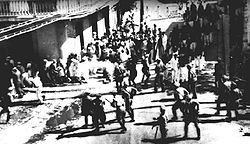 On March 21, 1937, a peaceful march was organized by the Nationalist Party to commemorate the ending of slavery in Puerto Rico by the governing Spanish National Assembly in 1873. The police, under the orders of General Blanton Winship, the US-appointed colonial Governor of Puerto Rico, opened fire at the peaceful Puerto Rican Nationalist Party parade, bringing about what came to be known as the "Ponce Massacre
": 20 people (including two of the policemen) were killed and over 100 were wounded. On July 25, 1938, a little over a year after the Ponce massacre, Governor Winship ordered a military parade take place in the city of Ponce in celebration of the American invasion of Puerto Rico. Such celebration customarily took place in San Juan, the capital of the colonial government. At the parade, an attempt was made to assassinate Winship, allegedly by members of the Nationalist Party. It was the first time in Puerto Rico's long history that an attempt had been made against a governor. Although Winship escaped unscathed, a total of 36 people were wounded, including a colonel in the National Guard and the Nationalist gunman.
.svg.png) In the years after World War II, social, political and economical changes began to take place that have continued to shape the island's character today. The late 1940s brought the beginning of a major migration
In the years after World War II, social, political and economical changes began to take place that have continued to shape the island's character today. The late 1940s brought the beginning of a major migration
to the continental United States, mainly to New York City. The main reasons for this were an undesirable economic situation brought by the Great Depression, as well as heavy recruitment made by the U.S. armed forces
and U.S. companies. Political changes began in 1946 when President Truman designated the first Puerto Rican, Commissioner Resident Jesús T. Piñero
, to serve as island governor. On June 11, 1948, Piñero, signed the infamous "Ley de la Mordaza" (Gag Law) or Law 53 as it was officially known, passed by the Puerto Rican legislature which made it illegal to display the Puerto Rican Flag, sing a patriotic song, talk of independence and to fight for the liberation of the island. It resembled the anti-communist Smith Law
passed in the United States.
The U.S. Congress passed an act allowing Puerto Ricans to vote for their own governor and the first elections under this act were held on November 2, 1948. Luis Muñoz Marín
, president of the Puerto Rican Senate, successfully campaigned and became the first democratically elected Governor of the island on January 2, 1949. In the 1950s, an ambitious industrialization project dubbed Operation Bootstrap
was launched under governor Muñoz Marín. It was coupled with agrarian reform (land redistribution) that limited the area that could be held by large sugarcane interests. Operation Bootstrap enticed US mainland investors to transfer or create manufacturing plants by granting them local and federal tax concessions, but maintaining the access to US markets free of import duties. Another incentive was the lower wage scales in the densely populated island, which had a rising urban unemployed population. The program accelerated the shift from an agricultural to an industrial society. The 1950s saw the development of labor-intensive light industries, such as textiles; later manufacturing gave way to heavy industry, such as petrochemicals and oil refining, in the 1960s and 1970s. Muñoz Marín's development programs brought some prosperity for an emergent middle class. The industrialization was in part fueled by generous local incentives and freedom from federal taxation, while providing access to continental US markets without import duties. As a result, a rural agricultural society was transformed into an industrial working class.
On July 4, 1950, President Harry S. Truman
signed Public Act 600, which allowed Puerto Ricans to draft their own constitution establishing the Commonwealth of Puerto Rico. The U.S. Congress had granted commonwealth status on Puerto Rico that enhanced Puerto Rico's political status from protectorate
to commonwealth. This, coupled with Muñoz Marín's reversal on not pursuing Puerto Rican Independence angered some Puerto Ricans. On late October 1950, a group of Puerto Rican nationalists, led by Pedro Albizu Campos, staged several revolts known as the Puerto Rican Nationalist Party Revolts of the 1950s
, the most successful of which is known as the Jayuya Uprising
. The revolts included an attack on the governor's mansion
, La Fortaleza
, the United States Capitol and at Blair House, where nationalists attempted to assassinate United States President Harry S. Truman. These acts led Muñoz to crack down on Puerto Rican nationalists and advocates of Puerto Rican independence. The actions by both Muñoz and the United States' Government would later be determined as infringing on constitutional rights. On July 25, 1952, the Constitution of Puerto Rico was approved by voters in a referendum, and the island organized as the Estado Libre Asociado (Commonwealth of Puerto Rico). That same year marked the first time that the Flag of Puerto Rico
could be publicly displayed.
The Partido Estadistas Unido (United Statehooders Party) was founded by Luis A. Ferré
to campaign for statehood in the 1967 plebiscite. On July 23, 1967, the first plebiscite on the political status of Puerto Rico was held. Voters overwhelmingly affirmed continuation of Commonwealth status (Commonwealth–60.4% Statehood–39%; Independence–0.6%). Other plebiscites have taken place to determine the political status of Puerto Rico, one in 1993 and another in 1998. Both times, although by smaller margins, the status quo has been upheld. However, the U.S. constitution does not mention this avenue of status, hence legally the island remains a territory of the United States, under congressional supervision. The Partido Estadistas Unido organized the Partido Nuevo Progresista
(New Progressive Party) under Ferré's leadership. The party campaigned for Puerto Rico to become the 51st state
of the Union. Luis A. Ferré was elected governor on November 5, 1968, with 43.6% of the vote, the first time a pro-statehood governor has received a plurality. The New Progressive Party, the Popular Democratic Party and the Independence Party constitute the current established political parties in the island.
Present-day Puerto Rico has become a major tourist
destination and a leading pharmaceutical
and manufacturing center. Still, Puerto Rico continues to struggle to define its political status. Even though Puerto Rico was granted local autonomy in 1952, it remains a territory of the United States. Its ambiguous status continues to spark political debates which dominate Puerto Rican society. Economically, Puerto Rico has recently seen its credit rating downgraded to Baa2 by Moody's Investor Services
with the possibility of more downgrades happening in the near future. This has led to fiscal measures to reduce government spending, increase revenues and balance the budget, and the implementation of a 7% sales tax.
Archipelago
An archipelago , sometimes called an island group, is a chain or cluster of islands. The word archipelago is derived from the Greek ἄρχι- – arkhi- and πέλαγος – pélagos through the Italian arcipelago...
of Puerto Rico
Puerto Rico
Puerto Rico , officially the Commonwealth of Puerto Rico , is an unincorporated territory of the United States, located in the northeastern Caribbean, east of the Dominican Republic and west of both the United States Virgin Islands and the British Virgin Islands.Puerto Rico comprises an...
by the Ortoiroid people
Ortoiroid people
The Ortoiroid people were the first human settlers of the Caribbean, who peaked culturally from 5000—200 BCE. They are believed to have originated in the Orinoco valley in South America, migrating to the Antilles from Trinidad and Tobago to Puerto Rico...
between 3000 and 2000 BC. Other tribes, such as the Saladoid
Saladoid
Saladoid culture is a pre-columbian indigenous culture of Venezuela and the Caribbean that flourished from 500 BCE to 545 CE.-Name:They have been given the name of the sites where their unique pottery styles were first recognised. The suffix "oid" has been added in this cultural classification...
and Arawak Indians, populated the island between 430 BC and 1000 AD. At the time of Christopher Columbus
Christopher Columbus
Christopher Columbus was an explorer, colonizer, and navigator, born in the Republic of Genoa, in northwestern Italy. Under the auspices of the Catholic Monarchs of Spain, he completed four voyages across the Atlantic Ocean that led to general European awareness of the American continents in the...
's arrival in the New World
New World
The New World is one of the names used for the Western Hemisphere, specifically America and sometimes Oceania . The term originated in the late 15th century, when America had been recently discovered by European explorers, expanding the geographical horizon of the people of the European middle...
in 1493, the dominant indigenous culture was that of the Taíno
Taíno people
The Taínos were pre-Columbian inhabitants of the Bahamas, Greater Antilles, and the northern Lesser Antilles. It is thought that the seafaring Taínos are relatives of the Arawak people of South America...
s. The Taíno culture died out during the latter half of the 16th century because of exploitation by Spanish settlers, the war they waged on the Taíno, and diseases introduced by the invaders.
Located in the northeastern Caribbean, Puerto Rico formed a key part of the Spanish Empire
Spanish Empire
The Spanish Empire comprised territories and colonies administered directly by Spain in Europe, in America, Africa, Asia and Oceania. It originated during the Age of Exploration and was therefore one of the first global empires. At the time of Habsburgs, Spain reached the peak of its world power....
from the early years of the exploration, conquest and colonization of the New World
New World
The New World is one of the names used for the Western Hemisphere, specifically America and sometimes Oceania . The term originated in the late 15th century, when America had been recently discovered by European explorers, expanding the geographical horizon of the people of the European middle...
. The island was a major military post during many wars between Spain and other European powers for control of the region in the 16th, 17th and 18th centuries. The smallest of the Greater Antilles
Greater Antilles
The Greater Antilles are one of three island groups in the Caribbean. Comprising Cuba, Jamaica, Hispaniola , and Puerto Rico, the Greater Antilles constitute almost 90% of the land mass of the entire West Indies.-Greater Antilles in context :The islands of the Caribbean Sea, collectively known as...
, Puerto Rico was a stepping-stone in the passage from Europe to Cuba
Cuba
The Republic of Cuba is an island nation in the Caribbean. The nation of Cuba consists of the main island of Cuba, the Isla de la Juventud, and several archipelagos. Havana is the largest city in Cuba and the country's capital. Santiago de Cuba is the second largest city...
, Mexico, Central America, and the northern territories of South America. Throughout most of the 19th century until the conclusion of the Spanish–American War, Puerto Rico and Cuba were the last two Spanish colonies in the New World; they served as Spain's final outposts in a strategy to regain control of the American continents.
In 1898, during the Spanish–American war, Puerto Rico was invaded and subsequently became a possession of the United States. The first half of the 20th century was marked by the struggle to obtain greater democratic rights from the United States. The Foraker Act
Foraker Act
The Foraker Act,officially the Organic Act of 1900, is a United States federal law that established civilian government on the island of Puerto Rico, which had been newly acquired by the United States as a result of the Spanish–American War. Section VII of the Foraker Act also established Puerto...
of 1900, which established a civil government, and the Jones Act
Jones-Shafroth Act
The Jones–Shafroth Act was a 1917 Act of the United States Congress by which Puerto Ricans were collectively made U.S. citizens, the people of Puerto Rico were empowered to have a popularly-elected Senate, established a bill of rights, and authorized the election of a Resident Commissioner to a...
of 1917, which made Puerto Ricans U.S. citizens, paved the way for the drafting of Puerto Rico's Constitution
Constitution of Puerto Rico
The Constitution of the Commonwealth of Puerto Rico is the controlling government document of the Commonwealth of Puerto Rico. It is composed of nine articles detailing the structure of the government as well as the function of several of its institutions. The document also contains an extensive...
and the establishment of democratic elections in 1952. However, the political status of Puerto Rico, a Commonwealth controlled by the United States, remains an anomaly more than 500 years after the first Europeans settled the island.
Pre-colonial Puerto Rico
Ortoiroid people
The Ortoiroid people were the first human settlers of the Caribbean, who peaked culturally from 5000—200 BCE. They are believed to have originated in the Orinoco valley in South America, migrating to the Antilles from Trinidad and Tobago to Puerto Rico...
culture from the Orinoco region
Orinoco
The Orinoco is one of the longest rivers in South America at . Its drainage basin, sometimes called the Orinoquia, covers , with 76.3% of it in Venezuela and the remainder in Colombia...
in South America. Some scholars suggest that their settlement dates back 4000 years. An archeological dig at the island of Vieques
Vieques, Puerto Rico
Vieques , in full Isla de Vieques, is an island–municipality of Puerto Rico in the northeastern Caribbean, part of an island grouping sometimes known as the Spanish Virgin Islands...
in 1990 found the remains of what is believed to be an Ortoiroid man (named Puerto Ferro man) which was dated to around 2000 BC. The Ortoiroid were displaced by the Saladoid
Saladoid
Saladoid culture is a pre-columbian indigenous culture of Venezuela and the Caribbean that flourished from 500 BCE to 545 CE.-Name:They have been given the name of the sites where their unique pottery styles were first recognised. The suffix "oid" has been added in this cultural classification...
, a culture from the same region that arrived on the island between 430 and 250 BC.
Between the seventh and 11th centuries Arawaks are thought to have settled the island. During this time the Taíno culture developed, and by approximately 1000 AD it had become dominant. Taíno culture has been traced to the village of Saladero at the basin of the Orinoco River
Orinoco
The Orinoco is one of the longest rivers in South America at . Its drainage basin, sometimes called the Orinoquia, covers , with 76.3% of it in Venezuela and the remainder in Colombia...
in Venezuela
Venezuela
Venezuela , officially called the Bolivarian Republic of Venezuela , is a tropical country on the northern coast of South America. It borders Colombia to the west, Guyana to the east, and Brazil to the south...
; the Taínos migrated to Puerto Rico by crossing the Lesser Antilles
Lesser Antilles
The Lesser Antilles are a long, partly volcanic island arc in the Western Hemisphere. Most of its islands form the eastern boundary of the Caribbean Sea with the Atlantic Ocean, with the remainder located in the southern Caribbean just north of South America...
.
At the time of Columbus' arrival, an estimated 30 to 60 thousand Taíno Amerindians, led by cacique
Cacique
Cacique is a title derived from the Taíno word for the pre-Columbian chiefs or leaders of tribes in the Bahamas, Greater Antilles, and the northern Lesser Antilles...
(chief) Agüeybaná, inhabited the island. They called it Boriken, "the great land of the valiant and noble Lord". The natives lived in small villages led by a cacique and subsisted on hunting, fishing and gathering of indigenous cassava
Cassava
Cassava , also called yuca or manioc, a woody shrub of the Euphorbiaceae native to South America, is extensively cultivated as an annual crop in tropical and subtropical regions for its edible starchy tuberous root, a major source of carbohydrates...
root and fruit. When the Spaniards arrived in 1493, conflicts with raiding Caribs, who were moving up the Antilles
Antilles
The Antilles islands form the greater part of the West Indies in the Caribbean Sea. The Antilles are divided into two major groups: the "Greater Antilles" to the north and west, including the larger islands of Cuba, Jamaica, Hispaniola , and Puerto Rico; and the smaller "Lesser Antilles" on the...
chain, were taking place. The Taíno domination of the island was nearing its end and the Spanish arrival would mark the beginning of their extinction. Their culture, however, remains strongly embedded in that of contemporary Puerto Rico. Musical instruments such as maracas and güiro
Güiro
The güiro is a Latin-American percussion instrument consisting of an open-ended, hollow gourd with parallel notches cut in one side. It is played by rubbing a stick or tines along the notches to produce a ratchet-like sound. The güiro is commonly used in Latin-American music, and plays a key role...
, the hammock
Hammock
A hammock is a sling made of fabric, rope, or netting, suspended between two points, used for swinging, sleeping, or resting. It normally consists of one or more cloth panels, or a woven network of twine or thin rope stretched with ropes between two firm anchor points such as trees or posts....
, and words such as Mayagüez
Mayagüez, Puerto Rico
Mayagüez is the eighth-largest municipality of Puerto Rico. Originally founded as "Nuestra Señora de la Candelaria" it is also known as "La Sultana del Oeste" , "Ciudad de las Aguas Puras" , or "Ciudad del Mangó"...
, Arecibo
Arecibo, Puerto Rico
Arecibo is a municipality in the northern midwest coast of Puerto Rico and located by the Atlantic Ocean, north of Utuado and Ciales; east of Hatillo; and west of Barceloneta, and Florida. Arecibo is spread over 18 wards and Arecibo Pueblo...
, iguana
Iguana
Iguana is a herbivorous genus of lizard native to tropical areas of Central America and the Caribbean. The genus was first described in 1768 by Austrian naturalist Josephus Nicolaus Laurenti in his book Specimen Medicum, Exhibens Synopsin Reptilium Emendatam cum Experimentis circa Venena...
, and huracán (hurricane) are examples of the legacy left by the Taíno.
Beginning of colonization
Christopher Columbus
Christopher Columbus was an explorer, colonizer, and navigator, born in the Republic of Genoa, in northwestern Italy. Under the auspices of the Catholic Monarchs of Spain, he completed four voyages across the Atlantic Ocean that led to general European awareness of the American continents in the...
set sail on his second voyage with 17 ships and 1,200–1,500 men from Cádiz
Cádiz
Cadiz is a city and port in southwestern Spain. It is the capital of the homonymous province, one of eight which make up the autonomous community of Andalusia....
. On November 19, 1493 he landed on the island, naming it San Juan Bautista in honor of Saint John the Baptist
John the Baptist
John the Baptist was an itinerant preacher and a major religious figure mentioned in the Canonical gospels. He is described in the Gospel of Luke as a relative of Jesus, who led a movement of baptism at the Jordan River...
. The first settlement, Caparra, was founded on August 8, 1508 by Juan Ponce de León
Juan Ponce de León
Juan Ponce de León was a Spanish explorer. He became the first Governor of Puerto Rico by appointment of the Spanish crown. He led the first European expedition to Florida, which he named...
, a lieutenant
Lieutenant
A lieutenant is a junior commissioned officer in many nations' armed forces. Typically, the rank of lieutenant in naval usage, while still a junior officer rank, is senior to the army rank...
under Columbus, who later became the first governor
Governor
A governor is a governing official, usually the executive of a non-sovereign level of government, ranking under the head of state...
of the island. The following year, the settlement was abandoned in favor of a nearby islet on the coast, named Puerto Rico (Rich Port), which had a suitable harbor. In 1511, a second settlement, San Germán
San Germán, Puerto Rico
San Germán is a municipality located in the southwestern region of Puerto Rico, south of Mayagüez and Maricao; north of Lajas; east of Hormigueros and Cabo Rojo; and west of Sabana Grande. San Germán is spread over 18 wards and San Germán Pueblo...
was established in the southwestern part of the island. During the 1520s, the island took the name of Puerto Rico while the port became San Juan
San Juan, Puerto Rico
San Juan , officially Municipio de la Ciudad Capital San Juan Bautista , is the capital and most populous municipality in Puerto Rico, an unincorporated territory of the United States. As of the 2010 census, it had a population of 395,326 making it the 46th-largest city under the jurisdiction of...
.
Colonization took the form of encomienda
Encomienda
The encomienda was a system that was employed mainly by the Spanish crown during the colonization of the Americas to regulate Native American labor....
settlements, where settlers enslaved Taínos, providing them with military protection in return for labor. On December 27, 1512, under pressure from the Roman Catholic Church
Roman Catholic Church
The Catholic Church, also known as the Roman Catholic Church, is the world's largest Christian church, with over a billion members. Led by the Pope, it defines its mission as spreading the gospel of Jesus Christ, administering the sacraments and exercising charity...
, Ferdinand II of Aragon
Ferdinand II of Aragon
Ferdinand the Catholic was King of Aragon , Sicily , Naples , Valencia, Sardinia, and Navarre, Count of Barcelona, jure uxoris King of Castile and then regent of that country also from 1508 to his death, in the name of...
issued the Burgos' Laws
Leyes de Burgos
The Leyes de Burgos , promulgated on December 27, 1512 in Burgos, Kingdom of Castile , was the first codified set of laws governing the behavior of Spaniards in the Americas, particularly with regards to the Indigenous peoples of the Americas ...
, which modified the encomiendas into a system called repartimiento
Repartimiento
The Repartimiento was a colonial forced labor system imposed upon the indigenous population of Spanish America and the Philippines. In concept it was similar to other tribute-labor systems, such as the mita of the Inca Empire or the corvée of Ancien Régime France: the natives were forced to do...
s, aimed at ending the exploitation. The laws prohibited the use of any form of punishment toward the indigenous people, regulated their work hours, pay, hygiene, and care, and ordered them to be catechized
Catechism
A catechism , i.e. to indoctrinate) is a summary or exposition of doctrine, traditionally used in Christian religious teaching from New Testament times to the present...
. In 1511, the Taínos revolted against the Spanish; cacique Urayoán
Urayoán
Urayoán was a Taíno "Cacique" famous for ordering the drowning of Diego Salcedo to determine if the Spanish were gods.He was the cacique of "Yucayeque del Yagüeka or Yagueca", a region that presently spans between Añasco and Mayagüez, Puerto Rico. In 1511, Urayoán and Agüeybaná II conceived a...
, as planned by Agüeybaná II
Agüeybaná
Agüeybaná and Agüeybaná II , were the principal and most powerful caciques of the Taíno people in "Borikén" when the Spaniards first arrived on the island on November 19, 1493.- "The Great Sun" :...
, ordered his warriors to drown the Spanish soldier Diego Salcedo
Diego Salcedo (soldier)
Diego Salcedo was a Spanish conquistador who allegedly lived during the colonization of the Americas. According to legend, his death at the hands of Taíno Indians ignited the Taíno rebellion of 1511....
to determine whether the Spaniards were immortal. After drowning Salcedo, they kept watch over his body for three days to confirm his death. The revolt was easily crushed by Ponce de León and within a few decades much of the native population had been decimated by disease, violence, and a high occurrence of suicide.
The Roman Catholic Church, realizing the opportunity to expand its influence, also participated in colonizing the island. On August 8, 1511, Pope Julius II
Pope Julius II
Pope Julius II , nicknamed "The Fearsome Pope" and "The Warrior Pope" , born Giuliano della Rovere, was Pope from 1503 to 1513...
established three diocese
Diocese
A diocese is the district or see under the supervision of a bishop. It is divided into parishes.An archdiocese is more significant than a diocese. An archdiocese is presided over by an archbishop whose see may have or had importance due to size or historical significance...
s in the New World, one in Puerto Rico and two on the island of Hispaniola
Hispaniola
Hispaniola is a major island in the Caribbean, containing the two sovereign states of the Dominican Republic and Haiti. The island is located between the islands of Cuba to the west and Puerto Rico to the east, within the hurricane belt...
under the archbishop
Archbishop
An archbishop is a bishop of higher rank, but not of higher sacramental order above that of the three orders of deacon, priest , and bishop...
of Seville
Seville
Seville is the artistic, historic, cultural, and financial capital of southern Spain. It is the capital of the autonomous community of Andalusia and of the province of Seville. It is situated on the plain of the River Guadalquivir, with an average elevation of above sea level...
. The Canon of Salamanca
Salamanca
Salamanca is a city in western Spain, in the community of Castile and León. Because it is known for its beautiful buildings and urban environment, the Old City was declared a UNESCO World Heritage Site in 1988. It is the most important university city in Spain and is known for its contributions to...
, Alonso Manso
Alonso Manso
Bishop Alonso Manso was a Spanish bishop born in Becerril de Campos, Spain. He studied theology at the University of Salamanca. He became the canon of Salamanca and the chaplain of the prince Don Juan. On November 15, 1504 he was appointed bishop of Magua, Dominican Republic...
, was appointed bishop of the Puerto Rican diocese. On September 26, 1512, before his arrival on the island, the first school of advanced studies was established by the bishop. Taking possession in 1513, he became the first bishop to arrive in the Americas. Puerto Rico would also become the first ecclesiastical headquarters in the New World during the reign of Pope Leo X
Pope Leo X
Pope Leo X , born Giovanni di Lorenzo de' Medici, was the Pope from 1513 to his death in 1521. He was the last non-priest to be elected Pope. He is known for granting indulgences for those who donated to reconstruct St. Peter's Basilica and his challenging of Martin Luther's 95 Theses...
and the general headquarters of the Spanish Inquisition
Spanish Inquisition
The Tribunal of the Holy Office of the Inquisition , commonly known as the Spanish Inquisition , was a tribunal established in 1480 by Catholic Monarchs Ferdinand II of Aragon and Isabella I of Castile. It was intended to maintain Catholic orthodoxy in their kingdoms, and to replace the Medieval...
in the New World.
As part of the colonization process, African slaves
African slave trade
Systems of servitude and slavery were common in many parts of Africa, as they were in much of the ancient world. In some African societies, the enslaved people were also indentured servants and fully integrated; in others, they were treated much worse...
were brought to the island in 1513. Following the decline of the Taíno population, more slaves were brought to Puerto Rico; however, the number of slaves on the island paled in comparison to those in neighboring islands. Also, early in the colonization of Puerto Rico, attempts were made to wrest control of Puerto Rico from Spain. The Caribs, a raiding tribe of the Caribbean, attacked Spanish settlements along the banks of the Daguao and Macao rivers in 1514 and again in 1521 but each time they were easily repelled by the superior Spanish firepower. However, these would not be the last attempts at control of Puerto Rico. The European powers quickly realized the potential of the newly discovered lands and attempted to gain control of them.
European threats
Guánica, Puerto Rico
Guánica is a municipality in southwestern Puerto Rico located on southern coast, bordering the Caribbean Sea, south of Sabana Grande, east of Lajas, and west of Yauco. It is part of the Yauco Metropolitan Statistical Area....
, Sotomayor
Aguada, Puerto Rico
Aguada is a municipality of Puerto Rico, located in the western coastal valley region bordering the Atlantic Ocean, west of Rincón, Aguadilla and Moca; and north of Anasco. It is part of the Aguadilla-Isabela-San Sebastián Metropolitan Statistical Area...
, Daguao
Ceiba, Puerto Rico
Ceiba is a small town in northeast Puerto Rico. It is named after the famous Ceiba tree. Ceiba is located in the east coast of the island, bordering the Atlantic Ocean, north of Naguabo, south of Fajardo, and east of Río Grande. It is located about one hour's driving distance from San Juan...
and Loíza
Loíza, Puerto Rico
Loíza is a small town and municipality in the northeastern coast of Puerto Rico, north of Canóvanas; east of Carolina; and west of Río Grande. Loíza is spread over 5 wards and Loíza Pueblo...
before the local militia forced them to retreat. The only settlement that remained was the capital, San Juan. French corsairs would again sack San Germán in 1538 and 1554.
Spain, determined to defend its possession, began the fortification of the inlet of San Juan in the early 16th century. In 1532, construction of the first fortifications began with La Fortaleza
La Fortaleza
La Fortaleza is the current official residence of the Governor of Puerto Rico. It was built between 1533 and 1540 to defend the harbor of San Juan. The structure is also known as Palacio de Santa Catalina . It is the oldest executive mansion in the New World...
(the Fortress) near the entrance to San Juan bay. Seven years later the construction of massive defenses around San Juan began, including Fort San Felipe del Morro astride the entrance to San Juan bay. Later, Fort San Cristóbal
Fort San Cristóbal
The Castillo de San Cristóbal is a Spanish fort in San Juan, Puerto Rico. It was built by Spain to protect against land based attacks on the city of San Juan. It is part of San Juan National Historic Site....
and Fort San Jerónimo
Fort San Jerónimo
Fortín de San Gerónimo del Boquerón is a small fort located in the entrance to what is known today as the Condado Lagoon which faces the historic town of Miramar in San Juan, Puerto Rico....
—built with a financial subsidy from the Mexican mines—garrisoned troops and defended against land attacks. In 1587, engineers Juan de Tejada and Juan Bautista Antonelli
Juan Bautista Antonelli
Battista Antonelli was a military engineer from a prestigious Italian family of military engineers in the service of the Habsburg monarchs of Austria and Spain....
redesigned Fort San Felipe del Morro; these changes endure. Politically, Puerto Rico was reorganized in 1580 into a captaincy general
Captaincy General of Puerto Rico
The Captaincy General of Puerto Rico was an administrative district of the Spanish Empire, created in 1580 to provide better military management of the island of Puerto Rico, previously under the direct rule of a simple governor and the jurisdiction of Audiencia of Santo Domingo...
to provide for more autonomy and quick administrative responses to military threats.
On November 22, 1595, English privateer
Privateer
A privateer is a private person or ship authorized by a government by letters of marque to attack foreign shipping during wartime. Privateering was a way of mobilizing armed ships and sailors without having to spend public money or commit naval officers...
Sir Francis Drake—with 27 vessels and 2,500 troops—sailed into San Juan Bay intending to loot the city. Even though San Juan was set ablaze, they were unable to defeat the forces entrenched in the forts. Knowing Drake had failed to overcome the city's defenses by sea, on June 15, 1598, the Royal Navy
Royal Navy
The Royal Navy is the naval warfare service branch of the British Armed Forces. Founded in the 16th century, it is the oldest service branch and is known as the Senior Service...
, led by George Clifford, 3rd Earl of Cumberland
George Clifford, 3rd Earl of Cumberland
Sir George Clifford, 3rd Earl of Cumberland, KG was an English peer, as well as a naval commander and courtier in the court of Queen Elizabeth I.-Background:...
, landed troops from 21 ships to the east in Santurce
Santurce, San Juan, Puerto Rico
Santurce is a district of San Juan, Puerto Rico.-Summary:Santurce is one of the top ten most populated areas of the island holding Miramar, Loíza, Isla Grande, Barrio Obrero, and Condado as main cultural hot spots for art, music, cuisine, fashion, hotels, technology, multimedia, film, textile and...
. Clifford and his men met Spanish resistance while attempting to cross the San Antonio bridge (from an area known today as Condado) into the islet of San Juan. Nonetheless, the British conquered the island and held it for several months. They were forced to abandon the island owing to an outbreak of dysentery
Dysentery
Dysentery is an inflammatory disorder of the intestine, especially of the colon, that results in severe diarrhea containing mucus and/or blood in the faeces with fever and abdominal pain. If left untreated, dysentery can be fatal.There are differences between dysentery and normal bloody diarrhoea...
among the troops. The following year Spain sent soldiers, cannons, and a new governor, Alonso de Mercado, to rebuild the city of San Juan.
In 1607, Puerto Rico served as a port for provisions for the English ships, the Godspeed, Susan Constant and the Discovery who were on their way to establish the Jamestown, Virginia
Jamestown, Virginia
Jamestown was a settlement in the Colony of Virginia. Established by the Virginia Company of London as "James Fort" on May 14, 1607 , it was the first permanent English settlement in what is now the United States, following several earlier failed attempts, including the Lost Colony of Roanoke...
, the first English settlement in the New World.
The 17th and 18th centuries saw more attacks on the island. On September 25, 1625, the Dutch
Netherlands
The Netherlands is a constituent country of the Kingdom of the Netherlands, located mainly in North-West Europe and with several islands in the Caribbean. Mainland Netherlands borders the North Sea to the north and west, Belgium to the south, and Germany to the east, and shares maritime borders...
, under the leadership of Boudewijn Hendrick (Balduino Enrico), attacked San Juan, besieging Fort San Felipe del Morro and La Fortaleza. Residents fled the city but the Spanish, led by Governor Juan de Haro, were able to repel the Dutch troops from Fort San Felipe del Morro. In their retreat the Dutch set the city ablaze. The fortification of San Juan continued; in 1634, Philip IV of Spain
Philip IV of Spain
Philip IV was King of Spain between 1621 and 1665, sovereign of the Spanish Netherlands, and King of Portugal until 1640...
fortified Fort San Cristóbal, along with six fortresses linked by a line of sandstone walls surrounding the city. In 1702, the English
Kingdom of England
The Kingdom of England was, from 927 to 1707, a sovereign state to the northwest of continental Europe. At its height, the Kingdom of England spanned the southern two-thirds of the island of Great Britain and several smaller outlying islands; what today comprises the legal jurisdiction of England...
assaulted the town of Arecibo, located on the north coast, west of San Juan, with no success. In 1797, the French and Spanish declared war on the United Kingdom
Kingdom of Great Britain
The former Kingdom of Great Britain, sometimes described as the 'United Kingdom of Great Britain', That the Two Kingdoms of Scotland and England, shall upon the 1st May next ensuing the date hereof, and forever after, be United into One Kingdom by the Name of GREAT BRITAIN. was a sovereign...
. The British attempted again to conquer the island, attacking San Juan with an invasion force of 7,000 troops and an armada
Naval fleet
A fleet, or naval fleet, is a large formation of warships, and the largest formation in any navy. A fleet at sea is the direct equivalent of an army on land....
consisting of 64 warships under the command of General Ralph Abercromby
Ralph Abercromby
Sir Ralph Abercromby was a Scottish soldier and politician. He rose to the rank of lieutenant-general in the British Army, was noted for his services during the Napoleonic Wars, and served as Commander-in-Chief, Ireland.He twice served as MP for Clackmannanshire and Kinross-shire, and was...
. Captain General Don Ramón de Castro and his army successfully resisted the attack.
Amidst the constant attacks, the first threads of Puerto Rican society emerged. A 1765 census conducted by Lt. General Alejandro O'Reilly
Alejandro O'Reilly
Alejandro O'Reilly , was a military reformer and Inspector-General of Infantry for the Spanish Empire in the second half of the 18th century...
showed a total population of 44,883, of which 5,037 (11.2%) were slaves, a low percentage compared to the other Spanish colonies in the Caribbean. In 1786 the first comprehensive history of Puerto Rico—Historia Geográfica, Civil y Política de Puerto Rico by Fray Iñigo Abbad y Lasierra
Fray Iñigo Abbad y Lasierra
Fray Íñigo Abbad y Lasierra , born in Estadilla, Spain, was a Benedictine monk and the first historian to extensively document Puerto Rico's history, nationality and culture....
—was published in Madrid
Madrid
Madrid is the capital and largest city of Spain. The population of the city is roughly 3.3 million and the entire population of the Madrid metropolitan area is calculated to be 6.271 million. It is the third largest city in the European Union, after London and Berlin, and its metropolitan...
, documenting the history of Puerto Rico from the time of Columbus' landing in 1493 until 1783. The book also presents a first hand account of Puerto Rican identity, including music, clothing, personality and nationality.
In 1779, Puerto Ricans fought in the American Revolutionary War
American Revolutionary War
The American Revolutionary War , the American War of Independence, or simply the Revolutionary War, began as a war between the Kingdom of Great Britain and thirteen British colonies in North America, and ended in a global war between several European great powers.The war was the result of the...
under the command of Bernardo de Gálvez, who was named Field Marshal
Field Marshal
Field Marshal is a military rank. Traditionally, it is the highest military rank in an army.-Etymology:The origin of the rank of field marshal dates to the early Middle Ages, originally meaning the keeper of the king's horses , from the time of the early Frankish kings.-Usage and hierarchical...
of the Spanish colonial army in North America. Puerto Ricans participated the capture of Pensacola
Pensacola, Florida
Pensacola is the westernmost city in the Florida Panhandle and the county seat of Escambia County, Florida, United States of America. As of the 2000 census, the city had a total population of 56,255 and as of 2009, the estimated population was 53,752...
, the capital of the British colony of West Florida and the cities of Baton Rouge
Baton Rouge, Louisiana
Baton Rouge is the capital of the U.S. state of Louisiana. It is located in East Baton Rouge Parish and is the second-largest city in the state.Baton Rouge is a major industrial, petrochemical, medical, and research center of the American South...
, St. Louis
St. Louis, Missouri
St. Louis is an independent city on the eastern border of Missouri, United States. With a population of 319,294, it was the 58th-largest U.S. city at the 2010 U.S. Census. The Greater St...
and Mobile
Mobile, Alabama
Mobile is the third most populous city in the Southern US state of Alabama and is the county seat of Mobile County. It is located on the Mobile River and the central Gulf Coast of the United States. The population within the city limits was 195,111 during the 2010 census. It is the largest...
. The Puerto Rican troops, commanded by Brigadier General Ramón de Castro, helped defeat the British and Indian army of 2,500 soldiers and British warships in Pensacola.
Early 19th century
Junta (Peninsular War)
In the Napoleonic era, junta was the name chosen by several local administrations formed in Spain during the Peninsular War as a patriotic alternative to the official administration toppled by the French invaders...
invited voting representatives from the colonies. Ramón Power y Giralt
Ramon Power y Giralt
Captain Ramón Power y Giralt , commonly known only as "Ramón Power", was, according to Puerto Rican historian Lidio Cruz Monclova, among the first native born Puerto Ricans to refer to himself as a "Puerto Rican" and to fight for the equal representation of Puerto Rico in front of the parliamentary...
was nominated as the local delegate to the Cádiz Cortes
Cádiz Cortes
The Cádiz Cortes were sessions of the national legislative body which met in the safe haven of Cádiz during the French occupation of Spain during the Napoleonic Wars...
. The Ley Power ("the Power Act") soon followed, which designated five ports for free commerce—Fajardo
Fajardo, Puerto Rico
Fajardo is a small city in Puerto Rico located in the east region of the island, bordering the Atlantic Ocean, north of Ceiba and east of Luquillo.Fajardo is spread over 7 wards and Downtown Fajardo , which serves as the administrative center of the city...
, Mayagüez, Aguadilla
Aguadilla, Puerto Rico
Aguadilla , founded in 1775 by Luis de Córdova, is a city located in the northwestern tip of Puerto Rico bordered by the Atlantic Ocean to the north and west, north of Aguada, and Moca and west of Isabela. Aguadilla is spread over 15 wards and Aguadilla Pueblo...
, Cabo Rojo
Cabo Rojo, Puerto Rico
Cabo Rojo is a municipality situated on the southwest coast of Puerto Rico and forms part of the San Germán–Cabo Rojo metropolitan area as well as the larger Mayagüez–San Germán–Cabo Rojo Combined Statistical Area....
and Ponce
Ponce, Puerto Rico
Ponce is both a city and a municipality in the southern part of Puerto Rico. The city is the seat of the municipal government.The city of Ponce, the fourth most populated in Puerto Rico, and the most populated outside of the San Juan metropolitan area, is named for Juan Ponce de León y Loayza, the...
—and established economic reforms with the goal of developing a more efficient economy. In 1812, the Cádiz Constitution
Spanish Constitution of 1812
The Spanish Constitution of 1812 was promulgated 19 March 1812 by the Cádiz Cortes, the national legislative assembly of Spain, while in refuge from the Peninsular War...
was adopted, dividing Spain and its territories into provinces, each with a local corporation or council to promote its prosperity and defend its interests; this granted Puerto Ricans conditional citizenship.
On August 10, 1815, the Royal Decree of Grace
Royal Decree of Graces of 1815
The Royal Decree of Graces of 1815 is a legal order approved by the Spanish Crown in the early half of the 19th century to encourage Spaniards and later Europeans of non-Spanish origin to settle and populate the colonies of Cuba and Puerto Rico....
was issued, allowing foreigners to enter Puerto Rico (including French refugees from Hispaniola), and opening the port to trade with nations other than Spain. This was the beginning of agriculture-based economic growth, with sugar, tobacco and coffee being the main products. The Decree also gave free land to anyone who swore their loyalty to the Spanish Crown and their allegiance to the Roman Catholic Church. Thousands of families from all regions of Spain (particularly Asturias, Catalonia, Majorca and Galicia), Germany
German immigration to Puerto Rico
German immigration to Puerto Rico increased when German businessmen immigrated to Puerto Rico during the early part of the 19th century. However, it was the economic and political situation in Europe during the early 19th century plus, the fact that the Spanish Crown issued the Royal Decree of...
, Corsica
Corsican immigration to Puerto Rico
Corsican immigration to Puerto Rico came about as a result of various economic and political changes in the mid-19th century Europe; among those factors were the social-economic changes which came about in Europe as a result of the Second Industrial Revolution, political discontent and widespread...
, Ireland
Irish immigration to Puerto Rico
From the 16th to the 19th century, there was considerable Irish immigration to Puerto Rico, for a number of reasons. During the 16th century many Irishmen, who were known as "Wild Geese," fled the English Army and joined the Spanish Army. Some of these men were stationed in Puerto Rico and...
, France
French immigration to Puerto Rico
The French immigration to Puerto Rico came about as a result of the economic and political situations which occurred in various places such as Louisiana , Saint-Domingue and in Europe....
, Portugal, the Canary Islands
Canary Islands
The Canary Islands , also known as the Canaries , is a Spanish archipelago located just off the northwest coast of mainland Africa, 100 km west of the border between Morocco and the Western Sahara. The Canaries are a Spanish autonomous community and an outermost region of the European Union...
and other locations, escaping from harsh economic times in Europe and lured by the offer of free land, soon immigrated to Puerto Rico. However, these small gains in autonomy and rights were short lived. After the fall of Napoleon, absolute power
Absolute monarchy
Absolute monarchy is a monarchical form of government in which the monarch exercises ultimate governing authority as head of state and head of government, his or her power not being limited by a constitution or by the law. An absolute monarch thus wields unrestricted political power over the...
returned to Spain, which revoked the Cádiz Constitution and reinstated Puerto Rico to its former condition as a colony
Colony
In politics and history, a colony is a territory under the immediate political control of a state. For colonies in antiquity, city-states would often found their own colonies. Some colonies were historically countries, while others were territories without definite statehood from their inception....
, subject to the unrestricted power of the Spanish monarch
Monarch
A monarch is the person who heads a monarchy. This is a form of government in which a state or polity is ruled or controlled by an individual who typically inherits the throne by birth and occasionally rules for life or until abdication...
.
The integration of immigrants into Puerto Rican culture and other events changed Puerto Rican society. On June 25, 1835, Queen María Cristina abolished the slave trade to Spanish colonies. In 1851, Governor Juan de la Pezuela Cevallos founded the Royal Academy of Belles Letters. The academy licensed primary school teachers, formulated school methods, and held literary contests that promoted the intellectual and literary progress of the island.
In 1858, Samuel Morse introduced wired communication to Latin America
Latin America
Latin America is a region of the Americas where Romance languages – particularly Spanish and Portuguese, and variably French – are primarily spoken. Latin America has an area of approximately 21,069,500 km² , almost 3.9% of the Earth's surface or 14.1% of its land surface area...
when he established a telegraph system in Puerto Rico. Morse's oldest daughter Susan Walker Morse (1821-1885), would often visit her uncle Charles Pickering Walker who owned the Hacienda Concordia in the town of Guayama
Guayama, Puerto Rico
Guayama is a municipality of Puerto Rico founded on January 29, 1736 and located on the Southern Coastal Valley region, bordering the Caribbean, south of Cayey; east of Salinas; and west of Patillas and Arroyo. Guayama is spread over 9 wards and Guayama Pueblo...
. Morse, who often spent his winters at the Hacienda with his daughter and son-in-law, who lived and owned the Habienda Henriqueta, set a two-mile telegraph line connecting his son-in-law's hacienda to their house in Arroyo. The line was inaugurated on March 1, 1859 in a ceremony flanked by the Spanish and American flags. The first lines transmitted by Morse that day in Puerto Rico were:
"Puerto Rico, beautiful jewel! When you are linked with the other jewels of the Antilles in the necklace of the world's telegraph, yours will not shine less brilliantly in the crown of your Queen!"
Struggle for sovereignty
The last half of the 19th century was marked by the Puerto Rican struggle for sovereigntySovereignty
Sovereignty is the quality of having supreme, independent authority over a geographic area, such as a territory. It can be found in a power to rule and make law that rests on a political fact for which no purely legal explanation can be provided...
. A census conducted in 1860 revealed a population of 583,308. Of these, 300,406 (51.5%) were white and 282,775 (48.5%) were persons of color, the latter including people of primarily African heritage, mulatto
Mulatto
Mulatto denotes a person with one white parent and one black parent, or more broadly, a person of mixed black and white ancestry. Contemporary usage of the term varies greatly, and the broader sense of the term makes its application rather subjective, as not all people of mixed white and black...
s and mestizo
Mestizo
Mestizo is a term traditionally used in Latin America, Philippines and Spain for people of mixed European and Native American heritage or descent...
s. The majority of the population in Puerto Rico was illiterate (83.7%) and lived in poverty, and the agricultural industry—at the time, the main source of income—was hampered by lack of road infrastructure, adequate tools and equipment, and natural disasters, including hurricanes and droughts. The economy also suffered from increasing tariffs and taxes imposed by the Spanish Crown. Furthermore, Spain had begun to exile or jail any person who called for liberal reforms.
Lares, Puerto Rico
Lares is a small mountain municipality of Puerto Rico's central-western area located north of Maricao and Yauco; south of Camuy, east of San Sebastián and Las Marias; and west of Hatillo, Utuado and Adjuntas. Lares is spread over 10 wards and Lares Pueblo...
—stricken by poverty and politically estranged from Spain—revolted against Spanish rule, seeking Puerto Rican independence. The Grito de Lares
Grito de Lares
El Grito de Lares —also referred as the Lares uprising, the Lares revolt, Lares rebellion or even Lares Revolution—was the first major revolt against Spanish rule and call for independence in Puerto Rico...
("Lares Cry" or "Lares Uprising") was planned by a group led by Dr. Ramón Emeterio Betances
Ramón Emeterio Betances
Ramón Emeterio Betances y Alacán was a Puerto Rican nationalist. He was the primary instigator of the Grito de Lares revolution, and as such, is considered to be the father of the Puerto Rican independence movement...
, at the time exiled to the Dominican Republic
Dominican Republic
The Dominican Republic is a nation on the island of La Hispaniola, part of the Greater Antilles archipelago in the Caribbean region. The western third of the island is occupied by the nation of Haiti, making Hispaniola one of two Caribbean islands that are shared by two countries...
, and Segundo Ruiz Belvis
Segundo Ruiz Belvis
Segundo Ruiz Belvis , was a dedicated abolitionist who also fought for Puerto Rico's right to independence.-Early years:...
. Dr. Betances had founded the Comité Revolucionario de Puerto Rico (Revolutionary Committee of Puerto Rico
Revolutionary Committee of Puerto Rico
The Revolutionary Committee of Puerto Rico was founded by Juan Ríus Rivera, Ramón Emeterio Betances and José Francisco Basora in Santo Domingo, Dominican Republic. The committee was founded on January 8, 1867, and composed of Puerto Rican and Dominican patriots. The goal of the committee was to...
) in January 1868. The most important figures in the uprising were Manuel Rojas, Mathias Brugman
Mathias Brugman
Mathias Brugman , a.k.a. Mathias Bruckman, was a leader in Puerto Rico's independence revolution against Spain known as El Grito de Lares .-Early years:...
, Mariana Bracetti
Mariana Bracetti
Mariana Bracetti was a patriot and leader of the Puerto Rico independence movement in the 1860s. She is attributed with having knitted the flag that was intended to be used as the national emblem of Puerto Rico in its attempt to overthrow the Spanish government on the island, and to establish the...
, Francisco Ramirez Medina
Francisco Ramírez Medina
Francisco Ramírez Medina , was one of the leaders of "El Grito de Lares", the first major revolt against Spanish rule and call for independence in Puerto Rico in 1868...
and Lola Rodríguez de Tió
Lola Rodríguez de Tio
Lola Rodríguez de TióThis name uses Spanish marriage naming customs; the first is the maiden family name " Rodríguez" and the second or matrimonial family name is "Tió"., , was the first Puerto Rican born poetess to establish herself a reputation as a great poet throughout all of Latin America...
. The uprising, although significant, was quickly controlled by Spanish authorities.
Following the Grito de Lares revolt, political and social reforms occurred toward the end of the 19th century. On June 4, 1870, due to the efforts of Román Baldorioty de Castro
Román Baldorioty de Castro
Román Baldorioty de Castro distinguished himself as one of Puerto Rico's foremost abolitionists and spokesman for the island's right to self-determination...
, Luis Padial
Luis Padial
Brigadier General Luis Padial , was a soldier, politician and one of the most important figures who was responsible for the abolishment of slavery in Puerto Rico.-Early years:...
and Julio Vizcarrondo
Julio Vizcarrondo
Julio Vizcarrondo Coronado was a Puerto Rican abolitionist, journalist, politician and religious leader. He played an instrumental role in the development and passage of the Moret Law which in 1873 abolished slavery in Puerto Rico...
, the Moret Law
Moret Law
The Moret Law was a form of freedom of wombs approved in Spain on July 4, 1870 for application in the colonies as a result of the efforts of Roman Baldorioty de Castro, Luis Padial, Julio Vizcarrondo, and Segismundo Moret...
was approved, giving freedom to slaves born after September 17, 1868 or over 60 years old; on March 22, 1873, the Spanish National Assembly officially abolished, with a few special clauses, slavery in Puerto Rico. In 1870, the first political organizations on the island were formed as two factions emerged. The Traditionalists, known as the Partido Liberal Conservador (Liberal Conservative Party) were led by José R. Fernández, Pablo Ubarri and Francisco Paula Acuña and advocated assimilation into the political party system of Spain. The Autonomists, known as the Partido Liberal Reformista (Liberal Reformist Party
Liberal Reformist Party (Puerto Rico)
The Liberal Reformist Party was a political party in Puerto Rico founded by Pedro Gerónimo Goico, Jose Julian Acosta and Roman Baldorioty de Castro in 1870.It was the first political party ever to be established in Puerto Rico....
) were led by Román Baldorioty de Castro, José Julián Acosta
José Julián Acosta
José Julián Acosta Calbo , born in San Juan, Puerto Rico, was a distinguished journalist and a fervent advocate of the abolition of slavery in Puerto Rico.-Early years:...
, Nicolás Aguayo and Pedro Gerónimo Goico and advocated decentralization away from Spanish control. Both parties would later change their names to Partido Incondicional Español (Unconditional Spanish Party) and Partido Federal Reformista (Reformist Federal Party), respectively. In March 1887, the Partido Federal Reformista was reformed and named the Partido Autonomista Puertorriqueño (Puerto Rican Autonomist Party
Autonomist Party (Puerto Rico)
The Autonomist Party was a political party in Puerto Rico founded in 1887. The Party was founded in Ponce, Puerto Rico, and its first chairman was Román Baldorioty de Castro....
); it tried to create a political and legal identity for Puerto Rico while emulating Spain in all political matters. It was led by Román Baldorioty de Castro, José Celso Barbosa
José Celso Barbosa
Dr. José Celso Barbosa was a medical Physician, sociologist, and political leader of Puerto Rico.Known within Puerto Rico's New Progressive Party as "The father of the Statehood for Puerto Rico movement", Barbosa was also the first Puerto Rican to be awarded an American medical degree.-Early...
, Rosendo Matienzo Cintrón
Rosendo Matienzo Cintrón
Rosendo Matienzo Cintrón was a lawyer, a member of the Puerto Rican House of Representatives, and a lifelong political contrarian. He favored Puerto Rican autonomy when Puerto Rico was a Spanish colony. After the Spanish-American War, when the island was ceded to the United States, he advocated...
and Luis Muñoz Rivera
Luis Muñoz Rivera
Luis Muñoz Rivera was a Puerto Rican poet, journalist and politician. He was a major figure in the struggle for political autonomy of Puerto Rico....
.
Antonio Mattei Lluberas
Antonio Mattei Lluberas , was a businessman and politician who in 1897 planned and led the second and last major uprising against Spanish colonial rule in Puerto Rico, known as the Intentona de Yauco.-Early years:...
and the local leaders of the independence movement of the town of Yauco, organized another uprising, which became known as the "Intentona de Yauco
Intentona de Yauco
The Intentona de Yauco a.k.a. the "Attempted Coup of Yauco" of 1897, was the second and last major revolt against Spanish colonial rule in Puerto Rico, staged by Puerto Rico's pro-independence movement....
". This was the first time that the current Puerto Rican was unfurled in Puerto Rican soil. The local conservative political factions, which believed that such an attempt would be a threat to their struggle for autonomy, opposed such an action. Rumors of the planned event spread to the local Spanish authorities who acted swiftly and put an end to what would be the last major uprising in the island to Spanish colonial rule.
The struggle for autonomy came close to achieving its goal on November 25, 1897, when the Carta Autonómica (Charter of Autonomy), which conceded political and administrative autonomy to the island, was approved in Spain. In the past 400-plus years, after centuries of colonial rule, Práxedes Mateo Sagasta
Práxedes Mateo Sagasta
Práxedes Mariano Mateo Sagasta y Escolar was a Spanish politician who served as Prime Minister on eight occasions between 1870 and 1902—always in charge of the Liberal Party—as part of the turno pacifico, alternating with the Liberal-Conservative leader Antonio Cánovas...
, the Prime Minister of Spain granted the island an autonomous government on November 25, 1897 in the empire's legislative body in Cádiz, Spain, and trade was opened up with the United States and European colonies. The charter maintained a governor appointed by Spain, who held the power to veto any legislative decision he disagreed with, and a partially elected parliamentary structure. That same year, the Partido Autonomista Ortodoxo (Orthodox Autonomist Party), led by José Celso Barbosa and Manuel Fernández Juncos
Manuel Fernández Juncos
Manuel Fernández Juncos was a Spanish journalist, poet, author and humanitarian who wrote the official lyrics to La Borinqueña, Puerto Rico's official anthem.-Early years:...
, was founded. On February 9, 1898, the new government officially began. Local legislature set its own budget and taxes. They accepted or rejected commercial treaties concluded by Spain. In February 1898, Governor General Manuel Macías
Manuel Macías y Casado
Manuel Macías y Casado was a Spanish general. He served as Governor-General of Puerto Rico during the Spanish-American War and as governor of Melilla , and occupied various other posts. Born in Teruel, Spain, Macías attended the Colegio de Infantería and became a sub-lieutenant at the age of 17....
inaugurated the new government of Puerto Rico under the Autonomous Charter which gave town councils complete autonomy in local matters. Subsequently, the governor had no authority to intervene in civil and political matters unless authorized to do so by the Cabinet. General elections were held in March and on July 17, 1898 Puerto Rico's autonomous government began to function, but not for long.
Invasion of 1898
Isthmus
An isthmus is a narrow strip of land connecting two larger land areas usually with waterforms on either side.Canals are often built through isthmuses where they may be particularly advantageous to create a shortcut for marine transportation...
.
This idea was not new, since William H. Seward
William H. Seward
William Henry Seward, Sr. was the 12th Governor of New York, United States Senator and the United States Secretary of State under Abraham Lincoln and Andrew Johnson...
, the former Secretary of State under the administrations of various presidents, among them Abraham Lincoln
Abraham Lincoln
Abraham Lincoln was the 16th President of the United States, serving from March 1861 until his assassination in April 1865. He successfully led his country through a great constitutional, military and moral crisis – the American Civil War – preserving the Union, while ending slavery, and...
and Ulysses Grant, had stressed that a canal be built either in Honduras
Honduras
Honduras is a republic in Central America. It was previously known as Spanish Honduras to differentiate it from British Honduras, which became the modern-day state of Belize...
, Nicaragua
Nicaragua
Nicaragua is the largest country in the Central American American isthmus, bordered by Honduras to the north and Costa Rica to the south. The country is situated between 11 and 14 degrees north of the Equator in the Northern Hemisphere, which places it entirely within the tropics. The Pacific Ocean...
or Panama
Panama
Panama , officially the Republic of Panama , is the southernmost country of Central America. Situated on the isthmus connecting North and South America, it is bordered by Costa Rica to the northwest, Colombia to the southeast, the Caribbean Sea to the north and the Pacific Ocean to the south. The...
and that the United States annex the Dominican Republic
Dominican Republic
The Dominican Republic is a nation on the island of La Hispaniola, part of the Greater Antilles archipelago in the Caribbean region. The western third of the island is occupied by the nation of Haiti, making Hispaniola one of two Caribbean islands that are shared by two countries...
and purchase Puerto Rico and Cuba. The idea of annexing the Dominican Republic failed to receive the approval of the U.S. Senate and Spain did not accept the 160 million dollars which the U.S. offered for Puerto Rico and Cuba.
Captain Mahan made the following statement to the to the War Department:
"Having therefore no foreign establishments either colonial or military, the ships of war of the United States, in war will be like land birds, unable to fly far from their own shores. To provide resting places for them where they can coal and repair, would be one of the first duties of a government proposing to itself the development of the power of the nation at sea"
Since 1894, the Naval War College
Naval War College
The Naval War College is an education and research institution of the United States Navy that specializes in developing ideas for naval warfare and passing them along to officers of the Navy. The college is located on the grounds of Naval Station Newport in Newport, Rhode Island...
had been formulating plans for war with Spain. By 1896, the Office of Naval Intelligence had prepared a plan which included military operations in Puerto Rican waters. Not only was Puerto Rico considered valuable as a naval station, Puerto Rico and Cuba were also abundant in a valuable commercial commodity which the United States lacked, that commodity was sugar.
On March 10, 1898, Dr. Julio J. Henna
Julio J. Henna
Julio J. Henna was a Puerto Rican physician and political figure. Henna participated in the founding of the Puerto Rico Section of the Cuban Revolutionary Party in New York. He later supported the annexation of Puerto Rico to the United States....
and Robert H. Todd
Robert H. Todd
Robert H. Todd is a professor of mechanical engineering at Brigham Young University and a fellow of the American Society for Engineering Education.- Biography :...
, leaders of the Puerto Rican section of the Cuban Revolutionary Party, began to correspond with United States President William McKinley
William McKinley
William McKinley, Jr. was the 25th President of the United States . He is best known for winning fiercely fought elections, while supporting the gold standard and high tariffs; he succeeded in forging a Republican coalition that for the most part dominated national politics until the 1930s...
and the United States Senate in hopes that they would consider including Puerto Rico in the intervention planned for Cuba. Henna and Todd also provided the US government with information about the Spanish military presence on the island. On April 24, Spanish Minister of Defense Segismundo Bermejo
Segismundo Bermejo
Admiral Segismundo Bermejo y Merelo served as the Spanish Minister of the Navy during the first part of its war with the United States. In addition to his military career, Bermejo was a noted author, particularly of works of science fiction...
sent instructions to Spanish Admiral Cervera to proceed with his fleet from Cape Verde
Cape Verde
The Republic of Cape Verde is an island country, spanning an archipelago of 10 islands located in the central Atlantic Ocean, 570 kilometres off the coast of Western Africa...
to the Caribbean, Cuba and Puerto Rico.
In May, Lt. Henry H. Whitney of the United States Fourth Artillery was sent to Puerto Rico on a reconnaissance mission. He provided maps and information on the Spanish military forces to the US government that would be useful for an invasion. Following the sinking of the battleship USS Maine on February 15, 1898, in Havana harbor, Cuba, the United States forwarded an ultimatum to Spain to withdraw from Cuba. In response, Spain broke off diplomatic relations with the United States, and on April 23, 1898, Spain declared war
Declaration of war
A declaration of war is a formal act by which one nation goes to war against another. The declaration is a performative speech act by an authorized party of a national government in order to create a state of war between two or more states.The legality of who is competent to declare war varies...
. On April 25, the U.S. Congress
United States Congress
The United States Congress is the bicameral legislature of the federal government of the United States, consisting of the Senate and the House of Representatives. The Congress meets in the United States Capitol in Washington, D.C....
declared that a state of war between the United States and Spain had existed since April 20. One of the United States' principal objectives in the Spanish-American War was to take control of Spanish possessions in the Atlantic — Puerto Rico and Cuba — and their possessions in the Pacific — the Philippines
Philippines
The Philippines , officially known as the Republic of the Philippines , is a country in Southeast Asia in the western Pacific Ocean. To its north across the Luzon Strait lies Taiwan. West across the South China Sea sits Vietnam...
and Guam
Guam
Guam is an organized, unincorporated territory of the United States located in the western Pacific Ocean. It is one of five U.S. territories with an established civilian government. Guam is listed as one of 16 Non-Self-Governing Territories by the Special Committee on Decolonization of the United...
. On May 10, Spanish forces at Fort San Cristóbal under the command of Capt. Ángel Rivero Méndez
Ángel Rivero Méndez
Ángel Rivero Méndez was a Puerto Rican soldier, writer, journalist and a businessman who is credited with inventing the "Kola Champagne" soft drink...
in San Juan exchanged fire with the under the command of Capt. William C. Wise. Two days later on May 12, a squadron of 12 US ships commanded by Rear Admiral William T. Sampson
William T. Sampson
William Thomas Sampson was a United States Navy rear admiral known for his victory in the Battle of Santiago de Cuba during the Spanish-American War.-Biography:...
bombarded San Juan, causing panic among the residents. On June 25, the blocked San Juan harbor. On July 18, General Nelson A. Miles
Nelson A. Miles
Nelson Appleton Miles was a United States soldier who served in the American Civil War, Indian Wars, and the Spanish-American War.-Early life:Miles was born in Westminster, Massachusetts, on his family's farm...
, commander of US forces, received orders to sail for Puerto Rico and to land his troops. On July 21, a convoy with nine transports and 3,300 soldiers, escorted by , sailed for Puerto Rico from Guantánamo
Guantánamo
Guantánamo is a municipality and city in southeast Cuba and capital of Guantánamo Province.Guantánamo is served by the Caimanera port and the site of a famous U.S. Naval base. The area produces sugarcane and cotton wool...
. General Nelson Miles landed unopposed at Guánica
Guánica, Puerto Rico
Guánica is a municipality in southwestern Puerto Rico located on southern coast, bordering the Caribbean Sea, south of Sabana Grande, east of Lajas, and west of Yauco. It is part of the Yauco Metropolitan Statistical Area....
, located in the southern coast of the island, on July 25, 1898 with the first contingent of American troops. Opposition was met in the southern and central regions of the island but by the end of August the island was under United States control.
On August 12, peace protocols were signed in Washington, D.C.
Washington, D.C.
Washington, D.C., formally the District of Columbia and commonly referred to as Washington, "the District", or simply D.C., is the capital of the United States. On July 16, 1790, the United States Congress approved the creation of a permanent national capital as permitted by the U.S. Constitution....
and Spanish Commissions met in San Juan on September 9 to discuss the details of the withdrawal of Spanish troops and the cession of the island to the United States. On October 1, an initial meeting was held in Paris to draft the Peace Treaty and on December 10, 1898, the Treaty of Paris
Treaty of Paris (1898)
The Treaty of Paris of 1898 was signed on December 10, 1898, at the end of the Spanish-American War, and came into effect on April 11, 1899, when the ratifications were exchanged....
was signed (ratified by the US Senate February 6, 1899). Spain renounced all claim to Cuba, ceded Guam
Guam
Guam is an organized, unincorporated territory of the United States located in the western Pacific Ocean. It is one of five U.S. territories with an established civilian government. Guam is listed as one of 16 Non-Self-Governing Territories by the Special Committee on Decolonization of the United...
and Puerto Rico and its dependent islets to the United States, and transferred sovereignty over the Philippines
Philippines
The Philippines , officially known as the Republic of the Philippines , is a country in Southeast Asia in the western Pacific Ocean. To its north across the Luzon Strait lies Taiwan. West across the South China Sea sits Vietnam...
to the United States for $20,000,000 ($ as of ). General John R. Brooke
John R. Brooke
John Rutter Brooke was a major general in the United States Army during both the American Civil War and the Spanish American War...
became the first United States military governor of the island.
Military government
After the ratification of the Treaty of Paris of 1898, Puerto Rico came under the military control of the United States of America. This brought about significant changes: the name of the island was changed to Porto Rico (it would be changed back to Puerto Rico in 1932) and the currency was changed from the Puerto Rican peso to the United States dollarUnited States dollar
The United States dollar , also referred to as the American dollar, is the official currency of the United States of America. It is divided into 100 smaller units called cents or pennies....
. Freedom of assembly, speech, press, and religion were decreed and an eight-hour day
Eight-hour day
The eight-hour day movement or 40-hour week movement, also known as the short-time movement, had its origins in the Industrial Revolution in Britain, where industrial production in large factories transformed working life and imposed long hours and poor working conditions. With working conditions...
for government employees was established. A public school system was begun and the U.S. Postal service
United States Postal Service
The United States Postal Service is an independent agency of the United States government responsible for providing postal service in the United States...
was extended to the island. The highway system was enlarged, and bridges over the more important rivers were constructed. The government lottery was abolished, cockfight
Cockfight
A cockfight is a blood sport between two roosters , held in a ring called a cockpit. Cockfighting is now illegal throughout all states in the United States, Brazil, Australia and in most of Europe. It is still legal in several U.S. territories....
ing was forbidden, and a centralized public health service established. Health conditions were poor at the time, with high rates of infant mortality and numerous endemic diseases.
Federal Party (Puerto Rico)
The Federal Party was a short-lived political party in Puerto Rico.The Federal Party was founded on October 1, 1899. It was formed by Luis Muñoz Rivera and other former members of the Autonomist Party during US military rule of the island following the Spanish-American War...
were created, led by José Celso Barbosa and Luis Muñoz Rivera, respectively. Both groups supported annexation by the United States as a solution to the colonial situation. The island's Creole
Criollo people
The Criollo class ranked below that of the Iberian Peninsulares, the high-born permanent residence colonists born in Spain. But Criollos were higher status/rank than all other castes—people of mixed descent, Amerindians, and enslaved Africans...
sugar planters, who had suffered from declining prices, greeted U.S. rule, hoping to gain access to the North American market.
Disaster struck in August 1899, when two hurricanes ravaged the island: Hurricane San Ciriaco
1899 Hurricane San Ciriaco
1899 San Ciriaco hurricane, also known as the 1899 Puerto Rico Hurricane, was the longest-lived Atlantic hurricane and the eleventh deadliest tropical cyclone in the basin. It was an intense and long-lived Atlantic Cape Verde-type hurricane which crossed Puerto Rico over the two day period August 8...
on August 8, and an unnamed hurricane on August 22. Approximately 3,400 people died in the floods and thousands were left without shelter, food, or work. The effects on the economy were devastating: millions of dollars were lost due to the destruction of the majority of the sugar and coffee plantations.
Foraker Act of 1900
Foraker Act
The Foraker Act,officially the Organic Act of 1900, is a United States federal law that established civilian government on the island of Puerto Rico, which had been newly acquired by the United States as a result of the Spanish–American War. Section VII of the Foraker Act also established Puerto...
(also known as the Organic Act of 1900), sponsored by Senator Joseph B. Foraker
Joseph B. Foraker
Joseph Benson Foraker was a Republican politician from Ohio. He served as the 37th Governor of Ohio from 1886 to 1890.-Early life:...
. This act established a civil government and free commerce between the island and the United States. The structure of the insular government included a governor appointed by the president, an executive council (the equivalent of a senate), and a legislature with 35 members, though the executive veto required a two-thirds vote to override. The first appointed civil governor, Charles Herbert Allen
Charles Herbert Allen
Charles Herbert Allen was an American politician and businessman. His positions included serving in the United States House of Representatives and as governor of Puerto Rico.-Early life:...
, was inaugurated on May 1, 1900. On June 5, President McKinley appointed an Executive Council which included five Puerto Rican members and six U.S. members. The act also established the creation of a judicial system headed by the Supreme Court of Puerto Rico
Supreme Court of Puerto Rico
The Supreme Court of Puerto Rico is the highest court of the Commonwealth of Puerto Rico, having judicial authority within Puerto Rico to interpret and decide questions of Commonwealth law. As the highest body of the judicial branch of the Puerto Rican government, it is analogous to one of the...
and allowed Puerto Rico to send a Resident Commissioner
Resident Commissioner of Puerto Rico
The Resident Commissioner of Puerto Rico is a non-voting member of the United States House of Representatives elected by the voters of the Commonwealth of Puerto Rico every four years...
as a representative to Congress. The Department of Education was subsequently formed, headed by Dr. M. G. Brumbaugh (later governor of Pennsylvania
Pennsylvania
The Commonwealth of Pennsylvania is a U.S. state that is located in the Northeastern and Mid-Atlantic regions of the United States. The state borders Delaware and Maryland to the south, West Virginia to the southwest, Ohio to the west, New York and Ontario, Canada, to the north, and New Jersey to...
). Teaching was conducted entirely in English with Spanish treated as a special subject. However, both Spanish and English were official languages in the island. On November 6, the first elections under the Foraker Act were held and on December 3, the first Legislative Assembly
Legislative Assembly
Legislative Assembly is the name given in some countries to either a legislature, or to one of its branch.The name is used by a number of member-states of the Commonwealth of Nations, as well as a number of Latin American countries....
took office. Federico Degetau
Federico Degetau
Federico Degetau y González, born in Ponce was a Puerto Rican politician, lawyer, writer, author, and the first Resident Commissioner of Puerto Rico to the United States House of Representatives.-Early years:...
took office in Washington as the first Resident Commissioner from Puerto Rico on March 14, 1901. The Foraker Act, (with the influence of the American sugar companies) required the removal of a stipulation from a local law which placed a limit of 500 acres (2 km²) as the amount of land that any one person was allowed to own. Thus the Foraker Act, whose political framework was established by the military and the War Department, transformed Puerto Rico's agricultural economy into a sugar monoculture economy. American sugar companies had an advantage over the local sugar plantation owners. The local plantation owner could only finance his operations at local banks which offered high interest rates compared to the low rates that the American companies received from the commercial banks in Wall Street
Wall Street
Wall Street refers to the financial district of New York City, named after and centered on the eight-block-long street running from Broadway to South Street on the East River in Lower Manhattan. Over time, the term has become a metonym for the financial markets of the United States as a whole, or...
. This factor, plus the tariffs now imposed, forced many of the local sugar plantation owners to go bankrupt or to sell their holdings to the more powerful sugar companies. Sugar was considered one of the few strategic commodities in which the United States was not fully self sufficient.
The new political status sparked the creation of more political groups on the island. In 1900, the Partido Federal (Federal Party
Federal Party (Puerto Rico)
The Federal Party was a short-lived political party in Puerto Rico.The Federal Party was founded on October 1, 1899. It was formed by Luis Muñoz Rivera and other former members of the Autonomist Party during US military rule of the island following the Spanish-American War...
) and the Partido Obrero Socialista de Puerto Rico (Socialist Labor Party of Puerto Rico) were founded. The former campaigned for Puerto Rico to become one of the states in the United States while the latter followed the ideals of the Socialist Labor Party of America
Socialist Labor Party of America
The Socialist Labor Party of America , established in 1876 as the Workingmen's Party, is the oldest socialist political party in the United States and the second oldest socialist party in the world. Originally known as the Workingmen's Party of America, the party changed its name in 1877 and has...
. Four years later, in 1904, Luis Muñoz Rivera and José de Diego
José de Diego
José de Diego y Martínez , known as "The Father of the Puerto Rican Independence Movement", was a statesman, journalist, poet, lawyer, and advocate for Puerto Rico's independence from Spain and from the United States....
restructured the American Federal Party into the Partido Unionista de Puerto Rico (Unionist Party of Puerto Rico
Union of Puerto Rico
The Union of Puerto Rico , also known as the Union Party, was a major political party in Puerto Rico.The UPR was founded in February 1904 by Luis Muñoz Rivera, Rosendo Matienzo Cintrón, Antonio R. Barceló, José de Diego and others after the disbanding of the Federal Party...
) with the intention of fighting against the colonial government established under the Foraker Act. In 1909, Rosendo Matienzo Cintrón
Rosendo Matienzo Cintrón
Rosendo Matienzo Cintrón was a lawyer, a member of the Puerto Rican House of Representatives, and a lifelong political contrarian. He favored Puerto Rican autonomy when Puerto Rico was a Spanish colony. After the Spanish-American War, when the island was ceded to the United States, he advocated...
, Manuel Zeno Gandía
Manuel Zeno Gandía
Dr. Manuel Zeno Gandía wrote the novel La Charca , which is considered by many to be the first Puerto Rican novel.-Early years:...
, Luis Llorens Torres
Luis Lloréns Torres
Luis Llorens Torres , was a Puerto Rican poet, playwright, and politician. He was an advocate for the independence of Puerto Rico.-Early years:...
, Eugenio Benítez Castaño, and Pedro Franceschi founded the Partido Independentista (Independence Party). It was the first political party whose agenda was the independence of Puerto Rico.
The status quo was again altered in 1909 when the Foraker Act, due to weaknesses and a small crisis in Puerto Rico's government, was modified by the Olmsted Amendment
Olmsted Amendment
The Olmsted Amendment was a modification to the Foraker Act of 1900, and became law on July 16, 1909. The law was designed to modify several perceived weaknesses in Puerto Rico's government at the request of President William Howard Taft and Governor Regis Henri Post.It was the Foraker Act that...
. This Amendment placed the supervision of Puerto Rican affairs in the jurisdiction of an executive department to be designated by the president. In 1914, the first Puerto Rican officers, Martin Travieso (Secretary) and Manuel V. Domenech
Manuel V. Domenech
Manuel V. Domenech was a Puerto Rican politician and engineer.-Early years:Domenech was born in Isabela, Puerto Rico...
(Commissioner of Interiors), were assigned to the Executive Cabinet, allowing islanders a majority. A 1915 delegation from Puerto Rico, accompanied by the Governor Arthur Yager
Arthur Yager
Arthur Yager served as Governor of Puerto Rico from 1913 to 1921.Yager was born in Campbellsburg in Henry County, Kentucky. He earned bachelors and masters degrees from Georgetown College in Kentucky, and a doctorate from Johns Hopkins University...
, traveled to Washington, D.C. to ask Congress to grant the island more autonomy. This delegation and speeches made by Resident Commissioner Luis Muñoz Rivera in Congress, coupled with political and economic interests, led to the drafting of the Jones-Shafroth Act
Jones-Shafroth Act
The Jones–Shafroth Act was a 1917 Act of the United States Congress by which Puerto Ricans were collectively made U.S. citizens, the people of Puerto Rico were empowered to have a popularly-elected Senate, established a bill of rights, and authorized the election of a Resident Commissioner to a...
of 1917 (Jones Act).
First shot of World War I fired
Camp Las Casas
Camp Las Casas was a United States military instalation established in Santurce, Puerto Rico in 1904. The camp was the main training base of the "Porto Rico Regiment of Infantry," On January 15, 1899, the military government changed the name of Puerto Rico to Porto Rico a segregated U.S...
in Santurce
Santurce, San Juan, Puerto Rico
Santurce is a district of San Juan, Puerto Rico.-Summary:Santurce is one of the top ten most populated areas of the island holding Miramar, Loíza, Isla Grande, Barrio Obrero, and Condado as main cultural hot spots for art, music, cuisine, fashion, hotels, technology, multimedia, film, textile and...
. Different units were stationed at other forts throughout the island and Lt. Marxuach was stationed at El Morro Castle, (then an Army base called Fort Brooke) at San Juan Bay. The United States tried to remain neutral when World War I broke out in August 1914. However Washington
Washington, D.C.
Washington, D.C., formally the District of Columbia and commonly referred to as Washington, "the District", or simply D.C., is the capital of the United States. On July 16, 1790, the United States Congress approved the creation of a permanent national capital as permitted by the U.S. Constitution....
insisted on its neutral right to send ships without them being attacked by German submarines. The American ships carried food and raw materials to Britain
United Kingdom of Great Britain and Ireland
The United Kingdom of Great Britain and Ireland was the formal name of the United Kingdom during the period when what is now the Republic of Ireland formed a part of it....
. On March 21, 1915, Lt. Teofilo Marxuach
Teofilo Marxuach
Lieutenant Colonel Teófilo Marxuach, , was the person who ordered the first shot fired in World War I on behalf of the United States on an armed German supply ship trying to force its way out of the San Juan Bay...
was the officer of the day at El Morro Castle. The Odenwald, built in 1903 (not to be confused with the German World War II war ship which carried the same name), was an armed German supply ship which tried to force its way out of the San Juan Bay and deliver supplies to the German submarine
Submarine
A submarine is a watercraft capable of independent operation below the surface of the water. It differs from a submersible, which has more limited underwater capability...
s waiting in the Atlantic Ocean. Lt. Marxuach gave the order to open fire on the ship from the walls of the fort. Sergeant Encarnacion Correa then manned a machine gun and fired warning shots at the ship with little effect. Marxuach then fired a shot from a cannon located at the Santa Rosa battery, in what is considered to be the first shot of World War I fired by the regular armed forces of the United States against any ship flying the colors of the Central Powers ", forcing the Odenwald to stop and to return to port where its supplies were confiscated. The shots ordered by Lt. Marxuach were the first fired by the United States in World War I.
Jones Act of 1917
The Jones ActJones-Shafroth Act
The Jones–Shafroth Act was a 1917 Act of the United States Congress by which Puerto Ricans were collectively made U.S. citizens, the people of Puerto Rico were empowered to have a popularly-elected Senate, established a bill of rights, and authorized the election of a Resident Commissioner to a...
was approved by the U.S. Congress on December 5, 1916, and signed into law by President Woodrow Wilson
Woodrow Wilson
Thomas Woodrow Wilson was the 28th President of the United States, from 1913 to 1921. A leader of the Progressive Movement, he served as President of Princeton University from 1902 to 1910, and then as the Governor of New Jersey from 1911 to 1913...
on March 2, 1917. The law made Puerto Rico a United States territory
United States territory
United States territory is any extent of region under the jurisdiction of the federal government of the United States, including all waters including all U.S. Naval carriers. The United States has traditionally proclaimed the sovereign rights for exploring, exploiting, conserving, and managing its...
which is "organized but unincorporated." Puerto Ricans were also collectively given a restricted U.S. citizenship. This implied that Puerto Ricans in the island did not have full American citizenship rights, such as the right to vote for the president of the United States. via the Jones Act
Jones-Shafroth Act
The Jones–Shafroth Act was a 1917 Act of the United States Congress by which Puerto Ricans were collectively made U.S. citizens, the people of Puerto Rico were empowered to have a popularly-elected Senate, established a bill of rights, and authorized the election of a Resident Commissioner to a...
. The Act allowed conscription
Conscription
Conscription is the compulsory enlistment of people in some sort of national service, most often military service. Conscription dates back to antiquity and continues in some countries to the present day under various names...
to be extended to the island, sending 20,000 Puerto Rican soldiers to the United States Army
United States Army
The United States Army is the main branch of the United States Armed Forces responsible for land-based military operations. It is the largest and oldest established branch of the U.S. military, and is one of seven U.S. uniformed services...
during the First World War
Puerto Ricans in World War I
Puerto Ricans and people of Puerto Rican descent have participated as members of the United States Armed Forces in every conflict in which the United States has been involved since World War I. One of the consequences of the Spanish-American War was that Puerto Rico was annexed by the United States...
. The Act also divided governmental powers into three branches: executive (appointed by the President of the United States), legislative, and judicial. The legislative branch was composed of the senate, consisting of 19 members, and a house of representatives, consisting of 39 members. The members of the legislature were freely elected by the Puerto Rican people. A bill of rights, which established elections to be held every four years, was also created. The Act also made English the official language of the Puerto Rican courts.
On October 11, 1918, an earthquake
1918 Puerto Rico earthquake
The San Fermín earthquake, also known as the Puerto Rico earthquake of 1918, was a major earthquake that struck the island of Puerto Rico at 10:14am on October 11, 1918. The magnitude for the earthquake has been reported at around 7.5 ; however, that might not be an exact number...
occurred, with an approximate magnitude of 7.3 on the Richter scale
Richter magnitude scale
The expression Richter magnitude scale refers to a number of ways to assign a single number to quantify the energy contained in an earthquake....
, accompanied by a tsunami
Tsunami
A tsunami is a series of water waves caused by the displacement of a large volume of a body of water, typically an ocean or a large lake...
reaching 6.1 metres (20 ft) in height. The epicenter was located northwest of Aguadilla in the Mona Passage (between Puerto Rico and the Dominican Republic
Dominican Republic
The Dominican Republic is a nation on the island of La Hispaniola, part of the Greater Antilles archipelago in the Caribbean region. The western third of the island is occupied by the nation of Haiti, making Hispaniola one of two Caribbean islands that are shared by two countries...
). This earthquake caused great damage and loss of life at Mayagüez
Mayagüez, Puerto Rico
Mayagüez is the eighth-largest municipality of Puerto Rico. Originally founded as "Nuestra Señora de la Candelaria" it is also known as "La Sultana del Oeste" , "Ciudad de las Aguas Puras" , or "Ciudad del Mangó"...
, and lesser damage along the west coast. Tremors continued for several weeks.
As a consequence of the Jones Act and the establishment of elections, a new political party, the Partido Nacionalista de Puerto Rico (Puerto Rican Nationalist Party
Puerto Rican Nationalist Party
The Puerto Rican Nationalist Party was founded on September 17, 1922. Its main objective is to work for Puerto Rican Independence.In 1919, José Coll y Cuchí, a member of the Union Party of Puerto Rico, felt that the Union Party was not doing enough for the cause of Puerto Rican independence and he...
), was founded on September 17, 1922. In the 1930s, the Nationalist Party, led by Pedro Albizu Campos
Pedro Albizu Campos
Don Pedro Albizu Campos was a Puerto Rican politician and one of the leading figures in the Puerto Rican independence movement. He was the leader and president of the Puerto Rican Nationalist Party from 1930 until his death...
withdrew from political participation and increased conflict arose between their adherents and the authorities.
In the 1920s, the economy of Puerto Rico boomed. A drastic increase in the price of sugar, Puerto Rico's principal export, brought increasing revenues to the island. As a result the island's infrastructure was steadily upgraded. New schools, roads and bridges were constructed. The increase in private wealth was reflected in the erection of many residences, while the development of commerce and agriculture stimulated the extension of banking and transport facilities. The high infant mortality death rate of the late 19th century declined steadily, thanks in large measure to basic public health programs. However, the economic growth would come to a screeching halt in 1929 when the United States stock market crash
Stock market crash
A stock market crash is a sudden dramatic decline of stock prices across a significant cross-section of a stock market, resulting in a significant loss of paper wealth. Crashes are driven by panic as much as by underlying economic factors...
ed.
This period of prosperity came to an end with the onset of the Great Depression
Great Depression
The Great Depression was a severe worldwide economic depression in the decade preceding World War II. The timing of the Great Depression varied across nations, but in most countries it started in about 1929 and lasted until the late 1930s or early 1940s...
. At the time, agriculture was the main contributor to the economy. Industry and commerce slowed during the 1930s as well. The depression was further aggravated when on September 27, 1932, Hurricane San Ciprián
1932 San Ciprian Hurricane
The 1932 San Ciprian hurricane was a powerful Atlantic tropical cyclone that struck Puerto Rico during the 1932 Atlantic hurricane season. The seventh tropical cyclone, fourth hurricane and third major hurricane of the 1932 season, the San Ciprian Hurricane formed on September 25 east of the...
struck the island. Exact figures of the destruction are not known but estimates say that 200–300 people were killed, more than a thousand were injured, and property damage escalated to $30–50 million ($ to $ as of ). The agricultural production, the principal economic driver for the island, came to a standstill. However, the decline of the economy would not end there. A new federal minimum wage
Minimum wage
A minimum wage is the lowest hourly, daily or monthly remuneration that employers may legally pay to workers. Equivalently, it is the lowest wage at which workers may sell their labour. Although minimum wage laws are in effect in a great many jurisdictions, there are differences of opinion about...
law of 25 cents an hour took effect in 1938. As a consequence, two-thirds of the island's textile factories closed because worker productivity was below that level.
On October 23, 1935, A student assembly was held at the University of Puerto Rico, where Albizu Campos was declared "persona non grata
Persona non grata
Persona non grata , literally meaning "an unwelcome person", is a legal term used in diplomacy that indicates a proscription against a person entering the country...
". It was requested that Governor Blanton Winship provide and place armed police officers on the grounds of the university in case the situation turned violent. This responsibility pertained to Colonel Elisha Francis Riggs, the U.S. appointed Police Chief. A couple of police officers spotted what they believed to be a suspicious looking automobile and asked the driver Ramón S. Pagán, who was accompanied by his friend Pedro Quiñones, for his license. A fight between the men in the car and the police soon followed which resulted in the death of four nationalist and one bystander. On February 23, 1936, two Nationalists Hiram Rosado and Elias Beauchamp, in retaliation for the "Rio Piedras Massacre
Río Piedras massacre
The Río Piedras massacre occurred at the University of Puerto Rico at Río Piedras, Puerto Rico, and involved a confrontation between local police officers and supporters of the Puerto Rican Nationalist Party on October 24, 1935...
," killed Police Chief Riggs in San Juan. They were apprehended and summarily executed at police headquarters. On July 31, 1936, Pedro Albizu Campos, Juan Antonio Corretjer
Juan Antonio Corretjer
Juan Antonio Corretjer Montes , was a poet, journalist and pro-independence political activist opposing United States rule in Puerto Rico.-Early years:...
, Clemente Soto Vélez
Clemente Soto Vélez
Clemente Soto Vélez was a Puerto Rican nationalist, poet, journalist and activist who mentored many generations of artists in Puerto Rico and New York City...
and other Nationalists were sentenced to six to 10 years in federal prison.
Ponce massacre
The Ponce massacre occurred on 21 March 1937 when a peaceful march in Ponce, Puerto Rico, by the Puerto Rican Nationalist Party commemorating the ending of slavery in Puerto Rico by the governing Spanish National Assembly in 1873, and coinciding with a protest against the incarceration by the...
": 20 people (including two of the policemen) were killed and over 100 were wounded. On July 25, 1938, a little over a year after the Ponce massacre, Governor Winship ordered a military parade take place in the city of Ponce in celebration of the American invasion of Puerto Rico. Such celebration customarily took place in San Juan, the capital of the colonial government. At the parade, an attempt was made to assassinate Winship, allegedly by members of the Nationalist Party. It was the first time in Puerto Rico's long history that an attempt had been made against a governor. Although Winship escaped unscathed, a total of 36 people were wounded, including a colonel in the National Guard and the Nationalist gunman.
Establishment of the Commonwealth
Puerto Rican migration to New York
Puerto Ricans have both immigrated and migrated to New York. The first group of Puerto Ricans moved to New York in the mid-19th century when Puerto Rico was a Spanish Colony and its people Spanish subjects and therefore they were immigrants. The following wave of Puerto Ricans to move to New York...
to the continental United States, mainly to New York City. The main reasons for this were an undesirable economic situation brought by the Great Depression, as well as heavy recruitment made by the U.S. armed forces
Military of the United States
The United States Armed Forces are the military forces of the United States. They consist of the Army, Navy, Marine Corps, Air Force, and Coast Guard.The United States has a strong tradition of civilian control of the military...
and U.S. companies. Political changes began in 1946 when President Truman designated the first Puerto Rican, Commissioner Resident Jesús T. Piñero
Jesus T. Piñero
Jesús Toribio Piñero Jiménez was the first native Puerto Rican to be appointed governor of Puerto Rico by the Government of the United States.-Early years:...
, to serve as island governor. On June 11, 1948, Piñero, signed the infamous "Ley de la Mordaza" (Gag Law) or Law 53 as it was officially known, passed by the Puerto Rican legislature which made it illegal to display the Puerto Rican Flag, sing a patriotic song, talk of independence and to fight for the liberation of the island. It resembled the anti-communist Smith Law
Smith Act
The Alien Registration Act or Smith Act of 1940 is a United States federal statute that set criminal penalties for advocating the overthrow of the U.S...
passed in the United States.
The U.S. Congress passed an act allowing Puerto Ricans to vote for their own governor and the first elections under this act were held on November 2, 1948. Luis Muñoz Marín
Luis Muñoz Marín
Don José Luis Alberto Muñoz Marín was a Puerto Rican poet, journalist, and politician. Regarded as the "father of modern Puerto Rico," he was the first democratically elected Governor of Puerto Rico. Muñoz Marín was the son of Luis Muñoz Rivera, a renowned autonomist leader...
, president of the Puerto Rican Senate, successfully campaigned and became the first democratically elected Governor of the island on January 2, 1949. In the 1950s, an ambitious industrialization project dubbed Operation Bootstrap
Operation Bootstrap
For other uses, see Bootstrapping and Bootstrapping .Operation Bootstrap is the name given to the ambitious projects which industrialized Puerto Rico in the mid-20th century.-History:...
was launched under governor Muñoz Marín. It was coupled with agrarian reform (land redistribution) that limited the area that could be held by large sugarcane interests. Operation Bootstrap enticed US mainland investors to transfer or create manufacturing plants by granting them local and federal tax concessions, but maintaining the access to US markets free of import duties. Another incentive was the lower wage scales in the densely populated island, which had a rising urban unemployed population. The program accelerated the shift from an agricultural to an industrial society. The 1950s saw the development of labor-intensive light industries, such as textiles; later manufacturing gave way to heavy industry, such as petrochemicals and oil refining, in the 1960s and 1970s. Muñoz Marín's development programs brought some prosperity for an emergent middle class. The industrialization was in part fueled by generous local incentives and freedom from federal taxation, while providing access to continental US markets without import duties. As a result, a rural agricultural society was transformed into an industrial working class.
On July 4, 1950, President Harry S. Truman
Harry S. Truman
Harry S. Truman was the 33rd President of the United States . As President Franklin D. Roosevelt's third vice president and the 34th Vice President of the United States , he succeeded to the presidency on April 12, 1945, when President Roosevelt died less than three months after beginning his...
signed Public Act 600, which allowed Puerto Ricans to draft their own constitution establishing the Commonwealth of Puerto Rico. The U.S. Congress had granted commonwealth status on Puerto Rico that enhanced Puerto Rico's political status from protectorate
Protectorate
In history, the term protectorate has two different meanings. In its earliest inception, which has been adopted by modern international law, it is an autonomous territory that is protected diplomatically or militarily against third parties by a stronger state or entity...
to commonwealth. This, coupled with Muñoz Marín's reversal on not pursuing Puerto Rican Independence angered some Puerto Ricans. On late October 1950, a group of Puerto Rican nationalists, led by Pedro Albizu Campos, staged several revolts known as the Puerto Rican Nationalist Party Revolts of the 1950s
Puerto Rican Nationalist Party Revolts of the 1950s
The Puerto Rican Nationalist Party Revolts of the 1950s was a call for independence and uprising by the Puerto Rican Nationalist Party against United States Government rule of Puerto Rico and against the approval of the creation of the political status "Free Associated State" for Puerto Rico which...
, the most successful of which is known as the Jayuya Uprising
Jayuya Uprising
The Jayuya Uprising, also known as the Jayuya Revolt or El Grito de Jayuya, refers to a nationalist revolt in the town of Jayuya, Puerto Rico which occurred on October 30, 1950...
. The revolts included an attack on the governor's mansion
Nationalist attack of San Juan
The Nationalist attack of San Juan was one of many uprisings against United States Government rule which occurred in Puerto Rico on October 30, 1950 during the Puerto Rican Nationalist Party revolts...
, La Fortaleza
La Fortaleza
La Fortaleza is the current official residence of the Governor of Puerto Rico. It was built between 1533 and 1540 to defend the harbor of San Juan. The structure is also known as Palacio de Santa Catalina . It is the oldest executive mansion in the New World...
, the United States Capitol and at Blair House, where nationalists attempted to assassinate United States President Harry S. Truman. These acts led Muñoz to crack down on Puerto Rican nationalists and advocates of Puerto Rican independence. The actions by both Muñoz and the United States' Government would later be determined as infringing on constitutional rights. On July 25, 1952, the Constitution of Puerto Rico was approved by voters in a referendum, and the island organized as the Estado Libre Asociado (Commonwealth of Puerto Rico). That same year marked the first time that the Flag of Puerto Rico
Flag of Puerto Rico
The flags of Puerto Rico represent and symbolize the island and people of Puerto Rico. The most commonly used flags of Puerto Rico are the current flag, which represents the people of the commonwealth of Puerto Rico; municipal flags, which represent the different regions of the island; political...
could be publicly displayed.
The Partido Estadistas Unido (United Statehooders Party) was founded by Luis A. Ferré
Luis A. Ferré
Don Luis Alberto Ferré Aguayo was a Puerto Rican engineer, industrialist, politician, philanthropist, and a patron of the arts. He was the third Governor of the Commonwealth of Puerto Rico from 1969 to 1973, and the founding father of the New Progressive Party which advocates for Puerto Rico...
to campaign for statehood in the 1967 plebiscite. On July 23, 1967, the first plebiscite on the political status of Puerto Rico was held. Voters overwhelmingly affirmed continuation of Commonwealth status (Commonwealth–60.4% Statehood–39%; Independence–0.6%). Other plebiscites have taken place to determine the political status of Puerto Rico, one in 1993 and another in 1998. Both times, although by smaller margins, the status quo has been upheld. However, the U.S. constitution does not mention this avenue of status, hence legally the island remains a territory of the United States, under congressional supervision. The Partido Estadistas Unido organized the Partido Nuevo Progresista
New Progressive Party of Puerto Rico
The New Progressive Party of Puerto Rico is a political party that advocates for Puerto Rico's admission to the United States of America as the 51st state...
(New Progressive Party) under Ferré's leadership. The party campaigned for Puerto Rico to become the 51st state
51st state
The 51st state, in United States political discourse, is a phrase that refers to areas either seriously or derisively considered candidates for addition to the 50 states already part of the United States. Before 1959, when Alaska and Hawaii joined the U.S., the term "the 49th state" was used...
of the Union. Luis A. Ferré was elected governor on November 5, 1968, with 43.6% of the vote, the first time a pro-statehood governor has received a plurality. The New Progressive Party, the Popular Democratic Party and the Independence Party constitute the current established political parties in the island.
Present-day Puerto Rico has become a major tourist
Tourism
Tourism is travel for recreational, leisure or business purposes. The World Tourism Organization defines tourists as people "traveling to and staying in places outside their usual environment for not more than one consecutive year for leisure, business and other purposes".Tourism has become a...
destination and a leading pharmaceutical
Pharmaceutical company
The pharmaceutical industry develops, produces, and markets drugs licensed for use as medications. Pharmaceutical companies are allowed to deal in generic and/or brand medications and medical devices...
and manufacturing center. Still, Puerto Rico continues to struggle to define its political status. Even though Puerto Rico was granted local autonomy in 1952, it remains a territory of the United States. Its ambiguous status continues to spark political debates which dominate Puerto Rican society. Economically, Puerto Rico has recently seen its credit rating downgraded to Baa2 by Moody's Investor Services
Moody's
Moody's Corporation is the holding company for Moody's Analytics and Moody's Investors Service, a credit rating agency which performs international financial research and analysis on commercial and government entities. The company also ranks the credit-worthiness of borrowers using a standardized...
with the possibility of more downgrades happening in the near future. This has led to fiscal measures to reduce government spending, increase revenues and balance the budget, and the implementation of a 7% sales tax.
See also
- Black history in Puerto Rico
- List of Registered Historic Places in Puerto Rico
- List of Puerto Ricans
- Military history of Puerto RicoMilitary history of Puerto RicoThe recorded military history of Puerto Rico encompasses the period from the 16th century, when Spanish conquistadores battled native Tainos in the rebellion of 1511, to the present employment of Puerto Ricans in the United States Armed Forces in the military campaigns in Afghanistan and...
- Official Historian of Puerto RicoOfficial Historian of Puerto RicoPursuant to a law approved in 1903, "An Act for the Approval and Conservation of Certain Historical Data of Puerto Rico", the Puerto Rico Legislature created the Office of the Official Historian of Puerto Rico. The historians who held the position during the early decades of the 20th century...
General references
- Brás, Marisabel. The Changing of the Guard: Puerto Rico in 1898; The World of 1898: The Spanish-American War; Hispanic Division, Library of CongressLibrary of CongressThe Library of Congress is the research library of the United States Congress, de facto national library of the United States, and the oldest federal cultural institution in the United States. Located in three buildings in Washington, D.C., it is the largest library in the world by shelf space and...
. Retrieved on 2007-06-18
Further reading
- Ramos, Reniel Rodriguez. Rethinking Puerto Rican Precolonial History (University of Alabama Press; 2010) 267 pages; examines successive cultures on the island before 1493.