

History of Limerick

Encyclopedia
The history of Limerick
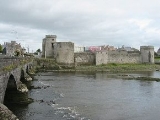
, stretches back to its establishment by the Vikings as a walled city on King's Island (an island in the River Shannon
) in 812, and its charter in 1197.
A great castle was built on the orders of King John in 1200. It was besieged
three times in the 17th century, resulting in the famous Treaty of Limerick
and the flight
of the defeated Catholic
leaders abroad
. Much of the city was built during the following Georgian
prosperity, which ended abruptly with the Act of Union
in 1800. The depression was to last nearly two centuries, through the Great Irish Famine (1845-1849), Irish War of Independence
, and neutrality emergency of the second world war, until the economic boom
from the 1990s until 2008. Today the city has a growing multicultural population.
, which was known as Loch Luimnigh. The original pre-Viking and Viking era settlement on Kings Island was known in the annals as Inis Sibhtonn and Inis an Ghaill Duibh.
The name dates from at least 561, but its original meaning is unclear. Early anglicised
spellings of the name are Limnigh, Limnagh, Lumnigh and Lumnagh, which are closer to the Irish spelling. There are numerous places of the same name throughout Ireland (anglicised as Luimnagh, Lumnagh, Limnagh etc.). According to P W Joyce in The Origin and History of Irish Names of Places II, the name "signifies a bare or barren spot of land". Similarly, others have suggested that the name derives from loimeanach meaning "a bare marsh" or "a spot made bare by feeding horses". The Dindsenchas
(The Metrical Dindsenchas III page 274), attempted to explain the name in a number of ways, connecting it particularly with luimnigthe ("cloaked") and luimnechda ("shielded").
wrote that the Irish had been zealous about their antiquity since the deluge and were ambitious to memorialise important events for posterity. The earliest provable settlement dates from 812; however, history suggests the presence of earlier settlements in the area surrounding King's Island, the island at the historical city centre. Antiquity's map-maker, Ptolemy
, produced in 150 the earliest map of Ireland
, showing a place called "Regia" at the same site as King's Island. History also records an important battle involving Cormac mac Airt
in 221 and a visit by St. Patrick in 434 to baptise a Eóganachta
king, Carthann the Fair. Saint Munchin
, the first bishop of Limerick died in 652, indicating the city was a place of some note. In 812 Danes sailed up the Shannon and pillaged the town, burned the monastery of Mungret but were forced to flee when the Irish attacked and killed many of their number.
s at Limerick is in 845, reported by the Annals of Ulster
, and there are intermittent reports of vikings in the region later in the 9th century. Permanent settlement on the site of modern Limerick had begun by 922. In that year a Viking jarl or prince called Tomrair mac Ailchi
—Thórir Helgason—led the Limerick fleet on raids along the River Shannon
, from the lake of Lough Derg to the lake of Lough Ree
, pillaging ecclesiastical settlements. Two years later, the Dublin vikings led by Gofraid ua Ímair
attacked Limerick, but were driven off. The war between Dublin and Limerick continued until 937 when the Dubliners, now led by Gofraid's son Amlaíb, captured Limerick's king Amlaíb Cenncairech
and for some reason destroyed his fleet. However, no battle is actually recorded and so a traditional interpretation has been that Amlaíb mac Gofraid was actually recruiting Amlaíb of Limerick for his upcoming conflict with Athelstan of England
, which would turn out be the famous Battle of Brunanburh
. The 920s and 930s are regarded as the height of Norse power in Ireland and only Limerick rivaled Dublin during this time.
The last Norse king of Limerick was Ivar of Limerick
, who features prominently as an enemy of Mathgamain mac Cennétig
and later his famous brother Brian Boru
in the Cogad Gáedel re Gallaib. He and his allies were defeated by the Dál gCais
, and after slaying Ivar Brian would annex Norse Limerick and begin to make it the new capital of his kingdom.
The power of the Norsemen never recovered, and they reduced to the level of a minor clan; however, they often played pivotal parts in the endless power struggles of the next few centuries.
Brian Boru's son, Donough, was routed by Diarmait mac Maíl na mBó
in the year 1058 when Limerick was burned, a punishment he repeated five years later. A year later Diarmait beat Donough again forcing him to flee overseas and installing Turlough instead. Obviously Limerick was of great importance as evidenced by being a contentious issue between neighbouring chieftains and foreigners who burned and pillaged the city. Brian Boru's sons were usually called Kings of north Munster
though their reigns were rather disturbed until 1164 when Donnchad mac Briain
became King of Munster. His reign was successful, founding monasteries and nunneries, constructing several monuments, including a church on the Rock of Cashel
, and in his grant bestowing his Limerick Gothic palace to the church he styled himself King of Limerick. However the Danes were still a powerful force who were able to obtain four sequential Danish bishops concentrated by the Archbishop of Canterbury
not subservient to the See of Cashel.
 The arrival of the Normans
to the area in 1173 changed everything. Domnall Mór Ua Briain
, the last styled King of Limerick, burned the City to the ground in 1174 in a bid to keep it from the hands of the new invaders. After he died in 1194, the Normans
finally captured the area in 1195, under the leadership of Prince John. In 1197, King Richard I of England
granted the city its first charter
, and its first Mayor, Adam Sarvant, ten years before London
. A castle, built on the orders of King John and bearing his name, was completed around 1200. Under the general peace imposed by Norman rule, Limerick prospered as a port and trading centre. By this time the city was divided into an area which became known as "English Town" on King's Island surrounded by high walls, while another settlement, named "Irish Town", where the Irish and Danes lived, had grown on the south bank of the river. Around 1395 construction started on walls around Irishtown that were not completed until the end of the 15th century.
The city opened a mint
in 1467. A 1574 document prepared for the Spanish ambassador attests to its wealth:
In the fifteenth and sixteenth centuries, Limerick became a city-state isolated from the principal area of effective English rule -the Pale
. Nevertheless, the Crown remained in control throughout the succeeding centuries. During the Reformation
tensions arose between those those loyal to the Catholic Church and those loyal to the newly established state religion - the Church of Ireland
.
's army under Henry Ireton
in 1651. The city had supported Confederate Ireland
since 1642 and was garrisoned by troops from Ulster. The Confederates supported the claims of Charles II
to the English throne, and the besiegers fought for a parliamentary republic. Famine and plague lead to the death of 5,000 residents before heavy bombardment of Irishtown led to breach and surrender in late October of that year.
In the Williamite war in Ireland
, following the Battle of the Boyne
in 1690, French
and Irish forces (numbering 14,000) regrouped in behind Limerick's walls. Time and war had led to a terrible decay of the once proud fortifications. The occupying armies are recorded as claiming that the walls could be knocked down with rotten apples. The Williamite
besiegers, while numbering 20,000, were hampered by the loss of their heavier guns to an attack by Patrick Sarsfield. In fierce fighting, the walls were breached on three occasions, but the defenders prevailed. Eventually the Williamites withdrew to Waterford
.
William's
forces returned in August 1691. Limerick was now the last stronghold of the Catholic Jacobites
, under the command of Sarsfield. The promised French reinforcement failed to arrive from the sea, and following the massacre of 850 defenders on Thomond Bridge, the city sued for peace. On 3 October 1691 the famous Treaty of Limerick
was signed using a large stone set in the bridge as a table. The treaty allowed the Jacobites to leave under full military honours and sail to France. Two days later French reinforcements finally arrived. Sarsfield was urged to continue the fight but refused, insisting on abiding by the terms of the treaty. Sarsfield sailed to France with 19,000 troops and formed the Irish Brigade
(see also the Flight of the Wild Geese
). From 1693 the Papacy supported James II again, and so the treaty was repudiated by the Williamites, for which the city became known as The City of the Violated Treaty and is a point of bitterness in the city to this day.
were introduced that banned Catholics from public office, buying freehold land, voting or practicing their religion in public, Limerick's position as the main port on the western side of Ireland meant that the city, and the Protestant upper class, began to prosper. The British version of mercantilism
required a great deal of trans-Atlantic trade, and Limerick profited somewhat by this. Many significant public buildings and infrastructure projects were paid for with local trade taxes. The first infirmary was founded by the surgeon Sylvester O'Halloran
in 1761. The House of Industry was built on northern bank of the river in 1774, in part as a poorhouse and infirmary. The development of Georgian Limerick was driven by Edmund Sexton Pery, speaker of the Irish House of Commons, and his name has been retained in the city centre; New Town Pery. Pery also built John's Square, while a basic sewer system was built in Newtownpery in the reign of George III
by simply closing over the gutters. By the time of George's reign, Limerick had 17 gates in the city walls, most of whose names continue in modern city placenames. St. Joseph's Psychiatric Hospital was completed in the south-side by 1826. Wellesley Bridge (later, Sarsfield Bridge) and new wet docks were also built during this time. Chief imports through the port included timber, coal, iron and tar. Exports included beef, pork, wheat, oats, flour and emigrants bound for North America. Exports of food continued during the Great Famine, often requiring the deployment of troops to protect the port.
No statistics exist on how many people in the Limerick area died during the famine. Nationally, the population declined by an average of 20%, half of whom died and half emigrated. While the Great Famine reduced the population of County Limerick
by 70,000, the population of the City actually rose slightly, as people fled to the workhouses
.
Ships berthed on the Limerick quaysides ready to transport produce from one of the most fertile parts of Ireland, the Golden Vale
, to the English ports. Francis Spaight, a Limerick merchant, farmer, British magistrate and ship owner, recorded 386,909 barrels of oats, and 46,288 barrels of wheat being shipped out of Limerick between June 1846 and May 1847. Giving evidence to a British parliament
select committee inquiring into the famine, Spaight said that:
The same quaysides were the departure point for many emigrant ships sailing over the Atlantic. One week in April 1850 saw four ships, Marie Brennan, Congress, Triumph, an 1849 Youghal
built ship, and Hannah, the smallest emigrant ship, glide down the Shannon towards the Americas. The latter three ship had 357 people aboard mostly comprising young men and women, depriving Ireland of their vigour and prosperity which they would bring to other nations instead. The Hannah at 59 feet long could barely hold the 60 passengers and eight crew, yet made eight trans-Atlantic voyages.
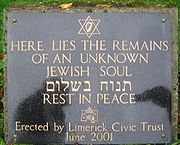
Census returns record one Jew in Limerick in 1861. This doubled by 1871 and doubled again by 1881. Increases to 35, 90 and 130 are shown for 1888, 1892, and 1896 respectively. A small number of Lithuanian Jewish
tradespeople, fleeing persecution in their homeland, began arriving in Limerick in 1878. They initially formed an accepted part of the city's retail trade, centred on Collooney St. The community established a synagogue
and a cemetery in the 1880s. Easter Sunday of 1884 saw the first of what were to be a series of sporadic violent antisemitic attacks and protests. The wife of Lieb Siev and his child were injured by stones and her house damaged by an angry crowd for which the ringleaders were sentenced to hard labour for a month. In 1892 two families were beaten and a stoning took place on November 24, 1896. Many details about Limerick's Jewish families are recorded in the 1901 census that shows most were peddler
s, though a few were described as drapery dealers and grocers.
In 1904 a young Catholic priest, Father John Creagh
, of the Redemptorist
order, delivered a fiery sermon castigating Jews for their rejection of Christ, being usurers and allies of the Freemasons then persecuting the Church in France, taking over the local economy, selling shoddy goods at inflated prices, to be paid for in installments. He urged Catholics "not to deal with the Jews." Later, after eighty Jews had been driven from their homes, Creagh was disowned by his superiors saying that: religious persecution had no place in Ireland. The Limerick Pogrom was the economic boycott waged against the small Jewish community for over two years. Keogh
suggests the name derives from their previous Lithuanian experience even though no one was killed or seriously injured. Limerick's Protestant community, many of whom were also traders, supported the Jews throughout the pogrom, but ultimately Limerick's Jews fled the city.
Many went to Cork
, intending to embark on ships from Cobh
to travel to America
. The people of Cork welcomed them into their homes. Church halls were opened for the refugees, many of whom remained. Gerald Goldberg
, a son of this migration, became Lord Mayor of Cork
in 1977, and the Marcus brothers, David
and Louis, grandchildren of the pogrom, would become hugely influential in Irish literature and Irish film, respectively.
 The IRA
and the independence movement of Sinn Féin
gained popular support in Limerick following the repressions and executions of 1916. Royal Irish Constabulary
carried out violent raids on the homes of suspected Sinn Féin sympathisers. Prisoners were interned without trial in Frongoch camp in North Wales
. Following the arrest and death of Robert Byrne, a local republican and trade unionist, most of Limerick city and a part of the county were declared a "Special Military Area under the Defence of the Realm Act
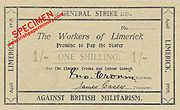
". Special permits, to be issued by the RIC, would now be required to enter the city. In response, the Limerick Trades and Labour Council called for a general strike and boycott of the troops. A special strike committee was set up to print their own money and control food prices. The Irish Times
referred to this committee as a Limerick Soviet
; however, the high degree of involvement of the Catholic Church shows that it was in fact quite different from the recent Bolshevik
uprising. An American army officer arriving in Limerick had to appear before the permits committee in order to get a lift to visit relatives outside Limerick, following which he said,
After 14 days the strike ended with a compromise on the permits issue.
Open conflict erupted on Roches Street in April 1920 between the Royal Welch Fusiliers
and the general population, involving bayonets on the one side and stones and bottles on the other. The troops fired indiscriminately, killing a publican and an usherette from the Coliseum Cinema. The British Government organised a new force to quell the population. The Black and Tans
, known as "the sweepings of English jails", were formed of ex-servicemen. On the night of March 6, 1921, Limerick's Mayor, George Clancy, and his wife were shot in their home by three Tans. On the same night the previous Mayor, Michael O'Callaghan, and Volunteer Joe O'Donoghue were murdered in their own homes after curfew. These assassinations became known as the Curfew Murders. IRA reprisals included the unsuccessful attack on six RIC men leaving a pub on Mungret Street and the shooting dead of a Black and Tan on Church Street. A truce between the IRA and the British forces came into effect on July 9, 1921.
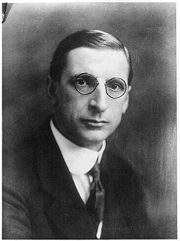
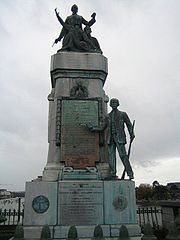 On December 5, 1921 Éamon de Valera
gave a speech (in what is now The Strand Hotel on the Ennis Road) cautioning against optimism in the peace process. A few hours later in London
, Michael Collins
signed the Anglo-Irish Treaty
, granting limited independence to the southern portion of Ireland as the Irish Free State
, while retaining the 6 counties of Northern Ireland
. The treaty also gifted the ports of Berehaven, Cobh and Lough Swilly
to the United Kingdom
as UK sovereign bases, while annuities would continue to be paid to the British government in lieu of money loaned to Irish tenants under various land acts. De Valera and others virulently opposed the treaty's compromises. The scene was set for the civil war
.
In Limerick, the first signs of trouble came when the British forces withdrew early in the New Year. Three separate Irish factions rushed in to fill the vacuum: The pro-Treaty Claremen of the First-Western Division under General Michael Brennan, who was asked by the new Free-State government to occupy the city because of doubts about the loyalty of Liam Forde's Mid-Limerick Brigade. In the event the Brigade split into pro- and anti-Treaty factions, the latter led by Forde. William St. became a battle zone by 7 p.m. on 11 July 1921, when the Free Staters opened fire on the Republican garrison holding the Ordnance Barracks. In the chaos, Roches Stores, which still stands on Sarsfield St, was looted. On 17 July, Eoin O'Duffy
arrived in the city as part of a nationwide offensive, in command of 1,500 Free State reinforcements equipped with artillery
. The Free Staters brought up an 18-pounder gun on the 19th and flattened the Ordnance Barracks. The Castle Barracks was captured the following day. The Republicans then abandoned the city. Limerick Prison, designed to hold 120, contained 800 prisoners by November. The Civil War ended the following May in victory for the Free State. De Valera and the Republicans would refuse to take their seats in the new Dáil Éireann
until 1927.
The Free State government set about rebuilding the county in the spirit of the times, with grand plans and schemes. The Shannon Scheme, the plan to build a Hydroelectric power station utilising the energy of Ireland's largest river, was begun in 1925. The German electric company Siemens-Schuckertwerke (today Siemens AG
) was awarded the 5.2 million pound contract, providing employment for 750 people. The Electricity Supply Board
set up to manage the project gradually oversaw the electrification of rural Ireland.
party were elected in 1932, Ireland was plunged into a series of "emergencies". De Valera fulfilled an election promise to suspend the payment of land annuities to Britain, and Britain retaliated by raising import duties on agricultural products to 40%. De Valera swept through the Dáil the "Emergency Imposition of Duties order" imposing reciprocal taxes. Economic War
had begun.
 Limerick's farm-based economy was reduced to a state of barter. This was the period during which Ireland's interventionist, control economic style was developed. The Laissez-faireism of the 1920s was abandoned in the face of skyrocketing unemployment, poverty and emigration. The state set up non-agricultural industries such as Turf Development Board (Later Bord na Móna
) and Aer Rianta (airports authority). In 1935 Charles Lindbergh
was consulted on the building of an airport on the Shannon Estuary
at Rineanna (later renamed Shannon Airport
), and in 1937 Foynes
was developed as a stopping point on the flying boat
route across the Atlantic. During this time, the de Valera government introduced several emergency laws to suppress the IRA and General Eoin O'Duffy
's Blueshirt Anti-Fianna Fáil supporters.
This first Emergency
ended in 1938 with the Anglo-Irish Free Trade Agreement, when Neville Chamberlain
's appeasement policy allowed a climb down. The UK would end economic sanctions
and return the treaty ports
in exchange for a once-off payment of £10m.
The following year, the outbreak of World War II
forced the introduction of the Emergency Powers Act 1939
to control communications, media, prices and imports. Ireland, with no native merchant fleet, and no coal, gas, or oil supplies faced hard times indeed. An army officer named Captain McKenna described it as the day "Realisation dawned on Ireland that the country was surrounded by water, and that the sea was of vital importance to her." Towards the end of the war, shortages of rubber and petrol particularly ended all non-emergency motorised transport, including rail, to and within the city. Lord Adare
restarted a four-horse stagecoach route to his hotel in Co. Limerick, a sight not seen since the 19th century.
The army was expanded massively to over 300,000 in preparation for the expected invasion by either Germany, attempting a stepping-stone approach to the invasion of Britain, or Britain herself, seeking use of the ports. Knockalisheen barracks (later Knockalisheen Refugee Camp) was built near Limerick at Meelick
to house the new defence forces.
 The economy of the Limerick area was largely neglected in the post war period and the city and county became characterised by extremely high emigration and unemployment. With the exception of Shannon Airport
and a few related businesses and a few clothing factories, Limerick had no industry. The economy was based on farming and services, fueled in no insignificant part by remittances from the extensive diaspora
. A few of the many who left became successful abroad, including the actor Richard Harris, the BBC presenter Terry Wogan
, and the school teacher turned memoirist, Frank McCourt
.
Limerick also had a few famous visitors during this time. In 1963 Irish-American US President John F. Kennedy
visited Limerick as part of his tour of Ireland. He was presented with a locally produced christening robe made of Limerick Lace
. From 1956, about 500 Hungarian
refugee
s were housed in Knockalisheen, near Meelick a few kilometers from the city, following the failed uprising in their country
. A few settled, but the majority moved on within a few years to new lives in the UK and North America due to the bad economic situation in Limerick.
Shannon airport also attracted a varied crowd. At this time nearly all transatlantic flights stopped at the airport, the most westerly in Europe, to refuel. Irish Times journalist Arthur Quinlan
who was based at Shannon boasts at having interviewed every US president from Harry Truman to George H. W. Bush
and many Soviet leaders, including Andrey Vyshinsky
and Andrei Gromyko
. He also famously taught Fidel Castro
how to make an Irish coffee
and interviewed Che Guevara
. On March 13, 1965, Guevara suddenly arrived at the airport when his flight from Prague to Cuba developed mechanical problems, and Quinlan was on hand to interview him. Guevara talked of his Irish connections through the name Lynch and of his grandmother's Irish roots in Galway
. Later, Che, and some of his Cuban comrades, went to Limerick city and adjourned to the Hanratty's Hotel on Glentworth Street. According to Quinlan, they returned that evening all wearing sprigs of shamrock, for Shannon and Limerick were preparing for the St. Patrick's Day celebrations.
In 1968, the government published the Buchanan Report on the regional dimension to economic planning which had largely been ignored. The report recommended on the social and economic sustainability of industry in the regions, which gradually lead to investment and improvement in the Limerick area.
 The seemingly sudden economic growth of the 1990s, termed the Celtic Tiger
, making Ireland one of the richest countries in the world, had deep foundations stretching back through the 1980s and 1970s. Shipping in Shannon estuary was developed extensively during the period with over 2bn pounds investment. A tanker terminal at Foynes and an oil jetty at Shannon Airport were built. In 1982 a massive Alumina Extraction Plant was built at Aughinish. 60,000-ton cargo vessels now carry raw bauxite from West African mines to the plant, where it is refined to alumina. This is then exported to Canada where it is further refined to aluminium. 1985 saw the opening of a huge power plant at Moneypoint, fed by regular visits by 150,000-tonne tankers. European Economic Community
funding was poured into infrastructure. Industrial estates at Raheen and Plassey
(Castletroy
), and energetic government intervention, brought in numerous foreign firms, notably Analog Devices
, Wang Laboratories
and Dell Computers. A science and engineering focused third-level college called NIHE
, Limerick, elevated in 1989 to university status as the University of Limerick
, and the establishment of Limerick Institute of Technology
, furthered the area's reputation as Ireland's Silicon Valley
. Thomond College of Education, Limerick
was a successful teacher training college and was integrated into the university in 1991.
In 1996 the city had a brief moment of world attention when the Irish
writer Frank McCourt
published Angela's Ashes
for which he won the Pulitzer prize
. The book tells of the author's childhood in a rundown and dirty slum of the 1930s and 40s and in 1999 was made into a feature film
. The slums spoken of in the book had long since been removed, and local people were embarrassed by the sudden unflattering discussion of the city. When McCourt wrote the book's sequel, 'Tis
, it was answered with the locally written Tisn't, which painted a better face on the city.
The appearance of the city has been undergoing a gradual face-lift
: two new bridges over the Shannon, and a newly opened tunnel complete the orbital road
; many of the older buildings have been replaced, some controversially such as the ancient Cruises Hotel (see Architecture of Limerick
). City architect, Jim Brown, led the way in turning Limerick around to face the river. Ireland's third tallest building, the 58 m Riverpoint
, completed in 2006, near Steamboat Quay, an area of fashionable restaurants overlooking the Shannon. The new wealth not only halted the high levels of emigration chronic through the 1980s, but led to the first large-scale immigration for centuries. The City now boasts a Russian delicatessen, a Chinese supermarket and several South Asian, African and Caribbean food shops. Near the Crescent Shopping Centre
, and down the road from the LDS Church, is Limerick's first Mosque.
Limerick
Limerick is the third largest city in the Republic of Ireland, and the principal city of County Limerick and Ireland's Mid-West Region. It is the fifth most populous city in all of Ireland. When taking the extra-municipal suburbs into account, Limerick is the third largest conurbation in the...
, stretches back to its establishment by the Vikings as a walled city on King's Island (an island in the River Shannon
River Shannon
The River Shannon is the longest river in Ireland at . It divides the west of Ireland from the east and south . County Clare, being west of the Shannon but part of the province of Munster, is the major exception...
) in 812, and its charter in 1197.
A great castle was built on the orders of King John in 1200. It was besieged
Sieges of Limerick
Siege of Limerick may refer to:* Siege of Limerick , English Protestants surrendered to Confederate Catholics* Siege of Limerick , Confederate Catholics and English Royalists surrendered to English Parliamentary forces...
three times in the 17th century, resulting in the famous Treaty of Limerick
Treaty of Limerick
The Treaty of Limerick ended the Williamite war in Ireland between the Jacobites and the supporters of William of Orange. It concluded the Siege of Limerick. The treaty really consisted of two treaties which were signed on 3 October 1691. Reputedly they were signed on the Treaty Stone, an...
and the flight
Flight of the Wild Geese
The Flight of the Wild Geese refers to the departure of an Irish Jacobite army under the command of Patrick Sarsfield from Ireland to France, as agreed in the Treaty of Limerick on October 3, 1691, following the end of the Williamite War in Ireland...
of the defeated Catholic
Catholic
The word catholic comes from the Greek phrase , meaning "on the whole," "according to the whole" or "in general", and is a combination of the Greek words meaning "about" and meaning "whole"...
leaders abroad
Irish diaspora
thumb|Night Train with Reaper by London Irish artist [[Brian Whelan]] from the book Myth of Return, 2007The Irish diaspora consists of Irish emigrants and their descendants in countries such as the United Kingdom, the United States, Canada, Australia, Argentina, New Zealand, Mexico, South Africa,...
. Much of the city was built during the following Georgian
Georgian era
The Georgian era is a period of British history which takes its name from, and is normally defined as spanning the reigns of, the first four Hanoverian kings of Great Britain : George I, George II, George III and George IV...
prosperity, which ended abruptly with the Act of Union
Act of Union 1800
The Acts of Union 1800 describe two complementary Acts, namely:* the Union with Ireland Act 1800 , an Act of the Parliament of Great Britain, and...
in 1800. The depression was to last nearly two centuries, through the Great Irish Famine (1845-1849), Irish War of Independence
Irish War of Independence
The Irish War of Independence , Anglo-Irish War, Black and Tan War, or Tan War was a guerrilla war mounted by the Irish Republican Army against the British government and its forces in Ireland. It began in January 1919, following the Irish Republic's declaration of independence. Both sides agreed...
, and neutrality emergency of the second world war, until the economic boom
Celtic Tiger
Celtic Tiger is a term used to describe the economy of Ireland during a period of rapid economic growth between 1995 and 2007. The expansion underwent a dramatic reversal from 2008, with GDP contracting by 14% and unemployment levels rising to 14% by 2010...
from the 1990s until 2008. Today the city has a growing multicultural population.
Name
Luimneach originally referred to the general area along the banks of the Shannon EstuaryShannon Estuary
The Shannon Estuary is a large estuary where the River Shannon flows into the Atlantic Ocean. The estuary has Limerick at its head and its seaward limits are marked by Loop Head to the north and Kerry Head to the south...
, which was known as Loch Luimnigh. The original pre-Viking and Viking era settlement on Kings Island was known in the annals as Inis Sibhtonn and Inis an Ghaill Duibh.
The name dates from at least 561, but its original meaning is unclear. Early anglicised
Anglicisation
Anglicisation, or anglicization , is the process of converting verbal or written elements of any other language into a form that is more comprehensible to an English speaker, or, more generally, of altering something such that it becomes English in form or character.The term most often refers to...
spellings of the name are Limnigh, Limnagh, Lumnigh and Lumnagh, which are closer to the Irish spelling. There are numerous places of the same name throughout Ireland (anglicised as Luimnagh, Lumnagh, Limnagh etc.). According to P W Joyce in The Origin and History of Irish Names of Places II, the name "signifies a bare or barren spot of land". Similarly, others have suggested that the name derives from loimeanach meaning "a bare marsh" or "a spot made bare by feeding horses". The Dindsenchas
Dindsenchas
Dindsenchas or Dindshenchas , meaning "lore of places" is a class of onomastic text in early Irish literature, recounting the origins of place-names and traditions concerning events and characters associates with the places in question...
(The Metrical Dindsenchas III page 274), attempted to explain the name in a number of ways, connecting it particularly with luimnigthe ("cloaked") and luimnechda ("shielded").
Early history
Limerick's early history is virtually undocumented, other than by the oral tradition, because the vikings were diligent in destroying Irish public records. William CamdenWilliam Camden
William Camden was an English antiquarian, historian, topographer, and officer of arms. He wrote the first chorographical survey of the islands of Great Britain and Ireland and the first detailed historical account of the reign of Elizabeth I of England.- Early years :Camden was born in London...
wrote that the Irish had been zealous about their antiquity since the deluge and were ambitious to memorialise important events for posterity. The earliest provable settlement dates from 812; however, history suggests the presence of earlier settlements in the area surrounding King's Island, the island at the historical city centre. Antiquity's map-maker, Ptolemy
Ptolemy
Claudius Ptolemy , was a Roman citizen of Egypt who wrote in Greek. He was a mathematician, astronomer, geographer, astrologer, and poet of a single epigram in the Greek Anthology. He lived in Egypt under Roman rule, and is believed to have been born in the town of Ptolemais Hermiou in the...
, produced in 150 the earliest map of Ireland
Eblana
Eblana is the name of an ancient Irish settlement believed by some to have occupied the same site as the modern city of Dublin, to the extent that 19th-century scholarly writers such as Louis Agassiz used Eblana as a Latin equivalent for Dublin...
, showing a place called "Regia" at the same site as King's Island. History also records an important battle involving Cormac mac Airt
Cormac mac Airt
Cormac mac Airt , also known as Cormac ua Cuinn or Cormac Ulfada , was, according to medieval Irish legend and historical tradition, a High King of Ireland...
in 221 and a visit by St. Patrick in 434 to baptise a Eóganachta
Eóganachta
The Eóganachta or Eoghanachta were an Irish dynasty centred around Cashel which dominated southern Ireland from the 6/7th to the 10th centuries, and following that, in a restricted form, the Kingdom of Desmond, and its offshoot Carbery, well into the 16th century...
king, Carthann the Fair. Saint Munchin
Munchin
Mainchín mac Setnai , also anglicised to Munchin, was allegedly the founder of the church of Luimnech, later Limerick , and a saint in Irish tradition, acquiring special eminence as patron of Limerick city...
, the first bishop of Limerick died in 652, indicating the city was a place of some note. In 812 Danes sailed up the Shannon and pillaged the town, burned the monastery of Mungret but were forced to flee when the Irish attacked and killed many of their number.
Viking origins
The earliest record of vikingViking
The term Viking is customarily used to refer to the Norse explorers, warriors, merchants, and pirates who raided, traded, explored and settled in wide areas of Europe, Asia and the North Atlantic islands from the late 8th to the mid-11th century.These Norsemen used their famed longships to...
s at Limerick is in 845, reported by the Annals of Ulster
Annals of Ulster
The Annals of Ulster are annals of medieval Ireland. The entries span the years between AD 431 to AD 1540. The entries up to AD 1489 were compiled in the late 15th century by the scribe Ruaidhrí Ó Luinín, under his patron Cathal Óg Mac Maghnusa on the island of Belle Isle on Lough Erne in the...
, and there are intermittent reports of vikings in the region later in the 9th century. Permanent settlement on the site of modern Limerick had begun by 922. In that year a Viking jarl or prince called Tomrair mac Ailchi
Tomrair mac Ailchi
Tomrair mac Ailchi, or Thormod/Thorir Helgason, was the Viking jarl and prince who reestablished the preexisting small Norse base or settlement at Limerick as a powerful kingdom in 922, and overnight, when he is recorded arriving there with a huge fleet from an unknown place of departure...
—Thórir Helgason—led the Limerick fleet on raids along the River Shannon
River Shannon
The River Shannon is the longest river in Ireland at . It divides the west of Ireland from the east and south . County Clare, being west of the Shannon but part of the province of Munster, is the major exception...
, from the lake of Lough Derg to the lake of Lough Ree
Lough Ree
Lough Ree is a lake in the midlands of Ireland, the second of the three major lakes on the River Shannon. Lough Ree is the second largest lake on the Shannon after Lough Derg. The other two major lakes are Lough Allen to the north, and Lough Derg to the south, there are also several minor lakes...
, pillaging ecclesiastical settlements. Two years later, the Dublin vikings led by Gofraid ua Ímair
Gofraid ua Ímair
Gofraid was a Norse-Gael king of Dublin and, for a short time, king of Northumbria...
attacked Limerick, but were driven off. The war between Dublin and Limerick continued until 937 when the Dubliners, now led by Gofraid's son Amlaíb, captured Limerick's king Amlaíb Cenncairech
Amlaíb Cenncairech
Amlaíb Cenncairech was a Norse ruler and presumably King of Limerick notable for his military activities in Ireland in the 930s, especially in the province of Connacht and apparently even in Ulster and Leinster...
and for some reason destroyed his fleet. However, no battle is actually recorded and so a traditional interpretation has been that Amlaíb mac Gofraid was actually recruiting Amlaíb of Limerick for his upcoming conflict with Athelstan of England
Athelstan of England
Athelstan , called the Glorious, was the King of England from 924 or 925 to 939. He was the son of King Edward the Elder, grandson of Alfred the Great and nephew of Æthelflæd of Mercia...
, which would turn out be the famous Battle of Brunanburh
Battle of Brunanburh
The Battle of Brunanburh was an English victory in 937 by the army of Æthelstan, King of England, and his brother Edmund over the combined armies of Olaf III Guthfrithson, the Norse-Gael King of Dublin, Constantine II, King of Scots, and Owen I, King of Strathclyde...
. The 920s and 930s are regarded as the height of Norse power in Ireland and only Limerick rivaled Dublin during this time.
The last Norse king of Limerick was Ivar of Limerick
Ivar of Limerick
Ivar of Limerick , died 977, was the last Norse king of the city-state of Limerick, and penultimate King of the Foreigners of Munster, reigning during the rise to power of the Dál gCais and the fall of the Eóganachta...
, who features prominently as an enemy of Mathgamain mac Cennétig
Mathgamain mac Cennétig
Mathgamain mac Cennétig was King of Munster from around 970 to his death in 976. He is the elder brother of Brian Bóruma and the ancestor of the McMahon family of County Clare in Western Ireland ....
and later his famous brother Brian Boru
Brian Boru
Brian Bóruma mac Cennétig, , , was an Irish king who ended the domination of the High Kingship of Ireland by the Uí Néill. Building on the achievements of his father, Cennétig mac Lorcain, and especially his elder brother, Mathgamain, Brian first made himself King of Munster, then subjugated...
in the Cogad Gáedel re Gallaib. He and his allies were defeated by the Dál gCais
Dál gCais
The Dál gCais were a dynastic group of related septs located in north Munster who rose to political prominence in the 10th century AD in Ireland. They claimed descent from Cormac Cas, or Cas mac Conall Echlúath, hence the term "Dál", meaning "portion" or "share" of Cas...
, and after slaying Ivar Brian would annex Norse Limerick and begin to make it the new capital of his kingdom.
The power of the Norsemen never recovered, and they reduced to the level of a minor clan; however, they often played pivotal parts in the endless power struggles of the next few centuries.
Brian Boru's son, Donough, was routed by Diarmait mac Maíl na mBó
Diarmait mac Mail na mBo
Diarmait mac Maíl na mBó was King of Leinster, and also High King of Ireland .He was one of the most important and significant Kings in Ireland in the pre-Norman era...
in the year 1058 when Limerick was burned, a punishment he repeated five years later. A year later Diarmait beat Donough again forcing him to flee overseas and installing Turlough instead. Obviously Limerick was of great importance as evidenced by being a contentious issue between neighbouring chieftains and foreigners who burned and pillaged the city. Brian Boru's sons were usually called Kings of north Munster
Kings of Munster
The name Munster is derived from the Gaelic God, Muman. The province of Munster was once divided into six regions: Tuadh Mhuman , Des Mhuman , Aur/Ur Mumhan , Iar mumhan or Iarmuman , Ernaibh Muman , and Deisi Muman...
though their reigns were rather disturbed until 1164 when Donnchad mac Briain
Donnchad mac Briain
Donnchadh mac Briain , formerly anglicised as Donough O'Brian, son of Brian Bóruma and Gormflaith ingen Murchada, was King of Munster.-Background:...
became King of Munster. His reign was successful, founding monasteries and nunneries, constructing several monuments, including a church on the Rock of Cashel
Rock of Cashel
The Rock of Cashel , also known as Cashel of the Kings and St. Patrick's Rock, is a historic site in Ireland's province of Munster, located at Cashel, South Tipperary.-History:...
, and in his grant bestowing his Limerick Gothic palace to the church he styled himself King of Limerick. However the Danes were still a powerful force who were able to obtain four sequential Danish bishops concentrated by the Archbishop of Canterbury
Archbishop of Canterbury
The Archbishop of Canterbury is the senior bishop and principal leader of the Church of England, the symbolic head of the worldwide Anglican Communion, and the diocesan bishop of the Diocese of Canterbury. In his role as head of the Anglican Communion, the archbishop leads the third largest group...
not subservient to the See of Cashel.
Normans
The Normans were the people who gave their name to Normandy, a region in northern France. They were descended from Norse Viking conquerors of the territory and the native population of Frankish and Gallo-Roman stock...
to the area in 1173 changed everything. Domnall Mór Ua Briain
Domnall Mór Ua Briain
Domnall Mór Ua Briain, or Domnall Mór mac Toirrdelbach Ua Briain, was King of Thomond in Ireland from 1168 to 1194, and a claimant to the title King of Munster...
, the last styled King of Limerick, burned the City to the ground in 1174 in a bid to keep it from the hands of the new invaders. After he died in 1194, the Normans
Normans
The Normans were the people who gave their name to Normandy, a region in northern France. They were descended from Norse Viking conquerors of the territory and the native population of Frankish and Gallo-Roman stock...
finally captured the area in 1195, under the leadership of Prince John. In 1197, King Richard I of England
Richard I of England
Richard I was King of England from 6 July 1189 until his death. He also ruled as Duke of Normandy, Duke of Aquitaine, Duke of Gascony, Lord of Cyprus, Count of Anjou, Count of Maine, Count of Nantes, and Overlord of Brittany at various times during the same period...
granted the city its first charter
Municipal charter
A city charter or town charter is a legal document establishing a municipality such as a city or town. The concept developed in Europe during the middle ages....
, and its first Mayor, Adam Sarvant, ten years before London
London
London is the capital city of :England and the :United Kingdom, the largest metropolitan area in the United Kingdom, and the largest urban zone in the European Union by most measures. Located on the River Thames, London has been a major settlement for two millennia, its history going back to its...
. A castle, built on the orders of King John and bearing his name, was completed around 1200. Under the general peace imposed by Norman rule, Limerick prospered as a port and trading centre. By this time the city was divided into an area which became known as "English Town" on King's Island surrounded by high walls, while another settlement, named "Irish Town", where the Irish and Danes lived, had grown on the south bank of the river. Around 1395 construction started on walls around Irishtown that were not completed until the end of the 15th century.
The city opened a mint
Mint (coin)
A mint is an industrial facility which manufactures coins for currency.The history of mints correlates closely with the history of coins. One difference is that the history of the mint is usually closely tied to the political situation of an era...
in 1467. A 1574 document prepared for the Spanish ambassador attests to its wealth:
Limerick is stronger and more beautiful than all the other cities of Ireland, well walled with stout walls of hewn marble...there is no entrance except by stone bridges, one of the two of which has 14 arches, and the other 8 ... for the most part the houses are of square stone of black marble and built in the form of towers and fortresses.
In the fifteenth and sixteenth centuries, Limerick became a city-state isolated from the principal area of effective English rule -the Pale
The Pale
The Pale or the English Pale , was the part of Ireland that was directly under the control of the English government in the late Middle Ages. It had reduced by the late 15th century to an area along the east coast stretching from Dalkey, south of Dublin, to the garrison town of Dundalk...
. Nevertheless, the Crown remained in control throughout the succeeding centuries. During the Reformation
English Reformation
The English Reformation was the series of events in 16th-century England by which the Church of England broke away from the authority of the Pope and the Roman Catholic Church....
tensions arose between those those loyal to the Catholic Church and those loyal to the newly established state religion - the Church of Ireland
Church of Ireland
The Church of Ireland is an autonomous province of the Anglican Communion. The church operates in all parts of Ireland and is the second largest religious body on the island after the Roman Catholic Church...
.
Siege and treaty
Limerick was besieged several times in the 17th century. The first was in 1642, when the Irish Confederates took the King John's Castle from its English garrison. The city was besieged by Oliver CromwellOliver Cromwell
Oliver Cromwell was an English military and political leader who overthrew the English monarchy and temporarily turned England into a republican Commonwealth, and served as Lord Protector of England, Scotland, and Ireland....
's army under Henry Ireton
Henry Ireton
Henry Ireton was an English general in the Parliamentary army during the English Civil War. He was the son-in-law of Oliver Cromwell.-Early life:...
in 1651. The city had supported Confederate Ireland
Confederate Ireland
Confederate Ireland refers to the period of Irish self-government between the Rebellion of 1641 and the Cromwellian conquest of Ireland in 1649. During this time, two-thirds of Ireland was governed by the Irish Catholic Confederation, also known as the "Confederation of Kilkenny"...
since 1642 and was garrisoned by troops from Ulster. The Confederates supported the claims of Charles II
Charles II of England
Charles II was monarch of the three kingdoms of England, Scotland, and Ireland.Charles II's father, King Charles I, was executed at Whitehall on 30 January 1649, at the climax of the English Civil War...
to the English throne, and the besiegers fought for a parliamentary republic. Famine and plague lead to the death of 5,000 residents before heavy bombardment of Irishtown led to breach and surrender in late October of that year.
In the Williamite war in Ireland
Williamite war in Ireland
The Williamite War in Ireland—also called the Jacobite War in Ireland, the Williamite-Jacobite War in Ireland and in Irish as Cogadh an Dá Rí —was a conflict between Catholic King James II and Protestant King William of Orange over who would be King of England, Scotland and Ireland...
, following the Battle of the Boyne
Battle of the Boyne
The Battle of the Boyne was fought in 1690 between two rival claimants of the English, Scottish and Irish thronesthe Catholic King James and the Protestant King William across the River Boyne near Drogheda on the east coast of Ireland...
in 1690, French
France
The French Republic , The French Republic , The French Republic , (commonly known as France , is a unitary semi-presidential republic in Western Europe with several overseas territories and islands located on other continents and in the Indian, Pacific, and Atlantic oceans. Metropolitan France...
and Irish forces (numbering 14,000) regrouped in behind Limerick's walls. Time and war had led to a terrible decay of the once proud fortifications. The occupying armies are recorded as claiming that the walls could be knocked down with rotten apples. The Williamite
William III of England
William III & II was a sovereign Prince of Orange of the House of Orange-Nassau by birth. From 1672 he governed as Stadtholder William III of Orange over Holland, Zeeland, Utrecht, Guelders, and Overijssel of the Dutch Republic. From 1689 he reigned as William III over England and Ireland...
besiegers, while numbering 20,000, were hampered by the loss of their heavier guns to an attack by Patrick Sarsfield. In fierce fighting, the walls were breached on three occasions, but the defenders prevailed. Eventually the Williamites withdrew to Waterford
Waterford
Waterford is a city in the South-East Region of Ireland. It is the oldest city in the country and fifth largest by population. Waterford City Council is the local government authority for the city and its immediate hinterland...
.
William's
William III of England
William III & II was a sovereign Prince of Orange of the House of Orange-Nassau by birth. From 1672 he governed as Stadtholder William III of Orange over Holland, Zeeland, Utrecht, Guelders, and Overijssel of the Dutch Republic. From 1689 he reigned as William III over England and Ireland...
forces returned in August 1691. Limerick was now the last stronghold of the Catholic Jacobites
Jacobitism
Jacobitism was the political movement in Britain dedicated to the restoration of the Stuart kings to the thrones of England, Scotland, later the Kingdom of Great Britain, and the Kingdom of Ireland...
, under the command of Sarsfield. The promised French reinforcement failed to arrive from the sea, and following the massacre of 850 defenders on Thomond Bridge, the city sued for peace. On 3 October 1691 the famous Treaty of Limerick
Treaty of Limerick
The Treaty of Limerick ended the Williamite war in Ireland between the Jacobites and the supporters of William of Orange. It concluded the Siege of Limerick. The treaty really consisted of two treaties which were signed on 3 October 1691. Reputedly they were signed on the Treaty Stone, an...
was signed using a large stone set in the bridge as a table. The treaty allowed the Jacobites to leave under full military honours and sail to France. Two days later French reinforcements finally arrived. Sarsfield was urged to continue the fight but refused, insisting on abiding by the terms of the treaty. Sarsfield sailed to France with 19,000 troops and formed the Irish Brigade
Irish Brigade (French)
The Irish Brigade was a brigade in the French army composed of Irish exiles, led by Robert Reid. It was formed in May 1690 when five Jacobite regiments were sent from Ireland to France in return for a larger force of French infantry who were sent to fight in the Williamite war in Ireland...
(see also the Flight of the Wild Geese
Flight of the Wild Geese
The Flight of the Wild Geese refers to the departure of an Irish Jacobite army under the command of Patrick Sarsfield from Ireland to France, as agreed in the Treaty of Limerick on October 3, 1691, following the end of the Williamite War in Ireland...
). From 1693 the Papacy supported James II again, and so the treaty was repudiated by the Williamites, for which the city became known as The City of the Violated Treaty and is a point of bitterness in the city to this day.
Great Irish Famine
While in 1695 the repressive penal lawsPenal Laws (Ireland)
The term Penal Laws in Ireland were a series of laws imposed under English and later British rule that sought to discriminate against Roman Catholics and Protestant dissenters in favour of members of the established Church of Ireland....
were introduced that banned Catholics from public office, buying freehold land, voting or practicing their religion in public, Limerick's position as the main port on the western side of Ireland meant that the city, and the Protestant upper class, began to prosper. The British version of mercantilism
Mercantilism
Mercantilism is the economic doctrine in which government control of foreign trade is of paramount importance for ensuring the prosperity and security of the state. In particular, it demands a positive balance of trade. Mercantilism dominated Western European economic policy and discourse from...
required a great deal of trans-Atlantic trade, and Limerick profited somewhat by this. Many significant public buildings and infrastructure projects were paid for with local trade taxes. The first infirmary was founded by the surgeon Sylvester O'Halloran
Sylvester O'Halloran
Sylvester O'Halloran was an Irish surgeon with an abiding interest in Gaelic poetry and history...
in 1761. The House of Industry was built on northern bank of the river in 1774, in part as a poorhouse and infirmary. The development of Georgian Limerick was driven by Edmund Sexton Pery, speaker of the Irish House of Commons, and his name has been retained in the city centre; New Town Pery. Pery also built John's Square, while a basic sewer system was built in Newtownpery in the reign of George III
George III of the United Kingdom
George III was King of Great Britain and King of Ireland from 25 October 1760 until the union of these two countries on 1 January 1801, after which he was King of the United Kingdom of Great Britain and Ireland until his death...
by simply closing over the gutters. By the time of George's reign, Limerick had 17 gates in the city walls, most of whose names continue in modern city placenames. St. Joseph's Psychiatric Hospital was completed in the south-side by 1826. Wellesley Bridge (later, Sarsfield Bridge) and new wet docks were also built during this time. Chief imports through the port included timber, coal, iron and tar. Exports included beef, pork, wheat, oats, flour and emigrants bound for North America. Exports of food continued during the Great Famine, often requiring the deployment of troops to protect the port.
No statistics exist on how many people in the Limerick area died during the famine. Nationally, the population declined by an average of 20%, half of whom died and half emigrated. While the Great Famine reduced the population of County Limerick
County Limerick
It is thought that humans had established themselves in the Lough Gur area of the county as early as 3000 BC, while megalithic remains found at Duntryleague date back further to 3500 BC...
by 70,000, the population of the City actually rose slightly, as people fled to the workhouses
Poor Law
The English Poor Laws were a system of poor relief which existed in England and Wales that developed out of late-medieval and Tudor-era laws before being codified in 1587–98...
.
Ships berthed on the Limerick quaysides ready to transport produce from one of the most fertile parts of Ireland, the Golden Vale
Golden Vale
The Golden Vale is an area of rolling pastureland in the civil province of Munster, southwestern Ireland. Covering parts of three counties, Limerick, Tipperary and Cork, it is the best land in Ireland for dairy farming....
, to the English ports. Francis Spaight, a Limerick merchant, farmer, British magistrate and ship owner, recorded 386,909 barrels of oats, and 46,288 barrels of wheat being shipped out of Limerick between June 1846 and May 1847. Giving evidence to a British parliament
Parliament of the United Kingdom
The Parliament of the United Kingdom of Great Britain and Northern Ireland is the supreme legislative body in the United Kingdom, British Crown dependencies and British overseas territories, located in London...
select committee inquiring into the famine, Spaight said that:
The same quaysides were the departure point for many emigrant ships sailing over the Atlantic. One week in April 1850 saw four ships, Marie Brennan, Congress, Triumph, an 1849 Youghal
Youghal
Youghal is a town in County Cork, Ireland. Sitting on the estuary of the River Blackwater, in the past it was militarily and economically important. Being built on the edge of a steep riverbank, the town has a distinctive long and narrow layout...
built ship, and Hannah, the smallest emigrant ship, glide down the Shannon towards the Americas. The latter three ship had 357 people aboard mostly comprising young men and women, depriving Ireland of their vigour and prosperity which they would bring to other nations instead. The Hannah at 59 feet long could barely hold the 60 passengers and eight crew, yet made eight trans-Atlantic voyages.
Pogrom
Census returns record one Jew in Limerick in 1861. This doubled by 1871 and doubled again by 1881. Increases to 35, 90 and 130 are shown for 1888, 1892, and 1896 respectively. A small number of Lithuanian Jewish
Lithuanian Jews
Lithuanian Jews or Litvaks are Jews with roots in the Grand Duchy of Lithuania:...
tradespeople, fleeing persecution in their homeland, began arriving in Limerick in 1878. They initially formed an accepted part of the city's retail trade, centred on Collooney St. The community established a synagogue
Synagogue
A synagogue is a Jewish house of prayer. This use of the Greek term synagogue originates in the Septuagint where it sometimes translates the Hebrew word for assembly, kahal...
and a cemetery in the 1880s. Easter Sunday of 1884 saw the first of what were to be a series of sporadic violent antisemitic attacks and protests. The wife of Lieb Siev and his child were injured by stones and her house damaged by an angry crowd for which the ringleaders were sentenced to hard labour for a month. In 1892 two families were beaten and a stoning took place on November 24, 1896. Many details about Limerick's Jewish families are recorded in the 1901 census that shows most were peddler
Peddler
A peddler, in British English pedlar, also known as a canvasser, cheapjack, monger, or solicitor , is a travelling vendor of goods. In England, the term was mostly used for travellers hawking goods in the countryside to small towns and villages; they might also be called tinkers or gypsies...
s, though a few were described as drapery dealers and grocers.
In 1904 a young Catholic priest, Father John Creagh
John Creagh
John Creagh was an Irish Redemptorist priest who is best known for delivering anti-Semitic sermons in Limerick in 1904 which led to riots against the small Jewish population in the city. In 1906, in the Philippines where he had been sent as a missionary, he had a nervous breakdown...
, of the Redemptorist
Congregation of the Most Holy Redeemer
The Congregation of the Most Holy Redeemer is a Roman Catholic missionary Congregation founded by Saint Alphonsus Liguori at Scala, near Amalfi, Italy for the purpose of labouring among the neglected country people in the neighbourhood of Naples.Members of the Congregation, priests and brothers,...
order, delivered a fiery sermon castigating Jews for their rejection of Christ, being usurers and allies of the Freemasons then persecuting the Church in France, taking over the local economy, selling shoddy goods at inflated prices, to be paid for in installments. He urged Catholics "not to deal with the Jews." Later, after eighty Jews had been driven from their homes, Creagh was disowned by his superiors saying that: religious persecution had no place in Ireland. The Limerick Pogrom was the economic boycott waged against the small Jewish community for over two years. Keogh
Dermot Keogh
Dermot Keogh is Professor of History and Emeritus Jean Monnet Professor of European Integration Studies at University College, Cork.-Bibliography:*Church and Politics in Latin America ISBN 0312028156...
suggests the name derives from their previous Lithuanian experience even though no one was killed or seriously injured. Limerick's Protestant community, many of whom were also traders, supported the Jews throughout the pogrom, but ultimately Limerick's Jews fled the city.
Many went to Cork
Cork (city)
Cork is the second largest city in the Republic of Ireland and the island of Ireland's third most populous city. It is the principal city and administrative centre of County Cork and the largest city in the province of Munster. Cork has a population of 119,418, while the addition of the suburban...
, intending to embark on ships from Cobh
Cobh
Cobh is a seaport town on the south coast of County Cork, Ireland. Cobh is on the south side of Great Island in Cork Harbour. Facing the town are Spike Island and Haulbowline Island...
to travel to America
United States
The United States of America is a federal constitutional republic comprising fifty states and a federal district...
. The people of Cork welcomed them into their homes. Church halls were opened for the refugees, many of whom remained. Gerald Goldberg
Gerald Goldberg
Gerald Yael Goldberg was a lawyer and politician who in 1977 became the first Jewish Lord Mayor of Cork...
, a son of this migration, became Lord Mayor of Cork
Lord Mayor of Cork
The Lord Mayor of Cork is the honorific title of the Chairman of Cork City Council which is the local government body for the city of Cork in Ireland. The incumbent is Terry Shannon of Fianna Fáil. The office holder is elected annually by the members of the Council.-History of office:In 1199 there...
in 1977, and the Marcus brothers, David
David Marcus
David Marcus was an Irish Jewish editor and writer who was a lifelong advocate and editor of Irish fiction.- Life and times :...
and Louis, grandchildren of the pogrom, would become hugely influential in Irish literature and Irish film, respectively.
Struggle for independence
Irish Republican Army
The Irish Republican Army was an Irish republican revolutionary military organisation. It was descended from the Irish Volunteers, an organisation established on 25 November 1913 that staged the Easter Rising in April 1916...
and the independence movement of Sinn Féin
Sinn Féin
Sinn Féin is a left wing, Irish republican political party in Ireland. The name is Irish for "ourselves" or "we ourselves", although it is frequently mistranslated as "ourselves alone". Originating in the Sinn Féin organisation founded in 1905 by Arthur Griffith, it took its current form in 1970...
gained popular support in Limerick following the repressions and executions of 1916. Royal Irish Constabulary
Royal Irish Constabulary
The armed Royal Irish Constabulary was Ireland's major police force for most of the nineteenth and the early twentieth centuries. A separate civic police force, the unarmed Dublin Metropolitan Police controlled the capital, and the cities of Derry and Belfast, originally with their own police...
carried out violent raids on the homes of suspected Sinn Féin sympathisers. Prisoners were interned without trial in Frongoch camp in North Wales
Wales
Wales is a country that is part of the United Kingdom and the island of Great Britain, bordered by England to its east and the Atlantic Ocean and Irish Sea to its west. It has a population of three million, and a total area of 20,779 km²...
. Following the arrest and death of Robert Byrne, a local republican and trade unionist, most of Limerick city and a part of the county were declared a "Special Military Area under the Defence of the Realm Act
Defence of the Realm Act 1914
The Defence of the Realm Act was passed in the United Kingdom on 8 August 1914, during the early weeks of World War I. It gave the government wide-ranging powers during the war period, such as the power to requisition buildings or land needed for the war effort, or to make regulations creating...
". Special permits, to be issued by the RIC, would now be required to enter the city. In response, the Limerick Trades and Labour Council called for a general strike and boycott of the troops. A special strike committee was set up to print their own money and control food prices. The Irish Times
The Irish Times
The Irish Times is an Irish daily broadsheet newspaper launched on 29 March 1859. The editor is Kevin O'Sullivan who succeeded Geraldine Kennedy in 2011; the deputy editor is Paul O'Neill. The Irish Times is considered to be Ireland's newspaper of record, and is published every day except Sundays...
referred to this committee as a Limerick Soviet
Limerick Soviet
The Limerick Soviet was a self-declared soviet that existed from 15 to 27 April 1919. At the beginning of the Irish War of Independence, a general strike was organised by the Limerick Trades and Labour Council, as a protest against the British army's declaration of a "Special Military Area" under...
; however, the high degree of involvement of the Catholic Church shows that it was in fact quite different from the recent Bolshevik
Bolshevik
The Bolsheviks, originally also Bolshevists , derived from bol'shinstvo, "majority") were a faction of the Marxist Russian Social Democratic Labour Party which split apart from the Menshevik faction at the Second Party Congress in 1903....
uprising. An American army officer arriving in Limerick had to appear before the permits committee in order to get a lift to visit relatives outside Limerick, following which he said,
- I guess it is some puzzle to know who rules these parts. You have to get a military permit to get in and be brought before a committee to get a permit to leave.
After 14 days the strike ended with a compromise on the permits issue.
Open conflict erupted on Roches Street in April 1920 between the Royal Welch Fusiliers
Royal Welch Fusiliers
The Royal Welch Fusiliers was an infantry regiment of the British Army, part of the Prince of Wales' Division. It was founded in 1689 to oppose James II and the imminent war with France...
and the general population, involving bayonets on the one side and stones and bottles on the other. The troops fired indiscriminately, killing a publican and an usherette from the Coliseum Cinema. The British Government organised a new force to quell the population. The Black and Tans
Black and Tans
The Black and Tans was one of two newly recruited bodies, composed largely of British World War I veterans, employed by the Royal Irish Constabulary as Temporary Constables from 1920 to 1921 to suppress revolution in Ireland...
, known as "the sweepings of English jails", were formed of ex-servicemen. On the night of March 6, 1921, Limerick's Mayor, George Clancy, and his wife were shot in their home by three Tans. On the same night the previous Mayor, Michael O'Callaghan, and Volunteer Joe O'Donoghue were murdered in their own homes after curfew. These assassinations became known as the Curfew Murders. IRA reprisals included the unsuccessful attack on six RIC men leaving a pub on Mungret Street and the shooting dead of a Black and Tan on Church Street. A truce between the IRA and the British forces came into effect on July 9, 1921.
Free State
Éamon de Valera
Éamon de Valera was one of the dominant political figures in twentieth century Ireland, serving as head of government of the Irish Free State and head of government and head of state of Ireland...
gave a speech (in what is now The Strand Hotel on the Ennis Road) cautioning against optimism in the peace process. A few hours later in London
London
London is the capital city of :England and the :United Kingdom, the largest metropolitan area in the United Kingdom, and the largest urban zone in the European Union by most measures. Located on the River Thames, London has been a major settlement for two millennia, its history going back to its...
, Michael Collins
Michael Collins (Irish leader)
Michael "Mick" Collins was an Irish revolutionary leader, Minister for Finance and Teachta Dála for Cork South in the First Dáil of 1919, Director of Intelligence for the IRA, and member of the Irish delegation during the Anglo-Irish Treaty negotiations. Subsequently, he was both Chairman of the...
signed the Anglo-Irish Treaty
Anglo-Irish Treaty
The Anglo-Irish Treaty , officially called the Articles of Agreement for a Treaty Between Great Britain and Ireland, was a treaty between the Government of the United Kingdom of Great Britain and Ireland and representatives of the secessionist Irish Republic that concluded the Irish War of...
, granting limited independence to the southern portion of Ireland as the Irish Free State
Irish Free State
The Irish Free State was the state established as a Dominion on 6 December 1922 under the Anglo-Irish Treaty, signed by the British government and Irish representatives exactly twelve months beforehand...
, while retaining the 6 counties of Northern Ireland
Northern Ireland
Northern Ireland is one of the four countries of the United Kingdom. Situated in the north-east of the island of Ireland, it shares a border with the Republic of Ireland to the south and west...
. The treaty also gifted the ports of Berehaven, Cobh and Lough Swilly
Lough Swilly
Lough Swilly in Ireland is a glacial fjord or sea inlet lying between the western side of the Inishowen Peninsula and the Fanad Peninsula, in County Donegal. Along with Carlingford Lough and Killary Harbour it is one of three known glacial fjords in Ireland....
to the United Kingdom
United Kingdom
The United Kingdom of Great Britain and Northern IrelandIn the United Kingdom and Dependencies, other languages have been officially recognised as legitimate autochthonous languages under the European Charter for Regional or Minority Languages...
as UK sovereign bases, while annuities would continue to be paid to the British government in lieu of money loaned to Irish tenants under various land acts. De Valera and others virulently opposed the treaty's compromises. The scene was set for the civil war
Irish Civil War
The Irish Civil War was a conflict that accompanied the establishment of the Irish Free State as an entity independent from the United Kingdom within the British Empire....
.
In Limerick, the first signs of trouble came when the British forces withdrew early in the New Year. Three separate Irish factions rushed in to fill the vacuum: The pro-Treaty Claremen of the First-Western Division under General Michael Brennan, who was asked by the new Free-State government to occupy the city because of doubts about the loyalty of Liam Forde's Mid-Limerick Brigade. In the event the Brigade split into pro- and anti-Treaty factions, the latter led by Forde. William St. became a battle zone by 7 p.m. on 11 July 1921, when the Free Staters opened fire on the Republican garrison holding the Ordnance Barracks. In the chaos, Roches Stores, which still stands on Sarsfield St, was looted. On 17 July, Eoin O'Duffy
Eoin O'Duffy
Eoin O'Duffy was in succession a Teachta Dála , the Chief of Staff of the Irish Republican Army , the second Commissioner of the Garda Síochána, leader of the Army Comrades Association and then the first leader of Fine Gael , before leading the Irish Brigade to fight for Francisco Franco during...
arrived in the city as part of a nationwide offensive, in command of 1,500 Free State reinforcements equipped with artillery
Artillery
Originally applied to any group of infantry primarily armed with projectile weapons, artillery has over time become limited in meaning to refer only to those engines of war that operate by projection of munitions far beyond the range of effect of personal weapons...
. The Free Staters brought up an 18-pounder gun on the 19th and flattened the Ordnance Barracks. The Castle Barracks was captured the following day. The Republicans then abandoned the city. Limerick Prison, designed to hold 120, contained 800 prisoners by November. The Civil War ended the following May in victory for the Free State. De Valera and the Republicans would refuse to take their seats in the new Dáil Éireann
Dáil Éireann
Dáil Éireann is the lower house, but principal chamber, of the Oireachtas , which also includes the President of Ireland and Seanad Éireann . It is directly elected at least once in every five years under the system of proportional representation by means of the single transferable vote...
until 1927.
The Free State government set about rebuilding the county in the spirit of the times, with grand plans and schemes. The Shannon Scheme, the plan to build a Hydroelectric power station utilising the energy of Ireland's largest river, was begun in 1925. The German electric company Siemens-Schuckertwerke (today Siemens AG
Siemens AG
Siemens AG is a German multinational conglomerate company headquartered in Munich, Germany. It is the largest Europe-based electronics and electrical engineering company....
) was awarded the 5.2 million pound contract, providing employment for 750 people. The Electricity Supply Board
Electricity Supply Board
The Electricity Supply Board , is a semi-state electricity company in Ireland. While historically a monopoly, the ESB now operates as a commercial semi-state concern in a liberalised and competitive market...
set up to manage the project gradually oversaw the electrification of rural Ireland.
The Emergency
Almost from the moment that de Valera and his new Fianna FáilFianna Fáil
Fianna Fáil – The Republican Party , more commonly known as Fianna Fáil is a centrist political party in the Republic of Ireland, founded on 23 March 1926. Fianna Fáil's name is traditionally translated into English as Soldiers of Destiny, although a more accurate rendition would be Warriors of Fál...
party were elected in 1932, Ireland was plunged into a series of "emergencies". De Valera fulfilled an election promise to suspend the payment of land annuities to Britain, and Britain retaliated by raising import duties on agricultural products to 40%. De Valera swept through the Dáil the "Emergency Imposition of Duties order" imposing reciprocal taxes. Economic War
Economic war
Economic war may refer to*The Anglo-Irish Trade War*An set of policies in Uganda under Idi Amin, including the expropriation of properties owned by Asians and Europeans....
had begun.
Bord na Móna
Bord na Móna , abbreviated BNM, is a semi-state company in Ireland, created in 1946 by the Turf Development Act 1946. The company is responsible for the mechanised harvesting of peat, primarily in the Midlands of Ireland...
) and Aer Rianta (airports authority). In 1935 Charles Lindbergh
Charles Lindbergh
Charles Augustus Lindbergh was an American aviator, author, inventor, explorer, and social activist.Lindbergh, a 25-year-old U.S...
was consulted on the building of an airport on the Shannon Estuary
Shannon Estuary
The Shannon Estuary is a large estuary where the River Shannon flows into the Atlantic Ocean. The estuary has Limerick at its head and its seaward limits are marked by Loop Head to the north and Kerry Head to the south...
at Rineanna (later renamed Shannon Airport
Shannon Airport
Shannon Airport, is one of the Republic of Ireland's three primary airports along with Dublin and Cork. In 2010 around 1,750,000 passengers passed through the airport, making it the third busiest airport in the Republic of Ireland after Dublin and Cork, and the fifth busiest airport on the island...
), and in 1937 Foynes
Foynes
Foynes is a village and major port in County Limerick in the midwest of Ireland, located at the edge of hilly land on the southern bank of the Shannon Estuary. The population of the town was 606 as of the 2006 census.-Foynes's role in aviation:...
was developed as a stopping point on the flying boat
Flying boat
A flying boat is a fixed-winged seaplane with a hull, allowing it to land on water. It differs from a float plane as it uses a purpose-designed fuselage which can float, granting the aircraft buoyancy. Flying boats may be stabilized by under-wing floats or by wing-like projections from the fuselage...
route across the Atlantic. During this time, the de Valera government introduced several emergency laws to suppress the IRA and General Eoin O'Duffy
Eoin O'Duffy
Eoin O'Duffy was in succession a Teachta Dála , the Chief of Staff of the Irish Republican Army , the second Commissioner of the Garda Síochána, leader of the Army Comrades Association and then the first leader of Fine Gael , before leading the Irish Brigade to fight for Francisco Franco during...
's Blueshirt Anti-Fianna Fáil supporters.
This first Emergency
State of emergency
A state of emergency is a governmental declaration that may suspend some normal functions of the executive, legislative and judicial powers, alert citizens to change their normal behaviours, or order government agencies to implement emergency preparedness plans. It can also be used as a rationale...
ended in 1938 with the Anglo-Irish Free Trade Agreement, when Neville Chamberlain
Neville Chamberlain
Arthur Neville Chamberlain FRS was a British Conservative politician who served as Prime Minister of the United Kingdom from May 1937 to May 1940. Chamberlain is best known for his appeasement foreign policy, and in particular for his signing of the Munich Agreement in 1938, conceding the...
's appeasement policy allowed a climb down. The UK would end economic sanctions
Economic sanctions
Economic sanctions are domestic penalties applied by one country on another for a variety of reasons. Economic sanctions include, but are not limited to, tariffs, trade barriers, import duties, and import or export quotas...
and return the treaty ports
Treaty Ports (Ireland)
Following the establishment of the Irish Free State, three deep water Treaty Ports at Berehaven, Queenstown and Lough Swilly were retained by the United Kingdom as sovereign bases in accordance with the Anglo-Irish Treaty of 6 December 1921...
in exchange for a once-off payment of £10m.
The following year, the outbreak of World War II
World War II
World War II, or the Second World War , was a global conflict lasting from 1939 to 1945, involving most of the world's nations—including all of the great powers—eventually forming two opposing military alliances: the Allies and the Axis...
forced the introduction of the Emergency Powers Act 1939
Emergency Powers Act 1939
The Emergency Powers Act 1939 is an act of the Oireachtas enacted on 3 September 1939 after an official state of emergency had been declared on 2 September 1939...
to control communications, media, prices and imports. Ireland, with no native merchant fleet, and no coal, gas, or oil supplies faced hard times indeed. An army officer named Captain McKenna described it as the day "Realisation dawned on Ireland that the country was surrounded by water, and that the sea was of vital importance to her." Towards the end of the war, shortages of rubber and petrol particularly ended all non-emergency motorised transport, including rail, to and within the city. Lord Adare
Adare
-General information:Adare's origin is as a settlement by a crossing point on the river Maigue. It is situated 16 km from Limerick City. Renowned as one of Ireland's prettiest villages, Adare is designated as a Heritage Town by the Irish government...
restarted a four-horse stagecoach route to his hotel in Co. Limerick, a sight not seen since the 19th century.
The army was expanded massively to over 300,000 in preparation for the expected invasion by either Germany, attempting a stepping-stone approach to the invasion of Britain, or Britain herself, seeking use of the ports. Knockalisheen barracks (later Knockalisheen Refugee Camp) was built near Limerick at Meelick
Meelick, County Clare
Meelick is a small village in County Clare, Ireland, situated a few kilometres north of Limerick City in the Midwest of Ireland.-History:From 1956, the area was home to 161 Hungarian refugees fleeing the Soviet repression in that country . They were housed in Knockalisheen Camp, a disused army...
to house the new defence forces.
Post war
Shannon Airport
Shannon Airport, is one of the Republic of Ireland's three primary airports along with Dublin and Cork. In 2010 around 1,750,000 passengers passed through the airport, making it the third busiest airport in the Republic of Ireland after Dublin and Cork, and the fifth busiest airport on the island...
and a few related businesses and a few clothing factories, Limerick had no industry. The economy was based on farming and services, fueled in no insignificant part by remittances from the extensive diaspora
Irish diaspora
thumb|Night Train with Reaper by London Irish artist [[Brian Whelan]] from the book Myth of Return, 2007The Irish diaspora consists of Irish emigrants and their descendants in countries such as the United Kingdom, the United States, Canada, Australia, Argentina, New Zealand, Mexico, South Africa,...
. A few of the many who left became successful abroad, including the actor Richard Harris, the BBC presenter Terry Wogan
Terry Wogan
Sir Michael Terence Wogan, KBE, DL , or also known as Terry Wogan, is a veteran Irish radio and television broadcaster who holds dual Irish and British citizenship. Wogan has worked for the BBC in the United Kingdom for most of his career...
, and the school teacher turned memoirist, Frank McCourt
Frank McCourt
Francis "Frank" McCourt was an Irish-American teacher and Pulitzer Prize–winning writer, best known as the author of Angela’s Ashes, an award-winning, tragicomic memoir of the misery and squalor of his childhood....
.
Limerick also had a few famous visitors during this time. In 1963 Irish-American US President John F. Kennedy
John F. Kennedy
John Fitzgerald "Jack" Kennedy , often referred to by his initials JFK, was the 35th President of the United States, serving from 1961 until his assassination in 1963....
visited Limerick as part of his tour of Ireland. He was presented with a locally produced christening robe made of Limerick Lace
Limerick lace
Limerick lace is an embroidered needle lace formed on a mesh using one or both of two techniques...*Tambour – where chain stitch is created using a hook.*Needlerun – where stitches are darned onto the ground using a needle....
. From 1956, about 500 Hungarian
Hungary
Hungary , officially the Republic of Hungary , is a landlocked country in Central Europe. It is situated in the Carpathian Basin and is bordered by Slovakia to the north, Ukraine and Romania to the east, Serbia and Croatia to the south, Slovenia to the southwest and Austria to the west. The...
refugee
Refugee
A refugee is a person who outside her country of origin or habitual residence because she has suffered persecution on account of race, religion, nationality, political opinion, or because she is a member of a persecuted 'social group'. Such a person may be referred to as an 'asylum seeker' until...
s were housed in Knockalisheen, near Meelick a few kilometers from the city, following the failed uprising in their country
1956 Hungarian Revolution
The Hungarian Revolution or Uprising of 1956 was a spontaneous nationwide revolt against the government of the People's Republic of Hungary and its Soviet-imposed policies, lasting from 23 October until 10 November 1956....
. A few settled, but the majority moved on within a few years to new lives in the UK and North America due to the bad economic situation in Limerick.
Shannon airport also attracted a varied crowd. At this time nearly all transatlantic flights stopped at the airport, the most westerly in Europe, to refuel. Irish Times journalist Arthur Quinlan
Arthur Quinlan
Arthur Quinlan is a print journalist for The Irish Times, formerly based at Shannon Airport. Shannon is the most westerly airport in Europe and an important fuel stop for both eastward and westward traffic. As journalist there for over half a century, he has had a unique opportunity to meet and...
who was based at Shannon boasts at having interviewed every US president from Harry Truman to George H. W. Bush
George H. W. Bush
George Herbert Walker Bush is an American politician who served as the 41st President of the United States . He had previously served as the 43rd Vice President of the United States , a congressman, an ambassador, and Director of Central Intelligence.Bush was born in Milton, Massachusetts, to...
and many Soviet leaders, including Andrey Vyshinsky
Andrey Vyshinsky
Andrey Januaryevich Vyshinsky – 22 November 1954) was a Soviet politician, jurist and diplomat.He is known as a state prosecutor of Joseph Stalin's Moscow trials and in the Nuremberg trials. He was the Soviet Foreign Minister from 1949 to 1953, after having served as Deputy Foreign...
and Andrei Gromyko
Andrei Gromyko
Andrei Andreyevich Gromyko was a Soviet statesman during the Cold War. He served as Minister of Foreign Affairs and as Chairman of the Presidium of the Supreme Soviet . Gromyko was responsible for many top decisions on Soviet foreign policy until he retired in 1987. In the West he was given the...
. He also famously taught Fidel Castro
Fidel Castro
Fidel Alejandro Castro Ruz is a Cuban revolutionary and politician, having held the position of Prime Minister of Cuba from 1959 to 1976, and then President from 1976 to 2008. He also served as the First Secretary of the Communist Party of Cuba from the party's foundation in 1961 until 2011...
how to make an Irish coffee
Irish coffee
Irish coffee is a cocktail consisting of hot coffee, Irish whiskey, and sugar, stirred, and topped with thick cream. The coffee is drunk through the cream. The original recipe explicitly uses cream that has not been whipped, although whipped cream is often used. Irish coffee may be considered a...
and interviewed Che Guevara
Che Guevara
Ernesto "Che" Guevara , commonly known as el Che or simply Che, was an Argentine Marxist revolutionary, physician, author, intellectual, guerrilla leader, diplomat and military theorist...
. On March 13, 1965, Guevara suddenly arrived at the airport when his flight from Prague to Cuba developed mechanical problems, and Quinlan was on hand to interview him. Guevara talked of his Irish connections through the name Lynch and of his grandmother's Irish roots in Galway
Galway
Galway or City of Galway is a city in County Galway, Republic of Ireland. It is the sixth largest and the fastest-growing city in Ireland. It is also the third largest city within the Republic and the only city in the Province of Connacht. Located on the west coast of Ireland, it sits on the...
. Later, Che, and some of his Cuban comrades, went to Limerick city and adjourned to the Hanratty's Hotel on Glentworth Street. According to Quinlan, they returned that evening all wearing sprigs of shamrock, for Shannon and Limerick were preparing for the St. Patrick's Day celebrations.
In 1968, the government published the Buchanan Report on the regional dimension to economic planning which had largely been ignored. The report recommended on the social and economic sustainability of industry in the regions, which gradually lead to investment and improvement in the Limerick area.
Celtic Tiger
Celtic Tiger
Celtic Tiger is a term used to describe the economy of Ireland during a period of rapid economic growth between 1995 and 2007. The expansion underwent a dramatic reversal from 2008, with GDP contracting by 14% and unemployment levels rising to 14% by 2010...
, making Ireland one of the richest countries in the world, had deep foundations stretching back through the 1980s and 1970s. Shipping in Shannon estuary was developed extensively during the period with over 2bn pounds investment. A tanker terminal at Foynes and an oil jetty at Shannon Airport were built. In 1982 a massive Alumina Extraction Plant was built at Aughinish. 60,000-ton cargo vessels now carry raw bauxite from West African mines to the plant, where it is refined to alumina. This is then exported to Canada where it is further refined to aluminium. 1985 saw the opening of a huge power plant at Moneypoint, fed by regular visits by 150,000-tonne tankers. European Economic Community
European Economic Community
The European Economic Community The European Economic Community (EEC) The European Economic Community (EEC) (also known as the Common Market in the English-speaking world, renamed the European Community (EC) in 1993The information in this article primarily covers the EEC's time as an independent...
funding was poured into infrastructure. Industrial estates at Raheen and Plassey
Plassey, County Limerick
Plassey is an area of County Limerick on the River Shannon, near Castletroy and Limerick, not to be confused with the Plassey estate in County Clare owned by Robert Clive, 1st Baron Clive...
(Castletroy
Castletroy
Castletroy is a rapidly growing and predominantly middle-class suburb of Limerick, Ireland and is the largest suburb in Munster. Its population is estimated at 40,000 as of 2010....
), and energetic government intervention, brought in numerous foreign firms, notably Analog Devices
Analog Devices
Analog Devices, Inc. , known as ADI, is an American multinational semiconductor company specializing in data conversion and signal conditioning technology, headquartered in Norwood, Massachusetts...
, Wang Laboratories
Wang Laboratories
Wang Laboratories was a computer company founded in 1951 by Dr. An Wang and Dr. G. Y. Chu. The company was successively headquartered in Cambridge , Tewksbury , and finally in Lowell, Massachusetts . At its peak in the 1980s, Wang Laboratories had annual revenues of $3 billion and employed over...
and Dell Computers. A science and engineering focused third-level college called NIHE
National Institute for Higher Education
A National Institute for Higher Education was a category of higher education institution established in the Republic of Ireland to provide higher level technical education above the standard of the then established Regional Technical College system but at university level...
, Limerick, elevated in 1989 to university status as the University of Limerick
University of Limerick
The University of Limerick is a university in Ireland near the city of Limerick on the island's west coast. It was established in 1972 as the National Institute for Higher Education, Limerick and became a university by statute in 1989 in accordance with the University of Limerick Act 1989...
, and the establishment of Limerick Institute of Technology
Limerick Institute of Technology
Limerick Institute of Technology is an institution of higher education in Limerick, Ireland and is one of 13 institutes that are members of the Institutes of Technology Ireland . The Institute has four campuses in Limerick City, one in both Thurles and Clonmel in County Tipperary and a regional...
, furthered the area's reputation as Ireland's Silicon Valley
Silicon Valley
Silicon Valley is a term which refers to the southern part of the San Francisco Bay Area in Northern California in the United States. The region is home to many of the world's largest technology corporations...
. Thomond College of Education, Limerick
Thomond College of Education, Limerick
Thomond College of Education, Limerick was established in 1973 in Limerick, Ireland as the National College of Physical Education to train physical education teachers...
was a successful teacher training college and was integrated into the university in 1991.
In 1996 the city had a brief moment of world attention when the Irish
Irish people
The Irish people are an ethnic group who originate in Ireland, an island in northwestern Europe. Ireland has been populated for around 9,000 years , with the Irish people's earliest ancestors recorded having legends of being descended from groups such as the Nemedians, Fomorians, Fir Bolg, Tuatha...
writer Frank McCourt
Frank McCourt
Francis "Frank" McCourt was an Irish-American teacher and Pulitzer Prize–winning writer, best known as the author of Angela’s Ashes, an award-winning, tragicomic memoir of the misery and squalor of his childhood....
published Angela's Ashes
Angela's Ashes
Angela's Ashes is a 1996 memoir by the Irish-American author Frank McCourt. The memoir consists of various anecdotes and stories of Frank McCourt's impoverished childhood and early adulthood in Brooklyn, New York and Limerick, Ireland, as well as McCourt's struggles with poverty, his father's...
for which he won the Pulitzer prize
Pulitzer Prize
The Pulitzer Prize is a U.S. award for achievements in newspaper and online journalism, literature and musical composition. It was established by American publisher Joseph Pulitzer and is administered by Columbia University in New York City...
. The book tells of the author's childhood in a rundown and dirty slum of the 1930s and 40s and in 1999 was made into a feature film
Angela's Ashes (film)
Angela's Ashes is a 1999 Irish-American drama film based on the memoir of the same title by Frank McCourt. It was directed by Alan Parker and starred Emily Watson, Robert Carlyle, Joe Breen, Ciaran Owens, and Michael Legge .-Plot:Angela's Ashes tells the story of Frank McCourt and his childhood...
. The slums spoken of in the book had long since been removed, and local people were embarrassed by the sudden unflattering discussion of the city. When McCourt wrote the book's sequel, 'Tis
'Tis
'Tis is a memoir written by Frank McCourt. Published in 1999, it begins where McCourt ended Angela's Ashes, his Pulitzer Prize winning memoir of his impoverished childhood in Ireland and his return to America.-Synopsis:...
, it was answered with the locally written Tisn't, which painted a better face on the city.
The appearance of the city has been undergoing a gradual face-lift
Architecture of Limerick
As with other cities in Ireland, Limerick has a history of great architecture. A 1574 document prepared for the Spanish ambassador attests to its wealth and fine architecture:Many examples remain in the city to the present day - though much has been lost also, through wars, decay and modern...
: two new bridges over the Shannon, and a newly opened tunnel complete the orbital road
R509 road
The R509 road, following part of the Childers Road , is a regional road in Ireland, running through the southeastern side of Limerick City...
; many of the older buildings have been replaced, some controversially such as the ancient Cruises Hotel (see Architecture of Limerick
Architecture of Limerick
As with other cities in Ireland, Limerick has a history of great architecture. A 1574 document prepared for the Spanish ambassador attests to its wealth and fine architecture:Many examples remain in the city to the present day - though much has been lost also, through wars, decay and modern...
). City architect, Jim Brown, led the way in turning Limerick around to face the river. Ireland's third tallest building, the 58 m Riverpoint
Riverpoint
Riverpoint is a mixed-use building located in Limerick. It is currently the fourth-tallest storeyed building in the Republic of Ireland, the ninth tallest in Ireland and the third-tallest in Munster after the Cork County Hall and The Elysian both in Cork...
, completed in 2006, near Steamboat Quay, an area of fashionable restaurants overlooking the Shannon. The new wealth not only halted the high levels of emigration chronic through the 1980s, but led to the first large-scale immigration for centuries. The City now boasts a Russian delicatessen, a Chinese supermarket and several South Asian, African and Caribbean food shops. Near the Crescent Shopping Centre
Crescent Shopping Centre
The Crescent Shopping Centre is a major shopping centre in Limerick, Ireland. Located on what was at one time the outskirts of the city, in Dooradoyle, the centre now lies between the suburb of Raheen and the city proper...
, and down the road from the LDS Church, is Limerick's first Mosque.
External links
- Limerick City Library
- John Begley, The Diocese of Limerick, Ancient and Medieval (1906)
- Journal of the Royal Society of Antiquaries of Ireland (1849) – contains the essay The Northmen of Limerick by Timothy Lee
- The Limerick Soviet, 1919 Online edition of Liam Cahill's excellent book
- Yahoo Holiday's Guide - Limerick History
- Local History and Folklore of Limerick city
- A Brief History of Limerick
- Images of Limerick from Flickr