

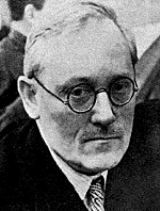
Andrey Vyshinsky

Encyclopedia
Andrey Januaryevich Vyshinsky – 22 November 1954) was a Soviet
politician
, jurist
and diplomat
.
He is known as a state prosecutor of Joseph Stalin
's Moscow trials
and in the Nuremberg trials
. He was the Soviet Foreign Minister from 1949 to 1953, after having served as Deputy Foreign Minister under Vyacheslav Molotov
since 1940. He also headed the Institute of State and Law
in the Soviet Academy of Sciences.
family in Odessa, who later moved to Baku
. He became a Menshevik
in 1903 and took an active part in the 1905 Russian Revolution at Baku, for which he was convicted and imprisoned in the Bailov
prison. Here he first met Stalin: a fellow inmate with whom he engaged in ideological disputes. After graduating in Law at Kiev University
, Vyshinsky became a successful lawyer in Moscow. In 1917 he undersigned an order to arrest Vladimir Lenin
, according to the decision of the Russian Provisional Government
. In 1920, he joined the Bolsheviks.
He carried out administrative preparations for a "systematic" drive "against harvest-wreckers and grain-thieves."
In 1935 he became Prosecutor General of the USSR
, the legal mastermind of Joseph Stalin
's Great Purge
. He is widely (and wrongly) cited for the principle that "confession of the accused is the queen of evidence" despite his monograph Theory of Judicial Proofs in Soviet Justice (which was awarded the Stalin Prize in 1947) stating directly the opposite. He first became a nationally known public figure as a result of the Semenchuk case of 1936. Konstantin Semenchuk was the head of the Glavsevmorput station on Wrangel Island
; he was accused of oppressing and starving the local Eskimos and of ordering his subordinate, the sled driver Stepan Startsev, to murder Dr. Nikolai Vulfson, who had attempted to stand up to Semenchuk, on 27 December 1934 (though there were also rumors that Startsev had fallen in love with Vulfson's wife, Dr. Gita Feldman, and killed him out of jealousy). The case came to trial before the Supreme Court of the RSFSR in May 1936; both defendants, attacked by Vyshinsky as "human waste," were found guilty and shot, and "the most publicized result of the trial was the joy of the liberated Eskimos."
Three months later, Vyshinsky achieved international fame as the prosecutor at the Zinoviev-Kamenev trial, the first of the Moscow Trials
during the Great Purge
, lashing its defenseless victims with vituperative rhetoric:
During the trials, Vyshinsky misappropriated
the house and money of Leonid Serebryakov, one of the defendants of the infamous Moscow Trials
, who was later executed.
In June, 1940, Vyshinsky was sent to the Republic of Latvia
. to supervise the establishment of a pro-Soviet government and incorporation of that country into the USSR, and later arranged for a communist regime to assume control of Romania
in 1945. In 1953 he was among the chief figures accused by the U.S. Congress Kersten Committee, during its investigation of the Soviet occupation of the Baltic states.
He was responsible for the Soviet preparations for the trial of the major war criminals by the International Military Tribunal
.
The positions he held included those of vice-premier (1939–1944), Deputy Minister of Foreign Affairs (1940–1949), Minister for Foreign Affairs (1949–1953), Academician of the Soviet Academy of Sciences from 1939, and permanent representative of the Soviet Union to the United Nations
.
He died in 1954 while in New York and was buried near Red Square
.
. Until the period of destalinization, the Institute of State and Law was named in his honor.
During his tenure as director of the ISL, Vyshinsky oversaw the publication of several important monographs on the general theory of state and law.
Soviet Union
The Soviet Union , officially the Union of Soviet Socialist Republics , was a constitutionally socialist state that existed in Eurasia between 1922 and 1991....
politician
Politician
A politician, political leader, or political figure is an individual who is involved in influencing public policy and decision making...
, jurist
Jurist
A jurist or jurisconsult is a professional who studies, develops, applies, or otherwise deals with the law. The term is widely used in American English, but in the United Kingdom and many Commonwealth countries it has only historical and specialist usage...
and diplomat
Diplomat
A diplomat is a person appointed by a state to conduct diplomacy with another state or international organization. The main functions of diplomats revolve around the representation and protection of the interests and nationals of the sending state, as well as the promotion of information and...
.
He is known as a state prosecutor of Joseph Stalin
Joseph Stalin
Joseph Vissarionovich Stalin was the Premier of the Soviet Union from 6 May 1941 to 5 March 1953. He was among the Bolshevik revolutionaries who brought about the October Revolution and had held the position of first General Secretary of the Communist Party of the Soviet Union's Central Committee...
's Moscow trials
Moscow Trials
The Moscow Trials were a series of show trials conducted in the Soviet Union and orchestrated by Joseph Stalin during the Great Purge of the 1930s. The victims included most of the surviving Old Bolsheviks, as well as the leadership of the Soviet secret police...
and in the Nuremberg trials
Nuremberg Trials
The Nuremberg Trials were a series of military tribunals, held by the victorious Allied forces of World War II, most notable for the prosecution of prominent members of the political, military, and economic leadership of the defeated Nazi Germany....
. He was the Soviet Foreign Minister from 1949 to 1953, after having served as Deputy Foreign Minister under Vyacheslav Molotov
Vyacheslav Molotov
Vyacheslav Mikhailovich Molotov was a Soviet politician and diplomat, an Old Bolshevik and a leading figure in the Soviet government from the 1920s, when he rose to power as a protégé of Joseph Stalin, to 1957, when he was dismissed from the Presidium of the Central Committee by Nikita Khrushchev...
since 1940. He also headed the Institute of State and Law
Institute of State and Law
The Institute of State and Law of the Russian Academy of Sciences is the largest scientific legal center in the Russian Federation. The ISL is part of the Philosophical, Sociological, Psychological, and Law Department of RAS...
in the Soviet Academy of Sciences.
Biography
Vyshinsky was born into a Polish CatholicCatholic
The word catholic comes from the Greek phrase , meaning "on the whole," "according to the whole" or "in general", and is a combination of the Greek words meaning "about" and meaning "whole"...
family in Odessa, who later moved to Baku
Baku
Baku , sometimes spelled as Baki or Bakou, is the capital and largest city of Azerbaijan, as well as the largest city on the Caspian Sea and of the Caucasus region. It is located on the southern shore of the Absheron Peninsula, which projects into the Caspian Sea. The city consists of two principal...
. He became a Menshevik
Menshevik
The Mensheviks were a faction of the Russian revolutionary movement that emerged in 1904 after a dispute between Vladimir Lenin and Julius Martov, both members of the Russian Social-Democratic Labour Party. The dispute originated at the Second Congress of that party, ostensibly over minor issues...
in 1903 and took an active part in the 1905 Russian Revolution at Baku, for which he was convicted and imprisoned in the Bailov
Bailov
-Geography:In March 2000, a major landslide in the Bayil slope destroyed dozens of shops, apartments and gas stations.The slope in later years also experienced few minor landslides which led Baku City Administration to examine the area and make a final decision on razing houses in this...
prison. Here he first met Stalin: a fellow inmate with whom he engaged in ideological disputes. After graduating in Law at Kiev University
Kiev University
Taras Shevchenko University or officially the Taras Shevchenko National University of Kyiv , colloquially known in Ukrainian as KNU is located in Kiev, the capital of Ukraine. It is the third oldest university in Ukraine after the University of Lviv and Kharkiv University. Currently, its structure...
, Vyshinsky became a successful lawyer in Moscow. In 1917 he undersigned an order to arrest Vladimir Lenin
Vladimir Lenin
Vladimir Ilyich Lenin was a Russian Marxist revolutionary and communist politician who led the October Revolution of 1917. As leader of the Bolsheviks, he headed the Soviet state during its initial years , as it fought to establish control of Russia in the Russian Civil War and worked to create a...
, according to the decision of the Russian Provisional Government
Russian Provisional Government
The Russian Provisional Government was the short-lived administrative body which sought to govern Russia immediately following the abdication of Tsar Nicholas II . On September 14, the State Duma of the Russian Empire was officially dissolved by the newly created Directorate, and the country was...
. In 1920, he joined the Bolsheviks.
He carried out administrative preparations for a "systematic" drive "against harvest-wreckers and grain-thieves."
In 1935 he became Prosecutor General of the USSR
Prosecutor General of the USSR
The Procurator General of the USSR , was the highest functionary of the Office of Public Procurator of the USSR, responsible for the whole system of offices of public procurators and supervision of their activities on the territory of the Soviet Union.-History:The office of procurator had its...
, the legal mastermind of Joseph Stalin
Joseph Stalin
Joseph Vissarionovich Stalin was the Premier of the Soviet Union from 6 May 1941 to 5 March 1953. He was among the Bolshevik revolutionaries who brought about the October Revolution and had held the position of first General Secretary of the Communist Party of the Soviet Union's Central Committee...
's Great Purge
Great Purge
The Great Purge was a series of campaigns of political repression and persecution in the Soviet Union orchestrated by Joseph Stalin from 1936 to 1938...
. He is widely (and wrongly) cited for the principle that "confession of the accused is the queen of evidence" despite his monograph Theory of Judicial Proofs in Soviet Justice (which was awarded the Stalin Prize in 1947) stating directly the opposite. He first became a nationally known public figure as a result of the Semenchuk case of 1936. Konstantin Semenchuk was the head of the Glavsevmorput station on Wrangel Island
Wrangel Island
Wrangel Island is an island in the Arctic Ocean, between the Chukchi Sea and East Siberian Sea. Wrangel Island lies astride the 180° meridian. The International Date Line is displaced eastwards at this latitude to avoid the island as well as the Chukchi Peninsula on the Russian mainland...
; he was accused of oppressing and starving the local Eskimos and of ordering his subordinate, the sled driver Stepan Startsev, to murder Dr. Nikolai Vulfson, who had attempted to stand up to Semenchuk, on 27 December 1934 (though there were also rumors that Startsev had fallen in love with Vulfson's wife, Dr. Gita Feldman, and killed him out of jealousy). The case came to trial before the Supreme Court of the RSFSR in May 1936; both defendants, attacked by Vyshinsky as "human waste," were found guilty and shot, and "the most publicized result of the trial was the joy of the liberated Eskimos."
Three months later, Vyshinsky achieved international fame as the prosecutor at the Zinoviev-Kamenev trial, the first of the Moscow Trials
Moscow Trials
The Moscow Trials were a series of show trials conducted in the Soviet Union and orchestrated by Joseph Stalin during the Great Purge of the 1930s. The victims included most of the surviving Old Bolsheviks, as well as the leadership of the Soviet secret police...
during the Great Purge
Great Purge
The Great Purge was a series of campaigns of political repression and persecution in the Soviet Union orchestrated by Joseph Stalin from 1936 to 1938...
, lashing its defenseless victims with vituperative rhetoric:
During the trials, Vyshinsky misappropriated
Misappropriation
In law, misappropriation is the intentional, illegal use of the property or funds of another person for one's own use or other unauthorized purpose, particularly by a public official, a trustee of a trust, an executor or administrator of a dead person's estate or by any person with a responsibility...
the house and money of Leonid Serebryakov, one of the defendants of the infamous Moscow Trials
Moscow Trials
The Moscow Trials were a series of show trials conducted in the Soviet Union and orchestrated by Joseph Stalin during the Great Purge of the 1930s. The victims included most of the surviving Old Bolsheviks, as well as the leadership of the Soviet secret police...
, who was later executed.
In June, 1940, Vyshinsky was sent to the Republic of Latvia
Latvia
Latvia , officially the Republic of Latvia , is a country in the Baltic region of Northern Europe. It is bordered to the north by Estonia , to the south by Lithuania , to the east by the Russian Federation , to the southeast by Belarus and shares maritime borders to the west with Sweden...
. to supervise the establishment of a pro-Soviet government and incorporation of that country into the USSR, and later arranged for a communist regime to assume control of Romania
Romania
Romania is a country located at the crossroads of Central and Southeastern Europe, on the Lower Danube, within and outside the Carpathian arch, bordering on the Black Sea...
in 1945. In 1953 he was among the chief figures accused by the U.S. Congress Kersten Committee, during its investigation of the Soviet occupation of the Baltic states.
He was responsible for the Soviet preparations for the trial of the major war criminals by the International Military Tribunal
Nuremberg Trials
The Nuremberg Trials were a series of military tribunals, held by the victorious Allied forces of World War II, most notable for the prosecution of prominent members of the political, military, and economic leadership of the defeated Nazi Germany....
.
The positions he held included those of vice-premier (1939–1944), Deputy Minister of Foreign Affairs (1940–1949), Minister for Foreign Affairs (1949–1953), Academician of the Soviet Academy of Sciences from 1939, and permanent representative of the Soviet Union to the United Nations
United Nations
The United Nations is an international organization whose stated aims are facilitating cooperation in international law, international security, economic development, social progress, human rights, and achievement of world peace...
.
He died in 1954 while in New York and was buried near Red Square
Red Square
Red Square is a city square in Moscow, Russia. The square separates the Kremlin, the former royal citadel and currently the official residence of the President of Russia, from a historic merchant quarter known as Kitai-gorod...
.
Scholarship
Vyshinsky was the director of the Soviet Academy of Sciences' Institute of State and LawInstitute of State and Law
The Institute of State and Law of the Russian Academy of Sciences is the largest scientific legal center in the Russian Federation. The ISL is part of the Philosophical, Sociological, Psychological, and Law Department of RAS...
. Until the period of destalinization, the Institute of State and Law was named in his honor.
During his tenure as director of the ISL, Vyshinsky oversaw the publication of several important monographs on the general theory of state and law.