


Bender, Moldova

Encyclopedia
Bender or Bendery, also known as Tighina is a city within the internationally recognized borders of Moldova
under de facto control of the unrecognized Transnistria
Republic (PMR) since 1992. Located on the right (western) bank of the river Dniester
in the historical region of Bessarabia
, together with its suburb Proteagailovca
, the city forms a municipality, which is separate from Transnistria according to the Moldovan law. Bender is located in the buffer zone
established at the end of the 1992 War of Transnistria
.
While the Joint Control Commission
has overriding powers in the city, Transnistria has de facto
administrative control.
origin), the town was known in the Middle Ages as Tighina in Moldavia
n sources and later as Bender in Ottoman
sources. The fortress and the city were called Bender for the most part of the time they were a rayah
of the Ottomans (1538–1812), and during most of the time they belonged to the Russian Empire
(1828–1917). They were known as Tighina (Тигина) in the Principality of Moldavia
, in the early part of the Russian Empire period (1812–1828), and during the time the city belonged to Romania (1918–1940; 1941–1944).
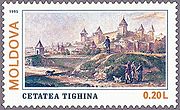 The city is part of the historical region of Bessarabia
. During the Soviet
period the city was known in the Moldavian SSR
as Бендер (Bender) in Moldovan
(Romanian) written then with the Cyrillic alphabet, and as Бендéры (Bendery) in Russian
.
In the independent Moldova, officially it is known as Bender, but otherwise both names Bender and Tighina are used.
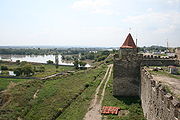
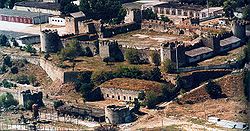 The town was first mentioned as an important customs post in a commerce grant issued by the Moldavia
n voivode Alexander the Good to the merchants of Lviv
on October 8, 1408. The name "Tighina" is found in documents from the second half of the 15th century. The town was the main Moldavian customs point on the commercial road linking the country to Tatar
Crimea
. During his reign of Moldavia, Stephen III
had a small wooden fort built in the town to defend the settlement from Tatar raids.
 In 1538, the Ottoman
sultan Suleiman the Magnificent
conquered the town from Moldavia, and renamed it Bender. Its fortifications were developed into a full fortress under the same name under the supervision of the Turkish architect Koji Mimar Sinan. The Ottomans used it to keep the pressure on Moldavia.
In the 18th century, the fort's area was expanded and modernized by the prince of Moldavia Antioh Cantemir
, who carried out these works under Ottoman supervision.
In 1713, the fortress, the town, and the neighboring village Varniţa
were the site of skirmishes
(kalabalik) between Charles XII of Sweden
, who had taken refuge there with the Cossack
Hetman
Ivan Mazepa after his defeat in the Battle of Poltava
, and Turks who wished to enforce the departure of the Swedish king.
During the second half of the 18th century, the fortress fell three times to the Russians during the Russo-Turkish Wars (in 1770, 1789, and in 1806 without a fight).
Along with Bessarabia
, the city was annexed to the Russian Empire
in 1812, and remained part of the Russian Governorate of Bessarabia
until 1917.
Tighina was part of the Moldavian Democratic Republic
in 1917-1918, and after 1918, as part of Bessarabia, the city belonged to Romania
, where it was the seat of Tighina County
.
Along with Bessarabia, the city was occupied by the Soviet Union on June 28, 1940, following an ultimatum. In the course of World War II, it was retaken by Romania in July 1941, and again by the USSR in August 1944.
In 1940-41, and 1941-1991 it was one of the four "republican cities" (i.e., not subordinated to a district) of the Moldavian Soviet Socialist Republic, one of the 15 republics of the Soviet Union. Since 1991, the city has been part of the independent Republic of Moldova.
 Due to the city's key strategic location on the right bank of Dniester
river, 10 km from left-bank Tiraspol
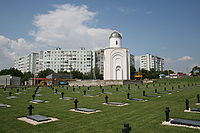
, Bender saw the heaviest fighting of the 1992 War of Transnistria
.
Since 1992, Bender has been formally in the demilitarized zone
established at the end of the conflict, but is de facto controlled by Transnistrian authorities. Moldovan authorities control the commune of Varniţa
, which fringes the city to the north. Transnistrian authorities control the communes of Proteagailovca
, which borders the city to the west, Gîsca
, which borders the city to the south-west, Chiţcani
and Cremenciug
, further to the south-east, while Moldovans are in control of Copanca
, further to the south-east.
, replacing Aleksander Posudnevsky in 2007.
, the city had a population of 100,169, of which the city itself 97,027, and the commune of Proteagailovca
, 3,142.
Note: 1 Since the independence of Moldova, there has been ongoing controversy
over whether Romanians and Moldovans should be counted officially as the same ethnic group or not. At the census, every citizen could only declare one nationality. Consequently, one could not declare oneself both Moldovan and Romanian.
Note: 2 The Ukrainian population of Bessarabia was counted in the past as "Ruthenians" in a similar way the Romanian population is counted as "Moldovan" today
 Famous people born in the city include:
is the city's professional football club, playing in the top Moldovan football league, the Divizia Naţională
.
with:
Beira
, Mozambique
Cavriago
, Italy
Dubăsari
, Moldova
Montesilvano
, Italy
Ochamchire
, Abkhazia
Moldova
Moldova , officially the Republic of Moldova is a landlocked state in Eastern Europe, located between Romania to the West and Ukraine to the North, East and South. It declared itself an independent state with the same boundaries as the preceding Moldavian Soviet Socialist Republic in 1991, as part...
under de facto control of the unrecognized Transnistria
Transnistria
Transnistria is a breakaway territory located mostly on a strip of land between the Dniester River and the eastern Moldovan border to Ukraine...
Republic (PMR) since 1992. Located on the right (western) bank of the river Dniester
Dniester
The Dniester is a river in Eastern Europe. It runs through Ukraine and Moldova and separates most of Moldova's territory from the breakaway de facto state of Transnistria.-Names:...
in the historical region of Bessarabia
Bessarabia
Bessarabia is a historical term for the geographic region in Eastern Europe bounded by the Dniester River on the east and the Prut River on the west....
, together with its suburb Proteagailovca
Proteagailovca
Proteagailovca is a commune in the municipality of Tighina , Moldova. It is composed of a single village, Proteagailovca, and had a population of 3,142 at the 2004 Census. The locality, although situated on the right bank of the river Dniester, is under the control of the breakaway Transnistrian...
, the city forms a municipality, which is separate from Transnistria according to the Moldovan law. Bender is located in the buffer zone
Buffer zone
A buffer zone is generally a zonal area that lies between two or more other areas , but depending on the type of buffer zone, the reason for it may be to segregate regions or to conjoin them....
established at the end of the 1992 War of Transnistria
War of Transnistria
The War of Transnistria was a limited conflict that broke out in November 1990 at Dubăsari between pro-Transnistria forces, including the Transnistrian Republican Guard, militia and Cossack units, and supported by elements of the Russian 14th army, and pro-Moldovan forces, including Moldovan...
.
While the Joint Control Commission
Joint Control Commission
The Joint Control Commission , is a tri-lateral peacekeeping force and joint military command structure which operates in a buffer zone on the border between the Republic of Moldova and the disputed territory controlled by the Pridnestrovian Moldavian Republic .-History:Following the War of...
has overriding powers in the city, Transnistria has de facto
De facto
De facto is a Latin expression that means "concerning fact." In law, it often means "in practice but not necessarily ordained by law" or "in practice or actuality, but not officially established." It is commonly used in contrast to de jure when referring to matters of law, governance, or...
administrative control.
Name
First mentioned in 1408 as Тягянякяча (Tyagyanyakyacha) in a document in Old Slavonic (the term is of CumanCumans
The Cumans were Turkic nomadic people comprising the western branch of the Cuman-Kipchak confederation. After Mongol invasion , they decided to seek asylum in Hungary, and subsequently to Bulgaria...
origin), the town was known in the Middle Ages as Tighina in Moldavia
Moldavia
Moldavia is a geographic and historical region and former principality in Eastern Europe, corresponding to the territory between the Eastern Carpathians and the Dniester river...
n sources and later as Bender in Ottoman
Ottoman Empire
The Ottoman EmpireIt was usually referred to as the "Ottoman Empire", the "Turkish Empire", the "Ottoman Caliphate" or more commonly "Turkey" by its contemporaries...
sources. The fortress and the city were called Bender for the most part of the time they were a rayah
Rayah
A rayah or reaya was a member of the tax-paying lower class of Ottoman society, in contrast to the askeri and kul...
of the Ottomans (1538–1812), and during most of the time they belonged to the Russian Empire
Russian Empire
The Russian Empire was a state that existed from 1721 until the Russian Revolution of 1917. It was the successor to the Tsardom of Russia and the predecessor of the Soviet Union...
(1828–1917). They were known as Tighina (Тигина) in the Principality of Moldavia
Moldavia
Moldavia is a geographic and historical region and former principality in Eastern Europe, corresponding to the territory between the Eastern Carpathians and the Dniester river...
, in the early part of the Russian Empire period (1812–1828), and during the time the city belonged to Romania (1918–1940; 1941–1944).
Bessarabia
Bessarabia is a historical term for the geographic region in Eastern Europe bounded by the Dniester River on the east and the Prut River on the west....
. During the Soviet
Soviet Union
The Soviet Union , officially the Union of Soviet Socialist Republics , was a constitutionally socialist state that existed in Eurasia between 1922 and 1991....
period the city was known in the Moldavian SSR
Moldavian SSR
The Moldavian Soviet Socialist Republic , commonly abbreviated to Moldavian SSR or MSSR, was one of the 15 republics of the Soviet Union...
as Бендер (Bender) in Moldovan
Moldovan language
Moldovan is one of the names of the Romanian language as spoken in the Republic of Moldova, where it is official. The spoken language of Moldova is closer to the dialects of Romanian spoken in northeastern Romania, and the two countries share the same literary standard...
(Romanian) written then with the Cyrillic alphabet, and as Бендéры (Bendery) in Russian
Russian language
Russian is a Slavic language used primarily in Russia, Belarus, Uzbekistan, Kazakhstan, Tajikistan and Kyrgyzstan. It is an unofficial but widely spoken language in Ukraine, Moldova, Latvia, Turkmenistan and Estonia and, to a lesser extent, the other countries that were once constituent republics...
.
In the independent Moldova, officially it is known as Bender, but otherwise both names Bender and Tighina are used.
History
Moldavia
Moldavia is a geographic and historical region and former principality in Eastern Europe, corresponding to the territory between the Eastern Carpathians and the Dniester river...
n voivode Alexander the Good to the merchants of Lviv
Lviv
Lviv is a city in western Ukraine. The city is regarded as one of the main cultural centres of today's Ukraine and historically has also been a major Polish and Jewish cultural center, as Poles and Jews were the two main ethnicities of the city until the outbreak of World War II and the following...
on October 8, 1408. The name "Tighina" is found in documents from the second half of the 15th century. The town was the main Moldavian customs point on the commercial road linking the country to Tatar
Tatars
Tatars are a Turkic speaking ethnic group , numbering roughly 7 million.The majority of Tatars live in the Russian Federation, with a population of around 5.5 million, about 2 million of which in the republic of Tatarstan.Significant minority populations are found in Uzbekistan, Kazakhstan,...
Crimea
Crimea
Crimea , or the Autonomous Republic of Crimea , is a sub-national unit, an autonomous republic, of Ukraine. It is located on the northern coast of the Black Sea, occupying a peninsula of the same name...
. During his reign of Moldavia, Stephen III
Stephen III of Moldavia
Stephen III of Moldavia was Prince of Moldavia between 1457 and 1504 and the most prominent representative of the House of Mușat.During his reign, he strengthened Moldavia and maintained its independence against the ambitions of Hungary, Poland, and the...
had a small wooden fort built in the town to defend the settlement from Tatar raids.
Ottoman Dynasty
The Ottoman Dynasty ruled the Ottoman Empire from 1299 to 1922, beginning with Osman I , though the dynasty was not proclaimed until Orhan Bey declared himself sultan...
sultan Suleiman the Magnificent
Suleiman the Magnificent
Suleiman I was the tenth and longest-reigning Sultan of the Ottoman Empire, from 1520 to his death in 1566. He is known in the West as Suleiman the Magnificent and in the East, as "The Lawgiver" , for his complete reconstruction of the Ottoman legal system...
conquered the town from Moldavia, and renamed it Bender. Its fortifications were developed into a full fortress under the same name under the supervision of the Turkish architect Koji Mimar Sinan. The Ottomans used it to keep the pressure on Moldavia.
In the 18th century, the fort's area was expanded and modernized by the prince of Moldavia Antioh Cantemir
Antioh Cantemir
Antioh Cantemir , son of Constantin Cantemir and older brother of Dimitrie Cantemir , was a Moldavian Voivode between December 18, 1695 and September 12, 1700, and again from February 23, 1705 to July 31, 1707.-Reigns:He and Dimitrie successfully plotted against Prince Constantin...
, who carried out these works under Ottoman supervision.
In 1713, the fortress, the town, and the neighboring village Varniţa
Varnita, Anenii Noi
Varniţa is a commune and village in the Anenii Noi District, Moldova, located near Bendery . It is also considered a suburb of Bendery...
were the site of skirmishes
Skirmish at Bender
The Skirmish at Bender was devised to remove Charles XII of Sweden from the Ottoman Empire after his military defeats in Russia. It took place on February 1, 1713 on Ottoman territory, in what is now the town of Bender, Moldova.-History:...
(kalabalik) between Charles XII of Sweden
Charles XII of Sweden
Charles XII also Carl of Sweden, , Latinized to Carolus Rex, Turkish: Demirbaş Şarl, also known as Charles the Habitué was the King of the Swedish Empire from 1697 to 1718...
, who had taken refuge there with the Cossack
Cossack
Cossacks are a group of predominantly East Slavic people who originally were members of democratic, semi-military communities in what is today Ukraine and Southern Russia inhabiting sparsely populated areas and islands in the lower Dnieper and Don basins and who played an important role in the...
Hetman
Hetman
Hetman was the title of the second-highest military commander in 15th- to 18th-century Poland and the Grand Duchy of Lithuania, which together, from 1569 to 1795, comprised the Polish-Lithuanian Commonwealth, or Rzeczpospolita....
Ivan Mazepa after his defeat in the Battle of Poltava
Battle of Poltava
The Battle of Poltava on 27 June 1709 was the decisive victory of Peter I of Russia over the Swedish forces under Field Marshal Carl Gustav Rehnskiöld in one of the battles of the Great Northern War. It is widely believed to have been the beginning of Sweden's decline as a Great Power; the...
, and Turks who wished to enforce the departure of the Swedish king.
During the second half of the 18th century, the fortress fell three times to the Russians during the Russo-Turkish Wars (in 1770, 1789, and in 1806 without a fight).
Along with Bessarabia
Bessarabia
Bessarabia is a historical term for the geographic region in Eastern Europe bounded by the Dniester River on the east and the Prut River on the west....
, the city was annexed to the Russian Empire
Russian Empire
The Russian Empire was a state that existed from 1721 until the Russian Revolution of 1917. It was the successor to the Tsardom of Russia and the predecessor of the Soviet Union...
in 1812, and remained part of the Russian Governorate of Bessarabia
Bessarabia Governorate
Bessarabia was an oblast and later a guberniya in the Russian Empire. It was the eastern part of the Principality of Moldavia annexed by Russia by the Treaty of Bucharest following the Russo-Turkish War, 1806-1812...
until 1917.
Tighina was part of the Moldavian Democratic Republic
Moldavian Democratic Republic
The Moldavian Democratic Republic , a.k.a. Moldavian Republic, was the state proclaimed on by Sfatul Ţării of Bessarabia, elected in October-November 1917 in the wake of the February Revolution and disintegration of the political power in the Russian Empire.Sfatul Ţării was its legislative body,...
in 1917-1918, and after 1918, as part of Bessarabia, the city belonged to Romania
Romania
Romania is a country located at the crossroads of Central and Southeastern Europe, on the Lower Danube, within and outside the Carpathian arch, bordering on the Black Sea...
, where it was the seat of Tighina County
Tighina County
Tighina County was, until February 2003, a major subdivision of Moldova with its capital at Căuşeni. It bordered Ukraine, Transnistria, Lăpuşna County and Chişinău County....
.
Along with Bessarabia, the city was occupied by the Soviet Union on June 28, 1940, following an ultimatum. In the course of World War II, it was retaken by Romania in July 1941, and again by the USSR in August 1944.
In 1940-41, and 1941-1991 it was one of the four "republican cities" (i.e., not subordinated to a district) of the Moldavian Soviet Socialist Republic, one of the 15 republics of the Soviet Union. Since 1991, the city has been part of the independent Republic of Moldova.
Dniester
The Dniester is a river in Eastern Europe. It runs through Ukraine and Moldova and separates most of Moldova's territory from the breakaway de facto state of Transnistria.-Names:...
river, 10 km from left-bank Tiraspol
Tiraspol
Tiraspol is the second largest city in Moldova and is the capital and administrative centre of the unrecognized Pridnestrovian Moldavian Republic . The city is located on the eastern bank of the Dniester River...
, Bender saw the heaviest fighting of the 1992 War of Transnistria
War of Transnistria
The War of Transnistria was a limited conflict that broke out in November 1990 at Dubăsari between pro-Transnistria forces, including the Transnistrian Republican Guard, militia and Cossack units, and supported by elements of the Russian 14th army, and pro-Moldovan forces, including Moldovan...
.
Since 1992, Bender has been formally in the demilitarized zone
Joint Control Commission
The Joint Control Commission , is a tri-lateral peacekeeping force and joint military command structure which operates in a buffer zone on the border between the Republic of Moldova and the disputed territory controlled by the Pridnestrovian Moldavian Republic .-History:Following the War of...
established at the end of the conflict, but is de facto controlled by Transnistrian authorities. Moldovan authorities control the commune of Varniţa
Varnita, Anenii Noi
Varniţa is a commune and village in the Anenii Noi District, Moldova, located near Bendery . It is also considered a suburb of Bendery...
, which fringes the city to the north. Transnistrian authorities control the communes of Proteagailovca
Proteagailovca
Proteagailovca is a commune in the municipality of Tighina , Moldova. It is composed of a single village, Proteagailovca, and had a population of 3,142 at the 2004 Census. The locality, although situated on the right bank of the river Dniester, is under the control of the breakaway Transnistrian...
, which borders the city to the west, Gîsca
Gîsca
Gîsca is a commune near in Căuşeni district, Moldova, composed of a single village with the same name, population 4,841 at the 2004 Census...
, which borders the city to the south-west, Chiţcani
Chitcani
Chiţcani may refer to several places in Moldova:*Chiţcani, a commune in Căuşeni district*Chiţcanii Vechi, a commune in Teleneşti district, and its village of Chiţcanii Noiand to several places in Romania:...
and Cremenciug
Cremenciug, Căuşeni
Cremenciug is a commune in Căușeni district, Moldova, composed of a single village with the same name, population 1,094 at the 2004 Census. The locality, although situated on the right bank of the river Dniester, is under the control of the breakaway Transnistrian authorities. On the opposite side...
, further to the south-east, while Moldovans are in control of Copanca
Copanca
Copanca is a commune in Căuşeni district, Moldova. It is composed of a single village, Copanca....
, further to the south-east.
Administration
Vyacheslav Kogut is the city's current mayorMayor
In many countries, a Mayor is the highest ranking officer in the municipal government of a town or a large urban city....
, replacing Aleksander Posudnevsky in 2007.
Demographics
At the 2004 Census2004 Census in Transnistria
The 2004 Census in Transnistria was organized in Transnistria at roughly the same time that Moldova held its own census, which Transnistria refused to participate in out of principle and deference to its September 2, 1990 Declaration of Independence....
, the city had a population of 100,169, of which the city itself 97,027, and the commune of Proteagailovca
Proteagailovca
Proteagailovca is a commune in the municipality of Tighina , Moldova. It is composed of a single village, Proteagailovca, and had a population of 3,142 at the 2004 Census. The locality, although situated on the right bank of the river Dniester, is under the control of the breakaway Transnistrian...
, 3,142.
| Ethnic composition | |||||||||
| Ethnic group | 1930 census | 1959 census | 1970 census | 1979 census | 1989 census | 2004 census | |||
| the city itself |
Proteagailovca Proteagailovca Proteagailovca is a commune in the municipality of Tighina , Moldova. It is composed of a single village, Proteagailovca, and had a population of 3,142 at the 2004 Census. The locality, although situated on the right bank of the river Dniester, is under the control of the breakaway Transnistrian... |
The municipality |
% | ||||||
| Russians Russians The Russian people are an East Slavic ethnic group native to Russia, speaking the Russian language and primarily living in Russia and neighboring countries.... |
15,116 | N/A | N/A | N/A | 57,800 | 41,949 | 1,482 | 43,431 | 43.35% |
| Moldovans Moldovans Moldovans or Moldavians are the largest population group of Moldova... 1 |
- | N/A | N/A | N/A | 41,400 | 24,313 | 756 | 25,069 | 25.03% |
| Romanians Romanians The Romanians are an ethnic group native to Romania, who speak Romanian; they are the majority inhabitants of Romania.... 1 |
5,464 | N/A | N/A | N/A | - | 61 | 0-5 | 61-66 | 0.06% |
| Ukrainians Ukrainians Ukrainians are an East Slavic ethnic group native to Ukraine, which is the sixth-largest nation in Europe. The Constitution of Ukraine applies the term 'Ukrainians' to all its citizens... 2 |
- | N/A | N/A | N/A | 25,100 | 17,348 | 658 | 18,006 | 17.98% |
| Ruthenians Ruthenians The name Ruthenian |Rus']]) is a culturally loaded term and has different meanings according to the context in which it is used. Initially, it was the ethnonym used for the East Slavic peoples who lived in Rus'. Later it was used predominantly for Ukrainians... 2 |
1,349 | N/A | N/A | N/A | - | - | - | - | - |
| Bulgarians Bessarabian Bulgarians The Bessarabian Bulgarians are a Bulgarian minority group of the historical region of Bessarabia, inhabiting parts of present-day Ukraine and Moldova.- Location and number :-Modern Ukraine:... |
170 | N/A | N/A | N/A | 3,800 | 3,001 | 163 | 3,164 | 3.16% |
| Gagauzians | 40 | N/A | N/A | N/A | 1,600 | 1,066 | 25 | 1,091 | 1.09% |
| Jews Bessarabian Jews -Early history:Jews are mentioned from very early in the Principality of Moldavia, but they did not represent a significant number. Their main activity in Moldavia was commerce, but they could not compete with Greeks and Armenians, who had the knowledge of the Levantine commerce and relationships... |
8,279 | N/A | N/A | N/A | - | 383 | 2 | 385 | 0.38% |
| Germans | 243 | N/A | N/A | - | - | 258 | 6 | 264 | 0.26% |
| Poles Poles thumb|right|180px|The state flag of [[Poland]] as used by Polish government and diplomatic authoritiesThe Polish people, or Poles , are a nation indigenous to Poland. They are united by the Polish language, which belongs to the historical Lechitic subgroup of West Slavic languages of Central Europe... |
309 | N/A | N/A | N/A | - | 190 | 0-12 | 190-202 | 0.20% |
| Armenians Armenians Armenian people or Armenians are a nation and ethnic group native to the Armenian Highland.The largest concentration is in Armenia having a nearly-homogeneous population with 97.9% or 3,145,354 being ethnic Armenian.... |
46 | N/A | N/A | N/A | - | 173 | 0-16 | 173-189 | 0.18% |
| Roma | 24 | N/A | N/A | N/A | - | 132 | 0-5 | 132-137 | 0.13% |
| Belorussians | 188 | N/A | N/A | N/A | - | 713 | 19 | 732 | 0.73% |
| others | N/A | N/A | N/A | 8,300 | 7,440 | 0-31 | 7,440-7,471 | 7.44% | |
| non-declared | 51 | N/A | N/A | - | N/A | ||||
| Greeks Greeks The Greeks, also known as the Hellenes , are a nation and ethnic group native to Greece, Cyprus and neighboring regions. They also form a significant diaspora, with Greek communities established around the world.... |
37 | N/A | N/A | - | N/A | ||||
| Hungarians | 24 | N/A | N/A | N/A | N/A | ||||
| Serbs Serbs The Serbs are a South Slavic ethnic group of the Balkans and southern Central Europe. Serbs are located mainly in Serbia, Montenegro and Bosnia and Herzegovina, and form a sizable minority in Croatia, the Republic of Macedonia and Slovenia. Likewise, Serbs are an officially recognized minority in... , Croats Croats Croats are a South Slavic ethnic group mostly living in Croatia, Bosnia and Herzegovina and nearby countries. There are around 4 million Croats living inside Croatia and up to 4.5 million throughout the rest of the world. Responding to political, social and economic pressure, many Croats have... , Slovenes |
22 | N/A | N/A | N/A | N/A | ||||
| Czechs, Slovaks Slovaks The Slovaks, Slovak people, or Slovakians are a West Slavic people that primarily inhabit Slovakia and speak the Slovak language, which is closely related to the Czech language.Most Slovaks today live within the borders of the independent Slovakia... |
19 | N/A | N/A | N/A | N/A | ||||
| Turks Turkish people Turkish people, also known as the "Turks" , are an ethnic group primarily living in Turkey and in the former lands of the Ottoman Empire where Turkish minorities had been established in Bulgaria, Cyprus, Bosnia and Herzegovina, Georgia, Greece, Kosovo, Macedonia, and Romania... |
2 | N/A | N/A | N/A | N/A | ||||
| Albanians Albanians Albanians are a nation and ethnic group native to Albania and neighbouring countries. They speak the Albanian language. More than half of all Albanians live in Albania and Kosovo... |
1 | N/A | N/A | N/A | N/A | ||||
| Total | 31,384 | 43,000 | 72,300 | 101,292 | 138,000 | 97,027 | 3,142 | 100,169 | 100% |
Note: 1 Since the independence of Moldova, there has been ongoing controversy
Controversy over linguistic and ethnic identity in Moldova
A controversy exists over the national identity and name of the native language of the main ethnic group in the Republic of Moldova. The issue more frequently disputed is whether Moldovans constitute a subgroup of Romanians or a separate ethnic group...
over whether Romanians and Moldovans should be counted officially as the same ethnic group or not. At the census, every citizen could only declare one nationality. Consequently, one could not declare oneself both Moldovan and Romanian.
Note: 2 The Ukrainian population of Bessarabia was counted in the past as "Ruthenians" in a similar way the Romanian population is counted as "Moldovan" today
| Native language | ||
| Language | 1930 census | 2004 census |
| Russian Russian language Russian is a Slavic language used primarily in Russia, Belarus, Uzbekistan, Kazakhstan, Tajikistan and Kyrgyzstan. It is an unofficial but widely spoken language in Ukraine, Moldova, Latvia, Turkmenistan and Estonia and, to a lesser extent, the other countries that were once constituent republics... |
16,566 | N/A |
| Yiddish | 8,117 | N/A |
| Romanian Romanian language Romanian Romanian Romanian (or Daco-Romanian; obsolete spellings Rumanian, Roumanian; self-designation: română, limba română ("the Romanian language") or românește (lit. "in Romanian") is a Romance language spoken by around 24 to 28 million people, primarily in Romania and Moldova... |
4,718 | N/A |
| Ukrainian Ukrainian language Ukrainian is a language of the East Slavic subgroup of the Slavic languages. It is the official state language of Ukraine. Written Ukrainian uses a variant of the Cyrillic alphabet.... |
1,286 | N/A |
| German German language German is a West Germanic language, related to and classified alongside English and Dutch. With an estimated 90 – 98 million native speakers, German is one of the world's major languages and is the most widely-spoken first language in the European Union.... |
225 | N/A |
| Polish Polish language Polish is a language of the Lechitic subgroup of West Slavic languages, used throughout Poland and by Polish minorities in other countries... |
219 | N/A |
| Bulgarian Bulgarian language Bulgarian is an Indo-European language, a member of the Slavic linguistic group.Bulgarian, along with the closely related Macedonian language, demonstrates several linguistic characteristics that set it apart from all other Slavic languages such as the elimination of case declension, the... |
78 | N/A |
| Turkish Turkish language Turkish is a language spoken as a native language by over 83 million people worldwide, making it the most commonly spoken of the Turkic languages. Its speakers are located predominantly in Turkey and Northern Cyprus with smaller groups in Iraq, Greece, Bulgaria, the Republic of Macedonia, Kosovo,... |
26 | N/A |
| Greek Greek language Greek is an independent branch of the Indo-European family of languages. Native to the southern Balkans, it has the longest documented history of any Indo-European language, spanning 34 centuries of written records. Its writing system has been the Greek alphabet for the majority of its history;... |
21 | N/A |
| Hungarian Hungarian language Hungarian is a Uralic language, part of the Ugric group. With some 14 million speakers, it is one of the most widely spoken non-Indo-European languages in Europe.... |
20 | N/A |
| Gypsy Romani language Romani or Romany, Gypsy or Gipsy is any of several languages of the Romani people. They are Indic, sometimes classified in the "Central" or "Northwestern" zone, and sometimes treated as a branch of their own.... |
16 | N/A |
| Czech Czech language Czech is a West Slavic language with about 12 million native speakers; it is the majority language in the Czech Republic and spoken by Czechs worldwide. The language was known as Bohemian in English until the late 19th century... , Slovak Slovak language Slovak , is an Indo-European language that belongs to the West Slavic languages .Slovak is the official language of Slovakia, where it is spoken by 5 million people... |
14 | N/A |
| Armenian Armenian language The Armenian language is an Indo-European language spoken by the Armenian people. It is the official language of the Republic of Armenia as well as in the region of Nagorno-Karabakh. The language is also widely spoken by Armenian communities in the Armenian diaspora... |
11 | N/A |
| Serbo-Croatian Serbo-Croatian language Serbo-Croatian or Serbo-Croat, less commonly Bosnian/Croatian/Serbian , is a South Slavic language with multiple standards and the primary language of Serbia, Croatia, Bosnia and Herzegovina, and Montenegro... , Slovene |
8 | N/A |
| Albanian Albanian language Albanian is an Indo-European language spoken by approximately 7.6 million people, primarily in Albania and Kosovo but also in other areas of the Balkans in which there is an Albanian population, including western Macedonia, southern Montenegro, southern Serbia and northwestern Greece... |
2 | N/A |
| other | 11 | N/A |
| non-declared | 46 | N/A |
| Total | 31,384 | 100,169 |
Famous natives
- Two OttomanOttoman EmpireThe Ottoman EmpireIt was usually referred to as the "Ottoman Empire", the "Turkish Empire", the "Ottoman Caliphate" or more commonly "Turkey" by its contemporaries...
Grand VizierGrand VizierGrand Vizier, in Turkish Vezir-i Azam or Sadr-ı Azam , deriving from the Arabic word vizier , was the greatest minister of the Sultan, with absolute power of attorney and, in principle, dismissable only by the Sultan himself...
s known as Benderli Pasha (disambiguation) - Constantin Andronic, artist
- Lev Simonovich Berg, Jewish Soviet zoologist and geographer
- Tamara Buciuceanu, Romanian actress
- Emil ConstantinescuEmil ConstantinescuEmil Constantinescu was President of Romania from 1996 to 2000.He graduated from the law school of the University of Bucharest, and subsequently started a career as a geologist...
, former President of Romania - Iuliu Filippovitch Edlis, dramatist, writer
- Evgenii Konstantinovitch Fiodorov, Russian geophysicist
- Nicolai Lilin (* 1980), author
- Jerzy NeymanJerzy NeymanJerzy Neyman , born Jerzy Spława-Neyman, was a Polish American mathematician and statistician who spent most of his professional career at the University of California, Berkeley.-Life and career:...
, Polish statistician - Michael Postan, British economic historian
- Anna Pavlovna Tanskaia, singer
- Zrubavel GiladZrubavel Gilad- Biography :Gilad was born in 1912 in Bender, Bessarabia, , and his family fled to Odessa during World War I. After the Russian Revolution, they moved to Mandate Palestine. In 1924, they settled in Ein Harod, where he lived until his death in 1988...
, poet
Sport
FC Dinamo BenderFC Dinamo Bender
FC Tighina is a Moldovan football club based in Bendery , Moldova. They play in the Divizia A, the second division in Moldovan football.-History:During its existence, the club has been known by the following names:...
is the city's professional football club, playing in the top Moldovan football league, the Divizia Naţională
Divizia Nationala
The Moldovan National Division is the top division of association football in Moldova. There are 12 teams in the competition. At the end of the season, the bottom club is relegated to the "A" Division and replaced by the lower league's champion....
.
Twin towns — Sister cities
Bender is twinnedTown twinning
Twin towns and sister cities are two of many terms used to describe the cooperative agreements between towns, cities, and even counties in geographically and politically distinct areas to promote cultural and commercial ties.- Terminology :...
with:
Beira
Beira, Mozambique
Beira is the second largest city in Mozambique. It lies in the central region of the country in Sofala Province, where the Pungue River meets the Indian Ocean. Beira had a population of 412,588 in 1997, which grew to an estimated 546,000 in 2006...
, Mozambique
Mozambique
Mozambique, officially the Republic of Mozambique , is a country in southeastern Africa bordered by the Indian Ocean to the east, Tanzania to the north, Malawi and Zambia to the northwest, Zimbabwe to the west and Swaziland and South Africa to the southwest...
Cavriago
Cavriago
Cavriago is a comune in the Province of Reggio Emilia in the Italian region Emilia-Romagna, located about 70 km northwest of Bologna and about 8 km west of Reggio Emilia...
, Italy
Italy
Italy , officially the Italian Republic languages]] under the European Charter for Regional or Minority Languages. In each of these, Italy's official name is as follows:;;;;;;;;), is a unitary parliamentary republic in South-Central Europe. To the north it borders France, Switzerland, Austria and...
Dubăsari
Dubasari
Dubăsari is a city in Transnistria, with a population of 23,650. The city is under the administration of the breakaway government of the "Transnistrian Moldovan Republic", and functions as the seat of the Dubăsari sub-district, Transnistria, Moldova.-Name:The origin of the town name is the plural...
, Moldova
Moldova
Moldova , officially the Republic of Moldova is a landlocked state in Eastern Europe, located between Romania to the West and Ukraine to the North, East and South. It declared itself an independent state with the same boundaries as the preceding Moldavian Soviet Socialist Republic in 1991, as part...
Montesilvano
Montesilvano
Montesilvano is a town and comune of the province of Pescara in the Abruzzo region of Italy. The name Montesilvano is apparently derived from the Latin which means woody hill .-Geography:...
, Italy
Italy
Italy , officially the Italian Republic languages]] under the European Charter for Regional or Minority Languages. In each of these, Italy's official name is as follows:;;;;;;;;), is a unitary parliamentary republic in South-Central Europe. To the north it borders France, Switzerland, Austria and...
Ochamchire
Ochamchire
Ochamchira is a seaside city on the Black Sea coast of Abkhazia, Georgia, and a centre of the eponymous district.According to the 1978 population census, Ochamchira had 18,700 residents. After the Georgian-Abkhaz conflict of 1992-93, Ochamchira experienced a significant population decline due to...
, Abkhazia
Abkhazia
Abkhazia is a disputed political entity on the eastern coast of the Black Sea and the south-western flank of the Caucasus.Abkhazia considers itself an independent state, called the Republic of Abkhazia or Apsny...