

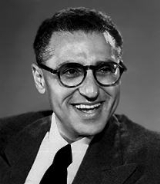
George Cukor

Encyclopedia
George Dewey Cukor was an American
film director
. He mainly concentrated on comedies and literary adaptations. His career flourished at RKO and later MGM, where he directed What Price Hollywood?
(1932), A Bill of Divorcement
(1932), Dinner at Eight
(1933), Little Women
(1933), David Copperfield
(1935), Romeo and Juliet
(1936) and Camille
(1936).
He was replaced as the director of Gone with the Wind
(1939), but he went on to direct The Philadelphia Story (1940), Adam's Rib
(1949), Born Yesterday
(1950), A Star Is Born
(1954) and My Fair Lady
(1964). He continued to work into the 1980s.
of New York City
, the younger child and only son of Hungarian
Jewish immigrants Victor, an assistant district attorney
, and Helen Ilona (née
Gross) Cukor. His parents selected his middle name in honor of Spanish–American War hero George Dewey
. The family was not particularly religious; Yiddish was not spoken in the home, pork was a staple on the dinner table, and when he started attending temple as a boy, Cukor learned Hebrew phonetically, with no real understanding of the meaning of the words or what they represented. As a result, he was ambivalent about his faith and dismissive of old world traditions from childhood, and as an adult he embraced Anglophilia
to remove himself even further from his roots.
As a child, Cukor appeared in several amateur plays and took dance lessons, and at the age of seven he performed in a recital with David O. Selznick
, who in later years would become a mentor and friend. As a teenager, Cukor frequently was taken to the New York Hippodrome
by his uncle. Infatuated with theatre
, he often cut classes at DeWitt Clinton High School
to attend afternoon matinees. During his senior year, he worked as a supernumerary
with the Metropolitan Opera
, earning 50¢ per appearance, and $1 if he was required to perform in blackface
.
Following his graduation in 1917, Cukor was expected to follow in his father's footsteps and pursue a career in law. He halfheartedly enrolled in the City College of New York
, where he entered the Students Army Training Corps in October 1918. His military experience was limited; Germany surrendered in early November, and Cukor's duty ended after only two months. Shortly after, he left school.
Cukor obtained a job as an assistant stage manager and bit player with a touring production of The Better 'Ole
, a popular British musical based on Old Bill
, a cartoon character created by Bruce Bairnsfather
. In 1920, he became the stage manager for the Knickerbocker Players, a troupe that shuttled between Syracuse
and Rochester, New York
, and the following year he was hired as general manager of the newly formed Lyceum Players, an upstate summer stock
company. In 1925 he formed the C.F. and Z. Production Company with Walter Folmer and John Zwicki, which gave him his first opportunity to direct. Following their first season, he made his Broadway directorial debut with Antonia by Hungarian playwright Melchior Lengyel
, then returned to Rochester, where C.F. and Z. evolved into the Cukor-Kondolf Stock Company, a troupe that included Louis Calhern
, Ilka Chase
, Phyllis Povah
, Frank Morgan
, Reginald Owen
, Elizabeth Patterson
and Douglass Montgomery
, all of whom would work with Cukor in later years in Hollywood. Lasting only one season with the company was Bette Davis
. Cukor later recalled, "Her talent was apparent, but she did buck at direction. She had her own ideas, and though she only did bits and ingenue
roles, she didn't hesitate to express them." For the next several decades, Davis claimed she was fired, and although Cukor never understood why she placed so much importance on an incident he considered so minor, he never worked with her again.
For the next few years, Cukor alternated between Rochester in the summer months and Broadway in the winter. His direction of a 1926 stage adaptation of The Great Gatsby
by Owen Davis
brought him to the attention of the New York critics. Writing in the Brooklyn Eagle
, drama critic Arthur Pollock called it "an unusual piece of work by a director not nearly so well-known as he should be." Cukor directed six more Broadway productions before departing for Hollywood in 1929.
signed him to a contract that reimbursed him for his airfare and initially paid him $600 per week with no screen credit during a six-month apprenticeship. He arrived in Hollywood in February 1929, and his first assignment was to coach the cast of River of Romance to speak with an acceptable Southern accent. In October, the studio lent him to Universal Pictures
to conduct the screen tests and work as a dialogue director for All Quiet on the Western Front. In 1930, he co-directed three films at Paramount, and his weekly salary was increased to $1500. In 1931, he made his solo directorial debut with Tarnished Lady
starring Tallulah Bankhead
.
Cukor was then assigned to One Hour With You
(1932), an operetta
with Maurice Chevalier
and Jeanette MacDonald
, when original director Ernst Lubitsch
opted to concentrate on producing the film instead. At first the two men worked well together, but two weeks into filming Lubitsch began arriving on the set on a regular basis, and he soon began directing scenes with Cukor's consent. Upon the film's completion, Lubitsch approached Paramount general manager B. P. Schulberg
and threatened to leave the studio if Cukor's name wasn't removed from the credits. When Schulberg asked him to cooperate, Cukor filed suit. He eventually settled for being billed as assistant director and then left Paramount to work with David O. Selznick
at RKO Studios.
Cukor quickly earned a reputation as a director who could coax great performances from actresses and he became known as a 'woman's director', a title he resented. Despite this reputation, during his career, he oversaw more performances honored with the Academy Award for Best Actor
than any other director: James Stewart
in The Philadelphia Story (1940), Ronald Colman
in A Double Life
(1947), and Rex Harrison
in My Fair Lady
(1964). One of Cukor's first ingenues was actress Katharine Hepburn
, who debuted in A Bill of Divorcement and whose looks and personality left RKO officials at a loss as to how to use her. Cukor directed her in several films, both successful (Little Women, 1933) and disastrous (Sylvia Scarlett
, 1935), and they became close friends off the set.
Cukor was hired to direct Gone with the Wind
by Selznick in 1936, even before the book was published. He spent the next two years involved with pre-production duties, including supervision of the numerous screen test
s of actresses anxious to portray Scarlett O'Hara
. Cukor favored Hepburn for the role, but Selznick, concerned about her reputation as 'box office poison', would not consider her without a screen test, and the actress refused to film one. Of those who did, Cukor preferred Paulette Goddard
, but her supposedly illicit relationship with Charlie Chaplin
(they were, in fact, secretly married) concerned Selznick.
Between his Wind chores, the director assisted with other projects. He filmed the cave scene for The Adventures of Tom Sawyer
(1938) and, following the firing of its original director Richard Thorpe
, Cukor spent a week on the set of The Wizard of Oz
(1939). Although he filmed no footage, he made crucial changes to the look of Dorothy by eliminating Judy Garland
's blonde wig and adjusting her makeup and costume, encouraging her to act in a more natural manner that greatly contributed to the success of the final film. Additionally, Cukor softened the Scarecrow's makeup and gave Margaret Hamilton
's Wicked Witch of the West a different hairstyle, as well as altering her makeup and other facial features.
Cukor spent many hours coaching Vivien Leigh
and Olivia de Havilland
prior to the start of filming Wind, but Clark Gable
resisted his efforts to get him to master a Southern accent. However, despite rumors about Gable being uncomfortable with Cukor on the set, nothing in the internal memos of David O. Selznick indicates or suggests that Clark Gable played any role in Cukor's dismissal from the film. Rather, they show Selznick's mounting dissatisfaction with Cukor's slow pace and quality of work. From a private letter from journalist Susan Myrick to Margaret Mitchell in February 1939: "George [Cukor] finally told me all about it. He hated [leaving the production] very much he said but he could not do otherwise. In effect he said he is an honest craftsman and he cannot do a job unless he knows it is a good job and he feels the present job is not right. For days, he told me he has looked at the rushes and felt he was failing... the things did not click as it should. Gradually he became convinced that the script was the trouble... So George just told David he would not work any longer if the script was not better and he wanted the [Sidney] Howard script back... he would not let his name go out over a lousy picture... And bull-headed David said 'OK get out!'"
Selznick had already been unhappy with Cukor ("a very expensive luxury") for not being more receptive to directing other Selznick assignments, even though Cukor had remained on salary since early 1937; and in a confidential memo written in September 1938, four months before principal photography began, Selznick flirted with the idea of replacing him with Victor Fleming. "I think the biggest black mark against our management to date is the Cukor situation and we can no longer be sentimental about it.... We are a business concern and not patrons of the arts..." Cukor was relieved of his duties, but he continued to work with Leigh and De Havilland off the set. Various rumors about the reasons behind his dismissal circulated throughout Hollywood. Selznick's friendship with Cukor had crumbled slightly when the director refused other assignments, including A Star is Born
(1937) and Intermezzo
(1939). Given that Gable and Cukor had worked together before, in Manhattan Melodrama
and Gable had no objection to working with him then, and given Selznick's desperation to get Gable for Rhett Butler, if Gable had any objections to Cukor, certainly they would have been expressed before he signed his contract for the film.
Cukor's dismissal from Wind freed him to direct The Women
(1939), notable for its all-female cast, followed by The Philadelphia Story (1940), starring Katharine Hepburn. He also directed another of his favorite actresses, Greta Garbo
, in Two-Faced Woman
(1941), her last film before she retired from the screen.
In 1942, at the age of forty-three, Cukor enlisted in the Signal Corps. Following basic training at Fort Monmouth
, he was assigned to the old Paramount
studios in Astoria, Queens
(where he had directed three films in the early 1930s), although he was permitted to lodge at the St. Regis Hotel in Manhattan. Working with Irwin Shaw
, John Cheever
and William Saroyan
, among others, Cukor produced training and instructional films for army personnel. Because he lacked an officer's commission, he found it difficult to give orders and directions to his superiors. Despite his efforts to rise above the rank of private
—he even called upon Frank Capra
to intercede on his behalf—he never achieved officer's status or any commendations during his six months of service. In later years Cukor suspected his homosexuality impeded him from receiving any advances or honors, although rumors to that effect could not be confirmed.
The remainder of the decade was a series of hits and misses for Cukor. Both Two Faced Woman and Her Cardboard Lover
(1942) were commercial failures. More successful were A Woman's Face
(1941) with Joan Crawford
and Gaslight
(1944) with Ingrid Bergman
and Charles Boyer
. During this era, Cukor forged an alliance with screenwriters Garson Kanin
and Ruth Gordon
, who had met in Cukor's home in 1939 and married three years later. Over the course of seven years, the trio collaborated on seven films, including Adam's Rib
(1949), Born Yesterday
(1950), The Marrying Kind
(1952), and It Should Happen to You
(1954), all starring another Cukor favorite, Judy Holliday
, who won the Academy Award for Best Actress
for Born Yesterday.
, who proposed the director helm a musical remake of the 1937 film A Star is Born with his then-wife Judy Garland in the lead role. Cukor had declined to direct the earlier film because it was too similar to his 1932 What Price Hollywood?, but the opportunity to direct his first Technicolor
film, first musical, and work with screenwriter Moss Hart
and especially Garland appealed to him, and he accepted. Getting the updated A Star Is Born
to the screen proved to be a challenge. Cukor wanted Cary Grant
for the male lead and went so far as to read the entire script with him, but Grant, while agreeing it was the role of a lifetime, steadfastly refused to do it, and Cukor never forgave him. The director then suggested either Humphrey Bogart
or Frank Sinatra
tackle the part, but Jack Warner
rejected both. Stewart Granger
was the front runner for a period of time, but he backed out when he was unable to adjust to Cukor's habit of acting out scenes as a form of direction. James Mason
ultimately was signed, and filming began on October 12, 1953. As the months passed, Cukor was forced to deal not only with constant script changes but a very unstable leading lady, who was plagued by chemical and alcohol dependencies, extreme weight fluctuations, and real and imagined illnesses. In March 1954, a rough cut still missing several musical numbers was assembled, and Cukor had mixed feelings about it. When the last scene finally was filmed in the early morning hours of July 28, 1954, Cukor already had departed the production and was unwinding in Europe. The first preview the following month ran 210 minutes and, despite ecstatic feedback from the audience, Cukor and editor Folmar Blangsted trimmed it to 182 minutes for its New York premiere in October. The reviews were the best of Cukor's career, but Warner executives, concerned the running time would limit the number of daily showings, made drastic cuts without Cukor, who had departed for India
to scout locations for Bhowani Junction
. At its final running time of 154 minutes, the film had lost musical numbers and crucial dramatic scenes, and Cukor called it "very painful." He was not included in the film's six Oscar nominations, all of which were lost.
Over the next ten years, Cukor directed a handful of films with varying success. Les Girls
(1957) won the Golden Globe Award for Best Motion Picture – Musical or Comedy, and Wild Is the Wind
(1957) earned Oscar nominations for Anna Magnani
and Anthony Quinn
, but neither Heller in Pink Tights
nor Let's Make Love
(both 1960) were box office hits. His most notable project during this period was the ill-fated Something's Got to Give
, an updated remake of the 1940 screwball comedy
My Favorite Wife
. Cukor liked leading lady Marilyn Monroe
but found it difficult to deal with her erratic work habits, frequent absences from the set, and the constant presence of her acting coach, Paula Strasberg
. After thirty-two days of shooting, the director had only 7½ minutes of usable film. Then Monroe travelled to New York to appear at a birthday celebration for John F. Kennedy
at Madison Square Garden
, where she famously serenaded the President. Studio documents released after Monroe's death confirmed that her appearance at the political fundraising event was approved by Fox executives. The production came to a halt when Cukor had filmed every scene not involving Monroe and the actress remained unavailable. 20th Century Fox
executive Peter Levathes fired her and hired Lee Remick
to replace her, prompting co-star Dean Martin
to quit, since his contract guaranteed he would be playing opposite Monroe. With the production already $2 million over budget and everyone back at the starting gate, the studio pulled the plug on the project. Less than two months later, Monroe was found dead in her home.
Two years later, Cukor achieved one of his greatest successes with My Fair Lady
. Throughout filming there were mounting tensions between the director and designer Cecil Beaton
, but Cukor was thrilled with leading lady Audrey Hepburn
, although the crew was less enchanted with her diva-like demands. Although several reviews were critical of the film – Pauline Kael
said it "staggers along" and Stanley Kauffmann
thought Cukor's direction was like "a rich gravy poured over everything, not remotely as delicately rich as in the Asquith
-Howard
1937 Pygmalion
" — the film was a box office hit which won him the Academy Award for Best Director, the Golden Globe Award for Best Director, and the Directors Guild of America Award after having been nominated for each several times.
Following My Fair Lady, Cukor became less active. He directed Maggie Smith
in Travels with My Aunt
in 1972 and helmed the critical and commercial flop The Blue Bird
, the first joint Soviet-American production, in 1976. He reunited twice with Katharine Hepburn for the television movie
s Love Among the Ruins
(1975) and The Corn Is Green
(1979). He directed his final film, Rich and Famous
(1981) with Jacqueline Bisset
and Candice Bergen
, at the age of eighty-two.
in Hollywood that Cukor was homosexual, although he was discreet about his sexual orientation and "never carried it as a pin on his lapel", as producer Joseph L. Mankiewicz
put it. He was a celebrated bon vivant whose luxurious home was the site of weekly Sunday afternoon parties attended by closeted
celebrities and the attractive young men they met in bars and gyms and brought with them. At least once, in the midst of his reign at MGM, he was arrested on vice
charges, but studio executives managed to get the charges dropped and all records of it expunged, and the incident never was publicized by the press. In the late 1950s, Cukor became involved with a considerably younger man named George Towers. He financed his education at the Los Angeles State College of Applied Arts and Sciences
and the University of Southern California
, from which Towers graduated with a law degree in 1967. That fall Towers married and his relationship with Cukor evolved into one of father and son, and for the remainder of Cukor's life the two remained very close.
By the mid-1930s, Cukor was not only established as a prominent director but, socially, as an unofficial head of Hollywood's gay subculture. His home, redecorated in 1935 by actor-turned interior designer William Haines
, was the scene of many gatherings for the industry's homosexuals. The close-knit group included Haines and his partner Jimmie Shields, Alan Ladd
, writer Somerset Maugham, director James Vincent
, screenwriter Rowland Leigh, costume designers Orry-Kelly
and Robert Le Maire, and actors John Darrow, Anderson Lawler, Grady Sutton
, Robert Seiter and Tom Douglas. Frank Horn, secretary to Cary Grant, was also a frequent guest.
Cukor's friends were of paramount importance to him and he kept his home filled with their photographs. Regular attendees at his famed soirées included Katharine Hepburn
and Spencer Tracy
, Joan Crawford
and Douglas Fairbanks, Jr.
, Lauren Bacall
and Humphrey Bogart
, Claudette Colbert
, Marlene Dietrich
, Laurence Olivier
and Vivien Leigh
, actor Richard Cromwell
, Stanley Holloway
, Judy Garland
, Gene Tierney
, Noël Coward
, Cole Porter
, director James Whale
, costume designer Edith Head
, and Norma Shearer
, especially after the death of her first husband, Irving Thalberg
. He often entertained literary figures like Sinclair Lewis
, Theodore Dreiser
, Aldous Huxley
, Ferenc Molnár
, and close friend Somerset Maugham, as well.
on January 24, 1983, and was interred in an unmarked grave at the Forest Lawn Memorial Park Cemetery in Glendale, California
. Records in probate court indicated his net worth at the time of his death was $2,377,720.
United States
The United States of America is a federal constitutional republic comprising fifty states and a federal district...
film director
Film director
A film director is a person who directs the actors and film crew in filmmaking. They control a film's artistic and dramatic nathan roach, while guiding the technical crew and actors.-Responsibilities:...
. He mainly concentrated on comedies and literary adaptations. His career flourished at RKO and later MGM, where he directed What Price Hollywood?
What Price Hollywood?
What Price Hollywood? is a 1932 American drama film directed by George Cukor. The screenplay by Gene Fowler, Rowland Brown, Ben Markson, and Jane Murfin is based on a story by Adela Rogers St. Johns.-Plot:...
(1932), A Bill of Divorcement
A Bill of Divorcement
A Bill of Divorcement is a 1932 American drama film, directed by George Cukor and starring John Barrymore and Katharine Hepburn in her movie debut. It is based on the British play of the same name, written by Clemence Dane as a reaction to a law passed in Britain in the early 1920s that allowed...
(1932), Dinner at Eight
Dinner at Eight (film)
Dinner at Eight is a Pre-Code 1933 comedy of manners/drama produced by MGM Studios. The film was adapted to the screen by Frances Marion and Herman J. Mankiewicz from the play by George S. Kaufman and Edna Ferber, with additional dialogue supplied by Donald Ogden Stewart. Produced by David O...
(1933), Little Women
Little Women (1933 film)
Little Women is a 1933 American drama film directed by George Cukor. The screenplay by Sarah Y. Mason and Victor Heerman is based on the classic novel of the same name by Louisa May Alcott...
(1933), David Copperfield
Personal History, Adventures, Experience, and Observation of David Copperfield the Younger
The Personal History, Adventures, Experience, & Observation of David Copperfield the Younger is a 1935 American film based upon the Charles Dickens novel David Copperfield...
(1935), Romeo and Juliet
Romeo and Juliet (1936 film)
Romeo and Juliet is a 1936 American film adapted from the play by Shakespeare, directed by George Cukor from a screenplay by Talbot Jennings...
(1936) and Camille
Camille (1936 film)
Camille is an American romantic drama film directed by George Cukor and produced by Irving Thalberg and Bernard H. Hyman, from a screenplay by James Hilton, Zoe Akins and Frances Marion. The picture is based on the 1852 novel and play La Dame aux Camélias by Alexandre Dumas, fils...
(1936).
He was replaced as the director of Gone with the Wind
Gone with the Wind (film)
Gone with the Wind is a 1939 American historical epic film adapted from Margaret Mitchell's Pulitzer-winning 1936 novel of the same name. It was produced by David O. Selznick and directed by Victor Fleming from a screenplay by Sidney Howard...
(1939), but he went on to direct The Philadelphia Story (1940), Adam's Rib
Adam's Rib
Adam's Rib is a 1949 American film written by Ruth Gordon and Garson Kanin and directed by George Cukor. It stars Spencer Tracy and Katharine Hepburn as married lawyers who come to oppose each other in court. Judy Holliday co-stars in her first substantial film role...
(1949), Born Yesterday
Born Yesterday (1950 film)
Born Yesterday is a 1950 film based on the play of the same name by Garson Kanin and directed by George Cukor. The screenplay was written by Albert Mannheimer with uncredited contributions from Kanin....
(1950), A Star Is Born
A Star Is Born (1954 film)
A Star Is Born is a 1954 American musical film directed by George Cukor. The screenplay written by Moss Hart was an adaptation of the original 1937 film, which was based on the original screenplay by Robert Carson, Dorothy Parker, and Alan Campbell...
(1954) and My Fair Lady
My Fair Lady (film)
My Fair Lady is a 1964 musical film adaptation of the Lerner and Loewe stage musical, of the same name, based on the 1938 film adaptation of the original stage play Pygmalion by George Bernard Shaw. The ballroom scene and the ending were taken from the previous film adaptation , rather than from...
(1964). He continued to work into the 1980s.
Early life
Cukor was born on the Lower East SideLower East Side
The Lower East Side, LES, is a neighborhood in the southeastern part of the New York City borough of Manhattan. It is roughly bounded by Allen Street, East Houston Street, Essex Street, Canal Street, Eldridge Street, East Broadway, and Grand Street....
of New York City
New York City
New York is the most populous city in the United States and the center of the New York Metropolitan Area, one of the most populous metropolitan areas in the world. New York exerts a significant impact upon global commerce, finance, media, art, fashion, research, technology, education, and...
, the younger child and only son of Hungarian
Hungary
Hungary , officially the Republic of Hungary , is a landlocked country in Central Europe. It is situated in the Carpathian Basin and is bordered by Slovakia to the north, Ukraine and Romania to the east, Serbia and Croatia to the south, Slovenia to the southwest and Austria to the west. The...
Jewish immigrants Victor, an assistant district attorney
District attorney
In many jurisdictions in the United States, a District Attorney is an elected or appointed government official who represents the government in the prosecution of criminal offenses. The district attorney is the highest officeholder in the jurisdiction's legal department and supervises a staff of...
, and Helen Ilona (née
Married and maiden names
A married name is the family name adopted by a person upon marriage. When a person assumes the family name of her spouse, the new name replaces the maiden name....
Gross) Cukor. His parents selected his middle name in honor of Spanish–American War hero George Dewey
George Dewey
George Dewey was an admiral of the United States Navy. He is best known for his victory at the Battle of Manila Bay during the Spanish-American War...
. The family was not particularly religious; Yiddish was not spoken in the home, pork was a staple on the dinner table, and when he started attending temple as a boy, Cukor learned Hebrew phonetically, with no real understanding of the meaning of the words or what they represented. As a result, he was ambivalent about his faith and dismissive of old world traditions from childhood, and as an adult he embraced Anglophilia
Anglophilia
An Anglophile is a person who is fond of English culture or, more broadly, British culture. Its antonym is Anglophobe.-Definition:The word comes from Latin Anglus "English" via French, and is ultimately derived from Old English Englisc "English" + Ancient Greek φίλος - philos, "friend"...
to remove himself even further from his roots.
As a child, Cukor appeared in several amateur plays and took dance lessons, and at the age of seven he performed in a recital with David O. Selznick
David O. Selznick
David O. Selznick was an American film producer. He is best known for having produced Gone with the Wind and Rebecca , both of which earned him an Oscar for Best Picture.-Early years:...
, who in later years would become a mentor and friend. As a teenager, Cukor frequently was taken to the New York Hippodrome
New York Hippodrome
The Hippodrome Theatre, also called the New York Hippodrome, was a theatre in New York City from 1905 to 1939, located on Sixth Avenue between 43rd and 44th Streets in the Theater District of Midtown Manhattan. It was called the world's largest theatre by its builders and had a seating capacity of...
by his uncle. Infatuated with theatre
Theatre
Theatre is a collaborative form of fine art that uses live performers to present the experience of a real or imagined event before a live audience in a specific place. The performers may communicate this experience to the audience through combinations of gesture, speech, song, music or dance...
, he often cut classes at DeWitt Clinton High School
DeWitt Clinton High School
DeWitt Clinton High School is an American high school located in the Bronx, New York City, New York.-History:Clinton opened in 1897 at 60 West 13th Street at the northern end of Greenwich Village under the name of Boys High School, although this Boys High School was not related to the one in Brooklyn...
to attend afternoon matinees. During his senior year, he worked as a supernumerary
Supernumerary actor
Supernumerary actors are usually amateur character actors in opera and ballet performances who train under professional direction to create a believable scene.- Definition :...
with the Metropolitan Opera
Metropolitan Opera
The Metropolitan Opera is an opera company, located in New York City. Originally founded in 1880, the company gave its first performance on October 22, 1883. The company is operated by the non-profit Metropolitan Opera Association, with Peter Gelb as general manager...
, earning 50¢ per appearance, and $1 if he was required to perform in blackface
Blackface
Blackface is a form of theatrical makeup used in minstrel shows, and later vaudeville, in which performers create a stereotyped caricature of a black person. The practice gained popularity during the 19th century and contributed to the proliferation of stereotypes such as the "happy-go-lucky darky...
.
Following his graduation in 1917, Cukor was expected to follow in his father's footsteps and pursue a career in law. He halfheartedly enrolled in the City College of New York
City College of New York
The City College of the City University of New York is a senior college of the City University of New York , in New York City. It is also the oldest of the City University's twenty-three institutions of higher learning...
, where he entered the Students Army Training Corps in October 1918. His military experience was limited; Germany surrendered in early November, and Cukor's duty ended after only two months. Shortly after, he left school.
Cukor obtained a job as an assistant stage manager and bit player with a touring production of The Better 'Ole
The Better 'Ole
The Better 'Ole, also called The Romance of Old Bill, is an Edwardian musical comedy with a book by Bruce Bairnsfather and Arthur Elliott, music by Herman Darewski, and lyrics by Percival Knight and James Heard, based on the cartoon character Old Bill, an infantryman, drawn by Bairnsfather...
, a popular British musical based on Old Bill
Old Bill (cartoon character)
Old Bill is a fictional character created in 1914-15 by cartoonist Bruce Bairnsfather. Old Bill was depicted as an elderly, pipe-smoking British "tommy" with a walrus moustache. The character achieved a great deal of popularity during World War I where it was considered a major morale booster for...
, a cartoon character created by Bruce Bairnsfather
Bruce Bairnsfather
Captain Bruce Bairnsfather was a prominent British humorist and cartoonist. His best-known cartoon character is Old Bill...
. In 1920, he became the stage manager for the Knickerbocker Players, a troupe that shuttled between Syracuse
Syracuse, New York
Syracuse is a city in and the county seat of Onondaga County, New York, United States, the largest U.S. city with the name "Syracuse", and the fifth most populous city in the state. At the 2010 census, the city population was 145,170, and its metropolitan area had a population of 742,603...
and Rochester, New York
Rochester, New York
Rochester is a city in Monroe County, New York, south of Lake Ontario in the United States. Known as The World's Image Centre, it was also once known as The Flour City, and more recently as The Flower City...
, and the following year he was hired as general manager of the newly formed Lyceum Players, an upstate summer stock
Summer Stock
For the article about the theatre genre, see Summer stock theatre.Summer Stock is a Metro-Goldwyn-Mayer musical made in 1950. The film was directed by Charles Walters and stars Judy Garland, Gene Kelly, Eddie Bracken, Gloria DeHaven, Marjorie Main, and Phil Silvers...
company. In 1925 he formed the C.F. and Z. Production Company with Walter Folmer and John Zwicki, which gave him his first opportunity to direct. Following their first season, he made his Broadway directorial debut with Antonia by Hungarian playwright Melchior Lengyel
Melchior Lengyel
Melchior Lengyel was a Hungarian writer, dramatist, and film screenwriter.-Biography:Lengyel was born Lebovics Menyhért in Balmazújváros, Hungary. He started his career as a journalist...
, then returned to Rochester, where C.F. and Z. evolved into the Cukor-Kondolf Stock Company, a troupe that included Louis Calhern
Louis Calhern
Louis Calhern was an American stage and screen actor.- Early life :Louis Calhern was born Carl Henry Vogt on February 19, 1895 in Brooklyn, New York. His family left New York City while he was still a child and moved to St. Louis, Missouri where he grew up...
, Ilka Chase
Ilka Chase
Ilka Chase was an American actress and novelist.Born in New York City and educated at convent and boarding schools in the United States, England, and France, she was the only child of Edna Woolman Chase, the editor in chief of Vogue magazine, and her first husband, Francis Dane Chase.Chase made...
, Phyllis Povah
Phyllis Povah
Phyllis Povah was an American stage and film actress.Povah made her Broadway theatre debut in Mr. Pim Passes By in 1921 and acted in minor roles in several productions over the next two decades. She achieved a notable success in a featured role in the stage production of The Women, and the play...
, Frank Morgan
Frank Morgan
Frank Morgan was an American actor. He was best known for his portrayal of the title character in the film The Wizard of Oz.-Early life:...
, Reginald Owen
Reginald Owen
John Reginald Owen was a British character actor. He was known for his many roles in British and American movies and later in television programs.-Personal:...
, Elizabeth Patterson
Elizabeth Patterson (actress)
Elizabeth Patterson was an American film and television character actress remembered for her portrayal of elderly neighbor Matilda Trumbull on I Love Lucy.-Career:...
and Douglass Montgomery
Douglass Montgomery
Robert Douglass Montgomery was an American film actor.-Career:Son of a jeweler, he used the stage name of Douglass Montgomery when he first acted on stage in New York. He appeared as a ruggedly handsome fair-haired man, often slightly naive. He started his career in Hollywood, often playing the...
, all of whom would work with Cukor in later years in Hollywood. Lasting only one season with the company was Bette Davis
Bette Davis
Ruth Elizabeth "Bette" Davis was an American actress of film, television and theater. Noted for her willingness to play unsympathetic characters, she was highly regarded for her performances in a range of film genres, from contemporary crime melodramas to historical and period films and occasional...
. Cukor later recalled, "Her talent was apparent, but she did buck at direction. She had her own ideas, and though she only did bits and ingenue
Ingenue (stock character)
See also Disingenuous, which is not quite the antonym that it may seem!The ingénue is a stock character in literature, film, and a role type in the theatre; generally a girl or a young woman who is endearingly innocent and wholesome. Ingenue may also refer to a new young actress or one typecast in...
roles, she didn't hesitate to express them." For the next several decades, Davis claimed she was fired, and although Cukor never understood why she placed so much importance on an incident he considered so minor, he never worked with her again.
For the next few years, Cukor alternated between Rochester in the summer months and Broadway in the winter. His direction of a 1926 stage adaptation of The Great Gatsby
The Great Gatsby
The Great Gatsby is a novel by the American author F. Scott Fitzgerald. First published in1925, it is set on Long Island's North Shore and in New York City from spring to autumn of 1922....
by Owen Davis
Owen Davis
Owen Gould Davis, Sr. was an American dramatist. He received the 1923 Pulitzer Prize for Drama for his 1923 play Icebound, and penned hundreds of plays and scripts for radio and film. Before the First World War, he also wrote racy sketches of New York high jinks and low life for the Police Gazette...
brought him to the attention of the New York critics. Writing in the Brooklyn Eagle
Brooklyn Eagle
The Brooklyn Daily Bulletin began publishing when the original Eagle folded in 1955. In 1996 it merged with a newly revived Brooklyn Daily Eagle, and now publishes a morning paper five days a week under the Brooklyn Daily Eagle name...
, drama critic Arthur Pollock called it "an unusual piece of work by a director not nearly so well-known as he should be." Cukor directed six more Broadway productions before departing for Hollywood in 1929.
Early Hollywood career
When Hollywood began to recruit New York theater talent for sound films, Cukor immediately answered the call. In December 1928, Paramount PicturesParamount Pictures
Paramount Pictures Corporation is an American film production and distribution company, located at 5555 Melrose Avenue in Hollywood. Founded in 1912 and currently owned by media conglomerate Viacom, it is America's oldest existing film studio; it is also the last major film studio still...
signed him to a contract that reimbursed him for his airfare and initially paid him $600 per week with no screen credit during a six-month apprenticeship. He arrived in Hollywood in February 1929, and his first assignment was to coach the cast of River of Romance to speak with an acceptable Southern accent. In October, the studio lent him to Universal Pictures
Universal Studios
Universal Pictures , a subsidiary of NBCUniversal, is one of the six major movie studios....
to conduct the screen tests and work as a dialogue director for All Quiet on the Western Front. In 1930, he co-directed three films at Paramount, and his weekly salary was increased to $1500. In 1931, he made his solo directorial debut with Tarnished Lady
Tarnished Lady
Tarnished Lady is a 1931 American drama film directed by George Cukor. The screenplay by Donald Ogden Stewart is based on his short story "A Story of a New York Lady."-Plot:...
starring Tallulah Bankhead
Tallulah Bankhead
Tallulah Brockman Bankhead was an award-winning American actress of the stage and screen, talk-show host, and bonne vivante...
.
Cukor was then assigned to One Hour With You
One Hour with You
One Hour with You is a 1932 American film. It was produced and directed by Ernst Lubitsch and written by Samson Raphaelson, from the Lothar Schmidt play Only a Dream....
(1932), an operetta
Operetta
Operetta is a genre of light opera, light in terms both of music and subject matter. It is also closely related, in English-language works, to forms of musical theatre.-Origins:...
with Maurice Chevalier
Maurice Chevalier
Maurice Auguste Chevalier was a French actor, singer, entertainer and a noted Sprechgesang performer. He is perhaps best known for his signature songs, including Louise, Mimi, Valentine, and Thank Heaven for Little Girls and for his films including The Love Parade and The Big Pond...
and Jeanette MacDonald
Jeanette MacDonald
Jeanette MacDonald was an American singer and actress best remembered for her musical films of the 1930s with Maurice Chevalier and Nelson Eddy...
, when original director Ernst Lubitsch
Ernst Lubitsch
Ernst Lubitsch was a German-born film director. His urbane comedies of manners gave him the reputation of being Hollywood's most elegant and sophisticated director; as his prestige grew, his films were promoted as having "the Lubitsch touch."In 1947 he received an Honorary Academy Award for his...
opted to concentrate on producing the film instead. At first the two men worked well together, but two weeks into filming Lubitsch began arriving on the set on a regular basis, and he soon began directing scenes with Cukor's consent. Upon the film's completion, Lubitsch approached Paramount general manager B. P. Schulberg
B. P. Schulberg
B.P. Schulberg was a pioneer film producer and movie studio executive.Born Percival Schulberg in Bridgeport, Connecticut, he took the name Benjamin from the boy in front of him when registering for school to avoid mockery for his British name...
and threatened to leave the studio if Cukor's name wasn't removed from the credits. When Schulberg asked him to cooperate, Cukor filed suit. He eventually settled for being billed as assistant director and then left Paramount to work with David O. Selznick
David O. Selznick
David O. Selznick was an American film producer. He is best known for having produced Gone with the Wind and Rebecca , both of which earned him an Oscar for Best Picture.-Early years:...
at RKO Studios.
Cukor quickly earned a reputation as a director who could coax great performances from actresses and he became known as a 'woman's director', a title he resented. Despite this reputation, during his career, he oversaw more performances honored with the Academy Award for Best Actor
Academy Award for Best Actor
Performance by an Actor in a Leading Role is one of the Academy Awards of Merit presented annually by the Academy of Motion Picture Arts and Sciences to recognize an actor who has delivered an outstanding performance while working within the film industry...
than any other director: James Stewart
James Stewart (actor)
James Maitland Stewart was an American film and stage actor, known for his distinctive voice and his everyman persona. Over the course of his career, he starred in many films widely considered classics and was nominated for five Academy Awards, winning one in competition and receiving one Lifetime...
in The Philadelphia Story (1940), Ronald Colman
Ronald Colman
Ronald Charles Colman was an English actor.-Early years:He was born in Richmond, Surrey, England, the second son and fourth child of Charles Colman and his wife Marjory Read Fraser. His siblings included Eric, Edith, and Marjorie. He was educated at boarding school in Littlehampton, where he...
in A Double Life
A Double Life
A Double Life is a 1947 film noir which tells the story of an actor whose mind becomes affected by the character he portrays. The movie starred Ronald Colman and Signe Hasso...
(1947), and Rex Harrison
Rex Harrison
Sir Reginald Carey “Rex” Harrison was an English actor of stage and screen. Harrison won an Academy Award and two Tony Awards.-Youth and stage career:...
in My Fair Lady
My Fair Lady (film)
My Fair Lady is a 1964 musical film adaptation of the Lerner and Loewe stage musical, of the same name, based on the 1938 film adaptation of the original stage play Pygmalion by George Bernard Shaw. The ballroom scene and the ending were taken from the previous film adaptation , rather than from...
(1964). One of Cukor's first ingenues was actress Katharine Hepburn
Katharine Hepburn
Katharine Houghton Hepburn was an American actress of film, stage, and television. In a career that spanned 62 years as a leading lady, she was best known for playing strong-willed, sophisticated women in both dramas and comedies...
, who debuted in A Bill of Divorcement and whose looks and personality left RKO officials at a loss as to how to use her. Cukor directed her in several films, both successful (Little Women, 1933) and disastrous (Sylvia Scarlett
Sylvia Scarlett
Sylvia Scarlett is a 1935 romantic comedy film starring Katharine Hepburn and Cary Grant, based on The Early Life and Adventures of Sylvia Scarlett, a novel by Compton MacKenzie. Directed by George Cukor, it was notorious as one of the most famous unsuccessful movies of the 1930s...
, 1935), and they became close friends off the set.
Cukor was hired to direct Gone with the Wind
Gone with the Wind (film)
Gone with the Wind is a 1939 American historical epic film adapted from Margaret Mitchell's Pulitzer-winning 1936 novel of the same name. It was produced by David O. Selznick and directed by Victor Fleming from a screenplay by Sidney Howard...
by Selznick in 1936, even before the book was published. He spent the next two years involved with pre-production duties, including supervision of the numerous screen test
Screen test
A screen test is a method of determining the suitability of an actor or actress for performing on film and/or in a particular role. The performer is generally given a scene, or selected lines and actions, and instructed to perform in front of a camera to see if they are suitable...
s of actresses anxious to portray Scarlett O'Hara
Scarlett O'Hara
Scarlett O' Hara is the protagonist in Margaret Mitchell's 1936 novel Gone with the Wind and in the later film of the same name...
. Cukor favored Hepburn for the role, but Selznick, concerned about her reputation as 'box office poison', would not consider her without a screen test, and the actress refused to film one. Of those who did, Cukor preferred Paulette Goddard
Paulette Goddard
Paulette Goddard was an American film and theatre actress. A former child fashion model and in several Broadway productions as Ziegfeld Girl, she was a major star of the Paramount Studio in the 1940s. She was married to several notable men, including Charlie Chaplin, Burgess Meredith, and Erich...
, but her supposedly illicit relationship with Charlie Chaplin
Charlie Chaplin
Sir Charles Spencer "Charlie" Chaplin, KBE was an English comic actor, film director and composer best known for his work during the silent film era. He became the most famous film star in the world before the end of World War I...
(they were, in fact, secretly married) concerned Selznick.
Between his Wind chores, the director assisted with other projects. He filmed the cave scene for The Adventures of Tom Sawyer
The Adventures of Tom Sawyer (1938 film)
The Adventures of Tom Sawyer is a 1938 American drama film directed by Norman Taurog. The screenplay by John V.A. Weaver was based on the classic 1876 novel by Mark Twain.-Plot:...
(1938) and, following the firing of its original director Richard Thorpe
Richard Thorpe
Richard Thorpe was an American film director.Born Rollo Smolt Thorpe in Hutchinson, Kansas, he began his entertainment career performing in vaudeville and onstage. In 1921 he began in motion pictures as an actor and directed his first silent film in 1923. He went on to direct more than one hundred...
, Cukor spent a week on the set of The Wizard of Oz
The Wizard of Oz (1939 film)
The Wizard of Oz is a 1939 American musical fantasy film produced by Metro-Goldwyn-Mayer. It was directed primarily by Victor Fleming. Noel Langley, Florence Ryerson and Edgar Allan Woolf received credit for the screenplay, but there were uncredited contributions by others. The lyrics for the songs...
(1939). Although he filmed no footage, he made crucial changes to the look of Dorothy by eliminating Judy Garland
Judy Garland
Judy Garland was an American actress and singer. Through a career that spanned 45 of her 47 years and for her renowned contralto voice, she attained international stardom as an actress in musical and dramatic roles, as a recording artist and on the concert stage...
's blonde wig and adjusting her makeup and costume, encouraging her to act in a more natural manner that greatly contributed to the success of the final film. Additionally, Cukor softened the Scarecrow's makeup and gave Margaret Hamilton
Margaret Hamilton
Margaret Hamilton was an American film actress known for her portrayal of the Wicked Witch of the West in the 1939 film The Wizard of Oz...
's Wicked Witch of the West a different hairstyle, as well as altering her makeup and other facial features.
Cukor spent many hours coaching Vivien Leigh
Vivien Leigh
Vivien Leigh, Lady Olivier was an English actress. She won the Best Actress Academy Award for her portrayal of Blanche DuBois in A Streetcar Named Desire , a role she also played on stage in London's West End, as well as for her portrayal of the southern belle Scarlett O'Hara, alongside Clark...
and Olivia de Havilland
Olivia de Havilland
Olivia Mary de Havilland is a British American film and stage actress. She won the Academy Award for Best Actress in 1946 and 1949. She is the elder sister of actress Joan Fontaine. The sisters are among the last surviving leading ladies from Hollywood of the 1930s.-Early life:Olivia de Havilland...
prior to the start of filming Wind, but Clark Gable
Clark Gable
William Clark Gable , known as Clark Gable, was an American film actor most famous for his role as Rhett Butler in the 1939 Civil War epic film Gone with the Wind, in which he starred with Vivien Leigh...
resisted his efforts to get him to master a Southern accent. However, despite rumors about Gable being uncomfortable with Cukor on the set, nothing in the internal memos of David O. Selznick indicates or suggests that Clark Gable played any role in Cukor's dismissal from the film. Rather, they show Selznick's mounting dissatisfaction with Cukor's slow pace and quality of work. From a private letter from journalist Susan Myrick to Margaret Mitchell in February 1939: "George [Cukor] finally told me all about it. He hated [leaving the production] very much he said but he could not do otherwise. In effect he said he is an honest craftsman and he cannot do a job unless he knows it is a good job and he feels the present job is not right. For days, he told me he has looked at the rushes and felt he was failing... the things did not click as it should. Gradually he became convinced that the script was the trouble... So George just told David he would not work any longer if the script was not better and he wanted the [Sidney] Howard script back... he would not let his name go out over a lousy picture... And bull-headed David said 'OK get out!'"
Selznick had already been unhappy with Cukor ("a very expensive luxury") for not being more receptive to directing other Selznick assignments, even though Cukor had remained on salary since early 1937; and in a confidential memo written in September 1938, four months before principal photography began, Selznick flirted with the idea of replacing him with Victor Fleming. "I think the biggest black mark against our management to date is the Cukor situation and we can no longer be sentimental about it.... We are a business concern and not patrons of the arts..." Cukor was relieved of his duties, but he continued to work with Leigh and De Havilland off the set. Various rumors about the reasons behind his dismissal circulated throughout Hollywood. Selznick's friendship with Cukor had crumbled slightly when the director refused other assignments, including A Star is Born
A Star Is Born (1937 film)
A Star Is Born is a 1937 Technicolor romantic drama film produced by David O. Selznick and directed by William A. Wellman, with a script by Wellman, Robert Carson, Dorothy Parker and Alan Campbell. It stars Janet Gaynor as an aspiring Hollywood actress, and Fredric March as an aging movie star who...
(1937) and Intermezzo
Intermezzo (1939 film)
Intermezzo is a romantic film made in the USA by Selznick International Pictures. It was directed by Gregory Ratoff and produced by David O. Selznick. It is a remake of the Swedish film Intermezzo . The screenplay by George O'Neil was based on the screenplay of the original film by Gösta Stevens...
(1939). Given that Gable and Cukor had worked together before, in Manhattan Melodrama
Manhattan Melodrama
Manhattan Melodrama is a 1934 crime melodrama film, produced by MGM, directed by W. S. Van Dyke, and starring Clark Gable, William Powell, and Myrna Loy...
and Gable had no objection to working with him then, and given Selznick's desperation to get Gable for Rhett Butler, if Gable had any objections to Cukor, certainly they would have been expressed before he signed his contract for the film.
Cukor's dismissal from Wind freed him to direct The Women
The Women (1939 film)
The Women is a 1939 American comedy-drama film directed by George Cukor. The film is based on Clare Boothe Luce's play of the same name, and was adapted for the screen by Anita Loos and Jane Murfin, who had to make the film acceptable for the Production Code in order for it to be released.The film...
(1939), notable for its all-female cast, followed by The Philadelphia Story (1940), starring Katharine Hepburn. He also directed another of his favorite actresses, Greta Garbo
Greta Garbo
Greta Garbo , born Greta Lovisa Gustafsson, was a Swedish film actress. Garbo was an international star and icon during Hollywood's silent and classic periods. Many of Garbo's films were sensational hits, and all but three were profitable...
, in Two-Faced Woman
Two-Faced Woman
Two-Faced Woman is a romantic comedy made by Metro-Goldwyn-Mayer. The film stars Greta Garbo, in her final film role, and Melvyn Douglas, with Constance Bennett, Roland Young and Ruth Gordon...
(1941), her last film before she retired from the screen.
In 1942, at the age of forty-three, Cukor enlisted in the Signal Corps. Following basic training at Fort Monmouth
Fort Monmouth
Fort Monmouth was an installation of the Department of the Army in Monmouth County, New Jersey. The post is surrounded by the communities of Eatontown, Tinton Falls and Oceanport, New Jersey, and is located about 5 miles from the Atlantic Ocean. The post covers nearly of land, from the Shrewsbury...
, he was assigned to the old Paramount
Kaufman Astoria Studios
The Kaufman Astoria Studios is an historic movie studio located in the Astoria section of the New York City borough of Queens.-History:It was originally built by Famous Players-Lasky in 1920 to provide the company with a facility close to the Broadway theater district. Many features and short...
studios in Astoria, Queens
Astoria, Queens
Astoria is a neighborhood in the northwestern corner of the borough of Queens in New York City. Located in Community Board 1, Astoria is bounded by the East River and is adjacent to three other Queens neighborhoods: Long Island City, Sunnyside , and Woodside...
(where he had directed three films in the early 1930s), although he was permitted to lodge at the St. Regis Hotel in Manhattan. Working with Irwin Shaw
Irwin Shaw
Irwin Shaw was a prolific American playwright, screenwriter, novelist, and short-story author whose written works have sold more than 14 million copies. He is best-known for his novel, The Young Lions about the fate of three soldiers during World War II that was made into a film starring Marlon...
, John Cheever
John Cheever
John William Cheever was an American novelist and short story writer. He is sometimes called "the Chekhov of the suburbs." His fiction is mostly set in the Upper East Side of Manhattan, the Westchester suburbs, old New England villages based on various South Shore towns around Quincy,...
and William Saroyan
William Saroyan
William Saroyan was an Armenian American dramatist and author. The setting of many of his stories and plays is the center of Armenian-American life in California in his native Fresno.-Early years:...
, among others, Cukor produced training and instructional films for army personnel. Because he lacked an officer's commission, he found it difficult to give orders and directions to his superiors. Despite his efforts to rise above the rank of private
Private (rank)
A Private is a soldier of the lowest military rank .In modern military parlance, 'Private' is shortened to 'Pte' in the United Kingdom and other Commonwealth countries and to 'Pvt.' in the United States.Notably both Sir Fitzroy MacLean and Enoch Powell are examples of, rare, rapid career...
—he even called upon Frank Capra
Frank Capra
Frank Russell Capra was a Sicilian-born American film director. He emigrated to the U.S. when he was six, and eventually became a creative force behind major award-winning films during the 1930s and 1940s...
to intercede on his behalf—he never achieved officer's status or any commendations during his six months of service. In later years Cukor suspected his homosexuality impeded him from receiving any advances or honors, although rumors to that effect could not be confirmed.
The remainder of the decade was a series of hits and misses for Cukor. Both Two Faced Woman and Her Cardboard Lover
Her Cardboard Lover
Her Cardboard Lover is a 1942 American comedy film directed by George Cukor. The screenplay by Jacques Deval, John Collier, Anthony Veiller, and William H. Wright is based on the English translation of Deval's play Dans sa candeur naïve by Valerie Wyngate and P.G. Wodehouse...
(1942) were commercial failures. More successful were A Woman's Face
A Woman's Face
A Woman's Face is a 1941 drama film directed by George Cukor, starring Joan Crawford, Melvyn Douglas and Conrad Veidt. It tells the story of Anna Holm, a facially disfigured blackmailer, who because of her appearance despises everyone she encounters...
(1941) with Joan Crawford
Joan Crawford
Joan Crawford , born Lucille Fay LeSueur, was an American actress in film, television and theatre....
and Gaslight
Gaslight (1944 film)
Gaslight is a 1944 mystery-thriller film adapted from Patrick Hamilton's play, Gas Light, performed as Angel Street on Broadway in 1941. It was the second version to be filmed; the first, released in the United Kingdom, had been made a mere four years earlier...
(1944) with Ingrid Bergman
Ingrid Bergman
Ingrid Bergman was a Swedish actress who starred in a variety of European and American films. She won three Academy Awards, two Emmy Awards, and the Tony Award for Best Actress. She is ranked as the fourth greatest female star of American cinema of all time by the American Film Institute...
and Charles Boyer
Charles Boyer
Charles Boyer was a French actor who appeared in more than 80 films between 1920 and 1976. After receiving an education in drama, Boyer started on the stage, but he found success in movies during the 1930s. His memorable performances were among the era's most highly praised romantic dramas,...
. During this era, Cukor forged an alliance with screenwriters Garson Kanin
Garson Kanin
Garson Kanin was a prolific American writer and director of plays and films.-Film and stage career:...
and Ruth Gordon
Ruth Gordon
Ruth Gordon Jones , better known as Ruth Gordon, was an American actress and writer. She was perhaps best known for her film roles such as Minnie Castevet, Rosemary's overly solicitous neighbor in Rosemary's Baby, as the eccentric Maude in Harold and Maude and as the mother of Orville Boggs in the...
, who had met in Cukor's home in 1939 and married three years later. Over the course of seven years, the trio collaborated on seven films, including Adam's Rib
Adam's Rib
Adam's Rib is a 1949 American film written by Ruth Gordon and Garson Kanin and directed by George Cukor. It stars Spencer Tracy and Katharine Hepburn as married lawyers who come to oppose each other in court. Judy Holliday co-stars in her first substantial film role...
(1949), Born Yesterday
Born Yesterday (1950 film)
Born Yesterday is a 1950 film based on the play of the same name by Garson Kanin and directed by George Cukor. The screenplay was written by Albert Mannheimer with uncredited contributions from Kanin....
(1950), The Marrying Kind
The Marrying Kind
The Marrying Kind is a film directed by George Cukor, starring Aldo Ray and Judy Holliday. Other cast members include John Alexander, Charles Bronson, Peggy Cass, Barry Curtis, Tom Farrell, Frank Ferguson, Ruth Gordon , Gordon Jones, Madge Kennedy, Nancy Kulp, Mickey Shaughnessy, and Joan...
(1952), and It Should Happen to You
It Should Happen to You
It Should Happen to You is a romantic comedy film starring Judy Holliday, notable as the first screen appearance of Jack Lemmon, who was then an aspiring young actor. The film was directed by George Cukor and filmed on location in New York City...
(1954), all starring another Cukor favorite, Judy Holliday
Judy Holliday
Judy Holliday was an American actress.Holliday began her career as part of a night-club act, before working in Broadway plays and musicals...
, who won the Academy Award for Best Actress
Academy Award for Best Actress
Performance by an Actress in a Leading Role is one of the Academy Awards of merit presented annually by the Academy of Motion Picture Arts and Sciences to recognize an actress who has delivered an outstanding performance while working within the film industry...
for Born Yesterday.
Later Hollywood career
In December 1952, Cukor was approached by Sid LuftSidney Luft
Sidney Luft was an American show business figure best known as the third husband of iconic American actress and singer Judy Garland.-Early life:...
, who proposed the director helm a musical remake of the 1937 film A Star is Born with his then-wife Judy Garland in the lead role. Cukor had declined to direct the earlier film because it was too similar to his 1932 What Price Hollywood?, but the opportunity to direct his first Technicolor
Technicolor
Technicolor is a color motion picture process invented in 1916 and improved over several decades.It was the second major process, after Britain's Kinemacolor, and the most widely used color process in Hollywood from 1922 to 1952...
film, first musical, and work with screenwriter Moss Hart
Moss Hart
Moss Hart was an American playwright and theatre director, best known for his interpretations of musical theater on Broadway.-Early years:...
and especially Garland appealed to him, and he accepted. Getting the updated A Star Is Born
A Star Is Born (1954 film)
A Star Is Born is a 1954 American musical film directed by George Cukor. The screenplay written by Moss Hart was an adaptation of the original 1937 film, which was based on the original screenplay by Robert Carson, Dorothy Parker, and Alan Campbell...
to the screen proved to be a challenge. Cukor wanted Cary Grant
Cary Grant
Archibald Alexander Leach , better known by his stage name Cary Grant, was an English actor who later took U.S. citizenship...
for the male lead and went so far as to read the entire script with him, but Grant, while agreeing it was the role of a lifetime, steadfastly refused to do it, and Cukor never forgave him. The director then suggested either Humphrey Bogart
Humphrey Bogart
Humphrey DeForest Bogart was an American actor. He is widely regarded as a cultural icon.The American Film Institute ranked Bogart as the greatest male star in the history of American cinema....
or Frank Sinatra
Frank Sinatra
Francis Albert "Frank" Sinatra was an American singer and actor.Beginning his musical career in the swing era with Harry James and Tommy Dorsey, Sinatra became an unprecedentedly successful solo artist in the early to mid-1940s, after being signed to Columbia Records in 1943. Being the idol of the...
tackle the part, but Jack Warner
Jack Warner
Jack Leonard "J. L." Warner , born Jacob Warner in London, Ontario, was a Canadian American film executive who was the president and driving force behind the Warner Bros. Studios in Hollywood, Los Angeles, California...
rejected both. Stewart Granger
Stewart Granger
Stewart Granger was an English-American film actor, mainly associated with heroic and romantic leading roles. He was a popular leading man from the 1940s to the early 1960s rising to fame through his appearances in the Gainsborough melodramas.-Early life:He was born James Lablache Stewart in Old...
was the front runner for a period of time, but he backed out when he was unable to adjust to Cukor's habit of acting out scenes as a form of direction. James Mason
James Mason
James Neville Mason was an English actor who attained stardom in both British and American films. Mason remained a powerful figure in the industry throughout his career and was nominated for three Academy Awards as well as three Golden Globes .- Early life :Mason was born in Huddersfield, in the...
ultimately was signed, and filming began on October 12, 1953. As the months passed, Cukor was forced to deal not only with constant script changes but a very unstable leading lady, who was plagued by chemical and alcohol dependencies, extreme weight fluctuations, and real and imagined illnesses. In March 1954, a rough cut still missing several musical numbers was assembled, and Cukor had mixed feelings about it. When the last scene finally was filmed in the early morning hours of July 28, 1954, Cukor already had departed the production and was unwinding in Europe. The first preview the following month ran 210 minutes and, despite ecstatic feedback from the audience, Cukor and editor Folmar Blangsted trimmed it to 182 minutes for its New York premiere in October. The reviews were the best of Cukor's career, but Warner executives, concerned the running time would limit the number of daily showings, made drastic cuts without Cukor, who had departed for India
India
India , officially the Republic of India , is a country in South Asia. It is the seventh-largest country by geographical area, the second-most populous country with over 1.2 billion people, and the most populous democracy in the world...
to scout locations for Bhowani Junction
Bhowani Junction (film)
Bhowani Junction is a 1956 film adaptation of the 1952 novel Bhowani Junction by John Masters made by MGM. The film was directed by George Cukor and produced by Pandro S...
. At its final running time of 154 minutes, the film had lost musical numbers and crucial dramatic scenes, and Cukor called it "very painful." He was not included in the film's six Oscar nominations, all of which were lost.
Over the next ten years, Cukor directed a handful of films with varying success. Les Girls
Les Girls
Les Girls, also known as Cole Porter's Les Girls, is a 1957 musical comedy film made by Metro-Goldwyn-Mayer. It was directed by George Cukor, produced by Sol C...
(1957) won the Golden Globe Award for Best Motion Picture – Musical or Comedy, and Wild Is the Wind
Wild Is the Wind
Wild Is the Wind is a 1957 film which tells the story of a rancher who marries his Italian sister-in-law after the passing of his wife, but she falls in love with his young ranch-hand. It stars Anna Magnani, Anthony Quinn and Anthony Franciosa....
(1957) earned Oscar nominations for Anna Magnani
Anna Magnani
Anna Magnani was an Italian stage and film actress. She won the Academy Award for Best Actress, along with four other international awards, for her portrayal of a Sicilian widow in The Rose Tattoo....
and Anthony Quinn
Anthony Quinn
Antonio Rodolfo Quinn-Oaxaca , more commonly known as Anthony Quinn, was a Mexican American actor, as well as a painter and writer...
, but neither Heller in Pink Tights
Heller in Pink Tights
Heller In Pink Tights is a 1960 Technicolor western film adapted from Louis L'Amour's novel, Heller with a Gun. It stars Sophia Loren and Anthony Quinn and was directed by George Cukor....
nor Let's Make Love
Let's Make Love
Let's Make Love is a 1960 musical comedy film made by 20th Century Fox. It was directed by George Cukor and produced by Jerry Wald from a screenplay by Norman Krasna, Hal Kanter and Arthur Miller...
(both 1960) were box office hits. His most notable project during this period was the ill-fated Something's Got to Give
Something's Got to Give
Something's Got to Give is an unfinished 1962 American feature film, directed by George Cukor and starring Marilyn Monroe, Dean Martin and Cyd Charisse...
, an updated remake of the 1940 screwball comedy
Screwball Comedy
Screwball Comedy is an album by the Japanese band Soul Flower Union. The album found the band going into a simpler, harder-rocking direction, after several heavily world-music influenced albums.-Track listing:...
My Favorite Wife
My Favorite Wife
My Favorite Wife is a 1940 screwball comedy produced and co-written by Leo McCarey and directed by Garson Kanin. The movie stars Irene Dunne as a woman who returns to her husband and children after being shipwrecked on a tropical island for several years, and Cary Grant as her husband...
. Cukor liked leading lady Marilyn Monroe
Marilyn Monroe
Marilyn Monroe was an American actress, singer, model and showgirl who became a major sex symbol, starring in a number of commercially successful motion pictures during the 1950s....
but found it difficult to deal with her erratic work habits, frequent absences from the set, and the constant presence of her acting coach, Paula Strasberg
Paula Strasberg
Paula Miller Strasberg was a former stage actress who became actor and teacher Lee Strasberg's second wife, mother of actors John and Susan Strasberg as well as Marilyn Monroe's acting coach and confidante....
. After thirty-two days of shooting, the director had only 7½ minutes of usable film. Then Monroe travelled to New York to appear at a birthday celebration for John F. Kennedy
John F. Kennedy
John Fitzgerald "Jack" Kennedy , often referred to by his initials JFK, was the 35th President of the United States, serving from 1961 until his assassination in 1963....
at Madison Square Garden
Madison Square Garden
Madison Square Garden, often abbreviated as MSG and known colloquially as The Garden, is a multi-purpose indoor arena in the New York City borough of Manhattan and located at 8th Avenue, between 31st and 33rd Streets, situated on top of Pennsylvania Station.Opened on February 11, 1968, it is the...
, where she famously serenaded the President. Studio documents released after Monroe's death confirmed that her appearance at the political fundraising event was approved by Fox executives. The production came to a halt when Cukor had filmed every scene not involving Monroe and the actress remained unavailable. 20th Century Fox
20th Century Fox
Twentieth Century Fox Film Corporation — also known as 20th Century Fox, or simply 20th or Fox — is one of the six major American film studios...
executive Peter Levathes fired her and hired Lee Remick
Lee Remick
Lee Ann Remick was an American film and television actress. Among her best-known films are Anatomy of a Murder , Days of Wine and Roses , and The Omen .-Early life:...
to replace her, prompting co-star Dean Martin
Dean Martin
Dean Martin was an American singer, film actor, television star and comedian. Martin's hit singles included "Memories Are Made of This", "That's Amore", "Everybody Loves Somebody", "You're Nobody till Somebody Loves You", "Sway", "Volare" and "Ain't That a Kick in the Head?"...
to quit, since his contract guaranteed he would be playing opposite Monroe. With the production already $2 million over budget and everyone back at the starting gate, the studio pulled the plug on the project. Less than two months later, Monroe was found dead in her home.
Two years later, Cukor achieved one of his greatest successes with My Fair Lady
My Fair Lady (film)
My Fair Lady is a 1964 musical film adaptation of the Lerner and Loewe stage musical, of the same name, based on the 1938 film adaptation of the original stage play Pygmalion by George Bernard Shaw. The ballroom scene and the ending were taken from the previous film adaptation , rather than from...
. Throughout filming there were mounting tensions between the director and designer Cecil Beaton
Cecil Beaton
Sir Cecil Walter Hardy Beaton, CBE was an English fashion and portrait photographer, diarist, painter, interior designer and an Academy Award-winning stage and costume designer for films and the theatre...
, but Cukor was thrilled with leading lady Audrey Hepburn
Audrey Hepburn
Audrey Hepburn was a British actress and humanitarian. Although modest about her acting ability, Hepburn remains one of the world's most famous actresses of all time, remembered as a film and fashion icon of the twentieth century...
, although the crew was less enchanted with her diva-like demands. Although several reviews were critical of the film – Pauline Kael
Pauline Kael
Pauline Kael was an American film critic who wrote for The New Yorker magazine from 1968 to 1991. Earlier in her career, her work appeared in City Lights, McCall's and The New Republic....
said it "staggers along" and Stanley Kauffmann
Stanley Kauffmann
Stanley Kauffmann is an American author, editor, and critic of film and theatre. He has written for The New Republic since 1958 and currently contributes film criticism to that magazine....
thought Cukor's direction was like "a rich gravy poured over everything, not remotely as delicately rich as in the Asquith
Anthony Asquith
Anthony Asquith was a leading English film director. He collaborated successfully with playwright Terence Rattigan on The Winslow Boy and The Browning Version , among other adaptations...
-Howard
Leslie Howard (actor)
Leslie Howard was an English stage and film actor, director, and producer. Among his best-known roles was Ashley Wilkes in Gone with the Wind and roles in Berkeley Square , Of Human Bondage , The Scarlet Pimpernel , The Petrified Forest , Pygmalion , Intermezzo , Pimpernel Smith...
1937 Pygmalion
Pygmalion (1938 film)
Pygmalion is a 1938 British film based on the George Bernard Shaw play of the same title, and adapted by him for the screen. It stars Leslie Howard and Wendy Hiller....
" — the film was a box office hit which won him the Academy Award for Best Director, the Golden Globe Award for Best Director, and the Directors Guild of America Award after having been nominated for each several times.
Following My Fair Lady, Cukor became less active. He directed Maggie Smith
Maggie Smith
Dame Margaret Natalie Smith, DBE , better known as Maggie Smith, is an English film, stage, and television actress who made her stage debut in 1952 and is still performing after 59 years...
in Travels with My Aunt
Travels with My Aunt (film)
Travels with My Aunt is a 1972 American comedy film directed by George Cukor. The screenplay by Jay Presson Allen and Hugh Wheeler is based on the 1969 novel of the same name by Graham Greene.-Plot:...
in 1972 and helmed the critical and commercial flop The Blue Bird
The Blue Bird (1976 film)
The Blue Bird is a 1976 American/Soviet fantasy film directed by George Cukor. The screenplay by Hugh Whitemore, Alfred Hayes, and Aleksei Kapler is based on L'Oiseau bleu by Maurice Maeterlinck. It was the fifth screen adaptation of the play, following two silent films, the studio's 1940 version...
, the first joint Soviet-American production, in 1976. He reunited twice with Katharine Hepburn for the television movie
Television movie
A television film is a feature film that is a television program produced for and originally distributed by a television network, in contrast to...
s Love Among the Ruins
Love Among the Ruins (film)
Love Among the Ruins is a 1975 British television film directed by George Cukor and starring Katharine Hepburn and Sir Laurence Olivier....
(1975) and The Corn Is Green
The Corn is Green
The Corn Is Green is a semi-autobiographical play by Emlyn Williams.At its core is L. C. Moffat, a strong-willed English school teacher working in a small poverty-stricken coal mining town in the late 19th century...
(1979). He directed his final film, Rich and Famous
Rich and Famous (1981 film)
Rich and Famous is a 1981 American drama film directed by George Cukor. The screenplay by Gerald Ayres is based on the 1941 play Old Acquaintance by John Van Druten, which was filmed with Bette Davis and Miriam Hopkins in 1943 under its original title. Both film versions are now owned by Turner...
(1981) with Jacqueline Bisset
Jacqueline Bisset
Jacqueline Bisset is an English actress. She has been nominated for four Golden Globe Awards and an Emmy Award. She is known for her roles in the films Bullitt , Airport , The Deep , Class , and the TV series Nip/Tuck in 2006...
and Candice Bergen
Candice Bergen
Candice Patricia Bergen is an American actress and former fashion model.She is known for starring in two TV series, as the title character on the situation comedy Murphy Brown , for which she won five Emmy Awards and two Golden Globe Awards; and as Shirley Schmidt on the comedy-drama Boston Legal...
, at the age of eighty-two.
Personal life
It was an open secretOpen secret
An open secret is a concept or idea that is "officially" secret or restricted in knowledge, but is actually widely known; or refers to something which is widely known to be true, but which none of the people most intimately concerned are willing to categorically acknowledge in public.Examples of...
in Hollywood that Cukor was homosexual, although he was discreet about his sexual orientation and "never carried it as a pin on his lapel", as producer Joseph L. Mankiewicz
Joseph L. Mankiewicz
Joseph Leo Mankiewicz was an American film director, screenwriter, and producer. Mankiewicz had a long Hollywood career and is best known as the writer-director of All About Eve , which was nominated for 14 Academy Awards and won six. He was brother to screenwriter and drama critic Herman J...
put it. He was a celebrated bon vivant whose luxurious home was the site of weekly Sunday afternoon parties attended by closeted
Closeted
Closeted and in the closet are metaphors used to describe lesbian, gay, bisexual, transgender, queer/questioning and intersex people who have not disclosed their sexual orientation or gender identity and aspects thereof, including sexual identity and sexual behavior.-Background:In late 20th...
celebrities and the attractive young men they met in bars and gyms and brought with them. At least once, in the midst of his reign at MGM, he was arrested on vice
Vice
Vice is a practice or a behavior or habit considered immoral, depraved, or degrading in the associated society. In more minor usage, vice can refer to a fault, a defect, an infirmity, or merely a bad habit. Synonyms for vice include fault, depravity, sin, iniquity, wickedness, and corruption...
charges, but studio executives managed to get the charges dropped and all records of it expunged, and the incident never was publicized by the press. In the late 1950s, Cukor became involved with a considerably younger man named George Towers. He financed his education at the Los Angeles State College of Applied Arts and Sciences
California State University, Los Angeles
California State University, Los Angeles is a public comprehensive university, part of the California State University system...
and the University of Southern California
University of Southern California
The University of Southern California is a private, not-for-profit, nonsectarian, research university located in Los Angeles, California, United States. USC was founded in 1880, making it California's oldest private research university...
, from which Towers graduated with a law degree in 1967. That fall Towers married and his relationship with Cukor evolved into one of father and son, and for the remainder of Cukor's life the two remained very close.
By the mid-1930s, Cukor was not only established as a prominent director but, socially, as an unofficial head of Hollywood's gay subculture. His home, redecorated in 1935 by actor-turned interior designer William Haines
William Haines
Charles William "Billy" Haines was an American film actor and interior designer. He was a star of the silent era until the 1930s, when Haines' career was cut short by MGM Studios due to his refusal to deny his homosexuality...
, was the scene of many gatherings for the industry's homosexuals. The close-knit group included Haines and his partner Jimmie Shields, Alan Ladd
Alan Ladd
-Early life:Ladd was born in Hot Springs, Arkansas. He was the only child of Ina Raleigh Ladd and Alan Ladd, Sr. He was of English ancestry. His father died when he was four, and his mother relocated to Oklahoma City where she married Jim Beavers, a housepainter...
, writer Somerset Maugham, director James Vincent
James Vincent
James Vincent was an American actor and film director of the silent era. He appeared in 23 films between 1910 and 1951...
, screenwriter Rowland Leigh, costume designers Orry-Kelly
Orry-Kelly
Orry-Kelly was the professional name of Orry George Kelly , a prolific Hollywood costume designer....
and Robert Le Maire, and actors John Darrow, Anderson Lawler, Grady Sutton
Grady Sutton
Grady Harwell Sutton was an American film and television actor from the 1920s to the 1970s.-Biography:Born in Chattanooga, Tennessee, Sutton was raised in Florida where he attended St. Petersburg High School. He began his career during the silent film era and made the transition to sound films...
, Robert Seiter and Tom Douglas. Frank Horn, secretary to Cary Grant, was also a frequent guest.
Cukor's friends were of paramount importance to him and he kept his home filled with their photographs. Regular attendees at his famed soirées included Katharine Hepburn
Katharine Hepburn
Katharine Houghton Hepburn was an American actress of film, stage, and television. In a career that spanned 62 years as a leading lady, she was best known for playing strong-willed, sophisticated women in both dramas and comedies...
and Spencer Tracy
Spencer Tracy
Spencer Bonaventure Tracy was an American theatrical and film actor, who appeared in 75 films from 1930 to 1967. Tracy was one of the major stars of Hollywood's Golden Age, ranking among the top ten box office draws for almost every year from 1938 to 1951...
, Joan Crawford
Joan Crawford
Joan Crawford , born Lucille Fay LeSueur, was an American actress in film, television and theatre....
and Douglas Fairbanks, Jr.
Douglas Fairbanks, Jr.
Douglas Elton Fairbanks, Jr. KBE was an American actor and a highly decorated naval officer of World War II.-Early life:...
, Lauren Bacall
Lauren Bacall
Lauren Bacall is an American film and stage actress and model, known for her distinctive husky voice and sultry looks.She first emerged as leading lady in the Humphrey Bogart film To Have And Have Not and continued on in the film noir genre, with appearances in The Big Sleep and Dark Passage ,...
and Humphrey Bogart
Humphrey Bogart
Humphrey DeForest Bogart was an American actor. He is widely regarded as a cultural icon.The American Film Institute ranked Bogart as the greatest male star in the history of American cinema....
, Claudette Colbert
Claudette Colbert
Claudette Colbert was a French-born American-based actress of stage and film.Born in Paris, France and raised in New York City, Colbert began her career in Broadway productions during the 1920s, progressing to film with the advent of talking pictures...
, Marlene Dietrich
Marlene Dietrich
Marlene Dietrich was a German-American actress and singer.Dietrich remained popular throughout her long career by continually re-inventing herself, professionally and characteristically. In the Berlin of the 1920s, she acted on the stage and in silent films...
, Laurence Olivier
Laurence Olivier
Laurence Kerr Olivier, Baron Olivier, OM was an English actor, director, and producer. He was one of the most famous and revered actors of the 20th century. He married three times, to fellow actors Jill Esmond, Vivien Leigh, and Joan Plowright...
and Vivien Leigh
Vivien Leigh
Vivien Leigh, Lady Olivier was an English actress. She won the Best Actress Academy Award for her portrayal of Blanche DuBois in A Streetcar Named Desire , a role she also played on stage in London's West End, as well as for her portrayal of the southern belle Scarlett O'Hara, alongside Clark...
, actor Richard Cromwell
Richard Cromwell (actor)
Richard Cromwell, born LeRoy Melvin Radabaugh , was an American actor. His family and friends called him Roy, though he was also professionally known and signed autographs as Dick Cromwell. Cromwell's career was at its pinnacle with his work in Jezebel with Bette Davis and Henry Fonda and again...
, Stanley Holloway
Stanley Holloway
Stanley Augustus Holloway, OBE was an English stage and film actor, comedian, singer, poet and monologist. He was famous for his comic and character roles on stage and screen, especially that of Alfred P. Doolittle in My Fair Lady...
, Judy Garland
Judy Garland
Judy Garland was an American actress and singer. Through a career that spanned 45 of her 47 years and for her renowned contralto voice, she attained international stardom as an actress in musical and dramatic roles, as a recording artist and on the concert stage...
, Gene Tierney
Gene Tierney
Gene Eliza Tierney was an American film and stage actress. Acclaimed as one of the great beauties of her day, she is best remembered for her performance in the title role of Laura and her Academy Award-nominated performance for Best Actress in Leave Her to Heaven .Other notable roles include...
, Noël Coward
Noël Coward
Sir Noël Peirce Coward was an English playwright, composer, director, actor and singer, known for his wit, flamboyance, and what Time magazine called "a sense of personal style, a combination of cheek and chic, pose and poise".Born in Teddington, a suburb of London, Coward attended a dance academy...
, Cole Porter
Cole Porter
Cole Albert Porter was an American composer and songwriter. Born to a wealthy family in Indiana, he defied the wishes of his domineering grandfather and took up music as a profession. Classically trained, he was drawn towards musical theatre...
, director James Whale
James Whale
James Whale was an English film director, theatre director and actor. He is best remembered for his work in the horror film genre, having directed such classics as Frankenstein , The Old Dark House , The Invisible Man and Bride of Frankenstein...
, costume designer Edith Head
Edith Head
Edith Head was an American costume designer who won eight Academy Awards, more than any other woman.-Early life and career:...
, and Norma Shearer
Norma Shearer
Edith Norma Shearer was a Canadian-American actress. Shearer was one of the most popular actresses in North America from the mid-1920s through the 1930s...
, especially after the death of her first husband, Irving Thalberg
Irving Thalberg
Irving Grant Thalberg was an American film producer during the early years of motion pictures. He was called "The Boy Wonder" for his youth and his extraordinary ability to select the right scripts, choose the right actors, gather the best production staff and make very profitable films.-Life and...
. He often entertained literary figures like Sinclair Lewis
Sinclair Lewis
Harry Sinclair Lewis was an American novelist, short-story writer, and playwright. In 1930, he became the first writer from the United States to be awarded the Nobel Prize in Literature, "for his vigorous and graphic art of description and his ability to create, with wit and humor, new types of...
, Theodore Dreiser
Theodore Dreiser
Theodore Herman Albert Dreiser was an American novelist and journalist of the naturalist school. His novels often featured main characters who succeeded at their objectives despite a lack of a firm moral code, and literary situations that more closely resemble studies of nature than tales of...
, Aldous Huxley
Aldous Huxley
Aldous Leonard Huxley was an English writer and one of the most prominent members of the famous Huxley family. Best known for his novels including Brave New World and a wide-ranging output of essays, Huxley also edited the magazine Oxford Poetry, and published short stories, poetry, travel...
, Ferenc Molnár
Ferenc Molnár
LanguageFerenc Molnár was a Hungarian dramatist and novelist. His Americanized name was Franz Molnar...
, and close friend Somerset Maugham, as well.
Death
Cukor died of a heart attackMyocardial infarction
Myocardial infarction or acute myocardial infarction , commonly known as a heart attack, results from the interruption of blood supply to a part of the heart, causing heart cells to die...
on January 24, 1983, and was interred in an unmarked grave at the Forest Lawn Memorial Park Cemetery in Glendale, California
Glendale, California
Glendale is a city in Los Angeles County, California, United States. As of the 2010 Census, the city population is 191,719, down from 194,973 at the 2000 census. making it the third largest city in Los Angeles County and the 22nd largest city in the state of California...
. Records in probate court indicated his net worth at the time of his death was $2,377,720.
Filmography
| Year | Title | Studio | Genre | Cast | Notes | |
|---|---|---|---|---|---|---|
| 1930 | Grumpy Grumpy (film) Grumpy is an American drama film directed by George Cukor and Cyril Gardner, and released by Paramount Pictures. The screenplay by Doris Anderson is based on a play by Horace Hodges and Thomas Wigney. A Spanish-language version entitled Cascarrabias, written by Catalan writer Josep Carner Ribalta ... |
Paramount Pictures Paramount Pictures Paramount Pictures Corporation is an American film production and distribution company, located at 5555 Melrose Avenue in Hollywood. Founded in 1912 and currently owned by media conglomerate Viacom, it is America's oldest existing film studio; it is also the last major film studio still... |
Drama Drama Drama is the specific mode of fiction represented in performance. The term comes from a Greek word meaning "action" , which is derived from "to do","to act" . The enactment of drama in theatre, performed by actors on a stage before an audience, presupposes collaborative modes of production and a... |
Cyril Maude Cyril Maude Cyril Francis Maude was an English actor-manager.-Biography:Maude was born in London and educated at the Charterhouse School. In 1881, he was sent to Adelaide, South Australia, on the clipper ship City of Adelaide to regain his health... |
Co-directed with Cyril Gardner Cyril Gardner Cyril Gardner was a French-born actor, film director, editor and screenwriter.-Selected filmography:Director* Declassee * Grumpy * The Royal Family of Broadway * Reckless Living... |
|
| 1930 | The Virtuous Sin The Virtuous Sin The Virtuous Sin is a 1930 American comedy-drama film directed by George Cukor and Louis J. Gasnier. The screenplay by Martin Brown and Louise Long is based on the play The General by Lajos Zilahy.-Plot:... |
Paramount Pictures Paramount Pictures Paramount Pictures Corporation is an American film production and distribution company, located at 5555 Melrose Avenue in Hollywood. Founded in 1912 and currently owned by media conglomerate Viacom, it is America's oldest existing film studio; it is also the last major film studio still... |
Drama Drama Drama is the specific mode of fiction represented in performance. The term comes from a Greek word meaning "action" , which is derived from "to do","to act" . The enactment of drama in theatre, performed by actors on a stage before an audience, presupposes collaborative modes of production and a... |
Kay Francis Kay Francis Kay Francis was an American stage and film actress. After a brief period on Broadway in the late 1920s, she moved to film and achieved her greatest success between 1930 and 1936, when she was the number one female star at the Warner Brothers studio, and the highest paid American film actress... , Walter Huston Walter Huston Walter Thomas Huston was a Canadian-born American actor. He was the father of actor and director John Huston and the grandfather of actress Anjelica Huston and actor Danny Huston.-Life and career:... , Kenneth MacKenna Kenneth MacKenna Kenneth MacKenna was an American actor and film director, born Leo Mielziner, Jr. in Canterbury, New Hampshire.-Family:Parents were portrait artist Leo Mielziner, Sr.,... |
Co-directed with Louis J. Gasnier Louis J. Gasnier Louis J. Gasnier was a French film director.Born in Paris, Gasnier was working in theatre when Pathé hired him to direct films in the earliest days of cinema. He directed comedian Max Linder in many of his early short comedies... |
|
| 1930 | The Royal Family of Broadway The Royal Family of Broadway The Royal Family of Broadway is a comedy film, directed by George Cukor and Cyril Gardner, and released by Paramount Pictures. The screenplay was adapted by Herman J. Mankiewicz and Gertrude Purcell from the play The Royal Family by Edna Ferber and George S... |
Paramount Pictures Paramount Pictures Paramount Pictures Corporation is an American film production and distribution company, located at 5555 Melrose Avenue in Hollywood. Founded in 1912 and currently owned by media conglomerate Viacom, it is America's oldest existing film studio; it is also the last major film studio still... |
Comedy Comedy Comedy , as a popular meaning, is any humorous discourse or work generally intended to amuse by creating laughter, especially in television, film, and stand-up comedy. This must be carefully distinguished from its academic definition, namely the comic theatre, whose Western origins are found in... |
Fredric March Fredric March Fredric March was an American stage and film actor. He won the Academy Award for Best Actor in 1932 for Dr. Jekyll and Mr... , Ina Claire Ina Claire Ina Claire was an American stage and film actress.-Career:Born Ina Fagan in 1893 in Washington, D.C., Claire began her career appearing in vaudeville... |
Co-directed with Cyril Gardner Cyril Gardner Cyril Gardner was a French-born actor, film director, editor and screenwriter.-Selected filmography:Director* Declassee * Grumpy * The Royal Family of Broadway * Reckless Living... |
|
| 1931 | Tarnished Lady Tarnished Lady Tarnished Lady is a 1931 American drama film directed by George Cukor. The screenplay by Donald Ogden Stewart is based on his short story "A Story of a New York Lady."-Plot:... |
Paramount Pictures Paramount Pictures Paramount Pictures Corporation is an American film production and distribution company, located at 5555 Melrose Avenue in Hollywood. Founded in 1912 and currently owned by media conglomerate Viacom, it is America's oldest existing film studio; it is also the last major film studio still... |
Drama Drama Drama is the specific mode of fiction represented in performance. The term comes from a Greek word meaning "action" , which is derived from "to do","to act" . The enactment of drama in theatre, performed by actors on a stage before an audience, presupposes collaborative modes of production and a... |
Tallulah Bankhead Tallulah Bankhead Tallulah Brockman Bankhead was an award-winning American actress of the stage and screen, talk-show host, and bonne vivante... , Clive Brook, Alexander Kirkland Alexander Kirkland Alexander Kirkland was a leading man in Hollywood during the early sound era, as well as a notable actor in Pittsburgh theatre. He was born in Mexico City, Mexico. He was recognized more for being the husband of Gypsy Rose Lee from 1942 to 1944... |
||
| 1931 | Girls About Town Girls About Town (film) Girls About Town is a 1931 comedy film directed by George Cukor and starring Kay Francis.-Cast:*Kay Francis as Wanda Howard*Joel McCrea as Jim Baker*Lilyan Tashman as Marie Bailey*Eugene Pallette as Benjamin Thomas*Alan Dinehart as Jerry Chase... |
Paramount Pictures Paramount Pictures Paramount Pictures Corporation is an American film production and distribution company, located at 5555 Melrose Avenue in Hollywood. Founded in 1912 and currently owned by media conglomerate Viacom, it is America's oldest existing film studio; it is also the last major film studio still... |
Comedy Comedy Comedy , as a popular meaning, is any humorous discourse or work generally intended to amuse by creating laughter, especially in television, film, and stand-up comedy. This must be carefully distinguished from its academic definition, namely the comic theatre, whose Western origins are found in... |
Kay Francis Kay Francis Kay Francis was an American stage and film actress. After a brief period on Broadway in the late 1920s, she moved to film and achieved her greatest success between 1930 and 1936, when she was the number one female star at the Warner Brothers studio, and the highest paid American film actress... , Lilyan Tashman Lilyan Tashman Lilyan Tashman was a Brooklyn-born Jewish American vaudeville, Broadway, and film actress. Tashman was best known for her supporting roles as tongue-in-cheek villainesses and the bitchy 'other woman'... , Joel McCrea Joel McCrea Joel Albert McCrea was an American actor whose career spanned 50 years and appearances in over 90 films.-Early life:... |
||
| 1932 | One Hour With You One Hour with You One Hour with You is a 1932 American film. It was produced and directed by Ernst Lubitsch and written by Samson Raphaelson, from the Lothar Schmidt play Only a Dream.... |
Paramount Pictures Paramount Pictures Paramount Pictures Corporation is an American film production and distribution company, located at 5555 Melrose Avenue in Hollywood. Founded in 1912 and currently owned by media conglomerate Viacom, it is America's oldest existing film studio; it is also the last major film studio still... |
Musical Musical film The musical film is a film genre in which songs sung by the characters are interwoven into the narrative, sometimes accompanied by dancing. The songs usually advance the plot or develop the film's characters, though in some cases they serve merely as breaks in the storyline, often as elaborate... |
Maurice Chevalier Maurice Chevalier Maurice Auguste Chevalier was a French actor, singer, entertainer and a noted Sprechgesang performer. He is perhaps best known for his signature songs, including Louise, Mimi, Valentine, and Thank Heaven for Little Girls and for his films including The Love Parade and The Big Pond... , Jeanette MacDonald Jeanette MacDonald Jeanette MacDonald was an American singer and actress best remembered for her musical films of the 1930s with Maurice Chevalier and Nelson Eddy... |
Directed part of the film when Ernst Lubitsch Ernst Lubitsch Ernst Lubitsch was a German-born film director. His urbane comedies of manners gave him the reputation of being Hollywood's most elegant and sophisticated director; as his prestige grew, his films were promoted as having "the Lubitsch touch."In 1947 he received an Honorary Academy Award for his... took ill and was credited as dialogue director |
|
| 1932 | Une heure près de toi | Paramount Pictures Paramount Pictures Paramount Pictures Corporation is an American film production and distribution company, located at 5555 Melrose Avenue in Hollywood. Founded in 1912 and currently owned by media conglomerate Viacom, it is America's oldest existing film studio; it is also the last major film studio still... |
Musical Musical film The musical film is a film genre in which songs sung by the characters are interwoven into the narrative, sometimes accompanied by dancing. The songs usually advance the plot or develop the film's characters, though in some cases they serve merely as breaks in the storyline, often as elaborate... |
Maurice Chevalier Maurice Chevalier Maurice Auguste Chevalier was a French actor, singer, entertainer and a noted Sprechgesang performer. He is perhaps best known for his signature songs, including Louise, Mimi, Valentine, and Thank Heaven for Little Girls and for his films including The Love Parade and The Big Pond... , Jeanette MacDonald Jeanette MacDonald Jeanette MacDonald was an American singer and actress best remembered for her musical films of the 1930s with Maurice Chevalier and Nelson Eddy... |
French version of One Hour With You / Co-directed with Ernst Lubitsch Ernst Lubitsch Ernst Lubitsch was a German-born film director. His urbane comedies of manners gave him the reputation of being Hollywood's most elegant and sophisticated director; as his prestige grew, his films were promoted as having "the Lubitsch touch."In 1947 he received an Honorary Academy Award for his... |
|
| 1932 | What Price Hollywood? What Price Hollywood? What Price Hollywood? is a 1932 American drama film directed by George Cukor. The screenplay by Gene Fowler, Rowland Brown, Ben Markson, and Jane Murfin is based on a story by Adela Rogers St. Johns.-Plot:... |
RKO | Drama Drama Drama is the specific mode of fiction represented in performance. The term comes from a Greek word meaning "action" , which is derived from "to do","to act" . The enactment of drama in theatre, performed by actors on a stage before an audience, presupposes collaborative modes of production and a... |
Constance Bennett Constance Bennett -Early life:She was born in New York City, the daughter of actor Richard Bennett and actress Adrienne Morrison, whose father was the stage actor Lewis Morrison , a wealthy performer of English and Spanish ancestry... , Lowell Sherman Lowell Sherman Lowell Sherman was an American actor and film director.... , Neil Hamilton |
||
| 1932 | A Bill of Divorcement A Bill of Divorcement A Bill of Divorcement is a 1932 American drama film, directed by George Cukor and starring John Barrymore and Katharine Hepburn in her movie debut. It is based on the British play of the same name, written by Clemence Dane as a reaction to a law passed in Britain in the early 1920s that allowed... |
RKO | Drama Drama Drama is the specific mode of fiction represented in performance. The term comes from a Greek word meaning "action" , which is derived from "to do","to act" . The enactment of drama in theatre, performed by actors on a stage before an audience, presupposes collaborative modes of production and a... |
John Barrymore John Barrymore John Sidney Blyth , better known as John Barrymore, was an acclaimed American actor. He first gained fame as a handsome stage actor in light comedy, then high drama and culminating in groundbreaking portrayals in Shakespearean plays Hamlet and Richard III... , Billie Burke Billie Burke Mary William Ethelbert Appleton "Billie" Burke was an American actress. She is primarily known to modern audiences as Glinda the Good Witch of the North in the musical film The Wizard of Oz. She was nominated for an Academy Award for her performance as Emily Kilbourne in Merrily We Live... , Katharine Hepburn Katharine Hepburn Katharine Houghton Hepburn was an American actress of film, stage, and television. In a career that spanned 62 years as a leading lady, she was best known for playing strong-willed, sophisticated women in both dramas and comedies... |
||
| 1932 | Rockabye Rockabye (1932 film) Rockabye is a 1932 American drama film directed by George Cukor. The screenplay by Jane Murfin is based on a play by Lucia Bronder.-Plot:When stage actress Judy Carroll testifies on behalf of her former lover, accused embezzler Al Howard, she loses custody of Elizabeth, an orphan she had planned to... |
RKO | Drama Drama Drama is the specific mode of fiction represented in performance. The term comes from a Greek word meaning "action" , which is derived from "to do","to act" . The enactment of drama in theatre, performed by actors on a stage before an audience, presupposes collaborative modes of production and a... |
Constance Bennett Constance Bennett -Early life:She was born in New York City, the daughter of actor Richard Bennett and actress Adrienne Morrison, whose father was the stage actor Lewis Morrison , a wealthy performer of English and Spanish ancestry... , Joel McCrea Joel McCrea Joel Albert McCrea was an American actor whose career spanned 50 years and appearances in over 90 films.-Early life:... , Paul Lukas Paul Lukas Paul Lukas was an Austrian-Hungarian-born actor.-Biography:Born Pál Lukács in Budapest, he arrived in Hollywood in 1927 after a successful stage and film career in Hungary, Germany and Austria where he worked with Max Reinhardt. He made his stage debut in Budapest in 1916 and his film debut in 1917... |
David O. Selznick David O. Selznick David O. Selznick was an American film producer. He is best known for having produced Gone with the Wind and Rebecca , both of which earned him an Oscar for Best Picture.-Early years:... hired Cukor to film two weeks of retakes after the initial film by George Fitzmaurice George Fitzmaurice George Fitzmaurice was a film director and producer. Fitzmaurice's career first started as a set designer on stage... did not meet expectations |
|
| 1932 | The Animal Kingdom | RKO | Drama Drama Drama is the specific mode of fiction represented in performance. The term comes from a Greek word meaning "action" , which is derived from "to do","to act" . The enactment of drama in theatre, performed by actors on a stage before an audience, presupposes collaborative modes of production and a... |
Leslie Howard Leslie Howard (actor) Leslie Howard was an English stage and film actor, director, and producer. Among his best-known roles was Ashley Wilkes in Gone with the Wind and roles in Berkeley Square , Of Human Bondage , The Scarlet Pimpernel , The Petrified Forest , Pygmalion , Intermezzo , Pimpernel Smith... , Ann Harding Ann Harding Ann Harding was an American theatre, motion picture, radio, and television actress.-Early years:Born Dorothy Walton Gatley at Fort Sam Houston in San Antonio, Texas, to George G. Gatley and Elizabeth "Bessie" Crabb. The daughter of a career army officer, she traveled often during her early life... , Myrna Loy Myrna Loy Myrna Loy was an American actress. Trained as a dancer, she devoted herself fully to an acting career following a few minor roles in silent films. Originally typecast in exotic roles, often as a vamp or a woman of Asian descent, her career prospects improved following her portrayal of Nora Charles... |
Uncredited | |
| 1933 | Our Betters Our Betters Our Betters is a 1933 American satirical comedy film directed by George Cukor. The screenplay by Jane Murfin and Harry Wagstaff Gribble is based on the 1923 play of the same title by W. Somerset Maugham.-Plot:... |
RKO | Drama Drama Drama is the specific mode of fiction represented in performance. The term comes from a Greek word meaning "action" , which is derived from "to do","to act" . The enactment of drama in theatre, performed by actors on a stage before an audience, presupposes collaborative modes of production and a... |
Constance Bennett Constance Bennett -Early life:She was born in New York City, the daughter of actor Richard Bennett and actress Adrienne Morrison, whose father was the stage actor Lewis Morrison , a wealthy performer of English and Spanish ancestry... |
||
| 1933 | Dinner At Eight Dinner at Eight (film) Dinner at Eight is a Pre-Code 1933 comedy of manners/drama produced by MGM Studios. The film was adapted to the screen by Frances Marion and Herman J. Mankiewicz from the play by George S. Kaufman and Edna Ferber, with additional dialogue supplied by Donald Ogden Stewart. Produced by David O... |
MGM | Drama Drama Drama is the specific mode of fiction represented in performance. The term comes from a Greek word meaning "action" , which is derived from "to do","to act" . The enactment of drama in theatre, performed by actors on a stage before an audience, presupposes collaborative modes of production and a... |
John Barrymore John Barrymore John Sidney Blyth , better known as John Barrymore, was an acclaimed American actor. He first gained fame as a handsome stage actor in light comedy, then high drama and culminating in groundbreaking portrayals in Shakespearean plays Hamlet and Richard III... , Jean Harlow Jean Harlow Jean Harlow was an American film actress and sex symbol of the 1930s. Known as the "Blonde Bombshell" and the "Platinum Blonde" , Harlow was ranked as one of the greatest movie stars of all time by the American Film Institute... , Marie Dressler Marie Dressler Marie Dressler was a Canadian-American actress and Depression-era film star. She won the Academy Award for Best Actress in 1930-31 in Min and Bill.-Early life and stage career:... , Lionel Barrymore Lionel Barrymore Lionel Barrymore was an American actor of stage, screen and radio. He won an Academy Award for Best Actor for his performance in A Free Soul... , Billie Burke Billie Burke Mary William Ethelbert Appleton "Billie" Burke was an American actress. She is primarily known to modern audiences as Glinda the Good Witch of the North in the musical film The Wizard of Oz. She was nominated for an Academy Award for her performance as Emily Kilbourne in Merrily We Live... , Wallace Beery Wallace Beery Wallace Fitzgerald Beery was an American actor. He is best known for his portrayal of Bill in Min and Bill opposite Marie Dressler, as Long John Silver in Treasure Island, as Pancho Villa in Viva Villa!, and his titular role in The Champ, for which he won the Academy Award for Best Actor... |
||
| 1933 | Little Women Little Women (1933 film) Little Women is a 1933 American drama film directed by George Cukor. The screenplay by Sarah Y. Mason and Victor Heerman is based on the classic novel of the same name by Louisa May Alcott... |
RKO | Drama Drama Drama is the specific mode of fiction represented in performance. The term comes from a Greek word meaning "action" , which is derived from "to do","to act" . The enactment of drama in theatre, performed by actors on a stage before an audience, presupposes collaborative modes of production and a... |
Katharine Hepburn Katharine Hepburn Katharine Houghton Hepburn was an American actress of film, stage, and television. In a career that spanned 62 years as a leading lady, she was best known for playing strong-willed, sophisticated women in both dramas and comedies... , Joan Bennett Joan Bennett Joan Geraldine Bennett was an American stage, film and television actress. Besides acting on the stage, Bennett appeared in more than 70 motion pictures from the era of silent movies well into the sound era... , Douglass Montgomery Douglass Montgomery Robert Douglass Montgomery was an American film actor.-Career:Son of a jeweler, he used the stage name of Douglass Montgomery when he first acted on stage in New York. He appeared as a ruggedly handsome fair-haired man, often slightly naive. He started his career in Hollywood, often playing the... |
||
| 1934 | Manhattan Melodrama Manhattan Melodrama Manhattan Melodrama is a 1934 crime melodrama film, produced by MGM, directed by W. S. Van Dyke, and starring Clark Gable, William Powell, and Myrna Loy... |
MGM, Cosmopolitan Pictures | Crime | Clark Gable Clark Gable William Clark Gable , known as Clark Gable, was an American film actor most famous for his role as Rhett Butler in the 1939 Civil War epic film Gone with the Wind, in which he starred with Vivien Leigh... , William Powell William Powell William Horatio Powell was an American actor.A major star at MGM, he was paired with Myrna Loy in 14 films, including the popular Thin Man series in which Powell and Loy played Nick and Nora Charles... , Myrna Loy Myrna Loy Myrna Loy was an American actress. Trained as a dancer, she devoted herself fully to an acting career following a few minor roles in silent films. Originally typecast in exotic roles, often as a vamp or a woman of Asian descent, her career prospects improved following her portrayal of Nora Charles... |
Directed additional scenes after production | |
| 1935 | David Copperfield Personal History, Adventures, Experience, and Observation of David Copperfield the Younger The Personal History, Adventures, Experience, & Observation of David Copperfield the Younger is a 1935 American film based upon the Charles Dickens novel David Copperfield... |
MGM | Drama Drama Drama is the specific mode of fiction represented in performance. The term comes from a Greek word meaning "action" , which is derived from "to do","to act" . The enactment of drama in theatre, performed by actors on a stage before an audience, presupposes collaborative modes of production and a... |
Freddie Bartholomew Freddie Bartholomew Frederick Cecil Bartholomew , known for his acting work as Freddie Bartholomew, was an English-American child actor. One of the most famous child actors of all time, he became very popular in 1930s Hollywood films... , W. C. Fields W. C. Fields William Claude Dukenfield , better known as W. C. Fields, was an American comedian, actor, juggler and writer... , Lionel Barrymore Lionel Barrymore Lionel Barrymore was an American actor of stage, screen and radio. He won an Academy Award for Best Actor for his performance in A Free Soul... |
||
| 1935 | No More Ladies No More Ladies No More Ladies is a 1935 film starring Joan Crawford, Robert Montgomery, and Franchot Tone, directed by Edward H. Griffith and George Cukor. It is based on a play by A.E. Thomas... |
MGM | Comedy Comedy Comedy , as a popular meaning, is any humorous discourse or work generally intended to amuse by creating laughter, especially in television, film, and stand-up comedy. This must be carefully distinguished from its academic definition, namely the comic theatre, whose Western origins are found in... |
Joan Crawford Joan Crawford Joan Crawford , born Lucille Fay LeSueur, was an American actress in film, television and theatre.... , Robert Montgomery Robert Montgomery (actor) Robert Montgomery was an American actor and director.- Early life :Montgomery was born Henry Montgomery, Jr. in Beacon, New York, then known as "Fishkill Landing", the son of Mary Weed and Henry Montgomery, Sr. His early childhood was one of privilege, since his father was president of the New... , Franchot Tone Franchot Tone Franchot Tone was an American stage, film, and television actor, star of Mutiny on the Bounty and many other films through the 1960s... |
Completed filming when Edward H. Griffith Edward H. Griffith Edward H. Griffith was an American motion picture director, screenwriter and producer. He directed 61 films from 1917 to 1946. He was born in Lynchburg, Virginia and began his career in motion pictures as a screenwriter in 1916, and advanced to the position of a director of two-reelers... took ill |
|
| 1935 | Sylvia Scarlett Sylvia Scarlett Sylvia Scarlett is a 1935 romantic comedy film starring Katharine Hepburn and Cary Grant, based on The Early Life and Adventures of Sylvia Scarlett, a novel by Compton MacKenzie. Directed by George Cukor, it was notorious as one of the most famous unsuccessful movies of the 1930s... |
RKO | Comedy Comedy Comedy , as a popular meaning, is any humorous discourse or work generally intended to amuse by creating laughter, especially in television, film, and stand-up comedy. This must be carefully distinguished from its academic definition, namely the comic theatre, whose Western origins are found in... |
Katharine Hepburn Katharine Hepburn Katharine Houghton Hepburn was an American actress of film, stage, and television. In a career that spanned 62 years as a leading lady, she was best known for playing strong-willed, sophisticated women in both dramas and comedies... , Cary Grant Cary Grant Archibald Alexander Leach , better known by his stage name Cary Grant, was an English actor who later took U.S. citizenship... , Brian Aherne Brian Aherne Brian Aherne was a British actor of both stage and screen, who found success in Hollywood.-Early life and stage career:... |
||
| 1936 | Romeo and Juliet Romeo and Juliet (1936 film) Romeo and Juliet is a 1936 American film adapted from the play by Shakespeare, directed by George Cukor from a screenplay by Talbot Jennings... |
MGM | Romance Romance film Romance films are love stories that focus on passion, emotion, and the affectionate involvement of the main characters and the journey that their love takes through courtship or marriage. Romance films make the love story or the search for love the main plot focus... |
Norma Shearer Norma Shearer Edith Norma Shearer was a Canadian-American actress. Shearer was one of the most popular actresses in North America from the mid-1920s through the 1930s... , Leslie Howard Leslie Howard (actor) Leslie Howard was an English stage and film actor, director, and producer. Among his best-known roles was Ashley Wilkes in Gone with the Wind and roles in Berkeley Square , Of Human Bondage , The Scarlet Pimpernel , The Petrified Forest , Pygmalion , Intermezzo , Pimpernel Smith... , John Barrymore John Barrymore John Sidney Blyth , better known as John Barrymore, was an acclaimed American actor. He first gained fame as a handsome stage actor in light comedy, then high drama and culminating in groundbreaking portrayals in Shakespearean plays Hamlet and Richard III... , Basil Rathbone Basil Rathbone Sir Basil Rathbone, KBE, MC, Kt was an English actor. He rose to prominence in England as a Shakespearean stage actor and went on to appear in over 70 films, primarily costume dramas, swashbucklers, and, occasionally, horror films... |
||
| 1936 | Camille Camille (1936 film) Camille is an American romantic drama film directed by George Cukor and produced by Irving Thalberg and Bernard H. Hyman, from a screenplay by James Hilton, Zoe Akins and Frances Marion. The picture is based on the 1852 novel and play La Dame aux Camélias by Alexandre Dumas, fils... |
MGM | Romance Romance film Romance films are love stories that focus on passion, emotion, and the affectionate involvement of the main characters and the journey that their love takes through courtship or marriage. Romance films make the love story or the search for love the main plot focus... |
Greta Garbo Greta Garbo Greta Garbo , born Greta Lovisa Gustafsson, was a Swedish film actress. Garbo was an international star and icon during Hollywood's silent and classic periods. Many of Garbo's films were sensational hits, and all but three were profitable... , Robert Taylor Robert Taylor (actor) Robert Taylor was an American film and television actor.-Early life:Born Spangler Arlington Brugh in Filley, Nebraska, he was the son of Ruth Adaline and Spangler Andrew Brugh, who was a farmer turned doctor... , Henry Daniell Henry Daniell Henry Daniell was an English actor, best known for his villainous movie roles, but who had a long and prestigious career on stage as well as in films.... |
||
| 1938 | I Met My Love Again I Met My Love Again I Met My Love Again is a 1938 romantic drama film distributed by United Artists, directed by Joshua Logan, Arthur Ripley and George Cukor. The screenplay was written by David Hertz, based on the novel Summer Lightning by Allene Corliss. The film stars Joan Bennett and Henry Fonda.-Synopsis:Two... |
Walter Wanger Productions Walter Wanger Walter Wanger was an American film producer. An intellectual and a socially conscious movie executive who produced provocative message movies and glittering romantic melodramas, Wanger's career began at Paramount Pictures in the 1920s and led him to work at virtually every major studio as either a... |
Romance Romance film Romance films are love stories that focus on passion, emotion, and the affectionate involvement of the main characters and the journey that their love takes through courtship or marriage. Romance films make the love story or the search for love the main plot focus... |
Joan Bennett Joan Bennett Joan Geraldine Bennett was an American stage, film and television actress. Besides acting on the stage, Bennett appeared in more than 70 motion pictures from the era of silent movies well into the sound era... , Henry Fonda Henry Fonda Henry Jaynes Fonda was an American film and stage actor.Fonda made his mark early as a Broadway actor. He also appeared in 1938 in plays performed in White Plains, New York, with Joan Tompkins... |
Assisted Joshua Logan Joshua Logan Joshua Lockwood Logan III was an American stage and film director and writer.-Early years:Logan was born in Texarkana, Texas, the son of Susan and Joshua Lockwood Logan. When he was three years old his father committed suicide... in directing parts of the film |
|
| 1938 | The Adventures of Tom Sawyer The Adventures of Tom Sawyer (1938 film) The Adventures of Tom Sawyer is a 1938 American drama film directed by Norman Taurog. The screenplay by John V.A. Weaver was based on the classic 1876 novel by Mark Twain.-Plot:... |
David O. Selznick David O. Selznick David O. Selznick was an American film producer. He is best known for having produced Gone with the Wind and Rebecca , both of which earned him an Oscar for Best Picture.-Early years:... |
Adventure Adventure (genre) The adventure genre, in the context of a narrative, is typically applied to works in which the protagonist or other major characters are consistently placed in dangerous situations... |
Tommy Kelly Tommy Kelly Tommy Kelly is an American football player who currently plays defensive tackle for the Oakland Raiders.-Early years:... , Jackie Moran |
Shot some retakes after production completed | |
| 1938 | Holiday Holiday (1938 film) Holiday is a 1938 is a film directed by George Cukor, a remake of the 1930 film of the same name. The film is a romantic comedy which tells the story of a man who has risen from humble beginnings only to be torn between his free-thinking lifestyle and the tradition of his wealthy fiancée's family... |
Columbia Columbia Pictures Columbia Pictures Industries, Inc. is an American film production and distribution company. Columbia Pictures now forms part of the Columbia TriStar Motion Picture Group, owned by Sony Pictures Entertainment, a subsidiary of the Japanese conglomerate Sony. It is one of the leading film companies... |
Drama Drama Drama is the specific mode of fiction represented in performance. The term comes from a Greek word meaning "action" , which is derived from "to do","to act" . The enactment of drama in theatre, performed by actors on a stage before an audience, presupposes collaborative modes of production and a... |
Katharine Hepburn Katharine Hepburn Katharine Houghton Hepburn was an American actress of film, stage, and television. In a career that spanned 62 years as a leading lady, she was best known for playing strong-willed, sophisticated women in both dramas and comedies... , Cary Grant Cary Grant Archibald Alexander Leach , better known by his stage name Cary Grant, was an English actor who later took U.S. citizenship... |
||
| 1939 | Zaza Zaza (film) Zaza is a feature film made by Paramount Pictures, directed by George Cukor. The screenplay was written by Zoe Akins, based on play the Zaza. The music score is by Frederick Hollander... |
Paramount Paramount Pictures Paramount Pictures Corporation is an American film production and distribution company, located at 5555 Melrose Avenue in Hollywood. Founded in 1912 and currently owned by media conglomerate Viacom, it is America's oldest existing film studio; it is also the last major film studio still... |
Drama Drama Drama is the specific mode of fiction represented in performance. The term comes from a Greek word meaning "action" , which is derived from "to do","to act" . The enactment of drama in theatre, performed by actors on a stage before an audience, presupposes collaborative modes of production and a... |
Claudette Colbert Claudette Colbert Claudette Colbert was a French-born American-based actress of stage and film.Born in Paris, France and raised in New York City, Colbert began her career in Broadway productions during the 1920s, progressing to film with the advent of talking pictures... , Herbert Marshall Herbert Marshall Herbert Marshall , born Herbert Brough Falcon Marshall, was an English actor.His parents were Percy F. Marshall and Ethel May Turner. He graduated from St. Mary's College in Old Harlow, Essex and worked for a time as an accounting clerk... |
||
| 1939 | The Women The Women (1939 film) The Women is a 1939 American comedy-drama film directed by George Cukor. The film is based on Clare Boothe Luce's play of the same name, and was adapted for the screen by Anita Loos and Jane Murfin, who had to make the film acceptable for the Production Code in order for it to be released.The film... |
MGM | Drama Drama Drama is the specific mode of fiction represented in performance. The term comes from a Greek word meaning "action" , which is derived from "to do","to act" . The enactment of drama in theatre, performed by actors on a stage before an audience, presupposes collaborative modes of production and a... |
Norma Shearer Norma Shearer Edith Norma Shearer was a Canadian-American actress. Shearer was one of the most popular actresses in North America from the mid-1920s through the 1930s... , Joan Crawford Joan Crawford Joan Crawford , born Lucille Fay LeSueur, was an American actress in film, television and theatre.... , Rosalind Russell Rosalind Russell Rosalind Russell was an American actress of stage and screen, perhaps best known for her role as a fast-talking newspaper reporter in the Howard Hawks screwball comedy His Girl Friday, as well as the role of Mame Dennis in the film Auntie Mame... |
||
| 1939 | Gone With the Wind Gone with the Wind (film) Gone with the Wind is a 1939 American historical epic film adapted from Margaret Mitchell's Pulitzer-winning 1936 novel of the same name. It was produced by David O. Selznick and directed by Victor Fleming from a screenplay by Sidney Howard... |
David O. Selznick David O. Selznick David O. Selznick was an American film producer. He is best known for having produced Gone with the Wind and Rebecca , both of which earned him an Oscar for Best Picture.-Early years:... |
Drama Drama Drama is the specific mode of fiction represented in performance. The term comes from a Greek word meaning "action" , which is derived from "to do","to act" . The enactment of drama in theatre, performed by actors on a stage before an audience, presupposes collaborative modes of production and a... |
Vivien Leigh Vivien Leigh Vivien Leigh, Lady Olivier was an English actress. She won the Best Actress Academy Award for her portrayal of Blanche DuBois in A Streetcar Named Desire , a role she also played on stage in London's West End, as well as for her portrayal of the southern belle Scarlett O'Hara, alongside Clark... , Clark Gable Clark Gable William Clark Gable , known as Clark Gable, was an American film actor most famous for his role as Rhett Butler in the 1939 Civil War epic film Gone with the Wind, in which he starred with Vivien Leigh... , Olivia De Havilland Olivia de Havilland Olivia Mary de Havilland is a British American film and stage actress. She won the Academy Award for Best Actress in 1946 and 1949. She is the elder sister of actress Joan Fontaine. The sisters are among the last surviving leading ladies from Hollywood of the 1930s.-Early life:Olivia de Havilland... , Leslie Howard Leslie Howard (actor) Leslie Howard was an English stage and film actor, director, and producer. Among his best-known roles was Ashley Wilkes in Gone with the Wind and roles in Berkeley Square , Of Human Bondage , The Scarlet Pimpernel , The Petrified Forest , Pygmalion , Intermezzo , Pimpernel Smith... |
Fired in the early stages of production, a few of his scenes remain in the finished film | |
| 1940 | Susan and God Susan and God Susan and God is a 1940 comedy-drama film released by Metro-Goldwyn-Mayer starring Joan Crawford and Fredric March in a story about a matron who finds religion. The screenplay by Anita Loos was based upon a 1937 play by Rachel Crothers. The film was directed by George Cukor and produced by Hunt... |
MGM | Comedy Comedy Comedy , as a popular meaning, is any humorous discourse or work generally intended to amuse by creating laughter, especially in television, film, and stand-up comedy. This must be carefully distinguished from its academic definition, namely the comic theatre, whose Western origins are found in... |
Joan Crawford Joan Crawford Joan Crawford , born Lucille Fay LeSueur, was an American actress in film, television and theatre.... , Fredric March Fredric March Fredric March was an American stage and film actor. He won the Academy Award for Best Actor in 1932 for Dr. Jekyll and Mr... |
||
| 1940 | The Philadelphia Story | MGM | Comedy Comedy Comedy , as a popular meaning, is any humorous discourse or work generally intended to amuse by creating laughter, especially in television, film, and stand-up comedy. This must be carefully distinguished from its academic definition, namely the comic theatre, whose Western origins are found in... |
Katharine Hepburn Katharine Hepburn Katharine Houghton Hepburn was an American actress of film, stage, and television. In a career that spanned 62 years as a leading lady, she was best known for playing strong-willed, sophisticated women in both dramas and comedies... , Cary Grant Cary Grant Archibald Alexander Leach , better known by his stage name Cary Grant, was an English actor who later took U.S. citizenship... , Jimmy Stewart |
||
| 1941 | A Woman's Face A Woman's Face A Woman's Face is a 1941 drama film directed by George Cukor, starring Joan Crawford, Melvyn Douglas and Conrad Veidt. It tells the story of Anna Holm, a facially disfigured blackmailer, who because of her appearance despises everyone she encounters... |
MGM | Drama Drama Drama is the specific mode of fiction represented in performance. The term comes from a Greek word meaning "action" , which is derived from "to do","to act" . The enactment of drama in theatre, performed by actors on a stage before an audience, presupposes collaborative modes of production and a... |
Joan Crawford Joan Crawford Joan Crawford , born Lucille Fay LeSueur, was an American actress in film, television and theatre.... , Melvyn Douglas Melvyn Douglas Melvyn Edouard Hesselberg , better known as Melvyn Douglas, was an American actor.Coming to prominence in the 1930s as a suave leading man , Douglas later transitioned into more mature and fatherly roles as in his Academy Award-winning performances in Hud... , Conrad Veidt Conrad Veidt Conrad Veidt was a German actor best remembered for his roles in films such as The Cabinet of Dr. Caligari , The Man Who Laughs , The Thief of Bagdad and Casablanca... |
||
| 1941 | Two-Faced Woman Two-Faced Woman Two-Faced Woman is a romantic comedy made by Metro-Goldwyn-Mayer. The film stars Greta Garbo, in her final film role, and Melvyn Douglas, with Constance Bennett, Roland Young and Ruth Gordon... |
MGM | Comedy Comedy Comedy , as a popular meaning, is any humorous discourse or work generally intended to amuse by creating laughter, especially in television, film, and stand-up comedy. This must be carefully distinguished from its academic definition, namely the comic theatre, whose Western origins are found in... |
Greta Garbo Greta Garbo Greta Garbo , born Greta Lovisa Gustafsson, was a Swedish film actress. Garbo was an international star and icon during Hollywood's silent and classic periods. Many of Garbo's films were sensational hits, and all but three were profitable... , Melvyn Douglas Melvyn Douglas Melvyn Edouard Hesselberg , better known as Melvyn Douglas, was an American actor.Coming to prominence in the 1930s as a suave leading man , Douglas later transitioned into more mature and fatherly roles as in his Academy Award-winning performances in Hud... , Constance Bennett Constance Bennett -Early life:She was born in New York City, the daughter of actor Richard Bennett and actress Adrienne Morrison, whose father was the stage actor Lewis Morrison , a wealthy performer of English and Spanish ancestry... |
||
| 1942 | Her Cardboard Lover Her Cardboard Lover Her Cardboard Lover is a 1942 American comedy film directed by George Cukor. The screenplay by Jacques Deval, John Collier, Anthony Veiller, and William H. Wright is based on the English translation of Deval's play Dans sa candeur naïve by Valerie Wyngate and P.G. Wodehouse... |
MGM | Comedy Comedy Comedy , as a popular meaning, is any humorous discourse or work generally intended to amuse by creating laughter, especially in television, film, and stand-up comedy. This must be carefully distinguished from its academic definition, namely the comic theatre, whose Western origins are found in... |
Norma Shearer Norma Shearer Edith Norma Shearer was a Canadian-American actress. Shearer was one of the most popular actresses in North America from the mid-1920s through the 1930s... , Robert Taylor Robert Taylor (actor) Robert Taylor was an American film and television actor.-Early life:Born Spangler Arlington Brugh in Filley, Nebraska, he was the son of Ruth Adaline and Spangler Andrew Brugh, who was a farmer turned doctor... , George Sanders George Sanders George Sanders was a British actor.George Sanders may also refer to:*George Sanders , Victoria Cross recipient in World War I... |
||
| 1942 | Keeper of the Flame Keeper of the Flame (film) Keeper of the Flame is a dramatic film from Metro-Goldwyn-Mayer . It stars Katharine Hepburn and Spencer Tracy. Hepburn plays the widow of a famous civic leader who has suddenly died in an accident. Tracy plays a former war correspondent who intends to write a flattering biography of the dead man,... |
MGM | Drama Drama Drama is the specific mode of fiction represented in performance. The term comes from a Greek word meaning "action" , which is derived from "to do","to act" . The enactment of drama in theatre, performed by actors on a stage before an audience, presupposes collaborative modes of production and a... |
Spencer Tracy Spencer Tracy Spencer Bonaventure Tracy was an American theatrical and film actor, who appeared in 75 films from 1930 to 1967. Tracy was one of the major stars of Hollywood's Golden Age, ranking among the top ten box office draws for almost every year from 1938 to 1951... , Katharine Hepburn Katharine Hepburn Katharine Houghton Hepburn was an American actress of film, stage, and television. In a career that spanned 62 years as a leading lady, she was best known for playing strong-willed, sophisticated women in both dramas and comedies... |
||
| 1943 | Resistance and Ohm's Law | Army Signal Corps | Documentary Documentary A documentary is a creative work of non-fiction, including:* Documentary film, including television* Radio documentary* Documentary photographyRelated terms include:... |
short film | ||
| 1944 | Gaslight Gaslight (1944 film) Gaslight is a 1944 mystery-thriller film adapted from Patrick Hamilton's play, Gas Light, performed as Angel Street on Broadway in 1941. It was the second version to be filmed; the first, released in the United Kingdom, had been made a mere four years earlier... |
MGM | Drama Drama Drama is the specific mode of fiction represented in performance. The term comes from a Greek word meaning "action" , which is derived from "to do","to act" . The enactment of drama in theatre, performed by actors on a stage before an audience, presupposes collaborative modes of production and a... |
Ingrid Bergman Ingrid Bergman Ingrid Bergman was a Swedish actress who starred in a variety of European and American films. She won three Academy Awards, two Emmy Awards, and the Tony Award for Best Actress. She is ranked as the fourth greatest female star of American cinema of all time by the American Film Institute... , Charles Boyer Charles Boyer Charles Boyer was a French actor who appeared in more than 80 films between 1920 and 1976. After receiving an education in drama, Boyer started on the stage, but he found success in movies during the 1930s. His memorable performances were among the era's most highly praised romantic dramas,... , Joseph Cotten Joseph Cotten Joseph Cheshire Cotten was an American actor of stage and film. Cotten achieved prominence on Broadway, starring in the original productions of The Philadelphia Story and Sabrina Fair... |
||
| 1944 | Winged Victory Winged Victory (film) Winged Victory is a 1944 drama film directed by George Cukor, a joint effort of 20th Century Fox and the U.S. Army Air Forces. Based upon the successful play with the same name by Moss Hart, who also wrote the screenplay, the film only opened after the play's theatre run.-Plot:Frankie Davis , Allan... |
20th Century Fox 20th Century Fox Twentieth Century Fox Film Corporation — also known as 20th Century Fox, or simply 20th or Fox — is one of the six major American film studios... |
War War film War films are a film genre concerned with warfare, usually about naval, air or land battles, sometimes focusing instead on prisoners of war, covert operations, military training or other related subjects. At times war films focus on daily military or civilian life in wartime without depicting battles... |
Ensemble cast | ||
| 1944 | I'll Be Seeing You | David O. Selznick David O. Selznick David O. Selznick was an American film producer. He is best known for having produced Gone with the Wind and Rebecca , both of which earned him an Oscar for Best Picture.-Early years:... |
Drama Drama Drama is the specific mode of fiction represented in performance. The term comes from a Greek word meaning "action" , which is derived from "to do","to act" . The enactment of drama in theatre, performed by actors on a stage before an audience, presupposes collaborative modes of production and a... |
Ginger Rogers Ginger Rogers Ginger Rogers was an American actress, dancer, and singer who appeared in film, and on stage, radio, and television throughout much of the 20th century.... , Joseph Cotten Joseph Cotten Joseph Cheshire Cotten was an American actor of stage and film. Cotten achieved prominence on Broadway, starring in the original productions of The Philadelphia Story and Sabrina Fair... , Shirley Temple Shirley Temple Shirley Temple Black , born Shirley Jane Temple, is an American film and television actress, singer, dancer, autobiographer, and former U.S. Ambassador to Ghana and Czechoslovakia... |
Replaced by William Dieterle William Dieterle William Dieterle was a German actor and film director, who worked in Hollywood for much of his career. His best known films include The Devil and Daniel Webster, The Story of Louis Pasteur and The Hunchback of Notre Dame... during production |
|
| 1947 | Desire Me | MGM | Drama Drama Drama is the specific mode of fiction represented in performance. The term comes from a Greek word meaning "action" , which is derived from "to do","to act" . The enactment of drama in theatre, performed by actors on a stage before an audience, presupposes collaborative modes of production and a... |
Greer Garson Greer Garson Greer Garson, CBE was a British-born actress who was very popular during World War II, being listed by the Motion Picture Herald as one of America's top ten box office draws in 1942, 1943, 1944, 1945, and 1946. As one of MGM's major stars of the 1940s, Garson received seven Academy Award... , Robert Mitchum Robert Mitchum Robert Charles Durman Mitchum was an American film actor, author, composer and singer and is #23 on the American Film Institute's list of the greatest male American screen legends of all time... |
Contributed to the film along with 4 other directors | |
| 1947 | A Double Life A Double Life A Double Life is a 1947 film noir which tells the story of an actor whose mind becomes affected by the character he portrays. The movie starred Ronald Colman and Signe Hasso... |
Garson Kanin Garson Kanin Garson Kanin was a prolific American writer and director of plays and films.-Film and stage career:... |
Film noir Film noir Film noir is a cinematic term used primarily to describe stylish Hollywood crime dramas, particularly those that emphasize cynical attitudes and sexual motivations. Hollywood's classic film noir period is generally regarded as extending from the early 1940s to the late 1950s... |
Ronald Colman Ronald Colman Ronald Charles Colman was an English actor.-Early years:He was born in Richmond, Surrey, England, the second son and fourth child of Charles Colman and his wife Marjory Read Fraser. His siblings included Eric, Edith, and Marjorie. He was educated at boarding school in Littlehampton, where he... , Signe Hasso Signe Hasso Signe Hasso was a Swedish-born American actress, writer and composer.-Background:Signe Eleonora Cecilia Larsson was born in the Kungsholmen parish of Stockholm, Sweden in 1915... , Shelley Winters Shelley Winters Shelley Winters was an American actress who appeared in dozens of films, as well as on stage and television; her career spanned over 50 years until her death in 2006... |
||
| 1949 | Edward, My Son Edward, My Son Edward, My Son is a 1949 American/British drama film directed by George Cukor that stars Spencer Tracy and Deborah Kerr. The screenplay by Donald Ogden Stewart is based on the play by Noel Langley and Robert Morley.-Plot:... |
MGM | Drama Drama Drama is the specific mode of fiction represented in performance. The term comes from a Greek word meaning "action" , which is derived from "to do","to act" . The enactment of drama in theatre, performed by actors on a stage before an audience, presupposes collaborative modes of production and a... |
Spencer Tracy Spencer Tracy Spencer Bonaventure Tracy was an American theatrical and film actor, who appeared in 75 films from 1930 to 1967. Tracy was one of the major stars of Hollywood's Golden Age, ranking among the top ten box office draws for almost every year from 1938 to 1951... , Deborah Kerr Deborah Kerr Deborah Kerr, CBE was a Scottish film and television actress from Glasgow. She won the Sarah Siddons Award for her Chicago performance as Laura Reynolds in Tea and Sympathy, a role which she originated on Broadway, a Golden Globe Award for the motion picture The King and I, and was a three-time... |
||
| 1949 | Adam's Rib Adam's Rib Adam's Rib is a 1949 American film written by Ruth Gordon and Garson Kanin and directed by George Cukor. It stars Spencer Tracy and Katharine Hepburn as married lawyers who come to oppose each other in court. Judy Holliday co-stars in her first substantial film role... |
Loew's | Comedy Comedy Comedy , as a popular meaning, is any humorous discourse or work generally intended to amuse by creating laughter, especially in television, film, and stand-up comedy. This must be carefully distinguished from its academic definition, namely the comic theatre, whose Western origins are found in... |
Spencer Tracy Spencer Tracy Spencer Bonaventure Tracy was an American theatrical and film actor, who appeared in 75 films from 1930 to 1967. Tracy was one of the major stars of Hollywood's Golden Age, ranking among the top ten box office draws for almost every year from 1938 to 1951... , Katharine Hepburn Katharine Hepburn Katharine Houghton Hepburn was an American actress of film, stage, and television. In a career that spanned 62 years as a leading lady, she was best known for playing strong-willed, sophisticated women in both dramas and comedies... , Judy Holliday Judy Holliday Judy Holliday was an American actress.Holliday began her career as part of a night-club act, before working in Broadway plays and musicals... |
||
| 1950 | A Life of Her Own A Life of Her Own A Life of Her Own is a 1950 American melodrama film directed by George Cukor. The screenplay by Isobel Lennart focuses on an aspiring model who leaves her small town in the Midwest to seek fame and fortune in New York City.-Plot:... |
MGM | Drama Drama Drama is the specific mode of fiction represented in performance. The term comes from a Greek word meaning "action" , which is derived from "to do","to act" . The enactment of drama in theatre, performed by actors on a stage before an audience, presupposes collaborative modes of production and a... |
Lana Turner Lana Turner Lana Turner was an American actress.Discovered and signed to a film contract by MGM at the age of sixteen, Turner first attracted attention in They Won't Forget . She played featured roles, often as the ingenue, in such films as Love Finds Andy Hardy... , Ray Milland Ray Milland Ray Milland was a Welsh actor and director. His screen career ran from 1929 to 1985, and he is best remembered for his Academy Award–winning portrayal of an alcoholic writer in The Lost Weekend , a sophisticated leading man opposite a corrupt John Wayne in Reap the Wild Wind , the murder-plotting... |
||
| 1950 | Born Yesterday Born Yesterday (1950 film) Born Yesterday is a 1950 film based on the play of the same name by Garson Kanin and directed by George Cukor. The screenplay was written by Albert Mannheimer with uncredited contributions from Kanin.... |
Columbia Columbia Pictures Columbia Pictures Industries, Inc. is an American film production and distribution company. Columbia Pictures now forms part of the Columbia TriStar Motion Picture Group, owned by Sony Pictures Entertainment, a subsidiary of the Japanese conglomerate Sony. It is one of the leading film companies... |
Comedy Comedy Comedy , as a popular meaning, is any humorous discourse or work generally intended to amuse by creating laughter, especially in television, film, and stand-up comedy. This must be carefully distinguished from its academic definition, namely the comic theatre, whose Western origins are found in... |
Judy Holliday Judy Holliday Judy Holliday was an American actress.Holliday began her career as part of a night-club act, before working in Broadway plays and musicals... , Broderick Crawford Broderick Crawford Broderick Crawford was an Academy Award-winning American stage, film, radio and TV actor, often cast in tough-guy roles and best known for his starring role in the television series "Highway Patrol."-Early life:... , William Holden William Holden William Holden was an American actor. Holden won the Academy Award for Best Actor in 1954 and the Emmy Award for Best Actor in 1974... |
||
| 1951 | The Model and the Marriage Broker The Model and the Marriage Broker The Model and the Marriage Broker is a 1951 comedy film about a model who is so pleased with the work of a marriage broker, she decides to return the favor.-Cast:* Jeanne Crain as Kitty Bennett* Scott Brady as Matt Hornbeck* Thelma Ritter as Mae Swasey... |
20th Century Fox 20th Century Fox Twentieth Century Fox Film Corporation — also known as 20th Century Fox, or simply 20th or Fox — is one of the six major American film studios... |
Comedy Comedy Comedy , as a popular meaning, is any humorous discourse or work generally intended to amuse by creating laughter, especially in television, film, and stand-up comedy. This must be carefully distinguished from its academic definition, namely the comic theatre, whose Western origins are found in... |
Thelma Ritter Thelma Ritter Thelma Ritter was an American supporting and character actress from the 1940s until her death in 1969.-Early life:... , Jeanne Crain Jeanne Crain Jeanne Elizabeth Crain was an American actress.-Early life:Crain was born in Barstow, California, to George A. Crain, a school teacher, and Loretta Carr; she was of Irish heritage on her mother's side, and of English and distant French descent on her father's... , Scott Brady Scott Brady Scott Brady was an American film and television actor.Born as Gerard Kenneth Tierney, he was the younger brother of fellow actor Lawrence Tierney. Brady served in the Navy during World War II, where he was a boxing champ... |
||
| 1952 | The Marrying Kind The Marrying Kind The Marrying Kind is a film directed by George Cukor, starring Aldo Ray and Judy Holliday. Other cast members include John Alexander, Charles Bronson, Peggy Cass, Barry Curtis, Tom Farrell, Frank Ferguson, Ruth Gordon , Gordon Jones, Madge Kennedy, Nancy Kulp, Mickey Shaughnessy, and Joan... |
Columbia Columbia Pictures Columbia Pictures Industries, Inc. is an American film production and distribution company. Columbia Pictures now forms part of the Columbia TriStar Motion Picture Group, owned by Sony Pictures Entertainment, a subsidiary of the Japanese conglomerate Sony. It is one of the leading film companies... |
Comedy Comedy Comedy , as a popular meaning, is any humorous discourse or work generally intended to amuse by creating laughter, especially in television, film, and stand-up comedy. This must be carefully distinguished from its academic definition, namely the comic theatre, whose Western origins are found in... |
Judy Holliday Judy Holliday Judy Holliday was an American actress.Holliday began her career as part of a night-club act, before working in Broadway plays and musicals... , Aldo Ray Aldo Ray Aldo Ray was an American actor.-Life and career:Ray was born in Pen Argyl, PA, to an Italian family of five brothers and one sister. His brother Mario lettered in football at USC in the years 1952-54... |
||
| 1952 | Pat and Mike Pat and Mike Pat and Mike is a 1952 comedy starring Katharine Hepburn and Spencer Tracy. The movie was directed by George Cukor, who also directed The Philadelphia Story and Adam's Rib.- Plot :... |
MGM | Comedy Comedy Comedy , as a popular meaning, is any humorous discourse or work generally intended to amuse by creating laughter, especially in television, film, and stand-up comedy. This must be carefully distinguished from its academic definition, namely the comic theatre, whose Western origins are found in... |
Spencer Tracy Spencer Tracy Spencer Bonaventure Tracy was an American theatrical and film actor, who appeared in 75 films from 1930 to 1967. Tracy was one of the major stars of Hollywood's Golden Age, ranking among the top ten box office draws for almost every year from 1938 to 1951... , Katharine Hepburn Katharine Hepburn Katharine Houghton Hepburn was an American actress of film, stage, and television. In a career that spanned 62 years as a leading lady, she was best known for playing strong-willed, sophisticated women in both dramas and comedies... , Aldo Ray Aldo Ray Aldo Ray was an American actor.-Life and career:Ray was born in Pen Argyl, PA, to an Italian family of five brothers and one sister. His brother Mario lettered in football at USC in the years 1952-54... |
||
| 1953 | The Actress The Actress The Actress is an 1953 American comedy-drama film based on Ruth Gordon's autobiographical play Years Ago. Gordon herself wrote the screenplay. The film was directed by George Cukor and stars Jean Simmons, Spencer Tracy, Teresa Wright, and Anthony Perkins in his film debut.The film was nominated for... |
MGM | Comedy Comedy Comedy , as a popular meaning, is any humorous discourse or work generally intended to amuse by creating laughter, especially in television, film, and stand-up comedy. This must be carefully distinguished from its academic definition, namely the comic theatre, whose Western origins are found in... |
Spencer Tracy Spencer Tracy Spencer Bonaventure Tracy was an American theatrical and film actor, who appeared in 75 films from 1930 to 1967. Tracy was one of the major stars of Hollywood's Golden Age, ranking among the top ten box office draws for almost every year from 1938 to 1951... , Teresa Wright Teresa Wright Teresa Wright was an American actress. She received the Academy Award for Best Supporting Actress in 1942 for her performance in Mrs. Miniver. That same year, she received an Academy Award for Best Actress nomination for her performance in Pride of the Yankees opposite Gary Cooper... , Jean Simmons Jean Simmons Jean Merilyn Simmons, OBE was an English actress. She appeared predominantly in motion pictures, beginning with films made in Great Britain during and after World War II – she was one of J... |
||
| 1954 | It Should Happen to You It Should Happen to You It Should Happen to You is a romantic comedy film starring Judy Holliday, notable as the first screen appearance of Jack Lemmon, who was then an aspiring young actor. The film was directed by George Cukor and filmed on location in New York City... |
Columbia Columbia Pictures Columbia Pictures Industries, Inc. is an American film production and distribution company. Columbia Pictures now forms part of the Columbia TriStar Motion Picture Group, owned by Sony Pictures Entertainment, a subsidiary of the Japanese conglomerate Sony. It is one of the leading film companies... |
Comedy Comedy Comedy , as a popular meaning, is any humorous discourse or work generally intended to amuse by creating laughter, especially in television, film, and stand-up comedy. This must be carefully distinguished from its academic definition, namely the comic theatre, whose Western origins are found in... |
Judy Holliday Judy Holliday Judy Holliday was an American actress.Holliday began her career as part of a night-club act, before working in Broadway plays and musicals... , Peter Lawford Peter Lawford Peter Sydney Ernest Aylen , better known as Peter Lawford, was an English-American actor.He was a member of the "Rat Pack", and brother-in-law to US President John F. Kennedy, perhaps more noted in later years for his off-screen activities as a celebrity than for his acting... , Jack Lemmon Jack Lemmon John Uhler "Jack" Lemmon III was an American actor and musician. He starred in more than 60 films including Some Like It Hot, The Apartment, Mister Roberts , Days of Wine and Roses, The Great Race, Irma la Douce, The Odd Couple, Save the Tiger John Uhler "Jack" Lemmon III (February 8, 1925June... |
||
| 1954 | A Star Is Born A Star Is Born (1954 film) A Star Is Born is a 1954 American musical film directed by George Cukor. The screenplay written by Moss Hart was an adaptation of the original 1937 film, which was based on the original screenplay by Robert Carson, Dorothy Parker, and Alan Campbell... |
Warner Bros. Warner Bros. Warner Bros. Entertainment, Inc., also known as Warner Bros. Pictures or simply Warner Bros. , is an American producer of film and television entertainment.One of the major film studios, it is a subsidiary of Time Warner, with its headquarters in Burbank,... , Transcona Enterprises |
Drama Drama Drama is the specific mode of fiction represented in performance. The term comes from a Greek word meaning "action" , which is derived from "to do","to act" . The enactment of drama in theatre, performed by actors on a stage before an audience, presupposes collaborative modes of production and a... |
Judy Garland Judy Garland Judy Garland was an American actress and singer. Through a career that spanned 45 of her 47 years and for her renowned contralto voice, she attained international stardom as an actress in musical and dramatic roles, as a recording artist and on the concert stage... , James Mason James Mason James Neville Mason was an English actor who attained stardom in both British and American films. Mason remained a powerful figure in the industry throughout his career and was nominated for three Academy Awards as well as three Golden Globes .- Early life :Mason was born in Huddersfield, in the... |
Partially lost film Lost film A lost film is a feature film or short film that is no longer known to exist in studio archives, private collections or public archives such as the Library of Congress, where at least one copy of all American films are deposited and catalogued for copyright reasons... |
|
| 1956 | Bhowani Junction Bhowani Junction (film) Bhowani Junction is a 1956 film adaptation of the 1952 novel Bhowani Junction by John Masters made by MGM. The film was directed by George Cukor and produced by Pandro S... |
MGM | Drama Drama Drama is the specific mode of fiction represented in performance. The term comes from a Greek word meaning "action" , which is derived from "to do","to act" . The enactment of drama in theatre, performed by actors on a stage before an audience, presupposes collaborative modes of production and a... |
Ava Gardner Ava Gardner Ava Lavinia Gardner was an American actress.She was signed to a contract by MGM Studios in 1941 and appeared mainly in small roles until she drew attention with her performance in The Killers . She became one of Hollywood's leading actresses, considered one of the most beautiful women of her day... , Stewart Granger Stewart Granger Stewart Granger was an English-American film actor, mainly associated with heroic and romantic leading roles. He was a popular leading man from the 1940s to the early 1960s rising to fame through his appearances in the Gainsborough melodramas.-Early life:He was born James Lablache Stewart in Old... |
||
| 1957 | Les Girls Les Girls Les Girls, also known as Cole Porter's Les Girls, is a 1957 musical comedy film made by Metro-Goldwyn-Mayer. It was directed by George Cukor, produced by Sol C... |
MGM | Musical Musical film The musical film is a film genre in which songs sung by the characters are interwoven into the narrative, sometimes accompanied by dancing. The songs usually advance the plot or develop the film's characters, though in some cases they serve merely as breaks in the storyline, often as elaborate... |
Gene Kelly Gene Kelly Eugene Curran "Gene" Kelly was an American dancer, actor, singer, film director and producer, and choreographer... , Mitzi Gaynor Mitzi Gaynor -Life and career:Gaynor was born as Francesca Marlene de Czanyi von Gerber in Chicago, Illinois to Pauline Fisher, a dancer, and Henry von Gerber, a violinist, cellist, and music director. The family first moved to Detroit and when she was eleven to Hollywood, California.She trained as a ballerina... , Kay Kendall Kay Kendall Kay Kendall was an English actress.Kendall began her film career in the 1946 musical London Town. Though the film was a financial failure, Kendall continued to work regularly until her appearance in the comedy Genevieve brought her widespread recognition... |
||
| 1957 | Wild Is the Wind Wild Is the Wind Wild Is the Wind is a 1957 film which tells the story of a rancher who marries his Italian sister-in-law after the passing of his wife, but she falls in love with his young ranch-hand. It stars Anna Magnani, Anthony Quinn and Anthony Franciosa.... |
Paramount Pictures Paramount Pictures Paramount Pictures Corporation is an American film production and distribution company, located at 5555 Melrose Avenue in Hollywood. Founded in 1912 and currently owned by media conglomerate Viacom, it is America's oldest existing film studio; it is also the last major film studio still... |
Drama Drama Drama is the specific mode of fiction represented in performance. The term comes from a Greek word meaning "action" , which is derived from "to do","to act" . The enactment of drama in theatre, performed by actors on a stage before an audience, presupposes collaborative modes of production and a... |
Anna Magnani Anna Magnani Anna Magnani was an Italian stage and film actress. She won the Academy Award for Best Actress, along with four other international awards, for her portrayal of a Sicilian widow in The Rose Tattoo.... , Anthony Quinn Anthony Quinn Antonio Rodolfo Quinn-Oaxaca , more commonly known as Anthony Quinn, was a Mexican American actor, as well as a painter and writer... |
||
| 1958 | Hot Spell Hot Spell (film) Hot Spell is a drama film directed by Daniel Mann, starring Shirley Booth and Anthony Quinn, and released by Paramount Pictures.-Cast:*Shirley Booth as Alma Duval*Anthony Quinn as John Henry Duval*Shirley MacLaine as Virginia Duval... |
Paramount Pictures Paramount Pictures Paramount Pictures Corporation is an American film production and distribution company, located at 5555 Melrose Avenue in Hollywood. Founded in 1912 and currently owned by media conglomerate Viacom, it is America's oldest existing film studio; it is also the last major film studio still... |
Drama Drama Drama is the specific mode of fiction represented in performance. The term comes from a Greek word meaning "action" , which is derived from "to do","to act" . The enactment of drama in theatre, performed by actors on a stage before an audience, presupposes collaborative modes of production and a... |
Shirley Booth Shirley Booth Shirley Booth was an American actress.Primarily a theatre actress, Booth's Broadway career began in 1925. Her most significant success was as Lola Delaney, in the drama Come Back, Little Sheba, for which she received a Tony Award in 1950... , Anthony Quinn Anthony Quinn Antonio Rodolfo Quinn-Oaxaca , more commonly known as Anthony Quinn, was a Mexican American actor, as well as a painter and writer... , Shirley MacLaine Shirley MacLaine Shirley MacLaine is an American film and theater actress, singer, dancer, activist and author, well-known for her beliefs in new age spirituality and reincarnation. She has written a large number of autobiographical works, many dealing with her spiritual beliefs as well as her Hollywood career... |
Uncredited | |
| 1960 | Heller in Pink Tights Heller in Pink Tights Heller In Pink Tights is a 1960 Technicolor western film adapted from Louis L'Amour's novel, Heller with a Gun. It stars Sophia Loren and Anthony Quinn and was directed by George Cukor.... |
Paramount Pictures Paramount Pictures Paramount Pictures Corporation is an American film production and distribution company, located at 5555 Melrose Avenue in Hollywood. Founded in 1912 and currently owned by media conglomerate Viacom, it is America's oldest existing film studio; it is also the last major film studio still... |
Western Western (genre) The Western is a genre of various visual arts, such as film, television, radio, literature, painting and others. Westerns are devoted to telling stories set primarily in the latter half of the 19th century in the American Old West, hence the name. Some Westerns are set as early as the Battle of... |
Sophia Loren Sophia Loren Sophia Loren, OMRI is an Italian actress.In 1962, Loren won the Academy Award for Best Actress for her role in Two Women, along with 21 awards, becoming the first actress to win an Academy Award for a non-English-speaking performance... , Anthony Quinn Anthony Quinn Antonio Rodolfo Quinn-Oaxaca , more commonly known as Anthony Quinn, was a Mexican American actor, as well as a painter and writer... , Steve Forrest |
The final film was disavowed by Cukor | |
| 1960 | Song Without End Song Without End Song Without End, subtitled The Story of Franz Liszt is a biographical film romance made by Columbia Pictures. It was directed by Charles Vidor, who died during the shooting of the picture and was replaced by George Cukor. It was produced by William Goetz from a screenplay by Oscar Millard,... |
William Goetz William Goetz William Goetz was an American Hollywood film producer and studio executive. William Goetz died of cancer in 1969 at his home in Los Angeles and was buried in Hillside Memorial Park Cemetery in Culver City, California.... |
Drama Drama Drama is the specific mode of fiction represented in performance. The term comes from a Greek word meaning "action" , which is derived from "to do","to act" . The enactment of drama in theatre, performed by actors on a stage before an audience, presupposes collaborative modes of production and a... |
Dirk Bogarde Dirk Bogarde Sir Dirk Bogarde was an English actor and novelist. Initially a matinee idol in such films as Doctor in the House and other Rank Organisation pictures, Bogarde later acted in art-house films such as Death in Venice... , Capucine Capucine Capucine was a French actress and fashion model best known for her comedic roles in The Pink Panther and What's New Pussycat? . She appeared in 36 films and 17 television productions between 1948 and 1990... , Genevieve Page Geneviève Page Geneviève Page is a leading French actress with a film career spanning fifty years. She is the daughter of Jacques Paul Bonjean , a well known French art-collector.-Career:... |
Completed the film when Charles Vidor Charles Vidor Charles Vidor was a film director.-Biography:Born Károly Vidor to a Jewish family in Budapest, Hungary, he served in the Hungarian Army during World War I... died during production |
|
| 1960 | Let's Make Love Let's Make Love Let's Make Love is a 1960 musical comedy film made by 20th Century Fox. It was directed by George Cukor and produced by Jerry Wald from a screenplay by Norman Krasna, Hal Kanter and Arthur Miller... |
The Company of Artists | Musical Musical film The musical film is a film genre in which songs sung by the characters are interwoven into the narrative, sometimes accompanied by dancing. The songs usually advance the plot or develop the film's characters, though in some cases they serve merely as breaks in the storyline, often as elaborate... |
Marilyn Monroe Marilyn Monroe Marilyn Monroe was an American actress, singer, model and showgirl who became a major sex symbol, starring in a number of commercially successful motion pictures during the 1950s.... , Yves Montand Yves Montand -Early life:Montand was born Ivo Livi in Monsummano Terme, Italy, the son of poor peasants Giuseppina and Giovanni Livi, a broommaker. Montand's mother was a devout Catholic, while his father held strong Communist beliefs. Because of the Fascist regime in Italy, Montand's family left for France in... , Tony Randall Tony Randall Tony Randall was a U.S. actor, comic, producer and director.-Early years:Randall was born Arthur Leonard Rosenberg to a Jewish family in Tulsa, Oklahoma, the son of Julia and Mogscha Rosenberg, an art and antiques dealer... |
||
| 1962 | Something's Got to Give Something's Got to Give Something's Got to Give is an unfinished 1962 American feature film, directed by George Cukor and starring Marilyn Monroe, Dean Martin and Cyd Charisse... |
20th Century Fox 20th Century Fox Twentieth Century Fox Film Corporation — also known as 20th Century Fox, or simply 20th or Fox — is one of the six major American film studios... |
Comedy Comedy Comedy , as a popular meaning, is any humorous discourse or work generally intended to amuse by creating laughter, especially in television, film, and stand-up comedy. This must be carefully distinguished from its academic definition, namely the comic theatre, whose Western origins are found in... |
Marilyn Monroe Marilyn Monroe Marilyn Monroe was an American actress, singer, model and showgirl who became a major sex symbol, starring in a number of commercially successful motion pictures during the 1950s.... , Dean Martin Dean Martin Dean Martin was an American singer, film actor, television star and comedian. Martin's hit singles included "Memories Are Made of This", "That's Amore", "Everybody Loves Somebody", "You're Nobody till Somebody Loves You", "Sway", "Volare" and "Ain't That a Kick in the Head?"... , Cyd Charisse Cyd Charisse Cyd Charisse was an American actress and dancer.After recovering from polio as a child, and studying ballet, Charisse entered films in the 1940s... |
The film was abandoned after Monroe's death / 37 minutes of footage survives | |
| 1962 | The Chapman Report The Chapman Report The Chapman Report is a 1962 film made by DFZ Productions and distributed by Warner Bros. Pictures. It was directed by George Cukor and produced by Darryl F. Zanuck and Richard D. Zanuck, from a screenplay by Wyatt Cooper and Don Mankiewicz, adapted by Gene Allen and Grant Stuart from Irving... |
DFZ Productions | Drama Drama Drama is the specific mode of fiction represented in performance. The term comes from a Greek word meaning "action" , which is derived from "to do","to act" . The enactment of drama in theatre, performed by actors on a stage before an audience, presupposes collaborative modes of production and a... |
Shelley Winters Shelley Winters Shelley Winters was an American actress who appeared in dozens of films, as well as on stage and television; her career spanned over 50 years until her death in 2006... , Jane Fonda Jane Fonda Jane Fonda is an American actress, writer, political activist, former fashion model, and fitness guru. She rose to fame in the 1960s with films such as Barbarella and Cat Ballou. She has won two Academy Awards and received several other movie awards and nominations during more than 50 years as an... , Claire Bloom Claire Bloom Claire Bloom is an English film and stage actress.-Early life:Bloom was born in the North London suburb of Finchley, the daughter of Elizabeth and Edward Max Blume, who worked in sales... , Glynis Johns Glynis Johns Glynis Johns is a South African-born Welsh stage and film actress, dancer, pianist and singer . With a career spanning seven decades, Johns is often cited as the "complete actress", who happens to be a trained pianist and singer... |
||
| 1964 | My Fair Lady My Fair Lady My Fair Lady is a musical based upon George Bernard Shaw's Pygmalion and with book and lyrics by Alan Jay Lerner and music by Frederick Loewe... |
Warner Bros. Warner Bros. Warner Bros. Entertainment, Inc., also known as Warner Bros. Pictures or simply Warner Bros. , is an American producer of film and television entertainment.One of the major film studios, it is a subsidiary of Time Warner, with its headquarters in Burbank,... |
Musical Musical film The musical film is a film genre in which songs sung by the characters are interwoven into the narrative, sometimes accompanied by dancing. The songs usually advance the plot or develop the film's characters, though in some cases they serve merely as breaks in the storyline, often as elaborate... |
Audrey Hepburn Audrey Hepburn Audrey Hepburn was a British actress and humanitarian. Although modest about her acting ability, Hepburn remains one of the world's most famous actresses of all time, remembered as a film and fashion icon of the twentieth century... , Rex Harrison Rex Harrison Sir Reginald Carey “Rex” Harrison was an English actor of stage and screen. Harrison won an Academy Award and two Tony Awards.-Youth and stage career:... |
||
| 1969 | Justine Justine (1969 film) Justine is a drama film directed by George Cukor and Joseph Strick. It was written by Lawrence B. Marcus and Andrew Sarris, based on the 1957 novel Justine by Lawrence Durrell.-Plot:... |
20th Century Fox 20th Century Fox Twentieth Century Fox Film Corporation — also known as 20th Century Fox, or simply 20th or Fox — is one of the six major American film studios... |
Drama Drama Drama is the specific mode of fiction represented in performance. The term comes from a Greek word meaning "action" , which is derived from "to do","to act" . The enactment of drama in theatre, performed by actors on a stage before an audience, presupposes collaborative modes of production and a... |
Michael York Michael York (actor) Michael York, OBE is an English actor.-Early life:York was born in Fulmer, Gerrards Cross, Buckinghamshire, the son of Florence Edith May , a musician; and Joseph Gwynne Johnson, a Llandovery born Welsh ex-Royal Artillery British Army officer and executive with Marks and Spencer department stores... , Anouk Aimée Anouk Aimée Anouk Aimée is a French film actress. Aimée has appeared in 70 films since 1947. She began her film career in 1947 at age 14. In 1958 she portrayed the tragic artist Jeanne Hébuterne in the film Les Amants de Montparnasse... , Dirk Bogarde Dirk Bogarde Sir Dirk Bogarde was an English actor and novelist. Initially a matinee idol in such films as Doctor in the House and other Rank Organisation pictures, Bogarde later acted in art-house films such as Death in Venice... |
Replaced Joseph Strick Joseph Strick Joseph Strick was an American director, producer and screenwriter.Born in Braddock, Pennsylvania, Strick briefly attended UCLA before enrolling in the Army during World War II. In the Army, he served as a cameraman in the Army Air Forces.In 1948, he and Irving Lerner produced Muscle Beach... shortly after production began |
|
| 1972 | Travels with My Aunt Travels with My Aunt (film) Travels with My Aunt is a 1972 American comedy film directed by George Cukor. The screenplay by Jay Presson Allen and Hugh Wheeler is based on the 1969 novel of the same name by Graham Greene.-Plot:... |
MGM | Comedy Comedy Comedy , as a popular meaning, is any humorous discourse or work generally intended to amuse by creating laughter, especially in television, film, and stand-up comedy. This must be carefully distinguished from its academic definition, namely the comic theatre, whose Western origins are found in... |
Maggie Smith Maggie Smith Dame Margaret Natalie Smith, DBE , better known as Maggie Smith, is an English film, stage, and television actress who made her stage debut in 1952 and is still performing after 59 years... , Alec McCowen Alec McCowen Alexander Duncan "Alec" McCowen CBE is an English actor. He is known for his work in numerous film and stage productions. He was awarded the CBE in the 1985 New Year's Honours List.-Personal:... , Cindy Williams Cindy Williams Cynthia Jane "Cindy" Williams is an American actress best known for starring in the television situation-comedy series Laverne & Shirley, in the role of "Shirley Feeney", and for her role as Laurie Henderson in the classic film American Graffiti.-Early life:Williams was born in Van Nuys,... |
||
| 1976 | The Blue Bird The Blue Bird (1976 film) The Blue Bird is a 1976 American/Soviet fantasy film directed by George Cukor. The screenplay by Hugh Whitemore, Alfred Hayes, and Aleksei Kapler is based on L'Oiseau bleu by Maurice Maeterlinck. It was the fifth screen adaptation of the play, following two silent films, the studio's 1940 version... |
20th Century Fox 20th Century Fox Twentieth Century Fox Film Corporation — also known as 20th Century Fox, or simply 20th or Fox — is one of the six major American film studios... , Lenfilm Studio, Tower International, Wenks Films |
Drama Drama Drama is the specific mode of fiction represented in performance. The term comes from a Greek word meaning "action" , which is derived from "to do","to act" . The enactment of drama in theatre, performed by actors on a stage before an audience, presupposes collaborative modes of production and a... |
Elizabeth Taylor Elizabeth Taylor Dame Elizabeth Rosemond "Liz" Taylor, DBE was a British-American actress. From her early years as a child star with MGM, she became one of the great screen actresses of Hollywood's Golden Age... , Jane Fonda Jane Fonda Jane Fonda is an American actress, writer, political activist, former fashion model, and fitness guru. She rose to fame in the 1960s with films such as Barbarella and Cat Ballou. She has won two Academy Awards and received several other movie awards and nominations during more than 50 years as an... , Ava Gardner Ava Gardner Ava Lavinia Gardner was an American actress.She was signed to a contract by MGM Studios in 1941 and appeared mainly in small roles until she drew attention with her performance in The Killers . She became one of Hollywood's leading actresses, considered one of the most beautiful women of her day... |
||
| 1981 | Rich And Famous Rich and Famous (1981 film) Rich and Famous is a 1981 American drama film directed by George Cukor. The screenplay by Gerald Ayres is based on the 1941 play Old Acquaintance by John Van Druten, which was filmed with Bette Davis and Miriam Hopkins in 1943 under its original title. Both film versions are now owned by Turner... |
MGM, Jaquet | Drama Drama Drama is the specific mode of fiction represented in performance. The term comes from a Greek word meaning "action" , which is derived from "to do","to act" . The enactment of drama in theatre, performed by actors on a stage before an audience, presupposes collaborative modes of production and a... |
Jacqueline Bisset Jacqueline Bisset Jacqueline Bisset is an English actress. She has been nominated for four Golden Globe Awards and an Emmy Award. She is known for her roles in the films Bullitt , Airport , The Deep , Class , and the TV series Nip/Tuck in 2006... , Candice Bergen Candice Bergen Candice Patricia Bergen is an American actress and former fashion model.She is known for starring in two TV series, as the title character on the situation comedy Murphy Brown , for which she won five Emmy Awards and two Golden Globe Awards; and as Shirley Schmidt on the comedy-drama Boston Legal... |
- Love Among the RuinsLove Among the Ruins (film)Love Among the Ruins is a 1975 British television film directed by George Cukor and starring Katharine Hepburn and Sir Laurence Olivier....
(1975) - The Corn is GreenThe Corn is Green (1979 film)The Corn Is Green is a 1979 television drama film starring Katharine Hepburn as a schoolteacher determined to bring education to a Welsh coal mining town, despite great opposition. It was directed by George Cukor, the tenth and last collaboration on film between the director and the actress, and is...
(1979)