
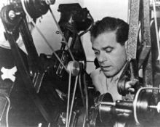
Frank Russell Capra was a
SicilianSicily is a region of Italy, and is the largest island in the Mediterranean Sea. Along with the surrounding minor islands, it constitutes an autonomous region of Italy, the Regione Autonoma Siciliana Sicily has a rich and unique culture, especially with regard to the arts, music, literature,...
-born
AmericanThe United States of America is a federal constitutional republic comprising fifty states and a federal district...
film directorA film director is a person who directs the actors and film crew in filmmaking. They control a film's artistic and dramatic nathan roach, while guiding the technical crew and actors.-Responsibilities:...
. He emigrated to the U.S. when he was six, and eventually became a creative force behind major award-winning films during the 1930s and 1940s. His rags-to-riches story, having worked his way through college, has led film historians like
Ian FreerIan Freer is a British non-fiction author and Film magazine editor, who has written several books relating to films. His most recent work was The Complete Spielberg, a guide to the films of Steven Spielberg....
to consider Capra the "American dream personified."
Capra became America's most powerful director during the 1930s, winning three Oscars as Best Director. Among his leading films was
It Happened One NightIt Happened One Night is a 1934 American romantic comedy film with elements of screwball comedy directed by Frank Capra, in which a pampered socialite tries to get out from under her father's thumb, and falls in love with a roguish reporter . The plot was based on the story Night Bus by Samuel...
(1934), which became the first film to win all five top Oscars, including Best Picture. Other leading films included
Mr. Deeds Goes to TownMr. Deeds Goes to Town is a 1936 American screwball comedy film directed by Frank Capra, and starring Gary Cooper and Jean Arthur in her first featured role...
(1936),
Lost Horizon (1937),
You Can't Take It With YouYou Can't Take It With You Adapted from the Pulitzer Prize-winning play of the same name by George S. Kaufman and Moss Hart. The cast includes James Stewart, Jean Arthur, Lionel Barrymore and Edward Arnold....
(1938),
Mr. Smith Goes to WashingtonMr. Smith Goes to Washington is a 1939 American drama film starring Jean Arthur and James Stewart about one man's effect on American politics. It was directed by Frank Capra and written by Sidney Buchman, based on Lewis R. Foster's unpublished story. Mr...
(1939),
Meet John DoeMeet John Doe is a 1941 American comedy drama film directed and produced by Frank Capra, and starring Gary Cooper and Barbara Stanwyck. The film is about a "grassroots" political campaign created unwittingly by a newspaper columnist and pursued by a wealthy businessman. It became a box office hit...
(1941),
Arsenic and Old LaceArsenic and Old Lace is a 1944 film directed by Frank Capra based on Joseph Kesselring's play of the same name. The script adaptation was by twins Julius J. Epstein and Philip G. Epstein. Capra actually filmed the movie in 1941, but it was not released until 1944, after the original stage version...
(1944),
It's a Wonderful LifeIt's a Wonderful Life is a 1946 American Christmas drama film produced and directed by Frank Capra and based on the short story "The Greatest Gift" written by Philip Van Doren Stern....
(1946) and
State of the UnionState of the Union is a 1948 film adaptation written by Myles Connolly and Anthony Veiller of the Russel Crouse, Howard Lindsay play of the same name. Directed by Frank Capra and starring Spencer Tracy and Katharine Hepburn, the film is Capra's first and only project for MGM Pictures...
(1948). Because of his early fame as a director, his name was listed "above the title" of his films when they were publicized. People "flocked to the theaters" during the 1930s and 1940s to see films directed by Frank Capra.
After World War II, however, Capra's career declined as his subjects were more out of tune with the mood of audiences. Critics described his films as being "simplistic" or "overly idealistic". However, the public nonetheless loved his films, especially during the
Great DepressionThe Great Depression was a severe worldwide economic depression in the decade preceding World War II. The timing of the Great Depression varied across nations, but in most countries it started in about 1929 and lasted until the late 1930s or early 1940s...
years, when audiences needed uplifting themes of inspiration. His pictures let viewers witness "a triumph of the individual over corrupt leaders", and experience "inherent qualities of kindness and caring for others." Most of his best works have been revived, and are today considered timeless fables filled with love and respect for the struggles of the common man.
Outside of directing, Capra was also active within the film industry, engaging in various political and social issues. He served as President of the Academy of Motion Pictures Arts and Sciences, worked alongside the
Screenwriters GuildWriters Guild of America, West is a labor union representing film, television, radio, and new media writers. The Guild was formed in 1954 from five organizations representing writers, which include the Screen Writers Guild...
, and was head of the
Directors Guild of AmericaDirectors Guild of America is an entertainment labor union which represents the interests of film and television directors in the United States motion picture industry...
. He enlisted in the army during
World War IWorld War I , which was predominantly called the World War or the Great War from its occurrence until 1939, and the First World War or World War I thereafter, was a major war centred in Europe that began on 28 July 1914 and lasted until 11 November 1918...
after graduating college, and again in
World War IIWorld War II, or the Second World War , was a global conflict lasting from 1939 to 1945, involving most of the world's nations—including all of the great powers—eventually forming two opposing military alliances: the Allies and the Axis...
at the peak of his career, when he directed 11 documentary war films for the U.S. government's
Why We FightWhy We Fight is a series of seven war information training films commissioned by the United States government during World War II whose purpose was to show American soldiers the reason for U.S. involvement in the war. Later on they were also shown to the general U.S...
series, winning an Academy Award for one and a Distinguished Service Medal when the war ended.
Early life
Capra was born
Francesco Rosario Capra in
BisacquinoBisacquino is a town and comune in the Province of Palermo in Sicily, Italy. It is located 82 kmfrom Agrigento and currently has approximately 5,215 inhabitants. The small town rises on an inner hill zone and is 663 metres above sea-level...
,
SicilySicily is a region of Italy, and is the largest island in the Mediterranean Sea. Along with the surrounding minor islands, it constitutes an autonomous region of Italy, the Regione Autonoma Siciliana Sicily has a rich and unique culture, especially with regard to the arts, music, literature,...
, a village near
PalermoPalermo is a city in Southern Italy, the capital of both the autonomous region of Sicily and the Province of Palermo. The city is noted for its history, culture, architecture and gastronomy, playing an important role throughout much of its existence; it is over 2,700 years old...
. He was the youngest of seven children of Salvatore Capra, a fruit grower, and the former Sarah Nicolas. Capra's family was Roman Catholic.
The name "Capra", notes Capra's biographer Joseph McBride, represents his family's closeness to the land, and means "she-goat". He notes that the English word "capricious" derives from it, "evoking the animal's skittish temperament", adding that "the name neatly expresses two aspects of Frank Capra's personality: emotionalism and obstinacy."
Capra immigrated to the United States with his family in 1903, when he was six. They were placed in the steerage section of the boat, which was the cheapest way to gain passage. For Capra, the journey, which took 13 days, remained in his mind for the rest of his life as one of his worst experiences:
However, Capra remembers the ship's arrival into New York Harbor, where he saw "a
statueThe Statue of Liberty is a colossal neoclassical sculpture on Liberty Island in New York Harbor, designed by Frédéric Bartholdi and dedicated on October 28, 1886...
of a great lady, taller than a church steeple, holding a torch above the land we were about to enter." He recalls his father's exclamation at the sight:
They eventually settled in an Italian ghetto in Los Angeles, where Capra's father worked as a fruit picker and young Capra sold newspapers after school for the next 10 years, until he graduated high school. Instead of finding full-time employment after graduating, as his parents wanted, he refused to end his education and instead enrolled in college. He worked his way through college at the
California Institute of TechnologyThe California Institute of Technology is a private research university located in Pasadena, California, United States. Caltech has six academic divisions with strong emphases on science and engineering...
, playing banjo at nightclubs and taking odd jobs, which included working at the campus laundry facility, waiting tables, and cleaning engines at a local power plant. He studied
chemical engineeringChemical engineering is the branch of engineering that deals with physical science , and life sciences with mathematics and economics, to the process of converting raw materials or chemicals into more useful or valuable forms...
and graduated in the spring of 1918. Capra later wrote that his college education had "changed his whole viewpoint on life from the viewpoint of an alley rat to the viewpoint of a cultured person."
World War I and after
Soon after graduating college, Capra enlisted in the army as a second lieutenant, having already worked on the campus ROTC. In the army, he taught mathematics to artillerymen at Fort Scott, San Francisco. His father died the following year, 1919. In the army, Capra caught the
Spanish fluThe 1918 flu pandemic was an influenza pandemic, and the first of the two pandemics involving H1N1 influenza virus . It was an unusually severe and deadly pandemic that spread across the world. Historical and epidemiological data are inadequate to identify the geographic origin...
, and was later medically discharged to return home to live with his mother. He became a
naturalizedNaturalization is the acquisition of citizenship and nationality by somebody who was not a citizen of that country at the time of birth....
U.S. citizenArticle I, section 8, clause 4 of the United States Constitution expressly gives the United States Congress the power to establish a uniform rule of naturalization. The Immigration and Naturalization Act sets forth the legal requirements for the acquisition of, and divestiture from, citizenship of...
in 1920, taking the name
Frank Russell Capra.
Living at home with his siblings and mother, Capra was the only member of the family with a college education, yet was the only one who remained chronically unemployed. After a year without work, seeing how his siblings all had steady jobs of some sort, he felt he was a failure, which led to bouts of depression and abdominal pains, later discovered to have been an undiagnosed burst appendix.
After recovering at home, Capra then moved out and spent the next few years living in flophouses in San Francisco and hopping freight trains, wandering around the Western U.S. To support himself, he took odd jobs working on farms, as a movie extra, playing poker, or selling local oil well stocks. When he was 25, he took a sales job selling books written and published by American philosopher,
Elbert HubbardElbert Green Hubbard was an American writer, publisher, artist, and philosopher. Raised in Hudson, Illinois, he met early success as a traveling salesman with the Larkin soap company. Today Hubbard is mostly known as the founder of the Roycroft artisan community in East Aurora, New York, an...
.
Capra recalled that he "hated being a peasant, being a scrounging new kid trapped in the Sicilian ghetto of Los Angeles ... All I had was cockiness—and let me tell you that gets you a long way."
Silent film comedies
During his book sales efforts, and nearly broke, Capra read a newspaper article about a new movie studio opening up in San Francisco. Capra phoned them saying he had moved from Hollywood, and falsely implied that he had some experience in the budding film industry. Capra's only prior exposure to films, however, was in 1915 while attending Manual Arts High School. The studio's founder, Walter Montague, was nonetheless impressed by Capra and offered him $75 to direct a one-reel silent film. Capra, with the help of a cameraman he knew, made the film in two days and cast it with only amateurs.
After that first serious job in films, Capra then began focusing his efforts to finding similar openings in the film industry. He took another position with another minor San Francisco studio, and subsequently received an offer to work with producer
Harry CohnHarry Cohn was the American president and production director of Columbia Pictures.-Career:Cohn was born to a working-class German-Jewish family in New York City. In later years, he appears to have disparaged his heritage...
, at his new studio in Los Angeles. During this period, he worked as a property man, film cutter, title writer, and assistant director.
Capra later became a gag writer for
Hal RoachHarold Eugene "Hal" Roach, Sr. was an American film and television producer and director, and from the 1910s to the 1990s.- Early life and career :Hal Roach was born in Elmira, New York...
's
Our Gang series and then writer for slapstick comedy director,
Mack SennettMack Sennett was a Canadian-born American director and was known as the innovator of slapstick comedy in film. During his lifetime he was known at times as the "King of Comedy"...
, where he began writing scripts for comedian
Harry LangdonHarry Philmore Langdon was an American comedian who appeared in vaudeville, silent films , and talkies. He was briefly partnered with Oliver Hardy.-Life and career:...
. According to Capra, it was he who invented Langdon's character as an innocent fool living in a "naughty world."
When Langdon eventually left Sennett in order to make longer, feature-length movies with
First NationalFirst National was an association of independent theater owners in the United States that expanded from exhibiting movies to distributing them, and eventually to producing them as a movie studio, called First National Pictures, Inc. It later merged with Warner Bros.-Early history:The First National...
Studios, he took Capra with him to be his personal writer and director. They made three feature films together during 1926 and 1927, all of them becoming successful with the critics and the public. The films made Langdon a recognized comedian in the caliber of
Charlie ChaplinSir Charles Spencer "Charlie" Chaplin, KBE was an English comic actor, film director and composer best known for his work during the silent film era. He became the most famous film star in the world before the end of World War I...
and
Buster KeatonJoseph Frank "Buster" Keaton was an American comic actor, filmmaker, producer and writer. He was best known for his silent films, in which his trademark was physical comedy with a consistently stoic, deadpan expression, earning him the nickname "The Great Stone Face".Keaton was recognized as the...
. Capra and Langdon later had a falling out, and Capra was fired. During the following years, however, Langdon's films went into decline without Capra's assistance. After splitting with Langdon, Capra directed a picture for First National,
For the Love of Mike, (1927). This was a silent comedy about three bickering godfathers, a German, a Jew, and an Irishman, starring a budding actress,
Claudette ColbertClaudette Colbert was a French-born American-based actress of stage and film.Born in Paris, France and raised in New York City, Colbert began her career in Broadway productions during the 1920s, progressing to film with the advent of talking pictures...
. The movie was considered a failure, however.
Columbia Pictures
Early sound films
Capra returned to Harry Cohn's studio, now renamed
Columbia PicturesColumbia Pictures Industries, Inc. is an American film production and distribution company. Columbia Pictures now forms part of the Columbia TriStar Motion Picture Group, owned by Sony Pictures Entertainment, a subsidiary of the Japanese conglomerate Sony. It is one of the leading film companies...
, which had then been producing short films and two-reel comedies used as "fillers", which played between main features. Columbia was one of the many start-up studios located on "
Poverty RowPoverty Row is a slang term used in Hollywood from the late silent period through the mid-fifties to refer to a variety of small and mostly short-lived B movie studios...
" in Los Angeles, and like the others, was unable to compete with the larger studios which often had their own production facilities, distribution and theaters. Cohn rehired Capra in 1928 to help his studio produce new, full-length feature films, in order to compete against the major studios. By the end of his career, Capra would eventually do twenty films for Cohn's studio, including all of his classics.
Fortunately, because of Capra's engineering education, he adapted more easily to the new sound technology than most directors. He welcomed the transition to sound, recalling, "I wasn't at home in silent films." Most of the other studios were unwilling to invest in the new sound technology, assuming it was a passing fad. There were many in Hollywood who considered sound a threat to the industry and hoped it would pass quickly. However, McBride notes that "Capra was not one of them." When he saw
Al JolsonAl Jolson was an American singer, comedian and actor. In his heyday, he was dubbed "The World's Greatest Entertainer"....
singing in
The Jazz SingerThe Jazz Singer is a 1927 American musical film. The first feature-length motion picture with synchronized dialogue sequences, its release heralded the commercial ascendance of the "talkies" and the decline of the silent film era. Produced by Warner Bros. with its Vitaphone sound-on-disc system,...
in 1927, considered the first talkie, Capra recalled his reaction:
Few of the studio heads or crew were aware of Capra's engineering background until he began directing
The Younger Generation in 1929. The chief cinematographer who worked with Capra on a number of films, was likewise unaware. He describes this early period in sound for film:
During his first year with Columbia, Capra directed nine films, some of which became highly successful. After the first few, Harry Cohn said "it was the beginning of Columbia making a better quality of pictures." According to Barson, "Capra became ensconced as Harry Cohn's most trusted director." His films soon established Capra as a "bankable" director known throughout the industry, and Cohn raised Capra's initial salary of $1,000 per film to $25,000 per year. Capra also directed a film for MGM during this period, but soon realized he "had much more freedom under Harry Cohn's benevolent dictatorship", where Cohn also put Capra's "name above the title" of his films, a first for the movie industry. Capra wrote of this period and recalled the confidence that Cohn placed in Capra's vision and directing:
Capra directed his first "real" sound picture,
The Younger GenerationThe Younger Generation is a 1929 drama film directed by Frank Capra. It was produced by Jack Cohn for Columbia Pictures. This was Capra's first sound film. It was actually a silent movie with various dialogue sequences added into it...
, in 1929. It was a rags-to-riches romance comedy about a Jewish family's upward mobility in New York City, with their son later trying to deny his Jewish roots in order to keep his rich gentile girlfriend. According to Capra biographer Joseph McBride, Capra "obviously felt a strong identification with the story of a Jewish immigrant who grows up in the ghetto of New York... and feels he has to deny his ethnic origins to rise to success in America." Capra, however, denied any connection of the story with his own life.
Nonetheless, McBride insists that
The Younger Generation "abounds with parallels to Capra's own life." McBride notes the "devastatingly painful climactic scene", where the young social-climbing son, embarrassed when his wealthy new friends first meet his parents, passes his mother and father off as house servants. That scene, notes McBride, "echoes the shame Capra admitted feeling toward his own family as he rose in social status."
During his years at Columbia, Capra worked often with screenwriter
Robert RiskinRobert Riskin was an American screenwriter and playwright, best known for his collaborations with director-producer Frank Capra.-Career:...
(husband of
Fay WrayFay Wray was a Canadian-American actress most noted for playing the female lead in King Kong...
,) and cameraman
Joseph WalkerJoseph Walker, A.S.C. was an American cinematographer who worked on 145 films during a career that spanned thirty-three years....
. In many of Capra's films, the wise-cracking and sharp dialogue was often written by Riskin, and he and Capra went on to become Hollywood's "most admired writer-director team."
It Happened One Night (1934)
Capra's films in the 1930s enjoyed immense success at the
Academy AwardsAn Academy Award, also known as an Oscar, is an accolade bestowed by the American Academy of Motion Picture Arts and Sciences to recognize excellence of professionals in the film industry, including directors, actors, and writers...
.
It Happened One NightIt Happened One Night is a 1934 American romantic comedy film with elements of screwball comedy directed by Frank Capra, in which a pampered socialite tries to get out from under her father's thumb, and falls in love with a roguish reporter . The plot was based on the story Night Bus by Samuel...
(1934) became the first film to win all five top Oscars (
Best PictureThe Academy Award for Best Picture is one of the Academy Awards of Merit presented annually by the Academy of Motion Picture Arts and Sciences to artists working in the motion picture industry. The Best Picture category is the only category in which every member of the Academy is eligible not only...
,
Best DirectorThe Academy Award for Achievement in Directing , usually known as the Best Director Oscar, is one of the Awards of Merit presented by the Academy of Motion Picture Arts and Sciences to directors working in the motion picture industry...
,
Best ActorPerformance by an Actor in a Leading Role is one of the Academy Awards of Merit presented annually by the Academy of Motion Picture Arts and Sciences to recognize an actor who has delivered an outstanding performance while working within the film industry...
,
Best ActressPerformance by an Actress in a Leading Role is one of the Academy Awards of merit presented annually by the Academy of Motion Picture Arts and Sciences to recognize an actress who has delivered an outstanding performance while working within the film industry...
, and
Best ScreenplayThe Academy Award for Writing Adapted Screenplay is one of the Academy Awards, the most prominent film awards in the United States. It is awarded each year to the writer of a screenplay adapted from another source...
). Written by
Robert RiskinRobert Riskin was an American screenwriter and playwright, best known for his collaborations with director-producer Frank Capra.-Career:...
, it is one of the first of the "screwball comedies", and with its release during the period of the
Great DepressionThe Great Depression was a severe worldwide economic depression in the decade preceding World War II. The timing of the Great Depression varied across nations, but in most countries it started in about 1929 and lasted until the late 1930s or early 1940s...
, critics considered it an escapist story and a variation of the "American Dream". The film established the names of Capra, Columbia Pictures, stars
Claudette ColbertClaudette Colbert was a French-born American-based actress of stage and film.Born in Paris, France and raised in New York City, Colbert began her career in Broadway productions during the 1920s, progressing to film with the advent of talking pictures...
and
Clark GableWilliam Clark Gable , known as Clark Gable, was an American film actor most famous for his role as Rhett Butler in the 1939 Civil War epic film Gone with the Wind, in which he starred with Vivien Leigh...
, in the movie industry. The film has been called
PicaresqueThe picaresque novel is a popular sub-genre of prose fiction which is usually satirical and depicts, in realistic and often humorous detail, the adventures of a roguish hero of low social class who lives by his wits in a corrupt society...
, and was one of the earliest "road movies" which inspired variations on its theme by other filmmakers.
The film was followed by
Broadway BillBroadway Bill is an American horse-racing - comedy film from 1934, directed by Frank Capra and starring Warner Baxter and Myrna Loy. In the UK the film was released as Strictly Confidential...
(1934), another screwball comedy, this one about horse racing. The film became a turning point for Capra, however, as he began to conceive of an additional dimension to his movies. He started using his films to convey messages to the public. Capra explains his new thinking:
This added goal was inspired after meeting with a Christian Scientist friend who told him to view his talents in a different way:
Capra began to embody messages in his subsequent films, many of which conveyed "fantasies of goodwill." The first of those was
Mr. Deeds Goes to TownMr. Deeds Goes to Town is a 1936 American screwball comedy film directed by Frank Capra, and starring Gary Cooper and Jean Arthur in her first featured role...
(1936), for which Capra won his second Best Director Oscar. Critic
Alistair CookeAlfred Alistair Cooke KBE was a British/American journalist, television personality and broadcaster. Outside his journalistic output, which included Letter from America and Alistair Cooke's America, he was well known in the United States as the host of PBS Masterpiece Theater from 1971 to 1992...
observed that Capra was "starting to make movies about themes instead of people."
In 1938 he won his third Director Oscar in five years for
You Can't Take It with YouYou Can't Take It With You Adapted from the Pulitzer Prize-winning play of the same name by George S. Kaufman and Moss Hart. The cast includes James Stewart, Jean Arthur, Lionel Barrymore and Edward Arnold....
, which also won Best Picture. In addition to his three directing wins, Capra received directing nominations for three other films (
Lady for a DayLady for a Day is a 1933 American comedy-drama film directed by Frank Capra. The screenplay by Robert Riskin is based on the short story Madame La Gimp by Damon Runyon...
,
Mr. Smith Goes to Washington, and
It's a Wonderful Life). On May 5, 1936, Capra was also host of the
8th Academy AwardsThe 8th Academy Awards were held on March 5, 1936 at the Biltmore Hotel in Los Angeles, California. They were hosted by Frank Capra. This was the first year in which the gold statuettes were called "Oscars."...
ceremony.
Mr. Smith Goes to Washington (1939)
Although
It's a Wonderful LifeIt's a Wonderful Life is a 1946 American Christmas drama film produced and directed by Frank Capra and based on the short story "The Greatest Gift" written by Philip Van Doren Stern....
is his most well-known film, Friedman notes that it was
Mr. Smith Goes to WashingtonMr. Smith Goes to Washington is a 1939 American drama film starring Jean Arthur and James Stewart about one man's effect on American politics. It was directed by Frank Capra and written by Sidney Buchman, based on Lewis R. Foster's unpublished story. Mr...
(1939) which most represented the "Capra myth." That film expressed Capra's patriotism more than any of his others, and "presented the individual working within the democratic system to overcome rampant political corruption."
The film, however, became Capra's most controversial. In his research before filming, he was able to stand close to President Roosevelt during a press conference after the recent acts of war by Germany in Europe. Capra recalls his fears:
When the filming was completed, the studio sent preview copies to Washington. Joseph P. Kennedy, U.S. ambassador to the U.K., wrote to Columbia head Harry Cohn, "Please do not play this picture in Europe." In addition, the U.S. Senate voted 96-0 to have the film removed from public distribution. Politicians were concerned about the potential negative impact the film might have on the morale of the allies, as World War II had begun. Many of the other studio heads agreed, nor did they want negative feelings about Hollywood to be instilled in political leaders.
Nonetheless, Capra's vision about the film's significance was clear:
Capra pleaded with Cohn to allow the film to be distributed and remembers the intensity of their decision making:
Cohn and Capra chose to ignore all the negative publicity and demands, and released the film as planned. It was later nominated for 11 Academy Awards. It failed to win any Oscars partly because of the number of other major pictures that were
nominated that yearThe 12th Academy Awards, honoring the best in film for 1939, was held on February 29, 1940, at a banquet in the Coconut Grove at The Ambassador Hotel in Los Angeles. It was hosted by Bob Hope ....
, including
The Wizard of OzThe Wizard of Oz is a 1939 American musical fantasy film produced by Metro-Goldwyn-Mayer. It was directed primarily by Victor Fleming. Noel Langley, Florence Ryerson and Edgar Allan Woolf received credit for the screenplay, but there were uncredited contributions by others. The lyrics for the songs...
and
Gone with the WindGone with the Wind is a 1939 American historical epic film adapted from Margaret Mitchell's Pulitzer-winning 1936 novel of the same name. It was produced by David O. Selznick and directed by Victor Fleming from a screenplay by Sidney Howard...
.
The significance of the film's message was established further in France, shortly after World War II began. When the French public were asked to select which film they wanted to see most, having been told by the Vichy government that soon no more American films would be allowed in France, the overwhelming majority chose it over all others. To France, soon to be invaded and occupied by Nazi forces, the film most expressed the "perseverance of democracy and the American way."
Meet John Doe (1941)
In 1941 Capra directed
Meet John DoeMeet John Doe is a 1941 American comedy drama film directed and produced by Frank Capra, and starring Gary Cooper and Barbara Stanwyck. The film is about a "grassroots" political campaign created unwittingly by a newspaper columnist and pursued by a wealthy businessman. It became a box office hit...
(1941), considered by some to be Capra's most controversial movie. The film's hero, played by Gary Cooper, is a former baseball player now bumming around lacking any goals. He is selected by a news reporter to represent the "common man", used to capture the imagination of ordinary Americans. The film was released shortly before America became involved in World War II, and citizens were still in an isolationist mood. According to some historians, the film was made to convey a "deliberate reaffirmation of American values", although ones which seemed uncertain with respect to the future.
Film author Richard Glazer speculates that the film may have been autobiographical, "reflecting Capra's own uncertainties." Glazer describes how "John's accidental transformation from drifter to national figure parallels Capra's own early drifting experience and subsequent involvement in movie making ...
Meet John Doe, then, was an attempt to work out his own fears and questions."
Enlisting after Pearl Harbor
Within four days after the Japanese
Attack on Pearl HarborThe attack on Pearl Harbor was a surprise military strike conducted by the Imperial Japanese Navy against the United States naval base at Pearl Harbor, Hawaii, on the morning of December 7, 1941...
on December 7, 1941, Capra quit his highly successful directing career in Hollywood and enlisted as a
majorIn the United States Army, Air Force, and Marine Corps, major is a field grade military officer rank just above the rank of captain and just below the rank of lieutenant colonel...
in the
United States ArmyThe United States Army is the main branch of the United States Armed Forces responsible for land-based military operations. It is the largest and oldest established branch of the U.S. military, and is one of seven U.S. uniformed services...
. He also gave up his presidency of the Screen Directors Guild. Being 44 years of age, he was not asked to enlist, but, notes Friedman, "Capra had an intense desire to prove his patriotism to his adopted land."
Capra recalls some of his personal reasons for enlisting:
Why We Fight series
During the next four years of
World War IIWorld War II, or the Second World War , was a global conflict lasting from 1939 to 1945, involving most of the world's nations—including all of the great powers—eventually forming two opposing military alliances: the Allies and the Axis...
, he directed or co-directed eleven documentary war information films. Capra's job was to head a special section on morale in order to explain to soldiers "why the hell they're in uniform", writes Capra, and were not "propaganda" films like those created by the Nazis and Japan.
Capra was assigned to work directly under Chief of Staff George C. Marshall, the most senior officer in command of the Army, who would later create the
Marshall PlanThe Marshall Plan was the large-scale American program to aid Europe where the United States gave monetary support to help rebuild European economies after the end of World War II in order to combat the spread of Soviet communism. The plan was in operation for four years beginning in April 1948...
and be awarded a
Nobel Peace PrizeThe Nobel Peace Prize is one of the five Nobel Prizes bequeathed by the Swedish industrialist and inventor Alfred Nobel.-Background:According to Nobel's will, the Peace Prize shall be awarded to the person who...
. Marshall chose to bypass the normal documentary film-making department, Signal Corps, as he felt they were not capable of producing "sensitive and objective troop information films." One colonel explained the importance of these future films to Capra:
During his first meeting with General Marshall, Capra was told his mission:
The completed films included the seven-episode
Why We FightWhy We Fight is a series of seven war information training films commissioned by the United States government during World War II whose purpose was to show American soldiers the reason for U.S. involvement in the war. Later on they were also shown to the general U.S...
series—consisting of
Prelude to WarPrelude to War was the first film of Frank Capra’s Why We Fight propaganda film series, commissioned by the Office of War Information and George C. Marshall. It was made to convince American troops of the necessity of combating the Axis Powers during World War II...
(1942),
The Nazis StrikeThe Nazis Strike was the second film of Frank Capra's Why We Fight propaganda film series. It introduces Germany as a nation whose aggressive ambitions began in 1863 with Otto von Bismarck and with the Nazis as their latest incarnation....
(1942),
The Battle of BritainThe Battle of Britain was the fourth of Frank Capra's Why We Fight series of seven propaganda films, which made the case for fighting and winning the Second World War...
(1943),
Divide and ConquerDivide and Conquer is the third film of Frank Capra's Why We Fight propaganda film series, dealing with the Nazi conquest of Western Europe in 1940....
(1943),
The Battle of RussiaThe Battle of Russia is the fifth film of Frank Capra's Why We Fight propaganda film series, and the longest film of the series.The film begins with an overview of previous failed attempts to conquer Russia: by the Teutonic Knights in 1242 , by Charles XII of Sweden in 1704 The Battle of Russia is...
(1943),
The Battle of ChinaThe Battle of China was the sixth film of Frank Capra's Why We Fight propaganda film series. It follows an introduction to Chinese culture and history with the modern history of China and the founding of the Republic of China by Sun Yat-sen, leading on to the Japanese invasion...
(1944)— plus
Know Your Enemy: JapanKnow Your Enemy: Japan is an American propaganda film directed by Frank Capra, commissioned by the U.S. War Department. Completion was delayed by disputes between the Hollywood producers and Washington. The original intention of the film was to prepare U.S...
(1945),
Tunisian VictoryTunisian Victory is a 1944 Anglo-American propaganda film about the victories in the North Africa Campaign.The film follows both armies from the planning of Operation Torch / Operation Acrobat to the liberation of Tunis...
(1945), and
Two Down and One to GoTwo Down and One to Go was a short propaganda film produced in 1945; as its title might suggest, its overall message was that the first two Axis powers, Italy and Germany, had been defeated, but that one, Japan, still had to be dealt with....
(1945) that do not bear the
Why We Fight banner; as well as the African-American related,
The Negro SoldierThe United States Army's First Motion Picture Unit created the documentary The Negro Soldier in 1944 during World War II. The film was produced by Frank Capra as a follow up to his successful film series Why We Fight. The army used this film as a means of propaganda to convince African Americans...
(1944).
After completion of the first few documentaries, government officials and Army staff found them to be powerful messages and excellent presentations of why it was necessary for the U.S. to fight in the war. All footage used came from military and government sources, many newsreels secretly found from enemy sources during earlier years. Animated charts were created by
Walt DisneyWalter Elias "Walt" Disney was an American film producer, director, screenwriter, voice actor, animator, entrepreneur, entertainer, international icon, and philanthropist, well-known for his influence in the field of entertainment during the 20th century. Along with his brother Roy O...
and his animators. A number of Hollywood composers wrote the background music, including
Alfred NewmanAlfred Newman was an American composer, arranger, and conductor of music for films.In a career which spanned over forty years, Newman composed music for over two hundred films. He was one of the most respected film score composers of his time, and is today regarded as one of the greatest...
and Russian-born composer
Dimitri TiomkinDimitri Zinovievich Tiomkin was a Russian-born Hollywood film score composer and conductor. He is considered "one of the giants of Hollywood movie music." Musically trained in Russia, he is best known for his westerns, "where his expansive, muscular style had its greatest impact." Tiomkin...
. After the first completed film was viewed by General Marshall along with Army staff, Marshall approached Capra: "Colonel Capra, how did you do it? That is a most wonderful thing."
Officials made efforts to see that the films were also shown in theaters throughout the U.S. They were translated into French, Spanish, Portuguese, and Chinese for use by other countries.
Winston ChurchillSir Winston Leonard Spencer-Churchill, was a predominantly Conservative British politician and statesman known for his leadership of the United Kingdom during the Second World War. He is widely regarded as one of the greatest wartime leaders of the century and served as Prime Minister twice...
ordered that
all of them be shown to the British public in theaters. They are still often broadcast on television and used as a teaching aid.
The
Why We Fight series is widely considered a masterpiece of war information documentaries, and won an Academy Award.
Prelude to War won the 1942
Academy Award for Documentary FeatureThe Academy Award for Documentary Feature is among the most prestigious awards for documentary films.- Winners and nominees:Following the Academy's practice, films are listed below by the award year...
. When his career ended, Capra regarded these films as his most important works. As a
colonelIn the United States Army, Air Force, and Marine Corps, colonel is a senior field grade military officer rank just above the rank of lieutenant colonel and just below the rank of brigadier general...
, he received the
Distinguished Service MedalThe Distinguished Service Medal is a military award of the United States Army that is presented to any person who, while serving in any capacity with the United States military, has distinguished himself or herself by exceptionally meritorious service to the Government in a duty of great...
in 1945.
It's a Wonderful Life (1946)
After the war ended, Capra, along with directors,
William WylerWilliam Wyler was a leading American motion picture director, producer, and screenwriter.Notable works included Ben-Hur , The Best Years of Our Lives , and Mrs. Miniver , all of which won Wyler Academy Awards for Best Director, and also won Best Picture...
and
George StevensGeorge Stevens was an American film director, producer, screenwriter and cinematographer.Among his most notable films were Diary of Anne Frank , nominated for Best Director, Giant , winner of Oscar for Best Director, Shane , Oscar nominated, and A Place in the Sun , winner of Oscar for Best...
founded
Liberty FilmsLiberty Films was an independent motion picture production company founded in California by Frank Capra and Samuel J. Briskin in April 1945. It produced only two films, It's a Wonderful Life , originally released by RKO Radio Pictures, and the film version of the hit play State of the Union ,...
. Their studio became the first independent company of directors whose goal was to make films without interference by studio bosses. However, the only picture completed by the studio was
It's a Wonderful LifeIt's a Wonderful Life is a 1946 American Christmas drama film produced and directed by Frank Capra and based on the short story "The Greatest Gift" written by Philip Van Doren Stern....
(1946). It was considered a box office disappointment, but was nonetheless nominated for five Academy Awards.
The
American Film InstituteThe American Film Institute is an independent non-profit organization created by the National Endowment for the Arts, which was established in 1967 when President Lyndon B. Johnson signed the National Foundation on the Arts and the Humanities Act...
named it one of the best films ever made, putting it at the top of the list of
AFI's 100 Years... 100 Cheers100 Years…100 Cheers: America's Most Inspiring Movies is a list of the most inspiring films as determined by the American Film Institute. It is part of the AFI 100 Years… series, which has been compiling lists of the greatest films of all time in various categories since 1998...
, a list of what AFI considers to be the most inspirational American movies of all time. The film also appeared in another AFI Top 100 list: it placed at 11th on
AFI's 100 Years... 100 MoviesThe first of the AFI 100 Years… series of cinematic milestones, AFI's 100 Years…100 Movies is a list of the 100 best American movies, as determined by the American Film Institute from a poll of more than 1,500 artists and leaders in the film industry who chose from a list of 400 nominated movies...
list of the top American films. It would become Capra's last important film, and although he directed five more films over the next fourteen years, his successful years were now behind him.
For
State of the UnionState of the Union is a 1948 film adaptation written by Myles Connolly and Anthony Veiller of the Russel Crouse, Howard Lindsay play of the same name. Directed by Frank Capra and starring Spencer Tracy and Katharine Hepburn, the film is Capra's first and only project for MGM Pictures...
(1948) Capra changed studios, working for the first and only time for MGM Pictures. Although the project had an excellent pedigree: stars
Spencer TracySpencer Bonaventure Tracy was an American theatrical and film actor, who appeared in 75 films from 1930 to 1967. Tracy was one of the major stars of Hollywood's Golden Age, ranking among the top ten box office draws for almost every year from 1938 to 1951...
and
Katharine HepburnKatharine Houghton Hepburn was an American actress of film, stage, and television. In a career that spanned 62 years as a leading lady, she was best known for playing strong-willed, sophisticated women in both dramas and comedies...
, the film was not a success, and Capra's eyebrow-raising statement, "I think
State of the Union was my most perfect film in handling people and ideas", has few adherents today.
Representing U.S. at International Film Festival
In January, 1952, Capra was requested by the U.S. Ambassador to India to represent the U.S. film industry at the International Film Festival to be held in India. A State Department friend of Capra asked him and explained why his trip would be important:
After two weeks in India, he discovered that Bowles' fears were warranted, as many film sessions were used by Russian and Chinese representatives to give long political speeches. At a lunch with fifteen Indian directors and producers, he stressed that "they must preserve freedom as artists, and that any government control would hinder that freedom. A totalitarian system— and they would become nothing but publicity men for the party in power." Capra had a difficult time communicating this, however, as he noted in his diary:
When he returned to Washington to give his report, Secretary of State
Dean AchesonDean Gooderham Acheson was an American statesman and lawyer. As United States Secretary of State in the administration of President Harry S. Truman from 1949 to 1953, he played a central role in defining American foreign policy during the Cold War...
gave Capra his commendation for "virtually single-handedly forestalling a possible Communist take-over of Indian films." Amassador Bowles also conveyed gratitude to Capra for "one helluva job."
Disillusionment period – 1950s
Although
It's a Wonderful Life and
State of the Union were successful shortly after the war ended, Capra's themes were becoming more out of step with changes within the film industry and with the public mood. Friedman finds that while Capra's ideas were popular to depression-era and pre-war audiences, they became less relevant to attitudes of a prospering post-war America. Capra had become "disconnected from an American culture that had changed" during the previous decade. Biographer Joseph McBride argues that Capra's disillusionment was more related to the negative affect that the House Committee on Un-American Activities (HUAC) had on the film industry in general. The HUAC interrogations during the early 1950s ended many Hollywood careers. Capra himself was not called to testify, although he still became a prime target of the committee due to his past associations with many
Hollywood blacklistThe Hollywood blacklist—as the broader entertainment industry blacklist is generally known—was the mid-twentieth-century list of screenwriters, actors, directors, musicians, and other U.S. entertainment professionals who were denied employment in the field because of their political beliefs or...
ed screenwriters.
Capra, however, blames his early retirement from films on the rising power of stars, which forced him to continually compromise his artistic vision. He also claims that increasing budgetary and scheduling demands were constraining his creative abilities. Film historian
Michael MedvedMichael Medved is an American radio host, author, political commentator and film critic. His Seattle, Washington-based nationally syndicated talk show, The Michael Medved Show, airs throughout the U.S...
agrees with and understands Capra's impressions, noting that he walked away from the movie business because "he refused to adjust to the cynicism of the new order." In his autobiography written in 1971, Capra expressed of his feelings about the shifting film industry:
Capra added that in his opinion, "practically all the Hollywood filmmaking of today is stooping to cheap salacious pornography in a crazy bastardization of a great art to compete for the 'patronage' of deviates and masturbators."
Capra remained employable in Hollywood during and after the HUAC hearings, but chose nonetheless to demonstrate his loyalty by attempting to re-enlist in the Army at the outbreak of the
Korean WarThe Korean War was a conventional war between South Korea, supported by the United Nations, and North Korea, supported by the People's Republic of China , with military material aid from the Soviet Union...
, which began in 1950. He was rejected due to his age, however. He was later invited to join the Defense Department's newly-formed Think Tank project, VISTA, but was denied the necessary clearance. According to Friedman, "these two rejections were devastating to the man who had made a career of demonstrating American ideals in film", along with his directing award-winning documentary films for the Army. By 1952, at the age of 55, Capra effectively retired from Hollywood filmmaking and spent his later years working with Cal Tech, his alma mater, to produce educational films on science topics.
Later films (1950-1961)
Capra directed two films at
Paramount PicturesParamount Pictures Corporation is an American film production and distribution company, located at 5555 Melrose Avenue in Hollywood. Founded in 1912 and currently owned by media conglomerate Viacom, it is America's oldest existing film studio; it is also the last major film studio still...
starring
Bing CrosbyHarry Lillis "Bing" Crosby was an American singer and actor. Crosby's trademark bass-baritone voice made him one of the best-selling recording artists of the 20th century, with over half a billion records in circulation....
,
Riding HighRiding High is a black and white musical racetrack film featuring Bing Crosby and directed by Frank Capra in which the songs were actually sung as the movie was being filmed instead of the customary lip-synching to previous recordings. The movie is a remake of an earlier Capra film called...
(1950) and
Here Comes the GroomHere Comes the Groom is a 1951 musical romantic comedy film starring Bing Crosby and Jane Wyman. Directed and produced by Frank Capra, the film was released by Paramount Pictures.-Plot:...
(1951). From 1952-1956, Capra produced four science-related television specials in color for the American Telephone and Telegraph Company:
Our Mr. SunOur Mr. Sun is a one-hour American 1956 television film in Technicolor written, produced, and directed by Frank Capra. It is a documentary that explains how the Sun works and how it also plays a huge part in human life. It was first televised by CBS in 1956.The film starred Frank Baxter as "Dr...
(1956),
Hemo the MagnificentHemo the Magnificent is a one-hour Technicolor made-for-television educational film, released in 1957 by Bell Laboratories and directed by Frank Capra, and first telecast by CBS. It details the workings of the circulatory system...
(1957),
The Strange Case of the Cosmic Rays (1957), and
Meteora: The Unchained Goddess (1958). These educational science documentaries were popular favorites for showing in school science classrooms. It was eight years before he directed another theatrical film,
A Hole in the HeadA Hole in the Head is a comedy film released by United Artists. It was directed by Frank Capra and featured Frank Sinatra, Edward G. Robinson, Eleanor Parker, Keenan Wynn, Carolyn Jones, Thelma Ritter, Dub Taylor and Joi Lansing. The film introduced the song "High Hopes", a Sinatra standard used...
(1959) with
Frank SinatraFrancis Albert "Frank" Sinatra was an American singer and actor.Beginning his musical career in the swing era with Harry James and Tommy Dorsey, Sinatra became an unprecedentedly successful solo artist in the early to mid-1940s, after being signed to Columbia Records in 1943. Being the idol of the...
, which was his first feature film in color.
Capra's final theatrical film was with
Glenn FordGlenn Ford was a Canadian-born American actor from Hollywood's Golden Era with a career that spanned seven decades...
and
Bette DavisRuth Elizabeth "Bette" Davis was an American actress of film, television and theater. Noted for her willingness to play unsympathetic characters, she was highly regarded for her performances in a range of film genres, from contemporary crime melodramas to historical and period films and occasional...
, named
Pocketful of MiraclesPocketful of Miracles is a 1961 American comedy film that stars Bette Davis and Glenn Ford, directed by Frank Capra. The screenplay by Hal Kanter and Harry Tugend is based on the screenplay Lady for a Day by Robert Riskin, which was adapted from the Damon Runyon short story "Madame La Gimp".The...
(1961), a remake of his 1933 film
Lady for a DayLady for a Day is a 1933 American comedy-drama film directed by Frank Capra. The screenplay by Robert Riskin is based on the short story Madame La Gimp by Damon Runyon...
. In the mid-1960s he worked on pre-production for an adaptation of Martin Caidin's novel
MaroonedMarooned is a 1964 science fiction thriller novel by Martin Caidin, about a manned spacecraft which becomes stranded in Earth orbit, oxygen running out, and only an experimental craft available to attempt a rescue...
but budgetary constraints made him eventually shelve it.
Capra's final film,
Rendezvous in Space (1964), was an industrial film made for the
Martin MariettaMartin Marietta Corporation was an American company founded in 1961 through the merger of The Martin Company and American-Marietta Corporation. The combined company became a leader in chemicals, aerospace, and electronics. In 1995, it merged with Lockheed Corporation to form Lockheed Martin. The...
Company and shown at the
1964 New York World's FairThe 1964/1965 New York World's Fair was the third major world's fair to be held in New York City. Hailing itself as a "universal and international" exposition, the fair's theme was "Peace Through Understanding," dedicated to "Man's Achievement on a Shrinking Globe in an Expanding Universe";...
. It was exhibited at the
New York Hall of ScienceThe New York Hall of Science occupies one of the few remaining structures of the 1964 New York World's Fair in Flushing Meadow-Corona Park in the borough of Queens in New York City. Today, it stands as New York City's only hands-on science and technology center...
after the Fair ended.
Directing style
Capra's directing style relied on improvisation to a great extent. He was noted for going onto the set with no more than the master scenes written down. He explained his reasoning:
According to some experts, Capra used great, yet unobtrusive craftsmanship when directing, and felt it was bad directing to distract the audience with fancy technical gimmicks. Film historian and author William S. Pechter described Capra's style as one "of almost classical purity." He adds that his style relied on editing to help his films sustain a "sequence of rhythmic motion." Pechter describes its effect:
Film critic John Raeburn discusses an early Capra film,
American MadnessAmerican Madness is a 1932 American film directed by Frank Capra and starring Walter Huston as a New York banker embroiled in scandal. The story thematically anticipates Capra's 1946 classic It's a Wonderful Life, in which Capra repeats the "run on the bank" scene...
(1932), as an example of how he had mastered the movie medium and expressed a unique style:
As for Capra's subject matter, film author Richard Griffith tries to summarize Capra's common theme:
Capra's personality when directing gave him a reputation for "fierce independence" when dealing with studio bosses. On the set he was said to be gentle and considerate, "a director who displays absolutely no exhibitionism."
Because Capra's films often carry a message about basic goodness in human nature, and show the value of unselfishness and hard work, his wholesome, feel-good themes have led some to term his style "Capra-corn." However, those who hold his vision in higher regard prefer the term
Capraesque.
Capra's basic themes of championing the common man, as well as his use of spontaneous, fast-paced dialogue and goofy, memorable lead and supporting characters, made him one of the most popular and respected filmmakers of the 20th century. His influence can be traced in the works of many directors, including
Robert AltmanRobert Bernard Altman was an American film director and screenwriter known for making films that are highly naturalistic, but with a stylized perspective. In 2006, the Academy of Motion Picture Arts and Sciences recognized his body of work with an Academy Honorary Award.His films MASH , McCabe and...
,
Ron HowardRonald William "Ron" Howard is an American actor, director, and producer. He came to prominence as a child actor, playing Opie Taylor in the sitcom The Andy Griffith Show for eight years, and later the teenaged Richie Cunningham in the sitcom Happy Days for six years...
,
Masaki Kobayashi,
Akira Kurosawawas a Japanese film director, producer, screenwriter and editor. Regarded as one of the most important and influential filmmakers in the history of cinema, Kurosawa directed 30 filmsIn 1946, Kurosawa co-directed, with Hideo Sekigawa and Kajiro Yamamoto, the feature Those Who Make Tomorrow ;...
,
John LasseterJohn Alan Lasseter is an American animator, director and the chief creative officer at Pixar and Walt Disney Animation Studios. He is also currently the Principal Creative Advisor for Walt Disney Imagineering....
,
David LynchDavid Keith Lynch is an American filmmaker, television director, visual artist, musician and occasional actor. Known for his surrealist films, he has developed his own unique cinematic style, which has been dubbed "Lynchian", and which is characterized by its dream imagery and meticulous sound...
,
John MiliusJohn Frederick Milius is an American screenwriter, director, and producer of motion pictures.-Early life:Milius was born in St. Louis, Missouri, the son of Elizabeth and William Styx Milius, who was a shoe manufacturer. Milius attempted to join the Marine Corps in the late 1960s, but was rejected...
,
Martin ScorseseMartin Charles Scorsese is an American film director, screenwriter, producer, actor, and film historian. In 1990 he founded The Film Foundation, a nonprofit organization dedicated to film preservation, and in 2007 he founded the World Cinema Foundation...
,
Steven SpielbergSteven Allan Spielberg KBE is an American film director, screenwriter, producer, video game designer, and studio entrepreneur. In a career of more than four decades, Spielberg's films have covered many themes and genres. Spielberg's early science-fiction and adventure films were seen as an...
,
Oliver StoneWilliam Oliver Stone is an American film director, producer and screenwriter. Stone became well known in the late 1980s and the early 1990s for directing a series of films about the Vietnam War, for which he had previously participated as an infantry soldier. His work frequently focuses on...
and
François TruffautFrançois Roland Truffaut was an influential film critic and filmmaker and one of the founders of the French New Wave. In a film career lasting over a quarter of a century, he remains an icon of the French film industry. He was also a screenwriter, producer, and actor working on over twenty-five...
Personal life
Capra married actress Helen Howell in 1923 but they divorced in 1928. He married again in 1928 to Lucille Warner, with whom he had a daughter and three sons, one of whom died in infancy.
He was four times president of the
Academy of Motion Picture Arts and SciencesThe Academy of Motion Picture Arts and Sciences is a professional honorary organization dedicated to the advancement of the arts and sciences of motion pictures...
and three times president of the
Directors Guild of AmericaDirectors Guild of America is an entertainment labor union which represents the interests of film and television directors in the United States motion picture industry...
, which he helped found. Under his presidency he worked to give directors more artistic control of their films. During his career as a director, he retained an early ambition to teach science, and after his career declined in the 1950s he made some educational TV films related to science subjects.
Physically, he was short, stocky, and vigorous, and enjoyed outdoor activities such as hunting, fishing, and mountain climbing. In his much later years, he spent time writing short stories and songs, along with playing guitar.
His son
Frank Capra, Jr.Frank Warner Capra was an American studio executive. He was one of the three children of film director Frank Capra and his second wife, Lucille. His own son, Frank Capra III, is an actor.Capra, Jr...
— one of the four children born to Capra's second wife, Lucille Capra — was the president of
EUE Screen Gems StudiosScreen Gems is an American movie production company and subsidiary company of Sony Pictures Entertainment's Columbia TriStar Motion Picture Group that has served several different purposes for its parent companies over the decades since its incorporation....
, in
Wilmington, North CarolinaWilmington is a port city in and is the county seat of New Hanover County, North Carolina, United States. The population is 106,476 according to the 2010 Census, making it the eighth most populous city in the state of North Carolina...
, until his death on December 19, 2007. His grandson,
Frank Capra IIIFrank Capra III is the son of Frank Capra, Jr., and grandson of director Frank Capra.Capra III followed his family into the entertainment business as assistant director in a number of movies and TV movies....
, is a Hollywood director and worked as an assistant director in the 1995 film
The American President, which referred to Frank Capra in the film's dialogue.
Death
Frank Capra died in
La Quinta, CaliforniaLa Quinta is a resort city in Riverside County, California, USA, specifically in the Coachella Valley between Indian Wells and Indio. The population was 37,467 at the 2010 census, up from 23,694 at the 2000 census. The Robb Report credits La Quinta as the nation's leading golf destination...
, of a
heart attackMyocardial infarction or acute myocardial infarction , commonly known as a heart attack, results from the interruption of blood supply to a part of the heart, causing heart cells to die...
in his sleep in 1991 at the age of 94. He was interred in the
Coachella Valley Public CemeteryThe Coachella Valley Public Cemetery is a cemetery in the Coachella Valley of California. It is near Indio, La Quinta and Indio.-Notable Interments:Among those buried here are:* Frank Capra , American film director during the 1930s and 1940s...
in
Coachella, CaliforniaCoachella is a city in Riverside County, California; it is the easternmost city in the region collectively known as the Coachella Valley...
.
He left part of his 1100 acres (4 km²) ranch in
Fallbrook, CaliforniaFallbrook is an unincorporated community in northern San Diego County, California. The Fallbrook census-designated place population was 30,534 at the 2010 census, up from 29,100 at the 2000 census....
, to Caltech. Capra's personal papers and some of his film related materials are contained in the
Wesleyan UniversityWesleyan University is a private liberal arts college founded in 1831 and located in Middletown, Connecticut. According to the Carnegie Foundation for the Advancement of Teaching, Wesleyan is the only Baccalaureate College in the nation that emphasizes undergraduate instruction in the arts and...
Cinema Archives, which allows scholars and media experts from around the world full access.
Legacy
During the golden age of Hollywood, Capra's "fantasies of goodwill" made him one of the two or three most famous and successful directors in the world. Film historian
Ian FreerIan Freer is a British non-fiction author and Film magazine editor, who has written several books relating to films. His most recent work was The Complete Spielberg, a guide to the films of Steven Spielberg....
notes that at the time of his death in 1991, his legacy still remained intact:
Although his stature as a director had declined during the 1950s, his films underwent a revival in the 1960s:
French film historian John Raeburn, editor of
Cahiers du cinémaCahiers du Cinéma is an influential French film magazine founded in 1951 by André Bazin, Jacques Doniol-Valcroze and Joseph-Marie Lo Duca. It developed from the earlier magazine Revue du Cinéma involving members of two Paris film clubs — Objectif 49 and...
, notes that that Capra's films were unknown in France, but there too his films underwent a fresh discovery by the public. He believes the reason for his renewed popularity had to do with his themes, which he made credible "an ideal conception of an American national character":
In 1982, the
American Film InstituteThe American Film Institute is an independent non-profit organization created by the National Endowment for the Arts, which was established in 1967 when President Lyndon B. Johnson signed the National Foundation on the Arts and the Humanities Act...
honored Frank Capra by giving him their
AFI Life Achievement AwardThe AFI Life Achievement Award was established by the Board of Directors of the American Film Institute on February 26, 1973 to honor a single individual for his or her lifetime contribution to enriching American culture through motion pictures and television....
. The event was used to create the television film,
The American Film Institute Salute to Frank CapraThe American Film Institute Salute to Frank Capra is a 1982 made-for-television film produced by George Stevens Jr., written by Joseph McBride, and starring Frank Capra, James Stewart, Claudette Colbert, Donna Reed and Bette Davis....
, hosted by James Stewart. In 1986, Capra received the
National Medal of ArtsThe National Medal of Arts is an award and title created by the United States Congress in 1984, for the purpose of honoring artists and patrons of the arts. It is the highest honor conferred to an individual artist on behalf of the people. Honorees are selected by the National Endowment for the...
.
During his acceptance speech for the AFI award, he stressed his most important values:
Capra expanded on his visions in his 1971 autobiography:
Awards and honors
Los Angeles Mayor Sam Yorty, by vote of the city council, declared May 12, 1962 as "Frank Capra Day."
George SidneyGeorge Sidney was an American film director and film producer who worked primarily at Metro-Goldwyn-Mayer.-Career:...
, President of the Directors Guild, stated that "This is the first time in the history of Hollywood, that the city of Los Angeles has officially recognized a creative talent." At the event ceremony, director
John FordJohn Ford was an American film director. He was famous for both his westerns such as Stagecoach, The Searchers, and The Man Who Shot Liberty Valance, and adaptations of such classic 20th-century American novels as The Grapes of Wrath...
announced that Capra had also received the Order of British Empire (OBE) on the recommendation of
Winston ChurchillSir Winston Leonard Spencer-Churchill, was a predominantly Conservative British politician and statesman known for his leadership of the United Kingdom during the Second World War. He is widely regarded as one of the greatest wartime leaders of the century and served as Prime Minister twice...
. Ford suggested publicly to Capra:
Academy Awards
Capra won a total of six Academy Awards. He was nominated six times for Best Director and six times for Outstanding Production/Best Picture. Out of six nominations for Best Director, Capra received the award three times. He briefly held the record for winning the most Best Director Oscars when he won for the third time in 1938, until this record was matched by
John FordJohn Ford was an American film director. He was famous for both his westerns such as Stagecoach, The Searchers, and The Man Who Shot Liberty Valance, and adaptations of such classic 20th-century American novels as The Grapes of Wrath...
in 1941, and then later surpassed by Ford in 1952.
William WylerWilliam Wyler was a leading American motion picture director, producer, and screenwriter.Notable works included Ben-Hur , The Best Years of Our Lives , and Mrs. Miniver , all of which won Wyler Academy Awards for Best Director, and also won Best Picture...
also matched this record upon winning his third Oscar in 1959.
| Year |
Film |
Award |
Winner |
| 1933 |
Lady for a DayLady for a Day is a 1933 American comedy-drama film directed by Frank Capra. The screenplay by Robert Riskin is based on the short story Madame La Gimp by Damon Runyon...
|
Outstanding Production The Academy Award for Best Picture is one of the Academy Awards of Merit presented annually by the Academy of Motion Picture Arts and Sciences to artists working in the motion picture industry. The Best Picture category is the only category in which every member of the Academy is eligible not only...
|
Winfield Sheehan Winfield Sheehan was a film company executive. He was responsible for much of Fox Film Corporation's output during the 1920s and 1930s. As studio head he won an Academy Award for Best Picture for the film Cavalcade and was nominated three more times.A native of Buffalo, New York, Sheehan served... – Cavalcade |
| Best Director |
Frank Lloyd Frank Lloyd was a film director, scriptwriter and producer... – Cavalcade |
| 1934 |
It Happened One NightIt Happened One Night is a 1934 American romantic comedy film with elements of screwball comedy directed by Frank Capra, in which a pampered socialite tries to get out from under her father's thumb, and falls in love with a roguish reporter . The plot was based on the story Night Bus by Samuel...
|
Outstanding Production The Academy Award for Best Picture is one of the Academy Awards of Merit presented annually by the Academy of Motion Picture Arts and Sciences to artists working in the motion picture industry. The Best Picture category is the only category in which every member of the Academy is eligible not only...
|
With Harry Cohn Harry Cohn was the American president and production director of Columbia Pictures.-Career:Cohn was born to a working-class German-Jewish family in New York City. In later years, he appears to have disparaged his heritage...
|
| Best Director |
|
| 1936 |
Mr. Deeds Goes to TownMr. Deeds Goes to Town is a 1936 American screwball comedy film directed by Frank Capra, and starring Gary Cooper and Jean Arthur in her first featured role...
|
Outstanding Production The Academy Award for Best Picture is one of the Academy Awards of Merit presented annually by the Academy of Motion Picture Arts and Sciences to artists working in the motion picture industry. The Best Picture category is the only category in which every member of the Academy is eligible not only...
|
Hunt StrombergHunt Stromberg was a film producer during Hollywood's Golden Age. In a prolific 30-year career beginning in 1921, Stromberg produced, wrote, and directed some of Hollywood's most profitable and enduring films, including The Thin Man series, the Nelson Eddy/Jeanette MacDonald operettas, The Women,... – The Great ZiegfeldThe Great Ziegfeld is a 1936 musical film produced by MGM. A fictionalized biography of Florenz Ziegfeld from his show business beginnings to his death, it showcases a series of spectacular musical productions. The film includes original music by Walter Donaldson and Irving Berlin...
|
| Best Director |
|
| 1937 |
Lost Horizon |
Outstanding Production The Academy Award for Best Picture is one of the Academy Awards of Merit presented annually by the Academy of Motion Picture Arts and Sciences to artists working in the motion picture industry. The Best Picture category is the only category in which every member of the Academy is eligible not only...
|
Henry Blanke Henry Blanke was a German-born film producer who also worked as an assistant director, supervisor, writer, and production manager. He was nominated for the Academy Award for Best Picture for The Nun's Story .... – The Life of Emile ZolaThe Life of Emile Zola is a 1937 American biographical film about French author Émile Zola. Set in the mid through late 19th century, it depicts his friendship with noted painter Paul Cézanne, and his rise to fame through his prolific writing, with particular focus on his involvement in the Dreyfus...
|
| 1938 |
You Can't Take It With YouYou Can't Take It With You Adapted from the Pulitzer Prize-winning play of the same name by George S. Kaufman and Moss Hart. The cast includes James Stewart, Jean Arthur, Lionel Barrymore and Edward Arnold....
|
Outstanding Production The Academy Award for Best Picture is one of the Academy Awards of Merit presented annually by the Academy of Motion Picture Arts and Sciences to artists working in the motion picture industry. The Best Picture category is the only category in which every member of the Academy is eligible not only...
|
|
| Best Director |
|
| 1939 |
Mr. Smith Goes to WashingtonMr. Smith Goes to Washington is a 1939 American drama film starring Jean Arthur and James Stewart about one man's effect on American politics. It was directed by Frank Capra and written by Sidney Buchman, based on Lewis R. Foster's unpublished story. Mr...
|
Outstanding Production The Academy Award for Best Picture is one of the Academy Awards of Merit presented annually by the Academy of Motion Picture Arts and Sciences to artists working in the motion picture industry. The Best Picture category is the only category in which every member of the Academy is eligible not only...
|
David O. SelznickDavid O. Selznick was an American film producer. He is best known for having produced Gone with the Wind and Rebecca , both of which earned him an Oscar for Best Picture.-Early years:... – Gone with the WindGone with the Wind is a 1939 American historical epic film adapted from Margaret Mitchell's Pulitzer-winning 1936 novel of the same name. It was produced by David O. Selznick and directed by Victor Fleming from a screenplay by Sidney Howard...
|
| Best Director |
Victor Fleming Victor Lonzo Fleming was an American film director, cinematographer, and producer. His most popular films were The Wizard of Oz , and Gone with the Wind , for which he won an Academy Award for Best Director.-Life and career:Fleming was born in La Canada, California, the son of Elizabeth Evaleen ... – Gone with the WindGone with the Wind is a 1939 American historical epic film adapted from Margaret Mitchell's Pulitzer-winning 1936 novel of the same name. It was produced by David O. Selznick and directed by Victor Fleming from a screenplay by Sidney Howard...
|
| 1943 |
Prelude to WarPrelude to War was the first film of Frank Capra’s Why We Fight propaganda film series, commissioned by the Office of War Information and George C. Marshall. It was made to convince American troops of the necessity of combating the Axis Powers during World War II...
|
Best Documentary The Academy Award for Documentary Feature is among the most prestigious awards for documentary films.- Winners and nominees:Following the Academy's practice, films are listed below by the award year...
|
|
| 1944 |
The Battle of Russia The Battle of Russia is the fifth film of Frank Capra's Why We Fight propaganda film series, and the longest film of the series.The film begins with an overview of previous failed attempts to conquer Russia: by the Teutonic Knights in 1242 , by Charles XII of Sweden in 1704 The Battle of Russia is...
|
Best Documentary, Features The Academy Award for Documentary Feature is among the most prestigious awards for documentary films.- Winners and nominees:Following the Academy's practice, films are listed below by the award year...
|
Desert VictoryDesert Victory is a 1943 film produced by the British Ministry of Information, documenting the Allies' North African campaign against Field Marshal Erwin Rommel and the Afrika Korps. This documentary traces the struggle between General Erwin Rommel and Field Marshal Bernard Montgomery, from the...
|
| 1946 |
It's a Wonderful LifeIt's a Wonderful Life is a 1946 American Christmas drama film produced and directed by Frank Capra and based on the short story "The Greatest Gift" written by Philip Van Doren Stern....
|
Best Motion Picture The Academy Award for Best Picture is one of the Academy Awards of Merit presented annually by the Academy of Motion Picture Arts and Sciences to artists working in the motion picture industry. The Best Picture category is the only category in which every member of the Academy is eligible not only...
|
Samuel GoldwynSamuel Goldwyn was an American film producer, and founding contributor executive of several motion picture studios.-Biography:... – The Best Years of Our LivesThe Best Years of Our Lives is a 1946 American drama film directed by William Wyler, and starring Fredric March, Myrna Loy, Dana Andrews, Teresa Wright, and Harold Russell, a United States paratrooper who lost both hands in a military training accident. The film is about three United States...
|
| Best Director |
William Wyler William Wyler was a leading American motion picture director, producer, and screenwriter.Notable works included Ben-Hur , The Best Years of Our Lives , and Mrs. Miniver , all of which won Wyler Academy Awards for Best Director, and also won Best Picture... – The Best Years of Our LivesThe Best Years of Our Lives is a 1946 American drama film directed by William Wyler, and starring Fredric March, Myrna Loy, Dana Andrews, Teresa Wright, and Harold Russell, a United States paratrooper who lost both hands in a military training accident. The film is about three United States...
|
American Film Institute
- Life Achievement Award
The AFI Life Achievement Award was established by the Board of Directors of the American Film Institute on February 26, 1973 to honor a single individual for his or her lifetime contribution to enriching American culture through motion pictures and television....
(1982)
Directors Guild of America
- Best Director Nomination for A Hole in the Head
A Hole in the Head is a comedy film released by United Artists. It was directed by Frank Capra and featured Frank Sinatra, Edward G. Robinson, Eleanor Parker, Keenan Wynn, Carolyn Jones, Thelma Ritter, Dub Taylor and Joi Lansing. The film introduced the song "High Hopes", a Sinatra standard used...
(1959)
- Life Achievement Award (1959)
- Best Director Nomination for Pocketful of Miracles
Pocketful of Miracles is a 1961 American comedy film that stars Bette Davis and Glenn Ford, directed by Frank Capra. The screenplay by Hal Kanter and Harry Tugend is based on the screenplay Lady for a Day by Robert Riskin, which was adapted from the Damon Runyon short story "Madame La Gimp".The...
(1961)
Golden Globe Award
- Best Director Award for It's a Wonderful Life
It's a Wonderful Life is a 1946 American Christmas drama film produced and directed by Frank Capra and based on the short story "The Greatest Gift" written by Philip Van Doren Stern....
(1946)
Venice Film Festival
- Mussolini Cups for best foreign film Nomination for It Happened One Night
It Happened One Night is a 1934 American romantic comedy film with elements of screwball comedy directed by Frank Capra, in which a pampered socialite tries to get out from under her father's thumb, and falls in love with a roguish reporter . The plot was based on the story Night Bus by Samuel...
(1934)
- Mussolini Cups for best foreign film Nomination for Mr. Deeds Goes to Town
Mr. Deeds Goes to Town is a 1936 American screwball comedy film directed by Frank Capra, and starring Gary Cooper and Jean Arthur in her first featured role...
(1936)
- Golden Lion
Il Leone d’Oro is the highest prize given to a film at the Venice Film Festival. The prize was introduced in 1949 by the organizing committee and is now regarded as one of the film industry's most distinguished prizes...
(1982)
American Film Institute recognition
- AFI's 100 Years... 100 Movies (10th Anniversary Edition)
- It's a Wonderful Life
It's a Wonderful Life is a 1946 American Christmas drama film produced and directed by Frank Capra and based on the short story "The Greatest Gift" written by Philip Van Doren Stern....
...# 20
- Mr. Smith Goes to Washington
Mr. Smith Goes to Washington is a 1939 American drama film starring Jean Arthur and James Stewart about one man's effect on American politics. It was directed by Frank Capra and written by Sidney Buchman, based on Lewis R. Foster's unpublished story. Mr...
...# 26
- It Happened One Night
It Happened One Night is a 1934 American romantic comedy film with elements of screwball comedy directed by Frank Capra, in which a pampered socialite tries to get out from under her father's thumb, and falls in love with a roguish reporter . The plot was based on the story Night Bus by Samuel...
...# 46
- AFI's 100 Years... 100 Cheers
100 Years…100 Cheers: America's Most Inspiring Movies is a list of the most inspiring films as determined by the American Film Institute. It is part of the AFI 100 Years… series, which has been compiling lists of the greatest films of all time in various categories since 1998...
- It's a Wonderful Life
It's a Wonderful Life is a 1946 American Christmas drama film produced and directed by Frank Capra and based on the short story "The Greatest Gift" written by Philip Van Doren Stern....
...# 1
- Mr. Smith Goes to Washington
Mr. Smith Goes to Washington is a 1939 American drama film starring Jean Arthur and James Stewart about one man's effect on American politics. It was directed by Frank Capra and written by Sidney Buchman, based on Lewis R. Foster's unpublished story. Mr...
...# 5
- Meet John Doe
Meet John Doe is a 1941 American comedy drama film directed and produced by Frank Capra, and starring Gary Cooper and Barbara Stanwyck. The film is about a "grassroots" political campaign created unwittingly by a newspaper columnist and pursued by a wealthy businessman. It became a box office hit...
...# 49
- Mr. Deeds Goes to Town
Mr. Deeds Goes to Town is a 1936 American screwball comedy film directed by Frank Capra, and starring Gary Cooper and Jean Arthur in her first featured role...
...# 83
- AFI's 100 Years... 100 Laughs
Part of the AFI 100 Years… series, AFI's 100 Years…100 Laughs is a list of the top 100 funniest movies in American cinema. A wide variety of comedies were nominated for the distinction that included slapstick comedy, screwball comedy, romantic comedy, satire, black comedy, musical comedy, comedy of...
- It Happened One Night
It Happened One Night is a 1934 American romantic comedy film with elements of screwball comedy directed by Frank Capra, in which a pampered socialite tries to get out from under her father's thumb, and falls in love with a roguish reporter . The plot was based on the story Night Bus by Samuel...
...# 8
- Arsenic and Old Lace
Arsenic and Old Lace is a 1944 film directed by Frank Capra based on Joseph Kesselring's play of the same name. The script adaptation was by twins Julius J. Epstein and Philip G. Epstein. Capra actually filmed the movie in 1941, but it was not released until 1944, after the original stage version...
...# 30
- Mr. Deeds Goes to Town
Mr. Deeds Goes to Town is a 1936 American screwball comedy film directed by Frank Capra, and starring Gary Cooper and Jean Arthur in her first featured role...
...# 70
- AFI's 100 Years... 100 Passions
Part of the AFI 100 Years… series, AFI's 100 Years…100 Passions is a list of the top 100 greatest love stories in American cinema. The list was unveiled by the American Film Institute on June 11, 2002, in a CBS television special hosted by American film and TV actress Candice Bergen.-The...
- It's a Wonderful Life
It's a Wonderful Life is a 1946 American Christmas drama film produced and directed by Frank Capra and based on the short story "The Greatest Gift" written by Philip Van Doren Stern....
...# 8
- It Happened One Night
It Happened One Night is a 1934 American romantic comedy film with elements of screwball comedy directed by Frank Capra, in which a pampered socialite tries to get out from under her father's thumb, and falls in love with a roguish reporter . The plot was based on the story Night Bus by Samuel...
...# 38
- AFI's 100 Years... 100 Heroes and Villains
AFI's 100 Years... 100 Heroes and Villains is a list of the 100 greatest screen characters chosen by American Film Institute in June 2003. It is part of the AFI 100 Years… series. The series was first presented in a CBS special hosted by Arnold Schwarzenegger...
- 50 greatest movie heroes
- It's a Wonderful Life
It's a Wonderful Life is a 1946 American Christmas drama film produced and directed by Frank Capra and based on the short story "The Greatest Gift" written by Philip Van Doren Stern....
...George BaileyGeorge Bailey is a fictional character and the main protagonist in Frank Capra's 1946 film It's a Wonderful Life. He is played by James Stewart. He is loosely based on George Pratt, a character in Philip Van Doren Stern's The Greatest Gift....
...# 9
- Mr. Smith Goes to Washington
Mr. Smith Goes to Washington is a 1939 American drama film starring Jean Arthur and James Stewart about one man's effect on American politics. It was directed by Frank Capra and written by Sidney Buchman, based on Lewis R. Foster's unpublished story. Mr...
...Jefferson Smith ...# 11
- 50 greatest movie villains
- It's a Wonderful Life
It's a Wonderful Life is a 1946 American Christmas drama film produced and directed by Frank Capra and based on the short story "The Greatest Gift" written by Philip Van Doren Stern....
...Mister PotterHenry F. Potter is a fictional character and the main antagonist in the 1946 Frank Capra film It's a Wonderful Life. He occupies slot #6 on the American Film Institute's list of the 50 Greatest Villains in American film history . Mr...
...# 6
- AFI's 10 Top 10
AFI's 10 Top 10 honors the ten greatest American films in ten classic film genres. Presented by the American Film Institute , the lists were unveiled on a television special broadcast by CBS on June 17, 2008....
- Fantasy
- It's a Wonderful Life
It's a Wonderful Life is a 1946 American Christmas drama film produced and directed by Frank Capra and based on the short story "The Greatest Gift" written by Philip Van Doren Stern....
...# 3
- Romantic Comedies
- It Happened One Night
It Happened One Night is a 1934 American romantic comedy film with elements of screwball comedy directed by Frank Capra, in which a pampered socialite tries to get out from under her father's thumb, and falls in love with a roguish reporter . The plot was based on the story Night Bus by Samuel...
...# 3
United States National Film Registry
- The Strong Man
The Strong Man is a 1926 American comedy silent film starring Harry Langdon and directed by Frank Capra.Along with Tramp, Tramp, Tramp, The Strong Man is Langdon's best known film...
(1926)
- It Happened One Night
It Happened One Night is a 1934 American romantic comedy film with elements of screwball comedy directed by Frank Capra, in which a pampered socialite tries to get out from under her father's thumb, and falls in love with a roguish reporter . The plot was based on the story Night Bus by Samuel...
(1934)
- Mr. Smith Goes to Washington
Mr. Smith Goes to Washington is a 1939 American drama film starring Jean Arthur and James Stewart about one man's effect on American politics. It was directed by Frank Capra and written by Sidney Buchman, based on Lewis R. Foster's unpublished story. Mr...
(1939)
- Why We Fight
Why We Fight is a series of seven war information training films commissioned by the United States government during World War II whose purpose was to show American soldiers the reason for U.S. involvement in the war. Later on they were also shown to the general U.S...
Series of seven films (1942)
- It's a Wonderful Life
It's a Wonderful Life is a 1946 American Christmas drama film produced and directed by Frank Capra and based on the short story "The Greatest Gift" written by Philip Van Doren Stern....
(1946)
Filmography
| Year |
Title |
Production Co. |
Cast |
Notes |
| Silent films |
| 1915 |
Our Wonderful Schools |
Reliance Film Company |
|
Documentary; film editor |
| 1922 |
Fultah Fisher's Boarding House Fultah Fisher's Boarding House is a silent film short and was the first film directed by Frank Capra. It was based on a poem by Rudyard Kipling.-Plot:... |
Fireside Productions |
|
Short film |
| 1926 |
The Strong ManThe Strong Man is a 1926 American comedy silent film starring Harry Langdon and directed by Frank Capra.Along with Tramp, Tramp, Tramp, The Strong Man is Langdon's best known film... |
Harry Langdon Corporation Harry Philmore Langdon was an American comedian who appeared in vaudeville, silent films , and talkies. He was briefly partnered with Oliver Hardy.-Life and career:... |
Harry Langdon Harry Philmore Langdon was an American comedian who appeared in vaudeville, silent films , and talkies. He was briefly partnered with Oliver Hardy.-Life and career:... |
|
| 1927 |
Long Pants Long Pants is a 1927 American comedy silent film starring Harry Langdon and directed by Frank Capra. Additional cast members include Gladys Brockwell, Alan Roscoe, Priscilla Bonner, and others.-Plot:... |
Harry Langdon Corporation Harry Philmore Langdon was an American comedian who appeared in vaudeville, silent films , and talkies. He was briefly partnered with Oliver Hardy.-Life and career:... |
Harry Langdon Harry Philmore Langdon was an American comedian who appeared in vaudeville, silent films , and talkies. He was briefly partnered with Oliver Hardy.-Life and career:... |
|
| 1927 |
For the Love of Mike For the Love of Mike was a 1927 American silent romantic drama film. Directed by Frank Capra, the film starred Claudette Colbert and Ben Lyon. The film is now considered to be a lost film.... |
Robert Kane Productions |
Claudette ColbertClaudette Colbert was a French-born American-based actress of stage and film.Born in Paris, France and raised in New York City, Colbert began her career in Broadway productions during the 1920s, progressing to film with the advent of talking pictures... / Ben LyonBen Lyon was an American film actor and a 20th Century Fox studio executive.-Life:Born in Atlanta, Georgia, Lyon entered films in 1918 after a successful appearance on Broadway opposite Jeanne Eagels. He attracted attention in the highly successful film Flaming Youth , and steadily developed into... |
|
| 1928 |
That Certain Thing .That Certain Thing is a 1928 silent film comedy directed by Frank Capra. It was Capra's first film for Harry Cohn's Columbia Pictures.-Plot:... |
ColumbiaColumbia Pictures Industries, Inc. is an American film production and distribution company. Columbia Pictures now forms part of the Columbia TriStar Motion Picture Group, owned by Sony Pictures Entertainment, a subsidiary of the Japanese conglomerate Sony. It is one of the leading film companies... |
Viola DanaViola Dana was an American film actress who was successful during the era of silent movies.- Career :Born Virginia Flugrath, Dana was a child star, appearing on the stage at the age of three. She read Shakespeare and particularly identified with the teenage Juliet. She enjoyed a long run at the... |
|
| 1928 |
So This is Love? So This is Love? is a 1928 silent film directed by Frank Capra. It was produced by Harry Cohn for Columbia Pictures.-Plot:Jerry McGuire is a dress designer who is tired of being looked upon as a wimp... |
ColumbiaColumbia Pictures Industries, Inc. is an American film production and distribution company. Columbia Pictures now forms part of the Columbia TriStar Motion Picture Group, owned by Sony Pictures Entertainment, a subsidiary of the Japanese conglomerate Sony. It is one of the leading film companies... |
Shirley Mason |
|
| 1928 |
The Matinee Idol The Matinee Idol is a 1928 silent romantic comedy film directed by Frank Capra, and starring Bessie Love and Johnnie Walker. A Broadway star falls in love with a woman who does not know his real identity.... |
ColumbiaColumbia Pictures Industries, Inc. is an American film production and distribution company. Columbia Pictures now forms part of the Columbia TriStar Motion Picture Group, owned by Sony Pictures Entertainment, a subsidiary of the Japanese conglomerate Sony. It is one of the leading film companies... |
Bessie LoveBessie Love was an American motion picture actress who achieved prominence mainly in the silent films and early talkies. With a small frame and delicate features, she played innocent young girls, flappers, and wholesome leading ladies. Her role in The Broadway Melody earned her a nomination for... / Johnnie Walker |
|
| 1928 |
The Way of the Strong The Way of the Strong is a silent crime drama film directed by Frank Capra. It was produced by Harry Cohn for Columbia Pictures.-Plot:Handsome Williams is a bootlegger who takes in the down-and-out Nora... |
ColumbiaColumbia Pictures Industries, Inc. is an American film production and distribution company. Columbia Pictures now forms part of the Columbia TriStar Motion Picture Group, owned by Sony Pictures Entertainment, a subsidiary of the Japanese conglomerate Sony. It is one of the leading film companies... |
Mitchell Lewis Mitchell Lewis was an American film actor. He appeared in 200 films between 1914 and 1956. His best known role is Captain of the Winkie Guards in The Wizard of Oz, but he was uncredited. His lines were "She's dead... / Alice DayAlice Day was a film actor who began her career as of the Sennett Bathing Beauties.... / William Norton Bailey |
|
| 1928 |
Say It with Sables Say It with Sables is a 1928 silent drama film directed by Frank Capra. It was produced by Harry Cohn for Columbia Pictures. Columbia no longer has a negative or print of this film, leaving it a lost film... |
ColumbiaColumbia Pictures Industries, Inc. is an American film production and distribution company. Columbia Pictures now forms part of the Columbia TriStar Motion Picture Group, owned by Sony Pictures Entertainment, a subsidiary of the Japanese conglomerate Sony. It is one of the leading film companies... |
Helene Chadwick Helene Chadwick was an American actress in silent motion pictures and in early sound films.-Early life and career:Chadwick was born in the small town of Chadwicks, New York, which was named for her grandfather... / Francis X. BushmanFrancis Xavier Bushman was an American actor, film director, and screenwriter. His matinee idol career started in 1911 in the silent film His Friend's Wife, but it did not survive the silent screen era.... / Margaret LivingstonMargaret Livingston was an American film actress, most notable for her work during the silent film era.... |
|
| 1928 |
Submarine Submarine is a 1928 silent drama film directed by Frank Capra. It was produced by Harry Cohn for Columbia Pictures. This was Capra's first attempt to make an "A-picture."-Plot:... |
ColumbiaColumbia Pictures Industries, Inc. is an American film production and distribution company. Columbia Pictures now forms part of the Columbia TriStar Motion Picture Group, owned by Sony Pictures Entertainment, a subsidiary of the Japanese conglomerate Sony. It is one of the leading film companies... |
Jack Holt Jack Holt was an American motion picture actor. He was a leading man of silent and sound films, and was known for his many roles in Westerns.-Early life:... / Ralph GravesRalph Graves was an American screenwriter, film director, and actor who appeared in 93 films between 1918 and 1949.... / Dorothy RevierDorothy Revier was an American actress.She was educated in the public schools of Oakland before going to New York City to study classical dancing... |
|
| 1928 |
The Power of the Press The Power of the Press is a 1928 silent film directed by Frank Capra and starring Douglas Fairbanks Jr as an aspiring newspaper reporter and Jobyna Ralston as a young woman suspected of murder.... |
ColumbiaColumbia Pictures Industries, Inc. is an American film production and distribution company. Columbia Pictures now forms part of the Columbia TriStar Motion Picture Group, owned by Sony Pictures Entertainment, a subsidiary of the Japanese conglomerate Sony. It is one of the leading film companies... |
Douglas Fairbanks Jr. |
|
| 1928 |
The Burglar |
Mack SennettMack Sennett was a Canadian-born American director and was known as the innovator of slapstick comedy in film. During his lifetime he was known at times as the "King of Comedy"... |
|
Short film / Co-directed with Phil Whitman |
| Sound films |
| 1929 |
The Younger Generation The Younger Generation is a 1929 drama film directed by Frank Capra. It was produced by Jack Cohn for Columbia Pictures. This was Capra's first sound film. It was actually a silent movie with various dialogue sequences added into it... |
ColumbiaColumbia Pictures Industries, Inc. is an American film production and distribution company. Columbia Pictures now forms part of the Columbia TriStar Motion Picture Group, owned by Sony Pictures Entertainment, a subsidiary of the Japanese conglomerate Sony. It is one of the leading film companies... |
Ricardo Cortez Jacob Krantz , known by his stage name Ricardo Cortez, was an American film actor who began his career during the silent era.-Life and career:... |
Talking sequences |
| 1929 |
The Donovan Affair The Donovan Affair is a 1929 comedic murder-mystery film directed by Frank Capra. It was produced by Harry Cohn for Columbia Pictures.-Plot:... |
ColumbiaColumbia Pictures Industries, Inc. is an American film production and distribution company. Columbia Pictures now forms part of the Columbia TriStar Motion Picture Group, owned by Sony Pictures Entertainment, a subsidiary of the Japanese conglomerate Sony. It is one of the leading film companies... |
Jack Holt Jack Holt was an American motion picture actor. He was a leading man of silent and sound films, and was known for his many roles in Westerns.-Early life:... |
|
| 1929 |
Flight |
ColumbiaColumbia Pictures Industries, Inc. is an American film production and distribution company. Columbia Pictures now forms part of the Columbia TriStar Motion Picture Group, owned by Sony Pictures Entertainment, a subsidiary of the Japanese conglomerate Sony. It is one of the leading film companies... |
Jack Holt Jack Holt was an American motion picture actor. He was a leading man of silent and sound films, and was known for his many roles in Westerns.-Early life:... / Ralph GravesRalph Graves was an American screenwriter, film director, and actor who appeared in 93 films between 1918 and 1949.... |
|
| 1930 |
Ladies of Leisure Ladies of Leisure is an American romantic drama film directed by Frank Capra, and starring Barbara Stanwyck and Ralph Graves. The screenplay by Jo Swerling is based on the 1924 play Ladies of the Evening by Milton Herbert Gropper.-Plot:... |
ColumbiaColumbia Pictures Industries, Inc. is an American film production and distribution company. Columbia Pictures now forms part of the Columbia TriStar Motion Picture Group, owned by Sony Pictures Entertainment, a subsidiary of the Japanese conglomerate Sony. It is one of the leading film companies... |
Barbara StanwyckBarbara Stanwyck was an American actress. She was a film and television star, known during her 60-year career as a consummate and versatile professional with a strong screen presence, and a favorite of directors including Cecil B. DeMille, Fritz Lang and Frank Capra... / Ralph GravesRalph Graves was an American screenwriter, film director, and actor who appeared in 93 films between 1918 and 1949.... |
|
| 1930 |
Rain or Shine Rain or Shine is a 1930 film directed by Frank Capra and starring Joe Cook and Louise Fazenda. A woman inherits her father's struggling traveling circus, and looks to the circus's manager, Smiley, to save the day when the performers conspire to strike during a performance.The film was adapted from... |
ColumbiaColumbia Pictures Industries, Inc. is an American film production and distribution company. Columbia Pictures now forms part of the Columbia TriStar Motion Picture Group, owned by Sony Pictures Entertainment, a subsidiary of the Japanese conglomerate Sony. It is one of the leading film companies... |
Joe Cook Joe Cook was an American actor, comedian, and entertainer most known for his work on Broadway but who also appeared in motion pictures.... |
|
| 1931 |
Dirigible Dirigible is Frank Capra's 1931 adventure film about the competition between American naval fixed-wing and airship pilots to reach the South Pole by air.... |
ColumbiaColumbia Pictures Industries, Inc. is an American film production and distribution company. Columbia Pictures now forms part of the Columbia TriStar Motion Picture Group, owned by Sony Pictures Entertainment, a subsidiary of the Japanese conglomerate Sony. It is one of the leading film companies... |
Jack Holt Jack Holt was an American motion picture actor. He was a leading man of silent and sound films, and was known for his many roles in Westerns.-Early life:... / Ralph GravesRalph Graves was an American screenwriter, film director, and actor who appeared in 93 films between 1918 and 1949.... / Fay WrayFay Wray was a Canadian-American actress most noted for playing the female lead in King Kong... |
|
| 1931 |
The Miracle Woman The Miracle Woman is a film released by Columbia Pictures about a woman preacher and the blind man who loves her . Directed by Frank Capra, it was the second of his five film collaborations with Stanwyck... |
ColumbiaColumbia Pictures Industries, Inc. is an American film production and distribution company. Columbia Pictures now forms part of the Columbia TriStar Motion Picture Group, owned by Sony Pictures Entertainment, a subsidiary of the Japanese conglomerate Sony. It is one of the leading film companies... |
Barbara StanwyckBarbara Stanwyck was an American actress. She was a film and television star, known during her 60-year career as a consummate and versatile professional with a strong screen presence, and a favorite of directors including Cecil B. DeMille, Fritz Lang and Frank Capra... |
|
| 1931 |
Platinum Blonde Plantinum Blonde is a 1931 romantic comedy motion picture starring Jean Harlow, Robert Williams, and Loretta Young . The film was written by Jo Swerling and directed by Frank Capra.... |
ColumbiaColumbia Pictures Industries, Inc. is an American film production and distribution company. Columbia Pictures now forms part of the Columbia TriStar Motion Picture Group, owned by Sony Pictures Entertainment, a subsidiary of the Japanese conglomerate Sony. It is one of the leading film companies... |
Loretta YoungLoretta Young was an American actress. Starting as a child actress, she had a long and varied career in film from 1917 to 1953... / Robert WilliamsRobert Williams was an American stage and film actor.-Career:Born in Morgantown, North Carolina, Williams appeared in his first film The Vengeance of Winona, in 1914. In 1922, he made his Broadway stage debut in the popular stage comedy Abie's Irish Rose... / Jean HarlowJean Harlow was an American film actress and sex symbol of the 1930s. Known as the "Blonde Bombshell" and the "Platinum Blonde" , Harlow was ranked as one of the greatest movie stars of all time by the American Film Institute... |
|
| 1932 |
Forbidden Forbidden is a 1932 American melodrama film directed by Frank Capra and starring Barbara Stanwyck as a librarian who falls in love with a married man played by Adolphe Menjou, with tragic consequences.-Cast :*Barbara Stanwyck as Lulu... |
ColumbiaColumbia Pictures Industries, Inc. is an American film production and distribution company. Columbia Pictures now forms part of the Columbia TriStar Motion Picture Group, owned by Sony Pictures Entertainment, a subsidiary of the Japanese conglomerate Sony. It is one of the leading film companies... |
Barbara StanwyckBarbara Stanwyck was an American actress. She was a film and television star, known during her 60-year career as a consummate and versatile professional with a strong screen presence, and a favorite of directors including Cecil B. DeMille, Fritz Lang and Frank Capra... / Adolphe MenjouAdolphe Jean Menjou was an American actor. His career spanned both silent films and talkies, appearing in such films as The Sheik, A Woman of Paris, Morocco, and A Star is Born... |
|
| 1932 |
American Madness American Madness is a 1932 American film directed by Frank Capra and starring Walter Huston as a New York banker embroiled in scandal. The story thematically anticipates Capra's 1946 classic It's a Wonderful Life, in which Capra repeats the "run on the bank" scene... |
ColumbiaColumbia Pictures Industries, Inc. is an American film production and distribution company. Columbia Pictures now forms part of the Columbia TriStar Motion Picture Group, owned by Sony Pictures Entertainment, a subsidiary of the Japanese conglomerate Sony. It is one of the leading film companies... |
Walter HustonWalter Thomas Huston was a Canadian-born American actor. He was the father of actor and director John Huston and the grandfather of actress Anjelica Huston and actor Danny Huston.-Life and career:... |
Co-directed with Allan DwanAllan Dwan was a pioneering Canadian-born American motion picture director, producer and screenwriter.-Early life:... / Roy William NeillRoy William Neill was a film director best known today for directing several of the Sherlock Holmes films starring Basil Rathbone and Nigel Bruce, made between 1943 and 1946 and released by Universal Studios....
|
| 1933 |
The Bitter Tea of General Yen The Bitter Tea of General Yen is a pre-Code 1933 film, directed by Frank Capra based on the novel by Grace Zaring Stone and starring Barbara Stanwyck and Nils Asther.... |
ColumbiaColumbia Pictures Industries, Inc. is an American film production and distribution company. Columbia Pictures now forms part of the Columbia TriStar Motion Picture Group, owned by Sony Pictures Entertainment, a subsidiary of the Japanese conglomerate Sony. It is one of the leading film companies... |
Barbara StanwyckBarbara Stanwyck was an American actress. She was a film and television star, known during her 60-year career as a consummate and versatile professional with a strong screen presence, and a favorite of directors including Cecil B. DeMille, Fritz Lang and Frank Capra... / Nils AstherNils Anton Alfhild Asther was a Danish-born Swedish actor active in Hollywood from 1926 to the mid 1950s, known for his beautiful face and often called "the male Greta Garbo"... |
|
| 1933 |
Lady for a DayLady for a Day is a 1933 American comedy-drama film directed by Frank Capra. The screenplay by Robert Riskin is based on the short story Madame La Gimp by Damon Runyon... |
ColumbiaColumbia Pictures Industries, Inc. is an American film production and distribution company. Columbia Pictures now forms part of the Columbia TriStar Motion Picture Group, owned by Sony Pictures Entertainment, a subsidiary of the Japanese conglomerate Sony. It is one of the leading film companies... |
May RobsonMay Robson was an actress and playwright. A major stage actress of the late 19th and early 20th century, Robson is best known today for the dozens of 1930s motion pictures she appeared in when she was well into her seventies, usually playing cross old ladies with hearts of gold.- Biography :Born... / Warren WilliamWarren William was a Broadway and Hollywood actor, popular during the early 1930s, who was later nicknamed the "king of Pre-Code". He was born Warren William Krech in Aitkin, Minnesota to parents Freeman E. and Frances Krech. He had a certain physical resemblance to John Barrymore. He attended the... / Guy KibbeeGuy Bridges Kibbee was an American stage and film actor.Born in El Paso, Texas, Kibbee began his entertainment career on Mississippi riverboats and eventually became a successful Broadway actor... |
|
| 1934 |
It Happened One NightIt Happened One Night is a 1934 American romantic comedy film with elements of screwball comedy directed by Frank Capra, in which a pampered socialite tries to get out from under her father's thumb, and falls in love with a roguish reporter . The plot was based on the story Night Bus by Samuel... |
ColumbiaColumbia Pictures Industries, Inc. is an American film production and distribution company. Columbia Pictures now forms part of the Columbia TriStar Motion Picture Group, owned by Sony Pictures Entertainment, a subsidiary of the Japanese conglomerate Sony. It is one of the leading film companies... |
Clark GableWilliam Clark Gable , known as Clark Gable, was an American film actor most famous for his role as Rhett Butler in the 1939 Civil War epic film Gone with the Wind, in which he starred with Vivien Leigh... / Claudette ColbertClaudette Colbert was a French-born American-based actress of stage and film.Born in Paris, France and raised in New York City, Colbert began her career in Broadway productions during the 1920s, progressing to film with the advent of talking pictures... |
|
| 1934 |
Broadway Bill Broadway Bill is an American horse-racing - comedy film from 1934, directed by Frank Capra and starring Warner Baxter and Myrna Loy. In the UK the film was released as Strictly Confidential... |
ColumbiaColumbia Pictures Industries, Inc. is an American film production and distribution company. Columbia Pictures now forms part of the Columbia TriStar Motion Picture Group, owned by Sony Pictures Entertainment, a subsidiary of the Japanese conglomerate Sony. It is one of the leading film companies... |
Warner BaxterWarner Leroy Baxter was an American actor, known for his role as The Cisco Kid in In Old Arizona , for which he won the second Academy Award for Best Actor in the 1928–1929 Academy Awards. Warner Baxter started his movie career in silent movies... / Myrna LoyMyrna Loy was an American actress. Trained as a dancer, she devoted herself fully to an acting career following a few minor roles in silent films. Originally typecast in exotic roles, often as a vamp or a woman of Asian descent, her career prospects improved following her portrayal of Nora Charles... |
|
| 1936 |
Mr. Deeds Goes to TownMr. Deeds Goes to Town is a 1936 American screwball comedy film directed by Frank Capra, and starring Gary Cooper and Jean Arthur in her first featured role... |
ColumbiaColumbia Pictures Industries, Inc. is an American film production and distribution company. Columbia Pictures now forms part of the Columbia TriStar Motion Picture Group, owned by Sony Pictures Entertainment, a subsidiary of the Japanese conglomerate Sony. It is one of the leading film companies... |
Gary CooperFrank James Cooper, known professionally as Gary Cooper, was an American film actor. He was renowned for his quiet, understated acting style and his stoic, but at times intense screen persona, which was particularly well suited to the many Westerns he made... / Jean ArthurJean Arthur was an American actress and a major film star of the 1930s and 1940s. She remains arguably the epitome of the female screwball comedy actress. As James Harvey wrote in his recounting of the era, "No one was more closely identified with the screwball comedy than Jean Arthur... |
|
| 1937 |
Lost Horizon |
ColumbiaColumbia Pictures Industries, Inc. is an American film production and distribution company. Columbia Pictures now forms part of the Columbia TriStar Motion Picture Group, owned by Sony Pictures Entertainment, a subsidiary of the Japanese conglomerate Sony. It is one of the leading film companies... |
Ronald Colman Ronald Charles Colman was an English actor.-Early years:He was born in Richmond, Surrey, England, the second son and fourth child of Charles Colman and his wife Marjory Read Fraser. His siblings included Eric, Edith, and Marjorie. He was educated at boarding school in Littlehampton, where he... / Jane WyattJane Waddington Wyatt was an American actress perhaps best known for her role as the housewife and mother on the television comedy Father Knows Best, and as Amanda Grayson, the human mother of Spock on the science fiction television series Star Trek... |
|
| 1938 |
You Can't Take It With YouYou Can't Take It With You Adapted from the Pulitzer Prize-winning play of the same name by George S. Kaufman and Moss Hart. The cast includes James Stewart, Jean Arthur, Lionel Barrymore and Edward Arnold.... |
ColumbiaColumbia Pictures Industries, Inc. is an American film production and distribution company. Columbia Pictures now forms part of the Columbia TriStar Motion Picture Group, owned by Sony Pictures Entertainment, a subsidiary of the Japanese conglomerate Sony. It is one of the leading film companies... |
Lionel BarrymoreLionel Barrymore was an American actor of stage, screen and radio. He won an Academy Award for Best Actor for his performance in A Free Soul... / Jean ArthurJean Arthur was an American actress and a major film star of the 1930s and 1940s. She remains arguably the epitome of the female screwball comedy actress. As James Harvey wrote in his recounting of the era, "No one was more closely identified with the screwball comedy than Jean Arthur... / James StewartJames Stewart was a Hollywood movie actor and USAF brigadier general.James Stewart may also refer to:-Noblemen:*James Stewart, 5th High Steward of Scotland*James Stewart, the Black Knight of Lorn James Stewart (1908–1997) was a Hollywood movie actor and USAF brigadier general.James Stewart... |
|
| 1939 |
Mr. Smith Goes to WashingtonMr. Smith Goes to Washington is a 1939 American drama film starring Jean Arthur and James Stewart about one man's effect on American politics. It was directed by Frank Capra and written by Sidney Buchman, based on Lewis R. Foster's unpublished story. Mr... |
ColumbiaColumbia Pictures Industries, Inc. is an American film production and distribution company. Columbia Pictures now forms part of the Columbia TriStar Motion Picture Group, owned by Sony Pictures Entertainment, a subsidiary of the Japanese conglomerate Sony. It is one of the leading film companies... |
James Stewart James Stewart was a Hollywood movie actor and USAF brigadier general.James Stewart may also refer to:-Noblemen:*James Stewart, 5th High Steward of Scotland*James Stewart, the Black Knight of Lorn James Stewart (1908–1997) was a Hollywood movie actor and USAF brigadier general.James Stewart... / Jean ArthurJean Arthur was an American actress and a major film star of the 1930s and 1940s. She remains arguably the epitome of the female screwball comedy actress. As James Harvey wrote in his recounting of the era, "No one was more closely identified with the screwball comedy than Jean Arthur... |
|
| 1941 |
Meet John Doe Meet John Doe is a 1941 American comedy drama film directed and produced by Frank Capra, and starring Gary Cooper and Barbara Stanwyck. The film is about a "grassroots" political campaign created unwittingly by a newspaper columnist and pursued by a wealthy businessman. It became a box office hit... |
Frank Capra Productions |
Gary CooperFrank James Cooper, known professionally as Gary Cooper, was an American film actor. He was renowned for his quiet, understated acting style and his stoic, but at times intense screen persona, which was particularly well suited to the many Westerns he made... / Barbara StanwyckBarbara Stanwyck was an American actress. She was a film and television star, known during her 60-year career as a consummate and versatile professional with a strong screen presence, and a favorite of directors including Cecil B. DeMille, Fritz Lang and Frank Capra... |
|
| 1943 |
The Nazis Strike The Nazis Strike was the second film of Frank Capra's Why We Fight propaganda film series. It introduces Germany as a nation whose aggressive ambitions began in 1863 with Otto von Bismarck and with the Nazis as their latest incarnation.... |
U.S. War Department |
|
DocumentaryDocumentary films constitute a broad category of nonfictional motion pictures intended to document some aspect of reality, primarily for the purposes of instruction or maintaining a historical record... / Short film / Co-directed with Anatole LitvakAnatole Litvak was a Ukrainian-born filmmaker who wrote, directed, and produced films in a various countries and languages...
|
| 1943 |
Divide and Conquer Divide and Conquer is the third film of Frank Capra's Why We Fight propaganda film series, dealing with the Nazi conquest of Western Europe in 1940.... |
U.S. War Department |
|
DocumentaryDocumentary films constitute a broad category of nonfictional motion pictures intended to document some aspect of reality, primarily for the purposes of instruction or maintaining a historical record... / Co-directed with Anatole LitvakAnatole Litvak was a Ukrainian-born filmmaker who wrote, directed, and produced films in a various countries and languages...
|
| 1943 |
The Battle of Britain The Battle of Britain was the fourth of Frank Capra's Why We Fight series of seven propaganda films, which made the case for fighting and winning the Second World War... |
Warner Bros.Warner Bros. Entertainment, Inc., also known as Warner Bros. Pictures or simply Warner Bros. , is an American producer of film and television entertainment.One of the major film studios, it is a subsidiary of Time Warner, with its headquarters in Burbank,... |
|
DocumentaryDocumentary films constitute a broad category of nonfictional motion pictures intended to document some aspect of reality, primarily for the purposes of instruction or maintaining a historical record... / Co-directed with Anthony VeillerAnthony Veiller was an American screenwriter and film producer. The son of the screenwriter Bayard Veiller and the English actress Margaret Wycherly, Anthony Veiller wrote for 41 films between 1934 and 1964.-Career and Awards:Veiller was twice nominated for an Academy Award for Best Screenplay...
|
| 1943 |
Prelude to WarPrelude to War was the first film of Frank Capra’s Why We Fight propaganda film series, commissioned by the Office of War Information and George C. Marshall. It was made to convince American troops of the necessity of combating the Axis Powers during World War II... |
U.S. War Department |
|
DocumentaryDocumentary films constitute a broad category of nonfictional motion pictures intended to document some aspect of reality, primarily for the purposes of instruction or maintaining a historical record... / Co-directed with Anatole LitvakAnatole Litvak was a Ukrainian-born filmmaker who wrote, directed, and produced films in a various countries and languages...
|
| 1943 |
The Battle of Russia The Battle of Russia is the fifth film of Frank Capra's Why We Fight propaganda film series, and the longest film of the series.The film begins with an overview of previous failed attempts to conquer Russia: by the Teutonic Knights in 1242 , by Charles XII of Sweden in 1704 The Battle of Russia is... |
U.S. War Department |
|
DocumentaryDocumentary films constitute a broad category of nonfictional motion pictures intended to document some aspect of reality, primarily for the purposes of instruction or maintaining a historical record... / Co-directed with Anatole LitvakAnatole Litvak was a Ukrainian-born filmmaker who wrote, directed, and produced films in a various countries and languages...
|
| 1944 |
The Battle of China The Battle of China was the sixth film of Frank Capra's Why We Fight propaganda film series. It follows an introduction to Chinese culture and history with the modern history of China and the founding of the Republic of China by Sun Yat-sen, leading on to the Japanese invasion... |
U.S. War Department |
|
DocumentaryDocumentary films constitute a broad category of nonfictional motion pictures intended to document some aspect of reality, primarily for the purposes of instruction or maintaining a historical record... / Co-directed with Anatole LitvakAnatole Litvak was a Ukrainian-born filmmaker who wrote, directed, and produced films in a various countries and languages...
|
| 1944 |
Tunisian Victory Tunisian Victory is a 1944 Anglo-American propaganda film about the victories in the North Africa Campaign.The film follows both armies from the planning of Operation Torch / Operation Acrobat to the liberation of Tunis... |
U.S. War Department |
|
DocumentaryDocumentary films constitute a broad category of nonfictional motion pictures intended to document some aspect of reality, primarily for the purposes of instruction or maintaining a historical record... / Co-directed with Hugh Stewart |
| 1944 |
Arsenic and Old Lace Arsenic and Old Lace is a 1944 film directed by Frank Capra based on Joseph Kesselring's play of the same name. The script adaptation was by twins Julius J. Epstein and Philip G. Epstein. Capra actually filmed the movie in 1941, but it was not released until 1944, after the original stage version... |
Warner Bros.Warner Bros. Entertainment, Inc., also known as Warner Bros. Pictures or simply Warner Bros. , is an American producer of film and television entertainment.One of the major film studios, it is a subsidiary of Time Warner, with its headquarters in Burbank,... |
Cary GrantArchibald Alexander Leach , better known by his stage name Cary Grant, was an English actor who later took U.S. citizenship... / Priscilla Lane |
|
| 1945 |
Your Job in Germany Your Job In Germany is a short film made for the United States War Department in 1945 just before Victory in Europe day. It was shown to U.S. soldiers about to go on occupation duty in Germany. The film was made by the military films unit commanded by Frank Capra, and was written by Theodor... |
|
|
DocumentaryDocumentary films constitute a broad category of nonfictional motion pictures intended to document some aspect of reality, primarily for the purposes of instruction or maintaining a historical record... / Short film |
| 1945 |
Know Your Enemy: Japan Know Your Enemy: Japan is an American propaganda film directed by Frank Capra, commissioned by the U.S. War Department. Completion was delayed by disputes between the Hollywood producers and Washington. The original intention of the film was to prepare U.S... |
U.S. War Department |
|
DocumentaryDocumentary films constitute a broad category of nonfictional motion pictures intended to document some aspect of reality, primarily for the purposes of instruction or maintaining a historical record... / Co-directed with Joris IvensJoris Ivens was a Dutch documentary filmmaker and committed communist.-Early life and career:...
|
| 1945 |
Two Down and One to Go Two Down and One to Go was a short propaganda film produced in 1945; as its title might suggest, its overall message was that the first two Axis powers, Italy and Germany, had been defeated, but that one, Japan, still had to be dealt with.... |
U.S. War Department |
|
DocumentaryDocumentary films constitute a broad category of nonfictional motion pictures intended to document some aspect of reality, primarily for the purposes of instruction or maintaining a historical record... / Short film |
| 1945 |
War Comes to AmericaWar Comes to America was the seventh and final film of Frank Capra's Why We Fight World War II propaganda film series.The early part of the film is an idealized version of American history which includes mention of the first settlements, the American Revolutionary War , and the ethnic diversity of... |
U.S. War Department |
|
DocumentaryDocumentary films constitute a broad category of nonfictional motion pictures intended to document some aspect of reality, primarily for the purposes of instruction or maintaining a historical record... / Co-directed with Anatole LitvakAnatole Litvak was a Ukrainian-born filmmaker who wrote, directed, and produced films in a various countries and languages...
|
| 1946 |
It's a Wonderful LifeIt's a Wonderful Life is a 1946 American Christmas drama film produced and directed by Frank Capra and based on the short story "The Greatest Gift" written by Philip Van Doren Stern.... |
Liberty Films Liberty Films was an independent motion picture production company founded in California by Frank Capra and Samuel J. Briskin in April 1945. It produced only two films, It's a Wonderful Life , originally released by RKO Radio Pictures, and the film version of the hit play State of the Union ,... |
James Stewart James Stewart was a Hollywood movie actor and USAF brigadier general.James Stewart may also refer to:-Noblemen:*James Stewart, 5th High Steward of Scotland*James Stewart, the Black Knight of Lorn James Stewart (1908–1997) was a Hollywood movie actor and USAF brigadier general.James Stewart... / Donna ReedDonna Reed was an American film and television actress.With appearances in over 40 films, Reed received the 1953 Academy Award for Best Supporting Actress for her performance as the tramp Lorene in the war drama From Here to Eternity. She is also noted for her role in the perennial Christmas... |
|
| 1948 |
State of the Union State of the Union is a 1948 film adaptation written by Myles Connolly and Anthony Veiller of the Russel Crouse, Howard Lindsay play of the same name. Directed by Frank Capra and starring Spencer Tracy and Katharine Hepburn, the film is Capra's first and only project for MGM Pictures... |
Liberty Films Liberty Films was an independent motion picture production company founded in California by Frank Capra and Samuel J. Briskin in April 1945. It produced only two films, It's a Wonderful Life , originally released by RKO Radio Pictures, and the film version of the hit play State of the Union ,... |
Spencer TracySpencer Bonaventure Tracy was an American theatrical and film actor, who appeared in 75 films from 1930 to 1967. Tracy was one of the major stars of Hollywood's Golden Age, ranking among the top ten box office draws for almost every year from 1938 to 1951... / Katharine HepburnKatharine Houghton Hepburn was an American actress of film, stage, and television. In a career that spanned 62 years as a leading lady, she was best known for playing strong-willed, sophisticated women in both dramas and comedies... |
|
| 1950 |
Riding High Riding High is a black and white musical racetrack film featuring Bing Crosby and directed by Frank Capra in which the songs were actually sung as the movie was being filmed instead of the customary lip-synching to previous recordings. The movie is a remake of an earlier Capra film called... |
Paramount PicturesParamount Pictures Corporation is an American film production and distribution company, located at 5555 Melrose Avenue in Hollywood. Founded in 1912 and currently owned by media conglomerate Viacom, it is America's oldest existing film studio; it is also the last major film studio still... |
Bing CrosbyHarry Lillis "Bing" Crosby was an American singer and actor. Crosby's trademark bass-baritone voice made him one of the best-selling recording artists of the 20th century, with over half a billion records in circulation.... |
Remake of Broadway Bill Broadway Bill is an American horse-racing - comedy film from 1934, directed by Frank Capra and starring Warner Baxter and Myrna Loy. In the UK the film was released as Strictly Confidential...
|
| 1951 |
Here Comes the Groom Here Comes the Groom is a 1951 musical romantic comedy film starring Bing Crosby and Jane Wyman. Directed and produced by Frank Capra, the film was released by Paramount Pictures.-Plot:... |
Paramount PicturesParamount Pictures Corporation is an American film production and distribution company, located at 5555 Melrose Avenue in Hollywood. Founded in 1912 and currently owned by media conglomerate Viacom, it is America's oldest existing film studio; it is also the last major film studio still... |
Bing CrosbyHarry Lillis "Bing" Crosby was an American singer and actor. Crosby's trademark bass-baritone voice made him one of the best-selling recording artists of the 20th century, with over half a billion records in circulation.... / Jane WymanJane Wyman was an American singer, dancer, and character actress of film and television. She began her film career in the 1930s, and was a prolific performer for two decades... |
|
| 1959 |
A Hole in the Head A Hole in the Head is a comedy film released by United Artists. It was directed by Frank Capra and featured Frank Sinatra, Edward G. Robinson, Eleanor Parker, Keenan Wynn, Carolyn Jones, Thelma Ritter, Dub Taylor and Joi Lansing. The film introduced the song "High Hopes", a Sinatra standard used... |
Sincap Productions |
Frank SinatraFrancis Albert "Frank" Sinatra was an American singer and actor.Beginning his musical career in the swing era with Harry James and Tommy Dorsey, Sinatra became an unprecedentedly successful solo artist in the early to mid-1940s, after being signed to Columbia Records in 1943. Being the idol of the... / Edward G. RobinsonEdward G. Robinson was a Romanian-born American actor. A popular star during Hollywood's Golden Age, he is best remembered for his roles as gangsters, such as Rico in his star-making film Little Caesar and as Rocco in Key Largo... |
First color film |
| 1961 |
Pocketful of MiraclesPocketful of Miracles is a 1961 American comedy film that stars Bette Davis and Glenn Ford, directed by Frank Capra. The screenplay by Hal Kanter and Harry Tugend is based on the screenplay Lady for a Day by Robert Riskin, which was adapted from the Damon Runyon short story "Madame La Gimp".The... |
Franton Production |
Glenn FordGlenn Ford was a Canadian-born American actor from Hollywood's Golden Era with a career that spanned seven decades... / Hope LangeHope Elise Ross Lange was an American stage, film, and television actress.- Early life :Lange was born into a theatrical family in Redding, Connecticut... / Bette DavisRuth Elizabeth "Bette" Davis was an American actress of film, television and theater. Noted for her willingness to play unsympathetic characters, she was highly regarded for her performances in a range of film genres, from contemporary crime melodramas to historical and period films and occasional... |
Eastmancolor film / Remake of Lady for a DayLady for a Day is a 1933 American comedy-drama film directed by Frank Capra. The screenplay by Robert Riskin is based on the short story Madame La Gimp by Damon Runyon...
|
His Films with Academy Awards
| Year |
Film |
Oscar Nominations |
Oscar Wins |
Performances Nominations |
| 1933 |
Lady for a DayLady for a Day is a 1933 American comedy-drama film directed by Frank Capra. The screenplay by Robert Riskin is based on the short story Madame La Gimp by Damon Runyon...
|
4 |
0 |
Best Actress Performance by an Actress in a Leading Role is one of the Academy Awards of merit presented annually by the Academy of Motion Picture Arts and Sciences to recognize an actress who has delivered an outstanding performance while working within the film industry... for May RobsonMay Robson was an actress and playwright. A major stage actress of the late 19th and early 20th century, Robson is best known today for the dozens of 1930s motion pictures she appeared in when she was well into her seventies, usually playing cross old ladies with hearts of gold.- Biography :Born... (nom) |
| 1934 |
It Happened One NightIt Happened One Night is a 1934 American romantic comedy film with elements of screwball comedy directed by Frank Capra, in which a pampered socialite tries to get out from under her father's thumb, and falls in love with a roguish reporter . The plot was based on the story Night Bus by Samuel...
|
5 |
5 |
Best Actor Performance by an Actor in a Leading Role is one of the Academy Awards of Merit presented annually by the Academy of Motion Picture Arts and Sciences to recognize an actor who has delivered an outstanding performance while working within the film industry... for Clark GableWilliam Clark Gable , known as Clark Gable, was an American film actor most famous for his role as Rhett Butler in the 1939 Civil War epic film Gone with the Wind, in which he starred with Vivien Leigh...
Best ActressPerformance by an Actress in a Leading Role is one of the Academy Awards of merit presented annually by the Academy of Motion Picture Arts and Sciences to recognize an actress who has delivered an outstanding performance while working within the film industry... for Claudette ColbertClaudette Colbert was a French-born American-based actress of stage and film.Born in Paris, France and raised in New York City, Colbert began her career in Broadway productions during the 1920s, progressing to film with the advent of talking pictures...
|
| 1936 |
Mr. Deeds Goes to TownMr. Deeds Goes to Town is a 1936 American screwball comedy film directed by Frank Capra, and starring Gary Cooper and Jean Arthur in her first featured role...
|
5 |
1 |
Best Actor Performance by an Actor in a Leading Role is one of the Academy Awards of Merit presented annually by the Academy of Motion Picture Arts and Sciences to recognize an actor who has delivered an outstanding performance while working within the film industry... for Gary CooperFrank James Cooper, known professionally as Gary Cooper, was an American film actor. He was renowned for his quiet, understated acting style and his stoic, but at times intense screen persona, which was particularly well suited to the many Westerns he made... (nom) |
| 1937 |
Lost Horizon |
7 |
2 |
Best Supporting Actor Performance by an Actor in a Supporting Role is one of the Academy Awards of Merit presented annually by the Academy of Motion Picture Arts and Sciences to recognize an actor who has delivered an outstanding performance while working within the film industry. Since its inception, however, the... for H. B. WarnerH. B. Warner was a British actor.-Early life:He was born Henry Byron Charles Stewart Warner-Lickford in St John's Wood, London, England in 1875... (nom) |
| 1938 |
You Can't Take It With YouYou Can't Take It With You Adapted from the Pulitzer Prize-winning play of the same name by George S. Kaufman and Moss Hart. The cast includes James Stewart, Jean Arthur, Lionel Barrymore and Edward Arnold....
|
7 |
2 |
Best Supporting Actress Performance by an Actress in a Supporting Role is one of the Academy Awards of Merit presented annually by the Academy of Motion Picture Arts and Sciences to recognize an actress who has delivered an outstanding performance while working within the film industry. Since its inception, however, the... for Spring ByingtonSpring Byington was an American actress. Her career included a seven-year run on radio and television as the star of December Bride. She was a key MGM contract player appearing in films from the 1930s through the 1960s.-Early life:Byington was born Spring Dell Byington in Colorado Springs,... (nom) |
| 1939 |
Mr. Smith Goes to WashingtonMr. Smith Goes to Washington is a 1939 American drama film starring Jean Arthur and James Stewart about one man's effect on American politics. It was directed by Frank Capra and written by Sidney Buchman, based on Lewis R. Foster's unpublished story. Mr...
|
11 |
1 |
Best Actor Performance by an Actor in a Leading Role is one of the Academy Awards of Merit presented annually by the Academy of Motion Picture Arts and Sciences to recognize an actor who has delivered an outstanding performance while working within the film industry... for James StewartJames Stewart was a Hollywood movie actor and USAF brigadier general.James Stewart may also refer to:-Noblemen:*James Stewart, 5th High Steward of Scotland*James Stewart, the Black Knight of Lorn James Stewart (1908–1997) was a Hollywood movie actor and USAF brigadier general.James Stewart... (nom) Best Supporting ActorPerformance by an Actor in a Supporting Role is one of the Academy Awards of Merit presented annually by the Academy of Motion Picture Arts and Sciences to recognize an actor who has delivered an outstanding performance while working within the film industry. Since its inception, however, the... for Harry Carey (nom) Best Supporting ActorPerformance by an Actor in a Supporting Role is one of the Academy Awards of Merit presented annually by the Academy of Motion Picture Arts and Sciences to recognize an actor who has delivered an outstanding performance while working within the film industry. Since its inception, however, the... for Claude RainsClaude Rains was an English stage and film actor whose career spanned 66 years. He was known for many roles in Hollywood films, among them the title role in The Invisible Man , a corrupt senator in Mr. Smith Goes to Washington , Mr... (nom) |
| 1941 |
Meet John Doe Meet John Doe is a 1941 American comedy drama film directed and produced by Frank Capra, and starring Gary Cooper and Barbara Stanwyck. The film is about a "grassroots" political campaign created unwittingly by a newspaper columnist and pursued by a wealthy businessman. It became a box office hit...
|
1 |
0 |
|
| 1942 |
Prelude to WarPrelude to War was the first film of Frank Capra’s Why We Fight propaganda film series, commissioned by the Office of War Information and George C. Marshall. It was made to convince American troops of the necessity of combating the Axis Powers during World War II...
|
1 |
1 |
Academy Award for Best Documentary Feature |
| 1943 |
The Battle of Russia The Battle of Russia is the fifth film of Frank Capra's Why We Fight propaganda film series, and the longest film of the series.The film begins with an overview of previous failed attempts to conquer Russia: by the Teutonic Knights in 1242 , by Charles XII of Sweden in 1704 The Battle of Russia is...
|
1 |
0 |
Academy Award for Best Documentary Feature |
| 1946 |
It's a Wonderful LifeIt's a Wonderful Life is a 1946 American Christmas drama film produced and directed by Frank Capra and based on the short story "The Greatest Gift" written by Philip Van Doren Stern....
|
5 |
0 |
Best Actor Performance by an Actor in a Leading Role is one of the Academy Awards of Merit presented annually by the Academy of Motion Picture Arts and Sciences to recognize an actor who has delivered an outstanding performance while working within the film industry... for James StewartJames Stewart was a Hollywood movie actor and USAF brigadier general.James Stewart may also refer to:-Noblemen:*James Stewart, 5th High Steward of Scotland*James Stewart, the Black Knight of Lorn James Stewart (1908–1997) was a Hollywood movie actor and USAF brigadier general.James Stewart... (nom) |
| 1951 |
Here Comes the Groom Here Comes the Groom is a 1951 musical romantic comedy film starring Bing Crosby and Jane Wyman. Directed and produced by Frank Capra, the film was released by Paramount Pictures.-Plot:...
|
2 |
1 |
|
| 1959 |
A Hole in the Head A Hole in the Head is a comedy film released by United Artists. It was directed by Frank Capra and featured Frank Sinatra, Edward G. Robinson, Eleanor Parker, Keenan Wynn, Carolyn Jones, Thelma Ritter, Dub Taylor and Joi Lansing. The film introduced the song "High Hopes", a Sinatra standard used...
|
1 |
1 |
|
| 1961 |
Pocketful of MiraclesPocketful of Miracles is a 1961 American comedy film that stars Bette Davis and Glenn Ford, directed by Frank Capra. The screenplay by Hal Kanter and Harry Tugend is based on the screenplay Lady for a Day by Robert Riskin, which was adapted from the Damon Runyon short story "Madame La Gimp".The...
|
3 |
0 |
Best Supporting Actor Performance by an Actor in a Supporting Role is one of the Academy Awards of Merit presented annually by the Academy of Motion Picture Arts and Sciences to recognize an actor who has delivered an outstanding performance while working within the film industry. Since its inception, however, the... for Peter FalkPeter Michael Falk was an American actor, best known for his role as Lieutenant Columbo in the television series Columbo...
|
See also
- James Stewart
James Stewart was a Hollywood movie actor and USAF brigadier general.James Stewart may also refer to:-Noblemen:*James Stewart, 5th High Steward of Scotland*James Stewart, the Black Knight of Lorn James Stewart (1908–1997) was a Hollywood movie actor and USAF brigadier general.James Stewart...
- The Bell Laboratory Science Series
The Bell Laboratory Science Series was a series of educational television specials made for Bell Labs by Frank Capra, Walt Disney, and others. Each special explored a single subject in detail. The host of seven of the eight films was Dr. Research, played by Frank C. Baxter...
- Frank Capra at the First International Film Festival of India, 1952
Diptendu Pramanick was a bengali film personality from Calcutta. He was the founder secretary of the Eastern India Motion Pictures Association in Calcutta, India - a fraternity of film personnel which is an interface between the entertainment industry of eastern India and the Government...
External links
Video clips
10th annual
AFIThe American Film Institute is an independent non-profit organization created by the National Endowment for the Arts, which was established in 1967 when President Lyndon B. Johnson signed the National Foundation on the Arts and the Humanities Act...
Life Achievement Award ceremony, 1982
War documentaries
Movie trailers and interviews