
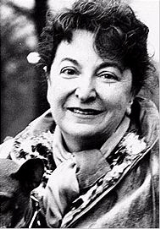
Pauline Kael was an American film critic who wrote for
The New YorkerThe New Yorker is an American magazine of reportage, commentary, criticism, essays, fiction, satire, cartoons and poetry published by Condé Nast...
magazine from 1968 to 1991. Earlier in her career, her work appeared in
City LightsCity Lights is a 1931 American silent film and romantic comedy-drama written by, directed by, and starring Charlie Chaplin. It also has the leads Virginia Cherrill and Harry Myers. Although "talking" pictures were on the rise since 1928, City Lights was immediately popular. Today, it is thought of...
,
McCall'sMcCall's was a monthly American women's magazine that enjoyed great popularity through much of the 20th century, peaking at a readership of 8.4 million in the early 1960s. It was established as a small-format magazine called The Queen in 1873...
and
The New RepublicThe magazine has also published two articles concerning income inequality, largely criticizing conservative economists for their attempts to deny the existence or negative effect increasing income inequality is having on the United States...
.
Kael was known for her "witty, biting, highly opinionated, and sharply focused" reviews, her opinions often contrary to those of her contemporaries. She is often regarded as the most influential American film critic of her day.
She left a lasting impression on many major critics, including
Armond WhiteArmond White is a New York-based film and music critic known for his provocative and idiosyncratic film criticism, which some have characterized as contrarian. He is currently the editor of City Arts, for which he also writes articles and reviews...
, whose reviews are similarly non-conformist, and
Roger EbertRoger Joseph Ebert is an American film critic and screenwriter. He is the first film critic to win a Pulitzer Prize for Criticism.Ebert is known for his film review column and for the television programs Sneak Previews, At the Movies with Gene Siskel and Roger Ebert, and Siskel and Ebert and The...
, who has said that Kael "had a more positive influence on the climate for film in America than any other single person over the last three decades."
Owen GleibermanOwen Gleiberman is an American film critic for Entertainment Weekly, a position he has held since the magazine's launch in 1990. From 1981–89, he worked at the Boston Phoenix....
said she "was more than a great critic. She re-invented the form, and pioneered an entire aesthetic of writing. She was like the Elvis or
the BeatlesThe Beatles were an English rock band, active throughout the 1960s and one of the most commercially successful and critically acclaimed acts in the history of popular music. Formed in Liverpool, by 1962 the group consisted of John Lennon , Paul McCartney , George Harrison and Ringo Starr...
of film criticism."
Early life and career
Kael was born on a chicken farm in Petaluma,
CaliforniaCalifornia is a state located on the West Coast of the United States. It is by far the most populous U.S. state, and the third-largest by land area...
, to Isaac Paul Kael and Judith Friedman Kael, Jewish immigrants from
PolandPoland , officially the Republic of Poland , is a country in Central Europe bordered by Germany to the west; the Czech Republic and Slovakia to the south; Ukraine, Belarus and Lithuania to the east; and the Baltic Sea and Kaliningrad Oblast, a Russian exclave, to the north...
. Her parents lost their farm when Kael was eight, and the family moved to
San Francisco, CaliforniaSan Francisco , officially the City and County of San Francisco, is the financial, cultural, and transportation center of the San Francisco Bay Area, a region of 7.15 million people which includes San Jose and Oakland...
. She matriculated at the
University of California, BerkeleyThe University of California, Berkeley , is a teaching and research university established in 1868 and located in Berkeley, California, USA...
, in 1936; she studied philosophy, literature, and the arts but dropped out in 1940 before completing her degree. Nevertheless, Kael intended to go on to law school but fell in with a group of artists and moved to
New York CityNew York is the most populous city in the United States and the center of the New York Metropolitan Area, one of the most populous metropolitan areas in the world. New York exerts a significant impact upon global commerce, finance, media, art, fashion, research, technology, education, and...
with the poet
Robert Horan-Life:He lived with Pauline Kael in Berkeley, California.He was part of the "Activist" group.He was friends with Gian Carlo Menotti, and Samuel Barber, staying with them at "The Capricorn", at Mount Kisco, New York....
.
Three years later, Kael returned to San Francisco and "led a
bohemianBohemianism is the practice of an unconventional lifestyle, often in the company of like-minded people, with few permanent ties, involving musical, artistic or literary pursuits...
life," marrying and divorcing three times, writing plays, and working in experimental film. In 1948, Kael and filmmaker
James BroughtonJames Broughton was an American poet, and poetic filmmaker. He was part of the San Francisco Renaissance...
had a daughter, Gina, whom Kael would raise alone. Gina had a serious illness through much of her childhood; and, to support Gina and herself, Kael worked a series of such menial jobs as cook and seamstress, along with stints as an advertising copywriter. In 1953, the editor of City Lights magazine overheard Kael arguing about films in a coffeeshop with a friend and asked her to review
Charlie ChaplinSir Charles Spencer "Charlie" Chaplin, KBE was an English comic actor, film director and composer best known for his work during the silent film era. He became the most famous film star in the world before the end of World War I...
's Limelight. Kael memorably dubbed the film "slimelight" and began publishing film criticism regularly in magazines.
Even these early reviews were notable for their informality and lack of pretension; Kael later explained, "I worked to loosen my style—to get away from the term-paper pomposity that we learn at college. I wanted the sentences to breathe, to have the sound of a human voice." Kael disparaged the supposed critic's ideal of
objectivityParent article: Journalism ethics and standardsObjectivity is a significant principle of journalistic professionalism. Journalistic objectivity can refer to fairness, disinterestedness, factuality, and nonpartisanship, but most often encompasses all of these qualities.- Definitions :In the context...
, referring to it as "saphead objectivity," and incorporated aspects of
autobiographyAn autobiography is a book about the life of a person, written by that person.-Origin of the term:...
into her criticism. In a review of
Vittorio De SicaVittorio De Sica was an Italian director and actor, a leading figure in the neorealist movement....
's 1946
neorealistItalian neorealism is a style of film characterized by stories set amongst the poor and working class, filmed on location, frequently using nonprofessional actors...
Shoeshine (Sciuscià) that has been ranked among her most memorable, Kael described seeing the film
Kael broadcast many of her early reviews on the alternative public radio station
KPFAKPFA is a listener-funded progressive talk radio and music radio station located in Berkeley, California, broadcasting to the San Francisco Bay Area. KPFA airs public news, public affairs, talk, and music programming. The station signed on-the-air April 15 1949, as the first Pacifica Station...
, in Berkeley, and gained further local-celebrity status as Berkeley Cinema Guild manager from 1955 to 1960. As manager of a two-screen theater, Kael programmed the films that were shown "unapologetically repeat[ing] her favorites until they also became audience favorites." She also wrote "pungent" capsule reviews of the films, which her patrons began collecting.
Going mass market
Kael continued to juggle writing with other work until she received an offer to publish a book of her criticism. Published in 1965 as
I Lost It at the MoviesI Lost It at the Movies is Pauline Kael's first collection of reviews, covering the years 1954-1965, which was published prior to her long stint at The New Yorker...
, the collection sold 150,000 paperback copies and was a surprise bestseller. Coinciding with a job at the high-circulation women's magazine
McCall'sMcCall's was a monthly American women's magazine that enjoyed great popularity through much of the 20th century, peaking at a readership of 8.4 million in the early 1960s. It was established as a small-format magazine called The Queen in 1873...
, Kael (as
NewsweekNewsweek is an American weekly news magazine published in New York City. It is distributed throughout the United States and internationally. It is the second-largest news weekly magazine in the U.S., having trailed Time in circulation and advertising revenue for most of its existence...
put it in a 1966 profile) "went mass".
During the same year, she wrote a blistering review of the phenomenally popular
The Sound of MusicRodgers and Hammerstein's The Sound of Music is a 1965 American musical film directed by Robert Wise and starring Julie Andrews and Christopher Plummer. The film is based on the Broadway musical The Sound of Music, with songs written by Richard Rodgers and Oscar Hammerstein II, and with the musical...
in McCall's. After mentioning that some of the press had dubbed it "The Sound of Money," Kael called the film's message a "sugarcoated lie that people seem to want to eat." Although, according to legend, this review led to her being fired from McCall's (The New York Times printed as much in Kael's obituary), both Kael and the magazine's editor, Robert Stein, denied this. According to Stein, "I [fired her] months later after she kept panning every commercial movie from
Lawrence of ArabiaLawrence of Arabia is a 1962 British film based on the life of T. E. Lawrence. It was directed by David Lean and produced by Sam Spiegel through his British company, Horizon Pictures, with the screenplay by Robert Bolt and Michael Wilson. The film stars Peter O'Toole in the title role. It is widely...
and Dr. Zhivago to
The PawnbrokerThe Pawnbroker is a novel by Edward Lewis Wallant which tells the story of Sol Nazerman, a concentration camp survivor who suffers flashbacks of his past Nazi imprisonment as he tries to cope with his daily life operating a pawn shop in East Harlem...
and
A Hard Day's NightA Hard Day's Night is a 1964 British black-and-white comedy film directed by Richard Lester and starring The Beatles—John Lennon, Paul McCartney, George Harrison and Ringo Starr—during the height of Beatlemania. It was written by Alun Owen and originally released by United Artists...
."
Her dismissal from McCall's led to a stint from 1966 to 1967 at
The New RepublicThe magazine has also published two articles concerning income inequality, largely criticizing conservative economists for their attempts to deny the existence or negative effect increasing income inequality is having on the United States...
, whose editors continually altered Kael's writing without permission. In October 1967, Kael wrote a lengthy essay on Bonnie and Clyde, which the magazine declined to publish.
William ShawnWilliam Shawn was an American magazine editor who edited The New Yorker from 1952 until 1987.-Education and Early Life:...
of The New Yorker obtained the piece and ran it in the New Yorker issue of October 21. Kael's review raved about the then controversial film
Bonnie and ClydeThe film was originally offered to François Truffaut, the best-known director of the New Wave movement, who made contributions to the script. He passed on the project to make Fahrenheit 451. The producers approached Jean-Luc Godard next...
. According to critic
David ThomsonDavid Thomson is a film critic and historian based in the United States and the author of more than 20 books, including The New Biographical Dictionary of Film.-Career:...
, "she was right about a film that had bewildered many other critics." A few months after the essay ran, Kael quit the Republic "in despair," Kael was asked by Shawn to join The New Yorker staff as one of its two film critics (she alternated every six months with
Penelope GilliattPenelope Gilliatt was an English novelist, short story writer, screenwriter, and film critic....
until 1979, after which she became sole film critic),
Initially, many considered her colloquial, brash writing style an odd fit with the sophisticated and genteel New Yorker. Kael remembered "getting a letter from an eminent New Yorker writer suggesting that I was trampling through the pages of the magazine with cowboy boots covered with dung." During her tenure at the New Yorker, however, she took advantage of a forum that permitted her to write at length and with presumably minimal editorial interference; and Kael achieved her greatest prominence. By 1968,
TimeTime is an American news magazine. A European edition is published from London. Time Europe covers the Middle East, Africa and, since 2003, Latin America. An Asian edition is based in Hong Kong...
magazine was referring to her as "one of the country's top movie critics." Kael noted that, during this period, her reviews were so interesting because the films were so compelling.
New Yorker tenure
In 1970, Kael received a George Polk Award for her work as a critic at the New Yorker. She continued to publish hardbound collections of her writings, many with (deliberately) suggestive titles such as
Kiss Kiss Bang BangKiss Kiss Bang Bang is Pauline Kael's second collection of reviews from 1965 through 1968, compiled from numerous magazines including The Atlantic, Holiday, The New Yorker, Life, Mademoiselle, The New Republic, McCall's, and Vogue...
,
When the Lights Go DownWhen The Lights Go Down , Complete Reviews 1975-1980, is the sixth collection of movie reviews by the critic Pauline Kael.-Background:All material in the book originally appeared in The New Yorker. The collection begins with an appreciation of Cary Grant...
, and
Taking It All InTaking It All In is the seventh collection of movie reviews by the critic Pauline Kael and contains the 150 film reviews she wrote for The New Yorker between June 9, 1980, and June 13, 1983...
. Her fourth book,
Deeper into MoviesDeeper Into Movies is the fourth collection of Pauline Kael's movie reviews from 1969-1972, which were originally published by The New Yorker...
(1973), was the first non-fiction book about films to win a
National Book AwardThe National Book Awards are a set of American literary awards. Started in 1950, the Awards are presented annually to American authors for literature published in the current year. In 1989 the National Book Foundation, a nonprofit organization which now oversees and manages the National Book...
.
Kael also wrote philosophical essays on filmgoing, the modern Hollywood film industry, and the lack of courage on the part of audiences (as she perceived it) to explore lesser-known, more challenging films (she rarely used the word "film" to describe films because she felt the word was too elitist). Among her more popular essays were a damning review of
Norman MailerNorman Kingsley Mailer was an American novelist, journalist, essayist, poet, playwright, screenwriter, and film director.Along with Truman Capote, Joan Didion, Hunter S...
's semi-fictional Marilyn: a Biography (an account of
Marilyn MonroeMarilyn Monroe was an American actress, singer, model and showgirl who became a major sex symbol, starring in a number of commercially successful motion pictures during the 1950s....
's life); an incisive look at
Cary GrantArchibald Alexander Leach , better known by his stage name Cary Grant, was an English actor who later took U.S. citizenship...
's career; and an extensively researched examination of
Citizen KaneCitizen Kane is a 1941 American drama film, directed by and starring Orson Welles. Many critics consider it the greatest American film of all time, especially for its innovative cinematography, music and narrative structure. Citizen Kane was Welles' first feature film...
, entitled Raising Kane (later reprinted in The Citizen Kane Book). She argued that
Herman J. MankiewiczHerman Jacob Mankiewicz was an American screenwriter, who, with Orson Welles, wrote the screenplay for Citizen Kane . Earlier, he was the Berlin correspondent for the Chicago Tribune and the drama critic for The New York Times and The New Yorker. Alexander Woollcott, said that Herman Mankiewicz was...
, Citizen Kanes co-screenwriter, deserved as much credit for the film as
Orson WellesGeorge Orson Welles , best known as Orson Welles, was an American film director, actor, theatre director, screenwriter, and producer, who worked extensively in film, theatre, television and radio...
, a thesis that provoked controversy and hurt Welles to the point that he considered suing Kael for libel. Pauline Kael's accusations were subsequently rebutted by scholars Robert L. Carringer, James Naremore and Jonathan Rosenbaum, who have established that Orson Welles significantly contributed to the film's conception and development. Most significantly, Charles Lederer who is cited by Kael as a source, himself claimed that Kael's research was largely distorted and poorly done.
Peter BogdanovichPeter Bogdanovich is an American film historian, director, writer, actor, producer, and critic. He was part of the wave of "New Hollywood" directors, which included William Friedkin, Brian De Palma, George Lucas, Martin Scorsese, Michael Cimino, and Francis Ford Coppola...
noted that Kael did not interview anyone then alive who was actively involved in the production of the film.
Bogdanovich also quotes
Woody AllenWoody Allen is an American screenwriter, director, actor, comedian, jazz musician, author, and playwright. Allen's films draw heavily on literature, sexuality, philosophy, psychology, Jewish identity, and the history of cinema...
's observation about Kael, "She has everything that a great critic needs except judgment. And I don't mean that facetiously. She has great passion, terrific wit, wonderful writing style, huge knowledge of film history, but too often what she chooses to extol or fails to see is very surprising."
Kael battled the editors of the New Yorker as much as her own critics. She fought with William Shawn to review the 1972 pornographic film
Deep ThroatDeep Throat is a 1972 American pornographic film written and directed by Gerard Damiano and produced by Louis Peraino and starring Linda Lovelace ....
, though she eventually relented. According to Kael, after reading her negative review of
Terrence MalickTerrence Frederick Malick is a U.S. film director, screenwriter, and producer. In a career spanning almost four decades, Malick has directed five feature films....
's 1973 film
BadlandsBadlands is a 1973 American crime drama film written and directed by Terrence Malick, starring Martin Sheen and Sissy Spacek. Warren Oates and Ramon Bieri are also featured. Malick has a small speaking part although he does not receive an acting credit...
, Shawn said, "I guess you didn't know that Terry is like a son to me." Kael responded, "Tough shit, Bill", and her review was printed unchanged. Other than sporadic confrontations with Shawn, Kael said she spent most of her work time at home, writing.
Upon the release of Kael's 1980 collection
When the Lights Go DownWhen The Lights Go Down , Complete Reviews 1975-1980, is the sixth collection of movie reviews by the critic Pauline Kael.-Background:All material in the book originally appeared in The New Yorker. The collection begins with an appreciation of Cary Grant...
, her New Yorker colleague
Renata AdlerRenata Adler is an American author, journalist and film critic.-Background and education:Adler was born in Milan, Italy, and grew up in Danbury, Connecticut. After gaining a B.A. in philosophy and German from Bryn Mawr, Adler studied for an M.A. in Comparative Literature at Harvard under I. A...
published an 8,000-word review in
The New York Review of BooksThe New York Review of Books is a fortnightly magazine with articles on literature, culture and current affairs. Published in New York City, it takes as its point of departure that the discussion of important books is itself an indispensable literary activity...
that dismissed the book as "jarringly, piece by piece, line by line, and without interruption, worthless." Adler argued that Kael's post-sixties work contained "nothing certainly of intelligence or sensibility," and faulted her "quirks [and] mannerisms," including Kael's repeated use of the "bullying" imperative and rhetorical question. The piece, which stunned Kael and quickly became infamous in literary circles, was described by Time magazine as "the New York literary Mafia['s] bloodiest case of assault and battery in years." Although Kael refused to respond, Adler's review became known as "the most sensational attempt on Kael's reputation"; twenty years later,
Salon.comSalon.com, part of Salon Media Group , often just called Salon, is an online liberal magazine, with content updated each weekday. Salon was founded by David Talbot and launched on November 20, 1995. It was the internet's first online-only commercial publication. The magazine focuses on U.S...
(ironically) referred to Adler's "worthless" denunciation of Kael as her "most famous single sentence."
In 1979, Kael accepted an offer from
Warren BeattyWarren Beatty born March 30, 1937) is an American actor, producer, screenwriter and director. He has received a total of fourteen Academy Award nominations, winning one for Best Director in 1982. He has also won four Golden Globe Awards including the Cecil B. DeMille Award.-Early life and...
to be a consultant to
Paramount PicturesParamount Pictures Corporation is an American film production and distribution company, located at 5555 Melrose Avenue in Hollywood. Founded in 1912 and currently owned by media conglomerate Viacom, it is America's oldest existing film studio; it is also the last major film studio still...
but left the position after only a few months to return to writing criticism.
Later years
In the early 1980s, Kael was diagnosed with
Parkinson's diseaseParkinson's disease is a degenerative disorder of the central nervous system...
. As her illness worsened, she became increasingly depressed about the state of American films, along with feeling that "I had nothing new to say." In a March 11, 1991, announcement which The New York Times referred to as "earth-shattering," Kael announced her retirement from reviewing films regularly. At the time, Kael explained that she would still write essays for The New Yorker, along with "some reflections and other pieces of writing about movies." During the next ten years, however, she published no new work besides an introduction to her 1994 compendium, For Keeps. In the introduction (which was reprinted in The New Yorker), Kael stated, in reference to her film criticism, "I'm frequently asked why I don't write my memoirs. I think I have."
Though she published no new writing of her own, Kael was not averse to giving interviews, in which she alternately praised and derided newly released films and television shows. In a 1998 interview with Modern Maturity, she said she sometimes regretted not being able to review: "A few years ago when I saw
Vanya on 42nd StreetVanya on 42nd Street is a 1994 film by Louis Malle and Andre Gregory. The film is an intimate, interpretive performance of the play Uncle Vanya by Anton Chekhov based on the English translation by David Mamet...
, I wanted to blow trumpets. Your trumpets are gone once you’ve quit." She died at her home in Massachusetts in 2001, aged 82.
Opinions
Kael's opinions often ran contrary to consensus critical opinion. Occasionally, she energetically championed films that were considered critical failures, such as The Warriors and
Last Tango in ParisLast Tango in Paris is a 1972 Italian romantic drama film directed by Bernardo Bertolucci which portrays a recent American widower who takes up an anonymous sexual relationship with a young, soon-to-be-married Parisian woman...
. Soon after the latter film's release, Kael won the 1973
Harvard LampoonThe Harvard Lampoon is an undergraduate humor publication founded in 1876 at Harvard University in Cambridge, Massachusetts.-Overview:Published since 1876, The Harvard Lampoon is the world's longest continually published humor magazine. It is also the second longest-running English-language humor...
Bosley Award, named after New York Times film critic
Bosley CrowtherBosley Crowther was a journalist and author who was film critic for The New York Times for 27 years. His reviews and articles helped shape the careers of actors, directors and screenwriters, though his reviews, at times, were unnecessarily mean...
and given to "that critic who consistently explores the farthest limits of bad taste." She was described by the Award's judges as "Pauline Kael, whose hysterical encomium loosed Bertolucci's Last Tango in Paris on an all-too-trusting world." She was not especially cruel to some films that had been roasted by many critics, such as the 1972
Man of La ManchaMan of La Mancha is a 1972 film adaptation of the Broadway musical Man of La Mancha by Dale Wasserman, with music by Mitch Leigh and lyrics by Joe Darion...
, in which she praised
Sophia LorenSophia Loren, OMRI is an Italian actress.In 1962, Loren won the Academy Award for Best Actress for her role in Two Women, along with 21 awards, becoming the first actress to win an Academy Award for a non-English-speaking performance...
's performance. She also condemned films that elsewhere attracted admiration, such as
It's a Wonderful LifeIt's a Wonderful Life is a 1946 American Christmas drama film produced and directed by Frank Capra and based on the short story "The Greatest Gift" written by Philip Van Doren Stern....
,
West Side StoryWest Side Story is a 1961 musical film directed by Robert Wise and Jerome Robbins. The film is an adaptation of the 1957 Broadway musical of the same name, which in turn was adapted from William Shakespeare's play Romeo and Juliet. It stars Natalie Wood, Richard Beymer, Russ Tamblyn, Rita Moreno,...
, and
ShoahThis page is about the film by the name of Shoah. For other uses, see Shoah Shoah is a 1985 French documentary film directed by Claude Lanzmann about the Holocaust...
. The originality of her opinions, as well as the forceful way in which she expressed them, won her ardent supporters as well as angry critics.
Notable film reviews by Kael included a venomous criticism of West Side Story that drew harsh replies from the film's supporters; ecstatic reviews of
ZZ is a 1969 French language political thriller directed by Costa Gavras, with a screenplay by Gavras and Jorge Semprún, based on the 1966 novel of the same name by Vassilis Vassilikos. The film presents a thinly fictionalized account of the events surrounding the assassination of democratic Greek...
and
MASHMASH is a 1970 American satirical dark comedy film directed by Robert Altman and written by Ring Lardner, Jr., based on Richard Hooker's novel MASH: A Novel About Three Army Doctors. It is the only feature film in the M*A*S*H franchise...
that resulted in enormous boosts to those films' popularity; and enthusiastic reviews of
Brian De PalmaBrian Russell De Palma is an American film director and writer. In a career spanning over 40 years, he is probably best known for his suspense and crime thriller films, including such box office successes as the horror film Carrie, Dressed to Kill, Scarface, The Untouchables, and Mission:...
's early films. Her 'preview' of
Robert AltmanRobert Bernard Altman was an American film director and screenwriter known for making films that are highly naturalistic, but with a stylized perspective. In 2006, the Academy of Motion Picture Arts and Sciences recognized his body of work with an Academy Honorary Award.His films MASH , McCabe and...
's 1975 film Nashville appeared several months before the film was actually completed, in an attempt to prevent the studio from re-cutting the film and to catapult it to box office glory.
Views on violence
Kael had a taste for anti-hero films that violated taboos involving sex and violence, and this reportedly alienated some of her readers. She also had a strong dislike for films that she felt were manipulative or appealed in superficial ways to conventional attitudes and feelings. She was particularly critical towards
Clint EastwoodClinton "Clint" Eastwood, Jr. is an American film actor, director, producer, composer and politician. Eastwood first came to prominence as a supporting cast member in the TV series Rawhide...
and her reviews of his films and acting, even if generally well-favored, were resoundingly negative; she became known as his arch nemesis.
She was an enthusiastic supporter of the violent action films of
Sam PeckinpahDavid Samuel "Sam" Peckinpah was an American filmmaker and screenwriter who achieved prominence following the release of the Western epic The Wild Bunch...
and early Walter Hill, as evidenced in her collection 5001 Nights at the Movies, which includes positive reviews of Hill's
Hard TimesHard Times is a 1975 film starring Charles Bronson as Chaney, a drifter who travels to Louisiana during the Great Depression and begins competing in illegal bare-knuckled boxing matches...
(1975), The Warriors (1979), and
Southern ComfortSouthern Comfort is an American action/thriller film directed by Walter Hill, working from a script by Hill, longtime collaborator David Giler, and Michael Kane. It featured Keith Carradine, Powers Boothe, Alan Autry, Les Lannom, Peter Coyote, T. K...
(1981), as well as Peckinpah's entire body of work. Although she initially dismissed
John BoormanJohn Boorman is a British filmmaker who is a long time resident of Ireland and is best known for his feature films such as Point Blank, Deliverance, Zardoz, Excalibur, The Emerald Forest, Hope and Glory, The General and The Tailor of Panama.-Early life:Boorman was born in Shepperton, Surrey,...
's Point Blank (1967) for what she felt was its pointless brutality, she later acknowledged it was "intermittently dazzling" with "more energy and invention than Boorman seems to know what to do with...one comes out exhilarated but bewildered."
However, Kael responded negatively to some action films that she felt pushed what she described as "right-wing" or "fascist" agendas. She labeled
Don SiegelDonald Siegel was an influential American film director and producer. His name variously appeared in the credits of his films as both Don Siegel and Donald Siegel.-Early life:...
's
Dirty HarryDirty Harry is a 1971 American crime thriller produced and directed by Don Siegel, the first in the Dirty Harry series. Clint Eastwood plays the title role, in his first outing as San Francisco Police Department Inspector "Dirty" Harry Callahan....
(1971), starring Clint Eastwood as "right-wing fantasy [that is] a remarkably single-minded attack on liberal values". She also called it "fascist medievalism". In an otherwise extremely positive critique of Peckinpah's Straw Dogs, Kael concluded that the controversial director had made "the first American film that is a fascist work of art".
In her negative review of
Stanley KubrickStanley Kubrick was an American film director, writer, producer, and photographer who lived in England during most of the last four decades of his career...
's
A Clockwork OrangeA Clockwork Orange is a 1971 film adaptation of Anthony Burgess's 1962 novel of the same name. It was written, directed and produced by Stanley Kubrick...
, Kael explained how she felt some directors who used brutal imagery in their films were de-sensitizing audiences to violence:
Accusations of homophobia
In preface to a 1983 interview with Kael for the
gayGay is a word that refers to a homosexual person, especially a homosexual male. For homosexual women the specific term is "lesbian"....
magazine
MandateMandate was a monthly gay pornographic magazine. It was published in the United States and distributed internationally since April, 1975. Together with the other magazines of the Mavety Group, such as Black Inches, it folded in 2009.-History:...
, Sam Staggs wrote that "she has always carried on a love/hate affair with her gay legions....like the bitchiest queen in gay mythology, she has a sharp remark about everything." In the early 1980s, however, largely in response to her review of the 1981 drama
Rich and FamousRich and Famous is a 1981 American drama film directed by George Cukor. The screenplay by Gerald Ayres is based on the 1941 play Old Acquaintance by John Van Druten, which was filmed with Bette Davis and Miriam Hopkins in 1943 under its original title. Both film versions are now owned by Turner...
, Kael faced notable accusations of
homophobiaHomophobia is a term used to refer to a range of negative attitudes and feelings towards lesbian, gay and in some cases bisexual, transgender people and behavior, although these are usually covered under other terms such as biphobia and transphobia. Definitions refer to irrational fear, with the...
. First remarked on by Stuart Byron in
The Village VoiceThe Village Voice is a free weekly newspaper and news and features website in New York City that features investigative articles, analysis of current affairs and culture, arts and music coverage, and events listings for New York City...
, according to gay writer Craig Seligman the accusations eventually "took on a life of their own and did real damage to her reputation."
In her review, Kael called the straight-themed Rich and Famous "more like a homosexual fantasy", saying that one female character's affairs "are creepy, because they don't seem like what a woman would get into." Byron, who "hit the ceiling" after reading the review, was joined by
The Celluloid ClosetThe Celluloid Closet is a 1996 American documentary film directed and written by Rob Epstein and Jeffrey Friedman. The film is based on the 1981 book of the same name written by Vito Russo, and on previous lecture and film clip presentations given in person by Russo 1972–82.Russo researched the...
author
Vito RussoVito Russo was an American LGBT activist, film historian and author who is best remembered as the author of the book The Celluloid Closet ....
, who argued that Kael equated promiscuity with homosexuality, "as though straight women have never been promiscuous or been given the permission to be promiscuous."
In response to her review of Rich and Famous, several critics reappraised Kael's earlier reviews of gay-themed films, including a wisecrack Kael made about the
lesbianLesbian is a term most widely used in the English language to describe sexual and romantic desire between females. The word may be used as a noun, to refer to women who identify themselves or who are characterized by others as having the primary attribute of female homosexuality, or as an...
-themed The Children's Hour: "I always thought this was why lesbians needed sympathy—that there isn't much they can do." Craig Seligman has defended Kael, saying that these remarks showed "enough ease with the topic to be able to crack jokes—in a dark period when other reviewers....'felt that if homosexuality were not a crime it would spread.'" Kael herself rejected the accusations as "craziness," adding, "I don't see how anybody who took the trouble to check out what I've actually written about movies with homosexual elements in them could believe that stuff."
Alleged Nixon quote
Kael has often been quoted as having said, in the wake of
Richard NixonRichard Milhous Nixon was the 37th President of the United States, serving from 1969 to 1974. The only president to resign the office, Nixon had previously served as a US representative and senator from California and as the 36th Vice President of the United States from 1953 to 1961 under...
's landslide victory in the 1972 presidential election, that she "couldn't believe Nixon had won", since no one she knew had voted for him. The quote is sometimes cited by conservatives (such as
Bernard GoldbergBernard Richard Goldberg , also known as Bernie Goldberg, is an eleven-time Emmy Award-winning American writer, journalist, and political commentator...
, in his book
BiasBias: A CBS Insider Exposes How the Media Distort the News is a non-fiction book by Bernard Goldberg, a 28-year veteran CBS news reporter and producer, giving detailed examples of what he calls liberal bias in television news reporting...
), as an example of the alleged cluelessness and insularity of the
liberal eliteLiberal elite is a political stigma used to describe affluent, politically left-leaning people. It is commonly used with the pejorative implication that the people who claim to support the rights of the working class are themselves members of the upper class, or upper middle class, and are...
. There are variations as to the exact wording, the speaker (it has variously been attributed to other liberal female writers, including
Katharine GrahamKatharine Meyer Graham was an American publisher. She led her family's newspaper, The Washington Post, for more than two decades, overseeing its most famous period, the Watergate coverage that eventually led to the resignation of President Richard Nixon...
,
Susan SontagSusan Sontag was an American author, literary theorist, feminist and political activist whose works include On Photography and Against Interpretation.-Life:...
, and
Joan DidionJoan Didion is an American author best known for her novels and her literary journalism. Her novels and essays explore the disintegration of American morals and cultural chaos, where the overriding theme is individual and social fragmentation...
), and the timing (in addition to Nixon's victory, it has been claimed to have been uttered after
Ronald ReaganRonald Wilson Reagan was the 40th President of the United States , the 33rd Governor of California and, prior to that, a radio, film and television actor....
's re-election in 1984.)
The story most likely originated in a December 28, 1972 New York Times article on a lecture Kael gave at the
Modern Language AssociationThe Modern Language Association of America is the principal professional association in the United States for scholars of language and literature...
, in which the newspaper quoted her as saying, "I live in a rather special world. I only know one person who voted for Nixon. Where they are I don't know. They're outside my ken. But sometimes when I'm in a theater I can feel them." There is no known record of Kael having expressed surprise at the outcome of the election, however.
Influence
Almost as soon as she began writing for The New Yorker, Kael carried a great deal of influence among fellow critics. In the early seventies,
CineramaCinerama is the trademarked name for a widescreen process which works by simultaneously projecting images from three synchronized 35 mm projectors onto a huge, deeply-curved screen, subtending 146° of arc. It is also the trademarked name for the corporation which was formed to market it...
distributors "initiate[d] a policy of individual screenings for each critic because her remarks [during the film] were affecting her fellow critics." In the seventies and eighties, Kael cultivated friendships with a group of young, mostly male critics, some of whom emulated her distinctive writing style. Referred to derisively as the "Paulettes," they came to dominate national film criticism in the 1990s. Critics who have acknowledged Kael's influence include, among many,
A. O. ScottAnthony Oliver Scott, known as A. O. Scott , is an American journalist and critic. He is a chief film critic for The New York Times, along with Manohla Dargis.-Background and education:...
of
The New York TimesThe New York Times is an American daily newspaper founded and continuously published in New York City since 1851. The New York Times has won 106 Pulitzer Prizes, the most of any news organization...
,
David DenbyDavid Denby is an American journalist, best known as a film critic for The New Yorker magazine.-Background and education:Denby grew up in New York City. He received a B.A...
and
Anthony LaneAnthony Lane is a film critic for The New Yorker magazine.-Personal life:Lane lives in Cambridge with Allison Pearson, a British writer and former Daily Mail columnist...
of The New Yorker,
David EdelsteinDavid Edelstein is the chief film critic for New York Magazine, as well as the film critic for NPR's Fresh Air and CBS Sunday Morning. He lives in Brooklyn, New York....
of New York Magazine,
Greil MarcusGreil Marcus is an American author, music journalist and cultural critic. He is notable for producing scholarly and literary essays that place rock music in a much broader framework of culture and politics than is customary in pop music journalism.-Life and career:Marcus was born in San Francisco...
,
Elvis MitchellElvis Mitchell is an American film critic, host of the public radio show The Treatment, and visiting lecturer at Harvard University. He has served as a film critic for the Fort Worth Star-Telegram, the LA Weekly, The Detroit Free Press, and The New York Times...
,
Michael SragowMichael Sragow is a film critic and columnist who has written for The Baltimore Sun, The New Times, The New Yorker , The Atlantic and salon.com...
, Armond White, and Stephanie Zacharek of
Salon.comSalon.com, part of Salon Media Group , often just called Salon, is an online liberal magazine, with content updated each weekday. Salon was founded by David Talbot and launched on November 20, 1995. It was the internet's first online-only commercial publication. The magazine focuses on U.S...
. It was repeatedly alleged that, after her retirement, Kael's "most ardent devotees deliberate[d] with each other [to] forge a common School of Pauline position" before their reviews were written. When confronted with the rumor that she ran "a conspiratorial network of young critics," Kael said she believed that critics imitated her style rather than her actual opinions, stating, "A number of critics take phrases and attitudes from me, and those takings stick out—they’re not integral to the writer’s temperament or approach."
When asked in 1998 if she thought her criticism had affected the way films were made, Kael deflected the question, stating, "If I say yes, I’m an egotist, and if I say no, I’ve wasted my life." Several directors' careers were indisputably affected by her, though, most notably that of
Taxi DriverTaxi Driver is a 1976 American drama film directed by Martin Scorsese and written by Paul Schrader. The film is set in New York City, soon after the Vietnam War. The film stars Robert De Niro and features Jodie Foster, Harvey Keitel, and Cybill Shepherd. The film was nominated for four Academy...
screenwriter
Paul SchraderPaul Joseph Schrader is an American screenwriter, film director, and former film critic. Apart from his credentials as a director, Schrader is most notably known for his screenplays for Martin Scorsese’s Taxi Driver and Raging Bull....
, who was accepted at UCLA Film School's graduate program on Kael's recommendation. Under her mentoring, Schrader worked as a film critic before taking up screenwriting and directing full-time. Also, film critic
Derek MalcolmDerek Malcolm is a British film critic and historian.Malcolm was educated at Eton College and Oxford University. He worked for several decades as a film critic for The Guardian, having previously been an amateur jockey and the paper's first horse racing correspondent. In 1977, he was a member of...
claimed that, "If a director was praised by Kael, he or she was generally allowed to work, since the money-men knew there would be similar approbation across a wide field of publications." Alternately, Kael was said to be able to prevent filmmakers from working;
David LeanSir David Lean CBE was an English film director, producer, screenwriter, and editor best remembered for big-screen epics such as The Bridge on the River Kwai , Lawrence of Arabia ,...
claimed that her criticism of his work "kept him from making a movie for 14 years." (He was most likely referring to the 14-year break between
Ryan's DaughterRyan's Daughter is a 1970 film directed by David Lean. The film, set in 1916, tells the story of a married Irish woman who has an affair with a British officer during World War I, despite opposition from her nationalist neighbours...
in 1970 and
A Passage to IndiaA Passage to India is a 1984 drama film written and directed by David Lean. The screenplay is based on the 1924 novel of the same title by E. M. Forster and the 1960 play by Santha Rama Rau that was inspired by the novel....
in 1984.)
In 1978, she was awarded the Women in Film Crystal Award for outstanding women who, through their endurance and the excellence of their work, have helped to expand the role of women within the entertainment industry.
Though he began directing films after she retired,
Quentin TarantinoQuentin Jerome Tarantino is an American film director, screenwriter, producer, cinematographer and actor. In the early 1990s, he began his career as an independent filmmaker with films employing nonlinear storylines and the aestheticization of violence...
was also influenced by Kael. He read her criticism voraciously growing up and said that Kael was "as influential as any director was in helping me develop my aesthetic."
Wes AndersonWesley Wales Anderson is an American film director, screenwriter, actor, and producer of features, short films and commercials....
recounted his efforts to screen his film
RushmoreRushmore is a 1998 comedy-drama film directed by Wes Anderson about an eccentric teenager named Max Fischer , his friendship with rich industrialist Herman Blume , and their mutual love for elementary school teacher Rosemary Cross . The film was co-written by Anderson and Owen Wilson...
for Kael in a 1999 The New York Times article titled "My Private Screening With Pauline Kael". He later wrote Kael that "your thoughts and writing about the movies [have] been a very important source of inspiration for me and my movies, and I hope you don't regret that."
The career of Pauline Kael is discussed at length in
For the Love of Movies: The Story of American Film CriticismFor the Love of Movies: The Story of American Film Criticism is a 2009 documentary film dramatizing a hundred years of American film criticism through film clips, historic photographs, and on-camera interviews with many of today’s important reviewers, mostly print but also Internet...
, by critics whom she helped with their careers, such as
Owen GleibermanOwen Gleiberman is an American film critic for Entertainment Weekly, a position he has held since the magazine's launch in 1990. From 1981–89, he worked at the Boston Phoenix....
and
Elvis MitchellElvis Mitchell is an American film critic, host of the public radio show The Treatment, and visiting lecturer at Harvard University. He has served as a film critic for the Fort Worth Star-Telegram, the LA Weekly, The Detroit Free Press, and The New York Times...
, as well as by those who fought with her, such as
Andrew SarrisAndrew Sarris is an American film critic and a leading proponent of the auteur theory of criticism.-Career:Sarris is generally credited with popularizing the auteur theory in the U.S...
. This 2009 documentary film also shows several Kael appearances on
PBSThe Public Broadcasting Service is an American non-profit public broadcasting television network with 354 member TV stations in the United States which hold collective ownership. Its headquarters is in Arlington, Virginia....
, including speaking together with
Woody AllenWoody Allen is an American screenwriter, director, actor, comedian, jazz musician, author, and playwright. Allen's films draw heavily on literature, sexuality, philosophy, psychology, Jewish identity, and the history of cinema...
.
In his 1988 film
WillowWillow is a 1988 American fantasy film directed by Ron Howard and produced/co-written by George Lucas. Warwick Davis stars in the film, as well as Val Kilmer, Joanne Whalley, Jean Marsh, and Patricia Hayes...
,
George LucasGeorge Walton Lucas, Jr. is an American film producer, screenwriter, and director, and entrepreneur. He is the founder, chairman and chief executive of Lucasfilm. He is best known as the creator of the space opera franchise Star Wars and the archaeologist-adventurer character Indiana Jones...
named one of the villains "General Kael," after the critic. Kael had often reviewed Lucas' work without enthusiasm; in her own (negative) review of Willow, she described the character as an "hommage à moi."
Books
- I Lost It at the Movies
I Lost It at the Movies is Pauline Kael's first collection of reviews, covering the years 1954-1965, which was published prior to her long stint at The New Yorker...
(1965)
- Kiss Kiss Bang Bang
Kiss Kiss Bang Bang is Pauline Kael's second collection of reviews from 1965 through 1968, compiled from numerous magazines including The Atlantic, Holiday, The New Yorker, Life, Mademoiselle, The New Republic, McCall's, and Vogue...
(1968) ISBN 0-31648-163-7
- Going Steady
Going Steady: Film Writings 1968-1969 is the third collection of film reviews by the critic Pauline Kael, comprising the years 1968-1969, when she first began her film-reviewing duties at The New Yorker and which covers, " a crucial period of social and aesthetic change at the end of the...
(1969) ISBN 0-55305-880-0
- Deeper into Movies
Deeper Into Movies is the fourth collection of Pauline Kael's movie reviews from 1969-1972, which were originally published by The New Yorker...
(1973) ISBN 0-7145-0941-8
- Reeling
Reeling was Pauline Kael's fifth collection of movie reviews, covering the years 1972 - 1975. The book is largely composed of movie reviews, ranging from her famous review of Last Tango in Paris to A Woman Under the Influence, but it also contains a longer essay entitled "On the Future of Movies"...
(1976)
- When the Lights Go Down
When The Lights Go Down , Complete Reviews 1975-1980, is the sixth collection of movie reviews by the critic Pauline Kael.-Background:All material in the book originally appeared in The New Yorker. The collection begins with an appreciation of Cary Grant...
(1980) ISBN 0-03042-511-5
- 5001 Nights at the Movies
5001 Nights at the Movies is a book compiling rilm critic Pauline Kael's reviews from the silent era to the 1980s. They were originally written for The New Yorker’s 'Goings On About Town' section....
(1982, revised in 1984 and 1991) ISBN 0-8050-1367-9
- Taking It All In
Taking It All In is the seventh collection of movie reviews by the critic Pauline Kael and contains the 150 film reviews she wrote for The New Yorker between June 9, 1980, and June 13, 1983...
(1984) ISBN 0-03069-362-4
- State of the Art
State of the Art: Film Writings 1983-1985 is the eighth collection of movie reviews by the critic Pauline Kael.In the Authors Note at the beginning of this collection she wrote : "The title of this book is a deliberate break with my sexually tinged titles of the past. It seemed time for a change;...
(1987) ISBN 0-71452-869-2
- Hooked (1989)
- Movie Love
Movie Love is the tenth and last collection of film reviews by the critic Pauline Kael and covers the period from October 1988 to March 1991, when she chose to retire from her regular film reviewing duties at The New Yorker...
(1991)
- For Keeps (1994)
- Raising Kane, and other essays (1996)
Selected reviews and essays
- "Trash, Art, and the Movies", essay published in the Feb. 1969 issue of Harper's.
- "Raising Kane", book-length essay on the making of Citizen Kane
Citizen Kane is a 1941 American drama film, directed by and starring Orson Welles. Many critics consider it the greatest American film of all time, especially for its innovative cinematography, music and narrative structure. Citizen Kane was Welles' first feature film...
published in the Feb. 20, 1971 and Feb. 27, 1971 issues of The New Yorker.
- "Stanley Strangelove", review of A Clockwork Orange
A Clockwork Orange is a 1971 film adaptation of Anthony Burgess's 1962 novel of the same name. It was written, directed and produced by Stanley Kubrick...
from a January 1972 issue of The New Yorker.
- "The Man From Dream City", profile of Cary Grant
Archibald Alexander Leach , better known by his stage name Cary Grant, was an English actor who later took U.S. citizenship...
from the July 14, 1975 issue of The New Yorker.
- "Why Are Movies So Bad? Or, The Numbers", essay published in the June 23, 1980 issue of The New Yorker. Reviews Mrs. Soffel
Mrs. Soffel is a 1984 American film drama based on the true Buck McGovern and the Biddle Boys case of 1901 Pittsburgh, starring Diane Keaton and Mel Gibson. It was filmed on location in and around the Serez family Farm in Mulmer Ontario, as well as Wisconsin and establishing shots in Pittsburgh...
, directed by Gillian ArmstrongGillian May Armstrong is an award-winning Australian director of feature films and documentaries.- Career :Born in Melbourne, Victoria, Gillian Armstrong grew up in the eastern suburb of Mitcham. She graduated from Swinburne Technical College in 1968 where she studied theatrical costume design and...
and The Cotton ClubThe Cotton Club is a 1984 crime-drama, centered on a famed Harlem jazz club of the 1930s, the Cotton Club.The movie was co-written and directed by Francis Ford Coppola, choreographed by Henry LeTang, and starred Richard Gere, Diane Lane, and Gregory Hines...
, directed by Francis Ford CoppolaFrancis Ford Coppola is an American film director, producer and screenwriter. He is widely acclaimed as one of Hollywood's most innovative and influential film directors...
. Reviews A Passage to IndiaA Passage to India is a 1984 drama film written and directed by David Lean. The screenplay is based on the 1924 novel of the same title by E. M. Forster and the 1960 play by Santha Rama Rau that was inspired by the novel....
, directed by David LeanSir David Lean CBE was an English film director, producer, screenwriter, and editor best remembered for big-screen epics such as The Bridge on the River Kwai , Lawrence of Arabia ,...
. Reviews Micki and Maude, directed by Blake EdwardsBlake Edwards was an American film director, screenwriter and producer.Edwards' career began in the 1940s as an actor, but he soon turned to writing radio scripts at Columbia Pictures...
; StarmanJohn Carpenter's Starman is a 1984 science-fiction fantasy film directed by John Carpenter that tells the story of an alien who has come to Earth in response to the invitation found on the gold phonograph record installed on the Voyager 2 space probe.The screenplay was written by Bruce A. Evans,...
, directed by John CarpenterJohn Howard Carpenter is an American film director, screenwriter, producer, editor, composer, and occasional actor. Although Carpenter has worked in numerous film genres in his four-decade career, his name is most commonly associated with horror and science fiction.- Early life :Carpenter was born...
; The Flamingo KidThe Flamingo Kid is a 1984 comedy film directed by Garry Marshall, written by Marshall, Neal Marshall and Bo Goldman. It stars Matt Dillon, Richard Crenna, Hector Elizondo, and Janet Jones...
, directed by Garry MarshallGarry Kent Marshall is an American actor, director, writer and producer. His notable credits include creating Happy Days and The Odd Couple and directing Nothing In Common, Pretty Woman, Runaway Bride, Valentine's Day, and The Princess Diaries.-Early life:Marshall was born in the New York City...
.
- Pauline Kael articles at Byliner
External links