

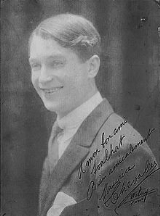
Maurice Chevalier

Encyclopedia
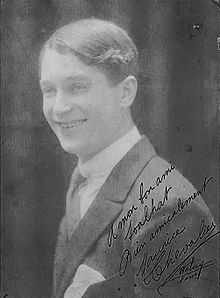
Sprechgesang
Sprechgesang and Sprechstimme are musical terms used to refer to an expressionist vocal technique between singing and speaking. Though sometimes used interchangeably, sprechgesang is a term directly related to the operatic recitative manner of singing , whereas sprechstimme is...
performer. He is perhaps best known for his signature songs, including Louise, Mimi, Valentine, and Thank Heaven for Little Girls
Thank Heaven for Little Girls
"Thank Heaven for Little Girls" is a 1957 song written by Lerner and Loewe and performed by Maurice Chevalier. It opened and closed the 1958 film Gigi. Alfred Drake performed the song in the 1973 Broadway production of Gigi....
and for his films including The Love Parade
The Love Parade
The Love Parade is a 1929 musical comedy film about the marital difficulties of Queen Louise of Sylvania and her consort, Count Alfred Renard...
and The Big Pond
The Big Pond
The Big Pond is a 1930 American romantic comedy film based on a 1928 play of the same name by George Middleton and A.E. Thomas. The film was written by Garrett Fort, Robert Presnell Sr. and Preston Sturges, who provided the dialogue in his first Hollywood assignment, and was directed by Hobart...
. His trademark attire was a boater hat, which he always wore on stage with a tuxedo.
Born in Paris
Paris
Paris is the capital and largest city in France, situated on the river Seine, in northern France, at the heart of the Île-de-France region...
, he made his name as a star of musical comedy, appearing in public as a singer and dancer at an early age before working in four menial jobs as a teenager. In 1909, he became the partner of the biggest female star in France at the time, Fréhel
Fréhel
Fréhel was a French singer and actress.-Biography:Born in Paris, France to a poor and dysfunctional Breton family, Marguerite Boulc'h was a child left to a life on the streets in the dark side of Paris...
and, although brief, she secured him his first major engagement, as a mimic and a singer in l'Alcazar in Marseille
Marseille
Marseille , known in antiquity as Massalia , is the second largest city in France, after Paris, with a population of 852,395 within its administrative limits on a land area of . The urban area of Marseille extends beyond the city limits with a population of over 1,420,000 on an area of...
to which he received critical acclaim by French theatre critics. In 1918 he discovered jazz
Jazz
Jazz is a musical style that originated at the beginning of the 20th century in African American communities in the Southern United States. It was born out of a mix of African and European music traditions. From its early development until the present, jazz has incorporated music from 19th and 20th...
and ragtime
Ragtime
Ragtime is an original musical genre which enjoyed its peak popularity between 1897 and 1918. Its main characteristic trait is its syncopated, or "ragged," rhythm. It began as dance music in the red-light districts of American cities such as St. Louis and New Orleans years before being published...
and went to London
London
London is the capital city of :England and the :United Kingdom, the largest metropolitan area in the United Kingdom, and the largest urban zone in the European Union by most measures. Located on the River Thames, London has been a major settlement for two millennia, its history going back to its...
, where he found new success at the Palace Theatre
Palace Theatre, London
The Palace Theatre is a West End theatre in the City of Westminster in London. It is an imposing red-brick building that dominates the west side of Cambridge Circus and is located near the intersection of Shaftesbury Avenue and Charing Cross Road...
.
In 1917, he discovered jazz
Jazz
Jazz is a musical style that originated at the beginning of the 20th century in African American communities in the Southern United States. It was born out of a mix of African and European music traditions. From its early development until the present, jazz has incorporated music from 19th and 20th...
and ragtime
Ragtime
Ragtime is an original musical genre which enjoyed its peak popularity between 1897 and 1918. Its main characteristic trait is its syncopated, or "ragged," rhythm. It began as dance music in the red-light districts of American cities such as St. Louis and New Orleans years before being published...
and toured the United States
United States
The United States of America is a federal constitutional republic comprising fifty states and a federal district...
. Whilst there, he met the American composers George Gershwin
George Gershwin
George Gershwin was an American composer and pianist. Gershwin's compositions spanned both popular and classical genres, and his most popular melodies are widely known...
and Irving Berlin
Irving Berlin
Irving Berlin was an American composer and lyricist of Jewish heritage, widely considered one of the greatest songwriters in American history.His first hit song, "Alexander's Ragtime Band", became world famous...
and brought Dédé to Broadway
Broadway theatre
Broadway theatre, commonly called simply Broadway, refers to theatrical performances presented in one of the 40 professional theatres with 500 or more seats located in the Theatre District centered along Broadway, and in Lincoln Center, in Manhattan in New York City...
in 1922. He also developed an interest in acting, where he appeared in Chaplin's silent movie A Woman of Paris
A Woman of Paris
A Woman of Paris is a feature-length silent film that debuted in 1923. The film, an atypical drama film for its creator, was written, directed, produced and later scored by Charlie Chaplin. It is also known as A Woman of Paris: A Drama of Fate....
and had success in the operetta
Operetta
Operetta is a genre of light opera, light in terms both of music and subject matter. It is also closely related, in English-language works, to forms of musical theatre.-Origins:...
Dédé
Dédé (opérette)
Dédé is an opérette or musical comedy in three acts with music by Henri Christiné and a French libretto by Albert Willemetz. It marked an important milestone in developing the career of Maurice Chevalier.-Performance history:...
. When talkies arrived, he returned to Hollywood in 1928 where he played his first American role in Innocents of Paris
Innocents of Paris
Innocents of Paris is a 1929 black and white American musical film. Directed by Richard Wallace and is based on the play Flea Market, the film was the first musical production by Paramount Pictures.-Cast:*Maurice Chevalier - Maurice Marney...
. In 1930 he was nominated for the Academy Award for Best Actor
Academy Award for Best Actor
Performance by an Actor in a Leading Role is one of the Academy Awards of Merit presented annually by the Academy of Motion Picture Arts and Sciences to recognize an actor who has delivered an outstanding performance while working within the film industry...
, for his roles in The Love Parade (1929) and The Big Pond (1930), which secured his first big American hit, Livin' in the Sunlight, Lovin' in the Moonlight
Livin' in the Sunlight, Lovin' in the Moonlight
"Livin' in the Sunlight, Lovin' in the Moonlight" is a popular song written by Al Sherman and Al Lewis for the 1930 film, The Big Pond starring Maurice Chevalier. The song was also sung by Chevalier who made it famous. Chevalier enjoyed his first American hit with this song...
.
In 1957, he appeared in Love in the Afternoon
Love in the Afternoon (1957 film)
Love in the Afternoon is a 1957 American romantic comedy film produced and directed by Billy Wilder. The screenplay by Wilder and I.A.L. Diamond is based on the Claude Anet novel Ariane, jeune fille russe , which previously was filmed as Scampolo in 1928 and Scampolo, ein Kind der Strasse in...
which was his first Hollywood film in more than 20 years. In the early 1960s, he made eight films, including Can-Can
Can-Can (film)
Can-Can is a 1960 musical film made by Suffolk-Cummings productions and distributed by 20th Century Fox. It was directed by Walter Lang, produced by Jack Cummings and Saul Chaplin, from a screenplay by Dorothy Kingsley and Charles Lederer, loosely based on the musical play by Abe Burrows with music...
in 1960 and Fanny the following year. In 1970 he made his final contribution to the film industry where he sung the title song of the Disney film The Aristocats
The Aristocats
The Aristocats is a 1970 American animated feature produced and released by Walt Disney Productions in 1970 and stars Eva Gabor and Phil Harris, with Roddy Maude-Roxby as Edgar the butler, the villain of the story...
. He died in Paris, on January 1, 1972, aged 83.
Early life
He was born in ParisParis
Paris is the capital and largest city in France, situated on the river Seine, in northern France, at the heart of the Île-de-France region...
to a house painter father and a mother of Belgian
Belgium
Belgium , officially the Kingdom of Belgium, is a federal state in Western Europe. It is a founding member of the European Union and hosts the EU's headquarters, and those of several other major international organisations such as NATO.Belgium is also a member of, or affiliated to, many...
descent. He made his name as a star of musical comedy, appearing in public as a singer and dancer at an early age.
He worked a number of jobs; a carpenter's apprentice, electrician, printer, and even as a doll painter. He started in show business in 1901. He was singing, unpaid, at a café when a member of the theatre saw him and suggested he try for a local musical. He got the part. Chevalier made a name as a mimic and a singer. His act in l'Alcazar in Marseille
Marseille
Marseille , known in antiquity as Massalia , is the second largest city in France, after Paris, with a population of 852,395 within its administrative limits on a land area of . The urban area of Marseille extends beyond the city limits with a population of over 1,420,000 on an area of...
was so successful, he made a triumphant rearrival in Paris.
In 1909, he became the partner of the biggest female star in France, Fréhel
Fréhel
Fréhel was a French singer and actress.-Biography:Born in Paris, France to a poor and dysfunctional Breton family, Marguerite Boulc'h was a child left to a life on the streets in the dark side of Paris...
. However, due to her alcoholism
Alcoholism
Alcoholism is a broad term for problems with alcohol, and is generally used to mean compulsive and uncontrolled consumption of alcoholic beverages, usually to the detriment of the drinker's health, personal relationships, and social standing...
and drug addiction, their liaison ended in 1911. Chevalier then started a relationship with 36-year-old Mistinguett
Mistinguett
Mistinguett was a French actress and singer, whose birth name was Jeanne Bourgeois. She was at one time the best-paid female entertainer in the world...
at the Folies Bergère where he was her 23 year old dance partner; they eventually played out a public romance.
World War I
When World War IWorld War I
World War I , which was predominantly called the World War or the Great War from its occurrence until 1939, and the First World War or World War I thereafter, was a major war centred in Europe that began on 28 July 1914 and lasted until 11 November 1918...
broke out, Chevalier was in the middle of his national service, already in the front line, where he was wounded by shrapnel in the back in the first weeks of combat and was taken as a prisoner of war
Prisoner of war
A prisoner of war or enemy prisoner of war is a person, whether civilian or combatant, who is held in custody by an enemy power during or immediately after an armed conflict...
in Germany
Germany
Germany , officially the Federal Republic of Germany , is a federal parliamentary republic in Europe. The country consists of 16 states while the capital and largest city is Berlin. Germany covers an area of 357,021 km2 and has a largely temperate seasonal climate...
for two years. In 1916, he was released through the secret intervention of Mistinguett
Mistinguett
Mistinguett was a French actress and singer, whose birth name was Jeanne Bourgeois. She was at one time the best-paid female entertainer in the world...
's admirer, King Alfonso XIII of Spain
Alfonso XIII of Spain
Alfonso XIII was King of Spain from 1886 until 1931. His mother, Maria Christina of Austria, was appointed regent during his minority...
, the only king of a neutral country who was related to both the British and German royal families.
In 1917, Chevalier became a star in le Casino de Paris and played before British soldiers and Americans. He discovered jazz
Jazz
Jazz is a musical style that originated at the beginning of the 20th century in African American communities in the Southern United States. It was born out of a mix of African and European music traditions. From its early development until the present, jazz has incorporated music from 19th and 20th...
and ragtime
Ragtime
Ragtime is an original musical genre which enjoyed its peak popularity between 1897 and 1918. Its main characteristic trait is its syncopated, or "ragged," rhythm. It began as dance music in the red-light districts of American cities such as St. Louis and New Orleans years before being published...
and started thinking about touring the United States
United States
The United States of America is a federal constitutional republic comprising fifty states and a federal district...
. In the prison camp, he studied English and had an advantage over other French artists. He went to London
London
London is the capital city of :England and the :United Kingdom, the largest metropolitan area in the United Kingdom, and the largest urban zone in the European Union by most measures. Located on the River Thames, London has been a major settlement for two millennia, its history going back to its...
, where he found new success at the Palace Theatre
Palace Theatre, London
The Palace Theatre is a West End theatre in the City of Westminster in London. It is an imposing red-brick building that dominates the west side of Cambridge Circus and is located near the intersection of Shaftesbury Avenue and Charing Cross Road...
, even though he still sang in French
French language
French is a Romance language spoken as a first language in France, the Romandy region in Switzerland, Wallonia and Brussels in Belgium, Monaco, the regions of Quebec and Acadia in Canada, and by various communities elsewhere. Second-language speakers of French are distributed throughout many parts...
.
Hollywood
After the war, Chevalier went back to Paris and created several songs still known today, such as "Valentine" (1924). He played in a few pictures, including Chaplin's A Woman of ParisA Woman of Paris
A Woman of Paris is a feature-length silent film that debuted in 1923. The film, an atypical drama film for its creator, was written, directed, produced and later scored by Charlie Chaplin. It is also known as A Woman of Paris: A Drama of Fate....
(a rare drama for Chaplin, in which his character of The Tramp
The Tramp
The Tramp, also known as The Little Tramp was Charlie Chaplin's most memorable on-screen character, a recognized icon of world cinema most dominant during the silent film era....
does not appear) and made a huge impression in the operetta
Operetta
Operetta is a genre of light opera, light in terms both of music and subject matter. It is also closely related, in English-language works, to forms of musical theatre.-Origins:...
Dédé
Dédé (opérette)
Dédé is an opérette or musical comedy in three acts with music by Henri Christiné and a French libretto by Albert Willemetz. It marked an important milestone in developing the career of Maurice Chevalier.-Performance history:...
. He met the American composers George Gershwin
George Gershwin
George Gershwin was an American composer and pianist. Gershwin's compositions spanned both popular and classical genres, and his most popular melodies are widely known...
and Irving Berlin
Irving Berlin
Irving Berlin was an American composer and lyricist of Jewish heritage, widely considered one of the greatest songwriters in American history.His first hit song, "Alexander's Ragtime Band", became world famous...
and brought Dédé to Broadway
Broadway theatre
Broadway theatre, commonly called simply Broadway, refers to theatrical performances presented in one of the 40 professional theatres with 500 or more seats located in the Theatre District centered along Broadway, and in Lincoln Center, in Manhattan in New York City...
in 1922. The same year he met Yvonne Vallée
Yvonne Vallée
Yvonne Vallée was a French actress.She was born Marguerite Yvonne Vallee in Bordeaux in 1899.Vallée was the wife of Maurice Chevalier from 1927 to 1933.She died in Vallauris, France in 1996, aged 97....
, a young dancer, who became his wife in 1927.
Douglas Fairbanks
Douglas Fairbanks
Douglas Fairbanks, Sr. was an American actor, screenwriter, director and producer. He was best known for his swashbuckling roles in silent films such as The Thief of Bagdad, Robin Hood, and The Mark of Zorro....
offered him star billing with Mary Pickford
Mary Pickford
Mary Pickford was a Canadian-born motion picture actress, co-founder of the film studio United Artists and one of the original 36 founders of the Academy of Motion Picture Arts and Sciences...
, but Chevalier doubted his own talent for silent movies (in Paris, he'd made a couple that failed). When sound arrived, he returned to Hollywood in 1928. He signed a contract with Paramount Pictures
Paramount Pictures
Paramount Pictures Corporation is an American film production and distribution company, located at 5555 Melrose Avenue in Hollywood. Founded in 1912 and currently owned by media conglomerate Viacom, it is America's oldest existing film studio; it is also the last major film studio still...
and played his first American role in Innocents of Paris
Innocents of Paris
Innocents of Paris is a 1929 black and white American musical film. Directed by Richard Wallace and is based on the play Flea Market, the film was the first musical production by Paramount Pictures.-Cast:*Maurice Chevalier - Maurice Marney...
. In 1930 he was nominated for the Academy Award for Best Actor
Academy Award for Best Actor
Performance by an Actor in a Leading Role is one of the Academy Awards of Merit presented annually by the Academy of Motion Picture Arts and Sciences to recognize an actor who has delivered an outstanding performance while working within the film industry...
, for his roles in The Love Parade
The Love Parade
The Love Parade is a 1929 musical comedy film about the marital difficulties of Queen Louise of Sylvania and her consort, Count Alfred Renard...
(1929) and The Big Pond
The Big Pond
The Big Pond is a 1930 American romantic comedy film based on a 1928 play of the same name by George Middleton and A.E. Thomas. The film was written by Garrett Fort, Robert Presnell Sr. and Preston Sturges, who provided the dialogue in his first Hollywood assignment, and was directed by Hobart...
(1930). The Big Pond gave Chevalier his first big American hit songs, "Livin' in the Sunlight, Lovin' in the Moonlight
Livin' in the Sunlight, Lovin' in the Moonlight
"Livin' in the Sunlight, Lovin' in the Moonlight" is a popular song written by Al Sherman and Al Lewis for the 1930 film, The Big Pond starring Maurice Chevalier. The song was also sung by Chevalier who made it famous. Chevalier enjoyed his first American hit with this song...
" with words and music by Al Lewis
Al Lewis (lyricist)
Al Lewis is thought of mostly as a Tin Pan Alley era lyricist; however, he did write music on occasion as well. Professionally he was most active during the 1920s working into the 1950s. During this time, he most often collaborated with popular songwriters Al Sherman and Abner Silver...
and Al Sherman
Al Sherman
Al Sherman was an American Tin Pan Alley songwriter from the first half of the twentieth century. Sherman is a link in a long chain of musical Sherman family members.-Early life:...
, plus "A New Kind of Love" (or "The Nightingales"). He collaborated with film director
Film director
A film director is a person who directs the actors and film crew in filmmaking. They control a film's artistic and dramatic nathan roach, while guiding the technical crew and actors.-Responsibilities:...
Ernst Lubitsch
Ernst Lubitsch
Ernst Lubitsch was a German-born film director. His urbane comedies of manners gave him the reputation of being Hollywood's most elegant and sophisticated director; as his prestige grew, his films were promoted as having "the Lubitsch touch."In 1947 he received an Honorary Academy Award for his...
. He appeared in Paramount's all-star revue film Paramount on Parade
Paramount on Parade
Paramount on Parade is a all-star revue released by Paramount Pictures, directed by several directors including Edmund Goulding, Dorothy Arzner, Ernst Lubitsch, Rowland V. Lee, A. Edward Sutherland, Victor Heerman, Lothar Mendes, Otto Brower, Edwin H...
(1930).
While under contract with Paramount, Chevalier's name was so recognized that his passport featured in the Marx Brothers
Marx Brothers
The Marx Brothers were an American family comedy act, originally from New York City, that enjoyed success in Vaudeville, Broadway, and motion pictures from the early 1900s to around 1950...
film Monkey Business
Monkey Business (1931 film)
Monkey Business is a 1931 comedy film. It is the third of the Marx Brothers' released movies, and the first not to be an adaptation of one of their Broadway shows. The film stars the four brothers: Groucho Marx, Chico Marx, Harpo Marx, and Zeppo Marx, and screen comedienne Thelma Todd. It is...
(1931). In this sequence, a little more than halfway through the film, each brother uses Chevalier's passport, and tries to sneak off the ocean liner where they were stowaways by claiming to be the singer—with unique renditions of "You Brought a New Kind of Love to Me
You Brought a New Kind of Love to Me
"You Brought a New Kind of Love to Me" is a 1930 popular song. The credits list music and lyrics as written by Sammy Fain, Irving Kahal, and Pierre Norman...
" with its line "If the nightingales could sing like you". In 1931, Chevalier starred in a musical called The Smiling Lieutenant
The Smiling Lieutenant
The Smiling Lieutenant is an American film directed by Ernst Lubitsch, starring Maurice Chevalier and Claudette Colbert, and released by Paramount Pictures.-Production background:...
with Claudette Colbert
Claudette Colbert
Claudette Colbert was a French-born American-based actress of stage and film.Born in Paris, France and raised in New York City, Colbert began her career in Broadway productions during the 1920s, progressing to film with the advent of talking pictures...
and Miriam Hopkins
Miriam Hopkins
Ellen Miriam Hopkins was an American actress known for her versatility in a wide variety of roles.Hopkins was born in Savannah, Georgia, and raised in Bainbridge, a town in the state's southwest near the Alabama border...
. Despite the disdain audiences held for musicals in 1931, it proved a successful film.
In 1932, he starred with Jeanette MacDonald
Jeanette MacDonald
Jeanette MacDonald was an American singer and actress best remembered for her musical films of the 1930s with Maurice Chevalier and Nelson Eddy...
in Paramount's film musical, One Hour With You
One Hour with You
One Hour with You is a 1932 American film. It was produced and directed by Ernst Lubitsch and written by Samson Raphaelson, from the Lothar Schmidt play Only a Dream....
which became a success and one of the films instrumental in making musicals popular again. Due to its popularity, Paramount starred Maurice Chevalier in another musical called Love Me Tonight
Love Me Tonight
Love Me Tonight is a 1932 musical comedy film produced and directed by Rouben Mamoulian, with music by Rodgers and Hart. It stars Maurice Chevalier as a tailor who poses as a nobleman and Jeanette MacDonald as a princess with whom he falls in love...
(also 1932), and again co-starring Jeanette MacDonald. It was about a tailor who falls in love with a princess when he goes to a castle to collect a debt and is mistaken for a baron. Featuring songs by Richard Rodgers
Richard Rodgers
Richard Charles Rodgers was an American composer of music for more than 900 songs and for 43 Broadway musicals. He also composed music for films and television. He is best known for his songwriting partnerships with the lyricists Lorenz Hart and Oscar Hammerstein II...
and Lorenz Hart
Lorenz Hart
Lorenz "Larry" Milton Hart was the lyricist half of the famed Broadway songwriting team Rodgers and Hart...
, it was directed by Rouben Mamoulian
Rouben Mamoulian
Rouben Mamoulian was an Armenian-American film and theatre director.-Biography:Born in Tbilisi, Georgia to an Armenian family, Rouben relocated to England and started directing plays in London in 1922...
, who, with the help of the songwriters, was able to put his ideas of the integrated musical (a musical which blends songs and dialogue so the songs advance the plot). It is considered one of the greatest film musicals of all time.
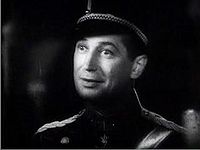
Franz Lehár
Franz Lehár was an Austrian-Hungarian composer. He is mainly known for his operettas of which the most successful and best known is The Merry Widow .-Biography:...
operetta The Merry Widow
The Merry Widow (1934 film)
The Merry Widow is a 1934 film adaptation of the operetta of the same name by Franz Lehár. It was directed by Ernst Lubitsch and starred Maurice Chevalier and Jeanette MacDonald...
, one of his best-known films. In 1935, he signed with MGM and returned to France later that year.
During his years in Hollywood, Chevalier had a reputation as a penny-pincher. When filming at Paramount, he balked at parking his car in the Paramount lot at ten cents a day. After bargaining, he managed to get five cents per day. Another story is told of Chevalier (a smoker) having a conversation with someone who offered him a cigarette. He took it, said "Thank you", put it in his pocket, and continued with the conversation. But in Hollywood he seemed to be a divided character. When not playing around with young chorus-girls, he actually felt quite lonely, and sought the company of Adolphe Menjou
Adolphe Menjou
Adolphe Jean Menjou was an American actor. His career spanned both silent films and talkies, appearing in such films as The Sheik, A Woman of Paris, Morocco, and A Star is Born...
and Charles Boyer
Charles Boyer
Charles Boyer was a French actor who appeared in more than 80 films between 1920 and 1976. After receiving an education in drama, Boyer started on the stage, but he found success in movies during the 1930s. His memorable performances were among the era's most highly praised romantic dramas,...
, also French, but both much better educated than Chevalier. Boyer in particular introduced him to art galleries and good literature, and Chevalier would try to copy him as the man of taste. But at other times, he would 'revert to type' as the bitter and impoverished street-kid he basically was. When performing in English, he always put on a heavy French accent, although his normal spoken English was quite fluent and sounded more American.
In 1937, he married the dancer Nita Ray. He had several successes, such as his revue Paris en Joie in the Casino de Paris. A year later, he performed in Amours de Paris. His songs remained big hits, such as Prosper (1935), Ma Pomme (1936) and Ça fait d'excellents français (1939).
World War II
During World War IIWorld War II
World War II, or the Second World War , was a global conflict lasting from 1939 to 1945, involving most of the world's nations—including all of the great powers—eventually forming two opposing military alliances: the Allies and the Axis...
, Chevalier kept performing for audiences. In 1941, he performed a new revue in the Casino de Paris: Bonjour Paris, which was another success. Songs like "Ça sent si bon la France" and "La Chanson du maçon" became hits. The Nazis asked Chevalier to perform in Berlin
Berlin
Berlin is the capital city of Germany and is one of the 16 states of Germany. With a population of 3.45 million people, Berlin is Germany's largest city. It is the second most populous city proper and the seventh most populous urban area in the European Union...
and sing for the collaborating
Collaborationism
Collaborationism is cooperation with enemy forces against one's country. Legally, it may be considered as a form of treason. Collaborationism may be associated with criminal deeds in the service of the occupying power, which may include complicity with the occupying power in murder, persecutions,...
radio station Radio Paris. He refused but did perform for prisoners of war in Germany at the camp where he was interned in World War I, and succeeded in liberating ten people in exchange.
In 1942 he returned to Bocca, near Cannes
Cannes
Cannes is one of the best-known cities of the French Riviera, a busy tourist destination and host of the annual Cannes Film Festival. It is a Commune of France in the Alpes-Maritimes department....
, but returned to the capital city in September. In 1944 when Allied forces freed France, Chevalier was accused of collaborationism. Even though he was acquitted
Acquittal
In the common law tradition, an acquittal formally certifies the accused is free from the charge of an offense, as far as the criminal law is concerned. This is so even where the prosecution is abandoned nolle prosequi...
by a French convened court, the English-speaking press remained hostile and he was refused a visa
Visa (document)
A visa is a document showing that a person is authorized to enter the territory for which it was issued, subject to permission of an immigration official at the time of actual entry. The authorization may be a document, but more commonly it is a stamp endorsed in the applicant's passport...
for several years.
After World War II
In his own country, however, he was still popular. In 1946, he split from Nita Ray and started writing his memoirs, which took many years to complete.He started to paint and collect and acted in Le silence est d'or (1946) by René Clair
René Clair
René Clair born René-Lucien Chomette, was a French filmmaker.-Biography:He was born in Paris and grew up in the Les Halles quarter. He attended the Lycée Montaigne and the Lycée Louis-le-Grand. During World War I, he served as an ambulance driver. After the war, he started a career as a journalist...
. He still toured throughout the United States and other parts of the world and returned to France in 1948.
In 1944, he had already participated in a Communist demonstration in Paris. He was therefore even less popular in the U.S. during the McCarthyism
McCarthyism
McCarthyism is the practice of making accusations of disloyalty, subversion, or treason without proper regard for evidence. The term has its origins in the period in the United States known as the Second Red Scare, lasting roughly from the late 1940s to the late 1950s and characterized by...
period; in 1951, he was refused re-entry into the U.S. because he had signed the Stockholm Appeal
Stockholm Appeal
March 1950: The World Peace Council releases the Stockholm Appeal calling for an absolute ban on nuclear weapons. The appeal was initiated by the French Communist physicist Frédéric Joliot-Curie, gathered petitions allegedly signed by 273,470,566 persons The text of the Appeal read:“We demand the...
.
In 1949, he performed in Stockholm
Stockholm
Stockholm is the capital and the largest city of Sweden and constitutes the most populated urban area in Scandinavia. Stockholm is the most populous city in Sweden, with a population of 851,155 in the municipality , 1.37 million in the urban area , and around 2.1 million in the metropolitan area...
in a Communist benefit against nuclear arms. Also in 1949, Chevalier was the subject of the first official roast
Roast (comedy)
A roast is an event in which an individual is subjected to a public presentation of comedic insults, praise, outlandish true and untrue stories, and heartwarming tributes, the implication being that the roastee is able to take the jokes in good humor and not as serious criticism or insult, and...
at The Friar's Club, although celebrities had been informally "roasted" at banquets since 1910.
In 1952, he bought a large property in Marnes-la-Coquette
Marnes-la-Coquette
Marnes-la-Coquette is a commune in the western suburbs of Paris, France. Located from the center of Paris, the town is situated between the Parc de Saint-Cloud and the Forest of Fausses-Reposes...
, near Paris, and named it "La Louque", as a homage to his mother's nickname. He started a relationship in 1952 with Janie Michels, a young divorcee with three children. In 1954, after the McCarthy era abated Chevalier was welcomed back in the United States. His first full American tour was in 1955, with Vic Schoen
Vic Schoen
Victor "Vic" Schoen was an American bandleader, arranger, and composer whose career spanned from the 1930s until his death in 2000...
as arranger and musical director. The Billy Wilder
Billy Wilder
Billy Wilder was an Austro-Hungarian born American filmmaker, screenwriter, producer, artist, and journalist, whose career spanned more than 50 years and 60 films. He is regarded as one of the most brilliant and versatile filmmakers of Hollywood's golden age...
film Love in the Afternoon
Love in the Afternoon (1957 film)
Love in the Afternoon is a 1957 American romantic comedy film produced and directed by Billy Wilder. The screenplay by Wilder and I.A.L. Diamond is based on the Claude Anet novel Ariane, jeune fille russe , which previously was filmed as Scampolo in 1928 and Scampolo, ein Kind der Strasse in...
(1957) with Audrey Hepburn
Audrey Hepburn
Audrey Hepburn was a British actress and humanitarian. Although modest about her acting ability, Hepburn remains one of the world's most famous actresses of all time, remembered as a film and fashion icon of the twentieth century...
and Gary Cooper
Gary Cooper
Frank James Cooper, known professionally as Gary Cooper, was an American film actor. He was renowned for his quiet, understated acting style and his stoic, but at times intense screen persona, which was particularly well suited to the many Westerns he made...
was his first Hollywood film in more than 20 years.
Chevalier appeared in the movie musical Gigi
Gigi (1958 film)
Gigi is a 1958 musical film directed by Vincente Minnelli. The screenplay by Alan Jay Lerner is based on the 1944 novella of the same name by Colette...
(1958) with Leslie Caron
Leslie Caron
Leslie Claire Margaret Caron is a French film actress and dancer, who appeared in 45 films between 1951 and 2003. In 2006, her performance in Law and Order: Special Victims Unit won her an Emmy for guest actress in a drama series...
and Hermione Gingold
Hermione Gingold
Hermione Gingold was an English actress known for her sharp-tongued, eccentric persona, an image enhanced by her sharp nose and chin, as well as her deepening voice, a result of vocal nodes which her mother reportedly encouraged her not to remove. She starred on stage, on radio, in films, on...
, with whom he shared the song "I Remember It Well", and several Walt Disney
Walt Disney
Walter Elias "Walt" Disney was an American film producer, director, screenwriter, voice actor, animator, entrepreneur, entertainer, international icon, and philanthropist, well-known for his influence in the field of entertainment during the 20th century. Along with his brother Roy O...
films. The success of Gigi prompted Hollywood to give him an Honorary Academy Award that year for achievements in entertainment. He also made a television appearance on an episode of The Lucy-Desi Comedy Hour
The Lucy-Desi Comedy Hour
The Lucy–Desi Comedy Hour is a CBS television situation comedy. The show is a collection of occasional specials rather than a regular series and originally served as part of Westinghouse Desilu Playhouse...
in 1958.
Final years
In the early 1960s, he toured the United States and between 1960 and 1963 made eight films, including Can-CanCan-Can (film)
Can-Can is a 1960 musical film made by Suffolk-Cummings productions and distributed by 20th Century Fox. It was directed by Walter Lang, produced by Jack Cummings and Saul Chaplin, from a screenplay by Dorothy Kingsley and Charles Lederer, loosely based on the musical play by Abe Burrows with music...
(1960) with Frank Sinatra
Frank Sinatra
Francis Albert "Frank" Sinatra was an American singer and actor.Beginning his musical career in the swing era with Harry James and Tommy Dorsey, Sinatra became an unprecedentedly successful solo artist in the early to mid-1940s, after being signed to Columbia Records in 1943. Being the idol of the...
. In 1961, he starred in the drama Fanny with Leslie Caron
Leslie Caron
Leslie Claire Margaret Caron is a French film actress and dancer, who appeared in 45 films between 1951 and 2003. In 2006, her performance in Law and Order: Special Victims Unit won her an Emmy for guest actress in a drama series...
and Charles Boyer
Charles Boyer
Charles Boyer was a French actor who appeared in more than 80 films between 1920 and 1976. After receiving an education in drama, Boyer started on the stage, but he found success in movies during the 1930s. His memorable performances were among the era's most highly praised romantic dramas,...
, an updated version of Marcel Pagnol
Marcel Pagnol
Marcel Pagnol was a French novelist, playwright, and filmmaker. In 1946, he became the first filmmaker elected to the Académie Française.-Biography:...
's "Marseilles Trilogy." In 1962, he filmed Panic Button; (not released until 1964); playing opposite blonde bombshell/sex symbol, Jayne Mansfield
Jayne Mansfield
Jayne Mansfield was an American actress working both in Hollywood and on the Broadway theatre...
. In 1965, at 77, he made another world tour. In 1967 he toured in Latin America
Latin America
Latin America is a region of the Americas where Romance languages – particularly Spanish and Portuguese, and variably French – are primarily spoken. Latin America has an area of approximately 21,069,500 km² , almost 3.9% of the Earth's surface or 14.1% of its land surface area...
, again the US, Europe and Canada. The following year, on October 1, 1968, he announced his farewell tour.
Historical newsreel footage of Chevalier appeared in the 1969 Marcel Ophuls
Marcel Ophuls
Marcel Ophüls is a documentary film maker and former actor.He was born in Frankfurt, Germany, the son of the director Max Ophüls...
documentary The Sorrow and the Pity
The Sorrow and the Pity
The Sorrow and the Pity is a two-part 1969 documentary film by Marcel Ophüls about the French Resistance and collaboration between the Vichy government and Nazi Germany during World War II. The film uses interviews with a German officer, collaborators, and resistance fighters from...
. In a wartime short film near the end of the film's second part, he explained his disappearance during World War II (see the "World War II" section in this entry) as rumors of his death lingered at that time, and emphatically denies any collaboration with the Nazis. His song, "Sweepin' the Clouds Away" (from his film Paramount on Parade) was one of its theme songs and was played in the end credits of the film's second part.
In 1970, several years after his retirement, songwriters Richard M. and Robert B. Sherman
Sherman Brothers
The Sherman Brothers are an American songwriting duo that specialize in musical films, made up of Robert B. Sherman and Richard M. Sherman ....
got him to sing the title song of the Disney film The Aristocats
The Aristocats
The Aristocats is a 1970 American animated feature produced and released by Walt Disney Productions in 1970 and stars Eva Gabor and Phil Harris, with Roddy Maude-Roxby as Edgar the butler, the villain of the story...
, which ended up being his final contribution to the film industry.
He died in Paris, on January 1, 1972, aged 83, and was interred in the cemetery of Marnes-la-Coquette in Hauts-de-Seine
Hauts-de-Seine
Hauts-de-Seine is designated number 92 of the 101 départements in France. It is part of the Île-de-France region, and covers the western inner suburbs of Paris...
, outside Paris, France.
Chevalier has a star on the Hollywood Walk of Fame
Hollywood Walk of Fame
The Hollywood Walk of Fame consists of more than 2,400 five-pointed terrazzo and brass stars embedded in the sidewalks along fifteen blocks of Hollywood Boulevard and three blocks of Vine Street in Hollywood, California...
at 1651 Vine Street.
Famous songs
- "Madelon de la Victoire" (1918)
- "Dans la vie faut pas s'en faire" (1921)
- "Valentine" (1924)
- "Louise" (1929)
- "(Up On Top Of A Rainbow) Sweepin' The Clouds Away" (1930)
- "You Brought a New Kind of Love to Me" (1930)
- "Living In the Sunlight, Loving In the Moonlight" (1930)
- "Mimi" (1932)
- "Prosper (Yop La Boum)" (1935)
- "Quand un Vicomte" (1935)
- "Ma Pomme" (1936)
- "Le Chapeau de Zozo" (1936)
- "Mimile (un gars du Ménilmontant)" (1936)
- "Ça Fait d' Excellents Français" (1939)
- "Paris sera toujours Paris" (1939)
- "Ça sent si bon la France" (1941)
- "La Chanson du Maçon" (1941)
- "Notre Espoir" (1941)
- "Thank Heaven For Little Girls" (1957)
- "I Remember It Well" (1957)
- "Enjoy It!" (1967)
- "The AristocatsThe AristocatsThe Aristocats is a 1970 American animated feature produced and released by Walt Disney Productions in 1970 and stars Eva Gabor and Phil Harris, with Roddy Maude-Roxby as Edgar the butler, the villain of the story...
" (1970)