
| |
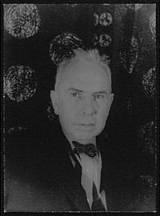
Theodore Herman Albert Dreiser (August 27 1871 – December 28 1945) was an American novelist and journalist. He pioneered the naturalist school and is known for portraying characters whose value lies not in their moral code, but in their persistence against all obstacles, and literary situations that more closely resemble studies of nature than tales of choice and agency.
ser was born in Terre Haute, Indiana, to Sarah and John Paul Dreiser, a strict Baptist.

Discussion
Ask a question about 'Theodore Dreiser'
Start a new discussion about 'Theodore Dreiser'
Answer questions from other users
|
Quotations
I acknowledge the Furies, I believe in them, I have heard the disastrous beating of their wings.
To Grant Richards (1911)
Our civilization is still in a middle stage, scarcely beast in that it is no longer wholly guided by instinct; scarcely human, in that it is not yet wholly guided by reason.
Sister Carrie, Ch. 8 (1900)
Oh, the moon is fair tonight along the Wabash,From the fields there comes the breath of new-mown hay;Through the sycamores the candle lights are gleamingOn the banks of the Wabash, far away.
On the Banks of the Wabash, chorus
The most futile thing in this world is any attempt, perhaps, at exact definition of character. All individuals are a bundle of contradictions—none more so than the most capable.
The Financier (1912)

Encyclopedia
Theodore Herman Albert Dreiser (August 27 1871 – December 28 1945) was an American novelist and journalist. He pioneered the naturalist school and is known for portraying characters whose value lies not in their moral code, but in their persistence against all obstacles, and literary situations that more closely resemble studies of nature than tales of choice and agency.
Early life
Dreiser was born in Terre Haute, Indiana, to Sarah and John Paul Dreiser, a strict Baptist. John Paul Dreiser was a German immigrant and Sarah was from the Mennonite farming community near Dayton, Ohio; she was disowned for marrying John and converting to Roman Catholicism. Theodore was the twelfth of thirteen children (the ninth of the ten surviving). The popular songwriter Paul Dresser (1859–1906) was his older brother.
From 1889 – 1890, Theodore attended Indiana University before flunking out. Within several years, he was writing for the Chicago Globe newspaper and then the St. Louis Globe-Democrat. He wrote several articles on writers like Nathaniel Hawthorne, William Dean Howells, Israel Zangwill and John Burroughs, and interviewed public figures like Andrew Carnegie, Marshall Field, Thomas Edison and Theodore Thomas. Other interviewees included Lillian Nordica, Emilia E. Barr, Philip Armour and Alfred Stieglitz. After proposing in 1893, he married Sara White on December 28 1898. They ultimately separated in 1909, but were never formally divorced.
Literary career
His first novel, Sister Carrie (1900), tells the story of a woman who flees her country life for the city (Chicago) and falls into a wayward life. The publisher did little to promote the book, and it sold poorly, however it was made into a 1952 film by William Wyler and starred Laurence Olivier and Jennifer Jones.
His second novel, Jennie Gerhardt, was published in 1911. Many of Dreiser's subsequent novels dealt with social inequality. His first commercial success was An American Tragedy (1925), which was made into a film in 1931 and again in 1951. In 1892, when Dreiser began work as a newspaperman he "began to observe a certain type of crime in the United States that proved very common. It seemed to spring from the fact that almost every young person was possessed of an ingrown ambition to be somebody financially and socially." "Fortune hunting became a disease" with the frequent result of a peculiarly American kind of crime "many forms of murder for money...the young ambitious lover of some poorer girl...(for) a more attractive girl with money or position...it was not always possible to drop the first girl. What usually stood in the way was pregnancy." Dreiser claimed to have collected such stories every year between 1895 and 1935. The murder in 1911 of Avis Linnell by Clarence Richeson particularly caught his attention. By 1919 this murder was the basis of one of two separate novels begun by Dreiser. The 1906 murder of Grace Brown by Chester Gillette eventually became the basis for An American Tragedy.
Though primarily known as a novelist, Dreiser published his first collection of short stories, Free and Other Stories in 1918. The collection contained 9 stories.
Other works include The "Genius" and Trilogy of Desire (a three-parter based on the remarkable life of the Chicago streetcar tycoon Charles Tyson Yerkes and composed of The Financier (1912), The Titan (1914), and The Stoic). The latter was published posthumously in 1947.
Political commitment
Politically, Dreiser was involved in several campaigns against social injustice. This included the lynching of Frank Little, one of the leaders of the Industrial Workers of the World, the Sacco and Vanzetti case, the deportation of Emma Goldman, and the conviction of the trade union leader Tom Mooney. In November 1931 Dreiser led the National Committee for the Defense of Political Prisoners to the coalfields of southeastern Kentucky, where they took testimony from coal miners in Pineville and Harlan on the violence against the miners and their unions by the coal operators.
Dreiser, a committed socialist, wrote several non-fiction books on political issues. These included Dreiser Looks at Russia (1928), the result of his 1927 trip to the Soviet Union, Tragic America (1931) and America Is Worth Saving (1941). His vision of capitalism and a future world order with a strong American military dictate combined with the harsh criticism of the latter made him unpopular within the official circles. For many years he supported American communists and at the evening of his life he joined Communist Party USA (1945).
He died December 28, 1945 in Hollywood, aged 74.
Heritage
Dreiser had an enormous influence on the generation that followed his. In his tribute "Dreiser" from Horses and Men (1923), Sherwood Anderson writes:
- Heavy, heavy, the feet of Theodore. How easy to pick some of his books to pieces, to laugh at him for so much of his heavy prose ... [T]he fellows of the ink-pots, the prose writers in America who follow Dreiser, will have much to do that he has never done. Their road is long but, because of him, those who follow will never have to face the road through the wilderness of Puritan denial, the road that Dreiser faced alone.
F. R. Leavis remarked that Dreiser wrote as if he did not have a native language.
Renowned mid-century literary critic Irving Howe spoke of Dreiser as "among the American giants, one of the very few American giants we have had."
Selected bibliography
Fiction
Nonfiction
- A Traveler at Forty (1913)
- A Hoosier Holiday (1916)
- Hey Rub-a-Dub-Dub (1920)
- A Book About Myself (1922); republished (unexpurgated) as Newspaper Days (1931)
- The Color of a Great City (1923)
- Dreiser Looks at Russia (1928)
- My City (1929)
- Tragic America (1931)
- Dawn (1931)
- America Is Worth Saving (1941)
Published as
- Sister Carrie, Jennie Gerhardt, Twelve Men (Richard Lehan, ed.) (Library of America, 1987) ISBN 978-0-94045041-7.
- An American Tragedy (Thomas P. Riggio, ed.) (Library of America, 2003) ISBN 978-1-93108231-0.
External links
|