

City College of New York

Encyclopedia
The City College of the City University of New York (known more commonly as the City College of New York or simply City College, CCNY, or colloquially as City) is a senior college of the City University of New York
(CUNY), in New York City
. It is also the oldest of the City University's twenty-three institutions of higher learning. City College's thirty-five acre Manhattan
campus along Convent Avenue from 130th Street to 141st Street is on a hill overlooking Harlem; its neo-Gothic campus was mostly designed by George Browne Post, and many of its buildings are landmarks.
CCNY was the first free public institution of higher education in the United States and also for many years has been considered the flagship campus of the CUNY public university system.
. A combination prep school and college, it would provide children of immigrants and the poor access to free higher education based on academic merit alone.
The Free Academy was the first of what would become a system of municipally-supported colleges. Hunter College
, the second, was founded as a women's institution in 1870. Brooklyn College
, the third, was established as a coeducational institution in 1930.
In 1847, New York State Governor John Young
had given permission to the Board of Education to found the Free Academy, which was ratified in a statewide referendum. Founder Townsend Harris proclaimed, "Open the doors to all… Let the children of the rich and the poor take their seats together and know of no distinction save that of industry, good conduct and intellect."
Dr. Horace Webster
, a West Point graduate, was the first president of the Free Academy. On the occasion of The Free Academy's formal opening, January 21, 1849, Webster said:
 In 1847, a curriculum was adopted which had nine main fields: mathematics, history, language, literature, drawing, natural philosophy, experimental philosophy, law, and political economy. The Academy's first graduation took place in 1853 in Niblo's Garden Theatre, a large theater and opera house on Broadway, near Houston Street at the corner of Broadway and Prince Street.
Even in its early years, the Free Academy showed tolerance for diversity, especially in comparison to its urban neighbor, Columbia College, which then wasn't much more than a finishing school for wealthy young gentlemen. The Free Academy had a framework of tolerance that extended beyond the admission of students from every social stratum. In 1854, Columbia's trustees denied Oliver Wolcott Gibbs
, a distinguished chemist and scientist, a faculty position because of Gibbs's religious beliefs. He was a Unitarian. Gibbs was a professor and held an appointment at the Free Academy since 1848. (In 1863, Gibbs went on to an appointment at Harvard University, the Rumsford Professorship in Chemistry, where he had a distinguished career. In 1873, he was awarded an honorary degree from Columbia with a unanimous vote by its Trustees with the strong urging of President Barnard.) Later in the history of CCNY, in the early 1900s, President John H. Finley gave the College a more secular orientation by abolishing mandatory chapel attendance. This change occurred at a time when more Jewish students were enrolling in the College.
In 1866, the Free Academy, a men's institution, was renamed the College of the City of New York. In 1929, the College of the City of New York became the City College of New York. Finally, the institution became known as the City College of the City University of New York
when CUNY was formally established as the umbrella institution for New York City's municipal-college system in 1961. The names City College of New York and City College, however, remain in general use.
With the name change in 1866, lavender was chosen as the College's color. In 1867, the academic senate, the first student government in the nation, was formed. Having struggled over the issue for ten years, in 1895 the New York State legislature voted to let the College build a new campus. A four-square block site was chosen, located in Manhattanville, within the area which was enclosed by the North Campus Arches; the College, however, quickly expanded north of the Arches (see below).
Like President Webster, the second president of City College was a West Point graduate. The second president, General Alexander S. Webb
, assumed office in 1869. One of the Union's heroes at Gettysburg, General Webb was the commander of the Philadelphia Brigade. When the Union Army repulsed the Confederates at Cemetery Hill, General Webb played a central role in the battle. Coddington wrote about Webb's conduct during Pickett's Charge: "Refusing to give up, [Webb] set an example of bravery and undaunted leadership for his men to follow...." In 1891, while still president of City College, he was awarded the Congressional Medal of Honor for heroism at Gettysburg. A full-length statue of Webb, in full military uniform, stands in his honor at the heart of the campus.
The College's curriculum under Webster and Webb combined classical training in Latin and Greek with more practical subjects like chemistry, physics, and engineering. One of the outstanding Nineteenth Century graduates of City College was the Brooklyn-born George Washington Goethals
, who put himself through the College in three years before going on to West Point. He later became the chief engineer on the Panama Canal. General Webb was succeeded by John Huston Finley
in 1903. Finley relaxed some of the West Point-like discipline that characterized the College, including compulsory chapel attendance. Delta Sigma Phi http://www.deltasig.org was founded at CCNY in 1899 as a Jewish and Christian Fraternity, however the chapter did not last long due to Delta Sigma Phi becoming only Christian in 1914.
(class of 1889) and Robert F. Wagner
(class of 1898). A 100 year time capsule was buried in North Campus.
Until 1929, City College had been an all-male institution. During that time, specifically in 1909, the first chapter of Sigma Alpha Mu
fraternity was founded. In 1930, CCNY admitted women for the first time, but only to graduate programs. In 1951, the entire institution became coeducational.
In the years when top-flight private schools were restricted to the children of the Protestant Establishment
, thousands of brilliant individuals (including Jewish students) attended City College because they had no other option. CCNY's academic excellence and status as a working-class school earned it the titles "Harvard
of the Proletariat
", the "poor man's Harvard", and "Harvard-on-the-Hudson".
Even today, after three decades of controversy over its academic standards, no other public college has produced as many Nobel
laureates who have studied and graduated with a degree from a particular public college. CCNY's official quote on this is "Nine Nobel laureates claim CCNY as their Alma Mater, the most from any public college in the United States." This should not be confused with Nobel laureates who teach at a public university; UC Berkeley
boasts 19.
In its heyday of the 1930s through the 1950s, CCNY became known for its political radicalism
. It was said that the old CCNY cafeteria in the basement of Shepard Hall, particularly in alcove 1, was the only place in the world where a fair debate between Trotskyists
and Stalinists
could take place. Being part of a political debate that began in the morning in alcove 1, Irving Howe
reported that after some time had passed he would leave his place among the arguing students in order to attend class. When he returned to the cafeteria late in the day, he would find that the same debate had continued but with an entirely different cast of students. Alumni
who were at City College in the mid-20th century said that City College in those days made UC Berkeley in the 1960s look like a school of conformity.
The municipality of New York was considerably more conformist than CCNY students and faculty. The Philosophy Department, at the end of the 1939-1940 academic year, invited the British mathematician and philosopher Bertrand Russell
to become a professor at CCNY. Members of the Catholic Church protested Russell’s appointment. A woman named Jean Kay filed suit against the Board of Higher Education to block Russell’s appointment on the grounds that his views on marriage and sex would adversely affect her daughter’s virtue, although her daughter was not a CCNY student. Russell wrote “a typical American witch-hunt was instituted against me.” Kay won the suit, but the Board declined to appeal after considering the political pressure exerted. Also see the Bertrand Russell Case
.
Russell took revenge in the preface of the first edition of his book An Inquiry into Meaning and Truth, which was published by the Unwin Brothers in the UK (the preface was not included in the U.S. editions). In a long précis that detailed Russell’s accomplishments including medals awarded by Columbia University and the Royal Society and faculty appointments at Oxford, Cambridge, UCLA, Harvard, the Sorbonne, Peking (the name used in that era), the LSE, Chicago, and so forth, Russell added, “Judicially pronounced unworthy to be Professor of Philosophy at the College of the City of New York.”
Many City College alumni served in the U.S. Armed Forces during the Second World War. A total of 310 CCNY alumni were killed in the War. Prior to World War II, a large number of City College alumni—relative to alumni of other U.S. colleges—volunteered to serve on the Republican side in the Spanish Civil War. Thirteen CCNY alumni were killed in Spain.
In 1945, Professor William E. Knickerbocker, Chairman of the Romance Languages Department, was accused of anti-semitism by four faculty members. They claimed that “for at least seven years they have been subjected to continual harassment and what looks very much like discrimination ....” by Knickerbocker. Four years later Knickerbocker was again accused of anti-semitism, this time for denying honors to high-achieving Jewish students. About the same time, Professor William C. Davis of the Economics Department was accused by students of maintaining a racially segregated dormitory at Army Hall. Professor Davis was the dormitory’s administrator. CCNY students, many of whom were World War II veterans, launched a massive strike in protest against Knickerbocker and Davis. The New York Times called the event "the first general strike at a municipal institution of higher learning." Also see the Knickerbocker Case
.
CCNY is the only team in men's college basketball
history to win both the National Invitation Tournament
and the NCAA Tournament
in the same year, 1950. However, this accomplishment was overshadowed by a point shaving
scandal in which seven CCNY basketball players were arrested, in 1951, for taking money from gamblers to affect the outcome of games. The scandal led to the decline of CCNY from a national powerhouse in Division I basketball to a member of Division III and damaged the national profile of college basketball in general. The College currently fields nine men's and seven women's varsity athletic teams.
In 1955, a City College student named Alan A. Brown founded the economics honor society, Omicron Chi Epsilon. The purpose of the society was to confer honors on outstanding economics students, organize academic meetings, and publish a journal. In 1963, Omicron Chi Epsilon merged with Omicron Delta Gamma, the other economics honor society, to form Omicron Delta Epsilon
, the current academic honor society in economics.
During a 1969 takeover of South campus, under threat of a riot, African American
and Puerto Rican activists and their white allies demanded, among other policy changes, that City College implement an aggressive affirmative action
program. At some point, campus protesters began referring to CCNY as "Harlem University." The administration of the City University at first balked at the demands, but instead, came up with an open admissions
or open-access program under which any graduate of a New York City high school would be able to matriculate either at City College or another college in the CUNY system. Beginning in 1970, the program opened doors to college to many who would not otherwise have been able to attend college. The program, however, came at the cost of City College's and the University's academic standing as well as New York City's fiscal health.
City College began charging tuition in 1976. By the 1990s, CCNY stopped admitting and offering remedial classes to students who did not meet its academic entrance requirements. CUNY then enrolled less well prepared students in its community colleges.
As a result of the 1989 student protests and building takeovers concerning tuition increases, a community action center was opened on the campus called The Guillermo Morales/Assata Shakur Community and Student Center located in the NAC building. The center was named after 1960s CCNY student activists Assata Shakur
and Guillermo Morales.
CCNY's new Frederick Douglass Debate Society defeated Harvard and Yale at the "Super Bowl" of the American Parliamentary Debate Association in 1996. In 2003, the College's Model UN Team was awarded as an Outstanding Delegation at the National Model United Nations (NMUN) Conference, an honor that it would repeat for four years in a row.
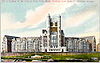
The U.S. Postal Service issued a postcard commemorating CCNY's 150th Anniversary, featuring Shepard Hall, on Charter Day, May 7, 1997.
began recruiting students for the University Scholars program in the fall 2000, and admitted the first cohort of undergraduate scholars in the fall 2001. CCNY was one of five CUNY campuses, on which the program was initiated. The newly admitted scholars became undergraduates in the college's newly formed Honors Program. Students attending the CCNY Honors College are awarded free tuition, a cultural passport that admits them to New York City cultural institutions for free or at sharply reduced prices, a notebook computer, and an academic expense account that they can apply to such academic-related activities as study abroad. These undergraduates are also required to attend a number of specially developed honors courses. In 2001 CUNY initiated the CUNY Honors College, renamed Macaulay Honors College in 2007. Both the CCNY Honors Program and the CCNY chapter of the Macaulay Honors College are run out of the CCNY Honors Center.
In October 2005, Dr. Andrew Grove
, a 1960 graduate of the Engineering School in Chemical Engineering
, and co-founder of Intel Corporation, donated $26 million to the Engineering School, which has since been renamed the Grove School of Engineering. It is the largest donation ever given to the City College of New York.
In 2009, the School of Architecture moved into the former 'Y' Building. The 'Y' building had been gutted and completely remodeled under the design direction of architect Rafael Viñoly
. Also in 2009, school was renamed the Bernard and Anne Spitzer School of Architecture in honor of the $25 million gift the Spitzers gave to the school.
, in the Free Academy Building, which was CCNY's home from 1849 to 1907. The building was designed by James Renwick, Jr.
and was located at Lexington Avenue and 23rd Street. According to some sources, it was the first Gothic Revival college building on the East Coast. Renwick's building was demolished in 1928, and replaced in 1930 with a 16-story structure that is part of the present-day Baruch College
campus.
campus was erected.
This new campus was designed by George Browne Post.
According to CCNY's published history, "The Landmark neo-Gothic buildings of the North Campus Quadrangle were designed by the noted architect George Browne Post. They are superb examples of English Perpendicular Gothic style and are among the first buildings, as an entire campus, to be built in the U.S. in this style. Groundbreaking for the Gothic Quadrangle buildings took place in 1903".
The original neo-Gothic buildings on the new upper Manhattan campus were:
Shepard Hall, the largest building and the centerpiece of the campus, was modeled after a Gothic cathedral plan with its main entrance on St. Nicholas Terrace. It has a large chapel assembly hall called "The Great Hall" which has a mural painted by Edwin Blashfield
called "The Graduate".
Harris Hall, named in the original architectural plans as "the Sub-Freshman Building", housed City College's preparatory high school, Townsend Harris High School
, from 1906 until it moved in 1930 downtown to the School of Business.
Wingate Hall was named for George Wood Wingate (Class of 1858), an attorney and promoter of physical fitness. It served as the College's main gymnasium between 1907 and 1972.
Baskerville Hall for many years housed the Chemistry Department, was also known as the Chemical Building, and had one of the largest original lecture halls on the campus, Doremus lecture hall. It currently houses HSMSE, The High School for Mathematics, Science, and Engineering.
Compton Hall was originally designed as the Mechanical Arts Building.
Five of these new Gothic campus buildings opened in 1906. The sixth, Goethals Hall, was completed in 1930. The new building was named for George Washington Goethals
, the CCNY civil engineering alumnus who, as mentioned above in the section on the history of the College, went on to become the chief engineer of the Panama Canal
. Goethals Hall housed the School of Technology (engineering) and adjoins the Mechanical Arts Building, Compton Hall.
The six Gothic buildings are connected by a tunnel, which closed to public use in 1969.
Six hundred grotesque
s on the original Gothic buildings represent the practical and the fine arts.
The North Campus Quadrangle contains four great arches on the main avenues entering and exiting the campus:
expressed interest in financing construction of the stadium. Lewisohn donated $75,000 for the stadium’s construction and Finley commissioned architect Arnold W. Brunner to design Lewisohn Stadium
, which was influenced by Finley's memories of a small rock-hewn theatre in the Trastevere section of Rome.
Lewisohn Stadium was built as a 6,000-seat stadium, with thousands more seats available on the infield during concerts, and was dedicated on May 29, 1915, two years after Dr. Finley had left his post at the College and Dr. Sidney Edward Mezes
had become CCNY's fourth president. The stadium's dedication was enhanced by a performance of "The Trojan Women
", produced by Granville Barker and Lillian McCarthy. College graduation services were held in Lewisohn for many years.
The Hebrew Orphan Asylum
was erected in 1884 on Amsterdam Avenue between 136th and 138th Street, and was designed by William H. Hume. It was already there when City College moved to upper Manhattan. When it closed in the 1940s, the building was used by City College to house members of the U.S. Armed Forces assigned to the Army Specialized Training Program
(ASTP). From 1946 to 1955, it was used as a dormitory, library, and classroom space for the College. It was called "Army Hall" until it was demolished in 1955 and 1956.
In 1946, CCNY purchased a former Episcopal orphanage on 135th Street and Convent Avenue (North campus), and renamed it Klapper Hall, after Paul Klapper (Class of 1904) Professor and the Dean of School of Education and who was later the first president of Queens College/CUNY (1937–1952). Klapper Hall was red brick in Georgian style and it served until 1983 as home of the School of Education.
(CCNY Class of 1906), a well known civil engineer and bridge designer.
In 1963, the Administration Building was erected on the North Campus across from Wingate Hall. It houses the College's administration offices, including the President's, Provost's and the Registrar's offices. It was originally intended as a warehouse to store the huge number of records and transcripts of students since 1847. In early 2007, the Administration Building was formally named The Howard E. Wille Administration Building, in honor of Howard E. Wille, class of 1955, a distinguished alumnus and philanthropist.
In 1971, the Marshak Science Building was completed on the site of the former Jasper Oval, an open space previously used as a football field. The building was named after Robert Marshak
, renowned physicist and president of CCNY (1970–1979). The Marshak building houses all science labs and adjoins the Mahoney Gymnasium and its athletic facilities including a swimming pool and tennis courts.
In the 1970s, construction of the massive North Academic Center (NAC) was initiated. It was completed in 1984, and replaced Lewisohn Stadium and Klapper Hall. The NAC building houses hundreds of classrooms, two cafeterias, the Cohen Library, student lounges and centers, administrative offices, and a number of computer installations. Designed by architect John Carl Warnecke
, the building has received criticism for its lack of design and outsize scale in comparison to the surrounding neighborhood.
Within the NAC, a student lounge space was created outside the campus bookstore, and murals celebrating the history of the campus were painted on the doors of the undergraduate Student Government. Founded in 1869, it claims to be the oldest continuously operating student government organization in the country.
The first floor of the Administration Building was given a postmodern renovation in 2004. The first floor houses the admissions office and the registrar's office. The upper floors house the offices of the president and provost.
The New York Landmarks Preservation Commission made the North Campus Quadrangle buildings and the College Gates official landmarks in 1981. The buildings in the Quadrangle were put on the State and National Register of Historic Places
in 1984. In the summer of 2006, the historic gates on Convent Avenue were restored.
(which, on a 1913 map, was shown as The Convent of the Sacred Heart), which added a south section to the campus. This expanded the campus to include many of the buildings in the area between 140th Street to 130th Street, from St. Nicholas Terrace in the east to Amsterdam Avenue in the west.
Former buildings of the Manhattanville College campus to be used by CCNY were re-named for City College's purposes: Stieglitz Hall, Downer Hall, Wagner Hall, the prominent Finley Student Center which contained the very active Buttenweiser Lounge, Eisner Hall, Park Gym, Mott Hall, and others.
As a result of this expansion, the South Campus of CCNY primarily contained the liberal arts classes and departments of the College. The North Campus, also as a result of this expansion, mostly housed classes and departments for the sciences and engineering, as well as Klapper Hall (School of Education), and the Administration Building.
In 1957, a new library building was erected in the middle of the campus, near 135th Street on the South Campus, and named Cohen Library, after Morris Raphael Cohen
, an alumnus (Class of 1900) and celebrated professor of philosophy at the College from 1912 to 1938. When the Cohen Library moved to the North Academic Complex in the early 1980s, the structure was renamed the 'Y' building, and housed offices, supplies, the mail room, etc. The building was eventually gutted and renovated to become the home of the School of Architecture in 2009 (see below).
In the 1970s, many of the old buildings of the South Campus were demolished, some which had been used by the Academy of The Sacred Heart. The buildings remaining on the South Campus at this time were the Cohen Library (later moved into the North Academic Center), Park Gym (now the Structural Biology Research Center), Eisner Hall (built in 1941 by Manhattanville College of the Sacred Heart as a library, later remodeled and housed CCNY's Art Department and named for the Chairman of the Board of Higher Education in the 1930s), the Schiff House (former President's residence, now a child care center), and Mott Hall (formerly the English Department, now a New York City Department of Education primary school).
Some of the buildings which were demolished at that time were Finley Hall (housed The Finley Student Center, student activities center, originally built in 1888-1890 as Manhattanville Academy's main building, and purchased in 1953 by City College), Wagner Hall (housed various social science and liberal arts departments and classes, originally built as a dormitory for Manhattanville Academy, and was named in honor of Robert F. Wagner Sr., member of the Class of 1898, who represented New York State for 23 years in the United States Senate), Stieglitz Hall, and Downer Hall, amongst others.
New buildings were erected on the South Campus, including Aaron Davis Hall in 1981, and the Herman Goldman sports field in 1993. In August 2006, the College completed the construction of a 600-bed dormitory, called "The Towers" There are plans to rename The Towers after a distinguished alumnus or donor.
The building that formerly housed Cohen Library, i.e., the 'Y' Building mentioned above, became the new home for the School of Architecture, with the renovation headed by architect Rafael Viñoly
. Near the 133rd Street gate, a new science building is under construction in order to relieve pressure from Marshak Hall, which had a beam collapse in 2005. Part of this project is the elimination of the Herman Goldman sports field, a controversial move which will dramatically alter the South Campus.
In 2007, two new buildings had been proposed for the South Campus site by the Dormitory Authority of the State of New York
(DASNY). One was a four story City College of New York Science Building, to serve as an adjunct to the Marshak Science Building on the North Campus, and the other was a six story City University of New York Advanced Science Research Center (ASRC).
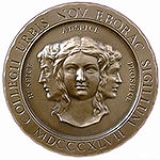
, the Roman god of beginnings, whose two faces connect the past and the future. He broadened this image of Janus in three faces to show the student, and consequently, knowledge, developing from childhood through youth into maturity.
It was redesigned again in 1947 by Professor Albert P. d'Andrea (CCNY class of 1918) for the college's Centennial Medal. Professor Albert P. d'Andrea came to the United States from Benevento
, Italy in 1901. He was a faculty member of the City College of New York from 1918 to 1948 and Professor of Art and Chairman of the Art Department from 1948 to 1968.
In 2003, the college decided to create a logo distinct from its seal, with the stylized text "the City College of New York."
(source: The Adolph Lewisohn Plaza of Honor website - archived copy)
City University of New York
The City University of New York is the public university system of New York City, with its administrative offices in Yorkville in Manhattan. It is the largest urban university in the United States, consisting of 23 institutions: 11 senior colleges, six community colleges, the William E...
(CUNY), in New York City
New York City
New York is the most populous city in the United States and the center of the New York Metropolitan Area, one of the most populous metropolitan areas in the world. New York exerts a significant impact upon global commerce, finance, media, art, fashion, research, technology, education, and...
. It is also the oldest of the City University's twenty-three institutions of higher learning. City College's thirty-five acre Manhattan
Manhattan
Manhattan is the oldest and the most densely populated of the five boroughs of New York City. Located primarily on the island of Manhattan at the mouth of the Hudson River, the boundaries of the borough are identical to those of New York County, an original county of the state of New York...
campus along Convent Avenue from 130th Street to 141st Street is on a hill overlooking Harlem; its neo-Gothic campus was mostly designed by George Browne Post, and many of its buildings are landmarks.
CCNY was the first free public institution of higher education in the United States and also for many years has been considered the flagship campus of the CUNY public university system.
Early history - 19th century
The City College of New York was originally founded as the Free Academy of the City of New York in 1847 by wealthy businessman and president of the Board of Education Townsend HarrisTownsend Harris
Townsend Harris was a successful New York City merchant and minor politician, and the first United States Consul General to Japan...
. A combination prep school and college, it would provide children of immigrants and the poor access to free higher education based on academic merit alone.
The Free Academy was the first of what would become a system of municipally-supported colleges. Hunter College
Hunter College
Hunter College, established in 1870, is a public university and one of the constituent colleges of the City University of New York, located on Manhattan's Upper East Side. Hunter grants undergraduate, graduate, and post-graduate degrees in more than one hundred fields of study, and is recognized...
, the second, was founded as a women's institution in 1870. Brooklyn College
Brooklyn College
Brooklyn College is a senior college of the City University of New York, located in Brooklyn, New York, United States.Established in 1930 by the New York City Board of Higher Education, the College had its beginnings as the Downtown Brooklyn branches of Hunter College and the City College of New...
, the third, was established as a coeducational institution in 1930.
In 1847, New York State Governor John Young
John Young (Governor)
John Young was an American politician.He was born in Chelsea, Vermont. As a child, he moved to Freeport , Livingston County, New York. He had only basic schooling but, by self-study accumulated a knowledge of classics and became a law clerk, becoming admitted to the bar in 1829...
had given permission to the Board of Education to found the Free Academy, which was ratified in a statewide referendum. Founder Townsend Harris proclaimed, "Open the doors to all… Let the children of the rich and the poor take their seats together and know of no distinction save that of industry, good conduct and intellect."
Dr. Horace Webster
Horace Webster
Horace Webster was an American educator who graduated from the United States Military Academy in 1818. Webster remained at West Point as a mathematics professor until 1825...
, a West Point graduate, was the first president of the Free Academy. On the occasion of The Free Academy's formal opening, January 21, 1849, Webster said:
The experiment is to be tried, whether the children of the people, the children of the whole people, can be educated; and whether an institution of the highest grade, can be successfully controlled by the popular will, not by the privileged few.
Even in its early years, the Free Academy showed tolerance for diversity, especially in comparison to its urban neighbor, Columbia College, which then wasn't much more than a finishing school for wealthy young gentlemen. The Free Academy had a framework of tolerance that extended beyond the admission of students from every social stratum. In 1854, Columbia's trustees denied Oliver Wolcott Gibbs
Oliver Wolcott Gibbs
For the writer, see Wolcott Gibbs.Oliver Wolcott Gibbs was an American chemist. He is known for performing the first electrogravimetric analyses, namely the reductions of copper and nickel ions to their respective metals.- Biography:Oliver Wolcott Gibbs was born in New York City in 1822 to...
, a distinguished chemist and scientist, a faculty position because of Gibbs's religious beliefs. He was a Unitarian. Gibbs was a professor and held an appointment at the Free Academy since 1848. (In 1863, Gibbs went on to an appointment at Harvard University, the Rumsford Professorship in Chemistry, where he had a distinguished career. In 1873, he was awarded an honorary degree from Columbia with a unanimous vote by its Trustees with the strong urging of President Barnard.) Later in the history of CCNY, in the early 1900s, President John H. Finley gave the College a more secular orientation by abolishing mandatory chapel attendance. This change occurred at a time when more Jewish students were enrolling in the College.
In 1866, the Free Academy, a men's institution, was renamed the College of the City of New York. In 1929, the College of the City of New York became the City College of New York. Finally, the institution became known as the City College of the City University of New York
City University of New York
The City University of New York is the public university system of New York City, with its administrative offices in Yorkville in Manhattan. It is the largest urban university in the United States, consisting of 23 institutions: 11 senior colleges, six community colleges, the William E...
when CUNY was formally established as the umbrella institution for New York City's municipal-college system in 1961. The names City College of New York and City College, however, remain in general use.
With the name change in 1866, lavender was chosen as the College's color. In 1867, the academic senate, the first student government in the nation, was formed. Having struggled over the issue for ten years, in 1895 the New York State legislature voted to let the College build a new campus. A four-square block site was chosen, located in Manhattanville, within the area which was enclosed by the North Campus Arches; the College, however, quickly expanded north of the Arches (see below).
Like President Webster, the second president of City College was a West Point graduate. The second president, General Alexander S. Webb
Alexander S. Webb
Alexander Stewart Webb was a career United States Army officer and a Union general in the American Civil War who received the Medal of Honor for gallantry at the Battle of Gettysburg...
, assumed office in 1869. One of the Union's heroes at Gettysburg, General Webb was the commander of the Philadelphia Brigade. When the Union Army repulsed the Confederates at Cemetery Hill, General Webb played a central role in the battle. Coddington wrote about Webb's conduct during Pickett's Charge: "Refusing to give up, [Webb] set an example of bravery and undaunted leadership for his men to follow...." In 1891, while still president of City College, he was awarded the Congressional Medal of Honor for heroism at Gettysburg. A full-length statue of Webb, in full military uniform, stands in his honor at the heart of the campus.
The College's curriculum under Webster and Webb combined classical training in Latin and Greek with more practical subjects like chemistry, physics, and engineering. One of the outstanding Nineteenth Century graduates of City College was the Brooklyn-born George Washington Goethals
George Washington Goethals
George Washington Goethals was a United States Army officer and civil engineer, best known for his supervision of construction and the opening of the Panama Canal...
, who put himself through the College in three years before going on to West Point. He later became the chief engineer on the Panama Canal. General Webb was succeeded by John Huston Finley
John Huston Finley
John Huston Finley was Professor of Polities at Princeton University from 1900 to 1903, and President of the City College of New York from 1903 until 1913, when he was appointed Commissioner of Education of the State of New York...
in 1903. Finley relaxed some of the West Point-like discipline that characterized the College, including compulsory chapel attendance. Delta Sigma Phi http://www.deltasig.org was founded at CCNY in 1899 as a Jewish and Christian Fraternity, however the chapter did not last long due to Delta Sigma Phi becoming only Christian in 1914.
20th century
Education courses were first offered in 1897 in response to a city law that prohibited the hiring of teachers who lacked a proper academic background. The School of Education was established in 1921. The college newspaper, The Campus, published its first issue in 1907, and the first degree-granting evening session in the United States was started. Separate Schools of Business and Civic Administration and of Technology (Engineering) were established in 1919. Students were also required to sign a loyalty oath. In 1947, the College celebrated its centennial year, awarding honorary degrees to Bernard BaruchBernard Baruch
Bernard Mannes Baruch was an American financier, stock-market speculator, statesman, and political consultant. After his success in business, he devoted his time toward advising U.S. Presidents Woodrow Wilson and Franklin D. Roosevelt on economic matters and became a philanthropist.-Early life...
(class of 1889) and Robert F. Wagner
Robert F. Wagner
Robert Ferdinand Wagner I was an American politician. He was a Democratic U.S. Senator from New York from 1927 to 1949.-Origin and early life:...
(class of 1898). A 100 year time capsule was buried in North Campus.
Until 1929, City College had been an all-male institution. During that time, specifically in 1909, the first chapter of Sigma Alpha Mu
Sigma Alpha Mu
Sigma Alpha Mu , also known as "Sammy", is a college fraternity founded at the City College of New York in 1909. Originally only for Jewish men, Sigma Alpha Mu remained so until 1953, when members from all backgrounds were accepted. Originally headquartered in New York, Sigma Alpha Mu has...
fraternity was founded. In 1930, CCNY admitted women for the first time, but only to graduate programs. In 1951, the entire institution became coeducational.
In the years when top-flight private schools were restricted to the children of the Protestant Establishment
The Establishment
The Establishment is a term used to refer to a visible dominant group or elite that holds power or authority in a nation. The term suggests a closed social group which selects its own members...
, thousands of brilliant individuals (including Jewish students) attended City College because they had no other option. CCNY's academic excellence and status as a working-class school earned it the titles "Harvard
Harvard University
Harvard University is a private Ivy League university located in Cambridge, Massachusetts, United States, established in 1636 by the Massachusetts legislature. Harvard is the oldest institution of higher learning in the United States and the first corporation chartered in the country...
of the Proletariat
Proletariat
The proletariat is a term used to identify a lower social class, usually the working class; a member of such a class is proletarian...
", the "poor man's Harvard", and "Harvard-on-the-Hudson".
Even today, after three decades of controversy over its academic standards, no other public college has produced as many Nobel
Nobel Prize
The Nobel Prizes are annual international awards bestowed by Scandinavian committees in recognition of cultural and scientific advances. The will of the Swedish chemist Alfred Nobel, the inventor of dynamite, established the prizes in 1895...
laureates who have studied and graduated with a degree from a particular public college. CCNY's official quote on this is "Nine Nobel laureates claim CCNY as their Alma Mater, the most from any public college in the United States." This should not be confused with Nobel laureates who teach at a public university; UC Berkeley
University of California, Berkeley
The University of California, Berkeley , is a teaching and research university established in 1868 and located in Berkeley, California, USA...
boasts 19.
In its heyday of the 1930s through the 1950s, CCNY became known for its political radicalism
Radicalism (historical)
The term Radical was used during the late 18th century for proponents of the Radical Movement. It later became a general pejorative term for those favoring or seeking political reforms which include dramatic changes to the social order...
. It was said that the old CCNY cafeteria in the basement of Shepard Hall, particularly in alcove 1, was the only place in the world where a fair debate between Trotskyists
Trotskyism
Trotskyism is the theory of Marxism as advocated by Leon Trotsky. Trotsky considered himself an orthodox Marxist and Bolshevik-Leninist, arguing for the establishment of a vanguard party of the working-class...
and Stalinists
Stalinism
Stalinism refers to the ideology that Joseph Stalin conceived and implemented in the Soviet Union, and is generally considered a branch of Marxist–Leninist ideology but considered by some historians to be a significant deviation from this philosophy...
could take place. Being part of a political debate that began in the morning in alcove 1, Irving Howe
Irving Howe
Irving Howe was an American literary and social critic and a prominent figure of the Democratic Socialists of America.-Life and career:...
reported that after some time had passed he would leave his place among the arguing students in order to attend class. When he returned to the cafeteria late in the day, he would find that the same debate had continued but with an entirely different cast of students. Alumni
Alumnus
An alumnus , according to the American Heritage Dictionary, is "a graduate of a school, college, or university." An alumnus can also be a former member, employee, contributor or inmate as well as a former student. In addition, an alumna is "a female graduate or former student of a school, college,...
who were at City College in the mid-20th century said that City College in those days made UC Berkeley in the 1960s look like a school of conformity.
The municipality of New York was considerably more conformist than CCNY students and faculty. The Philosophy Department, at the end of the 1939-1940 academic year, invited the British mathematician and philosopher Bertrand Russell
Bertrand Russell
Bertrand Arthur William Russell, 3rd Earl Russell, OM, FRS was a British philosopher, logician, mathematician, historian, and social critic. At various points in his life he considered himself a liberal, a socialist, and a pacifist, but he also admitted that he had never been any of these things...
to become a professor at CCNY. Members of the Catholic Church protested Russell’s appointment. A woman named Jean Kay filed suit against the Board of Higher Education to block Russell’s appointment on the grounds that his views on marriage and sex would adversely affect her daughter’s virtue, although her daughter was not a CCNY student. Russell wrote “a typical American witch-hunt was instituted against me.” Kay won the suit, but the Board declined to appeal after considering the political pressure exerted. Also see the Bertrand Russell Case
The Bertrand Russell Case
The Bertrand Russell Case edited by John Dewey and Horace M Kallen is a collection of articles on the 1940 dismissal of Bertrand Russell as Professor of Philosophy from the College of the City of New York....
.
Russell took revenge in the preface of the first edition of his book An Inquiry into Meaning and Truth, which was published by the Unwin Brothers in the UK (the preface was not included in the U.S. editions). In a long précis that detailed Russell’s accomplishments including medals awarded by Columbia University and the Royal Society and faculty appointments at Oxford, Cambridge, UCLA, Harvard, the Sorbonne, Peking (the name used in that era), the LSE, Chicago, and so forth, Russell added, “Judicially pronounced unworthy to be Professor of Philosophy at the College of the City of New York.”
Many City College alumni served in the U.S. Armed Forces during the Second World War. A total of 310 CCNY alumni were killed in the War. Prior to World War II, a large number of City College alumni—relative to alumni of other U.S. colleges—volunteered to serve on the Republican side in the Spanish Civil War. Thirteen CCNY alumni were killed in Spain.
In 1945, Professor William E. Knickerbocker, Chairman of the Romance Languages Department, was accused of anti-semitism by four faculty members. They claimed that “for at least seven years they have been subjected to continual harassment and what looks very much like discrimination ....” by Knickerbocker. Four years later Knickerbocker was again accused of anti-semitism, this time for denying honors to high-achieving Jewish students. About the same time, Professor William C. Davis of the Economics Department was accused by students of maintaining a racially segregated dormitory at Army Hall. Professor Davis was the dormitory’s administrator. CCNY students, many of whom were World War II veterans, launched a massive strike in protest against Knickerbocker and Davis. The New York Times called the event "the first general strike at a municipal institution of higher learning." Also see the Knickerbocker Case
Knickerbocker Case
The Knickerbocker Case occurred at the City College of New York between 1945 and 1950. It began with accusations of antisemitism against the Chairman of the Department of Romance Languages, William E...
.
CCNY is the only team in men's college basketball
College basketball
College basketball most often refers to the USA basketball competitive governance structure established by the National Collegiate Athletic Association . Basketball in the NCAA is divided into three divisions: Division I, Division II and Division III....
history to win both the National Invitation Tournament
National Invitation Tournament
The National Invitation Tournament is a men's college basketball tournament operated by the National Collegiate Athletic Association. There are two NIT events each season. The first, played in November and known as the Dick's Sporting Goods NIT Season Tip-Off , was founded in 1985...
and the NCAA Tournament
NCAA Men's Division I Basketball Championship
The NCAA Men's Division I Basketball Championship is a single-elimination tournament held each spring in the United States, featuring 68 college basketball teams, to determine the national championship in the top tier of college basketball...
in the same year, 1950. However, this accomplishment was overshadowed by a point shaving
CCNY Point Shaving Scandal
The CCNY point shaving scandal of 1950-1951 was a college basketball point shaving gambling scandal that involved seven schools in all, with four in Greater New York and three in the Midwest...
scandal in which seven CCNY basketball players were arrested, in 1951, for taking money from gamblers to affect the outcome of games. The scandal led to the decline of CCNY from a national powerhouse in Division I basketball to a member of Division III and damaged the national profile of college basketball in general. The College currently fields nine men's and seven women's varsity athletic teams.
In 1955, a City College student named Alan A. Brown founded the economics honor society, Omicron Chi Epsilon. The purpose of the society was to confer honors on outstanding economics students, organize academic meetings, and publish a journal. In 1963, Omicron Chi Epsilon merged with Omicron Delta Gamma, the other economics honor society, to form Omicron Delta Epsilon
Omicron Delta Epsilon
Omicron Delta Epsilon is an international honor society in the field of economics. Resulting from the merger of Omicron Delta Gamma and Omicron Chi Epsilon, ODE was founded in 1963 . Its board of trustees includes well-known economists such as Robert Lucas, Kenneth Arrow, and Robert Solow...
, the current academic honor society in economics.
During a 1969 takeover of South campus, under threat of a riot, African American
African American
African Americans are citizens or residents of the United States who have at least partial ancestry from any of the native populations of Sub-Saharan Africa and are the direct descendants of enslaved Africans within the boundaries of the present United States...
and Puerto Rican activists and their white allies demanded, among other policy changes, that City College implement an aggressive affirmative action
Affirmative action
Affirmative action refers to policies that take factors including "race, color, religion, gender, sexual orientation or national origin" into consideration in order to benefit an underrepresented group, usually as a means to counter the effects of a history of discrimination.-Origins:The term...
program. At some point, campus protesters began referring to CCNY as "Harlem University." The administration of the City University at first balked at the demands, but instead, came up with an open admissions
Open admissions
Open admissions is a type of unselective and non-competitive college admissions process in the United States in which the only criterion for entrance is a high school diploma or a General Educational Development certificate.This form of "inclusive" admissions is used by many public junior...
or open-access program under which any graduate of a New York City high school would be able to matriculate either at City College or another college in the CUNY system. Beginning in 1970, the program opened doors to college to many who would not otherwise have been able to attend college. The program, however, came at the cost of City College's and the University's academic standing as well as New York City's fiscal health.
City College began charging tuition in 1976. By the 1990s, CCNY stopped admitting and offering remedial classes to students who did not meet its academic entrance requirements. CUNY then enrolled less well prepared students in its community colleges.
As a result of the 1989 student protests and building takeovers concerning tuition increases, a community action center was opened on the campus called The Guillermo Morales/Assata Shakur Community and Student Center located in the NAC building. The center was named after 1960s CCNY student activists Assata Shakur
Assata Shakur
Assata Olugbala Shakur is an African-American activist and escaped convict who was a member of the Black Panther Party and Black Liberation Army...
and Guillermo Morales.
CCNY's new Frederick Douglass Debate Society defeated Harvard and Yale at the "Super Bowl" of the American Parliamentary Debate Association in 1996. In 2003, the College's Model UN Team was awarded as an Outstanding Delegation at the National Model United Nations (NMUN) Conference, an honor that it would repeat for four years in a row.
The U.S. Postal Service issued a postcard commemorating CCNY's 150th Anniversary, featuring Shepard Hall, on Charter Day, May 7, 1997.
21st century
The City University of New YorkCity University of New York
The City University of New York is the public university system of New York City, with its administrative offices in Yorkville in Manhattan. It is the largest urban university in the United States, consisting of 23 institutions: 11 senior colleges, six community colleges, the William E...
began recruiting students for the University Scholars program in the fall 2000, and admitted the first cohort of undergraduate scholars in the fall 2001. CCNY was one of five CUNY campuses, on which the program was initiated. The newly admitted scholars became undergraduates in the college's newly formed Honors Program. Students attending the CCNY Honors College are awarded free tuition, a cultural passport that admits them to New York City cultural institutions for free or at sharply reduced prices, a notebook computer, and an academic expense account that they can apply to such academic-related activities as study abroad. These undergraduates are also required to attend a number of specially developed honors courses. In 2001 CUNY initiated the CUNY Honors College, renamed Macaulay Honors College in 2007. Both the CCNY Honors Program and the CCNY chapter of the Macaulay Honors College are run out of the CCNY Honors Center.
In October 2005, Dr. Andrew Grove
Andrew Grove
Andrew Stephen Grove , is a Hungarian-born Jewish-American Businessman/ Engineer, Author & a science pioneer in the semiconductor industry. He escaped from Communist-controlled Hungary at the age of 20 and moved to the U.S., where he finished his education...
, a 1960 graduate of the Engineering School in Chemical Engineering
Chemical engineering
Chemical engineering is the branch of engineering that deals with physical science , and life sciences with mathematics and economics, to the process of converting raw materials or chemicals into more useful or valuable forms...
, and co-founder of Intel Corporation, donated $26 million to the Engineering School, which has since been renamed the Grove School of Engineering. It is the largest donation ever given to the City College of New York.
In 2009, the School of Architecture moved into the former 'Y' Building. The 'Y' building had been gutted and completely remodeled under the design direction of architect Rafael Viñoly
Rafael Viñoly
Rafael Viñoly is an Uruguayan architect living in the United States.-Biography:He was born in Montevideo, Uruguay to Román Viñoly Barreto, and Maria Beceiro ....
. Also in 2009, school was renamed the Bernard and Anne Spitzer School of Architecture in honor of the $25 million gift the Spitzers gave to the school.
Campus history
Downtown
City College was originally situated in downtown ManhattanManhattan
Manhattan is the oldest and the most densely populated of the five boroughs of New York City. Located primarily on the island of Manhattan at the mouth of the Hudson River, the boundaries of the borough are identical to those of New York County, an original county of the state of New York...
, in the Free Academy Building, which was CCNY's home from 1849 to 1907. The building was designed by James Renwick, Jr.
James Renwick, Jr.
James Renwick, Jr. , was a prominent American architect in the 19th-century. The Encyclopedia of American Architecture calls him "one of the most successful American architects of his time".-Life and work:Renwick was born into a wealthy and well-educated family...
and was located at Lexington Avenue and 23rd Street. According to some sources, it was the first Gothic Revival college building on the East Coast. Renwick's building was demolished in 1928, and replaced in 1930 with a 16-story structure that is part of the present-day Baruch College
Baruch College
Bernard M. Baruch College, more commonly known as Baruch College, is a constituent college of the City University of New York, located in the Flatiron district of Manhattan, New York City. With an acceptance rate of just 23%, Baruch is among the most competitive and diverse colleges in the nation...
campus.
North Campus
CCNY then moved to its current location in the upper Manhattan village of Manhattanville in 1906, when the Collegiate GothicCollegiate Gothic in North America
Collegiate Gothic is an architectural genre, a subgenre of Gothic Revival architecture.-History:The beginnings of Collegiate Gothic in North America date back to 1894 when Cope & Stewardson completed Pembroke Hall on the campus of Bryn Mawr College...
campus was erected.
This new campus was designed by George Browne Post.
According to CCNY's published history, "The Landmark neo-Gothic buildings of the North Campus Quadrangle were designed by the noted architect George Browne Post. They are superb examples of English Perpendicular Gothic style and are among the first buildings, as an entire campus, to be built in the U.S. in this style. Groundbreaking for the Gothic Quadrangle buildings took place in 1903".
The original neo-Gothic buildings on the new upper Manhattan campus were:
- Shepard Hall, standing on its own, across the street from the campus quadrangle on Convent Avenue
- Baskerville Hall
- Compton Hall
- Harris Hall
- Wingate Hall
Shepard Hall, the largest building and the centerpiece of the campus, was modeled after a Gothic cathedral plan with its main entrance on St. Nicholas Terrace. It has a large chapel assembly hall called "The Great Hall" which has a mural painted by Edwin Blashfield
Edwin Blashfield
Edwin Howland Blashfield , an American artist, was born in New York City.He was a pupil of Léon Joseph Florentin Bonnat in Paris beginning in 1867, and became a member of the National Academy of Design in New York...
called "The Graduate".
Harris Hall, named in the original architectural plans as "the Sub-Freshman Building", housed City College's preparatory high school, Townsend Harris High School
Townsend Harris High School
Townsend Harris High School is a public magnet high school for the humanities in the borough of Queens in New York City. Students and alumni often refer to themselves as "Harrisites." Townsend Harris consistently ranks as among the top 100 High Schools in the United States. It currently operates as...
, from 1906 until it moved in 1930 downtown to the School of Business.
Wingate Hall was named for George Wood Wingate (Class of 1858), an attorney and promoter of physical fitness. It served as the College's main gymnasium between 1907 and 1972.
Baskerville Hall for many years housed the Chemistry Department, was also known as the Chemical Building, and had one of the largest original lecture halls on the campus, Doremus lecture hall. It currently houses HSMSE, The High School for Mathematics, Science, and Engineering.
Compton Hall was originally designed as the Mechanical Arts Building.
Five of these new Gothic campus buildings opened in 1906. The sixth, Goethals Hall, was completed in 1930. The new building was named for George Washington Goethals
George Washington Goethals
George Washington Goethals was a United States Army officer and civil engineer, best known for his supervision of construction and the opening of the Panama Canal...
, the CCNY civil engineering alumnus who, as mentioned above in the section on the history of the College, went on to become the chief engineer of the Panama Canal
Panama Canal
The Panama Canal is a ship canal in Panama that joins the Atlantic Ocean and the Pacific Ocean and is a key conduit for international maritime trade. Built from 1904 to 1914, the canal has seen annual traffic rise from about 1,000 ships early on to 14,702 vessels measuring a total of 309.6...
. Goethals Hall housed the School of Technology (engineering) and adjoins the Mechanical Arts Building, Compton Hall.
The six Gothic buildings are connected by a tunnel, which closed to public use in 1969.
Six hundred grotesque
Grotesque
The word grotesque comes from the same Latin root as "Grotto", meaning a small cave or hollow. The original meaning was restricted to an extravagant style of Ancient Roman decorative art rediscovered and then copied in Rome at the end of the 15th century...
s on the original Gothic buildings represent the practical and the fine arts.
The North Campus Quadrangle contains four great arches on the main avenues entering and exiting the campus:
- the Hudson Gate on Amsterdam Avenue
- the George Washington Gate at 138th Street and Convent Avenue
- the Alexander Hamilton Gate at the northern edge of Convent Avenue
- the Peter Stuyvesant Gate at St. Nicholas Terrace. (The Archway and north pedestrian arch over the north side of St. Nicholas Terrace was dismantled prior to March 25, 1927 when ground was broken for the soon to be completed Bowker Library fronting on St. Nicholas Terrace)
Lewisohn Stadium (demolished)
In the early 1900s, after most of the Gothic campus had been built, CCNY President John H. Finley wanted the College to have a stadium because the existing facilities for the College’s athletic teams were inadequate. New York City did not provide the money needed to build a stadium; however, the municipal government donated to the College two city blocks south of the campus which were open park land. Finley’s wish for a stadium moved forward when in 1912 businessman and philanthropist Adolph LewisohnAdolph Lewisohn
Adolph Lewisohn was a German-Jewish immigrant born in Hamburg who became a New York City investment banker, mining magnate, and philanthropist. He is the namesake of the former School of Mines building on the Morningside Heights campus of Columbia University, as well as the former Lewisohn Stadium...
expressed interest in financing construction of the stadium. Lewisohn donated $75,000 for the stadium’s construction and Finley commissioned architect Arnold W. Brunner to design Lewisohn Stadium
Lewisohn Stadium
Lewisohn Stadium was an amphitheater and athletic facility built on the campus of the City College of New York. It opened in 1915 and was demolished in 1973.-History:...
, which was influenced by Finley's memories of a small rock-hewn theatre in the Trastevere section of Rome.
Lewisohn Stadium was built as a 6,000-seat stadium, with thousands more seats available on the infield during concerts, and was dedicated on May 29, 1915, two years after Dr. Finley had left his post at the College and Dr. Sidney Edward Mezes
Sidney Edward Mezes
Sidney Edward Mezes was an American philosopher.-Biography:He was born in what is now the town of Belmont, California on September 23, 1863, to a Spanish-born father and Italian-born mother. He graduated in 1884 from the University of California in engineering and was a member of the Chi Phi...
had become CCNY's fourth president. The stadium's dedication was enhanced by a performance of "The Trojan Women
The Trojan Women
The Trojan Women is a tragedy by the Greek playwright Euripides. Produced during the Peloponnesian War, it is often considered a commentary on the capture of the Aegean island of Melos and the subsequent slaughter and subjugation of its populace by the Athenians earlier in 415 BC , the same year...
", produced by Granville Barker and Lillian McCarthy. College graduation services were held in Lewisohn for many years.
Other demolished buildings
A separate library building originally planned in 1912 for the campus was never built but ground was broken on March 25, 1927 for a free-standing library to be built on St. Nicholas Terrace, between St. Nicholas & 141st St. Only 1/5 of the original library plan was constructed at a cost of $850,000, far above the $150,000 alumni had collected to establish a library at the original Amsterdam Avenue & 140th St. site. The Bowker/Alumni Library stood at the present site of the Steinman Engineering building until 1957.The Hebrew Orphan Asylum
Hebrew Orphan Asylum of New York
The Hebrew Orphan Asylum of New York was a Jewish orphanage in New York City. It was founded in 1860 by the Hebrew Benevolent Society. It closed in 1941, after pedagogical research concluded that children thrive better in foster care or small group homes, rather than in large institutions...
was erected in 1884 on Amsterdam Avenue between 136th and 138th Street, and was designed by William H. Hume. It was already there when City College moved to upper Manhattan. When it closed in the 1940s, the building was used by City College to house members of the U.S. Armed Forces assigned to the Army Specialized Training Program
Army Specialized Training Program
The Army Specialized Training Program was a military training program instituted by the United States Army during World War II at a number of American universities to meet wartime demands for junior officers and soldiers with technical skills...
(ASTP). From 1946 to 1955, it was used as a dormitory, library, and classroom space for the College. It was called "Army Hall" until it was demolished in 1955 and 1956.
In 1946, CCNY purchased a former Episcopal orphanage on 135th Street and Convent Avenue (North campus), and renamed it Klapper Hall, after Paul Klapper (Class of 1904) Professor and the Dean of School of Education and who was later the first president of Queens College/CUNY (1937–1952). Klapper Hall was red brick in Georgian style and it served until 1983 as home of the School of Education.
Postwar buildings
Steinman Hall, which houses the School of Engineering, was erected in 1962 on the north end of the campus, on the site of the Bowker Library and the Drill Hall to replace the facilities in Compton Hall and Goethals Hall, and was named for David Barnard SteinmanDavid B. Steinman
David Bernard Steinman was an American structural engineer. He was the designer of the Mackinac Bridge and many other notable bridges, and a published author. He grew up in New York City's lower Manhattan, and lived with the ambition of making his mark on the Brooklyn Bridge that he lived under...
(CCNY Class of 1906), a well known civil engineer and bridge designer.
In 1963, the Administration Building was erected on the North Campus across from Wingate Hall. It houses the College's administration offices, including the President's, Provost's and the Registrar's offices. It was originally intended as a warehouse to store the huge number of records and transcripts of students since 1847. In early 2007, the Administration Building was formally named The Howard E. Wille Administration Building, in honor of Howard E. Wille, class of 1955, a distinguished alumnus and philanthropist.
In 1971, the Marshak Science Building was completed on the site of the former Jasper Oval, an open space previously used as a football field. The building was named after Robert Marshak
Robert Marshak
Robert Eugene Marshak was an American physicist dedicated to learning, research, and education.-History:...
, renowned physicist and president of CCNY (1970–1979). The Marshak building houses all science labs and adjoins the Mahoney Gymnasium and its athletic facilities including a swimming pool and tennis courts.
In the 1970s, construction of the massive North Academic Center (NAC) was initiated. It was completed in 1984, and replaced Lewisohn Stadium and Klapper Hall. The NAC building houses hundreds of classrooms, two cafeterias, the Cohen Library, student lounges and centers, administrative offices, and a number of computer installations. Designed by architect John Carl Warnecke
John Carl Warnecke
John Carl Warnecke was an architect based in San Francisco, California, who designed numerous notable monuments and structures in the Modernist, Bauhaus, and other similar styles. He was an early proponent of contextual architecture. Among his more notable buildings and projects are the Hawaii...
, the building has received criticism for its lack of design and outsize scale in comparison to the surrounding neighborhood.
Within the NAC, a student lounge space was created outside the campus bookstore, and murals celebrating the history of the campus were painted on the doors of the undergraduate Student Government. Founded in 1869, it claims to be the oldest continuously operating student government organization in the country.
The first floor of the Administration Building was given a postmodern renovation in 2004. The first floor houses the admissions office and the registrar's office. The upper floors house the offices of the president and provost.
The New York Landmarks Preservation Commission made the North Campus Quadrangle buildings and the College Gates official landmarks in 1981. The buildings in the Quadrangle were put on the State and National Register of Historic Places
National Register of Historic Places
The National Register of Historic Places is the United States government's official list of districts, sites, buildings, structures, and objects deemed worthy of preservation...
in 1984. In the summer of 2006, the historic gates on Convent Avenue were restored.
South Campus
In 1953, CCNY bought the campus of the Manhattanville College of the Sacred HeartManhattanville College
Manhattanville College is a private, coeducational liberal arts college offering undergraduate and graduate degrees, located in Purchase, New York. Founded in 1841 it was known initially as Manhattanville College of the Sacred Heart...
(which, on a 1913 map, was shown as The Convent of the Sacred Heart), which added a south section to the campus. This expanded the campus to include many of the buildings in the area between 140th Street to 130th Street, from St. Nicholas Terrace in the east to Amsterdam Avenue in the west.
Former buildings of the Manhattanville College campus to be used by CCNY were re-named for City College's purposes: Stieglitz Hall, Downer Hall, Wagner Hall, the prominent Finley Student Center which contained the very active Buttenweiser Lounge, Eisner Hall, Park Gym, Mott Hall, and others.
As a result of this expansion, the South Campus of CCNY primarily contained the liberal arts classes and departments of the College. The North Campus, also as a result of this expansion, mostly housed classes and departments for the sciences and engineering, as well as Klapper Hall (School of Education), and the Administration Building.
In 1957, a new library building was erected in the middle of the campus, near 135th Street on the South Campus, and named Cohen Library, after Morris Raphael Cohen
Morris Raphael Cohen
Morris Raphael Cohen was an American philosopher, lawyer and legal scholar who united pragmatism with logical positivism and linguistic analysis. He was father to Felix S. Cohen....
, an alumnus (Class of 1900) and celebrated professor of philosophy at the College from 1912 to 1938. When the Cohen Library moved to the North Academic Complex in the early 1980s, the structure was renamed the 'Y' building, and housed offices, supplies, the mail room, etc. The building was eventually gutted and renovated to become the home of the School of Architecture in 2009 (see below).
In the 1970s, many of the old buildings of the South Campus were demolished, some which had been used by the Academy of The Sacred Heart. The buildings remaining on the South Campus at this time were the Cohen Library (later moved into the North Academic Center), Park Gym (now the Structural Biology Research Center), Eisner Hall (built in 1941 by Manhattanville College of the Sacred Heart as a library, later remodeled and housed CCNY's Art Department and named for the Chairman of the Board of Higher Education in the 1930s), the Schiff House (former President's residence, now a child care center), and Mott Hall (formerly the English Department, now a New York City Department of Education primary school).
Some of the buildings which were demolished at that time were Finley Hall (housed The Finley Student Center, student activities center, originally built in 1888-1890 as Manhattanville Academy's main building, and purchased in 1953 by City College), Wagner Hall (housed various social science and liberal arts departments and classes, originally built as a dormitory for Manhattanville Academy, and was named in honor of Robert F. Wagner Sr., member of the Class of 1898, who represented New York State for 23 years in the United States Senate), Stieglitz Hall, and Downer Hall, amongst others.
New buildings were erected on the South Campus, including Aaron Davis Hall in 1981, and the Herman Goldman sports field in 1993. In August 2006, the College completed the construction of a 600-bed dormitory, called "The Towers" There are plans to rename The Towers after a distinguished alumnus or donor.
The building that formerly housed Cohen Library, i.e., the 'Y' Building mentioned above, became the new home for the School of Architecture, with the renovation headed by architect Rafael Viñoly
Rafael Viñoly
Rafael Viñoly is an Uruguayan architect living in the United States.-Biography:He was born in Montevideo, Uruguay to Román Viñoly Barreto, and Maria Beceiro ....
. Near the 133rd Street gate, a new science building is under construction in order to relieve pressure from Marshak Hall, which had a beam collapse in 2005. Part of this project is the elimination of the Herman Goldman sports field, a controversial move which will dramatically alter the South Campus.
In 2007, two new buildings had been proposed for the South Campus site by the Dormitory Authority of the State of New York
Dormitory Authority of the State of New York
The Dormitory Authority of the State of New York provides construction, financing, and allied services which serve the public good of New York State...
(DASNY). One was a four story City College of New York Science Building, to serve as an adjunct to the Marshak Science Building on the North Campus, and the other was a six story City University of New York Advanced Science Research Center (ASRC).
Campus location
The College is located between West 130th and West 141st Street in Manhattan, along Convent Avenue and St. Nicholas Terrace, between Amsterdam and St. Nicholas Avenues. The campus is served by:- the 137th Street – City College subway station at Broadway, served by the train
- the 145th Street145th Street (IND Eighth Avenue Line)145th Street is a two level express station on the IND Eighth Avenue and Concourse Lines of the New York City Subway, located at the intersection of 145th Street and St. Nicholas Avenue in the New York City borough of Manhattan...
station at Saint Nicholas AvenueSaint Nicholas Avenue (Manhattan)Saint Nicholas Avenue is a major New York City street. It runs north-south between 193rd Street and 111th Streets in the New York City borough of Manhattan. It goes through the neighborhoods of Washington Heights, Harlem, Hamilton Heights, and Inwood...
, served by the trains. The south end of the station is closer to CCNY and is served by the College's bus service on weekdays. - numerous city buses and campus shuttle buses
College seal and medal logo
The design of the three-faced college seal took its roots in the 19th century when Professor Charles Anthon was inspired by views of JanusJanus (mythology)
In ancient Roman religion and mythology, Janus is the god of beginnings and transitions, thence also of gates, doors, doorways, endings and time. He is usually a two-faced god since he looks to the future and the past...
, the Roman god of beginnings, whose two faces connect the past and the future. He broadened this image of Janus in three faces to show the student, and consequently, knowledge, developing from childhood through youth into maturity.
It was redesigned again in 1947 by Professor Albert P. d'Andrea (CCNY class of 1918) for the college's Centennial Medal. Professor Albert P. d'Andrea came to the United States from Benevento
Benevento
Benevento is a town and comune of Campania, Italy, capital of the province of Benevento, 50 km northeast of Naples. It is situated on a hill 130 m above sea-level at the confluence of the Calore Irpino and Sabato...
, Italy in 1901. He was a faculty member of the City College of New York from 1918 to 1948 and Professor of Art and Chairman of the Art Department from 1948 to 1968.
In 2003, the college decided to create a logo distinct from its seal, with the stylized text "the City College of New York."
Rankings
- City College was ranked by Shanghai Jiao Tong UniversityShanghai Jiao Tong UniversityShanghai Jiao Tong University or SJTU), sometimes referred to as Shanghai Jiaotong University , is a top public research university located in Shanghai, China. Shanghai Jiao Tong University is known as one of the oldest and most prestigious universities in China...
as 89-117 nationally and 203-304 internationally in 2007 and 115-139 nationally, 303-401 internationally in 2008 and 90-121 nationally, 340-451 internationally in 2009. It should be noted however that the study focuses heavily on institutions with strong hard science backgrounds, as the rating is based on a number of factors including articles published in scientific journals and Nobel laureates. - The 2008 America's Best Colleges ranked by Forbes.com placed City College at #355.
- U.S. News and World Report ranks City College 62 in the master's universities of the North category.
Film
- MartyMarty (film)Marty is a 1955 American film directed by Delbert Mann. The screenplay was written by Paddy Chayefsky, expanding upon his 1953 teleplay of the same name. The film stars Ernest Borgnine and Betsy Blair. The film enjoyed international success, winning the 1955 Academy Award for Best Picture and...
(1955) - the main character, Marty, says that he filled out an application and was accepted to City College, but had to turn it down after his father died. - Love StoryLove Story (1970 film)Love Story is a 1970 romantic drama film written by Erich Segal and based on his novel Love Story. It was directed by Arthur Hiller. The film, well known as a tragedy, is considered one of the most romantic of all time by the American Film Institute , and was followed by a sequel, Oliver's Story...
(1970) - The Harvard graduation was in the Great Hall in CCNY's Shepard Hall. - BananasBananas (film)Bananas is a 1971 comedy film written by Mickey Rose and Woody Allen, directed by Allen, and starring himself and Louise Lasser. Parts of the plot were based on the book Don Quixote, U.S.A. by Richard P. Powell. It was filmed on location in New York City, Lima , and various locations in Puerto...
(1971) - the character Nancy, who is taking signatures for a petition in Fielding Mellish's apartment building, is a student at CCNY - Serpico (1973) - Al Pacino's character has a meeting at Lewisohn Stadium, which also shows the Marshak building and North Campus at the time.
- Fast BreakFast Break (film)Fast Break is a 1979 American comedy film. Fast Break stars Gabe Kaplan as David Greene, Harold Sylvester as D.C. and Bernard King as Hustler. It was directed by Jack Smight and produced by Stephen Friedman...
(1979) - Gabe Kaplan's character, David Greene, wears a City College sweatshirt during the movie. - Wall Street (1987) - Michael Douglas's character, Gordon Gekko, tells Bud Fox (played by Charlie Sheen) that his accomplishments are "not bad for a City College boy. I bought my way in; now all these Ivy League schmucks are sucking my knee caps."
- Crossing DelanceyCrossing DelanceyCrossing Delancey is a romantic comedy film starring Amy Irving and Peter Riegert released in 1988. It is directed by Joan Micklin Silver and based on a play by Susan Sandler, who also wrote the screenplay...
(1988) - Sam is wearing a City College of New York sweater when playing handball - Cocktail (1988) - the character Brian Flanagan was studying business at CCNY
- Reversal of FortuneReversal of FortuneReversal of Fortune is a 1990 film adapted from the 1985 book Reversal of Fortune: Inside the von Bülow Case, written by law professor Alan Dershowitz...
(1989) - The CCNY campus was used to depict Harvard for this 1990 movie. Many of the scenes taking place in the law school, including the office of Professor Alan M. Dershowitz and several classroom scenes, were filmed in late 1989 at the CCNY School of Architecture, located in Shepard Hall. - The Substance of FireThe Substance of FireThe Substance of Fire is a play by Jon Robin Baitz.At its core is Isaac Geldhart, a childhood survivor of the Holocaust, who arrived in New York City an orphan, reinvented himself as a bon vivant, married well, and found fame and fortune as a champion of authors who are passionate about their work...
(1996) - Scenes in the publishing firm run by Isaac Geldhart (Ron Rifkin's character), a Holocaust survivor, were shot in Shepard Hall. - HabitHabit (film)Habit is a 1997 vampire horror film written, directed, and starring Larry Fessenden. It received rave reviews at the Chicago and Los Angeles International Film Festivals. It is a remake of the 1985 film of the same name.-Plot:...
(1997) - A horror film by Larry FessendenLarry Fessenden-Life and career:He is president of Glass Eye Pix, an independent film production company based in New York City. Fessenden produced the Dark Sky film The Inkeepers which is directed by Ti West and the thriller Hypothermia, besides his work as producer he stars in the psychological thriller I Can...
. Scenes at the beginning of the film take place at City College as well as St. Nicholas Park behind CCNY. - The Royal TenenbaumsThe Royal TenenbaumsThe Royal Tenenbaums is a 2001 American comedy-drama film directed by Wes Anderson and co-written with Owen Wilson. The film stars Gene Hackman and Anjelica Huston, with Danny Glover, Bill Murray, Gwyneth Paltrow, Ben Stiller, Luke Wilson, and Owen Wilson....
(2001) - Shepard Hall's tower can be seen in the opening montage of this film as the young Richie Tenenbaum releases his eagle. Much of the film was shot at or near CCNY. - 25th Hour25th Hour25th Hour is a 2002 American drama film directed by Spike Lee and is based on the novel The 25th Hour written by David Benioff, who also wrote the screenplay. The film stars Edward Norton, Philip Seymour Hoffman, Barry Pepper, Rosario Dawson, Anna Paquin, and Brian Cox...
(2002) - Most scenes were shot in Shepard Hall, when Monty Brogan (Edward Norton's character) visits (and reminisces about the past) his old high school and friend Jacob Elinsky (Philip Seymour Hoffman's character) who teaches at a fancy private high school. - City IslandCity Island (film)City Island is a 2009 American comedy-drama film directed and written by Raymond De Felitta and starring Andy García, Julianna Margulies and Alan Arkin. It premiered at the Tribeca Film Festival in New York City on April 26, 2009...
(2009) - Protagonist Vince Rizzo says, "Anyway I had 75 hundred bucks in my pocket that I had earned, you know, working at my father's boat here on City Island, I was gunna use it to go to City College, but I gave it to her instead."
Television shows
- Mad MenMad MenMad Men is an American dramatic television series created and produced by Matthew Weiner. The series premiered on Sunday evenings on the American cable network AMC and are produced by Lionsgate Television. It premiered on July 19, 2007, and completed its fourth season on October 17, 2010. Each...
- Anna's niece, Stephanie, asks Don DraperDon DraperDonald "Don" Draper is a fictional character and the protagonist of AMC's television series Mad Men. He is portrayed by 2008 Golden Globe winner Jon Hamm. Until the third season finale, Draper was Creative Director of Manhattan advertising firm Sterling Cooper...
where he went to college, he responds “I strung together several non-consecutive years in night school—City College.” - Law & OrderLaw & OrderLaw & Order is an American police procedural and legal drama television series, created by Dick Wolf and part of the Law & Order franchise. It aired on NBC, and in syndication on various cable networks. Law & Order premiered on September 13, 1990, and completed its 20th and final season on May 24,...
- various scenes from Law & Order have been filmed on the City College campus. - The West Wing - It is stated on occasion that Toby ZieglerToby ZieglerTobias Zachary 'Toby' Ziegler is played by Richard Schiff on the television serial drama The West Wing. For most of the series' duration he is White House Communications Director.-Creation and development:...
attended City College. - Gossip GirlGossip GirlGossip Girl is an American young adult novel series written by Cecily von Ziegesar and published by Little, Brown and Company, a subsidiary of the Hachette Group. The series revolves around the lives and romances of the privileged teenagers at the Constance Billard School for Girls, an elite...
- Some scenes from the Gossip Girl show have been filmed on the City College campus. - WeedsWeeds (TV series)Weeds is an American television comedy created by Jenji Kohan and produced by Tilted Productions in association with Lionsgate Television. The central character is Nancy Botwin , a widowed mother of two boys who begins selling marijuana to support her family after her husband dies suddenly of a...
- Shane Botwin obtains admission to CCNY during the seventh season by lying about his nation of origin.
Literature
- Allen GinsbergAllen GinsbergIrwin Allen Ginsberg was an American poet and one of the leading figures of the Beat Generation in the 1950s. He vigorously opposed militarism, materialism and sexual repression...
- Allen Ginsberg referenced CCNY in multiple poems. - Langston HughesLangston HughesJames Mercer Langston Hughes was an American poet, social activist, novelist, playwright, and columnist. He was one of the earliest innovators of the then-new literary art form jazz poetry. Hughes is best known for his work during the Harlem Renaissance...
- Langston Hughes referenced CCNY in multiple poems, such as in "Theme for English B" as " ... to this college on the hill above Harlem." - Thomas PynchonThomas PynchonThomas Ruggles Pynchon, Jr. is an American novelist. For his most praised novel, Gravity's Rainbow, Pynchon received the National Book Award, and is regularly cited as a contender for the Nobel Prize in Literature...
- Thomas Pynchon referenced CCNY in his roman V.V.V. is the debut novel of Thomas Pynchon, published in 1963. It describes the exploits of a discharged U.S. Navy sailor named Benny Profane, his reconnection in New York with a group of pseudo-bohemian artists and hangers-on known as the Whole Sick Crew, and the quest of an aging traveller named...
On p. 132, it speaks of Esther Harvitz who was an honors graduate of CCNY. - Woody AllenWoody AllenWoody Allen is an American screenwriter, director, actor, comedian, jazz musician, author, and playwright. Allen's films draw heavily on literature, sexuality, philosophy, psychology, Jewish identity, and the history of cinema...
- Sidney Kugelmass, the protagonist of Allen's short story "The Kugelmass Episode," is stated to be a professor of humanities at CCNY.
Presidents
- 1. Horace WebsterHorace WebsterHorace Webster was an American educator who graduated from the United States Military Academy in 1818. Webster remained at West Point as a mathematics professor until 1825...
, 1847–1869 - 2. General Alexander S. WebbAlexander S. WebbAlexander Stewart Webb was a career United States Army officer and a Union general in the American Civil War who received the Medal of Honor for gallantry at the Battle of Gettysburg...
, 1869–1902 - 3. John Huston FinleyJohn Huston FinleyJohn Huston Finley was Professor of Polities at Princeton University from 1900 to 1903, and President of the City College of New York from 1903 until 1913, when he was appointed Commissioner of Education of the State of New York...
, 1903–1913 - 4. Sidney Edward MezesSidney Edward MezesSidney Edward Mezes was an American philosopher.-Biography:He was born in what is now the town of Belmont, California on September 23, 1863, to a Spanish-born father and Italian-born mother. He graduated in 1884 from the University of California in engineering and was a member of the Chi Phi...
, 1914–1927 - 5. Frederick RobinsonFrederick RobinsonFrederick Robinson may refer to:* Sir Frederick Philipse Robinson * Frederick John Robinson, 1st Viscount Goderich*Frederick Robinson, 2nd Marquess of Ripon*Frederick Robinson , English MP...
, 1927–1938 - 6. Harry N. Wright, 1941–1952
- 7. Buell G. Gallagher, 1953–1969
- 8. Robert MarshakRobert MarshakRobert Eugene Marshak was an American physicist dedicated to learning, research, and education.-History:...
, 1970–1979 - 9. Bernard W. Harleston, 1981–1992
- 10. Yolanda T. Moses, 1993–1999
- Stanford A. Roman Jr., (interim) 1999-2000
- 11. Gregory H. WilliamsGregory H. WilliamsGregory Howard Williams is the 27th President of the University of Cincinnati. He assumed his current role on November 1, 2009.President Williams previously served as the 11th President of the City College of New York whose term started in August 2001. He earned his J.D. and Ph.D. from George...
, 2001–2009- Robert "Buzz" Paaswell, (interim) 2009-2010
- 12. Lisa Staiano-CoicoLisa Staiano-CoicoDr. Lisa Staiano-Coico is the 12th president of City College of New York. She is also a widely published expert in skin cell biology, wound healing and burns...
, 2010-
(source: The Adolph Lewisohn Plaza of Honor website - archived copy)
Distinguished alumni and other notables associated with the College
See also
- Mid-InfraRed Technologies for Health and the EnvironmentMid-Infrared Technologies for Health and the EnvironmentMid-Infrared Technologies for Health and the Environment is an Engineering Research Center funded by the National Science Foundation. It was launched on May 1, 2006 as part of NSF's larger program of ERCs...
(MIRTHE) (largely based at Princeton University)
External links
- City College of New York
- City College Library Historical CCNY Exhibits
- The Lost World of CCNY exhibit at CCNY Library
- 100 Years on Hamilton Heights
- The Campus - Student Newspaper
- Arguing the World - PBSPublic Broadcasting ServiceThe Public Broadcasting Service is an American non-profit public broadcasting television network with 354 member TV stations in the United States which hold collective ownership. Its headquarters is in Arlington, Virginia....
documentary about the "New York Intellectuals," who came of age at City College - Press release regarding Dr. Andrew Grove's 2005 donation of $26,000,000 to the Engineering School
- "Higher education and the poor: The City University of New York", The Economist, January 19, 2006. Economist article on emerging 'elitism' at the City University of New York.
- Some photos of CCNY and Hamilton Heights, the neighborhood in which CCNY is located
- Special report on preserving CCNY architecture, "Architectural Janus", in the April 2006 issue of CUNY Matters
- Alumni Association of The City College of New York
- The City College Fund
- CCNY Timeline until 1999 (archived 2001)