

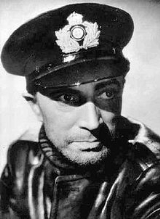
Conrad Veidt

Encyclopedia
Conrad Veidt was a German actor best remembered for his roles in films such as The Cabinet of Dr. Caligari
(1919), The Man Who Laughs
(1928), The Thief of Bagdad
(1940) and Casablanca
(1942). After a successful career in German silent film, where he was one of the best paid stars of Ufa
, he left Germany in 1933 with his new Jewish wife and settled in the United Kingdom, where he participated in a number of films before continuing to the United States around 1941.
, probably on the basis of an early claim on his part.) His family was Protestant.
In 1914, Veidt met actress Lucie Mannheim
, with whom he began a relationship. Later in the year Veidt was drafted
into the German Army during World War I. In 1915, Veidt was sent to the Eastern Front as a noncommissioned officer and took part in the Battle of Warsaw
. He contracted jaundice and pneumonia, and had to be evacuated to a hospital on the Baltic Sea. While recuperating, he received a letter from Mannheim informing him that she had found work at a theater in Libau
. Intrigued, Veidt applied for the theater as well. As his condition had not improved, the army allowed him to join the theater so that he could entertain the troops. While performing at the theater his relationship with Mannheim ended. In late 1916, he was reexamined by the Army and deemed unfit for service and given a full discharge in January 1917. Veidt then returned to Berlin to pursue his acting career.
From 1916 until his death, he appeared in well over 100 films. He appeared in two of the best-known films of the silent
era: as a murderous somnambulist in director Robert Wiene
's The Cabinet of Dr. Caligari
(1920) with Werner Krauss
and Lil Dagover
and as a disfigured circus performer in The Man Who Laughs
(1928). According to the Los Angeles Times
, "Conrad Veidt starred in this semi-silent film based on Victor Hugo
's novel in which the son of a lord is punished for his father's disrespect to the king by having his face carved into a permanent grin." Veidt also starred in other classic silent horror films such a The Hands of Orlac
in 1929 (again directed by Robert Weine), The Student of Prague
in 1926 and Waxworks in 1924 where he played Ivan the Terrible.
Veidt also appeared in Magnus Hirschfeld
's pioneering gay rights film Anders als die Andern
(Different from the Others, 1919), in which he played what is probably the first gay
character written especially for the cinema, and in Das Land ohne Frauen (1929), Germany's first talking picture.
He moved to Hollywood and made a few films in the twenties but the advent of talking pictures and his broken English made him return to Germany.
He continued making films in Britain, notably three with director Michael Powell
: The Spy in Black
(1939), Contraband (1940) and The Thief of Bagdad
(1940).
(1942), in which he had a dual role as a Nazi and as the Nazi's twin brother, but his best remembered role was as Major Heinrich Strasser in Casablanca
(1942). He found himself invariably playing the very characters he detested.
He died suddenly of a heart attack
in 1943 while playing golf in Los Angeles. In 1998, his ashes were interred at the Golders Green Crematorium
in London.
or was Jewish by birth.
Conrad Veidt married three times, his first marriage to Augusta Holl, a famous cabaret entertainer known as "Gussy", took place on June 18, 1918 and ended in divorce the following autumn. Gussy later married German actor Emil Jannings
. Veidt married a woman from an aristocratic German family, Felicitas Radke, in 1923. Their daughter, Vera Viola Maria, called Viola, was born August 10, 1925. His last marriage came in 1933, to Ilona Prager, called Lily, and lasted until his death.
He loaned his considerable fortune to the British Government and donated large amounts of his film salaries to help with the British war effort.
The Cabinet of Dr. Caligari
The Cabinet of Dr. Caligari is a 1920 silent horror film directed by Robert Wiene from a screenplay by Hans Janowitz and Carl Mayer. It is one of the most influential of German Expressionist films and is often considered one of the greatest horror movies of the silent era. This movie is cited as...
(1919), The Man Who Laughs
The Man Who Laughs (1928 film)
The Man Who Laughs is an American silent film directed by the German Expressionist filmmaker Paul Leni. The film is an adaptation of Victor Hugo's novel of the same name and stars Conrad Veidt as Gwynplaine and Mary Philbin as the blind Dea...
(1928), The Thief of Bagdad
The Thief of Bagdad (1940 film)
The Thief of Bagdad is a 1940 British fantasy film produced by Alexander Korda, and directed by Michael Powell, Ludwig Berger, and Tim Whelan, with contributions by Korda's brothers Vincent and Zoltán, and William Cameron Menzies...
(1940) and Casablanca
Casablanca (film)
Casablanca is a 1942 American romantic drama film directed by Michael Curtiz, starring Humphrey Bogart, Ingrid Bergman and Paul Henreid, and featuring Claude Rains, Conrad Veidt, Sydney Greenstreet, Peter Lorre and Dooley Wilson. Set during World War II, it focuses on a man torn between, in...
(1942). After a successful career in German silent film, where he was one of the best paid stars of Ufa
Universum Film AG
Universum Film AG, better known as UFA or Ufa, is a film company that was the principal film studio in Germany, home of the German film industry during the Weimar Republic and through World War II, and a major force in world cinema from 1917 to 1945...
, he left Germany in 1933 with his new Jewish wife and settled in the United Kingdom, where he participated in a number of films before continuing to the United States around 1941.
Early life and work
He was born Hans Walter Conrad Weidt in a working-class district of Berlin, Germany, the son of Amalie Marie (Gohtz) and Phillip Heinrich Veidt. (Some biographies wrongly state that he was born in PotsdamPotsdam
Potsdam is the capital city of the German federal state of Brandenburg and part of the Berlin/Brandenburg Metropolitan Region. It is situated on the River Havel, southwest of Berlin city centre....
, probably on the basis of an early claim on his part.) His family was Protestant.
In 1914, Veidt met actress Lucie Mannheim
Lucie Mannheim
Lucie Mannheim was a German singer and actress.Mannheim was born in Berlin–Köpenick where she studied drama and quickly became a popular figure appearing on stage in plays and musicals. Among other roles, she played Nora in Ibsen's A Doll's House, Marie in Büchner's Woyzeck, and Juliet in...
, with whom he began a relationship. Later in the year Veidt was drafted
Conscription
Conscription is the compulsory enlistment of people in some sort of national service, most often military service. Conscription dates back to antiquity and continues in some countries to the present day under various names...
into the German Army during World War I. In 1915, Veidt was sent to the Eastern Front as a noncommissioned officer and took part in the Battle of Warsaw
Great Retreat (Russian)
The Great Retreat was a Russian retreat from Galicia and Poland during World War I.-Background:During this period, the buildup of forces generally favored the Central Powers. Four new German armies, the Eleventh, Twelfth, Army of the Niemen and Army Bug, were being formed up, dramatically shifting...
. He contracted jaundice and pneumonia, and had to be evacuated to a hospital on the Baltic Sea. While recuperating, he received a letter from Mannheim informing him that she had found work at a theater in Libau
Liepaja
Liepāja ; ), is a republican city in western Latvia, located on the Baltic Sea directly at 21°E. It is the largest city in the Kurzeme Region of Latvia, the third largest city in Latvia after Riga and Daugavpils and an important ice-free port...
. Intrigued, Veidt applied for the theater as well. As his condition had not improved, the army allowed him to join the theater so that he could entertain the troops. While performing at the theater his relationship with Mannheim ended. In late 1916, he was reexamined by the Army and deemed unfit for service and given a full discharge in January 1917. Veidt then returned to Berlin to pursue his acting career.
From 1916 until his death, he appeared in well over 100 films. He appeared in two of the best-known films of the silent
Silent film
A silent film is a film with no synchronized recorded sound, especially with no spoken dialogue. In silent films for entertainment the dialogue is transmitted through muted gestures, pantomime and title cards...
era: as a murderous somnambulist in director Robert Wiene
Robert Wiene
Robert Wiene was an important film director of the German silent cinema.Robert Wiene was born in Breslau, as the elder son of the successful theatre actor Carl Wiene. His younger brother Conrad also became an actor, but Robert Wiene at first studied law at the University of Berlin. In 1908 he also...
's The Cabinet of Dr. Caligari
The Cabinet of Dr. Caligari
The Cabinet of Dr. Caligari is a 1920 silent horror film directed by Robert Wiene from a screenplay by Hans Janowitz and Carl Mayer. It is one of the most influential of German Expressionist films and is often considered one of the greatest horror movies of the silent era. This movie is cited as...
(1920) with Werner Krauss
Werner Krauss
Werner Johannes Krauss was a German stage and film actor.-Early life:Krauss was born at the parsonage of Gestungshausen in Upper Franconia, where his grandfather was Protestant pastor. He spent his childhood in Breslau and from 1901 attended the teacher's college at Kreuzburg...
and Lil Dagover
Lil Dagover
Lil Dagover was a German stage, film and television actress whose career spanned nearly six decades.-Early life:...
and as a disfigured circus performer in The Man Who Laughs
The Man Who Laughs (1928 film)
The Man Who Laughs is an American silent film directed by the German Expressionist filmmaker Paul Leni. The film is an adaptation of Victor Hugo's novel of the same name and stars Conrad Veidt as Gwynplaine and Mary Philbin as the blind Dea...
(1928). According to the Los Angeles Times
Los Angeles Times
The Los Angeles Times is a daily newspaper published in Los Angeles, California, since 1881. It was the second-largest metropolitan newspaper in circulation in the United States in 2008 and the fourth most widely distributed newspaper in the country....
, "Conrad Veidt starred in this semi-silent film based on Victor Hugo
Victor Hugo
Victor-Marie Hugo was a Frenchpoet, playwright, novelist, essayist, visual artist, statesman, human rights activist and exponent of the Romantic movement in France....
's novel in which the son of a lord is punished for his father's disrespect to the king by having his face carved into a permanent grin." Veidt also starred in other classic silent horror films such a The Hands of Orlac
The Hands of Orlac
Orlacs Hände is an Austrian silent film of 1924. This late Expressionist work, produced by Robert Wiene, has been remade twice.- Plot :...
in 1929 (again directed by Robert Weine), The Student of Prague
The Student of Prague
The Student of Prague or Der Student von Prag is the title of several films:* The Student of Prague , a German silent film by Stellan Rye* The Student of Prague , a remake of the original film by Henrik Galeen...
in 1926 and Waxworks in 1924 where he played Ivan the Terrible.
Veidt also appeared in Magnus Hirschfeld
Magnus Hirschfeld
Magnus Hirschfeld was a German physician and sexologist. An outspoken advocate for sexual minorities, Hirschfeld founded the Scientific Humanitarian Committee, which Dustin Goltz called "the first advocacy for homosexual and transgender rights."-Early life:Hirschfeld was born in Kolberg in a...
's pioneering gay rights film Anders als die Andern
Different From The Others
Different From The Others is a German film produced during the Weimar Republic. It was first released in 1919 and stars Conrad Veidt and Reinhold Schünzel.The story for Anders als die Andern was written by Richard Oswald with the assistance of Dr...
(Different from the Others, 1919), in which he played what is probably the first gay
Gay
Gay is a word that refers to a homosexual person, especially a homosexual male. For homosexual women the specific term is "lesbian"....
character written especially for the cinema, and in Das Land ohne Frauen (1929), Germany's first talking picture.
He moved to Hollywood and made a few films in the twenties but the advent of talking pictures and his broken English made him return to Germany.
Life in England
Veidt fervently opposed the Nazi regime, motivating him to emigrate from Germany in 1933 a week after marrying Illona Prager, a Jewish woman. He settled in the United Kingdom, perfected his English and became a British citizen in 1938.He continued making films in Britain, notably three with director Michael Powell
Michael Powell (director)
Michael Latham Powell was a renowned English film director, celebrated for his partnership with Emeric Pressburger...
: The Spy in Black
The Spy in Black
The Spy in Black is a 1939 British film, and the first collaboration between the British filmmakers Michael Powell and Emeric Pressburger. They were brought together by Alexander Korda to make the World War I spy thriller by Joseph Storer Clouston into a film...
(1939), Contraband (1940) and The Thief of Bagdad
The Thief of Bagdad (1940 film)
The Thief of Bagdad is a 1940 British fantasy film produced by Alexander Korda, and directed by Michael Powell, Ludwig Berger, and Tim Whelan, with contributions by Korda's brothers Vincent and Zoltán, and William Cameron Menzies...
(1940).
Later career
In the 1940s he moved back to Hollywood, California, and starred in a few films, such as Nazi AgentNazi Agent
Nazi Agent is a 1942 spy film directed by Jules Dassin. It stars Conrad Veidt playing identical twins, one loyal to the United States , the other a dedicated German Nazi....
(1942), in which he had a dual role as a Nazi and as the Nazi's twin brother, but his best remembered role was as Major Heinrich Strasser in Casablanca
Casablanca (film)
Casablanca is a 1942 American romantic drama film directed by Michael Curtiz, starring Humphrey Bogart, Ingrid Bergman and Paul Henreid, and featuring Claude Rains, Conrad Veidt, Sydney Greenstreet, Peter Lorre and Dooley Wilson. Set during World War II, it focuses on a man torn between, in...
(1942). He found himself invariably playing the very characters he detested.
He died suddenly of a heart attack
Myocardial infarction
Myocardial infarction or acute myocardial infarction , commonly known as a heart attack, results from the interruption of blood supply to a part of the heart, causing heart cells to die...
in 1943 while playing golf in Los Angeles. In 1998, his ashes were interred at the Golders Green Crematorium
Golders Green Crematorium
Golders Green Crematorium and Mausoleum was the first crematorium to be opened in London, and one of the oldest crematoria in Britain. The land for the crematorium was purchased in 1900, costing £6,000, and was opened in 1902 by Sir Henry Thompson....
in London.
Personal life
It has been reported, though not verified, that Veidt identified himself as Jewish on Nazi questionnaires as an act of protest. This may be the source of inaccurate claims that he either converted to JudaismJudaism
Judaism ) is the "religion, philosophy, and way of life" of the Jewish people...
or was Jewish by birth.
Conrad Veidt married three times, his first marriage to Augusta Holl, a famous cabaret entertainer known as "Gussy", took place on June 18, 1918 and ended in divorce the following autumn. Gussy later married German actor Emil Jannings
Emil Jannings
Emil Jannings was a German actor. He was not only the first actor to win the Academy Award for Best Actor, but also the first person to be presented an Oscar...
. Veidt married a woman from an aristocratic German family, Felicitas Radke, in 1923. Their daughter, Vera Viola Maria, called Viola, was born August 10, 1925. His last marriage came in 1933, to Ilona Prager, called Lily, and lasted until his death.
He loaned his considerable fortune to the British Government and donated large amounts of his film salaries to help with the British war effort.
Popular culture
- Comic book artist Bob KaneBob KaneBob Kane was an American comic book artist and writer, credited as the creator of the DC Comics superhero Batman...
, writer Bill FingerBill FingerWilliam "Bill" Finger was an American comic strip and comic book writer best known as the uncredited co-creator, with Bob Kane, of the DC Comics character Batman, as well as the co-architect of the series' development...
and artist Jerry RobinsonJerry RobinsonJerry Robinson is an American comic book artist best known for his work on DC Comics' Batman line of comics during the 1940s.He was inducted into the Comic Book Hall of Fame in 2004.-Career:...
used stills of Veidt in The Man Who Laughs as inspiration for the iconic supervillain The JokerJoker (comics)The Joker is a fictional character, a comic book supervillain published by DC Comics. He is the archenemy of Batman, having been directly responsible for numerous tragedies in Batman's life, including the paralysis of Barbara Gordon and the death of Jason Todd, the second Robin...
. The creators have long disputed who actually came up with the character. - Veidt sang the title song Where the Lighthouse Shines Across the Bay (in some territories) of the 1933 film F.P.1. It flopped at the time, but became a hit in the United Kingdom in 1980 after disc jockeyDisc jockeyA disc jockey, also known as DJ, is a person who selects and plays recorded music for an audience. Originally, "disc" referred to phonograph records, not the later Compact Discs. Today, the term includes all forms of music playback, no matter the medium.There are several types of disc jockeys...
Terry WoganTerry WoganSir Michael Terence Wogan, KBE, DL , or also known as Terry Wogan, is a veteran Irish radio and television broadcaster who holds dual Irish and British citizenship. Wogan has worked for the BBC in the United Kingdom for most of his career...
played it as a request on his breakfast show. Afterwards he was inundated with repeat requests. - He is mentioned in Thomas PynchonThomas PynchonThomas Ruggles Pynchon, Jr. is an American novelist. For his most praised novel, Gravity's Rainbow, Pynchon received the National Book Award, and is regularly cited as a contender for the Nobel Prize in Literature...
's 2009 novel Inherent ViceInherent ViceInherent Vice is a novel by Thomas Pynchon, originally published in August 2009.-Title:The term "inherent vice" is a legal tenet referring to a "hidden defect of a good or property which of itself is the cause of its deterioration, damage, or wastage...
(pg. 115). - On their 1979 album Dantzig Twist, the cult French post-punk band Marquis de Sade wrote a track called "Conrad Veidt". The chorus goes with the line " Conrad Veidt is dancing" in French.
Selected filmography
|
The Man Who Laughs (1928 film) The Man Who Laughs is an American silent film directed by the German Expressionist filmmaker Paul Leni. The film is an adaptation of Victor Hugo's novel of the same name and stars Conrad Veidt as Gwynplaine and Mary Philbin as the blind Dea... (1928) Menschen im Käfig Menschen im Käfig is a 1930 British drama film directed by Ewald André Dupont and starring Conrad Veidt, Fritz Kortner and Tala Birell. It was the German-language version of the 1930 British International Pictures film Cape Forlorn. A French-language version Le cap perdu was also produced... (1930) Der Kongreß tanzt Der Kongress tanzt is a Germany musical comedy film produced in 1931 by Ufa, directed by Erik Charell, starring Lilian Harvey as Christel Weinzinger, the glove seller, Willy Fritsch as Tsar Alexander I of Russia and his doppelgänger, Uralsky, Otto Wallburg as Bibikoff, his Adjutant, Conrad Veidt... (Der Kongreß tanzt) (1931) Rasputin, Dämon der Frauen Rasputin, Dämon der Frauen is a 1932 German historical drama film directed by Adolf Trotz and starring Conrad Veidt, Paul Otto and Hermine Sterler... (1932) Der schwarze Husar Der schwarze Husar is a 1932 German comedy action film directed by Gerhard Lamprecht and starring Conrad Veidt, Mady Christians, Wolf Albach-Retty and Ursula Grabley... (1932) Rome Express Rome Express is a British film directed by Walter Forde and written by Sidney Gilliat and Clifford Grey. -Cast:*Esther Ralston - Asta Marvelle*Conrad Veidt - Zurta*Harold Huth - George Grant*Frank Vosper - M... (1932) F.P.1 F.P.1 antwortet nicht, or F.P.1 Doesn't Respond was the name of a novel written by noted science fiction and fantasy writer/director Kurt Siodmak, best known as the creator of The Wolf Man.... (1933) I Was a Spy I Was a Spy is a 1933 British thriller film directed by Victor Saville and starring Madeleine Carroll, Herbert Marshall and Conrad Veidt. A Belgian woman who nurses injured German soldiers during World War I passes intelligence to the British.... (1933) William Tell (film) William Tell is a 1960 Swiss adventure film directed by Michel Dickoff and Karl Hartl and starring Robert Freitag, Wolfgang Rottsieper and Alfred Schlageter... (1934) Bella Donna 'Bella Donna or Belladonna is a name or alias used by two fictional characters in the Marvel Comics universe.... (1934) Jew Suss (1934 film) Jud Süß is a 1934 British historical romantic drama film. Directed by Lothar Mendes, the film stars German actor Conrad Veidt in the role of Joseph Süss Oppenheimer. British censors did not allow a film to openly criticize the persecution of Jews, since it would have appeared as an attack on German... (1934) - not to be confused with the 1940 German anti-semitic Jud Süß Jud Süß (1940 film) Jud Süß is an antisemitic propaganda film produced in 1940 by Terra Filmkunst at the behest of Joseph Goebbels. The movie was directed by Veit Harlan, who wrote the screenplay with Eberhard Wolfgang Möller and Ludwig Metzger, and starred Ferdinand Marian and Harlan's wife Kristina Söderbaum.The... |
King of the Damned King of the Damned is a 1935 British action film directed by Walter Forde and starring Conrad Veidt, Helen Vinson, Noah Beery and Cecil Ramage. Convict 83 is a prisoner on an island, where the harsh regime of the Governor pushes him to lead a revolt... (1935) The Passing of the Third Floor Back The Passing of the Third Floor Back is a 1935 British drama film directed by Berthold Viertel and starring Conrad Veidt, Anna Lee, René Ray and Frank Cellier. The film is based on a short story by Jerome K. Jerome and depicts the various small-minded inhabitants of a building and the arrival of a... (1935) Dark Journey (film) Dark Journey is a 1937 British spy film directed by Victor Saville set in the First World War. Its plot concerns two secret agents on opposite sides, played by Conrad Veidt and Vivien Leigh, who fall in love.-Cast:* Conrad Veidt as Baron Karl von Marwitz... (1937) Under the Red Robe (film) Under the Red Robe is a 1937 British / American film directed by Victor Sjöström. Previously filmed as a 1923 silent directed by Alan Crosland... (1937) The Spy in Black The Spy in Black is a 1939 British film, and the first collaboration between the British filmmakers Michael Powell and Emeric Pressburger. They were brought together by Alexander Korda to make the World War I spy thriller by Joseph Storer Clouston into a film... (1939) Escape (1940 film) Escape is a 1940 drama film about an American in pre-World War II Nazi Germany who discovers his mother is in a concentration camp and tries desperately to free her. It starred Norma Shearer, Robert Taylor, Conrad Veidt and Alla Nazimova... (1940) The Thief of Bagdad (1940 film) The Thief of Bagdad is a 1940 British fantasy film produced by Alexander Korda, and directed by Michael Powell, Ludwig Berger, and Tim Whelan, with contributions by Korda's brothers Vincent and Zoltán, and William Cameron Menzies... (1940) A Woman's Face A Woman's Face is a 1941 drama film directed by George Cukor, starring Joan Crawford, Melvyn Douglas and Conrad Veidt. It tells the story of Anna Holm, a facially disfigured blackmailer, who because of her appearance despises everyone she encounters... (1941) Whistling in the Dark (1941 film) Whistling in the Dark is the first of three comedy films starring Red Skelton as Wally "the Fox" Benton, who writes and acts in radio murder mysteries. Wally is kidnapped by a greedy cult leader , who threatens to kill Wally's girlfriend and another young woman unless he concocts a perfect murder... (1941) The Men in Her Life The Men in Her Life was a 1941 film adaptation of the novel Ballerina by Eleanor Smith. It was nominated for the 1941 Academy Award for Sound , but lost to That Hamilton Woman.-Cast:* Loretta Young as Lina Varsavina... (1941) All Through the Night (film) All Through the Night is a light-hearted thriller film released by Warner Brothers in 1941, starring Humphrey Bogart and directed by Vincent Sherman.-Plot:An elderly baker named Miller is murdered by a sinister stranger... (1941) Nazi Agent Nazi Agent is a 1942 spy film directed by Jules Dassin. It stars Conrad Veidt playing identical twins, one loyal to the United States , the other a dedicated German Nazi.... (1942) Casablanca (film) Casablanca is a 1942 American romantic drama film directed by Michael Curtiz, starring Humphrey Bogart, Ingrid Bergman and Paul Henreid, and featuring Claude Rains, Conrad Veidt, Sydney Greenstreet, Peter Lorre and Dooley Wilson. Set during World War II, it focuses on a man torn between, in... (1942) Above Suspicion (1943 film) Above Suspicion is a Metro-Goldwyn-Mayer spy drama film starring Joan Crawford and Fred MacMurray as newlyweds who spy on the Nazis for the British Secret Service during their honeymoon, along with Basil Rathbone as a Nazi who pursues them. The screenplay by Keith Winter, Melville Baker, and... (1943) |