


Ava Gardner

Encyclopedia
Ava Lavinia Gardner was an American actress.
She was signed to a contract by MGM Studios in 1941 and appeared mainly in small roles until she drew attention with her performance in The Killers
(1946). She became one of Hollywood's leading actresses, considered one of the most beautiful women of her day. She was nominated for the Academy Award for Best Actress
for her work in Mogambo
(1953).
She appeared in several high-profile films from the 1950s to 1970s, including The Hucksters
(1947), Show Boat
(1951), The Snows of Kilimanjaro (1952), The Barefoot Contessa
(1954), Bhowani Junction
(1956), On the Beach
(1959), Seven Days in May
(1964), The Night of the Iguana
(1964), The Life and Times of Judge Roy Bean
(1972), Earthquake
(1974), and The Cassandra Crossing
(1976). Gardner continued to act regularly until 1986, four years before her death from pneumonia
, at age 67, in 1990.
She is listed 25th among the American Film Institute
's Greatest female stars
.
, Johnston County, North Carolina
, the youngest of seven children (she had two brothers; Raymond and Melvin, and four sisters; Beatrice, Elsie Mae, Inez and Myra) of poor cotton
and tobacco
farmers; her mother, Mary Elizabeth ("Mollie") Gardner (née Baker) was a Baptist
of Scots-Irish and English
descent, while her father, Jonas Bailey Gardner, was a Roman Catholic
of Irish American
and American Indian (Tuscarora
) descent. When the children were still young, the Gardners lost their property, forcing Jonas Gardner to work at a sawmill and Mollie to begin working as a cook and housekeeper at a dormitory for teachers at the nearby Brogden School.
When Gardner was 13 years old, the family decided to try their luck in a larger city, Newport News, Virginia
, where Mollie Gardner found work managing a boardinghouse for the city's many shipworkers. While in Newport News, Gardner's father became ill and died from bronchitis
in 1938, when Ava was 15 years old. After Jonas Gardner's death, the family moved to Rock Ridge near Wilson, North Carolina
, where Mollie Gardner ran another boarding house for teachers. Ava Gardner attended high school in Rock Ridge and she graduated from there in 1939. She then attended secretarial classes at Atlantic Christian College
in Wilson for about a year.
Gardner was visiting her sister Beatrice ("Bappie") in New York in 1941 when Beatrice's husband Larry Tarr, a professional photographer, offered to take her portrait. He was so pleased with the results that he displayed the finished product in the front window of his Tarr Photography Studio on 25th Avenue.
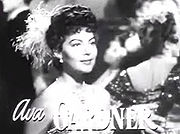 In 1941, a Loews Theatres legal clerk, Barnard "Barney" Duhan, spotted Gardner's photo in Tarr's studio. At the time, Duhan often posed as an MGM talent scout to meet girls, using the fact that MGM was a subsidiary of Loews. Duhan entered Tarr's and tried to get Gardner's number, but was rebuffed by the receptionist. Duhan made the offhand comment, "Somebody should send her info to MGM", and the Tarrs did so immediately. Shortly after, Gardner, who at the time was a student at Atlantic Christian College, traveled to New York
to be interviewed at MGM's New York office by Al Altman, head of MGM's New York talent department. With cameras rolling, he directed the eighteen-year-old to walk toward the camera, turn and walk away, then rearrange some flowers in a vase. He did not attempt to record her voice because her Southern accent made it almost impossible for him to understand her. Though Al thought Ava the most beautiful woman he'd ever seen, he believed the test was a disaster and was completely surprised by what he saw in the screening room. On screen she was magnetic. The camera loved her. He sent the test to Hollywood. Louis B. Mayer, head of the studio, sent a telegram to Al: "She can't sing, she can't act, she can't talk, She's terrific!" She was offered a standard contract by MGM, and left school for Hollywood in 1941 with her sister Bappie accompanying her. MGM's first order of business was to provide her a speech coach, as her Carolina drawl
was nearly incomprehensible to them.
in Whistle Stop, a film noir
starring George Raft
, whose career was in serious decline. Gardner's own career was really launched by the Mark Hellinger
-produced smash hit film noir
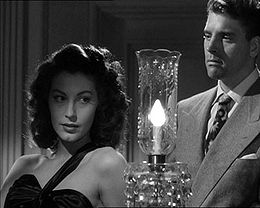
The Killers
that same year, which introduced Burt Lancaster
to the screen in the lead role.
 Other films include The Hucksters
(1947) with Clark Gable
, Show Boat
(1951), The Snows of Kilimanjaro (1952) with Gregory Peck
, Lone Star
(1952) with Clark Gable
, Mogambo
(1953) with Clark Gable
and Grace Kelly
, 1954's The Barefoot Contessa
with Humphrey Bogart
(which some consider to be Gardner's "signature film" since it mirrored her real life custom of going barefoot), Bhowani Junction
(1956), The Sun Also Rises
with Tyrone Power
and Errol Flynn
(in which she played party-girl Brett Ashley) (1957), and the film version of Nevil Shute
's best-selling On the Beach
with Peck and Fred Astaire
. Off-camera, she could be witty and pithy, as in her assessment of director John Ford
, who directed Mogambo ("The meanest man on earth. Thoroughly evil. Adored him!")
Gardner again appeared in a film starring Burt Lancaster
, this time paired with Kirk Douglas
in Seven Days in May
(1962), a taut thriller about a military takeover of the US government. She found herself billed between Charlton Heston
and David Niven
in the epic 55 Days at Peking
in 1963, a lavish version of the Chinese revolt against foreign control during the Boxer Rebellion
in 1900.
The following year, she played her last great leading role in a superlative film, The Night of the Iguana
(1964), based upon a Tennessee Williams
play and starring Richard Burton
as an atheist clergyman and Deborah Kerr
as a gentle artist traveling with her senile poet grandfather. John Huston
directed the movie in the seaside jungles of Mexico
, insisting on making the film in black and white, a decision he later regretted because of the vivid colors of the flora. Gardner received billing below Burton but above Deborah Kerr. Gardner was nominated for a BAFTA and a Golden Globe award for her hearty performance in this signature role.
Two years later, in 1966, Gardner briefly sought the role of Mrs. Robinson in Mike Nichols
' The Graduate
(1967). She reportedly called Nichols and said, "I want to see you! I want to talk about this Graduate thing!" Nichols never seriously considered her for the part, preferring to cast a younger woman (Anne Bancroft
was 36 while Gardner was 45), but he did visit her hotel, where he later recounted that "she sat at a little French desk with a telephone, she went through every movie star cliché. She said, 'All right, let's talk about your movie. First of all, I strip for nobody.'"
Gardner moved to London
, England in 1968, undergoing an elective hysterectomy
to allay her worries of contracting the uterine cancer
that had claimed the life of her own mother. That year, she made what some consider to be one of her best films, Mayerling
, in which she played the supporting role of Austrian Empress Elisabeth of Austria
opposite James Mason
as Emperor Franz Joseph I.
She appeared in a number of disaster films throughout the 1970s, notably Earthquake
(1974) with Charlton Heston
, The Cassandra Crossing
(1976), and the Canadian movie City on Fire
(1979). She also appeared briefly as Lillie Langtry
at the end of The Life and Times of Judge Roy Bean
(1972) with Paul Newman
and Jacqueline Bisset
, and in The Blue Bird
(1976) with Elizabeth Taylor
and Jane Fonda
.
Her last movie was Regina Roma (1982), a direct-to-video release. In the 1980s she acted primarily on television, including the miniseries remake of The Long Hot Summer (1985) and the prime-time soap opera Knots Landing
, also in 1985. In 1986 she appeared in her two final projects, the TV movies Harem and Maggie.
, Gardner met fellow MGM contract player Mickey Rooney
; they married on January 10, 1942, in Ballard, California
; she was 19 years old, and he was 21.
Gardner made several movies before 1946, but it wasn't until she starred in The Killers
with Burt Lancaster
that she became a star and a sex symbol
. Rooney and Gardner divorced in 1943. He later reputedly rhapsodized about their sex life, but Gardner retorted, "Well, honey, he may have enjoyed the sex, but [goodness knows] I didn't." She once characterized their marriage as "Love Finds Andy Hardy
".
in the early to mid-1940s and the relationship lasted into the 1950s.
, from 1945 to 1946.
. She would later say in her autobiography that he was the love of her life. Sinatra left his wife, Nancy, for Ava and their subsequent marriage made headlines. Sinatra was savaged by gossip columnists Hedda Hopper
and Louella Parsons
, the Hollywood establishment, the Roman Catholic Church and by his fans for leaving his wife for a noted femme fatale
. Gardner used her considerable influence, particularly with Harry Cohn
's wife, to get Sinatra cast in his Oscar
-winning role in From Here to Eternity
(1953). That role and the award revitalized both Sinatra's acting and singing careers.
The Gardner-Sinatra marriage was tumultuous. Gardner confided to Artie Shaw, her second husband, that “With him [Frank] it’s impossible…it’s like being with a woman. He’s so gentle. It’s as though he thinks I’ll break, as though I’m a piece of Dresden china and he’s gonna hurt me.” During their marriage Gardner became pregnant twice, but she had two abortions. "MGM had all sorts of penalty clauses about their stars having babies," she said. She said years later, "We couldn't even take care of ourselves. How were we going to take care of a baby?" Gardner and Sinatra remained good friends for the rest of her life.
. While staying with Hemingway at his villa in San Francisco de Paula in Havana
, Cuba
, Gardner once swam alone with no bathing suit in his pool. After watching her, Hemingway ordered his staff: "The water is not to be emptied". Gardner's friendship with Hemingway led to her becoming a fan of bullfighting and bullfighters such as Luis Miguel Dominguín, who became her lover. "It was a sort of madness, honey," she said later of the time.
, a terminal disease, in addition to an auto-immune disorder (which may have been lupus
). Two stroke
s in 1986 left her partially paralyzed and bedridden. Although Gardner could afford her medical expenses, Sinatra wanted to pay for her to visit a specialist in the United States, and she allowed him to make the arrangements for a medically-staffed private plane. Her last words (to her housekeeper Carmen), were reportedly, "I'm so tired," before she died of pneumonia at the age of 67. After her death, Sinatra's daughter, Tina, found him slumped in his room, crying, and unable to speak.
Gardner was not only the love of his life, but also was the inspiration for one of his most personal songs, "I'm a Fool to Want You", which Sinatra (who received a co-writing credit for the song) recorded twice, toward the end of his contract with Columbia Records
and during his years on Capitol Records
. ("It was Ava who taught him how to sing a torch song
", Sinatra arranger Nelson Riddle
was once quoted as saying.) Because of the presence of a black limousine parked behind the crowd of 500 mourners, it has been reported that Sinatra attended her funeral. Instead, a hairstylist from Fayetteville, North Carolina
, had felt that a limousine was the only appropriate mode of transportation to Gardner's funeral. A floral arrangement at Gardner's graveside simply read: "With My Love, Francis".
, following several years of declining health. Gardner was buried in the Sunset Memorial Park, Smithfield, North Carolina
, next to her brothers and their parents, Jonah (1878–1938) and Mollie Gardner (1883–1943). The town of Smithfield now has an Ava Gardner Museum
.
(1953); the award was won by Audrey Hepburn
for Roman Holiday. Her performance as Maxine Faulk in The Night of the Iguana
(1964), was well reviewed, and she was nominated a BAFTA Award and a Golden Globe.
in the TV miniseries Sinatra
, Deborah Kara Unger
in HBO's The Rat Pack
, and Kate Beckinsale
in the 2004 Howard Hughes
biopic, The Aviator.
She was signed to a contract by MGM Studios in 1941 and appeared mainly in small roles until she drew attention with her performance in The Killers
The Killers (1946 film)
The Killers is a 1946 American film noir directed by Robert Siodmak. It is based in part on the short story of the same name by Ernest Hemingway. The film features Burt Lancaster in his screen debut, as well as Ava Gardner, Edmond O'Brien, and Sam Levene...
(1946). She became one of Hollywood's leading actresses, considered one of the most beautiful women of her day. She was nominated for the Academy Award for Best Actress
Academy Award for Best Actress
Performance by an Actress in a Leading Role is one of the Academy Awards of merit presented annually by the Academy of Motion Picture Arts and Sciences to recognize an actress who has delivered an outstanding performance while working within the film industry...
for her work in Mogambo
Mogambo
Mogambo is a 1953 film directed by John Ford, featuring Clark Gable, Ava Gardner, Grace Kelly and Donald Sinden. The film was adapted by John Lee Mahin from the play by Wilson Collison....
(1953).
She appeared in several high-profile films from the 1950s to 1970s, including The Hucksters
The Hucksters
The Hucksters is a 1947 MGM film directed by Jack Conway and starring Clark Gable that marked the debut of Deborah Kerr in an American film. It also featured Sydney Greenstreet, Adolphe Menjou, Keenan Wynn, Edward Arnold and Ava Gardner...
(1947), Show Boat
Show Boat (1951 film)
Show Boat is a 1951 Technicolor film based on the musical by Jerome Kern and Oscar Hammerstein II and the novel by Edna Ferber....
(1951), The Snows of Kilimanjaro (1952), The Barefoot Contessa
The Barefoot Contessa
The Barefoot Contessa is a 1954 film about the life and loves of fictional Spanish sex symbol Maria Vargas. It was written and directed by Joseph L. Mankiewicz and stars Humphrey Bogart, Ava Gardner and Edmond O'Brien....
(1954), Bhowani Junction
Bhowani Junction (film)
Bhowani Junction is a 1956 film adaptation of the 1952 novel Bhowani Junction by John Masters made by MGM. The film was directed by George Cukor and produced by Pandro S...
(1956), On the Beach
On the Beach (1959 film)
On the Beach is a post-apocalyptic drama film based on Nevil Shute's 1957 novel of the same name. The film features Gregory Peck , Ava Gardner , Fred Astaire and Anthony Perkins...
(1959), Seven Days in May
Seven Days in May
Seven Days in May is an American political thriller novel written by Fletcher Knebel and Charles W. Bailey II and published in 1962. It was made into a motion picture and released in February 1964, with a screenplay by Rod Serling, directed by John Frankenheimer, and starring Burt Lancaster, Kirk...
(1964), The Night of the Iguana
The Night of the Iguana (film)
The Night of the Iguana is a 1964 film based on the 1961 play The Night of the Iguana by Tennessee Williams. Directed by John Huston, it starred Richard Burton, Ava Gardner, and Deborah Kerr. It won the 1964 Academy Award for Best Costume Design, and was nominated for the Academy Awards for Best...
(1964), The Life and Times of Judge Roy Bean
The Life and Times of Judge Roy Bean
The Life and Times of Judge Roy Bean is a 1972 western film written by John Milius, directed by John Huston, and starring Paul Newman...
(1972), Earthquake
Earthquake (film)
Earthquake is a 1974 American disaster film that achieved huge box-office success, continuing the disaster film genre of the 1970s where recognizable all-star casts attempt to survive life or death situations...
(1974), and The Cassandra Crossing
The Cassandra Crossing
The Cassandra Crossing is a 1976 British disaster film directed by George Pan Cosmatos and starring Richard Harris, Ava Gardner, Sophia Loren, Martin Sheen, Burt Lancaster, Lee Strasberg and O. J. Simpson.-Plot:...
(1976). Gardner continued to act regularly until 1986, four years before her death from pneumonia
Pneumonia
Pneumonia is an inflammatory condition of the lung—especially affecting the microscopic air sacs —associated with fever, chest symptoms, and a lack of air space on a chest X-ray. Pneumonia is typically caused by an infection but there are a number of other causes...
, at age 67, in 1990.
She is listed 25th among the American Film Institute
American Film Institute
The American Film Institute is an independent non-profit organization created by the National Endowment for the Arts, which was established in 1967 when President Lyndon B. Johnson signed the National Foundation on the Arts and the Humanities Act...
's Greatest female stars
AFI's 100 Years... 100 Stars
Part of the AFI 100 Years... series, AFI's 100 Years...100 Stars is a list of the top 50 greatest screen legends of American cinema, 25 male and 25 female...
.
Early years
Gardner was born in the small farming community of GrabtownGrabtown, North Carolina
- Grabtown, North Carolina :Grabtown is an unincorporated community in BertieCounty, North Carolina. It lies at an elevation of 26 feet at ....
, Johnston County, North Carolina
Johnston County, North Carolina
-Major highways:* Interstate 40* Interstate 95* U.S. Highway 70* U.S. Highway 301* U.S. Highway 701-Demographics:As of the census of 2000, there were 121,965 people, 46,595 households, and 33,688 families residing in the county. The population density was 154 people per square mile . There were...
, the youngest of seven children (she had two brothers; Raymond and Melvin, and four sisters; Beatrice, Elsie Mae, Inez and Myra) of poor cotton
Cotton
Cotton is a soft, fluffy staple fiber that grows in a boll, or protective capsule, around the seeds of cotton plants of the genus Gossypium. The fiber is almost pure cellulose. The botanical purpose of cotton fiber is to aid in seed dispersal....
and tobacco
Tobacco
Tobacco is an agricultural product processed from the leaves of plants in the genus Nicotiana. It can be consumed, used as a pesticide and, in the form of nicotine tartrate, used in some medicines...
farmers; her mother, Mary Elizabeth ("Mollie") Gardner (née Baker) was a Baptist
Baptist
Baptists comprise a group of Christian denominations and churches that subscribe to a doctrine that baptism should be performed only for professing believers , and that it must be done by immersion...
of Scots-Irish and English
English people
The English are a nation and ethnic group native to England, who speak English. The English identity is of early mediaeval origin, when they were known in Old English as the Anglecynn. England is now a country of the United Kingdom, and the majority of English people in England are British Citizens...
descent, while her father, Jonas Bailey Gardner, was a Roman Catholic
Roman Catholic Church
The Catholic Church, also known as the Roman Catholic Church, is the world's largest Christian church, with over a billion members. Led by the Pope, it defines its mission as spreading the gospel of Jesus Christ, administering the sacraments and exercising charity...
of Irish American
Irish American
Irish Americans are citizens of the United States who can trace their ancestry to Ireland. A total of 36,278,332 Americans—estimated at 11.9% of the total population—reported Irish ancestry in the 2008 American Community Survey conducted by the U.S. Census Bureau...
and American Indian (Tuscarora
Tuscarora (tribe)
The Tuscarora are a Native American people of the Iroquoian-language family, with members in New York, Canada, and North Carolina...
) descent. When the children were still young, the Gardners lost their property, forcing Jonas Gardner to work at a sawmill and Mollie to begin working as a cook and housekeeper at a dormitory for teachers at the nearby Brogden School.
When Gardner was 13 years old, the family decided to try their luck in a larger city, Newport News, Virginia
Newport News, Virginia
Newport News is an independent city located in the Hampton Roads metropolitan area of Virginia. It is at the southeastern end of the Virginia Peninsula, on the north shore of the James River extending southeast from Skiffe's Creek along many miles of waterfront to the river's mouth at Newport News...
, where Mollie Gardner found work managing a boardinghouse for the city's many shipworkers. While in Newport News, Gardner's father became ill and died from bronchitis
Bronchitis
Acute bronchitis is an inflammation of the large bronchi in the lungs that is usually caused by viruses or bacteria and may last several days or weeks. Characteristic symptoms include cough, sputum production, and shortness of breath and wheezing related to the obstruction of the inflamed airways...
in 1938, when Ava was 15 years old. After Jonas Gardner's death, the family moved to Rock Ridge near Wilson, North Carolina
Wilson, North Carolina
Wilson is a city and the county seat of Wilson County in the Coastal Plain region of the U.S. state of North Carolina. The 18th largest city in the state, Wilson had a population of 49,167 according to the 2010 census.- Geography :...
, where Mollie Gardner ran another boarding house for teachers. Ava Gardner attended high school in Rock Ridge and she graduated from there in 1939. She then attended secretarial classes at Atlantic Christian College
Barton College
Barton College is a private liberal arts college located in Wilson, North Carolina. Barton College is accredited by the Southern Association of Colleges and Schools, The NC Association of Colleges and Universities; the NC Department of Public Instruction; the NC Board of Nursing; and the Committee...
in Wilson for about a year.
Gardner was visiting her sister Beatrice ("Bappie") in New York in 1941 when Beatrice's husband Larry Tarr, a professional photographer, offered to take her portrait. He was so pleased with the results that he displayed the finished product in the front window of his Tarr Photography Studio on 25th Avenue.
Early career
New York City
New York is the most populous city in the United States and the center of the New York Metropolitan Area, one of the most populous metropolitan areas in the world. New York exerts a significant impact upon global commerce, finance, media, art, fashion, research, technology, education, and...
to be interviewed at MGM's New York office by Al Altman, head of MGM's New York talent department. With cameras rolling, he directed the eighteen-year-old to walk toward the camera, turn and walk away, then rearrange some flowers in a vase. He did not attempt to record her voice because her Southern accent made it almost impossible for him to understand her. Though Al thought Ava the most beautiful woman he'd ever seen, he believed the test was a disaster and was completely surprised by what he saw in the screening room. On screen she was magnetic. The camera loved her. He sent the test to Hollywood. Louis B. Mayer, head of the studio, sent a telegram to Al: "She can't sing, she can't act, she can't talk, She's terrific!" She was offered a standard contract by MGM, and left school for Hollywood in 1941 with her sister Bappie accompanying her. MGM's first order of business was to provide her a speech coach, as her Carolina drawl
Southern American English
Southern American English is a group of dialects of the English language spoken throughout the Southern region of the United States, from Southern and Eastern Maryland, West Virginia and Kentucky to the Gulf Coast, and from the Atlantic coast to most of Texas and Oklahoma.The Southern dialects make...
was nearly incomprehensible to them.
Career
In 1946, Gardner played the leading ladyLeading lady
Leading lady is an informal term for the actress who plays a secondary lead or supporting role, usually a love interest, to the leading actor in a film or play. It is not usually applied to the leading actress in the performance if her character is the protagonist.A leading lady can also be an...
in Whistle Stop, a film noir
Film noir
Film noir is a cinematic term used primarily to describe stylish Hollywood crime dramas, particularly those that emphasize cynical attitudes and sexual motivations. Hollywood's classic film noir period is generally regarded as extending from the early 1940s to the late 1950s...
starring George Raft
George Raft
George Raft was an American film actor and dancer identified with portrayals of gangsters in crime melodramas of the 1930s and 1940s...
, whose career was in serious decline. Gardner's own career was really launched by the Mark Hellinger
Mark Hellinger
Mark Hellinger was an American journalist, theatre columnist, and film producer.-Early life and career:Hellinger was born into an Orthodox Jewish family in New York City, although in later life he became a non-practicing Jew. When he was fifteen, he organized a student strike at Townsend Harris...
-produced smash hit film noir
Film noir
Film noir is a cinematic term used primarily to describe stylish Hollywood crime dramas, particularly those that emphasize cynical attitudes and sexual motivations. Hollywood's classic film noir period is generally regarded as extending from the early 1940s to the late 1950s...
The Killers
The Killers (1946 film)
The Killers is a 1946 American film noir directed by Robert Siodmak. It is based in part on the short story of the same name by Ernest Hemingway. The film features Burt Lancaster in his screen debut, as well as Ava Gardner, Edmond O'Brien, and Sam Levene...
that same year, which introduced Burt Lancaster
Burt Lancaster
Burton Stephen "Burt" Lancaster was an American film actor noted for his athletic physique and distinctive smile...
to the screen in the lead role.
The Hucksters
The Hucksters is a 1947 MGM film directed by Jack Conway and starring Clark Gable that marked the debut of Deborah Kerr in an American film. It also featured Sydney Greenstreet, Adolphe Menjou, Keenan Wynn, Edward Arnold and Ava Gardner...
(1947) with Clark Gable
Clark Gable
William Clark Gable , known as Clark Gable, was an American film actor most famous for his role as Rhett Butler in the 1939 Civil War epic film Gone with the Wind, in which he starred with Vivien Leigh...
, Show Boat
Show Boat (1951 film)
Show Boat is a 1951 Technicolor film based on the musical by Jerome Kern and Oscar Hammerstein II and the novel by Edna Ferber....
(1951), The Snows of Kilimanjaro (1952) with Gregory Peck
Gregory Peck
Eldred Gregory Peck was an American actor.One of 20th Century Fox's most popular film stars from the 1940s to the 1960s, Peck continued to play important roles well into the 1980s. His notable performances include that of Atticus Finch in the 1962 film To Kill a Mockingbird, for which he won an...
, Lone Star
Lone Star (1952 film)
Lone Star is a 1952 Western film starring Clark Gable, Ava Gardner, Broderick Crawford, Ed Begley, and Lionel Barrymore as President Andrew Jackson...
(1952) with Clark Gable
Clark Gable
William Clark Gable , known as Clark Gable, was an American film actor most famous for his role as Rhett Butler in the 1939 Civil War epic film Gone with the Wind, in which he starred with Vivien Leigh...
, Mogambo
Mogambo
Mogambo is a 1953 film directed by John Ford, featuring Clark Gable, Ava Gardner, Grace Kelly and Donald Sinden. The film was adapted by John Lee Mahin from the play by Wilson Collison....
(1953) with Clark Gable
Clark Gable
William Clark Gable , known as Clark Gable, was an American film actor most famous for his role as Rhett Butler in the 1939 Civil War epic film Gone with the Wind, in which he starred with Vivien Leigh...
and Grace Kelly
Grace Kelly
Grace Patricia Kelly was an American actress who, in April 1956, married Rainier III, Prince of Monaco, to become Princess consort of Monaco, styled as Her Serene Highness The Princess of Monaco, and commonly referred to as Princess Grace.After embarking on an acting career in 1950, at the age of...
, 1954's The Barefoot Contessa
The Barefoot Contessa
The Barefoot Contessa is a 1954 film about the life and loves of fictional Spanish sex symbol Maria Vargas. It was written and directed by Joseph L. Mankiewicz and stars Humphrey Bogart, Ava Gardner and Edmond O'Brien....
with Humphrey Bogart
Humphrey Bogart
Humphrey DeForest Bogart was an American actor. He is widely regarded as a cultural icon.The American Film Institute ranked Bogart as the greatest male star in the history of American cinema....
(which some consider to be Gardner's "signature film" since it mirrored her real life custom of going barefoot), Bhowani Junction
Bhowani Junction (film)
Bhowani Junction is a 1956 film adaptation of the 1952 novel Bhowani Junction by John Masters made by MGM. The film was directed by George Cukor and produced by Pandro S...
(1956), The Sun Also Rises
The Sun Also Rises
The Sun Also Rises is a 1926 novel written by American author Ernest Hemingway about a group of American and British expatriates who travel from Paris to the Festival of San Fermín in Pamplona to watch the running of the bulls and the bullfights. An early and enduring modernist novel, it received...
with Tyrone Power
Tyrone Power
Tyrone Edmund Power, Jr. , usually credited as Tyrone Power and known sometimes as Ty Power, was an American film and stage actor who appeared in dozens of films from the 1930s to the 1950s, often in swashbuckler roles or romantic leads such as in The Mark of Zorro, Blood and Sand, The Black Swan,...
and Errol Flynn
Errol Flynn
Errol Leslie Flynn was an Australian-born actor. He was known for his romantic swashbuckler roles in Hollywood films, being a legend and his flamboyant lifestyle.-Early life:...
(in which she played party-girl Brett Ashley) (1957), and the film version of Nevil Shute
Nevil Shute
Nevil Shute Norway was a popular British-Australian novelist and a successful aeronautical engineer. He used his full name in his engineering career, and 'Nevil Shute' as his pen name, in order to protect his engineering career from any potential negative publicity in connection with his novels.-...
's best-selling On the Beach
On the Beach (1959 film)
On the Beach is a post-apocalyptic drama film based on Nevil Shute's 1957 novel of the same name. The film features Gregory Peck , Ava Gardner , Fred Astaire and Anthony Perkins...
with Peck and Fred Astaire
Fred Astaire
Fred Astaire was an American film and Broadway stage dancer, choreographer, singer and actor. His stage and subsequent film career spanned a total of 76 years, during which he made 31 musical films. He was named the fifth Greatest Male Star of All Time by the American Film Institute...
. Off-camera, she could be witty and pithy, as in her assessment of director John Ford
John Ford
John Ford was an American film director. He was famous for both his westerns such as Stagecoach, The Searchers, and The Man Who Shot Liberty Valance, and adaptations of such classic 20th-century American novels as The Grapes of Wrath...
, who directed Mogambo ("The meanest man on earth. Thoroughly evil. Adored him!")
Gardner again appeared in a film starring Burt Lancaster
Burt Lancaster
Burton Stephen "Burt" Lancaster was an American film actor noted for his athletic physique and distinctive smile...
, this time paired with Kirk Douglas
Kirk Douglas
Kirk Douglas is an American stage and film actor, film producer and author. His popular films include Out of the Past , Champion , Ace in the Hole , The Bad and the Beautiful , Lust for Life , Paths of Glory , Gunfight at the O.K...
in Seven Days in May
Seven Days in May
Seven Days in May is an American political thriller novel written by Fletcher Knebel and Charles W. Bailey II and published in 1962. It was made into a motion picture and released in February 1964, with a screenplay by Rod Serling, directed by John Frankenheimer, and starring Burt Lancaster, Kirk...
(1962), a taut thriller about a military takeover of the US government. She found herself billed between Charlton Heston
Charlton Heston
Charlton Heston was an American actor of film, theatre and television. Heston is known for heroic roles in films such as The Ten Commandments, Ben-Hur for which he won the Academy Award for Best Actor, El Cid, and Planet of the Apes...
and David Niven
David Niven
James David Graham Niven , known as David Niven, was a British actor and novelist, best known for his roles as Phileas Fogg in Around the World in 80 Days and Sir Charles Lytton, a.k.a. "the Phantom", in The Pink Panther...
in the epic 55 Days at Peking
55 Days at Peking
55 Days at Peking is a 1963 historical epic film starring Charlton Heston, Ava Gardner, and David Niven, made by Samuel Bronston Productions, and released by Allied Artists. The movie was produced by Samuel Bronston and directed by Nicholas Ray, Andrew Marton , and Guy Green...
in 1963, a lavish version of the Chinese revolt against foreign control during the Boxer Rebellion
Boxer Rebellion
The Boxer Rebellion, also called the Boxer Uprising by some historians or the Righteous Harmony Society Movement in northern China, was a proto-nationalist movement by the "Righteous Harmony Society" , or "Righteous Fists of Harmony" or "Society of Righteous and Harmonious Fists" , in China between...
in 1900.
The following year, she played her last great leading role in a superlative film, The Night of the Iguana
The Night of the Iguana (film)
The Night of the Iguana is a 1964 film based on the 1961 play The Night of the Iguana by Tennessee Williams. Directed by John Huston, it starred Richard Burton, Ava Gardner, and Deborah Kerr. It won the 1964 Academy Award for Best Costume Design, and was nominated for the Academy Awards for Best...
(1964), based upon a Tennessee Williams
Tennessee Williams
Thomas Lanier "Tennessee" Williams III was an American writer who worked principally as a playwright in the American theater. He also wrote short stories, novels, poetry, essays, screenplays and a volume of memoirs...
play and starring Richard Burton
Richard Burton
Richard Burton, CBE was a Welsh actor. He was nominated seven times for an Academy Award, six of which were for Best Actor in a Leading Role , and was a recipient of BAFTA, Golden Globe and Tony Awards for Best Actor. Although never trained as an actor, Burton was, at one time, the highest-paid...
as an atheist clergyman and Deborah Kerr
Deborah Kerr
Deborah Kerr, CBE was a Scottish film and television actress from Glasgow. She won the Sarah Siddons Award for her Chicago performance as Laura Reynolds in Tea and Sympathy, a role which she originated on Broadway, a Golden Globe Award for the motion picture The King and I, and was a three-time...
as a gentle artist traveling with her senile poet grandfather. John Huston
John Huston
John Marcellus Huston was an American film director, screenwriter and actor. He wrote most of the 37 feature films he directed, many of which are today considered classics: The Maltese Falcon , The Treasure of the Sierra Madre , Key Largo , The Asphalt Jungle , The African Queen , Moulin Rouge...
directed the movie in the seaside jungles of Mexico
Mexico
The United Mexican States , commonly known as Mexico , is a federal constitutional republic in North America. It is bordered on the north by the United States; on the south and west by the Pacific Ocean; on the southeast by Guatemala, Belize, and the Caribbean Sea; and on the east by the Gulf of...
, insisting on making the film in black and white, a decision he later regretted because of the vivid colors of the flora. Gardner received billing below Burton but above Deborah Kerr. Gardner was nominated for a BAFTA and a Golden Globe award for her hearty performance in this signature role.
Two years later, in 1966, Gardner briefly sought the role of Mrs. Robinson in Mike Nichols
Mike Nichols
Mike Nichols is a German-born American television, stage and film director, writer, producer and comedian. He began his career in the 1950s as one half of the comedy duo Nichols and May, along with Elaine May. In 1968 he won the Academy Award for Best Director for the film The Graduate...
' The Graduate
The Graduate
The Graduate is a 1967 American comedy-drama motion picture directed by Mike Nichols. It is based on the 1963 novel The Graduate by Charles Webb, who wrote it shortly after graduating from Williams College. The screenplay was by Buck Henry, who makes a cameo appearance as a hotel clerk, and Calder...
(1967). She reportedly called Nichols and said, "I want to see you! I want to talk about this Graduate thing!" Nichols never seriously considered her for the part, preferring to cast a younger woman (Anne Bancroft
Anne Bancroft
Anne Bancroft was an American actress associated with the Method acting school, which she had studied under Lee Strasberg....
was 36 while Gardner was 45), but he did visit her hotel, where he later recounted that "she sat at a little French desk with a telephone, she went through every movie star cliché. She said, 'All right, let's talk about your movie. First of all, I strip for nobody.'"
Gardner moved to London
London
London is the capital city of :England and the :United Kingdom, the largest metropolitan area in the United Kingdom, and the largest urban zone in the European Union by most measures. Located on the River Thames, London has been a major settlement for two millennia, its history going back to its...
, England in 1968, undergoing an elective hysterectomy
Hysterectomy
A hysterectomy is the surgical removal of the uterus, usually performed by a gynecologist. Hysterectomy may be total or partial...
to allay her worries of contracting the uterine cancer
Uterine cancer
The term uterine cancer may refer to any of several different types of cancer which occur in the uterus, namely:*Uterine sarcomas: sarcomas of the myometrium, or muscular layer of the uterus, are most commonly leiomyosarcomas.*Endometrial cancer:...
that had claimed the life of her own mother. That year, she made what some consider to be one of her best films, Mayerling
Mayerling (1968 film)
Mayerling is a 1968 romantic tragedy film starring Omar Sharif, Catherine Deneuve, James Mason, Ava Gardner, Geneviève Page, James Robertson Justice and Andréa Parisy. It was written and directed by Terence Young...
, in which she played the supporting role of Austrian Empress Elisabeth of Austria
Elisabeth of Bavaria
Elisabeth of Austria was the spouse of Franz Joseph I, and therefore both Empress of Austria and Queen of Hungary. She also held the titles of Queen of Bohemia and Croatia, among others...
opposite James Mason
James Mason
James Neville Mason was an English actor who attained stardom in both British and American films. Mason remained a powerful figure in the industry throughout his career and was nominated for three Academy Awards as well as three Golden Globes .- Early life :Mason was born in Huddersfield, in the...
as Emperor Franz Joseph I.
She appeared in a number of disaster films throughout the 1970s, notably Earthquake
Earthquake (film)
Earthquake is a 1974 American disaster film that achieved huge box-office success, continuing the disaster film genre of the 1970s where recognizable all-star casts attempt to survive life or death situations...
(1974) with Charlton Heston
Charlton Heston
Charlton Heston was an American actor of film, theatre and television. Heston is known for heroic roles in films such as The Ten Commandments, Ben-Hur for which he won the Academy Award for Best Actor, El Cid, and Planet of the Apes...
, The Cassandra Crossing
The Cassandra Crossing
The Cassandra Crossing is a 1976 British disaster film directed by George Pan Cosmatos and starring Richard Harris, Ava Gardner, Sophia Loren, Martin Sheen, Burt Lancaster, Lee Strasberg and O. J. Simpson.-Plot:...
(1976), and the Canadian movie City on Fire
City on Fire (1979 film)
City on Fire is a 1979 disaster film directed by Alvin Rakoff and featuring an “all-star cast,” as was the custom for that time. The film’s plot revolves around a disgruntled employee who sets fire to an oil refinery, setting off a blaze which engulfs an entire city. Various people try to either...
(1979). She also appeared briefly as Lillie Langtry
Lillie Langtry
Lillie Langtry , usually spelled Lily Langtry when she was in the U.S., born Emilie Charlotte Le Breton, was a British actress born on the island of Jersey...
at the end of The Life and Times of Judge Roy Bean
The Life and Times of Judge Roy Bean
The Life and Times of Judge Roy Bean is a 1972 western film written by John Milius, directed by John Huston, and starring Paul Newman...
(1972) with Paul Newman
Paul Newman
Paul Leonard Newman was an American actor, film director, entrepreneur, humanitarian, professional racing driver and auto racing enthusiast...
and Jacqueline Bisset
Jacqueline Bisset
Jacqueline Bisset is an English actress. She has been nominated for four Golden Globe Awards and an Emmy Award. She is known for her roles in the films Bullitt , Airport , The Deep , Class , and the TV series Nip/Tuck in 2006...
, and in The Blue Bird
The Blue Bird
The Blue Bird may refer to:* The Blue Bird , by Maurice Maeterlinck** The Blue Bird , multiple adaptations of this play* "The Blue Bird" , by Madame d'Aulnoy...
(1976) with Elizabeth Taylor
Elizabeth Taylor
Dame Elizabeth Rosemond "Liz" Taylor, DBE was a British-American actress. From her early years as a child star with MGM, she became one of the great screen actresses of Hollywood's Golden Age...
and Jane Fonda
Jane Fonda
Jane Fonda is an American actress, writer, political activist, former fashion model, and fitness guru. She rose to fame in the 1960s with films such as Barbarella and Cat Ballou. She has won two Academy Awards and received several other movie awards and nominations during more than 50 years as an...
.
Her last movie was Regina Roma (1982), a direct-to-video release. In the 1980s she acted primarily on television, including the miniseries remake of The Long Hot Summer (1985) and the prime-time soap opera Knots Landing
Knots Landing
Knots Landing is an American primetime television soap opera that aired from December 27, 1979 to May 13, 1993 on CBS. Set in a fictitious coastal suburb of Los Angeles in California, the show centered on the lives of four married couples living in a cul-de-sac, Seaview Circle...
, also in 1985. In 1986 she appeared in her two final projects, the TV movies Harem and Maggie.
Mickey Rooney
Soon after her arrival in Los AngelesLos Ángeles
Los Ángeles is the capital of the province of Biobío, in the commune of the same name, in Region VIII , in the center-south of Chile. It is located between the Laja and Biobío rivers. The population is 123,445 inhabitants...
, Gardner met fellow MGM contract player Mickey Rooney
Mickey Rooney
Mickey Rooney is an American film actor and entertainer whose film, television, and stage appearances span nearly his entire lifetime. He has won multiple awards, including an Honorary Academy Award, a Golden Globe and an Emmy Award...
; they married on January 10, 1942, in Ballard, California
Ballard, California
Ballard is a census-designated place in Santa Barbara County, California. The town of Ballard is one of the communities that make up the Santa Ynez Valley. The nearest city is Solvang. The population was 467 at the 2010 census.-History:...
; she was 19 years old, and he was 21.
Gardner made several movies before 1946, but it wasn't until she starred in The Killers
The Killers (1946 film)
The Killers is a 1946 American film noir directed by Robert Siodmak. It is based in part on the short story of the same name by Ernest Hemingway. The film features Burt Lancaster in his screen debut, as well as Ava Gardner, Edmond O'Brien, and Sam Levene...
with Burt Lancaster
Burt Lancaster
Burton Stephen "Burt" Lancaster was an American film actor noted for his athletic physique and distinctive smile...
that she became a star and a sex symbol
Sex symbol
A sex symbol is a celebrity of either gender, typically an actor, musician, supermodel, teen idol, or sports star, noted for their sex appeal. The term was first used in the mid 1950s in relation to the popularity of certain Hollywood stars, especially Marilyn Monroe and Brigitte...
. Rooney and Gardner divorced in 1943. He later reputedly rhapsodized about their sex life, but Gardner retorted, "Well, honey, he may have enjoyed the sex, but [goodness knows] I didn't." She once characterized their marriage as "Love Finds Andy Hardy
Love Finds Andy Hardy
Love Finds Andy Hardy is a 1938 romantic comedy film which tells the story of a teenage boy who becomes entangled with three different girls all at the same time. It stars Mickey Rooney, Lewis Stone, Fay Holden, Cecilia Parker, Judy Garland, Lana Turner, Ann Rutherford, Mary Howard and Gene...
".
Howard Hughes
Gardner became a friend of businessman and aviator Howard HughesHoward Hughes
Howard Robard Hughes, Jr. was an American business magnate, investor, aviator, engineer, film producer, director, and philanthropist. He was one of the wealthiest people in the world...
in the early to mid-1940s and the relationship lasted into the 1950s.
Artie Shaw
Gardner's second marriage was to jazz musician and band leader Artie ShawArtie Shaw
Arthur Jacob Arshawsky , better known as Artie Shaw, was an American jazz clarinetist, composer, and bandleader. He was also the author of both fiction and non-fiction writings....
, from 1945 to 1946.
Frank Sinatra
Gardner's third and last marriage (1951–1957) was to singer and actor Frank SinatraFrank Sinatra
Francis Albert "Frank" Sinatra was an American singer and actor.Beginning his musical career in the swing era with Harry James and Tommy Dorsey, Sinatra became an unprecedentedly successful solo artist in the early to mid-1940s, after being signed to Columbia Records in 1943. Being the idol of the...
. She would later say in her autobiography that he was the love of her life. Sinatra left his wife, Nancy, for Ava and their subsequent marriage made headlines. Sinatra was savaged by gossip columnists Hedda Hopper
Hedda Hopper
Hedda Hopper was an American actress and gossip columnist, whose long-running feud with friend turned arch-rival Louella Parsons became at least as notorious as many of Hopper's columns.-Early life:...
and Louella Parsons
Louella Parsons
Louella Parsons was the first American news-writer movie columnist in the United States. She was a gossip columnist who, for many years, was an influential arbiter of Hollywood mores, often feared and hated by the individuals, mostly actors, whose careers she could negatively impact via her...
, the Hollywood establishment, the Roman Catholic Church and by his fans for leaving his wife for a noted femme fatale
Femme fatale
A femme fatale is a mysterious and seductive woman whose charms ensnare her lovers in bonds of irresistible desire, often leading them into compromising, dangerous, and deadly situations. She is an archetype of literature and art...
. Gardner used her considerable influence, particularly with Harry Cohn
Harry Cohn
Harry Cohn was the American president and production director of Columbia Pictures.-Career:Cohn was born to a working-class German-Jewish family in New York City. In later years, he appears to have disparaged his heritage...
's wife, to get Sinatra cast in his Oscar
Academy Award for Best Supporting Actor
Performance by an Actor in a Supporting Role is one of the Academy Awards of Merit presented annually by the Academy of Motion Picture Arts and Sciences to recognize an actor who has delivered an outstanding performance while working within the film industry. Since its inception, however, the...
-winning role in From Here to Eternity
From Here to Eternity
From Here to Eternity is a 1953 drama film directed by Fred Zinnemann and based on the novel of the same name by James Jones. It deals with the troubles of soldiers, played by Burt Lancaster, Montgomery Clift, Frank Sinatra and Ernest Borgnine stationed on Hawaii in the months leading up to the...
(1953). That role and the award revitalized both Sinatra's acting and singing careers.
The Gardner-Sinatra marriage was tumultuous. Gardner confided to Artie Shaw, her second husband, that “With him [Frank] it’s impossible…it’s like being with a woman. He’s so gentle. It’s as though he thinks I’ll break, as though I’m a piece of Dresden china and he’s gonna hurt me.” During their marriage Gardner became pregnant twice, but she had two abortions. "MGM had all sorts of penalty clauses about their stars having babies," she said. She said years later, "We couldn't even take care of ourselves. How were we going to take care of a baby?" Gardner and Sinatra remained good friends for the rest of her life.
Luis Miguel Dominguín
Gardner divorced Sinatra in 1957 and headed to Spain where she began a friendship with writer Ernest HemingwayErnest Hemingway
Ernest Miller Hemingway was an American author and journalist. His economic and understated style had a strong influence on 20th-century fiction, while his life of adventure and his public image influenced later generations. Hemingway produced most of his work between the mid-1920s and the...
. While staying with Hemingway at his villa in San Francisco de Paula in Havana
Havana
Havana is the capital city, province, major port, and leading commercial centre of Cuba. The city proper has a population of 2.1 million inhabitants, and it spans a total of — making it the largest city in the Caribbean region, and the most populous...
, Cuba
Cuba
The Republic of Cuba is an island nation in the Caribbean. The nation of Cuba consists of the main island of Cuba, the Isla de la Juventud, and several archipelagos. Havana is the largest city in Cuba and the country's capital. Santiago de Cuba is the second largest city...
, Gardner once swam alone with no bathing suit in his pool. After watching her, Hemingway ordered his staff: "The water is not to be emptied". Gardner's friendship with Hemingway led to her becoming a fan of bullfighting and bullfighters such as Luis Miguel Dominguín, who became her lover. "It was a sort of madness, honey," she said later of the time.
Final years
After a lifetime of smoking, Gardner suffered from emphysemaEmphysema
Emphysema is a long-term, progressive disease of the lungs that primarily causes shortness of breath. In people with emphysema, the tissues necessary to support the physical shape and function of the lungs are destroyed. It is included in a group of diseases called chronic obstructive pulmonary...
, a terminal disease, in addition to an auto-immune disorder (which may have been lupus
Systemic lupus erythematosus
Systemic lupus erythematosus , often abbreviated to SLE or lupus, is a systemic autoimmune disease that can affect any part of the body. As occurs in other autoimmune diseases, the immune system attacks the body's cells and tissue, resulting in inflammation and tissue damage...
). Two stroke
Stroke
A stroke, previously known medically as a cerebrovascular accident , is the rapidly developing loss of brain function due to disturbance in the blood supply to the brain. This can be due to ischemia caused by blockage , or a hemorrhage...
s in 1986 left her partially paralyzed and bedridden. Although Gardner could afford her medical expenses, Sinatra wanted to pay for her to visit a specialist in the United States, and she allowed him to make the arrangements for a medically-staffed private plane. Her last words (to her housekeeper Carmen), were reportedly, "I'm so tired," before she died of pneumonia at the age of 67. After her death, Sinatra's daughter, Tina, found him slumped in his room, crying, and unable to speak.
Gardner was not only the love of his life, but also was the inspiration for one of his most personal songs, "I'm a Fool to Want You", which Sinatra (who received a co-writing credit for the song) recorded twice, toward the end of his contract with Columbia Records
Columbia Records
Columbia Records is an American record label, owned by Japan's Sony Music Entertainment, operating under the Columbia Music Group with Aware Records. It was founded in 1888, evolving from an earlier enterprise, the American Graphophone Company — successor to the Volta Graphophone Company...
and during his years on Capitol Records
Capitol Records
Capitol Records is a major United States based record label, formerly located in Los Angeles, but operating in New York City as part of Capitol Music Group. Its former headquarters building, the Capitol Tower, is a major landmark near the corner of Hollywood and Vine...
. ("It was Ava who taught him how to sing a torch song
Torch song
A torch song is a sentimental love song, typically one in which the singer laments an unrequited or lost love, either where one party is oblivious to the existence of the other, where one party has moved on, or where a romantic affair has affected the relationship...
", Sinatra arranger Nelson Riddle
Nelson Riddle
Nelson Smock Riddle, Jr. was an American arranger, composer, bandleader and orchestrator whose career stretched from the late 1940s to the mid 1980s...
was once quoted as saying.) Because of the presence of a black limousine parked behind the crowd of 500 mourners, it has been reported that Sinatra attended her funeral. Instead, a hairstylist from Fayetteville, North Carolina
Fayetteville, North Carolina
Fayetteville is a city located in Cumberland County, North Carolina, United States. It is the county seat of Cumberland County, and is best known as the home of Fort Bragg, a U.S. Army post located northwest of the city....
, had felt that a limousine was the only appropriate mode of transportation to Gardner's funeral. A floral arrangement at Gardner's graveside simply read: "With My Love, Francis".
Death
Gardner died in her London home in 1990, from pneumoniaPneumonia
Pneumonia is an inflammatory condition of the lung—especially affecting the microscopic air sacs —associated with fever, chest symptoms, and a lack of air space on a chest X-ray. Pneumonia is typically caused by an infection but there are a number of other causes...
, following several years of declining health. Gardner was buried in the Sunset Memorial Park, Smithfield, North Carolina
Smithfield, North Carolina
Smithfield is a town in Johnston County, North Carolina, United States. In 2008, the estimated population was 12,965. It is the county seat of Johnston County...
, next to her brothers and their parents, Jonah (1878–1938) and Mollie Gardner (1883–1943). The town of Smithfield now has an Ava Gardner Museum
Ava Gardner Museum
The Ava Gardner Museum is located at 325 East Market Street in historic downtown Smithfield, North Carolina and holds an extensive collection of artifacts from Ava Gardner's career and private life....
.
Award Nominations
Gardner was nominated for an Academy Award for MogamboMogambo
Mogambo is a 1953 film directed by John Ford, featuring Clark Gable, Ava Gardner, Grace Kelly and Donald Sinden. The film was adapted by John Lee Mahin from the play by Wilson Collison....
(1953); the award was won by Audrey Hepburn
Audrey Hepburn
Audrey Hepburn was a British actress and humanitarian. Although modest about her acting ability, Hepburn remains one of the world's most famous actresses of all time, remembered as a film and fashion icon of the twentieth century...
for Roman Holiday. Her performance as Maxine Faulk in The Night of the Iguana
The Night of the Iguana (film)
The Night of the Iguana is a 1964 film based on the 1961 play The Night of the Iguana by Tennessee Williams. Directed by John Huston, it starred Richard Burton, Ava Gardner, and Deborah Kerr. It won the 1964 Academy Award for Best Costume Design, and was nominated for the Academy Awards for Best...
(1964), was well reviewed, and she was nominated a BAFTA Award and a Golden Globe.
Film Portrayals
Gardner has been portrayed by Marcia Gay HardenMarcia Gay Harden
Marcia Gay Harden is an American film and theatre actress. Harden's breakthrough role was in Miller's Crossing and then The First Wives Club which was followed by several roles which gained her wider fame including the hit comedy Flubber and Meet Joe Black...
in the TV miniseries Sinatra
Sinatra (TV miniseries)
Sinatra is a 1992 award-winning CBS miniseries. Directed by James Steven Sadwith and written by William Mastrosimone and Abby Mann and produced by Tina Sinatra and Richard M. Rosenbloom...
, Deborah Kara Unger
Deborah Kara Unger
Deborah Kara Unger is a Canadian actress. She is known for her roles in the films Crash , The Game , The Hurricane , White Noise , Silent Hill and 88 Minutes...
in HBO's The Rat Pack
The Rat Pack (film)
The Rat Pack is a 1998 HBO TV movie about the Rat Pack. The movie stars Ray Liotta as Frank Sinatra, Joe Mantegna as Dean Martin, Don Cheadle as Sammy Davis, Jr., and Angus Macfadyen as Peter Lawford....
, and Kate Beckinsale
Kate Beckinsale
Kathryn Bailey "Kate" Beckinsale is an English actress. After some minor television roles, she made her film debut in Much Ado About Nothing while still a student at Oxford University...
in the 2004 Howard Hughes
Howard Hughes
Howard Robard Hughes, Jr. was an American business magnate, investor, aviator, engineer, film producer, director, and philanthropist. He was one of the wealthiest people in the world...
biopic, The Aviator.
Filmography
| Year | Film | Role | Notes |
|---|---|---|---|
| 1941 1941 in film The year 1941 in film involved some significant events.-Events:Citizen Kane, consistently rated as one of the greatest films of all time, was released in 1941.-Top grossing films :-Academy Awards:... |
Shadow of the Thin Man Shadow of the Thin Man Shadow of the Thin Man is the fourth of the six The Thin Man films. It was released in 1941 and was directed by W. S. Van Dyke. It stars William Powell and Myrna Loy as Nick and Nora Charles. Also, in this film their son Nick Jr. is old enough to figure in the comic subplot... |
Passerby | |
| H.M. Pulham, Esq. | Young Socialite | ||
| Babes on Broadway Babes on Broadway Babes on Broadway is a 1941 musical film starring Mickey Rooney and Judy Garland and directed by Busby Berkeley, with Vincente Minnelli directing Garland's big solo numbers. The film, which features Fay Bainter and Virginia Weidler, was the third in the "Backyard Musical" series about kids who put... |
Pitt-Astor Girl | ||
| 1942 1942 in film The year 1942 in film involved some significant events, in particular the release of a film consistently rated as one of the greatest of all time, Casablanca.-Events:... |
Joe Smith - American | Miss Maynard, Secretary | |
| This Time for Keeps This Time for Keeps This Time for Keeps is an American romantic musical film released in 1947 and produced by MGM. It is about a soldier, returning home from war who does not wish to work for his father's opera company or to continue his relationship with his pre-war lover. It stars Esther Williams, Jimmy Durante,... |
Girl in car lighting cigarette | ||
| Kid Glove Killer | Car Hop | ||
| Sunday Punch | Ringsider | ||
| Calling Dr. Gillespie | Graduating student at Miss Hope's | ||
| Reunion in France Reunion in France Reunion in France is a Metro-Goldwyn-Mayer feature film starring Joan Crawford, Phillip Dorn, and John Wayne in a story about a woman who, suspecting her well-heeled lover has Nazi connections, aids a downed American flyer. The screenplay by Jan Lustig, Marvin Borowsky and Marc Connelly was based... |
Marie, a salesgirl | ||
| 1943 1943 in film The year 1943 in film involved some significant events.-Events:* January 3 - 1st missing persons telecast * February 20 - American film studio executives agree to allow the Office of War Information to censor films.... |
Hitler's Madman | Franciska Pritric a Student | |
| Ghosts on the Loose Ghosts on the Loose Ghosts on the Loose is a 1943 American film and the fourteenth film in the East Side Kids series, directed by William Beaudine.The film was released in the United Kingdom as Ghosts in the Night.-Cast:The East Side Kids:*Leo Gorcey as Mugs... |
Betty | ||
| Young Ideas | Co-ed | ||
| Du Barry Was a Lady | Perfume Girl | ||
| Swing Fever | Receptionist | ||
| Lost Angel | Hat Check Girl | ||
| 1944 1944 in film The year 1944 in film involved some significant events, including the wholesome, award-winning Going My Way plus popular murder mysteries such as Double Indemnity, Gaslight and Laura.-Events:*July 20 - Since You Went Away is released.... |
Two Girls and a Sailor | Dream Girl | |
| Three Men in White | Jean Brown | ||
| Maisie Goes to Reno | Gloria Fullerton | ||
| Blonde Fever | Bit Role | ||
| 1945 1945 in film The year 1945 in film involved some significant events.-Events:* Paramount Studios releases theatrical short cartoon titled The Friendly Ghost, featuring a ghost named Casper.* With Rossellini's Roma Città aperta, Italian neorealist cinema begins.... |
She Went to the Races She Went to the Races She Went to the Races is a 1945 American comedy film directed by Willis Goldbeck and starring James Craig, Frances Gifford and Ava Gardner. A team of scientists discover a seemingly foolproof way of discovering the winner of horse races.-Cast:... |
Hilda Spotts | |
| 1946 1946 in film The year 1946 in film involved some significant events.-Events:*November 21 - William Wyler's The Best Years of Our Lives premieres in New York featuring an ensemble cast including Fredric March, Myrna Loy, Dana Andrews, Teresa Wright, and Harold Russell.*December 20 - Frank Capra's It's a... |
Whistle Stop | Mary | |
| The Killers The Killers (1946 film) The Killers is a 1946 American film noir directed by Robert Siodmak. It is based in part on the short story of the same name by Ernest Hemingway. The film features Burt Lancaster in his screen debut, as well as Ava Gardner, Edmond O'Brien, and Sam Levene... |
Kitty Collins | ||
| 1947 1947 in film The year 1947 in film involved some significant events.-Events:*May 22 - Great Expectations is premiered in New York.*November 24 : The United States House of Representatives of the 80th Congress voted 346 to 17 to approve citations for contempt of Congress against the "Hollywood Ten".*November 25... |
Singapore Singapore (1947 film) Singapore is a American romance film directed by John Brahm and starring Fred MacMurray and Ava Gardner. The film was remade as Istanbul with the location moved to Turkey.-Plot:... |
Linda Grahame/Ann Van Leyden | |
| The Hucksters The Hucksters The Hucksters is a 1947 MGM film directed by Jack Conway and starring Clark Gable that marked the debut of Deborah Kerr in an American film. It also featured Sydney Greenstreet, Adolphe Menjou, Keenan Wynn, Edward Arnold and Ava Gardner... |
Jean Ogilvie | ||
| 1948 1948 in film The year 1948 in film involved some significant events.-Events:* Laurence Olivier's Hamlet becomes the first British film to win the American Academy Award for Best Picture.-Top grossing films : After theatrical re-issue- Awards :... |
One Touch of Venus One Touch of Venus One Touch of Venus is a musical with music written by Kurt Weill, lyrics by Ogden Nash, and book by S. J. Perelman and Nash, based on the novella The Tinted Venus by Thomas Anstey Guthrie, and very loosely spoofing the Pygmalion myth. The show satirizes contemporary American suburban values,... |
Venus | |
| 1949 1949 in film The year 1949 in film involved some significant events.-Top grossing films :- Awards :Academy Awards:*Abbott and Costello Meet the Killer, Boris Karloff, starring Bud Abbott and Lou Costello... |
The Bribe The Bribe The Bribe is an American crime film noir directed by Robert Z. Leonard and written by Marguerite Roberts, based on a story written by Frederick Nebel... |
Elizabeth Hintten | |
| The Great Sinner The Great Sinner The Great Sinner is a 1949 American drama film directed by Robert Siodmak. Based on the 1866 short novel The Gambler written by Fyodor Dostoyevsky, the film stars Gregory Peck, Ava Gardner, Frank Morgan, Ethel Barrymore, Walter Huston, Agnes Moorehead and Melvyn Douglas.-Plot:During the 1860s in... |
Pauline Ostrovsky | ||
| East Side, West Side East Side, West Side (1949 film) East Side, West Side is a melodramatic crime film, starring Barbara Stanwyck as a wronged wife and Ava Gardner in one of her earliest roles.-Plot:Wealthy socialite Brandon Bourne can't resist cheating on his faithful wife, Jessie... |
Isabel Lorrison | ||
| 1951 1951 in film The year 1951 in film involved some significant events.-Events:* Sweden - May Britt is scouted by Italian film-makers Carlo Ponti and Mario Soldati-Top grossing films : After theatrical re-issue- Awards :Academy Awards:... |
Pandora and the Flying Dutchman Pandora and the Flying Dutchman Pandora and the Flying Dutchman is a 1951 British drama film made by Romulus Films and released by MGM in the United States. It was directed by Albert Lewin and produced by Joe Kaufmann and Albert Lewin from his own screenplay, based on the legend of The Flying Dutchman.It starred Ava Gardner and... |
Pandora Reynolds | |
| My Forbidden Past My Forbidden Past My Forbidden Past is a 1951 film directed by Robert Stevenson. It stars Robert Mitchum and Ava Gardner.. Adapted from Polan Banks novel Carriage Entrance by Leopold Atlas.-Cast:*Robert Mitchum as Dr... |
Barbara Beaurevel | ||
| Show Boat Show Boat (1951 film) Show Boat is a 1951 Technicolor film based on the musical by Jerome Kern and Oscar Hammerstein II and the novel by Edna Ferber.... |
Julie LaVerne | ||
| 1952 1952 in film The year 1952 in film involved some significant events.-Events:* January 10 - Cecil B. DeMille's circus epic, The Greatest Show on Earth, premieres at Radio City Music Hall in New York City.... |
Lone Star Lone Star (1952 film) Lone Star is a 1952 Western film starring Clark Gable, Ava Gardner, Broderick Crawford, Ed Begley, and Lionel Barrymore as President Andrew Jackson... |
Martha Ronda | |
| The Snows of Kilimanjaro | Cynthia Green | ||
| 1953 1953 in film The year 1953 in film involved some significant events.-Events:*September 16 — The Robe debuts as the first anamorphic, widescreen CinemaScope film.-Top grossing films : After theatrical re-issue- Awards :Academy Awards:A... |
Knights of the Round Table Knights of the Round Table (film) Knights of the Round Table is a 1953 Technicolor Cinemascope historical film made by MGM. Directed by Richard Thorpe and produced by Pandro S. Berman, it was the first film in Cinemascope made by that studio... |
Guinevere | |
| Ride, Vaquero! Ride, Vaquero! Ride, Vaquero! is a 1953 western film made by Metro-Goldwyn-Mayer . It was directed by John Farrow and produced by Stephen Ames from a screenplay by Frank Fenton and John Farrow. The music score was by Bronislau Kaper and the cinematography by Robert Surtees.The film stars Robert Taylor, Ava... |
Cordelia Cameron | ||
| The Band Wagon The Band Wagon The Band Wagon is a 1953 musical comedy film that many critics rank, along with Singin' in the Rain, as the finest of the MGM musicals, although it was only a modest box-office success. It tells the story of an aging musical star who hopes a Broadway play will restart his career... |
Herself | ||
| Mogambo Mogambo Mogambo is a 1953 film directed by John Ford, featuring Clark Gable, Ava Gardner, Grace Kelly and Donald Sinden. The film was adapted by John Lee Mahin from the play by Wilson Collison.... |
Honey Bear Kelly | Nominated — Academy Award for Best Actress Academy Award for Best Actress Performance by an Actress in a Leading Role is one of the Academy Awards of merit presented annually by the Academy of Motion Picture Arts and Sciences to recognize an actress who has delivered an outstanding performance while working within the film industry... |
|
| 1954 1954 in film The year 1954 in film involved some significant events and memorable ones.-Events:*May 12 - The Marx Brothers' Zeppo Marx divorces wife Marion Benda... |
The Barefoot Contessa The Barefoot Contessa The Barefoot Contessa is a 1954 film about the life and loves of fictional Spanish sex symbol Maria Vargas. It was written and directed by Joseph L. Mankiewicz and stars Humphrey Bogart, Ava Gardner and Edmond O'Brien.... |
Maria Vargas | |
| 1956 1956 in film The year 1956 in film involved some significant events.-Events:* October 5 - The Ten Commandments opens in cinemas and becomes one of the most successful and popular movies of all time, currently ranking 5th on the list of all time moneymakers * February 5 - First showing of documentary films by... |
Bhowani Junction Bhowani Junction (film) Bhowani Junction is a 1956 film adaptation of the 1952 novel Bhowani Junction by John Masters made by MGM. The film was directed by George Cukor and produced by Pandro S... |
Victoria Jones | Nominated — BAFTA for Best Foreign Actress |
| 1957 1957 in film The year 1957 in film involved some significant events.-Events:* October 21 - The movie Jailhouse Rock, starring Elvis Presley, opens.-Top grossing films : After theatrical re-issue-Awards:... |
The Little Hut The Little Hut The Little Hut is a 1957 British-American romantic comedy film made by MGM. It was directed by Mark Robson, produced by Mark Robson and F. Hugh Herbert, from a screenplay by F. Hugh Herbert, adapted by Nancy Mitford from the play La petite hutte by André Roussin... |
Lady Susan Ashlow | |
| The Sun Also Rises The Sun Also Rises (1957 film) The Sun Also Rises is a 1957 film adaptation of the Ernest Hemingway novel of the same name, with the screenplay written by Peter Viertel. It starred Tyrone Power, Ava Gardner, Mel Ferrer and Errol Flynn. Much of it was filmed on location in France and Spain in Cinemascope and color by Deluxe... |
Lady Brett Ashley | ||
| 1958 1958 in film The year 1958 in film involved some significant events.-Events:* February 16- "In the Money" by William Beaudine is released on this date. It would be the last installment of The Bowery Boys series which began back in 1946.... |
The Naked Maja The Naked Maja The Naked Maja is an Italian-French-American co-production made by S.G.C., Titanus Films and United Artists. This historical film recounting of the romance between the painter Francisco Goya and the Duchess of Alba was directed by Henry Koster, and produced by Silvio Clementelli and Goffredo... |
Maria Cayetana, Duchess of Alba | |
| 1959 1959 in film The year 1959 in film involved some significant events, with Ben-Hur winning a record 11 Academy Awards.-Events:* The Three Stooges make their 190th and last short film, Sappy Bull Fighters.... |
On the Beach On the Beach (1959 film) On the Beach is a post-apocalyptic drama film based on Nevil Shute's 1957 novel of the same name. The film features Gregory Peck , Ava Gardner , Fred Astaire and Anthony Perkins... |
Moira Davidson | Nominated — BAFTA for Best Foreign Actress |
| 1960 1960 in film The year 1960 in film involved some significant events, with Alfred Hitchcock's Psycho the top-grossing release in the U.S.-Events:* April 20 - for the first time since coming home from military service in Germany, Elvis Presley returns to Hollywood, California to film G.I... |
The Angel Wore Red The Angel Wore Red The Angel Wore Red, also known as La Sposa Bella in its Italian version, is a 1960 Italian-American romantic war drama made by MGM and Titanus. It was directed by Nunnally Johnson and produced by Goffredo Lombardo, from a screenplay by Nunnally Johnson based on the 1953 novel The Fair Bride by... |
Soledad | |
| 1963 1963 in film The year 1963 in film involved some significant events.-Events:* June 12 - Cleopatra starring Elizabeth Taylor, Rex Harrison and Richard Burton premieres at the Rivoli Theatre in New York City.... |
55 Days at Peking 55 Days at Peking 55 Days at Peking is a 1963 historical epic film starring Charlton Heston, Ava Gardner, and David Niven, made by Samuel Bronston Productions, and released by Allied Artists. The movie was produced by Samuel Bronston and directed by Nicholas Ray, Andrew Marton , and Guy Green... |
Baroness Natalie Ivanoff | |
| 1964 1964 in film The year 1964 in film involved some significant events.-Events:* January 29 - The film Dr. Strangelove or: How I Learned to Stop Worrying and Love the Bomb is released.... |
Seven Days in May Seven Days in May Seven Days in May is an American political thriller novel written by Fletcher Knebel and Charles W. Bailey II and published in 1962. It was made into a motion picture and released in February 1964, with a screenplay by Rod Serling, directed by John Frankenheimer, and starring Burt Lancaster, Kirk... |
Eleanor Holbrook | |
| The Night of the Iguana The Night of the Iguana (film) The Night of the Iguana is a 1964 film based on the 1961 play The Night of the Iguana by Tennessee Williams. Directed by John Huston, it starred Richard Burton, Ava Gardner, and Deborah Kerr. It won the 1964 Academy Award for Best Costume Design, and was nominated for the Academy Awards for Best... |
Maxine Faulk | Nominated — BAFTA for Best Foreign Actress Nominated — Golden Globe for Best Motion Picture Actress - Drama |
|
| 1966 1966 in film The year 1966 in film involved some significant events.-Events:Animation legend Walter Disney, well known for his creation of Mickey Mouse, died in 15 December 1966 of acute circulatory collapse following a diagnosis of, and surgery for, lung cancer... |
The Bible: In The Beginning The Bible: In The Beginning The Bible: In the Beginning is a 1966 Biblical epic film recounting the first 22 chapters of the Book of Genesis. It was a joint American/Italian production conceived by Dino De Laurentiis and directed by John Huston. The music score is by Toshirô Mayuzumi. The production was photographed by... |
Sarah | |
| 1968 1968 in film The year 1968 in film involved some significant events.-Events:* October 30 - The film The Lion in Winter, starring Katharine Hepburn, debuts.* November 1 - The MPAA's film rating system is introduced.-Top grossing films :- Awards :... |
Mayerling Mayerling (1968 film) Mayerling is a 1968 romantic tragedy film starring Omar Sharif, Catherine Deneuve, James Mason, Ava Gardner, Geneviève Page, James Robertson Justice and Andréa Parisy. It was written and directed by Terence Young... |
Empress Elizabeth | |
| 1970 1970 in film The year 1970 in film involved some significant events.-Events:* January 9 - Larry Fine, the second member of The Three Stooges, suffers a massive stroke, therefore ending his career.... |
Tam-Lin Tam-Lin (film) Tam-Lin, also known as The Ballad of Tam-Lin, The Devil's Widow and The Devil's Woman, is a 1970 British film made by Commonwealth United Entertainment, Winkast Film Productions Ltd. and distributed by American International Pictures . It was directed by Roddy McDowall and produced by Alan Ladd, Jr... |
Michaela Cazaret | |
| 1972 1972 in film The year 1972 in film involved some significant events.-Top grossing films :- Awards :Academy Awards:*Avanti!, directed by Billy Wilder, starring Jack Lemmon and Juliet MillsB... |
The Life and Times of Judge Roy Bean The Life and Times of Judge Roy Bean The Life and Times of Judge Roy Bean is a 1972 western film written by John Milius, directed by John Huston, and starring Paul Newman... |
Lily Langtry | |
| 1974 1974 in film The year 1974 in film involved some significant events.-Events:*February 7 - Blazing Saddles is released in the USA.*August 7 - Peter Wolf, lead singer of The J... |
Earthquake Earthquake (film) Earthquake is a 1974 American disaster film that achieved huge box-office success, continuing the disaster film genre of the 1970s where recognizable all-star casts attempt to survive life or death situations... |
Remy Royce-Graff | |
| 1975 1975 in film The year 1975 in film involved some significant events, with Steven Spielberg's thriller Jaws topping the box office.-Events:*March 26 - The film version of The Who's Tommy premieres in London.... |
Permission to Kill Permission to Kill Permission to Kill, also known as The Executioner, is a 1975 spy film thriller made by Sascha-Verleih and distributed by AVCO Embassy Pictures. It was directed by Cyril Frankel and produced by Paul Mills from a screenplay by Robin Estridge... |
Katina Petersen | |
| 1976 1976 in film The year 1976 in film involved some significant events.-Events:*March 22 - Filming begins on George Lucas' Star Wars science fiction film... |
The Blue Bird The Blue Bird (film) Maurice Maeterlinck's 1908 play The Blue Bird has been adapted numerous times for film and television:*The Blue Bird , a silent film starring Pauline Gilmer and Olive Walter... |
Luxury | |
| The Cassandra Crossing The Cassandra Crossing The Cassandra Crossing is a 1976 British disaster film directed by George Pan Cosmatos and starring Richard Harris, Ava Gardner, Sophia Loren, Martin Sheen, Burt Lancaster, Lee Strasberg and O. J. Simpson.-Plot:... |
Nicole Dressler | ||
| 1977 1977 in film The year 1977 in film involved some significant events.-Events:*In the Academy Awards, Peter Finch, Faye Dunaway and Beatrice Straight win Best Actor and Actress and Supporting Actress awards for Network.... |
The Sentinel | Miss Logan | |
| 1979 1979 in film The year 1979 in film involved some significant events.- Major events :* March 5 - Production begins on Star Wars Episode V: The Empire Strikes Back.* May 25 - Alien, a landmark of the science fiction genre, is released.... |
City on Fire City on Fire (1979 film) City on Fire is a 1979 disaster film directed by Alvin Rakoff and featuring an “all-star cast,” as was the custom for that time. The film’s plot revolves around a disgruntled employee who sets fire to an oil refinery, setting off a blaze which engulfs an entire city. Various people try to either... |
Maggie Grayson | |
| 1980 1980 in film - Events :* May 21 - Star Wars Episode V: The Empire Strikes Back is released and is the biggest grosser of the year .... |
The Kidnapping of the President The Kidnapping of the President The Kidnapping of the President is a 1980 political thriller film made by Presidential Films and Sefel Films and distributed by Crown International Pictures. It was produced and directed by George Mendeluk and co-produced by John Ryan from a screenplay by Richard Murphy and Charles Templeton,... |
Beth Richards | |
| 1981 1981 in film -Events:*January 19 - Metro-Goldwyn-Mayer acquires beleaguered concurrent United Artists. UA was humiliated by the astronomical losses on the $40,000,000 movie Heaven's Gate, a major factor in the decision of owner Transamerica to sell it.... |
Priest of Love Priest of Love Priest of Love is a 1981 British biographical film about D. H. Lawrence, released by Filmways Pictures. It was produced and directed by Christopher Miles and co-produced by Andrew Donally. The screenplay was by Alan Plater from the biography A Priest of Love by Harry T. Moore... |
Mabel Dodge Luhan | |
| 1982 1982 in film -Events:* March 26 = I Ought to Be in Pictures, starring Walter Matthau, Ann-Margret and Dinah Manoff is released. Manoff would not appear in another movie until 1987's Backfire.* June = PG-rated film E.T... |
Regina Roma | Mama | |
Short subjects
| Year | Title | Role |
|---|---|---|
| 1941 1941 in film The year 1941 in film involved some significant events.-Events:Citizen Kane, consistently rated as one of the greatest films of all time, was released in 1941.-Top grossing films :-Academy Awards:... |
Fancy Answers | Girl at Recital |
| 1942 1942 in film The year 1942 in film involved some significant events, in particular the release of a film consistently rated as one of the greatest of all time, Casablanca.-Events:... |
We Do It Because- | Lucretia Borgia |
| Mighty Lak a Goat Mighty Lak a Goat Mighty Lak a Goat is a 1942 Our Gang short comedy film directed by Herbert Glazer. It was the 209th Our Gang short that was released.-Plot:... |
Girl at the Bijou box office | |
| 1949 1949 in film The year 1949 in film involved some significant events.-Top grossing films :- Awards :Academy Awards:*Abbott and Costello Meet the Killer, Boris Karloff, starring Bud Abbott and Lou Costello... |
Some of the Best | Herself |
| 1964 1964 in film The year 1964 in film involved some significant events.-Events:* January 29 - The film Dr. Strangelove or: How I Learned to Stop Worrying and Love the Bomb is released.... |
On the Trail of the Iguana | |
| 1968 1968 in film The year 1968 in film involved some significant events.-Events:* October 30 - The film The Lion in Winter, starring Katharine Hepburn, debuts.* November 1 - The MPAA's film rating system is introduced.-Top grossing films :- Awards :... |
Vienna: The Years Remembered | Herself |
Television
| Year | Title | Role |
|---|---|---|
| 1985 1985 in television The year 1985 involved some significant events.Below is a list of television-related events in 1985.For the American TV schedule, see: 1985-86 United States network television schedule.-Events:*January 1 – VH1 launches in the United States.... |
A.D. | Agrippina |
| Knots Landing Knots Landing Knots Landing is an American primetime television soap opera that aired from December 27, 1979 to May 13, 1993 on CBS. Set in a fictitious coastal suburb of Los Angeles in California, the show centered on the lives of four married couples living in a cul-de-sac, Seaview Circle... |
Ruth Galveston | |
| The Long Hot Summer | Minnie Littlejohn | |
| 1986 1986 in television The year 1986 in television involved some significant events.Below is a list of television-related events in 1986.For the American network television schedule, please see 1986-87 American network television schedule.-Events:-Debuts:*September 6 –... |
Harem | Kadin |
| Maggie | Diane Webb |
Further reading
- Cannon, Doris Rollins. Grabtown Girl: Ava Gardner's North Carolina Childhood and Her Enduring Ties to Home. Down Home Press, 2001. ISBN 1-878086-89-8
- Fowler, Karin. Ava Gardner: A Bio-Bibliography. Greenwood Press, 1990. ISBN 0-313-26776-6
- Gardner, Ava. Ava: My Story. Bantam, 1990. ISBN 0553071433
- Gigliotti, Gilbert, editor. Ava Gardner: Touches of Venus. Entasis Press, 2010. ISBN 978-0-9800999-5-9
- Rivers, Alton. Love, Ava: A Novel. St. Martin's Press, 2007. ISBN 0-312-36279-X
- Server, Lee. Ava Gardner: Love is Nothing. St. Martin's Press, 2006. ISBN 0-312-31209-1
- Wayne, Jane Ellen. Ava's Men: The Private Life of Ava Gardner. Robson Books, 2004. ISBN 1-86105-785-7
External links
- A Woman We Love: Ava Gardner photo gallery, everyday_i_show
- Ava Gardner at TVGuide.com
- Ava Gardner Museum