

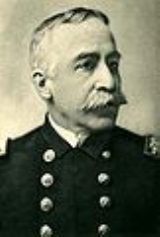
George Dewey

Overview
Admiral
Admiral is the rank, or part of the name of the ranks, of the highest naval officers. It is usually considered a full admiral and above vice admiral and below admiral of the fleet . It is usually abbreviated to "Adm" or "ADM"...
of the United States Navy
United States Navy
The United States Navy is the naval warfare service branch of the United States Armed Forces and one of the seven uniformed services of the United States. The U.S. Navy is the largest in the world; its battle fleet tonnage is greater than that of the next 13 largest navies combined. The U.S...
. He is best known for his victory at the Battle of Manila Bay
Battle of Manila Bay (1898)
The Battle of Manila Bay took place on 1 May 1898, during the Spanish-American War. The American Asiatic Squadron under Commodore George Dewey engaged and destroyed the Spanish Pacific Squadron under Admiral Patricio Montojo y Pasarón...
during the Spanish-American War
Spanish-American War
The Spanish–American War was a conflict in 1898 between Spain and the United States, effectively the result of American intervention in the ongoing Cuban War of Independence...
. He was also the only person in the history of the United States to have attained the rank of Admiral of the Navy
Admiral of the Navy (United States)
Admiral of the Navy is a rank in the United States Navy that has only been held once in history, by George Dewey. In recognition of his victory at Manila Bay in 1898, Congress authorized a single officer to hold the rank of Admiral, and promoted Dewey to this rank in March 1899...
, the most senior rank in the United States Navy.
Dewey was born in Montpelier, Vermont
Montpelier, Vermont
Montpelier is a city in the U.S. state of Vermont that serves as the state capital and the shire town of Washington County. As the capital of Vermont, Montpelier is the site of the Vermont State House, seat of the legislative branch of Vermont government. The population was 7,855 at the 2010...
, directly opposite the Vermont State House
Vermont State House
The Vermont State House, located in Montpelier, is the state capitol of Vermont and the seat of the Vermont General Assembly. The current Greek Revival structure is the third building on the same site to be used as the State House...
to Julius Yemans Dewey
Julius Yemans Dewey
Dr. Julius Yemans Dewey was an American doctor of medicine and businessman in the state of Vermont during the 19th century. He was born in Berlin, Vermont. He attended Washington County Grammar School and then the University of Vermont....
and his first wife, Mary Perrin. Julius was a physician
Physician
A physician is a health care provider who practices the profession of medicine, which is concerned with promoting, maintaining or restoring human health through the study, diagnosis, and treatment of disease, injury and other physical and mental impairments...
, having received his degree from The University of Vermont.
Unanswered Questions
