
All Topics  
Metropolitan Opera

 
Metropolitan Opera

   Email Print
   Bookmark   Link


Metropolitan Opera


The Metropolitan Opera Association of New York City, founded in April 1880, is a major presenter of all types of opera including Grand Opera
Grand Opera

File:Robert-le-diable.jpgGrand Opera is a genre of 19th-century opera generally in four or five acts, characterised by large-scale casts and orchestras, and lavish and spectacular design and stage-effects, normally with plots based on or around dramatic historic events....
. Peter Gelb
Peter Gelb

Peter Gelb is an American arts administrator. He is currently General Manager of the Metropolitan Opera in New York City....
 is the company's general manager and James Levine
James Levine

James Lawrence Levine is an United States orchestral conducting and piano. He is currently the music director of the Metropolitan Opera and of the Boston Symphony Orchestra....
 is music director.

The Metropolitan Opera is America's largest classical music organization, and annually presents some 220 opera performances. The home of the company, the Metropolitan Opera House, is considered by many to be one of the premier opera stages in the world, and is among the largest in the world.


Discussion
Ask a question about 'Metropolitan Opera'
Start a new discussion about 'Metropolitan Opera'
Answer questions from other users
Full Discussion Forum


Encyclopedia


The Metropolitan Opera Association of New York City, founded in April 1880, is a major presenter of all types of opera including Grand Opera
Grand Opera

File:Robert-le-diable.jpgGrand Opera is a genre of 19th-century opera generally in four or five acts, characterised by large-scale casts and orchestras, and lavish and spectacular design and stage-effects, normally with plots based on or around dramatic historic events....
. Peter Gelb
Peter Gelb

Peter Gelb is an American arts administrator. He is currently General Manager of the Metropolitan Opera in New York City....
 is the company's general manager and James Levine
James Levine

James Lawrence Levine is an United States orchestral conducting and piano. He is currently the music director of the Metropolitan Opera and of the Boston Symphony Orchestra....
 is music director.

The Metropolitan Opera is America's largest classical music organization, and annually presents some 220 opera performances. The home of the company, the Metropolitan Opera House, is considered by many to be one of the premier opera stages in the world, and is among the largest in the world. The Met, as it is commonly called, is one of the twelve resident organizations at Lincoln Center for the Performing Arts
Lincoln Center for the Performing Arts

Lincoln Center for the Performing Arts is a complex of buildings in New York City....
.

The Met presents a wide array of about twenty-seven operas each year in a season which lasts from mid-September through May. The operas are presented in a rotating repertory schedule with seven performances of four different works presented each week. Performances are given in the evening Monday through Saturday with a matinée on Saturday. Several new opera productions are offered each season. Sometimes these are borrowed from or shared with other major opera houses. The rest are given in revivals of productions from previous seasons.

The Met's huge performing company consists of a large symphony-sized orchestra, a chorus, children's choir, ballet company, and many supporting and leading solo singers. The Met's roster of singers is drawn from the ranks of the world's most famous artists. Some of its singers' careers have been developed by the Met itself through its young artists programs. Others have been engaged from companies around the world. Many, such as Luciano Pavarotti
Luciano Pavarotti

Luciano Pavarotti Italian orders of merit was an Italian opera tenor, who also crossed over into popular music. He was the most commercially successful tenor of all....
, have achieved world fame while singing at the Met, and a number, such as Renée Fleming
Renée Fleming

File:Ren?e Fleming 2008.jpgRen?e Fleming is an accomplished American soprano specializing in opera and lieder. Fleming possesses an agile full lyric soprano voice endowed with ringing freedom and apparent ease near the extreme top of its range....
 and Plácido Domingo
Plácido Domingo

Jos? Pl?cido Domingo Embil Order of the British Empire , better known as Pl?cido Domingo, is a Spanish tenor, known for his versatile and strong voice, possessing a ringing and dramatic tone throughout its range....
, are longtime regular members of the Met's roster (Domingo has sung at the Met since the late 1960s).

The Met's artistic standards are considered to be among the highest in the world. The company's stage facilities and technical staff offer leading directors and designers a state of the art environment in which to create any kind of production. The Met's production designs range from elegant and traditional to highly innovative and avant-garde.

Beyond performing in the opera house in New York, the Met has gradually expanded its audience as new technologies have become available. It has broadcast live weekly on radio since 1931 and has regularly presented performances on television since 1977. In 2006, the Met further introduced the innovations of live satellite radio broadcasts four times a week and live high-definition video transmissions presented to audiences in cinemas throughout the world.

History of the company

Metropolitan Opera 1937
The Metropolitan Opera Association was founded in 1880 to create an alternative to the Academy of Music
Academy of Music (Manhattan)

The Academy of Music was a theater and opera house located at 14th Street and Irving Place in Manhattan, New York City. The Academy was built in 1854 and seated approximately 1,500 people....
. The Academy represented the highest social circle in New York society, and the board of directors were loath to admit members of new wealthy families into their circle. The initial group of subscribers included the Morgan, Roosevelt, Astor and Vanderbilt families. Their creation, The Metropolitan Opera, has long outlasted the Academy. Henry Abbey
Henry Eugene Abbey

Henry Eugene Abbey was an United States theatre management and Theatrical producer. During the 1870s - 1890s, he managed such prominent Broadway theatres as Booth's, Wallack's, and the Park Theatre, promoting the talents of some of the foremost American actors of his day, as well as European stars....
 served as manager for the inaugural season 1883-84 which opened with a performance of Gounod's Faust
Faust (opera)

Faust is an opera in five acts by Charles Gounod to a French language libretto by Jules Barbier and Michel Carr? from Carr?'s play Faust et Marguerite, in turn loosely based on Goethe's Faust Part One....
 on October 22, 1883 starring the Swedish soprano Christine Nilsson.

Following Abbey's inaugural season, which had resulted in very large deficits, operas were given by a "pick-up" ensemble of relatively inexpensive German singers (which nevertheless included some of the most celebrated singers in Germany) who performed an international repertory, albeit in German.

This anomalous situation terminated at the time of the Great Fire, following which the Golden Age of Opera arrived at the Metropolitan under the celebrated management of Maurice Grau 1892-1903. The greatest (and most highly paid) operatic artists in the world then graced the stage of the Metropolitan Opera House, notably the brothers Jean
Jean de Reszke

Jean de Reszke, born Jan Mieczyslaw, was a Poland tenor. He enjoyed international renown for the quality of his singing and the elegance of his bearing and he became the biggest male opera star of the late 19th century....
 and Edouard de Reszke
Edouard de Reszke

Edouard de Reszke, born as Edward, was a Polish operatic Bass born in Warsaw.Edouard de Reszke learnt singing first in Warsaw, then in Italy....
, Lilli Lehmann
Lilli Lehmann

Lilli Lehmann was a Germany operatic soprano of phenomenal versatility.The future opera star's father, August Lehmann, was a singer while her mother, Maria Theresia L?w , was a soprano of Jewish origin....
, Lillian Nordica
Lillian Nordica

Lillian Nordica , was a United States opera singer who had an important international career.She established herself as one of the foremost dramatic sopranos of the late 19th century and early 20th century due to the high quality of her powerful voice and her ability to perform an unusually wide range of roles in German, French and Italian...
, Nellie Melba
Nellie Melba

Dame Nellie Melba Order of the British Empire , born Helen Porter Mitchell, legendary Australian opera soprano and one of the most famous sopranos, was the first Australian to achieve international recognition in the form....
, Milka Trnina, Emma Eames
Emma Eames

Emma Eames was an American soprano. She sang lyric and lyric-dramatic roles in opera and enjoyed a brilliant career in New York, London and Paris during the last decade of the 19th century and the first decade of the 20th century....
, Sofia Scalchi
Sofia Scalchi

Sofia Scalchi was an Italian contralto. Born in Turin, she studied with Augusta Boccabadati, making her debut in Mantua in Un ballo in maschera in 1866....
, Francesco Tamagno
Francesco Tamagno

Francesco Tamagno was an Italy opera singer who performed to enormous acclaim in Europe and America.The most famous heroic tenor of his age, Tamagno was celebrated throughout the operatic world for the extreme power of his singing, especially in the upper register....
, Jean Lassalle
Jean Lassalle

Jean Lassalle is a France Occitania politician and Union for French Democracy deputy in the French National Assembly....
, Mario Ancona
Mario Ancona

Mario Ancona was an Italian baritone, born in Livorno, Tuscany to a Jewish family. A master of bel canto singing, he enjoyed an international reputation as a star of what is commonly referred to as the "Golden Age of Opera"....
, Victor Maurel
Victor Maurel

Victor Maurel was a French operatic baritone who enjoyed an international reputation as a great singing-actor.Educated in music at the Paris Conservatory, he made his debut in opera in Marseilles in 1867, before appearing in the following year in Paris....
, Antonio Scotti
Antonio Scotti

Antonio Scotti was an Italy baritone. He was a principal artist of the New York Metropolitan Opera for more than 30 years but also sang with great success at London's Royal Opera House, Covent Garden....
 and Pol Plançon
Pol Plançon

Pol-Henri Plan?on was a French operatic Bass and one of the most acclaimed singers during the 1890s and early 1900s, a period often referred to as the "Golden Age of Opera"....
.

From 1898 to 1986, the Metropolitan Opera went on a six-week tour following its season in New York. These were cancelled because of financial losses.

Lionel Mapleson (1865–1937), a violinist and librarian of the Metropolitan, made the first recordings of live performances at the Metropolitan. From 1900 to 1904, Lionel Mapleson set up an Edison cylinder machine in the Metropolitan Opera House to record excerpts of performances. These cylinders, known as the Mapleson Cylinders
Mapleson Cylinders

The Mapleson Cylinders are a group of more than 100 phonograph cylinders recorded live at the Metropolitan Opera House, primarily in the years 1901-1903, by Lionel Mapleson....
, preserve an early audio glimpse of the Met and are the only known extant recordings of some performers, including Jean de Reszke
Jean de Reszke

Jean de Reszke, born Jan Mieczyslaw, was a Poland tenor. He enjoyed international renown for the quality of his singing and the elegance of his bearing and he became the biggest male opera star of the late 19th century....
. The recordings were later issued on a series of LPs and, in 2002, were included in the National Recording Registry. While many of the cylinders became greatly worn over the years, some still retain remarkable sound, particularly of choruses such as the waltz and "Soldier's Chorus" from Faust and the triumphal scene from Act 2 of Aida. Mapleson placed his machine in various locations, including the prompter's box, the side of the stage, and in the "flies", which enabled him to record the soloists, chorus, and orchestra, as well as the audience's applause. Many of the original cylinders are preserved in the Rodgers & Hammestein Archives of Recorded Sound at the New York Public Library for the Performing Arts.

The administration of Heinrich Conried
Heinrich Conried

Heinrich Conried was a theatrical manager and director of the Metropolitan Opera in New York City.Born into a Silesian weaver family he received his education at the Realschule in Vienna, Austria....
 in 1903–1908, which saw the arrival of Enrico Caruso
Enrico Caruso

Enrico Caruso was an italians tenor. Caruso was also one of the most significant and renowned singers in any genre in both the 19th and 20th Centuries, and one of the most important pioneers of recorded music....
, unquestionably the most celebrated singer who ever appeared at the Old Metropolitan, was followed by the 25-year reign, 1908-1935 of the magisterial Giulio Gatti-Casazza
Giulio Gatti-Casazza

Giulio Gatti-Casazza was the manager of La Scala and then the Metropolitan Opera in New York City, in the early 20th century....
, whose model planning, authoritative organizational skills and brilliant casts raised the level of Metropolitan Opera to a prolonged and unforgettable Silver Age. A prominent lawyer Paul Cravath
Paul Cravath

Paul Drennan Cravath was a millionaire lawyer of Manhattan and a Equity partner of the law firm today known as Cravath, Swaine & Moore....
 became Chairman of the Met. in 1931.

Again, the greatest singers and conductors appeared at the Met. At one point, both Arturo Toscanini
Arturo Toscanini

Arturo Toscanini was an Italian people conductor. One of the most acclaimed musicians of the late 19th and 20th Centuries, he was renowned for his brilliant intensity, his restless perfectionism, his phenomenal ear for orchestral detail and sonority, and his photographic memory....
 and Gustav Mahler
Gustav Mahler

Gustav Mahler was a Bohemian-born Austrian composer and conducting. He was best known during his own lifetime as one of the leading orchestral and operatic conductors of the day....
 were regular conductors at the Met.

The noted Canadian operatic tenor, Edward Johnson, was general manager between 1935 and 1950, successfully guiding the company through the dark years of the Depression and World War II. Zinka Milanov
Zinka Milanov

Zinka Milanov n?e Zinka Kunc was a Croatian-born operatic Voice type.Born in Zagreb, she studied with the Wagnerian soprano Milka Ternina and her assistant Marija Kostrencic....
, Jussi Björling
Jussi Björling

Johan Jonatan was a Sweden operatic tenor, Grammy Award for Best Classical Vocal Performance ....
, Richard Tucker
Richard Tucker

Richard Tucker was a highly regarded American operatic tenor.Tucker was born Rivn Ticker in Brooklyn, New York, into a family of immigrants from Bessarabia ....
 and Robert Merrill
Robert Merrill

Robert Merrill was an American operatic baritone. While there has been dispute regarding his birth year , the Social Security Death Index, his family, and his gravestone state that he was born in 1917....
 were first heard at the Met under his management. Sir Thomas Beecham, George Szell
George Szell

George Szell , originally Gy?rgy Sz?ll or Georg Szell, was a Hungary-born American conducting and composer. He is remembered today for his long and successful tenure as music director of the Cleveland Orchestra, and for the recordings of the standard classical repertoire he made in Cleveland and with other orchestras....
 and Bruno Walter
Bruno Walter

Bruno Walter was a Germany-born Conducting and composer. He was born in Berlin, but moved to several countries between 1933 and 1939, finally settling in the United States in 1939....
 were among the great conductors of the Johnson era.

The Austrian-born Rudolf Bing, was the one of the Met's most influential leaders. His tenure as general manager from 1950 to 1972 was, so far, the longest in Met history. Bing modernized the administration of the Company, ended an archaic ticket sales system, and ended the Company's weekly one-night stands in Philadelphia. He presided over an era of great singing and glittering new productions, and guided the company's move to a new home in Lincoln Center. Among the many great artists Sir Rudolf introduced to New York audiences were Maria Callas
Maria Callas

Maria Callas was an American-born Greeks soprano and one of the most renowned opera singers of the twentieth century. She combined an impressive bel canto technique with great dramatic gifts....
, Leonie Rysanek
Leonie Rysanek

Leopoldine "Leonie" Rysanek was an Austrian dramatic soprano.Rysanek was born in Vienna and made her operatic debut in 1949 in Innsbruck. Her Metropolitan Opera debut came in 1959 as Lady Macbeth , replacing Maria Callas who had been "fired" from the production....
, Birgit Nilsson
Birgit Nilsson

Birgit Nilsson was a Sweden dramatic soprano who specialized in operatic and symphonic works. Her voice was noted for its overwhelming force, bountiful reserves of power and the gleaming brilliance and clarity in the upper register....
, Renata Tebaldi
Renata Tebaldi

Renata Tebaldi was an Italian lirico-spinto soprano, popular in the post-World War II period. Acclaimed as one of the most beloved opera singers of all time, she primarily focused on the verismo roles of the lyric and dramatic repertoires....
, Christa Ludwig
Christa Ludwig

Christa Ludwig is a Germany retired mezzo-soprano, distinguished for her performances of opera and Lieder. Her career spanned from the late 1940s until the early 1990s....
, Renata Scotto
Renata Scotto

Renata Scotto is an Italy soprano. Since retiring from the stage as a singer in 2002, she has turned to directing opera as well as teaching at her own opera academy in Italy and New York....
, Dame Joan Sutherland, Lisa Della Casa
Lisa Della Casa

Lisa Della Casa is a Switzerland soprano who was famous for her interpretation of works by Wolfgang Amadeus Mozart and Richard Strauss as well as for her great beauty....
, Victoria de los Ángeles
Victoria de los Ángeles

Victoria de los ?ngeles was a Spanish operatic soprano and recitalist from Catalonia whose career began in the early 1940s and reached its height in the mid 1960s....
, Elisabeth Schwarzkopf
Elisabeth Schwarzkopf

Dame Elisabeth Schwarzkopf, Order of the British Empire was a German-born Austrian/British opera singer and recitalist. She was amongst the most renowned opera singers of the 20th Century, much admired for her performances of Wolfgang Amadeus Mozart, Richard Strauss and Hugo Wolf....
, Montserrat Caballé
Montserrat Caballé

Montserrat Caball? is a Spain Catalan people operaticsoprano. One of the greatest sopranos of the 20th century,she possesses a voice of remarkable beauty and of great range...
, Mirella Freni
Mirella Freni

Mirella Freni is an Italian opera soprano much admired for the youthful quality of her voice, her phrasing and thoughtful character interpretations and acting skills....
, Mario del Monaco
Mario del Monaco

Mario Del Monaco was an Italian tenor and is regarded by his admirers as being one of the greatest dramatic tenors of the 20th Century.Del Monaco was born Florence to a musical upper-class family....
, Franco Corelli
Franco Corelli

Franco Corelli was an Italian tenor active in opera from 1951 to 1976. Associated in particular with the big spinto and dramatic tenor roles of the Italian repertory, he was celebrated internationally for his handsome stage presence and thrilling upper register....
, Carlo Bergonzi
Carlo Bergonzi

Carlo Bergonzi is an Italian operatic tenor. Although he performed and recorded some bel canto and verismo roles, he is above all associated with the operas of Giuseppe Verdi, including a large number of the composer's lesser-known works that he helped revive....
, Nicolai Gedda
Nicolai Gedda

The Sweden tenor Nicolai Gedda is a famous opera singer and recitalist. Having made some two hundred recordings, Gedda is said to be the most widely recorded tenor in history....
, Plácido Domingo
Plácido Domingo

Jos? Pl?cido Domingo Embil Order of the British Empire , better known as Pl?cido Domingo, is a Spanish tenor, known for his versatile and strong voice, possessing a ringing and dramatic tone throughout its range....
, Jon Vickers
Jon Vickers

Jon S. Vickers, Order of Canada is a Canada tenor.Born in Prince Albert, Saskatchewan, he was the sixth in a family of eight children. In 1950, he was awarded a scholarship to study opera at Toronto?s Royal Conservatory of Music ....
, Sherrill Milnes
Sherrill Milnes

Sherrill Milnes is an United States operatic baritone most famous for his Giuseppe Verdi roles. From 1965 until 1997 he was associated with the Metropolitan Opera....
, Giorgio Tozzi
Giorgio Tozzi

Giorgio Tozzi was for many years a leading basso with the Metropolitan Opera, and was seen playing lead roles in nearly every major opera house world-wide....
 and Cesare Siepi
Cesare Siepi

Cesare Siepi is an Italy opera singer, generally considered to be one of the finest Basso of the post-war period. His voice was characterised by a deep, warm timbre, and a ringing, vibrant upper register....
. Critics of Bing complained of a lack of great conducting during his regime, but he did offer such fine conductors as Fritz Stiedry
Fritz Stiedry

Fritz Stiedry was an Austrian conducting.While studying law at the University of Vienna, Stiedry's musical abilities were noticed by Gustav Mahler who appointed him his assistant at the Vienna Court Opera in 1907....
, Dimitri Mitropoulos, Pierre Monteux
Pierre Monteux

Pierre Monteux was an orchestra conducting. Born in Paris, France, rue de la Grange Bateli?re. Monteux later became an American citizen....
, Erich Leinsdorf
Erich Leinsdorf

Erich Leinsdorf was an Austrian-born American conducting. He performed and recorded with leading orchestras and opera companies throughout the United States and Europe, earning a reputation for exacting standards as well as an acerbic personality....
, Fritz Reiner
Fritz Reiner

Frederick Martin ?Fritz? Reiner was a prominent Conducting of opera and symphonic music in the twentieth century....
, Karl Böhm
Karl Böhm

Karl August Leopold B?hm was an Austrian Conducting....
 and Herbert von Karajan
Herbert von Karajan

Herbert von Karajan was an Austrian orchestra and opera conducting, one of the most renowned 20th-century conductors. His obituary in The New York Times described him as "probably the world's best-known conductor and one of the most powerful figures in classical music." Karajan conducted the Berlin Philharmonic for thirty-five years....
.

Among the achievements of Bing's tenure was the integration of the Met's artistic roster. Marian Anderson
Marian Anderson

Marian Anderson was an United States Contralto and one of the most celebrated singers of the twentieth century. She possessed a rich and vibrant voice with an intrinsic quality of beauty....
's historic 1955 debut was followed by the introduction of a whole generation of fine African-American artists led by Leontyne Price
Leontyne Price

Mary Violet Leontyne Price in Laurel, Mississippi in the United States is one of America's most beloved and widely recorded operatic sopranos....
 (who inaugurated the new house in Lincoln Center), Grace Bumbry
Grace Bumbry

Grace Bumbry , an United States opera singer, was considered one of the leading mezzo-sopranos of her generation, as well as a major soprano for many years....
, Shirley Verrett
Shirley Verrett

Shirley Verrett is an American operatic mezzo-soprano and soprano. Verrett enjoyed great fame from the late 1960s and was much admired for her radiant voice, beauty, and great versatility....
, George Shirley
George Shirley

George Irving Shirley is a renowned tenor opera singer.At the age of 6, his family relocated to Detroit, Michigan, where he began music lessons....
, and many others.

Following Bing's retirement in 1972, the Met's management was overseen by a succession of executives. Bing's intended successor, the Swedish opera manager Göran Gentele
Göran Gentele

G?ran Gentele was a Sweden actor, Film director, and opera manager.Born in Stockholm, Gentele studied from 1944 until 1946 at the Dramatens elevskola, beginning a brief career as a film actor not long afterwards....
, tragically died in an auto accident before the start of his first season. Following Gentele, there were Schuyler Chapin
Schuyler Chapin

Schuyler Garrison Chapin was an assistant general manager of the Metropolitan Opera and a Commissioner of Cultural Affairs for New York City during the administration of Mayor Rudolph Giuliani....
, Anthony Bliss
Anthony Bliss

Anthony Bliss was a clergyman of the Church of England.Rev Anthony Bliss was the Vicar of Meriden, West Midlands and the incumbent of Castle Bromwich, both in the County of Warwick in the 18th century....
, Bruce Crawford and Hugh Southern. All of these men led the Met in partnership with Music Director James Levine
James Levine

James Lawrence Levine is an United States orchestral conducting and piano. He is currently the music director of the Metropolitan Opera and of the Boston Symphony Orchestra....
, the Met's guiding artistic force through the last third of the 20th century.

Joseph Volpe was the Met's second-longest serving manager, 1990-2006. He was the first head of the Met to advance from within the ranks of the company, having started his career there as a carpenter in 1964. Volpe expanded the Met's international touring activities and inaugurated the orchestra's Carnegie Hall series. During his tenure the Met considerably expanded its repertory, offering four world premiers and 22 Met premiers, more new works than under any manager since Gatti-Casazza. Volpe named Valery Gergiev
Valery Gergiev

Valery Abisalovich Gergiev is a Russian conducting and opera company director. He is general director and artistic director of the Mariinsky Theatre, principal conductor of the London Symphony Orchestra, and principal guest conductor of the Metropolitan Opera....
 as Principal Guest Conductor in 1997 and broadened the Met's Russian repertory. Cecilia Bartoli, Diana Damrau, Natalie Dessay, Renée Fleming, Juan Diego Florez, Marcello Giordani, Angela Gheorghiu, Susan Graham, Ben Heppner, Dmitri Hvorostovsky, Salvatore Licitra, Anna Netrebko, Rene Pape, Bryn Terfel and Deborah Voigt were among the artists first heard at the Met under his management.

The current General Manager is Peter Gelb
Peter Gelb

Peter Gelb is an American arts administrator. He is currently General Manager of the Metropolitan Opera in New York City....
. He began outlining his plans for the future in April 2006; these included more new productions each year, ideas for shaving staging costs and attracting new audiences without deterring existing opera-lovers (whose average age at the Met is over 60). Gelb saw these issues as crucial for an organization which, to a far greater extent than any of the other great opera theatres of the world, is dependent on private financing.

Gelb began his tenure by opening the 2006-2007 season with a colorful and highly stylized new production of Madama Butterfly
Madama Butterfly

Madama Butterfly is an opera in three acts by Giacomo Puccini, with an Italian libretto by Luigi Illica and Giuseppe Giacosa....
 by the English director Anthony Minghella
Anthony Minghella

Anthony Minghella Order of the British Empire was an Academy Awards-winning England film director, playwright and screenwriter. He was Chairman of the Board of Governors at the British Film Institute between 2003 and 2007....
. Minghella's highly theatrical concept featured vividly colored banners on a spare stage allowing the focus to be on the detailed acting of the singers. The abstract concept included casting the son of Cio-Cio-San as a bunraku-style puppet, operated in plain sight by three puppeteers clothed in black.

Until the late 1990s, the Metropolitan Opera was rather traditional in its new production designs. Recently, following the influence originating from Patrice Chéreau
Patrice Chéreau

Patrice Ch?reau is a France opera and theatre director, filmmaker, actor, and Television producer....
 and trends already established in many other opera houses around the world (particularly those in Europe), that tradition seems to be changing and traditionally-designed operas are becoming rarer at the Met.

In the 1990s, only limited productions used a symbolic type of scenery (starting from Der Fliegende Holländer in 1989; then Samson et Dalila
Samson and Delilah (opera)

Samson et Dalila , Op. 47, is a Grand Opera in three acts and four tableaux by Camille Saint-Sa?ns to a French language libretto by Ferdinand Lemaire....
 in 1998; and Tristan und Isolde
Tristan und Isolde

Tristan und Isolde is an opera, or music drama, in three acts by Richard Wagner to a German language libretto by the composer, based largely on the romance by Gottfried von Stra?burg....
). For The Rake's Progress
The Rake's Progress

The Rake's Progress is an opera in three acts and an epilogue by Igor Stravinsky. The libretto written by W. H. Auden and Chester Kallman is based loosely on the eight paintings and engravings A Rake's Progress of William Hogarth, which Stravinsky had seen on May 2, 1947, in a Chicago exhibition....
 in 1999 and Mefistofele
Mefistofele

Mefistofele is an opera in a prologue, four acts and an epilogue, the only completed opera by the Italy composer-librettist Arrigo Boito.Boito began consideration of an opera on the Faustian theme after completing his studies at the Milan Conservatory in 1861....
 in 2000, contemporary style business-like suits were used for the main characters (in operas which were supposed to be set centuries before). Similar things occurred in La Juive
La Juive

La Juive is a grand opera in five acts by Fromental Hal?vy to an original France libretto by Eug?ne Scribe....
 (2003)Salome
Salome (opera)

Salome is an opera in one act by Richard Strauss to a German language libretto by the composer, based on Hedwig Lachmann?s German translation of the French language play Salome by Oscar Wilde....
 (2004).

The trend towards "modernization" continued further under the new management in 2007 when a flushing toilet was used during the new production of Gianni Schicchi
Gianni Schicchi

Gianni Schicchi is an opera in one act by Giacomo Puccini to an Italian libretto by Giovacchino Forzano, based on a story that is referred to in Dante The Divine Comedy....
 (for a work which is supposed to take place in the year 1299). Victorian era costumes and surroundings were adopted as the scenery for 17th century Scotland
Scotland

conventional_long_name = ScotlandAlba|common_name= Scotland|image_flag = Flag of Scotland.svg|flag_width = 130px...
 in Lucia di Lammermoor
Lucia di Lammermoor

Lucia di Lammermoor is a dramma tragico in three acts by Gaetano Donizetti. Salvatore Cammarano wrote the Italian language libretto loosely based upon Sir Walter Scott's historical novel The Bride of Lammermoor....
. Similarly, even greater contrast existed with the substitution of the original Scotland of the early Middle Ages
Middle Ages

File:Karl 1 mit papst gelasius gregor1 sacramentar v karl d kahlen.jpgThe Middle Ages of European history are a period in history which lasted for roughly a millennium, commonly dated from the fall of the Roman Empire in the 5th century to the beginning of the Early Modern Period in the 16th century, marked by the division of Western Christi...
  for a mixture of 20th century items of clothing (including tuxedos, etc.) in a new production of Macbeth
Macbeth (opera)

Macbeth is an opera in four acts by Giuseppe Verdi, with an Italian libretto by Francesco Maria Piave and additions by Andrea Maffei, based on Shakespeare's Macbeth....
 or such oddity as World War I outfit plus punching in anger on piano keyboard with fists (or open palms) during the recent (2008) production of La fille du régiment
La fille du régiment

La fille du r?giment is an op?ra comique in two acts by Gaetano Donizetti. Written while the composer was living in Paris, the French libretto is by Jules-Henri Vernoy de Saint-Georges and Jean-Fran?ois Bayard....
.

Technological innovations


Met Titles

In 1995, under general manager Joseph Volpe, the Met installed its own system of simultaneous translations of opera texts designed for the particular needs of the Met and its audiences. Called "Met Titles", the $2.7 million electronic libretto system
Electronic libretto

The Electronic libretto system is used primarily in List of opera houses and is a device which presents translations of lyrics into an audience's language or transcribes lyrics that may be difficult to understand in the sung form....
 provides the audience with a translation of the opera's text in English on individual screens mounted in front of each seat. This system was the first in the world to be placed in an opera house with "each screen (having) a switch to turn it off, a filter to prevent the dim, yellow dot-matrix characters from disturbing nearby viewers and the option to display texts in multiple languages for newer productions (currently Spanish and German). Custom-designed, the system features rails of different heights for various sections of the house, individually designed displays for some box seats and commissioned translations costing up to $10,000 apiece." Due to the height of the Met's proscenium, it was not feasible to have titles displayed above the stage, as is done in most other opera houses. The idea of above-stage titles had been vehemently opposed by music director James Levine, but the "Met Titles" system has since been acknowledged as an ideal solution, offering texts to only those members of the Met audience that desire them.

Tessitura software

In 1998, Volpe initiated the development of a new software application, now called Tessitura
Tessitura software

Tessitura is an enterprise application used by arts organisations to manage their activities in the key commercial areas of Ticketing, Fundraising, Customer Relationship Management, and Marketing....
. Tessitura uses a single database of information to record, track and manage all contacts with the Met's constituents, conduct targeted marketing and fund raising appeals, handle all ticketing and membership transactions, and provide detailed and flexible performance reports. Beginning in 2000, Tessitura was offered to other arts organizations under license, and it is now used by a cooperative network of more than 200 opera companies, symphony orchestras, ballet companies, theater companies, performing arts centers, and museums in the United States, Canada, the United Kingdom, Australia, New Zealand, and Ireland.

The Met on radio and TV, and in movie theaters


Radio broadcasts

Outside of New York the Met has been known to audiences in large measure through its many years of live radio broadcasts. The Met's broadcast history goes back to January 1910 when radio pioneer Lee De Forest
Lee De Forest

Lee De Forest was an United States inventor with over 180 patents to his credit. De Forest invented the Audion tube, a vacuum tube that takes relatively weak electrical signals and amplifies them....
 broadcast experimentally, with erratic signal, two live performances from the stage of the Met that were reportedly heard as far away as Newark, New Jersey. Today the annual Met broadcast season typically begins the first week of December and offers twenty live Saturday matinée performances through May

The first network broadcast was heard on December 25, 1931, a performance of Engelbert Humperdinck's Hänsel und Gretel. The series came about as the Met, financially endangered in the early years of the Great Depression, sought to enlarge its audience and support through national exposure on network radio. Initially, those broadcasts featured only parts of longer operas, being limited to selected acts. Regular broadcasts of complete operas began March 11, 1933, with the transmission of Tristan und Isolde
Tristan und Isolde

Tristan und Isolde is an opera, or music drama, in three acts by Richard Wagner to a German language libretto by the composer, based largely on the romance by Gottfried von Stra?burg....
 with Frida Leider and Lauritz Melchior
Lauritz Melchior

Lauritz Melchior was a Danish people and later American opera singer. He was the pre-eminent Wagnerian tenor of the late 1920s, 1930s, and 1940s, and has since come to be considered the quintessence of his voice type....
.

The live broadcasts were originally heard on NBC Radio's Blue Network
Blue Network

The Blue Network was the on-air name of an American radio production and distribution service from 1942 to 1945, which traced its formal origins back to 1927....
 and continued on the Blue Network's successor, ABC, into the 1960s. As network radio waned, the Met founded its own Metropolitan Opera Radio Network which is now heard on radio stations around the world. In Canada the live broadcasts have been heard since December 1933 first on the Canadian Radio Broadcasting Commission
Canadian Radio Broadcasting Commission

The Canadian Radio Broadcasting Commission was Canada's first public broadcaster and the immediate precursor to the Canadian Broadcasting Corporation....
 and, since 1934, on its successor, the Canadian Broadcasting Corporation
Canadian Broadcasting Corporation

The Canadian Broadcasting Corporation , a Canada crown corporation, is the country?s national public radio and television broadcaster. In French, it is called la Soci?t? Radio-Canada ....
 where they are currently heard on CBC Radio 2.

Technical quality of the broadcasts steadily improved over the years. FM broadcasts were added in the 1950s, transmitted to stations via telephone lines. With the arrival of 1973/74 broadcasting season (December 1973), all broadcasts were offered in FM
FM broadcasting

FM broadcasting is a broadcasting technology invented by Edwin Howard Armstrong that uses frequency modulation to provide high-fidelity sound over broadcast radio....
 stereo
Stereophonic sound

Stereophonic sound, commonly called stereo, is the reproduction of sound, using two or more independent Sound recording and reproduction channels, through a symmetrical configuration of loudspeakers, in such a way as to create a pleasant and natural impression of sound heard from various directions, as in natural hearing....
. Satellite technology later allowed uniformly excellent broadcast sound to be sent live worldwide.

The first broadcasts were offered by NBC itself. Later, commercial sponsors included Colgate-Palmolive. Sponsorship of the Saturday afternoon broadcasts by The Texas Company (Texaco
Texaco

Texaco is the name of an United States petroleum retail brand. Its flagship product is its fuel,"Texaco with Techron". It also owns the Havoline motor oil brand....
) began on December 7, 1940 with Mozart's Le nozze di Figaro. Texaco's support continued for 63 years, the longest continuous sponsorship in broadcast history and included the first PBS television broadcasts. After its merger with Chevron
Chevron Corporation

Chevron Corporation is the world's fourth largest non-government energy corporation. Headquartered in San Ramon, California, United States, and active in more than 180 countries, it is engaged in every aspect of the Petroleum and gas industry, including exploration and Petroleum#Extraction; refining, marketing and transport; chemicals m...
, however, the combined company ChevronTexaco ended its sponsorship of the Met's radio network in April 2004. Emergency grants allowed the broadcasts to continue through 2005 when the home building company Toll Brothers
Toll Brothers

Toll Brothers is a Horsham, Pennsylvania, Pennsylvania based luxury homes builder....
 stepped in to become primary sponsor.

In the seven decades of its Saturday broadcasts, the Met has been introduced by the voices of only three permanent announcers. The legendary Milton Cross
Milton Cross

Milton John Cross was an American radio announcer famous for his work on the NBC and ABC radio networks. He was best known as the voice of the Metropolitan Opera, hosting its Saturday afternoon radio broadcasts for forty-three years, from the time of their inception in 1931 until his death in 1975....
 served from the inaugural broadcast until his death in 1975. He was succeeded by Peter Allen, who presided for 29 years through the 2003-2004 season. The present host of the broadcasts, Margaret Juntwait
Margaret Juntwait

Margaret Juntwait is an American radio broadcaster who is the voice of the Metropolitan Opera's Saturday afternoon broadcasts. She debuted in this position on December 11, 2004, replacing Peter Allen upon his retirement after twenty-nine years....
, began her tenure the following season. Since September 2006 she has also served as host for all of the live and recorded broadcasts on the Met's Sirius satellite radio channel. Other announcers have included Lloyd Moss who twice substituted for Cross and Deems Taylor
Deems Taylor

Deems Taylor was a United States of America composer, music critic, and promoter of classical music.Taylor was born in New York City and educated at New York University ....
 who was heard briefly as co-host during the early years. In recent seasons William Berger
William Berger (author)

William Berger is an United States author, radio music host and commentator.Born in California ca. 1960, studied Romance languages and musicology at the University of California, Santa Cruz....
 and Ira Siff have been heard as co-hosts with Miss Juntwait.

Satellite radio

Metropolitan Opera Radio, is a 24 hour opera channel on Sirius Satellite Radio
Sirius Satellite Radio

Sirius Satellite Radio is a satellite radio service operating in the United States and Canada, owned by Sirius XM Radio. Headquartered in New York City, with smaller studios in Los Angeles and Memphis, Tennessee, Sirius was officially launched on July 1, 2002 and currently provides 69 streams of music and 65 streams of sports, news and ente...
 which presents three to four live opera broadcasts each week during the Met's performing season. During other hours it also offers past broadcasts from the Met's archives. It was created in September 2006 when the Met initiated a multi-year relationship with Sirius. Margaret Juntwait is the host and announcer.

Television

The Met's experiments with television go back to 1948 when Verdi's Otello, was broadcast complete live on ABC-TV with Ramon Vinay
Ramón Vinay

Ram?n Vinay was a famous Chilean operatic tenor with a powerful, dramatic voice. He is probably best remembered for his appearances in the title role of Giuseppe Verdi's tragic opera Otello....
 as Othello
Othello

Othello, the Moor of Venice is a tragedy by William Shakespeare, believed to have been written in approximately 1603, and based on the Italian language short story "Un Capitano Moro" by Cinthio first published in 1565....
, Licia Albanese
Licia Albanese

Licia Albanese is a distinguished Italy soprano and chairman of The Licia Albanese-Puccini Foundation, founded in 1974 and dedicated to assisting young artists and singers....
 as Desdemona
Desdemona

Desdemona, as a name, may refer to:* Desdemona, a fictional character in a tale found in the Hecatommithi by Giovanni Battista Giraldi ...
, and Leonard Warren
Leonard Warren

Leonard Warren was a famous United States opera singer. A baritone, he was associated for many years with the Metropolitan Opera in New York City....
 as Iago
Iago

Iago is a fictional character in Shakespeare's Othello . The character's source is traced to Cinthio's tale "Un Capitano Moro" in Gli Hecatommithi ....
. The 1949 season opening Rossenkavalier was also telecast and in the early 1950s there was a short-lived experiment with closed circuit telecasts to movie theaters. Beyond these experiments, however, and an occasional gala or special, the Met did not become a regular presence on television until 1977.

In that year the company began a series of live television broadcasts on public television with a wildly successful live telecast of La Bohème
La bohème

La boh?me is an opera in four acts by Giacomo Puccini to an Italian libretto by Luigi Illica and Giuseppe Giacosa, based on Sc?nes de la vie de boh?me by Henri Murger....
 with Renata Scotto and Luciano Pavarotti. This new series of opera on PBS was called Live from the Met. This series remained on the air until the early 2000s, although the live broadcasts gave way to taped performances in the 1980s and its title became The Metropolitan Opera Presents. Many televised performances were broadcast including an historic complete telecast of Wagner's Ring Cycle in 1989. The Met returned to the air on PBS in 2007 in a new series called Great Performances @ The Met.

In addition to complete operas, television programs produced at the opera house have included: An episode of Omnibus with Leonard Bernstein (NBC, 1958); "Danny Kaye's Look-In at the Metropolitan Opera" (CBS
CBS

CBS Broadcasting Inc. is an American radio network and television network. The name is derived from the initials of Columbia Broadcasting System, its former legal name....
, 1975); "Sills and Burnett at the Met" (CBS, 1976); and the MTV Video Music Awards
MTV Video Music Awards

The MTV Video Music Awards were established in the end of the summer of 1984 in television by MTV to celebrate the top music videos of the year....
 (1999 and 2001).

The Met in movie theaters

Beginning on December 30, 2006, as part of the company's effort to build revenues and attract new audiences, the Met (along with NCM Fathom
National CineMedia

National CineMedia, LLC operates the largest digital in-theatre network in North America through long-term agreements with its founding members, AMC Theaters Inc., Cinemark USA Inc., and Regal Entertainment Group, the three largest theatre operators in the U.S., and through multiyear agreements with several other theatre operators....
) broadcast a series of six performances live via satellite into movie theaters called "Metropolitan Opera: Live in HD". The first broadcast was the Saturday matinee live performance of the 110-minute version of Julie Taymor
Julie Taymor

Julie Taymor is an United States stage director of theater, opera and film. Taymor's work has received many accolades from critics, and she has earned two Tony Awards out of four nominations, an Emmy Award, and an Academy Award nomination for her work....
's production of The Magic Flute
The Magic Flute

The Magic Flute is an opera in two acts composed in 1791 by Wolfgang Amadeus Mozart to a libretto by Emanuel Schikaneder. The work is in the form of a Singspiel, a popular form that included both singing and spoken dialogue....
. The series was carried in over 100 movie theaters across North America, Japan, Britain and several other European countries. During the 2006-07 season, the series included live HD transmissions of I Puritani
I puritani

I puritani is an opera in three acts, by Vincenzo Bellini. Libretto by Count Carlo Pepoli based on T?tes rondes et Cavaliers by Jacques-Fran?ois Ancelot and Joseph Xavier Saintine....
, The First Emperor
The First Emperor

The First Emperor is an opera in two acts with a libretto written in English language by Tan Dun and Ha Jin, and music by Tan Dun. The opera received its premiere at the Metropolitan Opera at the Lincoln Center in New York City on 21 December, 2006, conducted by the composer and with Pl?cido Domingo in the title role....
, Eugene Onegin
Eugene Onegin (opera)

Eugene Onegin, Op. 24, is an opera in 3 acts , by Pyotr Ilyich Tchaikovsky. The libretto was written by Konstantin Shilovsky and the composer and his brother Modest Ilyich Tchaikovsky, and is based on the Eugene Onegin by Alexander Pushkin....
, The Barber of Seville
The Barber of Seville

The Barber of Seville, or The Useless Precaution is an opera buffa in two acts by Gioachino Rossini with a libretto by Cesare Sterbini. The overture, first written for Aureliano in Palmira, is a famous example of Rossini's characteristic Italian style....
, and Il Trittico
Il trittico

Il trittico is the title of a collection of three one-act operas, Il tabarro, Suor Angelica, and Gianni Schicchi, by Giacomo Puccini....
. In addition, limited repeat showings of the operas were offered in most of the presenting cities. Digital sound for the performances was provided by Sirius Satellite Radio
Sirius Satellite Radio

Sirius Satellite Radio is a satellite radio service operating in the United States and Canada, owned by Sirius XM Radio. Headquartered in New York City, with smaller studios in Los Angeles and Memphis, Tennessee, Sirius was officially launched on July 1, 2002 and currently provides 69 streams of music and 65 streams of sports, news and ente...
.

These movie transmissions have received wide and generally favorable press coverage. The Met reports that 91% of available seats were sold for the HD performances. According to General Manager Peter Gelb, there were 60,000 people in cinemas around the world watching the March 24 transmission of The Barber of Seville. The New York Times reported that 324,000 tickets were sold worldwide for the 2006-07 season, while each simulcast cost $850,000 to $1 million to produce.

The 2007-08 season began on December 15, 2007 and featured eight of the Met's productions starting with Roméo et Juliette
Roméo et Juliette

Rom?o et Juliette is an opera in five acts by Charles Gounod to a French language libretto by Jules Barbier and Michel Carr?, based on The Tragedy of Romeo and Juliet by William Shakespeare....
 and ending with La fille du régiment
La fille du régiment

La fille du r?giment is an op?ra comique in two acts by Gaetano Donizetti. Written while the composer was living in Paris, the French libretto is by Jules-Henri Vernoy de Saint-Georges and Jean-Fran?ois Bayard....
 on April 26, 2008. The Met planned to broadcast to double the number of theaters in the US as the previous season, as well as to additional countries such as Belgium, France, Germany, Italy, and Spain. The number of participating venues in the US, which includes movie theatre chains as well as independent theatres and some college campus venues, is 343. While "the scope of the series expands to include more than 700 locations across North America, Europe, Asia, and Australia".

By the end of the season 920,000 people - exceeding the total number of people who attended live performances at the Met over the entire season - attended the 8 screenings bringing in a gross of $13.3 million from North America and $5 million from overseas.

Opera houses


The Met on 39th St.


The first Metropolitan Opera House opened on October 22, 1883, with a performance of Faust
Faust (opera)

Faust is an opera in five acts by Charles Gounod to a French language libretto by Jules Barbier and Michel Carr? from Carr?'s play Faust et Marguerite, in turn loosely based on Goethe's Faust Part One....
. It was located on 1411 Broadway
Broadway (New York City)

Broadway, as the name implies, is a wide avenue in New York City. While New York has several other Broadways, in the context of the city it usually refers to the Manhattan street....
, occupying the whole block between West 39th Street and West 40th Street on the west side of the street in the Garment District
Garment District, Manhattan

The Garment District is a neighborhood of the New York City borough of Manhattan, located between Fifth and Ninth Avenues from 34th to 42nd Street....
 of Midtown
Midtown Manhattan

Midtown Manhattan, or simply Midtown, is an area of Manhattan, New York City home to world-famous commercial zones such as Rockefeller Center, Broadway, and Times Square....
. Nicknamed "The Yellow Brick Brewery" for its industrial looking exterior, the original Metropolitan Opera House was designed by J. Cleaveland Cady
J. Cleaveland Cady

J Cleaveland Cady was a New York City-based architect whose most familiar surviving building is the south range of the American Museum of Natural History on New York's Upper West Side....
. On August 27, 1892 the nine-year-old theater was gutted by fire. The 1892-93 season was canceled while the opera house was rebuilt along its original lines.

In 1903 the interior of the opera house was extensively redesigned by the architects Carrère and Hastings. The familiar golden auditorium with its sunburst chandelier, and curved proscenium inscribed with the names of six composers (Gluck, Mozart, Beethoven, Wagner, Gounod and Verdi), dates from this time. The first of the Met's signature gold damask stage curtains was installed in 1906, completing the look that the old Metropolitan Opera House maintained until its closing.

In 1940 ownership of the opera house shifted from the wealthy families who occupied the theater's boxes to the non-profit Metropolitan Opera Association. At this time the last major change to the auditorium's interior was completed. The second tier of privately held boxes (the "grand tier") was converted into standard row seating. This enlarged the seating capacity and left only the first tier of boxes from the "golden horseshoe" of the opera house's origins as a showplace for New York society.

While the theater was noted for its excellent acoustics and elegant interior, as early as the turn of the century the backstage facilities were deemed to be severely inadequate for a large opera company. The Met's scenery and sets were a regular sight leaning against the building outside on 39th Street where they had to be shifted between performances. Various plans were put forward over the years to build a new home for the company and designs for new opera houses were created by various architects including Joseph Urban
Joseph Urban

Joseph Urban Born in Vienna, Austria, died in New York City, trained as an architect, known also for his theatrical design and his early illustrations of children's books....
. Proposed new locations included Columbus Circle
Columbus Circle

Columbus Circle, named for Christopher Columbus, is a major landmark and point of attraction in the New York City borough of Manhattan. Completed in 1905 and renovated a century later, it is located at the intersection of Broadway , Central Park West, Central Park South , and Eighth Avenue, at the southwest corner of Central Park, with coord...
 and what is now Rockefeller Center
Rockefeller Center

Rockefeller Center is a complex of 19 commerce buildings covering between 48th and 51st streets in New York City. Built by the Rockefeller family, it is located in the center of Midtown Manhattan, spanning between Fifth Avenue and Seventh Avenue ....
, but none of these plans came to fruition. Only with the development of Lincoln Center on New York's Upper West Side
Upper West Side

The Upper West Side is a neighborhood of the borough of Manhattan in New York City that lies between Central Park and the Hudson River above 59th Street ....
 did the Met finally have the opportunity to build a modern opera house.

The old Met closed on April 16, 1966 with a sentimental gala farewell performance featuring nearly all of the company's current leading artists. Zinka Milanov
Zinka Milanov

Zinka Milanov n?e Zinka Kunc was a Croatian-born operatic Voice type.Born in Zagreb, she studied with the Wagnerian soprano Milka Ternina and her assistant Marija Kostrencic....
 made her last Met appearance that night, and among the many invited guests was soprano Anna Case who had made her debut at the house in 1906. The original building, having failed to obtain landmark status, was razed in 1967. It was replaced by a modern office building intended to provide a steady income for the opera company.

The Met at Lincoln Center

The present Metropolitan Opera House, with approximately 3,800 seats, is located at Lincoln Center at Lincoln Square
Lincoln Square, New York

Lincoln Square is the name of both a town square and the surrounding neighborhood within the Upper West Side of the New York City borough of Manhattan....
 in the Upper West Side
Upper West Side

The Upper West Side is a neighborhood of the borough of Manhattan in New York City that lies between Central Park and the Hudson River above 59th Street ....
 and was designed by architect Wallace K. Harrison
Wallace Harrison

Wallace Kirkman Harrison , was an American twentieth-century architect.Harrison started his professional career with the firm of Corbett, Harrison & MacMurray, participating in the construction of Rockefeller Center....
. Although west-east roads do not run through Lincoln Center itself, the Metropolitan Opera House is parallel to the block from West 63rd Street to West 64th Street. The rear of the House meets Amsterdam Avenue
Tenth Avenue (Manhattan)

Tenth Avenue / Amsterdam Avenue is a north-south thoroughfare on the West Side of Manhattan in New York City. It carries uptown traffic as far as West 110th Street at the level of the northern edge of Central Park, but is two-way north of it....
 and the entrance to the Opera House is at Lincoln Center Plaza which begins at Columbus Avenue
Ninth Avenue (Manhattan)

Ninth Avenue / Columbus Avenue is a southbound thoroughfare on the West Side of Manhattan in New York City. Traffic runs downtown along its full length....
. The building is clad in white travertine
Travertine

Travertine is a sedimentary rock. It is a natural chemical precipitation of carbonate minerals; typically aragonite, but often recrystallized to, or primarily, calcite....
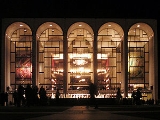
 and the east facade is graced with a distinctive series of five arches. On display in the lobby, and visible to the outside plaza, are two murals created for the space by Marc Chagall
Marc Chagall

Marc Chagall ; [shuh-GAHL] , was a Jewish Russians artist, born in Belarus and naturalized France in 1937, associated with several key art movements and was one of the most successful artists of the twentieth century....
. The square gold proscenium
Proscenium

A Proscenium theatre is a theatre space whose primary feature is a large archway at or near the front of the Stage , through which the audience views the Play ....
 is 54' wide and 54' high. The main curtain of custom-woven gold damask is the largest tab curtain in the world.

The new building opened on September 16, 1966, with the world premiere of Samuel Barber
Samuel Barber

Samuel Osborne Barber II was an American composer of orchestral, opera, choral, and piano music. His Adagio for Strings is among his most popular compositions and widely considered a masterpiece of modern classical music....
's Antony and Cleopatra
Antony and Cleopatra (opera)

Antony and Cleopatra is an opera in three acts by American composer Samuel Barber. The libretto was prepared by Franco Zeffirelli based on the play Antony and Cleopatra by Shakespeare....
. The large and highly mechanized stage and support space smoothly facilitates the rotating presentation of up to four different opera productions each week. There are 7 full stage elevators, (60' wide, with double decks) and three slipstages, the upstage one containing a 60' diameter revolve (turntable). There are 103 motorized battens (linesets) for overhead lifting and there are two 100' tall fully-enveloping cyclorama
Cyclorama

A cyclorama is a cylindrical panoramic painting designed to provide a viewer, standing in the middle of the cylinder, with a 360? view of the painting....
s.

While the Met Opera Company is on hiatus, the Metropolitan Opera House is home to the annual Spring season of American Ballet Theatre
American Ballet Theatre

American Ballet Theatre, based in New York City, was one of the foremost Ballet company of the 20th century. It continues as a leading dance company in the world today....
. It is also regularly the location for touring opera and ballet companies including the Kirov, Bolshoi, and La Scala. In addition, the Met has presented recitals by Vladimir Horowitz, Kathleen Battle and others. Philip Glass's Einstein on the Beach
Einstein on the Beach

Einstein on the Beach is an opera scored and written by Philip Glass and designed and directed by theatrical producer Robert Wilson . It also contains writings by Christopher Knowles, Samuel M....
 was staged independently at the Met in 1976.

Principal conductors

Although no conductor was officially titled "Music Director" until Rafael Kubelík, a number of conductors had ongoing influence on the quality and performance style of the orchestra throughout the Met's history. The Met has also had a great many celebrated guest conductors who are not listed here.
  • James Levine
    James Levine

    James Lawrence Levine is an United States orchestral conducting and piano. He is currently the music director of the Metropolitan Opera and of the Boston Symphony Orchestra....
     (1973–present) (Principal Conductor; Music Director from 1975 on)
  • Valery Gergiev
    Valery Gergiev

    Valery Abisalovich Gergiev is a Russian conducting and opera company director. He is general director and artistic director of the Mariinsky Theatre, principal conductor of the London Symphony Orchestra, and principal guest conductor of the Metropolitan Opera....
     (1997–2008) (Principal Guest Conductor)
  • Rafael Kubelík
    Rafael Kubelík

    Rafael Jeron?m Kubel?k was a Czechs conducting and composer....
     (1973–1974) (Music Director)
  • Erich Leinsdorf
    Erich Leinsdorf

    Erich Leinsdorf was an Austrian-born American conducting. He performed and recorded with leading orchestras and opera companies throughout the United States and Europe, earning a reputation for exacting standards as well as an acerbic personality....
     (1957–1962)
  • Dimitri Mitropoulos (1954–1960)
  • Fritz Reiner
    Fritz Reiner

    Frederick Martin ?Fritz? Reiner was a prominent Conducting of opera and symphonic music in the twentieth century....
     (1949–1953)
  • Fritz Busch
    Fritz Busch

    Fritz Busch was a Germany Conducting.Busch was born in Siegen, Province of Westphalia. He held posts conducting opera at Aachen, Stuttgart and Dresden....
     (1945–1949)
  • George Szell
    George Szell

    George Szell , originally Gy?rgy Sz?ll or Georg Szell, was a Hungary-born American conducting and composer. He is remembered today for his long and successful tenure as music director of the Cleveland Orchestra, and for the recordings of the standard classical repertoire he made in Cleveland and with other orchestras....
     (1942–1946)
  • Erich Leinsdorf
    Erich Leinsdorf

    Erich Leinsdorf was an Austrian-born American conducting. He performed and recorded with leading orchestras and opera companies throughout the United States and Europe, earning a reputation for exacting standards as well as an acerbic personality....
     (1938–1942) (principal conductor of German repertory)
  • Tullio Serafin
    Tullio Serafin

    Tullio Serafin was an Italy Conducting....
     (1924–1934)
  • Artur Bodanzky
    Artur Bodanzky

    Artur Bodanzky was an Austrian-USA conducting particularly associated with the operas of Richard Wagner....
     (1915–1939) (principal conductor of German repertory)
  • Arturo Toscanini
    Arturo Toscanini

    Arturo Toscanini was an Italian people conductor. One of the most acclaimed musicians of the late 19th and 20th Centuries, he was renowned for his brilliant intensity, his restless perfectionism, his phenomenal ear for orchestral detail and sonority, and his photographic memory....
     (1908–1915)
  • Gustav Mahler
    Gustav Mahler

    Gustav Mahler was a Bohemian-born Austrian composer and conducting. He was best known during his own lifetime as one of the leading orchestral and operatic conductors of the day....
     (1908–1910)
  • Alfred Hertz
    Alfred Hertz

    Alfred Hertz , a German Conducting born in Frankfurt am Main, Germany.Hertz first came to prominence conducting Richard Wagner at the Metropolitan Opera in New York....
     (1902–1915) (principal conductor of German repertory)
  • Walter Damrosch (1884–1902)
  • Anton Seidl
    Anton Seidl

    Anton Seidl was a Hungary conducting.He was born at Budapest, and entered the Felix Mendelssohn College of Music and Theatre in October 1870, remaining there until 1872, when he was summoned to Bayreuth as one of Richard Wagner's copyists....
     (1885–1897)


Deaths at the Met

On March 4, 1960, Leonard Warren
Leonard Warren

Leonard Warren was a famous United States opera singer. A baritone, he was associated for many years with the Metropolitan Opera in New York City....
 died of a stroke onstage after completing the aria "Urna fatale" in act two of Verdi's La forza del destino
La forza del destino

La forza del destino is an Italian opera by Giuseppe Verdi. The libretto was written by Francesco Maria Piave based on a Spanish drama, Don ?lvaro, o La fuerza del sino , by ?ngel de Saavedra, Duke of Rivas, with a scene adapted from Friedrich Schiller's Wallensteins Lager....
.

On April 30, 1977, Betty Stone, a member of the Met chorus, was killed in an accident offstage during a tour performance of Il Trovatore
Il trovatore

Il trovatore is an opera in four acts by Giuseppe Verdi to an Italian libretto by Leone Emanuele Bardare and Salvatore Cammarano, based on the Play El Trovador by Antonio Garc?a Guti?rrez....
 in Cleveland.

On July 23, 1980, Helen Hagnes Mintiks, a Canadian-born violinist, was found dead at the bottom of an air shaft at the Met, murdered by a stagehand, Craig Crimmins, during a performance of the Berlin Ballet.

On January 5, 1996, tenor Richard Versalle died while playing the role of Vitek in Leoš Janácek
Leoš Janácek

Leo? Jan?cek , was a Czech people composer, Music theory, Folkloristics, publicist and teacher. He was inspired by Moravian and all Slavic folk music to create an original, modern musical style....
's The Makropulos Case. Versalle was climbing a ladder in the opening scene when he suffered a heart attack and fell to the stage.

In addition, several audience members have died at the Met. The most well-known incident was the suicide of operagoer Bantcho Bantchevsky
Bantcho Bantchevsky

Bantcho Bantchevsky was a Bulgarian-born United States singer, singing coach, and translation. He is remembered today primarily for his death, a suicide which took place at the Metropolitan Opera in New York City during a nationally-broadcast performance....
 on January 23, 1988 during an intermission of Verdi's Macbeth
Macbeth (opera)

Macbeth is an opera in four acts by Giuseppe Verdi, with an Italian libretto by Francesco Maria Piave and additions by Andrea Maffei, based on Shakespeare's Macbeth....
.

See also

  • List of performers at the Metropolitan Opera
    List of performers at the Metropolitan Opera

    This is a list of singers, conductors, and dancers who have appeared in at least three hundred performances at the Metropolitan Opera. Performers are listed by the number of the performances they have appeared in as found at the Metropolitan Opera Archives....
  • List of premieres at the Metropolitan Opera
    List of premieres at the Metropolitan Opera

    Throughout its history the Metropolitan Opera has taken a leading role at introducing both original stage works to the world and bringing works from around the globe to the United States for the first time....
  • Live from the Met
    Live from the Met

    Live from the Met was an American television program that presented performances of complete operas from the Metropolitan Opera, New York City, on the Public Broadcasting Service television network....
  • Metropolitan Opera Radio
    Metropolitan Opera Radio

    Metropolitan Opera Radio is an all-opera radio station on Sirius Satellite Radio channel 78 and DISH Network channel 6078. It carries live broadcasts from the Metropolitan Opera three to four evenings each week during the opera season....
  • Metropolitan Opera's "Live in HD" series


Further reading

  • Meyer, Martin The Met: One Hundred Years of Grand Opera, New York: Simon and Schuster, 1983. ISBN 0-671-47087-6
  • Robinson, Francis, Celebration: The Metropolitan Opera, New York: Doubleday & Company, Inc, 1979. ISBN 0-385-12975-0
  • Wasserman, Adam, "Sirius Business", Opera News, December 2006


External links

  • Full text of by Henry Edward Krehbiel
    Henry Edward Krehbiel

    Henry Edward Krehbiel was an American music critic and musicologist.Krehbiel was born in Ann Arbor, Michigan. He received a general education from his father, a German clergyman of the Methodist Episcopal Church, and began in 1872 the study of law in Cincinnati, Ohio....
     from Project Gutenberg
    Project Gutenberg

    Project Gutenberg, abbreviated as PG, is a volunteer effort to digitize, archive and distribute cultural works, as founder Michael Hart said "To encourage the creation and distribution of eBooks."....
  • By Daniel J. Wakin, The New York Times, January 15, 2009