
Encyclopedia
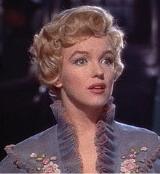
Marilyn Monroe was an iconic American actress, singer and model. To this day, she is one of the 20th century's most famous movie stars,
sex symbols and
pop icons. After acting in small roles for several years, she gradually became known for her comedic skills,
sex appeal and screen presence, going on to become one of the most popular movie stars of the
1950s. Later in her career, she worked towards serious roles with a measure of success. However, long standing problems were exacerbated by disappointments in both career and personal life during her later years.
Early life
She was born
Norma Jeane Mortenson in the charity ward of the Los Angeles County Hospital. According to biographer Fred Lawrence Guiles, her grandmother, Della Monroe Grainger, had her baptized Norma Jean Baker by
Aimee Semple McPherson.
Her mother, Gladys Pearl Monroe, had returned from
Kentucky where her ex-husband had kidnapped their children, Robert and Berniece. Some of Monroe's biographers portray Jasper Baker as a vicious brute. Berniece recounted in
My Sister Marilyn that when Robert later suffered a series of physical ailments, Baker refused to seek proper medical attention for him; the boy died in 1933.
Many biographers believe Norma Jeane's
biological father was Charles Stanley Gifford, a salesman for the studio where Gladys worked as a
film-cutter. Marilyn's
birth certificate lists Gladys' second husband, Martin Edward Mortenson, as the father. While Mortenson left Gladys before Norma Jeane's birth, some biographers think he was the father. In an interview with
Lifetime, James Dougherty said Norma Jeane believed that Gifford was her father. Whoever the father, he played no part in Marilyn's life.
Unable to persuade Della to take Norma Jeane, Gladys placed her with foster parents Albert and Ida Bolender of
Hawthorne, where she lived until she was seven. In her autobiography
My Story, Monroe states she thought Albert was a girl.
Some do not consider
My Story trustworthy and it's alleged the book was ghost-written by Ben Hecht and re-edited by Milton H. Greene. Hecht divulged to his agent: "It is easy to know when she is telling the truth. The moment a true thing comes out of her mouth, her eyes shed tears. She's like her own
lie detector."
Gladys visited Norma Jeane every Saturday. One day, she announced that she had bought a house. A few months after they had moved in, Gladys suffered a breakdown. In the book, Monroe recalls her mother "screaming and laughing" as she was forcibly removed to the State Hospital in
Norwalk. Gladys's father, Otis, died in an
asylum near
San Bernardino from
syphilis. According to
My Sister Marilyn, Gladys's brother, Marion,
hanged himself upon his release from an asylum, and Della's father did the same in a fit of
depression.
Norma Jeane was declared a ward of state and Gladys's best friend, Grace McKee became her guardian. After McKee married in 1935, Norma Jeane was sent to a Los Angeles orphanage and then to a succession of foster homes where she was allegedly subjected to sexual abuse and neglect.
The Goddards moved to the
east and could not take her. Grace Goddard worried about Norma Jeane having to return to the orphanage, so she spoke to the mother of James Dougherty. Mrs. Dougherty approached her son, who agreed to take Norma Jeane out on dates, paid for by Grace . They married two weeks after she turned 16.
Career
Early years
While her husband served in the
Merchant Marines during
World War II, Norma Jeane Dougherty moved in with her mother-in-law, and started to work in the
Radioplane Company factory , spraying airplane parts with fire retardant and inspecting
parachutes. Army photographer David Conover scouted local factories taking photos for a YANK magazine article about women contributing to the war effort. He saw her potential as a model and she was soon signed by The Blue Book modelling agency. In his book "Finding Marilyn", Conover claimed the two had an affair that lasted years. Shortly after signing with the agency Monroe began the eight month process of having her dark blond-light brown hair lightened to a golden blonde by hairstylist Sylvia Barnhart, who continued to work on Monroe's hair until mid-1953.
She became one of their most successful models, appearing on dozens of
magazine covers. In 1946 she came to the attention of talent scout Ben Lyon. He arranged a screen test for her with
20th Century Fox. She passed and was offered a standard six-month contract with a starting salary of $75 per week.
Lyon suggested "Marilyn" to be her stage name, since Norma Jeane wasn't considered commercial enough. She came up with her mother's maiden name "Monroe". Thus the twenty-year old Norma Jeane Baker became "Marilyn Monroe". During her first half year at Fox, Monroe was given no work. Instead, she learned about hair, make-up, costumes, acting and lighting. After six months, Fox renewed her contract. She was given minor appearances in
Scudda Hoo! Scudda Hay! and
Dangerous Years, both released in 1947. In
Scudda Hoo!, her part was edited out of the film except for a quick glimpse of her face when she speaks two words. Both films failed at the
box office and Fox decided not to renew her contract again. Monroe returned to modelling and began to
network and make contacts in
Hollywood.
In 1948, a six-month stint at
Columbia Pictures saw her star in
Ladies of the Chorus, but the low-budget musical was not a success and Monroe was dropped yet again. She then met one of Hollywood's top agents, Johnny Hyde, who had Fox re-sign her after
MGM had turned her down. Fox Vice-President Darryl F. Zanuck was not convinced of Monroe's potential. However, due to Hyde's persistence, she gained supporting parts in
All About Eve is a 1950 [i] movie drama [i] written [i] and directed [i] by ...
and
The Asphalt Jungle is a 1950 [i]
film noir [i] directed by John Huston [i]....
. Even though the roles were small, movie-goers as well as critics took notice. Hyde also arranged for her to have plastic surgery on her nose and chin, adding that to prior-made teeth cosmetic surgery .
The next two years were filled with inconsequential roles in standard fare such as
We're Not Married! and
Love Nest. However,
RKO executives used her to boost
box office potential of the
Fritz Lang production
Clash By Night. After the film performed well,
Fox employed a similar tactic and she was cast as the ditzy receptionist in the
Cary Grant/
Ginger Rogers comedy
Monkey Business. Critics no longer ignored her, and both films' success at the
box office was partly attributed to Monroe's growing popularity.
Fox finally gave her a starring role in 1952 with
Don't Bother to Knock, in which she portrayed a deranged babysitter who attacks the little girl in her care. It was a cheaply made
B-movie, and although the reviews were mixed, many claimed that it demonstrated Monroe's ability and confirmed that she was ready for more leading roles. Her performance in the film has since been noted as one of the finest of her career by many critics.
Stardom
Monroe proved she could carry a big-budget film when she received star billing for
Niagara in 1953. Movie critics focused on Monroe's connection with the camera as much as the sinister plot. She played the part of an unbalanced woman of easy virtue who is planning to murder her husband.
Around this time,
nude photos of Monroe began to surface, taken by photographer Tom Kelley when she had been struggling for work. Prints were bought by
Hugh Hefner and in December 1953 appeared in the first edition of
Playboy is an American [i] adult [i] entertainment [i] magazine [i], fo ...
. To the dismay of
Fox, Monroe decided to publicly admit it was indeed her posing in the pictures. To a journalist asking what she had on during the photoshoot, she replied: "The
radio." When asked what she wore in bed, she famously said: "
Chanel No. 5."
Over the following months,
Gentlemen Prefer Blondes is a 1953 [i] musical [i] based on the novel by Anita Loos [i]...
and
How To Marry A Millionaire is a 1953 [i] film, directed by Jean Negulesco [i] and starring Lauren Bacall [i] ...
cemented Monroe's status as an A-List screen
actress and she became one of the world's biggest movie stars. The lavish
Technicolor comedy films established Monroe's "dumb blonde" on-screen
persona.
In
Gentlemen Prefer Blondes, Monroe's turn as the gold-digging showgirl Lorelei Lee won her rave reviews , and the scene where she sings "Diamonds Are a Girl's Best Friend" has had an impact on popular culture, inspiring the likes of Madonna and
Kylie Minogue. In the Los Angeles premiere of the film, Monroe and co-star
Jane Russell pressed their foot- and handprints in the cemented forecourt of
Grauman's Chinese Theatre.
In
How to Marry a Millionaire, Monroe was teamed up with
Lauren Bacall and
Betty Grable. She played a short-sighted dumb blonde, and even though the role was stereotype, critics took note of her comedic timing.
Her next two films, the western
River of No Return and the musical
There's No Business Like Show Business, were not successful. Monroe got tired of the roles that Zanuck assigned her. After completing work on
The Seven Year Itch is a comedy film starring Marilyn Monroe [i] and Tom Ewell [i]. ...
in early 1955, she broke her contract and fled Hollywood to study acting at The Actors Studio in
New York. Fox would not accede on her contract demands and insisted she return to start work on productions she considered inappropriate, such as
The Girl in Pink Tights ,
The Girl in the Red Velvet Swing, and
How to Be Very, Very Popular.
Monroe refused to appear in these films and stayed in New York. As
The Seven Year Itch is a comedy film starring Marilyn Monroe [i] and Tom Ewell [i]. ...
raced to the top of the box office in the summer of 1955, and with Fox starlets
Jayne Mansfield and
Sheree North failing to click with audience, Zanuck admitted defeat and Monroe triumphantly returned to Hollywood. A new contract was drawn up, giving Monroe an approval of the director as well as the option to act in other studios' projects.
The first film to be made under the contract was
Bus Stop, directed by Joshua Logan. She performed the role of Chérie , a saloon bar
singer who falls in love with a cowboy. Monroe deliberately appeared badly made-up and non-glamorous.
She was nominated for a
Golden Globe for the performance and praised by critics. Bosley Crowther of
The New York Times proclaimed: "Hold on to your chairs, everybody, and get set for a rattling surprise. Marilyn Monroe has finally proved herself an actress." In his autobiography,
Movie Stars, Real People and Me, Director Joshua Logan said, "I found Marilyn to be one of the great talents of all time....She struck me as being a much brighter person than I had ever imagined, and I think that was the first time I learned that intelligence and, yes brilliance have nothing to do with education."
Monroe formed her own production company with friend and photographer Milton H. Greene. Marilyn Monroe Productions released its first and only film
The Prince and the Showgirl in 1957 to mixed reviews. Along with executive-producing the film, she starred opposite the acclaimed
British actor
Laurence Olivier, who directed it.
Olivier got furious at her habit of being late to the set, as well as her dependency on her drama coach, Paula Strasberg. While Monroe's reputation in the
film industry for being difficult grew, her performance was hailed by critics, especially in Europe, where she was handed the David di Donatello, the Italian equivalent of the
Academy Award, as well as the French Crystal Star Award. She was also nominated for the British
BAFTA award.
Later years
In 1959 she scored the biggest hit of her career starring alongside
Tony Curtis and
Jack Lemmon in
Billy Wilder's comedy
Some Like It Hot is a 1959 [i] comedy [i] film [i] directed by Billy Wilder [i]. ...
. After shooting finished, Wilder publicly blasted Monroe for her difficult on-set behavior. Soon, however, Wilder's attitude softened, and he hailed her a great comedienne.
Some Like It Hot is consistently rated as one of the best films ever made. Monroe's performance earned her a
Golden Globe for best actress in musical or comedy. The New York Times proclaimed Monroe a "talented commedienne."
After
Some Like It Hot, Monroe shot
Let's Make Love directed by George Cukor and co-starring
Yves Montand. Monroe, Montand and Cukor all considered the script subpar, yet Monroe was forced to shoot the picture because of her obligations to Twentieth Century-Fox. While the film was not a commercial or critical success, it included one of Monroe's legendary musical numbers,
Cole Porter's "My Heart Belongs to Daddy".
Arthur Miller wrote what became her and her co-star
Clark Gable's last completed film,
The Misfits. The exhausting shoot took place in the hot
Nevada desert. Monroe's tardiness became chronic and the shoot was troublesome. Despite this, Monroe, Gable and
Montgomery Clift delivered performances that are considered excellent by contemporary movie critics. Monroe became friends with Clift, with whom she felt a deep connection. Some blamed Gable's death of a
heart attack on Monroe, claiming she had given him a hard time on the set. Gable, however, insisted on doing his own stunts and was a heavy smoker. After Gable's death, Monroe attended the baptism of his son, and his widow maintained contact with her.
Some of the most famous photographs of her were taken by
Douglas Kirkland in 1961 as a feature for the 25th anniversary issue of
LOOK magazine.
Monroe returned to Hollywood to resume filming on the George Cukor comedy
Something's Got to Give is one of the most notorious unfinished [i] films in Hollywood [i] ...
, a never-finished film that has become legendary for problems on the set. In May 1962, she made her last significant public appearance, singing
Happy Birthday, Mr. President at a televised birthday party for
President John F. Kennedy. After shooting what was claimed to have been the first ever nude scene by a major motion picture actress, Monroe's attendance on the set became even more erratic. On June 1, her thirty-sixth birthday, she attended a charity event at Dodger Stadium.
Already in a financial strain due to production costs of
Cleopatra, starring
Elizabeth Taylor, Fox dropped Monroe from the film and replaced her with
Lee Remick. However, co-star
Dean Martin was unwilling to work with anyone else but Monroe. She was rehired.
Monroe conducted a lengthy interview with
Life Magazine, in which she expressed how bitter she was about Hollywood labeling her as a dumb blonde and how much she loved her audience. She also did a photo shoot for Vogue, and began discussing a future film project with
Gene Kelly and
Frank Sinatra, as stated in the Donald Spoto biography. Furthermore, she was planning to star in a biopic as
Jean Harlow. Other projects being considered for her were
What a Way to Go! and a musical version of
A Tree Grows In Brooklyn.
Before the shooting of
Something's Got to Give resumed, Monroe was found dead in her Los Angeles home, on the morning of August 5, 1962. She remains one of the 20th century's most legendary public figures and archetypal
Hollywood movie stars.
Marriages
James Dougherty
Monroe married James Dougherty on June 19, 1942. In
The Secret Happiness of Marilyn Monroe and
To Norma Jeane with Love, Jimmie, he claimed they were in love but dreams of stardom lured her away. She always maintained theirs was a marriage of convenience arranged by Grace Goddard. She was reportedly furious when he wrote in a 1953
Photoplay was one of the first film [i] fan magazine [i]s. ...
piece called "Marilyn Monroe Was My Wife" that she threatened to jump off the
Santa Monica Pier if he left her. He appeared on
To Tell the Truth in April 7, 1967 as "Marilyn Monroe's real first husband". He sold his books on his website.
In the 2004
documentary Marilyn's Man, Dougherty made three new claims: he was her Svengali and invented the "Marilyn Monroe" persona, studio executives forced her to divorce him, and that he was her true love. The evidence does not support this. He remarried in 1947. When informed of her death, the August 6, 1962
New York Times is a newspaper [i] published in New York City [i] by Arthur Ochs Sulzberger Jr. [i] ...
reported he replied "I'm sorry," and continued his
LAPD patrol; he did not attend her
funeral. Contrary to his later claims that he did not mind that she modeled, his sister wrote in the 12/1952
Modern Screen Magazine that Dougherty left Norma Jeane because she wanted to pursue modeling. He admitted to
A&E Network that his mother asked him to marry her, and told
Lifetime in 1996 he cut off her allotment after being served with divorce papers. Perhaps more telling, the 1999
Christie's auction of Monroe's estate revealed she kept nothing from Dougherty except their divorce decree. He died from leukemia complications on August 15, 2005.
Joe DiMaggio
In 1951
Joe DiMaggio saw a picture of Monroe with two
Chicago White Sox players, but did not ask the man who arranged the stunt to set up a
date until 1952. She wrote in
My Story that she did not want to meet him, fearing a stereotypical jock. They eloped at
San Francisco's
City Hall on January 14, 1954. During the honeymoon, she was asked to visit
Korea. She performed ten shows over four days in freezing temperatures for over 100,000 servicemen. Biographers have noted that DiMaggio was not pleased with his wife's decision during what he wanted to be an intimate trip.
Back home, she wrote him a letter about her dreams for their future, dated February 28, 1954:
- "My Dad, I don't know how to tell you just how much I miss you. I love you till my heart could burst... I want to just be where you are and be just what you want me to be... I want someday for you to be proud of me as a person and as your wife and as the mother of the rest of your children ..."
DiMaggio biographer Maury Allen quoted
New York Yankees PR man Arthur Richman that Joe told him everything went wrong from the trip to Japan on. Fred Lawrence Guiles speculated that Joe, knowing the power and hollowness of fame, wanted desperately to head off what he was convinced was her "collision-course with disaster." Friends claimed that DiMaggio became more controlling as Monroe grew more defiant . On September 14, 1954, she filmed the now-iconic skirt-blowing scene for
The Seven Year Itch is a comedy film starring Marilyn Monroe [i] and Tom Ewell [i]. ...
in front of New York's
Trans-Lux Theater. Bill Kobrin, then-Fox's east coast correspondent, told the June 26, 2006
Palm Springs Desert Sun that it was
Billy Wilder's idea to turn it into a media circus: "... every time her dress came up and the crowd started to get excited, DiMaggio just blew up." The couple later had a "yelling battle" in the theater lobby. Her makeup man Allan Snyder recalled Monroe later appeared on set with bruises on her upper arms . She filed for divorce on grounds of mental cruelty 274 days after the wedding.
Years later, she turned to him for help. In February 1961, her psychiatrist arranged for her to be admitted to the Payne Whitney Psychiatric Clinic, where, according to Donald Spoto, she was placed in the ward for the most seriously disturbed. Unable to check herself out, she called DiMaggio, who secured her release. She later joined him in
Florida. Their "just good friends" claim did not stop rumors of remarriage. Archive footage shows
Bob Hope jokingly dedicated Best Song nominee
The Second Time Around to them at the 1960
Academy Awards telecast, .
According to Maury Allen, on August 1, 1962 DiMaggio - alarmed by how his ex-wife had fallen in with people he felt detrimental to her, such as
Frank Sinatra and his "
Rat Pack" - quit his job with a PX supplier to ask her to remarry him. He claimed her body and arranged her funeral, barring Hollywood's elite. For 20 years, he had a dozen red roses delivered to her crypt three times a week. Unlike her other two husbands, he never talked about her publicly, wrote a tell-all, nor remarried. He died on March 8, 1999, of
lung cancer.
Arthur Miller
On June 29, 1956, Monroe married playwright
Arthur Miller, whom she had first met in 1951, in a civil ceremony in White Plains,
New York. Nominally raised as a Christian, she converted to
Judaism before marrying Miller. After she finished shooting
The Prince and the Showgirl, the couple returned to the States from
England and discovered she was
pregnant. However, she suffered from endometriosis and the pregnancy was found to be ectopic. A subsequent pregnancy ended in miscarriage, as noted in the Monroe biographies written by Anthony Summers, Fred Lawrence Guiles, and Donald Spoto.
By 1958, she was the couple's main breadwinner. While paying alimony to Miller's first wife, her husband reportedly charged her production company for buying and shipping a
Jaguar to the United States.
Miller's screenplay for
The Misfits was meant to be a
Valentine gift for his wife, but by the time filming started in 1960 their marriage was broken beyond repair. A Mexican divorce was granted on January 24, 1961. On February 17, 1962, Miller married
Inge Morath, one of the Magnum photographers recording the making of
The Misfits.
In January 1964, Miller's play
After the Fall opened, featuring a beautiful and devouring shrew named Maggie. The similarities between Maggie and Monroe did not go unnoticed by audiences and critics , many of whom sympathized with the fact that she was no longer alive and could not defend herself .
Simone Signoret noted in her autobiography the morbidity of Miller and
Elia Kazan resuming their professional association "over a casket". In interviews and in his autobiography, Miller insisted that Maggie was not based on Monroe. However, he never pretended that his last
Broadway-bound work,
Finishing the Picture, was not based on the making of
The Misfits. He told
Vanity Fair is a novel [i] by William Makepeace Thackeray [i] that satirizes [i] ...
the she was "highly self-destructive" and what "killed" her was not some conspiracy, but the fact that she was Marilyn Monroe . He died on February 10, 2005, at the age of 89.
Death and aftermath
Monroe was found dead in the bedroom of her
Brentwood, California home by her housekeeper Eunice Murray on August 5, 1962. She was 36 years old. Her death was ruled as an overdose from the sleeping pill Nembutal. Several conspiracy theories have surfaced in the decades after her death, some involving President John F. Kennedy. There is also speculation that her death was accidental, but the official cause of death was "probable suicide" by acute barbiturate poisoning.
On August 8, 1962, Monroe was buried at Corridor of Memories, #24, at the
Westwood Village Memorial Park Cemetery in
Los Angeles, California. Allegedly, this was the day she had planned to remarry DiMaggio. Lee Strasberg delivered the eulogy.
Administration of estate
In her will, Monroe left
Lee Strasberg control of 75% of her estate. She expressed her desire that Strasberg, or, if he predeceased her, her executor, "distribute among my friends, colleagues and those to whom I am devoted."
Strasberg willed his portion to his widow, Anna. She declared she would never sell Monroe's personal items after successfully suing Odyssey Auctions in 1994 to prevent the sale of items which were withheld by Monroe's former business manager, Inez Melson. However, in October 1999
Christie's auctioned the bulk of the items Monroe willed to Lee Strasberg, netting $12.3 million USD. Julien's staged a second auction in 2005.
Anna Strasberg is currently in litigation against the children of four photographers to determine rights of publicity, which permits the licensing of images of deceased personages for commercial purposes. The decision as to whether Marilyn was a resident of
California, where she died, or
New York, where her will was probated, is worth millions.
Trivia
- She had a mild stutter, which was most severe during her teens.
- The beauty mark above her mouth was a very pale mole she darkened.
- Truman Capote wanted her for Holly Golightly in the film adaptation of Breakfast At Tiffany's is the 1961 Oscar-winning movie starring Audrey Hepburn [i] and George Peppard [i] ...
. - Ella Fitzgerald credited Monroe with helping her break the colour barrier and launching her career into the mainstream. "It was because of [Marilyn Monroe] that I played the [heretofore segregated] Mocambo. She personally called the owner ... and told him she wanted me booked immediately, and if he would do it, she would take a front table every night. She told him – and it was true, due to Marilyn’s superstar status – that the press would go wild. The owner said yes, and Marilyn was there, front table, every night. The press went overboard… After that, I never had to play a small jazz club again. She was an unusual woman – a little ahead of her time. And didn’t she know it."
- The Jean-Louis gown Monroe wore to sing happy birthday to John F. Kennedy sold for over $1,500,000 at Christie's in 1999.
- Marilyn was pregnant during the filming of Some Like It Hot & miscarried a male child in December 1958. She had miscarried twice before during her marriage to Arthur Miller & suffered from chronic endometriosis, a gynecological condition that prevented her from carrying a child to term.
- Monroe's personal library contained over 400 books on topics ranging from art, history, psychology, philosophy, literature, religion, poetry & gardening. Many of the volumes, auctioned in 1999, bore her pencil notations in the margins.
- Although Monroe's primary residence at the time of her death was a Manhattan apartment on the 13th floor of 444 W. 57th Street, she had purchased a three bedroom Spanish Colonial hacienda in Brentwood, Los Angeles. Tiles on the front doorstep of the hacienda bore the Latin inscription, "Cursum Perificio"--translating to "My journey ends here." She died in the hacienda's master bedroom before its renovation was completed.
- Controversy surrounds Marilyn Monroe's dress size. One urban legend suggests she was a modern UK dress size 16 or US 12. The Jean Louis dress she wore when singing happy birthday to JFK in 1962 was listed a US size 5. However, dress sizes have gone down since the 1950s and 1960s. According to the autopsy report by Thomas Noguchi, coroner, Marilyn was 5' 5½? and weighed 117 lbs.
- Monroe was crowned the first "Artichoke Queen" for the Artichoke Festival, in Castroville, CA.
| Film | Year | Salary |
|---|
| Scudda Hoo! Scudda Hay! | 1948 | $75/week |
The Asphalt Jungle is a 1950 [i] film noir [i] directed by John Huston [i]....
| 1950 | $1,050 |
All About Eve is a 1950 [i] movie drama [i] written [i] and directed [i] by ...
| 1950 | $500/week, with one-week guarantee |
| We're Not Married! | 1952 | $750/week |
Gentlemen Prefer Blondes is a 1953 [i] musical [i] based on the novel by Anita Loos [i]...
| 1953 | $1,250/week |
The Seven Year Itch is a comedy film starring Marilyn Monroe [i] and Tom Ewell [i]. ...
| 1955 | $1,500/week |
Some Like It Hot is a 1959 [i] comedy [i] film [i] directed by Billy Wilder [i]. ...
| 1959 | $200,000 plus 10% gross over $4 million |
| The Misfits | 1961 | $250,000 |
Something's Got to Give is one of the most notorious unfinished [i] films in Hollywood [i] ...
| 1962 | $100,000 |
Filmography