


Editing of anime in American distribution

Encyclopedia
Editing of anime in American distribution describes the process of altering anime
to prepare it to be distributed in the United States
(and sometimes also Canada
) and forms part of the process of localization
. This process is generally applied only to series intended for broadcast on American television; series released directly to DVD
are not subject to such alterations. On top of the translation of dialogue into English
, this process commonly includes censoring audio/visual content to adhere to Federal Communications Commission (FCC)
and television network
regulations and standards and editing content to conform to American cultural
norm
s or to prepare it for distribution to a younger audience than it was originally intended. This type of editing may involve removing nudity
or sexual innuendo, removing violent scenes, removing profanity
, and/or the making of changes for reasons of racial and religious sensitivities.
This process may also include editing references that might confuse viewers who are unfamiliar with Japanese culture. Edits of this type commonly include the substitution of place names, food, and cultural elements not found in the United States. This may also include the changing/removal of titles, character names
, and honorific
s, and the removing of issues such as marriages between cousins, non-pornographic depictions of homosexuality
, and references to Japan's view of events such as in the case with World War II
. Opening
and closing credits
or scenes
may be shortened to allow more time for advertisement
s in a television time slot.
This type of censorship is not unique to anime, and is also practiced in imports from other countries and even in original American productions; both Batman: The Animated Series
and Spider-Man: The Animated Series
(especially the latter) were censored a lot for violence by the Fox Broadcasting Company
during the production process, and the Canadian series ReBoot
was censored post-production by the American Broadcasting Company
for sexual content and scenes that executives believed would promote incest
. Tom and Jerry
cartoons have gone through a lot of editing throughout the years due to racial references such as blackface
. Other shows such as Yu-Gi-Oh!
, Kirby: Right Back at Ya!
and Dragon Ball Z have been edited as well.
These titles included the earliest anime films to be brought to the United States in 1961 (and the first three feature films ever released by Toei Animation
): (August 14, 1960) (December 1959) (August 14, 1960)
The first anime series to be translated were not exempt:
Robotech
(which was adapted from three separate series, 1
, 2
, and 3
) (1985) and
(1979) broke this tradition by leaving in some of those elements and preserving the drama of the original, uncut Japanese versions. However, their plots were, at some points, heavily modified.
Founded in 1987, Streamline Pictures
was the first North America
n company founded primarily for the intention of distributing translated anime uncut and faithful to the original content. Streamline Pictures founder Carl Macek
had worked for Harmony Gold USA
during the mid-1980s, most notably on Robotech.
In the early 1990s, several American anime companies began to experiment with licensing less children-oriented material. Some, such as A.D. Vision
, Central Park Media
, and its imprints, achieved fairly substantial commercial success and went on to become major players in the now very lucrative American anime market (although, as of late, companies such as Geneon Entertainment, Central Park Media and A.D. Vision have since folded). Others, such as AnimEigo
, achieved more limited success. Many companies created directly by Japanese parent companies did not do as well, most releasing only one or two titles before folding their American operations, although Pioneer Entertainment (Later Geneon Entertainment following its purchase in late 2003 by Dentsu
) and Bandai Entertainment managed to survive well into the later half of the 2000s, although Geneon closed down its North American operations in 2007.
The localization and editing processes were far more heavy in the past, when anime was largely unheard of in the United States. A famous example of this was when Hayao Miyazaki
's Nausicaä of the Valley of the Wind was first released outside of Japan in the mid-1980s. Renamed as Warriors of the Wind, this release cut more than half an hour out of the original version and attempted to market the film as a children's action film
, rather than the heavier environmentalist drama Miyazaki intended it to be. In 2005, Nausicaa was finally released uncut on DVD in the West
, featuring a brand new dubbed soundtrack by Disney that was faithful to the original and included the original Japanese audio with English subtitles.
However, in recent years, these localization processes have been used less because of the demand for anime in its original form. This "light touch" approach to localization and editing has proved popular with fans, as well as viewers formally unfamiliar with anime. The "light touch" approach also applies to DVD
releases, as they often include both the English-dubbed audio version and the original Japanese audio version with subtitle
s, are often uncut, and lack commercial
s. Anime series with edited television versions may have uncut DVDs.
In recent years, a change in audience demographics has led to a greater emphasis being placed on releasing (or re-releasing) anime with fewer changes, especially on DVD, on which there are fewer content limitations. Often, these releases (such as the Disney
releases of Studio Ghibli
productions) include both English-dubbed versions and the original Japanese versions, usually with subtitles.
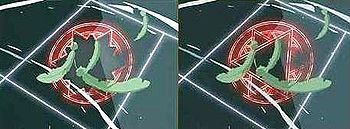 Due to cultural differences between the United States and Japan
, some anime contains images, which are publicly acceptable in Japanese society, are considered, in the United States, to carry connotations of racism or ethnic stereotyping
.
Religious symbols and dialogue are commonly altered and if they appear in contexts that are not considered acceptable in the United States. Sometimes, a character appearing to be crucified
by being bound to two wooden beams in the shape of a cross is enough to be considered unacceptable. For example, representations of the Christian cross
were airbrushed out of Pokémon and One Piece (4Kids version), while references to Hell
were replaced with "HFIL (Home For Infinite Losers)" in Dragon Ball
. Alleged demonic imagery is also commonly removed or toned down, as are uses of pentagram
s, because of their religious meanings and their apparent association with Satanism
and Paganism
. The word "Bible
" has also been removed from the covers of Bibles; names of certain monsters with religious origins are also commonly changed. When 4Kids dubbed Tokyo Mew Mew
, Zakuro's weapon was changed due to resembling a Christian cross, removing the horizontal part of the cross-like weapon.
Other examples include an ancient Sanskrit
religious symbol known as the manji, (representing "life, sun, power, strength, and good luck", and sometimes referred to as the “footsteps of the Buddha”), which was airbrushed out of series like Shaman King
and YuYu Hakusho
because it is easily mistaken for the Nazi swastika
by Western audiences. In some cases however, disclaimers have been included explaining the situation to readers, such as the manga
Blade of the Immortal
, in which the protagonist of the series wears this symbol.
In the series Mobile Fighter G Gundam
, a major plotline involves an annual competition in which each country builds a Gundam to battle those of other nations, with the winning country gaining rulership over the world until the next competition. To show their origins, many Gundam designs are based on ethnic/cultural stereotypes (America's Gundam resembles a football
player and a boxer, Mexico's Gundam bears a giant turbine in the shape of a sombrero
on its head, German one bears in its head a Stahlhelm
, etc.). For the official English language release of the show, Bandai/Sunrise ordered several of the Gundams to be renamed for the English language market with names that downplayed the stereotypes. Bandai employees have also implied that at one point the decision was almost made to completely remove the idea from the English dub that each Gundam specifically represented a country. However, this did not come to pass.
When the Japanese children's anime Magical Doremi
was released in North America by 4Kids, it was heavily edited and changed for US audiences as well as for a lower TV-Y Rating. Along with the many cut footage, An entire episode which is episode 30 was completely skipped, banned and cut from the series' syndicated US release as it contained strong religious references and centered around the young 8-year-old 3rd grader kids walking in a graveyard without their parents and exploring a church and meeting a Buddhist boy named Nobuaki Yamauchi.
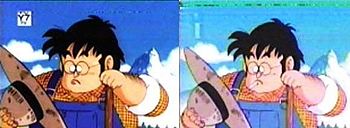 Due to Federal Communications Commission
(FCC) regulations and U.S. social factors, alcohol
and tobacco products are commonly airbrushed out of anime in the United States
, or are replaced with more acceptable "soft" variations. However, the exact level of censorship varies between television network
s, often depending on the target audience of the anime and the context in which the products appear. Wine or champagne may be acceptable in banquet or restaurant scenes and might escape censorship, while beer or sake consumed on the street might not. In Tenchi Muyo!
, references to sake were substituted for tea, and cigarettes were airbrushed out when it screened on Cartoon Network
's Toonami
, but were left in when the series broadcast on KTEH
. Rock Lee's consumption of alcohol and his Drunken Fist style were changed in both the English-version edited anime and manga of Naruto
to avoid referencing an underage character consuming alcohol. This was primarily done using the term "elixir" in place of the sake and referring to his Drunken Fist fighting style as "loopy-fist" in the anime. The Third Hokage was also shown smoking a pipe, while Asuma was shown smoking a cigarette (although it is unlit in the TV version). In the Cartoon Network airing of Rurouni Kenshin
, Saito, a character who is commonly seen smoking cigarettes, instead is depicted with a toothpick in his mouth — resulting in inconsistency when in some scenes he takes a drag of what appears to be a toothpick and somehow exhales smoke. Sometimes, alternate names are given to the alcoholic beverages, which may cause incoherencies with the actual beverages. For example, in Sailor Moon
, a glass of wine that was kept during a scene was instead called "juice". This change, however, caused confusion when "Serena" (Usagi) accidentally drank the alcoholic beverage, and later got drunk.
In the dubbed versions of Mobile Suit Gundam
and Mobile Suit Gundam 0080: War in the Pocket
, bottles had the word "SODA" applied to them to show that they were not alcohol, and direct references to alcoholic drinks were substituted for references to drinks such as coffee. A similar approach was also used in G Gundam
and Sailor Moon
. In the anime One Piece
, Sanji is commonly seen smoking a cigarette, though in the 4Kids dub, the cigarette is replaced with a lollipop. However, the Funimation dub on TV had changed this to have Sanji not having anything in his mouth, instead gritting his teeth. Another example of this in One Piece is Smoker, who is commonly seen with three cigars in his mouth at the same time. In order to remove references to smoking, not only the cigars were removed, but also Smoker was renamed "Chaser", and the cigarless smoke is explained as coming out of his mouth as a side effect of the Cursed Fruit he ate, which causes him to constantly exude smoke.
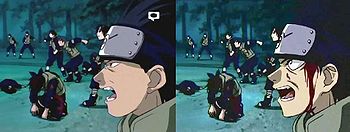 The media effects theory holds that people who are exposed to violence through media, especially during childhood, will be desensitized
to violence and violent acts. Because of this, anime that is released for children in the U.S. is often modified to remove violence, death, and weapons, particularly if the series is aimed towards children.
Commonly, the censorship of violence is done by removing the exact moment when a physical attack, such as a punch, slap, or kick, connects with a person. In some cases this is achieved by airbrushing the scene to include a caption or object (such as an explosion or movement lines) over the point of impact, or by flashing the screen so that the impact is never seen.
Under the same principle, weapons are also commonly airbrushed out or changed to something more kid friendly like toys or simply recolored to take less threatening form, and blood is either airbrushed out or covered with bandages. Where this is considered impractical or too time consuming, an entire scene might be deleted, leading to fights appearing highly contracted, or series missing details that are referenced later on. For example, the Pokémon episode "The Legend of Dratini" was entirely deleted because of the prolific use of guns being pointed and shot at characters. This caused much confusion as the missing episode explained how and when Ash Ketchum
captured 30 Tauros., as it showed in that case, as how an important episode which also led to the Sunrise and Bandai anime Sgt. Frog being acquired in America by ADV Films and later released in America by FUNimation Entertainment. And Magical Doremi episode 19 was edited to remove scenes showing a gun being shown and pointed at Reanne as well as Reanne being violently shaken and with violence removed.
When the Japanese animators of Toei Animation made the Japanese children's TV show called Magical Doremi aimed at young children in Japan, they inserted darker and mature content into the show because it is appropriate and friendly to young children in Japan but is considered inappropriate and unfriendly for young children in the United States. One kind of content is the appearance and use of a weapon such as a gun in episode 19, when Hazuki gets kidnapped by strangers. The plot of the episode involves the use and appearance of a realistic fake gun against the young child named Hazuki. All this as well as the scenes showing the violent strangers pointing the gun at Hazuki and even using the gun against Hazuki is cut out when dubbed in America by 4Kids just for giving the show a lower TV-Y rating in America.
In some censored shows, death is also either unmentioned, or referenced in some other way; words such as "kill" were substituted for "destroy" in the Gundam series, as well as some earlier episodes of Naruto
where "kill" is replaced with "defeat". In early seasons of Dragon Ball Z, all references to characters dying were changed so that they were instead transported to 'the next dimension'. Additionally, they had voice actors do nothing but breathe heavily so that a pile of dead civilians seemed like a pile of civilians that had been simply beaten up. This practice became less used in later seasons when the distribution was changed, with the concepts of death retained, but some content was still heavily edited. In Saber Rider, the death of enemy foot soldiers was removed by having them teleport to their own dimension rather than die. In Battle of the Planets
, voice-overs were added telling the audience that cities were evacuated prior to their destruction, and the dialog was altered to implicitly describe all combatants as being robot soldiers. In the first season of Star Blazers
, violence against the Gamilons was de-emphasized by redirecting it toward what were supposed to be robots; violence against members of the Star Force was de-emphasized via rewritten dialogue. In the second season, the deaths of several major and supporting characters near the end of the story arc (Orion, Conroy, Hardy, Royster, Kane, et al.) were cut out completely; the death scene of Sergeant Knox was rewritten with new dialogue so that he seemed to escape almost certain death and in Magical Doremi episode 18, references to death were removed.
As the teen, young adult, and DVD market become more important, a greater number of anime are now adapted without significant cuts to the violence. Some networks devoted to animation, such as Cartoon Network
, are now increasingly setting aside time slots in the evening and at night for uncut or lightly cut anime on Adult Swim
for the more mature and adult anime shows like Cowboy Bebop
and some of the anime previously aired on Toonami
like Neon Genesis Evangelion
, Tenchi Muyo and Outlaw Star
in an uncut format, as opposed to when the shows originally aired; episodes were edited or not aired at all for being deemed too inappropriate for the timeslot.
s are often known to use stronger interpretations for certain words, commonly resulting in the incorrect impression that the original version of the anime contains notably stronger language than its English counterpart. Most prominently, the commonly used word (literally, "excrement") is an expression of discontent with a situation; it is regularly translated by fansubbers as "shit" or "damn". For a series targeted at school-age children, this is not an appropriate English equivalent, as "shit" is considered a taboo
word, while "kuso" is not.
Also, some anime shown in Japan have English profanity, as is the case with BECK: Mongolian Chop Squad
. This led to the anime being rated TV-MA on the Funimation DVDs.
, suggested underage nudity is also commonly censored. In the U.S. release of Sailor Moon, all of the female leads' transformation sequences were airbrushed to remove the lines tracing their breasts and pubic areas (except for Moon and Chibi Moon; their sequences had little or no lines), even though the characters were shown in silhouette form only. This kind of editing is not limited to cartoons aimed at older audiences, either. For example, the anime series Blue Gender
contained scenes of sex
(next to blood and intense violence), which was edited out when shown in the U.S. on Adult Swim (the series was originally planned to air on Toonami but was considered too graphic). Another example, ADV Films edited out nudity of high-school-aged characters from the American DVD release of the anime Sakura Diaries
. However, the edits to the animation were not done by ADV Films but were shown on TV in Japan. The video was already edited for exposed female private parts, and were covered by inserted lingerie. Dialogue was also altered to shield suggestions of adolescent age. Meanwhile, in February 2008, the government of Canada
banned imports of such hentai
series Cool Devices and Words Worth, as it cited those series as "obscene
" under federal guidelines.
Views on sexuality and a tradition of celebrating relationships between males or females with a strong element of homoerotic undertones have resulted in more tolerance of homosexuals in fiction, but not necessarily in actuality, in Japan than in the United States. This level of social acceptance means that anime, including many series aimed at children, often includes male and/or female homosexuals as recurring characters. However, there is considerable social stigma
attached to homosexuality in the U.S., particularly where children's entertainment is concerned, and there is a strong association between homosexuality and sexual acts. Due to this, anime containing homosexual characters is often heavily censored through plot changes, dialog editing, and the deletion of scenes. Where such edits are not possible or practical, the entire anime may be considered unsuitable for broadcast television and never imported, or released only on DVD with a rating higher than G-rated (such as TV-PG or even TV-14).
Examples include the American version of Sailor Moon in which lesbian
characters Sailor Neptune
and Sailor Uranus, were changed to "cousins" to cover up the fact that they were a romantic couple, and some scenes that could not be explained away by their new relationship were cut. However, there were points in the series where some minor hints of "incest" were not cut out, which confused many viewers. The character Zoisite was also changed to a woman to conceal his relationship with the character Malachite. The character Fisheye was also changed to a woman because he would impersonate women to seduce men to obtain the Dream Mirror he and the other villains of Sailor Moon SuperS needed.
Censorship usually occurs even in cases when homosexual characters do not make sexual contact with one another on screen. Toya and Yukito's relationship was completely removed from Cardcaptor Sakura
despite them never being openly referred to as homosexual, and despite them never having any sexually intimate moments (they were never even pictured holding hands).
In some instances, censorship on the grounds of homosexuality has taken place even when no homosexual relationship exists. For example, Syaoran Li's attraction to the power of the moon contained within Yukito Tsukishiro in Cardcaptor Sakura
, was deleted on the grounds that it could be construed as homosexuality. Tomoyo Daidouji was also heavily implied to have a romantic fixation on Sakura Kinomoto, mostly through her dialogue. This was also removed in the American adaptation.
Similar censorship is applied to conceal transgenderism
or transvestitism. For example, in Battle of the Planets
a key villain with a male and female alter ego was divided into two separate characters, while in Sailor Moon, the character Sailor Uranus, who frequently dressed and acted as a male, was toned down by dialog edits and scene changes. Another example of this was found in the first season of Pokémon
. An entire episode (Holiday in Aopulco) was cut from the series' original syndicated US release as it centered around a bikini contest in which one of the contestants was Team Rocket's James wearing a bikini with inflatable breasts. A heavily censored version with the bikini scene cut did air several years later after Pokémon moved to Kids WB as the "lost episode" Beauty and the Beach.
This same censorship has also been practiced with hermaphrodite
characters. In the Japanese version of Yu-Gi-Oh! GX
, the villain Yubel was shown to be male on the left and female on the right, complete with two separate voices. In the dub she has been slightly edited to appear entirely female, and is portrayed with only a single female voice.
, one part of the three-part series, The Super Dimension Fortress Macross
, was originally aired in Japan as a weekly series. Harmony Gold USA
, the American company that produced Robotech, decided to combine it with two other weekly series, The Super Dimension Cavalry Southern Cross
and Genesis Climber Mospeada
, to make a show that had enough episodes to market it as a daily series on American syndicated television. Voltron
would also be another example; in this case, it combined the series GoLion
and Dairugger XV. In the second season (the Battle city arc) of Yu-Gi-Oh!, there had been change of plot through dialogue. In the original, Marik wanted to kill Yugi because he thought that Yugi killed his father. In the dub, Marik wanted to possess all three Egyptian God Cards so he could rule the world. This was changed to censor one character wanting to kill another. There has been a change in the plot in child-oriented anime as well such as in Magical Doremi
. In the original, strangers kidnap Hazuki just to get money from her family and they use a gun against her, while in the 4Kids dub, Hazuki is Reanne and the strangers are her uncle Nick and cousins and they take her to the museum in the dub and even the scenes showing them using the gun are cut.
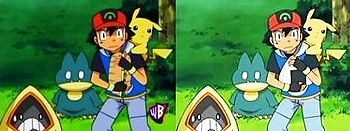 To accommodate American audiences, anime dubbed for the United States is commonly modified to state or imply it takes place within the United States
or a fictional country that resembles it. This is commonly achieved by substituting Japanese elements in a series for elements drawn from American popular culture, modifying food or other products to resemble their American equivalents and by replacing Japanese writing
with English writing.
There are also music changes in certain Anime to appeal more towards a Western audience. For example, In the Street Fighter II: The Animated Movie
when Ken Masters is driving in his car Them Bones
by Alice in Chains
is playing in the background instead of Plot
by Tetsuya Komuro
.
Currency can also be changed. For example, In the early episodes of early English dubs of Dragon Ball, United States dollars are used in place of Yen (¥). In the DiC-dubbed episodes of Sailor Moon
, any Yen notes are often altered by removing two digits from the banknotes (i.e., a ¥1000 banknote has two zeroes altered out and becomes a $10 banknote).
Lines can also be changed. For example, in the scene in Spirited Away
in which Chihiro Ogino first sees the bath house, in the Japanese version she just looks at it and says nothing, but in the English dub she says "It's a bath house". However, due to most American viewers not being familiar with a bath house, because, while bath houses are common in Japan, they are rare in the United States, so Chihiro would have to state what it is.
Although once common, recent years have seen a decline in this process, as American audiences have come to identify various aspects of Japanese and Asian culture
as "exotic", and they have actually become factors which attract them to the show. This trend has been mirrored in original North American animation, with series such as Hi Hi Puffy AmiYumi
, Xiaolin Showdown
, Yin Yang Yo, Avatar: The Last Airbender
and more being constructed around aspects of Asian culture due to its current popularity. Consequently, fewer companies are carrying out the process of eliminating such aspects in anime, but cultural edits are still being done by 4Kids and even Toei Animation
's US Division, as well.
(a series originally aimed primarily at a female audience) retitled the series Cardcaptors (plural and non-gender specific), and Warner Brothers edited the first series to give a male sub-character equal status to the original female lead. It also deleted every episode from the show's continuity that did not sufficiently feature the male character, including the three romance based subplots that formed much of the show's appeal to females. To this end, most elements of romance were also removed from the series. However, all 70 episodes aired in other countries, such as Australia
, Canada
, and the United Kingdom
's first run (albeit still titled Cardcaptors and still edited).
In some cases, changes made to fit with audience demographics can be so pronounced that they result in the production of a second unique series. For example, to take advantage of the popularity of space-themed features among six to nine year old boys created by the 1977 movie, Star Wars, footage from 85 of the 105 episodes of Gatchaman was heavily modified to create the new series Battle of the Planets
. Whereas Gatchaman was a dark series set on Earth and containing a heavy environmental protection message, its American counterpart was a light space based series which contained none of the original environmental message and was aimed at a younger audience.
's Ghost in the Shell
, which had dubtitles on the laser disc version but has an accurate translation on the subtitled version of the DVD release.
) is used to get a higher age rating (especially the BBFC rating 15
, hence the moniker). Manga Entertainment
was known for this in their dubs; for example Appleseed
, which is otherwise a 12-rated anime, had many uses of fuck in the dub to get a 15. However, Manga has re-edited Appleseed and other anime to make the dub more true to the original subtitles.
and closing credits
is common for demographic reasons, and to allow for the names of U.S.-based production staff and voice actors to be included. Credits may be completely remade, replaced with an English language version of the original credits, or retained but with a unique English language musical score. In many cases, credits are also altered for commercial reasons. Typical Japanese opening and ending sequences are 90 seconds long. Shortening the credits to 30–60 seconds allows more time to be made available for advertisements. Some companies have gone even as far as to remove such segments completely.
Sometimes, the titles of shows and names of characters are completely changed.
The decision was made early on to change almost all the names in Star Blazers
for marketing purposes. Unlike most other dubbed anime shows of the late 1970s, though, great care was used in choosing names to which English audiences could relate. The original name of the ship (Yamato) was retained; however, it was almost immediately rechristened as the Argo (via dialog) to draw parallels with the Greek myth of Jason and the Argonauts. Character names of both human and aliens alike were also carefully chosen. Some were transliterations of the Japanese originals (Desslar -> Desslok), some emphasized character traits (Susumu Kodai -> Derek Wildstar), and some were subtle wordplays or puns (many alien names). Fortunately, this standard did not last. With few exceptions (Robotech, to name one), such disregard would not be shown again on anime imports until the mid-1990s, when anime became a mainstream phenomena in the West.
Konjiki no Gash Bell!! (Golden Gash Bell) was retitled Zatch Bell!
due to the gore connotations with the word "gash" which means a wound inflicted with a sharp object (or possibly the related sexual dysphemism
). In doing so, the title character Gash Bell had his name changed to Zatch Bell. Other character name changes in the show were made to make them seem more American.
Almost the entire cast of Sailor Moon
were given Americanized names, especially if their Japanese names could not be modified easily. For example, "Usagi," the main character whose name translates to "bunny" or "rabbit" was renamed "Serena," a pun on her true name, "Serenity," in the original anime. However, Sailor Mercury
, whose Japanese name is "Ami" was simply called "Amy" in the American release. Also, Sailor Mars, whose Japanese name is "Rei" was called "Raye" instead, though her name was still pronounced the same.
In the anime Yu-Gi-Oh!
, almost all of the characters are given English names but some kept the original Japanese name like Yugi Moto. Also where they live, 4Kids want to make it appear that they live in America and not Japan.
In Disney's release of Studio Ghibli's Laputa: Castle in the Sky
, the film was retitled Castle in the Sky, because "la puta" is extremely offensive in Spanish (translating as "the whore"), though in the film, the characters still refer to the island as "Laputa" . However, in the Spanish
dubbing for Spain
the name was changed to "Lapuntu" for this reason (although the few visible captions still reads "Laputa" on screen). For similar reasons, Kiki's Delivery Service
was retitled in Spanish "Niki, la aprendiz de bruja" ("Niki, the witch apprentice"), as the original name of the character has (unintentional) adult connotations: kiki is vulgar for coitus in Spain. Nonetheless, most anime distribution in Spain is in uncut, full length original form aside to be dubbed.
In Funimation's release of the mystery series Detective Conan, the series was retitled Case Closed due to legal issues. Every character — save for the titular Conan — was given a new Americanized name while famous Japanese locales and landmarks were also Americanized.
Outside of Japan, Pocket Monsters was retitled Pokémon
, to avoid confusion with another Japanese media franchise Monster In My Pocket
. For the series One Piece
, the given name for character Roronoa Zoro was romanized as Zolo to avoid possible conflicts over rights to the name Zorro
.
Also, in Disney's release of Studio Ghibli's Ponyo on the Cliff by the Sea, the film was retitled "Ponyo" because they thought the name would be too long for American audiences. Every locale, landmark and character kept their name, with the only difference that the theme was translated into English.
As previously mentioned, Cardcaptor Sakura was renamed Cardcaptors in the U.S. to attract a male audience. Every character in the series had their names changed, save for Sakura herself (though her family name of "Kinomoto" would be changed to "Avalon").
Other examples are that the anime Dragon Ball Kai is known outside of Japan as Dragon Ball Z Kai to avoid confusion with the first Dragon Ball installment and that the second Fullmetal Alchemist series is known as Fullmetal Alchemist Brotherhood in the English version to avoid confusion with the first installment which also shared the same title.
Some titles (only on things like books and bags in the cartoon, not the title of the episode) have been completely erased. An example is in Kirby: Right Back at Ya!
. In one episode (Kirby's Pet Peeve), the title "The Crest and the Mark" is erased from the book Tiff is reading. However, a 4Kids employee stated that that, as well as other examples of English text in their anime dubs, are done to make the show easier to market internationally. http://www.reddit.com/r/IAmA/comments/ikyum/iama_4kids_entertainmentproductions_employee_ama/
When music is added or changed, however, it is more often for aesthetic reasons than for technical ones. For example, while it is common in Japanese films and anime to have silent moments of reflection for characters, it is not widely encountered in North American animation. Some dubbed versions of anime fill in these quiet moments through background dialogue not present in the original Japanese version, but adding music is another common antidote, as was seen through the first two seasons of the English TV airing of the Pokémon
anime.
On the other end of the spectrum, rather than just to fill in moments without music, the musical score is sometimes replaced entirely, the most controversial examples in recent years being Dragon Ball Z, Dragon Ball GT, the first two seasons of Sailor Moon
, and Yu-Gi-Oh!
. For some of these shows, such as Dragon Ball Z and Dragon Ball GT, however, uncut DVDs were eventually released which contain the option of hearing the English dub alongside the original music. Other times, the background music remains unchanged, but the Japanese lyrics in the theme songs are translated and sung in English.
In some extreme cases, when the dubbing company elects to change the emotional undertones of certain scenes, the music in an anime will be heavily changed in its dubbed counterpart to relate to the intended revised tone. An example of this is Sonic X
episode #77, in which the character Miles "Tails" Prower
is forced to shoot Cosmo, whom he is in love with. To reflect this in the original Japanese version, sad music is played when Super Sonic and Super Shadow kill Cosmo with her blessing. However, in the edited English version, produced by 4Kids Entertainment
, the music is changed to action music to emphasize the action aspects of the scene rather than the emotional aspects, which were toned down. Another example is in episode 38, in which "Live and Learn" (the main theme song from Sonic Adventure 2) is played when Super Sonic and Super Shadow battle Bio-Lizard. Instead, in the 4Kids English-dubbed version, the song is replaced by orchestral music. Some fans believe this was a needless change, since the song has been released in English-speaking countries and was sung in English by an American singer.
Other times, music is changed when it would be unfamiliar to English-speaking audiences. In Street Fighter II: The Animated Movie
, when Ken Masters is driving in his car, Them Bones
by Alice in Chains
is playing in the background instead of Plot
by Tetsuya Komuro
.
Changing an anime's music was very common during the early to late nineties. During this period, it was a popular belief among English anime producers that a show needed to be heavily changed and adapted in order to be marketable. With the success of certain English dubs of anime that used the original music such as Gundam Wing, Fullmetal Alchemist
, and Naruto
, however, that belief has largely died out. As such, the editing of music still happens on some level, particularly with anime dubbed by 4Kids Entertainment
, but is not particularly common anymore, with high profile animes such as Dragon Ball Z Kai having their background music unchanged even in the edited TV broadcast. However, a 4Kids employee on Reddit mentions that music is also sometimes changed due to the cost of licensing the original music, as it's not always packaged with the anime license or can cost extra, and thus producing their own music would be more cost-effective. http://www.reddit.com/r/IAmA/comments/ikyum/iama_4kids_entertainmentproductions_employee_ama/
, whose original runtime was two hours 15 minutes had a pre-credits sequence, numerous surrealistic special effects scenes, lengthy dialogue scenes, silent moments, as well as a musical ending (special appearance by Loudness, the band who performed some of the music numbers), all of which were cut resulting in a 90 minute English dub. The original North American release for Nausicaä of the Valley of the Wind, Warriors of the Wind, cut out almost half an hour of the movie, because it was considered too slow moving. This caused much confusion in the overall storyline. The two and a half hour film Farewell Space Battleship Yamato in the name of Love was also cut down to about 100 minutes when dubbed into English. The rationale for this practice is usually attributed to the perceived attention span of Western children, given the average length of domestic children's feature films rarely exceeding 100 minutes running time. This has appeared to be the case, even when these dubbed films are intended solely for home video and not theatrical release. Celebrity Home Entertainment
(as part of their Just For Kids line), for example, released a number of anime films such as Arcadia of My Youth
, The Dagger of Kamui
, Macross: Do You Remember Love, and Cyborg 009: Legend of the Super Galaxy, all of which had running times of over two hours and were truncated significantly resulting in films with average running times of 90 minutes. In most of the examples mentioned, scenes of death and violence were not cut, as they tend to regularly occur during more fast paced scenes.
released a few volumes of uncensored versions of Yu-Gi-Oh!
and Shaman King
on DVD. In addition to containing scenes originally cut from the features, the new versions contained the original music, Japanese language tracks, and new English language tracks with unlocalized dialogue that more closely matched the original Japanese dialog. These unedited DVDs sold poorly, being purchased only by a subset of fans within the wider anime market. Indeed, by the time that the unedited DVDs were released, both Yu-Gi-Oh!
and Shaman King
had been running on television in their localized forms for several years and had been released in that format for years as well. The first two volumes of Yu-Gi-Oh! were released uncut in 2004, and the third volume was released in 2005. Two volumes of Shaman King were released uncut. After time, both projects were canceled. 4Kids drew the ire of One Piece
fans for its heavily edited English dub up until Funimation acquired the rights to produce and distribute One Piece. Recently, 4Kids has begun distributing uncut, Japanese episodes of Yu-Gi-Oh! through YouTube
.
One of the first airings of uncut anime on cable television was shown on Cartoon Network
's block Toonami
entitled, "The Midnight Run". This block aired late at night and featured uncut versions of many of Toonami's anime including, Gundam Wing, Dragon Ball
, Dragon Ball Z, Blue Dragon, and Sailor Moon
. This block helped launch the popular Adult Swim
block which now shows uncut versions of Death Note
, Bleach
, Inuyasha
, Yu Yu Hakusho, Fullmetal Alchemist
, and also TV-MA-rated anime like Blood+
and Code Geass.
In addition, Funimation Entertainment
began releasing uncut versions of Dragon Ball Z to DVD
and VHS
in 2000, beginning with the third season. The dub was the same, but cut scenes were restored and certain portions were re-dubbed to better fit the original script and to leave no trace of editing. The whole series was released in this format, and, by now, the edited versions are only seen through the old edited VHS releases.
website, a fansub refers to "a fan-produced translated, subtitled version" of a foreign film or foreign television program which has been translated and subtitled by fans
into a language other than that of the original. It is most commonly used to refer to fan-translated
anime that is shared amongst other fans. The site also states:
, Naruto
, and One Piece
.
owners of anime as to whether or not to allow editing in their anime, and the ample number of anime edited for the United States would seem to indicate that the studios/copyright owners normally do not object. However, in some instances Japanese studios have refused to allow their work to be censored as a precondition of signing a U.S. release contracts.
Hayao Miyazaki
's anime film Nausicaä of the Valley of the Wind was severely edited by New World Pictures in the mid-1980s and released under the new title Warriors of the Wind on video and shown on HBO. About one-quarter of the film was cut, its lead character "Nausicaa (Naushika in Japanese
)" renamed "Princess Zandra," and its storyline simplified somewhat, distorting the original's ecological and pacifist
themes. Additionally, the voice actors and actresses who dubbed the English dialogue were not really informed of the story's plotline.
Miyazaki and Studio Ghibli
were aware of this editing to the film and were extremely unhappy about it. Miyazaki has since suggested that those who have viewed the edited version should "dismiss it from their minds." As a result of this experience, Studio Ghibli instituted a policy of never allowing a foreign company to edit any of its films prior to release in a new market.
During the late 1990s and 2000s, Studio Ghibli has allowed its catalogue to be dubbed into English by Disney Studios
, on the condition that no frames were removed or airbrushed, and that the English dialogue was not significantly changed from faithful translations of the Japanese versions. Nausicaä of the Valley of the Wind was re-released, uncut, with its original title (faithfully translated), by Disney
, in 2005.
The "no-cuts" policy was highlighted when Miramax co-chairman Harvey Weinstein
suggested editing Princess Mononoke
to make it more marketable and avoid a PG-13 rating. In response, an unnamed Studio Ghibli producer sent him an authentic katana
with a simple message: "No cuts." Although Studio Ghibli has not allowed Disney to cut the films themselves, some minor changes to translated dialogue have been permitted, including the removal of references to testicles in the English dub of Pom Poko
, replacing them with the innocuous euphemism "raccoon pouch."
In February 2006, Cartoon Network
aired Miyazaki's Spirited Away
with a TV-PG-V rating, as the film contained some minor violence and blood. Due to Studio Ghibli's strict "no cuts" policy, Cartoon Network ran the film uncut, and took a risk by showing the film during their Fridays children's block (with an encore the following Sunday evening). Cartoon Network did not receive complaints, and re-aired the film on March 18, 2006, during Toonami
's "A Month of Miyazaki", which also included the uncut Princess Mononoke, rated TV-14-V due to blood, violence, and a few mild uses of profanity
.
Anime
is the Japanese abbreviated pronunciation of "animation". The definition sometimes changes depending on the context. In English-speaking countries, the term most commonly refers to Japanese animated cartoons....
to prepare it to be distributed in the United States
United States
The United States of America is a federal constitutional republic comprising fifty states and a federal district...
(and sometimes also Canada
Canada
Canada is a North American country consisting of ten provinces and three territories. Located in the northern part of the continent, it extends from the Atlantic Ocean in the east to the Pacific Ocean in the west, and northward into the Arctic Ocean...
) and forms part of the process of localization
Language localisation
Language localisationThe spelling "localization", a variant of "localisation", is the preferred spelling in the US and Canada. is the second phase of a larger process of product translation and cultural adaptation to account for...
. This process is generally applied only to series intended for broadcast on American television; series released directly to DVD
DVD
A DVD is an optical disc storage media format, invented and developed by Philips, Sony, Toshiba, and Panasonic in 1995. DVDs offer higher storage capacity than Compact Discs while having the same dimensions....
are not subject to such alterations. On top of the translation of dialogue into English
English language
English is a West Germanic language that arose in the Anglo-Saxon kingdoms of England and spread into what was to become south-east Scotland under the influence of the Anglian medieval kingdom of Northumbria...
, this process commonly includes censoring audio/visual content to adhere to Federal Communications Commission (FCC)
Federal Communications Commission
The Federal Communications Commission is an independent agency of the United States government, created, Congressional statute , and with the majority of its commissioners appointed by the current President. The FCC works towards six goals in the areas of broadband, competition, the spectrum, the...
and television network
Television network
A television network is a telecommunications network for distribution of television program content, whereby a central operation provides programming to many television stations or pay TV providers. Until the mid-1980s, television programming in most countries of the world was dominated by a small...
regulations and standards and editing content to conform to American cultural
Culture of the United States
The Culture of the United States is a Western culture originally influenced by European cultures. It has been developing since long before the United States became a country with its own unique social and cultural characteristics such as dialect, music, arts, social habits, cuisine, and folklore...
norm
Norm (sociology)
Social norms are the accepted behaviors within a society or group. This sociological and social psychological term has been defined as "the rules that a group uses for appropriate and inappropriate values, beliefs, attitudes and behaviors. These rules may be explicit or implicit...
s or to prepare it for distribution to a younger audience than it was originally intended. This type of editing may involve removing nudity
Nudity
Nudity is the state of wearing no clothing. The wearing of clothing is exclusively a human characteristic. The amount of clothing worn depends on functional considerations and social considerations...
or sexual innuendo, removing violent scenes, removing profanity
Profanity
Profanity is a show of disrespect, or a desecration or debasement of someone or something. Profanity can take the form of words, expressions, gestures, or other social behaviors that are socially constructed or interpreted as insulting, rude, vulgar, obscene, desecrating, or other forms.The...
, and/or the making of changes for reasons of racial and religious sensitivities.
This process may also include editing references that might confuse viewers who are unfamiliar with Japanese culture. Edits of this type commonly include the substitution of place names, food, and cultural elements not found in the United States. This may also include the changing/removal of titles, character names
Personal name
A personal name is the proper name identifying an individual person, and today usually comprises a given name bestowed at birth or at a young age plus a surname. It is nearly universal for a human to have a name; except in rare cases, for example feral children growing up in isolation, or infants...
, and honorific
Honorific
An honorific is a word or expression with connotations conveying esteem or respect when used in addressing or referring to a person. Sometimes, the term is used not quite correctly to refer to an honorary title...
s, and the removing of issues such as marriages between cousins, non-pornographic depictions of homosexuality
Homosexuality
Homosexuality is romantic or sexual attraction or behavior between members of the same sex or gender. As a sexual orientation, homosexuality refers to "an enduring pattern of or disposition to experience sexual, affectional, or romantic attractions" primarily or exclusively to people of the same...
, and references to Japan's view of events such as in the case with World War II
World War II
World War II, or the Second World War , was a global conflict lasting from 1939 to 1945, involving most of the world's nations—including all of the great powers—eventually forming two opposing military alliances: the Allies and the Axis...
. Opening
Opening credits
In a motion picture, television program, or video game, the opening credits are shown at the very beginning and list the most important members of the production. They are now usually shown as text superimposed on a blank screen or static pictures, or sometimes on top of action in the show. There...
and closing credits
Closing credits
Closing credits or end credits are added at the end of a motion picture, television program, or video game to list the cast and crew involved in the production. They usually appear as a list of names in small type, which either flip very quickly from page to page, or move smoothly across the...
or scenes
Scene (film)
In TV and movies, a scene is generally thought of as the action in a single location and continuous time. Due to the ability to edit recorded visual works, it is typically much shorter than a stage play scene....
may be shortened to allow more time for advertisement
Advertising
Advertising is a form of communication used to persuade an audience to take some action with respect to products, ideas, or services. Most commonly, the desired result is to drive consumer behavior with respect to a commercial offering, although political and ideological advertising is also common...
s in a television time slot.
This type of censorship is not unique to anime, and is also practiced in imports from other countries and even in original American productions; both Batman: The Animated Series
Batman: The Animated Series
Batman: The Animated Series is an American animated series based on the DC Comics character Batman. The series featured an ensemble cast of many voice-actors including Kevin Conroy, Mark Hamill, Efrem Zimbalist, Jr., Arleen Sorkin, and Loren Lester. The series won four Emmy Awards and was nominated...
and Spider-Man: The Animated Series
Spider-Man (1994 TV series)
Spider-Man, also known as Spider-Man: The Animated Series, is an American animated series starring the Marvel Comics superhero, Spider-Man. The show ran on Fox Kids from November 19, 1994, to January 31, 1998. The producer/story editor was John Semper, Jr. and production company was Marvel Films...
(especially the latter) were censored a lot for violence by the Fox Broadcasting Company
Fox Broadcasting Company
Fox Broadcasting Company, commonly referred to as Fox Network or simply Fox , is an American commercial broadcasting television network owned by Fox Entertainment Group, part of Rupert Murdoch's News Corporation. Launched on October 9, 1986, Fox was the highest-rated broadcast network in the...
during the production process, and the Canadian series ReBoot
ReBoot
ReBoot is a Canadian CGI-animated action-adventure cartoon series that originally aired from 1994 to 2001. It was produced by Vancouver-based production company Mainframe Entertainment, Alliance Communications, BLT Productions and created by Gavin Blair, Ian Pearson, Phil Mitchell and John Grace,...
was censored post-production by the American Broadcasting Company
American Broadcasting Company
The American Broadcasting Company is an American commercial broadcasting television network. Created in 1943 from the former NBC Blue radio network, ABC is owned by The Walt Disney Company and is part of Disney-ABC Television Group. Its first broadcast on television was in 1948...
for sexual content and scenes that executives believed would promote incest
Incest
Incest is sexual intercourse between close relatives that is usually illegal in the jurisdiction where it takes place and/or is conventionally considered a taboo. The term may apply to sexual activities between: individuals of close "blood relationship"; members of the same household; step...
. Tom and Jerry
Tom and Jerry
Tom and Jerry are the cat and mouse cartoon characters that were evolved starting in 1939.Tom and Jerry also may refer to:Cartoon works featuring the cat and mouse so named:* The Tom and Jerry Show...
cartoons have gone through a lot of editing throughout the years due to racial references such as blackface
Blackface
Blackface is a form of theatrical makeup used in minstrel shows, and later vaudeville, in which performers create a stereotyped caricature of a black person. The practice gained popularity during the 19th century and contributed to the proliferation of stereotypes such as the "happy-go-lucky darky...
. Other shows such as Yu-Gi-Oh!
Yu-Gi-Oh!
is a Japanese manga created by Kazuki Takahashi. It has produced a franchise that includes multiple anime shows, a trading card game and numerous video games...
, Kirby: Right Back at Ya!
Kirby: Right Back at Ya!
Kirby: of the stars, known in Japan Kirby right back at ya!', is an anime series based on Nintendo's Kirby franchise. The series was produced by Warpstar Inc., a company formed between a joint investment between Nintendo and HAL Laboratory, Inc.The series, which takes place in a village called...
and Dragon Ball Z have been edited as well.
History
The first few anime series and films to be brought to the United States were all bowdlerized for American audiences, with violence, deaths, sexual references, and other things the intended audience might find offensive, completely edited out, since the audience of the anime was assumed to be made up of young children (over time, anime has moved its target audience from young children to teenagers and young adults).These titles included the earliest anime films to be brought to the United States in 1961 (and the first three feature films ever released by Toei Animation
Toei Animation
Toei Animation Co., Ltd. is a Japanese animation studio owned by Toei Co., Ltd. The studio was founded in 1948 as Japan Animated Films . In 1956, Toei purchased the studio and it was reincorporated under its current name...
): (August 14, 1960) (December 1959) (August 14, 1960)
The first anime series to be translated were not exempt:
Robotech
Robotech
Robotech is an 85-episode science fiction anime adaptation produced by Harmony Gold USA in association with Tatsunoko Production Co., Ltd. and first released in the United States in 1985...
(which was adapted from three separate series, 1
The Super Dimension Fortress Macross
is an anime television series. According to story creator Shoji Kawamori, it depicts "a love triangle against the backdrop of great battles" during the first Human-alien war....
, 2
The Super Dimension Cavalry Southern Cross
was the third Japanese animated series released under the "Super Dimension" moniker by the sponsor Big West. This 1984 science fiction robotic mecha series followed Super Dimension Fortress Macross created by Studio Nue with Artland and produced by Tatsunoko, and Super Dimension Century Orguss ,...
, and 3
Genesis Climber Mospeada
is an anime science fiction series created by Shinji Aramaki and Hideki Kakinuma. The 25-episode television series ran from late 1983 to early 1984 in Japan...
) (1985) and
(1979) broke this tradition by leaving in some of those elements and preserving the drama of the original, uncut Japanese versions. However, their plots were, at some points, heavily modified.
Founded in 1987, Streamline Pictures
Streamline Pictures
Streamline Pictures was an American media company that was best known for its distribution of English dubbed Japanese animation. -Founding:Founded in Los Angeles, California, in 1988, Streamline Pictures was one of the first North American companies that was created primarily for the intention of...
was the first North America
North America
North America is a continent wholly within the Northern Hemisphere and almost wholly within the Western Hemisphere. It is also considered a northern subcontinent of the Americas...
n company founded primarily for the intention of distributing translated anime uncut and faithful to the original content. Streamline Pictures founder Carl Macek
Carl Macek
Carl F. Macek was an American writer and controversial anime pioneer and producer of the 1980s and 1990s.-Robotech and Harmony Gold USA:...
had worked for Harmony Gold USA
Harmony Gold USA
Harmony Gold is a television production and distribution company established in 1983. It is best known as the “creator” and main distributor of the anime series Robotech. It also partially dubbed the Dragon Ball series in the late 1980s....
during the mid-1980s, most notably on Robotech.
In the early 1990s, several American anime companies began to experiment with licensing less children-oriented material. Some, such as A.D. Vision
A.D. Vision
A.D. Vision was an American international multimedia entertainment company headquartered in Houston, Texas, prior to its collapse and distress sale to four other Houston-based companies in 2009...
, Central Park Media
Central Park Media
Central Park Media was an American multimedia entertainment company based in New York City, New York, that was active in the distribution of East Asian cinema, television series, anime, manga and manhwa titles in North America prior to its bankruptcy in 2009...
, and its imprints, achieved fairly substantial commercial success and went on to become major players in the now very lucrative American anime market (although, as of late, companies such as Geneon Entertainment, Central Park Media and A.D. Vision have since folded). Others, such as AnimEigo
AnimEigo
AnimEigo is an American entertainment company that licenses and distributes anime, samurai films and Japanese cinema. The company was founded in 1988 in Ithaca, New York by Robert Woodhead and Roe R. Adams, III. It is now based in Wilmington, North Carolina, and run by Natsumi Ueki, Robert's wife...
, achieved more limited success. Many companies created directly by Japanese parent companies did not do as well, most releasing only one or two titles before folding their American operations, although Pioneer Entertainment (Later Geneon Entertainment following its purchase in late 2003 by Dentsu
Dentsu
is one of the largest advertising agencies in the world. Its headquarters are located in the Dentsu Building in the Shiodome district of Minato, Tokyo....
) and Bandai Entertainment managed to survive well into the later half of the 2000s, although Geneon closed down its North American operations in 2007.
The localization and editing processes were far more heavy in the past, when anime was largely unheard of in the United States. A famous example of this was when Hayao Miyazaki
Hayao Miyazaki
is a Japanese manga artist and prominent film director and animator of many popular anime feature films. Through a career that has spanned nearly fifty years, Miyazaki has attained international acclaim as a maker of animated feature films and, along with Isao Takahata, co-founded Studio Ghibli,...
's Nausicaä of the Valley of the Wind was first released outside of Japan in the mid-1980s. Renamed as Warriors of the Wind, this release cut more than half an hour out of the original version and attempted to market the film as a children's action film
Action film
Action film is a film genre where one or more heroes is thrust into a series of challenges that require physical feats, extended fights and frenetic chases...
, rather than the heavier environmentalist drama Miyazaki intended it to be. In 2005, Nausicaa was finally released uncut on DVD in the West
Western world
The Western world, also known as the West and the Occident , is a term referring to the countries of Western Europe , the countries of the Americas, as well all countries of Northern and Central Europe, Australia and New Zealand...
, featuring a brand new dubbed soundtrack by Disney that was faithful to the original and included the original Japanese audio with English subtitles.
However, in recent years, these localization processes have been used less because of the demand for anime in its original form. This "light touch" approach to localization and editing has proved popular with fans, as well as viewers formally unfamiliar with anime. The "light touch" approach also applies to DVD
DVD
A DVD is an optical disc storage media format, invented and developed by Philips, Sony, Toshiba, and Panasonic in 1995. DVDs offer higher storage capacity than Compact Discs while having the same dimensions....
releases, as they often include both the English-dubbed audio version and the original Japanese audio version with subtitle
Subtitle (captioning)
Subtitles are textual versions of the dialog in films and television programs, usually displayed at the bottom of the screen. They can either be a form of written translation of a dialog in a foreign language, or a written rendering of the dialog in the same language, with or without added...
s, are often uncut, and lack commercial
Television advertisement
A television advertisement or television commercial, often just commercial, advert, ad, or ad-film – is a span of television programming produced and paid for by an organization that conveys a message, typically one intended to market a product...
s. Anime series with edited television versions may have uncut DVDs.
In recent years, a change in audience demographics has led to a greater emphasis being placed on releasing (or re-releasing) anime with fewer changes, especially on DVD, on which there are fewer content limitations. Often, these releases (such as the Disney
The Walt Disney Company
The Walt Disney Company is the largest media conglomerate in the world in terms of revenue. Founded on October 16, 1923, by Walt and Roy Disney as the Disney Brothers Cartoon Studio, Walt Disney Productions established itself as a leader in the American animation industry before diversifying into...
releases of Studio Ghibli
Studio Ghibli
is a Japanese animation and film studio founded in June 1985. The company's logo features the character Totoro from Hayao Miyazaki's film My Neighbor Totoro...
productions) include both English-dubbed versions and the original Japanese versions, usually with subtitles.
Stereotypes
Japan
Japan is an island nation in East Asia. Located in the Pacific Ocean, it lies to the east of the Sea of Japan, China, North Korea, South Korea and Russia, stretching from the Sea of Okhotsk in the north to the East China Sea and Taiwan in the south...
, some anime contains images, which are publicly acceptable in Japanese society, are considered, in the United States, to carry connotations of racism or ethnic stereotyping
Ethnic stereotype
An ethnic stereotype is a generalized representation of an ethnic group, composed of what are thought to be typical characteristics of members of the group.Ethnic stereotypes are commonly portrayed in ethnic jokes.-Ethnic stereotypes:*African Americans...
.
Religious symbols and dialogue are commonly altered and if they appear in contexts that are not considered acceptable in the United States. Sometimes, a character appearing to be crucified
Crucifixion
Crucifixion is an ancient method of painful execution in which the condemned person is tied or nailed to a large wooden cross and left to hang until dead...
by being bound to two wooden beams in the shape of a cross is enough to be considered unacceptable. For example, representations of the Christian cross
Christian cross
The Christian cross, seen as a representation of the instrument of the crucifixion of Jesus Christ, is the best-known religious symbol of Christianity...
were airbrushed out of Pokémon and One Piece (4Kids version), while references to Hell
Hell
In many religious traditions, a hell is a place of suffering and punishment in the afterlife. Religions with a linear divine history often depict hells as endless. Religions with a cyclic history often depict a hell as an intermediary period between incarnations...
were replaced with "HFIL (Home For Infinite Losers)" in Dragon Ball
Dragon Ball
is a Japanese manga series written and illustrated by Akira Toriyama. It was originally serialized in Weekly Shōnen Jump from 1984 to 1995; later the 519 individual chapters were published into 42 tankōbon volumes by Shueisha. Dragon Ball was inspired by the classical Chinese novel Journey to the...
. Alleged demonic imagery is also commonly removed or toned down, as are uses of pentagram
Pentagram
A pentagram is the shape of a five-pointed star drawn with five straight strokes...
s, because of their religious meanings and their apparent association with Satanism
Satanism
Satanism is a group of religions that is composed of a diverse number of ideological and philosophical beliefs and social phenomena. Their shared feature include symbolic association with, admiration for the character of, and even veneration of Satan or similar rebellious, promethean, and...
and Paganism
Paganism
Paganism is a blanket term, typically used to refer to non-Abrahamic, indigenous polytheistic religious traditions....
. The word "Bible
Bible
The Bible refers to any one of the collections of the primary religious texts of Judaism and Christianity. There is no common version of the Bible, as the individual books , their contents and their order vary among denominations...
" has also been removed from the covers of Bibles; names of certain monsters with religious origins are also commonly changed. When 4Kids dubbed Tokyo Mew Mew
Tokyo Mew Mew
, also known as Mew Mew Power, is a Japanese shōjo manga series written by Reiko Yoshida and illustrated by Mia Ikumi. It was originally serialized in Nakayoshi from September 2000 to February 2003, and later published in seven tankōbon volumes by Kodansha from February 2001 to April 2003...
, Zakuro's weapon was changed due to resembling a Christian cross, removing the horizontal part of the cross-like weapon.
Other examples include an ancient Sanskrit
Sanskrit
Sanskrit , is a historical Indo-Aryan language and the primary liturgical language of Hinduism, Jainism and Buddhism.Buddhism: besides Pali, see Buddhist Hybrid Sanskrit Today, it is listed as one of the 22 scheduled languages of India and is an official language of the state of Uttarakhand...
religious symbol known as the manji, (representing "life, sun, power, strength, and good luck", and sometimes referred to as the “footsteps of the Buddha”), which was airbrushed out of series like Shaman King
Shaman King
is a Japanese manga series written and illustrated by Hiroyuki Takei. Shaman King follows the adventures of Yoh Asakura as he attempts to hone his shaman skills to become the Shaman King in the Shaman tournament....
and YuYu Hakusho
YuYu Hakusho
is a Japanese manga series written and illustrated by Yoshihiro Togashi. The name of the series is spelled YuYu Hakusho in the Viz Media manga and Yu Yu Hakusho in other English distributions of the franchise. The series tells the story of Yusuke Urameshi, a teenage delinquent who is struck and...
because it is easily mistaken for the Nazi swastika
Swastika
The swastika is an equilateral cross with its arms bent at right angles, in either right-facing form in counter clock motion or its mirrored left-facing form in clock motion. Earliest archaeological evidence of swastika-shaped ornaments dates back to the Indus Valley Civilization of Ancient...
by Western audiences. In some cases however, disclaimers have been included explaining the situation to readers, such as the manga
Manga
Manga is the Japanese word for "comics" and consists of comics and print cartoons . In the West, the term "manga" has been appropriated to refer specifically to comics created in Japan, or by Japanese authors, in the Japanese language and conforming to the style developed in Japan in the late 19th...
Blade of the Immortal
Blade of the Immortal
is a Japanese manga series by Hiroaki Samura. The series won an Excellence Prize at the 1997 Japan Media Arts Festival and the Will Eisner Comic Industry Award in 2000 for Best U.S. Edition of Foreign Material...
, in which the protagonist of the series wears this symbol.
In the series Mobile Fighter G Gundam
Mobile Fighter G Gundam
Mobile Fighter G Gundam, known in Japan as , is a Japanese animated television series directed by Yasuhiro Imagawa . Created to commemorate the 15th anniversary of the franchise in 1994, it is the first of the Gundam series to be set in an alternate continuity from the original "Universal Century"...
, a major plotline involves an annual competition in which each country builds a Gundam to battle those of other nations, with the winning country gaining rulership over the world until the next competition. To show their origins, many Gundam designs are based on ethnic/cultural stereotypes (America's Gundam resembles a football
American football
American football is a sport played between two teams of eleven with the objective of scoring points by advancing the ball into the opposing team's end zone. Known in the United States simply as football, it may also be referred to informally as gridiron football. The ball can be advanced by...
player and a boxer, Mexico's Gundam bears a giant turbine in the shape of a sombrero
Sombrero
Sombrero in English refers to a type of wide-brimmed hat originating in Mexico. In Spanish, however, it is the generic word for "hat", which originates from "sombra", meaning "shade"....
on its head, German one bears in its head a Stahlhelm
Stahlhelm
Stahlhelm is German for "steel helmet". The Imperial German Army began to replace the traditional boiled-leather Pickelhaube with the Stahlhelm during World War I in 1916...
, etc.). For the official English language release of the show, Bandai/Sunrise ordered several of the Gundams to be renamed for the English language market with names that downplayed the stereotypes. Bandai employees have also implied that at one point the decision was almost made to completely remove the idea from the English dub that each Gundam specifically represented a country. However, this did not come to pass.
When the Japanese children's anime Magical Doremi
Magical DoReMi
Magical DoReMi, known as in Japan, is a magical girl anime television series created by Toei Animation in 1999. It focuses on elementary school students who become witch apprentices. Led by Doremi Harukaze, the girls must maintain their double lives in secret.Magical DoReMi has been followed up by...
was released in North America by 4Kids, it was heavily edited and changed for US audiences as well as for a lower TV-Y Rating. Along with the many cut footage, An entire episode which is episode 30 was completely skipped, banned and cut from the series' syndicated US release as it contained strong religious references and centered around the young 8-year-old 3rd grader kids walking in a graveyard without their parents and exploring a church and meeting a Buddhist boy named Nobuaki Yamauchi.
Recreational drugs, alcoholic beverages, and tobacco products
Federal Communications Commission
The Federal Communications Commission is an independent agency of the United States government, created, Congressional statute , and with the majority of its commissioners appointed by the current President. The FCC works towards six goals in the areas of broadband, competition, the spectrum, the...
(FCC) regulations and U.S. social factors, alcohol
Alcoholic beverage
An alcoholic beverage is a drink containing ethanol, commonly known as alcohol. Alcoholic beverages are divided into three general classes: beers, wines, and spirits. They are legally consumed in most countries, and over 100 countries have laws regulating their production, sale, and consumption...
and tobacco products are commonly airbrushed out of anime in the United States
Anime in the United States
These anime series have been shown and have achieved varying levels of popularity in the United States and Canada. In the United States, most anime can be seen televised on channels such as Adult Swim, FUNimation Channel, G4, Disney XD, Nicktoons, CW4Kids, Cartoon Network , Syfy or veiwed online on...
, or are replaced with more acceptable "soft" variations. However, the exact level of censorship varies between television network
Television network
A television network is a telecommunications network for distribution of television program content, whereby a central operation provides programming to many television stations or pay TV providers. Until the mid-1980s, television programming in most countries of the world was dominated by a small...
s, often depending on the target audience of the anime and the context in which the products appear. Wine or champagne may be acceptable in banquet or restaurant scenes and might escape censorship, while beer or sake consumed on the street might not. In Tenchi Muyo!
Tenchi Muyo!
, is a Japanese anime, light novel, and manga series created by Masaki Kajishima and Hiroki Hayashi.The generally accepted translation of the title is No Need for Tenchi or Useless Tenchi, though at the time of its appearance it was also translated variably as No Heaven and Earth and This Way Up...
, references to sake were substituted for tea, and cigarettes were airbrushed out when it screened on Cartoon Network
Cartoon Network
Cartoon Network is a name of television channels worldwide created by Turner Broadcasting which used to primarily show animated programming. The channel began broadcasting on October 1, 1992 in the United States....
's Toonami
Toonami
Toonami was a registered trademark of Cartoon Network, used initially for action-oriented programming blocks on Cartoon Network television channels worldwide, mostly showing American cartoons and Japanese anime, originating in the United States on March 17, 1997 and ended on September 20, 2008.The...
, but were left in when the series broadcast on KTEH
KTEH
KQEH is a public television station in San Jose, California, serving the San Francisco Bay Area as a PBS member station on channel 54. The station is owned by Northern California Public Broadcasting with sister-stations KQED in San Francisco and KQET in Watsonville, the latter mirroring KQED.Until...
. Rock Lee's consumption of alcohol and his Drunken Fist style were changed in both the English-version edited anime and manga of Naruto
Naruto
is an ongoing Japanese manga series written and illustrated by Masashi Kishimoto. The plot tells the story of Naruto Uzumaki, an adolescent ninja who constantly searches for recognition and aspires to become the Hokage, the ninja in his village who is acknowledged as the leader and the strongest of...
to avoid referencing an underage character consuming alcohol. This was primarily done using the term "elixir" in place of the sake and referring to his Drunken Fist fighting style as "loopy-fist" in the anime. The Third Hokage was also shown smoking a pipe, while Asuma was shown smoking a cigarette (although it is unlit in the TV version). In the Cartoon Network airing of Rurouni Kenshin
Rurouni Kenshin
, also known as Rurouni Kenshin and Samurai X, is a Japanese manga series written and illustrated by Nobuhiro Watsuki. The fictional setting takes place during the early Meiji period in Japan. The story is about a fictional assassin named Himura Kenshin, from the Bakumatsu who becomes a wanderer to...
, Saito, a character who is commonly seen smoking cigarettes, instead is depicted with a toothpick in his mouth — resulting in inconsistency when in some scenes he takes a drag of what appears to be a toothpick and somehow exhales smoke. Sometimes, alternate names are given to the alcoholic beverages, which may cause incoherencies with the actual beverages. For example, in Sailor Moon
Sailor Moon
Sailor Moon, known as , is a media franchise created by manga artist Naoko Takeuchi. Fred Patten credits Takeuchi with popularizing the concept of a team of magical girls, and Paul Gravett credits the series with "revitalizing" the magical-girl genre itself...
, a glass of wine that was kept during a scene was instead called "juice". This change, however, caused confusion when "Serena" (Usagi) accidentally drank the alcoholic beverage, and later got drunk.
In the dubbed versions of Mobile Suit Gundam
Mobile Suit Gundam
is a televised anime series, created by Sunrise. Created and directed by Yoshiyuki Tomino, it premiered in Japan on Nagoya Broadcasting Network on April 7, 1979, and lasted until January 26, 1980, spanning 43 episodes...
and Mobile Suit Gundam 0080: War in the Pocket
Mobile Suit Gundam 0080: War in the Pocket
is a 1989 Japanese science fiction original video animation series, the first such series in the Gundam franchise. Directed by Fumihiko Takayama, it was also the first time anyone other than creator Yoshiyuki Tomino was given a chance to direct a Gundam story. Released in 1989, it serves to...
, bottles had the word "SODA" applied to them to show that they were not alcohol, and direct references to alcoholic drinks were substituted for references to drinks such as coffee. A similar approach was also used in G Gundam
Mobile Fighter G Gundam
Mobile Fighter G Gundam, known in Japan as , is a Japanese animated television series directed by Yasuhiro Imagawa . Created to commemorate the 15th anniversary of the franchise in 1994, it is the first of the Gundam series to be set in an alternate continuity from the original "Universal Century"...
and Sailor Moon
Sailor Moon
Sailor Moon, known as , is a media franchise created by manga artist Naoko Takeuchi. Fred Patten credits Takeuchi with popularizing the concept of a team of magical girls, and Paul Gravett credits the series with "revitalizing" the magical-girl genre itself...
. In the anime One Piece
One Piece
is a Japanese shōnen manga series written and illustrated by Eiichiro Oda. It has been serialized in Weekly Shōnen Jump since August 4, 1997; the individual chapters are being published in tankōbon volumes by Shueisha, with the first released on December 24, 1997, and the 64th volume released as...
, Sanji is commonly seen smoking a cigarette, though in the 4Kids dub, the cigarette is replaced with a lollipop. However, the Funimation dub on TV had changed this to have Sanji not having anything in his mouth, instead gritting his teeth. Another example of this in One Piece is Smoker, who is commonly seen with three cigars in his mouth at the same time. In order to remove references to smoking, not only the cigars were removed, but also Smoker was renamed "Chaser", and the cigarless smoke is explained as coming out of his mouth as a side effect of the Cursed Fruit he ate, which causes him to constantly exude smoke.
Violence, blood, gore, death, and weapons
Desensitization (psychology)
In psychology, desensitization is a process for mitigating the harmful effects of phobias or other disorders. It also occurs when an emotional response is repeatedly evoked in situations in which the action tendency that is associated with the emotion proves irrelevant or unnecessary...
to violence and violent acts. Because of this, anime that is released for children in the U.S. is often modified to remove violence, death, and weapons, particularly if the series is aimed towards children.
Commonly, the censorship of violence is done by removing the exact moment when a physical attack, such as a punch, slap, or kick, connects with a person. In some cases this is achieved by airbrushing the scene to include a caption or object (such as an explosion or movement lines) over the point of impact, or by flashing the screen so that the impact is never seen.
Under the same principle, weapons are also commonly airbrushed out or changed to something more kid friendly like toys or simply recolored to take less threatening form, and blood is either airbrushed out or covered with bandages. Where this is considered impractical or too time consuming, an entire scene might be deleted, leading to fights appearing highly contracted, or series missing details that are referenced later on. For example, the Pokémon episode "The Legend of Dratini" was entirely deleted because of the prolific use of guns being pointed and shot at characters. This caused much confusion as the missing episode explained how and when Ash Ketchum
Ash Ketchum
Ash Ketchum, known as for all appearances in Japan, is a fictional character in the Pokémon franchise owned by Nintendo. He was created by, and named after, Satoshi Tajiri as the protagonist of the anime and manga series, as well as on various merchandise related to the franchise...
captured 30 Tauros., as it showed in that case, as how an important episode which also led to the Sunrise and Bandai anime Sgt. Frog being acquired in America by ADV Films and later released in America by FUNimation Entertainment. And Magical Doremi episode 19 was edited to remove scenes showing a gun being shown and pointed at Reanne as well as Reanne being violently shaken and with violence removed.
When the Japanese animators of Toei Animation made the Japanese children's TV show called Magical Doremi aimed at young children in Japan, they inserted darker and mature content into the show because it is appropriate and friendly to young children in Japan but is considered inappropriate and unfriendly for young children in the United States. One kind of content is the appearance and use of a weapon such as a gun in episode 19, when Hazuki gets kidnapped by strangers. The plot of the episode involves the use and appearance of a realistic fake gun against the young child named Hazuki. All this as well as the scenes showing the violent strangers pointing the gun at Hazuki and even using the gun against Hazuki is cut out when dubbed in America by 4Kids just for giving the show a lower TV-Y rating in America.
In some censored shows, death is also either unmentioned, or referenced in some other way; words such as "kill" were substituted for "destroy" in the Gundam series, as well as some earlier episodes of Naruto
Naruto
is an ongoing Japanese manga series written and illustrated by Masashi Kishimoto. The plot tells the story of Naruto Uzumaki, an adolescent ninja who constantly searches for recognition and aspires to become the Hokage, the ninja in his village who is acknowledged as the leader and the strongest of...
where "kill" is replaced with "defeat". In early seasons of Dragon Ball Z, all references to characters dying were changed so that they were instead transported to 'the next dimension'. Additionally, they had voice actors do nothing but breathe heavily so that a pile of dead civilians seemed like a pile of civilians that had been simply beaten up. This practice became less used in later seasons when the distribution was changed, with the concepts of death retained, but some content was still heavily edited. In Saber Rider, the death of enemy foot soldiers was removed by having them teleport to their own dimension rather than die. In Battle of the Planets
Battle of the Planets
Battle of the Planets is an American animated television adaptation of the Japanese anime series Science Ninja Team Gatchaman . Of the 105 original Gatchaman episodes, 85 were used in the Battle of the Planets adaptation, produced by Sandy Frank Entertainment...
, voice-overs were added telling the audience that cities were evacuated prior to their destruction, and the dialog was altered to implicitly describe all combatants as being robot soldiers. In the first season of Star Blazers
Star Blazers
Star Blazers is an American animated television series adaptation of the Japanese anime series, . Star Blazers was first broadcast in the United States in 1979. Significantly, it was the first popular English-translated anime that had an over-arching plot and storyline that required the episodes to...
, violence against the Gamilons was de-emphasized by redirecting it toward what were supposed to be robots; violence against members of the Star Force was de-emphasized via rewritten dialogue. In the second season, the deaths of several major and supporting characters near the end of the story arc (Orion, Conroy, Hardy, Royster, Kane, et al.) were cut out completely; the death scene of Sergeant Knox was rewritten with new dialogue so that he seemed to escape almost certain death and in Magical Doremi episode 18, references to death were removed.
As the teen, young adult, and DVD market become more important, a greater number of anime are now adapted without significant cuts to the violence. Some networks devoted to animation, such as Cartoon Network
Cartoon Network
Cartoon Network is a name of television channels worldwide created by Turner Broadcasting which used to primarily show animated programming. The channel began broadcasting on October 1, 1992 in the United States....
, are now increasingly setting aside time slots in the evening and at night for uncut or lightly cut anime on Adult Swim
Adult Swim
Adult Swim is an adult-oriented Cable network that shares channel space with Cartoon Network from 9:00 pm until 6:00 am ET/PT in the United States, and broadcasts in countries such as Australia and New Zealand...
for the more mature and adult anime shows like Cowboy Bebop
Cowboy Bebop
is a critically acclaimed and award-winning 1998 Japanese anime series directed by Shinichirō Watanabe, written by Keiko Nobumoto, and produced by Sunrise. Its 26 episodes comprise a complete storyline: set in 2071, the series follows the adventures, misadventures and tragedies of five bounty...
and some of the anime previously aired on Toonami
Toonami
Toonami was a registered trademark of Cartoon Network, used initially for action-oriented programming blocks on Cartoon Network television channels worldwide, mostly showing American cartoons and Japanese anime, originating in the United States on March 17, 1997 and ended on September 20, 2008.The...
like Neon Genesis Evangelion
Neon Genesis Evangelion
, commonly referred to as Evangelion, is a commercially and critically successful Japanese anime series that began airing in October 1995. The series was highly influential, and launched the Neon Genesis Evangelion franchise. It garnered several major animation awards...
, Tenchi Muyo and Outlaw Star
Outlaw Star
is a seinen manga series written and illustrated by Takehiko Itō and his affiliated Morning Star Studio. The series is a space opera/Space Western that takes place in the "Toward Stars Era" universe in which spacecraft are capable of traveling faster than the speed of light...
in an uncut format, as opposed to when the shows originally aired; episodes were edited or not aired at all for being deemed too inappropriate for the timeslot.
Swearing and profanity
Unlike the English language, the Japanese language has few direct swear words. Cursing is most often conveyed through particular variants of existing, harmless words (such as the term "kisama", a very rude version of "you", commonly translated as "Damn You"), rather than words that can be easily translated into curse word equivalents. However, translators producing English-language fansubFansub
A fansub is a version of a foreign film or foreign television program which has been translated by fans and subtitled into a language other than that of the original.-History:...
s are often known to use stronger interpretations for certain words, commonly resulting in the incorrect impression that the original version of the anime contains notably stronger language than its English counterpart. Most prominently, the commonly used word (literally, "excrement") is an expression of discontent with a situation; it is regularly translated by fansubbers as "shit" or "damn". For a series targeted at school-age children, this is not an appropriate English equivalent, as "shit" is considered a taboo
Taboo
A taboo is a strong social prohibition relating to any area of human activity or social custom that is sacred and or forbidden based on moral judgment, religious beliefs and or scientific consensus. Breaking the taboo is usually considered objectionable or abhorrent by society...
word, while "kuso" is not.
Also, some anime shown in Japan have English profanity, as is the case with BECK: Mongolian Chop Squad
BECK: Mongolian Chop Squad
BECK is a manga by Harold Sakuishi published by Kodansha in Monthly Shōnen Magazine. It was adapted as an anime television series with the title BECK: Mongolian Chop Squad...
. This led to the anime being rated TV-MA on the Funimation DVDs.
Nudity and sexuality
As nudity is far more stigmatized in the U.S. than it is in Japan, such content is often edited out of locally distributed anime. Due to U.S. law regarding child pornographyChild pornography
Child pornography refers to images or films and, in some cases, writings depicting sexually explicit activities involving a child...
, suggested underage nudity is also commonly censored. In the U.S. release of Sailor Moon, all of the female leads' transformation sequences were airbrushed to remove the lines tracing their breasts and pubic areas (except for Moon and Chibi Moon; their sequences had little or no lines), even though the characters were shown in silhouette form only. This kind of editing is not limited to cartoons aimed at older audiences, either. For example, the anime series Blue Gender
Blue Gender
is a 26-episode anime created by Ryōsuke Takahashi broadcast in Japan from 1999-2000. Blue Gender was created by the Japanese animation studio, AIC and is distributed in the United States by Funimation Entertainment...
contained scenes of sex
Sexual intercourse
Sexual intercourse, also known as copulation or coitus, commonly refers to the act in which a male's penis enters a female's vagina for the purposes of sexual pleasure or reproduction. The entities may be of opposite sexes, or they may be hermaphroditic, as is the case with snails...
(next to blood and intense violence), which was edited out when shown in the U.S. on Adult Swim (the series was originally planned to air on Toonami but was considered too graphic). Another example, ADV Films edited out nudity of high-school-aged characters from the American DVD release of the anime Sakura Diaries
Sakura Diaries
is a 12 episode OVA series based on the manga of the same name by renowned hentai manga artist U-Jin about romance, love triangles, and the struggle to get into a prestigious university.-Plot:...
. However, the edits to the animation were not done by ADV Films but were shown on TV in Japan. The video was already edited for exposed female private parts, and were covered by inserted lingerie. Dialogue was also altered to shield suggestions of adolescent age. Meanwhile, in February 2008, the government of Canada
Government of Canada
The Government of Canada, formally Her Majesty's Government, is the system whereby the federation of Canada is administered by a common authority; in Canadian English, the term can mean either the collective set of institutions or specifically the Queen-in-Council...
banned imports of such hentai
Hentai
is a Japanese word that, in the West, is used when referring to sexually explicit or pornographic comics and animation, particularly those of Japanese origin such as anime, manga, and computer games. The word hentai is a kanji compound of 変 and 態...
series Cool Devices and Words Worth, as it cited those series as "obscene
Obscenity
An obscenity is any statement or act which strongly offends the prevalent morality of the time, is a profanity, or is otherwise taboo, indecent, abhorrent, or disgusting, or is especially inauspicious...
" under federal guidelines.
Homosexuality
Views on sexuality and a tradition of celebrating relationships between males or females with a strong element of homoerotic undertones have resulted in more tolerance of homosexuals in fiction, but not necessarily in actuality, in Japan than in the United States. This level of social acceptance means that anime, including many series aimed at children, often includes male and/or female homosexuals as recurring characters. However, there is considerable social stigma
Social stigma
Social stigma is the severe disapproval of or discontent with a person on the grounds of characteristics that distinguish them from other members of a society.Almost all stigma is based on a person differing from social or cultural norms...
attached to homosexuality in the U.S., particularly where children's entertainment is concerned, and there is a strong association between homosexuality and sexual acts. Due to this, anime containing homosexual characters is often heavily censored through plot changes, dialog editing, and the deletion of scenes. Where such edits are not possible or practical, the entire anime may be considered unsuitable for broadcast television and never imported, or released only on DVD with a rating higher than G-rated (such as TV-PG or even TV-14).
Examples include the American version of Sailor Moon in which lesbian
Lesbian
Lesbian is a term most widely used in the English language to describe sexual and romantic desire between females. The word may be used as a noun, to refer to women who identify themselves or who are characterized by others as having the primary attribute of female homosexuality, or as an...
characters Sailor Neptune
Michiru Kaioh
is one of the central characters in the Sailor Moon metaseries. Her civilian name is , an artistic schoolgirl who can transform into one of the series' specialized heroines, the Sailor Senshi....
and Sailor Uranus, were changed to "cousins" to cover up the fact that they were a romantic couple, and some scenes that could not be explained away by their new relationship were cut. However, there were points in the series where some minor hints of "incest" were not cut out, which confused many viewers. The character Zoisite was also changed to a woman to conceal his relationship with the character Malachite. The character Fisheye was also changed to a woman because he would impersonate women to seduce men to obtain the Dream Mirror he and the other villains of Sailor Moon SuperS needed.
Censorship usually occurs even in cases when homosexual characters do not make sexual contact with one another on screen. Toya and Yukito's relationship was completely removed from Cardcaptor Sakura
Cardcaptor Sakura
, abbreviated as CCS and also known as Cardcaptors, is a Japanese shōjo manga series written and illustrated by the manga artist group Clamp. The manga was originally serialized monthly in Nakayoshi from the May 1996 until the June 2000 issue, and later published in 12 tankōbon volumes by Kodansha...
despite them never being openly referred to as homosexual, and despite them never having any sexually intimate moments (they were never even pictured holding hands).
In some instances, censorship on the grounds of homosexuality has taken place even when no homosexual relationship exists. For example, Syaoran Li's attraction to the power of the moon contained within Yukito Tsukishiro in Cardcaptor Sakura
Cardcaptor Sakura
, abbreviated as CCS and also known as Cardcaptors, is a Japanese shōjo manga series written and illustrated by the manga artist group Clamp. The manga was originally serialized monthly in Nakayoshi from the May 1996 until the June 2000 issue, and later published in 12 tankōbon volumes by Kodansha...
, was deleted on the grounds that it could be construed as homosexuality. Tomoyo Daidouji was also heavily implied to have a romantic fixation on Sakura Kinomoto, mostly through her dialogue. This was also removed in the American adaptation.
Similar censorship is applied to conceal transgenderism
Transgenderism
Transgenderism is a social movement seeking transgender rights and affirming transgender pride.-History:In her 1995 book Apartheid of Sex, biopolitical lawyer and writer Martine Rothblatt describes "transgenderism" as a grassroots social movement seeking transgender rights and affirming transgender...
or transvestitism. For example, in Battle of the Planets
Battle of the Planets
Battle of the Planets is an American animated television adaptation of the Japanese anime series Science Ninja Team Gatchaman . Of the 105 original Gatchaman episodes, 85 were used in the Battle of the Planets adaptation, produced by Sandy Frank Entertainment...
a key villain with a male and female alter ego was divided into two separate characters, while in Sailor Moon, the character Sailor Uranus, who frequently dressed and acted as a male, was toned down by dialog edits and scene changes. Another example of this was found in the first season of Pokémon
Pokémon (anime)
, abbreviated from , is a children's TV anime series, which has since been adapted for the North and South American, Australian and European television markets...
. An entire episode (Holiday in Aopulco) was cut from the series' original syndicated US release as it centered around a bikini contest in which one of the contestants was Team Rocket's James wearing a bikini with inflatable breasts. A heavily censored version with the bikini scene cut did air several years later after Pokémon moved to Kids WB as the "lost episode" Beauty and the Beach.
This same censorship has also been practiced with hermaphrodite
Hermaphrodite
In biology, a hermaphrodite is an organism that has reproductive organs normally associated with both male and female sexes.Many taxonomic groups of animals do not have separate sexes. In these groups, hermaphroditism is a normal condition, enabling a form of sexual reproduction in which both...
characters. In the Japanese version of Yu-Gi-Oh! GX
Yu-Gi-Oh! GX
Yu-Gi-Oh! GX, known in Japan as , is an anime spin-off and sequel of the original Yu-Gi-Oh! Duel Monsters anime. It aired in Japan on TV Tokyo between October 6, 2004 and March 26, 2008, and was succeeded by Yu-Gi-Oh! 5D's...
, the villain Yubel was shown to be male on the left and female on the right, complete with two separate voices. In the dub she has been slightly edited to appear entirely female, and is portrayed with only a single female voice.
Plot
In the case of RobotechRobotech
Robotech is an 85-episode science fiction anime adaptation produced by Harmony Gold USA in association with Tatsunoko Production Co., Ltd. and first released in the United States in 1985...
, one part of the three-part series, The Super Dimension Fortress Macross
The Super Dimension Fortress Macross
is an anime television series. According to story creator Shoji Kawamori, it depicts "a love triangle against the backdrop of great battles" during the first Human-alien war....
, was originally aired in Japan as a weekly series. Harmony Gold USA
Harmony Gold USA
Harmony Gold is a television production and distribution company established in 1983. It is best known as the “creator” and main distributor of the anime series Robotech. It also partially dubbed the Dragon Ball series in the late 1980s....
, the American company that produced Robotech, decided to combine it with two other weekly series, The Super Dimension Cavalry Southern Cross
The Super Dimension Cavalry Southern Cross
was the third Japanese animated series released under the "Super Dimension" moniker by the sponsor Big West. This 1984 science fiction robotic mecha series followed Super Dimension Fortress Macross created by Studio Nue with Artland and produced by Tatsunoko, and Super Dimension Century Orguss ,...
and Genesis Climber Mospeada
Genesis Climber Mospeada
is an anime science fiction series created by Shinji Aramaki and Hideki Kakinuma. The 25-episode television series ran from late 1983 to early 1984 in Japan...
, to make a show that had enough episodes to market it as a daily series on American syndicated television. Voltron
Voltron
Voltron is the titular super robot of an anime series that features a team of young pilots, known as the Voltron Force. The team’s individual vehicles join together to form the giant super robot, with which they defend the galaxy from evil...
would also be another example; in this case, it combined the series GoLion
Golion
is a Japanese super robot anime television series. The animation from GoLion was edited and trimmed to create the Lion version of the U.S. Voltron: Defender of the Universe series, with new names and dialogue, as well as several plot changes...
and Dairugger XV. In the second season (the Battle city arc) of Yu-Gi-Oh!, there had been change of plot through dialogue. In the original, Marik wanted to kill Yugi because he thought that Yugi killed his father. In the dub, Marik wanted to possess all three Egyptian God Cards so he could rule the world. This was changed to censor one character wanting to kill another. There has been a change in the plot in child-oriented anime as well such as in Magical Doremi
Magical DoReMi
Magical DoReMi, known as in Japan, is a magical girl anime television series created by Toei Animation in 1999. It focuses on elementary school students who become witch apprentices. Led by Doremi Harukaze, the girls must maintain their double lives in secret.Magical DoReMi has been followed up by...
. In the original, strangers kidnap Hazuki just to get money from her family and they use a gun against her, while in the 4Kids dub, Hazuki is Reanne and the strangers are her uncle Nick and cousins and they take her to the museum in the dub and even the scenes showing them using the gun are cut.
Cultural streamlining
United States
The United States of America is a federal constitutional republic comprising fifty states and a federal district...
or a fictional country that resembles it. This is commonly achieved by substituting Japanese elements in a series for elements drawn from American popular culture, modifying food or other products to resemble their American equivalents and by replacing Japanese writing
Japanese writing system
The modern Japanese writing system uses three main scripts:*Kanji, adopted Chinese characters*Kana, a pair of syllabaries , consisting of:...
with English writing.
There are also music changes in certain Anime to appeal more towards a Western audience. For example, In the Street Fighter II: The Animated Movie
Street Fighter II: The Animated Movie
Street Fighter II: The Animated Movie, known as in Japan and Australia, is a 1994 Japanese animated film adaptation of the Street Fighter II fighting games written by Kenichi Imai, directed by Gisaburō Sugii and animated by Group TAC. The film, originally released in Japan on August 8, 1994, has...
when Ken Masters is driving in his car Them Bones
Them Bones
"Them Bones" is a song by the American rock band Alice in Chains. The song was released as the second single from their second album, Dirt . The song was also included on the compilation albums Nothing Safe: Best of the Box , Music Bank , Greatest Hits , The Essential Alice in Chains...
by Alice in Chains
Alice in Chains
Alice in Chains is an American rock band formed in Seattle, Washington, in 1987 by guitarist and songwriter Jerry Cantrell and original lead vocalist Layne Staley. The initial lineup was rounded out by drummer Sean Kinney, and bassist Mike Starr...
is playing in the background instead of Plot
Plot
Plot is a literary term defined as the events that make up a story, particularly as they relate to one another in a pattern, in a sequence, through cause and effect, or by coincidence. One is generally interested in how well this pattern of events accomplishes some artistic or emotional effect...
by Tetsuya Komuro
Tetsuya Komuro
, also known as TK, is a Japanese keyboardist, guitarist, singer, songwriter and music producer born on November 27, 1958 in Fuchu, Tokyo, Japan. He is recognized as being the most successful producer in Japanese music history and introduced dance music to the Japanese mainstream...
.
Currency can also be changed. For example, In the early episodes of early English dubs of Dragon Ball, United States dollars are used in place of Yen (¥). In the DiC-dubbed episodes of Sailor Moon
Sailor Moon
Sailor Moon, known as , is a media franchise created by manga artist Naoko Takeuchi. Fred Patten credits Takeuchi with popularizing the concept of a team of magical girls, and Paul Gravett credits the series with "revitalizing" the magical-girl genre itself...
, any Yen notes are often altered by removing two digits from the banknotes (i.e., a ¥1000 banknote has two zeroes altered out and becomes a $10 banknote).
Lines can also be changed. For example, in the scene in Spirited Away
Spirited Away
is a 2001 Japanese animated fantasy-adventure film written and directed by Hayao Miyazaki and produced by Studio Ghibli. The film tells the story of Chihiro Ogino, a sullen ten-year-old girl who, while moving to a new neighborhood and after her parents are transformed into pigs by the witch Yubaba,...
in which Chihiro Ogino first sees the bath house, in the Japanese version she just looks at it and says nothing, but in the English dub she says "It's a bath house". However, due to most American viewers not being familiar with a bath house, because, while bath houses are common in Japan, they are rare in the United States, so Chihiro would have to state what it is.
Although once common, recent years have seen a decline in this process, as American audiences have come to identify various aspects of Japanese and Asian culture
Culture of Asia
The culture of Asia is human civilization in Asia. It features different kinds of cultural heritage of many nationalities, societies, and ethnic groups in the region, traditionally called a continent from a Western-centric perspective, of Asia...
as "exotic", and they have actually become factors which attract them to the show. This trend has been mirrored in original North American animation, with series such as Hi Hi Puffy AmiYumi
Hi Hi Puffy AmiYumi
is an American-Japanese animated series from Cartoon Network, produced by Renegade Animation. The show was created by Sam Register, who also serves as the series' executive producer....
, Xiaolin Showdown
Xiaolin Showdown
Xiaolin Showdown is an American animated television series that aired on Kids WB and was created by Christy Hui. Set in a world where martial arts battles and Eastern magic are commonplace, the series follows four young warriors in training that battle the forces of evil...
, Yin Yang Yo, Avatar: The Last Airbender
Avatar: The Last Airbender
Avatar: The Last Airbender is an American animated television series that aired for three seasons on Nickelodeon from 2005 to 2008. The series was created and produced by Michael Dante DiMartino and Bryan Konietzko, who served as executive producers along with Aaron Ehasz...
and more being constructed around aspects of Asian culture due to its current popularity. Consequently, fewer companies are carrying out the process of eliminating such aspects in anime, but cultural edits are still being done by 4Kids and even Toei Animation
Toei Animation
Toei Animation Co., Ltd. is a Japanese animation studio owned by Toei Co., Ltd. The studio was founded in 1948 as Japan Animated Films . In 1956, Toei purchased the studio and it was reincorporated under its current name...
's US Division, as well.
Audience stereotyping
Some series have been heavily edited to comply to American audience stereotypes, either to add elements that increase the series appeal to a key demographic, or to remove elements that may detract from that demographic. For example, to attract boys aged six to nine years, the U.S. distributor of Cardcaptor SakuraCardcaptor Sakura
, abbreviated as CCS and also known as Cardcaptors, is a Japanese shōjo manga series written and illustrated by the manga artist group Clamp. The manga was originally serialized monthly in Nakayoshi from the May 1996 until the June 2000 issue, and later published in 12 tankōbon volumes by Kodansha...
(a series originally aimed primarily at a female audience) retitled the series Cardcaptors (plural and non-gender specific), and Warner Brothers edited the first series to give a male sub-character equal status to the original female lead. It also deleted every episode from the show's continuity that did not sufficiently feature the male character, including the three romance based subplots that formed much of the show's appeal to females. To this end, most elements of romance were also removed from the series. However, all 70 episodes aired in other countries, such as Australia
Australia
Australia , officially the Commonwealth of Australia, is a country in the Southern Hemisphere comprising the mainland of the Australian continent, the island of Tasmania, and numerous smaller islands in the Indian and Pacific Oceans. It is the world's sixth-largest country by total area...
, Canada
Canada
Canada is a North American country consisting of ten provinces and three territories. Located in the northern part of the continent, it extends from the Atlantic Ocean in the east to the Pacific Ocean in the west, and northward into the Arctic Ocean...
, and the United Kingdom
United Kingdom
The United Kingdom of Great Britain and Northern IrelandIn the United Kingdom and Dependencies, other languages have been officially recognised as legitimate autochthonous languages under the European Charter for Regional or Minority Languages...
's first run (albeit still titled Cardcaptors and still edited).
In some cases, changes made to fit with audience demographics can be so pronounced that they result in the production of a second unique series. For example, to take advantage of the popularity of space-themed features among six to nine year old boys created by the 1977 movie, Star Wars, footage from 85 of the 105 episodes of Gatchaman was heavily modified to create the new series Battle of the Planets
Battle of the Planets
Battle of the Planets is an American animated television adaptation of the Japanese anime series Science Ninja Team Gatchaman . Of the 105 original Gatchaman episodes, 85 were used in the Battle of the Planets adaptation, produced by Sandy Frank Entertainment...
. Whereas Gatchaman was a dark series set on Earth and containing a heavy environmental protection message, its American counterpart was a light space based series which contained none of the original environmental message and was aimed at a younger audience.
Dubtitling
The practice of dubtitling is to take the scripts used for the English dubbed versions and using them as the English subtitles. The differences between the dubtitles and the actual translation can be so much as to make the redubbed translations inaccurate. It is often easy for fans to find such inaccuracies. Dubtitling usually happens on older titles that were put on laser disc, but most current DVD releases have an accurate translation of the subtitled versions, an example being Manga EntertainmentManga Entertainment
Manga Entertainment is a producer, licensor and distributor of Japanese animation in the United States, United Kingdom, Canada, France, Australia and New Zealand...
's Ghost in the Shell
Ghost in the Shell
is a Japanese multimedia franchise composed of manga, animated films, anime series, video games and novels. It focuses on the activities of the counter-terrorist organization Public Security Section 9 in a futuristic, cyberpunk Japan ....
, which had dubtitles on the laser disc version but has an accurate translation on the subtitled version of the DVD release.
Fifteening
Fifteening, something that happened in the earlier days of anime releases in the United States, is when more mature language (e.g., profanityProfanity
Profanity is a show of disrespect, or a desecration or debasement of someone or something. Profanity can take the form of words, expressions, gestures, or other social behaviors that are socially constructed or interpreted as insulting, rude, vulgar, obscene, desecrating, or other forms.The...
) is used to get a higher age rating (especially the BBFC rating 15
British Board of Film Classification
The British Board of Film Classification , originally British Board of Film Censors, is a non-governmental organisation, funded by the film industry and responsible for the national classification of films within the United Kingdom...
, hence the moniker). Manga Entertainment
Manga Entertainment
Manga Entertainment is a producer, licensor and distributor of Japanese animation in the United States, United Kingdom, Canada, France, Australia and New Zealand...
was known for this in their dubs; for example Appleseed
Appleseed (OVA)
is a cyberpunk-style anime OVA that takes place in the future. The anime, produced by Bandai Visual in 1988, is an adaptation of the manga, Appleseed created by Masamune Shirow. The anime departs from the manga's storyline and primarily has only the setting and characters in common...
, which is otherwise a 12-rated anime, had many uses of fuck in the dub to get a 15. However, Manga has re-edited Appleseed and other anime to make the dub more true to the original subtitles.
Opening and closing credits
Changing the visuals of the openingOpening credits
In a motion picture, television program, or video game, the opening credits are shown at the very beginning and list the most important members of the production. They are now usually shown as text superimposed on a blank screen or static pictures, or sometimes on top of action in the show. There...
and closing credits
Closing credits
Closing credits or end credits are added at the end of a motion picture, television program, or video game to list the cast and crew involved in the production. They usually appear as a list of names in small type, which either flip very quickly from page to page, or move smoothly across the...
is common for demographic reasons, and to allow for the names of U.S.-based production staff and voice actors to be included. Credits may be completely remade, replaced with an English language version of the original credits, or retained but with a unique English language musical score. In many cases, credits are also altered for commercial reasons. Typical Japanese opening and ending sequences are 90 seconds long. Shortening the credits to 30–60 seconds allows more time to be made available for advertisements. Some companies have gone even as far as to remove such segments completely.
Renaming, retitling and various disappearing titles
Sometimes, the titles of shows and names of characters are completely changed.
The decision was made early on to change almost all the names in Star Blazers
Star Blazers
Star Blazers is an American animated television series adaptation of the Japanese anime series, . Star Blazers was first broadcast in the United States in 1979. Significantly, it was the first popular English-translated anime that had an over-arching plot and storyline that required the episodes to...
for marketing purposes. Unlike most other dubbed anime shows of the late 1970s, though, great care was used in choosing names to which English audiences could relate. The original name of the ship (Yamato) was retained; however, it was almost immediately rechristened as the Argo (via dialog) to draw parallels with the Greek myth of Jason and the Argonauts. Character names of both human and aliens alike were also carefully chosen. Some were transliterations of the Japanese originals (Desslar -> Desslok), some emphasized character traits (Susumu Kodai -> Derek Wildstar), and some were subtle wordplays or puns (many alien names). Fortunately, this standard did not last. With few exceptions (Robotech, to name one), such disregard would not be shown again on anime imports until the mid-1990s, when anime became a mainstream phenomena in the West.
Konjiki no Gash Bell!! (Golden Gash Bell) was retitled Zatch Bell!
Zatch Bell!
Zatch Bell!, known in Japan as is a shōnen manga series written and illustrated by Makoto Raiku. It was published in Shogakukan's Weekly Shōnen Sunday...
due to the gore connotations with the word "gash" which means a wound inflicted with a sharp object (or possibly the related sexual dysphemism
Dysphemism
In language, dysphemism, malphemism, and cacophemism refer to the usage of an intentionally harsh, rather than polite, word or expression; roughly the opposite of euphemism...
). In doing so, the title character Gash Bell had his name changed to Zatch Bell. Other character name changes in the show were made to make them seem more American.
Almost the entire cast of Sailor Moon
Sailor Moon
Sailor Moon, known as , is a media franchise created by manga artist Naoko Takeuchi. Fred Patten credits Takeuchi with popularizing the concept of a team of magical girls, and Paul Gravett credits the series with "revitalizing" the magical-girl genre itself...
were given Americanized names, especially if their Japanese names could not be modified easily. For example, "Usagi," the main character whose name translates to "bunny" or "rabbit" was renamed "Serena," a pun on her true name, "Serenity," in the original anime. However, Sailor Mercury
Sailor Mercury
, in Japan, is one of the central characters in the Sailor Moon metaseries. Her real name is , a genius schoolgirl who can transform into one of the series' specialized heroines, the Sailor Senshi....
, whose Japanese name is "Ami" was simply called "Amy" in the American release. Also, Sailor Mars, whose Japanese name is "Rei" was called "Raye" instead, though her name was still pronounced the same.
In the anime Yu-Gi-Oh!
Yu-Gi-Oh!
is a Japanese manga created by Kazuki Takahashi. It has produced a franchise that includes multiple anime shows, a trading card game and numerous video games...
, almost all of the characters are given English names but some kept the original Japanese name like Yugi Moto. Also where they live, 4Kids want to make it appear that they live in America and not Japan.
In Disney's release of Studio Ghibli's Laputa: Castle in the Sky
Castle in the Sky
All compositions by Joe Hisaishi.#"The Girl Who Fell from the Sky" – 2:27#"Morning in Slag Ravine" – 3:04#"A Fun Brawl " – 4:27#"Memories of Gondoa" – 2:46#"Discouraged Pazu" – 1:46#"Robot Soldier " – 2:34...
, the film was retitled Castle in the Sky, because "la puta" is extremely offensive in Spanish (translating as "the whore"), though in the film, the characters still refer to the island as "Laputa" . However, in the Spanish
Spanish language
Spanish , also known as Castilian , is a Romance language in the Ibero-Romance group that evolved from several languages and dialects in central-northern Iberia around the 9th century and gradually spread with the expansion of the Kingdom of Castile into central and southern Iberia during the...
dubbing for Spain
Spain
Spain , officially the Kingdom of Spain languages]] under the European Charter for Regional or Minority Languages. In each of these, Spain's official name is as follows:;;;;;;), is a country and member state of the European Union located in southwestern Europe on the Iberian Peninsula...
the name was changed to "Lapuntu" for this reason (although the few visible captions still reads "Laputa" on screen). For similar reasons, Kiki's Delivery Service
Kiki's Delivery Service
is a 1989 Japanese animated fantasy film produced, written, and directed by Hayao Miyazaki. It was the fourth theatrically released Studio Ghibli film.The film won the Animage Anime Grand Prix prize in 1989...
was retitled in Spanish "Niki, la aprendiz de bruja" ("Niki, the witch apprentice"), as the original name of the character has (unintentional) adult connotations: kiki is vulgar for coitus in Spain. Nonetheless, most anime distribution in Spain is in uncut, full length original form aside to be dubbed.
In Funimation's release of the mystery series Detective Conan, the series was retitled Case Closed due to legal issues. Every character — save for the titular Conan — was given a new Americanized name while famous Japanese locales and landmarks were also Americanized.
Outside of Japan, Pocket Monsters was retitled Pokémon
Pokémon (anime)
, abbreviated from , is a children's TV anime series, which has since been adapted for the North and South American, Australian and European television markets...
, to avoid confusion with another Japanese media franchise Monster In My Pocket
Monster in My Pocket
Monster in my Pocket is a media franchise developed by Morrison Entertainment Group, headed by Joe Morrison and John Weems ....
. For the series One Piece
One Piece
is a Japanese shōnen manga series written and illustrated by Eiichiro Oda. It has been serialized in Weekly Shōnen Jump since August 4, 1997; the individual chapters are being published in tankōbon volumes by Shueisha, with the first released on December 24, 1997, and the 64th volume released as...
, the given name for character Roronoa Zoro was romanized as Zolo to avoid possible conflicts over rights to the name Zorro
Zorro
Zorro is a fictional character created in 1919 by New York-based pulp writer Johnston McCulley. The character has been featured in numerous books, films, television series, and other media....
.
Also, in Disney's release of Studio Ghibli's Ponyo on the Cliff by the Sea, the film was retitled "Ponyo" because they thought the name would be too long for American audiences. Every locale, landmark and character kept their name, with the only difference that the theme was translated into English.
As previously mentioned, Cardcaptor Sakura was renamed Cardcaptors in the U.S. to attract a male audience. Every character in the series had their names changed, save for Sakura herself (though her family name of "Kinomoto" would be changed to "Avalon").
Other examples are that the anime Dragon Ball Kai is known outside of Japan as Dragon Ball Z Kai to avoid confusion with the first Dragon Ball installment and that the second Fullmetal Alchemist series is known as Fullmetal Alchemist Brotherhood in the English version to avoid confusion with the first installment which also shared the same title.
Some titles (only on things like books and bags in the cartoon, not the title of the episode) have been completely erased. An example is in Kirby: Right Back at Ya!
Kirby: Right Back at Ya!
Kirby: of the stars, known in Japan Kirby right back at ya!', is an anime series based on Nintendo's Kirby franchise. The series was produced by Warpstar Inc., a company formed between a joint investment between Nintendo and HAL Laboratory, Inc.The series, which takes place in a village called...
. In one episode (Kirby's Pet Peeve), the title "The Crest and the Mark" is erased from the book Tiff is reading. However, a 4Kids employee stated that that, as well as other examples of English text in their anime dubs, are done to make the show easier to market internationally. http://www.reddit.com/r/IAmA/comments/ikyum/iama_4kids_entertainmentproductions_employee_ama/
Music
On occasion, the musical score for the original version of an anime film or television series will be modified or dropped altogether when brought to English-speaking audiences. The reasons vary. In some cases with older anime, music may be added or replaced because the separated vocal and musical tracks are not available to the dubbing company.When music is added or changed, however, it is more often for aesthetic reasons than for technical ones. For example, while it is common in Japanese films and anime to have silent moments of reflection for characters, it is not widely encountered in North American animation. Some dubbed versions of anime fill in these quiet moments through background dialogue not present in the original Japanese version, but adding music is another common antidote, as was seen through the first two seasons of the English TV airing of the Pokémon
Pokémon
is a media franchise published and owned by the video game company Nintendo and created by Satoshi Tajiri in 1996. Originally released as a pair of interlinkable Game Boy role-playing video games developed by Game Freak, Pokémon has since become the second most successful and lucrative video...
anime.
On the other end of the spectrum, rather than just to fill in moments without music, the musical score is sometimes replaced entirely, the most controversial examples in recent years being Dragon Ball Z, Dragon Ball GT, the first two seasons of Sailor Moon
Sailor Moon
Sailor Moon, known as , is a media franchise created by manga artist Naoko Takeuchi. Fred Patten credits Takeuchi with popularizing the concept of a team of magical girls, and Paul Gravett credits the series with "revitalizing" the magical-girl genre itself...
, and Yu-Gi-Oh!
Yu-Gi-Oh!
is a Japanese manga created by Kazuki Takahashi. It has produced a franchise that includes multiple anime shows, a trading card game and numerous video games...
. For some of these shows, such as Dragon Ball Z and Dragon Ball GT, however, uncut DVDs were eventually released which contain the option of hearing the English dub alongside the original music. Other times, the background music remains unchanged, but the Japanese lyrics in the theme songs are translated and sung in English.
In some extreme cases, when the dubbing company elects to change the emotional undertones of certain scenes, the music in an anime will be heavily changed in its dubbed counterpart to relate to the intended revised tone. An example of this is Sonic X
Sonic X
is an anime series based on the Sonic the Hedgehog video game series. It was produced in Japan by TMS Entertainment with the partnership of Sega and was created by Sonic Team and Sonic Project. In the United States, 4Kids currently owns and manages copyright and branding of the series.- Series 1 ...
episode #77, in which the character Miles "Tails" Prower
Miles "Tails" Prower
, better known by his nickname , is a character, as well as the main deuteragonist in the Sonic the Hedgehog series of video games, comics, animated series and film released by Sega....
is forced to shoot Cosmo, whom he is in love with. To reflect this in the original Japanese version, sad music is played when Super Sonic and Super Shadow kill Cosmo with her blessing. However, in the edited English version, produced by 4Kids Entertainment
4Kids Entertainment
4Kids Entertainment is an American film and television production company in bankruptcy since April 2011. It is known for English-dubbing Japanese anime and specializing in the acquisition, production and licensing of children's entertainment around the United States...
, the music is changed to action music to emphasize the action aspects of the scene rather than the emotional aspects, which were toned down. Another example is in episode 38, in which "Live and Learn" (the main theme song from Sonic Adventure 2) is played when Super Sonic and Super Shadow battle Bio-Lizard. Instead, in the 4Kids English-dubbed version, the song is replaced by orchestral music. Some fans believe this was a needless change, since the song has been released in English-speaking countries and was sung in English by an American singer.
Other times, music is changed when it would be unfamiliar to English-speaking audiences. In Street Fighter II: The Animated Movie
Street Fighter II: The Animated Movie
Street Fighter II: The Animated Movie, known as in Japan and Australia, is a 1994 Japanese animated film adaptation of the Street Fighter II fighting games written by Kenichi Imai, directed by Gisaburō Sugii and animated by Group TAC. The film, originally released in Japan on August 8, 1994, has...
, when Ken Masters is driving in his car, Them Bones
Them Bones
"Them Bones" is a song by the American rock band Alice in Chains. The song was released as the second single from their second album, Dirt . The song was also included on the compilation albums Nothing Safe: Best of the Box , Music Bank , Greatest Hits , The Essential Alice in Chains...
by Alice in Chains
Alice in Chains
Alice in Chains is an American rock band formed in Seattle, Washington, in 1987 by guitarist and songwriter Jerry Cantrell and original lead vocalist Layne Staley. The initial lineup was rounded out by drummer Sean Kinney, and bassist Mike Starr...
is playing in the background instead of Plot
Plot
Plot is a literary term defined as the events that make up a story, particularly as they relate to one another in a pattern, in a sequence, through cause and effect, or by coincidence. One is generally interested in how well this pattern of events accomplishes some artistic or emotional effect...
by Tetsuya Komuro
Tetsuya Komuro
, also known as TK, is a Japanese keyboardist, guitarist, singer, songwriter and music producer born on November 27, 1958 in Fuchu, Tokyo, Japan. He is recognized as being the most successful producer in Japanese music history and introduced dance music to the Japanese mainstream...
.
Changing an anime's music was very common during the early to late nineties. During this period, it was a popular belief among English anime producers that a show needed to be heavily changed and adapted in order to be marketable. With the success of certain English dubs of anime that used the original music such as Gundam Wing, Fullmetal Alchemist
Fullmetal Alchemist
, is a Japanese manga series written and illustrated by Hiromu Arakawa. The world of Fullmetal Alchemist is styled after the European Industrial Revolution...
, and Naruto
Naruto
is an ongoing Japanese manga series written and illustrated by Masashi Kishimoto. The plot tells the story of Naruto Uzumaki, an adolescent ninja who constantly searches for recognition and aspires to become the Hokage, the ninja in his village who is acknowledged as the leader and the strongest of...
, however, that belief has largely died out. As such, the editing of music still happens on some level, particularly with anime dubbed by 4Kids Entertainment
4Kids Entertainment
4Kids Entertainment is an American film and television production company in bankruptcy since April 2011. It is known for English-dubbing Japanese anime and specializing in the acquisition, production and licensing of children's entertainment around the United States...
, but is not particularly common anymore, with high profile animes such as Dragon Ball Z Kai having their background music unchanged even in the edited TV broadcast. However, a 4Kids employee on Reddit mentions that music is also sometimes changed due to the cost of licensing the original music, as it's not always packaged with the anime license or can cost extra, and thus producing their own music would be more cost-effective. http://www.reddit.com/r/IAmA/comments/ikyum/iama_4kids_entertainmentproductions_employee_ama/
Length
Many earlier anime theatrical films had slow deliberate pacing resulting in running times that were over two hours. Odin: Photon Sailer StarlightOdin: Photon Sailer Starlight
, also known as Odin: Starlight Mutiny is a 1985 Japanese anime film produced by Yoshinobu Nishizaki's West Cape Corporation which was previously known for Space Battleship Yamato...
, whose original runtime was two hours 15 minutes had a pre-credits sequence, numerous surrealistic special effects scenes, lengthy dialogue scenes, silent moments, as well as a musical ending (special appearance by Loudness, the band who performed some of the music numbers), all of which were cut resulting in a 90 minute English dub. The original North American release for Nausicaä of the Valley of the Wind, Warriors of the Wind, cut out almost half an hour of the movie, because it was considered too slow moving. This caused much confusion in the overall storyline. The two and a half hour film Farewell Space Battleship Yamato in the name of Love was also cut down to about 100 minutes when dubbed into English. The rationale for this practice is usually attributed to the perceived attention span of Western children, given the average length of domestic children's feature films rarely exceeding 100 minutes running time. This has appeared to be the case, even when these dubbed films are intended solely for home video and not theatrical release. Celebrity Home Entertainment
Celebrity Home Entertainment
Celebrity Home Entertainment , founded by Noel C. Bloom , was a home video distributor specializing in mostly obscure material from around the world, as well as B-grade action films and soft-core adult fare, although they also released some material that...
(as part of their Just For Kids line), for example, released a number of anime films such as Arcadia of My Youth
Arcadia of My Youth
is an anime film depicting the origin of Leiji Matsumoto's seminal character Captain Harlock. At one time, it was considered to be the central hub of the so called Leijiverse with other works such as Galaxy Express 999 and 1978's Space Pirate Captain Harlock television series occurring sometime...
, The Dagger of Kamui
The Dagger of Kamui
is a Japanese novel series by Tetsu Yano released by Kadokawa Shoten from 1984 to 1985.The series was adapted in 1985 into an anime film directed by Rintaro and animated by Madhouse and Toei Animation. The screenplay was adapted by Mori Masaki, and character designs were created by Moribi Murano,...
, Macross: Do You Remember Love, and Cyborg 009: Legend of the Super Galaxy, all of which had running times of over two hours and were truncated significantly resulting in films with average running times of 90 minutes. In most of the examples mentioned, scenes of death and violence were not cut, as they tend to regularly occur during more fast paced scenes.
Official releases
After several years of petitioning, 4Kids Entertainment4Kids Entertainment
4Kids Entertainment is an American film and television production company in bankruptcy since April 2011. It is known for English-dubbing Japanese anime and specializing in the acquisition, production and licensing of children's entertainment around the United States...
released a few volumes of uncensored versions of Yu-Gi-Oh!
Yu-Gi-Oh! (second series anime)
Yu-Gi-Oh!, known in Japan and the rest of East Asia as is an anime based on the Yu-Gi-Oh! manga. It is produced by Studio Gallop and Nihon Ad Systems, and the English-language adaptation was distributed by 4Kids Entertainment until March 29, 2011 when TV Tokyo and Nihon Ad Systems sued 4Kids...
and Shaman King
Shaman King
is a Japanese manga series written and illustrated by Hiroyuki Takei. Shaman King follows the adventures of Yoh Asakura as he attempts to hone his shaman skills to become the Shaman King in the Shaman tournament....
on DVD. In addition to containing scenes originally cut from the features, the new versions contained the original music, Japanese language tracks, and new English language tracks with unlocalized dialogue that more closely matched the original Japanese dialog. These unedited DVDs sold poorly, being purchased only by a subset of fans within the wider anime market. Indeed, by the time that the unedited DVDs were released, both Yu-Gi-Oh!
Yu-Gi-Oh! (second series anime)
Yu-Gi-Oh!, known in Japan and the rest of East Asia as is an anime based on the Yu-Gi-Oh! manga. It is produced by Studio Gallop and Nihon Ad Systems, and the English-language adaptation was distributed by 4Kids Entertainment until March 29, 2011 when TV Tokyo and Nihon Ad Systems sued 4Kids...
and Shaman King
Shaman King
is a Japanese manga series written and illustrated by Hiroyuki Takei. Shaman King follows the adventures of Yoh Asakura as he attempts to hone his shaman skills to become the Shaman King in the Shaman tournament....
had been running on television in their localized forms for several years and had been released in that format for years as well. The first two volumes of Yu-Gi-Oh! were released uncut in 2004, and the third volume was released in 2005. Two volumes of Shaman King were released uncut. After time, both projects were canceled. 4Kids drew the ire of One Piece
One Piece
is a Japanese shōnen manga series written and illustrated by Eiichiro Oda. It has been serialized in Weekly Shōnen Jump since August 4, 1997; the individual chapters are being published in tankōbon volumes by Shueisha, with the first released on December 24, 1997, and the 64th volume released as...
fans for its heavily edited English dub up until Funimation acquired the rights to produce and distribute One Piece. Recently, 4Kids has begun distributing uncut, Japanese episodes of Yu-Gi-Oh! through YouTube
YouTube
YouTube is a video-sharing website, created by three former PayPal employees in February 2005, on which users can upload, view and share videos....
.
One of the first airings of uncut anime on cable television was shown on Cartoon Network
Cartoon Network
Cartoon Network is a name of television channels worldwide created by Turner Broadcasting which used to primarily show animated programming. The channel began broadcasting on October 1, 1992 in the United States....
's block Toonami
Toonami
Toonami was a registered trademark of Cartoon Network, used initially for action-oriented programming blocks on Cartoon Network television channels worldwide, mostly showing American cartoons and Japanese anime, originating in the United States on March 17, 1997 and ended on September 20, 2008.The...
entitled, "The Midnight Run". This block aired late at night and featured uncut versions of many of Toonami's anime including, Gundam Wing, Dragon Ball
Dragon Ball
is a Japanese manga series written and illustrated by Akira Toriyama. It was originally serialized in Weekly Shōnen Jump from 1984 to 1995; later the 519 individual chapters were published into 42 tankōbon volumes by Shueisha. Dragon Ball was inspired by the classical Chinese novel Journey to the...
, Dragon Ball Z, Blue Dragon, and Sailor Moon
Sailor Moon
Sailor Moon, known as , is a media franchise created by manga artist Naoko Takeuchi. Fred Patten credits Takeuchi with popularizing the concept of a team of magical girls, and Paul Gravett credits the series with "revitalizing" the magical-girl genre itself...
. This block helped launch the popular Adult Swim
Adult Swim
Adult Swim is an adult-oriented Cable network that shares channel space with Cartoon Network from 9:00 pm until 6:00 am ET/PT in the United States, and broadcasts in countries such as Australia and New Zealand...
block which now shows uncut versions of Death Note
Death Note
is a manga created by writer Tsugumi Ohba and manga artist Takeshi Obata. The main character is Light Yagami, a high school student who discovers a supernatural notebook, the "Death Note", dropped on Earth by a god of death, or a shinigami, named Ryuk...
, Bleach
Bleach (manga)
is a Japanese shōnen manga series written and illustrated by Noriaki "Tite" Kubo. Bleach follows the adventures of Ichigo Kurosaki after he obtains the powers of a —a death personification similar to the Grim Reaper—from another Soul Reaper, Rukia Kuchiki...
, Inuyasha
InuYasha
, also known as , is a Japanese manga series written and illustrated by Rumiko Takahashi. It premiered in Weekly Shōnen Sunday on November 13, 1996 and concluded on June 18, 2008...
, Yu Yu Hakusho, Fullmetal Alchemist
Fullmetal Alchemist
, is a Japanese manga series written and illustrated by Hiromu Arakawa. The world of Fullmetal Alchemist is styled after the European Industrial Revolution...
, and also TV-MA-rated anime like Blood+
Blood+
Blood+, pronounced as "Blood Plus", is an anime series produced by Production I.G and Aniplex and directed by Junichi Fujisaku. The series premiered in Japan on Sony's anime satellite channel, Animax, as well as on terrestrial networks such as MBS, TBS, and RKB on October 8, 2005. The final episode...
and Code Geass.
In addition, Funimation Entertainment
Funimation Entertainment
Funimation is an American entertainment company. Originally founded in 1994 by Gen Fukunaga, the company became a subsidiary of Navarre Corporation on May 11, 2005...
began releasing uncut versions of Dragon Ball Z to DVD
DVD
A DVD is an optical disc storage media format, invented and developed by Philips, Sony, Toshiba, and Panasonic in 1995. DVDs offer higher storage capacity than Compact Discs while having the same dimensions....
and VHS
VHS
The Video Home System is a consumer-level analog recording videocassette standard developed by Victor Company of Japan ....
in 2000, beginning with the third season. The dub was the same, but cut scenes were restored and certain portions were re-dubbed to better fit the original script and to leave no trace of editing. The whole series was released in this format, and, by now, the edited versions are only seen through the old edited VHS releases.
Fansub
According to the Anime News NetworkAnime News Network
Anime News Network is an anime industry news website that reports on the status of anime, manga, Japanese popular music and other otaku-related culture within North America, Australia and Japan. Additionally, it sometimes features similar happenings throughout the Anglosphere and elsewhere in the...
website, a fansub refers to "a fan-produced translated, subtitled version" of a foreign film or foreign television program which has been translated and subtitled by fans
Fan (person)
A Fan, sometimes also called aficionado or supporter, is a person with a liking and enthusiasm for something, such as a band or a sports team. Fans of a particular thing or person constitute its fanbase or fandom...
into a language other than that of the original. It is most commonly used to refer to fan-translated
Fan translation
A fan translation, in video gaming, refers to an unofficial translation of a computer game or video game.The fan translation practice grew with the rise of video game console emulation in the late 1990s. A community of people developed that were interested in replaying and modifying the games they...
anime that is shared amongst other fans. The site also states:
Current American companies licensing anime
Most anime produced for the United States today is left uncut, but almost all uncut anime is only released on DVD; many anime series shown on television are still edited to a certain extent. That being said, most major distribution companies leave anime completely uncut, although they may make edited versions for television, as is the case with the shows YuYu HakushoYuYu Hakusho
is a Japanese manga series written and illustrated by Yoshihiro Togashi. The name of the series is spelled YuYu Hakusho in the Viz Media manga and Yu Yu Hakusho in other English distributions of the franchise. The series tells the story of Yusuke Urameshi, a teenage delinquent who is struck and...
, Naruto
Naruto
is an ongoing Japanese manga series written and illustrated by Masashi Kishimoto. The plot tells the story of Naruto Uzumaki, an adolescent ninja who constantly searches for recognition and aspires to become the Hokage, the ninja in his village who is acknowledged as the leader and the strongest of...
, and One Piece
One Piece
is a Japanese shōnen manga series written and illustrated by Eiichiro Oda. It has been serialized in Weekly Shōnen Jump since August 4, 1997; the individual chapters are being published in tankōbon volumes by Shueisha, with the first released on December 24, 1997, and the 64th volume released as...
.
Creators' attitudes
The original creators of the anime that have been edited are usually not directly notified of the editing. It is up to the studios/copyrightCopyright
Copyright is a legal concept, enacted by most governments, giving the creator of an original work exclusive rights to it, usually for a limited time...
owners of anime as to whether or not to allow editing in their anime, and the ample number of anime edited for the United States would seem to indicate that the studios/copyright owners normally do not object. However, in some instances Japanese studios have refused to allow their work to be censored as a precondition of signing a U.S. release contracts.
Hayao Miyazaki
Hayao Miyazaki
is a Japanese manga artist and prominent film director and animator of many popular anime feature films. Through a career that has spanned nearly fifty years, Miyazaki has attained international acclaim as a maker of animated feature films and, along with Isao Takahata, co-founded Studio Ghibli,...
's anime film Nausicaä of the Valley of the Wind was severely edited by New World Pictures in the mid-1980s and released under the new title Warriors of the Wind on video and shown on HBO. About one-quarter of the film was cut, its lead character "Nausicaa (Naushika in Japanese
Japanese language
is a language spoken by over 130 million people in Japan and in Japanese emigrant communities. It is a member of the Japonic language family, which has a number of proposed relationships with other languages, none of which has gained wide acceptance among historical linguists .Japanese is an...
)" renamed "Princess Zandra," and its storyline simplified somewhat, distorting the original's ecological and pacifist
Peace
Peace is a state of harmony characterized by the lack of violent conflict. Commonly understood as the absence of hostility, peace also suggests the existence of healthy or newly healed interpersonal or international relationships, prosperity in matters of social or economic welfare, the...
themes. Additionally, the voice actors and actresses who dubbed the English dialogue were not really informed of the story's plotline.
Miyazaki and Studio Ghibli
Studio Ghibli
is a Japanese animation and film studio founded in June 1985. The company's logo features the character Totoro from Hayao Miyazaki's film My Neighbor Totoro...
were aware of this editing to the film and were extremely unhappy about it. Miyazaki has since suggested that those who have viewed the edited version should "dismiss it from their minds." As a result of this experience, Studio Ghibli instituted a policy of never allowing a foreign company to edit any of its films prior to release in a new market.
During the late 1990s and 2000s, Studio Ghibli has allowed its catalogue to be dubbed into English by Disney Studios
Walt Disney Pictures
Walt Disney Pictures is an American film studio owned by The Walt Disney Company. Walt Disney Pictures and Television, a subsidiary of the Walt Disney Studios and the main production company for live-action feature films within the Walt Disney Motion Pictures Group, based at the Walt Disney...
, on the condition that no frames were removed or airbrushed, and that the English dialogue was not significantly changed from faithful translations of the Japanese versions. Nausicaä of the Valley of the Wind was re-released, uncut, with its original title (faithfully translated), by Disney
The Walt Disney Company
The Walt Disney Company is the largest media conglomerate in the world in terms of revenue. Founded on October 16, 1923, by Walt and Roy Disney as the Disney Brothers Cartoon Studio, Walt Disney Productions established itself as a leader in the American animation industry before diversifying into...
, in 2005.
The "no-cuts" policy was highlighted when Miramax co-chairman Harvey Weinstein
Harvey Weinstein
Harvey Weinstein, CBE is an American film producer and movie studio chairman. He is best known as co-founder of Miramax Films. He and his brother Bob have been co-chairmen of The Weinstein Company, their film production company, since 2005...
suggested editing Princess Mononoke
Princess Mononoke
is a 1997 epic Japanese animated historical fantasy feature film written and directed by Hayao Miyazaki of Studio Ghibli. is not a name, but a general term in the Japanese language for a spirit or monster...
to make it more marketable and avoid a PG-13 rating. In response, an unnamed Studio Ghibli producer sent him an authentic katana
Katana
A Japanese sword, or , is one of the traditional bladed weapons of Japan. There are several types of Japanese swords, according to size, field of application and method of manufacture.-Description:...
with a simple message: "No cuts." Although Studio Ghibli has not allowed Disney to cut the films themselves, some minor changes to translated dialogue have been permitted, including the removal of references to testicles in the English dub of Pom Poko
Pom Poko
is a 1994 Japanese animated film, the eighth written and directed by Isao Takahata and animated by Studio Ghibli.Consistent with Japanese folklore, the tanuki are portrayed as a highly sociable, mischievous species, able to use "illusion science" to transform into almost anything, but too...
, replacing them with the innocuous euphemism "raccoon pouch."
In February 2006, Cartoon Network
Cartoon Network
Cartoon Network is a name of television channels worldwide created by Turner Broadcasting which used to primarily show animated programming. The channel began broadcasting on October 1, 1992 in the United States....
aired Miyazaki's Spirited Away
Spirited Away
is a 2001 Japanese animated fantasy-adventure film written and directed by Hayao Miyazaki and produced by Studio Ghibli. The film tells the story of Chihiro Ogino, a sullen ten-year-old girl who, while moving to a new neighborhood and after her parents are transformed into pigs by the witch Yubaba,...
with a TV-PG-V rating, as the film contained some minor violence and blood. Due to Studio Ghibli's strict "no cuts" policy, Cartoon Network ran the film uncut, and took a risk by showing the film during their Fridays children's block (with an encore the following Sunday evening). Cartoon Network did not receive complaints, and re-aired the film on March 18, 2006, during Toonami
Toonami
Toonami was a registered trademark of Cartoon Network, used initially for action-oriented programming blocks on Cartoon Network television channels worldwide, mostly showing American cartoons and Japanese anime, originating in the United States on March 17, 1997 and ended on September 20, 2008.The...
's "A Month of Miyazaki", which also included the uncut Princess Mononoke, rated TV-14-V due to blood, violence, and a few mild uses of profanity
Profanity
Profanity is a show of disrespect, or a desecration or debasement of someone or something. Profanity can take the form of words, expressions, gestures, or other social behaviors that are socially constructed or interpreted as insulting, rude, vulgar, obscene, desecrating, or other forms.The...
.
See also
- Anime industryAnime industryThe anime industry has grown significantly in the last few years, especially outside of Japan. It has spread rapidly across the world, with a major increase in the licensing of various series, movies, and OVAs at an increased rate across multiple regions, and the rise of the anime network, Animax,...
- History of animeHistory of animeThe history of anime began at the start of the 20th century, when Japanese filmmakers experimented with the animation techniques that were being explored in the West. During the 1970s, anime developed further, separating itself from its Western roots, and developing distinct genres such as mecha...
- Re-edited filmRe-edited filmA re-edited film is a film that has been edited from the original theatrical release.-Types of re-editing:Films edited for format, length, and content....
- Standards & PracticesStandards & PracticesIn the United States, Standards and Practices is the name traditionally given to the department at a television network which is responsible for the moral, ethical, and legal implications of the program that network airs...
Books
- Clements, Jonathan and Helen McCarthy (2006). The Anime Encyclopedia: A Guide to Japanese Animation since 1917. Stone Bridge Press. ISBN 0-7425-3787-0.
Further reading
Mechademia 5: Fanthropologies]]|year=2010|publisher=University of Minnesota Press|location=Minneapolis|isbn=978-0816673872|pages=31-49|editor=Lunning, Frenchy|chapter=Transforming U.S. Anime in the 1980s: Localization and Longevity}}External links
- The Otaku Alliance (Internet Archive) - "...a group of fans dedicated to fighting companies that have treated anime titles unfairly."
- Anime' No Editing Zone (Mirror Website) - "...dedicated to promoting the idea that all anime deserves to be brought over to the North American market uncut, unedited, uncensored, and as unaltered as reasonably possible."