
All Topics  
Advertising

 
Advertising

   Email Print
   Bookmark   Link


Advertising


Advertising is a form of communication
Communication

Communication is commonly defined as "the imparting or interchange of thoughts, opinions, or information by speech, writing, or signs...",, 1: an act or instance of transmitting and 3 a: "a process by which information is exchanged between individuals through a common system of symbols, signs, or beha...
 that typically attempts to persuade potential customer
Customer

A customer, also client, buyer or purchaser is the buyer or user of the paid products of an individual or organization, mostly called the supplier or seller....
s to purchase
Purchasing

Purchasing refers to a business or organization attempting to acquire goods or services to accomplish the goals of the enterprise. Though there are several organizations that attempt to set standards in the purchasing process, processes can vary greatly between organizations....
 or to consume more of a particular brand
Brand

A brand is a collection of symbols, experiences and associations connected with a product, a service, a person or any other artifact or entity....
 of product
Product (business)

The noun product is defined as a "thing produced by labor or effort" or the "result of an act or a process", and stems from the verb produce from the Latin produce, lead or bring forth....
 or service. “While now central to the contemporary global economy and the reproduction of global production networks, it is only quite recently that advertising has been more than a marginal influence on patterns of sales and production. The formation of modern advertising was intimately bound up with the emergence of new forms of monopoly capitalism around the end of the 19th and beginning of the 20th century as one element in corporate strategies to create, organize and where possible control markets, especially for mass produced consumer goods.


Discussion
Ask a question about 'Advertising'
Start a new discussion about 'Advertising'
Answer questions from other users
Full Discussion Forum


Recent Posts


Quotations


An advertising agency is 85% confusion and 15% commission.

Society drives people crazy with lust and calls it advertising.

John Lahr, The Guardian 1989

You can tell the ideals of a nation by its advertisements.

South Wind by Norman Douglas, 1917

Advertising may be described as the science of arresting the human intelligence long enough to get money from it.

Half the money I spend on advertising is wasted, and the trouble is I don't know which half.

John Wanamaker, In Ogilvy Confessions of an Advertising Man 1963

The modern Little Red Riding Hood, reared on singing commercials, has no objection to being eaten by the wolf.


Encyclopedia


Advertising is a form of communication
Communication

Communication is commonly defined as "the imparting or interchange of thoughts, opinions, or information by speech, writing, or signs...",, 1: an act or instance of transmitting and 3 a: "a process by which information is exchanged between individuals through a common system of symbols, signs, or beha...
 that typically attempts to persuade potential customer
Customer

A customer, also client, buyer or purchaser is the buyer or user of the paid products of an individual or organization, mostly called the supplier or seller....
s to purchase
Purchasing

Purchasing refers to a business or organization attempting to acquire goods or services to accomplish the goals of the enterprise. Though there are several organizations that attempt to set standards in the purchasing process, processes can vary greatly between organizations....
 or to consume more of a particular brand
Brand

A brand is a collection of symbols, experiences and associations connected with a product, a service, a person or any other artifact or entity....
 of product
Product (business)

The noun product is defined as a "thing produced by labor or effort" or the "result of an act or a process", and stems from the verb produce from the Latin produce, lead or bring forth....
 or service. “While now central to the contemporary global economy and the reproduction of global production networks, it is only quite recently that advertising has been more than a marginal influence on patterns of sales and production. The formation of modern advertising was intimately bound up with the emergence of new forms of monopoly capitalism around the end of the 19th and beginning of the 20th century as one element in corporate strategies to create, organize and where possible control markets, especially for mass produced consumer goods. Mass production necessitated mass consumption, and this in turn required a certain homogenization of consumer tastes for final products. At its limit, this involved seeking to create ‘world cultural convergence’, to homogenize consumer tastes and engineer a ‘convergence of lifestyle, culture and behaviours among consumer segments across the world’.”

Many advertisements are designed to generate increased consumption of those products and services through the creation and reinvention of the "brand
Brand

A brand is a collection of symbols, experiences and associations connected with a product, a service, a person or any other artifact or entity....
 image" . For these purposes, advertisements sometimes embed their persuasive message with factual information. Every major medium is used to deliver these messages, including television
Television

Television is a widely used telecommunication mass-media for transmitting and receiving moving , either monochrome or color, usually accompanied by sound....
, radio
Radio

Radio is the transmission of signals, by modulation of electromagnetic radiation with frequency below those of visible light.Electromagnetic radiation radio propagation by means of oscillating electromagnetic fields that pass through the air and the vacuum of space....
, cinema
Film

Film encompasses individual motion pictures, the field of film as an art form, and the film industry. Films are produced by recording images from the world with cameras, or by creating images using animation techniques or special effects....
, magazine
Magazine

for quarterly in Heraldry see Quartering Magazines, periodicals, glossies or serials are publications, generally published on a regular schedule, containing a variety of Article , generally financed by advertising, by a purchase price, by pre-paid magazine subscription, or all three....
s, newspaper
Newspaper

A newspaper is a publication containing news, information and advertising, usually printed on low-cost paper called newsprint. General-interest newspapers often feature articles on Politics, crime, business, art/entertainment, society and sports....
s, video games, the Internet
Internet marketing

Internet marketing, also referred to as web marketing, online marketing, or eMarketing, is the marketing of products or services over the Internet....
, carrier bags and billboard
Billboard

Billboard is a weekly United States magazine devoted to the music industry. It maintains several internationally recognized Record chart that track the most popular songs and albums in various categories on a weekly basis....
s. Advertising is often placed by an advertising agency
Advertising agency

An advertising agency or ad agency is a service business dedicated to creating, planning and handling advertising for its clients. An ad agency is independent from the client and provides an outside point of view to the effort of selling the client's products or services....
 on behalf of a company or other organization.

Organizations that frequently spend large sums of money on advertising that sells what is not, strictly speaking, a product or service include political parties
Political campaign

A political campaign is an organized effort which seeks to influence the decision making process within a specific group. In democracy, political campaigns often refer to election campaigns, wherein representatives are chosen or referendum are decided....
, interest group
Interest group

An interest group is an organized collection of people who seek to influence political decisions. It is a private organization that tries to persuade public officials to act or vote according to group members? interests....
s, religious organizations
Religion-supporting organization

Religious activities generally need some infrastructure to be conducted. For this reason, there generally exist religion-supporting organizations, which are some form of organization that organize:...
, and military recruiters
Military

A military is an organization authorized by its nation to use force, usually including use of weapons, in defending its country by combating actual or Threat of force ....
. Non-profit organization
Non-profit organization

A nonprofit organization is any organization that does not aim to make a profit, and which is not a public body....
s are not typical advertising clients, and may rely on free modes of persuasion, such as public service announcement
Public service announcement

A public service announcement or community service announcement is a non-commercial advertising broadcast on radio or television, ostensibly for the public interest....
s.

Money spent on advertising has increased dramatically in recent years. In 2007, spending on advertising has been estimated at over $150 billion in the United States and $385 billion worldwide, and the latter to exceed $450 billion by 2010.

While advertising can be seen as necessary for economic growth
Economic growth

Economic growth is the increase in the amount of the goods and services produced by an economics over time. It is conventionally measured as the percent rate of increase in real gross domestic product, or real GDP....
, it is not without social cost
Social cost

In economics social cost is defined as the sum of private cost and externality costs. Economic theorists ascribe individual decision-making to a calculation costs and benefits....
s. Unsolicited Commercial Email
E-mail spam

E-mail spam, also known as junk e-mail, is a subset of spam that involves nearly identical messages sent to numerous recipients by e-mail....
 and other forms of spam
Spam (electronic)

Spam is the abuse of electronic messaging systems to send unsolicited bulk messages indiscriminately. While the most widely recognized form of spam is e-mail spam, the term is applied to similar abuses in other media: Messaging spam, Newsgroup spam, spamdexing, spam in blogs, wiki spam, Classified advertising spam, mobile phone spam, Forum...
 have become so prevalent as to have become a major nuisance to users of these services, as well as being a financial burden on internet service provider
Internet service provider

An Internet service provider is a company that offers its customers access to the Internet. The ISP connects to its customers using a data transmission technology appropriate for delivering Internet Protocol datagrams, such as dial-up, DSL, cable modem or dedicated high-speed interconnects....
s. Advertising is increasingly invading public spaces, such as schools, which some critics argue is a form of child exploitation.

History

Egyptians used papyrus
Papyrus

Papyrus is a thick paper material produced from the pith of the papyrus plant, Cyperus papyrus, a wetland Cyperaceae that was once abundant in the Nile Delta of Egypt....
 to make sales messages and wall posters. Commercial messages
Advertising campaign

An advertising campaign is a series of advertisement messages that share a single idea and theme which make up an Integrated Marketing Communications ....
 and political campaign displays have been found in the ruins of Pompei
Pompei

Pompei is a city in the province of Naples .The city is mainly famous for the ruins of the ancient city of Pompeii, located in the frazione of Pompei Scavi....
 and ancient Arabia
Arabian Peninsula

The Arabian Peninsula , Arabia, Arabistan, and the Arabian subcontinent is a peninsula in Southwest Asia at the junction of Africa and Asia. The area is an important part of the Middle East and plays a critically important geopolitics role because of its vast reserves of petroleum and natural gas....
. Lost and found
Lost and found

A lost and found , lost property , or lost articles is an office in a large public building or area where visitors can go to retrieve lost articles that may have been found by other visitors....
 advertising on papyrus was common in Ancient Greece
Ancient Greece

The term Ancient Greece refers to the period of History of Greece lasting from the Greek Dark Ages ca. 1100 BC and the Dorian invasion, to 146 BC and the Roman Republic conquest of Greece after the Battle of Corinth ....
 and Ancient Rome
Ancient Rome

Ancient Rome was a civilization that grew out of a small agricultural community founded on the Italian Peninsula as early as the 10th century BC....
. Wall or rock painting for commercial advertising is another manifestation of an ancient advertising form, which is present to this day in many parts of Asia, Africa, and South America. The tradition of wall painting can be traced back to Indian rock art
Rock art

Rock art is a term in archaeology for any man-made markings made on natural stone. They can be divided into:*Petroglyphs - carvings into stone surfaces...
 paintings that date back to 4000 BCE.

As the towns and cities of the Middle Ages
Middle Ages

File:Karl 1 mit papst gelasius gregor1 sacramentar v karl d kahlen.jpgThe Middle Ages of European history are a period in history which lasted for roughly a millennium, commonly dated from the fall of the Roman Empire in the 5th century to the beginning of the Early Modern Period in the 16th century, marked by the division of Western Christi...
 began to grow, and the general populace was unable to read, signs that today would say cobbler, miller, tailor or blacksmith would use an image associated with their trade such as a boot, a suit, a hat, a clock, a diamond, a horse shoe, a candle or even a bag of flour. Fruits and vegetables were sold in the city square from the backs of carts and wagons and their proprietors used street callers or town crier
Town crier

A town crier is a person who is employed by a town council to make public announcements in the streets. The crier can also be used in court or official announcements....
s to announce their whereabouts for the convenience of the customers.

As education became an apparent need and reading, as well printing developed, advertising expanded to include handbill
Flyer (pamphlet)

A flyer is a single page leaflet advertising a nightclub, festival, Service , or other activity. Flyers are typically used by individuals or businesses to promote their products or services....
s. In the 17th century advertisements started to appear in weekly newspapers in England. These early print advertisements were used mainly to promote books and newspapers, which became increasingly affordable with advances in the printing press
Printing press

A printing press is a mechanical device for applying pressure to an inked surface resting upon a medium , thereby transferring an image. The mechanical systems involved were first assembled in Germany by the goldsmith Johannes Gutenberg around 1439, based on existing screw-presses used to press cloth, grapes etc., and possibly to print wood...
; and medicines, which were increasingly sought after as disease ravaged Europe. However, false advertising
False advertising

False advertising or deceptive advertising is the use of false or misleading statements in advertising. As advertising has the potential to persuade people into commercial transactions that they might otherwise avoid, many governments around the world use regulations to control false, deceptive or misleading advertising....
 and so-called "quack
Quackery

Quackery is a derogatory term used to describe unproven or fraudulent medicine. Random House Dictionary describes a "quack" as a "fraudulent or ignorant pretender to medical skill" or "a person who pretends, professionally or publicly, to have skill, knowledge, or Professional certification he or she does not possess; a charlatan."...
" advertisements became a problem, which ushered in the regulation of advertising content.

Edo Period Advertising in Japan
As the economy expanded during the 19th century, advertising grew alongside. In the United States, the success of this advertising format eventually led to the growth of mail-order advertising.

In June 1836, French newspaper La Presse
La Presse (France)

La Presse was the first penny press newspaper in France....
 is the first to include paid advertising in its pages, allowing it to lower its price, extend its readership and increase its profitability
Profit (economics)

Pure economic profit is the increase in wealth that an investor has from making an investment, taking into consideration all costs associated with that investment including the opportunity cost of Capital ....
 and the formula was soon copied by all titles. Around 1840, Volney Palmer established a predecessor to advertising agencies in Boston. Around the same time, in France, Charles-Louis Havas
Charles-Louis Havas

Charles-Louis Havas was a France writer and founder of the news agency Agence France-Presse .Born at Rouen, Havas can be regarded as the founder of the concept of a press agency....
 extended the services of his news agency, Havas
Havas

Havas is the second largest advertising group in France and is a "Global advertising and communications services group" and the sixth-largest global advertising and communications group worldwide, operating on the communications consulting market through three main operational divisions: Euro RSCG Worldwide, Havas Media and Arnold Worldwide...
 to include advertisement brokerage, making it the first French group to organize. At first, agencies were brokers for advertisement space in newspapers. N. W. Ayer & Son was the first full-service agency to assume responsibility for advertising content. N.W. Ayer opened in 1869, and was located in Philadelphia.

At the turn of the century, there were few career choices for women in business; however, advertising was one of the few. Since women were responsible for most of the purchasing done in their household
Household

The household is "the basic residential unit in which production , consumption , inheritance, child rearing, and shelter are organized and carried out"; [the household] "may or may not be synonomous with family"....
, advertisers and agencies recognized the value of women's insight during the creative process
Creativity

Creativity is a mental and social process involving the generation of new ideas or concepts, or new associations of the creative mind between existing ideas or concepts....
. In fact, the first American advertising to use a sexual sell
Sex in advertising

Sex in advertising is the use of sexual or erotic imagery in advertising to draw interest to a particular product , for purpose of sale. A feature of sex in advertising is that the imagery used, such as that of a pretty woman, typically has no connection to the product being advertised....
 was created by a woman – for a soap product. Although tame by today's standards, the advertisement featured a couple with the message "The skin you love to touch".

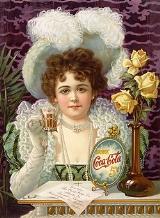
Ad Encyclopaedia Britannica 05 1913
In the early 1920s, the first radio stations were established by radio equipment manufacturers and retailers who offered programs in order to sell more radios to consumers. As time passed, many non-profit organizations followed suit in setting up their own radio stations, and included: schools, clubs and civic groups. When the practice of sponsoring programs was popularised, each individual radio program was usually sponsored by a single business in exchange for a brief mention of the business' name at the beginning and end of the sponsored shows. However, radio station owners soon realised they could earn more money by selling sponsorship rights in small time allocations to multiple businesses throughout their radio station's broadcasts, rather than selling the sponsorship rights to single businesses per show.

This practice was carried over to television in the late 1940s and early 1950s. A fierce battle was fought between those seeking to commercialise the radio and people who argued that the radio spectrum should be considered a part of the commons – to be used only non-commercially and for the public good. The United Kingdom pursued a public funding model for the BBC, originally a private company, the British Broadcasting Company
British Broadcasting Company

The British Broadcasting Company Ltd was a United Kingdom commercial company formed on 18 October 1922 by British and American electrical companies doing business in the United Kingdom....
, but incorporated as a public body by Royal Charter
Royal Charter

A royal charter is a charter granted by a Monarch to create institutions or other forms of incorporated bodies . In the United Kingdom legal tradition a royal charter is in the form of letters patent....
 in 1927. In Canada, advocates like Graham Spry
Graham Spry

Graham Spry, Order of Canada was a Canada broadcasting pioneer, business executive, diplomat and socialist. He was the husband of Irene Spry and father of Robin Spry....
 were likewise able to persuade the federal government to adopt a public funding model, creating the Canadian Broadcasting Corporation
Canadian Broadcasting Corporation

The Canadian Broadcasting Corporation , a Canada crown corporation, is the country?s national public radio and television broadcaster. In French, it is called la Soci?t? Radio-Canada ....
. However, in the United States, the capitalist model prevailed with the passage of the Communications Act of 1934
Communications Act of 1934

The Communications Act of 1934 was a United States federal law enacted as Public Law Number 416, Act of June 19, 1934, ch. 652, 48 Stat. 1064, by the 73rd Congress, codified as Chapter 5 of Title 47 of the United States Code, et seq....
 which created the Federal Communications Commission
Federal Communications Commission

The Federal Communications Commission is an Independent agencies of the United States government, created, directed, and empowered by United States Congress statute , and with the majority of its commissioners appointed by the current President of the United States....
. To placate the socialists, the U.S. Congress did require commercial broadcasters to operate in the "public interest, convenience, and necessity". Public broadcasting
Public broadcasting

Public broadcasting includes radio, television and other electronic mass media outlets that receive some or all of their funding from the public....
 now exists in the United States due to the 1967 Public Broadcasting Act
Public Broadcasting Act of 1967

The Public Broadcasting Act of 1967 set up public broadcasting in the United States, establishing the Corporation for Public Broadcasting, and eventually the Public Broadcasting Service and National Public Radio ....
 which led to the Public Broadcasting Service
Public Broadcasting Service

The Public Broadcasting Service is an United States non-profit public broadcasting television service with 354 member TV stations in the United States....
 and National Public Radio
National Public Radio

National Public Radio is a privately and publicly funded non-profit membership media organization that serves as a national Radio syndication to 797 public radio List of NPR stations in the United States....
.

In the early 1950s, the DuMont Television Network
DuMont Television Network

The DuMont Television Network, also known as the DuMont Network, DuMont, Du Mont, or Dumont was the world's first commercial television network, beginning operation in the United States in 1946....
 began the modern trend of selling advertisement time to multiple sponsors. Previously, DuMont had trouble finding sponsors for many of their programs and compensated by selling smaller blocks of advertising time to several businesses. This eventually became the standard for the commercial television industry in the United States. However, it was still a common practice to have single sponsor shows, such as The United States Steel Hour
The United States Steel Hour

The United States Steel Hour is an anthology series which brought hour-long dramas to television from 1953 to 1963. The television series and the radio program that preceded it were both sponsored by the U.S....
. In some instances the sponsors exercised great control over the content of the show - up to and including having one's advertising agency actually writing the show. The single sponsor model is much less prevalent now, a notable exception being the Hallmark Hall of Fame
Hallmark Hall of Fame

Hallmark Hall of Fame is an anthology program on United States television. It has had a historically long run, beginning in 1951 and still continuing today....
.

The 1960s saw advertising transform into a modern approach in which creativity was allowed to shine, producing unexpected messages that made advertisements more tempting to consumers' eyes. The Volkswagen
Volkswagen

Volkswagen Passenger Cars, also known as VW, is an automobile manufacturer based in Wolfsburg, Germany and is the original as well as the largest brand by sales volume within the Volkswagen Group....
 ad campaign—featuring such headlines as "Think Small" and "Lemon" (which were used to describe the appearance of the car)—ushered in the era of modern advertising by promoting a "position" or "unique selling proposition" designed to associate each brand with a specific idea in the reader or viewer's mind. This period of American advertising is called the Creative Revolution and its archetype
Archetype

An archetype is an original model of a person, ideal example, or a prototype after which others are copied, patterned, or emulated; a symbol universally recognized by all....
 was William Bernbach
William Bernbach

William Bernbach was a legendary figure in the history of American advertising. He was one of the three founders of Doyle Dane Bernbach and directed ad campaigns such as "Think Small" for Volkswagen Beetle ....
 who helped create the revolutionary Volkswagen ads among others. Some of the most creative and long-standing American advertising dates to this period.

The late 1980s and early 1990s saw the introduction of cable television
Cable television

Cable television is a system of providing television to consumers via radio frequency signals transmitted to televisions through fixed optical fibers or coaxial cables as opposed to the over-the-air method used in traditional television broadcasting in which a television antenna is required....
 and particularly MTV
MTV

MTV is an United States cable television network based in Media of New York City. Launched on August 1, 1981, the original purpose of the channel was to play music videos guided by on-air hosts known as VJ ....
. Pioneering the concept of the music video
Music video

A music video is a short film or video that accompanies a complete piece of music, most commonly a pop music or rock music song with lyrics. Modern music videos are primarily made and used as a marketing device intended to promote the sale of music recordings....
, MTV ushered in a new type of advertising: the consumer tunes in for the advertising message, rather than it being a by-product
By-product

A by-product is a secondary or incidental product deriving from a manufacturing process, a chemical reaction or a biochemical pathway, and is not the primary product or service being produced....
 or afterthought. As cable and satellite television
Satellite television

Satellite television is television delivered by the means of communications satellite and received by a satellite dish and set-top box. In many areas of the world it provides a wide range of channels and services, often to areas that are not serviced by terrestrial television or cable television providers....
 became increasingly prevalent, specialty channel
Specialty channel

A specialty channel is a television channel which consists of programming focused on a single type or targeted at a specific demographic.The number of specialty channels has greatly increased during the 1990s and 2000s while the previously common concept of countries having just a few TV stations addressing all interest groups and demogra...
s emerged, including channels entirely devoted to advertising
Shopping channel

Shopping channels are television specialty channels that present shopping related content, particularly for home shopping enthusiasts. Home shopping pioneers:...
, such as QVC
QVC

QVC is a West Chester, Pennsylvania, United States of America, multinational corporation, specializing in televised Shopping channel. Founded in 1986 in television by Joseph Segel, QVC broadcasts in four major countries to 141 million consumers....
, Home Shopping Network
Home Shopping Network

Home Shopping Network or HSN is a 24-hour basic cable shopping television network that can be seen on cable television, satellite television, and some terrestrial television channels in the United States....
, and ShopTV Canada
ShopTV Canada

ShopTV Canada is a Canadian English language cable television Shopping channel. It is currently owned by Torstar Media Group Television....
.

Marketing through the Internet
Internet

The Internet is a global network of interconnected computers, enabling users to share information along multiple channels. Typically, a computer that connects to the Internet can access information from a vast array of available server and other computers by moving information from them to the computer's local memory....
 opened new frontiers for advertisers and contributed to the "dot-com
Dot-com bubble

The "dot-com bubble" was a economic bubble covering roughly 1995?2001 during which stock markets in Western world saw their value increase rapidly from growth in the new quaternary sector of industry and related fields....
" boom of the 1990s. Entire corporations operated solely on advertising revenue, offering everything from coupon
Coupon

In marketing a coupon is a ticket or document that can be exchanged for a financial discounts and allowances or rebate when purchasing a product ....
s to free Internet access. At the turn of the 21st century, a number of websites including the search engine
Web search engine

A Web search engine is a tool designed to search for information on the World Wide Web. The search results are usually presented in a list and are commonly called hits....
 Google
Google

Google Inc. is an United States public company, earning revenue from AdWords related to its Google search, Gmail, Google Maps, Google Apps, Orkut, and YouTube services as well as selling advertising-free versions of the Google Search Appliance....
, started a change in online advertising
Online advertising

Online advertising is a form of promotion that uses the Internet and World Wide Web for the expressed purpose of delivering marketing messages to attract customers....
 by emphasizing contextually relevant, unobtrusive ads intended to help, rather than inundate, users. This has led to a plethora of similar efforts and an increasing trend of interactive advertising
Interactive advertising

Interactive advertising uses online or offline interactive media to communicate with consumers and to promote products, brands, services, and public service announcements, corporate or political groups....
.

The share of advertising spending relative to GDP
Gross domestic product

File:GDP nominal per capita world map IMF 2008.pngThe gross domestic product or gross domestic income is one of the measures of national income and output for a given country's economy....
 has changed little across large changes in media
Mass media

Mass media is a term used to denote a section of the media specifically envisioned and designed to reach a mainstream such as the population of a nation state....
. For example, in the U.S. in 1925, the main advertising media were newspapers, magazines, signs on streetcars
Tram

A tram, tramcar, trolley, trolley car, or streetcar is a railroad car, of lighter weight and construction than a train, designed for the transport of passengers within, close to, or between villages, towns and/or cities, on tracks running primarily on streets....
, and outdoor poster
Poster

A poster is any piece of printed paper designed to be attached to a wall or vertical surface. Typically posters include both typography and graphic elements, although a poster may be either wholly graphical or wholly textual....
s. Advertising spending as a share of GDP was about 2.9 percent. By 1998, television and radio had become major advertising media. Nonetheless, advertising spending as a share of GDP was slightly lower—about 2.4 percent.

A recent advertising innovation is "guerrilla marketing
Guerrilla marketing

Guerrilla marketing is an unconventional system of promotion that relies on time, energy and imagination rather than a big marketing budget. Typically, guerrilla marketing tactics are unexpected and unconventional; consumers are targeted in unexpected places, which can make the idea that's being marketed memorable, generate marketing buzz, a...
", which involve unusual approaches such as staged encounters in public places, giveaways of products such as cars that are covered with brand messages, and interactive advertising where the viewer can respond to become part of the advertising message. This reflects an increasing trend of interactive and "embedded" ads, such as via product placement
Product placement

Product placement, or embedded marketing, is a form of advertisement, where branded goods or services are placed in a context usually devoid of ads, such as movies, the story line of television shows, or news programs....
, having consumers vote through text message
Text messaging

File:Texting.jpgText messaging, or texting is the common term for the sending of "short" text messages from mobile phones using the Short message service ....
s, and various innovations utilizing social network service
Social network service

A social network service focuses on building online communities of people who share interests and/or activities, or who are interested in exploring the interests and activities of others....
s such as MySpace
MySpace

MySpace is a social network service website with an interactive, user-submitted network of friends, personal profiles, blogs, groups, photos, music, and videos for teenagers and adults internationally....
.

Mobile billboard advertising


Mobile billboard
Mobile billboard

A mobile billboard is the marketing practice of advertising on the side of a truck or trailer that is typically mobile. Mobile billboards are a form of Out-Of-Home Advertising....
s are truck- or blimp-mounted billboard
Billboard

Billboard is a weekly United States magazine devoted to the music industry. It maintains several internationally recognized Record chart that track the most popular songs and albums in various categories on a weekly basis....
s or digital screens. These can be dedicated vehicles built solely for carrying advertisements along routes preselected by clients, or they can be specially-equipped cargo trucks. The billboards are often lighted; some being backlit
Backlight

A backlight is a form of illumination used in liquid crystal displays . Backlights illuminate the LCD from the side or back of the display panel, unlike frontlights, which are placed in front of the LCD....
, and others employing spotlights. Some billboard displays are static, while others change; for example, continuously or periodically rotating among a set of advertisements.

Mobile displays are used for various situations in metropolitan areas throughout the world, including:

  • Target advertising
  • One-day, and long-term campaigns
  • Conventions
  • Sporting events
  • Store openings and similar promotional events
  • Big advertisements from smaller companies
  • Others


Public service advertising


The same advertising techniques used to promote commercial goods and services can be used to inform, educate and motivate the public about non-commercial issues, such as AIDS, political ideology, energy conservation, religious recruitment, and deforestation.

Advertising, in its non-commercial guise, is a powerful educational tool capable of reaching and motivating large audiences. "Advertising justifies its existence when used in the public interest - it is much too powerful a tool to use solely for commercial purposes." - Attributed to Howard Gossage by David Ogilvy
David Ogilvy

David MacKenzie Ogilvy, Order of the British Empire , was a notable advertising executive. He has often been called "The Father of Advertising." In 1962, Time called him "the most sought-after wizard in today's advertising industry." He was known for a career of expanding the bounds of both creativity and morality....
.

Public service advertising

Public service advertising is the use of commercial advertising techniques for non-commercial purposes . Typical topics for public service advertising include public health/public safety issues, emergency preparedness instructions, natural resources Conservation movement information, and other topics of broad interest....
, non-commercial advertising
Non-commercial advertising

Non-commercial advertising is sponsored by or for a Charitable organization institution or civic group or religious or political organization. Many noncommercial advertisements seek money and placed in the hope of raising funds....
, public interest advertising, cause marketing
Cause marketing

Cause marketing or cause-related marketing refers to a type of marketing involving the cooperative efforts of a "for profit" business and a non-profit organization for mutual benefit....
, and social marketing
Social marketing

Social marketing is the systematic application of marketing along with other concepts and techniques to achieve specific behavioral goals for a social good....
 are different terms for (or aspects of) the use of sophisticated advertising and marketing communications techniques (generally associated with commercial enterprise) on behalf of non-commercial, public interest issues and initiatives.

In the United States, the granting of television and radio licenses by the FCC is contingent upon the station broadcasting a certain amount of public service advertising. To meet these requirements, many broadcast stations in America air the bulk of their required public service announcement
Public service announcement

A public service announcement or community service announcement is a non-commercial advertising broadcast on radio or television, ostensibly for the public interest....
s during the late night or early morning when the smallest percentage of viewers are watching, leaving more day and prime time commercial slots available for high-paying advertisers.

Public service advertising reached its height during World Wars I
World War I

World War I, or the First World War , was a global military conflict which involved the Great powers, organized into two opposing military alliances: the Allies of World War I and the Central Powers....
 and II
World War II

World War II, or the Second World War , was a global military conflict which involved a Participants in World War II, including all of the great powers, organised into two opposing military alliances: the Allies of World War II and the Axis powers....
 under the direction of several governments.

Types of advertising


Media


Advertisingman


Commercial advertising media can include wall paintings
Mural

A mural is a painting on a wall, ceiling, or other large permanent surface....
, billboards, street furniture components, printed flyers and rack card
Rack card

A rack card is a document used for advertising, frequently in convenience stores, hotels, landmarks, restaurants, rest areas and other locations that enjoy significant foot traffic....
s, radio, cinema and television adverts, web banner
Web banner

A web banner or banner ad is a form of advertising on the World Wide Web. This form of online advertising entails embedding an advertisement into a web page....
s, mobile telephone screens, shopping carts, web popups
Pop-up ad

Pop-up ads or pop-ups are a form of online advertising on the WWW World Wide Web intended to attract web traffic or capture email addresses....
, skywriting
Skywriting

Skywriting is the process of using a small aircraft, able to expel special smoke during flight, to fly in certain patterns to create writing readable by someone on the ground....
, bus stop benches, human billboard
Human billboard

A human billboard is someone who applies an advertisement on his or her person. Most commonly, this means holding or wearing a sign of some sort, but also may include wearing advertising as clothing or in extreme cases, having advertising tattooed on the body....
s, magazines, newspapers, town criers, sides of buses, banners attached to or sides of airplanes ("logojet
Logojet

A logojet is an airliner with an advertising paint scheme. Logojets used for advertising companies remain uncommon due to the time and cost of repainting an entire airliner....
s"), in-flight advertisements
In-flight advertising

In-flight advertising encompasses any means of advertising that targets potential consumers on-board an airline. This includes commercials during in-flight entertainment programming, advertisements in in-flight magazines, ads on Airline Tray Table Advertising and Airliner#Overhead bins, and sales pitches by flight attendants....
 on seatback tray tables
Tray-table

A tray-table is a small, tray-shaped table used to place small objects upon. They are most commonly used to place meals on while watching television....
 or overhead storage bins, taxicab doors, roof mounts and passenger screens
Cabvision

Cabvision is a narrowcast private recorded television service provided in London taxicabs....
, musical stage shows, subway platforms and trains, elastic bands on disposable diapers, stickers on apples in supermarket
Supermarket

A supermarket is a self-service Retailing#Retail types offering a wide variety of food and household merchandise, organized into departments....
s, shopping cart handles
Shopping cart

A shopping cart is a cart supplied by a Retailing#Shops and stores, especially a supermarket, for use by customers inside the shop for transport of merchandise to the check-out counter during shopping, and often to the customer's car after paying as well....
 (grabertising), the opening section of streaming
Streaming media

Streaming media is multimedia that is constantly received by, and normally presented to, an End-user while it is being delivered by a streaming provider ....
 audio and video, posters, and the backs of event tickets and supermarket receipts. Any place an "identified" sponsor pays to deliver their message through a medium is advertising.

One way to measure advertising effectiveness is known as Ad Tracking
Ad Tracking

Ad tracking, also known as post-testing or ad effectiveness tracking is continuous in-market research that Copy testing including brand and advertising awareness, product trial and usage, and attitudes about the brand versus their competition....
. This advertising research
Advertising research

Advertising research is a specialized form of marketing research conducted to improve the efficiency of wiktionary:advertising. According to MarketConscious.com, ?It may focus on a specific ad or campaign, or may be directed at a more general understanding of how advertising works or how consumers use the information in advertising....
 methodology measures shifts in target market perceptions about the brand and product or service. These shifts in perception are plotted against the consumers’ levels of exposure to the company’s advertisements and promotions
Marketing

Marketing is defined by the American Marketing Association as the activity, set of institutions, and processes for creating, communicating, delivering, and exchanging offerings that have value for customers, clients, partners, and society at large....
. The purpose of Ad Tracking is generally to provide a measure of the combined effect of the media weight or spending level, the effectiveness of the media buy or targeting
Advertising media selection

Advertising media selection is the process of choosing the most cost-effective Mass media to achieve the necessary coverage, and number of exposures, among the target audience....
, and the quality of the advertising executions or creative.
Covert advertising

Covert advertising is when a product or brand is embedded in entertainment and media. For example, in a film, the main character can use an item or other of a definite brand, as in the movie Minority Report
Minority Report (film)

Minority Report is a 2002 in film science fiction film directed by Steven Spielberg, loosely based on the Philip K. Dick short story The Minority Report and it is one of several Philip K....
, where Tom Cruise
Tom Cruise

Thomas Cruise Mapother IV , better known by his Stage name Tom Cruise, is an United States actor and film producer. Forbes magazine ranked him as the world's most powerful celebrity in 2006....
's character John Anderton owns a phone with the Nokia
Nokia

Nokia Corporation is a Finland Multinational corporation communications corporation, headquartered in Keilaniemi, Espoo, a city neighbouring Finland's capital Helsinki....
 logo clearly written in the top corner, or his watch engraved with the Bulgari
Bulgari

Bulgari is an Italy jeweler and luxury goods retailer. The name is usually written "BVLGARI" in ancient Roman style, and is derived from the surname of the company's Greeks founder, Sotirios Voulgaris ....
 logo. Another example of advertising in film is in I, Robot
I, Robot (film)

I, Robot is a science fiction film set in a world where humans and humanoid robots interact . It was directed by Alex Proyas, written by Jeff Vintar, and starred Will Smith....
, where main character played by Will Smith
Will Smith

Willard Christopher "Will" Smith, Jr. is an United Statesn actor, film producer and rapping. He has enjoyed success in music, television and film....
 mentions his Converse shoes several times, calling them "classics," because the film is set far in the future. I, Robot and Spaceballs
Spaceballs

Spaceballs is a 1987 science fiction parody film co-written, directed by, and starring Mel Brooks. It was released on June 24, 1987, and earned only modest returns, but has gone on to become a seminal cult film on video....
 also showcase futuristic cars with the Audi
Audi

AUDI AG, is a Germany car manufacturer which produces cars under the Audi brand, . The name Audi is based on a latin translation of the last name of the founder August "Horch", itself the German word for ?hear." Another explanation for the origin of the name is as an acronym for ?Auto Union Deutschland Ingolstadt."...
 and Mercedes-Benz
Mercedes-Benz

Mercedes-Benz is a German manufacturer of automobiles, buses, coach es, and trucks. It is currently a division of the parent company, Daimler AG , after previously being owned by Daimler-Benz....
 logos clearly displayed on the front of the vehicles. Cadillac
Cadillac

Cadillac is a luxury vehicle marque owned by General Motors. Cadillac vehicles are sold in over 50 countries and territories, mainly in the United States, Canada, and Mexico....
 chose to advertise in the movie The Matrix Reloaded
The Matrix Reloaded

The Matrix Reloaded is a 2003 in film film, the second installment in The Matrix , written and directed by the Wachowski Brothers. It premiered on May 7, 2003, in Westwood, Los Angeles, California, and went on general release by Warner Bros....
, which as a result contained many scenes in which Cadillac cars were used. Similarly, product placement for Omega Watches, Ford
Ford Motor Company

The Ford Motor Company is an United States multinational corporation and the world's List of automobile manufacturers#World Motor Vehicle Production by Manufacturer based on worldwide vehicle sales, following Toyota, General Motors, and Volkswagen Group....
, VAIO
VAIO

VAIO is a sub-brand for many of Sony's computer products. It was originally an acronym for Video Audio Integrated Operation, but since 2008 amended to Visual Audio Intelligence Organizer to celebrate the brand's 10th year anniversary....
, BMW
BMW

, is an independent German automotive industry founded in 1916. It also produces BMW Motorrad, is the owner of the MINI brand and is the parent company of Rolls-Royce Motor Cars....
 and Aston Martin
Aston Martin

Aston Martin Lagonda Limited is a British manufacturer of luxury sports cars, based in Gaydon, Warwickshire. The company name is derived from the name of one of the company's founders, Lionel Martin, and from the Aston Hill hillclimbing near Aston Clinton in Buckinghamshire...
 cars are featured in recent James Bond
James Bond

James Bond 007 is a fictional character created in 1953 by writer Ian Fleming, who featured him in twelve novels and two short story collections....
 films, most notably Casino Royale
Casino Royale (2006 film)

Casino Royale is the twenty-first film in the James Bond James Bond ; it is directed by Martin Campbell and the first to star Daniel Craig as Secret Intelligence Service agent James Bond ....
. Bladerunner includes some of the most obvious product placement; the whole film stops to show a coca cola billboard.

Television commercials

The TV commercial is generally considered the most effective mass-market advertising format, as is reflected by the high prices TV networks charge for commercial airtime
Broadcasting

Broadcasting is distribution of Sound and/or video Signalling s which transmit programs to an audience. The audience may be the general public or a relatively large sub-audience, such as children or young adults....
 during popular TV events. The annual Super Bowl
Super Bowl

In professional American football, the Super Bowl is the championship game of the National Football League . The game and its ancillary festivities constitute Super Bowl Sunday....
 football
American football

American football, known in the United States and Canada simply as football, is a competitive team sport known for mixing strategy with physical play....
 game in the United States is known as the most prominent advertising event on television. The average cost of a single thirty-second TV spot during this game has reached $3 million (as of 2009).

The majority of television commercials feature a song or jingle
Jingle

A jingle is a memorable slogan, set to an engaging melody, mainly Broadcasting on radio and sometimes on television commercials.History ...
 that listeners soon relate to the product.

Virtual advertisements may be inserted into regular television programming through computer graphics. It is typically inserted into otherwise blank backdrops or used to replace local billboards that are not relevant to the remote broadcast audience. More controversially, virtual billboards may be inserted into the background where none exist in real-life. Virtual product placement is also possible.

Infomercials

There are two types of infomercial
Infomercial

Infomercials are long-format television Television advertisement, typically five minutes or longer.. Infomercials are also known as paid programming ....
s, described as long form and short form. Long form infomercials have a time length of 30 minutes. Short form infomercials are 30 seconds to 2 minutes long. Infomercials are also known as direct response television
Direct response television

Direct Response Television, or DRTV for short, includes any television advertising that asks consumers to respond directly to the company --- usually either by calling an 800 number or by visiting a web site....
 (DRTV) commercials or direct response marketing
Direct response marketing

Direct response marketing is a form of marketing designed to solicit a direct response which is specific and quantifiable. The delivery of the response is direct between the viewer and the advertiser, that is, the customer responds to the marketer directly....
.

The main objective in an infomercial is to create an impulse purchase
Impulse purchase

An impulse purchase or impulse buy is an unplanned or otherwise spontaneous purchase. One who tends to make such purchases is referred to as an impulse purchaser or impulse buyer....
, so that the consumer sees the presentation and then immediately buys the product through the advertised toll-free telephone number
Toll-free telephone number

A toll-free, Freecall, Freephone, or 800 number is a special telephone number, in that the called party is charged the cost of the calls by the telephone carrier, instead of the calling party....
 or website
Website

A Web site is a collection of related Web pages, images, videos or other digital assets that are hosted on one Web server, usually accessible via the Internet....
. Infomercials describe, display, and often demonstrate products and their features, and commonly have testimonials from consumers and industry professionals.

Some well known companies in the infomercial business are Script to Screen, Hawthorne Direct, International Shopping Network and Guthy-Renker
Guthy-Renker

Guthy-Renker Corporation is a direct-response marketer known primarily for selling products in the United States via infomercials. However, the company now sells products direct to consumer through many media channels through offices in many countries ....
.

Celebrities

This type of advertising focuses upon using celebrity power, fame, money, popularity to gain recognition for their products and promote specific stores or products. Advertisers often advertise their products, for example, when celebrities share their favourite products or wear clothes by specific brands or designers. Celebrities are often involved in advertising campaigns such as television or print adverts to advertise specific or general products.

Media and advertising approaches

Increasingly, other media are overtaking television because of a shift towards consumer's usage of the Internet as well as devices such as TiVo
TiVo

TiVo is the pioneer of the digital video recorder . TiVo was introduced in the United States, and is now available in Canada, Mexico, Australia, and Taiwan....
.

Advertising on the World Wide Web
World Wide Web

The World Wide Web is a very large set of interlinked hypertext documents accessed via the Internet. With a Web browser, one can view Web pages that may contain writing, s, videos, and other multimedia and navigate between them using hyperlinks....
 is a recent phenomenon. Prices of Web-based advertising space are dependent on the "relevance" of the surrounding web content and the traffic that the website receives.

E-mail
E-mail

Electronic mail, often abbreviated as e-mail, email, E-Mail, or eMail, is any method of creating, transmitting, or storing primarily text-based human communications with digital communications systems....
 advertising is another recent phenomenon. Unsolicited bulk E-mail advertising is known as "spam".

Some companies have proposed placing messages or corporate logo
Logo

A logo is a graphical element that, together with its logotype form a trademark or commercial brand. Typically, a logo's design is for immediate recognition....
s on the side of booster rocket
Rocket

A rocket or rocket vehicle is a missile, aircraft or other vehicle which obtains thrust by the Reaction of the rocket to the ejection of fast moving fluid exhaust from a rocket engine....
s and the International Space Station
International Space Station

The International Space Station is a research facility Assembly of the International Space Station in outer space. On-orbit construction of the station began in 1998, and is scheduled to be complete by 2011, with operations continuing until around 2015....
. Controversy
Controversy

A controversy is a dispute, argument, discussion or debate featuring strong disagreements and opposing, contrary, or sharply contrasting opinions about an idea, subject, group or person....
 exists on the effectiveness of subliminal advertising
Subliminal message

A subliminal message is a signal or message embedded in another medium, designed to pass below the normal limits of the human mind's perception....
 (see mind control
Mind control

Mind control is a broad range of psychology tactics able to subvert an individual's control of his own thought, behavior, emotions, or decisions....
), and the pervasiveness of mass messages (see propaganda
Propaganda

Propaganda is the dissemination of information aimed at influencing the opinions or behaviors of large numbers of people. As opposed to Objectivity providing information, propaganda in its most basic sense presents information in order to influence its audience....
).

Unpaid advertising (also called publicity
Publicity

Publicity is the deliberate attempt to manage the public's perception of a subject. The subjects of publicity include people , product and services, organizations of all kinds, and works of art or entertainment....
 advertising), can provide good exposure at minimal cost. Personal recommendations ("bring a friend", "sell it"), spreading buzz, or achieving the feat of equating a brand with a common noun (in the United States, "Xerox
Xerox

Xerox Corporation is a global document management company which manufactures and sells a range of color and black-and-white Computer printer, multifunction systems, photo copiers, digital production printing presses, and related consulting services and supplies....
" = "photocopier
Photocopier

A photocopier is a machine that makes paper copies of documents and other visual images quickly and cheaply. Most current photocopiers use a technology called xerography, a dry process using heat....
", "Kleenex
Kleenex

Kleenex is a brand name for a variety of products such as facial tissue, bathroom tissue, paper towels, and diapers. Kleenex is a registered trademark of Kimberly-Clark....
" = tissue
Facial tissue

Facial tissue and paper handkerchief refers to a class of soft, absorbent, disposable papers that is suitable for use on the face. They are disposable and more Hygiene alternatives for cloth handkerchiefs....
, "Vaseline
Vaseline

Vaseline is a brand of petroleum jelly based products owned by Anglo-Dutch company Unilever. Products include plain petroleum jelly and a selection of skin creams, lotions, cleansers, deodorants and personal lubricant....
" = petroleum jelly
Petroleum jelly

Petroleum jelly, petrolatum or soft paraffin is a semi-solid mixture of hydrocarbons , originally promoted as a topical ointment for its healing properties....
, "Hoover
The Hoover Company

The Hoover Company started out as an American floor care manufacturer based in North Canton, Ohio, Ohio. It also established a major base in the United Kingdom and for most of the early-and-mid-20th century, it dominated the electric vacuum cleaner industry, to the point where the "hoover" Genericized trademark for vacuum cleaners and vacuum...
" = vacuum cleaner
Vacuum cleaner

A vacuum cleaner is a device that uses an air pump to create a partial vacuum to suck up dust and dirt, usually from floors.Most homes with carpeted floors in developed countries possess a vacuum cleaner for cleaning....
,nintendo
Nintendo

is a global company located in Kyoto, Japan founded on September 23, 1889 by Fusajiro Yamauchi to produce handmade hanafuda cards. By 1963, the company had tried several small niche businesses, such as a cab company and a love hotel....
(older people)=video games, and "Band-Aid
Band-Aid

Band-Aid is the brand name for Johnson & Johnson line of adhesive bandages and related products. It has also become something of a genericized trademark for any adhesive bandage among the consuming public in the United States, India, Canada, Brazil and Australia....
" = adhesive bandage
Adhesive bandage

An adhesive bandage is a small dressing used for injuries not serious enough to require a full-size bandage....
) — these can be seen as the pinnacle of any advertising campaign. However, some companies oppose the use of their brand name to label an object. Equating a brand with a common noun also risks turning that brand into a genericized trademark
Genericized trademark

A genericized trademark is a trademark or brand name that has become the colloquialism or generic description for a general class of Good or Service , rather than the specific meaning intended by the trademark's holder....
 - turning it into a generic term which means that its legal protection as a trademark
TradeMark

TradeMark is a tall, primarily residential, skyscraper in Charlotte, North Carolina. It was completed in 2007 and has 28 floors. There are 200 hundred residential units....
 is lost.

As the mobile phone
Mobile phone

A mobile phone is a long-range, electronic device used for mobile voice or data communication over a network of specialized base stations known as cell sites....
 became a new mass media in 1998 when the first paid downloadable content appeared on mobile phones in Finland, it was only a matter of time until mobile advertising
Mobile advertising

Mobile advertising is a form of advertising via Mobile phone or other mobile devices. It is a subset of mobile marketing....
 followed, also first launched in Finland in 2000. By 2007 the value of mobile advertising had reached $2.2 billion and providers such as Admob delivered billions of mobile ads.

More advanced mobile ads include banner ads, coupons, Multimedia Messaging Service
Multimedia Messaging Service

File:MMS.jpg Multimedia Messaging Service, or MMS, is a telecommunications standard for sending messages that include multimedia objects ....
 picture and video messages, advergames and various engagement marketing campaigns. A particular feature driving mobile ads is the 2D Barcode
Barcode

A bar code is an optical machine-readable representation of data. Originally, bar codes represented data in the widths and the spacings of parallel lines and may be referred to as linear or 1D barcodes or symbologies....
, which replaces the need to do any typing of web addresses, and uses the camera feature of modern phones to gain immediate access to web content. 83 percent of Japanese mobile phone users already are active users of 2D barcodes.

A new form of advertising that is growing rapidly is social network advertising
Social network advertising

Social Network Advertising is a term that is used to describe a form of Online advertising that focuses on social networking sites. One of the major benefits of advertising on a social networking site is that advertisers can take advantage of the users demographic information and target their ads appropriately....
. It is online advertising with a focus on social networking sites. This is a relatively immature market, but it has shown a lot of promise as advertisers are able to take advantage of the demographic information the user has provided to the social networking site. Friendertising is a more precise advertising term in which people are able to direct advertisements toward others directly using social network service
Social network service

A social network service focuses on building online communities of people who share interests and/or activities, or who are interested in exploring the interests and activities of others....
.

From time to time, The CW Television Network
The CW Television Network

The CW Television Network is a television network in the United States launched at the beginning of the 2006-07 United States network television schedule....
 airs short programming breaks called "Content Wraps," to advertise one company's product during an entire commercial break. The CW pioneered "content wraps" and some products featured were Herbal Essences
Herbal Essences

Herbal Essences is a brand of shampoo, hair conditioner, and hair coloring products initially designed to appeal to holistic and natural products shoppers but eventually targeted almost exclusively at women, created by Clairol and subsequently owned by Procter & Gamble....
, Crest, Guitar Hero II
Guitar Hero II

Guitar Hero II is a music video game developed by Harmonix Music Systems and published by RedOctane. It is the second installment in the Guitar Hero and is the sequel to Guitar Hero ....
, CoverGirl, and recently Toyota.

Criticism of advertising


Hyper-commercialism and the commercial tidal wave


Criticism of advertising is closely linked with criticism of media and often interchangeable. They can refer to its audio-visual aspects (e. g. cluttering of public spaces and airwaves), environmental aspects (e. g. pollution, oversize packaging, increasing consumption) , political aspects (e. g. media dependency, free speech, censorship), financial aspects (costs), ethical/moral/social aspects (e. g. sub-conscious influencing, invasion of privacy, increasing consumption and waste, target groups, certain products, honesty) and, of course, a mix thereof. Some aspects can be subdivided further and some can cover more than one category.

As advertising has become increasingly ubiquitous in modern Western societies, it is also increasingly being criticized. A person can hardly move in the public sphere or use a medium without being subject to advertising. Advertising occupies public space and more and more invades the private sphere of people, many of which consider it a nuisance. “It is becoming harder to escape from advertising and the media. … Public space is increasingly turning into a gigantic billboard for products of all kind. The aesthetical and political consequences cannot yet be foreseen.” Hanno Rauterberg in the German newspaper ‘Die Zeit’ calls advertising a new kind of dictatorship that cannot be escaped.

“’’’Ad Creep’’’: …There are ads in schools, airport lounges, doctors offices, movie theaters, hospitals, gas stations, elevators, convenience stores, on the Internet, on fruit, on ATM's, on garbage cans and countless other places. There are ads on beach sand and restroom walls.” “One of the ironies of advertising in our times is that as commercialism increases, it makes it that much more difficult for any particular advertiser to succeed, hence pushing the advertiser to even greater efforts.” Within a decade advertising in radios climbed to nearly 18 or 19 minutes per hour; on prime-time television the standard until 1982 was no more than 9.5 minutes of advertising per hour, today it’s between 14 and 17 minutes. With the introduction of the shorter 15-second-spot the total amount of ads increased even more dramatically. Ads are not only placed in breaks but e. g. also into baseball telecasts during the game itself. They flood the internet, a market growing in leaps and bounds.

Other growing markets are ‘’product placement
Product placement

Product placement, or embedded marketing, is a form of advertisement, where branded goods or services are placed in a context usually devoid of ads, such as movies, the story line of television shows, or news programs....
s’’ in entertainment programming and in movies where it has become standard practice and ‘’virtual advertising’’ where products get placed retroactively into rerun shows. Product billboards are virtually inserted into Major League Baseball broadcasts and in the same manner, virtual street banners or logos are projected on an entry canopy or sidewalks, for example during the arrival of celebrities at the 2001 Grammy Awards. Advertising precedes the showing of films at cinemas including lavish ‘film shorts’ produced by companies such as Microsoft or DaimlerChrysler. “The largest advertising agencies have begun working aggressively to co-produce programming in conjunction with the largest media firms” creating Infomercials resembling entertainment programming.

Opponents equate the growing amount of advertising with a “tidal wave” and restrictions with “damming” the flood. Kalle Lasn
Kalle Lasn

Kalle Lasn is the founder of Adbusters magazine and author of the books Culture Jam and Design Anarchy. He is the CEO of the Blackspot Anticorporation....
, one of the most outspoken critics of advertising on the international stage, considers advertising “the most prevalent and toxic of the mental pollutants. From the moment your radio alarm sounds in the morning to the wee hours of late-night TV microjolts of commercial pollution flood into your brain at the rate of around 3,000 marketing messages per day. Every day an estimated twelve billion display ads, 3 million radio commercials and more than 200,000 television commercials are dumped into North America’s collective unconscious”. In the course of his life the average American watches three years of advertising on television.

More recent developments are video games incorporating products into their content, special commercial patient channels in hospitals and public figures sporting temporary tattoos. A method unrecognisable as advertising is so-called ‘’guerrilla marketing’’ which is spreading ‘buzz’ about a new product in target audiences. Cash-strapped U.S. cities do not shrink back from offering police cars for advertising. A trend, especially in Germany, is companies buying the names of sports stadiums. The Hamburg soccer Volkspark stadium first became the AOL Arena and then the HSH Nordbank Arena. The Stuttgart Neckarstadion became the Mercedes-Benz Arena, the Dortmund Westfalenstadion now is the Signal Iduna Park
Signal Iduna Park

Westfalenstadion is a football stadium in the Germany city of Dortmund in the industrial metropolitan area of the Ruhrgebiet .The stadium is officially named Signal Iduna Park under a sponsorship arrangement lasting from December 2005 until June 2011, giving naming rights to the Signal Iduna Group, an insurance company....
. The former SkyDome in Toronto was renamed Rogers Centre
Rogers Centre

Rogers Centre, formerly known as SkyDome, is a multi-purpose stadium in Toronto, Ontario, Canada, situated next to the CN Tower near the shores of Lake Ontario....
. Other recent developments are, for example, that whole subway stations in Berlin are redesigned into product halls and exclusively leased to a company. Düsseldorf even has ‘multi-sensorial’ adventure transit stops equipped with loudspeakers and systems that spread the smell of a detergent. Swatch used beamers to project messages on the Berlin TV-tower and Victory column, which was fined because it was done without a permit. The illegality was part of the scheme and added promotion.

It’s standard business management knowledge that advertising is a pillar, if not “the” pillar of the growth-orientated free capitalist economy. “Advertising is part of the bone marrow of corporate capitalism.” “Contemporary capitalism could not function and global production networks could not exist as they do without advertising.”

For communication scientist and media economist Manfred Knoche at the University of Salzburg, Austria, advertising isn’t just simply a ‘necessary evil’ but a ‘necessary elixir of life’ for the media business, the economy and capitalism as a whole. Advertising and mass media economic interests create ideology. Knoche describes advertising for products and brands as ‘the producer’s weapons in the competition for customers’ and trade advertising, e. g. by the automotive industry, as a means to collectively represent their interests against other groups, such as the train companies. In his view editorial articles and programmes in the media, promoting consumption in general, provide a ‘cost free’ service to producers and sponsoring for a ‘much used means of payment’ in advertising. Christopher Lasch
Christopher Lasch

Christopher Lasch was a well-known American historian, moralist, and social critic....
 argues that advertising leads to an overall increase in consumption
Consumption

Consumption may refer to:*Using Final goods by a Consumer until disposal*Consumption *Consumption function, an economic formula*Power consumption, in electrical engineering...
 in society; "Advertising serves not so much to advertise products as to promote consumption as a way of life
Consumerism

Consumerism is the equation of personal happiness with Consumption and the purchase of material possessions.The term is often associated with criticisms of consumption starting with Thorstein Veblen....
."

Advertising and constitutional rights


Advertising is equated with constitutionally guaranteed freedom of opinion and speech. Therefore criticizing advertising or any attempt to restrict or ban advertising is almost always considered to be an attack on fundamental rights (First Amendment in the USA) and meets the combined and concentrated resistance of the business and especially the advertising community. “Currently or in the near future, any number of cases are and will be working their way through the court system that would seek to prohibit any government regulation of ….. commercial speech (e. g. advertising or food labelling) on the grounds that such regulation would violate citizens’ and corporations’ First Amendment rights to free speech or free press.” An example for this debate is advertising for tobacco or alcohol but also advertising by mail or fliers (clogged mail boxes), advertising on the phone, in the internet and advertising for children. Various legal restrictions concerning spamming, advertising on mobile phones, addressing children, tobacco, alcohol have been introduced by the US, the EU and various other countries. Not only the business community resists restrictions of advertising. Advertising as a means of free expression has firmly established itself in western society. Surveys e. g. reveal that advertising is generally seen as a welcome information and seldom as a nuisance. At worst it is seen as a necessary evil to be endured and most often its entertaining value is pointed out. Hardly any bye-law restricting advertising fails to appease possible critics by pointing out the positive effects and the necessity of advertising in its foreword. McChesney argues, that the government deserves constant vigilance when it comes to such regulations, but that it is certainly not “the only antidemocratic force in our society. …corporations and the wealthy enjoy a power every bit as immense as that enjoyed by the lords and royalty of feudal times” and “markets are not value-free or neutral; they not only tend to work to the advantage of those with the most money, but they also by their very nature emphasize profit over all else….Hence, today the debate is over whether advertising or food labelling, or campaign contributions are speech….if the rights to be protected by the First Amendment can only be effectively employed by a fraction of the citizenry, and their exercise of these rights gives them undue political power and undermines the ability of the balance of the citizenry to exercise the same rights and/or constitutional rights, then it is not necessarily legitimately protected by the First Amendment.” In addition, “those with the capacity to engage in free press are in a position to determine who can speak to the great mass of citizens and who cannot”. Critics in turn argue, that advertising invades privacy which is a constitutional right. For, on the one hand, advertising physically invades privacy, on the other, it increasingly uses relevant, information-based communication with private data assembled without the knowledge or consent of consumers or target groups.

For Georg Franck at Vienna University of Technology advertising is part of what he calls “mental capitalism” , taking up a term (mental) which has been used by groups concerned with the mental environment, such as Adbusters
AdBusters

Adbusters Media Foundation is a not-for-profit, Anti-consumerism organization founded in 1989 by Kalle Lasn and Bill Schmalz in Vancouver, British Columbia, Canada....
. Franck blends the “Economy of Attention” with Christopher Lasch’s The Culture of Narcissism I culture of narcissm into the mental capitalism : In his essay „Advertising at the Edge of the Apocalypse“, Sut Jhally
Sut Jhally

Sutinder "Sut" Jhally is a professor of Communication studies at the University of Massachusetts Amherst and is a cultural studies scholar in the area of advertising, mass media, and consumption ....
 writes: “20. century advertising is the most powerful and sustained system of propaganda in human history and its cumulative cultural effects, unless quickly checked, will be responsible for destroying the world as we know it.

The price of attention and hidden costs


Advertising has developed into a billion-dollar business on which many depend. In 2006 391 billion US dollars were spent worldwide for advertising. In Germany, for example, the advertising industry contributes 1.5% of the gross national income; the figures for other developed countries are similar. Thus, advertising and growth are directly and causally linked. As far as a growth based economy can be blamed for the harmful human lifestyle (affluent society) advertising has to be considered in this aspect concerning its negative impact, because its main purpose is to raise consumption. “The industry is accused of being one of the engines powering a convoluted economic mass production system which promotes consumption.”

Attention and attentiveness have become a new commodity for which a market developed. “The amount of attention that is absorbed by the media and redistributed in the competition for quotas and reach is not identical with the amount of attention, that is available in society. The total amount circulating in society is made up of the attention exchanged among the people themselves and the attention given to media information. Only the latter is homogenised by quantitative measuring and only the latter takes on the character of an anonymous currency.” According to Franck, any surface of presentation that can guarantee a certain degree of attentiveness works as magnet for attention, e. g. media which are actually meant for information and entertainment, culture and the arts, public space etc. It is this attraction which is sold to the advertising business. The German Advertising Association stated that in 2007 30.78 billion Euros were spent on advertising in Germany , 26% in newspapers, 21% on television, 15% by mail and 15% in magazines. In 2002 there were 360.000 people employed in the advertising business. The internet revenues for advertising doubled to almost 1 billion Euros from 2006 to 2007, giving it the highest growth rates.

Spiegel-Online reported that in the USA in 2008 for the first time more money was spent for advertising on internet (105.3 billion US dollars) than on television (98.5 billion US dollars). The largest amount in 2008 was still spent in the print media (147 billion US dollars). For that same year, Welt-Online reported that the US pharmaceutical industry spent almost double the amount on advertising (57.7 billion dollars) than it did on research (31.5 billion dollars). But Marc-André Gagnon und Joel Lexchin of York University, Toronto, estimate that the actual expenses for advertising are higher yet, because not all entries are recorded by the research institutions. Not included are indirect advertising campaigns such as sales, rebates and price reductions. Few consumers are aware of the fact that they are the ones paying for every cent spent for public relations, advertisements, rebates, packaging etc. since they ordinarily get included in the price calculation.

Influencing and conditioning

The most important element of advertising is not information but suggestion more or less making use of associations, emotions (appeal to emotion
Appeal to emotion

Appeal to emotion is a fallacy which uses the manipulation of the recipient's emotions, rather than valid logic, to win an argument. This kind of appeal to emotion is a type of red herring and encompasses several logical fallacies, including:...
) and drives dormant in the sub-conscience of people, such as sex drive, herd instinct, of desires, such as happiness, health, fitness, appearance, self-esteem, reputation, belonging, social status, identity, adventure, distraction, reward, of fears (appeal to fear
Appeal to fear

An appeal to fear is a fallacy in which a person attempts to create support for his or her idea by increasing fear and prejudice toward a competitor....
), such as illness, weaknesses, loneliness, need, uncertainty, security or of prejudices, learned opinions and comforts. “All human needs, relationships, and fears – the deepest recesses of the human psyche – become mere means for the expansion of the commodity universe under the force of modern marketing. With the rise to prominence of modern marketing, commercialism
Commercialism

Commercialism, in its original meaning, is the practices, methods, aims, and spirit of commerce or business. Today, however, it primarily refers to the tendency within capitalism to turn everything into objects, images, and services sold for the purpose of generating net income....
 – the translation of human relations into commodity relations – although a phenomenon intrinsic to capitalism, has expanded exponentially.” ’Cause-related marketing’ in which advertisers link their product to some worthy social cause has boomed over the past decade.

Advertising exploits the model role of celebrities or popular figures and makes deliberate use of humour as well as of associations with colour, tunes, certain names and terms. Altogether, these are factors of how one perceives himself and one’s self-worth. In his description of ‘mental capitalism’ Franck says, “the promise of consumption making someone irresistible is the ideal way of objects and symbols into a person’s subjective experience. Evidently, in a society in which revenue of attention moves to the fore, consumption is drawn by one’s self-esteem. As a result, consumption becomes ‘work’ on a person’s attraction. From the subjective point of view, this ‘work’ opens fields of unexpected dimensions for advertising. Advertising takes on the role of a life councillor in matters of attraction. (…) The cult around one’s own attraction is what Christopher Lasch described as ‘Culture of Narcissism’.”

For advertising critics another serious problem is that “the long standing notion of separation between advertising and editorial/creative sides of media is rapidly crumbling” and advertising is increasingly hard to tell apart from news, information or entertainment. The boundaries between advertising and programming are becoming blurred. According to the media firms all this commercial involvement has no influence over actual media content, but, as McChesney puts it, “this claim fails to pass even the most basic giggle test, it is so preposterous.”

Advertising draws “heavily on psychological theories about how to create subjects, enabling advertising and marketing to take on a ‘more clearly psychological tinge’ (Miller and Rose, 1997, cited in Thrift, 1999, p. 67). Increasingly, the emphasis in advertising has switched from providing ‘factual’ information to the symbolic connotations of commodities, since the crucial cultural premise of advertising is that the material object being sold is never in itself enough. Even those commodities providing for the most mundane necessities of daily life must be imbued with symbolic qualities and culturally endowed meanings via the ‘magic system (Williams, 1980) of advertising. In this way and by altering the context in which advertisements appear, things ‘can be made to mean "just about anything"’ (McFall, 2002, p. 162) and the ‘same’ things can be endowed with different intended meanings for different individuals and groups of people, thereby offering mass produced visions of individualism.”

Before advertising is done, market research
Market research

Market research often refers to either primary or secondary. In secondary research, the company uses information compiled from various sources which appears applicable to a new or existing product....
 institutions need to know and describe the target group in order to exactly plan and implement the advertising campaign and to achieve the best possible results. A whole array of sciences directly deal with advertising and marketing or is used to improve its effects. Focus groups, psychologists and cultural anthropologists are ‘’’de rigeur’’’ in marketing research”. Vast amounts of data on persons and their shopping habits are collected, accumulated, aggregated and analysed with the aid of credit cards, bonus cards, raffles and, last but not least, internet surveying. With increasing accuracy this supplies a picture of behaviour, wishes and weaknesses of certain sections of a population with which advertisement can be employed more selectively and effectively. The efficiency of advertising is improved through advertising research
Advertising research

Advertising research is a specialized form of marketing research conducted to improve the efficiency of wiktionary:advertising. According to MarketConscious.com, ?It may focus on a specific ad or campaign, or may be directed at a more general understanding of how advertising works or how consumers use the information in advertising....
. Universities, of course supported by business and in co-operation with other disciplines (s. above), mainly Psychiatry
Psychiatry

Psychiatry is a Medicine Specialty devoted to the Treatment of mental disorders, Biomedical research and Prevention of mental disorder. The term was first coined by the German physician Johann Christian Reil in 1808....
, Anthropology
Anthropology

Anthropology is the study of humans and humanity in its totality. Anthropology has origins in the natural sciences, and the humanities. In Great Britain it was originally divided into physical anthropology and cultural anthropology, which itself was divided into archaeology, technology, ethnology and sociology ....
, Neurology
Neurology

Neurology is a medical specialty dealing with disorders of the nervous system. Specifically, it deals with the diagnosis and treatment of all categories of disease involving the Central nervous system, Peripheral nervous system, and autonomic nervous systems, including their coverings, blood vessels, and...
 and behavioural sciences, are constantly in search for ever more refined, sophisticated, subtle and crafty methods to make advertising more effective. “Neuromarketing
Neuromarketing

Neuromarketing is a new field of marketing that studies consumers' sensorimotor, cognitive, and affective response to marketing stimuli. Researchers use technologies such as functional magnetic resonance imaging to measure changes in activity in parts of the brain, electroencephalography to measure activity in specific regional spectra of...
 is a controversial new field of marketing which uses medical technologies such as functional Magnetic Resonance Imaging
Magnetic resonance imaging

GaneshMagnetic resonance imaging , or nuclear magnetic resonance imaging , is primarily a medical imaging technique most commonly used in radiology to visualize the structure and function of the body....
 (fMRI) -- not to heal, but to sell products. Advertising and marketing firms have long used the insights and research methods of psychology in order to sell products, of course. But today these practices are reaching epidemic levels, and with a complicity on the part of the psychological profession that exceeds that of the past. The result is an enormous advertising and marketing onslaught that comprises, arguably, the largest single psychological project ever undertaken. Yet, this great undertaking remains largely ignored by the American Psychological Association.” Robert McChesney calls it "the greatest concerted attempt at psychological manipulation in all of human history."

Dependency of the media and corporate censorship
Corporate censorship

Corporate censorship is censorship by corporations, the sanctioning of speech by spokespersons, employees, and business associates by threat of monetary loss, loss of employment, or loss of access to the marketplace....


Almost all mass media are advertising media and many of them are exclusively advertising media and, with the exception of public service broadcasting are privately owned. Their income is predominantly generated through advertising; in the case of newspapers and magazines from 50 to 80%. Public service broadcasting in some countries can also heavily depend on advertising as a source of income (up to 40%). In the view of critics no media that spreads advertisements can be independent and the higher the proportion of advertising, the higher the dependency. This dependency has “distinct implications for the nature of media content…. In the business press, the media are often referred to in exactly the way they present themselves in their candid moments: as a branch of the advertising industry.”

In addition, the private media are increasingly subject to mergers and concentration with property situations often becoming entangled and opaque. This development, which Henry A. Giroux calls an “ongoing threat to democratic culture”, by itself should suffice to sound all alarms in a democracy. Five or six advertising agencies dominate this 400 billion U.S. dollar global industry.

“Journalists have long faced pressure to shape stories to suit advertisers and owners …. the vast majority of TV station executives found their news departments ‘cooperative’ in shaping the news to assist in ‘non-traditional revenue development.” Negative and undesired reporting can be prevented or influenced when advertisers threaten to cancel orders or simply when there is a danger of such a cancellation. Media dependency and such a threat becomes very real when there is only one dominant or very few large advertisers. The influence of advertisers is not only in regard to news or information on their own products or services but expands to articles or shows not directly linked to them. In order to secure their advertising revenues the media has to create the best possible ‘advertising environment’. Another problem considered censorship by critics is the refusal of media to accept advertisements that are not in their interest. A striking example of this is the refusal of TV stations to broadcast ads by Adbusters
AdBusters

Adbusters Media Foundation is a not-for-profit, Anti-consumerism organization founded in 1989 by Kalle Lasn and Bill Schmalz in Vancouver, British Columbia, Canada....
. Groups try to place advertisements and are refused by networks.

It is principally the viewing rates which decide upon the programme in the private radio and television business. “Their business is to absorb as much attention as possible. The viewing rate measures the attention the media trades for the information offered. The service of this attraction is sold to the advertising business” and the viewing rates determine the price that can be demanded for advertising.

“Advertising companies determining the contents of shows has been part of daily life in the USA since 1933. Procter & Gamble (P&G) …. offered a radio station a history-making trade (today know as “bartering”): the company would produce an own show for “free” and save the radio station the high expenses for producing contents. Therefore the company would want its commercials spread and, of course, its products placed in the show. Thus, the series ‘Ma Perkins
Ma Perkins

Ma Perkins was a radio soap opera which was heard on NBC from 1933 to 1949 and on CBS from 1942 to 1960. Between 1942 and 1949, the show was heard simultaneously on both networks....
’ was created, which P&G skilfully used to promote Oxydol, the leading detergent brand in those years and the Soap opera
Soap opera

A soap opera is an ongoing, episodic work of dramatic fiction presented in Serial format on television or radio. Programs described as soap operas have existed as an entertainment long enough for audiences to recognize them simply by the term soap....
 was born …”

While critics basically worry about the subtle influence of the economy on the media, there are also examples of blunt exertion of influence. The US company Chrysler
Chrysler

Chrysler LLC is an American automobile manufacturer that has manufactured automobiles since 1925. From 1998 to 2007, Chrysler and its subsidiaries were part of the German based DaimlerChrysler ....
, before it merged with Daimler Benz had its agency, PentaCom, send out a letter to numerous magazines, demanding them to send, an overview of all the topics before the next issue is published to “avoid potential conflict”. Chrysler most of all wanted to know, if there would be articles with “sexual, political or social” content or which could be seen as “provocative or offensive”. PentaCom executive David Martin said: “Our reasoning is, that anyone looking at a 22.000 $ product would want it surrounded by positive things. There is nothing positive about an article on child pornography.” In another example, the „USA Network held top-level ‚off-the-record’ meetings with advertisers in 2000 to let them tell the network what type of programming content they wanted in order for USA to get their advertising.” Television shows are created to accommodate the needs for advertising, e. g. splitting them up in suitable sections. Their dramaturgy is typically designed to end in suspense or leave an unanswered question in order to keep the viewer attached.

The movie system, at one time outside the direct influence of the broader marketing system, is now fully integrated into it through the strategies of licensing, tie-ins and product placements. The prime function of many Hollywood films today is to aid in the selling of the immense collection of commodities. The press called the 2002 Bond film ‘Die Another Day’ featuring 24 major promotional partners an ‘ad-venture’ and noted that James Bond
James Bond

James Bond 007 is a fictional character created in 1953 by writer Ian Fleming, who featured him in twelve novels and two short story collections....
 “now has been ‘licensed to sell’” As it has become standard practise to place products in motion pictures, it “has self-evident implications for what types of films will attract product placements and what types of films will therefore be more likely to get made”.

Advertising and information are increasingly hard to distinguish from each other. “The borders between advertising and media …. become more and more blurred…. What August Fischer, chairman of the board of Axel Springer
Axel Springer

Axel Springer , was a Germany journalist and the founder and owner of the Axel Springer AG publishing company.Springer was born as Axel C?sar Springer in Hamburg, where his father worked as publisher....
 publishing company considers to be a ‘proven partnership between the media and advertising business’ critics regard as nothing but the infiltration of journalistic duties and freedoms”. According to RTL
RTL

On Wikipedia, RTL may refer to...
-executive Helmut Thoma “private stations shall not and cannot serve any mission but only the goal of the company which is the ‘acceptance by the advertising business and the viewer’. The setting of priorities in this order actually says everything about the ‘design of the programmes’ by private television.” Patrick Le Lay, former managing director of TF1, a private French television channel with a market share of 25 to 35%, said: There are many ways to talk about television. But from the business point of view, let’s be realistic: basically, the job of TF1 is, e. g. to help Coca Cola sell its product. (…) For an advertising message to be perceived the brain of the viewer must be at our disposal. The job of our programmes is to make it available, that is to say, to distract it, to relax it and get it ready between two messages. It is disposable human brain time that we sell to Coca Cola.”

Because of these dependencies a widespread and fundamental public debate about advertising and its influence on information and freedom of speech is difficult to obtain, at least through the usual media channels; otherwise these would saw off the branch they are sitting on. “The notion that the commercial basis of media, journalism, and communication could have troubling implications for democracy is excluded from the range of legitimate debate” just as “capitalism is off-limits as a topic of legitimate debate in U.S. political culture”.

An early critic of the structural basis of U.S. journalism was Upton Sinclair
Upton Sinclair

Upton Sinclair, Jr. , was a Pulitzer Prize-winning prolific United States author who wrote over 90 books in many genres and was widely considered to be one of the best investigators advocating Socialism views....
 with his novel The Brass Check
The Brass Check

The Brass Check is a Muckraker Expos? of American journalism by Upton Sinclair published in 1919. It focuses mainly on newspapers and the Associated Press News agency, along with a few magazines....
 in which he stresses the influence of owners, advertisers, public relations, and economic interests on the media. In his book “Our Master's Voice – Advertising” the social ecologist James Rorty (1890–1973) wrote: "The gargoyle’s mouth is a loudspeaker, powered by the vested interest of a two-billion dollar industry, and back of that the vested interests of business as a whole, of industry, of finance. It is never silent, it drowns out all other voices, and it suffers no rebuke, for it is not the voice of America? That is its claim and to some extent it is a just claim...”

It has taught us how to live, what to be afraid of, what to be proud of, how to be beautiful, how to be loved, how to be envied, how to be successful.. Is it any wonder that the American population tends increasingly to speak, think, feel in terms of this jabberwocky? That the stimuli of art, science, religion are progressively expelled to the periphery of American life to become marginal values, cultivated by marginal people on marginal time?"

The commercialisation of culture and sports


Performances, exhibitions, shows, concerts, conventions and most other events can hardly take place without sponsoring. The increasing lack of public funding or support makes the arts and cultural events dependant on private business. Thus, arts and culture are put into the service of sales promotion. Wherever sponsors finance publicly born arts and culture they buy the service of attraction. Artists are graded and paid according to their art’s value for commercial purposes. Corporations promote renown artists, therefore getting exclusive rights in global advertising campaigns. Broadway shows, like ‘La Bohème’ featured commercial props in its set.

Advertising itself is extensively considered to be a contribution to culture. Advertising is integrated into fashion. On many pieces of clothing the company logo
Logo

A logo is a graphical element that, together with its logotype form a trademark or commercial brand. Typically, a logo's design is for immediate recognition....
 is the only design or is an important part of it. There is only little room left outside the consumption economy, in which culture and art can develop independently and where alternative values can be expressed. A last important sphere, the universities, is under strong pressure to open up for business and its interests.

Competitive sports have become unthinkable without sponsoring and there is a mutual dependency. High income with advertising is only possible with a comparable number of spectators or viewers. On the other hand, the poor performance of a team or a sportsman results in less advertising revenues. Jürgen Hüther and Hans-Jörg Stiehler talk about a ‘Sports/Media Complex which is a complicated mix of media, agencies, managers, sports promoters, advertising etc. with partially common and partially diverging interests but in any case with common commercial interests. The media presumably is at centre stage because it can supply the other parties involved with a rare commodity, namely (potential) public attention. In sports “the media are able to generate enormous sales in both circulation and advertising.”

“Sports sponsorship is acknowledged by the tobacco industry to be valuable advertising. A Tobacco Industry journal in 1994 described the Formula One car as ‘The most powerful advertising space in the world’. …. In a cohort study carried out in 22 secondary schools in England in 1994 and 1995 boys whose favourite television sport was motor racing had a 12.8% risk of becoming regular smokers compared to 7.0% of boys who did not follow motor racing.”

Not the sale of tickets but transmission rights, sponsoring and merchandising in the meantime make up the largest part of sports association’s and sports club’s revenues with the IOC (International Olympic Committee
International Olympic Committee

The International Olympic Committee is an organization based in Lausanne, Switzerland, created by Pierre de Coubertin and Demetrios Vikelas on June 23, 1894....
) taking the lead. The influence of the media brought many changes in sports including the admittance of new ‘trend sports’ into the Olympic Games
Olympic Games

The Olympic Games are an international multi-sport event established for both summer and winter sports. There have been two generations of the Olympic Games; the first were the Ancient Olympic Games held at Olympia, Greece, Greece....
, the alteration of competition distances, changes of rules, animation of spectators, changes of sports facilities, the cult of sports heroes who quickly establish themselves in the advertising and entertaining business because of their media value and last but not least, the naming and renaming of sport stadiums after big companies. “In sports adjustment into the logic of the media can contribute to the erosion of values such as equal chances or fairness, to excessive demands on athletes through public pressure and multiple exploitation or to deceit (doping
Doping

Doping is generally the practice of adding impurities to something.* Doping in sport* Doping * Link doping, an internet slang term...
, manipulation of results …). It is in the very interest of the media and sports to counter this danger because media sports can only work as long as sport exists.

Occupation and commercialisation of public space


Every visually perceptible place has potential for advertising. Especially urban areas with their structures but also landscapes in sight of through fares are more and more turning into media for advertisements. Signs, posters, billboards, flags have become decisive factors in the urban appearance and their numbers are still on the increase. “Outdoor advertising has become unavoidable. Traditional billboards and transit shelters have cleared the way for more pervasive methods such as wrapped vehicles, sides of buildings, electronic signs, kiosks, taxis, posters, sides of buses, and more. Digital technologies are used on buildings to sport ‘urban wall displays’. In urban areas commercial content is placed in our sight and into our consciousness every moment we are in public space. The German Newspaper ‘Zeit’ called it a new kind of ‘dictatorship that one cannot escape’. Over time, this domination of the surroundings has become the “natural” state. Through long-term commercial saturation, it has become implicitly understood by the public that advertising has the right to own, occupy and control every inch of available space. The steady normalization of invasive advertising dulls the public’s perception of their surroundings, re-enforcing a general attitude of powerlessness toward creativity and change, thus a cycle develops enabling advertisers to slowly and consistently increase the saturation of advertising with little or no public outcry.”

The massive optical orientation toward advertising changes the function of public spaces which are utilised by brands. Urban landmarks are turned into trademarks. The highest pressure is exerted on renown and highly frequented public spaces which are also important for the identity of a city (e. g. Piccadilly Circus
Piccadilly Circus

Piccadilly Circus is a famous junction and public space of London's West End of London in the City of Westminster,built in 1819 to connect Regent Street with the major shopping street of Piccadilly....
, Times Square
Times Square

Times Square is a major intersection in Manhattan, a borough of New York City at the junction of Broadway and Seventh Avenue and stretching from West 42nd Street to West 47th Street s....
, Alexanderplatz
Alexanderplatz

is a large Town square and transport hub in the Mitte district of Berlin, near the river Spree and the Berliner Dom. Berliners often call it simply Alex, referring to a larger neighborhood stretching from Mollstra?e in the northeast to Spandauer Stra?e and the City Hall in the southwest....
). Urban spaces are public commodities and in this capacity they are subject to “aesthetical environment protection”, mainly through building regulations, heritage protection and landscape protection. “It is in this capacity that these spaces are now being privatised. They are peppered with billboards and signs, they are remodelled into media for advertising.”

Socio-cultural aspects, sexism
Sexism

Sexism, a term coined in the late 20th century, refers to the belief or attitude that one gender or sex is inferior to or less valuable than the other....
, discrimination
Discrimination

Discrimination toward or against a person or group is the treatment or consideration based on class or category rather than individual merit. It is usually associated with prejudice....
 and stereotyping


“Advertising has an “agenda setting function” which is the ability, with huge sums of money, to put consumption as the only item on the agenda. In the battle for a share of the public conscience this amounts to non-treatment (ignorance) of whatever is not commercial and whatever is not advertised for. Spheres without commerce and advertising serving the muses and relaxation remain without respect. With increasing force advertising makes itself comfortable in the private sphere so that the voice of commerce becomes the dominant way of expression in society.” Advertising critics see advertising as the leading light in our culture. Sut Jhally and James Twitchell go beyond considering advertising as kind of religion and that advertising even replaces religion as a key institution. "Corporate advertising (or is it commercial media?) is the largest single psychological project ever undertaken by the human race. Yet for all of that, its impact on us remains unknown and largely ignored. When I think of the media’s influence over years, over decades, I think of those brainwashing experiments conducted by Dr. Ewen Cameron in a Montreal psychiatric hospital in the 1950s (see MKULTRA). The idea of the CIA-sponsored "depatterning" experiments was to outfit conscious, unconscious or semiconscious subjects with headphones, and flood their brains with thousands of repetitive "driving" messages that would alter their behaviour over time….Advertising aims to do the same thing." Advertising is especially aimed at young people and children and it increasingly reduces young people to consumers. For Sut Jhally it is not “surprising that something this central and with so much being expended on it should become an important presence in social life. Indeed, commercial interests intent on maximizing the consumption of the immense collection of commodities have colonized more and more of the spaces of our culture. For instance, almost the entire media system (television and print) has been developed as a delivery system for marketers its prime function is to produce audiences for sale to advertisers. Both the advertisements it carries, as well as the editorial matter that acts as a support for it, celebrate the consumer society. The movie system, at one time outside the direct influence of the broader marketing system, is now fully integrated into it through the strategies of licensing, tie-ins and product placements. The prime function of many Hollywood films today is to aid in the selling of the immense collection of commodities. As public funds are drained from the non-commercial cultural sector, art galleries, museums and symphonies bid for corporate sponsorship.” In the same way effected is the education system and advertising is increasingly penetrating schools and universities. Cities, such as New York, accept sponsors for public playgrounds. “Even the pope has been commercialized … The pope’s 4-day visit to Mexico in …1999 was sponsored by Frito-Lay and PepsiCo. The industry is accused of being one of the engines powering a convoluted economic mass production system which promotes consumption. As far as social effects are concerned it does not matter whether advertising fuels consumption but which values, patterns of behaviour and assignments of meaning it propagates. Advertising is accused of hijacking the language and means of pop culture, of protest movements and even of subversive criticism and does not shy away from scandalizing and breaking taboos (e. g. Benneton). This in turn incites counter action, what Kalle Lasn in 2001 called ‘’Jamming the Jam of the Jammers’’. Anything goes. “It is a central social-scientific question what people can be made to do by suitable design of conditions and of great practical importance. For example, from a great number of experimental psychological experiments it can be assumed, that people can be made to do anything they are capable of, when the according social condition can be created.”

Advertising often uses stereotype gender specific roles of men and women reinforcing existing cliché
Cliché

A clich? or cliche is a saying, expression or idea which has been overused to the point of losing its original meaning, especially when at some earlier time it was considered distinctively meaningful or novel, rendering it a stereotype....
s and it has been criticized as “inadvertently or even intentionally promoting sexism, racism, and ageism… At very least, advertising often reinforces stereotypes by drawing on recognizable "types" in order to tell stories in a single image or 30 second time frame.” Activities are depicted as typical male or female (stereotyping). In addition people are reduced to their sexuality or equated with commodities and gender specific qualities are exaggerated. Sexualised female bodies, but increasingly also males, serve as eye-catchers. In advertising it is usually a woman being depicted as
  • servants of men and children that react to the demands and complaints of their loved ones with a bad conscience and the promise for immediate improvement (wash, food)
  • a sexual or emotional play toy for the self-affirmation of men
  • a technically totally clueless being that can only manage a childproof operation
  • female expert, but stereotype from the fields of fashion, cosmetics, food or at the most, medicine
  • doing ground-work for others, e. g. serving coffee while a journalist interviews a politician


A great part of advertising is the promotion of products dealing with the appearance of people, mainly for women (in the past almost only for women). Thus, the media put girls and women under high pressure to compare themselves with a propagated ideal beauty. Consequences of this are eating disorders, self mutilations, beauty operations etc. The EU parliament passed a resolution in 2008 that advertising may not be discriminating and degrading. This shows that politics is increasingly concerned about the negative aspects of advertising.

Children and adolescents as target groups


The children’s market, where resistance to advertising is weakest, is the “pioneer for ad creep”. “Kids are among the most sophisticated observers of ads. They can sing the jingles and identify the logos, and they often have strong feelings about products. What they generally don't understand, however, are the issues that underlie how advertising works. Mass media are used not only to sell goods but also ideas: how we should behave, what rules are important, who we should respect and what we should value.” Youth is increasingly reduced to the role of a consumer. Not only the makers of toys, sweets, ice cream, breakfast food and sport articles prefer to aim their promotion at children and adolescents. Advertising for other products preferably uses media with which they can also reach the next generation of consumers. “Key advertising messages exploit the emerging independence of young people”. Cigarettes, for example, “are used as a fashion accessory and appeal to young women. Other influences on young people include the linking of sporting heroes and smoking through sports sponsorship, the use of cigarettes by popular characters in television programmes and cigarette promotions. Research suggests that young people are aware of the most heavily advertised cigarette brands.”

Product placement
Product placement

Product placement, or embedded marketing, is a form of advertisement, where branded goods or services are placed in a context usually devoid of ads, such as movies, the story line of television shows, or news programs....
s show up everywhere, and children aren't exempt. Far from it. The animated film, Foodfight, had ‘thousands of products and character icons from the familiar (items) in a grocery store.’ Children's books also feature branded items and characters, and millions of them have snack foods as lead characters.“ Business is interested in children and adolescents because of their buying power and because of their influence on the shopping habits of their parents. As they are easier to influence they are especially targeted by the advertising business. “The marketing industry is facing increased pressure over claimed links between exposure to food advertising and a range of social problems, especially growing obesity levels.” In 2001, children’s programming accounted for over 20% of all U.S. television watching. The global market for children’s licensed products was some 132 billion U.S. dollars in 2002. Advertisers target children because, e. g. in Canada, they “represent three distinct markets:
  • 1. Primary Purchasers ($2.9 billion annually)
  • 2. Future Consumers (Brand-loyal adults)
  • 3. Purchase Influencers ($20 billion annually)
Kids will carry forward brand expectations, whether positive, negative or indifferent Kids are already accustomed to being catered to as consumers. The long term prize: Loyalty of the kid translates into a brand loyal adult customer”

The average Canadian child sees 350,000 TV commercials before graduating from high school, spends nearly as much time watching TV as attending classes. In 1980 the Canadian province of Québec banned advertising for children under age 13. “In upholding the consititutional validity of the Quebec Consumer Protection Act restrictions on advertising to children under age 13 (in the case of a challenge by a toy company) the Court held: ‘...advertising directed at young children is per se manipulative. Such advertising aims to promote products by convincing those who will always believe.’” Norway (ads directed at children under age 12), and Sweden (television ads aimed at children under age 12) also have legislated broad bans on advertising to children, during child programmes any kind of advertising is forbidden in Sweden, Denmark, Austria and Flemish Belgium. In Greece there is no advertising for kids products from 7 to 22 h. An attempt to restrict advertising directed at children in the USA failed with reference to the First Amendment. In Spain bans are also considered undemocratic.

Opposition and campaigns against advertising

Utomhusreklam I Lund
According to critics, the total commercialization of all fields of society, the privatization of public space, the acceleration of consumption and waste of resources including the negative influence on lifestyles and on the environment has not been noticed to the necessary extent. The “hyper-commercialization of the culture is recognized and roundly detested by the citizenry, although the topic scarcely receives a whiff of attention in the media or political culture”. “The greatest damage done by advertising is precisely that it incessantly demonstrates the prostitution of men and women who lend their intellects, their voices, their artistic skills to purposes in which they themselves do not believe, and …. that it helps to shatter and ultimately destroy our most precious non-material possessions: the confidence in the existence of meaningful purposes of human activity and respect for the integrity of man.” “The struggle against advertising is therefore essential if we are to overcome the pervasive alienation from all genuine human needs that currently plays such a corrosive role in our society. But in resisting this type of hyper-commercialism we should not be under any illusions. Advertising may seem at times to be an almost trivial of omnipresent aspect of our economic system. Yet, as economist A. C. Pigou pointed out, it could only be ‘removed altogether’ if ‘conditions of monopolistic competition’ inherent to corporate capitalism were removed. To resist it is to resist the inner logic of capitalism itself, of which it is the pure expression.”

“Visual pollution, much of it in the form of advertising, is an issue in all the world's large cities. But what is pollution to some is a vibrant part of a city's fabric to others. New York City without Times Square's huge digital billboards or Tokyo without the Ginza's commercial panorama is unthinkable. Piccadilly Circus would be just a London roundabout without its signage. Still, other cities, like Moscow, have reached their limit and have begun to crack down on over-the-top outdoor advertising.” “Many communities have chosen to regulate billboards to protect and enhance their scenic character. The following is by no means a complete list of such communities, but it does give a good idea of the geographic diversity of cities, counties and states that prohibit new construction of billboards. Scenic America estimates the nationwide total of cities and communities prohibiting the construction of new billboards to be at least 1500. A number of States in the USA prohibit all billboards:
  • Vermont - Removed all billboards in 1970s
  • Hawaii - Removed all billboards in 1920s
  • Maine - Removed all billboards in 1970s and early 80s
  • Alaska - State referendum passed in 1998 prohibits billboards
  • Almost two years ago the city of São Paulo, Brazil, ordered the downsizing or removal of all billboards and most other forms of commercial advertising in the city.”
Technical appliances, such as Spam filters, TV-Zappers, Ad-Blockers for TV’s and stickers on mail boxes: “No Advertising” and an increasing number of court cases indicate a growing interest of people to restrict or rid themselves of unwelcome advertising.

Consumer protection associations, environment protection groups, globalization opponents, consumption critics, sociologists, media critics, scientists and many others deal with the negative aspects of advertising. “Antipub” in France, “subvertising
Subvertising

Subvertising refers to the practice of making spoofs or parody of corporation and politics advertising in order to make a statement. This can take the form of a new image or an alteration to an existing image....
”, culture jamming
Culture jamming

Culture jamming is an individualistic turning away from all forms of herd mentality ? including that of social movements ? and by that definition, culture jamming is generally not treated as a movement....
 and adbusting have become established terms in the anti-advertising community. On the international level globalization critics
Anti-globalization

"Anti-globalization" is a term that encompasses a number of related ideas. What is shared is that participants stand in opposition to the unregulated political power of large, multi-national corporations, and the powers exercised through trade agreements....
 such as Naomi Klein
Naomi Klein

Naomi Klein is a Canada journalist, author and Activism well known for her political analyses and criticism of corporate globalization....
 and Noam Chomsky
Noam Chomsky

Avram Noam Chomsky is an United States linguistics, philosopher, cognitive science, political activist, author, and lecturer. He is an Institute Professor emeritus and professor emeritus of linguistics at the Massachusetts Institute of Technology....
 are also renown media and advertising critics. These groups criticize the complete occupation of public spaces, surfaces, the airwaves, the media, schools etc. and the constant exposure of almost all senses to advertising messages, the invasion of privacy, and that only few consumers are aware that they themselves are bearing the costs for this to the very last penny. Some of these groups, such as the ‘The Billboard Liberation Front Creative Group’ in San Francisco or Adbusters
AdBusters

Adbusters Media Foundation is a not-for-profit, Anti-consumerism organization founded in 1989 by Kalle Lasn and Bill Schmalz in Vancouver, British Columbia, Canada....
 in Vancouver
Vancouver

Vancouver is a coastal city and major seaport located in the Lower Mainland of southwestern British Columbia, Canada. It is the largest city in British Columbia and the second largest metropolitan area in the Pacific Northwest region....
, Canada, have manifestos. Grassroots organizations campaign against advertising or certain aspects of it in various forms and strategies and quite often have different roots. Adbusters, for example contests and challenges the intended meanings of advertising by subverting them and creating unintended meanings instead. Other groups, like ‘Illegal Signs Canada’ try to stem the flood of billboards by detecting and reporting ones that have been put up without permit. Examples for various groups and organizations in different countries are ‘L'association Résistance à l'Agression Publicitaire’ in France, where also media critic Jean Baudrillard
Jean Baudrillard

Jean Baudrillard was a France culture theory, sociologist, philosopher, political commentator, and photographer. His work is frequently associated with postmodernism and post-structuralism....
 is a renown author. The ‘Anti Advertising Agency’ works with parody and humour to raise awareness about advertising. and ‘Commercial Alert’ campaigns for the protection of children, family values, community, environmental integrity and democracy. Media literacy
Media literacy

Media literacy is the process of accessing, analyzing, evaluating and creating messages in a wide variety of media modes, genres and forms. It uses an inquiry-based instructional model that encourages people to ask questions about what they watch, see, and read....
 organisations aim at training people, especially children in the workings of the media and advertising in their programmes. In the U. S., for example, the ‘Media Education Foundation’ produces and distributes documentary films and other educational resources. ‘MediaWatch’, a Canadian non-profit women's organization works to educate consumers about how they can register their concerns with advertisers and regulators. The Canadian ‘Media Awareness Network/Réseau éducation médias’ offers one of the world’s most comprehensive collections of media education and Internet literacy resources. Its member organizations represent the public, non-profit but also private sectors. Although it stresses its independence it accepts financial support from Bell Canada, CTVGlobeMedia, CanWest, TELUS and S-VOX.

To counter the increasing criticism of advertising aiming at children media literacy organizations are also initiated and funded by corporations and the advertising business themselves. In the U. S. the ‘The Advertising Educational Foundation’ was created in 1983 supported by ad agencies, advertisers and media companies. It is the “advertising industry's provider and distributor of educational content to enrich the understanding of advertising and its role in culture, society and the economy” sponsored for example by American Airlines, Anheuser-Busch, Campbell Soup, Coca-Cola, Colgate-Palmolive, Walt Disney, Ford, General Foods, General Mills, Gillette, Heinz, Johnson & Johnson, Kellogg, Kraft, Nestle, Philip Morris, Quaker Oats, Nabisco, Schering, Sterling, Unilever, Warner Lambert, advertising agencies like Saatchi & Saatchi Compton and media companies like American Broadcasting Companies, CBS, Capital Cities Communications, Cox Enterprises, Forbes, Hearst, Meredith, The New York Times, RCA/NBC, Reader’s Digest, Time, Washington Post, just to mention a few. Canadian businesses established ‘Concerned Children's Advertisers’ in 1990 “to instill confidence in all relevant publics by actively demonstrating our commitment, concern, responsibility and respect for children”. Members are CanWest, Corus, CTV, General Mills, Hasbro, Hershey’s, Kellogg’s, Loblaw, Kraft, Mattel, MacDonald’s, Nestle, Pepsi, Walt Disney, Weston as well as almost 50 private broadcast partners and others. Concerned Children's Advertisers was example for similar organizations in other countries like ‘Media smart’ in the United Kingdom with offspring in Germany, France, the Netherlands and Sweden. New Zealand has a similar business-funded programme called ‘Willie Munchright’. “While such interventions are claimed to be designed to encourage children to be critical of commercial messages in general, critics of the marketing industry suggest that the motivation is simply to be seen to address a problem created by the industry itself, that is, the negative social impacts to which marketing activity has contributed…. By contributing media literacy education resources, the marketing industry is positioning itself as being part of the solution to these problems, thereby seeking to avoid wide restrictions or outright bans on marketing communication, particularly for food products deemed to have little nutritional value directed at children…. The need to be seen to be taking positive action primarily to avert potential restrictions on advertising is openly acknowledged by some sectors of the industry itself…. Furthermore, Hobbs (1998) suggests that such programs are also in the interest of media organizations that support the interventions to reduce criticism of the potential negative effects of the media themselves.”

Taxation as revenue and control


Public interest groups suggest that “access to the mental space targeted by advertisers should be taxed, in that at the present moment that space is being freely taken advantage of by advertisers with no compensation paid to the members of the public who are thus being intruded upon. This kind of tax would be a Pigovian tax
Pigovian tax

A Pigovian tax is a tax levied on a market activity to correct the market outcome, if there are Externality associated with the market activity....
 in that it would act to reduce what is now increasingly seen as a public nuisance. Efforts to that end are gathering more momentum, with Arkansas and Maine considering bills to implement such a taxation. Florida enacted such a tax in 1987 but was forced to repeal it after six months, as a result of a concerted effort by national commercial interests, which withdrew planned conventions, causing major losses to the tourism industry, and cancelled advertising, causing a loss of 12 million dollars to the broadcast industry alone”.

In the U. S., for example, advertising is tax deductible and suggestions for possible limits to the advertising tax deduction are met with fierce opposition from the business sector, not to mention suggestions for a special taxation. In other countries, taxation at least is taxed in the same manner services are taxed and in some advertising is subject to special taxation although on a very low level. In many cases the taxation refers especially to media with advertising (e. g. Austria, Italy, Greece, Netherlands, Turkey, Estonia). Tax on advertising in European countries :
  • Belgium: Advertising or billboard tax (taxe d'affichage or aanplakkingstaks) on public posters depending on size and kind of paper as well as on neon signs
  • France: Tax on television commercials (taxe sur la publicité télévisée) based on the cost of the advertising unit
  • Italy: Municipal tax on acoustic and visual kinds of advertisements within the municipality (imposta communale sulla publicità) and municipal tax on signs, posters and other kinds of advertisements (diritti sulle pubbliche offisioni), the tariffs of which are under the jurisdiction of the municipalities
  • Netherlands: Advertising tax (reclamebelastingen) with varying tariffs on certain advertising measures (excluding ads in newspapers and magazines) which can be levied by municipalities depending on the kind of advertising (billboards, neon signs etc.)
  • Austria: Municipal announcement levies on announcemens through writing, pictures or lights in public areas or publicly accessible areas with varying tariffs depending on the fee, the surface or the duration of the advertising measure as well as advertising tariffs on paid ads in printed media of usually 10% of the fee.
  • Sweden: Advertising tax (reklamskatt) on ads and other kinds of advertising (billboards, film, television, advertising at fairs and exhibitions, flyers) in the range of 4% for ads in newspapers and 11% in all other cases. In the case of flyers the tariffs are based on the production costs, else on the fee
  • Spain: Municipalities can tax advertising measures in their territory with a rather unimportant taxes and fees of various kinds.
In his book “When Corporations Rule the World” U.S. author and globalization critic David Korten
David Korten

Dr. David C. Korten is an author and a leader in the global resistance against corporate globalization. He is probably best known as the author of the book When Corporations Rule the World....
 even advocates a 50% tax on advertising to counter attack by what he calls "an active propaganda machinery controlled by the world's largest corporations” which “constantly reassures us that consumerism
Consumerism

Consumerism is the equation of personal happiness with Consumption and the purchase of material possessions.The term is often associated with criticisms of consumption starting with Thorstein Veblen....
 is the path to happiness, governmental restraint of market excess is the cause our distress, and economic globalization is both a historical inevitability and a boon to the human species."

Regulation


In the US many communities believe that many forms of outdoor advertising blight the public realm. As long ago as the 1960s in the US there were attempts to ban billboard advertising in the open countryside. Cities such as São Paulo
São Paulo

S?o Paulo is the largest city in Brazil, and along with Tokyo, Seoul and Mexico City is among the four largest metropolitan regions of the world....
 have introduced an outright ban with London
London

London is the capital of both England and the United Kingdom, and the most populous municipality in the European Union. An important settlement for two millennia, History of London goes back to its founding by the Roman Empire....
 also having specific legislation to control unlawful displays.

There have been increasing efforts to protect the public interest by regulating the content and the influence of advertising. Some examples are: the ban on television tobacco advertising imposed in many countries, and the total ban of advertising to children under 12 imposed by the Swedish government in 1991. Though that regulation continues in effect for broadcasts originating within the country, it has been weakened by the European Court of Justice
European Court of Justice

The Court of Justice of the European Communities, usually called the European Court of Justice , is the Supreme court of the European Union ....
, which had found that Sweden was obliged to accept foreign programming, including those from neighboring countries or via satellite.

In Europe and elsewhere, there is a vigorous debate on whether (or how much) advertising to children should be regulated. This debate was exacerbated by a report released by the Kaiser Family Foundation
Kaiser Family Foundation

The Henry J. Kaiser Family Foundation , or just Kaiser Family Foundation, is a U.S.-based non-profit organization, private operating foundation headquartered in Menlo Park, California....
 in February 2004 which suggested that food advertising, such as that for fast foods
Fast food advertising

Fast food advertising is the advertising of fast food products and ventures through a variety of mass media. Fast food advertising campaigns are not as highly advertising regulation as some other products, such as those imposed on alcohol advertising, but there are often public calls for their promotion to be minimized....
, targeting children was an important factor in the epidemic of childhood obesity
Childhood obesity

Childhood obesity is a condition where excess body fat negatively affects a child's health or wellbeing. As methods to determine body fat directly are difficult, the diagnosis of obesity is often based on Body mass index....
 in the United States.

In many countries - namely New Zealand, South Africa, Canada, and many European countries - the advertising industry operates a system of self-regulation. Advertisers, advertising agencies and the media agree on a code of advertising standards that they attempt to uphold. The general aim of such codes is to ensure that any advertising is 'legal, decent, honest and truthful'. Some self-regulatory organizations are funded by the industry, but remain independent, with the intent of upholding the standards or codes like the Advertising Standards Authority
Advertising Standards Authority (United Kingdom)

The Advertising Standards Authority is the independent self-regulatory organisation of the advertising industry in the United Kingdom. The ASA is a non-statutory organisation and so cannot interpret or enforce legislation....
 in the UK.

In the UK most forms of outdoor advertising such as the display of billboards is regulated by the UK Town and County Planning system. Currently the display of an advertisement without consent from the Planning Authority is a criminal offense liable to a fine of £2,500 per offence. All of the major outdoor billboard companies in the UK have convictions of this nature.

Naturally, many advertisers view governmental regulation or even self-regulation as intrusion of their freedom of speech or a necessary evil. Therefore, they employ a wide-variety of linguistic devices to bypass regulatory laws (e.g. printing English words in bold and French translations in fine print to deal with the Article 12 of the 1994 Toubon Law
Toubon Law

The Toubon Law , is a law of the French government mandating the use of the French language in official government publications, in advertisements, in the workplace, in commercial contracts, in some other commercial communication contexts, in government-financed schools, and some other contexts....
 limiting the use of English in French advertising). The advertisement of controversial products such as cigarettes and condoms is subject to government regulation in many countries. For instance, the tobacco industry is required by law in most countries to display warnings cautioning consumers about the health hazards of their products. Linguistic variation is often used by advertisers as a creative device to reduce the impact of such requirements.

Future


Global advertising


Advertising has gone through five major stages of development: domestic, export, international, multi-national, and global. For global advertisers
Global marketing

The Oxford University Press defines global marketing as ?wiktionary: marketing on a worldwide scale reconciling or taking commercial advantage of global operational differences, similarities and opportunities in order to meet global objectives.?...
, there are four, potentially competing, business objectives that must be balanced when developing worldwide advertising: building a brand while speaking with one voice, developing economies of scale in the creative process, maximising local effectiveness of ads, and increasing the company’s speed of implementation. Born from the evolutionary stages of global marketing are the three primary and fundamentally different approaches to the development of global advertising executions: exporting executions, producing local executions, and importing ideas that travel.

Advertising research is key to determining the success of an ad in any country or region. The ability to identify which elements and/or moments of an ad that contributes to its success is how economies of scale are maximised. Once one knows what works in an ad, that idea or ideas can be imported by any other market. Market research
Market research

Market research often refers to either primary or secondary. In secondary research, the company uses information compiled from various sources which appears applicable to a new or existing product....
 measures, such as Flow of Attention, Flow of Emotion and branding moments provide insight into what is working in an ad in any country or region because the measures are based on the visual, not verbal, elements of the ad.

Trends


With the dawn of the Internet came many new advertising opportunities. Popup, Flash
Adobe Flash

Adobe Flash is a multimedia Platform created by Macromedia and currently developed and distributed by Adobe Systems. Since its introduction in 1996, Flash has become a popular method for adding animation and interactivity to web pages; Flash is commonly used to create animation, advertisements, and various web page components, to integrate...
, banner
Web banner

A web banner or banner ad is a form of advertising on the World Wide Web. This form of online advertising entails embedding an advertisement into a web page....
, Popunder, advergaming
Advergaming

Advergaming is the practice of using video games to advertise a product, organization or viewpoint. The term "advergames" was coined in January 2000 by Anthony Giallourakis, and later mentioned by Wired 's "Jargon Watch" column in 2001....
, and email advertisements (the last often being a form of spam) are now commonplace.

The ability to record shows on digital video recorder
Digital video recorder

A digital video recorder or personal video recorder is a device that records video in a digital format to a disk drive or other memory medium within a device....
s (such as TiVo) allow users to record the programs for later viewing, enabling them to fast forward through commercials. Additionally, as more seasons of pre-recorded box sets are offered for sale of television program
Television program

A television program , television programme , or television show is something that people watch on television. It may be a one-off broadcast or, more usually, part of a periodically recurring television series....
s; fewer people watch the shows on TV. However, the fact that these sets are sold, means the company will receive additional profits from the sales of these sets. To counter this effect, many advertisers have opted for product placement on TV shows like Survivor
Survivor (TV series)

Survivor is a popular reality television game show format produced in many countries throughout the world. In the show, contestants are isolated in the wilderness and compete for cash and other prizes....
.

Particularly since the rise of "entertaining" advertising, some people may like an advertisement enough to wish to watch it later or show a friend. In general, the advertising community has not yet made this easy, although some have used the Internet to widely distribute their ads to anyone willing to see or hear them.

Another significant trend regarding future of advertising is the growing importance of the niche market
Niche market

A niche market is a focused targetable portion of a market.By definition, then, a business that focuses on a niche market is addressing a need for a product or service that is not being addressed by mainstream providers....
 using niche or targeted ads. Also brought about by the Internet and the theory of The Long Tail
The Long Tail

The phrase The Long Tail was first coined by Chris Anderson in an October 2004 Wired magazine article to describe the niche strategy of businesses, such as Amazon.com or Netflix, that sell a large number of unique items, each in relatively small quantities....
, advertisers will have an increasing ability to reach specific audiences. In the past, the most efficient way to deliver a message was to blanket the largest mass market
Mass market

The mass market is a general business term describing the largest group of consumers for a specified industry product. It is the opposite extreme of the term niche market....
 audience possible. However, usage tracking, customer profiles and the growing popularity of niche content brought about by everything from blog
Blog

A blog is a type of website, usually maintained by an individual with regular entries of commentary, descriptions of events, or other material such as graphics or video....
s to social networking sites, provide advertisers with audiences that are smaller but much better defined, leading to ads that are more relevant to viewers and more effective for companies' marketing products. Among others, Comcast Spotlight
Comcast Spotlight

Comcast Spotlight is the advertising sales division of Comcast Cable. With its headquarters located in New York City and offices all over the country, Comcast Spotlight employs over 3,500 people across the United States....
 is one such advertiser employing this method in their video on demand
Video on demand

Video on demand or audio video on demand systems allow users to select and watch/listen to video or Sound recording and reproduction content on demand....
 menus. These advertisements are targeted to a specific group and can be viewed by anyone wishing to find out more about a particular business or practice at any time, right from their home. This causes the viewer to become proactive and actually choose what advertisements they want to view.

In freelance
Freelancer

A freelancer, freelance worker, or freelance is a self-employed person who pursues a profession without a long-term commitment to any particular employer....
 advertising, companies hold public competitions to create ads for their product, the best one of which is chosen for widespread distribution with a prize given to the winner(s). During the 2007 Super Bowl, PepsiCo
PepsiCo

PepsiCo, Incorporated is a large conglomerate with interests in manufacturing, marketing and selling a wide variety of carbonation and non-carbonation beverages, as well as sodium, sweet and grain-based snacks, and other foods....
 held such a contest for the creation of a 30-second television ad for the Doritos
Doritos

Doritos is a brand of flavored tortilla chips produced since 1966 by the American food company Frito-Lay . Doritos are sold in many countries worldwide in assorted flavors....
 brand of chips, offering a cash prize to the winner. Chevrolet
Chevrolet

Chevrolet is a brand of automobile, produced by General Motors . It is the top selling GM marque, with "Chevrolet" or "Chevy" being at times synonymous with GM....
 held a similar competition for their Tahoe line of SUV
Sport utility vehicle

A sport utility vehicle is a generic marketing description for a vehicle similar to a station wagon but built on a light-truck chassis. Usually equipped with four-wheel drive for on or off-road ability, some SUVs include the towing capacity of a pickup truck with the passenger-carrying space of a minivan....
s. This type of advertising, however, is still in its infancy. It may ultimately decrease the importance of advertising agencies by creating a niche for independent freelancers.

See also


  • Advertising Adstock
    Advertising Adstock

    Advertising Adstock is a term coined by Simon Broadbent to describe the prolonged or lagged effect of advertising on consumer purchase behavior....
  • Advertising to children
    Advertising to children

    Advertising to children is the act of marketing or advertising products or services to young people. In 2000, children under 13 years old impacted the spending of over $600 billion in the United States alone....
  • American Advertising Federation Hall of Fame
    American Advertising Federation Hall of Fame

    The Advertising Hall of Fame is a list of notable advertising leaders in America as chosen by the American Advertising Federation.It was founded in 1948 as a result of a proposal by the New York Ad Club and its president, Andrew Haire, to the Advertising Federation of America, the predecessor organization to the American Advertising Federat...
  • Branded content
    Branded content

    Branded content, also known as Branded entertainment and Product placement, is a relatively new form of advertising medium that blurs conventional distinctions between what constitutes advertising and what constitutes entertainment....
  • Classified advertising
    Classified advertising

    Classified advertising is a form of advertising which is particularly common in newspapers, online and other periodicals, e.g. free ads papers or Pennysavers....
  • Communication design
    Communication design

    Communication design is a mixed discipline between design and information-development which is concerned with how media intermission such as printing, crafted, electronic media or presentations communicate with people....
  • Conquesting
    Conquesting

    Conquesting as used in the Advertising industry, is a means to deploy an advertisement for one's products or services adjacent to editorial content relating to the competitor or the competitors' products....
  • Coolhunting
    Coolhunting

    Coolhunting is a term coined in the early 1990s referring to a new breed of marketing professionals, called coolhunters. It is their job to make observations and predictions in changes of new or existing cultural trends....
  • Copy testing
    Copy testing

    Copy testing is a specialized field of Marketing research, it is the study of television commercials prior to airing them. It is defined as research to determine an ad?s effectiveness based on consumers? responses to the ad and covers all media including print, TV, radio, Internet etcAlthough also known as copy testing, wiktionary: pre test i...


  • Copywriting
    Copywriting

    Copywriting is the use of words to promote a person, business, opinion or idea. Although the word copy may be applied to any content intended for printing , the term copywriter is generally limited to such promotional situations, regardless of media ....
  • Graphic design
    Graphic design

    The term graphic design can refer to a number of artistic and professional disciplines which focus on visual communication and presentation. Various methods are used to create and combine symbols, images and/or words to create a visual representation of ideas and messages....
  • Integrated Marketing Communications
    Integrated Marketing Communications

    Integrated Marketing Communications , according to The American Marketing Association, is ?a planning process designed to assure that all wiktionary: brand contacts received by a customer or prospect for a product, service, or organization are relevant to that person and consistent over time.? ...
  • Senior media creative
    Senior media creative

    SUMMARY: The position Senior Media Creative is found on the advertising agency side as well as on the customer side.The Senior Media Creative oversees and develops the creative work of a product launch or product repositioning....
  • Local advertising
    Local advertising

    Local advertising refers to optimizing delivering ads according to the position of the recipient . It is used in Geo . Local search often fuels uses optimization for targeting the advertising....
  • Market overhang
    Market overhang

    Market overhang is a term derived from the physical world meaning things that stick out or hang over another thing. Often from the viewpoint of standing beneath an 'overhang' there is shade provided by a protrusion from the adjacent vertical domain, such as a tree or building....
  • Mobile Marketing
    Mobile Marketing

    Mobile marketing can refer to one of two categories of marketing. First, and relatively new, is meant to describe marketing on or with a mobile device, such as a mobile phone ....
  • Performance-based advertising
    Performance-based advertising

    With performance-based advertising, the advertiser pays only for measurable results.With other forms of advertising they pay regardless of results....
  • Pseudo-event
    Pseudo-event

    A pseudo-event is an event or activity that exists for the sole purpose of garnering media publicity and serves little to no other function in real life....
  • Public relations
    Public relations

    Public relations is the practice of managing the flow of information between an organization and its publics. Public relations - often referred to as PR - gains an organization or individual exposure to their audiences using topics of public interest and news items that do not require direct payment....


  • Reality marketing
    Reality marketing

    Reality Marketing is a form of Permission marketing that blends many types of interactive advertising techniques into a Reality television show format....
  • Sex in advertising
    Sex in advertising

    Sex in advertising is the use of sexual or erotic imagery in advertising to draw interest to a particular product , for purpose of sale. A feature of sex in advertising is that the imagery used, such as that of a pretty woman, typically has no connection to the product being advertised....
  • Shock advertising
    Shock advertising

    Shock advertising is a type of advertising generally regarded as one that ?deliberately, rather than inadvertently, startles and offends its audience by violating norms for social values and personal ideals.? Shock advertising is designed principally to break through the advertising ?clutter? to capture attention and create buzz, and also to...
  • Shockvertising
    Shockvertising

    Shockvertising is the use of shocking images and/or scenes to advertise something.It is the employment in advertising or public relations of "graphic imagery and blunt slogans to highlight" a public policy issue, goods, or services....
  • Video commerce
    Video commerce

    Video Commerce or Video eCommerce is the practice of using video content to promote, sell and support commercial products or services on the Internet....
  • Video news release
    Video news release

    A video news release is a video segment created by a public relations firm, advertising agency,marketing firm, corporation, or government agency and provided to...
  • Viral marketing
    Viral marketing

    Viral marketing and viral advertising refer to marketing techniques that use pre-existing social networks to produce increases in brand awareness or to achieve other marketing objectives through self-replicating Viral phenomenon processes, analogous to the spread of virus and computer viruses....
  • Visual communication
    Visual communication

    Visual communication as the name suggests is communication through visual aid. It is the conveyance of ideas and information in forms that can be read or looked upon....
  • Web analytics
    Web analytics

    Web analytics is the measurement, collection, analysis and reporting of Data for purposes of understanding and optimizing web site usage.There are two categories of web analytics; off-site and on-site web analytics....
  • World Federation of Advertisers
    World Federation of Advertisers

    The World Federation of Advertisers is a global trade association for multi-national advertisers and national advertiser associations. Its membership is made up of 50 of the world's top 500 advertisers and national associations in 55 of the world's biggest advertising markets....

Bibliography


  • Anthony,A,Abdo AU (2007) professor, history and geography
  • Bhatia, Tej K. 2000. Advertising in Rural India: Language, Marketing Communication, and Consumerism. Institute for the Study of Languages and Cultures of Asia and Africa. Tokyo University of Foreign Studies. Tokyo Press: Japan. ISBN 4-87297-782-3
  • Arthur Richards, Kent USA (2008) Teacher, Pirate, renaissance man
  • Clark, Eric, "The Want Makers", Viking, 1988. ISBN 0340320281
  • Cook, Guy (2001 2nd edition) "The Discourse of Advertising", London: Routledge, ISBN 0-415-23455-7
  • Graydon, Shari (2003) "Made You Look - How Advertising Works and Why You Should Know", Toronto: Annick Press, ISBN 1-55037-814-7
  • Johnson, J. Douglas, "Advertising Today", Chicago: Science Research Associates, 1978. ISBN 0-574-19355-3
  • Klein, Naomi (2000) No Logo . Harper-Collins, ISBN 0-00-653040-0
  • Kleppner, Otto, "Advertising Procedure", Englewood Cliffs, N.J., Prentice-Hall, 1966.
  • Kotabe, Masaki and Kristiaan Helsen, Global Marketing Management, 3rd Edition, John Wiley & Sopns, Inc, publishers, Copyright 2004, ISBN 0-471-23062-6
  • Laermer, Richard; Simmons, Mark, Punk Marketing, New York : Harper Collins, 2007. ISBN 978-0-06-115110-1 (Review of the book by Marilyn Scrizzi, in Journal of Consumer Marketing 24(7), 2007)
  • Lears, Jackson, Fables of Abundance: A Cultural History of Advertising in America, Basic Books, 1995, ISBN 0465090753
  • Leon, Jose Luis (1996) "Los effectos de la publicidad". Barcelona: Ariel, ISBN 84-344-1266-7
  • Leon, Jose Luis (2001) "Mitoanálisis de la publicidad". Barcelona. Ariel, ISBN 84-344-1285-3
McFall, Liz (2004) Advertising: a cultural economy. London, Sage
  • Mulvihill, Donald F., , Journal of Marketing, Vol. 16, No. 2, Oct., 1951, pp. 179-183.
  • Packard, Vance
    Vance Packard

    Vance Packard was an American journalist, social critic, and author....
    , The Hidden Persuaders, New York, D. McKay Co., 1957.
  • Petley, Julian (2002) "Advertising". North Mankato, Minnesota: Smart Apple Media., ISBN 1-58340-255-1
  • Young, Charles E., The Advertising Handbook, Ideas in Flight, Seattle, WA April 2005, ISBN 0-9765574-0-1
  • Wernick, Andrew (1991) "Promotional Culture: Advertising, Ideology and Symbolic Expression (Theory, Culture & Society S.)", London: Sage Publications Ltd, ISBN 0-8039-8390-5


Advertising critcs
  • Baines, Paul. (2001) "A Pie in the Face" in Alternatives Journal, Spring 2001 v27 i2 p14. Retrieved: InfoTrac Web: Expanded Academic ASAP plus. (24/07/2002).
  • Blisset, Luther: Handbuch der Kommunikationsguerilla. Assoziation a, August 2001, ISBN 978-3-922611-64-6.
  • Boiler, David in: Silent Theft. The Private Plunder of Our Common Wealth, Routledge, New York, February 2003, ISBN13: 9780415944823, ISBN10: 0415944821
  • Chomsky, Noam. Manufacturing Consent
  • De Certeau, Michel. (1984) The Practice of Everyday Life. Berkley, London: University of California Press.
  • Franck, Georg: Mentaler Kapitalismus. Eine politische Ökonomie des Geistes. 1. Edition. Carl Hanser, August 2005, ISBN 978-3-446-20687-8
  • Franck, Georg: Ökonomie der Aufmerksamkeit. Ein Entwurf. 1. Edition. Carl Hanser, März 1998, ISBN 978-3-446-19348-2.
  • Fraser, Nancy. (2000) "Rethinking the Public Sphere: A contribution to the critique of actually existing democracy" in S. During (ed), The Cultural Studies Reader. London and New York: Routledge.
  • Goldman, Debra. (1999) "Consumer Republic" in Adweek.Com , Nov22, 1999 v36 i47 p13. Retrieved: www.adweek.com (8/08/2002).
  • Habermas, Jürgen. (c1989) The Structural Transformation of the Public Sphere: an Inquiry into a Category of Bourgeois Society. Cambridge, Mass.: MIT Press.
  • Harkin, James. (1996) "The Logos Fight Back" in New Statesman, June 18, 20001 v130 i4542 p25. Retrieved: InfoTrac Web: Expanded Academic ASAP plus. (8/08/2002).
  • Hoepfner, Friedrich Georg (1976). Verbraucherverhalten. Stuttgart: Kohlhammer (Urban TB).
  • Hoffmann, Hans-Joachim . Werbepsychologie. Berlin DeGruyter (Sammlung Göschen 5009).
  • Hodge, R. and Kress, G. (1988) Social Semiotics. Cambridge: Polity Press.
  • Holt, D. (2002) "Why Brands Cause Trouble? A dialectical theory of Consumer Culture and Branding" in Journal of Consumer Research, June 2002 v29 i1 p70(21). Retrieved: InfoTrac Web: Expanded Academic ASAP plus. (29/07/2002).
  • Horkheimer, Max and Adorno, Theodor W. (1973) Dialectic of Enlightenment. London: Allen Lane.
  • Irle, Martin & Bussmann, Wolfs (1983, Hrsg.). Marktpsychologie. Handbuch der Psychologie, Vol. 12., 2. Halbbände. 1. Halbband: Marktpsychologie als Sozialwissenschaft. 2. Halbband: Methoden und Anwendungen in der Marktpsychologie. Göttingen: Hogrefe
  • Jhully, Sut. (2006) The Spectacle of Accumulation. Essays in Media. Culture & Politics, Peter Lang Publishing (June 24, 2006), ISBN-10: 0820479047, ISBN-13: 978-0820479040
  • Jhully, Sut (1990) The Codes of Advertising: Fetishism and the political Economy of Meaning, Routledge; 1 edition (December 12, 1990), ISBN-10: 041590353X, ISBN-13: 978-0415903530
  • Jhully, Sut, Leiss, William, Kline, Stephen, Botterill, Jacqueline (2005): Social Communication in Advertising: Consumption in the Mediated Marketplace, Routledge; 3 edition (September 28, 2005), ISBN-10: 0415966760, ISBN-13: 978-0415966764
  • Kaiser, Andreas (1980, Hrsg.). Werbung. Theorie und Praxis werblicher Beeinflussung. München: Vahlen.
  • Kilbourne, Jean: Can't Buy My Love: How Advertising Changes the Way We Think and Feel, Free Press; 1 edition (November 2, 2000), ISBN-10: 0684866005
  • Klein, Naomi. (2000) No Logo: Taking Aim at the Brand Bullies. New York: Picador.
  • Korten, David. (1995) When Corporations Rule the World. 2. Edition 2001: Berrett-Koehler, San Francisco, California, ISBN 1-887208-04-6
  • Lasch, Christopher: Zeitalter des Narzissmus. 1. Edition. Hoffmann und Campe, Hamburg 1995.
  • Lasch, Christopher. The Culture of Narcissism: American Life in an Age of Diminishing Expectations, Norton, New York, ISBN 978-0393307382
  • Lasn, Kalle. (2000) Culture Jam: how to reverse America's suicidal consumer binge - and why we must, Harper Paperbacks (November 7, 2000), ISBN-10: 0688178057
ISBN-13: 978-0688178055
  • Lasn, Kalle. (1999) Culture Jam: The Uncooling of America, William Morrow & Company; 1st edition (November 1999), ISBN-10: 0688156568, ISBN-13: 978-0688156565
  • Lees, Loretta, (1998) "Urban Renaissance and the Street" in Nicholas R. Fyfe (ed) Images of the Street: Planning, Identity and Control in Public Space. London; New York: Routledge.
  • Leiss, William: (1990) Social Communication in Advertising, Routledge; 2 edition (July 27, 1990), ISBN-10: 0415903548, ISBN-13: 978-0415903547
  • Lemke, Jay L. (1995) Textual Politics: Discourse and Social Dynamics. London: Taylor & Francis.
  • Livingston, Sonia and Lunt, Peter. (1994) Talk on Television: Audience Participation and Public Debate. London & New York: Routledge.
  • Louw, Eric. (2001) The Media and Cultural Production. London: Sage Publications.
  • McChesney, Robert W., Stolzfus, Duane C. S. and Nerone, John C, (2007) Freedom from Advertising: E. W. Scripps's Chicago Experiment (History of Communication), Univ of Illinois Pr (30 March 2007)
  • McChesney, Robert W. “The Political Economy of Media: Enduring Issues, Emerging Dilemmas”. Monthly Review Press, New York, (May 1, 2008), ISBN-13: 978-1583671610
  • Mularz, Stephen. The negative effects of advertising. http://www.mularzart.com/writings/THE%20NEGATIVE%20EFFECTS%20OF%20ADVERTISING.pdf
  • Prothers, Lisa (1998) "Culture Jamming: An Interview with Pedro Carvajal" in Bad Subjects: Political Education for Everyday Life. Retrieved: http://www.eserver.org/bs/37/prothers.htm (1/08/2002).
  • Quart, Alissa: Branded. Wie wir gekauft und verkauft werden. Riemann, März 2003, ISBN 978-3-570-50029-3.
  • Richter, Hans-Jürgen (1977). Einführung in das Image-Marketing. Feldtheoretische Forschung. Stuttgart: Kohlhammer (Urban TB).
  • Rorty, James: “Our Master's Voice: Advertising” Ayer Co Pub, 1976, ISBN 10: 0405080441 / 0-405-08044-1, ISBN 13: 9780405080449
  • Schmölders, Günter (1978). Verhaltensforschung im Wirtschaftsleben. Reinbek: Rowohlt.
  • Schmidt, S. J. & Spieß, B. (1994). Die Geburt der schönen Bilder (1994)
  • Schmidt, S. J. & Spieß, B. (1995). Werbung, Medien und Kultur, Westdeutscher Verlag,1995,Opladen
  • Sinclair, Upton (1919): The Brass Check
  • Stuart, Ewen. Captains of Consciousness: Advertising and the Social Roots of the Consumer Culture, Basic Books, ISBN13: 9780465021550, ISBN10: 0465021557
  • Williamson, Judith (1994): Decoding Advertisements (Ideas in Progress), Marion Boyars Publishers Ltd (March 1, 1994),ISBN-10: 0714526150, ISBN-13: 978-0714526157


External links


  • , archived advertising exhibits and classroom resources
  • Over 7,000 U.S. and Canadian advertisements, dated 1911-1955, covering five product categories - Beauty and Hygiene, Radio, Television, Transportation, and World War II propaganda.
  • Includes 9,000 advertising items and publications dating from 1850 to 1920, illustrating the rise of consumer culture and the birth of a professionalized advertising industry in the United States.
  • at
  • AAAI GoaFest 2009


Advertising criticism
  • (englisch)
  • whitedot: http://www.whitedot.org/issue/iss_front.asp
  • billboard liberators: http://www.billboardliberation.com
  • infiltration: http://www.infiltration.org
  • Illeagal Signs Canada: http://illegalsigns.ca/
  • SCRUB Society created to remove Urban Blight (Philadelphia) http://www.urbanblight.org/
  • Scenic America: http://www.scenic.org/
  • Campaign for a Commercial-free Childhood: http://www.commercialexploitation.com/
  • Center for Media and Democracy: http://www.prwatch.org/
  • Commercial Alert: http://www.commercialalert.org/
  • Center for Media Literacy http://www.medialit.org
  • Media Awareness Network http://www.media-awareness.ca
  • ECML - European Centre for Media Literacy http://www.zsi.at/en/projekte/313.html