

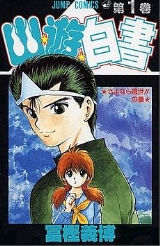
YuYu Hakusho

Encyclopedia
is a Japanese manga
series written and illustrated by Yoshihiro Togashi
. The name of the series is spelled YuYu Hakusho in the Viz Media
manga and Yu Yu Hakusho in other English distributions of the franchise. The series tells the story of Yusuke Urameshi, a teenage delinquent
who is struck and killed by a car while attempting to save a child's life. After a number of tests presented to him by Koenma, the son of the ruler of the afterlife Underworld, Yusuke is revived and appointed the title of "Underworld Detective", with which he must investigate various cases involving demon
s and apparitions
in the human world. The manga becomes more focused on martial arts
battles and tournaments as it progresses. Togashi began creating YuYu Hakusho around November 1990, basing the series on his interests in the occult
and horror film
s and an influence of Buddhist
mythology.
The manga was originally serialized in Shueisha
's Weekly Shōnen Jump
from December 1990 to July 1994. The series consists of 175 chapters collected in 19 tankōbon
volumes. In North America, the manga ran completely in Viz's Shonen Jump
from January 2003 to January 2010. An anime
adaptation consisting of 112 television episodes was directed by Noriyuki Abe
and co-produced by Fuji Television
, Yomiko Advertising, and Studio Pierrot
. The television series originally aired on Japan's Fuji Television network from October 10, 1992 to January 7, 1995. It was later licensed in North America
by Funimation Entertainment
in 2001, where it aired on popular Cartoon Network
blocks including Adult Swim
and Toonami
. The television series has also been broadcast in various countries around the world. It is currently being aired across Japan, other parts of Asia, and Eastern Europe
by the anime satellite television
network Animax
. The YuYu Hakusho franchise has spawned two animated films, a series of original video animation
s (OVAs), audio albums, video games, and other merchandise.
YuYu Hakusho has been well received since its debut, with the manga selling over 49 million copies in Japan alone and winning the prestigious Shogakukan Manga Award
for shōnen manga in 1993. The animated series won the Animage
Anime Grand Prix prize for best anime in 1994 and 1995. YuYu Hakusho has been watched by a large number of television viewers in Japan and wide range of age groups in the United States. The anime has been given mostly positive reviews by critics in North America, which compliment its writing, characters, and amount of action. Some reviewers have judged the series as being too repetitive.
, is hit by a car and killed in an attempt to save a young boy by pushing him out of the way. His ghost is greeted by Botan, a woman who introduces herself as the pilot of the River Styx
, who ferries souls to the "Underworld" where they may be judged for the afterlife. Botan informs Yusuke that his act had caught even the Underworld by surprise and that there was not yet a place made for him in either heaven or hell. Thus Koenma, son of the Underworld's ruler King Enma
, offers Yusuke a chance to return to his body through a series of tests. Yusuke succeeds with the help of his friends Keiko and Kazuma Kuwabara. After returning to life, Koenma grants Yusuke the title of "Underworld Detective", charging him with investigating supernatural activity within the human world. Soon Yusuke is off on his first case, retrieving three treasures stolen from the Underworld by a gang of demons: Hiei, Kurama and Goki. Yusuke collects the three treasures with the aid of his new technique, the "Rei Gun", a shot of aura energy fired mentally from his index finger. He then travels to the mountains in search of the aged, female martial artist Genkai. Together with his rival Kazuma Kuwabara, Yusuke fights through a tournament organized by Genkai to find her successor. Yusuke uses the competition as a cover to search for Rando, a demon who steals the techniques of martial arts masters and kills them. Yusuke defeats Rando in the final round of the tournament and trains with Genkai for several months, gaining more mastery over his aura. Yusuke is then sent to Maze Castle in the Underworld where Kuwabara and the newly reformed Kurama and Hiei assist him in defeating the Four Beasts, a quartet of demons attempting to blackmail Koenma into removing the barrier keeping them out of the human world.
Yusuke's next case sends him on a rescue mission, where he meets Toguro, a human turned into the strongest of demons. In order to test his strength, Toguro invites Yusuke to the "Dark Tournament", an event put on by corrupt, rich humans in which teams of demons, and occasionally humans, fight fierce battles for the chance to receive any wish they desire. Team Urameshi, consisting of Yusuke, Kuwabara, Kurama, Hiei and a disguised Genkai, traverse through the strenuous early rounds to face Team Toguro in the finals and win the tournament. They learn that Team Toguro's owner, Sakyo, was attempting to win in order to create a large hole from the human world to the "Demon Plane", a third world occupied solely by countless demons. With his loss, Sakyo destroys the tournament arena, killing himself in the process.
After the tournament, Yusuke returns home, but has little time to rest as he is challenged to a fight by three teenagers possessing superhuman powers and who end up taking the detective hostage. Kuwabara and the others rescue him and learn that the whole scenario was a test put on by Genkai. It is disclosed that Shinobu Sensui, Yusuke's predecessor as Underworld Detective, has recruited six other powerful beings to help him take over where Sakyo left off, opening a hole to the Demon Plane in order to cause genocide of the human race. Yusuke and his friends challenge and defeat Sensui's associates one-by-one, culminating in a final battle between the two detectives. Sensui kills Yusuke then retreats into the newly opened portal to the Demon Plane. Yusuke is reborn as a partial demon, discovering that his ancestor passed down a recessive gene that would hide until an heir with sufficient power surfaced, when his demonic lineage would be revealed. Yusuke travels to the Demon Plane and defeats Sensui with the aid of the spirit of his ancestor who takes control of Yusuke's body to finish the fight.
As they return to the human world, Yusuke is stripped of his detective title as King Enma orders he be captured and executed in fear that Yusuke's demon blood could cause him to go on a rampage in the human world. Yusuke, unsettled at having been controlled by his ancestor Raizen, accepts an offer by Raizen's followers to return to the Demon Plane. Raizen, desiring a successor to his territory, is on the brink of dying of starvation, a death that would topple the delicate political balance of the three ruling powers of the Demon Plane. Hiei and Kurama are summoned by the other two rulers, Mukuro and Yomi, respectively, to prepare for an inevitable war. The three protagonists train in the realm for one year, during which time Raizen dies and Yusuke inherits his territory. Yusuke takes initiative and proposes a fighting tournament to name the true ruler of the Demon Plane, which is agreed upon by Mukuro and Yomi. During the tournament, Yusuke and Yomi meet in the second elimination round where Yusuke is defeated and knocked unconscious. Yusuke awakens days later to find that the tournament has ended and that a similar competition is to be held every so often to determine the Demon Plane's ruler. Yusuke stays in the Demon Plane for a while longer, but eventually returns to the human world to be with Keiko.
stated that he began working on YuYu Hakusho during a period of time around November 1990, though he forgot the exact time. As a fan of the occult
and horror film
s, he desired to write and illustrate a manga based on his interests. Togashi had previously published an occult detective fiction manga titled Occult Tanteidan, of which he referenced positive reception from readers as a reason for continuing to create manga. When first producing YuYu Hakusho, he did not have a clear idea of what he wanted to call it. He used the tentative title "How to be a Ghost" whle presenting rough drafts to his editors. Once given the go-ahead to begin publication, Togashi proposed "YuYu-Ki (Poltergeist Chronicles)" for the title, as there would be battles with demons and it would be a play on the title SaiYu-Ki
. Because a series with a similar name (Chin-Yu-Ki) had already begun publication, Togashi quickly created an alternative: "YuYu Hakusho (Poltergeist Report)". He commented that he could have used "Den (Legend)" or "Monogatari (Story)", but "Hakusho (Report)" was the first thing that came to his mind. He contiguously developed the names of the main characters by skimming through a dictionary and taking out kanji
characters he found appealing. "Yusuke Urameshi" is a pun
, "Kazuma Kuwabara" is a combination of two professional baseball
players, and "Hiei" and "Kurama" are "just names that popped into [Togashi's] head". When he introduced the latter two characters in volume three, the author had early plans to make Kurama a main character but was not certain about Hiei.
The manga's shift from occult detective fiction to the martial arts genre after Yusuke's death and revival in the early chapters was planned by Togashi from the beginning. The series borrows many elements from Asian folklore, particularly Buddhist
beliefs in the afterlife. Togashi came up with the concept of the Ningenkai (human world), Reikai (Underworld), and Makai (Demon Plane) as being parallel planes of existence
in the YuYu Hakusho universe. He thought of them as places that one could not easily travel between using modern technology, but rather as a spirit lacking a material body. However, the idea for the "territory" powers from the Sensui story arc
was parodied from a separate, unnamed work by Yasutaka Tsutsui
. For his drawing materials, Togashi used drafting ink
and Kabura pens throughout the creation of the series. While his style of artwork began with screentone
, he gradually developed into minimalism
. As the series progressed, he would draw figures and faces very detailed or "cartoony, sketchy and jumping with action" whenever he desired such effects.
During the years he worked on YuYu Hakusho, Togashi would calculate the personal time he had based on a formula of four hours per page without scripting and five hours of sleep per night. He wrote in his own dōjinshi
Yoshirin de Pon! that he stopped the production on YuYu Hakusho out of selfishness. The author had originally wanted to end the manga in December 1993, at the climax of the Sensui arc. Although there was not a large demand from the editorial staff, Togashi was under a great deal of personal stress
at certain points of the series' run, particularly during its final six months of publication. He claimed that, beginning with the Dark Tournament arc, inconsistent sleep resulting from overwork was causing him health problems. He noted himself as being very ill while working on the color pages for Yusuke's match with Chu. There were also many instances where he would create nearly entire manuscript
s by himself, such as Yusuke's meeting with Raizen and the battle between Kurama and Karasu. Togashi was relieved at the conclusion of the manga.
in the Japanese
magazine Weekly Shōnen Jump
from December 1990 to July 1994. The manga consists of 175 chapters spanning 19 tankōbon
(collected volumes) with the first one being released on April 10, 1991 and the last one released on December 12, 1994. Between August 4, 2004 and March 4, 2005, Shueisha released the kanzenban (complete) editions of the manga. Each of the 15 kanzenban volumes features a new cover and more chapters than the tankōbon edition. YuYu Hakusho has also been published as part of the Shueisha Jump Remix series of magazine-style books. Nine volumes were released between December 22, 2008 and April 27, 2009. A bunkobon version began publication on November 18, 2010.
An English translation of the YuYu Hakusho manga was serialized in North America
by Viz Media
in the American Shonen Jump
magazine, where it debuted in its inaugural January 2003 issue and ended in January 2010. Viz released all 19 collected volumes of the English manga between May 13, 2003 and March 2, 2010. A total of 176 chapters exist in this format due to Viz treating the extra non-numbered chapter "YuYu Hakusho Tales: Two Shot" found in volume seven (which tells the story of how Hiei and Kurama first met) as the 64th chapter. The YuYu Hakusho manga has additionally been licensed and published across Asia and Europe. A French translation from Kana
, for example, began publication in 1997.
and co-produced by Fuji Television
, Yomiko Advertising, and Studio Pierrot
. The series, consisting of 112 television episodes, aired from October 10, 1992 to January 7, 1995 on Fuji Television in Japan. The anime differed from its manga source material by containing different levels of violence and profanity, as well as minor variations in art style from one to the other. In early 2001, the series was acquired by Funimation Entertainment
for North American distribution as Yu Yu Hakusho: Ghost Files. Funimation's production saw a significant contribution from voice actor Justin Cook
, who not only directed the dub but also voiced the protagonist Yusuke. The English dubbed episodes aired from February 23, 2002 to April 1, 2006 on Cartoon Network. Initially, the episodes were shown on the channel's Adult Swim
programming block from February 2002 to April 2003, and switched to its Toonami
programming block. Some of the show's original depictions of mature content including violence, sexual humor, and coarse language, as well as some controversial cultural discrepancies were edited out
for broadcast. YuYu Hakusho was taken off Toonami around March 2005 and moved to an early Saturday morning time slot that October where the series finished its run. It was also aired uncut as part of the Funimation programming block on Colours TV
in 2006 and the Funimation Channel
in high-definition
in 2011. The series was distributed in the United Kingdom
by MVM Films
and in Australia
and New Zealand
by Madman Entertainment
. It is currently being aired by the satellite television
network Animax
across East Asia
, Southeast Asia
, the Indian subcontinent
, and eastern European nations such as Hungary
and Romania
. YuYu Hakusho was localized in the Philippines
as Ghost Fighter and aired on the GMA Network
as early as 1999.
The four seasons that compose the television series are each their own story arc and are referred to as "sagas" by Funimation. In North America, 32 DVD compilations have been released by Funimation for the four sagas, with the first released on April 16, 2002, and the last on July 19, 2005. The episodes have been released in both edited and uncut formats. In addition, DVD collection boxes have been released for all four sagas, each containing all the episodes of that particular saga, with the exception of the Dark Tournament Saga, which was split into two collection boxes. Funimation released season box sets of the anime starting with season one on July 8, 2008 and ending with season four on January 13, 2009. Each set contains four DVDs which have 28 episodes, or one quarter of the whole series. Funimation began releasing the seasons on Blu-ray Disc
on May 31, 2011. Cook has stated that the production staff made minor improvements to their recordings, such as redubbing certain lines, cleaning up the dialogue, and removing "arrant anomalies". In Japan, three separate multidisc DVD box sets were released, as well as 28 DVDs totaling all 112 episodes of the series. Japanese home video distributor Bandai Visual
began releasing the series on Blu-ray Disc on October 27, 2009, with the first set containing a picture drama set after the end of the series.
to the manga. Yu Yu Hakusho: The Movie was released in Japan on July 10, 1993 as part of a seasonal film festival. In the movie, the protagonists Yusuke and Kuwabara are on a mission to rescue a kidnapped Koenma from a pair of demons who desire the Golden Seal, a stamp used for finalizing the sentencing of souls in the afterlife. AnimeWorks
released an English dubbed version of the half-hour film for VHS in both English-dubbed and subtitled formats on May 5, 1998 and on DVD on January 30, 2001. Yu Yu Hakusho the Movie: Poltergeist Report, known in Japan as , was released in Japanese theaters on April 9, 1994. The plot revolves around Yusuke and his friends defending the human world against inhabitants of a fourth plane of existence called the "Netherworld". This full-length feature received its first English dubbed version by Central Park Media
, which released it on VHS on March 3, 1998 and on DVD on October 8, 2002.
A series of YuYu Hakusho OVAs
collectively titled was released in Japan in VHS format between 1994 and 1996. The OVAs feature very short clips that take place after the end of the series. They also contain video montages from the anime, image song
s, voice actor interviews, and satirical animated shorts focusing on the four protagonists. The OVAs consist of three volumes as well as an opening and ending encyclopedia. A four-DVD box set containing this series was released in Japan by Pony Canyon
on December 15, 2004. Funimation dubbed the OVAs and redubbed the first theatrical film. Both will be released in North America in a DVD bundle on December 13, 2011.
, as well as five closing themes: , and "Daydream Generation" also by Mawatari; and and by Hiro Takahashi
. When Funimation gained rights to the series, English language versions of each of these songs were produced and arranged by musician Carl Finch
. The localized opening theme is sung by Sara White and the closing themes are sung by members of the English cast including Stephanie Nadolny
, Jerry Jewell
, and Meredith McCoy
.
A number of audio CDs have been released in Japan. The Yū Yū Hakusho Original Soundtrack was released in two separate volumes by Pony Canyon on January 17, 1997. The discs contain the show's instrumental
tracks and some vocal themes. Also released on that day is Yū Yū Hakusho: Music Battle, a series of three albums featuring vocal tracks sung by the Japanese voice actors as their corresponding characters. Compilations of vocal songs including Yū Yū Hakusho Super Covers, Yū Yū Hakusho Super Dance Mix, and Legend of Yū Yū Hakusho: "Sai-Kyou" Best Selection Album
were released on December 16, 1995, March 21, 1996, and March 21, 1997 respectively. Yū Yū Hakusho: Collective Songs and Yū Yū Hakusho: Collective Rare Trax, which contain covers
of the theme songs performed by the series' voice actors, were both released on March 17, 1999. Two drama albums
have been released by Shueisha, the first of which has an audio adaptation of the chapter "YuYu Hakusho Tales: Two Shot". A CD soundtrack for the second film and a maxi single
with the vocal songs of Mawatari and Takahashi have also been published.
, Super Famicom
, Sega
consoles, and various other platforms. None of them were made available to English-speaking audiences in North America, Europe or Australia. A single Mega Drive game, Yū Yū Hakusho: Makyō Tōitsusen, was published in Brazil
by Tectoy in 1999 under the title Yu Yu Hakusho: Sunset Fighters. When Atari gained publishing rights to YuYu Hakusho video games in 2003, the company released three games in these regions: Yu Yu Hakusho: Spirit Detective
, an action-adventure game
for the Game Boy Advance
; Yu Yu Hakusho: Tournament Tactics
, a tactical role-playing game
also for the Game Boy Advance; and Yu Yu Hakusho: Dark Tournament
, a 3D
fighting game
for the PlayStation 2
. A few more recent games have since been released only in Japan.
toys also exist. A collectable card game based on the franchise was released by Movic
. In North America, the series saw licensing for apparel from ODM, lines of action figure
s by IF Labs and Jakks Pacific
, a Skannerz
electronic toy from Radica Games
, and an activities book from Scholastic. Score Entertainment
created the Yu Yu Hakusho Trading Card Game
for release in the United States. An English guidebook to the series titled YuYu Hakusho Uncovered: The Unofficial Guide was published by Cocoro Books on October 12, 2004.
, acknowledged the manga as "one of the kings of popularity in the mid-1990's" in the region where it saw mass availability from large bookstore chains to small train station kiosk
s. YuYu Hakusho earned Yoshihiro Togashi the Shogakukan Manga Award
for shōnen in 1993. Towards the end of the series' run, Togashi was publicly criticized for not meeting chapter deadlines and for lower quality art.
In North America, several volumes of the manga have ranked within the weekly Nielsen BookScan
graphic novels list, including volume five at both sixth and ninth in October 2004, volume six at sixth in February 2005, and volume seven at seventh in June 2005. In 2004, the YuYu Hakusho manga serialization sparked a controversy when a Florida grade school teacher issued a complaint about material found in an issue of the American Shonen Jump magazine purchased by a fifth-grade student at a Scholastic Book Fair. The complaint centered around portions of the manga containing violence, mild profanity, a character wearing a swastika
, and another character smoking a cigarette. About 18,000 copies of the publication (out of 120,000) were returned from the fairs as a result of the matter. A Viz spokesperson defended the manga, clarifying that it is intended for older teens and that the alleged swastika is actually a Buddhist manji.
The YuYu Hakusho manga publication has received mixed criticism by reviewers in English-speaking regions. Martin Ouellette of the Canadian Protoculture Addicts
compared the progression of the series to Dragon Ball Z and stated, "Togashi's art, while simple, is extremely efficient and the story is really fun." An older article by the same reviewer disagreed with the notion that YuYu Hakusho was similar to Dragon Ball, stating that the former franchise has better developed characters, more interesting action sequences, and more humor. Eduardo M. Chavez of Mania.com enjoyed the manga's artwork and found that the supporting characters tend to be illustrated with more detail than the main characters. He praised Lillian Olsen's English translation, but disliked Viz's use of overlaying English words to translate the expression of sound effects. In later volumes Chavez was dismayed by the transition of the manga from the early detective cases to the Dark Tournament arc. He asserted, "Seeing fight, after fight, after fight gets boring and this seriously is only the start of this trend." Dan Polley, a staff reviewer of Manga Life, gave an average grade to the fifth volume, which entails Yusuke's battle with Suzaku, the leader of the Four Beasts. Although he found some the battle sequences to be inviting, he judged the chapters as lacking in characterization and development. Polley also discounted the manga's comedy, considering the "bit gags or fairly lame jokes" to be "too much" at times.
. Additionally, the publication declared the series number 53 on its top 100 anime listing in 2001. In a 2006 web poll conducted in Japan by the network TV Asahi
, YuYu Hakusho was voted as the 15th best anime of all time. The Japanese magazine Brutus
voted it the sixth best anime of all time. The hit show garnered a large number of viewers
during its run in Japan. Funimation president Gen Fukunaga
remarked that YuYu Hakusho "came 'out of nowhere' to surprise people with huge ratings", which were just below those achieved by the popular series Dragon Ball Z. YuYu Hakusho was frequently watched by several age groups during its early run in North America. When it aired on Adult Swim
, the anime, along with others such as InuYasha
and Cowboy Bebop
, met with male audiences ages 18–34. During its Toonami
debut in May 2003, YuYu Hakusho placed in seven out of the top 111 Nielsen ratings
for Cartoon Network
telecasts, with the highest being number 30 on May 13 at a two percent share of all viewing televisions in the country. Atari stated in December 2003 that the anime was one of the top-rated television programs in North America for males ages 9–14. Nielsen additionally reported that YuYu Hakusho tied with Dragon Ball GT as the top-rated Cartoon Network program for the same demographic during the week of September 28, 2004. It was the second highest-rated show among ages 12–17 the same week. Cartoon Network dropped the show from Toonami in March 2005 due to declining ratings. YuYu Hakusho proved to be popular in the Philippines, where it was rerun several times and managed to draw more viewers in the prime time
slot than both local and foreign soap operas.
The animated series received a generally positive reception in North America. In January 2004, YuYu Hakusho was named the second best action-adventure anime by Anime Insider
. It was voted by the users of IGN
as the tenth best animated series of all time. Critical reviews focused on the series' attempt at a versatile balance of narrative, character development, and action sequences. Animerica
's Justin Kovalsky defined YuYu Hakusho as a character-driven series and compared it to other anime like Phantom Quest Corp., Rurouni Kenshin
, and Flame of Recca
in that it successfully combines different ideas such as martial arts battles, character dynamics, the supernatural, and mythology. Allen Divers of the Anime News Network
identified YuYu Hakusho as "one of the best action series out there", and noted consistently good storytelling and character development throughout his critique of key points of the series. Todd Douglass Jr. of DVD Talk
declared, "It's a fun show with a great cast, a sense of humor, and a lot of action so there's no excuse not to at least give it a chance." He recommended the first three season box sets of YuYu Hakusho, as well as the original boxset of the Three Kings Saga, but enjoyed the show's third season more than the others because of its multiple plotlines. N. S. Davidson of IGN concluded that having several concurrent plot branches is not enough for an anime to succeed, but that good writing, interesting characters, and action are also necessary. He proclaimed in his review of the anime's final episodes that YuYu Hakusho possesses all of these qualities. This was concurred upon by Joseph Luster of Otaku USA
, who summed up his feelings about the universe of YuYu Hakusho by stating, "Togashi's world is eternally hellish and dark, but wildly varied. The only thing that doesn't change throughout its run is the fact that you'll still be rooting for the well-defined protagonists until the credits run on the last episode."
Jeffrey Harris of IGN was more critical when looking at later episodes, and felt that the end of the show's third arc involving the villain Sensui is too similar to the finale of the second arc with Toguro. He described the episodes as trying too hard to draw sympathy from the audience for anime's villains. Despite his overall praise of YuYu Hakusho, Divers likewise summarized in one DVD release that the show "[walks] that fine line of a solid long running series or being a broken record". He also called the artwork of the first few episodes "dated" and pointed out questionable script choices regarding the English dub.
Manga
Manga is the Japanese word for "comics" and consists of comics and print cartoons . In the West, the term "manga" has been appropriated to refer specifically to comics created in Japan, or by Japanese authors, in the Japanese language and conforming to the style developed in Japan in the late 19th...
series written and illustrated by Yoshihiro Togashi
Yoshihiro Togashi
is a Japanese manga artist. He began drawing manga at an early age; while he attended college, the publisher Shueisha recognized his talent. Togashi has authored numerous manga series in different genres during the past three decades...
. The name of the series is spelled YuYu Hakusho in the Viz Media
VIZ Media
VIZ Media, LLC, headquartered in San Francisco, is an anime, manga, and Japanese entertainment company. It was founded in 1986 as VIZ LLC. In 2005, VIZ LLC and ShoPro Entertainment merged to form the current VIZ Media LLC, which is jointly owned by Japanese publishers Shogakukan and Shueisha, and...
manga and Yu Yu Hakusho in other English distributions of the franchise. The series tells the story of Yusuke Urameshi, a teenage delinquent
Juvenile delinquency
Juvenile delinquency is participation in illegal behavior by minors who fall under a statutory age limit. Most legal systems prescribe specific procedures for dealing with juveniles, such as juvenile detention centers. There are a multitude of different theories on the causes of crime, most if not...
who is struck and killed by a car while attempting to save a child's life. After a number of tests presented to him by Koenma, the son of the ruler of the afterlife Underworld, Yusuke is revived and appointed the title of "Underworld Detective", with which he must investigate various cases involving demon
Demon
call - 1347 531 7769 for more infoIn Ancient Near Eastern religions as well as in the Abrahamic traditions, including ancient and medieval Christian demonology, a demon is considered an "unclean spirit" which may cause demonic possession, to be addressed with an act of exorcism...
s and apparitions
Ghost
In traditional belief and fiction, a ghost is the soul or spirit of a deceased person or animal that can appear, in visible form or other manifestation, to the living. Descriptions of the apparition of ghosts vary widely from an invisible presence to translucent or barely visible wispy shapes, to...
in the human world. The manga becomes more focused on martial arts
Martial arts film
Martial arts film is a film genre. A sub-genre of the action film, martial arts films contain numerous fights between characters, usually as the films' primary appeal and entertainment value, and often as a method of storytelling and character expression and development. Martial arts are frequently...
battles and tournaments as it progresses. Togashi began creating YuYu Hakusho around November 1990, basing the series on his interests in the occult
Occult
The word occult comes from the Latin word occultus , referring to "knowledge of the hidden". In the medical sense it is used to refer to a structure or process that is hidden, e.g...
and horror film
Horror film
Horror films seek to elicit a negative emotional reaction from viewers by playing on the audience's most primal fears. They often feature scenes that startle the viewer through the means of macabre and the supernatural, thus frequently overlapping with the fantasy and science fiction genres...
s and an influence of Buddhist
Buddhism
Buddhism is a religion and philosophy encompassing a variety of traditions, beliefs and practices, largely based on teachings attributed to Siddhartha Gautama, commonly known as the Buddha . The Buddha lived and taught in the northeastern Indian subcontinent some time between the 6th and 4th...
mythology.
The manga was originally serialized in Shueisha
Shueisha
is a major publisher in Japan. The company was founded in 1925 as the entertainment-related publishing division of Japanese publisher Shogakukan. The following year, Shueisha became a separate, independent company. Magazines published by Shueisha include Weekly Shōnen Jump, Weekly Young Jump,...
's Weekly Shōnen Jump
Weekly Shonen Jump
is a weekly shōnen manga anthology published in Japan by Shueisha under the Jump line of magazines. The first issue was released with a cover date of July 2, 1968, and it is still circulating. One of the longest-running manga magazines in Japan, it has a circulation of 2.8 million copies...
from December 1990 to July 1994. The series consists of 175 chapters collected in 19 tankōbon
Tankobon
, with a literal meaning close to "independently appearing book", is the Japanese term for a book that is complete in itself and is not part of a series , though the manga industry uses it for volumes which may be in a series...
volumes. In North America, the manga ran completely in Viz's Shonen Jump
Shonen Jump (magazine)
Shonen Jump, officially stylized SHONEN JUMP and abbreviated SJ, is a shōnen manga anthology published in North America by Viz Media. It debuted in November 2002 with the first issue having a January 2003 cover date...
from January 2003 to January 2010. An anime
Anime
is the Japanese abbreviated pronunciation of "animation". The definition sometimes changes depending on the context. In English-speaking countries, the term most commonly refers to Japanese animated cartoons....
adaptation consisting of 112 television episodes was directed by Noriyuki Abe
Noriyuki Abe
is a Japanese anime director, storyboard artist, and sound director. He is best known for working with Studio Pierrot on major hits such as Ninku, Flame of Recca, Bleach, and Yu Yu Hakusho...
and co-produced by Fuji Television
Fuji Television
is a Japanese television station based in Daiba, Minato, Tokyo, Japan, also known as or CX, based on the station's callsign "JOCX-DTV". It is the flagship station of the Fuji News Network and the ....
, Yomiko Advertising, and Studio Pierrot
Studio Pierrot
is a Japanese animation/animation studio, founded in 1979 by former employees of Tatsunoko Production. Its headquarters is located in Mitaka, Tokyo.The company has a simple logo of the face of a clown...
. The television series originally aired on Japan's Fuji Television network from October 10, 1992 to January 7, 1995. It was later licensed in North America
North America
North America is a continent wholly within the Northern Hemisphere and almost wholly within the Western Hemisphere. It is also considered a northern subcontinent of the Americas...
by Funimation Entertainment
Funimation Entertainment
Funimation is an American entertainment company. Originally founded in 1994 by Gen Fukunaga, the company became a subsidiary of Navarre Corporation on May 11, 2005...
in 2001, where it aired on popular Cartoon Network
Cartoon Network
Cartoon Network is a name of television channels worldwide created by Turner Broadcasting which used to primarily show animated programming. The channel began broadcasting on October 1, 1992 in the United States....
blocks including Adult Swim
Adult Swim
Adult Swim is an adult-oriented Cable network that shares channel space with Cartoon Network from 9:00 pm until 6:00 am ET/PT in the United States, and broadcasts in countries such as Australia and New Zealand...
and Toonami
Toonami
Toonami was a registered trademark of Cartoon Network, used initially for action-oriented programming blocks on Cartoon Network television channels worldwide, mostly showing American cartoons and Japanese anime, originating in the United States on March 17, 1997 and ended on September 20, 2008.The...
. The television series has also been broadcast in various countries around the world. It is currently being aired across Japan, other parts of Asia, and Eastern Europe
Eastern Europe
Eastern Europe is the eastern part of Europe. The term has widely disparate geopolitical, geographical, cultural and socioeconomic readings, which makes it highly context-dependent and even volatile, and there are "almost as many definitions of Eastern Europe as there are scholars of the region"...
by the anime satellite television
Satellite television
Satellite television is television programming delivered by the means of communications satellite and received by an outdoor antenna, usually a parabolic mirror generally referred to as a satellite dish, and as far as household usage is concerned, a satellite receiver either in the form of an...
network Animax
Animax
is a Japanese anime satellite television network, dedicated to broadcasting anime programming. A subsidiary of Japanese media conglomerate Sony, it is headquartered in in Minato, Tokyo, Japan, with its co-founders and shareholders including Sony Pictures Entertainment and the noted anime studios...
. The YuYu Hakusho franchise has spawned two animated films, a series of original video animation
Original video animation
, abbreviated as media , are animated films and series made specially for release in home-video formats. The term originated in relation to Japanese animation...
s (OVAs), audio albums, video games, and other merchandise.
YuYu Hakusho has been well received since its debut, with the manga selling over 49 million copies in Japan alone and winning the prestigious Shogakukan Manga Award
Shogakukan Manga Award
The is one of Japan's major manga awards, sponsored by Shogakukan Publishing. It has been awarded annually for serialized manga since 1955 and features candidates from a number of publishers.The current award categories are:...
for shōnen manga in 1993. The animated series won the Animage
Animage
is a Japanese anime and entertainment magazine which Tokuma Shoten began publishing in July 1978. Hayao Miyazaki's internationally renowned manga, Nausicaä of the Valley of the Wind, was serialized in Animage from 1982 through 1994...
Anime Grand Prix prize for best anime in 1994 and 1995. YuYu Hakusho has been watched by a large number of television viewers in Japan and wide range of age groups in the United States. The anime has been given mostly positive reviews by critics in North America, which compliment its writing, characters, and amount of action. Some reviewers have judged the series as being too repetitive.
Plot
YuYu Hakusho follows Yusuke Urameshi, a street-brawling delinquent who, in an uncharacteristic act of altruismAltruism
Altruism is a concern for the welfare of others. It is a traditional virtue in many cultures, and a core aspect of various religious traditions, though the concept of 'others' toward whom concern should be directed can vary among cultures and religions. Altruism is the opposite of...
, is hit by a car and killed in an attempt to save a young boy by pushing him out of the way. His ghost is greeted by Botan, a woman who introduces herself as the pilot of the River Styx
Sanzu River
The Sanzu River , or River of Three Crossings, is a Japanese Buddhist tradition and religious belief similar to the River Styx...
, who ferries souls to the "Underworld" where they may be judged for the afterlife. Botan informs Yusuke that his act had caught even the Underworld by surprise and that there was not yet a place made for him in either heaven or hell. Thus Koenma, son of the Underworld's ruler King Enma
Yama (Buddhism and Chinese mythology)
Yama the name of the Buddhist dharmapala and judge of the dead, who presides over the Buddhist Narakas , "Hells" or "Purgatories". Although ultimately based on the god Yama of the Hindu Vedas, the Buddhist Yama has developed different myths and different functions from the Hindu deity...
, offers Yusuke a chance to return to his body through a series of tests. Yusuke succeeds with the help of his friends Keiko and Kazuma Kuwabara. After returning to life, Koenma grants Yusuke the title of "Underworld Detective", charging him with investigating supernatural activity within the human world. Soon Yusuke is off on his first case, retrieving three treasures stolen from the Underworld by a gang of demons: Hiei, Kurama and Goki. Yusuke collects the three treasures with the aid of his new technique, the "Rei Gun", a shot of aura energy fired mentally from his index finger. He then travels to the mountains in search of the aged, female martial artist Genkai. Together with his rival Kazuma Kuwabara, Yusuke fights through a tournament organized by Genkai to find her successor. Yusuke uses the competition as a cover to search for Rando, a demon who steals the techniques of martial arts masters and kills them. Yusuke defeats Rando in the final round of the tournament and trains with Genkai for several months, gaining more mastery over his aura. Yusuke is then sent to Maze Castle in the Underworld where Kuwabara and the newly reformed Kurama and Hiei assist him in defeating the Four Beasts, a quartet of demons attempting to blackmail Koenma into removing the barrier keeping them out of the human world.
Yusuke's next case sends him on a rescue mission, where he meets Toguro, a human turned into the strongest of demons. In order to test his strength, Toguro invites Yusuke to the "Dark Tournament", an event put on by corrupt, rich humans in which teams of demons, and occasionally humans, fight fierce battles for the chance to receive any wish they desire. Team Urameshi, consisting of Yusuke, Kuwabara, Kurama, Hiei and a disguised Genkai, traverse through the strenuous early rounds to face Team Toguro in the finals and win the tournament. They learn that Team Toguro's owner, Sakyo, was attempting to win in order to create a large hole from the human world to the "Demon Plane", a third world occupied solely by countless demons. With his loss, Sakyo destroys the tournament arena, killing himself in the process.
After the tournament, Yusuke returns home, but has little time to rest as he is challenged to a fight by three teenagers possessing superhuman powers and who end up taking the detective hostage. Kuwabara and the others rescue him and learn that the whole scenario was a test put on by Genkai. It is disclosed that Shinobu Sensui, Yusuke's predecessor as Underworld Detective, has recruited six other powerful beings to help him take over where Sakyo left off, opening a hole to the Demon Plane in order to cause genocide of the human race. Yusuke and his friends challenge and defeat Sensui's associates one-by-one, culminating in a final battle between the two detectives. Sensui kills Yusuke then retreats into the newly opened portal to the Demon Plane. Yusuke is reborn as a partial demon, discovering that his ancestor passed down a recessive gene that would hide until an heir with sufficient power surfaced, when his demonic lineage would be revealed. Yusuke travels to the Demon Plane and defeats Sensui with the aid of the spirit of his ancestor who takes control of Yusuke's body to finish the fight.
As they return to the human world, Yusuke is stripped of his detective title as King Enma orders he be captured and executed in fear that Yusuke's demon blood could cause him to go on a rampage in the human world. Yusuke, unsettled at having been controlled by his ancestor Raizen, accepts an offer by Raizen's followers to return to the Demon Plane. Raizen, desiring a successor to his territory, is on the brink of dying of starvation, a death that would topple the delicate political balance of the three ruling powers of the Demon Plane. Hiei and Kurama are summoned by the other two rulers, Mukuro and Yomi, respectively, to prepare for an inevitable war. The three protagonists train in the realm for one year, during which time Raizen dies and Yusuke inherits his territory. Yusuke takes initiative and proposes a fighting tournament to name the true ruler of the Demon Plane, which is agreed upon by Mukuro and Yomi. During the tournament, Yusuke and Yomi meet in the second elimination round where Yusuke is defeated and knocked unconscious. Yusuke awakens days later to find that the tournament has ended and that a similar competition is to be held every so often to determine the Demon Plane's ruler. Yusuke stays in the Demon Plane for a while longer, but eventually returns to the human world to be with Keiko.
Production
Author Yoshihiro TogashiYoshihiro Togashi
is a Japanese manga artist. He began drawing manga at an early age; while he attended college, the publisher Shueisha recognized his talent. Togashi has authored numerous manga series in different genres during the past three decades...
stated that he began working on YuYu Hakusho during a period of time around November 1990, though he forgot the exact time. As a fan of the occult
Occult
The word occult comes from the Latin word occultus , referring to "knowledge of the hidden". In the medical sense it is used to refer to a structure or process that is hidden, e.g...
and horror film
Horror film
Horror films seek to elicit a negative emotional reaction from viewers by playing on the audience's most primal fears. They often feature scenes that startle the viewer through the means of macabre and the supernatural, thus frequently overlapping with the fantasy and science fiction genres...
s, he desired to write and illustrate a manga based on his interests. Togashi had previously published an occult detective fiction manga titled Occult Tanteidan, of which he referenced positive reception from readers as a reason for continuing to create manga. When first producing YuYu Hakusho, he did not have a clear idea of what he wanted to call it. He used the tentative title "How to be a Ghost" whle presenting rough drafts to his editors. Once given the go-ahead to begin publication, Togashi proposed "YuYu-Ki (Poltergeist Chronicles)" for the title, as there would be battles with demons and it would be a play on the title SaiYu-Ki
Journey to the West
Journey to the West is one of the Four Great Classical Novels of Chinese literature. It was written by Wu Cheng'en in the 16th century. In English-speaking countries, the tale is also often known simply as Monkey. This was one title used for a popular, abridged translation by Arthur Waley...
. Because a series with a similar name (Chin-Yu-Ki) had already begun publication, Togashi quickly created an alternative: "YuYu Hakusho (Poltergeist Report)". He commented that he could have used "Den (Legend)" or "Monogatari (Story)", but "Hakusho (Report)" was the first thing that came to his mind. He contiguously developed the names of the main characters by skimming through a dictionary and taking out kanji
Kanji
Kanji are the adopted logographic Chinese characters hanzi that are used in the modern Japanese writing system along with hiragana , katakana , Indo Arabic numerals, and the occasional use of the Latin alphabet...
characters he found appealing. "Yusuke Urameshi" is a pun
Pun
The pun, also called paronomasia, is a form of word play which suggests two or more meanings, by exploiting multiple meanings of words, or of similar-sounding words, for an intended humorous or rhetorical effect. These ambiguities can arise from the intentional use and abuse of homophonic,...
, "Kazuma Kuwabara" is a combination of two professional baseball
Professional baseball in Japan
Professional baseball in Japan first started in the 1920s, but it was not until the was established in 1934 that the modern professional game had continued success.-History:...
players, and "Hiei" and "Kurama" are "just names that popped into [Togashi's] head". When he introduced the latter two characters in volume three, the author had early plans to make Kurama a main character but was not certain about Hiei.
The manga's shift from occult detective fiction to the martial arts genre after Yusuke's death and revival in the early chapters was planned by Togashi from the beginning. The series borrows many elements from Asian folklore, particularly Buddhist
Buddhism
Buddhism is a religion and philosophy encompassing a variety of traditions, beliefs and practices, largely based on teachings attributed to Siddhartha Gautama, commonly known as the Buddha . The Buddha lived and taught in the northeastern Indian subcontinent some time between the 6th and 4th...
beliefs in the afterlife. Togashi came up with the concept of the Ningenkai (human world), Reikai (Underworld), and Makai (Demon Plane) as being parallel planes of existence
Parallel universe (fiction)
A parallel universe or alternative reality is a hypothetical self-contained separate reality coexisting with one's own. A specific group of parallel universes is called a "multiverse", although this term can also be used to describe the possible parallel universes that constitute reality...
in the YuYu Hakusho universe. He thought of them as places that one could not easily travel between using modern technology, but rather as a spirit lacking a material body. However, the idea for the "territory" powers from the Sensui story arc
Story arc
A story arc is an extended or continuing storyline in episodic storytelling media such as television, comic books, comic strips, boardgames, video games, and in some cases, films. On a television program, for example, the story would unfold over many episodes. In television, the use of the story...
was parodied from a separate, unnamed work by Yasutaka Tsutsui
Yasutaka Tsutsui
is a Japanese novelist, science fiction author, and actor. Along with Shinichi Hoshi and Sakyo Komatsu, he is one of the most famous science fiction writers in Japan. His Yumenokizaka bunkiten won the Tanizaki Prize in 1987. He has also won the 1981 Izumi Kyoka award, the 1989 Kawabata Yasunari...
. For his drawing materials, Togashi used drafting ink
Fountain pen
A fountain pen is a nib pen that, unlike its predecessor the dip pen, contains an internal reservoir of water-based liquid ink. The pen draws ink from the reservoir through a feed to the nib and deposits it on paper via a combination of gravity and capillary action...
and Kabura pens throughout the creation of the series. While his style of artwork began with screentone
Screentone
Screentone is a technique for applying textures and shades to drawings, used as an alternative to hatching. In the conventional process, patterns are transferred to paper from preprinted sheets, but the technique is also simulated in computer graphics...
, he gradually developed into minimalism
Minimalism
Minimalism describes movements in various forms of art and design, especially visual art and music, where the work is set out to expose the essence, essentials or identity of a subject through eliminating all non-essential forms, features or concepts...
. As the series progressed, he would draw figures and faces very detailed or "cartoony, sketchy and jumping with action" whenever he desired such effects.
During the years he worked on YuYu Hakusho, Togashi would calculate the personal time he had based on a formula of four hours per page without scripting and five hours of sleep per night. He wrote in his own dōjinshi
Dojinshi
is the Japanese term for self-published works, usually magazines, manga or novels. Dōjinshi are often the work of amateurs, though some professional artists participate as a way to publish material outside the regular industry. The term dōjinshi is derived from and . Dōjinshi are part of a wider...
Yoshirin de Pon! that he stopped the production on YuYu Hakusho out of selfishness. The author had originally wanted to end the manga in December 1993, at the climax of the Sensui arc. Although there was not a large demand from the editorial staff, Togashi was under a great deal of personal stress
Workplace stress
Workplace stress is the harmful physical and emotional response that occurs when there is a poor match between job demands and the capabilities, resources, or needs of the worker....
at certain points of the series' run, particularly during its final six months of publication. He claimed that, beginning with the Dark Tournament arc, inconsistent sleep resulting from overwork was causing him health problems. He noted himself as being very ill while working on the color pages for Yusuke's match with Chu. There were also many instances where he would create nearly entire manuscript
Manuscript
A manuscript or handwrite is written information that has been manually created by someone or some people, such as a hand-written letter, as opposed to being printed or reproduced some other way...
s by himself, such as Yusuke's meeting with Raizen and the battle between Kurama and Karasu. Togashi was relieved at the conclusion of the manga.
Manga
The YuYu Hakusho manga series was written and drawn by Togashi and originally serialized by ShueishaShueisha
is a major publisher in Japan. The company was founded in 1925 as the entertainment-related publishing division of Japanese publisher Shogakukan. The following year, Shueisha became a separate, independent company. Magazines published by Shueisha include Weekly Shōnen Jump, Weekly Young Jump,...
in the Japanese
Japanese language
is a language spoken by over 130 million people in Japan and in Japanese emigrant communities. It is a member of the Japonic language family, which has a number of proposed relationships with other languages, none of which has gained wide acceptance among historical linguists .Japanese is an...
magazine Weekly Shōnen Jump
Weekly Shonen Jump
is a weekly shōnen manga anthology published in Japan by Shueisha under the Jump line of magazines. The first issue was released with a cover date of July 2, 1968, and it is still circulating. One of the longest-running manga magazines in Japan, it has a circulation of 2.8 million copies...
from December 1990 to July 1994. The manga consists of 175 chapters spanning 19 tankōbon
Tankobon
, with a literal meaning close to "independently appearing book", is the Japanese term for a book that is complete in itself and is not part of a series , though the manga industry uses it for volumes which may be in a series...
(collected volumes) with the first one being released on April 10, 1991 and the last one released on December 12, 1994. Between August 4, 2004 and March 4, 2005, Shueisha released the kanzenban (complete) editions of the manga. Each of the 15 kanzenban volumes features a new cover and more chapters than the tankōbon edition. YuYu Hakusho has also been published as part of the Shueisha Jump Remix series of magazine-style books. Nine volumes were released between December 22, 2008 and April 27, 2009. A bunkobon version began publication on November 18, 2010.
An English translation of the YuYu Hakusho manga was serialized in North America
North America
North America is a continent wholly within the Northern Hemisphere and almost wholly within the Western Hemisphere. It is also considered a northern subcontinent of the Americas...
by Viz Media
VIZ Media
VIZ Media, LLC, headquartered in San Francisco, is an anime, manga, and Japanese entertainment company. It was founded in 1986 as VIZ LLC. In 2005, VIZ LLC and ShoPro Entertainment merged to form the current VIZ Media LLC, which is jointly owned by Japanese publishers Shogakukan and Shueisha, and...
in the American Shonen Jump
Shonen Jump (magazine)
Shonen Jump, officially stylized SHONEN JUMP and abbreviated SJ, is a shōnen manga anthology published in North America by Viz Media. It debuted in November 2002 with the first issue having a January 2003 cover date...
magazine, where it debuted in its inaugural January 2003 issue and ended in January 2010. Viz released all 19 collected volumes of the English manga between May 13, 2003 and March 2, 2010. A total of 176 chapters exist in this format due to Viz treating the extra non-numbered chapter "YuYu Hakusho Tales: Two Shot" found in volume seven (which tells the story of how Hiei and Kurama first met) as the 64th chapter. The YuYu Hakusho manga has additionally been licensed and published across Asia and Europe. A French translation from Kana
Kana (publisher)
Kana is a French publisher affiliated with Les Éditions Dargaud. Kana was founded in 1996 by Yves Schlirf. The company publishes manga in French and Dutch. Its headquarters are in the Dargaud offices in the 18th arrondissement of Paris.-External links:*...
, for example, began publication in 1997.
Anime
The YuYu Hakusho anime adaptation was directed by Noriyuki AbeNoriyuki Abe
is a Japanese anime director, storyboard artist, and sound director. He is best known for working with Studio Pierrot on major hits such as Ninku, Flame of Recca, Bleach, and Yu Yu Hakusho...
and co-produced by Fuji Television
Fuji Television
is a Japanese television station based in Daiba, Minato, Tokyo, Japan, also known as or CX, based on the station's callsign "JOCX-DTV". It is the flagship station of the Fuji News Network and the ....
, Yomiko Advertising, and Studio Pierrot
Studio Pierrot
is a Japanese animation/animation studio, founded in 1979 by former employees of Tatsunoko Production. Its headquarters is located in Mitaka, Tokyo.The company has a simple logo of the face of a clown...
. The series, consisting of 112 television episodes, aired from October 10, 1992 to January 7, 1995 on Fuji Television in Japan. The anime differed from its manga source material by containing different levels of violence and profanity, as well as minor variations in art style from one to the other. In early 2001, the series was acquired by Funimation Entertainment
Funimation Entertainment
Funimation is an American entertainment company. Originally founded in 1994 by Gen Fukunaga, the company became a subsidiary of Navarre Corporation on May 11, 2005...
for North American distribution as Yu Yu Hakusho: Ghost Files. Funimation's production saw a significant contribution from voice actor Justin Cook
Justin Cook
Justin Ryan Cook is an American Producer, Voice Actor, Line Producer, ADR Director, and Engineer who works for Funimation Entertainment and OkraTron 5000...
, who not only directed the dub but also voiced the protagonist Yusuke. The English dubbed episodes aired from February 23, 2002 to April 1, 2006 on Cartoon Network. Initially, the episodes were shown on the channel's Adult Swim
Adult Swim
Adult Swim is an adult-oriented Cable network that shares channel space with Cartoon Network from 9:00 pm until 6:00 am ET/PT in the United States, and broadcasts in countries such as Australia and New Zealand...
programming block from February 2002 to April 2003, and switched to its Toonami
Toonami
Toonami was a registered trademark of Cartoon Network, used initially for action-oriented programming blocks on Cartoon Network television channels worldwide, mostly showing American cartoons and Japanese anime, originating in the United States on March 17, 1997 and ended on September 20, 2008.The...
programming block. Some of the show's original depictions of mature content including violence, sexual humor, and coarse language, as well as some controversial cultural discrepancies were edited out
Editing of anime in American distribution
Editing of anime in American distribution describes the process of altering anime to prepare it to be distributed in the United States and forms part of the process of localization. This process is generally applied only to series intended for broadcast on American television; series released...
for broadcast. YuYu Hakusho was taken off Toonami around March 2005 and moved to an early Saturday morning time slot that October where the series finished its run. It was also aired uncut as part of the Funimation programming block on Colours TV
CoLours TV
Colours TV was a multicultural American TV network produced by the non-profit organization Black Star Communications. Programs focused on the cultural and educational issues of the Hispanic, Black, Asian, and Native American communities. Some examples of programming included video...
in 2006 and the Funimation Channel
FUNimation Channel
The FUNimation Channel is a 24-hour cable network which broadcasts anime series in the United States. OlympuSAT was chosen as the exclusive distributor of the network....
in high-definition
High-definition television
High-definition television is video that has resolution substantially higher than that of traditional television systems . HDTV has one or two million pixels per frame, roughly five times that of SD...
in 2011. The series was distributed in the United Kingdom
United Kingdom
The United Kingdom of Great Britain and Northern IrelandIn the United Kingdom and Dependencies, other languages have been officially recognised as legitimate autochthonous languages under the European Charter for Regional or Minority Languages...
by MVM Films
MVM Films
MVM Films is a British distributor of Japanese animation. The company sublicenses anime titles from US Anime companies such as Media Blasters, Geneon, Nozomi Entertainment, Urban Vision, AnimEigo, and US Manga Corps, which do not have a UK presence, and releases them on Region 2 DVD...
and in Australia
Australia
Australia , officially the Commonwealth of Australia, is a country in the Southern Hemisphere comprising the mainland of the Australian continent, the island of Tasmania, and numerous smaller islands in the Indian and Pacific Oceans. It is the world's sixth-largest country by total area...
and New Zealand
New Zealand
New Zealand is an island country in the south-western Pacific Ocean comprising two main landmasses and numerous smaller islands. The country is situated some east of Australia across the Tasman Sea, and roughly south of the Pacific island nations of New Caledonia, Fiji, and Tonga...
by Madman Entertainment
Madman Entertainment
Madman Entertainment is an Australian company that distributes international films as well as Japanese anime and manga in Australia and New Zealand. The company is owned by Funtastic Limited and is one of the major entertainment companies in Australia. It employs 130 people and has an annual...
. It is currently being aired by the satellite television
Satellite television
Satellite television is television programming delivered by the means of communications satellite and received by an outdoor antenna, usually a parabolic mirror generally referred to as a satellite dish, and as far as household usage is concerned, a satellite receiver either in the form of an...
network Animax
Animax
is a Japanese anime satellite television network, dedicated to broadcasting anime programming. A subsidiary of Japanese media conglomerate Sony, it is headquartered in in Minato, Tokyo, Japan, with its co-founders and shareholders including Sony Pictures Entertainment and the noted anime studios...
across East Asia
East Asia
East Asia or Eastern Asia is a subregion of Asia that can be defined in either geographical or cultural terms...
, Southeast Asia
Southeast Asia
Southeast Asia, South-East Asia, South East Asia or Southeastern Asia is a subregion of Asia, consisting of the countries that are geographically south of China, east of India, west of New Guinea and north of Australia. The region lies on the intersection of geological plates, with heavy seismic...
, the Indian subcontinent
Indian subcontinent
The Indian subcontinent, also Indian Subcontinent, Indo-Pak Subcontinent or South Asian Subcontinent is a region of the Asian continent on the Indian tectonic plate from the Hindu Kush or Hindu Koh, Himalayas and including the Kuen Lun and Karakoram ranges, forming a land mass which extends...
, and eastern European nations such as Hungary
Hungary
Hungary , officially the Republic of Hungary , is a landlocked country in Central Europe. It is situated in the Carpathian Basin and is bordered by Slovakia to the north, Ukraine and Romania to the east, Serbia and Croatia to the south, Slovenia to the southwest and Austria to the west. The...
and Romania
Romania
Romania is a country located at the crossroads of Central and Southeastern Europe, on the Lower Danube, within and outside the Carpathian arch, bordering on the Black Sea...
. YuYu Hakusho was localized in the Philippines
Philippines
The Philippines , officially known as the Republic of the Philippines , is a country in Southeast Asia in the western Pacific Ocean. To its north across the Luzon Strait lies Taiwan. West across the South China Sea sits Vietnam...
as Ghost Fighter and aired on the GMA Network
GMA Network
GMA Network is a major commercial television & radio network in the Philippines. GMA Network is owned by GMA Network, Inc. a publicly listed company...
as early as 1999.
The four seasons that compose the television series are each their own story arc and are referred to as "sagas" by Funimation. In North America, 32 DVD compilations have been released by Funimation for the four sagas, with the first released on April 16, 2002, and the last on July 19, 2005. The episodes have been released in both edited and uncut formats. In addition, DVD collection boxes have been released for all four sagas, each containing all the episodes of that particular saga, with the exception of the Dark Tournament Saga, which was split into two collection boxes. Funimation released season box sets of the anime starting with season one on July 8, 2008 and ending with season four on January 13, 2009. Each set contains four DVDs which have 28 episodes, or one quarter of the whole series. Funimation began releasing the seasons on Blu-ray Disc
Blu-ray Disc
Blu-ray Disc is an optical disc storage medium designed to supersede the DVD format. The plastic disc is 120 mm in diameter and 1.2 mm thick, the same size as DVDs and CDs. Blu-ray Discs contain 25 GB per layer, with dual layer discs being the norm for feature-length video discs...
on May 31, 2011. Cook has stated that the production staff made minor improvements to their recordings, such as redubbing certain lines, cleaning up the dialogue, and removing "arrant anomalies". In Japan, three separate multidisc DVD box sets were released, as well as 28 DVDs totaling all 112 episodes of the series. Japanese home video distributor Bandai Visual
Bandai Visual
, is a Japanese anime, film production and distribution enterprise, established by Bandai Co., Ltd. and a subsidiary of Namco Bandai Holdings, Inc., which is based in Minato, Tokyo, Japan. Since the reorganisation of Namco Bandai Holdings in 2006, Bandai Visual now heads the group's Visual and...
began releasing the series on Blu-ray Disc on October 27, 2009, with the first set containing a picture drama set after the end of the series.
Films and original video animations
Two animated films based on YuYu Hakusho have been produced. Both films have original storyline content that is not canonicalCanonical
Canonical is an adjective derived from canon. Canon comes from the greek word κανών kanon, "rule" or "measuring stick" , and is used in various meanings....
to the manga. Yu Yu Hakusho: The Movie was released in Japan on July 10, 1993 as part of a seasonal film festival. In the movie, the protagonists Yusuke and Kuwabara are on a mission to rescue a kidnapped Koenma from a pair of demons who desire the Golden Seal, a stamp used for finalizing the sentencing of souls in the afterlife. AnimeWorks
Media Blasters
Media Blasters is an entertainment corporation founded by John Sirabella and Sam Liebowitz, based in New York City. They are in the business of licensing, translating, and releasing to the North American market manga compilations and anime and live-action movies and television series to home-video...
released an English dubbed version of the half-hour film for VHS in both English-dubbed and subtitled formats on May 5, 1998 and on DVD on January 30, 2001. Yu Yu Hakusho the Movie: Poltergeist Report, known in Japan as , was released in Japanese theaters on April 9, 1994. The plot revolves around Yusuke and his friends defending the human world against inhabitants of a fourth plane of existence called the "Netherworld". This full-length feature received its first English dubbed version by Central Park Media
Central Park Media
Central Park Media was an American multimedia entertainment company based in New York City, New York, that was active in the distribution of East Asian cinema, television series, anime, manga and manhwa titles in North America prior to its bankruptcy in 2009...
, which released it on VHS on March 3, 1998 and on DVD on October 8, 2002.
A series of YuYu Hakusho OVAs
Original video animation
, abbreviated as media , are animated films and series made specially for release in home-video formats. The term originated in relation to Japanese animation...
collectively titled was released in Japan in VHS format between 1994 and 1996. The OVAs feature very short clips that take place after the end of the series. They also contain video montages from the anime, image song
Image song
An image song or character song is a song on a tie-in single or album for an anime, game or dorama that is usually sung by the seiyū or actor of a character, in character...
s, voice actor interviews, and satirical animated shorts focusing on the four protagonists. The OVAs consist of three volumes as well as an opening and ending encyclopedia. A four-DVD box set containing this series was released in Japan by Pony Canyon
Pony Canyon
is a Japanese company, established on October 1, 1966 , which publishes music, DVD and VHS videos, movies and video games. It is a subsidiary of Japanese Media Group, Fujisankei Communications Group.-History:...
on December 15, 2004. Funimation dubbed the OVAs and redubbed the first theatrical film. Both will be released in North America in a DVD bundle on December 13, 2011.
CDs
The music for the YuYu Hakusho anime adaptation was composed by Yusuke Honma. The series has one opening theme, by Matsuko MawatariMatsuko Mawatari
is a Japanese singer-songwriter. She is known for having written "Hohoemi no Bakudan" , which is the opening theme for the YuYu Hakusho anime series.She also sang a few other songs from the same anime, such as:...
, as well as five closing themes: , and "Daydream Generation" also by Mawatari; and and by Hiro Takahashi
Hiro Takahashi
, born as , was a Japanese singer, lyricist, and composer.- Biography :On the music program Hey! Hey! Hey! Music Champ, he mentioned he composed two songs at the age of 11 - Heart of a Woman and Northern Town....
. When Funimation gained rights to the series, English language versions of each of these songs were produced and arranged by musician Carl Finch
Carl Finch
Carl Finch is a guitarist, keyboardist, accordionist, vocalist, songwriter, and record producer who co-founded the Grammy-winning polka/dance band Brave Combo in 1979 in Denton, Texas.-Career highlights:...
. The localized opening theme is sung by Sara White and the closing themes are sung by members of the English cast including Stephanie Nadolny
Stephanie Nadolny
Stephanie Ann Nadolny is an American voice actress and Singer who has worked on the properties of FUNimation Entertainment and ADV Films...
, Jerry Jewell
Jerry Jewell
Jerry Dean Jewell is an American actor, Singer, and voice actor who works for Funimation Entertainment...
, and Meredith McCoy
Meredith McCoy
Meredith McCoy Mauldin is an American actress, singer, and voice actress who has worked for Funimation Entertainment. Meredith has done national commercials for Radio Shack, AT&T, 7-Eleven, and Chevrolet. Her father Jaan McCoy is a longtime radio personality in the Dallas/Forth Worth area...
.
A number of audio CDs have been released in Japan. The Yū Yū Hakusho Original Soundtrack was released in two separate volumes by Pony Canyon on January 17, 1997. The discs contain the show's instrumental
Instrumental
An instrumental is a musical composition or recording without lyrics or singing, although it might include some non-articulate vocal input; the music is primarily or exclusively produced by musical instruments....
tracks and some vocal themes. Also released on that day is Yū Yū Hakusho: Music Battle, a series of three albums featuring vocal tracks sung by the Japanese voice actors as their corresponding characters. Compilations of vocal songs including Yū Yū Hakusho Super Covers, Yū Yū Hakusho Super Dance Mix, and Legend of Yū Yū Hakusho: "Sai-Kyou" Best Selection Album
Yu Yu Hakusho: Sai-Kyou Best Selection Album
is a compilation album released for the Japanese TV series YuYu Hakusho. The album was published on March 21, 1997 by Pony Canyon.The album includes hit songs that were featured in the YuYu Hakusho series like "Hohoemi no Bakudan" and "Unbalance na Kiss wo Shite" and pop ballad "Taiyou ga Mata...
were released on December 16, 1995, March 21, 1996, and March 21, 1997 respectively. Yū Yū Hakusho: Collective Songs and Yū Yū Hakusho: Collective Rare Trax, which contain covers
Cover version
In popular music, a cover version or cover song, or simply cover, is a new performance or recording of a contemporary or previously recorded, commercially released song or popular song...
of the theme songs performed by the series' voice actors, were both released on March 17, 1999. Two drama albums
Radio drama in Japan
Radio drama in Japan has a history as long as that of radio broadcasting in that country, which began in 1925. Some consider the first Japanese radio drama to have been "" which was a radio broadcast of a stage play. Others consider the Japanese translation of Richard Hughes's "Danger" or to be...
have been released by Shueisha, the first of which has an audio adaptation of the chapter "YuYu Hakusho Tales: Two Shot". A CD soundtrack for the second film and a maxi single
Maxi single
A maxi single or maxi-single is a music single release with more than the usual two tracks of an a-side song and a b-side song.-The first maxi singles:...
with the vocal songs of Mawatari and Takahashi have also been published.
Video games
A number of video games have been developed that tie to the YuYu Hakusho series, most of which have been released exclusively in Japan. Prior to the launch of the franchise in North America, games were released on the Game BoyGame Boy
The , is an 8-bit handheld video game device developed and manufactured by Nintendo. It was released in Japan on , in North America in , and in Europe on...
, Super Famicom
Super Nintendo Entertainment System
The Super Nintendo Entertainment System is a 16-bit video game console that was released by Nintendo in North America, Europe, Australasia , and South America between 1990 and 1993. In Japan and Southeast Asia, the system is called the , or SFC for short...
, Sega
Sega
, usually styled as SEGA, is a multinational video game software developer and an arcade software and hardware development company headquartered in Ōta, Tokyo, Japan, with various offices around the world...
consoles, and various other platforms. None of them were made available to English-speaking audiences in North America, Europe or Australia. A single Mega Drive game, Yū Yū Hakusho: Makyō Tōitsusen, was published in Brazil
Brazil
Brazil , officially the Federative Republic of Brazil , is the largest country in South America. It is the world's fifth largest country, both by geographical area and by population with over 192 million people...
by Tectoy in 1999 under the title Yu Yu Hakusho: Sunset Fighters. When Atari gained publishing rights to YuYu Hakusho video games in 2003, the company released three games in these regions: Yu Yu Hakusho: Spirit Detective
Yu Yu Hakusho: Spirit Detective
Yu Yu Hakusho: Spirit Detective is a video game for the Game Boy Advance handheld console. Based on the popular manga and anime series YuYu Hakusho created by Yoshihiro Togashi, the plot follows the central character Yusuke Urameshi, a street-brawling, often truant teenager who dies trying to save...
, an action-adventure game
Action-adventure game
An action-adventure game is a video game that combines elements of the adventure game genre with various action game elements. It is perhaps the broadest and most diverse genre in gaming, and can include many games which might better be categorized under narrow genres...
for the Game Boy Advance
Game Boy Advance
The is a 32-bit handheld video game console developed, manufactured, and marketed by Nintendo. It is the successor to the Game Boy Color. It was released in Japan on March 21, 2001; in North America on June 11, 2001; in Australia and Europe on June 22, 2001; and in the People's Republic of China...
; Yu Yu Hakusho: Tournament Tactics
Yu Yu Hakusho: Tournament Tactics
Yu Yu Hakusho: Tournament Tactics is a video game for the Game Boy Advance. It is based on the manga and anime series YuYu Hakusho created by Yoshihiro Togashi. The plot follows the protagonist Yusuke Urameshi, a teenage delinquent who dies in an accident and is brought back to life as a "Spirit...
, a tactical role-playing game
Tactical role-playing game
A tactical role-playing game is a type of video game which incorporates elements of traditional role-playing video games and strategy games. In Japan these games are known as , a designation which might seem peculiar to native English speakers...
also for the Game Boy Advance; and Yu Yu Hakusho: Dark Tournament
Yu Yu Hakusho: Dark Tournament
Yu Yu Hakusho: Dark Tournament is a video game for the PlayStation 2 home game console. Based on the popular manga and anime series YuYu Hakusho created by Yoshihiro Togashi, Dark Tournament follows the protagonist Yusuke Urameshi, a rebellious teenager who dies and is brought back to life in...
, a 3D
3D computer graphics
3D computer graphics are graphics that use a three-dimensional representation of geometric data that is stored in the computer for the purposes of performing calculations and rendering 2D images...
fighting game
Fighting game
Fighting game is a video game genre where the player controls an on-screen character and engages in close combat with an opponent. These characters tend to be of equal power and fight matches consisting of several rounds, which take place in an arena. Players must master techniques such as...
for the PlayStation 2
PlayStation 2
The PlayStation 2 is a sixth-generation video game console manufactured by Sony as part of the PlayStation series. Its development was announced in March 1999 and it was first released on March 4, 2000, in Japan...
. A few more recent games have since been released only in Japan.
Other merchandise
An encyclopedia titled was published by Shueisha on March 4, 2005. It contains extensive character profiles, story summaries, and an exclusive interview with Yoshihiro Togashi. An art book, , was published by Shueisha on April 27, 2005. It is composed of pieces of artwork from the series, including illustrations created for the kanzenban edition reprints and an index of print material where each image was first used. Shueisha has also released two volumes of a guide book titled and books based on both films, each containing screenshots organized in manga-style panels. In Japan, various collectables such as trading figures, plush dolls, and gashaponGashapon
is a Bandai brand trademark widely used throughout the world for their capsule toys. It is also referred to as ." Both gashapon and gachapon are Japanese onomatopoeia, made up of two sounds: "gasha" or "gacha" for the turning of a crank on a toy vending machine, and "pon" for the sound of the toy...
toys also exist. A collectable card game based on the franchise was released by Movic
Movic
is a Japanese company which specializes in the publication of trading cards, figures, CDs, and other general media related to the anime industry. Movic is a part of the Animate group.-Anime involved in:*Ah! My Goddess: The Movie: Production...
. In North America, the series saw licensing for apparel from ODM, lines of action figure
Action figure
An action figure is a posable character figurine, made of plastic or other materials, and often based upon characters from a film, comic book, video game, or television program. These action figures are usually marketed towards boys and male collectors...
s by IF Labs and Jakks Pacific
Jakks Pacific
JAKKS Pacific, Inc. is a designer and marketer of toys and consumer products, with a range of products that feature numerous children's toy licenses...
, a Skannerz
Skannerz
Skannerz is a series of electronic toys made by Radica Games that use barcode technology to create an interactive battle game. Radica brand barcodes have the additional feature of being able to act as a healing code in the first 2 iterations of the game....
electronic toy from Radica Games
Radica Games
Radica Games Limited is a company that produces electronic games. On October 3, 2006, Mattel, Inc. announced the completion of their acquisition of Radica. Radica was originally founded in 1983. It began by producing electronic souvenir games for casinos. In the late 1990s, it became famous for...
, and an activities book from Scholastic. Score Entertainment
Score Entertainment
Score Entertainment was a trading card design and manufacturing company based in Arlington, Texas. Their first card game was the Dragon Ball Z: Collectible Card Game in 2000. Score Entertainment was a member of the Donruss Playoff LP family of companies...
created the Yu Yu Hakusho Trading Card Game
Yu Yu Hakusho Trading Card Game
The Yu Yu Hakusho Trading Card Game was first published in 2003 by Score Entertainment, and is based on the anime and manga series YuYu Hakusho...
for release in the United States. An English guidebook to the series titled YuYu Hakusho Uncovered: The Unofficial Guide was published by Cocoro Books on October 12, 2004.
Manga reception
As of 2011, YuYu Hakusho has sold more than 49 million copies in Japan alone. Patricia Duffield, a columnist for Animerica ExtraAnimerica Extra
Animerica Extra is a monthly shōjo manga magazine that was published in North America by Viz Media from 1998 until 2004. Established as a complement to its monthly review magazine Animerica, Animerica Extra was the first manga anthology to be published by Viz.The titles published in Animerica Extra...
, acknowledged the manga as "one of the kings of popularity in the mid-1990's" in the region where it saw mass availability from large bookstore chains to small train station kiosk
Kiosk
Kiosk is a small, separated garden pavilion open on some or all sides. Kiosks were common in Persia, India, Pakistan, and in the Ottoman Empire from the 13th century onward...
s. YuYu Hakusho earned Yoshihiro Togashi the Shogakukan Manga Award
Shogakukan Manga Award
The is one of Japan's major manga awards, sponsored by Shogakukan Publishing. It has been awarded annually for serialized manga since 1955 and features candidates from a number of publishers.The current award categories are:...
for shōnen in 1993. Towards the end of the series' run, Togashi was publicly criticized for not meeting chapter deadlines and for lower quality art.
In North America, several volumes of the manga have ranked within the weekly Nielsen BookScan
Nielsen BookScan
Nielsen BookScan is a data provider for the book publishing industry, owned by the Nielsen Company. BookScan compiles point of sale data for book sales.-History:...
graphic novels list, including volume five at both sixth and ninth in October 2004, volume six at sixth in February 2005, and volume seven at seventh in June 2005. In 2004, the YuYu Hakusho manga serialization sparked a controversy when a Florida grade school teacher issued a complaint about material found in an issue of the American Shonen Jump magazine purchased by a fifth-grade student at a Scholastic Book Fair. The complaint centered around portions of the manga containing violence, mild profanity, a character wearing a swastika
Swastika
The swastika is an equilateral cross with its arms bent at right angles, in either right-facing form in counter clock motion or its mirrored left-facing form in clock motion. Earliest archaeological evidence of swastika-shaped ornaments dates back to the Indus Valley Civilization of Ancient...
, and another character smoking a cigarette. About 18,000 copies of the publication (out of 120,000) were returned from the fairs as a result of the matter. A Viz spokesperson defended the manga, clarifying that it is intended for older teens and that the alleged swastika is actually a Buddhist manji.
The YuYu Hakusho manga publication has received mixed criticism by reviewers in English-speaking regions. Martin Ouellette of the Canadian Protoculture Addicts
Protoculture Addicts
Protoculture Addicts was a Canadian-based North American anime and manga magazine published by Protoculture Inc., an Anime News Network company...
compared the progression of the series to Dragon Ball Z and stated, "Togashi's art, while simple, is extremely efficient and the story is really fun." An older article by the same reviewer disagreed with the notion that YuYu Hakusho was similar to Dragon Ball, stating that the former franchise has better developed characters, more interesting action sequences, and more humor. Eduardo M. Chavez of Mania.com enjoyed the manga's artwork and found that the supporting characters tend to be illustrated with more detail than the main characters. He praised Lillian Olsen's English translation, but disliked Viz's use of overlaying English words to translate the expression of sound effects. In later volumes Chavez was dismayed by the transition of the manga from the early detective cases to the Dark Tournament arc. He asserted, "Seeing fight, after fight, after fight gets boring and this seriously is only the start of this trend." Dan Polley, a staff reviewer of Manga Life, gave an average grade to the fifth volume, which entails Yusuke's battle with Suzaku, the leader of the Four Beasts. Although he found some the battle sequences to be inviting, he judged the chapters as lacking in characterization and development. Polley also discounted the manga's comedy, considering the "bit gags or fairly lame jokes" to be "too much" at times.
Anime reception
The YuYu Hakusho television series was voted the best anime of the year in the 1994 and 1995 Animage Anime Grand Prix and the second best in 1993 after Sailor MoonSailor Moon
Sailor Moon, known as , is a media franchise created by manga artist Naoko Takeuchi. Fred Patten credits Takeuchi with popularizing the concept of a team of magical girls, and Paul Gravett credits the series with "revitalizing" the magical-girl genre itself...
. Additionally, the publication declared the series number 53 on its top 100 anime listing in 2001. In a 2006 web poll conducted in Japan by the network TV Asahi
TV Asahi
, also known as EX and , is a Japanese television network headquartered in Roppongi, Minato, Tokyo, Japan. The company writes its name in lower-case letters, tv asahi, in its logo and public-image materials. The company also owns All-Nippon News Network....
, YuYu Hakusho was voted as the 15th best anime of all time. The Japanese magazine Brutus
Brutus (magazine)
is a well-respected magazine published in Japan by Magazine House. A popular magazine, it had a circulation of 88,543 with a target audience of 20–50 year old trend-conscious males....
voted it the sixth best anime of all time. The hit show garnered a large number of viewers
Audience measurement
Audience measurement measures how many people are in an audience, usually in relation to radio listenership and television viewership, but also in relation to newspaper and magazine readership and, increasingly, web traffic on websites...
during its run in Japan. Funimation president Gen Fukunaga
Gen Fukunaga
is a Japanese-born businessman and producer who is the founder and president of Funimation Entertainment, a company that distributes anime in the United States and Canada.Fukunaga was born in Japan and grew up in West Lafayette, Indiana in the United States....
remarked that YuYu Hakusho "came 'out of nowhere' to surprise people with huge ratings", which were just below those achieved by the popular series Dragon Ball Z. YuYu Hakusho was frequently watched by several age groups during its early run in North America. When it aired on Adult Swim
Adult Swim
Adult Swim is an adult-oriented Cable network that shares channel space with Cartoon Network from 9:00 pm until 6:00 am ET/PT in the United States, and broadcasts in countries such as Australia and New Zealand...
, the anime, along with others such as InuYasha
InuYasha
, also known as , is a Japanese manga series written and illustrated by Rumiko Takahashi. It premiered in Weekly Shōnen Sunday on November 13, 1996 and concluded on June 18, 2008...
and Cowboy Bebop
Cowboy Bebop
is a critically acclaimed and award-winning 1998 Japanese anime series directed by Shinichirō Watanabe, written by Keiko Nobumoto, and produced by Sunrise. Its 26 episodes comprise a complete storyline: set in 2071, the series follows the adventures, misadventures and tragedies of five bounty...
, met with male audiences ages 18–34. During its Toonami
Toonami
Toonami was a registered trademark of Cartoon Network, used initially for action-oriented programming blocks on Cartoon Network television channels worldwide, mostly showing American cartoons and Japanese anime, originating in the United States on March 17, 1997 and ended on September 20, 2008.The...
debut in May 2003, YuYu Hakusho placed in seven out of the top 111 Nielsen ratings
Nielsen Ratings
Nielsen ratings are the audience measurement systems developed by Nielsen Media Research, in an effort to determine the audience size and composition of television programming in the United States...
for Cartoon Network
Cartoon Network
Cartoon Network is a name of television channels worldwide created by Turner Broadcasting which used to primarily show animated programming. The channel began broadcasting on October 1, 1992 in the United States....
telecasts, with the highest being number 30 on May 13 at a two percent share of all viewing televisions in the country. Atari stated in December 2003 that the anime was one of the top-rated television programs in North America for males ages 9–14. Nielsen additionally reported that YuYu Hakusho tied with Dragon Ball GT as the top-rated Cartoon Network program for the same demographic during the week of September 28, 2004. It was the second highest-rated show among ages 12–17 the same week. Cartoon Network dropped the show from Toonami in March 2005 due to declining ratings. YuYu Hakusho proved to be popular in the Philippines, where it was rerun several times and managed to draw more viewers in the prime time
Prime time
Prime time or primetime is the block of broadcast programming during the middle of the evening for television programing.The term prime time is often defined in terms of a fixed time period—for example, from 19:00 to 22:00 or 20:00 to 23:00 Prime time or primetime is the block of broadcast...
slot than both local and foreign soap operas.
The animated series received a generally positive reception in North America. In January 2004, YuYu Hakusho was named the second best action-adventure anime by Anime Insider
Anime Insider
Anime Insider was a monthly magazine published by Wizard Entertainment, consisting of news and entertainment pieces relating to the Japanese anime and manga subculture....
. It was voted by the users of IGN
IGN
IGN is an entertainment website that focuses on video games, films, music and other media. IGN's main website comprises several specialty sites or "channels", each occupying a subdomain and covering a specific area of entertainment...
as the tenth best animated series of all time. Critical reviews focused on the series' attempt at a versatile balance of narrative, character development, and action sequences. Animerica
Animerica
Animerica is a quarterly digest published by Viz Media. It initially started as a monthly magazine featuring reviews of anime and manga titles, as well as related works. After a preview issue was released in November 1992, the magazine's first issue was released in February 1993 with a March 1993...
's Justin Kovalsky defined YuYu Hakusho as a character-driven series and compared it to other anime like Phantom Quest Corp., Rurouni Kenshin
Rurouni Kenshin
, also known as Rurouni Kenshin and Samurai X, is a Japanese manga series written and illustrated by Nobuhiro Watsuki. The fictional setting takes place during the early Meiji period in Japan. The story is about a fictional assassin named Himura Kenshin, from the Bakumatsu who becomes a wanderer to...
, and Flame of Recca
Flame of Recca
is a manga series written and illustrated by Nobuyuki Anzai, which was adapted into an anime series spanning forty-two episodes by Studio Pierrot. The series has also been adapted into two video games; Flame of Recca for the Game Boy Advance and Flame of Recca Final Burning for the PlayStation...
in that it successfully combines different ideas such as martial arts battles, character dynamics, the supernatural, and mythology. Allen Divers of the Anime News Network
Anime News Network
Anime News Network is an anime industry news website that reports on the status of anime, manga, Japanese popular music and other otaku-related culture within North America, Australia and Japan. Additionally, it sometimes features similar happenings throughout the Anglosphere and elsewhere in the...
identified YuYu Hakusho as "one of the best action series out there", and noted consistently good storytelling and character development throughout his critique of key points of the series. Todd Douglass Jr. of DVD Talk
DVD Talk
DVD Talk is a website for DVD enthusiasts founded in January 1999 by Geoffrey Kleinman when DVDs and DVD players were first beginning to hit the market.The site started as an online forum, an email newsletter, and a page of DVD news and reviews...
declared, "It's a fun show with a great cast, a sense of humor, and a lot of action so there's no excuse not to at least give it a chance." He recommended the first three season box sets of YuYu Hakusho, as well as the original boxset of the Three Kings Saga, but enjoyed the show's third season more than the others because of its multiple plotlines. N. S. Davidson of IGN concluded that having several concurrent plot branches is not enough for an anime to succeed, but that good writing, interesting characters, and action are also necessary. He proclaimed in his review of the anime's final episodes that YuYu Hakusho possesses all of these qualities. This was concurred upon by Joseph Luster of Otaku USA
Otaku USA
Otaku USA is a bimonthly magazine, published by Sovereign Media, which covers various elements of the "otaku" lifestyle from an American perspective...
, who summed up his feelings about the universe of YuYu Hakusho by stating, "Togashi's world is eternally hellish and dark, but wildly varied. The only thing that doesn't change throughout its run is the fact that you'll still be rooting for the well-defined protagonists until the credits run on the last episode."
Jeffrey Harris of IGN was more critical when looking at later episodes, and felt that the end of the show's third arc involving the villain Sensui is too similar to the finale of the second arc with Toguro. He described the episodes as trying too hard to draw sympathy from the audience for anime's villains. Despite his overall praise of YuYu Hakusho, Divers likewise summarized in one DVD release that the show "[walks] that fine line of a solid long running series or being a broken record". He also called the artwork of the first few episodes "dated" and pointed out questionable script choices regarding the English dub.