

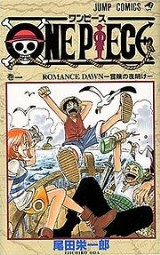
One Piece

Encyclopedia
is a Japanese shōnen manga
series written and illustrated by Eiichiro Oda
. It has been serialized in Weekly Shōnen Jump
since August 4, 1997; the individual chapters are being published in tankōbon
volumes by Shueisha
, with the first released on December 24, 1997, and the 64th volume released as of November 2011. One Piece follows the adventures of Monkey D. Luffy
, a 17-year-old boy who gains elastic abilities after inadvertently eating a supernatural fruit, and his diverse crew of pirates, named the Straw Hat Pirates. Luffy explores the ocean in search of the world's ultimate treasure known as the One Piece and to become the next Pirate King. Along his journey, Luffy makes several friends and battles a wide variety of villains, many of whom try to capture the Straw Hats.
The chapters have been adapted into an original video animation
(OVA) produced by Production I.G in 1998, and an anime
series produced by Toei Animation
, which began broadcasting in Japan in 1999. Since then, the still ongoing series has aired over 500 episodes. Additionally, Toei has developed eleven animated feature films, an OVA, and five television specials. Several companies have developed various types of merchandising such as a trading card game, and a large number of video games.
The manga series was licensed for an English language release in North America by Viz Media
, in the United Kingdom by Gollancz Manga, and in Australia and New Zealand by Madman Entertainment
. The anime series has been licensed by Funimation Entertainment
for an English-language release in North America, although the series was originally licensed and distributed by 4Kids Entertainment
.
Since its release, One Piece has become the most popular manga series of all time in Japan and one of the most popular manga series worldwide. It is the highest-selling manga of all time in the history of Weekly Shōnen Jump, as well as currently being its most acclaimed manga. In 2010, Shueisha announced that they sold over 230 million volumes of One Piece manga so far; volume 61 set a new record for the highest initial print run of any book in Japan in history with 3.8 million copies (the previous record belonging to volume 60 with 3.4 million copies). Volume 60 is the first book to sell over two million copies in its opening week on Japan's Oricon
book rankings. One Piece is currently ranked as the best-selling series of all time in manga history. It enjoys a very high readership, with more than 250 million volumes of the series sold by 2011. One Piece has received wide critical acclaim from reviewers, primarily for its art, characterization, humor and story.
Twenty years have passed since Roger's execution, and Monkey D. Luffy
, a young pirate inspired by the pirate known as "Red-Haired" Shanks, has since set off on a journey from the East Blue to succeed Roger and find the treasure. He organizes and leads a nine-member crew named the Straw Hat Pirates. Each crew member Luffy encounters eventually become his close friends, including the swordsman Roronoa Zoro, the navigator and thief Nami, the liar and cowardly sharpshooter Usopp, the womanizing chef Sanji, the doctor and anthropomorphized reindeer Tony Tony Chopper, the archaeologist and former enemy Nico Robin, the cybernetic shipwright Franky, and the musician skeleton Brook.
The crew crosses paths with diverse villains, such as Buggy the Clown, many of the Seven Warlords of the Sea, the Marines, who place bounties on Luffy and Zoro's heads, and Arlong, a fishman and member of the former Sun Pirates. They encounter Baroque Works, the crime syndicate responsible for a civil war in the desert kingdom of Alabasta, along with fellow pirate Blackbeard, whose dream is also to become the King of the Pirates. The crew also confronts Enel, the ruler of the floating island Skypiea. Later, the crew meets the Marine admiral Aokiji, who reveals that Robin was involved in searching for Poneglyphs, stones with markings left by an ancient civilization whom Roger himself was also able to read. The crew also encounters Cipher Pol No. 9, the intelligence agency responsible for the destruction of Robin's homeland, who causes the pirates to declare war on the World Government. After an epic battle at Enies Lobby, the crew defeats CP9 - saving Robin and avenging the lives lost in the destruction - and each member receives bounties on their heads.
Some time later, the crew prepares to sail off to the New World, the second half of the Grand Line. The crew eventually gets separated during a battle at the Sabaody Archipelago. At the same time, the Marines sentence Luffy's older brother and Roger's son Portgas D. Ace to be executed, and hold a war against a group of pirates led by Whitebeard. Luffy eventually rescues Ace, but both Whitebeard and Ace are killed in the ensuing chaos. Later, Luffy and the crew undergo rigorous training regimens, some under the tutelage of prominent figures. Two years later, the crew regroups and journeys to Fishman Island to enter the New World. At the same time, a group of evil fishman pirates appear, and holds a coup d'état
to decide the fate of the island, but are eventually defeated by the Straw Hats alongside Jimbei.
The currents and weather on the Grand Line's open sea are extremely unpredictable, while as in the vicinity of islands the climate is stable. What makes it even harder to navigate is the fact that normal compasses do not work there. A special compass called a must be used. The Log Pose works by locking on to one island's magnetic field and then locking on to another island's magnetic field. The time for it to set depends on the island. This process can be bypassed by obtaining an , a Log Pose variation that is permanently set to a specific island and never changes.
The world of One Piece is filled with anachronisms, like the , snail-like animals that can be attached to electric equipment and function as rotary phones, fax machines, surveillance cameras, and similar devices. , the shells
of certain sky-dwelling animals, can be used to store wind, sound, images, heat, and the like and have various applications.
The Devil Fruit is treasures in the sea.They growing in the deep of sea and the market price at least one hundred million bailey above.
A (renamed "Cursed Fruit" in 4Kids' and Funimation's edited dubs) is a type of fruit which when eaten confers a power on the eater. There are three categories of Devil Fruit. fruits allow the user to fully and partially transform into a specific animal. fruits give control over and allow the user "to change their living body structure into the powers of nature". is a catch-all category for fruits that give the user superhuman abilities. They are said to be incarnations of the Sea Devil himself, and as a result, Devil Fruit users cannot swim in sea water, as "they are hated by the sea". When even partially submerged in sea water, they lose all of their strength and coordination, although some abilities remain, such as Luffy still being able to stretch after being totally submerged. "Moving" water, such as rain or waves, does not have this effect.
PEREMPTORY(霸气)there are three kinds of PEREMPTORY,were the overlord color ambition(stun),Armed color dominance(Defense and break the ability),and Documentary show color(Predict the attack).
, Eiichiro Oda began writing One Piece in 1996. From there, it started as three one-shot stories entitled Romance Dawn—which would later be used as the title for One Pieces first chapter and volume. The two one-shots featured the character of Luffy, and included elements that would later appear in the main series. The first of these short stories was published in August 1996 in a special issue of Shōnen Jump and later in One Piece Red. The second was published in the 41st issue of Shōnen Jump in 1996 and reprinted 1998 in Oda's short story collection, Wanted!.
Oda originally planned One Piece to last five years, and he had already planned out the ending, but he found himself enjoying the story too much to end it in that amount of time and now has no idea how long it will take to reach that point. Nevertheless, the author states, as of July 2007, that the ending will still be the one he had decided on from the beginning and he is committed to seeing it through to the end, no matter how many years it takes.
When creating a Devil Fruit, Oda thinks of something that would fulfill a human desire; he added that he does not see why he would draw a Devil Fruit unless the fruit's appearance would entice one to eat it. The names of many special attacks and other concepts in the manga consist of a form of punning, in which phrases written in kanji
are paired with an idiosyncratic reading. The names of Luffy, Sanji, Chopper, Robin, and Franky's techniques are often mixed with other languages, and the names of a number of Zoro's sword techniques are designed as jokes; for example, some of them look fearsome when read by sight but sound like kinds of food when read aloud (like Zoro's signature move, Onigiri
, which is rendered as demon's cut but may also mean rice dumpling). Eisaku Inoue, the animation director, has said that the creators did not use these kanji readings in the anime since they "might have cut down the laughs by about half." Nevertheless, Konosuke Uda
, the director, said that he believes that the creators "made the anime pretty close to the manga."
Oda was "sensitive" about how it would be translated. The English version of the One Piece manga in many instances uses one onomatopoeia for multiple onomatopoeia used in the Japanese version. For instance, "saaa" (the sound of light rain, close to a mist) and "zaaa" (the sound of pouring rain) are both translated as "fshhhhhhh." Unlike other manga artists, Oda draws everything that moves—including crowds, animals, smoke, clouds, and oceans—himself to create a consistent look, leaving his staff to draw the backgrounds, based on sketches drawn by Oda.
, One Piece has been serialized in the manga anthology Weekly Shōnen Jump
starting on August 4, 1997. The chapters have been published into tankōbon
volumes by Shueisha
since December 24, 1997. , there are 648 chapters and 64 tankōbon
volumes.
The One Piece series was licensed for an English language release by Viz Media
publishes its English-language adaptation of the series, chapterwise in the manga anthology Shonen Jump
, since the magazine's launch in November 2002, and in bound volumes since June 2003. , 58 English-language volumes have been published. In 2009, Viz Media announced the release of five volumes per month in North America during the first half of 2010, greatly increasing that number. In the United Kingdom, the volumes were published by Gollancz Manga, starting March 2006, until Viz Media replaced it after the fourteenth volume. In Australia and New Zealand, the English volumes have been distributed by Madman Entertainment
since November 10, 2008. In Poland, Japonica Polonica Fantastica
is publishing the manga – as of June 2011, four volumes have been released.
s (OVAs) have been released in Japan. The first, One Piece: Defeat The Pirate Ganzack!, was produced by Production I.G for the Jump Super Anime Tour of 1998 and directed by Gorō Taniguchi
. It is 29 minutes in length and features character designs by Hisashi Kagawa. Luffy, Nami, and Zoro are attacked by a sea monster that destroys their boat and separates them. Luffy is found on an island beach, where he saves a little girl, Medaka, from two pirates. All the villagers, including Medaka's father, have been taken away by Ganzack and his crew as forced laborers. After hearing that Ganzak also stole all the food, Luffy and Zoro rush out to get it back. As they fight the pirates, one of them kidnaps Medaka. A fight starts between Luffy and Ganzack, ending in Luffy's capture. Meanwhile, Zoro is forced to give up after a threat is made to kill all of the villagers. The people from the village rise up against Ganzack, and while the islanders and pirates fight, Nami goes and unlocks the three captives. Ganzack defeats the rebellion and reveals his armored battleship. Now it is up to the Straw Hats to "Defeat the Pirate Ganzack!" and prevent him from destroying the island.
The second OVA, One Piece: Romance Dawn Story, was produced by Toei Animation
in July 2008 for the Jump Super Anime Tour. It is 34 minutes in length and based on the first version of Romance Dawn, the pilot story for One Piece, but includes the Straw Hat Pirates up to Brook and their second ship, the Thousand Sunny. In search for food for his crew, Luffy arrives at a port town, defeating a pirate named Crescent Moon Gally on the way. He meets a girl named Silk in town, who was abandoned by attacking pirates as a baby and raised by the mayor, which has caused her to value the town as her "treasure". The villagers mistake Luffy for Gally and capture him just as the real Gally returns. Gally throws Luffy in the water and plans to destroy the town, but Silk saves him and Luffy goes after Gally. His crew arrives to help him, and with his help, he recovers the treasure for the town, gets some food, and destroys Gally's ship.
The third OVA, One Piece Film Strong World: Episode 0, is the animated version of the Manga One Piece Special called "Chapter 0" which shows how things were before and after the death of Roger. It is also the introductory chapter to the long-awaited tenth film, One Piece Film: Strong World
.
produced an anime television series based on the manga chapters, also titled One Piece. The series premiered in Japan on Fuji Television
on October 20, 1999. Since then, the still ongoing series has aired more than 500 episodes and has been exported to various countries around the world.
In 2004, 4Kids Entertainment
acquired the license for distribution of One Piece in North America. 4Kids collaborated with Viz Media
to distribute the series for home video release. This dub was heavily edited for content
, as well as length; reducing the first 143 episodes into 104. Sanji's cigarettes, for example, were turned into lollipops, and "the skin of a black pirate was changed to a tan mulatto / white color." 4Kids originally created an English version of the original opening theme; however, the music was replaced with an alternate score. The series premiered in the United States on September 18, 2004 on the Fox
network as part of the Fox Box block, and later aired on the Cartoon Network
in the Toonami block in April 2005. 4Kids released a statement in December 2006 confirming that it cancelled the project. In July 2010, an interview was conducted between Anime News Network and Mark Kirk, the Vice President of Digital Media for 4Kids Entertainment. In this interview, Kirk explained that 4Kids acquired One Piece as part of a package deal with other anime, and that the company did not actually watch any of the series before acquiring it. However, once 4Kids realized One Piece would not work with their intended demographic, the company decided to edit it into a more child-oriented series until they had an opportunity to legally drop the license. Kirk said the experience on producing One Piece "ruined [the] company's reputation." Ever since that incident, 4Kids established a more strict set of guidelines, checks, and balances to determine what anime the company acquires.
Following the 4Kids dub in 2007, Funimation Entertainment
began production on an English-language release of One Piece. In an interview with voice actor Christopher Sabat
, Sabat stated that Funimation had been interested in acquiring One Piece from the very beginning, and produced a "test episode," in which Sabat played the character of Helmeppo and Eric Vale
played the part of the main character, Luffy (they would later go on to provide the English voices for Roronoa Zoro and Sanji, respectively). After producing a new English voice dub, the company released its first unedited, bilingual DVD box set, containing 13 episodes, on May 27, 2008. Similarly sized sets followed with fourteen sets released as of October 26, 2010. The Funimation dubbed episodes premiered on the Cartoon Network
on September 29, 2007 and aired until its cancellation on March 22, 2008. The remainder of Funimation's dubbed episodes continued to be aired on Australia's Cartoon Network, and then shifted into reruns of the Funimation dub before being replaced by Total Drama Island. On October 28, 2011, Funimation posted a press release on their official website, confirming the acquisition of episodes 206-263 and the aspect ratio, beginning with episode 207, will be changed to the 16:9 widescreen format.
Funimation, Toei Animation, Shueisha, and Fuji TV announced in May 2009 that they would simulcast stream the series within an hour of the weekly Japanese broadcast. This free, English-subtitled simulcast is available at www.onepieceofficial.com. Originally scheduled to begin on May 30, 2009 with episode 403, a lack of security resulted in a leak of the episode. As a result, Funimation delayed the offer until August 29, 2009 at which point it began with a simulcast of episode #415. One Piece episodes are also available for streaming at Hulu.com, in both subtitled and dubbed formats (with the dub being the unedited DVD release version).
of Bandai
and later as part of Namco Bandai Games
. The games have been released on a variety of video game
and handheld consoles
. The series features various genres, mostly role-playing games
—the predominant type in the series' early years—and fighting game
s, such as the titles of the Grand Battle! sub-series.
The series debuted in Japan on July 19, 2000 with One Piece: Mezase Kaizoku Ou!. At the moment, the series contains 27 games, not counting Battle Stadium D.O.N
, the title One Piece shares with its related anime series Dragon Ball Z and Naruto
.
and Shiro Hamaguchi
. Various theme songs
and character songs were released on a total of 49 singles
. Most of the songs are also featured on six compilation album
s and on 16 soundtrack CDs.
s was published based on the first OVA, certain episodes of the TV anime, and all but the first feature film. They featured art work by Oda and are written by Tatsuya Hamasaki. The first of these novels, One Piece: Defeat The Pirate Ganzak!, based on the OVA, was released on June 3, 1999. On July 17, 2000, followed One Piece: Logue Town Chapter, a light novel adaptation of the TV anime's Logue Town story arc
. The first feature film to be adapted was Clockwork Island Adventure. The book was released on March 19, 2001. On December 25, 2001, followed the second and so far last light novel adaptation of a TV anime arc in One Piece: Thousand-year Dragon Legend. The adaptation of Chopper's Kingdom on the Island of Strange Animals was released on March 22, 2002, and that of Dead End Adventure on March 10, 2003. Curse of the Sacred Sword followed on March 22, 2004, and Baron Omatsuri and the Secret Island on March 14, 2005. The light novel of The Giant Mechanical Soldier of Karakuri Castle was released on March 6, 2006 and that of The Desert Princess and the Pirates: Adventures in Alabasta on March 7, 2007. The newest novel adapts Episode of Chopper Plus: Bloom in the Winter, Miracle Cherry Blossom and was released on February 25, 2008.
s for the One Piece series have been released. The first art book, One Piece: Color Walk 1, released June 2001, has also been released in English on November 8, 2005. The second art book, One Piece: Color Walk 2, was released on November 4, 2003, the third, One Piece: Color Walk 3 – Lion, was released January 5, 2006, and the fourth art book, subtitled Eagle, was released on March 4, 2010. The fifth art book, subtitled Shark, was released on December 3, 2010. The first guidebook, One Piece: Red – Grand Characters was released on March 2, 2002. The second guidebook, One Piece: Blue – Grand Data File, was released on August 2, 2002. The third guidebook, One Piece: Yellow – Grand Elements, was released on April 4, 2007, and the fourth guidebook, One Piece: Green – Secret Pieces, was released on November 4, 2010. An anime guidebook, One Piece: RAINBOW!, was released on May 1, 2007, and covers the first 8 years of the TV show.
named One Piece CCG and a drama CD centering around the character of Nefertari Vivi released by Avex Trax
on December 26, 2002.
One Piece's Chopper gets a new Hello Kitty-esque style in the newly released previews of the new One Piece and Hello Kitty
collaboration. For this collaboration, One Piece takes a journey, crossing over into the world of Hello Kitty.
One Piece is also the first manga to increase Weekly Shōnen Jumps sales in eleven years. Volume 61 holds a manga publishing record in Japan, with 3.8 million copies published in its first printing alone, breaking its own previous records established by volumes 57, 59 and 60 (at 3.0, 3.2 and 3.4 million copies respectively). In addition to that, it also broke Japan's all time first print publishing record of all books, passing the previous record of 2.9 million copies, held by Harry Potter and the Order of the Phoenix
. Overall, the series has re-written Japanese record for first print manga publication 9 times with Volumes 24, 25, 26, 27, 56, 57, 59, 60, 61 and 63. The first week sales of volume 60, at 2,094,123 copies, also broke the Japanese all-time sales record for all books in its debut week, and is currently the only book to reach the 2 million mark in its first week. It is also currently the highest selling manga series of all time in Japan with over 230 million copies sold, and the fastest manga series to reach sales of 100 million.
One Piece was the best-selling manga series during 2008 in Japan with 5,956,540 volumes sold. Volumes 50, 51 and 49 placed first, second, and fourth, respectively, on Oricon's list of best selling manga volumes, with sales of 1,678,208, 1,646,978, and 1,544,000 copies sold respectively. Additionally, Oricon conducted a popularity survey with Japanese male and female readers between with ages ranging from ten to forty to determine the "Most Interesting Manga of 2008". In that survey, the four One Piece volumes published that year, volumes 49, 50, 51, and 52, placed first with an approval rating of 45.9%. In ICv2's list of "Top 25 Manga Properties Fall 2008", One Piece made a 15th place. In 2010 One Piece had improved to 2nd in ICv2's list of "Top 25 Manga Properties—Q3 2010".
According to Anime News Network
, which gathers its rankings for Oricon, One Piece maintained its top spot in 2009 with 14,721,241 copies sold, more than second [Naruto] and third place [Bleach] combined. The four volumes released during that time frame 53, 54, 52, 55 ranked 1–4 respectively for single volume sales.
In 2010 One Piece again maintained its top spot with 32,343,809 copies sold, more than second Naruto, third Kimi ni Todoke, fourth Fairy Tail, fifth Bleach and sixth Fullmetal Alchemist combined.
ANN comments that the art style of the One Piece manga requires "time to get used to" with its "very simple" artwork and its designs, which appear "very cartoonish" at first. They also note that the influence of Akira Toriyama
(Dragon Ball
) shines through in Oda's style of writing with its "huge epic battles punctuated by a lot of humor" and that, in One Piece, he creates a "rich tale" without focusing too much on plot. Active Anime describes the art work in One Piece as "wonderfully quirky and full of expression". Splashcomics comments that Oda's "pleasantly bright and dynamic" art style suits the story's "funny and exciting" (German: "witzigen und ... spannenden") atmosphere.
EX lauds Oda's art for its "crispy" monochrome pictures, "great use of subtle shade changes" on color pages, "sometimes exquisite" use of angles, and for its consistency. Shaenon K. Garrity
, who at some point edited the series for Shonen Jump, said that, while doing so, her amazement over Oda's craft grew increasingly. She states that "he has a natural, playful mastery of the often restrictive weekly-manga format", notes that "interesting things [are] going on deep in the narrative structure", and recommends "sticking through to the later volumes to see just how crazy and Peter Max
-y the art gets." Mania Entertainment writer Jarred Pine comments that "One Piece is a fun adventure story, with an ensemble cast that is continuing to develop, with great action and character drama." He lauds Oda's artwork as "imaginative and creative" and comments that "Oda's imagination just oozes all of the panels". He also comments that "Oda's panel work [...] features a lot of interesting perspectives and direction, especially during the explosive action sequences which are always a blast", though he complains that the panels can sometimes get "a little chaotic".
The North American releases of the English translation of volumes 39–43 debuted at #5–9 on the New York Times Best Seller Manga list.
One Piece's 60th volume held the fastest selling record until in February 2011, the manga beat its own record with its 61st volume, selling 2,086,080 copies in 3 days after its official sale (Feb 4–6). this was beaten by One piece's 63rd volume which sold 2,119,400 in 4 days, this means that 14 consequetive volumes of One piece has sold over 2 million copies since oricon began publishing it's book sales in april 2008 (one piece volume 50 shipped in june 2008) . This volume also broke the record for biggest first print that was before hold by One piece's 61st and 62nd volume who had 3.8 million while the 63rd volume had a first print on 3.9 million
Since 2010 One piece has sold 54.8 million copies out of its total of around 250 million copies. This amounted to more than number 2 Naruto
, number 3 Kimi ni Todoke
, number 4 Fairy Tail
, number 5 Bleach
, number 6 Bakuman
, number 7 Gintama
and number 8 Fullmetal Alchemist
combined.
In a review of the second DVD release of 4Kids Entertainment's dub, Todd Douglass, Jr. of DVD talk
called its adaptation a "shabby treatment" resulting in an "arguably less enjoyable rendition". Douglass said that the 4Kids original opening was "a crappy rap song" and that the removal of whole scenes leaves a "feeling that something is missing". He later went on to say that "Fans of the 'real' One Piece will want to skip picking [...] up [4Kids Entertainment's One Piece DVDs] until an uncut release is announced", and also stated that "kids may get into this version because it's what they have seen on TV." Margaret Veira of Active Anime praised the TV series' "great" animation, stating that "It gives life and stays true to the style and characters of the manga." and noting the fight scenes in particular as having "a lot of energy to them". Patrick King of Animefringe comments that the art style of One Piece is "very distinctive and fresh". In a review of the first Funimation DVD release for Mania Entertainment, Bryce Coulter comments that One Piece is "not your typical pirate adventure" and that mixed with "the right amount of random fun along with a shonen style storyline" it becomes "an appealing and fun romp". In a review of Funimation Entertainment's second DVD release for Mania Entertainment, Bryce Coulter comments that "You can tell that they are giving One Piece the attention that was neglected by 4Kids" and that "One Piece is a great tale of high-seas fun that will leave you wanting more!"
In Indonesia, Global TV
was reprimanded by the Indonesian Broadcasting Commission (KPI) for airing the TV anime. Nina Armando, member of the KPI and lecturer at the University of Indonesia, said the show should not be aired at times when children are likely to watch.
The German translation of its 44th volume won the Sondermann
audience award
for international manga category, a yearly comic award given for 7 categories by the Frankfurt Book Fair
, the Frankfurter Rundschau
, Spiegel Online
and Comicforum
since 2004, on the Frankfurt Book Fair
Comics Centre in 2005.
In a 2008 poll by Oricon
, Japanese teenagers elected it the most interesting manga.
, a popular Japanese anime magazine, voted the TV anime in 5th place of "The Readers' Picks for the Anime that should be remembered in the 21st Century". In June 2002, the Animage readers voted One Piece to be the 16th best new anime of the year 2001, and gave it another 16th place in 2004 in the category "Favorite Anime Series". In a 2005 web poll by Japanese television network TV Asahi
One Piece was voted 6th "most popular animated TV series". Before the poll, Asahi TV broadcast another list based on a nation-wide survey in which One Piece placed 4th among teenagers. In 2006, it was elected 32nd of the Top 100 Japanese anime by TV Asahi and 21st by its viewers. [114
placed it 5th. Funimation's first DVD release of the series "One Piece: Season 1 First Voyage" was nominated for the Fifth Annual TV DVD Awards.
Events were held from March 25 to 27 at the Kyocera Dome in Osaka, and from April 27 to May 1 at Tokyo Dome. Though only Tokyo and Osaka events have been scheduled so far, event organizers hope to tour throughout the nation before the year's end.
English
Manga
Manga is the Japanese word for "comics" and consists of comics and print cartoons . In the West, the term "manga" has been appropriated to refer specifically to comics created in Japan, or by Japanese authors, in the Japanese language and conforming to the style developed in Japan in the late 19th...
series written and illustrated by Eiichiro Oda
Eiichiro Oda
is a Japanese manga artist, best known as the creator of One Piece.-Early life:As a child, Oda was inspired by Akira Toriyama's works and aspired to become a manga artist. He recalls that his interest in pirates was probably sparked by the popular TV animation series titled Vicky the Viking...
. It has been serialized in Weekly Shōnen Jump
Weekly Shonen Jump
is a weekly shōnen manga anthology published in Japan by Shueisha under the Jump line of magazines. The first issue was released with a cover date of July 2, 1968, and it is still circulating. One of the longest-running manga magazines in Japan, it has a circulation of 2.8 million copies...
since August 4, 1997; the individual chapters are being published in tankōbon
Tankobon
, with a literal meaning close to "independently appearing book", is the Japanese term for a book that is complete in itself and is not part of a series , though the manga industry uses it for volumes which may be in a series...
volumes by Shueisha
Shueisha
is a major publisher in Japan. The company was founded in 1925 as the entertainment-related publishing division of Japanese publisher Shogakukan. The following year, Shueisha became a separate, independent company. Magazines published by Shueisha include Weekly Shōnen Jump, Weekly Young Jump,...
, with the first released on December 24, 1997, and the 64th volume released as of November 2011. One Piece follows the adventures of Monkey D. Luffy
Monkey D. Luffy
, often addressed as , is a fictional character and the main protagonist of the One Piece franchise created by Eiichiro Oda. He is introduced as a boy who possesses elasticity powers from eating a devil fruit called the Gum-Gum Fruit and superhuman strength....
, a 17-year-old boy who gains elastic abilities after inadvertently eating a supernatural fruit, and his diverse crew of pirates, named the Straw Hat Pirates. Luffy explores the ocean in search of the world's ultimate treasure known as the One Piece and to become the next Pirate King. Along his journey, Luffy makes several friends and battles a wide variety of villains, many of whom try to capture the Straw Hats.
The chapters have been adapted into an original video animation
Original video animation
, abbreviated as media , are animated films and series made specially for release in home-video formats. The term originated in relation to Japanese animation...
(OVA) produced by Production I.G in 1998, and an anime
Anime
is the Japanese abbreviated pronunciation of "animation". The definition sometimes changes depending on the context. In English-speaking countries, the term most commonly refers to Japanese animated cartoons....
series produced by Toei Animation
Toei Animation
Toei Animation Co., Ltd. is a Japanese animation studio owned by Toei Co., Ltd. The studio was founded in 1948 as Japan Animated Films . In 1956, Toei purchased the studio and it was reincorporated under its current name...
, which began broadcasting in Japan in 1999. Since then, the still ongoing series has aired over 500 episodes. Additionally, Toei has developed eleven animated feature films, an OVA, and five television specials. Several companies have developed various types of merchandising such as a trading card game, and a large number of video games.
The manga series was licensed for an English language release in North America by Viz Media
VIZ Media
VIZ Media, LLC, headquartered in San Francisco, is an anime, manga, and Japanese entertainment company. It was founded in 1986 as VIZ LLC. In 2005, VIZ LLC and ShoPro Entertainment merged to form the current VIZ Media LLC, which is jointly owned by Japanese publishers Shogakukan and Shueisha, and...
, in the United Kingdom by Gollancz Manga, and in Australia and New Zealand by Madman Entertainment
Madman Entertainment
Madman Entertainment is an Australian company that distributes international films as well as Japanese anime and manga in Australia and New Zealand. The company is owned by Funtastic Limited and is one of the major entertainment companies in Australia. It employs 130 people and has an annual...
. The anime series has been licensed by Funimation Entertainment
Funimation Entertainment
Funimation is an American entertainment company. Originally founded in 1994 by Gen Fukunaga, the company became a subsidiary of Navarre Corporation on May 11, 2005...
for an English-language release in North America, although the series was originally licensed and distributed by 4Kids Entertainment
4Kids Entertainment
4Kids Entertainment is an American film and television production company in bankruptcy since April 2011. It is known for English-dubbing Japanese anime and specializing in the acquisition, production and licensing of children's entertainment around the United States...
.
Since its release, One Piece has become the most popular manga series of all time in Japan and one of the most popular manga series worldwide. It is the highest-selling manga of all time in the history of Weekly Shōnen Jump, as well as currently being its most acclaimed manga. In 2010, Shueisha announced that they sold over 230 million volumes of One Piece manga so far; volume 61 set a new record for the highest initial print run of any book in Japan in history with 3.8 million copies (the previous record belonging to volume 60 with 3.4 million copies). Volume 60 is the first book to sell over two million copies in its opening week on Japan's Oricon
Oricon
, established in 1999, is the holding company at the head of a Japanese corporate group that supplies statistics and information on music and the music industry in Japan. It started as , which was founded by Sōkō Koike in November 1967 and became known for its music charts. Oricon Inc...
book rankings. One Piece is currently ranked as the best-selling series of all time in manga history. It enjoys a very high readership, with more than 250 million volumes of the series sold by 2011. One Piece has received wide critical acclaim from reviewers, primarily for its art, characterization, humor and story.
Plot
The series begins with the execution of Gold Roger, a man known as the . Just before his death, Roger announces that his treasure, the , will be up for the taking, causing the to begin. As a result, countless pirates set out to the Grand Line to look for the treasure.Twenty years have passed since Roger's execution, and Monkey D. Luffy
Monkey D. Luffy
, often addressed as , is a fictional character and the main protagonist of the One Piece franchise created by Eiichiro Oda. He is introduced as a boy who possesses elasticity powers from eating a devil fruit called the Gum-Gum Fruit and superhuman strength....
, a young pirate inspired by the pirate known as "Red-Haired" Shanks, has since set off on a journey from the East Blue to succeed Roger and find the treasure. He organizes and leads a nine-member crew named the Straw Hat Pirates. Each crew member Luffy encounters eventually become his close friends, including the swordsman Roronoa Zoro, the navigator and thief Nami, the liar and cowardly sharpshooter Usopp, the womanizing chef Sanji, the doctor and anthropomorphized reindeer Tony Tony Chopper, the archaeologist and former enemy Nico Robin, the cybernetic shipwright Franky, and the musician skeleton Brook.
The crew crosses paths with diverse villains, such as Buggy the Clown, many of the Seven Warlords of the Sea, the Marines, who place bounties on Luffy and Zoro's heads, and Arlong, a fishman and member of the former Sun Pirates. They encounter Baroque Works, the crime syndicate responsible for a civil war in the desert kingdom of Alabasta, along with fellow pirate Blackbeard, whose dream is also to become the King of the Pirates. The crew also confronts Enel, the ruler of the floating island Skypiea. Later, the crew meets the Marine admiral Aokiji, who reveals that Robin was involved in searching for Poneglyphs, stones with markings left by an ancient civilization whom Roger himself was also able to read. The crew also encounters Cipher Pol No. 9, the intelligence agency responsible for the destruction of Robin's homeland, who causes the pirates to declare war on the World Government. After an epic battle at Enies Lobby, the crew defeats CP9 - saving Robin and avenging the lives lost in the destruction - and each member receives bounties on their heads.
Some time later, the crew prepares to sail off to the New World, the second half of the Grand Line. The crew eventually gets separated during a battle at the Sabaody Archipelago. At the same time, the Marines sentence Luffy's older brother and Roger's son Portgas D. Ace to be executed, and hold a war against a group of pirates led by Whitebeard. Luffy eventually rescues Ace, but both Whitebeard and Ace are killed in the ensuing chaos. Later, Luffy and the crew undergo rigorous training regimens, some under the tutelage of prominent figures. Two years later, the crew regroups and journeys to Fishman Island to enter the New World. At the same time, a group of evil fishman pirates appear, and holds a coup d'état
Coup d'état
A coup d'état state, literally: strike/blow of state)—also known as a coup, putsch, and overthrow—is the sudden, extrajudicial deposition of a government, usually by a small group of the existing state establishment—typically the military—to replace the deposed government with another body; either...
to decide the fate of the island, but are eventually defeated by the Straw Hats alongside Jimbei.
Setting
The fictional world of One Piece is covered by two vast oceans, which are divided by a massive mountain range called the . The , a sea that runs perpendicular to the Red Line, further divides them into four seas: , , and . Surrounding the Grand Line are two regions called , which experience almost no wind and ocean currents and are breeding ground for the huge sea creatures called . Because of this, the Calm Belts are very effective barriers for those trying to enter the Grand Line. While marine ships, using to mask their presence, can simply pass through, most have to use the canal system of , a mountain at the first intersection of the Grand Line and the Red Line. Sea water from each of the four seas runs up that mountain and merges at the top to flow down a fifth canal and into the first half of the Grand Line. The second half of the Grand Line, beyond the second intersection with the Red Line, is also known as the .The currents and weather on the Grand Line's open sea are extremely unpredictable, while as in the vicinity of islands the climate is stable. What makes it even harder to navigate is the fact that normal compasses do not work there. A special compass called a must be used. The Log Pose works by locking on to one island's magnetic field and then locking on to another island's magnetic field. The time for it to set depends on the island. This process can be bypassed by obtaining an , a Log Pose variation that is permanently set to a specific island and never changes.
The world of One Piece is filled with anachronisms, like the , snail-like animals that can be attached to electric equipment and function as rotary phones, fax machines, surveillance cameras, and similar devices. , the shells
Seashell
A seashell or sea shell, also known simply as a shell, is a hard, protective outer layer created by an animal that lives in the sea. The shell is part of the body of the animal. Empty seashells are often found washed up on beaches by beachcombers...
of certain sky-dwelling animals, can be used to store wind, sound, images, heat, and the like and have various applications.
The Devil Fruit is treasures in the sea.They growing in the deep of sea and the market price at least one hundred million bailey above.
A (renamed "Cursed Fruit" in 4Kids' and Funimation's edited dubs) is a type of fruit which when eaten confers a power on the eater. There are three categories of Devil Fruit. fruits allow the user to fully and partially transform into a specific animal. fruits give control over and allow the user "to change their living body structure into the powers of nature". is a catch-all category for fruits that give the user superhuman abilities. They are said to be incarnations of the Sea Devil himself, and as a result, Devil Fruit users cannot swim in sea water, as "they are hated by the sea". When even partially submerged in sea water, they lose all of their strength and coordination, although some abilities remain, such as Luffy still being able to stretch after being totally submerged. "Moving" water, such as rain or waves, does not have this effect.
PEREMPTORY(霸气)there are three kinds of PEREMPTORY,were the overlord color ambition(stun),Armed color dominance(Defense and break the ability),and Documentary show color(Predict the attack).
Production
While working as an assistant to Nobuhiro WatsukiNobuhiro Watsuki
is a Japanese manga artist, best known for his samurai-themed series Rurouni Kenshin. He once worked as an assistant for his favorite author Takeshi Obata.-Biography:...
, Eiichiro Oda began writing One Piece in 1996. From there, it started as three one-shot stories entitled Romance Dawn—which would later be used as the title for One Pieces first chapter and volume. The two one-shots featured the character of Luffy, and included elements that would later appear in the main series. The first of these short stories was published in August 1996 in a special issue of Shōnen Jump and later in One Piece Red. The second was published in the 41st issue of Shōnen Jump in 1996 and reprinted 1998 in Oda's short story collection, Wanted!.
Oda originally planned One Piece to last five years, and he had already planned out the ending, but he found himself enjoying the story too much to end it in that amount of time and now has no idea how long it will take to reach that point. Nevertheless, the author states, as of July 2007, that the ending will still be the one he had decided on from the beginning and he is committed to seeing it through to the end, no matter how many years it takes.
When creating a Devil Fruit, Oda thinks of something that would fulfill a human desire; he added that he does not see why he would draw a Devil Fruit unless the fruit's appearance would entice one to eat it. The names of many special attacks and other concepts in the manga consist of a form of punning, in which phrases written in kanji
Kanji
Kanji are the adopted logographic Chinese characters hanzi that are used in the modern Japanese writing system along with hiragana , katakana , Indo Arabic numerals, and the occasional use of the Latin alphabet...
are paired with an idiosyncratic reading. The names of Luffy, Sanji, Chopper, Robin, and Franky's techniques are often mixed with other languages, and the names of a number of Zoro's sword techniques are designed as jokes; for example, some of them look fearsome when read by sight but sound like kinds of food when read aloud (like Zoro's signature move, Onigiri
Onigiri
, also known as or rice ball, is a Japanese food made from white rice formed into triangular or oval shapes and often wrapped in nori . Traditionally, an onigiri is filled with pickled ume , salted salmon, katsuobushi, kombu, tarako, or any other salty or sour ingredient as a natural preservative...
, which is rendered as demon's cut but may also mean rice dumpling). Eisaku Inoue, the animation director, has said that the creators did not use these kanji readings in the anime since they "might have cut down the laughs by about half." Nevertheless, Konosuke Uda
Konosuke Uda
is a director of anime.He directed several of the One Piece works created by Toei Animation, including the television series and the similarly titled films...
, the director, said that he believes that the creators "made the anime pretty close to the manga."
Oda was "sensitive" about how it would be translated. The English version of the One Piece manga in many instances uses one onomatopoeia for multiple onomatopoeia used in the Japanese version. For instance, "saaa" (the sound of light rain, close to a mist) and "zaaa" (the sound of pouring rain) are both translated as "fshhhhhhh." Unlike other manga artists, Oda draws everything that moves—including crowds, animals, smoke, clouds, and oceans—himself to create a consistent look, leaving his staff to draw the backgrounds, based on sketches drawn by Oda.
Manga
Written and illustrated by Eiichiro OdaEiichiro Oda
is a Japanese manga artist, best known as the creator of One Piece.-Early life:As a child, Oda was inspired by Akira Toriyama's works and aspired to become a manga artist. He recalls that his interest in pirates was probably sparked by the popular TV animation series titled Vicky the Viking...
, One Piece has been serialized in the manga anthology Weekly Shōnen Jump
Weekly Shonen Jump
is a weekly shōnen manga anthology published in Japan by Shueisha under the Jump line of magazines. The first issue was released with a cover date of July 2, 1968, and it is still circulating. One of the longest-running manga magazines in Japan, it has a circulation of 2.8 million copies...
starting on August 4, 1997. The chapters have been published into tankōbon
Tankobon
, with a literal meaning close to "independently appearing book", is the Japanese term for a book that is complete in itself and is not part of a series , though the manga industry uses it for volumes which may be in a series...
volumes by Shueisha
Shueisha
is a major publisher in Japan. The company was founded in 1925 as the entertainment-related publishing division of Japanese publisher Shogakukan. The following year, Shueisha became a separate, independent company. Magazines published by Shueisha include Weekly Shōnen Jump, Weekly Young Jump,...
since December 24, 1997. , there are 648 chapters and 64 tankōbon
Tankobon
, with a literal meaning close to "independently appearing book", is the Japanese term for a book that is complete in itself and is not part of a series , though the manga industry uses it for volumes which may be in a series...
volumes.
The One Piece series was licensed for an English language release by Viz Media
VIZ Media
VIZ Media, LLC, headquartered in San Francisco, is an anime, manga, and Japanese entertainment company. It was founded in 1986 as VIZ LLC. In 2005, VIZ LLC and ShoPro Entertainment merged to form the current VIZ Media LLC, which is jointly owned by Japanese publishers Shogakukan and Shueisha, and...
publishes its English-language adaptation of the series, chapterwise in the manga anthology Shonen Jump
Shonen Jump (magazine)
Shonen Jump, officially stylized SHONEN JUMP and abbreviated SJ, is a shōnen manga anthology published in North America by Viz Media. It debuted in November 2002 with the first issue having a January 2003 cover date...
, since the magazine's launch in November 2002, and in bound volumes since June 2003. , 58 English-language volumes have been published. In 2009, Viz Media announced the release of five volumes per month in North America during the first half of 2010, greatly increasing that number. In the United Kingdom, the volumes were published by Gollancz Manga, starting March 2006, until Viz Media replaced it after the fourteenth volume. In Australia and New Zealand, the English volumes have been distributed by Madman Entertainment
Madman Entertainment
Madman Entertainment is an Australian company that distributes international films as well as Japanese anime and manga in Australia and New Zealand. The company is owned by Funtastic Limited and is one of the major entertainment companies in Australia. It employs 130 people and has an annual...
since November 10, 2008. In Poland, Japonica Polonica Fantastica
Japonica Polonica Fantastica
Japonica Polonica Fantastica, also known as JPF, is a Polish manga publisher, located in Mierzyn near Szczecin, Poland. The founder of JPF is Shin Yasuda.-Titles published:*.hack//Legend of the Twilight*Akira*Angel Sanctuary...
is publishing the manga – as of June 2011, four volumes have been released.
Original video animations
Three original video animationOriginal video animation
, abbreviated as media , are animated films and series made specially for release in home-video formats. The term originated in relation to Japanese animation...
s (OVAs) have been released in Japan. The first, One Piece: Defeat The Pirate Ganzack!, was produced by Production I.G for the Jump Super Anime Tour of 1998 and directed by Gorō Taniguchi
Goro Taniguchi
is a Japanese anime director, writer, producer and storyboard artist, who is among Sunrise's noted new directors.-TV anime:*Zettai Muteki Raijin-Oh...
. It is 29 minutes in length and features character designs by Hisashi Kagawa. Luffy, Nami, and Zoro are attacked by a sea monster that destroys their boat and separates them. Luffy is found on an island beach, where he saves a little girl, Medaka, from two pirates. All the villagers, including Medaka's father, have been taken away by Ganzack and his crew as forced laborers. After hearing that Ganzak also stole all the food, Luffy and Zoro rush out to get it back. As they fight the pirates, one of them kidnaps Medaka. A fight starts between Luffy and Ganzack, ending in Luffy's capture. Meanwhile, Zoro is forced to give up after a threat is made to kill all of the villagers. The people from the village rise up against Ganzack, and while the islanders and pirates fight, Nami goes and unlocks the three captives. Ganzack defeats the rebellion and reveals his armored battleship. Now it is up to the Straw Hats to "Defeat the Pirate Ganzack!" and prevent him from destroying the island.
The second OVA, One Piece: Romance Dawn Story, was produced by Toei Animation
Toei Animation
Toei Animation Co., Ltd. is a Japanese animation studio owned by Toei Co., Ltd. The studio was founded in 1948 as Japan Animated Films . In 1956, Toei purchased the studio and it was reincorporated under its current name...
in July 2008 for the Jump Super Anime Tour. It is 34 minutes in length and based on the first version of Romance Dawn, the pilot story for One Piece, but includes the Straw Hat Pirates up to Brook and their second ship, the Thousand Sunny. In search for food for his crew, Luffy arrives at a port town, defeating a pirate named Crescent Moon Gally on the way. He meets a girl named Silk in town, who was abandoned by attacking pirates as a baby and raised by the mayor, which has caused her to value the town as her "treasure". The villagers mistake Luffy for Gally and capture him just as the real Gally returns. Gally throws Luffy in the water and plans to destroy the town, but Silk saves him and Luffy goes after Gally. His crew arrives to help him, and with his help, he recovers the treasure for the town, gets some food, and destroys Gally's ship.
The third OVA, One Piece Film Strong World: Episode 0, is the animated version of the Manga One Piece Special called "Chapter 0" which shows how things were before and after the death of Roger. It is also the introductory chapter to the long-awaited tenth film, One Piece Film: Strong World
One Piece Film: Strong World
or simply is a 2009 Japanese animated film directed by Munehisa Sakai. It is the tenth feature film based on the shonen manga series One Piece by Eiichiro Oda. The film stars the regular television cast of Mayumi Tanaka, Kazuya Nakai, Akemi Okamura, Kappei Yamaguchi, Hiroaki Hirata, Ikue Otani,...
.
Anime series
Toei AnimationToei Animation
Toei Animation Co., Ltd. is a Japanese animation studio owned by Toei Co., Ltd. The studio was founded in 1948 as Japan Animated Films . In 1956, Toei purchased the studio and it was reincorporated under its current name...
produced an anime television series based on the manga chapters, also titled One Piece. The series premiered in Japan on Fuji Television
Fuji Television
is a Japanese television station based in Daiba, Minato, Tokyo, Japan, also known as or CX, based on the station's callsign "JOCX-DTV". It is the flagship station of the Fuji News Network and the ....
on October 20, 1999. Since then, the still ongoing series has aired more than 500 episodes and has been exported to various countries around the world.
In 2004, 4Kids Entertainment
4Kids Entertainment
4Kids Entertainment is an American film and television production company in bankruptcy since April 2011. It is known for English-dubbing Japanese anime and specializing in the acquisition, production and licensing of children's entertainment around the United States...
acquired the license for distribution of One Piece in North America. 4Kids collaborated with Viz Media
VIZ Media
VIZ Media, LLC, headquartered in San Francisco, is an anime, manga, and Japanese entertainment company. It was founded in 1986 as VIZ LLC. In 2005, VIZ LLC and ShoPro Entertainment merged to form the current VIZ Media LLC, which is jointly owned by Japanese publishers Shogakukan and Shueisha, and...
to distribute the series for home video release. This dub was heavily edited for content
Editing of anime in American distribution
Editing of anime in American distribution describes the process of altering anime to prepare it to be distributed in the United States and forms part of the process of localization. This process is generally applied only to series intended for broadcast on American television; series released...
, as well as length; reducing the first 143 episodes into 104. Sanji's cigarettes, for example, were turned into lollipops, and "the skin of a black pirate was changed to a tan mulatto / white color." 4Kids originally created an English version of the original opening theme; however, the music was replaced with an alternate score. The series premiered in the United States on September 18, 2004 on the Fox
Fox Broadcasting Company
Fox Broadcasting Company, commonly referred to as Fox Network or simply Fox , is an American commercial broadcasting television network owned by Fox Entertainment Group, part of Rupert Murdoch's News Corporation. Launched on October 9, 1986, Fox was the highest-rated broadcast network in the...
network as part of the Fox Box block, and later aired on the Cartoon Network
Cartoon Network
Cartoon Network is a name of television channels worldwide created by Turner Broadcasting which used to primarily show animated programming. The channel began broadcasting on October 1, 1992 in the United States....
in the Toonami block in April 2005. 4Kids released a statement in December 2006 confirming that it cancelled the project. In July 2010, an interview was conducted between Anime News Network and Mark Kirk, the Vice President of Digital Media for 4Kids Entertainment. In this interview, Kirk explained that 4Kids acquired One Piece as part of a package deal with other anime, and that the company did not actually watch any of the series before acquiring it. However, once 4Kids realized One Piece would not work with their intended demographic, the company decided to edit it into a more child-oriented series until they had an opportunity to legally drop the license. Kirk said the experience on producing One Piece "ruined [the] company's reputation." Ever since that incident, 4Kids established a more strict set of guidelines, checks, and balances to determine what anime the company acquires.
Following the 4Kids dub in 2007, Funimation Entertainment
Funimation Entertainment
Funimation is an American entertainment company. Originally founded in 1994 by Gen Fukunaga, the company became a subsidiary of Navarre Corporation on May 11, 2005...
began production on an English-language release of One Piece. In an interview with voice actor Christopher Sabat
Christopher Sabat
Christopher Robin Sabat is an American voice actor, ADR Director, and Line Producer. He has provided voices for a number of English language versions of Japanese anime films and television series, as well as video games...
, Sabat stated that Funimation had been interested in acquiring One Piece from the very beginning, and produced a "test episode," in which Sabat played the character of Helmeppo and Eric Vale
Eric Vale
Christopher Eric Johnson better known by his stage name Eric Vale, is an American voice actor, ADR Director, Script, and Head Writer who is affiliated with Funimation Entertainment...
played the part of the main character, Luffy (they would later go on to provide the English voices for Roronoa Zoro and Sanji, respectively). After producing a new English voice dub, the company released its first unedited, bilingual DVD box set, containing 13 episodes, on May 27, 2008. Similarly sized sets followed with fourteen sets released as of October 26, 2010. The Funimation dubbed episodes premiered on the Cartoon Network
Cartoon Network
Cartoon Network is a name of television channels worldwide created by Turner Broadcasting which used to primarily show animated programming. The channel began broadcasting on October 1, 1992 in the United States....
on September 29, 2007 and aired until its cancellation on March 22, 2008. The remainder of Funimation's dubbed episodes continued to be aired on Australia's Cartoon Network, and then shifted into reruns of the Funimation dub before being replaced by Total Drama Island. On October 28, 2011, Funimation posted a press release on their official website, confirming the acquisition of episodes 206-263 and the aspect ratio, beginning with episode 207, will be changed to the 16:9 widescreen format.
Funimation, Toei Animation, Shueisha, and Fuji TV announced in May 2009 that they would simulcast stream the series within an hour of the weekly Japanese broadcast. This free, English-subtitled simulcast is available at www.onepieceofficial.com. Originally scheduled to begin on May 30, 2009 with episode 403, a lack of security resulted in a leak of the episode. As a result, Funimation delayed the offer until August 29, 2009 at which point it began with a simulcast of episode #415. One Piece episodes are also available for streaming at Hulu.com, in both subtitled and dubbed formats (with the dub being the unedited DVD release version).
Anime films
Eleven animated films based on the One Piece series have been released in Japan. The films are traditionally released during the Japanese school spring break since 2000. The films feature self-contained, completely original plots or alternate retellings of story arcs with animation of higher quality than what the weekly anime allows for. Funimation Entertainment has licensed the eighth film for release in North America.Video games
The One Piece franchise has been adapted into multiple video games published by subsidiariesSubsidiary
A subsidiary company, subsidiary, or daughter company is a company that is completely or partly owned and wholly controlled by another company that owns more than half of the subsidiary's stock. The subsidiary can be a company, corporation, or limited liability company. In some cases it is a...
of Bandai
Bandai
is a Japanese toy making and video game company, as well as the producer of a large number of plastic model kits. It is the world's third-largest producer of toys . Some ex-Bandai group companies produce anime and tokusatsu programs...
and later as part of Namco Bandai Games
Namco Bandai Games
is an arcade, mobile and home video game developer and publisher based in Japan which is the product of a merger between the video game development divisions of Bandai and Namco. Namco Bandai Games is a wholly owned subsidiary of Namco Bandai Holdings and specializes in production and sales of...
. The games have been released on a variety of video game
Video game console
A video game console is an interactive entertainment computer or customized computer system that produces a video display signal which can be used with a display device to display a video game...
and handheld consoles
Handheld game console
A handheld game console is a lightweight, portable electronic device with a built-in screen, game controls and speakers. Handheld game consoles are run on machines of small size allowing people to carry them and play them at any time or place...
. The series features various genres, mostly role-playing games
Role-playing game (video games)
Role-playing video games are a video game genre with origins in pen-and-paper role-playing games such as Dungeons & Dragons, using much of the same terminology, settings and game mechanics. The player in RPGs controls one character, or several adventuring party members, fulfilling one or many quests...
—the predominant type in the series' early years—and fighting game
Fighting game
Fighting game is a video game genre where the player controls an on-screen character and engages in close combat with an opponent. These characters tend to be of equal power and fight matches consisting of several rounds, which take place in an arena. Players must master techniques such as...
s, such as the titles of the Grand Battle! sub-series.
The series debuted in Japan on July 19, 2000 with One Piece: Mezase Kaizoku Ou!. At the moment, the series contains 27 games, not counting Battle Stadium D.O.N
Battle Stadium D.O.N
is a Japanese fighting game for the GameCube and PlayStation 2 featuring characters from the three popular manga series published by Weekly Shōnen Jump. Dragon Ball Z, One Piece, and Naruto, hence the D.O.N...
, the title One Piece shares with its related anime series Dragon Ball Z and Naruto
Naruto
is an ongoing Japanese manga series written and illustrated by Masashi Kishimoto. The plot tells the story of Naruto Uzumaki, an adolescent ninja who constantly searches for recognition and aspires to become the Hokage, the ninja in his village who is acknowledged as the leader and the strongest of...
.
Music
Myriad soundtracks were released to the anime, films and the games. The music for the One Piece anime series and most of its films were directed by Kohei TanakaKohei Tanaka (composer)
is a Japanese composer, arranger and singer. He is affiliated with the music production company Imagine. He has created numerous musical scores for famous anime TV series, OVAs, movies, computer games and tokusatsu series. Tanaka was born in Ebisubashi, Osaka, Osaka Prefecture on February 14,...
and Shiro Hamaguchi
Shiro Hamaguchi
is a Japanese anime composer, arranger and orchestrator. He is best known for composing music to the anime franchises One Piece and Oh My Goddess! and arranging/orchestrating music in the Final Fantasy series...
. Various theme songs
Theme music
Theme music is a piece that is often written specifically for a radio program, television program, video game or movie, and usually played during the title sequence and/or end credits...
and character songs were released on a total of 49 singles
Single (music)
In music, a single or record single is a type of release, typically a recording of fewer tracks than an LP or a CD. This can be released for sale to the public in a variety of different formats. In most cases, the single is a song that is released separately from an album, but it can still appear...
. Most of the songs are also featured on six compilation album
Compilation album
A compilation album is an album featuring tracks from one or more performers, often culled from a variety of sources The tracks are usually collected according to a common characteristic, such as popularity, genre, source or subject matter...
s and on 16 soundtrack CDs.
Light novels
A series of light novelLight novel
A is a style of Japanese novel primarily targeting junior high and high school students . The term "light novel" is a wasei-eigo, or a Japanese term formed from words in the English language. Light novels are often called or for short...
s was published based on the first OVA, certain episodes of the TV anime, and all but the first feature film. They featured art work by Oda and are written by Tatsuya Hamasaki. The first of these novels, One Piece: Defeat The Pirate Ganzak!, based on the OVA, was released on June 3, 1999. On July 17, 2000, followed One Piece: Logue Town Chapter, a light novel adaptation of the TV anime's Logue Town story arc
Story arc
A story arc is an extended or continuing storyline in episodic storytelling media such as television, comic books, comic strips, boardgames, video games, and in some cases, films. On a television program, for example, the story would unfold over many episodes. In television, the use of the story...
. The first feature film to be adapted was Clockwork Island Adventure. The book was released on March 19, 2001. On December 25, 2001, followed the second and so far last light novel adaptation of a TV anime arc in One Piece: Thousand-year Dragon Legend. The adaptation of Chopper's Kingdom on the Island of Strange Animals was released on March 22, 2002, and that of Dead End Adventure on March 10, 2003. Curse of the Sacred Sword followed on March 22, 2004, and Baron Omatsuri and the Secret Island on March 14, 2005. The light novel of The Giant Mechanical Soldier of Karakuri Castle was released on March 6, 2006 and that of The Desert Princess and the Pirates: Adventures in Alabasta on March 7, 2007. The newest novel adapts Episode of Chopper Plus: Bloom in the Winter, Miracle Cherry Blossom and was released on February 25, 2008.
Art and guidebooks
Five art books and five guidebookGUIdebook
GUIdebook is a website that contains screenshots of computer software.It shows a visual history of the software's user interface. It includes operating systems like Mac OS and Windows, desktop environments like GNOME and KDE, portable operating systems like Newton OS and Windows CE, and...
s for the One Piece series have been released. The first art book, One Piece: Color Walk 1, released June 2001, has also been released in English on November 8, 2005. The second art book, One Piece: Color Walk 2, was released on November 4, 2003, the third, One Piece: Color Walk 3 – Lion, was released January 5, 2006, and the fourth art book, subtitled Eagle, was released on March 4, 2010. The fifth art book, subtitled Shark, was released on December 3, 2010. The first guidebook, One Piece: Red – Grand Characters was released on March 2, 2002. The second guidebook, One Piece: Blue – Grand Data File, was released on August 2, 2002. The third guidebook, One Piece: Yellow – Grand Elements, was released on April 4, 2007, and the fourth guidebook, One Piece: Green – Secret Pieces, was released on November 4, 2010. An anime guidebook, One Piece: RAINBOW!, was released on May 1, 2007, and covers the first 8 years of the TV show.
Other media
Other One Piece media include a trading card game by BandaiBandai
is a Japanese toy making and video game company, as well as the producer of a large number of plastic model kits. It is the world's third-largest producer of toys . Some ex-Bandai group companies produce anime and tokusatsu programs...
named One Piece CCG and a drama CD centering around the character of Nefertari Vivi released by Avex Trax
Avex Trax
, listed in the Tokyo Stock Exchange as 7860 and abbreviated as AGHD, is the holding company for a group of entertainment-related subsidiaries based in Japan...
on December 26, 2002.
One Piece's Chopper gets a new Hello Kitty-esque style in the newly released previews of the new One Piece and Hello Kitty
Hello Kitty
is a fictional character produced by the Japanese company Sanrio, first designed by Yuko Shimizu. She is portrayed as a female white Japanese bobtail cat with a red bow. The character's first appearance on an item, a vinyl coin purse, was introduced in Japan in 1974 and brought to the United States...
collaboration. For this collaboration, One Piece takes a journey, crossing over into the world of Hello Kitty.
Manga
One Piece, the most popular manga series of all time in Japan and one of the most popular manga series worldwide, is the highest-selling manga in the history of Weekly Shōnen Jump and has received wide critical acclaim, primarily for its art, characterization, humor and story. It now currently ranks at number one for the best-selling manga in history.One Piece is also the first manga to increase Weekly Shōnen Jumps sales in eleven years. Volume 61 holds a manga publishing record in Japan, with 3.8 million copies published in its first printing alone, breaking its own previous records established by volumes 57, 59 and 60 (at 3.0, 3.2 and 3.4 million copies respectively). In addition to that, it also broke Japan's all time first print publishing record of all books, passing the previous record of 2.9 million copies, held by Harry Potter and the Order of the Phoenix
Harry Potter and the Order of the Phoenix
Harry Potter and the Order of the Phoenix is the fifth in the Harry Potter series written by J. K. Rowling, and was published on 21 June 2003 by Bloomsbury in the United Kingdom, Scholastic in the United States, and Raincoast in Canada...
. Overall, the series has re-written Japanese record for first print manga publication 9 times with Volumes 24, 25, 26, 27, 56, 57, 59, 60, 61 and 63. The first week sales of volume 60, at 2,094,123 copies, also broke the Japanese all-time sales record for all books in its debut week, and is currently the only book to reach the 2 million mark in its first week. It is also currently the highest selling manga series of all time in Japan with over 230 million copies sold, and the fastest manga series to reach sales of 100 million.
One Piece was the best-selling manga series during 2008 in Japan with 5,956,540 volumes sold. Volumes 50, 51 and 49 placed first, second, and fourth, respectively, on Oricon's list of best selling manga volumes, with sales of 1,678,208, 1,646,978, and 1,544,000 copies sold respectively. Additionally, Oricon conducted a popularity survey with Japanese male and female readers between with ages ranging from ten to forty to determine the "Most Interesting Manga of 2008". In that survey, the four One Piece volumes published that year, volumes 49, 50, 51, and 52, placed first with an approval rating of 45.9%. In ICv2's list of "Top 25 Manga Properties Fall 2008", One Piece made a 15th place. In 2010 One Piece had improved to 2nd in ICv2's list of "Top 25 Manga Properties—Q3 2010".
According to Anime News Network
Anime News Network
Anime News Network is an anime industry news website that reports on the status of anime, manga, Japanese popular music and other otaku-related culture within North America, Australia and Japan. Additionally, it sometimes features similar happenings throughout the Anglosphere and elsewhere in the...
, which gathers its rankings for Oricon, One Piece maintained its top spot in 2009 with 14,721,241 copies sold, more than second [Naruto] and third place [Bleach] combined. The four volumes released during that time frame 53, 54, 52, 55 ranked 1–4 respectively for single volume sales.
In 2010 One Piece again maintained its top spot with 32,343,809 copies sold, more than second Naruto, third Kimi ni Todoke, fourth Fairy Tail, fifth Bleach and sixth Fullmetal Alchemist combined.
ANN comments that the art style of the One Piece manga requires "time to get used to" with its "very simple" artwork and its designs, which appear "very cartoonish" at first. They also note that the influence of Akira Toriyama
Akira Toriyama
is a Japanese manga artist and game artist known mostly for his creation of Dragon Ball in 1984. Toriyama admires Osamu Tezuka's Astro Boy and was impressed by Walt Disney's One Hundred and One Dalmatians, which he remembers for the great art...
(Dragon Ball
Dragon Ball
is a Japanese manga series written and illustrated by Akira Toriyama. It was originally serialized in Weekly Shōnen Jump from 1984 to 1995; later the 519 individual chapters were published into 42 tankōbon volumes by Shueisha. Dragon Ball was inspired by the classical Chinese novel Journey to the...
) shines through in Oda's style of writing with its "huge epic battles punctuated by a lot of humor" and that, in One Piece, he creates a "rich tale" without focusing too much on plot. Active Anime describes the art work in One Piece as "wonderfully quirky and full of expression". Splashcomics comments that Oda's "pleasantly bright and dynamic" art style suits the story's "funny and exciting" (German: "witzigen und ... spannenden") atmosphere.
EX lauds Oda's art for its "crispy" monochrome pictures, "great use of subtle shade changes" on color pages, "sometimes exquisite" use of angles, and for its consistency. Shaenon K. Garrity
Shaenon K. Garrity
Shaenon K. Garrity is a webcomics writer and artist, best known as the creator of Narbonic. She is one of the most prominent cartoonists in the Modern Tales network of commercial webcomic sites, and became the site's editor on August 1, 2006...
, who at some point edited the series for Shonen Jump, said that, while doing so, her amazement over Oda's craft grew increasingly. She states that "he has a natural, playful mastery of the often restrictive weekly-manga format", notes that "interesting things [are] going on deep in the narrative structure", and recommends "sticking through to the later volumes to see just how crazy and Peter Max
Peter Max
Peter Max is a German-born Jewish American artist. At first, works in this style appeared on posters and were seen on the walls of college dorms all across America. Max then became fascinated with new printing techniques that allowed for four-color reproduction on product merchandise...
-y the art gets." Mania Entertainment writer Jarred Pine comments that "One Piece is a fun adventure story, with an ensemble cast that is continuing to develop, with great action and character drama." He lauds Oda's artwork as "imaginative and creative" and comments that "Oda's imagination just oozes all of the panels". He also comments that "Oda's panel work [...] features a lot of interesting perspectives and direction, especially during the explosive action sequences which are always a blast", though he complains that the panels can sometimes get "a little chaotic".
The North American releases of the English translation of volumes 39–43 debuted at #5–9 on the New York Times Best Seller Manga list.
One Piece's 60th volume held the fastest selling record until in February 2011, the manga beat its own record with its 61st volume, selling 2,086,080 copies in 3 days after its official sale (Feb 4–6). this was beaten by One piece's 63rd volume which sold 2,119,400 in 4 days, this means that 14 consequetive volumes of One piece has sold over 2 million copies since oricon began publishing it's book sales in april 2008 (one piece volume 50 shipped in june 2008) . This volume also broke the record for biggest first print that was before hold by One piece's 61st and 62nd volume who had 3.8 million while the 63rd volume had a first print on 3.9 million
Since 2010 One piece has sold 54.8 million copies out of its total of around 250 million copies. This amounted to more than number 2 Naruto
Naruto
is an ongoing Japanese manga series written and illustrated by Masashi Kishimoto. The plot tells the story of Naruto Uzumaki, an adolescent ninja who constantly searches for recognition and aspires to become the Hokage, the ninja in his village who is acknowledged as the leader and the strongest of...
, number 3 Kimi ni Todoke
Kimi ni Todoke
is a romance shōjo manga by . It has been published by Shueisha in Bessatsu Margaret since 2005 and collected in 14 tankōbon volumes as of September 2011. In 2008, it won the Best Shōjo Manga award in the 32nd Annual Kodansha Manga Award. The series was also nominated for the first Manga Taisho...
, number 4 Fairy Tail
Fairy Tail
is a Japanese manga series written and illustrated by Hiro Mashima. It has been serialized in Weekly Shōnen Magazine since August 23, 2006, and has been published by Kodansha in 29 tankōbon volumes . An ongoing anime produced by A-1 Pictures and Satelight was released in Japan on October 12, 2009,...
, number 5 Bleach
Bleach
Bleach refers to a number of chemicals that remove color, whiten, or disinfect, often via oxidation. Common chemical bleaches include household chlorine bleach , lye, oxygen bleach , and bleaching powder...
, number 6 Bakuman
Bakuman
Bakuman, stylized as , is a shōnen manga written by Tsugumi Ohba and illustrated by Takeshi Obata, the same creative team responsible for Death Note...
, number 7 Gintama
Gintama
, also known as Gintama, is a Japanese manga written and illustrated by Hideaki Sorachi and serialized, beginning on December 8, 2003, in Shueisha's Weekly Shōnen Jump...
and number 8 Fullmetal Alchemist
Fullmetal Alchemist
, is a Japanese manga series written and illustrated by Hiromu Arakawa. The world of Fullmetal Alchemist is styled after the European Industrial Revolution...
combined.
Anime
The One Piece anime series has received positive responses from reviewers and viewers alike. While the original Japanese series has gained praise, the 4Kids English dub version has garnered some significant criticism. The Funimation English dubbed version, in contrast to its 4Kids counterpart, has received praise.In a review of the second DVD release of 4Kids Entertainment's dub, Todd Douglass, Jr. of DVD talk
DVD Talk
DVD Talk is a website for DVD enthusiasts founded in January 1999 by Geoffrey Kleinman when DVDs and DVD players were first beginning to hit the market.The site started as an online forum, an email newsletter, and a page of DVD news and reviews...
called its adaptation a "shabby treatment" resulting in an "arguably less enjoyable rendition". Douglass said that the 4Kids original opening was "a crappy rap song" and that the removal of whole scenes leaves a "feeling that something is missing". He later went on to say that "Fans of the 'real' One Piece will want to skip picking [...] up [4Kids Entertainment's One Piece DVDs] until an uncut release is announced", and also stated that "kids may get into this version because it's what they have seen on TV." Margaret Veira of Active Anime praised the TV series' "great" animation, stating that "It gives life and stays true to the style and characters of the manga." and noting the fight scenes in particular as having "a lot of energy to them". Patrick King of Animefringe comments that the art style of One Piece is "very distinctive and fresh". In a review of the first Funimation DVD release for Mania Entertainment, Bryce Coulter comments that One Piece is "not your typical pirate adventure" and that mixed with "the right amount of random fun along with a shonen style storyline" it becomes "an appealing and fun romp". In a review of Funimation Entertainment's second DVD release for Mania Entertainment, Bryce Coulter comments that "You can tell that they are giving One Piece the attention that was neglected by 4Kids" and that "One Piece is a great tale of high-seas fun that will leave you wanting more!"
In Indonesia, Global TV
Global TV (Indonesia)
Global TV is an Indonesian private television station based in West Jakarta. It is established in early January 1, 1998 and first went on air on January 1, 2001 with MTV programming....
was reprimanded by the Indonesian Broadcasting Commission (KPI) for airing the TV anime. Nina Armando, member of the KPI and lecturer at the University of Indonesia, said the show should not be aired at times when children are likely to watch.
Manga
The manga was a finalist for the Tezuka Osamu Cultural Prize three times in a row from 2000 to 2002, with the highest number of fan nominations in the first two years.The German translation of its 44th volume won the Sondermann
Sondermann
Sondermann is a cartoon character of the painter and cartoonist Bernd Pfarr, which appeared, until August 1994, in a column of the same name by the writer Simone Borowiak and, from 1987 to August 2004, regularly in the satirical magazine Titanic...
audience award
Audience award
An audience award is typically an award at a film festival which is selected by the audience attending the festival, rather than by the festival jury or a group of critics.- Examples :...
for international manga category, a yearly comic award given for 7 categories by the Frankfurt Book Fair
Frankfurt Book Fair
The Frankfurt Book Fair is the world's largest trade fair for books, based on the number of publishing companies represented. As to the number of visitors, the Turin Book Fair attracts about as many visitors, viz. some 300,000....
, the Frankfurter Rundschau
Frankfurter Rundschau
The Frankfurter Rundschau is a German daily newspaper, based in Frankfurt am Main. It is published every day but Sunday as a city, two regional and one nationwide issues and offers an online edition as well as an e-paper...
, Spiegel Online
Spiegel Online
Spiegel Online , the online version of German weekly news magazine Der Spiegel, is one the most visited news websites written in the German language.- Company :...
and Comicforum
Comicforum
Comicforum is an internet forum with a focus on comics that was founded in the year 2000.- Development and content :When the forum went online in 2000, it was the only comics-related discussion forum. Various large comic publishers like Carlsen, Egmont Ehapa, and Panini Comics opened official...
since 2004, on the Frankfurt Book Fair
Frankfurt Book Fair
The Frankfurt Book Fair is the world's largest trade fair for books, based on the number of publishing companies represented. As to the number of visitors, the Turin Book Fair attracts about as many visitors, viz. some 300,000....
Comics Centre in 2005.
In a 2008 poll by Oricon
Oricon
, established in 1999, is the holding company at the head of a Japanese corporate group that supplies statistics and information on music and the music industry in Japan. It started as , which was founded by Sōkō Koike in November 1967 and became known for its music charts. Oricon Inc...
, Japanese teenagers elected it the most interesting manga.
Anime
The first opening of the One Piece TV anime, "We Are!", won the Animation Kobe Theme Song Award of the year 2000. In February 2001, One Piece placed 9th among TV anime in Japan. In 2001, the readers of AnimageAnimage
is a Japanese anime and entertainment magazine which Tokuma Shoten began publishing in July 1978. Hayao Miyazaki's internationally renowned manga, Nausicaä of the Valley of the Wind, was serialized in Animage from 1982 through 1994...
, a popular Japanese anime magazine, voted the TV anime in 5th place of "The Readers' Picks for the Anime that should be remembered in the 21st Century". In June 2002, the Animage readers voted One Piece to be the 16th best new anime of the year 2001, and gave it another 16th place in 2004 in the category "Favorite Anime Series". In a 2005 web poll by Japanese television network TV Asahi
TV Asahi
, also known as EX and , is a Japanese television network headquartered in Roppongi, Minato, Tokyo, Japan. The company writes its name in lower-case letters, tv asahi, in its logo and public-image materials. The company also owns All-Nippon News Network....
One Piece was voted 6th "most popular animated TV series". Before the poll, Asahi TV broadcast another list based on a nation-wide survey in which One Piece placed 4th among teenagers. In 2006, it was elected 32nd of the Top 100 Japanese anime by TV Asahi and 21st by its viewers. [114
Newtype (magazine)
is a monthly magazine publication originating from Japan, covering anime and manga . It was launched by publishing company Kadokawa Shoten on March 8, 1985 with its April issue, and has since seen regular release on the 10th of every month in its home country...
placed it 5th. Funimation's first DVD release of the series "One Piece: Season 1 First Voyage" was nominated for the Fifth Annual TV DVD Awards.
Events
One Piece is the first ever manga series to hold a "Dome Tour," in which there will be events held in famous dome venues of Osaka and Tokyo in Spring 2011.Events were held from March 25 to 27 at the Kyocera Dome in Osaka, and from April 27 to May 1 at Tokyo Dome. Though only Tokyo and Osaka events have been scheduled so far, event organizers hope to tour throughout the nation before the year's end.
External links
Japanese- Official manga website of Weekly Shōnen JumpWeekly Shonen Jumpis a weekly shōnen manga anthology published in Japan by Shueisha under the Jump line of magazines. The first issue was released with a cover date of July 2, 1968, and it is still circulating. One of the longest-running manga magazines in Japan, it has a circulation of 2.8 million copies...
- Official anime website of Toei AnimationToei AnimationToei Animation Co., Ltd. is a Japanese animation studio owned by Toei Co., Ltd. The studio was founded in 1948 as Japan Animated Films . In 1956, Toei purchased the studio and it was reincorporated under its current name...
- Official anime website of Fuji TelevisionFuji Televisionis a Japanese television station based in Daiba, Minato, Tokyo, Japan, also known as or CX, based on the station's callsign "JOCX-DTV". It is the flagship station of the Fuji News Network and the ....
English
- Official manga website of Viz MediaVIZ MediaVIZ Media, LLC, headquartered in San Francisco, is an anime, manga, and Japanese entertainment company. It was founded in 1986 as VIZ LLC. In 2005, VIZ LLC and ShoPro Entertainment merged to form the current VIZ Media LLC, which is jointly owned by Japanese publishers Shogakukan and Shueisha, and...
- Official manga website of Shonen JumpShonen Jump (magazine)Shonen Jump, officially stylized SHONEN JUMP and abbreviated SJ, is a shōnen manga anthology published in North America by Viz Media. It debuted in November 2002 with the first issue having a January 2003 cover date...
- Official website of Madman EntertainmentMadman EntertainmentMadman Entertainment is an Australian company that distributes international films as well as Japanese anime and manga in Australia and New Zealand. The company is owned by Funtastic Limited and is one of the major entertainment companies in Australia. It employs 130 people and has an annual...
- Official anime website of Funimation EntertainmentFunimation EntertainmentFunimation is an American entertainment company. Originally founded in 1994 by Gen Fukunaga, the company became a subsidiary of Navarre Corporation on May 11, 2005...