
| |
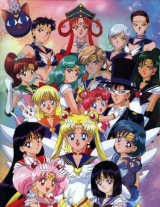
is the title of a Japanese media franchise created by Naoko Takeuchi. It is generally credited with popularizing the concept of a sentai (team) of magical girls, as well as "revitalizing" the magical girl genre itself.
The story of the various metaseries revolves around the reincarnated defenders of a kingdom that once spanned the solar system, and around the evil forces that they battle. The major characters—called Sailor Senshi (literally "Sailor Soldiers"; frequently called "Sailor Scouts" in the North American version)—are teenage girls who can transform into heroines named for the moon and planets (Sailor Moon, Sailor Mercury, Sailor Mars, etc).

Discussion
Ask a question about 'Sailor Moon'
Start a new discussion about 'Sailor Moon'
Answer questions from other users
|
Quotations
Both: We shall punish you!=Sailor Stars (fifth series)=== Sailor Uranus From now on, you want to protect her...
Molly: Although we could use him as a backup dancer...
Molly: I knew that would get rid of him!
---------------------------------------------
Sailor Chibi Moon: The pretty sailor suited soldiers
Sailor Moon: Again, my important friends are gone! In the end, nobody could protect anything!
Sailor Moon: No, I haven't. I love this world. Sailor Moon's ribbons fade leaving her nude with the Silver Crystal embedded in her chest

Encyclopedia
is the title of a Japanese media franchise created by Naoko Takeuchi. It is generally credited with popularizing the concept of a sentai (team) of magical girls, as well as "revitalizing" the magical girl genre itself.
The story of the various metaseries revolves around the reincarnated defenders of a kingdom that once spanned the solar system, and around the evil forces that they battle. The major characters—called Sailor Senshi (literally "Sailor Soldiers"; frequently called "Sailor Scouts" in the North American version)—are teenage girls who can transform into heroines named for the moon and planets (Sailor Moon, Sailor Mercury, Sailor Mars, etc). The use of "Sailor" comes from a style of girls' school uniform popular in Japan, the sera fuku (sailor outfit), after which the Senshi's uniforms are modeled. The elements of fantasy in the series are heavily symbolic and often based on mythology.
The Sailor Moon manga was preceded by Codename: Sailor V, which centered around just one Sailor Senshi. Takeuchi devised the idea when she wanted to create a cute series about girls in outer space, and her editor asked her to put them in sailor fuku. When Sailor V was proposed for adaptation into an anime, the concept was modified so that Sailor V herself became only one member of a team. The resulting manga series was a fusion of the popular magical girl and sentai genres of which Takeuchi was a fan, making Sailor Moon one of the first series ever to combine the two.
The manga resulted in spinoffs into other types of media, including a highly popular anime, as well as musical theatre productions, video games, and a live-action (tokusatsu) series. Although most concepts in the many versions overlap, often notable differences occur, and thus continuity between the different formats is limited.
Story
The protagonist of Sailor Moon, Usagi Tsukino, lives as an ordinary middle school girl until she is found by a talking cat named Luna. Through Luna, Usagi learns that the world is about to be attacked by a Dark Kingdom that had appeared once before, long ago, and destroyed the kingdom of the moon. Her dormant powers are then awakened to defend the Earth against the coming onslaught, and she is led to a number of friends who join her in the battle.
Usagi fights using the identity of Sailor Moon, and as the story progresses she learns more and more about the enemies which face her and the evil force that is sending them. Gradually she discovers the truth about her own past life, her destined true love, and the possibilities for the future of the Solar System.
The plot spans five major story arcs, each of them represented in both the manga and anime, usually under different names:
- the Dark Kingdom arc
- the Black Moon arc (Sailor Moon R)
- the Infinity arc (Sailor Moon S)
- the Dream arc (Sailor Moon Supers)
- the Stars arc (Sailor Stars)
The anime added an additional minor arc at the start of the second series, and spent the first few episodes of Sailor Stars wrapping up the plot from the previous series.
Characters
- The main character of the series, called Serena in the English anime (nicknamed Bunny in the English manga). Usagi, a carefree schoolgirl with an enormous capacity for love, transforms into the heroine called Sailor Moon. At the beginning of the series she is portrayed as an immature crybaby who hates having to fight evil and wants nothing more than to be a normal girl. As she progresses, however, she embraces the chance to use her power to protect those she cares about.
- A student somewhat older than Usagi, called Darien in the English adaptations of the series. As a young child he experienced a terrible car accident that robbed him of his parents and of his knowledge of who he is. During the series he has some precognitive ability, including dreams that inspire him to take on the guise of Tuxedo Mask and fight alongside the Sailor Senshi. After an initially confrontational relationship, he and Usagi remember their past lives together and fall in love again.
- A quiet bookworm in Usagi's class, called Amy in the English adaptations of the series. Highly intelligent, with a rumored IQ of 300,she can transform into Sailor Mercury, acquiring power over all phases of water. Ami's shy exterior masks a passion for knowledge and for taking care of the people around her. She hopes to become a doctor one day, like her mother, and tends to be the practical one in the group. Secretly, she is also a fan of pop culture and romance novels, and becomes embarrassed whenever this is pointed out.
- An elegant miko (shrine maiden), called Raye in the English versions. Because of her work as a Shinto priestess, Rei can sense and dispel evil even in civilian form. When she transforms into Sailor Mars she can also manipulate fire. She is very serious and focused, but although easily annoyed by Usagi's flightiness, cares about her very much. Rei is portrayed as boy-crazy in the early anime, but is uninterested in romance in both the manga and live-action series. She attends a private Catholic school, separate from the other girls.
- A tomboy who transfers into Usagi's school, called Lita in the English versions. Very tall and strong for a Japanese schoolgirl, she can transform into Sailor Jupiter, attacking with lightning and with some control over plants. Both Makoto's parents died in a plane crash years ago, so she lives alone and takes care of herself. She cultivates her physical strength as well as more domestic interests, including housekeeping, cooking, and gardening. She wants to marry young and to own a flower-and-cake shop.
- A perky dreamer who acted on her own as Sailor V for some time. Called Mina in the English versions, she has a companion cat called Artemis who works alongside Luna in guiding the Sailor Senshi. Minako transforms into Sailor Venus, Soldier of Love, and leads Sailor Moon's four inner guardians. She also dreams of becoming a famous singer and idol and attends auditions whenever she can. At the start of the live-action series, she is already these things, but has poor health and separates herself from the other Senshi.
- The future daughter of Usagi and Mamoru, Chibiusa travels from the 30th century to seek help to save her parents, then later to train with Sailor Moon to become a soldier. She learns to transform into Sailor Chibi Moon. At times she has an adversarial relationship with her mother in the 20th century, as she considers herself more mature than Usagi, but as the series progresses they develop a deep bond. Chibiusa wants to grow up to become a lady like her mother. In the English adaptations, she is called Rini, and her alter ego is called Sailor Mini Moon.
- A mysterious woman, called Trista in the English anime. She appears first as Sailor Pluto, the Guardian of Time, who has the task of protecting the Space-Time Door from unauthorized travelers. It is only later that she appears on Earth, living as a college student. She has a distant personality and can be very stern, but can also be quite friendly and helps the younger Sailor Senshi when she can. After so long at the gate of time she carries a deep sense of loneliness, although she is close friends with Chibiusa.
- A talented violinist with some precognition, called Michelle in the English anime. A year older than most of the other Sailor Senshi, she can transform into Sailor Neptune, channeling the power of the ocean. She worked alone for some time before finding her partner, Sailor Uranus, with whom she fell in love. Michiru is elegant and personable, already well-known for her music as well as her painting, but has given up her own dreams for the life of a Senshi. She is fully devoted to this duty and willing to make any sacrifice for it.
- A good-natured, masculine-acting girl, called Amara in the English anime. Haruka, of an age with her partner, Michiru, transforms into Sailor Uranus, Soldier of the Sky. Before becoming a Sailor Senshi, she dreamt of being a racer, and is skilled at driving. She tends to dress and, in the anime, speak like a man. She is so friendly and genial that nearly everyone she meets is attracted to her. When it comes to fighting the enemy, however, she distrusts outside help and prefers to work solely with Sailor Neptune and, later, Pluto and Saturn.
- A sweet, lonely young girl whose name remains unchanged in English (though pronounced slightly differently). Daughter of a possessed mad scientist, she is sickly and weak as the result of a terrible lab accident in her youth. After overcoming the darkness that has surrounded her family, she is able to become the Soldier of Silence, Sailor Saturn. She wields forces of destruction so powerful that she is rarely called upon to use them, and unlike the others, her Senshi and civilian personae seem somewhat disconnected. She is often pensive, and as a human has the inexplicable power to heal others.
Adaptations
Manga The Sailor Moon series began as a manga written and drawn by Takeuchi, the series' creator. It evolved from her earlier Codename: Sailor V idea, expanding the concept into a team of five girls rather than just one. Recurring motifs include astronomy, astrology, Greek myth, Roman myth, geology, Japanese elemental themes, teen fashions, and schoolgirl antics.
Talks between Takeuchi and her publishers originally envisaged only one story arc, and the storyline developed in meetings a year prior to publications, but after it was completed Takeuchi was asked to continue. Four more story arcs were produced, often being published simultaneously with the five corresponding anime series. The anime series would only lag the manga by a month or two.
The complete original manga spans 52 chapters, known as Acts, as well as ten separate side-stories. Its main series appeared in serial form in Nakayoshi, Kodansha's shojo manga magazine, from 1991 to 1995; the side-stories were serialized in Kodansha's Run Run. All chapters and side stories have been published in book form by Kodansha. The first edition came out as the series was being produced, from 1992 through 1997, and consisted of 18 volumes with all the chapters and side stories in the order in which they had been released.
The second edition, called the shinsoban or "renewal" edition, began in 2003 during the run of the live-action series. The individual chapters were redistributed so that there are more per book, and some corrections and updates were made to the dialogue and drawings. New art was featured as well, including completely new cover art and character sketches (including characters unique to the live-action series). In all, the new edition consists of 12 story volumes and two separate short story volumes.
By the end of 1995, the thirteen Sailor Moon volumes then available had sold about one million copies each, and Japan had exported the manga to over 23 countries, including China, Mexico, Australia, most of Europe and North America.
A special artbook was released for each of the five story arcs, collectively called the Original Picture Collection, which contain cover art, promotional material, and other work done by Takeuchi. Many of the drawings appear accompanied by comments on how she developed her ideas, how she created each picture, whether or not she likes it, and commentary on the anime interpretation of her story.
Two additional books appeared later: Original Picture Collection Volume Infinity, released in 1997 after the end of the series, is a self-published artbook including drawings by Takeuchi as well as her friends, her staff, and many of the voice-actors who worked on the anime. In 1999, the Materials Collection was published, containing development sketches and notes for nearly every character in the manga, as well as some who never appeared. Each drawing is surrounded with notes by Takeuchi about the specifics of various costume pieces, the mentality of the character, or even her particular feelings about them. It also includes timelines for the story arcs and for the real-life release of products and materials relating to the anime and manga. At the end, the Parallel Sailor Moon short story is featured, celebrating the year of the rabbit.
Anime The Sailor Moon anime, co-produced by TV Asahi, Toei Agency and Toei Animation, started airing only a month after the first issue of the manga was published. With 200 episodes airing from March 1992 to February 1997 on TV Asahi, Sailor Moon is one of the longest magical girl anime series. The anime sparked a highly successful merchandising campaign of over 5000 items, which contributed to demand all over the world and translation into numerous languages. Sailor Moon has since become one of the most famous anime properties in the world.
Strictly speaking, Sailor Moon represents an anime metaseries. It consists of five separate series averaging around 40 episodes each, often referred to as seasons by anglophone fans because of the over-arching storyline. Each series roughly corresponds to one of the five major story arcs of the manga, following the same general storyline and including most of the same characters. There were also five special animated shorts, as well as three theatrically-released movies: Sailor Moon R: The Movie, Sailor Moon S: The Movie, and Sailor Moon Supers: The Movie.
The anime series uses traditional animation techniques throughout. The series was directed first by Junichi Sato, then by Kunihiko Ikuhara and later by Takuya Igarashi. Character design was headed by Kazuko Tadano, Ikuko Itoh and Katsumi Tamegai, all of whom were also animation directors. Other animation directors included Masahiro Ando, Hisashi Kagawa, and Hideyuki Motohashi.
The series sold as twenty "volumes" in Japan, and by the end of 1995, each volume had sales of about 300,000.
Music
Numerous people wrote and composed music for the Sailor Moon metaseries, with frequent lyrical contributions by creator Naoko Takeuchi. All of the background musical scores, including the spinoffs, games, and movies, were composed and arranged by Takanori Arisawa, who earned the "Golden Disk Grand Prize" from Columbia Records for his work on the first series soundtrack in 1993. In 1998, 2000, and 2001 he won the JASRAC International Award for most international royalties, owing largely to the popularity of Sailor Moon music in other nations.
Most of the TV series used for an opening theme , composed by Tetsuya Komoro with lyrics by Kanako Oda. It was one of the series' most popular songs. "Moonlight Densetsu" was performed by DALI as the opener for the first two anime series, and then by Moon Lips for the third and fourth. The final series, Sailor Stars, switched to using "Sailor Star Song" for its opening theme, written by Shoki Araki with lyrics by Naoko Takeuchi and performed by Kae Hanazawa. "Moonlight Densetsu" made its final appearance as the closing song for the very last episode, #200. "Moonlight Densetsu" has been covered and remixed many times by artists such as the punk supergroup Osaka Popstar.
The English-language dub of the anime series used the melody of "Moonlight Densetsu", but with very different lyrics and instrumentation. At the time, it was unusual for anime theme songs to be translated, and this was one of the first such themes to be redone in English since Speed Racer. The English theme has been described as "inane but catchy". The Japanese theme is a love song based on the relationship between Usagi and Mamoru ("born on the same Earth"); its first verse, translated into English, is as follows:
- I'm sorry, I'm not gentle
- I can say it in my dreams
- My thoughts are about to short circuit
- I want to be with you right now
The English "Sailor Moon Theme" rather resembles a superhero anthem. Its first verse is written:
- Fighting evil by moonlight,
- Winning love by daylight,
- Never running from a real fight,
- She is the one named Sailor Moon
Both versions of the series also make use of insert themes, battle music, and image songs, with the original being much more prolific. Over 40 Japanese music albums were released for the anime alone, many of which were remixes of the previous albums in jazz style, music box, French, etc. In addition, 33 different CD singles were released, many of them centered around specific characters. The second most prolific country in terms of Sailor Moon music releases was Germany, which produced some fifteen albums and singles, including five by the pop band Super Moonies. In North America, only three albums were ever released.
"Moonlight Densetsu" won first place in the Song category in Animage's 15th and 16th Anime Grand Prix. It came seventh in the 17th Grand Prix, and "Moon Revenge", a song from Sailor Moon R: The Movie, came eighth. "Rashiku Ikimasho", the second closing song for Supers, placed eighteenth in 1996. In 1997, "Sailor Star Song", the new opening theme for Sailor Stars, came eleventh, and "Moonlight Densetsu" came sixteenth.
Stage musicals
The musical stage shows, usually referred to collectively as SeraMyu, were a series of live theatre productions that played over 800 performances in some 29 musicals between 1993 and 2005. The stories of the shows include anime-inspired plotlines as well as a large amount of original material. Music from the series has been released on about 20 "memorial" albums.
Musicals ran twice a year, in the winter and in the summer. In the summer, the musicals showed only in the Sunshine Theatre in the Ikebukuro area of Tokyo; however, in the winter they went on tour to the other large cities in Japan.
The final incarnation of the series, , went on stage in January 2005. After that show, the series went on a hiatus.
Live-action series The Tokyo Broadcasting System screened a tokusatsu (live-action) version of Sailor Moon from October 4, 2003 through September 25, 2004. The series is known officially as Pretty Guardian Sailor Moon (usually abbreviated to PGSM by fans), and it is the first series in the franchise to have a complete English-language title. It lasted a total of 49 episodes. Numerous other television stations in Japan retransmitted the series.
The series' storyline more closely follows the original manga than the anime at first, but in later episodes it proceeds into a significantly different storyline from either, with original characters and new plot developments.
In addition to the main episodes, two direct-to-video releases appeared after the show ended its television broadcast. These were the "Special Act", which is set four years after the main storyline ends and which shows the wedding of the two main characters, and "Act Zero", a prequel which shows the origins of Sailor V and Tuxedo Mask.
Video games Numerous Sailor Moon console and arcade games have appeared in Japan, all based on the anime series. Bandai and a Japanese game company called Angel made most of them, with some produced by Banpresto. The early games were side-scrolling fighters, whereas the later ones were unique puzzle games, or versus fighting games. Another Story was a turn-based role-playing game.
The only original Sailor Moon game released outside of Japan was the Bishojo Senshi Sailor Moon game developed by Angel, released in France as "Sailormoon" in 1994. The other games are hard to find in any other country, unless downloaded from the internet as ROMs, some of which have been translated into languages other than Japanese.
A handful of games were produced} in North America, including "The 3D Adventures of Sailor Moon".
English adaptations The English adaptation of Sailor Moon attempted to capitalize on the success of Mighty Morphin Power Rangers. After a bidding-war between Toon Makers, who wanted to produce a half live-action and half American-style cartoon version,
and DiC Entertainment, DiC — then owned by The Walt Disney Company
— acquired the rights to the first two seasons of Sailor Moon, from which they cut six episodes and merged two. Editors cut each of the remaining episodes by several minutes to make room for more commercials, to censor plot points or visuals deemed inappropriate for children, and to allow the insertion of "educational" segments called "Sailor Says" at the end of each episode.
The English adaptations by Optimum Productions for Cloverway of Sailor Moon S and Sailor Moon Supers (the third and fourth series) stayed relatively close to the original Japanese versions, without skipping or merging any episodes. Some controversial changes were made, however, such as the depiction of Sailors Uranus and Neptune as cousins rather than lovers.
The fifth and final series, Sailor Stars, has never been licensed for adaptation into English. , the rest of the metaseries has officially gone off the air in all English-speaking countries due to lapsed and unrenewed licenses.
The manga publisher Mixx (subsequently renamed Tokyopop) translated the Sailor Moon manga into English in 1997. The manga was initially syndicated in MixxZine but was later pulled out of that magazine and moved into a secondary magazine called "SMILE." The US comic was released as three series: Sailor Moon, which collects the first three arcs (the Dark Kingdom, Black Moon, and Infinity arcs), Sailor Moon Super S, which collects the Supers arc, and Sailor Moon Stars, which collects the Sailor Stars arc. They feature all of the content from the original manga collections (though the names of characters introduced in the first two story arcs were changed to those used in the English anime), as well as the occasional new sketch and "thank you" commentary from the series' creator.
, Tokyopop's license to the Sailor Moon manga has lapsed, and the English-language manga has gone out of print.
Reception
Originally planned to run for only six months, the Sailor Moon anime repeatedly continued due to its popularity, concluding only after a five-year run. In Japan, it aired every Saturday night in prime time, getting TV viewership ratings around 11-12% for most of the series run. The media franchise is one of the most successful Japan has ever had, reaching 1.5 billion dollars in merchandise sales during the first three years. Ten years after the series completion, the series has featured among the top thirty of TV Asahis Top 100 Anime polls in 2005 and 2006. The anime series won the Animage Anime Grand Prix prize in 1993.
Sailor Moon has also been popular internationally. The first dubbed version was made in France, premiering on Club Dorothée in December 1993. Other countries followed suit, including South Korea, Italy, Spain, Peru, Sweden and China (Hong Kong), before it was picked up for a North American adaptation. It is credited as being the beginning of a wider movement of girls taking up shojo manga. Gilles Poitras defines a "generation" of anime fans as those who were introduced to anime by Sailor Moon in the 1990s, noting that they were both much younger than the other fans and also mostly girls. Poitras credits Sailor Moon as laying the ground for other shojo series such as Fushigi Yuugi, Vision of Escaflowne and Revolutionary Girl Utena. In 2001, the Sailor Moon manga was Tokyopop's best selling property, outselling the next-best selling titles by at least a factor of 1.5.
The anime series has been commended for its portrayal of strong friendships, as well as for "memorable characters", "charm", and an ability to appeal to a wide audience. It is credited with changing the genre of magical girls—its heroine must use her powers to fight evil, not simply to have fun as previous magical girls had done.
According to Martha Cornog and Timothy Perper, Sailor Moon became popular because of its "strongly-plotted action with fight scenes, rescues" and its "emphasis on feelings and relationships", including some "sexy romance" between Usagi and Mamoru. In contrast, Sailor Moon is also sometimes considered campy and melodramatic, and has been criticised for its use of formulaic plots, monsters of the day, and stock footage.
In the West, people sometimes associated Sailor Moon with the Girl Power movement and with empowering its viewers. As such, it has been compared both favorably and unfavorably with Barbie, Mighty Morphin Power Rangers, Buffy the Vampire Slayer, and Sabrina, the Teenage Witch.
Drazen notes that Sailor Moon has two kinds of villains, the Monster of the Day and the "thinking, feeling, humans". Although this is common in anime and manga, it is "almost unheard of in the West". Despite the series' apparent popularity among Western anime fandom, the dubbed version of the series received poor ratings in the United States and did not do well in DVD sales in the United Kingdom. Anne Allison attributes the lack of popularity in the United States primarily to poor marketing (in the United States, the series was initially broadcast at times which did not suit the target audience - weekdays at 9:00 a.m. and 2:00 pm). Executives connected with Sailor Moon suggest that poor localization played a role. Helen McCarthy and Jonathan Clements go further, calling the dub "indifferent", and suggesting that Sailor Moon was put in "dead" timeslots due to local interests. The British distributor, MVM Films, has attributed the poor sales to the United Kingdom release being of the dub only, and that major retailers refused to support the show leading to the DVD release appealing to neither children nor older anime fans.
In English-speaking countries, Sailor Moon developed a cult following amongst male university students, and Drazen considers that the Internet was a new medium that fans used to communicate and played a role in the popularity of Sailor Moon. NEO magazine suggested that part of Sailor Moons allure was that fans communicated about the differences between the dub and the original version. In a United States study, children paid rapt attention to the fighting scenes in Sailor Moon, although when questioned if Sailor Moon was "violent" only two would say yes, the other ten preferring to describe the episodes as "soft" or "cute".
The manga won the Kodansha Manga Award in 1993 for shojo. Sales of Sailor Moon's fashion dolls overtook that of Licca-chan in the 1990s; Mattel suggested that this was due to the "fashion-action" blend of the Sailor Moon storyline. Doll accessories included both fashion items and the Senshi's weapons.
Although both the manga and the anime were released in Mexico, pressure from a Catholic parents' group led to both being taken off the market. Due to Japan–Korea relations, Japanese media was banned for many years in Korea. A Korean TV station producer "did not even try to buy" Sailor Moon because he thought it would not pass the censorship laws, but as of May 1997, Sailor Moon was airing on the national broadcaster without issues and was "enormously" popular.
External links
|