
Home      Discussion      Topics      Dictionary      Almanac
Signup       Login
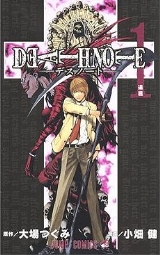
Death Note

Death Note

Overview
is a Japanese manga
Manga
Manga consist of comics and print cartoons , in the Japanese language and conforming to the style developed in Japan in the late 20th century...

 series created by writer Tsugumi Ohba
Tsugumi Ohba
Born in Tokyo, is a writer best known for the manga Death Note. Ohba's real identity is a closely guarded secret. Some fans believe that Tsugumi Ohba is just a pen-name for Hiroshi Gamō...

 and manga artist Takeshi Obata
Takeshi Obata
is a Japanese mangaka. He generally works as the artist in collaboration with a writer. He has also mentored several mangaka, including Kentaro Yabuki of Black Cat fame, Nobuhiro Watsuki of Rurouni Kenshin and Busou Renkin, and Yusuke Murata of Eyeshield 21.He originally became noticed in 1985 when...

. The series centers on Light Yagami
Light Yagami
, also known as and the second L, is the protagonist of the manga and anime series Death Note. He is an extremely intelligent, athletic, popular, but bored, young man who finds the Death Note dropped by the Shinigami Ryuk by sheer chance...

, a university student who discovers a supernatural
Supernatural
The term supernatural or supranatural pertains to an order of existence beyond the scientifically visible universe. Religious miracles are typically supernatural claims, as are spells and curses, divination, the belief that there is an afterlife for the dead, and innumerable others...

 notebook
Notebook
A notebook is a book, made of paper or computer based, of which various uses can be made, including writing, drawing, and scrapbooking.-Paper Notebooks:...

, the "Death Note", dropped on Earth by a shinigami
Shinigami
is the personification of death that evolved in Japan, having been imported to Japan from Europe during the Meiji period. This image of death was quickly adopted and featured in such works as the rakugo play Shinigami and in Shunsen Takehara's Ehon Hyaku Monogatari .The term shinigami may also be...

(death god) named Ryuk. The Death Note grants its user the ability to kill anyone whose face they have seen, by writing the victim's name in the notebook. The story follows Light's attempt to create and rule a world cleansed of evil using the notebook, and the complex conflict between him, his opponents and a mysterious detective known to the world only as L
L (Death Note)
, commonly referred to by his alias , is the deuteragonist in the manga, anime and film series Death Note by Tsugumi Ohba, and as an enemy of the villainous protagonist Light Yagami. L is considered the world's greatest detective, whose identity remains unknown before the story takes place because...

.

Death Note was first serialized in 108 chapters by Shueisha
Shueisha
is a major publisher in Japan. The company was founded in 1925 as the entertainment-related publishing division of Japanese publisher Shogakukan. The following year Shueisha became a separate, independent company. Magazines published by Shueisha include Weekly Shōnen Jump, Weekly Young Jump,...

 in the Japanese manga magazine Weekly Shōnen Jump
Weekly Shonen Jump
is a weekly shōnen manga anthology published in Japan by Shueisha under the Jump line of magazines. The first issue was released with a cover date of July 2, 1968, and it is still circulating. One of the longest-running manga magazines in Japan, it has a circulation of 2.7 million readers...

from December 2003 to May 2006.
Discussion
Ask a question about 'Death Note'
Start a new discussion about 'Death Note'
Answer questions from other users
Full Discussion Forum
 
Quotations

He was someone who deserved to die.

I'm going to change the world.

I... am... justice.

Those who oppose that god, they are the ones who are truly evil!

Wow, this is the first time ever since my birth that I want to hit a girl.

I will erase him.

L, do you know gods of death love apples?

The real battle starts now.

She has to be eliminated.

That's right … I am Kira.

Encyclopedia
is a Japanese manga
Manga
Manga consist of comics and print cartoons , in the Japanese language and conforming to the style developed in Japan in the late 20th century...

 series created by writer Tsugumi Ohba
Tsugumi Ohba
Born in Tokyo, is a writer best known for the manga Death Note. Ohba's real identity is a closely guarded secret. Some fans believe that Tsugumi Ohba is just a pen-name for Hiroshi Gamō...

 and manga artist Takeshi Obata
Takeshi Obata
is a Japanese mangaka. He generally works as the artist in collaboration with a writer. He has also mentored several mangaka, including Kentaro Yabuki of Black Cat fame, Nobuhiro Watsuki of Rurouni Kenshin and Busou Renkin, and Yusuke Murata of Eyeshield 21.He originally became noticed in 1985 when...

. The series centers on Light Yagami
Light Yagami
, also known as and the second L, is the protagonist of the manga and anime series Death Note. He is an extremely intelligent, athletic, popular, but bored, young man who finds the Death Note dropped by the Shinigami Ryuk by sheer chance...

, a university student who discovers a supernatural
Supernatural
The term supernatural or supranatural pertains to an order of existence beyond the scientifically visible universe. Religious miracles are typically supernatural claims, as are spells and curses, divination, the belief that there is an afterlife for the dead, and innumerable others...

 notebook
Notebook
A notebook is a book, made of paper or computer based, of which various uses can be made, including writing, drawing, and scrapbooking.-Paper Notebooks:...

, the "Death Note", dropped on Earth by a shinigami
Shinigami
is the personification of death that evolved in Japan, having been imported to Japan from Europe during the Meiji period. This image of death was quickly adopted and featured in such works as the rakugo play Shinigami and in Shunsen Takehara's Ehon Hyaku Monogatari .The term shinigami may also be...

(death god) named Ryuk. The Death Note grants its user the ability to kill anyone whose face they have seen, by writing the victim's name in the notebook. The story follows Light's attempt to create and rule a world cleansed of evil using the notebook, and the complex conflict between him, his opponents and a mysterious detective known to the world only as L
L (Death Note)
, commonly referred to by his alias , is the deuteragonist in the manga, anime and film series Death Note by Tsugumi Ohba, and as an enemy of the villainous protagonist Light Yagami. L is considered the world's greatest detective, whose identity remains unknown before the story takes place because...

.

Death Note was first serialized in 108 chapters by Shueisha
Shueisha
is a major publisher in Japan. The company was founded in 1925 as the entertainment-related publishing division of Japanese publisher Shogakukan. The following year Shueisha became a separate, independent company. Magazines published by Shueisha include Weekly Shōnen Jump, Weekly Young Jump,...

 in the Japanese manga magazine Weekly Shōnen Jump
Weekly Shonen Jump
is a weekly shōnen manga anthology published in Japan by Shueisha under the Jump line of magazines. The first issue was released with a cover date of July 2, 1968, and it is still circulating. One of the longest-running manga magazines in Japan, it has a circulation of 2.7 million readers...

from December 2003 to May 2006. The series was also published in tankōbon
Tankobon
, with a literal meaning close to "independently appearing book", is the Japanese term for a book that is complete in itself and is not part of a series, though the manga industry uses it for volumes which may be in a series...

format in Japan starting in May 2004 and ending in October 2006 with a total of twelve volumes. The series was adapted into live-action films released in Japan on June 17, 2006, on November 3, 2006, and on February 2, 2008. The anime
Anime
is animation originating in Japan. The world outside Japan regards anime as "Japanese animation". Anime originated about 1917.Anime, like manga , has a large audience in Japan and high recognition throughout the world...

 series aired in Japan from October 3, 2006, to June 26, 2007. Composed of 37 episodes, the anime was developed by Madhouse
Madhouse (company)
is a Japanese animation studio, founded in 1972 by ex–Mushi Pro animators including Masao Maruyama, Osamu Dezaki, Rintaro, and Yoshiaki Kawajiri. It has created and helped to produce many well known shows, starting with TV anime series Ace o Nerae! in 1973, and including western favourites Ninja...

 and directed by Tetsuro Araki
Tetsuro Araki
is a Japanese anime director. He was born in Sayama City, Saitama Prefecture, Japan.Araki is a graduate at Senshu University and works with Madhouse. His directorial debut was 2005's Otogi-Jūshi Akazukin. He is best known as the director of the Death Note anime adaptation...

. A light novel
Light novel
A is a novel primarily targeting teenagers and young adults. The term "light novel" is a wasei-eigo, or a Japanese term formed from words in the English language. Light novels are often called or for short...

 based on the series, written by Nisio Isin
Nisio Isin
, frequently written as NisiOisiN to emphasize that his pen name is a palindrome, is a Japanese novelist and manga writer. He attended and left Ritsumeikan University without graduating. In 2002, he debuted with the novel , which earned him the 23rd Mephisto Award at twenty years of age....

, was released in Japan. Additionally, various video games have been published by Konami
Konami
is a Japanese leading developer and publisher of numerous popular and strong-selling toys, trading cards, anime, tokusatsu, slot machines, arcade cabinets and video games...

 for Nintendo DS
Nintendo DS
The is a dual-screen handheld game console developed and manufactured by Nintendo. It was released in 2004 in Canada, the United States, and Japan. The console features a clamshell design, similar to the Game Boy Advance SP, with two LCD screens inside—with the bottom one being a touchscreen...

.

Viz Media
VIZ Media
Viz Media, LLC, headquartered in San Francisco, California, United States, is an anime, manga and Japanese entertainment company founded in 1986 as Viz, LLC. In 2005, the Viz, LLC...

 licensed the Death Note manga in North America and has published all the twelve volumes from the series as well as the light novel. The episodes from the anime first appeared in North America as downloadable by IGN
IGN
IGN is a multimedia news and reviews website that focuses heavily on video games...

. Viz later licensed the anime series and it aired on Bionix
Bionix
Bionix is a late night anime program block on the Canadian television channel YTV. It currently airs Saturday nights/early Sunday morning from 12:00 am to 2:00 am, beginning on September 13, 2009.-History:...

. The live-actions briefly played in certain North American theaters since 2008. However, none of the video games titles have thus far been published in North America.

Several publications for manga, anime and other media have added praise and criticism on the Death Note series. The plot and violence from the story have been praised, noting it to be very entertaining. However, the series was banned in China due to various problems people had with children altering their notebooks to resemble the Death Note.

Plot


Light Yagami
Light Yagami
, also known as and the second L, is the protagonist of the manga and anime series Death Note. He is an extremely intelligent, athletic, popular, but bored, young man who finds the Death Note dropped by the Shinigami Ryuk by sheer chance...

 is an extremely intelligent young man who resents what appears to be a relentless increase of crime and corruption in the world around him. His life undergoes a drastic change when he discovers a mysterious notebook, known as the "Death Note," lying on the ground. The Death Note's instructions claim that if a human's name is written within it, that person shall die. Light is initially skeptical of the notebook's authenticity, but after experimenting with it, he realizes that the Death Note is real. After meeting with the previous owner of the Death Note, a shinigami
Shinigami (Death Note)
In the manga and anime series Death Note, are a race of extra-dimensional beings who survive by killing humans to extend their own lives. Shinigami in this series are not responsible for every death that occurs; people will eventually die regardless of whether or not the Shinigami pay attention to...

named Ryuk, Light seeks to become "the God of the New World" by passing his keen judgment on those he deems to be evil or who get in his way.

Soon, the number of inexplicable deaths of reported criminals catches the attention of the International Police Organization
Interpol
Interpol, whose full name is the International Criminal Police Organization – INTERPOL, is an organization facilitating international police cooperation...

 and a mysterious detective known only as "L
L (Death Note)
, commonly referred to by his alias , is the deuteragonist in the manga, anime and film series Death Note by Tsugumi Ohba, and as an enemy of the villainous protagonist Light Yagami. L is considered the world's greatest detective, whose identity remains unknown before the story takes place because...

". L quickly learns that the serial killer, dubbed by the public as , is located in Japan. He also concludes that Kira can kill people without laying a finger on them. Light realizes that L will be his greatest nemesis, and a game of psychological cat and mouse between the two begins.

Misa Amane
Misa Amane
is a fictional character in the Death Note anime, manga, and film series.-Conception and development:Tsugumi Ohba, writer of Death Note, decided to create Misa to be the second Kira before the serialization began...

, another Death Note owner, finds Light. Obsessed by Kira after the death of her parents' murderer, she devotes herself to helping Light, but is captured by L. Light makes a plan involving renouncing ownership of both Death Notes, and all of his memories of them, and turns himself in to L for surveillance. Together, Light and L investigate eight people from the company "Yotsuba" who are using Light's Death Note for their own profit. While arresting them, Light recovers all his memories when he touches the Death Note. He remembers and continues his plan of compelling the former owner of Misa's Death Note, the shinigami Rem, into killing L and his aide Watari.

After L's death, Light is given the position of the "new L" by the Japanese Task Force. Four years later, Near and Mello - two children who were raised to be successors to L - appear, with the goal of finding Kira. In the meantime, Kira has gained much public support, and has contacts. Mello, one of L's successors, kidnaps the Sayu Yagami, Light's little sister as a bargaining chip to get the Death Note. The Japanese Task Force plan to go to Los Angeles to rescue Sayu but end up losing the Notebook. The task force later attempts to retrieve it and succeeds in doing so; but, as a result of an explosive that Mello uses to cover his escape, Soichiro Yagami, Light's father, dies.

Near begins to suspect the second L of being Kira thus causing some members of the Japanese task force to also openly suspect him. Realizing the risk of being caught, Light has Misa give up ownership of her Death Note. He then finds his next successor, Teru Mikami, a strong, almost crazed Kira supporter. Mikami later recruits a new spokesman for Kira, Kiyomi Takada, a newscaster and one of Light's former college girlfriends. Teru Mikami and Kiyomi Takada continue killing criminals while Light is unable to do so himself. Kiyomi is later kidnapped by Mello and is forced to kill him with a hidden piece of the Death Note. Light kills Kiyomi to avoid her implicating him after she uses the note to kill Mello. In a final confrontation between Light and Near, the latter reveals that the former is Kira. Light's name is then written in a Death Note by Ryuk, as he stated he would at the beginning of the series. Light suffers a heart attack
Myocardial infarction
Myocardial infarction or acute myocardial infarction , commonly known as a heart attack, is the interruption of blood supply to part of the heart, causing some heart cells to die...

 and dies.

Production


The Death Note concept did not derive from any single source but rather a general concept involving Shinigami and "specific rules." Tsugumi Ohba wanted to create a suspense series because he did not feel that he could have created a fight-style series and that the genre had few suspense series. After publication of the pilot chapter the series was not expected to be approved as a serialized comic by the author who did not consider it to "fit with Jump." Ohba said that when he learned that Death Note received approval and that Takeshi Obata would create the artwork he "couldn't even believe it." Due to positive reactions to the series Death Note became a serialized manga series.

"Thumbnails" were created incorporating dialog, panel layout, and basic drawings, and were sent to the illustrator. The editor reviewed the thumbnails and sent them to back to the illustrator (Obata) with the script set in stone and the panel layout "mostly done." Obata then determined the expressions and "camera angles" and created the final artwork. Ohba concentrated on the tempo and the amount of dialogue, making sure that the text was as concise as possible. Ohba commented that he believed "reading too much exposition" would be tiring and would negatively affect the atmosphere and "air of suspense." Significant artistic license was given to the illustrator who worked on basic descriptions, such as "abandoned building", and this extended to the design of the Death Notes with Obata possessing free rein. Obata originally thought of the books as "'Bible
Bible
The Bible contains the central religious texts of Judaism and Christianity. Modern Judaism generally recognizes a single set of canonical books known as the Tanakh, or Hebrew Bible, as it is written almost entirely in the Hebrew language, with some small portions in Aramaic...

-like'...something you would automatically think was a Death Note." He also felt this design would seem "difficult to use" and instead opted for an easy-to-use college notebook. At a later point the concept of Death Notes looking different from one another, depending on the human era (such as Death Notes in ancient Japan looking like scrolls and Death Notes in medieval Europe looking like The Old Testament) was conceived.

When Ohba decided on the plot he internally visualized the panels while being on his bed, drinking tea, or walking around his house, needing to feel relaxed while visualizing the panels. On many occasions the original draft was too long and needed to be refined various times before the desired "tempo" and "flow" for the chapter was finalised. The writer remarked on his preference for reading the previous "two or four" chapters carefully to ensure consistency in the story.

The typical weekly production schedule consisted of five days for creating and thinking and one day using pencil to insert dialogue into rough drafts; after this point the writer faxed any initial drafts to the editor. The illustrator's weekly production schedule involved one day with the thumbnails, layout, and pencils and one day with additional penciling and inking. Obata's assistants usually worked for four days and Obata spent one day to finish it. Obata said that sometimes he took a few extra days to color pages and that this "messed with the schedule." In contrast, the writer took three or four days to create a chapter on some occasions, while on others he took a month. Obata said that his schedule remained consistent except when he had to create color pages.

Ohba and Obata rarely met in person during the creation of the serialized manga; instead the two met with the editor. The first time they met in person was at an editorial party in January 2004. Obata said that, despite the intrigue, he did not ask his editor about Ohba's plot developments as he anticipated the new thumbnails every week. The two did not discuss the final chapters with one another and they continued to talk with the editor. Ohba said that when he asked the editor if Obata had "said anything" about the story and plot the editor responded '"No, nothing" [laughs].'

Ohba claims that the series ended more or less in the manner that he intended for it to end; he considered the idea of L
L (Death Note)
, commonly referred to by his alias , is the deuteragonist in the manga, anime and film series Death Note by Tsugumi Ohba, and as an enemy of the villainous protagonist Light Yagami. L is considered the world's greatest detective, whose identity remains unknown before the story takes place because...

 defeating Light Yagami with Light dying but instead chose to use the "Yellow Box warehouse" ending. According to Ohba the details had been set "from the beginning." The writer wanted an ongoing plot line instead of an episodic series because Death Note was serialized and its focus was intended to be on a cast with a series of events triggered by the Death Note. 13: How to Read states that the humorous aspects of Death Note originated from Ohba's "enjoyment of humorous stories."

Ohba said that he did not have a theme that he wished to express throughout the series but that, had he been required to choose one, it would be that "Humans will all eventually die and never come back to life, so let's give it our all while we're alive." He said that he did not intend for Death Note to push an ideology or make a statement about good and evil, and that Near's statement in Volume 12 about deciding right and wrong is closest to his own personal belief. Ohba also remarked that he understands how debate can form from the story; the answers to the questions raised become "ideological" and he believed this development would be "dangerous" and not "interesting in a manga." This aspect was ultimately omitted from Death Note.

When the writer was asked, during an interview, whether the series was meant to be about enjoying the plot twists and psychological warfare, Ohba responded by saying that this concept was the reason why he was "very happy" to place the story in Weekly Shōnen Jump. He said that because Death Note is aimed at "the young" the reader can "push back ideology" and focus on "pure entertainment." He also said that if the series was aimed at an older audience he would expect "more debate over the issues" and therefore believed the story would have had to develop in that direction. Death Note 13: How to Read states that debate about good and evil "sometimes" appears in the series and that the "answer" to the debate is left for the reader to decide.

Ohba was also asked what he considered the most important thing in Death Note, and he responded by saying, "the human whose name is written in this note shall die"; in contrast, Obata responded to the same question by answering "impossible to say."

Pilot chapter


The Death Note process began when Ohba brought thumbnails for two concept ideas to Shueisha
Shueisha
is a major publisher in Japan. The company was founded in 1925 as the entertainment-related publishing division of Japanese publisher Shogakukan. The following year Shueisha became a separate, independent company. Magazines published by Shueisha include Weekly Shōnen Jump, Weekly Young Jump,...

; Ohba said that the Death Note pilot, one of the concepts, was "received well" by editors and attained positive reactions by readers. Ohba described keeping the story of the pilot to one chapter as "very difficult" and he said that he remembered it took over a month to begin writing the chapter. He added that the story had to revive the killed characters with the Death Eraser and that he "didn't really care" for that plot device.

Obata said that he wanted to draw the story after he heard of a "horror story featuring Shinigami." According to Obata, when he first received the rough draft created by Ohba, he "didn't really get it" at first and he wanted to work on the project due to the presence of Shinigami and because the work "was dark." He also said he wondered about the progression of the plot as he read the thumbnails, and if Jump readers would enjoy reading the comic. Obata said that while there is little action and the main character "doesn't really drive the plot" he enjoyed the atmosphere of the story. He stated that he drew the pilot chapter so that it would appeal to himself.

Ohba brought the rough draft of the pilot chapter to the editorial department. Obata came into the picture at a later point to create the artwork. They did not meet in person while creating the pilot chapter. Ohba said that the editor told him he did not need to meet with Obata to discuss the pilot; Ohba said "I think it worked out all right."

Adaptation


Tetsuro Araki, the director, said that he wished to convey aspects that "made the series interesting" instead of simply "focusing on morals or the concept of justice." Toshiki Inoue, the series organizer, agreed with Araki and added that, in anime adaptations, there is a lot of importance in highlighting the aspects that are "interesting in the original." He concluded that Light's presence was "the most compelling" aspect; therefore the adaptation chronicles Light's "thoughts and actions as much as possible." Inoue noted that, to best incorporate the manga's plot into the anime, he "tweak[ed] the chronology a bit" and incorporated flashbacks that appear after the openings of the episodes; he said this revealed the desired tensions. Araki said that, because in an anime the viewer cannot "turn back pages" in the manner that a comic reader can, the anime staff ensured that the show clarified details. Inoue added that the staff did not want to get involved with every single detail, so the staff selected elements to emphasize. Due to the complexity of the original manga, he described the process as "definitely delicate and a great challenge." Inoue admitted that he placed more instructions and notes in the script than usual. Araki added that because of the importance of otherwise trivial details, the notes became crucial to the development of the series.

Araki said that when he discovered the Death Note anime project, he "literally begged" to join the production team; when he joined he insisted that Inoue should write the scripts. Inoue added that, because he enjoyed reading the original comic, he wished to use his effort.

Manga


The Death Note manga series was first serialized in the Japanese manga magazine Weekly Shōnen Jump
Weekly Shonen Jump
is a weekly shōnen manga anthology published in Japan by Shueisha under the Jump line of magazines. The first issue was released with a cover date of July 2, 1968, and it is still circulating. One of the longest-running manga magazines in Japan, it has a circulation of 2.7 million readers...

published by Shueisha
Shueisha
is a major publisher in Japan. The company was founded in 1925 as the entertainment-related publishing division of Japanese publisher Shogakukan. The following year Shueisha became a separate, independent company. Magazines published by Shueisha include Weekly Shōnen Jump, Weekly Young Jump,...

 in December 2003. The series has since ended in Japan with a total of 108 chapters. Later, the individual chapters were collected into twelve separate tankōbon. In April from 2005 Death Note was licensed for publication in North America by Viz Media
VIZ Media
Viz Media, LLC, headquartered in San Francisco, California, United States, is an anime, manga and Japanese entertainment company founded in 1986 as Viz, LLC. In 2005, the Viz, LLC...

, and the first English-language
English language
English is a West Germanic language that developed in England during the Anglo-Saxon era. As a result of the military, economic, scientific, political, and cultural influence of the British Empire during the 18th, 19th, and early 20th centuries, and of the United States since the mid 20th century,...

 volume was released on October 10, 2005. In February 2008, a one-shot special was released. Set two years after the manga's epilogue, it sees the introduction of a new Kira and the reactions of the main characters in response to the copycat's appearance. Several Death Note yonkoma
Yonkoma
Yonkoma manga , a comic-strip format, generally consists of gag comic strips within four panels of equal size ordered from top to bottom...

 (four-panel comics) appeared in Akamaru Jump. The yonkoma were written to be humorous. The Akamaru Jump issues that printed the comics include 2004 Spring, 2004 Summer, 2005 Winter, and 2005 Spring. In addition Weekly Shōnen Jump
Weekly Shonen Jump
is a weekly shōnen manga anthology published in Japan by Shueisha under the Jump line of magazines. The first issue was released with a cover date of July 2, 1968, and it is still circulating. One of the longest-running manga magazines in Japan, it has a circulation of 2.7 million readers...

Gag Special 2005 included some Death Note yonkoma in a Jump Heroes Super 4-Panel Competition.

In addition, a guidebook for the manga was also released in October 13, 2006. It was named Death Note 13: How to Read and contained data relating to the series, including character profiles of almost every character that is named, creator interviews, behind the scenes info for the series and the pilot chapter that preceded Death Note. It also reprinted all of the yonkoma serialized in Akamaru Jump and the Weekly Shōnen Jump Gag Special 2005. Its first edition could be purchased with a Death Note themed diorama which includes five finger puppets inspired by Near's toys. The five finger puppets are Kira, L, Misa
Misa Amane
is a fictional character in the Death Note anime, manga, and film series.-Conception and development:Tsugumi Ohba, writer of Death Note, decided to create Misa to be the second Kira before the serialization began...

, Mello
Mello (Death Note)
, whose real name is , is a fictional character in the anime and manga series Death Note.-Character:Mello is the older of L's three potential successors raised in Wammy's House, Watari's orphanage for gifted children, in Winchester, England, United Kingdom...

, and Near
Near (Death Note)
, whose real name is , is a fictional character of the anime and manga series Death Note and in the film L: Change the WorLd. Near is the younger of the two successors of L, and the leader of SPK , an organization that looks into the Kira case and, in the end, succeeds in uncovering Kira's...

. In North America, 13: How to Read was released in February 19, 2008.

Live-action films


Death Note was adapted into a series of live-action films in 2006. The films were directed by Shūsuke Kaneko
Shusuke Kaneko
is a Japanese filmmaker and screenwriter.-Career:Shūsuke Kaneko began his career in film with Nikkatsu's Roman Porno film series, in which he served as assistant director to Kōyū Ohara...

, produced by Nippon Television
Nippon Television
is a television network based in the Shiodome area of Minato, Tokyo, Japan owned by the Yomiuri Shimbun. It is commonly known as , contracted to , and abbreviated as "NTV".-Offices:...

, and distributed by Warner Bros.
Warner Bros.
Warner Bros. Entertainment, Inc. Warner Bros. Entertainment, Inc. Warner Bros. Entertainment, Inc. (also known as Warner Bros. Pictures, or simply Warner Bros.—the shortened form of the former official, sometimes still used, formal corporate name: Warner Brothers
, Pictures Japan. The first film, simply titled Death Note
Death Note (film)
is a series of two live-action Japanese films released in 2006 and based on the Death Note manga and anime series by Tsugumi Ohba and Takeshi Obata. The films primarily center on a university student who decides to rid the world of evil with the help of a supernatural notebook that kills anyone...

, premiered in Japan on June 17, 2006 and topped the Japanese box office
Box office
A box office is a place where tickets are sold to the public for admission to a venue. Patrons may perform the transaction at a countertop, through an unblocked hole through a wall, or at a wicket...

 for two weeks, pushing The Da Vinci Code
The Da Vinci Code (film)
The Da Vinci Code is a 2006 film directed by Ron Howard, which is based on the bestselling 2003 novel The Da Vinci Code by Dan Brown. It was one of the most anticipated films of 2006, and was previewed at the opening night of the Cannes Film Festival on May 17, 2006...

into second place. The first movie briefly played in certain North American theaters on May 20–21, 2008 The film was broadcast in Canadian theaters for one night only on September 15, 2008. The DVD was released on September 16, 2008, one day after the Canadian showing. The sequel, Death Note: The Last Name, premiered in Japan on November 3, 2006. It was featured in U.S. films on October from 2008. A spinoff from the films named L: Change the World
L: Change the WorLd
L: Change the WorLd , directed by Hideo Nakata, is a spin-off film and a sequel to the Death Note film series. The series is based on the manga Death Note by Tsugumi Ohba and illustrated by Takeshi Obata, but follows an original storyline...

was released in Japan on February 9, 2008. It is focused on the final 23 days of L's life, as he solves one final case involving a bio-terrorist group. Two dubbed versions of the film were shown in the United States on April 29 and 30, 2009.

Death Note has been optioned for a live-action Hollywood remake. A 2007 article in The Star
The Star (Malaysia)
The Star is the leading English-language tabloid format newspaper in Malaysia. It is the largest in terms of circulation in Malaysia, according to the Audit Bureau of Circulations. It has a daily circulation of between 290,000 to 300,000...

(Malaysia
Malaysia
Malaysia is a country in Southeast Asia that consists of thirteen states and three Federal Territories, with a total landmass of . The capital city is Kuala Lumpur, while Putrajaya is the seat of the federal government. The population stands at over 28 million inhabitants...

) states that more than ten film companies in the United States expressed interest in creating a remake. Vertigo Entertainment is currently set to develop an American Death Note remake. In April 2009, it was announced that WB had acquired the rights to make a live-action version of the manga, and had hired Charley and Vlas Parlapanides to adapt the script. The new film will be based upon the original manga series rather than the existing live-action films.

Soundtracks


There have been several soundtracks released for this series, such as the ones for the film adaptations and also for the anime adaptation. Sound of Death Note is a soundtrack featuring music from the first Death Note film composed and arranged by Kenji Kawai
Kenji Kawai
Kenji Kawai , born April 23, 1957 in Shinagawa, Tokyo, is a Japanese music composer, for motion pictures, anime movies, videogames and televised programs. He has contributed to the musical scores for numerous films from Japan and other countries in Asia, working in film genres as diverse as anime,...

. It was released on June 17, 2006 by VAP. Sound of Death Note the Last name is the soundtrack from the second Death Note film, Death Note the Last name. It was released on November 2, 2006. Death Note Tribute is a tribute album dedicated to the live action
Live action
In film, theatre and video, live-action refers to works that are acted out by human actors, as opposed to by animation. As it is the norm, the term is usually superfluous, but it makes an important distinction in situations in which one might normally expect animation, as in a Pixar film, a video...

 movie for the Death Note film. Published by BMG Japan on June 21, 2006 Japan, it contains 15 tracks performed by various artists, such as Shikao Suga, M-Flo
M-flo
is a Japanese hip hop group consisting of producer and DJ Taku Takahashi and emcee Verbal. Former member Lisa left the group in 2002 to pursue a solo career.As of 2008, the group have released five studio albums, all of which have been top-ten hits in Japan....

, Buck-Tick
Buck-Tick
Buck-Tick is a Japanese rock band consisting of five members: Atsushi Sakurai on vocals, Hisashi Imai on guitars, backing vocals, noises and theremin, Hidehiko Hoshino on guitars and backing vocals, Yutaka Higuchi on bass, and Yagami Toll on drums. They originally formed in 1984 and have been...

 and Aya Matsuura
Aya Matsuura
is a J-pop artist from Himeji, Hyōgo Prefecture, Japan.- 2001–2009: Hello! Project :Aya auditioned in 2000 for the fourth Morning Musume & Heike Michiyo Protegee Audition and was selected along with Sheki-Dol to become a part of what was later known as Hello! Project. It is a common...

. The soundtrack came with a cosplay
Cosplay
, short for "costume roleplay", is a fan labor type of performance art in which participants don costumes and accessories to represent a specific character or idea. Characters are often drawn from popular fiction in Japan, Taiwan, South Korea, China, and the Philippines. Favorite sources include...

 Death Note notebook. Another tribute album is The Songs for Death Note the movie~the Last name Tribute dedicated to the second film. Published by Sony Music Entertainment Japan
Sony Music Entertainment Japan
is Sony's music arm in Japan. SMEJ is directly owned by Sony Corporation and independent from the United States-based Sony Music Entertainment due to its strength in the Japanese music industry....

 on December 20, 2006, it contains 14 tracks performed by various artist, such as Orange Range
Orange Range
is a 5-member Okinawan alternative rock band, based in Okinawa. Formed in 2001, the band began with Spice Music and later signed with Sony Music Japan's gr8! records division in 2003.-Indies:...

, abingdon boys school
Abingdon boys school
is a Japanese rock bandfronted by Takanori Nishikawa . Formed in 2005, the band was named after Abingdon School, the all-male school where English rock band Radiohead was established.-Members: – vocals is a Japanese rock bandfronted by Takanori Nishikawa (T.M. Revolution). Formed in 2005, the band...

, High and Mighty Color
High and Mighty Color
is a Japanese rock band signed to Sony Music Entertainment Japan.-Formation and Anti-Nobunaga:The band started with a Metallica cover band in their local hometown Okinawa, consisting of members Meg and Sassy, who are native Okinawans. The two founding members played in this band for two years...

, Doping Panda
Doping Panda
Doping Panda is a Japanese rock group. They are part of Sony Music Japan's gr8 records! division, which includes bands such as Orange Range, Uverworld and Boom Boom Satellites. They released their first album "Performation" in 2001, and a second "WE IN MUSIC" in 2004. In 2005, Doping Panda...

 and Galneryus
Galneryus

is a power metal/neoclassical metal band from Osaka, Japan. They were formed in 2001.- History :Galneryus was formed early 2001 by guitarist Syu along with vocalist Yama-B, frontman of AxBites and solo artist of Rekion, River End, Gunbridge...

.

The music from the anime was composed by Yoshihisa Hirano
Yoshihisa Hirano
is a Japanese composer.- Biography :Yoshihisa Hirano studied composing at Juilliard School in 1992, and later at Eastman School of Music. Some of the awards he has received include first prize in the Axia Tape Competition in Japan during his high school years and New York's New Music for Young...

 and Hideki Taniuchi, while the CDs were also published by VAP. The first one was Death Note Original Soundtrack, which was released in Japan on December 21, 2006. It contains music from the series with the first opening and ending themes sung by the Japanese band Nightmare
Nightmare (band)
is an influential visual kei band from Japan. They enjoyed mainstream success with the inclusion of "The World" in the anime series Death Note and are considered a major influence in the ongoing visual kei scene.-Members:YOMI - Vocals
...

 in the TV size format. Death Note Original Soundtrack II was first released in Japan on March 21, 2007. It features the new opening and closing themes by Maximum the Hormone
Maximum the Hormone
is a Japanese nu metal band fromHachiōji, Tokyo.-1998-2001:Maximum the Hormone was created in 1998 by Daisuke Tsuda and Nao Kawakita, along with former members Sugi and Key. After a couple regional gigs, the band signed a contract with the Japanese rock label Sky Records. A.S.A...

 in the TV size format. The third CD, Death Note Original Soundtrack III was released on June 27, 2007. The tracks 1-21 were composed and arranged by Taniuchi, while the tracks 22-28 were composed and arranged by Hirano. The album features one track sung by Aya Hirano
Aya Hirano
from Aichi Prefecture, Japan, is a seiyū and J-pop singer who has had roles in several anime, visual novels, and TV commercials in Japan. She is contracted to Space Craft Produce, a branch of Space Craft Group for her seiyū career. For her singing career, she is signed under Lantis...

, who was also the seiyū
Seiyu
A is a Japanese voice actor that works in radio, television, or movies. Seiyū perform voice-overs for non-Japanese movies, provide narration, and also work as anime and video game character actors...

of Misa Amane
Misa Amane
is a fictional character in the Death Note anime, manga, and film series.-Conception and development:Tsugumi Ohba, writer of Death Note, decided to create Misa to be the second Kira before the serialization began...

 in the anime series. Also appearing on this soundtrack is the ending theme Coda~Death Note, which can be heard at the end of the final episode of the anime as the credits are shown.

Light novels


A light novel
Light novel
A is a novel primarily targeting teenagers and young adults. The term "light novel" is a wasei-eigo, or a Japanese term formed from words in the English language. Light novels are often called or for short...

 adaptation of the series has been written by Nisio Isin
Nisio Isin
, frequently written as NisiOisiN to emphasize that his pen name is a palindrome, is a Japanese novelist and manga writer. He attended and left Ritsumeikan University without graduating. In 2002, he debuted with the novel , which earned him the 23rd Mephisto Award at twenty years of age....

, called . The novel was released by Shueisha on August 1, 2006. It serves as a prequel to the manga series, with Mello narrating the story of L's first encounter with Naomi Misora during the Los Angeles "BB Serial Murder Case" mentioned in volume 2 of the manga. Beside Naomi's character, the novel focuses on how L works and one of the criminals L has to chase down. Insight was given into Watari's orphanage and how the whole system of geniuses such as L, Mello, Beyond Birthday, Matt and Near were put to work. Viz released the novel in English on February 19, 2008. The film L: Change the World
L: Change the WorLd
L: Change the WorLd , directed by Hideo Nakata, is a spin-off film and a sequel to the Death Note film series. The series is based on the manga Death Note by Tsugumi Ohba and illustrated by Takeshi Obata, but follows an original storyline...

was also adapted into a light novel with the same name on December 25, 2007 by "M".

Anime


The Death Note anime, directed by Tetsurō Araki
Tetsuro Araki
is a Japanese anime director. He was born in Sayama City, Saitama Prefecture, Japan.Araki is a graduate at Senshu University and works with Madhouse. His directorial debut was 2005's Otogi-Jūshi Akazukin. He is best known as the director of the Death Note anime adaptation...

 and animated by Madhouse
Madhouse (company)
is a Japanese animation studio, founded in 1972 by ex–Mushi Pro animators including Masao Maruyama, Osamu Dezaki, Rintaro, and Yoshiaki Kawajiri. It has created and helped to produce many well known shows, starting with TV anime series Ace o Nerae! in 1973, and including western favourites Ninja...

, began airing in Japan on October 3, 2006, and finished its run on June 26, 2007, totaling 37 twenty-minute episodes. It is set in the year 2007, instead of starting at the year 2003. The series aired on the Nippon Television
Nippon Television
is a television network based in the Shiodome area of Minato, Tokyo, Japan owned by the Yomiuri Shimbun. It is commonly known as , contracted to , and abbreviated as "NTV".-Offices:...

 network "every Tuesday at 24:56". The series was co-produced by Madhouse, Nippon Television, Shueisha
Shueisha
is a major publisher in Japan. The company was founded in 1925 as the entertainment-related publishing division of Japanese publisher Shogakukan. The following year Shueisha became a separate, independent company. Magazines published by Shueisha include Weekly Shōnen Jump, Weekly Young Jump,...

, D.N. Dream Partners and VAP.

In North America, the series has been licensed by Viz for residents in the United States to use "Download-to-Own" and "Download-to-Rent" services while it was still airing in Japan. This move is seen as "significant because it marks the first time a well known Japanese anime property will be made legally available to domestic audiences for download to own while the title still airs on Japanese television." The downloadable episodes contain the original Japanese audio track and English subtitles, and is available through IGN
IGN
IGN is a multimedia news and reviews website that focuses heavily on video games...

's Windows
Microsoft Windows
Microsoft Windows is a series of software operating systems and graphical user interfaces produced by Microsoft. Microsoft first introduced an operating environment named Windows in November 1985 as an add-on to MS-DOS in response to the growing interest in graphical user interfaces...

-only Direct2Drive service. DVDs of the series are also being released, containing both an English dubbed audio track, produced by The Ocean Group
The Ocean Group
The Ocean Group is a production company located in Vancouver, British Columbia, Canada that specializes in localizing foreign animation into English, including doing translation, dubbing and subtitling. As of 2005 the group has also started providing DVD authoring services to some of their clients...

, and the original Japanese audio track with optional English subtitles. Viz announced at Anime Expo 2007
Anime Expo
Anime Expo, abbreviated AX, is an American anime convention that usually takes place on the July 4 weekend for four days each year in Southern California. The convention tries to include July 4 in its dates, except on the years when July 4 falls on a Wednesday. Anime Expo is hosted by the...

 that the first DVD was officially released on November 20, 2007, in both regular and special editions, and also confirmed at Comic-Con International
Comic-Con International
Comic-Con International: San Diego, commonly known as Comic-Con or the San Diego Comic-Con was founded as the Golden State Comic Book Convention and later the San Diego Comic Book Convention in 1970 by Shel Dorf and a group of San Diegans...

 2007 that the first 15,000 copies of each DVD contains collectible figures.

Death Note was slated to make its North American television premiere in Canada on YTV's Bionix
Bionix
Bionix is a late night anime program block on the Canadian television channel YTV. It currently airs Saturday nights/early Sunday morning from 12:00 am to 2:00 am, beginning on September 13, 2009.-History:...

 programming block on September 7, 2007; however, the show was removed from the schedule at the last minute. The Canadian premiere was pushed back to October 26, 2007, at 10:00 p.m., when it finally premiered. Death Note premiered in the U.S. on October 20, 2007, at 11:30 p.m. on Cartoon Network's Adult Swim
Adult Swim
Adult Swim, often stylized as [adult swim] and abbreviated as [as], is an adult-oriented cable television network that shares channel space with Cartoon Network from 10:00 PM to 6:00 AM ET/PT in the United States and broadcasting in countries such as Australia and Japan...

. The last episode aired on Canada's YTV channel on July 4, 2008, with Adult Swim
Adult Swim
Adult Swim, often stylized as [adult swim] and abbreviated as [as], is an adult-oriented cable television network that shares channel space with Cartoon Network from 10:00 PM to 6:00 AM ET/PT in the United States and broadcasting in countries such as Australia and Japan...

 airing it 2 days later. YTV took away the show on July 5, 2008, with the last airing being the last episode rerun @ 1:30am ET, as part of YTV moving the Bionix block to a 2-hour only block on Saturdays. The show also streams online for free on Adult Swim Video, with a new episode uploaded every Saturday afternoon, on the day of its broadcast premiere.

A two-hour animated TV special aired on Nippon Television in Japan on August 31, 2007, at 8:00 PM. It is a recap which takes place after the series end, where a Shinigami approaches Ryuk in the Shinigami realm in order to learn more about the human world. Instead, Ryuk tells him of all the events leading up to the last story arc, about Light Yagami and his rival L. Originally, this special was advertised as a retelling told from Ryuk's point of view, but it does not give a different point of view from what was originally told. However, it contains updated dialog, as well as a few new scenes, including an alternate ending.

The Japanese broadcaster NTV has aired the special on August 22, 2008. Like the first special, this new compilation summarized a part of the 2006–2007 television anime series. Specifically, it recounted the final half of the suspenseful supernatural story, including the investigators Near and Mello's confrontations with the vigilante Kira. This version notably features more updates than the previous one, most notably omission of the mafia plot, moving Light's meetings with Mikami and Takada to earlier and having them be the ones to kill the SPK.

Video games


A Death Note video game developed and published by Konami
Konami
is a Japanese leading developer and publisher of numerous popular and strong-selling toys, trading cards, anime, tokusatsu, slot machines, arcade cabinets and video games...

 for the Nintendo DS
Nintendo DS
The is a dual-screen handheld game console developed and manufactured by Nintendo. It was released in 2004 in Canada, the United States, and Japan. The console features a clamshell design, similar to the Game Boy Advance SP, with two LCD screens inside—with the bottom one being a touchscreen...

, titled , was released on February 15, 2007.
Kira Game is a strategy game
Strategy video game
Strategy video games are a genre of video game that emphasize skillful thinking and planning to achieve victory. They emphasize strategic, tactical, and sometimes logistical challenges. Many games also offer economic challenges and exploration...

 where the player takes on the role of Kira or L. These are just titles, as any character can be Kira or L. The player will attempt to deduce who their enemy is (Kira will try to uncover L's identity and vice versa). This will play out in 3 phases: Investigation, where the player will discuss the case and clues with other characters; Voting, where each member of the investigation team casts a vote on who they suspect is L or Kira based on the player's performance in the previous phase; L/Kira, where the player can either focus their investigation on one member to see if they are Kira (L part) or force a member off of the team (Kira part).
A sequel to the game, , was released in Japan on July 12, 2007. The storyline is based on the second part of the manga, featuring characters such as Mello and Near.

A third game, , was released for the Nintendo DS in Japan on February 7, 2008. The player assumes the role of a rookie FBI agent who awakens in a strange hotel and attempts to escape with the help of L, who provides assistance via an in-game PDA. The story is set before the Kira investigation in the original series.

Several characters from Death Note appear in Jump Super Stars
Jump Super Stars
is a 2D fighting game for the Nintendo DS. It was developed by Ganbarion and published by Nintendo. The game was released on August 8, 2005 in Japan and accompanied the release of a red Nintendo DS...

and Jump Ultimate Stars
Jump Ultimate Stars
is a fighting video game developed by Ganbarion and published by Nintendo for the Nintendo DS. It is the sequel to Jump Super Stars, also released for the DS. The game was released in Japan on November 23, 2006...

, a fighting game
Fighting game
Fighting game is a video game genre where the player controls an on-screen character and engages in one-on-one close combat with an opponent. These characters tend to be of equal power and fight matches consisting of several rounds, which take place in an arena...

 featuring a plethora of characters from
Shōnen Jump
Weekly Shonen Jump
is a weekly shōnen manga anthology published in Japan by Shueisha under the Jump line of magazines. The first issue was released with a cover date of July 2, 1968, and it is still circulating. One of the longest-running manga magazines in Japan, it has a circulation of 2.7 million readers...

 titles. Light, Ryuk and L appear in
Jump Super Stars as support characters. In Jump Ultimate Stars Misa, Near, and Mello are added as support characters as well.

Reception


,
Death Note has sold around twenty million copies in Japan. On December 31, 2008, Comipress reported that the twelve volumes from the series had sold 26,500,000 copies. It was also nominated for Best Manga at the 2006 American Anime Awards
American Anime Awards
The American Anime Awards are a series of awards designed to recognize excellence in the release of anime and manga in North America.The first annual American Anime Awards balloting was supervised by Milton Griepp of industry website ICv2. The first gala awards presentation was hosted in New York...

 but lost. In 2007, the first three volumes of
Death Note were on the American Library Association
American Library Association
The American Library Association is a non-profit organization based in the United States that promotes libraries and library education internationally. It is the oldest and largest library association in the world, with more than 65,000 members....

's 2007 Great Graphic Novels for Teens Top Ten list. On ICv2's "Top 10 Shonen Properties Q2 2009",
Death Note was the third best manga property from North America. During January from 2007, Oricon
Oricon
, established in 1999, is the holding company at the head of a Japanese corporate group that supplies statistics and information on music and the music industry in Japan. It started as , which was founded by Sōkō Koike in November 1967 and became known for its music charts. Oricon Inc...

 made a poll in which they asked Japanese fans from manga and anime which characters from any series they would most like to see in spinoff series. The overall winner from the poll was L, who also ranked first in the women's poll and second in the men's poll.

Various publications for several types of media have commented on the Death Note manga, adding praise and criticism. Anime News Network
Anime News Network
Anime News Network is an anime industry news website that reports on the status of anime, manga, Japanese popular music and other otaku-related culture within North America, Australia and Japan. Additionally, it sometimes features similar happenings throughout the Anglosphere and elsewhere in the...

 (ANN) writer Zac Bertschy noted that the difference between
Death Note and other manga from the same genre was very big due to the murders the main character (Light Yagami
Light Yagami
, also known as and the second L, is the protagonist of the manga and anime series Death Note. He is an extremely intelligent, athletic, popular, but bored, young man who finds the Death Note dropped by the Shinigami Ryuk by sheer chance...

) commits as well as how he hides his identity of Kira. Although Bertchy mentioned some readers from other
shonen would be surprised with the dark themes of Death Note, he praised the series for its "great art, great story, compelling characters." Julie Rosato from Mania Entertainment found the story to be very entertaining, having liked Light's development in the story and L's introduction as well as how the latter starts suspecting of the former's identity. Additionally, he praised the story as it is "building a climax" with each detail introduced in the first chapter, making the reader to look forward to upcoming chapters. Briana Lawrence from ANN liked the series' ending as most of the characters from the story were "given a chance to shine" and due to the fact the notebook and other aspects from the series had little importance in the focus of Death Note and now they play a more important part. However, she did not like how the epilogue made no mention of what happens with Misa Amane
Misa Amane
is a fictional character in the Death Note anime, manga, and film series.-Conception and development:Tsugumi Ohba, writer of Death Note, decided to create Misa to be the second Kira before the serialization began...

 and how Near and Mello were still treated like parts of L. Shūsuke Kaneko
Shusuke Kaneko
is a Japanese filmmaker and screenwriter.-Career:Shūsuke Kaneko began his career in film with Nikkatsu's Roman Porno film series, in which he served as assistant director to Kōyū Ohara...

, director of the film versions of the series, said that the manga series "barely touches" pain felt by the Death Note's victims, so he decided to use a different focus with the film series.

Douglas Wolk of Salon said that a rumor circulated stating that the creators intended to create Death Note to last half as long as its actual run; according to Wolk the rumor stated that Ohba and Obata had been persuaded to lengthen the storyline when Death Notes popularity increased. In addition he said that fans wrote "thousands" of Death Note fan fiction
Fan fiction
Fan fiction is a broadly-defined term for fan labor regarding stories about characters or settings written by fans of the original work, rather than by the original creator...

 stories and posted them on the internet. Carl Kimlinger, in Protoculture Addicts
Protoculture Addicts
Protoculture Addicts is a Canadian-based North American anime and manga magazine published by Protoculture Inc.-The magazine:Protoculture Addicts is the oldest anime and manga magazine in North America. Its name derives from the popularity of the Robotech anime series, and its namesake, Protoculture...

, called Death Note "morally repellant" and said it "presents a worldview that is both shallow and repulsively misanthropic."

The anime was also commented with Tom S. Pepirium of IGN saying that Death Notes "heavy serialized nature" is what "makes the show so engaging and discussion worthy." Pepirium, saying that translating Death Note is "no small task," said that Stephen Hedley created a dub with "nothing clunky." Pepirium added that Karl Willems, director of the dub, assembled a "stunning voice cast of professionals" with a "solid tone minus some of the cheesy yelling and screaming of other dubs." John Powers of the NPR show Fresh Air
Fresh Air
Fresh Air is a radio talk show hosted by Terry Gross, broadcast on National Public Radio stations across the United States. , the show was syndicated to 450 stations and claimed 4.5 million listeners...

finds the show "addicting" and equates its similarity to the American TV series Lost
Lost (TV series)
Lost is an American serial drama television series. It follows the lives of plane crash survivors on a mysterious tropical island, after a commercial passenger jet flying between Sydney, Australia, and Los Angeles, United States, crashes somewhere in the South Pacific...

. It was also listed as the 51st best animated show in IGN's Top 100 Animated Series.
"Running over thirty-seven 20 minutes episodes, the anime sticks much closer to the manga so takes a far more languid approach to storytelling, better fleshing out the fantastic characters of Light and his nemesis, L. Light in particular is one of the most layered characters to appear in anime in a long time. -Hyper
Hyper (magazine)
Hyper is a multi-platform Australian video game magazine. Australia's longest running gaming magazine, it has been in publication since 1993, and was released the same month as the better known UK magazine Edge....


The novelization L: Change the World became the second top selling light novel in Japan during 2008. A.E. Sparrow of IGN reviewed the novel Another Note and gave it a 9.5 out of 10. Sparrow said that the author understood "what made these characters click so well" and "captures everything that made the manga the compelling read that it is." Sparrow said that fans of Death Note who read Another Note will "find a welcome home" in the Nisio Isin's work that "adds a few more fun layers" to the Death Note franchise.

Banning by People's Republic of China


Early in 2005, school officials in Shenyang
Shenyang
Shenyang , or Mukden , is a sub-provincial city and capital of Liaoning province in Northeast China.Along with its nearby cities, Shenyang is an important industrial center in China, and the transportation and commercial centre of China's northeastern region.The city was also known as Shengjing or...

, the capital of Liaoning Province (People's Republic of China), banned Death Note. The immediate cause was that students had been altering notebooks to resemble Death Notes and then writing the names of acquaintances, enemies, and teachers in the books. The ban was designed to protect the "physical and mental health" of students from horror material that "misleads innocent children and distorts their mind and spirit." Jonathan Clements
Jonathan Clements
Jonathan Clements is a British author and scriptwriter. His non-fiction works include biographies of Confucius, Koxinga and Qin Shihuangdi , as well as monthly opinion columns for NEO magazine...

 has suggested that the Chinese authorities acted partly against "superstition" but also against illegal, pirate publishers of Death Note. The ban has been extended to other Chinese cities including Beijing, Shanghai and Lanzhou
Lanzhou
Lanzhou is a prefecture-level city and capital of Gansu province in northwestern China.-History:Originally in the territory of the Western Qiang peoples, Lanzhou became part of the territory of Qin in the 6th century BC....

 in Gansu
Gansu
' is a province located in the northwest of the People's Republic of China. It lies between Quinghai, Inner Mongolia, and the Huangtu plateaus, and borders Mongolia to the north and Xinjiang to the west. The Yellow River passes the southern part of the province. It has a population of nearly 31...

 Province. Legally published Chinese language versions of Death Note are published in Hong Kong and in Taiwan.

Copycat crimes and imitations


There have been various copycat crimes around the world which were based on Death Note. On September 28, 2007, two notes written with Latin characters stating "Watashi wa Kira dess" (私はキラです, meaning "I am Kira" in Japanese) were found near the unidentified remains of a Caucasian
Caucasian race
The term Caucasian race has been used to denote the general physical type of some or all of the indigenous populations of Europe, North Africa, the Horn of Africa, West Asia, Central Asia, and South Asia...

 male in Belgium. Nothing was found on or near the victim besides these two notes. A senior at the Franklin Military Academy in Richmond, Virginia
Richmond, Virginia
Richmond is the capital of the Commonwealth of Virginia, in the United States. Like all Virginia municipalities incorporated as cities, it is an independent city and not part of any county. Richmond is the center of the Richmond Metropolitan Statistical Area and the Greater Richmond area...

, United States was suspended after being caught possessing a replica "Death Note" notebook with the names of fellow students.

In South Carolina
South Carolina
South Carolina is a U.S. state that borders Georgia to the south and North Carolina to the north. Originally part of the Province of Carolina, the Province of South Carolina was one of the 13 colonies that declared independence from the British Crown during the American Revolution. The colony was...

, U.S. in 2008, school officials seized a "Death Note" notebook from a Hartsville Middle School student. District officials linked the notebook to the anime/manga. The notebook listed seven students' names. The school planned a disciplinary hearing and contacted the seven students' parents. The principal, Chris Rogers, sent letters to all the students' parents saying "Regardless of the origin of the book, we take the situation very seriously. The safety of our school family is always our top priority. We treat situations like this the same as if a student called in a bomb threat or brought a weapon to school. While there may not be any serious intent to do anyone harm, we cannot and will not take that chance with our students. We will take all steps necessary to ensure our students' well-being."

In Gadsden, Alabama
Gadsden, Alabama
Gadsden is a city in and the county seat of Etowah County, northeastern Alabama, United States, approximately 60 miles northeast of Birmingham. It is the principal city of and is included in the Gadsden Metropolitan Statistical Area, which has a population of 103,459...

, U.S. two sixth grade boys were arrested for possessions of "Death Notes" that listed names of several staff members and fellow students. According to Etowah County Sheriff's Department Sgt. Lanny Handy, the notebook was found the previous afternoon by a staffer. The students were suspended from the county's schools. The students, their parents, and school officials had met with Handy and a junior probation officer.

In Gig Harbor, Washington
Gig Harbor, Washington
Gig Harbor is the name of both a bay on Puget Sound and a city on its shore in Pierce County, Washington, United States. The population was 6,465 at the 2000 census.Gig Harbor is known as the gateway to the Olympic Peninsula...

, U.S. one middle school student was expelled and three were suspended on May 14, 2008 for having their own "Death Note" books. A father of one of the students said that the notebook was "an outlet for frustration from about two years of bullying."

External links