


Scourge

Encyclopedia
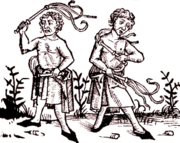
A scourge is a whip or lash, especially a multi-thong type used to inflict severe corporal punishment
or self-mortification on the back.

(usually two or three leather thongs without a separate handle); cat o' nine tails
: naval thick-rope knotted-end scourge, the army and civil prison versions usually are leather.
The scourge, or flail, and the crook
, are the two symbols of power and domination depicted in the hands of Osiris
in Egyptian monuments and they are the unchanging form of the instrument throughout the ages; though, the flail depicted in Egyptian mythology was an agricultural instrument used to thresh
wheat
, and not for corporal punishment.
The priests of Cybele
scourged themselves and others, and such stripes were considered sacred.
From a Biblical quotation, scorpio 'scorpion' is Latin for a Roman flagrum. Hard material was affixed to multiple thongs to give a flesh-tearing 'bite' [1 Kings
12:11: ...My father scourged you with whips; I will scourge you with scorpions]. The name testifies to the pain caused by the arachnid
. To its generous Roman application testifies the existence of the Latin words Flagrifer 'carrying a whip' and Flagritriba 'often-lashed slave'.
 Scourging was the first step in the traditional Roman
punishment for parricide
.
Scourging was soon adopted as a sanction in the monastic discipline of the fifth and following centuries. Early in the fifth century it is mentioned by Palladius of Galatia
in the Historia Lausiaca, and Socrates Scholasticus
tells us that, instead of being excommunicated, offending young monks were scourged. (See the sixth-century rules of St. Cæsarius of Arles for nuns, and of St. Aurelian of Arles.) Thenceforth scourging is frequently mentioned in monastic rules and councils as a preservative of discipline. Its use as a punishment was general in the seventh century in all monasteries of the severe Columban rule.
Canon law
(Decree of Gratian, Decretals of Gregory IX
) recognized it as a punishment for ecclesiastics; even as late as the sixteenth and seventeenth centuries, it appears in ecclesiastical legislation as a punishment for blasphemy
, concubinage
and simony
. Though doubtless at an early date a private means of penance
and mortification
, such use is publicly exemplified in the tenth and eleventh centuries by the lives of St. Dominic Loricatus
and St. Peter Damian (died 1072). The latter wrote a special treatise in praise of self-flagellation; though blamed by some contemporaries for excess of zeal, his example and the high esteem in which he was held did much to popularize the voluntary use of the scourge or "discipline" as a means of mortification and penance. Thenceforth it is met with in most medieval religious orders and associations.
The practice was, of course, capable of abuse, and so arose in the thirteenth century the fanatical sect of the Flagellants, though in the same period we meet with the private use of the "discipline" by such saintly persons as King Louis IX of France
and Elisabeth of Hungary
.
ic uses to mean a severe affliction, e.g. "the scourge of drug abuse". As a result, some people forget its literal meaning and seem to imagine a connection with "scour" -to clean something by scrubbing it vigorously.
Physical punishment
Physical punishment is any form of penalty in a judicial, educational or domestic setting that takes a physical form, by the infliction on the offender of pain, injury, discomfort or humiliation...
or self-mortification on the back.
Description
The typical scourge (Latin: flagrum; English: flagellum) has several thongs fastened to a handle; c.f. Scottish tawseTawse
The tawse, sometimes formerly spelled taws is an implement used for corporal punishment...
(usually two or three leather thongs without a separate handle); cat o' nine tails
Cat o' nine tails
The cat o' nine tails, commonly shortened to the cat, is a type of multi-tailed whipping device that originated as an implement for severe physical punishment, notably in the Royal Navy and Army of the United Kingdom, and also as a judicial punishment in Britain and some other...
: naval thick-rope knotted-end scourge, the army and civil prison versions usually are leather.
The scourge, or flail, and the crook
Crook
- Places :* Crook, County Durham, England, United Kingdom* Crook, Cumbria, England, United Kingdom* Crook, Devon, England, United Kingdom* Crook Inn, Scotland, United Kingdom* Crook, Colorado, United States* Crook County, Oregon, United States...
, are the two symbols of power and domination depicted in the hands of Osiris
Osiris
Osiris is an Egyptian god, usually identified as the god of the afterlife, the underworld and the dead. He is classically depicted as a green-skinned man with a pharaoh's beard, partially mummy-wrapped at the legs, wearing a distinctive crown with two large ostrich feathers at either side, and...
in Egyptian monuments and they are the unchanging form of the instrument throughout the ages; though, the flail depicted in Egyptian mythology was an agricultural instrument used to thresh
Threshing
Threshing is the process of loosening the edible part of cereal grain from the scaly, inedible chaff that surrounds it. It is the step in grain preparation after harvesting and before winnowing, which separates the loosened chaff from the grain...
wheat
Wheat
Wheat is a cereal grain, originally from the Levant region of the Near East, but now cultivated worldwide. In 2007 world production of wheat was 607 million tons, making it the third most-produced cereal after maize and rice...
, and not for corporal punishment.
The priests of Cybele
Cybele
Cybele , was a Phrygian form of the Earth Mother or Great Mother. As with Greek Gaia , her Minoan equivalent Rhea and some aspects of Demeter, Cybele embodies the fertile Earth...
scourged themselves and others, and such stripes were considered sacred.
From a Biblical quotation, scorpio 'scorpion' is Latin for a Roman flagrum. Hard material was affixed to multiple thongs to give a flesh-tearing 'bite' [1 Kings
Books of Kings
The Book of Kings presents a narrative history of ancient Israel and Judah from the death of David to the release of his successor Jehoiachin from imprisonment in Babylon, a period of some 400 years...
12:11: ...My father scourged you with whips; I will scourge you with scorpions]. The name testifies to the pain caused by the arachnid
Arachnid
Arachnids are a class of joint-legged invertebrate animals in the subphylum Chelicerata. All arachnids have eight legs, although in some species the front pair may convert to a sensory function. The term is derived from the Greek words , meaning "spider".Almost all extant arachnids are terrestrial...
. To its generous Roman application testifies the existence of the Latin words Flagrifer 'carrying a whip' and Flagritriba 'often-lashed slave'.
Ancient Rome
Ancient Rome was a thriving civilization that grew on the Italian Peninsula as early as the 8th century BC. Located along the Mediterranean Sea and centered on the city of Rome, it expanded to one of the largest empires in the ancient world....
punishment for parricide
Parricide
Parricide is defined as:*the act of murdering one's father , mother or other close relative, but usually not children ....
.
Scourging was soon adopted as a sanction in the monastic discipline of the fifth and following centuries. Early in the fifth century it is mentioned by Palladius of Galatia
Palladius of Galatia
Palladius of Galatia was bishop of Helenopolis in Bithynia, and a devoted disciple of Saint John Chrysostom. He is best remembered for his work, the Lausiac History; he was also, in all probability, the author of the Dialogue on the Life of Chrysostom....
in the Historia Lausiaca, and Socrates Scholasticus
Socrates Scholasticus
Socrates of Constantinople, also known as Socrates Scholasticus, not to be confused with the Greek philosopher Socrates, was a Greek Christian church historian, a contemporary of Sozomen and Theodoret, who used his work; he was born at Constantinople c. 380: the date of his death is unknown...
tells us that, instead of being excommunicated, offending young monks were scourged. (See the sixth-century rules of St. Cæsarius of Arles for nuns, and of St. Aurelian of Arles.) Thenceforth scourging is frequently mentioned in monastic rules and councils as a preservative of discipline. Its use as a punishment was general in the seventh century in all monasteries of the severe Columban rule.
Canon law
Canon law
Canon law is the body of laws & regulations made or adopted by ecclesiastical authority, for the government of the Christian organization and its members. It is the internal ecclesiastical law governing the Catholic Church , the Eastern and Oriental Orthodox churches, and the Anglican Communion of...
(Decree of Gratian, Decretals of Gregory IX
Decretals of Gregory IX
The decretals of Gregory IX are an important source of medieval canon law. In 1230, the pontiff ordered his chaplain and confessor, St. Raymond of Peñaforte , a Dominican, to form a new canonical collection destined to replace all former collections...
) recognized it as a punishment for ecclesiastics; even as late as the sixteenth and seventeenth centuries, it appears in ecclesiastical legislation as a punishment for blasphemy
Blasphemy
Blasphemy is irreverence towards religious or holy persons or things. Some countries have laws to punish blasphemy, while others have laws to give recourse to those who are offended by blasphemy...
, concubinage
Concubinage
Concubinage is the state of a woman or man in an ongoing, usually matrimonially oriented, relationship with somebody to whom they cannot be married, often because of a difference in social status or economic condition.-Concubinage:...
and simony
Simony
Simony is the act of paying for sacraments and consequently for holy offices or for positions in the hierarchy of a church, named after Simon Magus , who appears in the Acts of the Apostles 8:9-24...
. Though doubtless at an early date a private means of penance
Penance
Penance is repentance of sins as well as the proper name of the Roman Catholic, Orthodox Christian, and Anglican Sacrament of Penance and Reconciliation/Confession. It also plays a part in non-sacramental confession among Lutherans and other Protestants...
and mortification
Mortification
Mortification can refer to:*Mortification , theological doctrine*Mortification of the flesh, religious practice of corporal mortification...
, such use is publicly exemplified in the tenth and eleventh centuries by the lives of St. Dominic Loricatus
St. Dominic Loricatus
Saint Dominic Loricatus — in Italian, San Domenico Loricato — was an Umbrian saint, born in the Italian village of Luceolis near Cantiano . His father, sensing social advancement, paid a bribe to have him ordained a priest when still a child...
and St. Peter Damian (died 1072). The latter wrote a special treatise in praise of self-flagellation; though blamed by some contemporaries for excess of zeal, his example and the high esteem in which he was held did much to popularize the voluntary use of the scourge or "discipline" as a means of mortification and penance. Thenceforth it is met with in most medieval religious orders and associations.
The practice was, of course, capable of abuse, and so arose in the thirteenth century the fanatical sect of the Flagellants, though in the same period we meet with the private use of the "discipline" by such saintly persons as King Louis IX of France
Louis IX of France
Louis IX , commonly Saint Louis, was King of France from 1226 until his death. He was also styled Louis II, Count of Artois from 1226 to 1237. Born at Poissy, near Paris, he was an eighth-generation descendant of Hugh Capet, and thus a member of the House of Capet, and the son of Louis VIII and...
and Elisabeth of Hungary
Elisabeth of Hungary
Elizabeth of Hungary, T.O.S.F., was a princess of the Kingdom of Hungary, Countess of Thuringia, Germany and a greatly-venerated Catholic saint. Elizabeth was married at the age of 14, and widowed at 20. She then became one of the first members of the newly-founded Third Order of St. Francis,...
.
Metaphoric use
Semi-literal usages such as "the scourge of God" for Attila the Hun (i.e. "God's whip to punish the nations with") led to metaphorMetaphor
A metaphor is a literary figure of speech that uses an image, story or tangible thing to represent a less tangible thing or some intangible quality or idea; e.g., "Her eyes were glistening jewels." Metaphor may also be used for any rhetorical figures of speech that achieve their effects via...
ic uses to mean a severe affliction, e.g. "the scourge of drug abuse". As a result, some people forget its literal meaning and seem to imagine a connection with "scour" -to clean something by scrubbing it vigorously.