
|
|
|
|
Stonyhurst College
|
| |
|
| |
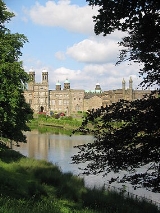
Stonyhurst College is an independent, Roman Catholic school in the Jesuit tradition. It is located on the Stonyhurst Estate near Clitheroe in rural Lancashire, England, where it occupies a Grade I listed building.
The school was founded in 1593 by Father Robert Persons SJ at St Omer, at a time when penal laws prohibited Catholic education in England. It relocated to Stonyhurst Hall in 1794, having moved already to Bruges in 1762 and Liège in 1773.

Discussion
Ask a question about 'Stonyhurst College'
Start a new discussion about 'Stonyhurst College'
Answer questions from other users
|
Encyclopedia
Stonyhurst College is an independent, Roman Catholic school in the Jesuit tradition. It is located on the Stonyhurst Estate near Clitheroe in rural Lancashire, England, where it occupies a Grade I listed building.
The school was founded in 1593 by Father Robert Persons SJ at St Omer, at a time when penal laws prohibited Catholic education in England. It relocated to Stonyhurst Hall in 1794, having moved already to Bruges in 1762 and Liège in 1773. Today the school provides boarding and day education to approximately four hundred and fifty boys and girls aged 13-18, whilst on an adjacent site, its preparatory school, St Mary's Hall, provides education for boys and girls aged 3-13.
Under the motto Quant Je Puis, "As Much As I can", the school combines academic development with a range of extra-curricular activities. The spiritual plays an important role in College life, with emphasis on both prayer and service, according to the Jesuit philosophy of creating Men and Women for Others.
Its alumni/ae include three Saints, twelve Beati, twenty-two martyrs, seven archbishops, seven Victoria Cross winners,, a Peruvian president and a number of writers, sportsmen, politicians, and European royals.
The school was granted Fair Trade status in 2009.
History
Stonyhurst Hall
The earliest Deed concerning the "Stanihurst" dates from approximately 1200 A.D. and can now be found in the Arundell Library in the College, whilst the earliest evidence of a building on the site is from 1372 when John de Bayley was licensed to have an oratory there. The oldest portion of the extant buildings was completed by Bayley's descendents, the Shireburn family. Richard Shireburn began building the Hall, whilst his grandson Nicholas extended it, constructing the ponds, avenue and gardens. Upon his death, the estate passed to his wife and then to their sole heir, Mary, the Duchess of Norfolk. In 1754, it was inherited by her cousin Thomas Weld of Lulworth. An old boy of the school when it was at Liege, he donated the buildings, with of land, in 1794 to the Society of Jesus.
The College The story of the school starts at St Omer in what was then the Spanish Netherlands in 1593, where a college, with the backing of Philip II of Spain, was founded by Fr Robert Persons SJ for English boys unable to receive a Catholic education in Elizabethan England. As such it was one of a number of expatriate English schools operating on the European mainland. In 1762, the Jesuits were forced to flee, re-establishing their school at Bruges. The school was again moved in 1773 to Liège, before finally settling at Stonyhurst on 29 August 1794, where schooling resumed on Wednesday 22 October of the same year.
The College flourished during the nineteenth century: the Society of Jesus was re-established in Britain at Stonyhurst in 1803, and over the century student numbers rose steeply from the original twelve migrants from Liège to make it England's largest Catholic college at the turn of the following century. Stonyhurst Hall underwent extensive alterations to accommodate these numbers; the Old South Front was constructed in 1810, only to be demolished and replaced with much grander buildings in the 1880s. A seminary was constructed on the estate, and an observatory and meteorological station erected in the gardens. The twentieth century saw the emergence of a mostly lay staff as the number of Jesuits declined. The seminary at Saint Mary's Hall was closed and the school discontinued its education of university-aged philosophers. Physical development continued, with the completion of a new wing in the 1960s, new science buildings in the 1950s and 1960s, a new swimming pool in the 1980s and the refurbishment of existing areas throughout the 1990s to the present. The school became fully co-educational in 1999.
Hodder Place, St Mary's Hall & Hodder House
The original preparatory school to Stonyhurst, Hodder Place, came into the hands of the Jesuits as part of the estate donated by alumnus Thomas Weld. Originally used as a novitiate, it became a preparatory school to the College in 1807.
St Mary's Hall, on an adjoining site to Stonyhurst, was built as a Jesuit Seminary in 1828 (extended in the 1850s) and functioned until 1926, when the seminarians moved to Heythrop Hall. The poet Gerard Manley Hopkins, and John Tolkien, son of J. R. R. Tolkien, trained as priests there. During the War, the English College occupied the Hall. After their return to Rome, St Mary's Hall opened as a middle school in 1946. At the same time, Hodder Place continued to educate those aged eight to eleven, until its closure and conversion into flats in 1970. Hodder Place pupils then moved up to St Mary's Hall to form Hodder Playroom. As successor to Hodder Place, St Mary's Hall has a claim to be the oldest surviving preparatory school in Britain.
In 2004, the old gymnasium at St Mary's Hall was converted into new nursery and infant facilities named Hodder House, for those aged three to seven, making it now possible for a pupil to spend fifteen years in education at Stonyhurst.
Religious life
The College is Roman Catholic and has had a significant place in English Catholic history for many centuries (including controversial events such as the Popish Plot and Gunpowder Plot conspiracies). It was founded initially to educate English Catholics on the continent in the hope that, through them, Catholicism might be restored in England. Finally, the school settled in England in 1794 and the Society of Jesus was officially re-established in Britain in 1803. Stonyhurst remained the headquarters of the English Province until the middle of the century; by 1851, a third of the Province's Jesuits were based there. Until the 1920s Jesuit priests were trained on site in what is today the preparatory school. Its closure cut the number of Jesuits at Stonyhurst to a third within a decade. Since then, the Jesuit presence has been in decline but the school nevertheless continues to place Catholicism and Jesuit philosophy at its core under the guidance of a Jesuit-led chaplaincy team and Jesuit involvement among the governors.
Jesuit ethos The Jesuit educational ethos consists chiefly of seven strands:
- Finding God in All Things
- Caring for the individual
- Showing love in deeds
- Building Christian community
- Engaging with the wider world
- Encouraging excellence
- Co-operating in Jesuit mission
Under these guiding principles, the College strives for the formation of well-rounded individuals, influenced by Ignatian reasoning and spirituality, and concern for humankind: the development of Men and Women for Others. In particular, students are encouraged to take part in daily prayer, retreats, meditations, celebration of the sacraments, pilgrimages and to be actively involved in charity work.
Chapels
The school has one main church, St Peter's, and five chapels: the College Chapel (formerly known as the Boys' Chapel), the Chapel of the Angels, the Sodality Chapel, the St Aloysius Chapel and the St Ignatius Chapel. The latter two are both within the towers of St Peter's Church, and are not normally used by students.
The Sodality Chapel is the home of the remains of third century Roman convert St Gordianus. Having rested beneath the altar since 1859, after travelling with the Jesuits from the College of St Omer, his bones were temporarily removed again in 2006 whilst the chapel underwent restoration, but they have since been returned. The Chapel is once again used by the re-established Sodality.
Adjacent to the Old Infirmary is the Rosary Garden, a place for spiritual contemplation, at the centre of which is a stone statue of Mary.
Traditions
It is a long-standing practice that pupils write A.M.D.G. in the top left hand corner of any piece of work they do. It stands for the Latin phrase Ad Majorem Dei Gloriam which means For the Greater Glory of God. At the end of a piece of work they write L.D.S. in the centre of the page. It stands for Laus Deo Semper which means Praise to God Always. These are both traditional Jesuit mottoes.
A distinguishing feature of Stonyhurst is the singing of the Pater Noster, the "Lord's Prayer" in Latin. It is sung at mass, and has been adopted as an anthem by the school's sports teams.
Charitable status As a registered charity, Stonyhurst is obliged to provide benefits to the wider community under the terms of the Charities Act 2006. As such, the College is home to the local Catholic parish church, which receives worshippers from Hurst Green on a daily basis. Its sports facilities, including the swimming pool and all-weather pitch are available for public use; the latter will be used for competitors training for the London 2012 Olympic Games. Much of the estate has public access; in particular the gardens and tea house are visited during the summer months, whilst the College plays host to tours, antiques fairs, food festivals, music concerts, conferences and weddings. The school has a relationship with a number of state schools, arranging shared activities with their pupils, in particular those serving special needs children. In addition, the school makes available a number of places to pupils offered on scholarship, bursaries or free of charge; almost a third of current pupils receive financial support for their places.
Motto
The French motto, Quant Je Puis — As Much as I Can, is central to the ethos of the school, which focusses upon the all-round development of the individual. It is inherited from the Shireburn family who once owned the original mansion on the site; the family emblem is emblazoned, in stone, with the motto, above the fireplace in the Top Refectory. At the far end of the same room, once the dining room of the Shireburns, the motto can be seen again, carved into the minstrel's gallery: Quant Je Puis. Hugo Sherburn armig. me fieri fecit. Anno Domini 1523. Et sicut fuit sic fiat.
Academic
Academic standards are high: 85% of GCSE students attain A*-C grades; there is a 100% pass rate at A-Level; and 100% of A-Level leavers take up places at universities (10% to Oxbridge) or on gap year schemes.
Ten GCSEs are usually taken by each pupil, consisting of five compulsory subjects (Religious Studies, Mathematics, English Language and Literature, and French) plus Information Technology and Personal, Social Education, with five other options from humanities, sciences, or arts subjects. In Poetry (lower sixth), four or five AS-Levels are taken from a choice of 25 subjects, with a weekly Theology class. One of these may be dropped and the remainder, or all, taken on to A-Level. Six A* - C grades are the requirement for Sixth Form entry. Each academic department has dedicated teaching rooms around the school, in addition to the general classrooms and playroom study places.
Education during the College's early history was based on St Ignatius' Ratio Studiorum, with emphasis upon theology, classics and science, all of which still feature prominently in the curriculum. The educational practice, observed at the College of St Omer, of dividing a class into Romans and Carthaginians continued long after the migration to Stonyhurst but is rarely employed today; each pupil would be pitched against an opponent with the task of picking up on the other's mistakes in an attempt to score points.
Until Roman Catholics were admitted to Oxbridge in 1894, Stonyhurst was also home to a number of "philosopher gentlemen" studying BA courses under the London Matriculation Examination system. Their numbers began to fall after 1894 and the department was closed in 1916.
Libraries and collections
Libraries Stonyhurst College has four main libraries: the Arundell, the Bay, the Square and the More (dedicated to Saint Thomas More).
The More Library is the main library for students whilst the 'House Libraries' (the Arundell, the Bay, and the Square) contain many artefacts from the Society of Jesus and English Catholicism. The Arundell Library, presented in 1837 by Everard, 11th Baron Arundell of Wardour, is the most significant; it is not only a country-house library from Wardour Castle but also has a notable collection of 250 Incunabula, medieval manuscripts and volumes of Jacobite interest, signal among which is Mary Tudor's Book of Hours, which it is believed she gave to her chaplain on the scaffold. The M.S. Le Livre de Seyntz Medicines was written in 1354 by Henry, Duke of Lancaster. To these were added the archives of the English Province of the Society of Jesus, which include 16th-century manuscript verses by St Robert Southwell SJ, the letters of St Edmund Campion SJ (1540-81) and holographs of the 19th-century poet Gerard Manley Hopkins. The Arundell Library held the seventh century Stonyhurst Gospel of St John, before it was loaned to the British Library, as well as a first folio of Shakespeare. The Stonyhurst copy of the Chronicles of Jean Froissart, captured at the Battle of Agincourt in 1415 are currently on loan to the Royal Armouries in Leeds, where they are the centre-piece of a new exhibition.
Collections Among those collections kept away from public view are the numerous blood-soaked garments from Jesuits martyred in Japan, the skull of Cardinal Morton, the ropes used to quarter St Edmund Campion SJ, the hairs of St Francis Xavier SJ, an enormous solid silver jewel-encrusted monstrance, the Wintour vestments, a cope made for Henry VII, and a thorn said to be from the crown of thorns placed upon Jesus' head at the crucifixion.
The school has a number of fine paintings, including a portrait of Tsar Nicholas I of Russia and another of the Jesuit Henry Garnet. In the Stuart Parlour are portraits of a number of Jacobites including James Francis Edward Stuart, and his sons Charles Edward Stuart and Henry Benedict Stuart. There are also several original engravings by Rembrandt and Dürer, such as the 'Greater Passion' and the 'Car of Maximillian'.
Observatory The school has a functioning observatory which was built in 1866. An older observatory, built in 1838, which also functioned as a meteorological station is now the tea house in the gardens, but was once one of seven important stations in the country when the Meteorological Office came under the auspices of the Royal Society. The records of temperature taken there start from 1846 and are the oldest continuous daily records in the world. During the nineteenth century, the observatory was maintained by the astronomer priests, Fr Weld, Fr Perry and Fr Sidgreaves whose research included astronomy, geomagnetrometry and seismology. Astrophysicist Pietro Angelo Secchi, director of the Vatican Observatory, also taught astronomy at the College during the period. Sir Edward Sabine chose the observatory as one of his main stations when conducting a magnetic survey of Britain in 1858. Five years later Fr Sidgreaves began the first series of monthly geometric observations, which continued until May 1919. During the course of the twentieth century, the observatory fell out of use and its telescope, parts of which dated to the 1860s, was sold after the Second World War. When its private owner came to sell it, the College was able to buy it back and restore it to its original home.
Arts
Music, Drama, Art
Music plays a prominent role in school life. All those entering the school in Lower Grammar (year nine) are obliged to learn to play an orchestral instrument. There are two choirs: the Chapel Choir, which sings regularly at mass, and the Schola Cantorum, composed of teachers and pupils, which sings at concerts and public events such as the May celebration in the College amphitheatre. Pupils participate in the school orchestra and various bands, whilst the staff band is a notable feature of the Poetry Banquet and Rhetoric Ball.
Drama is equally important, with plays staged throughout the school year, the main performance being at Great Academies, whilst some students take Theatre Studies as an additional AS Level subject. The College has a traditional theatre, the Academy Room, and a high-tech theatre built at Saint Mary's Hall as part of the Centenaries Appeal in 1993. The latter plays host to the annual Ribble Valley International Piano Week. A number of former pupils have gone on to achieve success upon the stage, including OSCAR-winning actor and director Charles Laughton and BAFTA-winning director and producer Peter Glenville.
Art is an important part of the curriculum, and is compulsory for those in Lower Grammar (year nine). There is a dedicated art studio in addition to a separate design and technology centre. Student artwork is displayed on the walls of the Lower Gallery, including a portrait of the Queen painted by Isobel Bidwell during the Golden Jubilee year; upon receipt of a copy, the Queen's lady-in-waiting said that "The Queen was delighted to see the painting and know that it is on display in the school".
Literary associations
Stonyhurst has a number of literary associations: its setting has provided inspiration for poets and authors who include former classics teacher Gerard Manley Hopkins, whose poems feature details of the local countryside, and former pupil Sir Arthur Conan Doyle whose "Baskerville Hall" was modelled on Stonyhurst Hall, and who named Sherlock Holmes' nemesis, Moriarty, after a fellow pupil. J.R.R. Tolkien wrote part of the Lord of the Rings in a classroom on the Upper Gallery during his stay at the College where his son taught Classics; his "Middle Earth" is said to resemble the local area, whilst there are specific resonances in names such as "Shire Lane", (the name of a road in Hurst Green) and the "River Shirebourn" (the Shireburns built Stonyhurst). Poet Laureate Alfred Austin, and the poet Oliver St John Gogarty ("Stately plump Buck Mulligan" in James Joyce's Ulysses) were educated at the school, (as were the sons of Oscar Wilde and Evelyn Waugh). George Archer-Shee, at the centre of Terence Rattigan's playThe Winslow Boy, is an alumnus.
The School runs its own publication company, St Omers Press, which publishes religious literature, and first began when the College was located at St Omer in Flanders.
Sport
Pupils are required to participate in games on a regular basis. The school is most noted for rugby union but an array of sporting activities are on offer, and since turning fully co-educational, hockey and rounders have widened the sports programme.
Stonyhurst College Rugby Union Football Club (SCRUFC)
Rugby has played a big part in the life of the school, despite only supplanting football as the school's primary sport in 1921. All boys are encouraged to play when they enter Lower Grammar but are not required to play throughout their time at the school. Stonyhurst has a successful rugby season, with games well supported by pupils, staff and parents. Sporting rivalry is particularly prominent against Ampleforth College and Sedbergh School. The Stonyhurst Sevens - the largest school sevens event in Britain - take place annually, attracting large crowds and numerous teams from all over the country.
The school has produced fourteen international rugby players (England (5), Ireland (6), Italy (1), the USA (1) and the Bahamas (1) ), as well as players for the Barbarians and the British and Irish Lions. Most recently they include Iain Balshaw and Kyran Bracken, who both played for England when they won the 2003 Rugby World Cup, whilst another member of that team, Will Greenwood, went to Stonyhurst Saint Mary's Hall, where his mother taught mathematics until 2007. Current pupils of the school have won places to represent Spain, the Irish Exiles, and the Welsh Exiles (under 19s). A number of old boys have also played at varsity level and have won blues for Oxford or Cambridge.
Stonyhurst has had well known coaches, including former England coaches Dick Greenwood, and Brian Ashton who coached the first XV.
Stonyhurst Football
Stonyhurst Football, inherited from the College of St Omer (along with Stonyhurst Cricket), was played between the handball walls on the Playground. The game was discontinued with the advent of Association Football but was re-established in 1988 when a "Grand Match" was played at Great Academies; traditionally a "Grand Match" was played on Shrove Tuesday and was the primary Stonyhurst Football match of the season. The teams were England vs France (although during the Crimean War England vs Russia was played and more recently England vs Ireland was played in the 1980s). The last game took place in 1995.
Sporting facilities
- all-weather astro-turf sports pitch
- 9 hole golf course
- shooting range
- 2 ponds used for canoeing and fishing
- 25m swimming pool
- 2 squash courts
- 9 tennis courts
- 4 cricket pitches
- 8 rugby pitches
- 2 football pitches
- weight-training gymnasium
- 2 indoor sports halls (one at SMH)
- large estate used for cross-country, orienteering, clay-pigeon shooting and rambling
Rhetoric vs. Hodder cricket and rounders
Towards the end of the Summer Term each year, Rhetoric boys issue a challenge, written in Latin, to the boys in preparatory at Stonyhurst Saint Mary's Hall, inviting them to compete in a cricket match. Preparatory respond in turn, also in Latin. The Rhetoricians take part wearing fancy dress, and are traditionally 'defeated' by preparatory. In 2003, the tradition was adopted by the girls who issued a Latin challenge to preparatory girls inviting them to compete at rounders.
Military
Officer Training Corps (OTC)
The Stonyhurst Officer Training Corps assembled for the first time on Tuesday 16 October 1900, in the Ambulacrum, overseen by The First Volunteer Battalion, the East Lancashire Regiment who gave instruction in drill and musketry. The original uniform was scarlet with a white piping and slouch hat, which was changed to khaki before the First World War. The Corps was granted the honour of representation at the Coronation of 1910 and sent members to the Royal Review at Windsor in 1911. It also appeared on parade annually for the spectacle of the Corpus Christi celebrations until the practice became obsolete after Vatican II.
Combined Cadet Corps (CCF)
After the Second World War, school OTCs were succeeded by the Combined Cadet Force. Stonyhurst's is run from the College Armoury adjoining the Ambulacrum and Shooting Range, led by a team of officers under a Major assigned to the school. It meets weekly on a Thursday afternoon and comprises the following platoons named after Stonyhurst's seven Victoria Cross winners:
Junior company
Senior company
Those in Grammar Playroom (year ten) are automatically enrolled in the CCF and are given the option of continuing at the end of the year, following a summer camp which takes place at a local barracks. Training involves a range of activities such as drill (marching and related manoeuvres), shooting, learning how to assemble and clean weapons, tactical planning and team work. The school supplies pupils with uniform, the orderliness of which is rigorously enforced and inspected each week. Each platoon is lead by a Junior Under Officer, his sergeant and corporals who are sixth form students.
Military careers In recent years, a number of pupils have distinguished themselves as members of the CCF and gone on to receive places at the Royal Military Academy Sandhurst. This follows a long tradition of service from Stonyhurst pupils: many O.S. were killed in the two World Wars and are commemorated on the war memorial at the end of the Upper Gallery. The Stonyhurst War Records were published in their honour. A memorial at the top of the main staircase records the names of the six O.S. killed in the Boer War.
School organisation
Playroom system
Unlike most English public schools, Stonyhurst is organised horizontally by year groups (known as playrooms) rather than vertically by houses, although the girls are also split into junior and senior houses. Each playroom has an assigned playroom master, with each cohort moving through the playrooms, having a sequence of playroom masters (rather than a single housemaster).
Currently, the College has the following playrooms, following the Roman order of learning:
- Lower Grammar Playroom ('LG' 13-14)
- Grammar Playroom (14-15)
- Syntax Playroom (15-16, GCSE Year)
- Poetry Playroom (16-17)
- Rhetoric Playroom (17-18)
Lines
In addition to the horizontal division of the school into playrooms, there is also a vertical grouping which cuts through the year groups, the "lines", and is used mostly for competitive purposes in sport and music. The Lines and colours are as follows:
- Campion (Red) (named after St Edmund Campion)
- St Omers (Yellow, though Brown for sporting attire) (named after St Omer, the town the school was founded in)
- Shireburn (Green) (named after the Shireburn family which built Stonyhurst)
- Weld (Blue) (named after Thomas Weld who donated Stonyhurst to the Jesuits)
Notable events in the school year The Ascensio Scholarum, inherited from the College of St Omer, in its present form, is the opening address of the headmaster at the beginning of the year to the entire school gathered in the Academy Room. Previously, it was a formal transition for pupils from one playroom to the next at the beginning of the year, which involved a pupil from each year announcing to the playroom of the year below them that the next playroom had been vacated by the senior pupils. The students and their belongings would then move up to their next playroom. This is how it acquired the name, "the ascension of the school".
Great Academies takes place annually at the end of the first half of the Summer Term. Although different in its present form, it is a continuation of a tradition begun at St Omers, with the first taking place at Stonyhurst on 6 August 1795. Today, it is an occasion when the school is on display - there are exhibitions, musical performances, the school play, sporting events, as well as prize-giving and the headmaster's speech, culminating with the Rhetoric Ball and Rhetoric Mass the following morning.
Stonyhurst Association
After less formal arrangements had been made for many years, the Association was formed in 1879. Its primary objective is to foster a strong spirit of union amongst past pupils and friends of Stonyhurst, which has been achieved in a variety of ways reflecting the spirit of succeeding generations. Recently, there has been a strong charitable emphasis, embedded with similar developments at the College. This was formalised in 1985, when the Association was granted charitable status by the Charity Commission. It also supports a number of charities connected to the school including Eagle Aid.
Alumni/ae
Stonyhurst has educated prominent individuals in every area, from statesmen to sportsmen, and actors to archbishops. Seven alumni have been awarded the Victoria Cross, the highest award for gallantry; their paintings today adorn the walls of the Top Refectory in the school.
Notable alumni include:
Alumni currently in the public eye include:
Notable masters
- Brian Ashton, history master and England rugby coach.
- Dick Greenwood, sports master and England Rugby coach.
- Christopher Hollis, assistant master, history master (1925-1935), author, politician and president of the Oxford Union.
- Gerard Manley Hopkins, classics master and poet.
- Stephen Oliver, classics master and novelist.
- Stephen Joseph Perry, astronomy master.
- Pietro Angelo Secchi, astronomy master, astrophysicist, and director of the Vatican Observatory.
- George Tyrrell, philosophy master and Roman Catholic modernist.
Headmasters
Since the College's foundation in Flanders in 1593, there have been seventy-eight headmasters, (variably known as presidents, rectors, superiors and directors). Until the appointment of Giles Mercer in 1985, the headmaster had always been a member of the Society of Jesus. There have been three lay headmasters.
style="font-size:100%;"
- St Omers, Bruges, Liège (1593-1794)
- See: Heads of St Omers, Bruges, Liège
- Stonyhurst (1794-present)
- Presidents
- Marmaduke Stone SJ (1794-1808)
- Nicholas Sewall SJ (1808-1813)
- John Weld SJ (1813-1816)
- Nicholas Sewall SJ (1816-1817)
- Rector and Headmaster
- Charles Plowden SJ (1817-1819)
- Joseph Tristram SJ (1819-1827)
- Richard Norris SJ (1827-1832)
- Richard Parker SJ (1832-1836)
- John Brownbill SJ (1836-1839)
- Francis Daniel SJ (1839-1841)
- Andrew Barrow SJ (1841-1845)
- Richard Norris SJ (1845-1846)
- Henry Walmesley SJ (1846-1847)
- Richard Sumner SJ (1847-1848)
- Francis Clough SJ (1848-1861)
- Joseph Johnson SJ (1861-1868)
- Charles Henry SJ (1868-1869)
- Edward Purbick SJ (1869-1879)
- William Eyre SJ (1879-1885)
- Reginald Colley SJ (1885-1891)
- Herman Walmesley SJ (1891-1898)
- Joseph Browne SJ (1898-1906)
- Pedro Gordon SJ (1906-1907)
- William Bodkin SJ (1907-1916)
- Edward O'Connor SJ (1916-1924)
- Walter Weld SJ (1924-1929)
- Richard Worsley SJ (1929-1932)
- Edward O'Connor SJ (1932-1938)
- Leo Belton SJ (1938-1945)
- Bernard Swindells SJ (1945-1952)
- Francis Vavasour SJ (1952-1958)
- Desmond Boyle SJ (1958-1961)
- Headmasters
- Frederick J. Turner SJ (1961-1963)
- George Earle SJ (1963-1971)
- Michael Bossy SJ (1971-1985)
- Giles Mercer (1985-1996)
- Adrian Aylward (1996-2006)
- Andrew Johnson (2006 - Present)
- Headmasters of Hodder Place & St Mary's Hall (1807-present)
- See: Headmasters of Stonyhurst Saint Mary's Hall
See also
style="font-size:100%;"
Further reading
- Chadwick, Hubert, S.J. (1962), St Omers to Stonyhurst, (Burns & Oats.)
- Walsh, R.R. (1989), Stonyhurst War Record
- Muir, T.E. (2006) Stonyhurst, (St Omers Press, Gloucestershire) second edition ISBN 0-9553592-0-1
- Kirby, Henry L. and Walsh, R. Raymond (1987), The Seven V.C.s of Stonyhurst College, (T.H.C.L. Books) ISBN 0-948494-04-2
- The Authorities of Stonyhurst College (1963), A Stonyhurst Handbook for Visitors and Others, (Stonyhurst, Lancashire) third edition
- Hewitson, A. (1878), Stonyhurst College, Present and Past: Its History, Discipline, Treasures and Curiosities, (Preston: The Chronicle office) second edition
External links
|
| |
|
|