

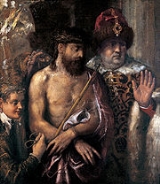
Ecce Homo

Encyclopedia
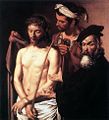
Latin
Latin is an Italic language originally spoken in Latium and Ancient Rome. It, along with most European languages, is a descendant of the ancient Proto-Indo-European language. Although it is considered a dead language, a number of scholars and members of the Christian clergy speak it fluently, and...
words used by Pontius Pilate
Pontius Pilate
Pontius Pilatus , known in the English-speaking world as Pontius Pilate , was the fifth Prefect of the Roman province of Judaea, from AD 26–36. He is best known as the judge at Jesus' trial and the man who authorized the crucifixion of Jesus...
in the Vulgate
Vulgate
The Vulgate is a late 4th-century Latin translation of the Bible. It was largely the work of St. Jerome, who was commissioned by Pope Damasus I in 382 to make a revision of the old Latin translations...
translation of the , when he presents a scourge
Scourge
A scourge is a whip or lash, especially a multi-thong type used to inflict severe corporal punishment or self-mortification on the back.-Description:...
d Jesus Christ, bound and crowned with thorns
Crown of Thorns
In Christianity, the Crown of Thorns, one of the instruments of the Passion, was woven of thorn branches and placed on Jesus Christ before his crucifixion...
, to a hostile crowd shortly before his Crucifixion
Crucifixion of Jesus
The crucifixion of Jesus and his ensuing death is an event that occurred during the 1st century AD. Jesus, who Christians believe is the Son of God as well as the Messiah, was arrested, tried, and sentenced by Pontius Pilate to be scourged, and finally executed on a cross...
. The original Greek
Greek language
Greek is an independent branch of the Indo-European family of languages. Native to the southern Balkans, it has the longest documented history of any Indo-European language, spanning 34 centuries of written records. Its writing system has been the Greek alphabet for the majority of its history;...
is Ἰδοὺ ὁ ἄνθρωπος (Idou ho Anthrōpos). The King James Version translates the phrase into English as Behold the Man. The scene is widely depicted in Christian art
Christian art
Christian art is sacred art produced in an attempt to illustrate, supplement and portray in tangible form the principles of Christianity, though other definitions are possible. Most Christian groups use or have used art to some extent, although some have had strong objections to some forms of...
.
Artistic subject
The Ecce homo is a standard component of cycles illustrating the Passion and Life of ChristLife of Christ
The Life of Christ as a narrative cycle in Christian art comprises a number of different subjects, which were often grouped in series or cycles of works in a variety of media, narrating the life of Jesus on earth, as distinguished from the many other subjects in art showing the eternal life of...
in art. It follows the Flagellation of Christ
Flagellation of Christ
The Flagellation of Christ, sometimes known as Christ at the Column or the Scourging at the Pillar, is a scene from the Passion of Christ very frequently shown in Christian art, in cycles of the Passion or the larger subject of the Life of Christ. It is the fourth station of the modern alternate...
, the Crowning with thorns
Crown of Thorns
In Christianity, the Crown of Thorns, one of the instruments of the Passion, was woven of thorn branches and placed on Jesus Christ before his crucifixion...
and the Mocking of Christ, the last two often being combined. The usual depiction shows Pilate and Christ, the mocking crowd and parts of the city of Jerusalem.
But, from the 15th century, devotional pictures
Andachtsbilder
Andachtsbilder is a German term often used in English in art history for Christian devotional images designed as aids for prayer or contemplation...
began to portray Jesus alone, in half or full figure with a purple robe, loincloth, crown of thorns and torture wounds, especially on his head. Similar subjects but with the wounds of the crucifixion visible (Nail wounds on the limbs, spear wounds on the sides), are termed a Man of Sorrow(s) (also Misericordia). If the "Instruments of the Passion" are present, it may be called an Arma Christi
Arma Christi
Arma Christi , or the Instruments of the Passion, are the objects associated with Jesus' Passion in Christian symbolism and art....
. If Christ is sitting down (usually supporting himself with his hand on his thigh), it may be referred to it as Christ at rest or Pensive Christ
Pensive Christ
The Pensive Christ or Christus im Elend is a subject in Christian iconography depicting a contemplating Jesus, sitting with his head supported by his hand with the Crown of Thorns and marks of his flagellation...
. It is not always possible to distinguish these subjects.
Early depictions

Syria
Syria , officially the Syrian Arab Republic , is a country in Western Asia, bordering Lebanon and the Mediterranean Sea to the West, Turkey to the north, Iraq to the east, Jordan to the south, and Israel to the southwest....
n-byzantine
Byzantine
Byzantine usually refers to the Roman Empire during the Middle Ages.Byzantine may also refer to:* A citizen of the Byzantine Empire, or native Greek during the Middle Ages...
culture. Western
Western Christianity
Western Christianity is a term used to include the Latin Rite of the Catholic Church and groups historically derivative thereof, including the churches of the Anglican and Protestant traditions, which share common attributes that can be traced back to their medieval heritage...
depictions in the Middle Ages that often seem to depict the ecce homo scene, (and are usually interpreted as such) more often than not only show the crowning of thorns and the mocking of Christ, (cf. the Egbert Codex and the Codex Aureus Epternacensis) which precede the actual ecce homo scene in the Bible. The independent image only developed around 1400, probably in Burgundy, but then rapidly became extremely popular, especially in Northern Europe.
.jpg)
Passion (Christianity)
The Passion is the Christian theological term used for the events and suffering – physical, spiritual, and mental – of Jesus in the hours before and including his trial and execution by crucifixion...
became a central theme in Western piety in the 15th and 16th centuries. The ecce homo theme was included not only in the passion play
Passion play
A Passion play is a dramatic presentation depicting the Passion of Jesus Christ: his trial, suffering and death. It is a traditional part of Lent in several Christian denominations, particularly in Catholic tradition....
s of medieval
Middle Ages
The Middle Ages is a periodization of European history from the 5th century to the 15th century. The Middle Ages follows the fall of the Western Roman Empire in 476 and precedes the Early Modern Era. It is the middle period of a three-period division of Western history: Classic, Medieval and Modern...
theatre, but also in cycles of illustrations of the story of the Passion, as in the Passions of Albrecht Dürer
Albrecht Dürer
Albrecht Dürer was a German painter, printmaker, engraver, mathematician, and theorist from Nuremberg. His prints established his reputation across Europe when he was still in his twenties, and he has been conventionally regarded as the greatest artist of the Northern Renaissance ever since...
or the prints of Martin Schongauer
Martin Schongauer
Martin Schongauer was a German engraver and painter. He was the most important German printmaker before Albrecht Dürer....
. The scene was (especially in France) often depicted as a sculpture or group of sculptures; even altarpieces and other paintings with the motif were produced (by, for example, Hieronymus Bosch or Hans Holbein
Hans Holbein the Elder
Hans Holbein was a German painter.He was born in Augsburg, Bavaria and died in Isenheim, Alsace. He and his brother Sigismund Holbein painted religious works in the late Gothic style...
). Like the passion plays, the visual depictions of the ecce homo scene, it has been argued, often, and increasingly, portray the people of Jerusalem in a highly critical light, bordering perhaps on antisemitic caricatures. Equally, this style of art has been read as a kind of simplistic externalisation of the inner hatred of the angry crowd towards Jesus, not necessarily implying any racial judgment.
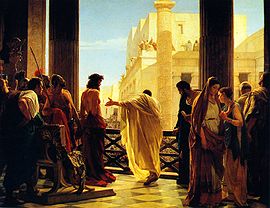
Old master print
An old master print is a work of art produced by a printing process within the Western tradition . A date of about 1830 is usually taken as marking the end of the period whose prints are covered by this term. The main techniques concerned are woodcut, engraving and etching, although there are...
(for example, by Jacques Callot
Jacques Callot
Jacques Callot was a baroque printmaker and draftsman from the Duchy of Lorraine . He is an important figure in the development of the old master print...
and Rembrandt), the paintings of the Renaissance
Renaissance
The Renaissance was a cultural movement that spanned roughly the 14th to the 17th century, beginning in Italy in the Late Middle Ages and later spreading to the rest of Europe. The term is also used more loosely to refer to the historical era, but since the changes of the Renaissance were not...
and the Baroque
Baroque
The Baroque is a period and the style that used exaggerated motion and clear, easily interpreted detail to produce drama, tension, exuberance, and grandeur in sculpture, painting, literature, dance, and music...
, as well as in Baroque sculptures.
Hieronymus Bosch painted his first ecce homo during the 1470s. He returned to the subject in 1490 to paint in a characteristically Netherlandish style, with deep perspective and a surreal ghostly image of praying monks in the lower left-hand corner.
In 1498, Albrecht Dürer
Albrecht Dürer
Albrecht Dürer was a German painter, printmaker, engraver, mathematician, and theorist from Nuremberg. His prints established his reputation across Europe when he was still in his twenties, and he has been conventionally regarded as the greatest artist of the Northern Renaissance ever since...
depicted the suffering of Christ in the ecce homo scene of his Great Passion, in unusually close relation with his self-portrait, leading to a reinterpretation of the motif as a metaphor for the suffering of the artist. James Ensor
James Ensor
James Sidney Edouard, Baron Ensor was a Flemish-Belgian painter and printmaker, an important influence on expressionism and surrealism who lived in Ostend for almost his entire life...
used the ecce homo motif in his ironic print Christ and the Critics (1891), in which he portrayed himself as Christ.
Recent usage
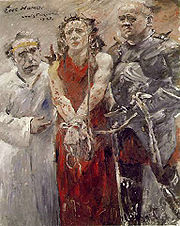
Lovis Corinth
Lovis Corinth was a German painter and printmaker whose mature work realized a synthesis of impressionism and expressionism....
's work Ecce Homo (1925), which shows, from the perspective of the crowd, Jesus, a soldier and Pilate dressed as a physician. Following the Holocaust of World War II
World War II
World War II, or the Second World War , was a global conflict lasting from 1939 to 1945, involving most of the world's nations—including all of the great powers—eventually forming two opposing military alliances: the Allies and the Axis...
, Otto Dix
Otto Dix
Wilhelm Heinrich Otto Dix was a German painter and printmaker, noted for his ruthless and harshly realistic depictions of Weimar society and the brutality of war. Along with George Grosz, he is widely considered one of the most important artists of the Neue Sachlichkeit.-Early life and...
portrayed himself as the suffering Christ in a concentration camp, in Ecce homo with self-likeness behind barbed wire (1948). The artist Joe Forkan painted a version in 2009.
Works with articles
- Ecce Homo (Antonello da Messina)Ecce Homo (Antonello da Messina)Ecce Homo is the title of a series of paintings by the Italian Renaissance master Antonello da Messina. They date from 1470 to 1475.Antonello is known to have treated this subject four times; three are variations of the same design; a fourth differs.*a) Christ Crowned with Thorns, in the...
- Ecce Homo (Bosch, 1470s)
- Ecce Homo (Bosch, 1490s)
- Ecce Homo (Caravaggio)Ecce Homo (Caravaggio)Ecce Homo is a painting by the Italian master Michelangelo Merisi da Caravaggio . It is housed in the Palazzo Rosso, Genoa.-Background:...