

Cretan Turks

Encyclopedia
The Cretan Turks, Turco-Cretans (Greek:
Τουρκοκρητικοί, Tourkokritikoi), or Cretan Muslims (Turkish:
Giritli, Girit Türkleri, or Türk Giritliler) were the Muslim
inhabitants of Crete
(until 1923) and now their descendants, who settled principally in Turkey
, the Levant
, and Egypt
as well as in the larger Turkish diaspora
.
After the Ottoman
conquest of Crete (1645–1669), a high rate of local conversions made the island a unique case in Ottoman history; indeed, the Muslim population of Crete resulted "primarily through conversion to Islam".
Sectarian violence during the 19th century caused many to leave, especially during the Greco-Turkish War of 1897
, and after autonomous Crete's unilateral declaration of union with Greece rule in 1908. Finally, after the Greco-Turkish War of 1919–1922 and the Turkish War of Independence
, the remaining Muslims of Crete were compulsorily exchanged for the Greek Christians of Anatolia
under the terms of the Treaty of Lausanne
(1923).
At all periods, most Cretan Muslims were Greek-speaking, but the language of administration and the prestige language for the Muslim urban upper classes was Ottoman Turkish
. In the folk tradition, however, Greek was used to express Muslims' "Islamic--often Bektashi--sensibility".
Under the Ottoman Empire, many Cretan Turks attained prominent positions.
Those who left Crete in the late 19th and early 20th centuries settled largely along Turkey's Aegean and Mediterranean coast; other waves of refugees settled in Syria
n cities like Damascus
, Aleppo
, and Al Hamidiyah
; in Tripoli
, Lebanon
; Haifa
, Israel
; Alexandria
and Tanta
in Egypt
. While some of these peoples have integrated themselves with the populations around them over the course of the 20th century, the majority of them still live in a tightly knit communities preserving their unique culture, traditions, Cretan Greek
dialect and Turkish language
. In fact many of them made reunion visits to distant relatives in Lebanon
, in Crete
and even other parts of Greece
where some of the cousins may still share the family name but follow a different religion.
Although most Cretan Turks are Sunni Muslims, Islam
in Crete during the Ottoman rule was deeply influenced by the Bektashi
Sufi order, as it has been the case in some parts of the Balkans
. This influence went far beyond the actual numbers of Bektashis present in Crete and it contributed to the shaping of the literary output, folk Islam and a tradition of inter-religious tolerance.
traditions, especially in the 18th century Personal, mystical, fantastic themes abound in the works of these men of letters, reflecting the dynamism of the cultural life in the island.
A taste and echo of this tradition can be perceived in the verses below by Giritli Sırrı Pasha
(1844–1895);
Fidânsın nev-nihâl-i hüsn ü ânsın âfet-i cânsın
Gül âşık bülbül âşıkdır sana, bir özge cânânsın
which were certainly addressed to his wife, the poetess-composer Leyla Saz
, herself a notable figure of Turkish literature
and Turkish Classical Music.
Recently, a number of books written by descendants of Cretan Turks in the form of novellized family souvenirs with scenes set in Crete and Anatolia have seen the day in Turkey's book market. Saba Altınsay's "Kritimu" and Ahmet Yorulmaz's trilogy were the first to set the example in this move. There has even been family souvenirs written by a Cretan Turk - Afro-Turk
, namely Mustafa Olpak whose biographies in retrospect from the shores of Istanbul, Crete and Kenya
follow his grandfathers who were initially brought to the Ottoman Empire as slaves to Crete. (see below: Further reading)
). During the 1910s, with the termination of the Cretan State
which had recognized the Muslim community of the island a proper status, many others left. The Greco-Turkish War (1919-1922)
and the ensuing population exchange is the final chapter among the root causes that shaped these nuances.
Among contributions made by Cretan Turks to the Turkish culture in general, the first to be mentioned should be their particular culinary traditions based on consumption at high-levels of olive oil and of a surprisingly wide array of herbs and other plant-based raw materials. While they have certainly not introduced olive oil and herbs to their compatriots, Cretan Turks have greatly extended the knowledge and paved the way for a more varied use of these products. Their predilection for herbs, some of which could be considered as unusual ones, has also been the source of some jokes. The Giritli chain of restaurants in İstanbul
, Ankara
and Bodrum
, and Ayşe Ün's "Girit Mutfağı" (Cretan Cuisine) eateries in İzmir
are indicative references in this regard. Occasional although intrinsically inadequate care has also been demonstrated by the authorities in the first years of the Turkish Republic for settling Cretan Turks in localities where vineyards left by the departed Greeks were found, since this capital was bound to be lost in the hands of cultivators with no prior knowledge of viniculture. In the field of maritime industries, the pioneer of gulet
boats construction that became a vast industry in Bodrum in our day, Ziya Güvendiren was a Cretan Turk, as are many of his former apprentices who themselves have become master shipbuilders and who are based in Bodrum or Güllük
today.
An overall pattern of investing in expertise and success remains remarkable among Cretan Turks, as attested by the notable names below. However, with sex roles and social change starting out from different grounds for Turkish Cretans, the adaptation to the "fatherland" did not always take place without pain, including that of being subjected to slurs as in other cases involving immigration of people. According to Peter Loizos, they were often were relegated to the poorest land:
The same author depicts a picture where they did not share the "Ottoman perceptions of certain crafts and trades as being of low status", so more entrepreneurial opportunities were open to them. Like others who did not speak Turkish, they suffered during the "Citizens Speak Turkish" campaign which started in 1928. "Arabs, Circassians, Cretan Muslims, and Kurds in the country were being targeted for not speaking Turkish. In Mersin, for instance, ‘Kurds, Cretans, Arabs and Syrians’ were being fined for speaking languages other than Turkish.". In the summary translation of a book on Bodrum
made by Loizos, it is stated that, even as late as 1967, the Cretans and the 'local Turks' did not mix in some towns; they continued to speak Greek and mostly married other Cretans.
being Rum kemençesi - Greek kemenche).
and about 3,000 in Al Hamidiyah
, Syria
. The majority of them are Muslims of Cretan origin. Records suggest that the community left Crete between 1866 and 1897, on the outbreak of the last Cretan uprising against the Ottoman empire, which ended the Greco-Turkish War of 1897
. Sultan Abdul Hamid II
provided Cretan Muslim families who fled the island with refuge on the Levant
ine coast. The new settlement was named Hamidiye after the sultan.
Many Cretan Muslims of Lebanon somewhat managed to preserve their identity and language. Unlike neighbouring communities, they are monogamous
and consider divorce
a disgrace. Until the Lebanese Civil War
, their community was close-knit and entirely endogamous
. However many of them left Lebanon during the 15 years of the war.
Cretan Muslims constitute 60% of Al Hamidiyah
's population. The community is very much concerned with maintaining its culture. The knowledge of the spoken Greek language is remarkably good and their contact with their historical homeland has been possible by means of satellite television and relatives.
gradually took Crete
from the Republic of Venice
, which had ruled it since 1204. In the final major defeat
, Candia
(modern Iraklion) fell to the Ottomans in 1669 (though some offshore islands remained Venetian until 1715
). Crete remained part of the Ottoman Empire until 1897.
Unlike other Ottoman provinces, the fall of Crete was not accompanied by a large influx of Muslims. On the other hand, many Cretans converted to Islam — more than in any other part of the Greek world. Various explanations have been given for this, including the disruption of war, the possibility of receiving a timar
(for those who went over to the Ottomans during the war), Latin
-Orthodox
dissension, avoidance of the head-tax (cizye
) on non-Muslims
( but this is highly unlikely reason since by becoming Muslims they would have to pay the zakat which is higher in amount than the jizya), the increased social mobility of Muslims, and the opportunity that Muslims had of joining the paid militia (which the Cretans also aspired to under Venetian rule).
It is difficult to estimate the proportion which became Muslim, as Ottoman cizye tax records count only Christians: estimates range from 30-50%. By the late 18th century, as many as 45% of the islanders may have been Muslim. The Muslim population declined through the 19th century, and by the last Ottoman census, in 1881, Muslims were only 26% of the population, concentrated in the three large towns on the north coast, and in Monofatsi.
Most Cretan Muslims were local Greek converts who spoke Cretan Greek
, yet at the dawn of Greek nationalism, the Christian population labeled them "Turks". People who claim descent from Muslim Cretans are still found in several Muslim countries today, and principally in Turkey
.
Between 1821 and 1828, during the Greek War of Independence
, the island was the scene of repeated hostilities. Most Muslims were driven into the large fortified towns on the north coast and both the Muslim and Christian populations of the island suffered severe losses, due to conflicts, plague or famine. In the 1830s, Crete
was an impoverished and backward island.
Since the Ottoman sultan, Mahmud II
, had no army of his own available, he was forced to seek the aid of his rebellious vassal and rival, Kavalalı Mehmed Ali Pasha of Egypt
, who sent troops to the island. Starting in 1832, the island was administered for two decades by an Albanian
from Egypt
, Mustafa Naili Pasha (later a Grand Vizier
), whose rule attempted to create a synthesis between the Muslim landowers and the emergent Christian
commercial classes. His rule was generally cautious, pro-British
, and he tried harder to win the support of the Christians (having married the daughter of a priest and allowed her to remain Christian) than the Muslims. In 1834, however, a Cretan committee had already been founded in Athens
to work for the union of the island with Greece
.
In 1840, Egypt was forced by Palmerston
to return Crete to direct Ottoman rule. Mustafa Naili Pasha angled unsuccessfully to become a semi-independent prince but the Cretans rose up against him, once more driving the Muslims temporarily into siege in the towns. An Anglo-Ottoman naval operation restored control in the island and Mustafa Naili Pasha was confirmed as its governor, though under command from İstanbul
. He remained in Crete until 1851 when he was summoned to the capital, where at a relatively advanced age he pursued a successful career.
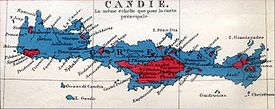 Religious tensions erupted on the island between Muslims and Christians and the Christian populations of Crete revolted twice against Ottoman rule (in 1866 and in 1897). In the uprising of 1866
, the rebels initially managed to gain control of most of the hinterland although as always the four fortified towns of the north coast and the southern town of Ierapetra
remained in Ottoman hands. The Ottoman approach to the Cretan question was that, if Crete was lost, the next line of defense would have to be the Dardanelles
, as indeed it was the case later. The Ottoman Grand Vizier, Mehmed Emin Aali Pasha arrived in the island in October 1867 and set in progress a low profile district-by-district reconquest of the island followed by the erection of blockhouses or local fortresses across the whole of it. More importantly, he designed an Organic Law which gave the Cretan Christians equal (in practice, because of their superior numbers, majority) control of local administration. At the time of the Congress of Berlin
in the summer of 1878, there was a further uprising, which was speedily halted through the adaptation of the Organic Law into a constitutional settlement known as the Pact of Halepa
.
Crete became a semi-independent parliamentary state within the Ottoman Empire under a Greek Orthodox Governor. A number of the senior "Christian Pashas" including Photiades Pasha and Adossides Pasha ruled the island in the 1880s, presiding over a parliament in which liberals and conservatives contended for power. Disputes between these led to a further insurgency in 1889 and the collapse of the Pact of Halepa
arrangements. The international powers allowed the Ottoman authorities to send troops to the island and restore order but the Sultan Abdulhamid II used the occasion for ruling the island by martial law. This action led to international sympathy for the Cretan Christians and to a loss of any remaining acquiescence among them for continued Ottoman rule. When a small insurgency began in September 1895, it quickly spiralled out of control and by the summer of 1896, the Ottoman forces had lost military control over most of the island. The insurrection in 1897 led to a war between Greece and the Ottoman Empire. By March 1897 however, the Great Powers decided to govern the island temporarily through a committee of four admirals who remained in charge until the arrival of Prince George of Greece as first governor-general of an autonomous Crete, effectively detached from the Ottoman Empire, in late December 1898. Ottoman forces were expelled in 1898, and an independent Cretan State
, headed by Prince George of Greece, was founded.
The island's Muslim population dropped dramatically from these changes. From the summer of 1896 until the end of hostilities in 1898, Cretan Muslims remained under siege in the four coastal cities, where massacres against them took place. Subsequent waves of emigration followed as the island was united by stages with Greece
. Those remaining were forced to leave Crete under the Exchange of Greek and Turkish Populations in 1924. In Turkey
, some descendants of this population continued to speak a form of Cretan Greek
dialect
until recently.
In 1908, the Cretan deputies declared union with Greece
, which was internationally recognized after the Balkan Wars
in 1913. Under the Treaty of London, Sultan Mehmed V
relinquished his formal rights to the island.
Writer Cevat Şakir Kabaağaçlı
, alias Halikarnas Balıkçısı (The Fisherman of Halicarnassus), although born in Crete and has often let himself be cited as Cretan, descends from a family of Ottoman aristocracy with roots in Afyonkarahisar
, and his father had been an Ottoman High Commissioner in Crete
and later ambassador in Athens
. Likewise, as stated above, Mustafa Naili Pasha was Albanian
/Egypt
ian.
Greek language
Greek is an independent branch of the Indo-European family of languages. Native to the southern Balkans, it has the longest documented history of any Indo-European language, spanning 34 centuries of written records. Its writing system has been the Greek alphabet for the majority of its history;...
Τουρκοκρητικοί, Tourkokritikoi), or Cretan Muslims (Turkish:
Turkish language
Turkish is a language spoken as a native language by over 83 million people worldwide, making it the most commonly spoken of the Turkic languages. Its speakers are located predominantly in Turkey and Northern Cyprus with smaller groups in Iraq, Greece, Bulgaria, the Republic of Macedonia, Kosovo,...
Giritli, Girit Türkleri, or Türk Giritliler) were the Muslim
Muslim
A Muslim, also spelled Moslem, is an adherent of Islam, a monotheistic, Abrahamic religion based on the Quran, which Muslims consider the verbatim word of God as revealed to prophet Muhammad. "Muslim" is the Arabic term for "submitter" .Muslims believe that God is one and incomparable...
inhabitants of Crete
Crete
Crete is the largest and most populous of the Greek islands, the fifth largest island in the Mediterranean Sea, and one of the thirteen administrative regions of Greece. It forms a significant part of the economy and cultural heritage of Greece while retaining its own local cultural traits...
(until 1923) and now their descendants, who settled principally in Turkey
Turkey
Turkey , known officially as the Republic of Turkey , is a Eurasian country located in Western Asia and in East Thrace in Southeastern Europe...
, the Levant
Levant
The Levant or ) is the geographic region and culture zone of the "eastern Mediterranean littoral between Anatolia and Egypt" . The Levant includes most of modern Lebanon, Syria, Jordan, Israel, the Palestinian territories, and sometimes parts of Turkey and Iraq, and corresponds roughly to the...
, and Egypt
Egypt
Egypt , officially the Arab Republic of Egypt, Arabic: , is a country mainly in North Africa, with the Sinai Peninsula forming a land bridge in Southwest Asia. Egypt is thus a transcontinental country, and a major power in Africa, the Mediterranean Basin, the Middle East and the Muslim world...
as well as in the larger Turkish diaspora
Turkish diaspora
The Turkish diaspora refers to "Turks" who have emigrated from their homeland. Thus, the term may refer to citizens of Turkey living abroad or ethnic Turks from traditional areas of Turkish settlement who are living abroad.Due to the...
.
After the Ottoman
Ottoman Empire
The Ottoman EmpireIt was usually referred to as the "Ottoman Empire", the "Turkish Empire", the "Ottoman Caliphate" or more commonly "Turkey" by its contemporaries...
conquest of Crete (1645–1669), a high rate of local conversions made the island a unique case in Ottoman history; indeed, the Muslim population of Crete resulted "primarily through conversion to Islam".
Sectarian violence during the 19th century caused many to leave, especially during the Greco-Turkish War of 1897
Greco-Turkish War (1897)
The Greco-Turkish War of 1897, also called the Thirty Days' War and known as the Black '97 in Greece, was a war fought between the Kingdom of Greece and Ottoman Empire. Its immediate cause was the question over the status of the Ottoman province of Crete, whose Greek majority long desired union...
, and after autonomous Crete's unilateral declaration of union with Greece rule in 1908. Finally, after the Greco-Turkish War of 1919–1922 and the Turkish War of Independence
Turkish War of Independence
The Turkish War of Independence was a war of independence waged by Turkish nationalists against the Allies, after the country was partitioned by the Allies following the Ottoman Empire's defeat in World War I...
, the remaining Muslims of Crete were compulsorily exchanged for the Greek Christians of Anatolia
Population exchange between Greece and Turkey
The 1923 population exchange between Greece and Turkey was based upon religious identity, and involved the Greek Orthodox citizens of Turkey and the Muslim citizens of Greece...
under the terms of the Treaty of Lausanne
Treaty of Lausanne
The Treaty of Lausanne was a peace treaty signed in Lausanne, Switzerland on 24 July 1923, that settled the Anatolian and East Thracian parts of the partitioning of the Ottoman Empire. The treaty of Lausanne was ratified by the Greek government on 11 February 1924, by the Turkish government on 31...
(1923).
At all periods, most Cretan Muslims were Greek-speaking, but the language of administration and the prestige language for the Muslim urban upper classes was Ottoman Turkish
Ottoman Turkish language
The Ottoman Turkish language or Ottoman language is the variety of the Turkish language that was used for administrative and literary purposes in the Ottoman Empire. It borrows extensively from Arabic and Persian, and was written in a variant of the Perso-Arabic script...
. In the folk tradition, however, Greek was used to express Muslims' "Islamic--often Bektashi--sensibility".
Under the Ottoman Empire, many Cretan Turks attained prominent positions.
Those who left Crete in the late 19th and early 20th centuries settled largely along Turkey's Aegean and Mediterranean coast; other waves of refugees settled in Syria
Syria
Syria , officially the Syrian Arab Republic , is a country in Western Asia, bordering Lebanon and the Mediterranean Sea to the West, Turkey to the north, Iraq to the east, Jordan to the south, and Israel to the southwest....
n cities like Damascus
Damascus
Damascus , commonly known in Syria as Al Sham , and as the City of Jasmine , is the capital and the second largest city of Syria after Aleppo, both are part of the country's 14 governorates. In addition to being one of the oldest continuously inhabited cities in the world, Damascus is a major...
, Aleppo
Aleppo
Aleppo is the largest city in Syria and the capital of Aleppo Governorate, the most populous Syrian governorate. With an official population of 2,301,570 , expanding to over 2.5 million in the metropolitan area, it is also one of the largest cities in the Levant...
, and Al Hamidiyah
Al Hamidiyah
Al Hamidiyah is a town on the coastal Syrian line about 3km from the Lebanese border. The town was founded in a very short time on direct orders from the Turkish Sultan ‘Abdu’l-Hamid II circa 1897, to serve as refuge for the Muslim Cretans, be they Muslim Greeks or Cretan Turks, who were forced to...
; in Tripoli
Tripoli
Tripoli is the capital and largest city in Libya. It is also known as Western Tripoli , to distinguish it from Tripoli, Lebanon. It is affectionately called The Mermaid of the Mediterranean , describing its turquoise waters and its whitewashed buildings. Tripoli is a Greek name that means "Three...
, Lebanon
Lebanon
Lebanon , officially the Republic of LebanonRepublic of Lebanon is the most common term used by Lebanese government agencies. The term Lebanese Republic, a literal translation of the official Arabic and French names that is not used in today's world. Arabic is the most common language spoken among...
; Haifa
Haifa
Haifa is the largest city in northern Israel, and the third-largest city in the country, with a population of over 268,000. Another 300,000 people live in towns directly adjacent to the city including the cities of the Krayot, as well as, Tirat Carmel, Daliyat al-Karmel and Nesher...
, Israel
Israel
The State of Israel is a parliamentary republic located in the Middle East, along the eastern shore of the Mediterranean Sea...
; Alexandria
Alexandria
Alexandria is the second-largest city of Egypt, with a population of 4.1 million, extending about along the coast of the Mediterranean Sea in the north central part of the country; it is also the largest city lying directly on the Mediterranean coast. It is Egypt's largest seaport, serving...
and Tanta
Tanta
Tanta is a city in Egypt. It is the country's fifth largest populated area, with an estimated 429,000 inhabitants . Tanta is located north of Cairo and southeast of Alexandria...
in Egypt
Egypt
Egypt , officially the Arab Republic of Egypt, Arabic: , is a country mainly in North Africa, with the Sinai Peninsula forming a land bridge in Southwest Asia. Egypt is thus a transcontinental country, and a major power in Africa, the Mediterranean Basin, the Middle East and the Muslim world...
. While some of these peoples have integrated themselves with the populations around them over the course of the 20th century, the majority of them still live in a tightly knit communities preserving their unique culture, traditions, Cretan Greek
Cretan Greek
Cretan Greek is a dialect of the Greek language, spoken by more than half a million people in Crete and many thousands in the diaspora....
dialect and Turkish language
Turkish language
Turkish is a language spoken as a native language by over 83 million people worldwide, making it the most commonly spoken of the Turkic languages. Its speakers are located predominantly in Turkey and Northern Cyprus with smaller groups in Iraq, Greece, Bulgaria, the Republic of Macedonia, Kosovo,...
. In fact many of them made reunion visits to distant relatives in Lebanon
Lebanon
Lebanon , officially the Republic of LebanonRepublic of Lebanon is the most common term used by Lebanese government agencies. The term Lebanese Republic, a literal translation of the official Arabic and French names that is not used in today's world. Arabic is the most common language spoken among...
, in Crete
Crete
Crete is the largest and most populous of the Greek islands, the fifth largest island in the Mediterranean Sea, and one of the thirteen administrative regions of Greece. It forms a significant part of the economy and cultural heritage of Greece while retaining its own local cultural traits...
and even other parts of Greece
Greece
Greece , officially the Hellenic Republic , and historically Hellas or the Republic of Greece in English, is a country in southeastern Europe....
where some of the cousins may still share the family name but follow a different religion.
Although most Cretan Turks are Sunni Muslims, Islam
Islam
Islam . The most common are and . : Arabic pronunciation varies regionally. The first vowel ranges from ~~. The second vowel ranges from ~~~...
in Crete during the Ottoman rule was deeply influenced by the Bektashi
Bektashi
Bektashi Order or Bektashism is an Islamic Sufi order founded in the 13th century by the Persian saint Haji Bektash Veli. In addition to the spiritual teachings of Haji Bektash Veli the order was significantly influenced during its formative period by both the Hurufis as well as the...
Sufi order, as it has been the case in some parts of the Balkans
Balkans
The Balkans is a geopolitical and cultural region of southeastern Europe...
. This influence went far beyond the actual numbers of Bektashis present in Crete and it contributed to the shaping of the literary output, folk Islam and a tradition of inter-religious tolerance.
Literature
Turks in Crete produced an unusually rich and varied literary output, leading one researcher to define a "Cretan School" which counts twenty-one poets who evolved within Ottoman Divan poetry or Turkish folk literatureTurkish folk literature
Turkish folk literature is an oral tradition deeply rooted, in its form, in Central Asian nomadic traditions. However, in its themes, Turkish folk literature reflects the problems peculiar to a settling people who have abandoned the nomadic lifestyle...
traditions, especially in the 18th century Personal, mystical, fantastic themes abound in the works of these men of letters, reflecting the dynamism of the cultural life in the island.
A taste and echo of this tradition can be perceived in the verses below by Giritli Sırrı Pasha
Giritli Sirri Pasha
Giritli Sırrı Pasha was a 19th century Ottoman administrator and man of letters of Turkish Cretan origin.He was born in 1844 in Kandiye, Crete, Ottoman Empire as the son of Helvacızade Salih Tosun Efendi...
(1844–1895);
Fidânsın nev-nihâl-i hüsn ü ânsın âfet-i cânsın
Gül âşık bülbül âşıkdır sana, bir özge cânânsın
which were certainly addressed to his wife, the poetess-composer Leyla Saz
Leyla Saz
Leyla Saz, also called Leyla Hanimefendi in her time, was a Turkish composer, poet and writer.Born in 1850 in Istanbul to a family of Ottoman aristocrats of Cretan Turkish origins, she was the daughter of İsmail Hakkı Pasha, Leyla Saz, also called Leyla Hanimefendi in her time, was a Turkish...
, herself a notable figure of Turkish literature
Turkish literature
Turkish literature comprises both oral compositions and written texts in the Turkish language, either in its Ottoman form or in less exclusively literary forms, such as that spoken in the Republic of Turkey today...
and Turkish Classical Music.
Recently, a number of books written by descendants of Cretan Turks in the form of novellized family souvenirs with scenes set in Crete and Anatolia have seen the day in Turkey's book market. Saba Altınsay's "Kritimu" and Ahmet Yorulmaz's trilogy were the first to set the example in this move. There has even been family souvenirs written by a Cretan Turk - Afro-Turk
Afro-Turks
Afro-Turks, African Turks, or Turkish Africans are people of African descent in Turkey. "Afro-Turk" is a neologism; they have been colloquially named as Arap or zenci in Turkish, and are now also referred to as Afrika kökenli Türkler .-History:Beginning several centuries ago, a number of Africans,...
, namely Mustafa Olpak whose biographies in retrospect from the shores of Istanbul, Crete and Kenya
Kenya
Kenya , officially known as the Republic of Kenya, is a country in East Africa that lies on the equator, with the Indian Ocean to its south-east...
follow his grandfathers who were initially brought to the Ottoman Empire as slaves to Crete. (see below: Further reading)
Music
A study by one Greek researcher counts six Muslim Cretans who engaged themselves into music in Cretan Greek dialect. The Cretans brought the musical tradition they shared with the Cretan Christians to Turkey with them:
One of the significant aspects of Giritli culture is that this Islamic--often Bektashi--sensibility is expressed through the Greek language. [There has been] some confusion about their cultural identity, and an assumption is often made that their music was somehow more "Turkish" than "Cretan". In my view this assumption is quite wrong....
Cretan Turkish popular culture in Turkey
Nuances may be observed among the waves of immigrations from Crete and the respective behavioral patterns. At the end of the 19th century Turks often fled massacres to take refuge in the present-day territory of Turkey or beyond (see Al HamidiyahAl Hamidiyah
Al Hamidiyah is a town on the coastal Syrian line about 3km from the Lebanese border. The town was founded in a very short time on direct orders from the Turkish Sultan ‘Abdu’l-Hamid II circa 1897, to serve as refuge for the Muslim Cretans, be they Muslim Greeks or Cretan Turks, who were forced to...
). During the 1910s, with the termination of the Cretan State
Cretan State
The Cretan State was established in 1898, following the intervention by the Great Powers on the island of Crete. In 1897 an insurrection in Crete led the Ottoman Empire to declare war on Greece, which led the United Kingdom, France, Italy and Russia to intervene on the grounds that the Ottoman...
which had recognized the Muslim community of the island a proper status, many others left. The Greco-Turkish War (1919-1922)
Greco-Turkish War (1919-1922)
The Greco–Turkish War of 1919–1922, known as the Western Front of the Turkish War of Independence in Turkey and the Asia Minor Campaign or the Asia Minor Catastrophe in Greece, was a series of military events occurring during the partitioning of the Ottoman Empire after World War I between May...
and the ensuing population exchange is the final chapter among the root causes that shaped these nuances.
Among contributions made by Cretan Turks to the Turkish culture in general, the first to be mentioned should be their particular culinary traditions based on consumption at high-levels of olive oil and of a surprisingly wide array of herbs and other plant-based raw materials. While they have certainly not introduced olive oil and herbs to their compatriots, Cretan Turks have greatly extended the knowledge and paved the way for a more varied use of these products. Their predilection for herbs, some of which could be considered as unusual ones, has also been the source of some jokes. The Giritli chain of restaurants in İstanbul
Istanbul
Istanbul , historically known as Byzantium and Constantinople , is the largest city of Turkey. Istanbul metropolitan province had 13.26 million people living in it as of December, 2010, which is 18% of Turkey's population and the 3rd largest metropolitan area in Europe after London and...
, Ankara
Ankara
Ankara is the capital of Turkey and the country's second largest city after Istanbul. The city has a mean elevation of , and as of 2010 the metropolitan area in the entire Ankara Province had a population of 4.4 million....
and Bodrum
Bodrum
Bodrum is a port city in Muğla Province, in the southwestern Aegean Region of Turkey. It is located on the southern coast of Bodrum Peninsula, at a point that checks the entry into the Gulf of Gökova. The site was called Halicarnassus of Caria in ancient times and was famous for housing the...
, and Ayşe Ün's "Girit Mutfağı" (Cretan Cuisine) eateries in İzmir
Izmir
Izmir is a large metropolis in the western extremity of Anatolia. The metropolitan area in the entire Izmir Province had a population of 3.35 million as of 2010, making the city third most populous in Turkey...
are indicative references in this regard. Occasional although intrinsically inadequate care has also been demonstrated by the authorities in the first years of the Turkish Republic for settling Cretan Turks in localities where vineyards left by the departed Greeks were found, since this capital was bound to be lost in the hands of cultivators with no prior knowledge of viniculture. In the field of maritime industries, the pioneer of gulet
Gulet
A gulet is a traditional design of a two-masted wooden sailing vessel from the south-west coast of Turkey, although similar vessels can be found all around the eastern Mediterranean. Today this type of vessel, varying in size from 14 to 35 metres, is popular for tourist charters...
boats construction that became a vast industry in Bodrum in our day, Ziya Güvendiren was a Cretan Turk, as are many of his former apprentices who themselves have become master shipbuilders and who are based in Bodrum or Güllük
Güllük
Güllük, is a small harbor town with own municipality within the district of Milas, situated north of Bodrum in Muğla Province of Turkey. It is a small Turkish town and growing holiday destination, with the town being pleasantly developed with a range of tourist amenities. The Town centre is...
today.
An overall pattern of investing in expertise and success remains remarkable among Cretan Turks, as attested by the notable names below. However, with sex roles and social change starting out from different grounds for Turkish Cretans, the adaptation to the "fatherland" did not always take place without pain, including that of being subjected to slurs as in other cases involving immigration of people. According to Peter Loizos, they were often were relegated to the poorest land:
They were briefly feted on arrival, as 'Turks' 'returning' to the Turkish heartland... like the Asia Minor Christians seeking to settle on land in northern Greece, the Muslim refugees found that local people, sometimes government officials, had already occupied the best land and housing.
The same author depicts a picture where they did not share the "Ottoman perceptions of certain crafts and trades as being of low status", so more entrepreneurial opportunities were open to them. Like others who did not speak Turkish, they suffered during the "Citizens Speak Turkish" campaign which started in 1928. "Arabs, Circassians, Cretan Muslims, and Kurds in the country were being targeted for not speaking Turkish. In Mersin, for instance, ‘Kurds, Cretans, Arabs and Syrians’ were being fined for speaking languages other than Turkish.". In the summary translation of a book on Bodrum
Bodrum
Bodrum is a port city in Muğla Province, in the southwestern Aegean Region of Turkey. It is located on the southern coast of Bodrum Peninsula, at a point that checks the entry into the Gulf of Gökova. The site was called Halicarnassus of Caria in ancient times and was famous for housing the...
made by Loizos, it is stated that, even as late as 1967, the Cretans and the 'local Turks' did not mix in some towns; they continued to speak Greek and mostly married other Cretans.
Greek perception of Cretan Turks
The Greek perception of Muslims in Crete used the terms "Turk" and "Greek" in a religious rather than ethnic or racial meaning (Turks themselves would have more readily used the term "Muslim" at the time). A Greek observer remarks that we are acquainted with extremely few cases of Muslim Cretan lyra-players as against Cretan Greeks (the very name for that instrument in Turkish languageTurkish language
Turkish is a language spoken as a native language by over 83 million people worldwide, making it the most commonly spoken of the Turkic languages. Its speakers are located predominantly in Turkey and Northern Cyprus with smaller groups in Iraq, Greece, Bulgaria, the Republic of Macedonia, Kosovo,...
being Rum kemençesi - Greek kemenche).
Cretan Turks in Lebanon and Syria
Today there are about 7,000 living in Tripoli, LebanonTripoli, Lebanon
Tripoli is the largest city in northern Lebanon and the second-largest city in Lebanon. Situated 85 km north of the capital Beirut, Tripoli is the capital of the North Governorate and the Tripoli District. Geographically located on the east of the Mediterranean, the city's history dates back...
and about 3,000 in Al Hamidiyah
Al Hamidiyah
Al Hamidiyah is a town on the coastal Syrian line about 3km from the Lebanese border. The town was founded in a very short time on direct orders from the Turkish Sultan ‘Abdu’l-Hamid II circa 1897, to serve as refuge for the Muslim Cretans, be they Muslim Greeks or Cretan Turks, who were forced to...
, Syria
Syria
Syria , officially the Syrian Arab Republic , is a country in Western Asia, bordering Lebanon and the Mediterranean Sea to the West, Turkey to the north, Iraq to the east, Jordan to the south, and Israel to the southwest....
. The majority of them are Muslims of Cretan origin. Records suggest that the community left Crete between 1866 and 1897, on the outbreak of the last Cretan uprising against the Ottoman empire, which ended the Greco-Turkish War of 1897
Greco-Turkish War (1897)
The Greco-Turkish War of 1897, also called the Thirty Days' War and known as the Black '97 in Greece, was a war fought between the Kingdom of Greece and Ottoman Empire. Its immediate cause was the question over the status of the Ottoman province of Crete, whose Greek majority long desired union...
. Sultan Abdul Hamid II
Abdul Hamid II
His Imperial Majesty, The Sultan Abdülhamid II, Emperor of the Ottomans, Caliph of the Faithful was the 34th sultan of the Ottoman Empire...
provided Cretan Muslim families who fled the island with refuge on the Levant
Levant
The Levant or ) is the geographic region and culture zone of the "eastern Mediterranean littoral between Anatolia and Egypt" . The Levant includes most of modern Lebanon, Syria, Jordan, Israel, the Palestinian territories, and sometimes parts of Turkey and Iraq, and corresponds roughly to the...
ine coast. The new settlement was named Hamidiye after the sultan.
Many Cretan Muslims of Lebanon somewhat managed to preserve their identity and language. Unlike neighbouring communities, they are monogamous
Monogamy
Monogamy /Gr. μονός+γάμος - one+marriage/ a form of marriage in which an individual has only one spouse at any one time. In current usage monogamy often refers to having one sexual partner irrespective of marriage or reproduction...
and consider divorce
Divorce
Divorce is the final termination of a marital union, canceling the legal duties and responsibilities of marriage and dissolving the bonds of matrimony between the parties...
a disgrace. Until the Lebanese Civil War
Lebanese Civil War
The Lebanese Civil War was a multifaceted civil war in Lebanon. The war lasted from 1975 to 1990 and resulted in an estimated 150,000 to 230,000 civilian fatalities. Another one million people were wounded, and today approximately 350,000 people remain displaced. There was also a mass exodus of...
, their community was close-knit and entirely endogamous
Endogamy
Endogamy is the practice of marrying within a specific ethnic group, class, or social group, rejecting others on such basis as being unsuitable for marriage or other close personal relationships. A Greek Orthodox Christian endogamist, for example, would require that a marriage be only with another...
. However many of them left Lebanon during the 15 years of the war.
Cretan Muslims constitute 60% of Al Hamidiyah
Al Hamidiyah
Al Hamidiyah is a town on the coastal Syrian line about 3km from the Lebanese border. The town was founded in a very short time on direct orders from the Turkish Sultan ‘Abdu’l-Hamid II circa 1897, to serve as refuge for the Muslim Cretans, be they Muslim Greeks or Cretan Turks, who were forced to...
's population. The community is very much concerned with maintaining its culture. The knowledge of the spoken Greek language is remarkably good and their contact with their historical homeland has been possible by means of satellite television and relatives.
History
Starting in 1645, the Ottoman EmpireOttoman Empire
The Ottoman EmpireIt was usually referred to as the "Ottoman Empire", the "Turkish Empire", the "Ottoman Caliphate" or more commonly "Turkey" by its contemporaries...
gradually took Crete
Cretan War (1645–1669)
The Cretan War or War of Candia , as the Fifth Ottoman–Venetian War is better known, was a conflict between the Republic of Venice and her allies against the Ottoman Empire and the Barbary States, fought over the island of Crete, Venice's largest and richest overseas possession...
from the Republic of Venice
Republic of Venice
The Republic of Venice or Venetian Republic was a state originating from the city of Venice in Northeastern Italy. It existed for over a millennium, from the late 7th century until 1797. It was formally known as the Most Serene Republic of Venice and is often referred to as La Serenissima, in...
, which had ruled it since 1204. In the final major defeat
Siege of Candia
The Siege of Candia was a military conflict in which Ottoman forces besieged the Venetian-ruled city and were ultimately victorious. Lasting from 1648 to 1669, it was the longest siege in history.-Background:...
, Candia
Heraklion
Heraklion, or Heraclion is the largest city and the administrative capital of the island of Crete, Greece. It is the 4th largest city in Greece....
(modern Iraklion) fell to the Ottomans in 1669 (though some offshore islands remained Venetian until 1715
Turkish–Venetian War (1714–1718)
The Seventh Ottoman–Venetian War was fought between the Republic of Venice and the Ottoman Empire between 1714 and 1718. It was the last conflict between the two powers, and ended with an Ottoman victory and the loss of Venice's major possession in the Greek peninsula, the Peloponnese . Venice was...
). Crete remained part of the Ottoman Empire until 1897.
Unlike other Ottoman provinces, the fall of Crete was not accompanied by a large influx of Muslims. On the other hand, many Cretans converted to Islam — more than in any other part of the Greek world. Various explanations have been given for this, including the disruption of war, the possibility of receiving a timar
Timar
Timar is a land granted by the Ottoman sultans between the fourteenth and sixteenth centuries, with a tax revenue annual value of less than 20 000 akçes. The revenues produced from land acted as compensation for military service. A Timar holder was known as a Timariot...
(for those who went over to the Ottomans during the war), Latin
Roman Catholic Church
The Catholic Church, also known as the Roman Catholic Church, is the world's largest Christian church, with over a billion members. Led by the Pope, it defines its mission as spreading the gospel of Jesus Christ, administering the sacraments and exercising charity...
-Orthodox
Greek Orthodox Church
The Greek Orthodox Church is the body of several churches within the larger communion of Eastern Orthodox Christianity sharing a common cultural tradition whose liturgy is also traditionally conducted in Koine Greek, the original language of the New Testament...
dissension, avoidance of the head-tax (cizye
Jizya
Under Islamic law, jizya or jizyah is a per capita tax levied on a section of an Islamic state's non-Muslim citizens, who meet certain criteria...
) on non-Muslims
Dhimmi
A , is a non-Muslim subject of a state governed in accordance with sharia law. Linguistically, the word means "one whose responsibility has been taken". This has to be understood in the context of the definition of state in Islam...
( but this is highly unlikely reason since by becoming Muslims they would have to pay the zakat which is higher in amount than the jizya), the increased social mobility of Muslims, and the opportunity that Muslims had of joining the paid militia (which the Cretans also aspired to under Venetian rule).
It is difficult to estimate the proportion which became Muslim, as Ottoman cizye tax records count only Christians: estimates range from 30-50%. By the late 18th century, as many as 45% of the islanders may have been Muslim. The Muslim population declined through the 19th century, and by the last Ottoman census, in 1881, Muslims were only 26% of the population, concentrated in the three large towns on the north coast, and in Monofatsi.
| Year | 1821 | 1832 | 1858 | 1881 | 1900 | 1910 | 1920 | 1928 |
|---|---|---|---|---|---|---|---|---|
| Muslims | 47% | 43% | 22% | 26% | 11% | 8% | 7% | 0% |
Most Cretan Muslims were local Greek converts who spoke Cretan Greek
Greek language
Greek is an independent branch of the Indo-European family of languages. Native to the southern Balkans, it has the longest documented history of any Indo-European language, spanning 34 centuries of written records. Its writing system has been the Greek alphabet for the majority of its history;...
, yet at the dawn of Greek nationalism, the Christian population labeled them "Turks". People who claim descent from Muslim Cretans are still found in several Muslim countries today, and principally in Turkey
Turkey
Turkey , known officially as the Republic of Turkey , is a Eurasian country located in Western Asia and in East Thrace in Southeastern Europe...
.
Between 1821 and 1828, during the Greek War of Independence
Greek War of Independence
The Greek War of Independence, also known as the Greek Revolution was a successful war of independence waged by the Greek revolutionaries between...
, the island was the scene of repeated hostilities. Most Muslims were driven into the large fortified towns on the north coast and both the Muslim and Christian populations of the island suffered severe losses, due to conflicts, plague or famine. In the 1830s, Crete
Crete
Crete is the largest and most populous of the Greek islands, the fifth largest island in the Mediterranean Sea, and one of the thirteen administrative regions of Greece. It forms a significant part of the economy and cultural heritage of Greece while retaining its own local cultural traits...
was an impoverished and backward island.
Since the Ottoman sultan, Mahmud II
Mahmud II
Mahmud II was the 30th Sultan of the Ottoman Empire from 1808 until his death in 1839. He was born in the Topkapi Palace, Istanbul, the son of Sultan Abdulhamid I...
, had no army of his own available, he was forced to seek the aid of his rebellious vassal and rival, Kavalalı Mehmed Ali Pasha of Egypt
Muhammad Ali of Egypt
Muhammad Ali Pasha al-Mas'ud ibn Agha was a commander in the Ottoman army, who became Wāli, and self-declared Khedive of Egypt and Sudan...
, who sent troops to the island. Starting in 1832, the island was administered for two decades by an Albanian
Albanians
Albanians are a nation and ethnic group native to Albania and neighbouring countries. They speak the Albanian language. More than half of all Albanians live in Albania and Kosovo...
from Egypt
Egypt
Egypt , officially the Arab Republic of Egypt, Arabic: , is a country mainly in North Africa, with the Sinai Peninsula forming a land bridge in Southwest Asia. Egypt is thus a transcontinental country, and a major power in Africa, the Mediterranean Basin, the Middle East and the Muslim world...
, Mustafa Naili Pasha (later a Grand Vizier
Grand Vizier
Grand Vizier, in Turkish Vezir-i Azam or Sadr-ı Azam , deriving from the Arabic word vizier , was the greatest minister of the Sultan, with absolute power of attorney and, in principle, dismissable only by the Sultan himself...
), whose rule attempted to create a synthesis between the Muslim landowers and the emergent Christian
Christian
A Christian is a person who adheres to Christianity, an Abrahamic, monotheistic religion based on the life and teachings of Jesus of Nazareth as recorded in the Canonical gospels and the letters of the New Testament...
commercial classes. His rule was generally cautious, pro-British
British Empire
The British Empire comprised the dominions, colonies, protectorates, mandates and other territories ruled or administered by the United Kingdom. It originated with the overseas colonies and trading posts established by England in the late 16th and early 17th centuries. At its height, it was the...
, and he tried harder to win the support of the Christians (having married the daughter of a priest and allowed her to remain Christian) than the Muslims. In 1834, however, a Cretan committee had already been founded in Athens
Athens
Athens , is the capital and largest city of Greece. Athens dominates the Attica region and is one of the world's oldest cities, as its recorded history spans around 3,400 years. Classical Athens was a powerful city-state...
to work for the union of the island with Greece
Greece
Greece , officially the Hellenic Republic , and historically Hellas or the Republic of Greece in English, is a country in southeastern Europe....
.
In 1840, Egypt was forced by Palmerston
Henry Temple, 3rd Viscount Palmerston
Henry John Temple, 3rd Viscount Palmerston, KG, GCB, PC , known popularly as Lord Palmerston, was a British statesman who served twice as Prime Minister in the mid-19th century...
to return Crete to direct Ottoman rule. Mustafa Naili Pasha angled unsuccessfully to become a semi-independent prince but the Cretans rose up against him, once more driving the Muslims temporarily into siege in the towns. An Anglo-Ottoman naval operation restored control in the island and Mustafa Naili Pasha was confirmed as its governor, though under command from İstanbul
Istanbul
Istanbul , historically known as Byzantium and Constantinople , is the largest city of Turkey. Istanbul metropolitan province had 13.26 million people living in it as of December, 2010, which is 18% of Turkey's population and the 3rd largest metropolitan area in Europe after London and...
. He remained in Crete until 1851 when he was summoned to the capital, where at a relatively advanced age he pursued a successful career.
Cretan Revolt (1866–1869)
The Cretan Revolt of 1866–1869 or Great Cretan Revolution was a three year uprising against Ottoman rule, the third and largest in a series of Cretan revolts between the end of the Greek War of Independence in 1830 and the establishment of the independent Cretan State in 1898.-Background:The...
, the rebels initially managed to gain control of most of the hinterland although as always the four fortified towns of the north coast and the southern town of Ierapetra
Ierapetra
Ierapetra is a town in the southeast of the Greek island of Crete and a municipality of Crete region.-History:The town of Ierapetra is located on the southeast coast of Crete, along the beach of Ierapetra Bay. It lies south of Agios Nikolaos and southwest of Sitia and is an important regional...
remained in Ottoman hands. The Ottoman approach to the Cretan question was that, if Crete was lost, the next line of defense would have to be the Dardanelles
Dardanelles
The Dardanelles , formerly known as the Hellespont, is a narrow strait in northwestern Turkey connecting the Aegean Sea to the Sea of Marmara. It is one of the Turkish Straits, along with its counterpart the Bosphorus. It is located at approximately...
, as indeed it was the case later. The Ottoman Grand Vizier, Mehmed Emin Aali Pasha arrived in the island in October 1867 and set in progress a low profile district-by-district reconquest of the island followed by the erection of blockhouses or local fortresses across the whole of it. More importantly, he designed an Organic Law which gave the Cretan Christians equal (in practice, because of their superior numbers, majority) control of local administration. At the time of the Congress of Berlin
Congress of Berlin
The Congress of Berlin was a meeting of the European Great Powers' and the Ottoman Empire's leading statesmen in Berlin in 1878. In the wake of the Russo-Turkish War of 1877–78, the meeting's aim was to reorganize the countries of the Balkans...
in the summer of 1878, there was a further uprising, which was speedily halted through the adaptation of the Organic Law into a constitutional settlement known as the Pact of Halepa
Pact of Halepa
The Pact of Halepa was an agreement made in 1878 between the Ottoman Empire and the representatives of several European states...
.
Crete became a semi-independent parliamentary state within the Ottoman Empire under a Greek Orthodox Governor. A number of the senior "Christian Pashas" including Photiades Pasha and Adossides Pasha ruled the island in the 1880s, presiding over a parliament in which liberals and conservatives contended for power. Disputes between these led to a further insurgency in 1889 and the collapse of the Pact of Halepa
Pact of Halepa
The Pact of Halepa was an agreement made in 1878 between the Ottoman Empire and the representatives of several European states...
arrangements. The international powers allowed the Ottoman authorities to send troops to the island and restore order but the Sultan Abdulhamid II used the occasion for ruling the island by martial law. This action led to international sympathy for the Cretan Christians and to a loss of any remaining acquiescence among them for continued Ottoman rule. When a small insurgency began in September 1895, it quickly spiralled out of control and by the summer of 1896, the Ottoman forces had lost military control over most of the island. The insurrection in 1897 led to a war between Greece and the Ottoman Empire. By March 1897 however, the Great Powers decided to govern the island temporarily through a committee of four admirals who remained in charge until the arrival of Prince George of Greece as first governor-general of an autonomous Crete, effectively detached from the Ottoman Empire, in late December 1898. Ottoman forces were expelled in 1898, and an independent Cretan State
Cretan State
The Cretan State was established in 1898, following the intervention by the Great Powers on the island of Crete. In 1897 an insurrection in Crete led the Ottoman Empire to declare war on Greece, which led the United Kingdom, France, Italy and Russia to intervene on the grounds that the Ottoman...
, headed by Prince George of Greece, was founded.
The island's Muslim population dropped dramatically from these changes. From the summer of 1896 until the end of hostilities in 1898, Cretan Muslims remained under siege in the four coastal cities, where massacres against them took place. Subsequent waves of emigration followed as the island was united by stages with Greece
Greece
Greece , officially the Hellenic Republic , and historically Hellas or the Republic of Greece in English, is a country in southeastern Europe....
. Those remaining were forced to leave Crete under the Exchange of Greek and Turkish Populations in 1924. In Turkey
Turkey
Turkey , known officially as the Republic of Turkey , is a Eurasian country located in Western Asia and in East Thrace in Southeastern Europe...
, some descendants of this population continued to speak a form of Cretan Greek
Greek language
Greek is an independent branch of the Indo-European family of languages. Native to the southern Balkans, it has the longest documented history of any Indo-European language, spanning 34 centuries of written records. Its writing system has been the Greek alphabet for the majority of its history;...
dialect
Varieties of Modern Greek
The linguistic varieties of Modern Greek can be classified along two principal dimensions. First, there is a long tradition of sociolectal variation between the natural, popular spoken language on the one hand and archaizing, learned written forms on the other. Second, there is regional variation...
until recently.
In 1908, the Cretan deputies declared union with Greece
Greece
Greece , officially the Hellenic Republic , and historically Hellas or the Republic of Greece in English, is a country in southeastern Europe....
, which was internationally recognized after the Balkan Wars
Balkan Wars
The Balkan Wars were two conflicts that took place in the Balkans in south-eastern Europe in 1912 and 1913.By the early 20th century, Montenegro, Bulgaria, Greece and Serbia, the countries of the Balkan League, had achieved their independence from the Ottoman Empire, but large parts of their ethnic...
in 1913. Under the Treaty of London, Sultan Mehmed V
Mehmed V
Mehmed V Reshad was the 35th Ottoman Sultan. He was the son of Sultan Abdülmecid I. He was succeeded by his half-brother Mehmed VI.-Birth:...
relinquished his formal rights to the island.
Notable Cretan Turks
(in chronological order)- Ali Baba Giritli: May refer to two different persons who are also called under other names. One is the founder of the first BektashiBektashiBektashi Order or Bektashism is an Islamic Sufi order founded in the 13th century by the Persian saint Haji Bektash Veli. In addition to the spiritual teachings of Haji Bektash Veli the order was significantly influenced during its formative period by both the Hurufis as well as the...
tekkeZawiyyaThe word zawiyya can refer to a sufi brotherhood or the shrine of a saint. Zawiyyas used to be very common in especially North Africa and Iran.-References:...
in CreteCreteCrete is the largest and most populous of the Greek islands, the fifth largest island in the Mediterranean Sea, and one of the thirteen administrative regions of Greece. It forms a significant part of the economy and cultural heritage of Greece while retaining its own local cultural traits...
in the early stages of the Ottoman conquest, and the other is an 18th century BektashiBektashiBektashi Order or Bektashism is an Islamic Sufi order founded in the 13th century by the Persian saint Haji Bektash Veli. In addition to the spiritual teachings of Haji Bektash Veli the order was significantly influenced during its formative period by both the Hurufis as well as the...
mystic and author of several works of a Sufi nature. - Ahmed Resmî EfendiAhmed Resmî EfendiAhmed Resmî Efendi , also called Ahmed bin İbrahim Giridî , was an Ottoman statesman, diplomat and author of the late 18th century...
: 18th century Ottoman statesman, diplomat and author (notably of two sefâretnâmeSefâretnâmeSefâretnâme , literally the book of embassy, was a genre in the Turkish literature which was closely related to seyahatname , but was specific to the recounting of journeys and experiences of an Ottoman ambassador in a foreign, usually European, land and capital...
). Turkey's first ever ambassador in BerlinBerlinBerlin is the capital city of Germany and is one of the 16 states of Germany. With a population of 3.45 million people, Berlin is Germany's largest city. It is the second most populous city proper and the seventh most populous urban area in the European Union...
(during Frederick the Great's reign). - Giritli Ali Aziz EfendiGiritli Ali Aziz EfendiGiritli Ali Aziz Efendi was an Ottoman ambassador and an Ottoman author of the late-18th century and he is notable for his novel "Muhayyelât" , a unique work of fiction blending personal and fantastic themes, well in the current of the traditional Ottoman prose, but also exhibiting influences from...
: Turkey's third ambassador in Berlin and arguably the first Turkish author to have written in novelistic form. - Giritli Hüseyin Pasha: Kapudan Pasha (Admiral of the Fleet) of the Ottoman Empire between 1789–1792
- SalacıoğluSalaciogluSalacıoğlu was a Turkish Cretan sufi poet of the late 18th century and early 19th century, author of one collection of poetry and of two mesnevis. He also used the pen names Salacızade and Salacıdedeoğlu.Little is known on his life...
: (1750 Hanya - 1825 Kandiye): One of the most important 18th century poets of Turkish folk literatureTurkish folk literatureTurkish folk literature is an oral tradition deeply rooted, in its form, in Central Asian nomadic traditions. However, in its themes, Turkish folk literature reflects the problems peculiar to a settling people who have abandoned the nomadic lifestyle...
. - Giritli Sırrı PashaGiritli Sirri PashaGiritli Sırrı Pasha was a 19th century Ottoman administrator and man of letters of Turkish Cretan origin.He was born in 1844 in Kandiye, Crete, Ottoman Empire as the son of Helvacızade Salih Tosun Efendi...
: Ottoman administrator, Leyla Saz's husband and a notable man of letters in his own right. - Vedat TekVedat TekMehmet Vedat Tek was a notable Turkish architect, who has been one of the leading figures of the First Turkish National Architecture Movement.-Early life and career:...
: Representative figure of the First National Architecture Movement in Turkish architecture. Son of Leyla SazLeyla SazLeyla Saz, also called Leyla Hanimefendi in her time, was a Turkish composer, poet and writer.Born in 1850 in Istanbul to a family of Ottoman aristocrats of Cretan Turkish origins, she was the daughter of İsmail Hakkı Pasha, Leyla Saz, also called Leyla Hanimefendi in her time, was a Turkish...
and Giritli Sırrı PashaGiritli Sirri PashaGiritli Sırrı Pasha was a 19th century Ottoman administrator and man of letters of Turkish Cretan origin.He was born in 1844 in Kandiye, Crete, Ottoman Empire as the son of Helvacızade Salih Tosun Efendi...
. - Giritli Hüseyin: 19th century Turkish painter.
- Dr. İbrahim Pertev: 19th century community leader.
- Paul MullaPaul MullaPaul Mulla or Monseigneur Paul was a Turkish Cretan who, after having been a fervent Muslim in his youth, had converted to the Roman Catholic Church and baptised in 1905, to the great sorrow of his father İbrahim Pertev, and was ordained priest in 1913. He was a disciple, and then the godson, of...
(alias Mollazade Mehmed Ali): Roman Catholic bishop and author. - Tahmiscizade Mehmed Macid: Memorialst
- Rahmizâde Bahaeddin BedizRahmizâde Bahaeddin BedizRahmizâde Bahaeddin Bey was a Cretan Turk who is generally agreed by historians to be the first Turkish photographer by profession...
: The first Turkish photographer by profession. The thousands of photographs he took, based as of 1895 successively in Crete, İzmirIzmirIzmir is a large metropolis in the western extremity of Anatolia. The metropolitan area in the entire Izmir Province had a population of 3.35 million as of 2010, making the city third most populous in Turkey...
, İstanbulIstanbulIstanbul , historically known as Byzantium and Constantinople , is the largest city of Turkey. Istanbul metropolitan province had 13.26 million people living in it as of December, 2010, which is 18% of Turkey's population and the 3rd largest metropolitan area in Europe after London and...
and AnkaraAnkaraAnkara is the capital of Turkey and the country's second largest city after Istanbul. The city has a mean elevation of , and as of 2010 the metropolitan area in the entire Ankara Province had a population of 4.4 million....
(as Head of the Photography Department of Turkish Historical SocietyTurkish Historical SocietyThe Turkish Historical Society also known as Turkish Historical Association or Turkish History Foundation is a research society studying the history of Turkey and the Turkish people, founded in 1931 by the initiative of Mustafa Kemal Atatürk, with headquarters in Ankara, Turkey.-Presidents:The...
), have immense historical value. - Salih Zeki: Turkish photographer in Chania
- Mustafa Karagioules: Turkish musician of Cretan folk music
- Ismail Fazil PashaIsmail Fazil PashaIsmail Fazil Pasha - April 18, 1921; Ankara) was a general of the Ottoman Army, a politician, statesman of the Ottoman Empire and the government of the Grand National Assembly of Turkey. He married Zekiye Hatice Hanim, who was daughter of Mehmed Ali Pasha...
: (1856-1921) descended from the rooted Cebecioğlu family of SökeSökeSöke is a town and a large district of Aydın Province in the Aegean region of western Turkey, south-west of the city of Aydın, near the Aegean coast. It had 68,020 population in 2010.- Geography :...
who had settled in Crete He has been the first Minister of Public Works in the government of Grand National AssemblyGrand National Assembly of TurkeyThe Grand National Assembly of Turkey , usually referred to simply as the Meclis , is the unicameral Turkish legislature. It is the sole body given the legislative prerogatives by the Turkish Constitution. It was founded in Ankara on 23 April 1920 in the midst of the Turkish War of Independence...
in 1920. He was the father of Ali FuadAli Fuat CebesoyAli Fuat Cebesoy was a Turkish officer, politician and statesman.-Early life:Ali Fuat was born in September 1882 to father Ismail Fazil Pasha and mother Zekiye Hanım...
and Mehmed Ali. - Mehmet Atıf AteşdağlıMehmet Atıf AteşdağlıMehmet Atıf Ateşdağlı was an officer of the Ottoman Army and of the Turkish Army.-Medals and Decorations:*Order of the Medjidie 4th class*Silver Medal of Liyakat*Gallipoli Star...
: (1876-1947) Turkish officer. - Ahmed Cevat Emre: (1876-1961) Linguist, close aid of Atatürk and a notable figure in the Turkish Language AssociationTurkish Language AssociationThe Turkish Language Association is the official regulatory body of the Turkish language, founded on July 12, 1932 and headquartered in Ankara, Turkey...
during the reform of the Turkish language started in the 1930s. - Mustafa Ertuğrul Aker: (1892-1961) Turkish officer who sank HMS Ben-my-ChreeHMS Ben-my-ChreeHMS Ben-my-Chree was a packet steamer and a Royal Navy seaplane carrier of the First World War. She had originally been built as a fast passenger ferry for the Isle of Man Steam Packet — the third to bear her name — in 1907 by Vickers for the England–Isle of Man route...
.
Writer Cevat Şakir Kabaağaçlı
Cevat Sakir Kabaagaçli
Cevat Şakir Kabaağaçlı was a Turkish writer of novels, short-stories and essays, as well as being a keen ethnographer and travelogue.-Biography:He is deeply associated with Bodrum where...
, alias Halikarnas Balıkçısı (The Fisherman of Halicarnassus), although born in Crete and has often let himself be cited as Cretan, descends from a family of Ottoman aristocracy with roots in Afyonkarahisar
Afyonkarahisar
Afyonkarahisar is a city in western Turkey, the capital of Afyon Province. Afyon is in mountainous countryside inland from the Aegean coast, south-west of Ankara along the Akarçay River. Elevation...
, and his father had been an Ottoman High Commissioner in Crete
Crete
Crete is the largest and most populous of the Greek islands, the fifth largest island in the Mediterranean Sea, and one of the thirteen administrative regions of Greece. It forms a significant part of the economy and cultural heritage of Greece while retaining its own local cultural traits...
and later ambassador in Athens
Athens
Athens , is the capital and largest city of Greece. Athens dominates the Attica region and is one of the world's oldest cities, as its recorded history spans around 3,400 years. Classical Athens was a powerful city-state...
. Likewise, as stated above, Mustafa Naili Pasha was Albanian
Albanians
Albanians are a nation and ethnic group native to Albania and neighbouring countries. They speak the Albanian language. More than half of all Albanians live in Albania and Kosovo...
/Egypt
Egypt
Egypt , officially the Arab Republic of Egypt, Arabic: , is a country mainly in North Africa, with the Sinai Peninsula forming a land bridge in Southwest Asia. Egypt is thus a transcontinental country, and a major power in Africa, the Mediterranean Basin, the Middle East and the Muslim world...
ian.
See also
- History of CreteHistory of CreteThe History of Crete goes back to the 7th Millennium B.C., preceding the ancient Minoan civilization by more than four millennia. The Minoan civilization was the first civilization in Europe and the first, in Europe, to build a palace...
- Ottoman CreteOttoman CreteThe island of Crete was declared an Ottoman eyalet in 1646, after the Ottomans managed to conquer the western part of the island as part of the Cretan War, but the Venetians would not surrender the capital Candia until 1669, when Francesco Morosini surrendered the keys of the town. The island...
- Al HamidiyahAl HamidiyahAl Hamidiyah is a town on the coastal Syrian line about 3km from the Lebanese border. The town was founded in a very short time on direct orders from the Turkish Sultan ‘Abdu’l-Hamid II circa 1897, to serve as refuge for the Muslim Cretans, be they Muslim Greeks or Cretan Turks, who were forced to...
- Greek MuslimsGreek MuslimsGreek Muslims, also known as Greek-speaking Muslims, are Muslims of Greek ethnic origin, nowadays found mainly in Turkey, although migrations to Lebanon and Syria have been reported. Historically, Greek Orthodoxy has been associated with being Romios, i.e...
- Abo Hafs Omer Al-Baloty
- Turks in LebanonTurks in LebanonTurks in Lebanon refers to the Turkish community which lives in Lebanon. The majority live in Beirut and Tripoli.-Modern migration:In 1950, thousands of Turks left the Turkish city of Mardin and headed for Lebanon because of the economic crises and unemployment in Turkey...