

Crassulacean acid metabolism

Encyclopedia
Carbon fixation
In biology, carbon fixation is the reduction of carbon dioxide to organic compounds by living organisms. The obvious example is photosynthesis. Carbon fixation requires both a source of energy such as sunlight, and an electron donor such as water. All life depends on fixed carbon. Organisms that...
pathway that evolved in some plant
Plant
Plants are living organisms belonging to the kingdom Plantae. Precise definitions of the kingdom vary, but as the term is used here, plants include familiar organisms such as trees, flowers, herbs, bushes, grasses, vines, ferns, mosses, and green algae. The group is also called green plants or...
s as an adaptation to arid
Arid
A region is said to be arid when it is characterized by a severe lack of available water, to the extent of hindering or even preventing the growth and development of plant and animal life...
conditions. The stoma
Stoma
In botany, a stoma is a pore, found in the leaf and stem epidermis that is used forgas exchange. The pore is bordered by a pair of specialized parenchyma cells known as guard cells that are responsible for regulating the size of the opening...
ta in the leaves remain shut during the day to reduce evapotranspiration
Evapotranspiration
Evapotranspiration is a term used to describe the sum of evaporation and plant transpiration from the Earth's land surface to atmosphere. Evaporation accounts for the movement of water to the air from sources such as the soil, canopy interception, and waterbodies...
, but open at night to collect carbon dioxide
Carbon dioxide
Carbon dioxide is a naturally occurring chemical compound composed of two oxygen atoms covalently bonded to a single carbon atom...
. The is stored as the four-carbon acid malate
Malic acid
Malic acid is an organic compound with the formula HO2CCH2CHOHCO2H. It is a dicarboxylic acid which is made by all living organisms, contributes to the pleasantly sour taste of fruits, and is used as a food additive. Malic acid has two stereoisomeric forms , though only the L-isomer exists...
, and then used during photosynthesis
Photosynthesis
Photosynthesis is a chemical process that converts carbon dioxide into organic compounds, especially sugars, using the energy from sunlight. Photosynthesis occurs in plants, algae, and many species of bacteria, but not in archaea. Photosynthetic organisms are called photoautotrophs, since they can...
during the day. The pre-collected is concentrated around the enzyme RuBisCo
RuBisCO
Ribulose-1,5-bisphosphate carboxylase oxygenase, commonly known by the shorter name RuBisCO, is an enzyme involved in the first major step of carbon fixation, a process by which atmospheric carbon dioxide is converted by plants to energy-rich molecules such as glucose. RuBisCo is an abbreviation...
, increasing photosynthetic efficiency
Photosynthetic efficiency
The photosynthetic efficiency is the fraction of light energy converted into chemical energy during photosynthesis in plants and algae. Photosynthesis can be described by the simplified chemical reactionwhere CH2O represents carbohydrates such as sugars, cellulose, and lignin.The value of the...
.
Historical background
CAM was first suspected by De Saussure in 1804 in his Recherches Chimiques sur la Vegetation, confirmed and refined by Aubert, E. in 1892 in his Recherches physiologiques de plants, Les grasses and expounded upon by Richards, H. M. 1915 in Acidity and Gas Interchange in Cacti, Carnegie Institution. The term CAM may have been coined by Ranson and Thomas in 1940, but they were not the first to discover this cycle.It was observed by the botanists Ranson and Thomas, in the Crassulaceae
Crassulaceae
Crassulaceae, or the orpine family, are a family of dicotyledons. They store water in their succulent leaves. They are found worldwide, but mostly occur in the Northern Hemisphere and southern Africa, typically in dry and/or cold areas where water may be scarce...
family of succulents (which includes jade plant
Jade plant
Commonly known as jade plant, friendship tree, lucky plant or Money Plant, Crassula ovata is a succulent plant with small pink or white flowers. It is native to South Africa, and is common as a houseplant worldwide...
s and Sedum
Sedum
Sedum is a large genus of flowering plants in the family Crassulaceae, members of which are commonly known as stonecrops. It contains around 400 species of leaf succulents that are found throughout the Northern Hemisphere, varying from annual and creeping herbs to shrubs. The plants have...
). Its name refers to acid metabolism in Crassulaceae, not the metabolism
Metabolism
Metabolism is the set of chemical reactions that happen in the cells of living organisms to sustain life. These processes allow organisms to grow and reproduce, maintain their structures, and respond to their environments. Metabolism is usually divided into two categories...
of Crassulacean acid.
Overview of CAM: a two-part cycle
CAM plants are adapted to life in arid conditions by conserving water.During the night
During the night, the CAM plant's stomata are open, allowing to enter and be fixated as organic acids that are stored in vacuoleVacuole
A vacuole is a membrane-bound organelle which is present in all plant and fungal cells and some protist, animal and bacterial cells. Vacuoles are essentially enclosed compartments which are filled with water containing inorganic and organic molecules including enzymes in solution, though in certain...
s. During the day the stomata are closed (thus preventing water loss), and the carbon is released to the Calvin cycle
Calvin cycle
The Calvin cycle or Calvin–Benson-Bassham cycle or reductive pentose phosphate cycle or C3 cycle or CBB cycle is a series of biochemical redox reactions that take place in the stroma of chloroplasts in photosynthetic organisms...
so that photosynthesis
Photosynthesis
Photosynthesis is a chemical process that converts carbon dioxide into organic compounds, especially sugars, using the energy from sunlight. Photosynthesis occurs in plants, algae, and many species of bacteria, but not in archaea. Photosynthetic organisms are called photoautotrophs, since they can...
may take place.
The carbon dioxide is fixed in the mesophyll cell's cytoplasm
Cytoplasm
The cytoplasm is a small gel-like substance residing between the cell membrane holding all the cell's internal sub-structures , except for the nucleus. All the contents of the cells of prokaryote organisms are contained within the cytoplasm...
by a PEP reaction similar to that of C4 plants
C4 carbon fixation
C4 carbon fixation is one of three biochemical mechanisms, along with and CAM photosynthesis, used in carbon fixation. It is named for the 4-carbon molecule present in the first product of carbon fixation in these plants, in contrast to the 3-carbon molecule products in plants. fixation is an...
. But, unlike C4 plants, the resulting organic acids are stored in vacuoles for later use; that is, they are not immediately passed on to the Calvin cycle. Of course, the latter cannot operate during night because the light reactions that provide it with ATP
Adenosine triphosphate
Adenosine-5'-triphosphate is a multifunctional nucleoside triphosphate used in cells as a coenzyme. It is often called the "molecular unit of currency" of intracellular energy transfer. ATP transports chemical energy within cells for metabolism...
and NADPH cannot take place without light.
During the day
The carbon in the organic acids is freed from the mesophyllMesophyll
Mesophyll can refer to:* Mesophyll tissue, in plant anatomy, photosynthetic parenchyma cells that lie between the upper and lower epidermis layers of a leaf...
cell's vacuoles and enters the chloroplast's
Chloroplast
Chloroplasts are organelles found in plant cells and other eukaryotic organisms that conduct photosynthesis. Chloroplasts capture light energy to conserve free energy in the form of ATP and reduce NADP to NADPH through a complex set of processes called photosynthesis.Chloroplasts are green...
stroma
Stroma (fluid)
Stroma, in botany, refers to the colourless fluid surrounding the grana within the Plastid, chloroplast.Within the stroma are grana, stacks of thylakoids, the sub-organelles, where photosynthesis is commenced before the chemical changes are completed in the stroma.Photosynthesis occurs in two...
and, thus, into the Calvin cycle.
The benefits of CAM
The most important benefit to the plant is the ability to leave most leaf stomata closed during the day. CAM plants are most common in arid environments, where water comes at a premium. Being able to keep stomata closed during the hottest and driest part of the day reduces the loss of water through evapotranspirationEvapotranspiration
Evapotranspiration is a term used to describe the sum of evaporation and plant transpiration from the Earth's land surface to atmosphere. Evaporation accounts for the movement of water to the air from sources such as the soil, canopy interception, and waterbodies...
, allowing CAM plants to grow in environments that would otherwise be far too dry. plants
C3 carbon fixation
carbon fixation is a metabolic pathway for carbon fixation in photosynthesis. This process converts carbon dioxide and ribulose bisphosphate into 3-phosphoglycerate through the following reaction:...
, for example, lose 97% of the water they uptake through the roots to transpiration - a high cost avoided by CAM plants.
Comparison with metabolism

C4 carbon fixation
C4 carbon fixation is one of three biochemical mechanisms, along with and CAM photosynthesis, used in carbon fixation. It is named for the 4-carbon molecule present in the first product of carbon fixation in these plants, in contrast to the 3-carbon molecule products in plants. fixation is an...
bears resemblance to CAM; both act to concentrate around RuBisCO, thereby increasing its efficiency. CAM concentrates it in time, providing during the day, and not at night, when respiration is the dominant reaction. plants, in contrast, concentrate spatially, with a RuBisCO reaction centre in a "bundle sheath cell" being inundated with . Due to the inactivity required by the CAM mechanism, carbon fixation has a greater efficiency in terms of PGA synthesis.
Identifying a CAM plant
CAM can be considered an adaptation to arid conditions. CAM plants often display other xerophytic characters, such as thick, reduced leaves with a low surface-areaSurface area
Surface area is the measure of how much exposed area a solid object has, expressed in square units. Mathematical description of the surface area is considerably more involved than the definition of arc length of a curve. For polyhedra the surface area is the sum of the areas of its faces...
-to-volume ratio; thick cuticle
Cuticle
A cuticle , or cuticula, is a term used for any of a variety of tough but flexible, non-mineral outer coverings of an organism, or parts of an organism, that provide protection. Various types of "cuticles" are non-homologous; differing in their origin, structure, function, and chemical composition...
; and stomata sunken into pits. Some shed their leaves during the dry season; others (the succulents) store water in vacuole
Vacuole
A vacuole is a membrane-bound organelle which is present in all plant and fungal cells and some protist, animal and bacterial cells. Vacuoles are essentially enclosed compartments which are filled with water containing inorganic and organic molecules including enzymes in solution, though in certain...
s.
CAM plants not only are good at retaining water but also use nitrogen
Nitrogen
Nitrogen is a chemical element that has the symbol N, atomic number of 7 and atomic mass 14.00674 u. Elemental nitrogen is a colorless, odorless, tasteless, and mostly inert diatomic gas at standard conditions, constituting 78.08% by volume of Earth's atmosphere...
very efficiently. However, because their stomata are closed by day, they are less efficient at absorption. This limits the amount of carbon they have available for growth.
CAM plants can also be recognized as plants whose leaves have an increasing sour taste during the night yet become sweeter-tasting during the day. This is due to malic acid stored in the vacuoles of the plants' cells during the night and then used up during the day.
Biochemistry
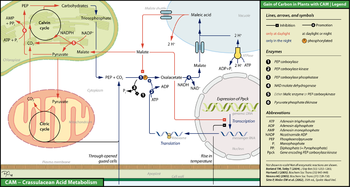
At low temperatures (frequently at night), CAM plants open their guard cells, molecules diffuse into the spongy mesophyll's intracellular spaces and then into the cytoplasm
Cytoplasm
The cytoplasm is a small gel-like substance residing between the cell membrane holding all the cell's internal sub-structures , except for the nucleus. All the contents of the cells of prokaryote organisms are contained within the cytoplasm...
. Here, they can meet phosphoenolpyruvate
Phosphoenolpyruvate
Phosphoenolpyruvic acid , or phosphoenolpyruvate as the anion, is an important chemical compound in biochemistry. It has the high-energy phosphate bond found in living organisms, and is involved in glycolysis and gluconeogenesis...
(PEP), which is a phosphorylated
Phosphorylation
Phosphorylation is the addition of a phosphate group to a protein or other organic molecule. Phosphorylation activates or deactivates many protein enzymes....
triose
Triose
A triose is a monosaccharide, or simple sugar, containing three carbon atoms. There are only three possible trioses: L-Glyceraldehyde and D-Glyceraldehyde, both aldotrioses because the carbonyl group is at the end of the chain, and dihydroxyacetone, a ketotriose because the carbonyl group is in...
. During this time, CAM plants are synthesizing a protein called PEP carboxylase kinase
Kinase
In chemistry and biochemistry, a kinase is a type of enzyme that transfers phosphate groups from high-energy donor molecules, such as ATP, to specific substrates, a process referred to as phosphorylation. Kinases are part of the larger family of phosphotransferases...
(PEP-C kinase), whose expression can be inhibited by high temperatures (frequently at daylight) and the presence of malate
Malate
Malate is the ionized form of malic acid. It is an important chemical compound in biochemistry. In the C4 carbon fixation process, malate is a source of CO2 in the Calvin cycle....
. PEP-C kinase phosphorylates its target enzyme
Enzyme
Enzymes are proteins that catalyze chemical reactions. In enzymatic reactions, the molecules at the beginning of the process, called substrates, are converted into different molecules, called products. Almost all chemical reactions in a biological cell need enzymes in order to occur at rates...
PEP carboxylase (PEP-C). Phosphorylation dramatically enhances the enzyme's capability to catalyze
Catalysis
Catalysis is the change in rate of a chemical reaction due to the participation of a substance called a catalyst. Unlike other reagents that participate in the chemical reaction, a catalyst is not consumed by the reaction itself. A catalyst may participate in multiple chemical transformations....
the formation of oxalacetate, which can be subsequently transformed into malate
Malate
Malate is the ionized form of malic acid. It is an important chemical compound in biochemistry. In the C4 carbon fixation process, malate is a source of CO2 in the Calvin cycle....
by NAD+
Nicotinamide adenine dinucleotide
Nicotinamide adenine dinucleotide, abbreviated NAD, is a coenzyme found in all living cells. The compound is a dinucleotide, since it consists of two nucleotides joined through their phosphate groups. One nucleotide contains an adenine base and the other nicotinamide.In metabolism, NAD is involved...
malate dehydrogenase
Malate dehydrogenase
Malate dehydrogenase is an enzyme in the citric acid cycle that catalyzes the conversion of malate into oxaloacetate and vice versa...
. Malate is then transported via malate shuttles into the vacuole, where it is converted into the storage form malic acid
Malic acid
Malic acid is an organic compound with the formula HO2CCH2CHOHCO2H. It is a dicarboxylic acid which is made by all living organisms, contributes to the pleasantly sour taste of fruits, and is used as a food additive. Malic acid has two stereoisomeric forms , though only the L-isomer exists...
. In contrast to PEP-C kinase, PEP-C is synthesized
Biosynthesis
Biosynthesis is an enzyme-catalyzed process in cells of living organisms by which substrates are converted to more complex products. The biosynthesis process often consists of several enzymatic steps in which the product of one step is used as substrate in the following step...
all the time but almost inhibited at daylight either by dephosphorylation
Dephosphorylation
Dephosphorylation is the essential process of removing phosphate groups from an organic compound by hydrolysis. Its opposite is phosphorylation...
via PEP-C phosphatase
Phosphatase
A phosphatase is an enzyme that removes a phosphate group from its substrate by hydrolysing phosphoric acid monoesters into a phosphate ion and a molecule with a free hydroxyl group . This action is directly opposite to that of phosphorylases and kinases, which attach phosphate groups to their...
or directly by binding malate. The latter is not possible at low temperatures, since malate is efficiently transported into the vacuole, whereas PEP-C kinase readily inverts dephosphorylation.
At daylight, CAM plants close their guard cells and discharge malate that is subsequently transported into chloroplasts. There, depending on plant species, it is cleaved into pyruvate and either by malic enzyme or by PEP carboxykinase. is then introduced into the Calvin cycle, a coupled and self-recovering enzyme system, which is used to build branched carbohydrates. The by-product pyruvate can be further degraded in the mitochondrial citric acid cycle
Citric acid cycle
The citric acid cycle — also known as the tricarboxylic acid cycle , the Krebs cycle, or the Szent-Györgyi-Krebs cycle — is a series of chemical reactions which is used by all aerobic living organisms to generate energy through the oxidization of acetate derived from carbohydrates, fats and...
, thereby providing additional molecules for the Calvin Cycle. Pyruvate can also be used to recover PEP via pyruvate phosphate dikinase, a high-energy step, which requires ATP
Adenosine triphosphate
Adenosine-5'-triphosphate is a multifunctional nucleoside triphosphate used in cells as a coenzyme. It is often called the "molecular unit of currency" of intracellular energy transfer. ATP transports chemical energy within cells for metabolism...
and an additional phosphate
Phosphate
A phosphate, an inorganic chemical, is a salt of phosphoric acid. In organic chemistry, a phosphate, or organophosphate, is an ester of phosphoric acid. Organic phosphates are important in biochemistry and biogeochemistry or ecology. Inorganic phosphates are mined to obtain phosphorus for use in...
. During the following cool night, PEP is finally exported into the cytoplasm, where it is involved in fixing carbon dioxide via malate.
Ecological and taxonomic distribution of CAM plants
The majority of plants possessing CAM are either epiphyteEpiphyte
An epiphyte is a plant that grows upon another plant non-parasitically or sometimes upon some other object , derives its moisture and nutrients from the air and rain and sometimes from debris accumulating around it, and is found in the temperate zone and in the...
s (e.g., orchids, bromeliads) or succulent xerophyte
Xerophyte
A xerophyte or xerophytic organism is a plant which has adapted to survive in an environment that lacks water, such as a desert. Xerophytic plants may have adapted shapes and forms or internal functions that reduce their water loss or store water during long periods of dryness...
s (e.g., cacti, cactoid Euphorbias), but CAM is also found in hemiepiphyte
Hemiepiphyte
A hemiepiphyte is a plant which begins its life as an epiphyte but which later grows roots down into the ground. The seeds of hemiepiphytes germinate in the canopy and initially live epiphytically...
s (e.g., Clusia
Clusia
Clusia is the type genus of the family Clusiaceae. Comprising 140-150 species, it is native to tropical and subtropical America. Its species are shrubs, vines and small to medium-size trees up to 20 m tall, with evergreen foliage...
); lithophyte
Lithophyte
Lithophytes are a type of plant that grows in or on rocks. Lithophytes feed off moss, nutrients in rain water, litter, and even their own dead tissue....
s (e.g., Sedum
Sedum
Sedum is a large genus of flowering plants in the family Crassulaceae, members of which are commonly known as stonecrops. It contains around 400 species of leaf succulents that are found throughout the Northern Hemisphere, varying from annual and creeping herbs to shrubs. The plants have...
, Sempervivum); terrestrial bromeliads; hydrophytes (e.g., Isoetes, Crassula
Crassula
Crassula is a large genus of succulent plants containing many species, including the popular Jade Plant, Crassula ovata. They are native to many parts of the globe, but cultivated varieties are almost exclusively from the Eastern Cape of South Africa....
(Tillaea); and in one halophyte
Halophyte
A halophyte is a plant that grows where it is affected by salinity in the root area or by salt spray, such as in saline semi-deserts, mangrove swamps, marshes and sloughs, and seashores. An example of a halophyte is the salt marsh grass Spartina alterniflora . Relatively few plant species are...
, Mesembryanthemum crystallinum
Mesembryanthemum crystallinum
Mesembryanthemum crystallinum is a prostrate succulent plant that is native to Africa, Western Asia and Europe. The plant is covered with large, glistening bladder cells, reflected in its common names of Common Ice Plant, Crystalline Iceplant or Iceplant.-Uses:Its leaves are edible, as with some...
; one non-succulent terrestrial plant, (Dodonaea viscosa
Dodonaea viscosa
Dodonaea viscosa is a species of flowering plant in the soapberry family, Sapindaceae, that has a cosmopolitan distribution in tropical, subtropical and warm temperate regions of Africa, the Americas, southern Asia and Australasia.-Description:...
) and one mangrove
Mangrove
Mangroves are various kinds of trees up to medium height and shrubs that grow in saline coastal sediment habitats in the tropics and subtropics – mainly between latitudes N and S...
associate (Sesuvium portulacastrum
Sesuvium portulacastrum
Sesuvium portulacastrum, commonly known as shoreline purslane or "sea purslane", is a sprawling perennial herb that grows in coastal areas throughout much of the world.-Description:...
).
Some plants are able to switch between different methods of carbon fixation. Portulacaria afra
Portulacaria afra
Portulacaria afra, also known as Dwarf Jade Plant, Elephant's Food, Elephant Bush, and Spekboom in Afrikaans, is a small-leaved succulent found in South Africa.-Description:...
, better known as Dwarf Jade Plant, normally uses fixation but can use CAM if it is drought-stressed, whereas Portulaca oleracea, better known as Purslane, normally uses fixation but is also able to switch to CAM when drought-stressed.
CAM has evolved convergently
Convergent evolution
Convergent evolution describes the acquisition of the same biological trait in unrelated lineages.The wing is a classic example of convergent evolution in action. Although their last common ancestor did not have wings, both birds and bats do, and are capable of powered flight. The wings are...
many times. It occurs in 16,000 species (about 7% of plants), belonging to over 300 genera
Genus
In biology, a genus is a low-level taxonomic rank used in the biological classification of living and fossil organisms, which is an example of definition by genus and differentia...
and around 40 families
Family (biology)
In biological classification, family is* a taxonomic rank. Other well-known ranks are life, domain, kingdom, phylum, class, order, genus, and species, with family fitting between order and genus. As for the other well-known ranks, there is the option of an immediately lower rank, indicated by the...
, but this is thought to be a considerable underestimate. It is found in quillwort
Quillwort
Isoëtes, also written Isoetes and commonly known as the quillworts, is a genus of plants in the class Isoetopsida and order Isoetales. They are considered "fern allies". There are about 140-150 species, with a cosmopolitan distribution but often scarce to rare...
s (relatives of club mosses), in fern
Fern
A fern is any one of a group of about 12,000 species of plants belonging to the botanical group known as Pteridophyta. Unlike mosses, they have xylem and phloem . They have stems, leaves, and roots like other vascular plants...
s, and in gymnosperms, but the great majority of CAM plants are angiosperms (flowering plants).
The following list summarizes the taxonomic distribution of CAM plants.
| Division | Class/Angiosperm group | Order | Family | Plant Type | Clade involved |
|---|---|---|---|---|---|
| Lycopodiophyta Lycopodiophyta The Division Lycopodiophyta is a tracheophyte subdivision of the Kingdom Plantae. It is the oldest extant vascular plant division at around 410 million years old, and includes some of the most "primitive" extant species... |
Isoetopsida Isoetopsida The Isoetopsida is a class of the Lycopodiophyta. All living plants belong to the genus Selaginella in the Selaginellales or to Isoetes in the order Isoetales. In the past, members of this group have sometimes been placed in the class Isoetopsida, sometimes in the Selaginellopsida or Lycopodiopsida... |
Isoetales Isoetales Isoetales, also written Isoëtales, is an order of plants in the class Isoetopsida. There are about 140-150 living species, all classified in the genus Isoëtes , with a cosmopolitan distribution but often scarce to rare. Living species are mostly aquatic or semi-aquatic in clear ponds and... |
Isoetaceae | hydrophyte | Isoetes (the sole genus of class Isoetopsida) - I. howellii (seasonally submerged), I. macrospora, I. bolanderi, I. engelmanni, I. lacustris, I. sinensis, I. storkii, I. kirkii |
| Pteridophyta | Polypodiopsida | Polypodiales Polypodiales The order Polypodiales encompasses the major lineages of polypod ferns, which comprise more than 80% of today's fern species. They are found in many parts of the world including tropical, semitropical and temperate areas... |
Polypodiaceae Polypodiaceae Polypodiaceae is a family of polypod ferns, which includes more than 60 genera divided into several tribes and containing around 1,000 species. Nearly all are epiphytes, but some are terrestrial.-Description:... |
epiphyte, lithophyte | CAM is recorded from Microsorium, Platycerium Platycerium Platycerium is a genus of about 18 fern species in the polypod family, Polypodiaceae. Ferns in this genus are widely known as staghorn or elkhorn ferns due to their uniquely-shaped fronds... and Polypodium Polypodium Polypodium is a genus of 75–100 species of true ferns, widely distributed throughout the world, with the highest species diversity in the tropics. The name is derived from Ancient Greek poly "many" + podion "little foot", on account of the foot-like appearance of the rhizome and its branches... , Pyrrosia and Drymoglossum and Microgramma Microgramma (fern) Microgramma is a genus of ferns in the family Polypodiaceae. Most species in the genus are restricted to Central and South America.It contains the following species :* Microgramma bifrons* Microgramma dictyophylla... |
| Pteridopsida | Pteridales Pteridales The Pteridales are ferns that have their sori in linear strips under the edge of the leaf tissue, usually with the edge of the lamina reflexed over.This order is considered a family under the Smith classification... |
Vittariaceae | epiphyte | Vittaria Vittaria Vittaria is a genus of ferns in the family Pteridaceae. It had previously been placed in the family Vittariaceae, but that family is no longer recognized.... Anetium citrifolium |
|
| Cycadophyta | Cycadopsida | Cycadales | Zamiaceae Zamiaceae The Zamiaceae are a family of cycads that are superficially palm or fern-like. They are divided into two subfamilies with eight genera and about 150 species in the tropical and warm temperate regions of Africa, Australia and North and South America.... |
Dioon edule Dioon edule Dioon edule is a cycad native to Mexico, also known as palma de la Virgen.Two subspecies are known*Dioon edule subsp. angustifolium*Dioon edule subsp. edule- Dioon Edule var. Edule :... |
|
| Pinophyta Pinophyta The conifers, division Pinophyta, also known as division Coniferophyta or Coniferae, are one of 13 or 14 division level taxa within the Kingdom Plantae. Pinophytes are gymnosperms. They are cone-bearing seed plants with vascular tissue; all extant conifers are woody plants, the great majority being... |
Gnetopsida | Welwitschiales | Welwitschiaceae | xerophyte | Welwitschia mirabilis (the sole species of the order Welwitschiales) |
| Magnoliophyta | magnoliids | Magnoliales Magnoliales Magnoliales is an order of flowering plants.-Classification:The Magnoliales includes six families:* Annonaceae... |
Piperaceae Piperaceae The Piperaceae, also known as the pepper family, is a large family of flowering plants. The group contains roughly 3,610 currently accepted species in five genera. The vast majority of peppers can be found within the two main genera: Piper and Peperomia .Members of the Piperaceae may be small... |
epiphyte | Peperomia camptotricha Peperomia camptotricha Peperomia camptotricha is a species of plant in the Piperaceae family endemic to Mexico.... |
| eudicots | Caryophyllales Caryophyllales Caryophyllales is an order of flowering plants that includes the cacti, carnations, amaranths, ice plants, and many carnivorous plants. Many members are succulent, having fleshy stems or leaves.-Description:... |
Plantaginaceae Plantaginaceae Plantaginaceae Juss. or plantain family, are a family of flowering plants in the order Lamiales. The type genus is Plantago L..In older classifications it used to be the only family of the order Plantaginales, but numerous phylogenetic studies, summarized by the Angiosperm Phylogeny Group, have... |
hydrophyte | Littorella Littorella Littorella is a genus of two to three species of aquatic plants. Many plants live their entire lives submersed, and reproduce by stolons, but some are only underwater for part of the year, and flower when they are not underwater.- Classification :... uniflora |
|
| Aizoaceae Aizoaceae The Family Aizoaceae or Ficoidaceae is a taxon of dicotyledonous flowering plants containing 135 genera and about 1900 species. They are commonly known as stone plants or carpet weeds. Species that resemble stones or pebbles are sometimes called mesembs... |
xerophyte | widespread in the family; Mesembryanthemum crystallinum Mesembryanthemum crystallinum Mesembryanthemum crystallinum is a prostrate succulent plant that is native to Africa, Western Asia and Europe. The plant is covered with large, glistening bladder cells, reflected in its common names of Common Ice Plant, Crystalline Iceplant or Iceplant.-Uses:Its leaves are edible, as with some... is a rare instance of an halophyte that displays CAM |
|||
| Cactaceae | xerophyte | all cacti have obligate Crassulacean Acid Metabolism in their stems; those few cacti with leaves have C3 Metabolism in those leaves; seedlings have C3 Metabolism. | |||
| Portulacaceae Portulacaceae Portulacaceae are a family of flowering plants, comprising about 20 genera with about 500 species, ranging from herbaceous plants to shrubs. The family has been recognised by most taxonomists, and is also known as the purslane family; it has a cosmopolitan distribution, with the highest diversity... |
xerophyte | recorded in approximately half of the genera (note: Portulacaceae is paraphyletic with respect to Cactaceae and Didieraceae) | |||
| Didiereaceae Didiereaceae Didiereaceae is a small family of just four genera and 11 species of flowering plants endemic to south and southwest Madagascar, where they form an important component of the Madagascar spiny forests.-Description:... |
xerophyte | ||||
| Saxifragales Saxifragales Saxifragales is an order of flowering plants. Their closest relatives are a large eudicot group known as the rosids by the definition of rosids given in the APG II classification system. Some authors define the rosids more widely, including Saxifragales as their most basal group. Saxifragales is... |
Crassulaceae Crassulaceae Crassulaceae, or the orpine family, are a family of dicotyledons. They store water in their succulent leaves. They are found worldwide, but mostly occur in the Northern Hemisphere and southern Africa, typically in dry and/or cold areas where water may be scarce... |
hydrophyte, xerophyte, lithophyte | CAM is widespread in the family | ||
| eudicots (rosids) | Vitales | Vitaceae Vitaceae Vitaceae are a family of dicotyledonous flowering plants including the grapevine and Virginia creeper. The family name is derived from the genus Vitis... |
Cissus Cissus Cissus is a genus of approximately 350 species of woody vines in the grape family . They have a cosmopolitan distribution, though the majority are to be found in the tropics. In Tamil they are known as pirandai .-Medicinal:... , Cyphostemma Cyphostemma Cyphostemma is a flowering plant genus belonging to the family Vitaceae. These species are caudiciform and used to belong to the genus Cissus... |
||
| Malpighiales Malpighiales Malpighiales is one of the largest orders of flowering plants, containing about 16000 species, approximately 7.8% of the eudicots. The order is very diverse and hard to recognize except with molecular phylogenetic evidence. It is not part of any of the classification systems that are based only on... |
Clusiaceae Clusiaceae The Clusiaceae or Guttiferae Juss. is a family of plants formerly including about 37 genera and 1610 species of trees and shrubs, often with milky sap and fruits or capsules for seeds. It is primarily tropical... |
hemiepiphyte Hemiepiphyte A hemiepiphyte is a plant which begins its life as an epiphyte but which later grows roots down into the ground. The seeds of hemiepiphytes germinate in the canopy and initially live epiphytically... |
Clusia Clusia Clusia is the type genus of the family Clusiaceae. Comprising 140-150 species, it is native to tropical and subtropical America. Its species are shrubs, vines and small to medium-size trees up to 20 m tall, with evergreen foliage... |
||
| Euphorbiaceae Euphorbiaceae Euphorbiaceae, the Spurge family are a large family of flowering plants with 300 genera and around 7,500 species. Most are herbs, but some, especially in the tropics, are also shrubs or trees. Some are succulent and resemble cacti.... |
CAM is found is some species of Euphorbia including some formerly placed in the sunk genera Monadenium, Pedilanthus and Synadenium. C4 photosynthesis is also found in Euphorbia (subgenus Chamaesyce). | ||||
| Passifloraceae Passifloraceae Passifloraceae is a family of flowering plants, containing about 530 species classified in around 18 genera. They include trees, shrubs, lianas and climbing plants, and are mostly found in tropical regions.... |
xerophyte | Adenia Adenia Adenia is a genus in the passionflower family Passifloraceae. It is named after Aden, a city in Yemen.The genus includes a number of tropical and subtropical xerophytes; many of which form substantially thickened bases or lianas. It is also a Caudiciform. Many species are characterised by the... |
|||
| Geraniales Geraniales Geraniales are a small order of flowering plants, included within the rosid subgroup of dicotyledons. The largest family in the order is Geraniaceae with over 800 species. In addition, the order includes some small families, contributing together another less than 40 species... |
Geraniaceae Geraniaceae Geraniaceae is a family of flowering plants placed in the order Geraniales. The family name is derived from the genus Geranium. It includes both the genus Geranium and the garden plants called geraniums, which modern botany classifies as genus Pelargonium, along with other related genera.There are... |
CAM is found in some succulent species of Pelargonium Pelargonium Pelargonium is a genus of flowering plants which includes about 200 species of perennials, succulents, and shrubs, commonly known as scented geraniums or storksbills. Confusingly, Geranium is the correct botanical name of a separate genus of related plants often called Cranesbills. Both Geranium... , and is also reported from Geranium pratense Geranium pratense Geranium pratense, the Meadow Cranesbill, is a species of plant in the Geraniaceae family. The leaves are deeply divided, divided into 7-9 lobes and 3-6 inch wide. It is native to much of Europe and Asia, but is cultivated and naturalized elsewhere.-References:*... |
|||
| Cucurbitales Cucurbitales The Cucurbitales are an order of flowering plants, included in the rosid group of dicotyledons. This order mostly belongs to tropical areas, with limited presence in subtropic and temperate regions. The order includes shrubs and trees, together with many herbs and climbers... |
Cucurbitaceae Cucurbitaceae The plant family Cucurbitaceae consists of various squashes, melons, and gourds, including crops such as cucumber, pumpkins, luffas, and watermelons... |
Xerosicyos Xerosicyos Xerosicyos is a flowering plant genus of the family Cucurbitaceae. Its name comes from Greek xeros and sicyos . There are three species, all endemic to Madagascar. Xerosicyos danguyi is a large liana with thick stems and round, gray succlent leaves. It is common in cultivation and often called... danguyi, Dendrosicyos Dendrosicyos Dendrosicyos is a monotypic genus in the Cucurbitaceae. The only species is Dendrosicyos socotranus, the cucumber tree. The species is endemic to the island of Socotra in Yemen, and is the only species in the Cucurbitaceae to grow in a tree form.- Features :It has a bulbous trunk and a small crown.... socotrana, Momordica Momordica Momordica is a genus of about 60 species of annual or perennial climbers herbaceous or rarely small shrubs belonging to the family Cucurbitaceae, natives of tropical and subtropical Africa and Asia and Australia... |
|||
| Celastrales Celastrales Celastrales is an order of flowering plants. They are found throughout the tropics and subtropics, with only a few species extending far into the temperate regions. There are about 1200 to 1350 species in about 100 genera. All but 7 of these genera are in the large family Celastraceae... |
Celastraceae Celastraceae The Celastraceae , is a family of about 90-100 genera and 1,300 species of vines, shrubs and small trees, belonging to the order Celastrales... |
||||
| Oxalidales Oxalidales The Oxalidales are an order of flowering plants, included within the rosid subgroup of eudicots. The following families are typically placed here:* Family Brunelliaceae* Family Cephalotaceae * Family Connaraceae... |
Oxalidaceae Oxalidaceae The Oxalidaceae, or wood sorrel family, are a small family of eight genera of herbaceous plants, shrubs and small trees, with the great majority of the 900 species in the genus Oxalis... |
||||
| Brassicales Brassicales The Brassicales are an order of flowering plants, belonging to the eurosids II group of dicotyledons under the APG II system. One character common to many members of the order is the production of glucosinolate compounds... |
Moringaceae | Moringa Moringa Moringa is the sole genus in the flowering plant family Moringaceae. The name is derived from the Tamil word murunggai or the Malayalam word muringa, both of which refer to M. oleifera... |
|||
| Sapindales Sapindales Sapindales is a botanical name for an order of flowering plants. Well-known members of Sapindales include citrus; maples, horse-chestnuts, lychees and rambutans; mangos and cashews; frankincense and myrrh; mahogany and neem.... |
Sapindaceae Sapindaceae Sapindaceae, also known as the soapberry family, is a family of flowering plants in the order Sapindales. There are about 140-150 genera with 1400-2000 species, including maple, horse chestnut and lychee.... |
Dodonaea viscosa Dodonaea viscosa Dodonaea viscosa is a species of flowering plant in the soapberry family, Sapindaceae, that has a cosmopolitan distribution in tropical, subtropical and warm temperate regions of Africa, the Americas, southern Asia and Australasia.-Description:... |
|||
| Zygophyllaceae Zygophyllaceae The Zygophyllaceae is a family of flowering plants that contains the bean-caper and caltrop. It includes around 285 species in 22 genera.In the APG III system of classification, the families Zygophyllaceae and Krameriaceae compose the order Zygophyllales... |
Zygophyllum Zygophyllum Zygophyllum is the type genus of the flowering plant family Zygophyllaceae. The generic name is derived from the Greek words ζυγόν , meaning "yoke," and φυλλον , meaning "leaf." It refers to the leaves, each of which have two leaflets... |
||||
| eudicots (asterids) | Ericales Ericales The Ericales are a large and diverse order of dicotyledons, including for example tea, persimmon, blueberry, Brazil nut, and azalea. The order includes trees and bushes, lianas and herbaceous plants. Together with ordinary autophytic plants, the Ericales include chlorophyll-deficient... |
Ebenaceae Ebenaceae The Ebenaceae are a family of flowering plants, which includes ebony and persimmon. The family has approximately 500 species of trees and shrubs in two genera, Diospyros and Euclea. The species are mostly evergreen and native to the tropics and subtropics, with a few deciduous species native to... |
|||
| Solanales Solanales The Solanales are an order of flowering plants, included in the asterid group of dicotyledons. Some older sources used the name Polemoniales for this order.... |
Convolvulaceae Convolvulaceae Convolvulaceae, known commonly as the bindweed or morning glory family, are a group of about 60 genera and more than 1,650 species of mostly herbaceous vines, but also trees, shrubs and herbs.- Description :... |
Ipomaea | |||
| Gentianales Gentianales Gentianales are an order of flowering plants, included within the asterid group of dicotyledons.The circumscription of Gentiales in the Cronquist system included a broadly defined Loganiaceae , Retziaceae, Gentianaceae, Saccifoliaceae, Apocynaceae, and Asclepiadaceae... |
Rubiaceae Rubiaceae The Rubiaceae is a family of flowering plants, variously called the coffee family, madder family, or bedstraw family. The group contains many commonly known plants, including the economically important coffee , quinine , and gambier , and the horticulturally valuable madder , west indian jasmine ,... |
epiphyte | Hydnophytum Hydnophytum Hydnophytum is a genus of epiphytic myrmecophytes native to Southeast Asia, the Pacific region and also extending into Queensland in northern Australia. The name is derived from the Ancient Greek hydnon "tuber", and phyton "plant", after their appearance with their swollen succulent stems. The... and Myrmecodia Myrmecodia Myrmecodia is a genus of epiphytic myrmecophytes native to Southeast Asia and large islands extending south to Queensland in Australia. Myrmecodia plants grow in tree branches and on trunks. In nature, Myrmecodia tubers often grow hanging downward on bare branches without significant amounts of... |
||
| Apocynaceae Apocynaceae The Apocynaceae or dogbane family is a family of flowering plants that includes trees, shrubs, herbs, and lianas.Many species are tall trees found in tropical rainforests, and most are from the tropics and subtropics, but some grow in tropical dry, xeric environments. There are also perennial herbs... |
CAM is found in subfamily Asclepidioideae (Hoya Hoya Hoya is a genus of 200-300 species of tropical plants in the family Apocynaceae , fomerly considered to be in the Asclepiadaceae... , Dischidia Dischidia Dischidia is a genus of plants in the Milkweed family, Asclepiadaceae. It comprises about 80 known species which all grow as epiphytes and are native to tropical areas of China, India and most areas of Indo-China. Dischidia are closely aligned with the sister genus Hoya... , Ceropegia Ceropegia Ceropegia is a genus of plants within the family Apocynaceae. It was named by Carl Linnaeus, who first described this genus in volume 1 of his Species plantarum, which appeared in 1753. Linnaeus thought that the flowers looked like a fountain of wax. From this the scientific name was derived:... , Stapelia Stapelia The genus Stapelia consists of around 40 species of low growing, spineless, stem succulent plants, predominantly from South Africa. The flowers of certain species, most notably Stapelia gigantea, can reach 41 cm in diameter when fully open... , Caralluma Caralluma Caralluma is a genus of flowering plants in the dogbane family, Apocynaceae, consisting of about 120 species.Once classified in the family Asclepiadaceae, it is now in the subfamily Asclepiadoideae. The generic name is derived from the Arabic word qahr al-luhum, meaning "wound in the flesh" or... negevensis, Frerea Frerea Frerea is a genus which contains only one species, Frerea indica , a small succulent native to the Junnar hill forest in the Western Ghats in Maharashtra state in India. It is also grown as a greenhouse plant by succulent plant enthusiasts... indica, Adenium Adenium Adenium is a genus of flowering plants in the dogbane family, Apocynaceae.-Cultivation and uses:Adenium obesum is grown as a houseplant in temperate regions. Numerous hybrids have been developed. Adeniums are appreciated for their colorful flowers, but also for their unusual, thick caudexes... , Huernia Huernia The genus Huernia The genus Huernia The genus Huernia (family Asclepiadaceae consists of some (30-)60 species of stem succulents from Eastern and Southern Africa. The flowers are five-lobed, usually somewhat more funnel- or bell-shaped than in the closely related genus Stapelia, and often striped... ), and also in Carissa Carissa Carissa is a genus of about 20-30 species of shrubs or small trees native to tropical and subtropical regions of Africa, Australia and Asia.... and Akocanthera |
||||
| Lamiales Lamiales Lamiales is an order in the asterid group of dicotyledonous flowering plants. It includes approximately 11,000 species divided into about 20 families... |
Gesneriaceae Gesneriaceae Gesneriaceae is a family of flowering plants consisting of ca. 150 genera and ca. 3,200 species in the Old World and New World tropics and subtropics, with a very small number extending to temperate areas. Many species have colorful and showy flowers and are cultivated as ornamental plants.Most... |
epiphyte | CAM was found Codonanthe Codonanthe Codonanthe is a New World genus, consists of a dozen or more species of evergreen epiphytic compact creeping vines with rooting along their stems, and scandent herbs or subshrubs with woody, upright stems from Brazil, Guiana, Central America and West Indies. In its own habitat, the plant usually... crassifolia, but not in 3 other genera |
||
| Lamiaceae Lamiaceae The mints, taxonomically known as Lamiaceae or Labiatae, are a family of flowering plants. They have traditionally been considered closely related to Verbenaceae, but in the 1990s, phylogenetic studies suggested that many genera classified in Verbenaceae belong instead in Lamiaceae... |
Plectranthus Plectranthus Plectranthus, with some 350 species, is a genus of warm-climate plants occurring largely in the southern hemisphere, in sub-Saharan Africa, Madagascar, India and the Indonesian archipelago down to Australia and some Pacific islands. It is closely related to Solenostemon, sometimes known as the... marrubioides, Coleus Coleus Solenostemon is a genus of perennial plants, native to tropical Africa, Asia, Australia, the East Indies, the Malay Archipelago, and the Philippines... |
||||
| Apiales Apiales The Apiales are an order of flowering plants. The families given at right are those recognized in the APG III system. This is typical of the newer classifications, though there is some slight variation, and in particular the Torriceliaceae may be divided... |
Apiaceae Apiaceae The Apiaceae , commonly known as carrot or parsley family, is a group of mostly aromatic plants with hollow stems. The family is large, with more than 3,700 species spread across 434 genera, it is the sixteenth largest family of flowering plants... |
hydrophyte | Lilaeopsis Lilaeopsis Lilaeopsis genus of several species of flowering plants known commonly as grassworts. L. brasiliensis is used as a decorative plant for the foreground of aquaria.Species include:* Lilaeopsis brasiliensis syn... lacustris |
||
| Asterales Asterales Asterales is an order of dicotyledonous flowering plants that includes the composite family and its related families.The order is a cosmopolite, and includes mostly herbaceous species, although a small number of trees and shrubs are also present.The Asterales can be characterized on the... |
Asteraceae Asteraceae The Asteraceae or Compositae , is an exceedingly large and widespread family of vascular plants. The group has more than 22,750 currently accepted species, spread across 1620 genera and 12 subfamilies... |
some species of Senecio Senecio Senecio is a genus of the daisy family that includes ragworts and groundsels. The flower heads are normally rayed, completely yellow, and the heads are borne in branched clusters... |
|||
| Magnoliophyta | monocots | Alismatales Alismatales Alismatales is an order of flowering plants including about 2500 species. Pleants assigned to this order are mostly tropical or aquatic.-Description:... |
Hydrocharitaceae Hydrocharitaceae Hydrocharitaceae is a flowering plant family that includes a number of species of aquatic plant, broadly called the Tape-grasses, and includes the well known Canadian Waterweed and Frog's Bit.The family includes both fresh and marine aquatics... |
hydrophyte | Hydrilla Hydrilla Hydrilla is an aquatic plant genus, usually treated as containing just one species, Hydrilla verticillata, though some botanists divide it into several species. Synonyms include H. asiatica, H. japonica, H. lithuanica, and H. ovalifolica... , Vallisneria Vallisneria Vallisneria is a genus of freshwater aquatic plant, commonly called eelgrass, tape grass or vallis. The genus has 6-10 species that are widely distributed, but do not grow in colder regions.... |
| Alismataceae Alismataceae The water-plantains are a family of flowering plants, comprising 11 genera and between 85-95 species. The family has a cosmopolitan distribution, with the greatest number of species in temperate regions of the Northern Hemisphere... |
hydrophyte | Sagittaria Sagittaria Sagittaria is a genus of about 30 species of aquatic plants whose members go by a variety of common names, including arrowhead, duck potato, iz-ze-kn, katniss, kuwai , swan potato, tule potato, and wapato... |
|||
| Araceae Araceae Araceae are a family of monocotyledonous flowering plants in which flowers are borne on a type of inflorescence called a spadix. The spadix is usually accompanied by, and sometimes partially enclosed in, a spathe or leaf-like bract. Also known as the Arum family, members are often colloquially... |
Zamioculcas Zamioculcas Zamioculcas is a genus of flowering plant in the family Araceae, containing the single species Zamioculcas zamiifolia. It is a tropical perennial plant native to eastern Africa, from Kenya south to northeastern South Africa... zamiifolia is the only CAM plant in Araceae, and the only non-aquatic CAM plant in Alismatales |
||||
| Poales Poales Poales is a large order of flowering plants in the monocotyledons, and includes families of plants such as the grasses, bromeliads, and sedges. Sixteen plant families are currently recognized by botanists to be part of Poales.... |
Bromeliaceae Bromeliaceae Bromeliaceae is a family of monocot flowering plants of around 3,170 species native mainly to the tropical Americas, with a few species found in the American subtropics and one in tropical west Africa, Pitcairnia feliciana... |
epiphyte | Bromelioideae Bromelioideae Bromelioideae is a subfamily of the bromeliads . This subfamily is the most diverse, represented by the greatest number of genera with 32, but the least number of species with 861. Most of the plants in this group are epiphytes, though some have evolved in, or will adapt to, terrestrial conditions... (91%), Puya Puya (genus) Puya is a genus of the botanical family Bromeliaceae, subfamily Pitcairnioideae. These terrestrial plants are native to the Andes Mountains of South America and southern Central America... (24%), Dyckia Dyckia Dyckia is a genus of the botanical family Bromeliaceae, subfamily Pitcairnioideae.The genus is named after the Prussian botanist, botanical artist and horticulturist The Prince and Earl of Salm Reifferscheid-Dyck .... and related genera (all), Hechtia Hechtia Hechtia is a genus of the botanical family Bromeliaceae, subfamily Pitcairnioideae. The genus is named for Julius Gottfried Conrad Hecht , German counselor to the King of Prussia.. Except for H. gayorum, the plants of this genus are dioecious.-Species:-External links:* photos... (all), Tillandsia Tillandsia Tillandsia is a genus of around 540 species in the Bromeliad family , found in the forests, mountains, and deserts, of Central and South America, and Mexico and the southern United States in North America.... (many) |
||
| Cyperaceae Cyperaceae Cyperaceae are a family of monocotyledonous graminoid flowering plants known as sedges, which superficially resemble grasses or rushes. The family is large, with some 5,500 species described in about 109 genera. These species are widely distributed, with the centers of diversity for the group... |
hydrophyte | Scirpus Scirpus The plant genus Scirpus consists of a large number of aquatic, grass-like species in the family Cyperaceae , many with the common names club-rush or bulrush . Other common names are deergrass or grassweed.The genus has a cosmopolitan distribution, and grows in wetlands and moist soil... , Eleocharis Eleocharis Eleocharis is a genus of 250 or more species of flowering plants in the sedge family, Cyperaceae. They are known commonly as spikerushes, although spikesedges is a more technically appropriate name and most scientists who study them in earnest refer to them as such... |
|||
| Asparagales Asparagales Asparagales is the name of an order of plants, used in modern classification systems such as the APG III system . The order takes its name from the family Asparagaceae and is placed in the monocots. The order has only recently been recognized in classification systems... |
Orchidaceae Orchidaceae The Orchidaceae, commonly referred to as the orchid family, is a morphologically diverse and widespread family of monocots in the order Asparagales. Along with the Asteraceae, it is one of the two largest families of flowering plants, with between 21,950 and 26,049 currently accepted species,... |
epiphyte | |||
| Agavaceae Agavaceae Agavoideae is a subfamily of monocot flowering plants in the family Asparagaceae, order Asparagales. It has previously been treated as a separate family, Agavaceae. The group includes many well-known desert and dry zone types such as the agave, yucca, and Joshua tree... |
xerophyte | Agave Agave Agave is a genus of monocots. The plants are perennial, but each rosette flowers once and then dies ; they are commonly known as the century plant.... , Hesperaloe Hesperaloe Hesperaloe is a genus of flowering plants in the family Asparagaceae, subfamily Agavoideae. It contains perennial yucca-like plants with long, narrow leaves produced in a basal rosette and flowers borne on long panicles or racemes... , Yucca Yucca Yucca is a genus of perennial shrubs and trees in the family Asparagaceae, subfamily Agavoideae. Its 40-50 species are notable for their rosettes of evergreen, tough, sword-shaped leaves and large terminal panicles of white or whitish flowers. They are native to the hot and dry parts of North... |
|||
| Asphodelaceae Asphodelaceae Asphodeloideae is a subfamily of the monocot family Xanthorrhoeaceae in the order Asparagales. It has previously been treated as a separate family, Asphodelaceae. The subfamily name is derived from the generic name of the type genus, Asphodelus... |
xerophyte | Aloe Aloe Aloe , also Aloë, is a genus containing about 500 species of flowering succulent plants. The most common and well known of these is Aloe vera, or "true aloe".... , Gasteria Gasteria Gasteria is a genus of succulent plants native to South Africa. Closely related genera include Aloe and Haworthia. The genus is named for its stomach-shaped flowers and is part of the family Xanthorrhoeaceae, subfamily Asphodeloideae... and Haworthia Haworthia Haworthia is a genus of flowering plants within the family Xanthorrhoeaceae, subfamily Asphodeloideae.. They are small solitary or clump-forming and endemic to South Africa. Some species have firm, tough leaves, usually dark green in color, whereas other are soft and semi-translucent. Their... |
|||
| Ruscaceae Ruscaceae Nolinoideae is a monocot subfamily of the family Asparagaceae in the APG III system of 2009. It was previously treated as a separate family, Ruscaceae s.l... |
Sansevieria Sansevieria Sansevieria is a genus of about 70 species of flowering plants, whose common names include mother-in-law's tongue, devil's tongue, jinn's tongue, bow string hemp, snake plant and snake tongue. It is often included in the genus Dracaena; in the APG III classification system, both genera are placed... , Dracaena Dracaena Dracaena can mean:*Drakaina, a Greek mythological entity*Dracaena , a genus of plants*Cordyline australis, a plant commonly known as the Dracaena palm... |
||||
| Commelinales Commelinales Commelinales is the botanical name of an order of flowering plants. It comprises five families: Commelinaceae, Haemodoraceae, Hanguanaceae, Philydraceae, and Pontederiaceae. All the families combined contain over 800 species in about 70 genera; the majority of species are in the Commelinaceae... |
Commelinaceae Commelinaceae Commelinaceae is a family of flowering plants. In less formal contexts, the group is referred to as the dayflower family or spiderwort family. It is one of five families in the order Commelinales and by far the largest of these with an estimated 650 species in 40 genera. Well known genera include... |
Callisia Callisia Callisia is a genus of flowering plants in the spiderwort family, Commelinaceae. Members of the genus are commonly known as Roselings. The generic name is derived from the Greek word καλλον , meaning "beauty."... , Tradescantia Tradescantia Tradescantia , the Spiderworts, is a genus of an estimated 71 species of perennial plants in the family Commelinaceae, native to the New World from southern Canada south to northern Argentina. They are weakly upright to scrambling plants, growing to 30–60 cm tall, and are commonly found... , Tripogandra |