

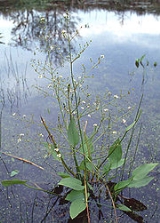
Alismatales

Encyclopedia
Alismatales is an order of flowering plant
s including about 2500 species. Pleants assigned to this order are mostly tropical or aquatic.
flowering plants of aquatic and marshy habitats, and the only monocots known to have green embryo
s other than the Amaryllidaceae
. They also include the only marine angiosperms. The flower
s are usually arranged in inflorescence
s, and the mature seeds lack endosperm
.
Both marine and freshwater forms include those with staminate flowers that detach from the parent plant and float to the surface where they become pollinated. In others, pollination occurs underwater where pollen may form elongated strands, increasing chance of success. Most aquatic species have a totally submerged juvenile phase, and flowers are either floating or emergent. Vegetation may be totally submersed, have floating leaves, or protrude from the water. Collectively they are commonly known as "water plantain".
.
) of 1998 and APG II
(2003) assigned the Alismatales to the monocots, which may be thought of as an unranked clade containing the families listed below. The biggest departure from earlier systems (see below) is the inclusion of family Araceae
. By its inclusion the order has grown enormously in number of species. The family Araceae alone accounts for about a hundred genera, totaling over two thousand species. The rest of the families together contain only about five hundred species.
The APG III system
(2009) differs only in that the Limnocharitaceae
are combined with the Alismataceae
; it was also suggested that the genus Maundia (of the Juncaginaceae
) could be separated into a monogeneric family, Maundiaceae, but the authors noted that more study was necessary before Maundiaceae could be recognized.
(1981) places the Alismatales in subclass Alismatidae
, class Liliopsida
[= monocotyledons] and includes only three families as shown:
Cronquist's subclass Alismatidae
conformed fairly closely to the order Alismatales as defined by APG, minus the Araceae.
The Dahlgren system
places the Alismatales in the superorder Alismatanae in the subclass Liliidae
[= monocotyledons] in the class Magnoliopsida
[= angiosperms] with the following families included:
In Tahktajan's classification (1997), the Order Alismatales contains only the Alismataceae and Limnocharitaceae making it equivalent to the Alismataceae as revised in APG-III. Other families included in the Alismatates as currently defined are here distributed among ten additional orders, all of which are assigned, with the following exception, to the Subclass Alismatidae. Araceae in Tahktajan 1997 is assigned to the Arales
and placed in the Subclass Aridae; Tofieldiaceae to the Melanthiales and placed in the Liliidae
.
Flowering plant
The flowering plants , also known as Angiospermae or Magnoliophyta, are the most diverse group of land plants. Angiosperms are seed-producing plants like the gymnosperms and can be distinguished from the gymnosperms by a series of synapomorphies...
s including about 2500 species. Pleants assigned to this order are mostly tropical or aquatic.
Description
Alismatales comprise herbaceousHerbaceous
A herbaceous plant is a plant that has leaves and stems that die down at the end of the growing season to the soil level. They have no persistent woody stem above ground...
flowering plants of aquatic and marshy habitats, and the only monocots known to have green embryo
Embryo
An embryo is a multicellular diploid eukaryote in its earliest stage of development, from the time of first cell division until birth, hatching, or germination...
s other than the Amaryllidaceae
Amaryllidaceae
Amaryllidoideae is the subfamily of flowering plants that takes its name from the genus Amaryllis. It is part of the family Amaryllidaceae, in order Asparagales...
. They also include the only marine angiosperms. The flower
Flower
A flower, sometimes known as a bloom or blossom, is the reproductive structure found in flowering plants . The biological function of a flower is to effect reproduction, usually by providing a mechanism for the union of sperm with eggs...
s are usually arranged in inflorescence
Inflorescence
An inflorescence is a group or cluster of flowers arranged on a stem that is composed of a main branch or a complicated arrangement of branches. Strictly, it is the part of the shoot of seed plants where flowers are formed and which is accordingly modified...
s, and the mature seeds lack endosperm
Endosperm
Endosperm is the tissue produced inside the seeds of most flowering plants around the time of fertilization. It surrounds the embryo and provides nutrition in the form of starch, though it can also contain oils and protein. This makes endosperm an important source of nutrition in human diet...
.
Both marine and freshwater forms include those with staminate flowers that detach from the parent plant and float to the surface where they become pollinated. In others, pollination occurs underwater where pollen may form elongated strands, increasing chance of success. Most aquatic species have a totally submerged juvenile phase, and flowers are either floating or emergent. Vegetation may be totally submersed, have floating leaves, or protrude from the water. Collectively they are commonly known as "water plantain".
Classification
As understood, the order contains about 165 genera in 13 families, with a cosmopolitan distributionCosmopolitan distribution
In biogeography, a taxon is said to have a cosmopolitan distribution if its range extends across all or most of the world in appropriate habitats. For instance, the killer whale has a cosmopolitan distribution, extending over most of the world's oceans. Other examples include humans, the lichen...
.
APG
The Angiosperm Phylogeny Group system (APGAPG system
The APG system of plant classification is the first, now obsolete, version of a modern, mostly molecular-based, system of plant taxonomy that was published in 1998 by the Angiosperm Phylogeny Group. It was superseded in 2003 by a revision, the APG II system, and then in 2009 by a further...
) of 1998 and APG II
APG II system
The APG II system of plant classification is the second, now obsolete, version of a modern, mostly molecular-based, system of plant taxonomy that was published in April 2003 by the Angiosperm Phylogeny Group. It was a revision of the first APG system, published in 1998, and was superseded in 2009...
(2003) assigned the Alismatales to the monocots, which may be thought of as an unranked clade containing the families listed below. The biggest departure from earlier systems (see below) is the inclusion of family Araceae
Araceae
Araceae are a family of monocotyledonous flowering plants in which flowers are borne on a type of inflorescence called a spadix. The spadix is usually accompanied by, and sometimes partially enclosed in, a spathe or leaf-like bract. Also known as the Arum family, members are often colloquially...
. By its inclusion the order has grown enormously in number of species. The family Araceae alone accounts for about a hundred genera, totaling over two thousand species. The rest of the families together contain only about five hundred species.
- order Alismatales APG-III
- family AlismataceaeAlismataceaeThe water-plantains are a family of flowering plants, comprising 11 genera and between 85-95 species. The family has a cosmopolitan distribution, with the greatest number of species in temperate regions of the Northern Hemisphere...
(including LimnocharitaceaeLimnocharitaceaeLimnocharitaceae is the botanical name of a family of flowering plants in the monocot order Alismatales. It is commonly known as the water poppy family. They are small, perennial, aquatic herbs, native to the tropics, but adventive or naturalized in the subtropics as a result of...
) - family AponogetonaceaeAponogetonaceaeThe Aponogetonaceae are a family of flowering plants in the order Alismatales.In recent decades the family has had universal recognition by taxonomists. The APG system and APG II system treat it in the order Alismatales in the clade monocots...
- family AraceaeAraceaeAraceae are a family of monocotyledonous flowering plants in which flowers are borne on a type of inflorescence called a spadix. The spadix is usually accompanied by, and sometimes partially enclosed in, a spathe or leaf-like bract. Also known as the Arum family, members are often colloquially...
- family ButomaceaeButomusButomus is the sole genus in the monogeneric plant family Butomaceae, containing the single species Butomus umbellatus, also known as flowering rush or grass rush.-Description:...
- family Cymodoceaceae
- family HydrocharitaceaeHydrocharitaceaeHydrocharitaceae is a flowering plant family that includes a number of species of aquatic plant, broadly called the Tape-grasses, and includes the well known Canadian Waterweed and Frog's Bit.The family includes both fresh and marine aquatics...
- family JuncaginaceaeJuncaginaceaeJuncaginaceae is the botanical name of a family of flowering plants, recognized by most taxonomists for the past few decades. It is also known as the Arrowgrass family....
- family Posidoniaceae
- family PotamogetonaceaePotamogetonaceaeThe Potamogetonaceae, commonly referred to as the pondweed family, is an aquatic family of monocotyledonous flowering plants. There are roughly 120 species spread across six genera in the Potamagetonaceae...
- family RuppiaceaeRuppiaceaeRuppia, also known as the ditch grasses, is the only genus in the family Ruppiaceae. Such a family has been recognized by relatively few taxonomists...
- family ScheuchzeriaceaeScheuchzeriaceaeScheuchzeria palustris , is a flowering plant, the only species in the genus Scheuchzeria, itself the only genus in the family Scheuchzeriaceae...
- family TofieldiaceaeTofieldiaceaeTofieldiaceae is the botanical name of a family of flowering plants in the monocot order Alismatales. The family is divided into five genera, which together comprise 20 or 21 species. They are small, herbaceous plants, mostly of arctic and subarctic regions, but a few extend further south, and...
- family ZosteraceaeZosteraceaeZosteraceae is a family of marine perennial flowering plants found in temperate and subtropical coastal waters, with the highest diversity located around Korea and Japan. Most seagrasses complete their entire life cycle under water, having filamentous pollen especially adapted to dispersion in an...
- family Alismataceae
The APG III system
APG III system
The APG III system of flowering plant classification is the third version of a modern, mostly molecular-based, system of plant taxonomy...
(2009) differs only in that the Limnocharitaceae
Limnocharitaceae
Limnocharitaceae is the botanical name of a family of flowering plants in the monocot order Alismatales. It is commonly known as the water poppy family. They are small, perennial, aquatic herbs, native to the tropics, but adventive or naturalized in the subtropics as a result of...
are combined with the Alismataceae
Alismataceae
The water-plantains are a family of flowering plants, comprising 11 genera and between 85-95 species. The family has a cosmopolitan distribution, with the greatest number of species in temperate regions of the Northern Hemisphere...
; it was also suggested that the genus Maundia (of the Juncaginaceae
Juncaginaceae
Juncaginaceae is the botanical name of a family of flowering plants, recognized by most taxonomists for the past few decades. It is also known as the Arrowgrass family....
) could be separated into a monogeneric family, Maundiaceae, but the authors noted that more study was necessary before Maundiaceae could be recognized.
Earlier systems
The Cronquist systemCronquist system
The Cronquist system is a taxonomic classification system of flowering plants. It was developed by Arthur Cronquist in his texts An Integrated System of Classification of Flowering Plants and The Evolution and Classification of Flowering Plants .Cronquist's system places flowering plants into two...
(1981) places the Alismatales in subclass Alismatidae
Alismatidae
Alismatidae is a botanical name at the rank of subclass. Circumscription of the subclass will vary with the taxonomic system being used ; the only requirement being that it includes the family Alismataceae...
, class Liliopsida
Liliopsida
Liliopsida is a botanical name for the class containing the family Liliaceae . It is considered synonymous with the name monocotyledon. Publication of the name is credited to Scopoli : see author citation...
[= monocotyledons] and includes only three families as shown:
- AlismataceaeAlismataceaeThe water-plantains are a family of flowering plants, comprising 11 genera and between 85-95 species. The family has a cosmopolitan distribution, with the greatest number of species in temperate regions of the Northern Hemisphere...
- Butomaceae
- LimnocharitaceaeLimnocharitaceaeLimnocharitaceae is the botanical name of a family of flowering plants in the monocot order Alismatales. It is commonly known as the water poppy family. They are small, perennial, aquatic herbs, native to the tropics, but adventive or naturalized in the subtropics as a result of...
Cronquist's subclass Alismatidae
Alismatidae
Alismatidae is a botanical name at the rank of subclass. Circumscription of the subclass will vary with the taxonomic system being used ; the only requirement being that it includes the family Alismataceae...
conformed fairly closely to the order Alismatales as defined by APG, minus the Araceae.
The Dahlgren system
Dahlgren system
One of the modern systems of plant taxonomy, the Dahlgren system was published by monocot specialist Rolf Dahlgren. His wife Gertrud Dahlgren carried on after his death.According to the extensive listing by Professor Reveal One of the modern systems of plant taxonomy, the Dahlgren system was...
places the Alismatales in the superorder Alismatanae in the subclass Liliidae
Liliidae
Liliidae is a botanical name at the rank of subclass. Circumscription of the subclass will vary with the taxonomic system being used ; the only requirement being that it includes the family Liliaceae....
[= monocotyledons] in the class Magnoliopsida
Magnoliopsida
Magnoliopsida is a valid botanical name for a class of flowering plants. By definition the class will include the family Magnoliaceae, but its circumscription can otherwise vary, being more inclusive or less inclusive depending upon the classification system being discussed.-Cronquist and...
[= angiosperms] with the following families included:
- AlismataceaeAlismataceaeThe water-plantains are a family of flowering plants, comprising 11 genera and between 85-95 species. The family has a cosmopolitan distribution, with the greatest number of species in temperate regions of the Northern Hemisphere...
- AponogetonaceaeAponogetonaceaeThe Aponogetonaceae are a family of flowering plants in the order Alismatales.In recent decades the family has had universal recognition by taxonomists. The APG system and APG II system treat it in the order Alismatales in the clade monocots...
- Butomaceae
- HydrocharitaceaeHydrocharitaceaeHydrocharitaceae is a flowering plant family that includes a number of species of aquatic plant, broadly called the Tape-grasses, and includes the well known Canadian Waterweed and Frog's Bit.The family includes both fresh and marine aquatics...
- LimnocharitaceaeLimnocharitaceaeLimnocharitaceae is the botanical name of a family of flowering plants in the monocot order Alismatales. It is commonly known as the water poppy family. They are small, perennial, aquatic herbs, native to the tropics, but adventive or naturalized in the subtropics as a result of...
In Tahktajan's classification (1997), the Order Alismatales contains only the Alismataceae and Limnocharitaceae making it equivalent to the Alismataceae as revised in APG-III. Other families included in the Alismatates as currently defined are here distributed among ten additional orders, all of which are assigned, with the following exception, to the Subclass Alismatidae. Araceae in Tahktajan 1997 is assigned to the Arales
Arales
Arales is a botanical name for an order of flowering plants. The name was used in the Cronquist system for an order placed in subclass Arecidae, circumscribed as :* order Arales*: family Acoraceae*: family Araceae...
and placed in the Subclass Aridae; Tofieldiaceae to the Melanthiales and placed in the Liliidae
Liliidae
Liliidae is a botanical name at the rank of subclass. Circumscription of the subclass will vary with the taxonomic system being used ; the only requirement being that it includes the family Liliaceae....
.