

Agavaceae

Encyclopedia
Agavoideae is a subfamily of monocot
flowering plants in the family
Asparagaceae
, order
Asparagales
. It has previously been treated as a separate family, Agavaceae. The group includes many well-known desert
and dry zone types such as the agave
, yucca
, and Joshua tree. There are about 640 species
in around 23 genera
, widespread in the tropical, subtropical and warm temperate regions of the world.
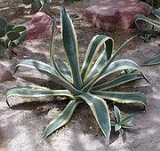
or not. In general, Agavoideae leaves occur as rosettes at the end of a woody stem, which may range from extremely short to tree-like heights, as in the Joshua tree. The leaves are parallel-veined, and usually appear long and pointed, often with a hardened spine on the end, and sometimes with additional spines along the margins.
Agave species are used to make pulque
and mezcal
, while others are valued for their fibers. They are quite popular for xeriscaping
, many types having showy flowers.
of 2009, adopted here, the Agavoideae is defined very broadly to include the former family Agavaceae along with other formerly separate families such as Anemarrhenaceae, Chlorogalaceae, Hostaceae, Yuccaceae, Anthericaceae, Hesperocallidaceae and Chlorogalaceae. This is based on data from molecular systematics. Stevens comments that "The broad concept of Agavoideae [...] may not seem very satisfactory" but that none of the alternatives is better. Sources prior to 2009 will still have Agavaceae (in varying circumscriptions) as a separate family and may contain varying numbers of other families included in Agavoideae in the APG III system.
Some genera formerly placed in this group (under whatever name) have been separated off; e.g. Dracaena
, which superficially resembles some species of Agave
, is currently placed in the subfamily Nolinoideae.
Monocotyledon
Monocotyledons, also known as monocots, are one of two major groups of flowering plants that are traditionally recognized, the other being dicotyledons, or dicots. Monocot seedlings typically have one cotyledon , in contrast to the two cotyledons typical of dicots...
flowering plants in the family
Family (biology)
In biological classification, family is* a taxonomic rank. Other well-known ranks are life, domain, kingdom, phylum, class, order, genus, and species, with family fitting between order and genus. As for the other well-known ranks, there is the option of an immediately lower rank, indicated by the...
Asparagaceae
Asparagaceae
Asparagaceae is the botanical name of a family of flowering plants, placed in the order Asparagales of the monocots.In earlier classification systems, the species involved were often treated as belonging to the family Liliaceae...
, order
Order (biology)
In scientific classification used in biology, the order is# a taxonomic rank used in the classification of organisms. Other well-known ranks are life, domain, kingdom, phylum, class, family, genus, and species, with order fitting in between class and family...
Asparagales
Asparagales
Asparagales is the name of an order of plants, used in modern classification systems such as the APG III system . The order takes its name from the family Asparagaceae and is placed in the monocots. The order has only recently been recognized in classification systems...
. It has previously been treated as a separate family, Agavaceae. The group includes many well-known desert
Desert
A desert is a landscape or region that receives an extremely low amount of precipitation, less than enough to support growth of most plants. Most deserts have an average annual precipitation of less than...
and dry zone types such as the agave
Agave
Agave is a genus of monocots. The plants are perennial, but each rosette flowers once and then dies ; they are commonly known as the century plant....
, yucca
Yucca
Yucca is a genus of perennial shrubs and trees in the family Asparagaceae, subfamily Agavoideae. Its 40-50 species are notable for their rosettes of evergreen, tough, sword-shaped leaves and large terminal panicles of white or whitish flowers. They are native to the hot and dry parts of North...
, and Joshua tree. There are about 640 species
Species
In biology, a species is one of the basic units of biological classification and a taxonomic rank. A species is often defined as a group of organisms capable of interbreeding and producing fertile offspring. While in many cases this definition is adequate, more precise or differing measures are...
in around 23 genera
Genus
In biology, a genus is a low-level taxonomic rank used in the biological classification of living and fossil organisms, which is an example of definition by genus and differentia...
, widespread in the tropical, subtropical and warm temperate regions of the world.
Description and uses
Species may be succulentSucculent plant
Succulent plants, also known as succulents or fat plants, are water-retaining plants adapted to arid climates or soil conditions. Succulent plants store water in their leaves, stems, and also in roots...
or not. In general, Agavoideae leaves occur as rosettes at the end of a woody stem, which may range from extremely short to tree-like heights, as in the Joshua tree. The leaves are parallel-veined, and usually appear long and pointed, often with a hardened spine on the end, and sometimes with additional spines along the margins.
Agave species are used to make pulque
Pulque
Pulque, or octli, is a milk-colored, somewhat viscous alcoholic beverage made from the fermented sap of the maguey plant, and is a traditional native beverage of Mexico. The drink’s history extends far back into the Mesoamerican period, when it was considered sacred, and its use was limited to...
and mezcal
Mezcal
Mezcal, or mescal, is a distilled alcoholic beverage made from the maguey plant native to Mexico. The word mezcal comes from Nahuatl metl and ixcalli which mean 'oven cooked agave.'...
, while others are valued for their fibers. They are quite popular for xeriscaping
Xeriscaping
Xeriscaping and xerogardening refers to landscaping and gardening in ways that reduce or eliminate the need for supplemental water from irrigation...
, many types having showy flowers.
Systematics
The taxonomy of the group has varied widely. In the APG III systemAPG III system
The APG III system of flowering plant classification is the third version of a modern, mostly molecular-based, system of plant taxonomy...
of 2009, adopted here, the Agavoideae is defined very broadly to include the former family Agavaceae along with other formerly separate families such as Anemarrhenaceae, Chlorogalaceae, Hostaceae, Yuccaceae, Anthericaceae, Hesperocallidaceae and Chlorogalaceae. This is based on data from molecular systematics. Stevens comments that "The broad concept of Agavoideae [...] may not seem very satisfactory" but that none of the alternatives is better. Sources prior to 2009 will still have Agavaceae (in varying circumscriptions) as a separate family and may contain varying numbers of other families included in Agavoideae in the APG III system.
Some genera formerly placed in this group (under whatever name) have been separated off; e.g. Dracaena
Dracaena (plant)
Dracaena is a genus of about 40 species of trees and succulent shrubs. In the APG III classification system, it is placed in the family Asparagaceae, subfamily Nolinoideae . It has also formerly been separated into the family Dracaenaceae or placed in the Agavaceae...
, which superficially resembles some species of Agave
Agave
Agave is a genus of monocots. The plants are perennial, but each rosette flowers once and then dies ; they are commonly known as the century plant....
, is currently placed in the subfamily Nolinoideae.
Genera
A possibly partial list of the genera included in the Agavoideae is given below. The reference is to the source which places the genus in this subfamily. As noted above, the genera currently included here have varied widely in their limits and assignment to families and subfamilies; some former family placements other than Agavaceae which will be found in the literature are given below.| Genus | Former family placement(s) outside Agavaceae/Agavoideae |
| Agave Agave Agave is a genus of monocots. The plants are perennial, but each rosette flowers once and then dies ; they are commonly known as the century plant.... L. |
|
| Anemarrhena Bunge | Anemarrhenaceae |
| Anthericum Anthericum Anthericum is a genus of about 300 species, rhizomatous perennial plants in the family Asparagaceae, subfamily Agavoideae. It was formerly placed in its own family, Anthericeae. The species have rhizomatous or tuberous roots, long narrow leaves and branched stems carrying starry white flowers... L. |
Anthericaceae |
| Behnia Behnia Behnia is a genus of flowering plants. In the APG III classification system, it is placed in the family Asparagaceae, subfamily Agavoideae .There is a single species, Behnia reticulata Didr.... Didr. |
Behniaceae, Philesiaceae |
| Beschorneria Beschorneria Beschorneria is a genus of succulent plants belonging to the family Asparagaceae, subfamily Agavoideae, native to Mexico.Species include:*Beschorneria albiflora Matuda*Beschorneria bracteata Jacobi*Beschorneria calcicola A.García-Mendoza... Kunth |
|
| Camassia Camassia Camassia is a genus of six species native to western North America, from southern British Columbia to northern California, and east to Utah, Wyoming and Montana... Lindl. |
Chlorogalaceae, Hyacinthaceae |
| Chlorogalum (Lindl.) Kunth | Chlorogalaceae, Hyacinthaceae |
| Chlorophytum Chlorophytum Chlorophytum is a genus of about 200-220 species of evergreen perennial flowering plants in family Asparagaceae, subfamily Agavoideae, native to the tropical and subtropical regions of Africa and Asia.... Ker Gawl. |
Anthericaceae |
| Diamena Ravenna | |
| Diora Ravenna | Anthericaceae |
| Echeandia Echeandia Echeandia is a genus of flowering plants in the family Asparagaceae, subfamily Agavoideae. It is named for Spanish botanist Pedro Gregorio Echeandía . Species in the genus are distributed from the Southwestern United States south to Northwestern Argentina, Southern Bolivia, and Southern Peru. They... Ortega |
Anthericaceae |
| Eremocrinum M.E.Jones | |
| Furcraea Furcraea Furcraea is a genus of succulent plants belonging to the family Asparagaceae, subfamily Agavoideae, native to tropical regions of Mexico, the Caribbean, Central America and northern South America... Vent. |
|
| Hagenbachia Nees & Mart. | |
| Hastingsia Hastingsia Hastingsia is a small genus of flowering plants in the family Asparagaceae, subfamily Agavoideae, known generally as rushlilies. These are small perennial herbs endemic to serpentine soils of the Siskiyou-Klamath region in northern California and SW Oregon in the United States... S.Watson |
Chlorogalaceae, Hyacinthaceae |
| Herreria Herreria (plant) Herreria is a genus of about nine species of flowering plants. In the APG III classification system, the genus is placed in the family Asparagaceae, subfamily Agavoideae .... Ruiz & Pav. |
Herreriaceae |
| Herreriopsis Herreriopsis Herreriopsis is a genus of one species of flowering plants, found in Madagascar. In the APG III classification system, the genus is placed in the family Asparagaceae, subfamily Agavoideae .... H.Perrier |
Herreriaceae |
| Hesperaloe Hesperaloe Hesperaloe is a genus of flowering plants in the family Asparagaceae, subfamily Agavoideae. It contains perennial yucca-like plants with long, narrow leaves produced in a basal rosette and flowers borne on long panicles or racemes... Engelm. in S.Watson |
|
| Hesperocallis A.Gray | Hesperocallidaceae, Hyacinthaceae |
| Hesperoyucca Hesperoyucca Hesperoyucca is a small genus of three species of flowering plants closely related to, and recently split from, Yucca, which is in the family Asparagaceae, subfamily Agavoideae.-Description:... (Engelm.) Trel. (included in Yucca Yucca Yucca is a genus of perennial shrubs and trees in the family Asparagaceae, subfamily Agavoideae. Its 40-50 species are notable for their rosettes of evergreen, tough, sword-shaped leaves and large terminal panicles of white or whitish flowers. They are native to the hot and dry parts of North... by some sources) |
Yuccaceae |
| Hosta Hosta Hosta is a genus of about 23–45 species of lily-like plants in the family Asparagaceae, subfamily Agavoideae, native to northeast Asia. They have been placed in their own family, Hostaceae ; like many 'lilioid monocots', they were once classified in the Liliaceae... Tratt. |
Hostaceae |
| Leucocrinum Leucocrinum Leucocrinum montanum, commonly known as the sand lily, starlily or mountain lily, is the only species in the monotypic genus Leucocrinum, placed in the family Asparagaceae, subfamily Agavoideae. It is a perennial plant native to western North America growing to 0.2 meters that flowers in late... Nutt. ex A.Gray |
Anthericaceae |
| Manfreda Manfreda Manfreda is a genus of about 20 species of flowering plants in the family Asparagaceae, subfamily Agavoideae. Along with Polianthes, members are commonly called tuberoses. Some authorities place Manfreda in genus Polianthes, while others group place both genera in Agave... Salisb. (included in Agave Agave Agave is a genus of monocots. The plants are perennial, but each rosette flowers once and then dies ; they are commonly known as the century plant.... by some sources) |
|
| Paradisea Paradisea Paradisea is a genus of flowering plants in the family Asparagaceae. It was formerly classified in the family Anthericaceae or earlier in the Liliaceae. The genus includes several species which were formerly classed as part of the genus Anthericum.... Mazzuc. |
Asphodelaceae |
| Polianthes Polianthes Polianthes is a genus of plants in family Asparagaceae, subfamily Agavoideae. It includes tuberose , a plant that is commonly used in perfume making... L. (included in Agave Agave Agave is a genus of monocots. The plants are perennial, but each rosette flowers once and then dies ; they are commonly known as the century plant.... by some sources) |
|
| Prochnyanthes S.Watson | |
| Schoenolirion Schoenolirion Schoenolirion is a genus of about three species of flowering plants. In the APG III classification system, the genus is placed in the family Asparagaceae, subfamily Agavoideae .... Durand |
Chlorogalaceae, Hyacinthaceae |
| Yucca Yucca Yucca is a genus of perennial shrubs and trees in the family Asparagaceae, subfamily Agavoideae. Its 40-50 species are notable for their rosettes of evergreen, tough, sword-shaped leaves and large terminal panicles of white or whitish flowers. They are native to the hot and dry parts of North... L. (including Samuela) |
Yuccaceae |
External links
- Agavaceae in Flora of North America.
- Agavaceae in L. Watson and M.J. Dallwitz (1992 onwards). The families of flowering plants: descriptions, illustrations, identification, information retrieval.
- Die Agaven.