


Euphorbiaceae

Encyclopedia
Euphorbiaceae, the Spurge family are a large family of flowering plant
s with 300 genera and around 7,500 species. Most are herb
s, but some, especially in the tropics
, are also shrub
s or tree
s. Some are succulent and resemble cacti
.
This family occurs mainly in the tropics, with the majority of the species in the Indo-Malayan region and tropical America
a good second. There is a large variety in tropical Africa, but it is not as abundant or varied as in these two other tropical regions. However, Euphorbia also has many species
in non-tropical areas such as the Mediterranean Basin
, the Middle East
, South Africa
, and southern USA.
The leaves
are alternate, seldom opposite, with stipule
s. They are mainly simple, but where compound, are always palmate, never pinnate
. Stipules may be reduced to hairs, glands, or spines, or in succulent species are sometimes absent.
The radially symmetrical flower
s are unisexual, with the male and the female flowers usually occurring on the same plant. As can be expected from such a large family, there is a wide variety in the structure of the flowers. They can be monoecious
or dioecious
. The stamen
s (the male organs) can number from 1 to 10 (or even more). The female flowers are hypogynous, that is, with a superior ovary
.
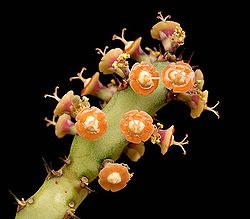 The genera in tribe Euphorbieae
, subtribe Euphorbiinae (Euphorbia and close relatives) show a highly specialized form of pseudanthium
("false flower" made up of several true flowers) called a cyathium
. This is usually a small cup-like involucre
consisting of fused together bracts and peripheral nectary glands, surrounding a ring of male flowers, each a single stamen
. In the middle of the cyathium stands a female flower: a single pistil with branched stigmas. This whole arrangement resembles a single flower.
The fruit
is usually a schizocarp
, sometimes a drupe
. A typical schizocarp is the regma, a capsular fruit with three or more cells, each of which splits open at maturity into separate parts and then breaks away explosively, scattering the small seeds.
The family contains a large variety of phytotoxin
s (toxic substances produced by plants), mainly diterpene
ester
s, alkaloid
s, glycoside
s, and ricin
-type toxin
s.
A milky sap or latex
is a characteristic of the subfamilies Euphorbioideae
and Crotonoideae
. This milky sap is poison
ous in the Euphorbioideae, but innocuous in the Crotonoideae . White mangrove (Excoecaria
agallocha), or Blind-Your-Eye Mangrove sap causes blistering on contact and temporary blindness if it contacts the eyes. Other common names are Milky Mangrove, Buta Buta (Malay
), Gewa (Bangladesh
). The sap of spurge
was used as a laxative
.
Recent molecular studies have shown that the enigmatic family Rafflesiaceae
, which was only recently recognized to belong to order Malpighiales
, is derived from within Euphorbiaceae (Davis et al. 2007).
(Manihot esculenta), Castor oil plant
(Ricinus communis), Barbados nut (Jatropha curcas
), and the Para rubber tree
(Hevea brasiliensis).
Many are grown as ornamental plant
s, such as Poinsettia (Euphorbia pulcherrima). Leafy spurge (Euphorbia esula) and Chinese tallow
(Sapium sebiferum) are invasive
weeds in North America.
In medicine, some species of Euphorbiaceae proved effective against genital herpes (HSV-2).
Flowering plant
The flowering plants , also known as Angiospermae or Magnoliophyta, are the most diverse group of land plants. Angiosperms are seed-producing plants like the gymnosperms and can be distinguished from the gymnosperms by a series of synapomorphies...
s with 300 genera and around 7,500 species. Most are herb
Herb
Except in botanical usage, an herb is "any plant with leaves, seeds, or flowers used for flavoring, food, medicine, or perfume" or "a part of such a plant as used in cooking"...
s, but some, especially in the tropics
Tropics
The tropics is a region of the Earth surrounding the Equator. It is limited in latitude by the Tropic of Cancer in the northern hemisphere at approximately N and the Tropic of Capricorn in the southern hemisphere at S; these latitudes correspond to the axial tilt of the Earth...
, are also shrub
Shrub
A shrub or bush is distinguished from a tree by its multiple stems and shorter height, usually under 5–6 m tall. A large number of plants may become either shrubs or trees, depending on the growing conditions they experience...
s or tree
Tree
A tree is a perennial woody plant. It is most often defined as a woody plant that has many secondary branches supported clear of the ground on a single main stem or trunk with clear apical dominance. A minimum height specification at maturity is cited by some authors, varying from 3 m to...
s. Some are succulent and resemble cacti
Cactus
A cactus is a member of the plant family Cactaceae. Their distinctive appearance is a result of adaptations to conserve water in dry and/or hot environments. In most species, the stem has evolved to become photosynthetic and succulent, while the leaves have evolved into spines...
.
This family occurs mainly in the tropics, with the majority of the species in the Indo-Malayan region and tropical America
Americas
The Americas, or America , are lands in the Western hemisphere, also known as the New World. In English, the plural form the Americas is often used to refer to the landmasses of North America and South America with their associated islands and regions, while the singular form America is primarily...
a good second. There is a large variety in tropical Africa, but it is not as abundant or varied as in these two other tropical regions. However, Euphorbia also has many species
Species
In biology, a species is one of the basic units of biological classification and a taxonomic rank. A species is often defined as a group of organisms capable of interbreeding and producing fertile offspring. While in many cases this definition is adequate, more precise or differing measures are...
in non-tropical areas such as the Mediterranean Basin
Mediterranean Basin
In biogeography, the Mediterranean Basin refers to the lands around the Mediterranean Sea that have a Mediterranean climate, with mild, rainy winters and hot, dry summers, which supports characteristic Mediterranean forests, woodlands, and scrub vegetation...
, the Middle East
Middle East
The Middle East is a region that encompasses Western Asia and Northern Africa. It is often used as a synonym for Near East, in opposition to Far East...
, South Africa
South Africa
The Republic of South Africa is a country in southern Africa. Located at the southern tip of Africa, it is divided into nine provinces, with of coastline on the Atlantic and Indian oceans...
, and southern USA.
The leaves
Leaf
A leaf is an organ of a vascular plant, as defined in botanical terms, and in particular in plant morphology. Foliage is a mass noun that refers to leaves as a feature of plants....
are alternate, seldom opposite, with stipule
Stipule
In botany, stipule is a term coined by Linnaeus which refers to outgrowths borne on either side of the base of a leafstalk...
s. They are mainly simple, but where compound, are always palmate, never pinnate
Pinnate
Pinnate is a term used to describe feather-like or multi-divided features arising from both sides of a common axis in plant or animal structures, and comes from the Latin word pinna meaning "feather", "wing", or "fin". A similar term is pectinate, which refers to a comb-like arrangement of parts...
. Stipules may be reduced to hairs, glands, or spines, or in succulent species are sometimes absent.
The radially symmetrical flower
Flower
A flower, sometimes known as a bloom or blossom, is the reproductive structure found in flowering plants . The biological function of a flower is to effect reproduction, usually by providing a mechanism for the union of sperm with eggs...
s are unisexual, with the male and the female flowers usually occurring on the same plant. As can be expected from such a large family, there is a wide variety in the structure of the flowers. They can be monoecious
Plant sexuality
Plant sexuality covers the wide variety of sexual reproduction systems found across the plant kingdom. This article describes morphological aspects of sexual reproduction of plants....
or dioecious
Plant sexuality
Plant sexuality covers the wide variety of sexual reproduction systems found across the plant kingdom. This article describes morphological aspects of sexual reproduction of plants....
. The stamen
Stamen
The stamen is the pollen producing reproductive organ of a flower...
s (the male organs) can number from 1 to 10 (or even more). The female flowers are hypogynous, that is, with a superior ovary
Ovary (plants)
In the flowering plants, an ovary is a part of the female reproductive organ of the flower or gynoecium. Specifically, it is the part of the pistil which holds the ovule and is located above or below or at the point of connection with the base of the petals and sepals...
.
Euphorbieae
Euphorbieae is a tribe of flowering plants of the family Euphorbiaceae. It comprises 3 subtribes and 6 genera.-Genera:* Subtribe Anthosteminae** Anthostema A.Juss.** Dichostemma Pierre* Subtribe Euphorbiinae** Cubanthus Millsp....
, subtribe Euphorbiinae (Euphorbia and close relatives) show a highly specialized form of pseudanthium
Pseudanthium
A pseudanthium or flower head is a special type of inflorescence, in which several flowers are grouped together to form a flower-like structure. The real flowers are generally small and greatly reduced, but can sometimes be quite large...
("false flower" made up of several true flowers) called a cyathium
Cyathium
A cyathium is one of the specialised pseudanthia forming the inflorescence of plants in the genus Euphorbia . A cyathium consists of:...
. This is usually a small cup-like involucre
Involucre
Involucre may refer to* involucral bract, a bract, bract pair, or whorl of bracts surrounding a flower or inflorescence* a term sometimes misused for the cupule surrounding developing nuts in the Fagaceae...
consisting of fused together bracts and peripheral nectary glands, surrounding a ring of male flowers, each a single stamen
Stamen
The stamen is the pollen producing reproductive organ of a flower...
. In the middle of the cyathium stands a female flower: a single pistil with branched stigmas. This whole arrangement resembles a single flower.
The fruit
Fruit
In broad terms, a fruit is a structure of a plant that contains its seeds.The term has different meanings dependent on context. In non-technical usage, such as food preparation, fruit normally means the fleshy seed-associated structures of certain plants that are sweet and edible in the raw state,...
is usually a schizocarp
Schizocarp
A schizocarp is a dry fruit that develops from multiple carpels. When mature it splits up into mericarps. Mericarps are often 1-seeded as in, for example, Malva, Malvastrum, and Sida...
, sometimes a drupe
Drupe
In botany, a drupe is a fruit in which an outer fleshy part surrounds a shell of hardened endocarp with a seed inside. These fruits develop from a single carpel, and mostly from flowers with superior ovaries...
. A typical schizocarp is the regma, a capsular fruit with three or more cells, each of which splits open at maturity into separate parts and then breaks away explosively, scattering the small seeds.
The family contains a large variety of phytotoxin
Phytotoxin
Phytotoxin refers to a substance produced by a plant that is toxic or a substance that is toxic to the plant Many substances produced by plants are secondary metabolites and are the by-products of primary physiological processes...
s (toxic substances produced by plants), mainly diterpene
Terpene
Terpenes are a large and diverse class of organic compounds, produced by a variety of plants, particularly conifers, though also by some insects such as termites or swallowtail butterflies, which emit terpenes from their osmeterium. They are often strong smelling and thus may have had a protective...
ester
Ester
Esters are chemical compounds derived by reacting an oxoacid with a hydroxyl compound such as an alcohol or phenol. Esters are usually derived from an inorganic acid or organic acid in which at least one -OH group is replaced by an -O-alkyl group, and most commonly from carboxylic acids and...
s, alkaloid
Alkaloid
Alkaloids are a group of naturally occurring chemical compounds that contain mostly basic nitrogen atoms. This group also includes some related compounds with neutral and even weakly acidic properties. Also some synthetic compounds of similar structure are attributed to alkaloids...
s, glycoside
Glycoside
In chemistry, a glycoside is a molecule in which a sugar is bound to a non-carbohydrate moiety, usually a small organic molecule. Glycosides play numerous important roles in living organisms. Many plants store chemicals in the form of inactive glycosides. These can be activated by enzyme...
s, and ricin
Ricin
Ricin , from the castor oil plant Ricinus communis, is a highly toxic, naturally occurring protein. A dose as small as a few grains of salt can kill an adult. The LD50 of ricin is around 22 micrograms per kilogram Ricin , from the castor oil plant Ricinus communis, is a highly toxic, naturally...
-type toxin
Toxin
A toxin is a poisonous substance produced within living cells or organisms; man-made substances created by artificial processes are thus excluded...
s.
A milky sap or latex
Latex
Latex is the stable dispersion of polymer microparticles in an aqueous medium. Latexes may be natural or synthetic.Latex as found in nature is a milky fluid found in 10% of all flowering plants . It is a complex emulsion consisting of proteins, alkaloids, starches, sugars, oils, tannins, resins,...
is a characteristic of the subfamilies Euphorbioideae
Euphorbioideae
The Euphorbioideae is a subfamily of the family Euphorbiaceae....
and Crotonoideae
Crotonoideae
The Crotonoideae is a subfamily of the family Euphorbiaceae....
. This milky sap is poison
Poison
In the context of biology, poisons are substances that can cause disturbances to organisms, usually by chemical reaction or other activity on the molecular scale, when a sufficient quantity is absorbed by an organism....
ous in the Euphorbioideae, but innocuous in the Crotonoideae . White mangrove (Excoecaria
Excoecaria
Excoecaria is a plant genus of the family Euphorbiaceae, comprising about 40 species. The genus is native to the Old World Tropics.The milky sap of Excoecaria agallocha, also known as Thillai, milky mangrove, blind-your-eye mangrove and river poison tree, is poisonous. Mangroves of this plant...
agallocha), or Blind-Your-Eye Mangrove sap causes blistering on contact and temporary blindness if it contacts the eyes. Other common names are Milky Mangrove, Buta Buta (Malay
Malay language
Malay is a major language of the Austronesian family. It is the official language of Malaysia , Indonesia , Brunei and Singapore...
), Gewa (Bangladesh
Bengali language
Bengali or Bangla is an eastern Indo-Aryan language. It is native to the region of eastern South Asia known as Bengal, which comprises present day Bangladesh, the Indian state of West Bengal, and parts of the Indian states of Tripura and Assam. It is written with the Bengali script...
). The sap of spurge
Spurge
Euphorbia is a genus of plants belonging to the family Euphorbiaceae. Consisting of 2008 species, Euphorbia is one of the most diverse genera in the plant kingdom, exceeded possibly only by Senecio. Members of the family and genus are sometimes referred to as Spurges...
was used as a laxative
Laxative
Laxatives are foods, compounds, or drugs taken to induce bowel movements or to loosen the stool, most often taken to treat constipation. Certain stimulant, lubricant, and saline laxatives are used to evacuate the colon for rectal and/or bowel examinations, and may be supplemented by enemas under...
.
Recent molecular studies have shown that the enigmatic family Rafflesiaceae
Rafflesiaceae
Rafflesiaceae is a family of parasitic plants found in east and southeast Asia, including Rafflesia arnoldii, the plant with the largest flower of all plants. The plants are endoparasites of vines in the genus Tetrastigma and lack stems, leaves, roots, and any photosynthetic tissue...
, which was only recently recognized to belong to order Malpighiales
Malpighiales
Malpighiales is one of the largest orders of flowering plants, containing about 16000 species, approximately 7.8% of the eudicots. The order is very diverse and hard to recognize except with molecular phylogenetic evidence. It is not part of any of the classification systems that are based only on...
, is derived from within Euphorbiaceae (Davis et al. 2007).
Uses
A number of plants of the Spurge family are of considerable economic importance. Prominent plants include CassavaCassava
Cassava , also called yuca or manioc, a woody shrub of the Euphorbiaceae native to South America, is extensively cultivated as an annual crop in tropical and subtropical regions for its edible starchy tuberous root, a major source of carbohydrates...
(Manihot esculenta), Castor oil plant
Castor oil plant
The castor oil plant, Ricinus communis, is a species of flowering plant in the spurge family, Euphorbiaceae. It belongs to a monotypic genus, Ricinus, and subtribe, Ricininae. The evolution of castor and its relation to other species are currently being studied.Its seed is the castor bean which,...
(Ricinus communis), Barbados nut (Jatropha curcas
Jatropha curcas
Jatropha curcas is a species of flowering plant in the spurge family, Euphorbiaceae, that is native to the American tropics, most likely Mexico and Central America. It is cultivated in tropical and subtropical regions around the world, becoming naturalized in some areas...
), and the Para rubber tree
Para rubber tree
Hevea brasiliensis, the Pará rubber tree, often simply called rubber tree, is a tree belonging to the family Euphorbiaceae, and the most economically important member of the genus Hevea...
(Hevea brasiliensis).
Many are grown as ornamental plant
Ornamental plant
Ornamental plants are plants that are grown for decorative purposes in gardens and landscape design projects, as house plants, for cut flowers and specimen display...
s, such as Poinsettia (Euphorbia pulcherrima). Leafy spurge (Euphorbia esula) and Chinese tallow
Chinese tallow
Sapium sebifera, formerly referred to as Triadica sebiferum, is commonly known as the Chinese tallow tree, Florida aspen, Chicken Tree, and Gray Popcorn Tree . The tree is native to eastern Asia, and is most commonly associated with eastern China, Taiwan, and Japan...
(Sapium sebiferum) are invasive
Invasive species
"Invasive species", or invasive exotics, is a nomenclature term and categorization phrase used for flora and fauna, and for specific restoration-preservation processes in native habitats, with several definitions....
weeds in North America.
In medicine, some species of Euphorbiaceae proved effective against genital herpes (HSV-2).