


Lithophyte

Encyclopedia
Plant
Plants are living organisms belonging to the kingdom Plantae. Precise definitions of the kingdom vary, but as the term is used here, plants include familiar organisms such as trees, flowers, herbs, bushes, grasses, vines, ferns, mosses, and green algae. The group is also called green plants or...
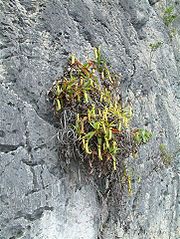
that grows in or on rocks
Rock (geology)
In geology, rock or stone is a naturally occurring solid aggregate of minerals and/or mineraloids.The Earth's outer solid layer, the lithosphere, is made of rock. In general rocks are of three types, namely, igneous, sedimentary, and metamorphic...
. Lithophytes feed off moss
Moss
Mosses are small, soft plants that are typically 1–10 cm tall, though some species are much larger. They commonly grow close together in clumps or mats in damp or shady locations. They do not have flowers or seeds, and their simple leaves cover the thin wiry stems...
, nutrients in rain water, litter, and even their own dead tissue.
Examples of lithophytes include several Paphiopedilum
Paphiopedilum
The paphiopedilums – often abbreviated Paph and colloquially known as paphs in horticulture – are flowering plants in the orchid family . It contains about 80 accepted species nowadays, some of which are natural hybrids...
orchids, the pitcher plant
Pitcher plant
Pitcher plants are carnivorous plants whose prey-trapping mechanism features a deep cavity filled with liquid known as a pitfall trap. It has been widely assumed that the various sorts of pitfall trap evolved from rolled leaves, with selection pressure favouring more deeply cupped leaves over...
Nepenthes campanulata
Nepenthes campanulata
Nepenthes campanulata , the Bell-Shaped Pitcher-Plant, is a tropical pitcher plant endemic to Borneo.Forest fires destroyed the only known population of N. campanulata in 1983 and it was uncertain whether the species had survived elsewhere or was in fact extinct. It was rediscovered in 1997,...
, and several Utricularia species.