

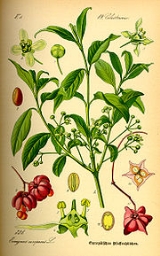
Celastrales

Encyclopedia
Celastrales is an order
of flowering plants. They are found throughout the tropics
and subtropics
, with only a few species extending far into the temperate regions. There are about 1200 to 1350 species
in about 100 genera
. All but 7 of these genera are in the large family
Celastraceae
. Until recently, the composition of the order and its division into families varied greatly from one author to another.
and is consequently hard to recognize. The flower
s are usually small with a conspicuous nectary disk. The stipule
s are small or rarely absent. The micropyle
has 2 openings and is therefore called a bistomal micropyle. Flowers with well-developed male and female parts are often functionally unisexual
. The seed
often has an aril
. In bud
, the sepal
s have a quincuncial arrangement. This means that 2 sepals are inside, 2 are outside, and the other has one side covered and one side exposed.
order, Sapindales
. Since the 2 orders are not closely related
, the disk must have been an independent development in each of these 2 lines
.
Celastrales is a member of the COM clade of Fabidae, with Fabidae being one of the 2 groups of Eurosids. The COM clade consists of 3 orders, Celastrales, Oxalidales
(including Huaceae
), and Malpighiales
.
Celastrales was first used by Thomas Baskerville in 1839. In the time since Baskerville first defined the order, until the 21st century, there were great differences of opinion about what should be included in the order and in its largest family, Celastraceae
. The family Celastraceae was the only group
consistently placed in the order by all authors who accepted it. Because of the ambiguity and complexity of its definition
, Celastraceae became a dumping ground for genera of dubious affinity
. Several genera were assigned to this family with considerable doubt about whether they really belonged there. Also, some genera that properly belong in Celastraceae were placed elsewhere.
By the end of the 20th century, Goupia
and Forsellesia
had been excluded from Celastraceae and also from Celastrales. Goupia is now in Malpighiales
. Forsellesia is now in Crossosomatales
. It continues to be the subject of a dispute about whether its proper name is Forsellesia or Glossopetalon
.
After being placed elsewhere, Canotia, Brexia, and Plagiopteron were found to belong in Celastraceae. The family Hippocrateaceae was found to be deeply nested within Celastraceae and is no longer recognized as a separate family.
In 2000, Vincent Savolainen et alii found that 3 families - Lepidobotryaceae
, Parnassiaceae
, and Celastraceae
- were closely related. They stated that these three families should constitute the order Celastrales, and this idea was accepted by the Angiosperm Phylogeny Group
, which later subsumed
Parnassiaceae into Celastraceae. Savolainen and co-authors also excluded Lophopyxis
from Celastrales. Lophopyxis now constitutes a monogeneric family in Malpighiales.
In 2001, in a molecular phylogenetic study
of DNA sequence
s, Mark Simmons and others confirmed all of these results except for the placement of Lophopyxis and Lepidobotryaceae, which they did not sample
.
In 2006, Li-Bing Zhang and Mark Simmons produced a phylogeny of Celastrales based on nuclear
ribosomal
and chloroplast
DNA
. Their results showed that Bhesa
and Perrottetia
were misplaced in Celastraceae. Bhesa is now in Centroplacaceae
, a family in Malpighiales. and Perrottetia is in Huerteales
. Zhang and Simmons found Pottingeria
and Mortonia
to be closely related to the families Parnassiaceae and Celastraceae, as they were then defined, but not in either of them. These two genera are therefore in Celastrales. They found that Siphonodon
and Empleuridium are proper members of Celastraceae, removing considerable doubt about their placement there. They also showed that the small family Stackhousiaceae, consisting of three genera, is embedded
in Celastraceae. Except for taxa
that were not sampled, these results were confirmed by the second phylogeny of Celastrales, which was produced by Mark Simmons and several co-authors in 2008.
Nicobariodendron sleumeri, the only member of its genus, continues to be an enigma. It is a small tree from the Andaman and Nicobar Islands of India
. Little is known of it and it has never been sampled for DNA. It is generally thought to belong in Celastrales, but this is not a certainty. It is one of the five taxa placed incertae sedis
in the angiosperms in the APG III system
of classification
.
recognized 3 families in Celastrales - Lepidobotryaceae
, Parnassiaceae
, and Celastraceae
. When they revised their classification in 2009, they recognized only two families because Pottingeria and the two genera of Parnassiaceae were transferred to Celastraceae. Nicobariodendron became one of the five taxa placed incertae sedis
in the angiosperms.
In the 2006 phylogeny, Nicobariodendron was not sampled, but those species that were sampled fell into 2 strongly supported clades. One was a small clade consisting only of the family Lepidobotryaceae. Its sister was a very large clade containing the rest of the order. The large clade consisted of 5 strongly supported groups. These are the family Parnassiaceae, the genus Pottingeria, the genus Mortonia
(in Celastraceae), and a pair of genera from Celastraceae (Quetzalia and Zinowiewia
), and the rest of Celastraceae. No relationships were resolved among these 5 groups.
In 2008, Simmons and others produced a phylogeny of Celastrales that achieved better resolution than the 2006 study by sampling more species and more DNA. They found the same pentatomy
of five strongly supported groups that the previous study had found, but only weak to moderate support for any relationships between the five groups. In the APG III system, Celastraceae was expanded to consist of these five groups. No one has yet published an intrafamilial classification for the expanded Celastraceae.
was made by combining parts of three different trees. Bootstrap support is 100% except where shown. Branches with less than 50% bootstrap support are collapsed. The clade numbers are from Simmons et alii (2008).
Order (biology)
In scientific classification used in biology, the order is# a taxonomic rank used in the classification of organisms. Other well-known ranks are life, domain, kingdom, phylum, class, family, genus, and species, with order fitting in between class and family...
of flowering plants. They are found throughout the tropics
Tropics
The tropics is a region of the Earth surrounding the Equator. It is limited in latitude by the Tropic of Cancer in the northern hemisphere at approximately N and the Tropic of Capricorn in the southern hemisphere at S; these latitudes correspond to the axial tilt of the Earth...
and subtropics
Subtropics
The subtropics are the geographical and climatical zone of the Earth immediately north and south of the tropical zone, which is bounded by the Tropic of Cancer and the Tropic of Capricorn, at latitudes 23.5°N and 23.5°S...
, with only a few species extending far into the temperate regions. There are about 1200 to 1350 species
Species
In biology, a species is one of the basic units of biological classification and a taxonomic rank. A species is often defined as a group of organisms capable of interbreeding and producing fertile offspring. While in many cases this definition is adequate, more precise or differing measures are...
in about 100 genera
Genus
In biology, a genus is a low-level taxonomic rank used in the biological classification of living and fossil organisms, which is an example of definition by genus and differentia...
. All but 7 of these genera are in the large family
Family (biology)
In biological classification, family is* a taxonomic rank. Other well-known ranks are life, domain, kingdom, phylum, class, order, genus, and species, with family fitting between order and genus. As for the other well-known ranks, there is the option of an immediately lower rank, indicated by the...
Celastraceae
Celastraceae
The Celastraceae , is a family of about 90-100 genera and 1,300 species of vines, shrubs and small trees, belonging to the order Celastrales...
. Until recently, the composition of the order and its division into families varied greatly from one author to another.
Description
Celastrales is a diverse order that has no conspicuous distinguishing characteristicSynapomorphy
In cladistics, a synapomorphy or synapomorphic character is a trait that is shared by two or more taxa and their most recent common ancestor, whose ancestor in turn does not possess the trait. A synapomorphy is thus an apomorphy visible in multiple taxa, where the trait in question originates in...
and is consequently hard to recognize. The flower
Flower
A flower, sometimes known as a bloom or blossom, is the reproductive structure found in flowering plants . The biological function of a flower is to effect reproduction, usually by providing a mechanism for the union of sperm with eggs...
s are usually small with a conspicuous nectary disk. The stipule
Stipule
In botany, stipule is a term coined by Linnaeus which refers to outgrowths borne on either side of the base of a leafstalk...
s are small or rarely absent. The micropyle
Micropyle
A micropyle is small opening in the surface of an ovule, through which the pollen tube penetrates, often visible as a small pore in the ripe seed....
has 2 openings and is therefore called a bistomal micropyle. Flowers with well-developed male and female parts are often functionally unisexual
Plant sexuality
Plant sexuality covers the wide variety of sexual reproduction systems found across the plant kingdom. This article describes morphological aspects of sexual reproduction of plants....
. The seed
Seed
A seed is a small embryonic plant enclosed in a covering called the seed coat, usually with some stored food. It is the product of the ripened ovule of gymnosperm and angiosperm plants which occurs after fertilization and some growth within the mother plant...
often has an aril
Aril
An aril is any specialized outgrowth from the funiculus that covers or is attached to the seed. It is sometimes applied to any appendage or thickening of the seed coat in flowering plants, such as the edible parts of the mangosteen and pomegranate fruit, the mace of the nutmeg seed, or the...
. In bud
Bud
In botany, a bud is an undeveloped or embryonic shoot and normally occurs in the axil of a leaf or at the tip of the stem. Once formed, a bud may remain for some time in a dormant condition, or it may form a shoot immediately. Buds may be specialized to develop flowers or short shoots, or may have...
, the sepal
Sepal
A sepal is a part of the flower of angiosperms . Collectively the sepals form the calyx, which is the outermost whorl of parts that form a flower. Usually green, sepals have the typical function of protecting the petals when the flower is in bud...
s have a quincuncial arrangement. This means that 2 sepals are inside, 2 are outside, and the other has one side covered and one side exposed.
Relationships
Perhaps the most conspicuous and unusual trait of Celastrales is the nectary disk, a feature that it shares with another rosidRosids
The rosids are members of a large clade of flowering plants, containing about 70,000 species, more than a quarter of all angiosperms. The clade is divided into 16 to 20 orders, depending upon circumscription and classification. These orders, in turn, together comprise about 140 families...
order, Sapindales
Sapindales
Sapindales is a botanical name for an order of flowering plants. Well-known members of Sapindales include citrus; maples, horse-chestnuts, lychees and rambutans; mangos and cashews; frankincense and myrrh; mahogany and neem....
. Since the 2 orders are not closely related
Plant taxonomy
Plant taxonomy is the science that finds, describes, classifies, identifies, and names plants. It thus is one of the main branches of taxonomy.Plant taxonomy is closely allied to plant systematics, and there is no sharp boundary between the two...
, the disk must have been an independent development in each of these 2 lines
Lineage (evolution)
An evolutionary lineage is a sequence of species, that form a line of descent, each new species the direct result of speciation from an immediate ancestral species. Lineages are subsets of the evolutionary tree of life. Lineages are often determined by the techniques of molecular systematics.-...
.
Celastrales is a member of the COM clade of Fabidae, with Fabidae being one of the 2 groups of Eurosids. The COM clade consists of 3 orders, Celastrales, Oxalidales
Oxalidales
The Oxalidales are an order of flowering plants, included within the rosid subgroup of eudicots. The following families are typically placed here:* Family Brunelliaceae* Family Cephalotaceae * Family Connaraceae...
(including Huaceae
Huaceae
Huaceae is a family of plant in the rosids group, which has been classed in the orders Malpighiales, Malvales, and Violales or in its own order Huales. The APG II system places it in the clade eurosids I, whereas the APG III system of 2009 placed it within the Oxalidales. It contains the following...
), and Malpighiales
Malpighiales
Malpighiales is one of the largest orders of flowering plants, containing about 16000 species, approximately 7.8% of the eudicots. The order is very diverse and hard to recognize except with molecular phylogenetic evidence. It is not part of any of the classification systems that are based only on...
.
Circumscription
The nameBotanical name
A botanical name is a formal scientific name conforming to the International Code of Botanical Nomenclature and, if it concerns a plant cultigen, the additional cultivar and/or Group epithets must conform to the International Code of Nomenclature for Cultivated Plants...
Celastrales was first used by Thomas Baskerville in 1839. In the time since Baskerville first defined the order, until the 21st century, there were great differences of opinion about what should be included in the order and in its largest family, Celastraceae
Celastraceae
The Celastraceae , is a family of about 90-100 genera and 1,300 species of vines, shrubs and small trees, belonging to the order Celastrales...
. The family Celastraceae was the only group
Clade
A clade is a group consisting of a species and all its descendants. In the terms of biological systematics, a clade is a single "branch" on the "tree of life". The idea that such a "natural group" of organisms should be grouped together and given a taxonomic name is central to biological...
consistently placed in the order by all authors who accepted it. Because of the ambiguity and complexity of its definition
Circumscription (taxonomy)
In taxonomy, circumscription is the definition of the limits of a taxonomic group of organisms. One goal of taxonomy is to achieve a stable circumscription for every taxonomic group. Achieving stability can be simple or difficult....
, Celastraceae became a dumping ground for genera of dubious affinity
Systematics
Biological systematics is the study of the diversification of terrestrial life, both past and present, and the relationships among living things through time. Relationships are visualized as evolutionary trees...
. Several genera were assigned to this family with considerable doubt about whether they really belonged there. Also, some genera that properly belong in Celastraceae were placed elsewhere.
By the end of the 20th century, Goupia
Goupia
Goupia is a neotropical genus of flowering plants and the sole genus included in the family Goupiaceae. There are three species, all found in tropical northern South America.Species*Goupia cinerascens...
and Forsellesia
Glossopetalon
Glossopetalon is a small genus of shrubs in the plant family Crossosomataceae. These plants are sometimes called greasebushes. They are native to the western United States and northern Mexico, where they can be found on dry mountain slopes...
had been excluded from Celastraceae and also from Celastrales. Goupia is now in Malpighiales
Malpighiales
Malpighiales is one of the largest orders of flowering plants, containing about 16000 species, approximately 7.8% of the eudicots. The order is very diverse and hard to recognize except with molecular phylogenetic evidence. It is not part of any of the classification systems that are based only on...
. Forsellesia is now in Crossosomatales
Crossosomatales
The Crossosomatales are an order, newly recognized by the AGP II, of flowering plants, included within the Rosids, which are part of the eudicots...
. It continues to be the subject of a dispute about whether its proper name is Forsellesia or Glossopetalon
Glossopetalon
Glossopetalon is a small genus of shrubs in the plant family Crossosomataceae. These plants are sometimes called greasebushes. They are native to the western United States and northern Mexico, where they can be found on dry mountain slopes...
.
After being placed elsewhere, Canotia, Brexia, and Plagiopteron were found to belong in Celastraceae. The family Hippocrateaceae was found to be deeply nested within Celastraceae and is no longer recognized as a separate family.
In 2000, Vincent Savolainen et alii found that 3 families - Lepidobotryaceae
Lepidobotryaceae
Lepidobotryaceae is a flowering plant family in the order Celastrales. It contains only two species, Lepidobotrys staudtii and Ruptiliocarpon caracolito.- Description :...
, Parnassiaceae
Parnassiaceae
Parnassiaceae Gray is a family of Flowering plants in the eudicot order Celastrales. It is not recognized in the APG III system of plant classification. When that system was published in 2009, Parnassiaceae was treated as a segregate of an expanded Celastraceae. Parnassiaceae has only two...
, and Celastraceae
Celastraceae
The Celastraceae , is a family of about 90-100 genera and 1,300 species of vines, shrubs and small trees, belonging to the order Celastrales...
- were closely related. They stated that these three families should constitute the order Celastrales, and this idea was accepted by the Angiosperm Phylogeny Group
Angiosperm Phylogeny Group
The Angiosperm Phylogeny Group, or APG, refers to an informal international group of systematic botanists who came together to try to establish a consensus on the taxonomy of flowering plants that would reflect new knowledge about plant relationships discovered through phylogenetic studies., three...
, which later subsumed
Synonym (taxonomy)
In scientific nomenclature, a synonym is a scientific name that is or was used for a taxon of organisms that also goes by a different scientific name. For example, Linnaeus was the first to give a scientific name to the Norway spruce, which he called Pinus abies...
Parnassiaceae into Celastraceae. Savolainen and co-authors also excluded Lophopyxis
Lophopyxis
Lophopyxis is a genus of flowering plants and the sole genus of the family Lophopyxidaceae. The group consists of 2 species of tendrillate lianas. They are found in the Sunda Islands....
from Celastrales. Lophopyxis now constitutes a monogeneric family in Malpighiales.
In 2001, in a molecular phylogenetic study
Research
Research can be defined as the scientific search for knowledge, or as any systematic investigation, to establish novel facts, solve new or existing problems, prove new ideas, or develop new theories, usually using a scientific method...
of DNA sequence
DNA sequence
The sequence or primary structure of a nucleic acid is the composition of atoms that make up the nucleic acid and the chemical bonds that bond those atoms. Because nucleic acids, such as DNA and RNA, are unbranched polymers, this specification is equivalent to specifying the sequence of...
s, Mark Simmons and others confirmed all of these results except for the placement of Lophopyxis and Lepidobotryaceae, which they did not sample
Sample (material)
In general, a sample is a limited quantity of something which is intended to be similar to and represent a larger amount of that thing. The things could be countable objects such as individual items available as units for sale, or a material not countable as individual items. Samples of countable...
.
In 2006, Li-Bing Zhang and Mark Simmons produced a phylogeny of Celastrales based on nuclear
Cell nucleus
In cell biology, the nucleus is a membrane-enclosed organelle found in eukaryotic cells. It contains most of the cell's genetic material, organized as multiple long linear DNA molecules in complex with a large variety of proteins, such as histones, to form chromosomes. The genes within these...
ribosomal
Ribosome
A ribosome is a component of cells that assembles the twenty specific amino acid molecules to form the particular protein molecule determined by the nucleotide sequence of an RNA molecule....
and chloroplast
Chloroplast
Chloroplasts are organelles found in plant cells and other eukaryotic organisms that conduct photosynthesis. Chloroplasts capture light energy to conserve free energy in the form of ATP and reduce NADP to NADPH through a complex set of processes called photosynthesis.Chloroplasts are green...
DNA
DNA
Deoxyribonucleic acid is a nucleic acid that contains the genetic instructions used in the development and functioning of all known living organisms . The DNA segments that carry this genetic information are called genes, but other DNA sequences have structural purposes, or are involved in...
. Their results showed that Bhesa
Bhesa
Bhesa is a genus of plant in family Centroplacaceae. A 2009 molecular phylogeny study places it in the family Centroplacaceae in the order Malpighiales.Species include:* Bhesa ceylanica, Ding Hou* Bhesa nitidissima, Kosterm....
and Perrottetia
Perrottetia
Perrottetia is a genus of flowering plants in the family Dipentodontaceae. The fifteen species it contains occur in Asia from China to Australia, and in the Americas from Mexico to Peru.-Selected species:* Perrottetia excelsa Lund....
were misplaced in Celastraceae. Bhesa is now in Centroplacaceae
Centroplacaceae
Centroplacaceae is a family of flowering plants in the order Malpighiales and is recognized by the APG III system of classification. The family comprises two genera: Bhesa, which was formerly recognized in the Celastraceae, and Centroplacus, which was formerly recognized in the Euphorbiaceae...
, a family in Malpighiales. and Perrottetia is in Huerteales
Huerteales
Huerteales is the botanical name for an order of flowering plants. It is one of the 17 orders that make up the large eudicot group known as the rosids in the APG III system of plant classification. Within the rosids, it is one of the orders in Malvidae, a group formerly known as eurosids II and...
. Zhang and Simmons found Pottingeria
Pottingeria
Pottingeria is a small tree or large shrub native to mountainous areas of southeast Asia .It had long been thought, at least by some, to belong in the order Celastrales. In a phylogenetic study of that order in 2006, Pottingeria was found to be a member of the order, but not of any of its families...
and Mortonia
Mortonia
Mortonia is a small genus of flowering shrubs known as saddlebushes or mortonias. These are rough, hairy shrubs with leathery leaves and panicles of fleshy white to purplish flowers. They bear nutlets containing 1 seed each...
to be closely related to the families Parnassiaceae and Celastraceae, as they were then defined, but not in either of them. These two genera are therefore in Celastrales. They found that Siphonodon
Siphonodon
Siphonodon is a genus of plant in family Celastraceae.Species include:* Siphonodon celastrineus, Griff....
and Empleuridium are proper members of Celastraceae, removing considerable doubt about their placement there. They also showed that the small family Stackhousiaceae, consisting of three genera, is embedded
Paraphyly
A group of taxa is said to be paraphyletic if the group consists of all the descendants of a hypothetical closest common ancestor minus one or more monophyletic groups of descendants...
in Celastraceae. Except for taxa
Taxon
|thumb|270px|[[African elephants]] form a widely-accepted taxon, the [[genus]] LoxodontaA taxon is a group of organisms, which a taxonomist adjudges to be a unit. Usually a taxon is given a name and a rank, although neither is a requirement...
that were not sampled, these results were confirmed by the second phylogeny of Celastrales, which was produced by Mark Simmons and several co-authors in 2008.
Nicobariodendron sleumeri, the only member of its genus, continues to be an enigma. It is a small tree from the Andaman and Nicobar Islands of India
India
India , officially the Republic of India , is a country in South Asia. It is the seventh-largest country by geographical area, the second-most populous country with over 1.2 billion people, and the most populous democracy in the world...
. Little is known of it and it has never been sampled for DNA. It is generally thought to belong in Celastrales, but this is not a certainty. It is one of the five taxa placed incertae sedis
Incertae sedis
, is a term used to define a taxonomic group where its broader relationships are unknown or undefined. Uncertainty at specific taxonomic levels is attributed by , , and similar terms.-Examples:*The fossil plant Paradinandra suecica could not be assigned to any...
in the angiosperms in the APG III system
APG III system
The APG III system of flowering plant classification is the third version of a modern, mostly molecular-based, system of plant taxonomy...
of classification
Biological classification
Biological classification, or scientific classification in biology, is a method to group and categorize organisms by biological type, such as genus or species. Biological classification is part of scientific taxonomy....
.
Families
Celastrales has been divided into families in various ways. In their APG II classification in 2003, the Angiosperm Phylogeny GroupAngiosperm Phylogeny Group
The Angiosperm Phylogeny Group, or APG, refers to an informal international group of systematic botanists who came together to try to establish a consensus on the taxonomy of flowering plants that would reflect new knowledge about plant relationships discovered through phylogenetic studies., three...
recognized 3 families in Celastrales - Lepidobotryaceae
Lepidobotryaceae
Lepidobotryaceae is a flowering plant family in the order Celastrales. It contains only two species, Lepidobotrys staudtii and Ruptiliocarpon caracolito.- Description :...
, Parnassiaceae
Parnassiaceae
Parnassiaceae Gray is a family of Flowering plants in the eudicot order Celastrales. It is not recognized in the APG III system of plant classification. When that system was published in 2009, Parnassiaceae was treated as a segregate of an expanded Celastraceae. Parnassiaceae has only two...
, and Celastraceae
Celastraceae
The Celastraceae , is a family of about 90-100 genera and 1,300 species of vines, shrubs and small trees, belonging to the order Celastrales...
. When they revised their classification in 2009, they recognized only two families because Pottingeria and the two genera of Parnassiaceae were transferred to Celastraceae. Nicobariodendron became one of the five taxa placed incertae sedis
Incertae sedis
, is a term used to define a taxonomic group where its broader relationships are unknown or undefined. Uncertainty at specific taxonomic levels is attributed by , , and similar terms.-Examples:*The fossil plant Paradinandra suecica could not be assigned to any...
in the angiosperms.
In the 2006 phylogeny, Nicobariodendron was not sampled, but those species that were sampled fell into 2 strongly supported clades. One was a small clade consisting only of the family Lepidobotryaceae. Its sister was a very large clade containing the rest of the order. The large clade consisted of 5 strongly supported groups. These are the family Parnassiaceae, the genus Pottingeria, the genus Mortonia
Mortonia
Mortonia is a small genus of flowering shrubs known as saddlebushes or mortonias. These are rough, hairy shrubs with leathery leaves and panicles of fleshy white to purplish flowers. They bear nutlets containing 1 seed each...
(in Celastraceae), and a pair of genera from Celastraceae (Quetzalia and Zinowiewia
Zinowiewia
Zinowiewia is a genus of plants in the family Celastraceae.Species include:* Z. costaricensis Lundell* Z. madsenii C. Ulloa & P. Jørg.* Z. micrantha Lundell...
), and the rest of Celastraceae. No relationships were resolved among these 5 groups.
In 2008, Simmons and others produced a phylogeny of Celastrales that achieved better resolution than the 2006 study by sampling more species and more DNA. They found the same pentatomy
Polytomy
A polytomy , meaning many temporal based branches, is a section of a phylogeny in which the evolutionary relationships can not be fully resolved to dichotomies. In a phylogenetic tree, a polytomy is represented as a node which has more than two immediate descending branches...
of five strongly supported groups that the previous study had found, but only weak to moderate support for any relationships between the five groups. In the APG III system, Celastraceae was expanded to consist of these five groups. No one has yet published an intrafamilial classification for the expanded Celastraceae.
Phylogeny
The following phylogenetic treePhylogenetic tree
A phylogenetic tree or evolutionary tree is a branching diagram or "tree" showing the inferred evolutionary relationships among various biological species or other entities based upon similarities and differences in their physical and/or genetic characteristics...
was made by combining parts of three different trees. Bootstrap support is 100% except where shown. Branches with less than 50% bootstrap support are collapsed. The clade numbers are from Simmons et alii (2008).